
Life, 1924-07-24 · page 16 of 36
Life — July 24, 1924 — page 16: what you’re looking at
What you’re looking at
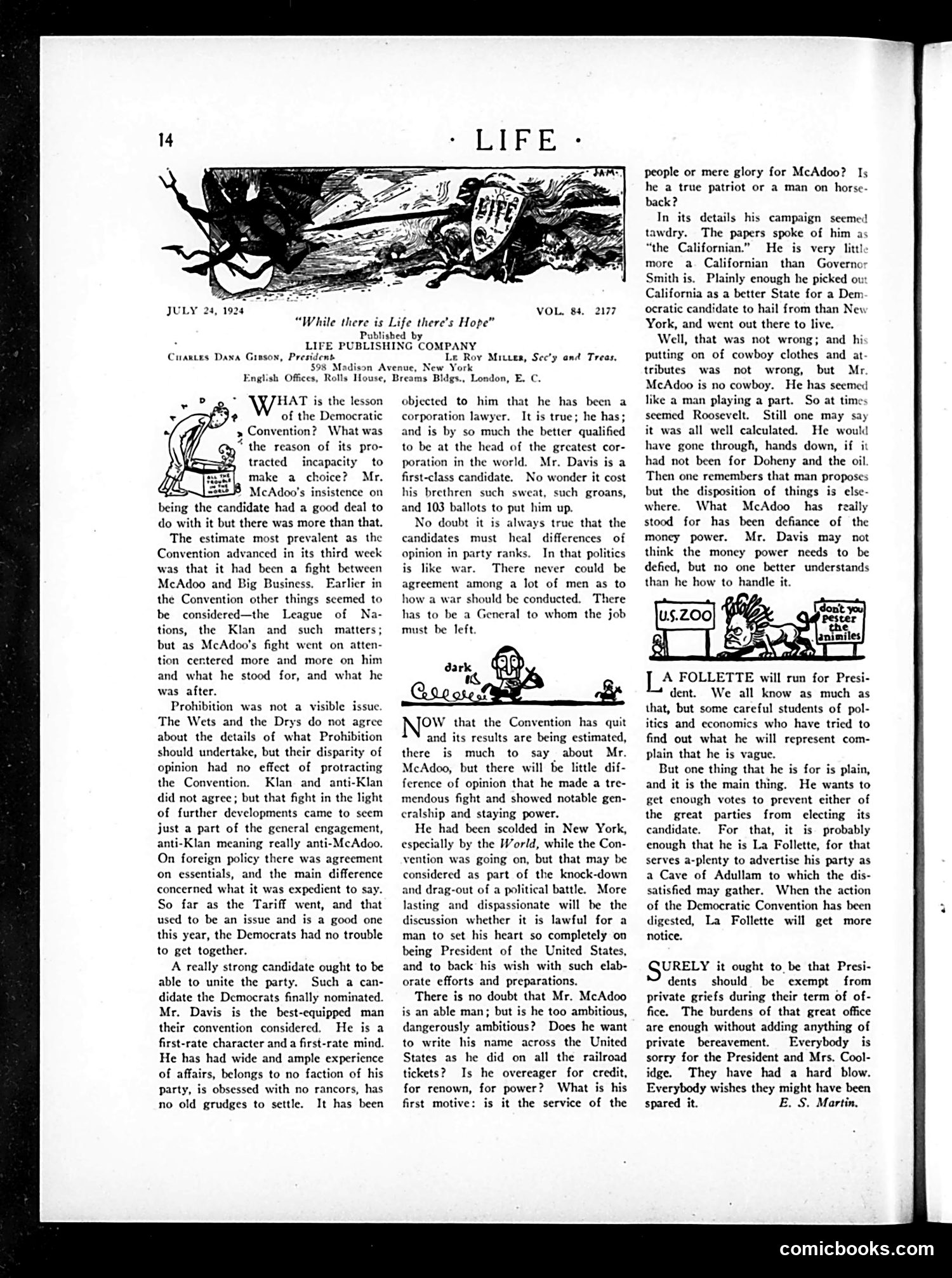
This page discusses the 1924 Democratic Convention and candidate William Gibbs McAdoo. The main cartoon (top) depicts a donkey—the Democratic Party symbol—appearing exhausted or collapsed, labeled "While there is Life there's Hope." The text criticizes McAdoo's candidacy, questioning whether he's a true patriot or merely an ambitious politician. It notes his railroad background and questions his motives: does he seek the presidency for public service or personal glory? The small cartoon (bottom right) shows a zoo visitor considering which animal to follow, satirizing the difficulty voters face in choosing between candidates. The article argues McAdoo is "playing a part" and represents money power over true democratic principles, suggesting the Democratic Party is divided and struggling to find a suitable nominee.
📄 Transcribed text from this page (OCR, searchable)
Machine-transcribed from the original scan — historical spelling and the odd misread are preserved.
JULY 24, 1928 VOL, 84. 2177 “While there is Life there’s Hope” Published by LIFE PUBLISHING COMPANY Curartes Dana Ginson, President Le Rov Miter, Sec’y and Treas, 598 Madison Avenue, New York English Offices, Rolls House, Breams Bldgs., London, E. C. HAT is the lesson of the Democratic » Convention? What was * the reason of its pro- tracted incapacity to make a choice?) Mr. McAdoo's insistence on being the candidate had a good deal to do with it but there was more than that. The estimate most prevalent as the Convention advanced in its third week was that it had been a fight between McAdoo and Big Business. Earlier in the Convention other things scemed to be considered—the League of Na- tions, the Klan and such matters; but as McAdoo's fight went on atten- tion centered more and more on him and what he stood for, and what he was after. Prohibition was not a visible issue. The Wets and the Drys do not agree about the details of what Prohibition should undertake, but their disparity of opinion had no effect of protracting the Convention. Klan and anti-Klan did not agree; but that fight in the light of further developments came to seem just a part of the general engagement, anti-Klan meaning really anti-McAdoo. On foreign policy there was agreement on essentials, and the main difference concerned what it was expedient to say. So far as the Tariff went, and that used to be an issue and is a good one this year, the Democrats had no trouble to get together. A really strong candidate ought to be able to unite the party. Such a can- didate the Democrats finally nominated. Mr. Davis is the best-equipped man their convention considered. He is a first-rate character and a first-rate mind. He has had wide and ample experience of affairs, belongs to no faction of his party, is obsessed with no rancors, has no old grudges to settle. It has been objected to him that he has been a corporation lawyer. It is true; he has; and is by so much the better qualified to be at the head of the greatest cor- poration in the world. Mr. Davis is a first-class candidate. No wonder it cost his brethren such sweat, such groans, and 103 ballots to put him up. No doubt it is always true that the candidates must heal differences of opinion in party ranks. In that politics is like war. There never could be agreement among a lot of men as to how a war should be conducted. There has to be a General to whom the job must be left. dai ree Gog OW that the Convention has quit and its results are being estimated, there is much to say about Mr. McAdoo, but there will be little dif- ference of opinion that he made a tre- mendous fight and showed notable gen- cralship and staying power. He had been scolded in New York, especially by the World, while the Con- vention was going on, but that may be considered as part of the knock-down and drag-out of a political battle. More lasting and dispassionate will be the discussion whether it is lawful for a man to set his heart so completely on being President of the United States, and to back his wish with such elab- orate efforts and preparations. There is no doubt that Mr. McAdoo is an able man; but is he too ambitious, dangerously ambitious? Does he want to write his name across the United States as he did on all the railroad tickets? Is he overeager for credit, for renown, for power? What is his first motive: is it the service of the people or mere glory for McAdoo? Is he a true patriot or a man on horse- back? In its details his campaign seemed tawdry. The papers spoke of him as “the Californian.” He is very litt! more a Californian than Governor Smith is. Plainly enough he picked California as a better State for a Dem ocratic candidate to hail from than New York, and went out there to live. Well, that was not wrong; and hi putting on of cowboy clothes and at- tributes was not wrong, but Mr. McAdoo is no cowboy. He has seemed like a man playing a part. So at times seemed Roosevelt. Still one may say it was all well calculated. He would have gone through, hands down, if it had not been for Doheny and the oil. Then one remembers that man proposes but the disposition of things is else- where. What McAdoo has _ really stood for has been defiance of the moncy power. Mr. Davis may not think the money power needs to be defied, but no one better understands than he how to handle it. A FOLLETTE will run for Presi- dent. We all know as much as that, but some careful students of pol- itics and economics who have tried to find out what he will represent com- plain that he is vague. But one thing that he is for is plain, and it is the main thing. He wants to get enough votes to prevent either of the great parties from electing its candidate. For that, it is probably enough that he is La Follette, for that serves a-plenty to advertise his party as a Cave of Adullam to which the dis- satisfied may gather. When the action of the Democratic Convention has been digested, La Follette will get more notice. RELY it ought to be that Presi- dents should be exempt from private griefs during their term of of- fice. The burdens of that great office are enough without adding anything of private bereavement. Everybody is sorry for the President and Mrs. Cool- idge. They have had a hard blow. Everybody wishes they might have been spared it. E. S. Martin, comicbooks.com