
Life, 1924-07-24 · page 29 of 36
Life — July 24, 1924 — page 29: what you’re looking at
What you’re looking at
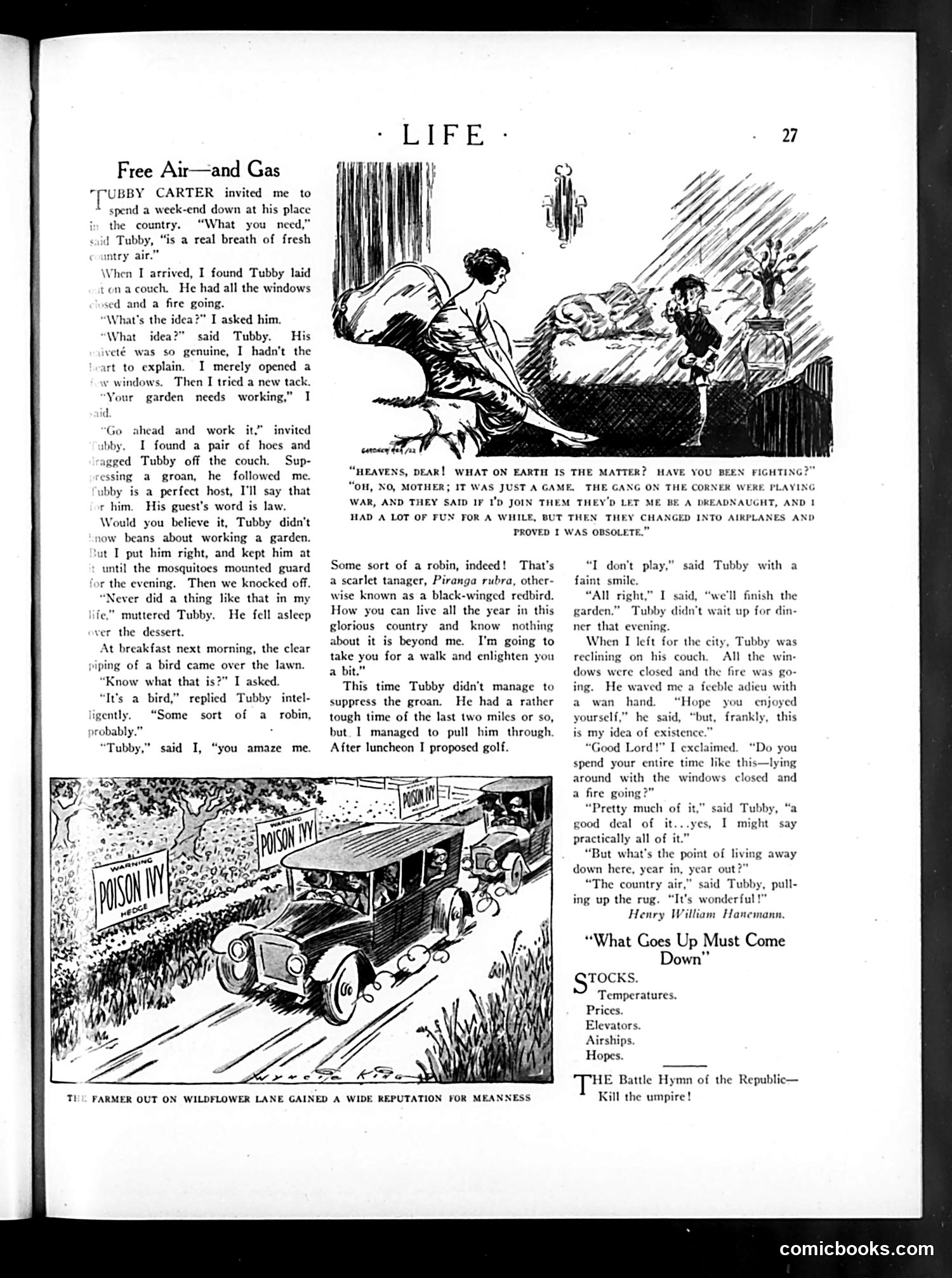
This page contains two satirical pieces mocking early 20th-century American life. **Main Story ("Free Air—and Gas"):** A city dweller visits his country-dwelling friend Tubby Carter for "fresh country air." The joke: Tubby keeps windows sealed and fires burning indoors, completely defeats the purpose of country living through lethargy and ignorance. Despite the guest's efforts to engage him in gardening, bird-watching, and golf, Tubby remains horizontal on his couch. The satire targets wealthy urbanites who romanticize rural life while lacking any actual engagement with nature—they want the *idea* of country living without its substance. **Children's Cartoon (top right):** Shows children playing war games, then switching to "airplanes," with one child declaring himself "obsolete." This likely references pre-WWI anxieties about military technology and changing warfare tactics—warships becoming obsolete as aviation advanced. **Bottom section ("What Goes Up Must Come Down"):** Brief satirical list mocking market speculation and economic instability of the era.
📄 Transcribed text from this page (OCR, searchable)
Machine-transcribed from the original scan — historical spelling and the odd misread are preserved.
Free Air—and Gas "TUBBY CARTER invited me to spend a week-end down at his place the country. “What you need,” d Tubby, “is a real breath of fresh intry air.” \When I arrived, I found Tubby laid tonacouch. He had all the windows sed and a fire going. What's the idea?" I asked him. What idea?” said Tubby. His yas so genuine, I hadn't the I merely opened a Then I tried a new tack. “Your garden needs working,” I d Go ahead and work ii invited abby. I found a pair of hoes and igged Tubby off the couch. Sup- essing a groan, he followed me. ubby is a perfect host, I'll say that + him. His guest's word is law. Would you believe it, Tubby didn't iow beans about working a garden. tut I put him right, and kept him at until the mosquitoes mounted guard r the evening. Then we knocked off. “Never did a thing like that in my ie,” muttered Tubby. He fell asleep ver the dessert. At breakfast next morning, the clear siping of a bird came over the lawn. “Know what that is?” I asked. “It's a bird,” replied Tubby intel- igently. “Some sort of a robin, “HEAVENS, DEAR! WHAT ON EARTH IS THE MATTER? “OH, NO, MOTHER; IT WAS JUST A GAME. WAR, AND THEY SAID IF I'D JOIN THEM THEY'D LET ME BE A DREADNAUGH HAD A LOT OF FUN FOR A WHILE, BUT THEN THEY CHANGED INTO AIRPLANES AND PROVED I WAS OBSOLETE.” Some sort of a robin, indeed! That's a scarlet tanager, Piranga rubra, other- wise known as a black-winged redbird. How you can live all the year in this glorious country and know nothing about it is beyond me. I'm going to take you for a walk and enlighten you a bit.” This time Tubby didn’t manage to suppress the groan. He had a rather tough time of the last two miles or so, but. I managed to pull him through. After luncheon I proposed golf. FARMER OUT ON WILDFLOWER LANE GAINED A WIDE REPUTATION FOR MEANNESS “I don't play,” said Tubby with a faint smile. “All right,” I said, “we'll finish the garden.” Tubby didn't wait up for din- ner that evening. When I left for the city, Tubby was reclining on his couch, All the win- dows were closed and the fire was go- ing. He waved me a feeble adieu with a wan hand. “Hope you enjoyed yourself,” he said, “but, frankly, this “Good Lord!" I exclaimed. “Do you spend your entire time like this—lying around with the windows closed and a fire going?” “Pretty much of i good deal of it...yes, I practically all of it.” “But what's the point of living away down here, year in, year out?” “The country aii id Tubby, pull- ing up the rug. “It's wonderful!” Henry William Hanemann. “What Goes Up Must Come Down” said Tubby, “a might say TOCKS. Temperatures. Prices. Elevators. Airships. Hopes. 1E Battle Kill the umpire! Hymn of the Republic— comicbooks.com HAVE YOU BEEN FIGHTING?” THE GANG ON THE CORNER WERE PLAYING ANDI