
Life, 1924-07-24 · page 28 of 36
Life — July 24, 1924 — page 28: what you’re looking at
What you’re looking at
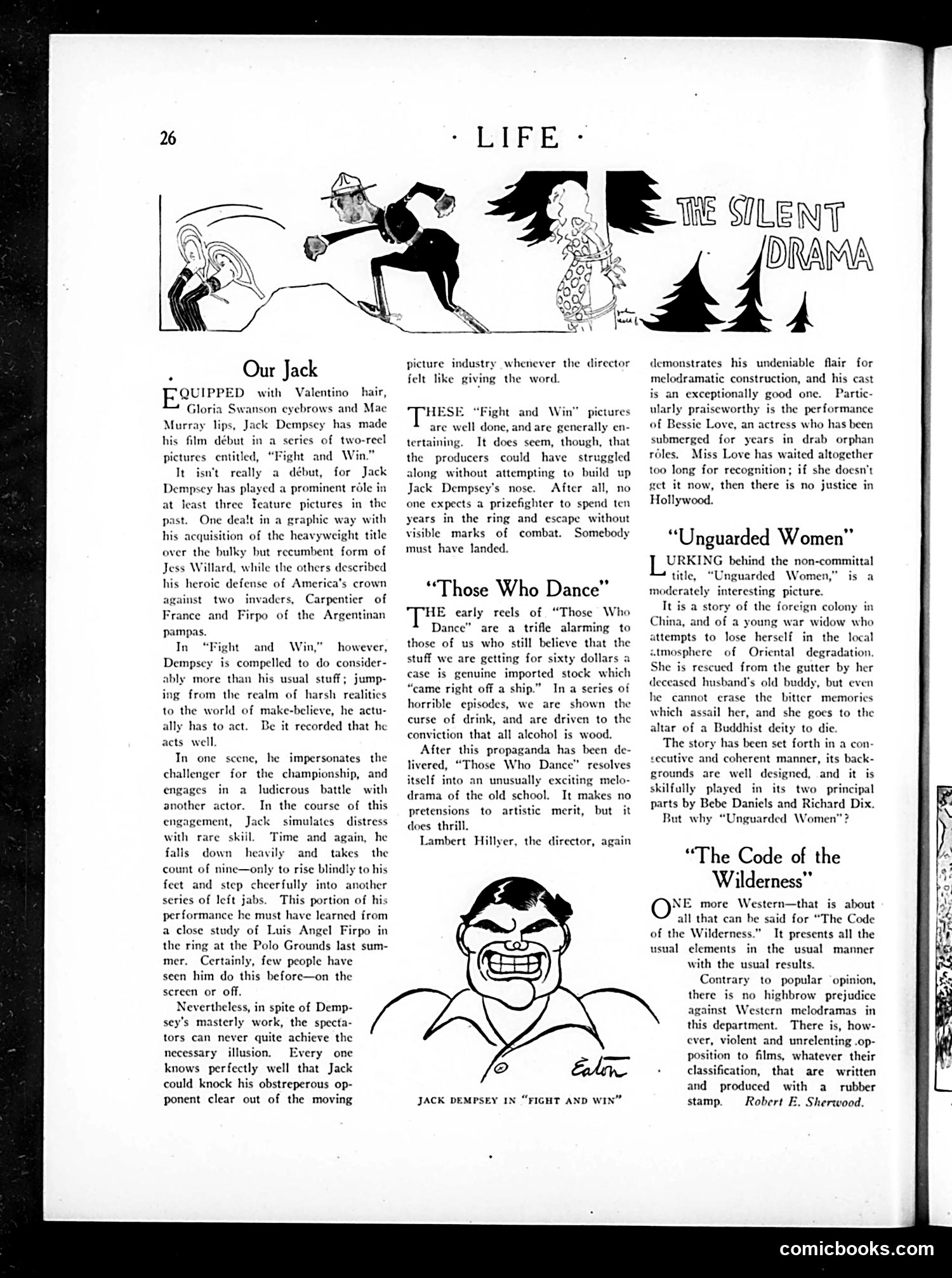
This page from *Life* magazine reviews several silent films, primarily focusing on **Jack Dempsey**, the famous heavyweight boxing champion, making his film debut in "Fight and Win." The satire centers on the incongruity of casting a real boxer as an actor. The text praises Dempsey's actual fighting prowess while gently mocking the film's premise: audiences know Dempsey could genuinely knock out his opponents with ease, yet must pretend the staged battles are genuine dramatic conflict. This undercuts the "necessary illusion" filmmaking requires. The page also reviews "Those Who Dance" (praised for melodrama if not artistic merit) and "Unguarded Women" (a colonial drama). The small cartoon captioned "JACK DEMPSEY IN 'FIGHT AND WIN'" shows a caricatured boxer mid-punch, illustrating the tension between Dempsey's real boxing identity and his attempt at fictional acting. The humor relies on the reader's knowledge of Dempsey's authentic boxing reputation making his cinematic pretense inherently comedic.
📄 Transcribed text from this page (OCR, searchable)
Machine-transcribed from the original scan — historical spelling and the odd misread are preserved.
Our Jack QUIPPED Valentino Gloria Swanson eyebrows and Mac Murray lips, Jack Dempsey has made his film début in a series of two-reel pictures entitled, “Fight and Win.” It isn’t really a for Jack Dempsey has played a prominent role in at least three Teature pictures in the past. One dealt in a graphic way with his acquisition of the heavyweight title with hair, début, over the bulky but recumbent form of Jess Willard, while the others described of America’s crown Carpentier of France and Firpo of the Argentinan pampas. In “Fight and Win,” however, Dempscy is compelled to do consider- ably more than his usual stuff; jump- ing from the realm of harsh realities to the world of make-believe, he actu- ally has to act. Be it recorded that he acts well. In one scene, he impersonates the challenger for the championship, and ludicrous battle In the course of this his heroic defen: against two ders, engages in a with another actor. engagement, Jack simulates distress skiil down with rare Time and again, he falis and ta the count of ninc—only to rise blindly to his feet and step cheerfully into another series of left jabs. This portion of his performance he must have learned from a close study of Luis Angel Firpo in the ring at the Polo Grounds last sum- mer. Certainly, few people have seen him do this before—on the screen or off. Nevertheless, in spite of Demp- sey’s masterly work, the specta- tors can never quite achieve the necessary illusion. Every one knows perfectly well that Jack could knock his obstreperous op- ponent clear out of the moving heavily picture industry whenever the director felt like giving the word. HESE “Fight and Win” pictures are well done, and are generally en- tertaining. It does seem, though, that the producers could have struggled along without attempting to build up Jack Dempsey’s nose. After all, no one expects a prizefighter to spend ten years in the ring and escape without visible marks of combat. Somebody must have landed. “Those Who Dance” THE early reels of “Those Who Dance” are a trifle alarming to those of us who still believe that the stuff we are getting for sixty dollars a case is genuine imported stock which “came right off a ship.” In a series of horrible episodes, we are shown the curse of drink, and are driven to the conviction that all alcohol is wood. After this propaganda has been de- livered, “Those Who Dance” resolves itself into an unusually exciting melo- drama of the old school. It makes no pretensions to artistic merit, but it does thrill. Lambert Hillyer, the director, again JACK DEMPSEY IN “FIGHT AND WIN” Te SLENT 7 A demonstrates his undeniable flair for melodramatic construction, and his cast is an exceptionally good one. Partic- ularly praiseworthy is the performance of Bessie Love, an actress who has been submerged for years in drab orphan roles. Miss Love has waited altogether too long for recognition; if she doesn’t get it now, then there is no justice in Hollywood. “Unguarded Women” URKING behind the non-committal Unguarded Women,” is a ely interesting picture. a story of the foreign colony China, and of a young war widow who attempts to lose herself in the local atmosphere of Oriental degradation. She is rescued from the gutter by her deceased husband's old buddy, but even he cannot crase the bitter memories which assail her, and she goes to the altar of a Buddhist deity to die. The story has been set forth in a con- secutive and coherent manner, its back- grounds are well designed, and it is skilfully played in its two principal parts by Bebe Daniels and Richard Dix. But why “Unguarded Wome: “The Code of the Wilderness” NE more Western—that is about all that can be said for “The Code of the Wilderness.” It presents all the usual elements in the usual manner with the usual results. Contrary to popular ‘opinion, there is no highbrow prejudice against Western melodramas in this department. There is, how- ever, violent and unrelenting .op- position to films, whatever their classification, that are written and produced with a rubber stamp. Robert E. Sherwood. comicbooks.com