
A complete issue · 40 pages · 1924
Life — June 19, 1924
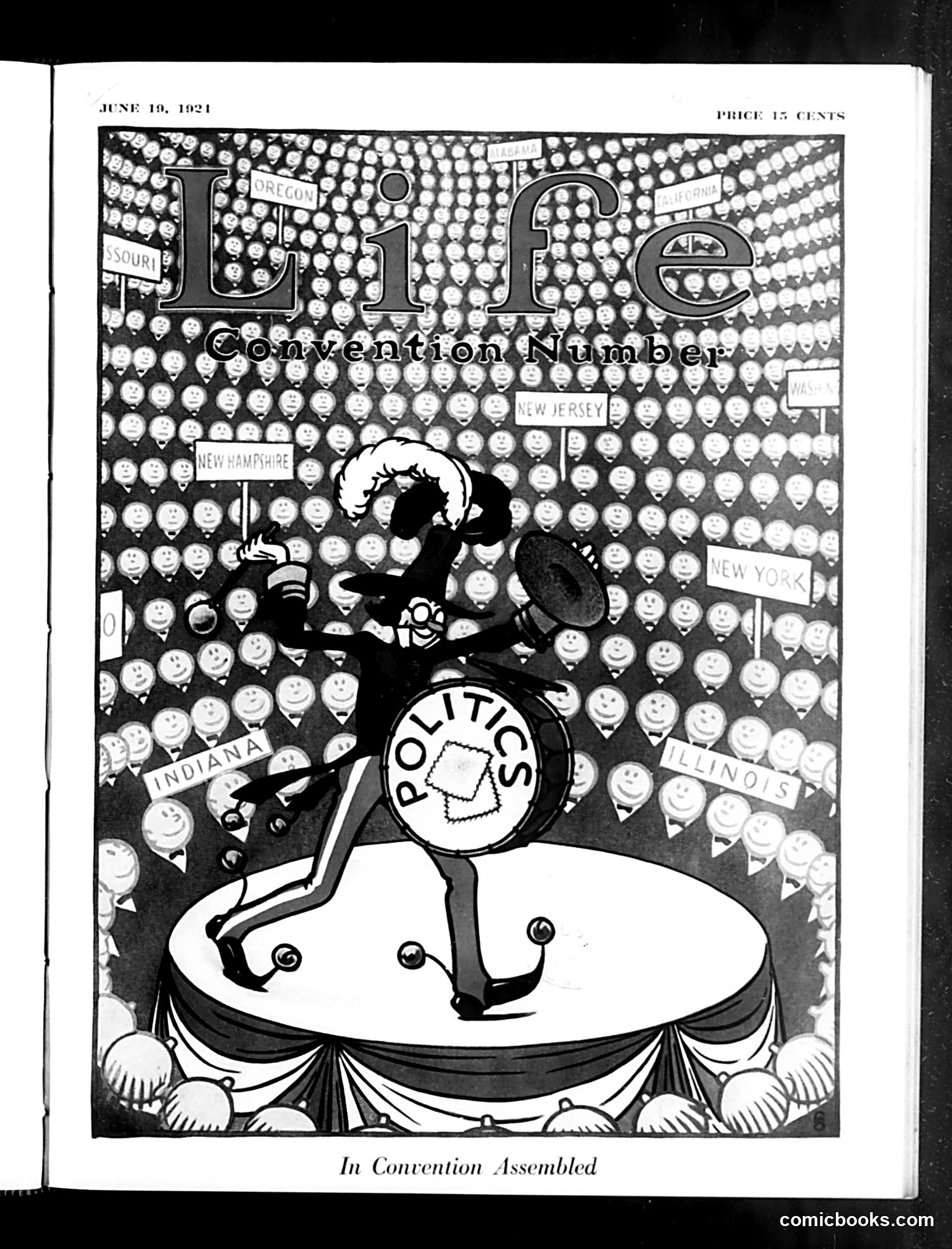
This cover satirizes the 1924 Democratic National Convention. The cartoon depicts a chaotic political figure conducting an orchestra labeled "POLITICS," literally beating a drum while standing on a platform. Behind the conductor are hundreds of balloon heads labeled with state names (Indiana, Illinois, New Jersey, New York, Oregon, Missouri visible), representing state delegates. The satire mocks the Democratic convention's notorious difficulty in selecting a presidential nominee—the 1924 convention required 103 ballots, the longest in American history. The "balloon heads" joke suggests delegates lacked substance or independent thought, while the frantic conductor implies chaotic, disorganized proceedings. The caption "In Convention Assembled" and subtitle "Convention Number" emphasize the absurdity of the drawn-out, contentious process.
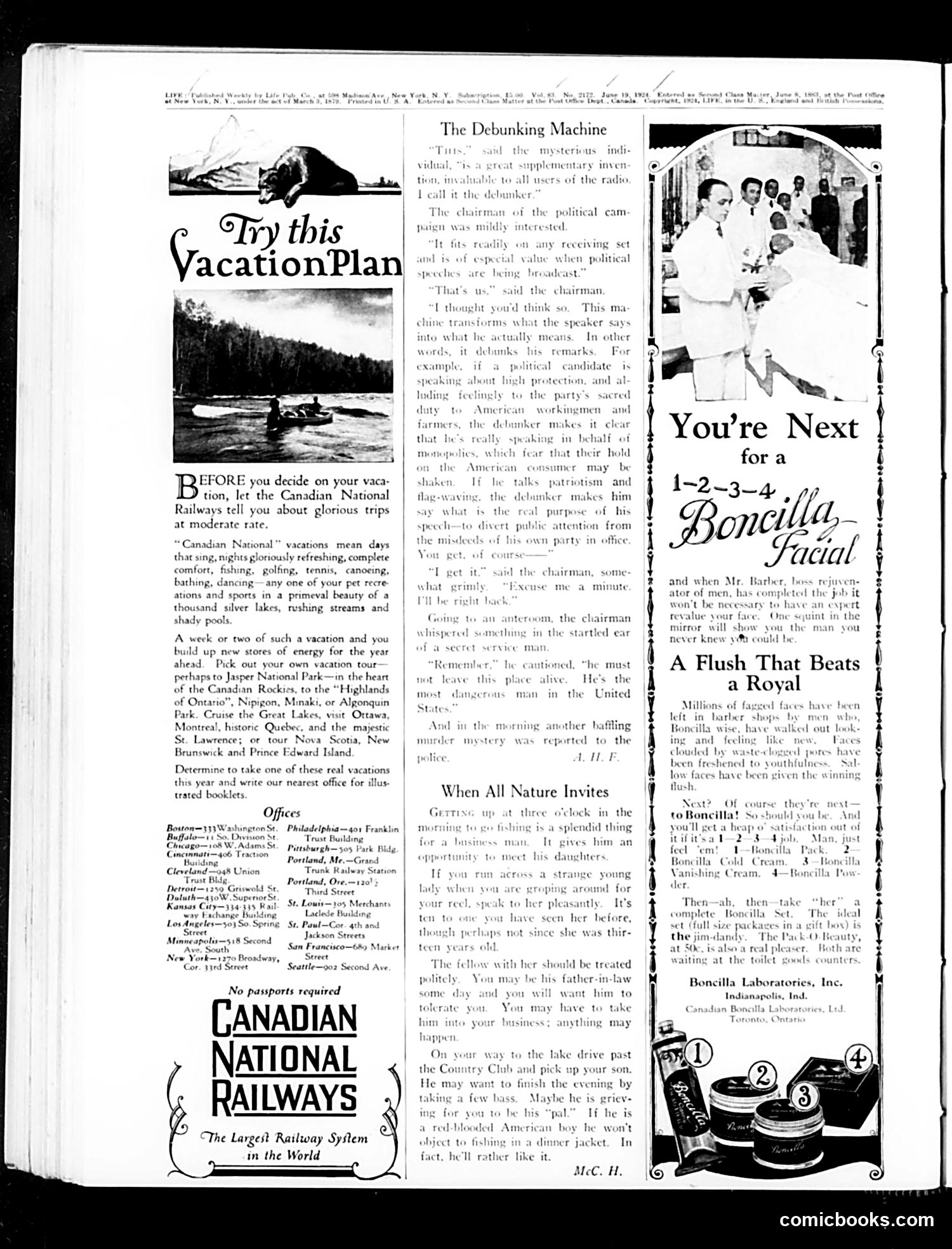
This page satirizes a mysterious radio device called "the debunker" that supposedly reveals a speaker's true motives by transforming their public statements into their actual meaning. The cartoon illustrates the concept: when a political candidate broadcasts about "high protection" and patriotic duty to "American workingmen and farmers," the debunker exposes he's actually representing monopolies and undermining consumer interests. Similarly, when a speaker uses patriotic rhetoric, the machine reveals he's diverting public attention from his party's internal scandals. The satire mocks political doublespeak and hypocrisy—the gap between what politicians claim and what they actually mean—suggesting voters need a literal "translation device" to understand campaign rhetoric. It's a commentary on campaign deception and public skepticism toward politicians.
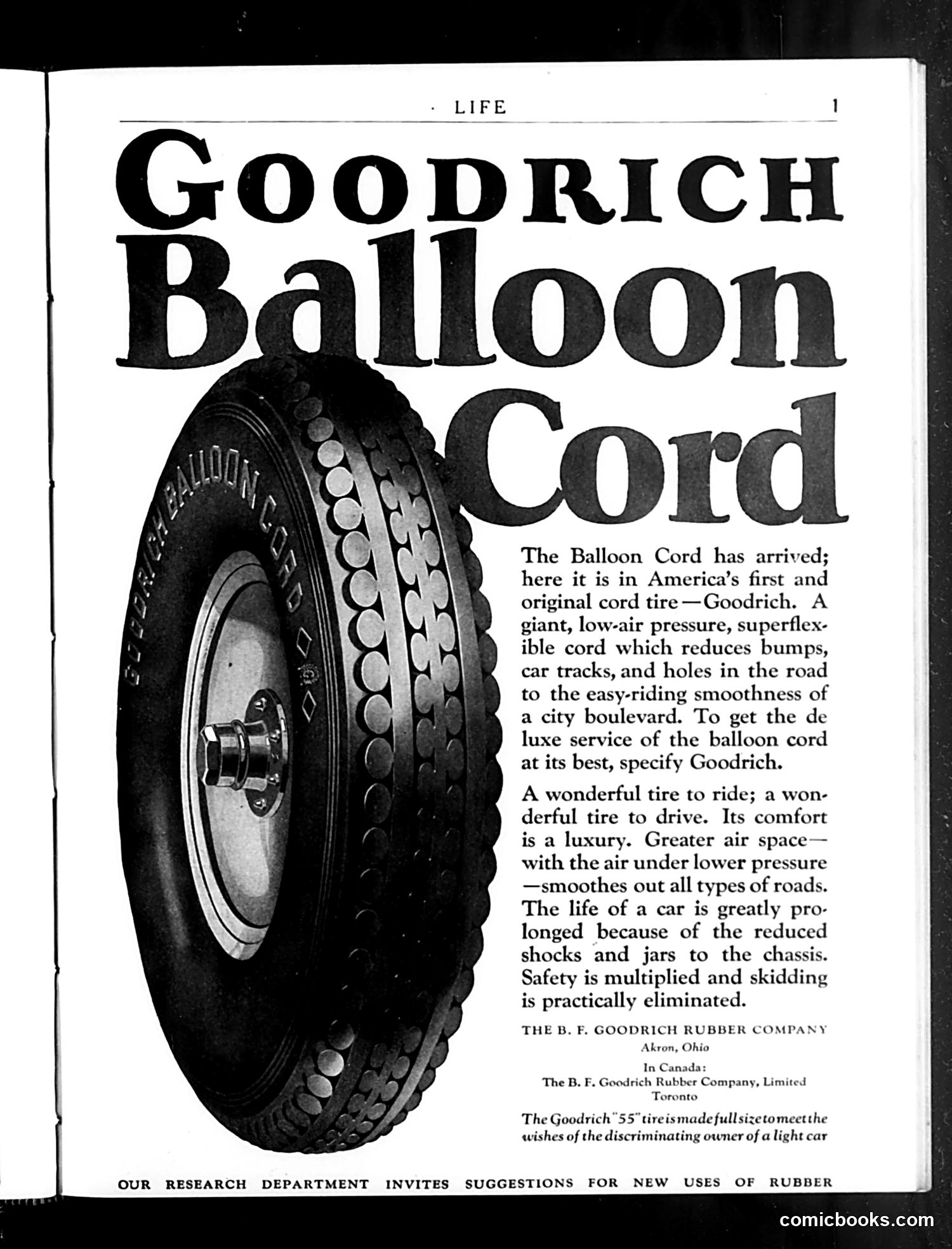
This page is **not a political cartoon or satire**—it is a straightforward **advertisement** for Goodrich Balloon Cord tires, published in Life magazine. The ad features a large photograph of an automobile tire with distinctive balloon-cord construction (visible as raised bumps on the sidewall). The text promotes this as "America's first and original cord tire," emphasizing its low-air-pressure design for improved comfort and reduced road damage. The advertiser is the B.F. Goodrich Rubber Company of Akron, Ohio, with a Canadian subsidiary in Toronto. A small note at bottom mentions the "Goodrich '55' tire" for light cars. There is no political message, satire, or caricature present—merely automotive product promotion typical of period consumer advertising.
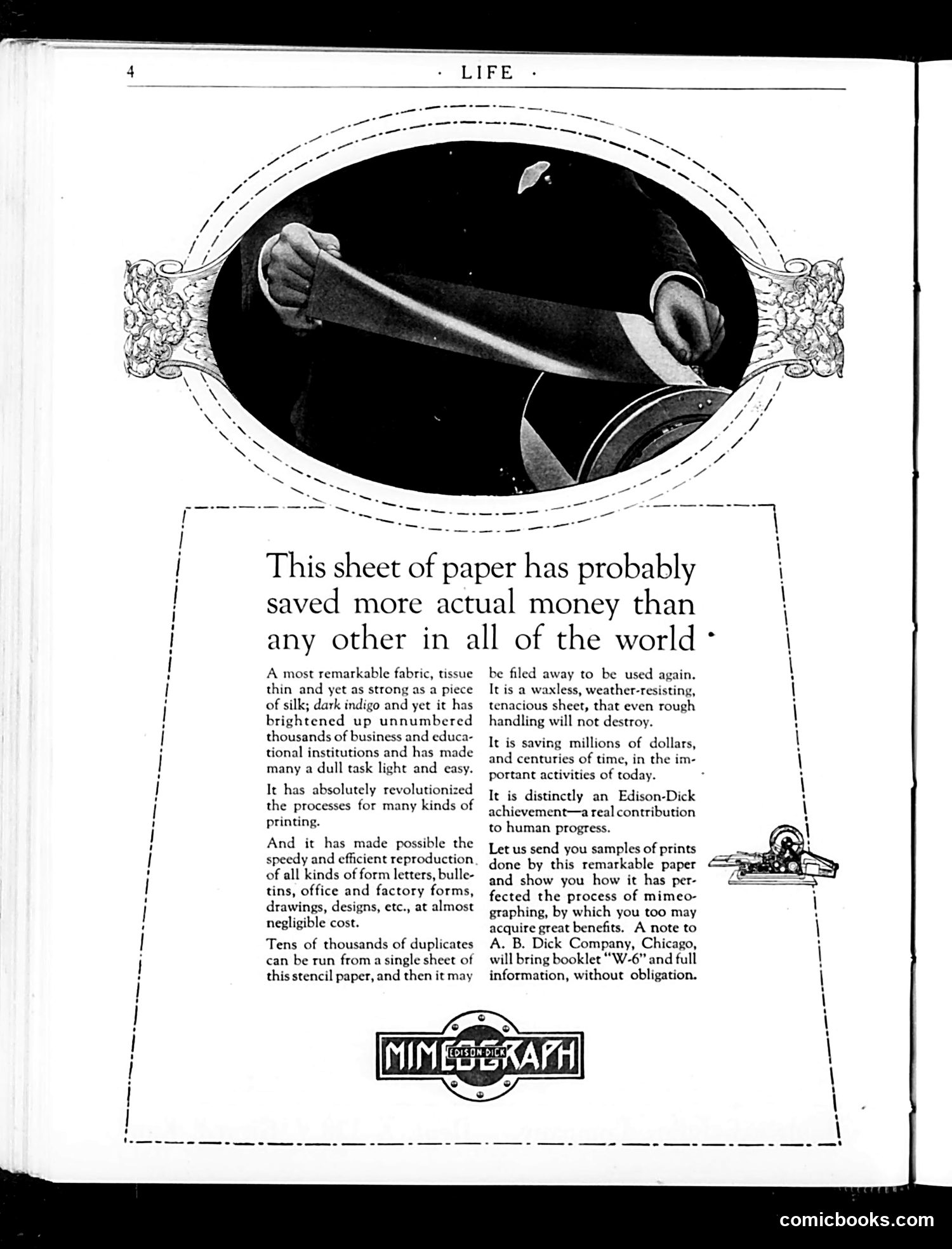
This page is **primarily an advertisement**, not political satire. It promotes Edison-Dick's mimeograph stencil paper to a business audience. The ad claims this particular sheet of paper has "probably saved more actual money than any other in all of the world" by enabling cheap, efficient reproduction of documents. The text emphasizes the paper's durability, weather-resistance, and cost-effectiveness for printing forms, letters, and designs. The oval image shows hands operating mimeograph equipment. The ad concludes by offering free samples and a booklet ("W-6") to interested businesses. This reflects early-20th-century office technology marketing, when mimeographs were revolutionary business tools. There is no political cartoon or satire present on this page.
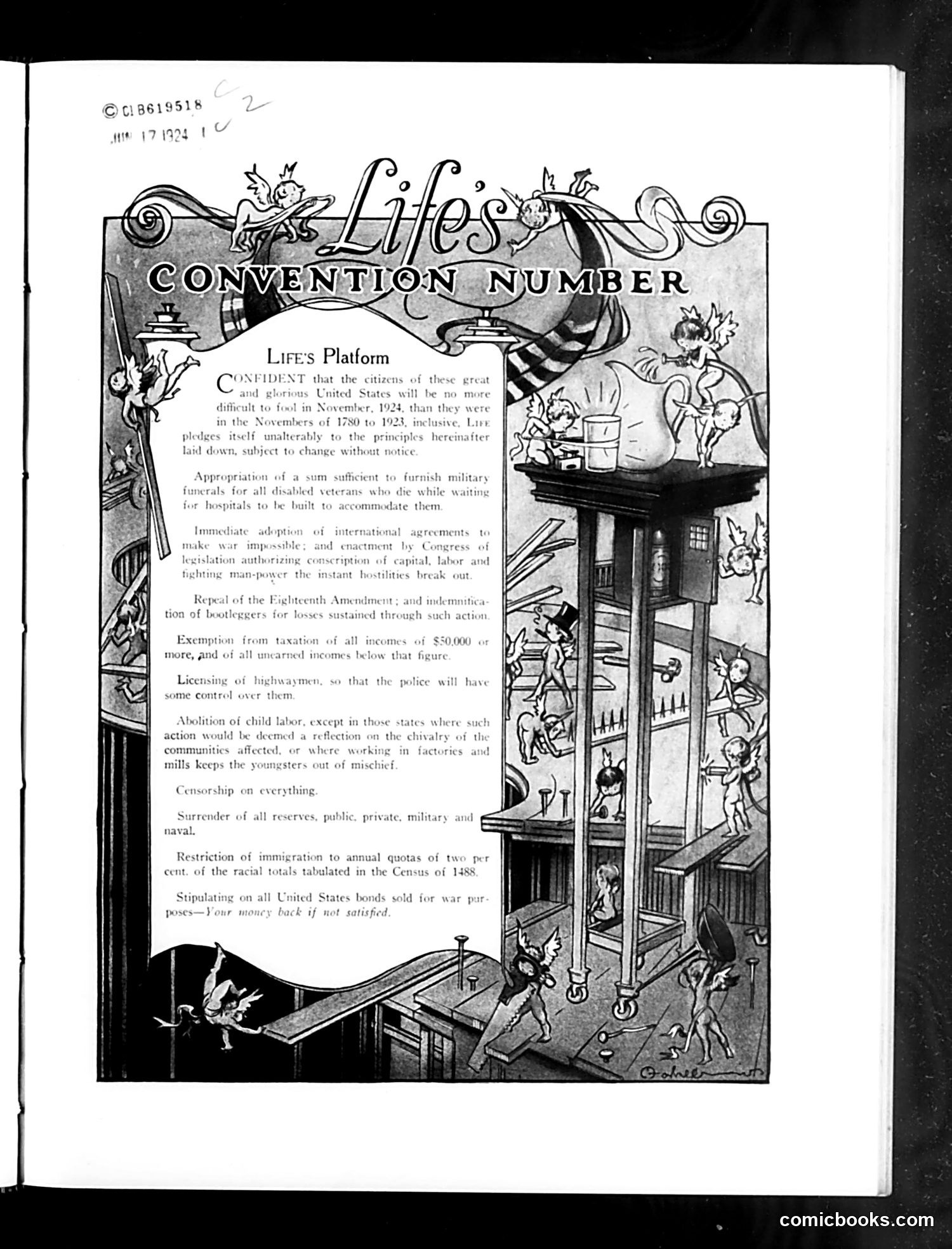
This is a satirical "platform" presented as Life magazine's proposal for the 1924 election. The cartoon depicts allegorical figures—appearing to represent various social forces or political interests—interacting within and around a building (likely representing government or the Capitol). The text lists Life's political positions, including: military benefits for disabled veterans, international agreements, income taxation, child labor abolition, police licensing, censorship, immigration restrictions based on 1488 Census data, and bond stipulations. The satire appears to mock the proliferation of competing political demands and platforms during election season, presenting them in exaggerated form. The decorative mythological figures suggest the magazine is treating serious policy proposals with ironic, whimsical visual treatment—a characteristic Life approach to political commentary.
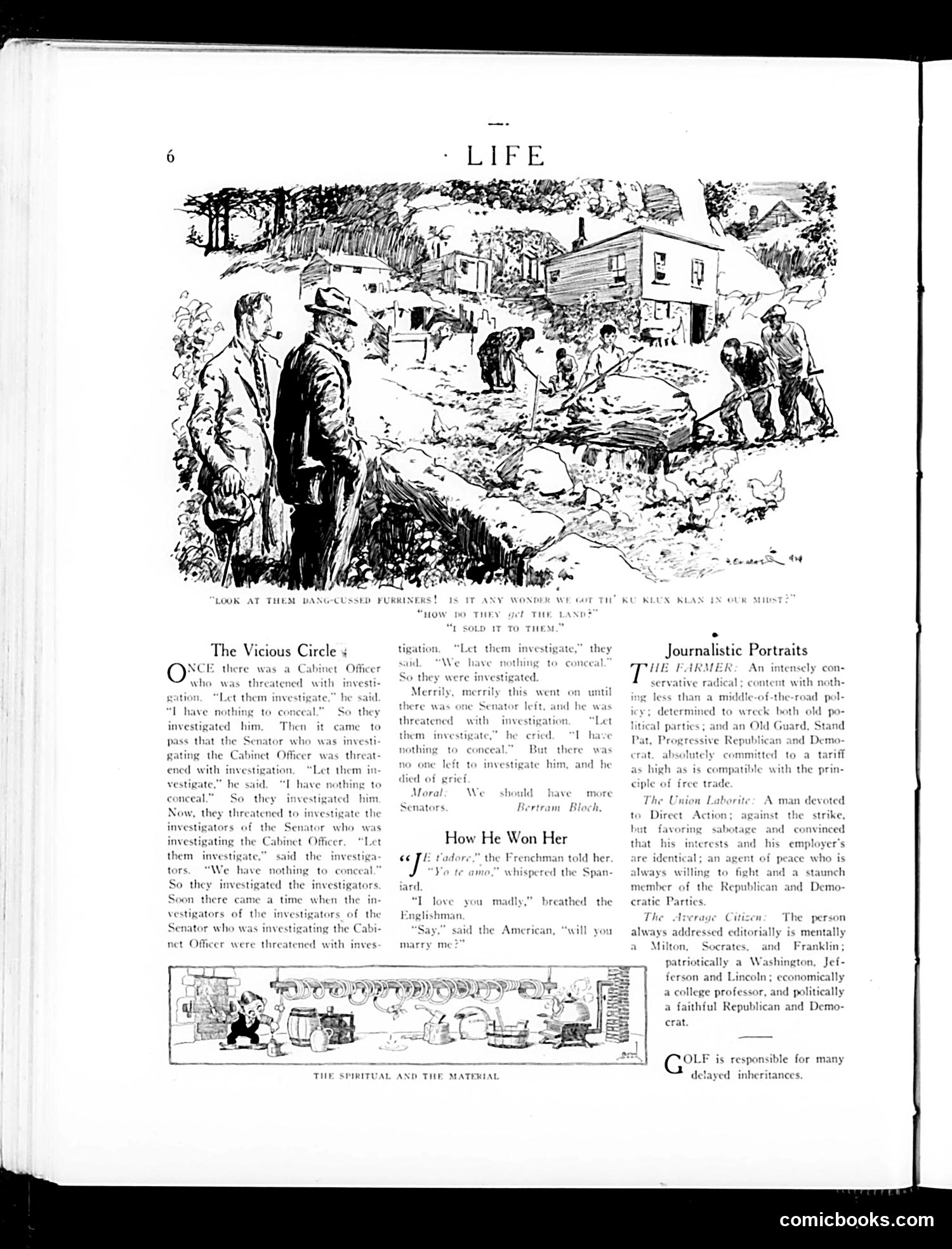
This page satirizes political corruption and investigative accountability. The main cartoon depicts officials in a rural setting, with the caption questioning the presence of "Ku Klux Klan in our midst" and asking how "they got the land." **"The Vicious Circle"** section describes a Cabinet Officer threatened with investigation who says "I have nothing to conceal," yet simultaneously works to block investigations of others—a circular logic the text mocks. The satire suggests politicians use investigations as political weapons while protecting themselves. **"Journalistic Portraits"** sketches various political figures, including references to trade policy debates and Republican/Democratic partisan divisions. The overall point: Political corruption perpetuates through mutual protection and hypocrisy, where officials investigate enemies while shielding allies—a "vicious circle" of accountability failure.
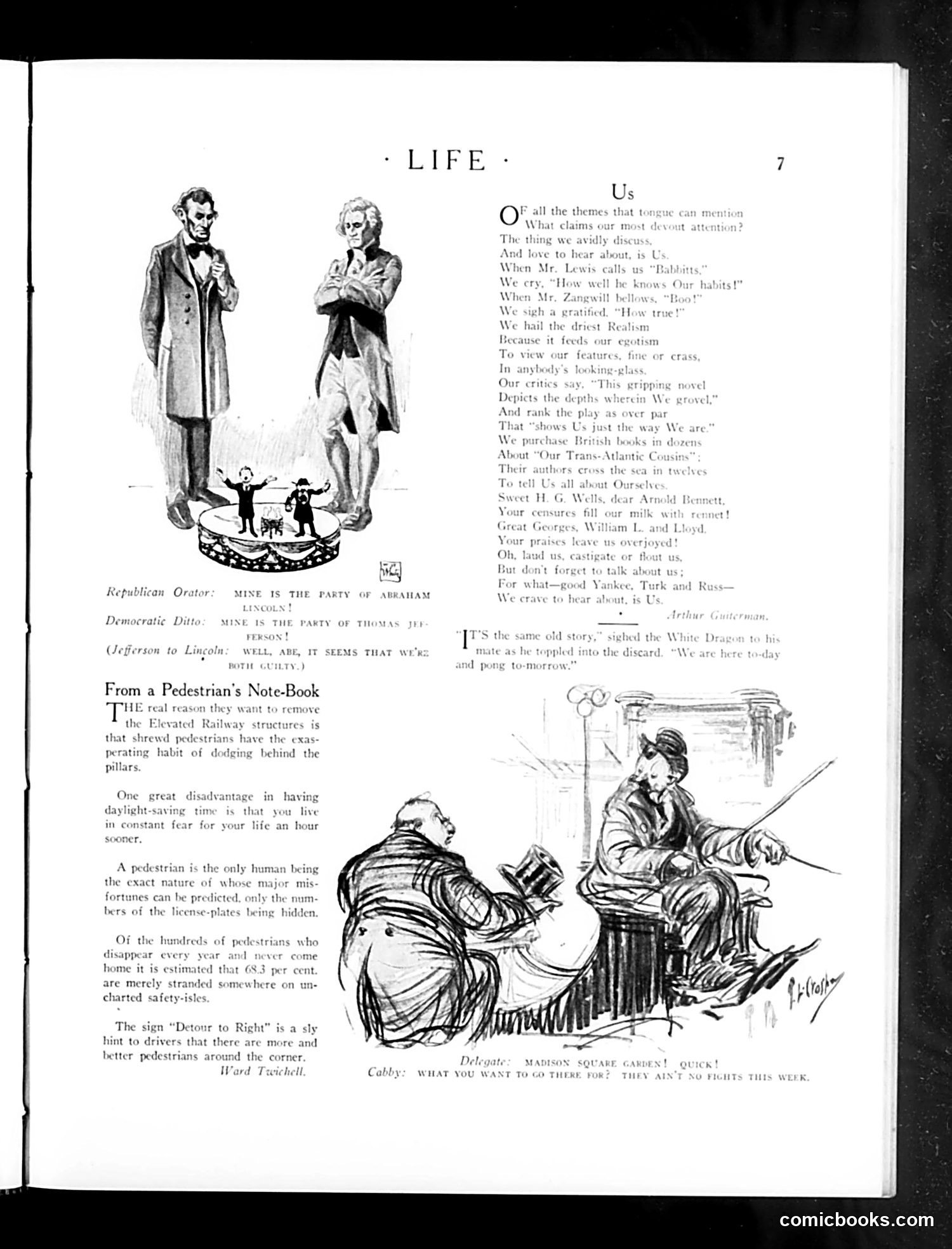
This page satirizes American obsession with celebrity and self-absorption. The poem "Us" critiques how the public craves gossip about famous figures—mentioning H.G. Wells, Arnold Bennett, and "Our Trans-Atlantic Cousins"—yet primarily wants to read about themselves. The references to "British books" and trans-Atlantic authors suggest contemporary fascination with European intellectuals. The top illustration shows two tall figures towering over tiny people below, likely representing how celebrities dominate public discourse. The bottom cartoon depicts a cabby and passenger at Madison Square Garden, illustrating the common person's practical concerns (traffic rights) versus the wealthy's leisure pursuits—mocking the class divide and mismatched priorities in Gilded Age New York.
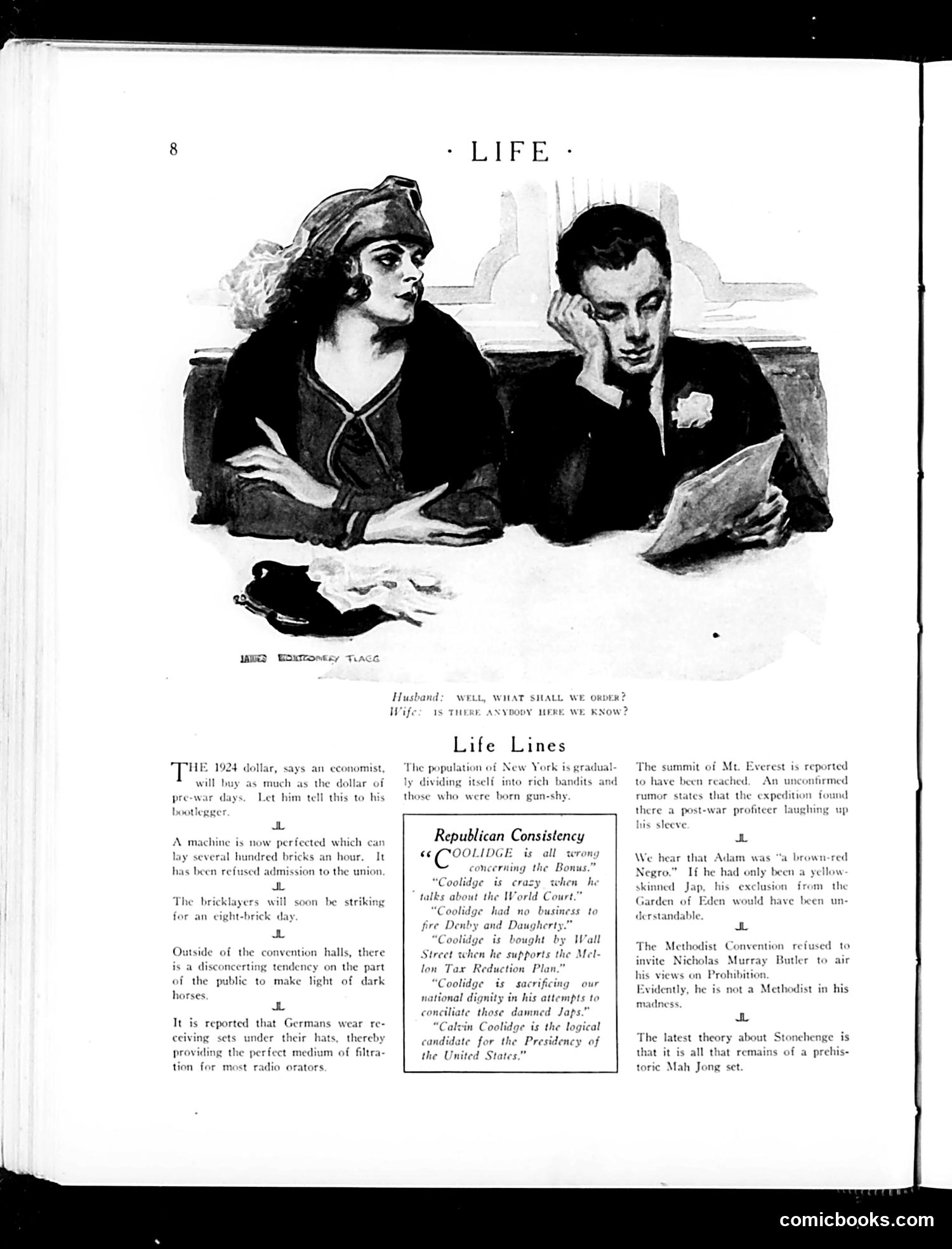
The main cartoon depicts a husband and wife reviewing finances, with the husband asking "Well, what shall we order?" and the wife responding "Is there anybody here we know?" This satirizes the economic hardship of the 1920s—specifically the declining value of the dollar mentioned in the text below, where an economist warns that the 1924 dollar will buy less than pre-war currency. The "Republican Consistency" box mocks Calvin Coolidge through contradictory quotes about his positions on the Bonus, World Court, Wall Street, and Japanese relations—suggesting inconsistent or hypocritical policies. The page combines domestic financial anxiety with political critique of Coolidge-era economics and foreign policy.
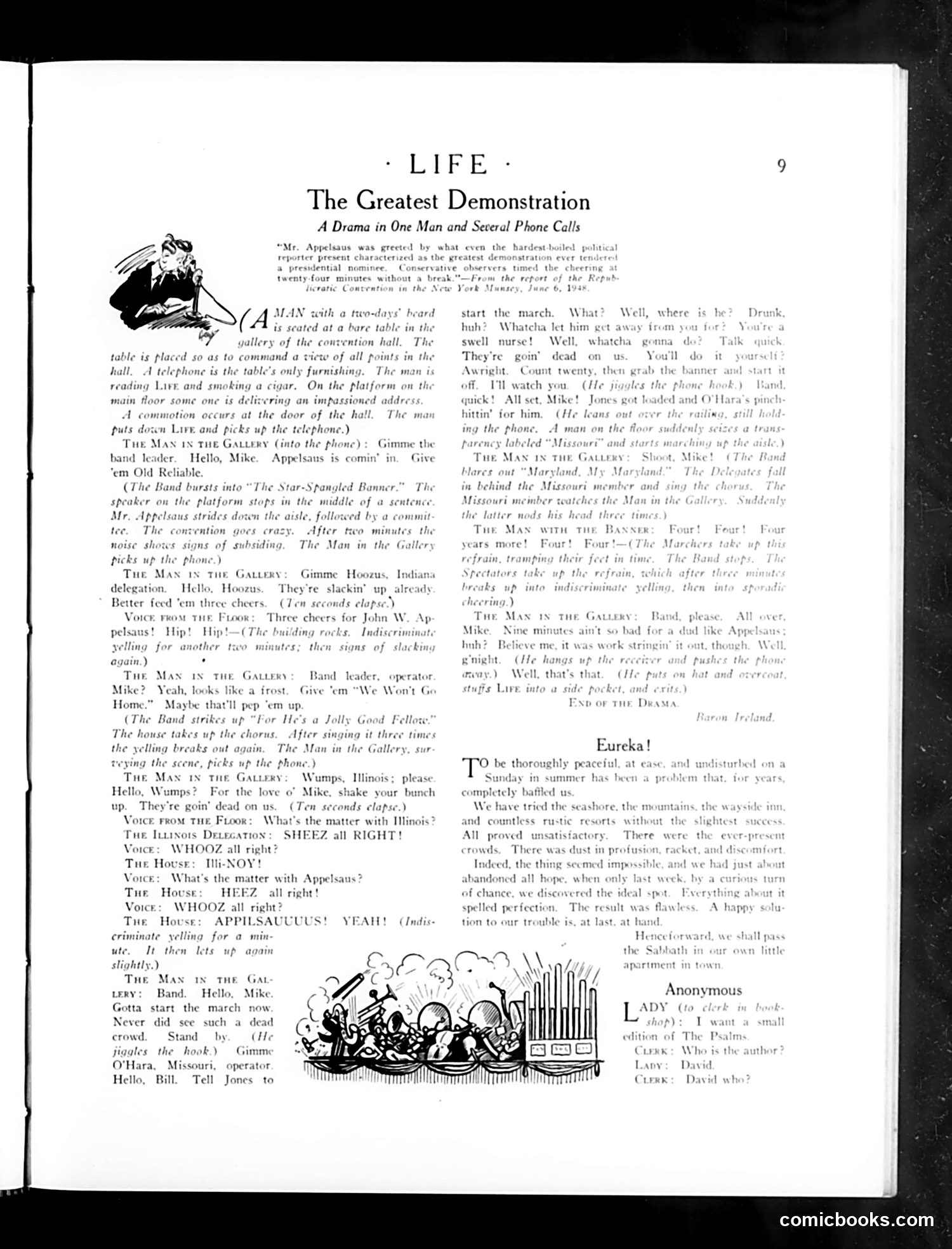
This one-act drama satirizes a massive political convention or protest march. The sketch depicts organizers frantically coordinating via telephone as crowds gather, with repeated shouted phrases ("WHOOZ all right?", "APPLESAUCTUS! YEAH!") suggesting mindless mob enthusiasm. The central illustration shows a dense, chaotic crowd with raised arms and signs at what appears to be a convention hall or rally. The satire mocks both the spectacle of organized political demonstrations and participants' apparent lack of genuine engagement—they're simply following leaders' cues rather than thinking independently. This likely critiques early 20th-century American political conventions, where large crowds were marshaled for effect. The repetitive, nonsensical chants emphasize the satirist's view that such demonstrations prioritize appearance over substance, with participants reduced to puppets responding to stage management.
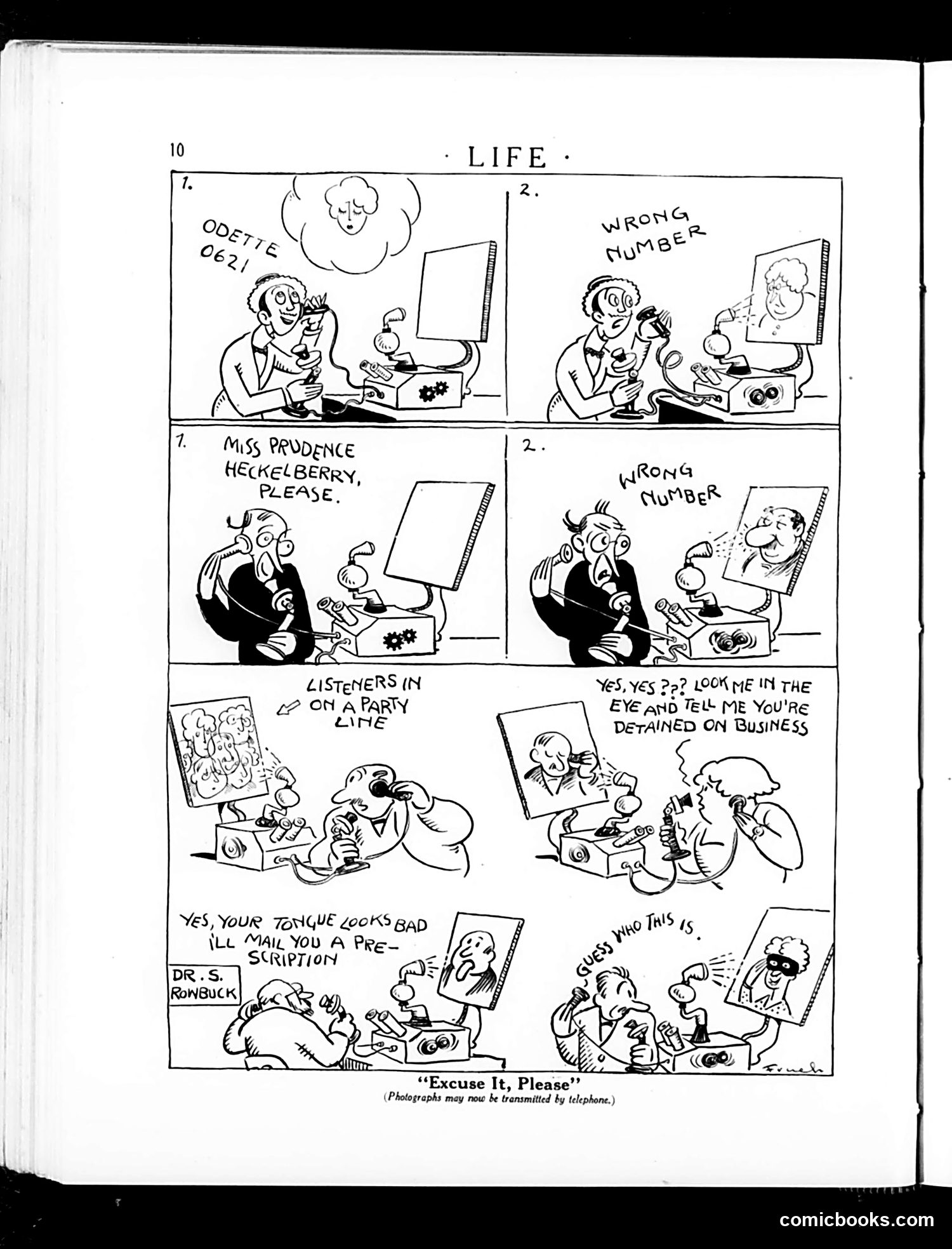
This multi-panel cartoon satirizes **radio broadcasts**, likely from the 1920s-30s when radio was new. The humor centers on technical failures during live transmission: Panel 1: A caller reports the wrong number to "Odette 062!" Panel 2: The operator receives a "wrong number" report. Panels 3-4: A woman ("Miss Prudence Heckelberry") experiences similar errors. The bottom panels show "Listeners on a party line" experiencing increasingly absurd interruptions—someone demanding a doctor examine their tongue, mysterious voices asking "guess who this is?" The joke: Early radio broadcasts were plagued by technical glitches, wrong connections, and interference. The cartoon mocks both the unreliable technology and callers' exasperation with constant mistakes. The title "Excuse It, Please" ironically suggests the only response available to frustrated listeners.
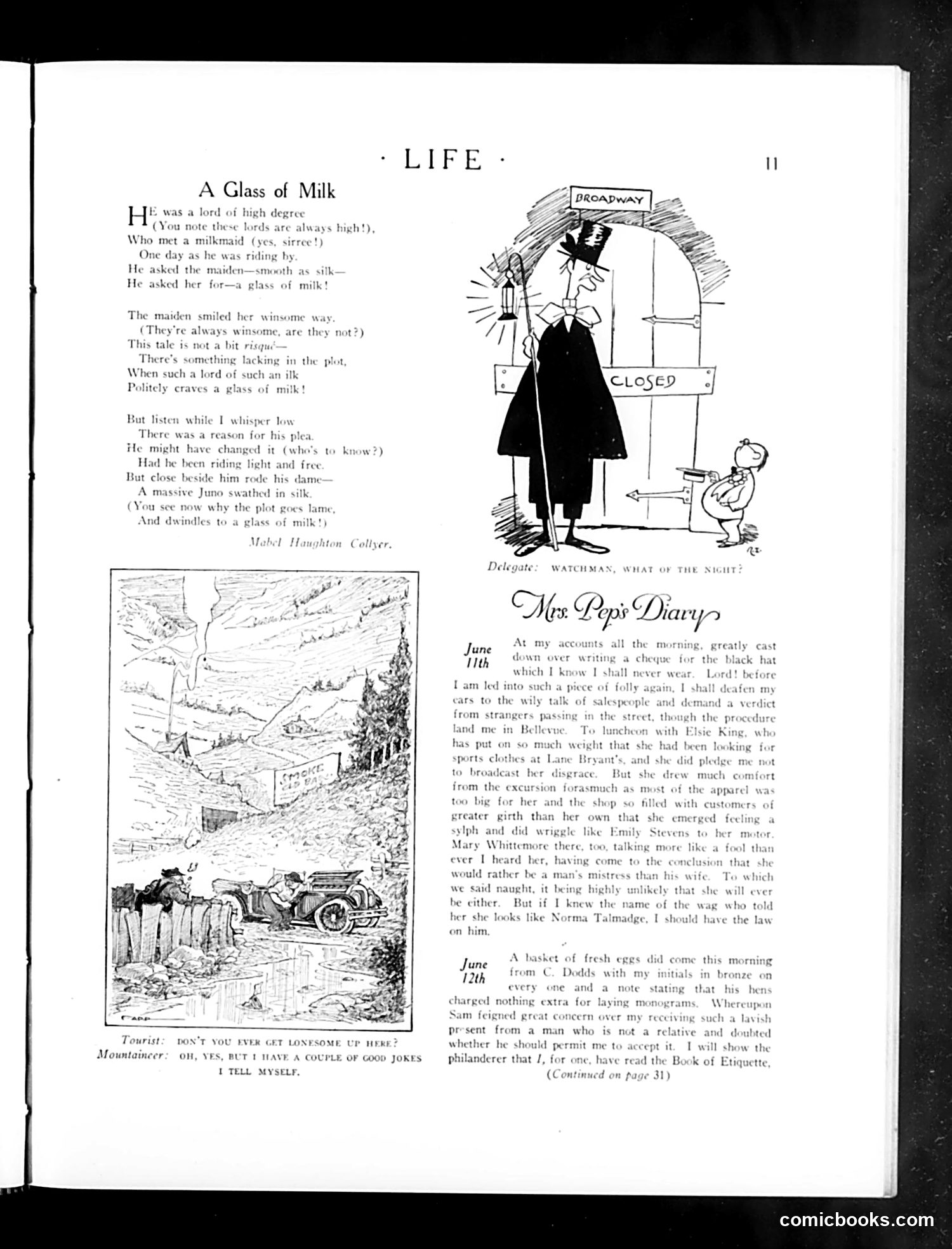
**"A Glass of Milk" Poem:** A humorous verse about a high-ranking nobleman who demands milk from a milkmaid. The joke plays on class absurdity—a lord of "high degree" craves something so ordinary. The poem suggests he could have "changed it" (presumably through his status), but instead rode beside the maid, creating an awkward situation that ends with him getting milk, not romance. It's satirizing aristocratic pretension and deflating pomposity through mundane reality. **"Mrs. Pep's Diary" Column:** A society gossip entry dated June 11th-12th describing wealthy women's social activities—purchasing clothes, attending luncheons, discussing etiquette. It satirizes upper-class women's shallow preoccupations with fashion, social status, and appearing respectable while engaging in frivolous behavior. **The Cartoons:** A "Broadway Closed" sketch mocks theatrical shutdown; a mountain scene depicts tourists and guides, likely satirizing tourist behavior or commercialism.
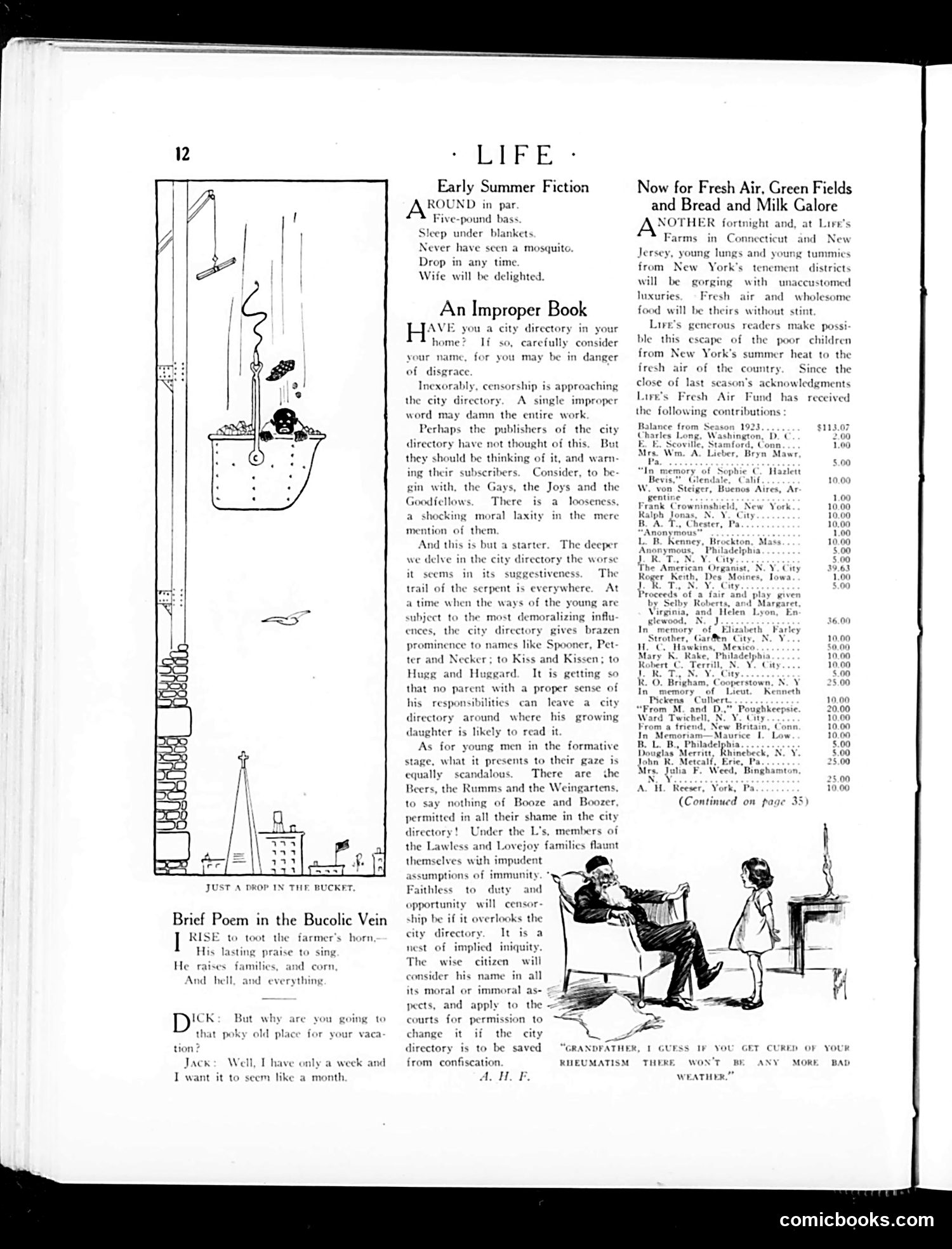
This page contains three distinct pieces: 1. **"Just a Drop in the Bucket"** (left): A cartoon illustrating the idiom literally—showing someone dropping liquid into a bucket, presumably to convey futility or insignificance. 2. **"Brief Poem in the Bucolic Vein"** (bottom left): A short satirical poem about a farmer's son who "rises families, and corn / And hell, and everything." It mocks rural simplicity. 3. **"An Improper Book"** (center-right): A satirical essay criticizing city directories for including names of disreputable people (Spooner, Petticoat, Necker, Kisses, etc.). The author argues this compromises moral standards and suggests censorship would be appropriate—satire of both directory publishers and censorship advocates. 4. **Right side illustration**: Shows an adult and child, with the caption about rheumatis—unfinished text, appears to be advertising or medical content. The page primarily satirizes American social pretensions and gatekeeping around "proper" society.
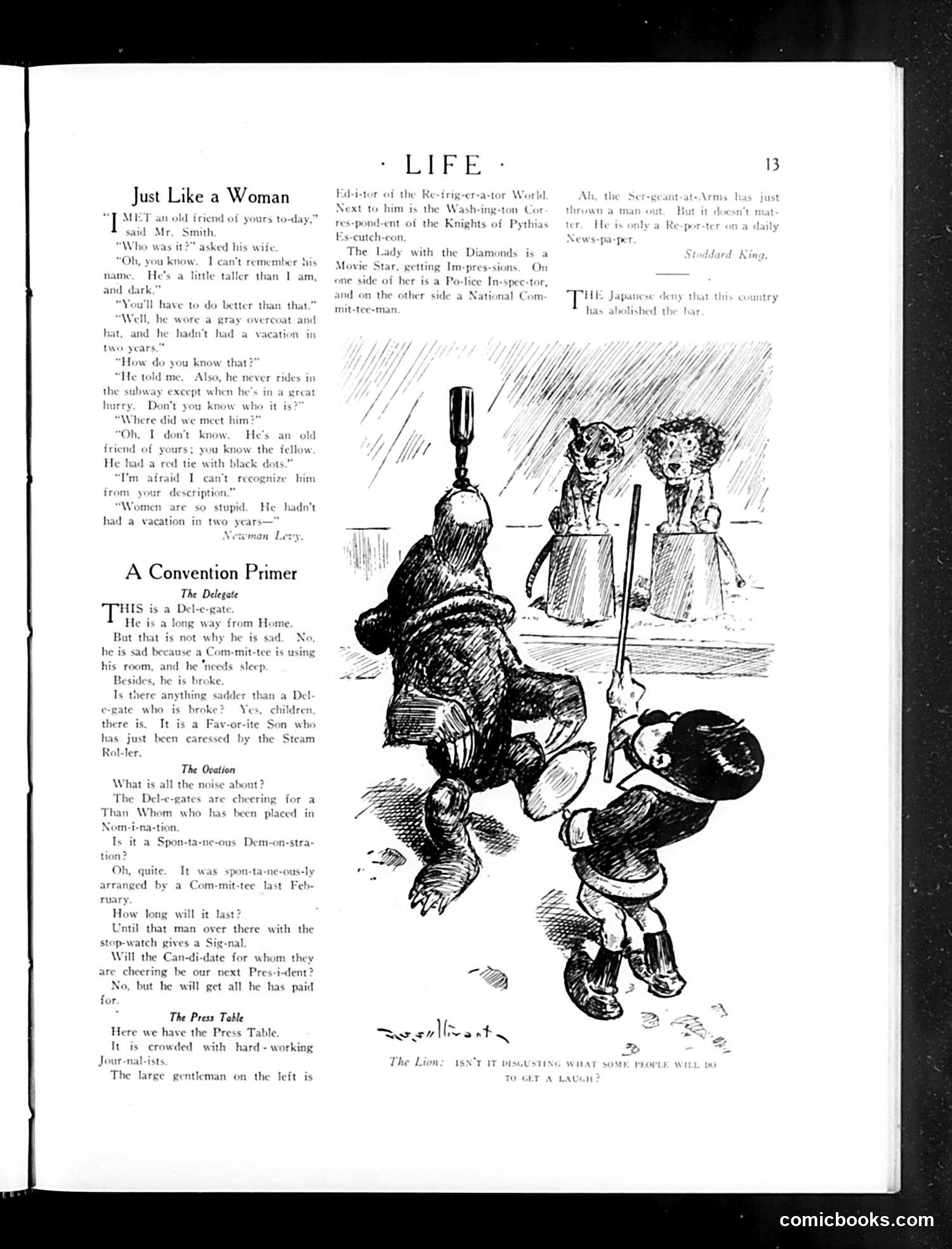
This page contains satirical commentary on early 20th-century American political conventions and social customs. "A Convention Primer" uses mock-serious descriptions of convention attendees—"The Delegate" (a broke, tired participant), "The Orator" (discussing a "Spon-ta-ne-ous Dem-on-stra-tion"), and "The Press Table" (crowded journalists). The main illustration depicts anthropomorphic animals—likely a bear and other creatures—in what appears to be a chaotic scene. The caption "The Lion: ISN'T IT DISGUSTING WHAT SOME PEOPLE WILL DO TO GET A LAUGH?" suggests the satire targets absurd behavior at conventions or public gatherings. The upper sections include snippets about women's observations, adding social commentary alongside the political satire. The humor relies on readers' familiarity with contemporary convention culture and political theater.
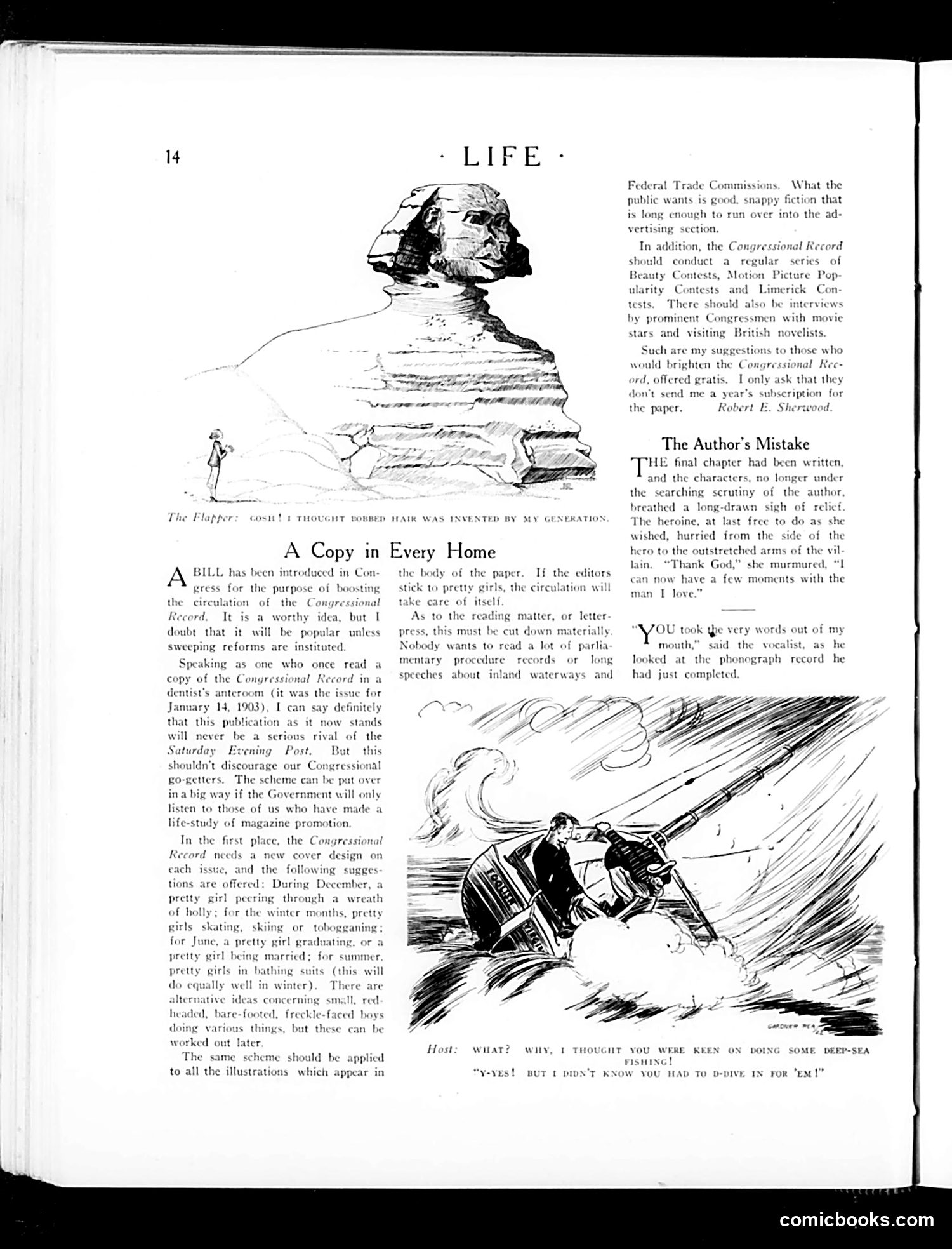
This page contains two distinct pieces: **"A Copy in Every Home"** argues for distributing the *Congressional Record* more widely. The author satirizes Congress's legislative proposals—suggesting they add entertainment value (beauty contests, movie star interviews, limerick competitions) to boost readership. The satire critiques the *Congressional Record* as tediously dull, comparing it unfavorably to the *Saturday Evening Post*. **"The Author's Mistake"** is a short story excerpt about a writer who finishes her novel and briefly finds romantic companionship. The accompanying illustration shows a couple in a boat, humorously captioned with dialogue about unexpected deep-sea fishing. Both pieces employ light satirical humor typical of Life's editorial voice—poking fun at bureaucratic tedium and literary pretension.
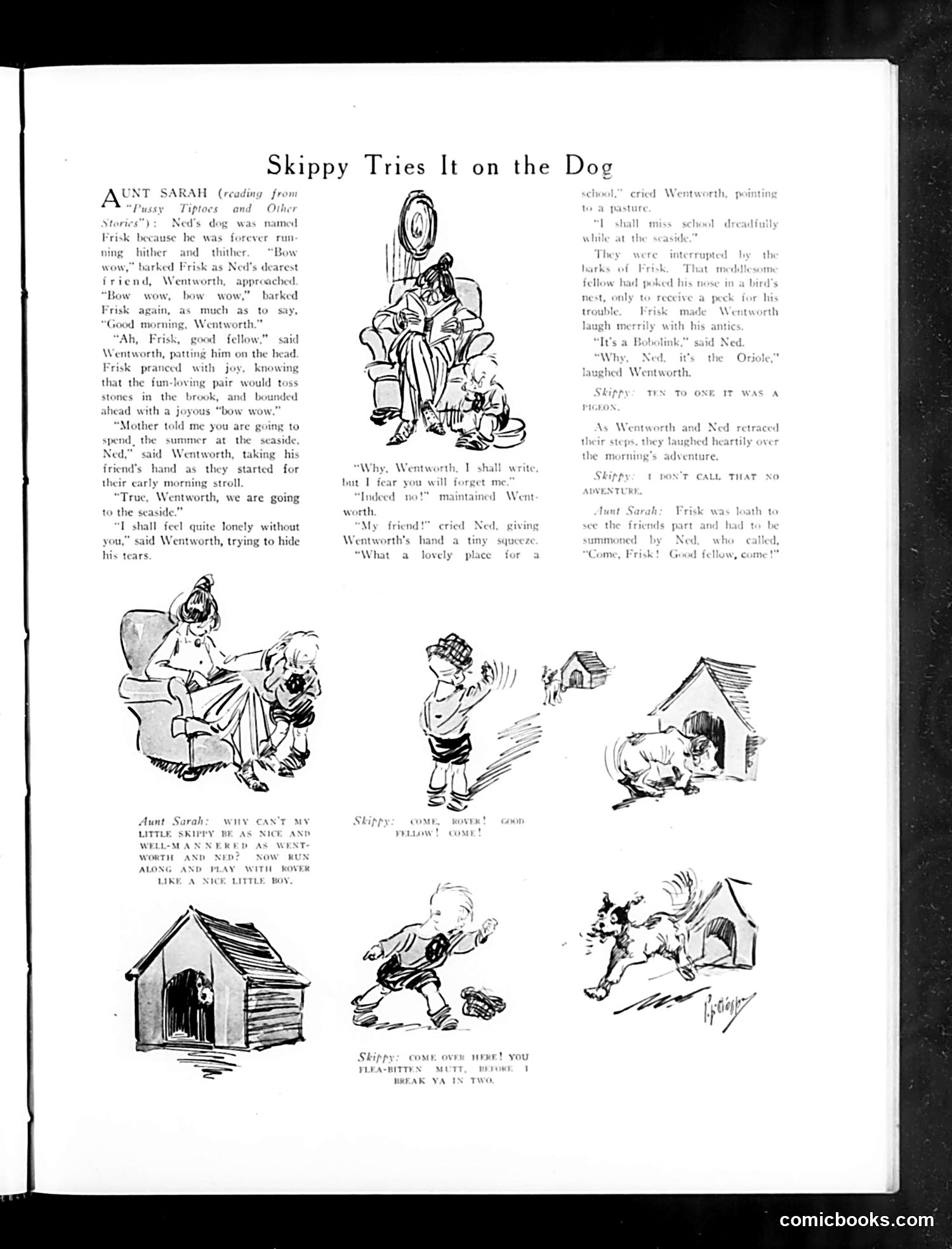
This is a children's story illustrated with comic panels, not political satire. It concerns a character named Skippy (a small boy) and his interactions with friends Aunt Sarah, Ned, and Wentworth, centered around a dog named Frisk. The narrative follows Skippy attempting to train or play with the dog, with dialogue showing typical childhood concerns about friendship and summer activities. The comic panels depict domestic scenes: children with the dog, a doghouse, and various playful interactions. This appears to be entertainment content for young readers rather than social commentary. The humor derives from children's antics and the dog's behavior rather than political or satirical messaging.
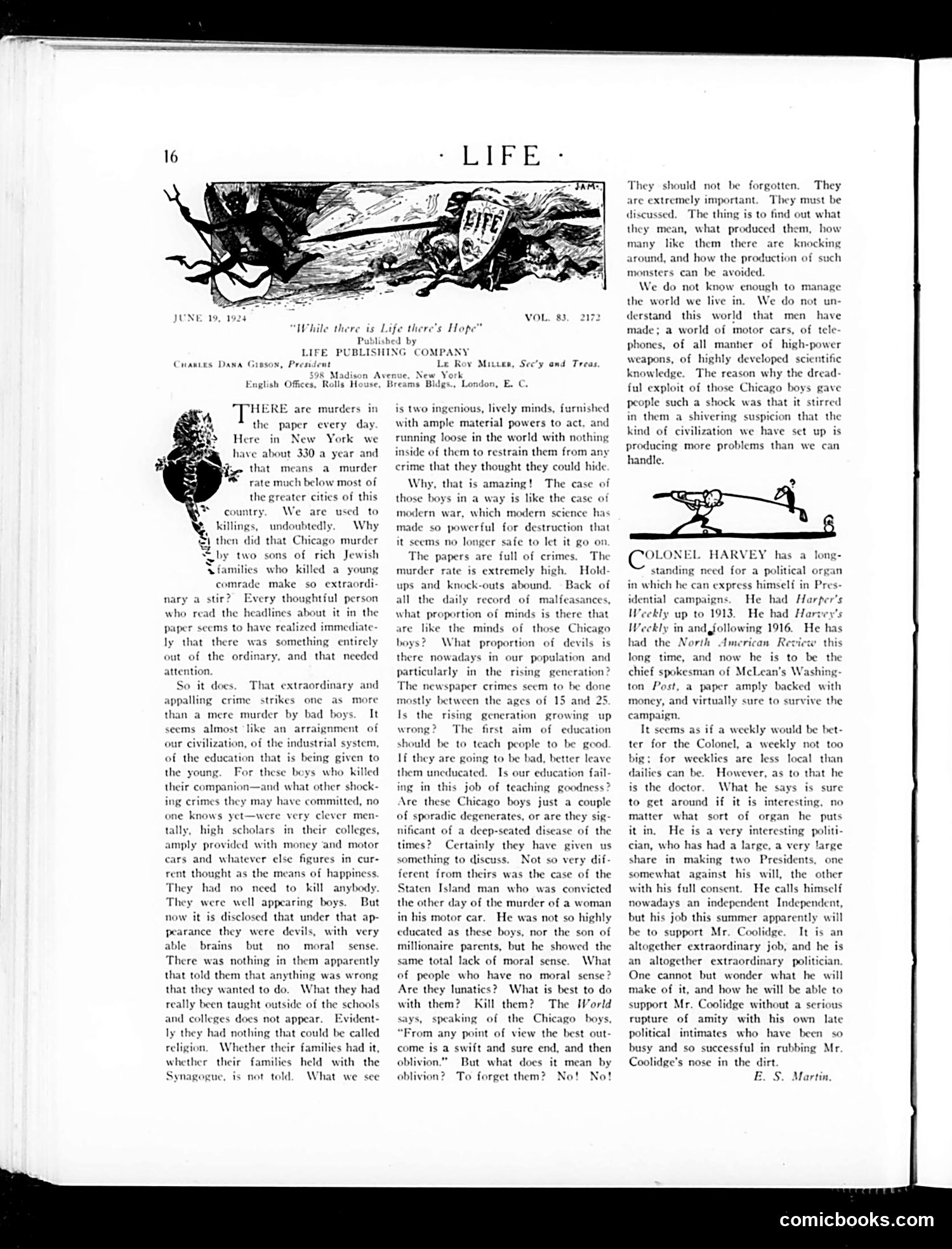
This editorial responds to the Leopold-Loeb murder case—two wealthy, intelligent Chicago boys who killed a young companion. The author uses their crime to explore a disturbing paradox: these murderers were well-educated, privileged, and intellectually brilliant, yet utterly amoral. The satirical point targets the industrial civilization that produces such "monsters." The boys had everything society promised would bring happiness—money, education, good appearance—yet possessed no moral restraint. The author questions whether modern education teaches goodness, whether such criminals are isolated degenerates or symptomatic of deeper societal disease, and challenges the press's suggestion to simply "forget" them. The cartoon (depicting a skeletal figure labeled "Life") visually reinforces the headline's dark irony: hope exists only where life exists, yet modern civilization seems to generate perfectly functional but morally empty individuals capable of terrible acts.
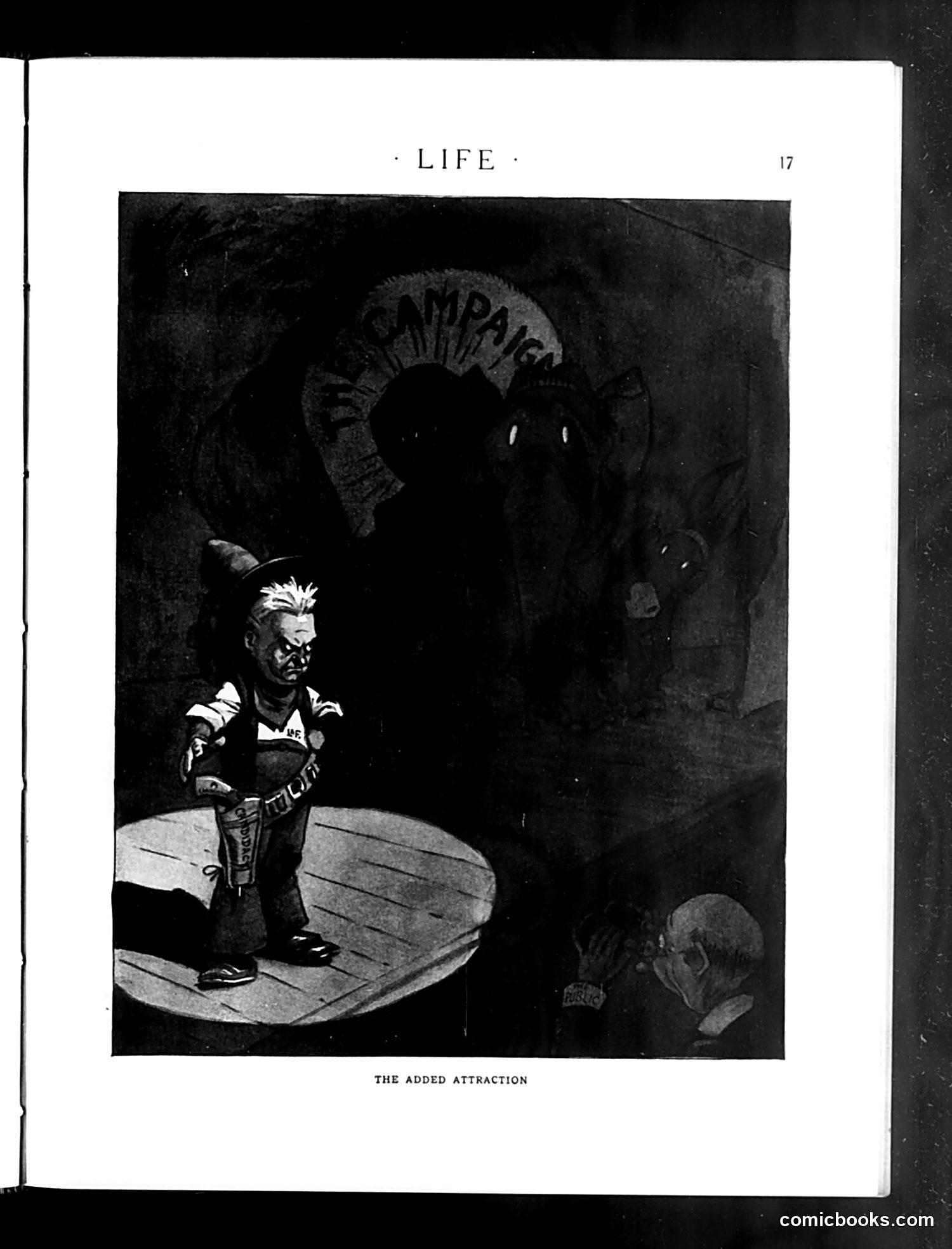
This political cartoon depicts a small, caricatured military figure (appearing to be a dictator or authoritarian leader based on the exaggerated facial features and military uniform) standing spotlit on stage. He's positioned before what appears to be an audience or gathering in darkness. The imagery suggests he is being presented as entertainment or spectacle—a theatrical "added attraction"—rather than as a serious political figure. The satire likely critiques how media or political systems sensationalize and trivialize authoritarian leaders, transforming them into carnival-like curiosities for public consumption rather than addressing the genuine threat they represent. The contrast between the isolated, illuminated figure and the shadowy crowd emphasizes how such leaders are simultaneously elevated and rendered absurd through public spectacle.
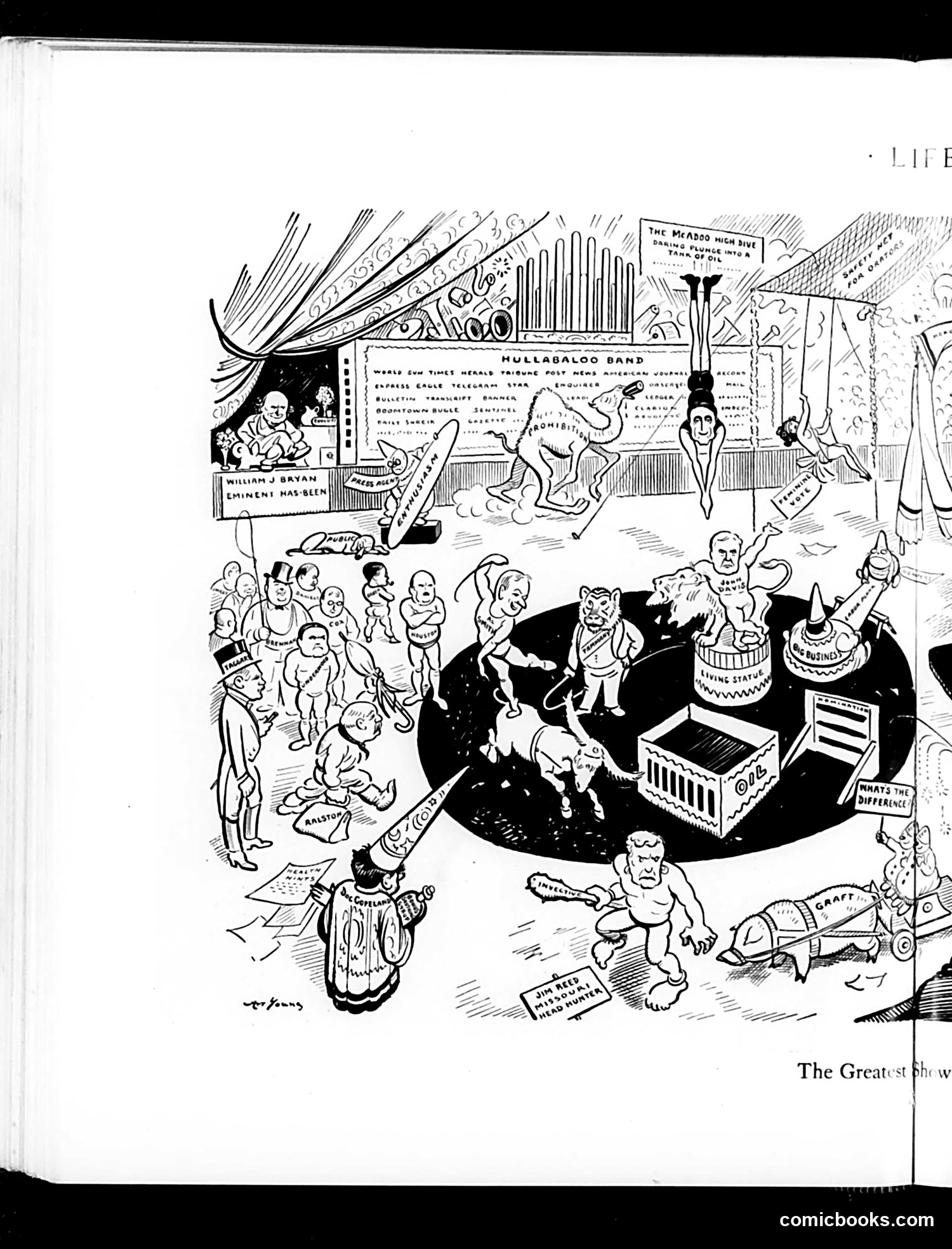
This appears to be a satirical carnival or circus scene from early 20th-century *Life* magazine. The central dark circular area depicts what looks like political or social commentary through carnival attractions and performances. Visible text references include "William J. Bryan" (likely the politician), "Hullabaloo Band," and "The Meadow Men Dive." Various caricatured figures engage in exaggerated activities—acrobatics, performances, and spectacles. The cartoon likely satirizes American political figures or social movements of its era, using the circus metaphor to mock their theatricality or public appeal. Bryan's inclusion suggests this targets 1890s-1900s politics. The "greatest show" title reinforces the comparison between politics and entertainment, suggesting politicians were viewed as carnival performers rather than serious statesmen. The exact satirical target remains unclear without additional publication date context.
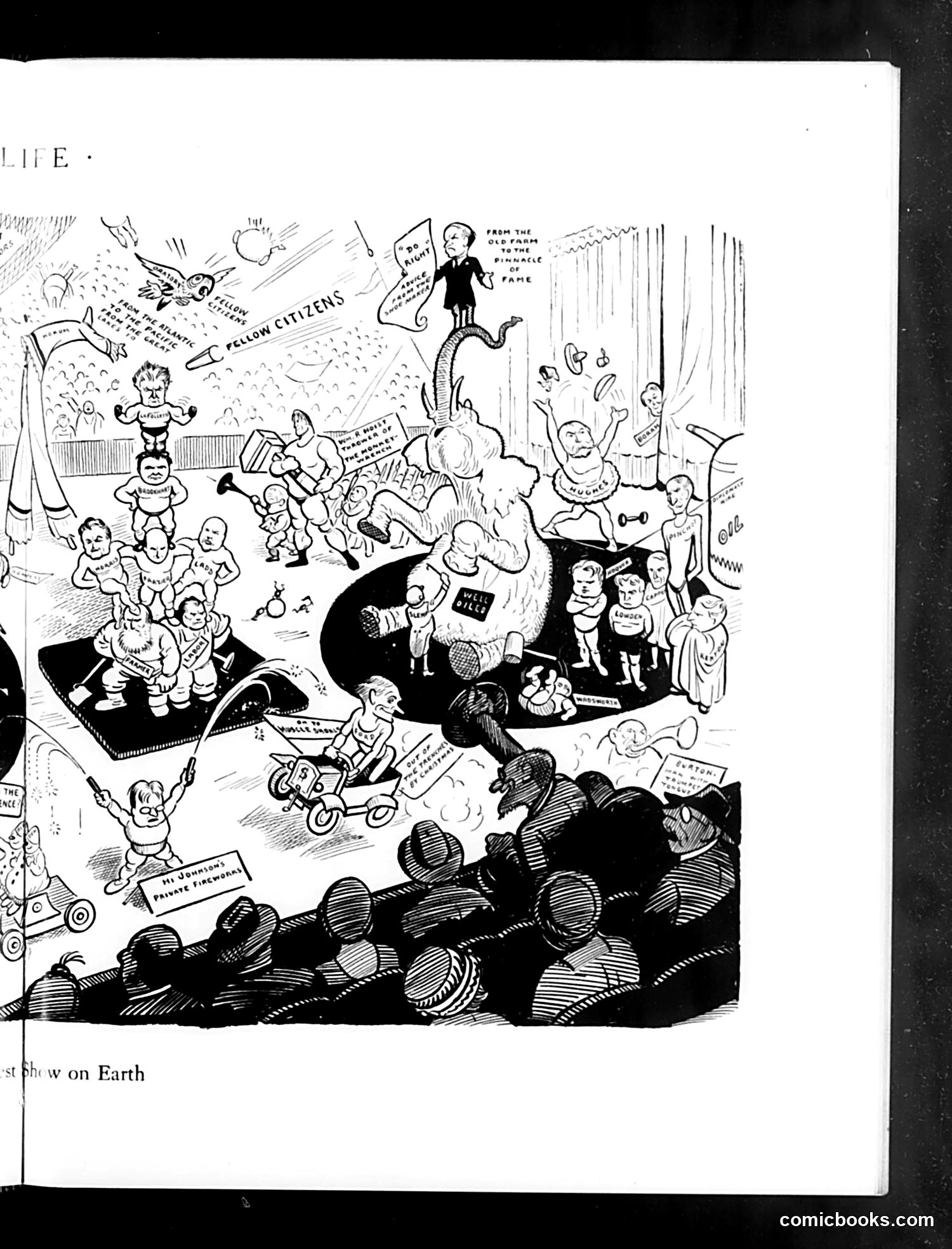
This satirical cartoon depicts a chaotic circus or carnival scene populated by numerous figures engaged in various activities—acrobatics, performance, and spectacle. The image appears to critique American celebrity culture and public fascination with entertainment and personalities. Key visible elements include: - A snake charmer or performer atop a serpent (center-top) - Multiple acrobats and circus performers - Crowds of onlookers watching the spectacle - Various labels and signs (text unclear in reproduction) - Heavily shaded figures at bottom, possibly representing the masses or audience The cartoon likely satirizes how Americans are distracted by entertainment and personalities rather than substantive matters. The circus metaphor suggests frivolity masking serious concerns. The exact targets remain unclear without legible text labels visible in this reproduction.
This article discusses the cultural hierarchy of humor and entertainment in 1920s America. The author examines critic Gilbert Seldes' book *The Seven Lively Arts*, which praises popular artists (Ring Lardner, Irving Berlin, Joe Cook, George Herriman) typically considered "lowbrow." The satire targets intellectual snobbery: highbrow critics initially dismiss popular works, then later "discover" merit in them and claim social elevation by championing lowbrow art—a performative gesture the author mocks as patronizing. The piece argues these artists are actually sophisticated: Lardner's satire of lowbrow mentality is too subtle for average readers; Herriman and Cook possess genuine intellectual merit. Therefore, Seldes' appreciation is legitimate, not slumming. The implicit joke: true highbrows recognize quality everywhere, while pseudo-intellectuals maintain artificial class distinctions. The article defends popular entertainment against pretentious gatekeeping.
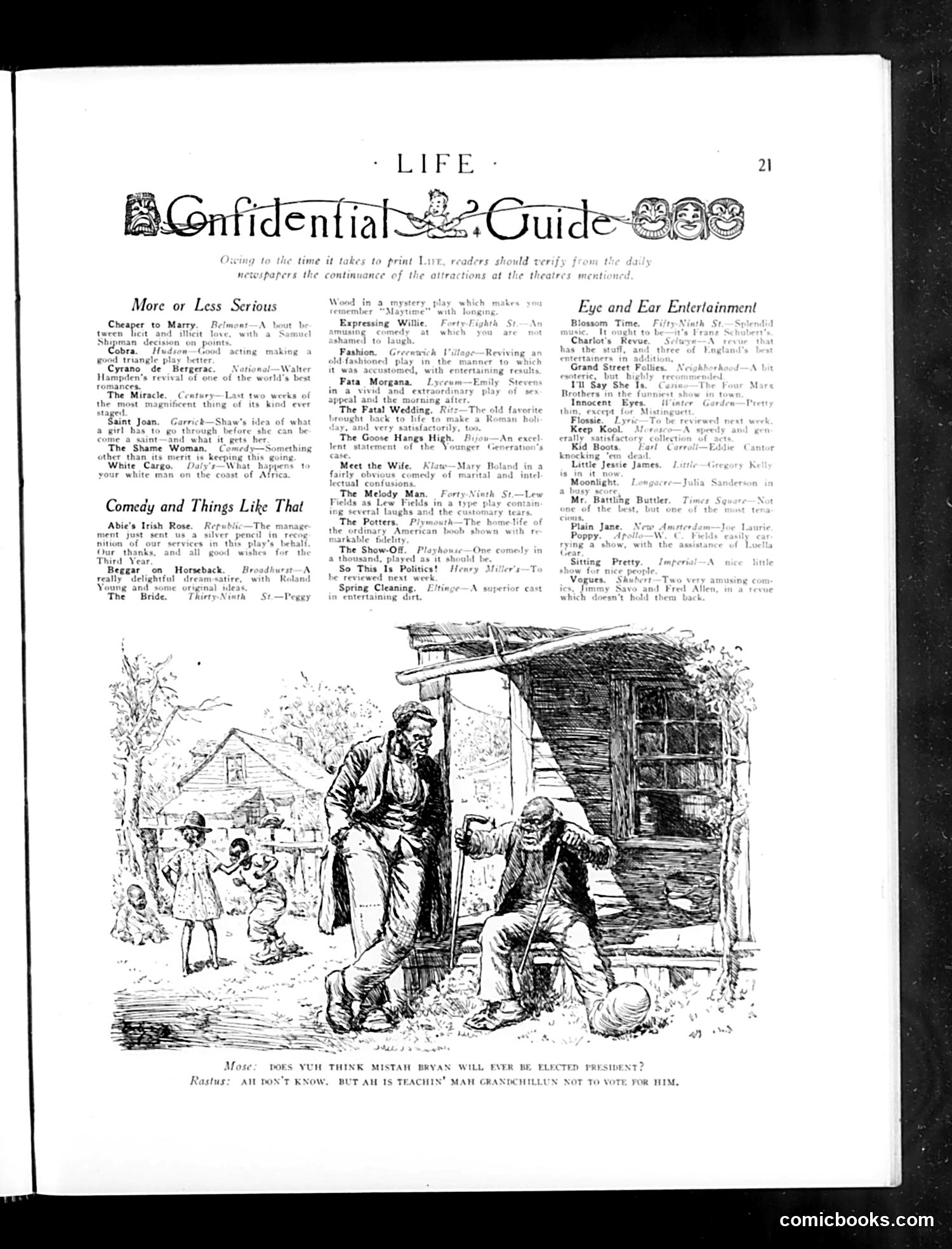
This cartoon depicts two Black men in rural/poverty conditions discussing William Jennings Bryan's presidential prospects. The dialogue reveals the satire's point: while one character expresses uncertainty about Bryan's electoral viability, the other states he's actively teaching his grandchild *not* to vote for him. The joke targets Bryan—a three-time presidential candidate known for populist appeals—by suggesting that even those in the poorest circumstances recognize his unsuitability and actively work against him. The rural setting and dialect humor (typical of period satire, though offensive by modern standards) emphasizes that Bryan's rejection comes from those with the least political power, making his unpopularity seemingly universal. The cartoon likely dates to one of Bryan's campaigns (1896, 1900, or 1908), using working-class opposition to mock his political viability.
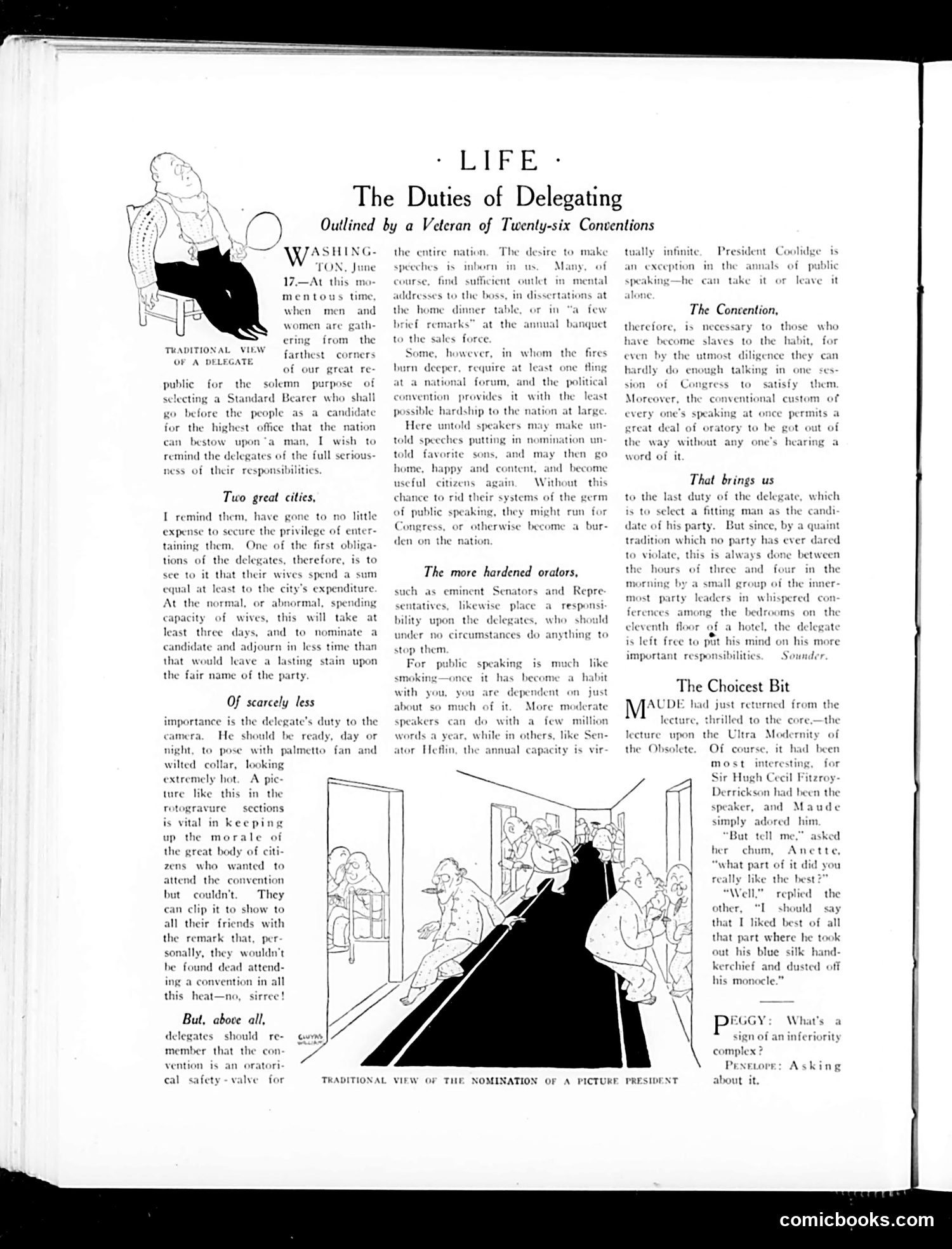
This satirical article, attributed to a "veteran of twenty-six conventions," mocks the ceremonial duties of political convention delegates through exaggerated advice. The cartoons illustrate traditional delegate behaviors: posing formally for photographs in wilted formal wear, and participating in hotel-room nomination proceedings for "favorite sons" candidates. The satire targets several conventions: 1. **Wives' spending**: Delegates should ensure their wives spend lavishly in host cities to offset convention expenses. 2. **Photography duty**: Delegates must pose uncomfortably for rotogravure photos to show folks back home, maintaining morale. 3. **Speech-making compulsion**: The article mocks how national conventions serve as pressure-relief valves for would-be orators, allowing minor politicians to deliver countless nominating speeches for obscure "favorite son" candidates. 4. **Backroom deals**: The final section hints that actual candidate selection happens in private hotel negotiations, not on the convention floor—delegates' public votes are predetermined theater. The piece satirizes the performative, ritualistic aspects of American political conventions rather than their substantive democratic functions.
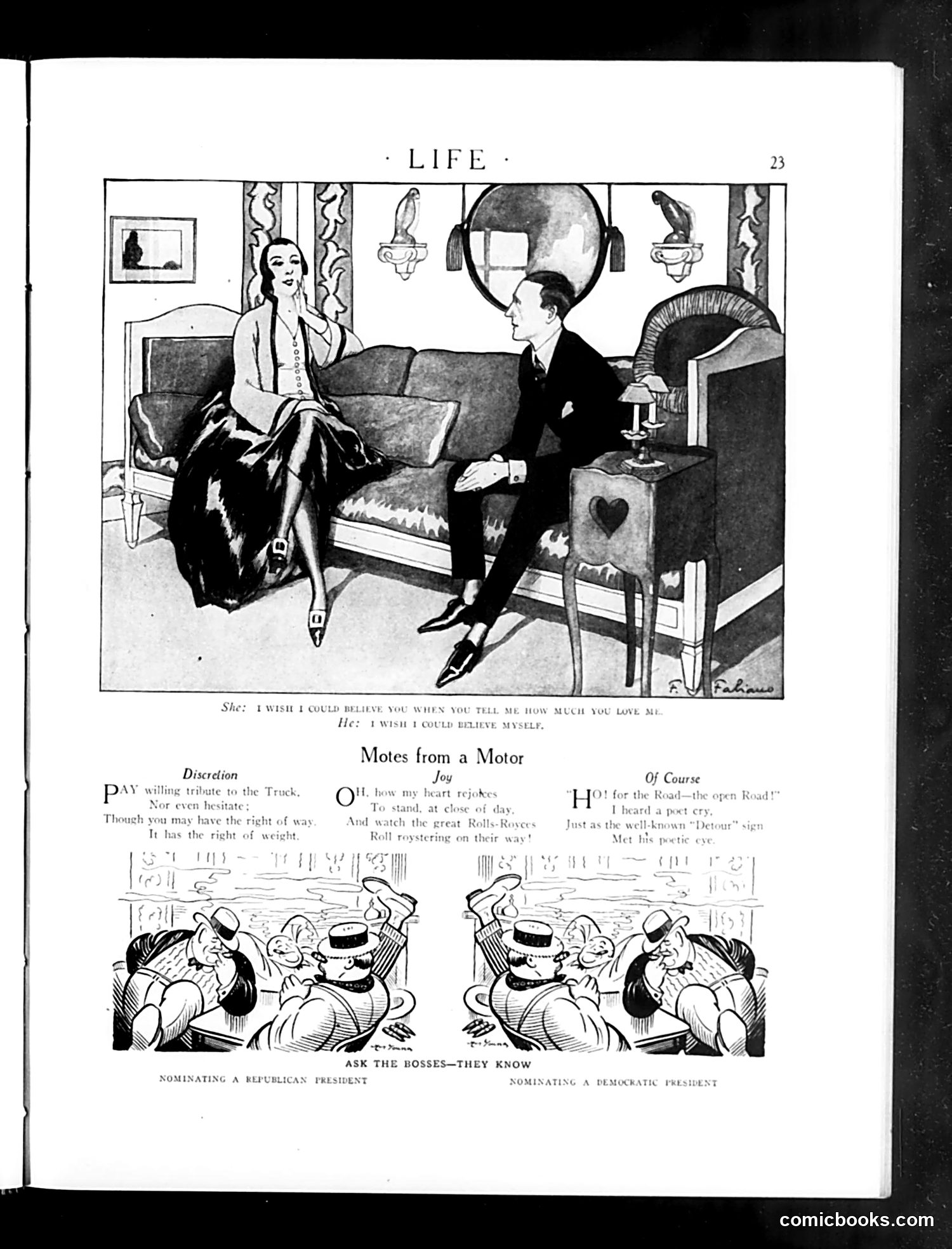
This page features two distinct satirical sections: **Top cartoon**: A romantic domestic scene where a woman and man sit on a couch. The captions express romantic doubt—she wishes she could believe his declarations of love; he wishes he could believe himself. This mocks relationship insecurity and romantic dishonesty in 1920s dating culture. **Bottom cartoons**: Two panels titled "Ask the Bosses—They Know" depict cartoon figures (appearing to be working-class men or caricatures) discussing political nominations. One panel references nominating a Republican president; the other, a Democratic president. The satire suggests that ordinary workers or "bosses" lack genuine political knowledge or agency—they're portrayed as buffoonish decision-makers, mocking democratic participation and suggesting wealthy or powerful figures actually control political outcomes.
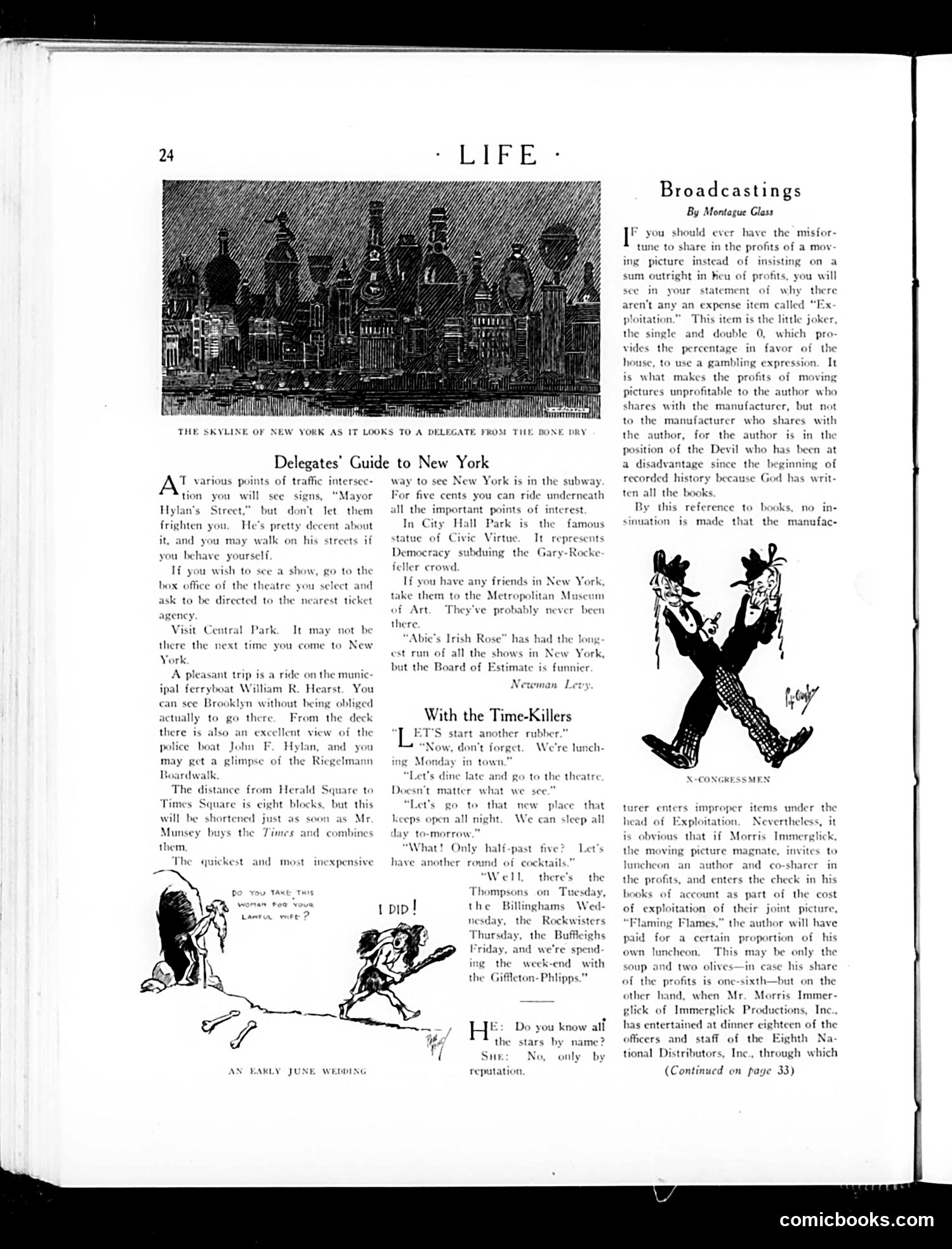
This page satirizes New York City and the movie industry circa the 1920s. The top section, titled "Delegates' Guide to New York," mocks a "bone dry" delegate—someone from a Prohibition-era region where alcohol is banned—with tongue-in-cheek tourist advice. References to Mayor Hylan and newspaper magnates (Munsey, Hearst) were recognizable contemporary figures. The joke hinges on NYC's lawlessness and corruption during Prohibition. The "Broadcastings" column by Montague Glass attacks studio accounting practices, specifically "exploitation expenses"—fake costs studios used to ensure authors and profit-sharers received nothing, despite contracts promising a cut. The author argues manufacturers exploited creative people systematically. This was standard Hollywood practice: studios would inflate costs to zero out profit distributions. The cartoon illustrations show socialites making dinner plans and a wedding scene, reinforcing themes of leisure-class excess and urban sophistication that contrast with the provincial "bone dry" delegate.
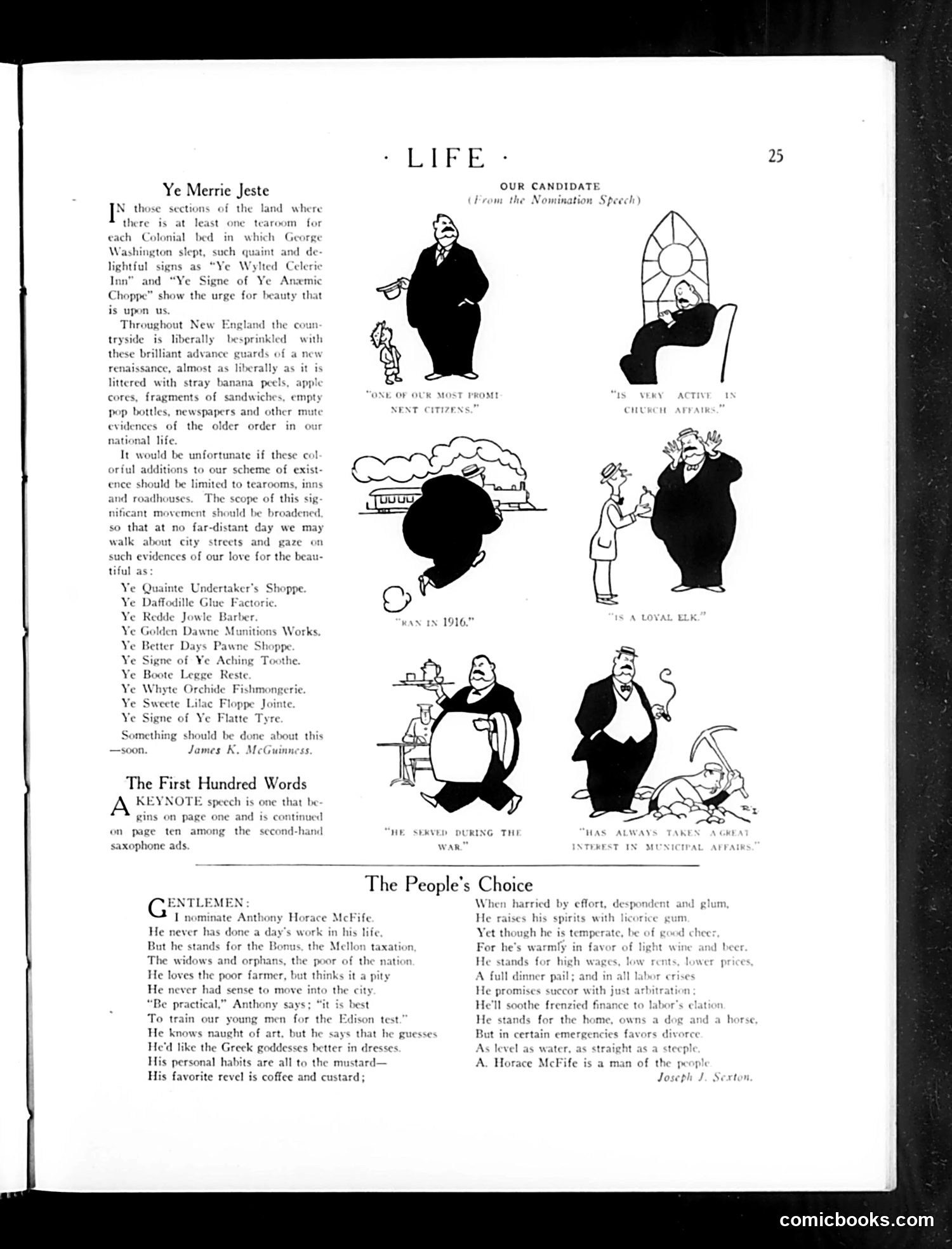
This 1916 *Life* magazine page satirizes two targets: **"Ye Merrie Jeste"** mocks the Colonial Revival fad—tearoom owners adopting fake-archaic "Ye Olde" names (like "Ye Wylted Celerie Inn"). The article jokes that this quaint aesthetic trend, while confined to tearooms, should spread absurdly to all businesses: undertakers, barbershops, and tire repair shops with ridiculous pseudo-medieval names. It's satire on affectation and commercialized nostalgia. **"The People's Choice"** presents Anthony Horace McFife, apparently a political candidate, through cartoons showing his character traits: he's practical, pro-labor (supports high wages, low rents), favors home ownership, and represents "the people." The accompanying verse endorses him as a man of common sense and populist values. This appears to be campaign material or political endorsement disguised as humorous character sketches—advocacy wrapped in cartoon form.
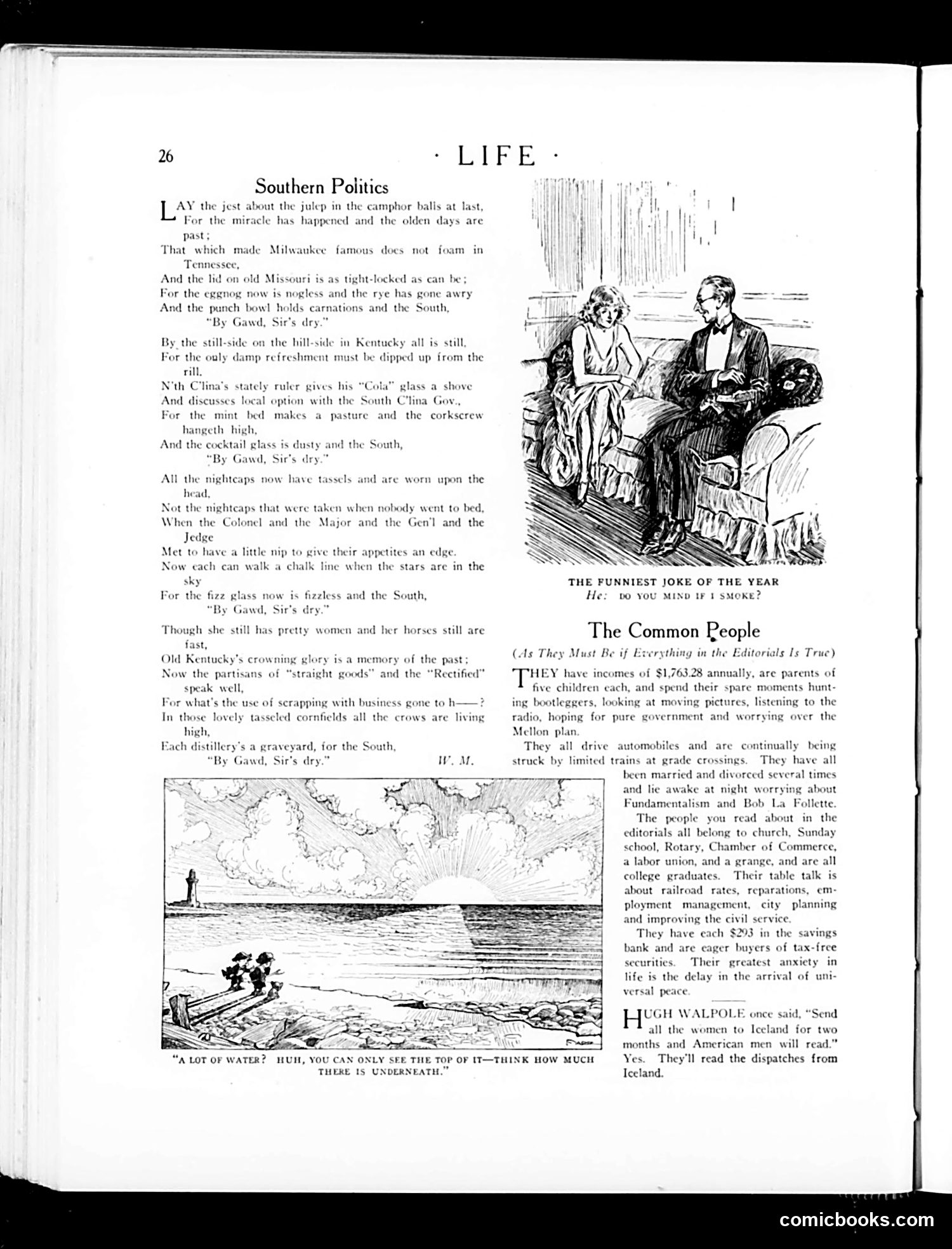
This page contains two distinct satirical pieces from *Life* magazine (likely 1920s-era, during Prohibition). **"Southern Politics"** (poem with illustration): A humorous lament about Prohibition's effects on the American South. The piece mocks how Southern society—traditionally associated with whiskey, juleps, and casual drinking culture—has been forced "dry" by Prohibition laws. References to "Milwaukee famous" (brewing beer), Kentucky stills, and mint juleps emphasize how deeply alcohol was embedded in Southern identity and hospitality. The repeated refrain "By Gawd, Sir's dry" captures the resigned frustration. **"The Common People"** (satirical commentary): This mocks the disconnect between editorial moralizing in newspapers and average Americans' actual lives. The editors preach about virtuous citizenship, yet the piece sarcastically suggests ordinary people earning modest incomes ($1,763 annually) somehow manage to own cars, support large families, hunt bootleggers, worry about international reparations and philosophical movements (Fundamentalism, La Follette's politics), and maintain savings accounts—an obviously absurd portrait highlighting editorial hypocrisy about who "the common people" supposedly are.
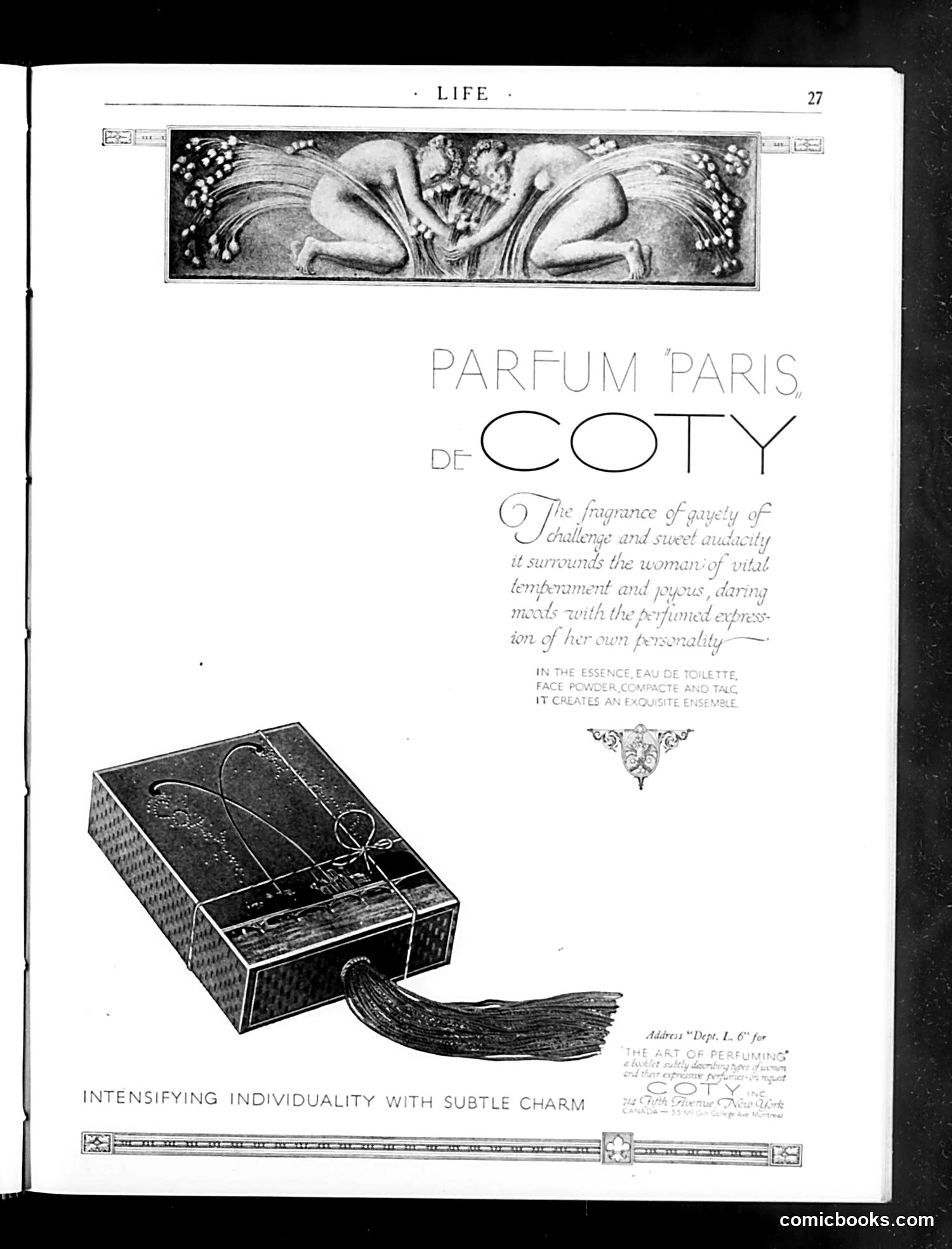
This page is primarily an **advertisement for Coty perfume**, not a political cartoon or satire. The ad promotes "Parfum 'Paris' de Coty," describing it as a fragrance for women of "vital temperament and joyous, daring moods." The decorative elements include classical cherub imagery at the top and an ornamental box illustration showing the perfume packaging with a tassel. The tagline "Intensifying Individuality with Subtle Charm" emphasizes the product's appeal to modern women seeking personal expression. This appears to be from the 1920s era based on the typography and design aesthetic. The ad targets affluent female readers of *Life* magazine, positioning the fragrance as a luxury good that conveys personality and sophistication rather than mere hygiene.
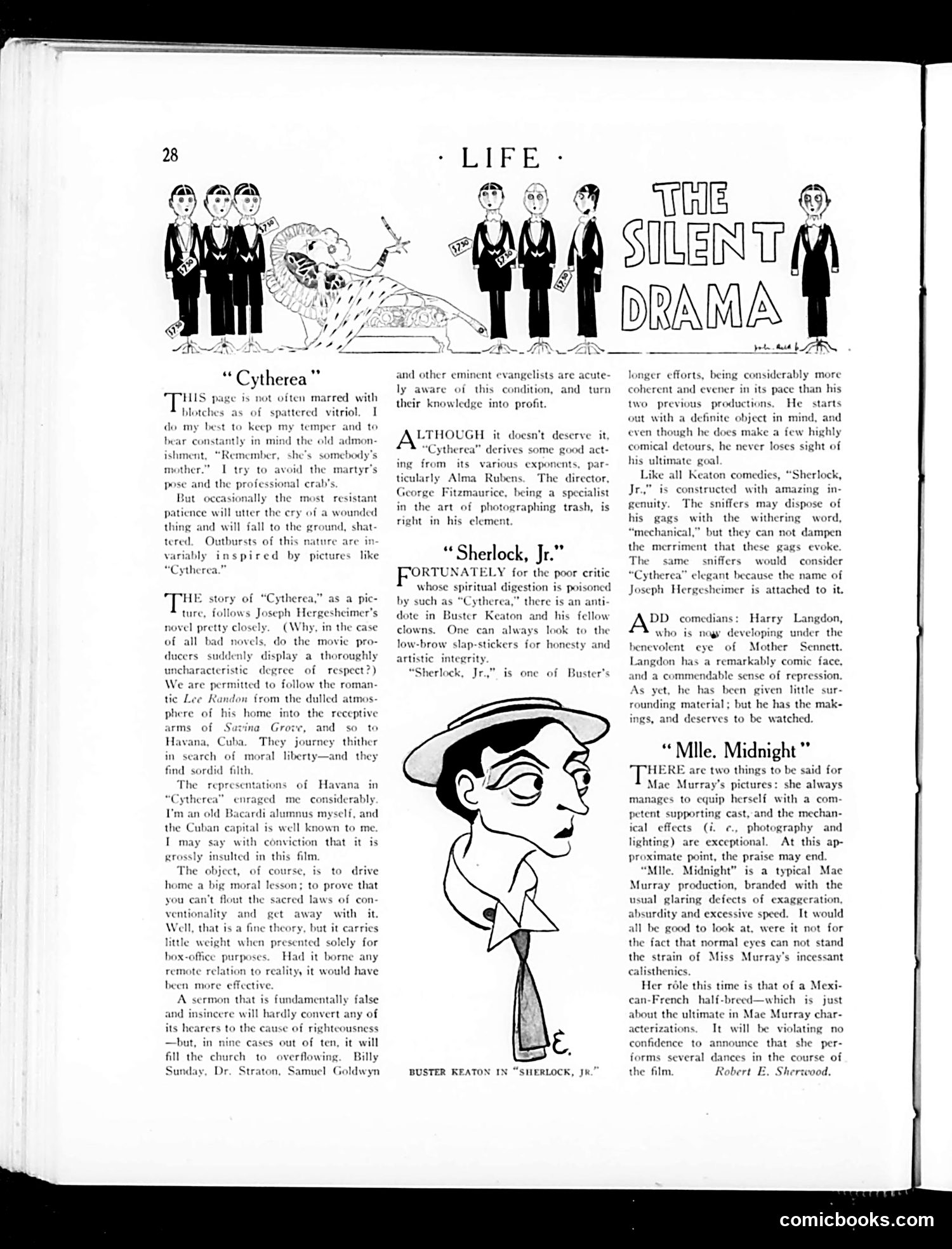
This page reviews three silent films. The header cartoon satirizes cinema's moral pretensions: filmmakers (shown in suits) claim to teach morality through entertainment, but critics see this as hypocritical box-office manipulation. **"Cytherea"** (based on Joseph Hergesheimer's novel) is attacked for insulting Cuba and Havana with sordid depictions while claiming to teach moral lessons about infidelity. The critic argues such "fundamentally false" sermons fail to convert audiences—they're just packaging vice for profit. **"Sherlock, Jr."** receives praise: Buster Keaton's comedy is coherent and genuinely funny, with "amazing ingenuity" in its gags, unlike pretentious films trading on famous authors' names. **"Mlle. Midnight"** (a Mae Murray production) is dismissed as typical Murray fare: well-photographed but marred by exaggeration and absurdity. The satire critiques cinema's dual hypocrisy: moralizing while exploiting vice, and claiming artistic legitimacy through literary adaptation rather than honest entertainment.
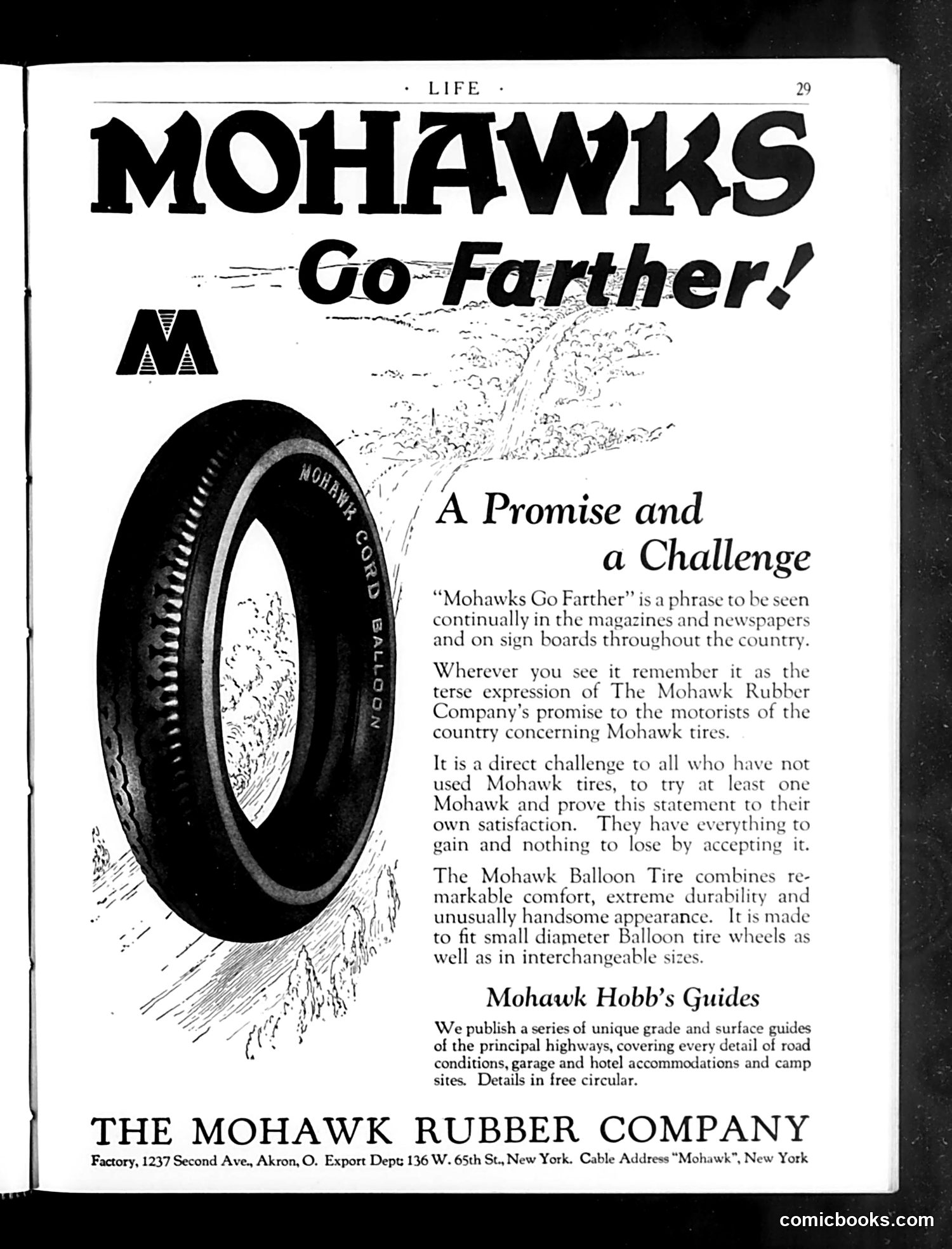
This is not a cartoon or satire—it's a straightforward **advertisement for Mohawk Rubber Company tires**, published in *Life* magazine (likely 1920s-1930s based on style). The page features a large illustration of a tire and promotional text. The phrase "Mohawks Go Farther!" was the company's actual advertising slogan, appearing repeatedly in period media. The ad positions this as both a "promise" (quality claim) and "challenge" (inviting skeptical consumers to test the product themselves). The company highlights their "Balloon Tire" technology and offers free road guides covering highway conditions, accommodations, and campsites—practical tools for early automobile touring when road conditions varied dramatically by region. The factory locations (Akron, Ohio and New York) and cable address confirm this as genuine commercial advertising, not satire.
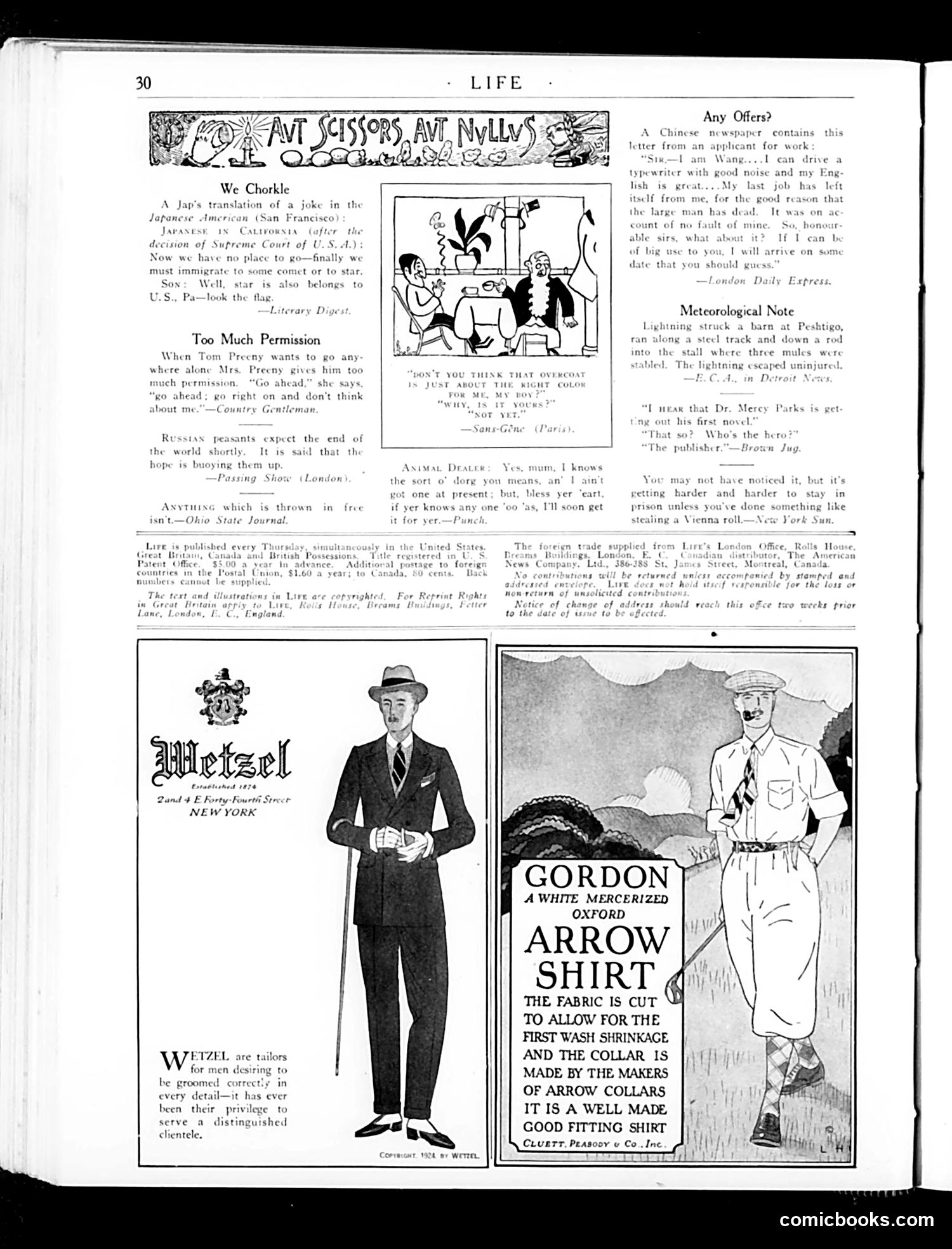
This page combines humor and advertising typical of early 20th-century Life magazine. **The Cartoons:** The main cartoon titled "We Chorkle" presents a domestic joke about a wife granting her husband excessive freedom ("Too Much Permission"). When Tom Preeny wants to go out alone, his wife Mrs. Preeny gives him permission so readily that he's puzzled—the humor lies in the reversal of typical domestic power dynamics, where husbands usually must ask permission. **The Advertisements:** Two product ads occupy the lower half. The Wetzel tailoring ad emphasizes precision craftsmanship for distinguished clientele. The Gordon Arrow Shirt ad highlights practical features (pre-shrunk fabric, quality collar construction), appealing to practical consumers. **Historical Context:** This reflects 1920s gender relations, domestic comedy conventions, and marketing approaches that stressed both craftsmanship and practical value rather than style alone.
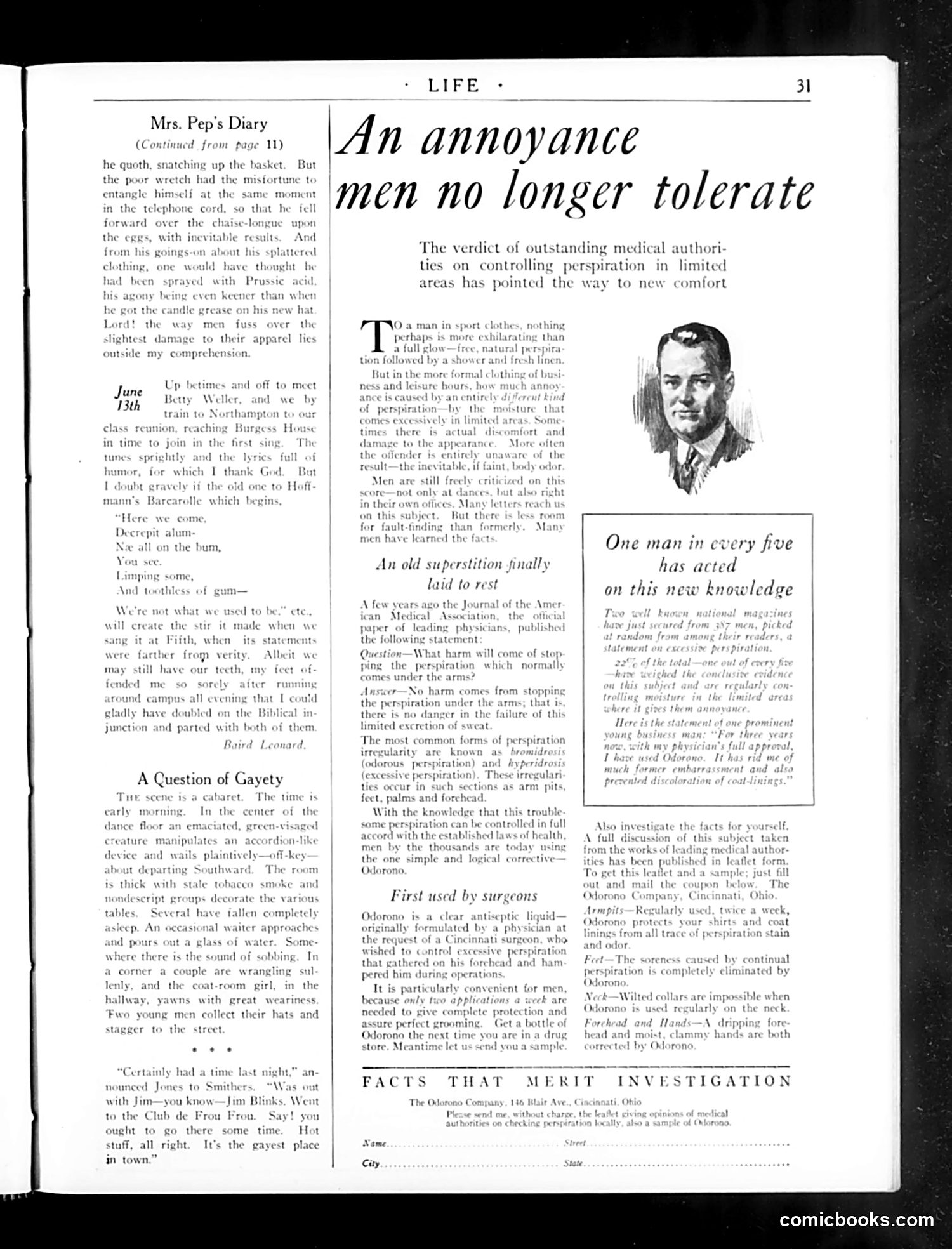
This page is primarily **advertising content** disguised as editorial material. The main feature is a full-page advertisement for **Odorono**, an antiperspirant product, presented under the guise of medical authority and scientific validation. The ad claims that "one man in every five" has discovered this new antiperspirant knowledge, citing endorsements from doctors and surgeons. It emphasizes that Odorono was "first used by surgeons" and presents testimonials from satisfied male users in business contexts. The sidebar features "Mrs. Pep's Diary" (a gossip column) and "A Question of Gayety" (a brief humorous anecdote about clubgoers), which appear designed to make the page feel like typical magazine content rather than pure advertising. The satire is implicit: the advertisement treats underarm perspiration as a serious social problem requiring medical intervention—a common early 20th-century marketing tactic that exploited anxieties about modernity and propriety to sell consumer products.
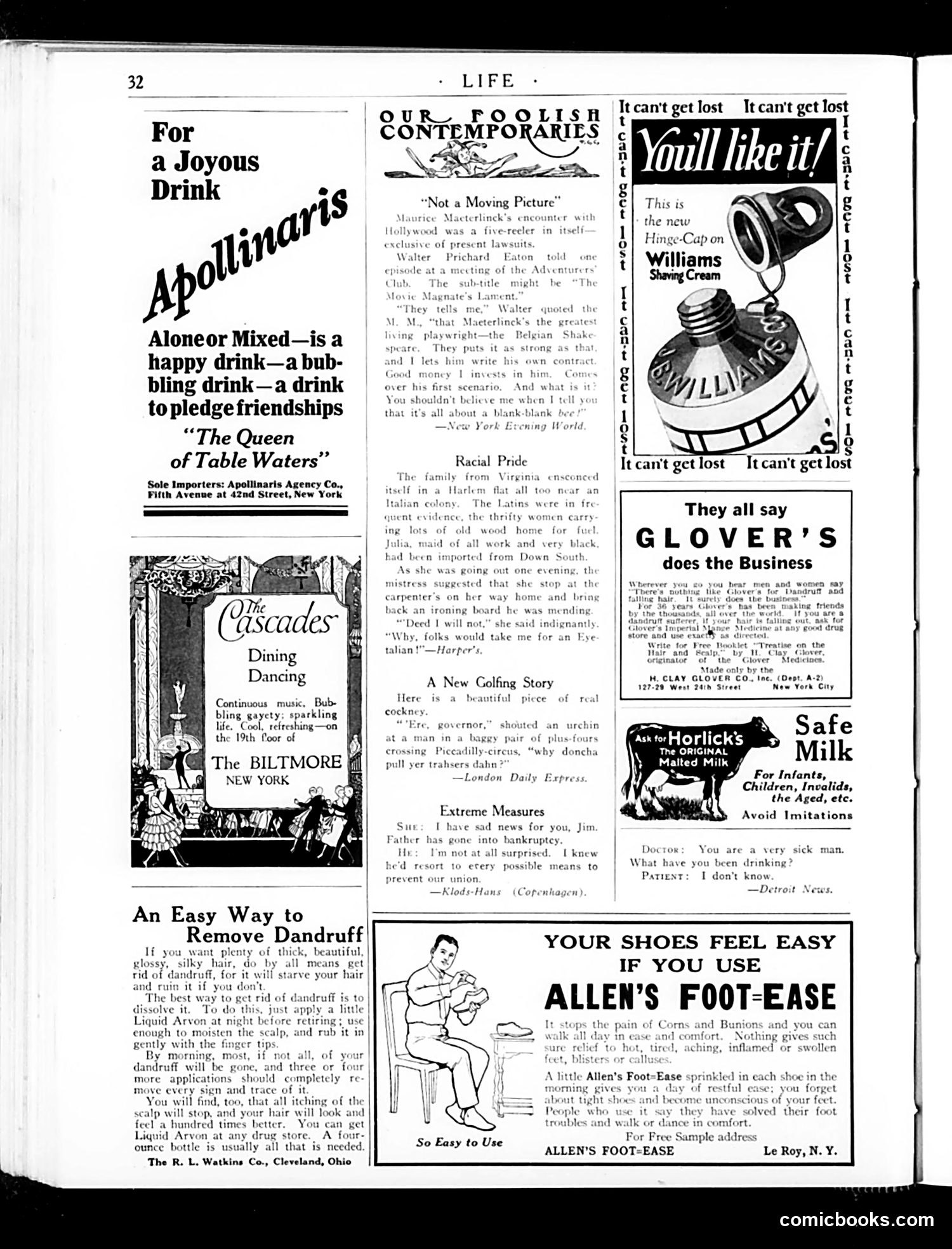
This is primarily an **advertising page** from Life magazine's satirical section "Our Foolish Contemporaries," which mocked notable figures and events of the era. The main satirical content includes brief humorous anecdotes: - **"Not a Moving Picture"**: A joke about Maurice Maeterlinck (Belgian playwright) being compared to a five-reel film by Hollywood standards—satirizing both Maeterlinck's pretension and Hollywood's commercial excess. - **"Racial Pride"**: A short anecdote about a Virginia family's social prejudices, poking fun at racial attitudes of the period. - **"A New Golfing Story"** and **"Extreme Measures"**: Brief comedic vignettes typical of Life's humor style. The remainder consists of period advertisements for Apollinaris water, The Biltmore hotel, Glover's (hair/skin products), Williams Shaving Cream, Horlick's Malted Milk, and Allen's Foot-Ease—products marketed to affluent readers concerned with grooming and social standing. The page reflects 1920s consumer culture and social attitudes now considered dated or offensive.
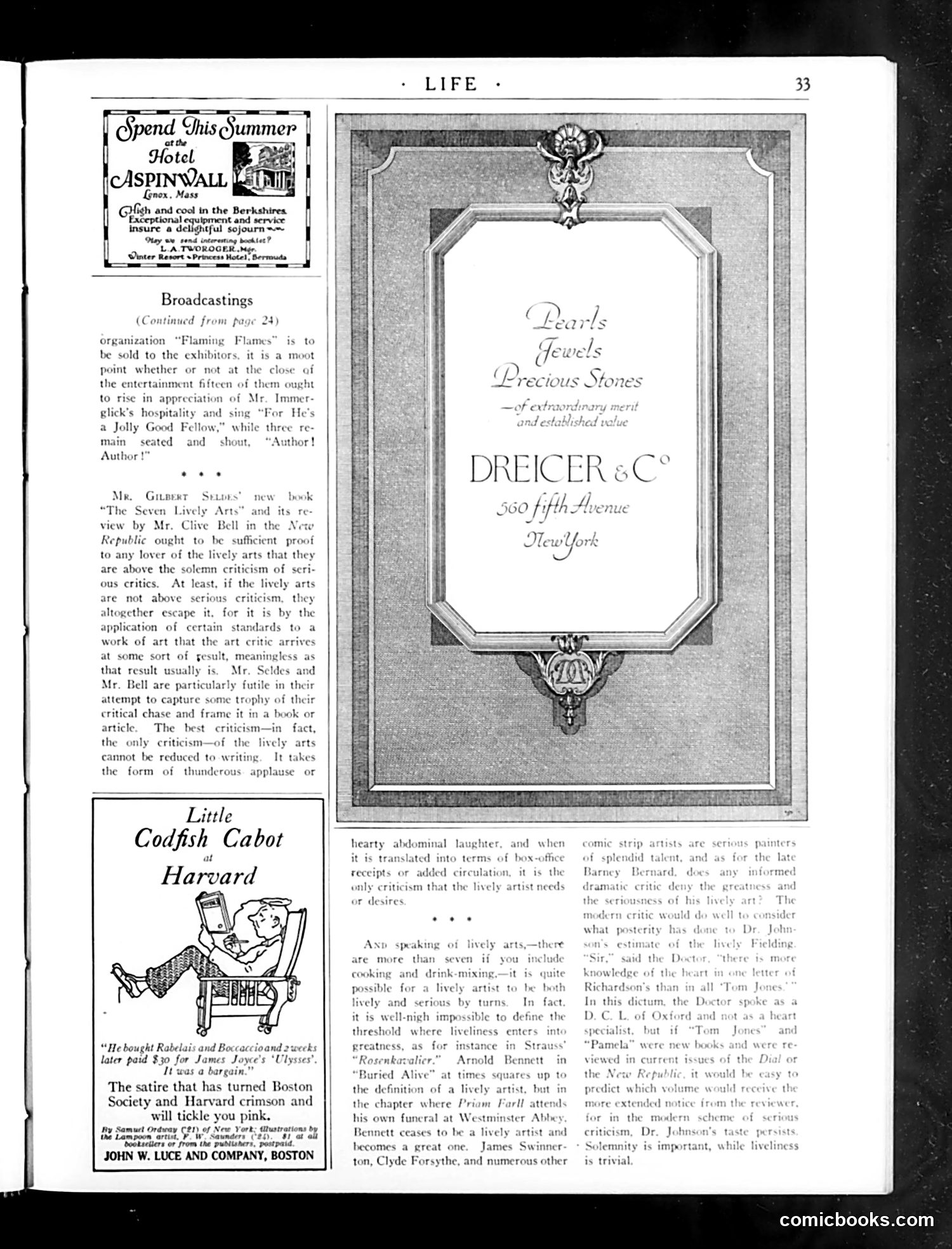
This cartoon satirizes wealthy Boston society and Harvard students through the character of "Codfish Cabot," a nouveau riche Harvard undergraduate who ostentatiously collects rare books. The joke centers on his purchasing behavior: he buys expensive literary classics (Rabelais, Boccaccio, James Joyce) not for genuine appreciation but as status symbols—spending $30 on Joyce's *Ulysses* merely to display his wealth and sophistication. The "codfish" reference alludes to the Cabot family's old Boston money derived from the cod fishing trade, suggesting irony: despite inherited wealth, this character lacks authentic cultural refinement. The satire targets both nouveau riche pretension and Harvard's role in marketing elite status rather than genuine intellectual development. The accompanying text about "lively arts" criticism reinforces the theme: true appreciation of art cannot be reduced to mere possession or financial outlay.
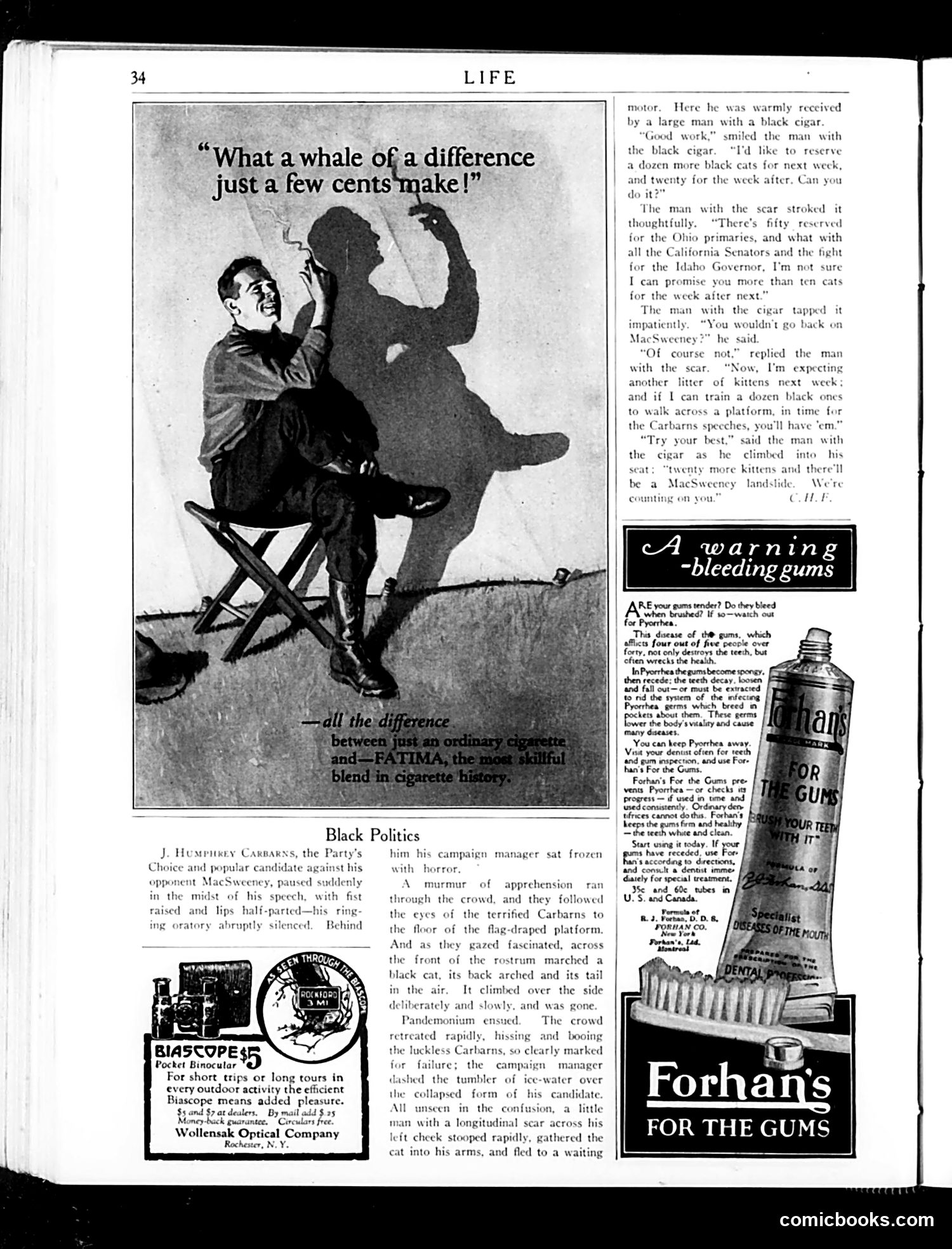
This 1920s satire depicts a political dirty trick during a campaign speech. **J. Humphrey Carbarns**, the Party's preferred candidate, is interrupted mid-speech when a **black cat** walks across the flag-draped platform—a deliberate sabotage by his opponent **MacSweeney**. The superstitious crowd panics (black cats symbolized bad luck), causing chaos that humiliates Carbarns. The hidden punchline reveals the conspiracy: MacSweeney's operative, a scarred man, deliberately planted trained black cats to disrupt rival speeches. He calmly discusses with a cigar-smoking handler ordering more cats for upcoming primaries and gubernatorial races—suggesting systematic use of this tactic across multiple campaigns. The satire mocks both machine politics' underhanded methods and public superstition. The absurdist humor lies in treating trained black cats as standard campaign weaponry, comparable to other political tools.
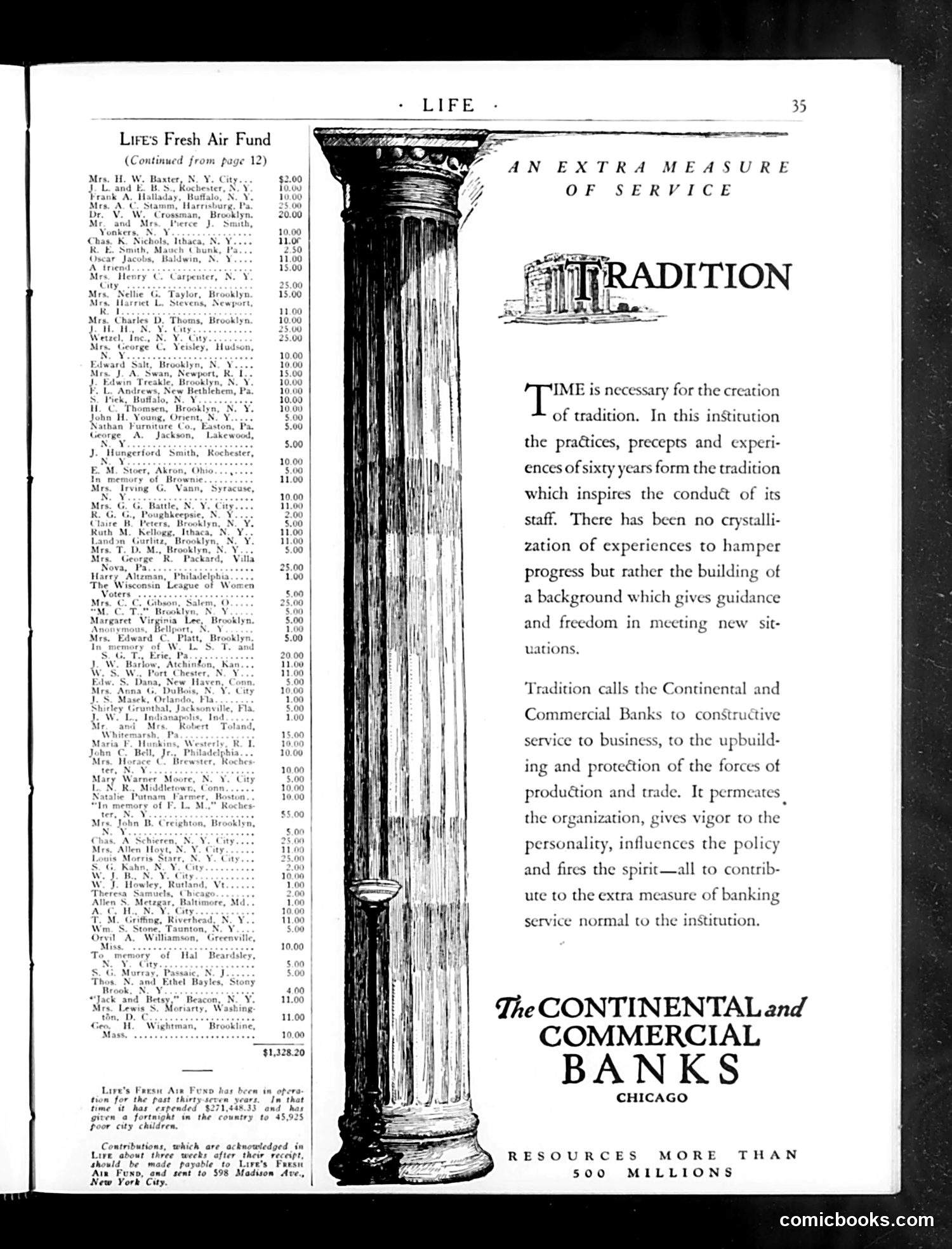
This page is primarily a **bank advertisement**, not satire. The Continental and Commercial Banks of Chicago places a full-page ad emphasizing its "tradition" of 60 years of banking practice and commitment to business growth. The left column contains a continuation of **Life's Fresh Air Fund** — a genuine charitable initiative listing donors who contributed to sending poor urban children (particularly from New York City's slums) to the countryside for health and fresh air. Amounts range from $1-$53, reflecting modest middle-class donations. The advertisement's classical column illustration and talk of "tradition" and institutional "vigor" reflect early-20th-century corporate messaging: banks positioning themselves as stable, principled institutions worthy of trust during an era of financial uncertainty. There is **no satire here** — this is sincere advertising alongside genuine charity work, showing how Life magazine combined commercial content with philanthropic coverage.
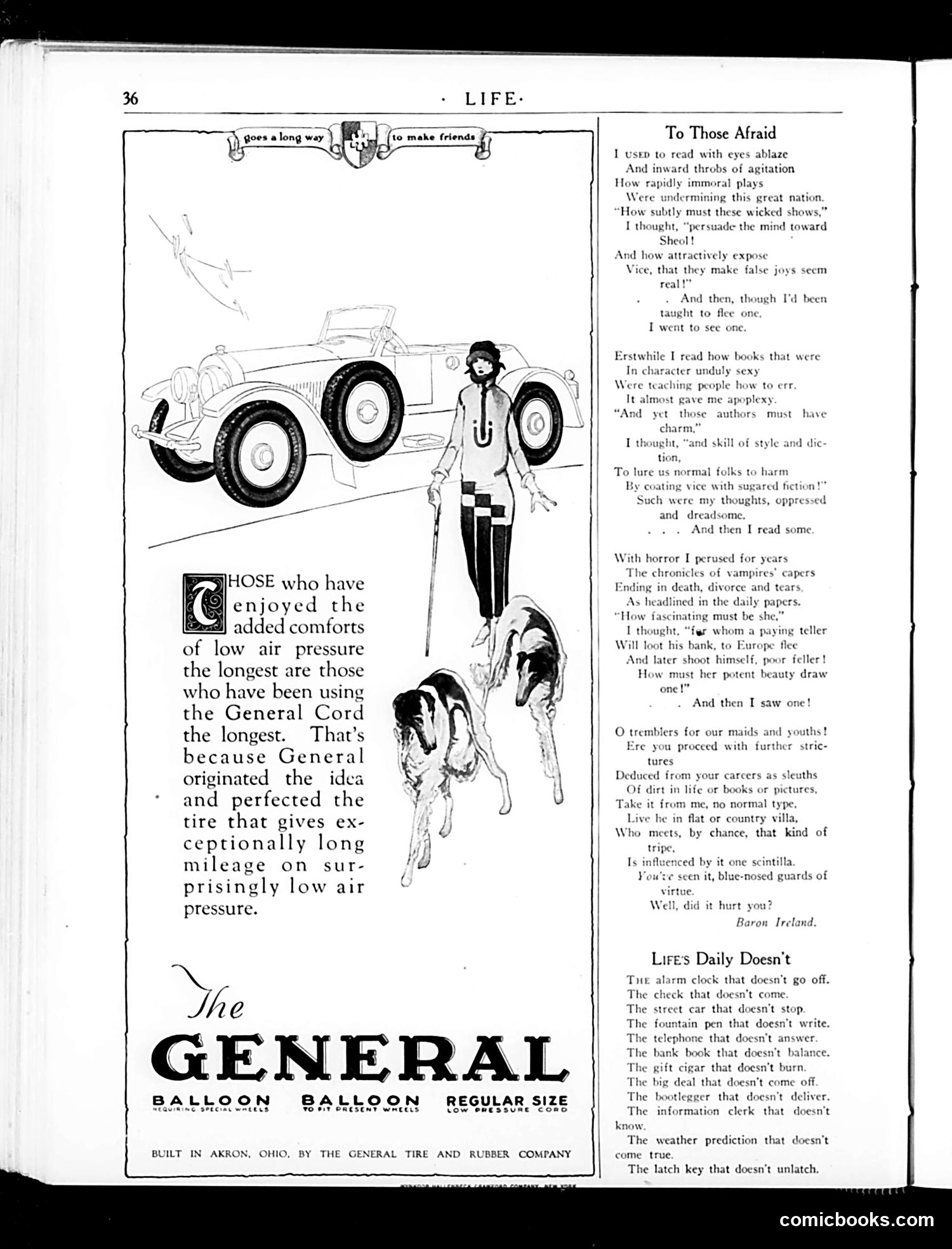
This page contains a tire advertisement alongside two distinct pieces of satirical content. **The Advertisement**: General Tire promotes their "low air pressure" tire technology, claiming superior mileage and comfort. **"To Those Afraid"** (poem by Baron Ireland): A satirical commentary on moral panic. The speaker mocks his former self for being alarmed by "immoral plays" and "sexy books" that supposedly corrupt society. The poem's irony is clear: he worried these entertainments would seduce him toward vice, but upon actually experiencing them, found them harmless. The satire targets early 20th-century censorship advocates and moral crusaders who condemned entertainment without direct experience. **"Life's Daily Doesn't"**: A humorous list of everyday frustrations—alarms that don't work, checks that don't arrive, etc. This appears to be commentary on modern inconveniences and unreliable services, poking fun at urban life's disappointments. Both pieces reflect 1920s concerns: cultural anxieties about mass entertainment and the comedic frustrations of modern living.
This is primarily an **advertisement for *Life* magazine** rather than a political cartoon. The page targets newly married women—"June Brides"—with a subscription offer. The satire lies in the headline: "LOVE HONOR AND OBEY THAT IMPULSE!" This plays on traditional wedding vows ("love, honor, and obey") but redirects the "impulse" to subscribing to *Life*. The illustration shows a bride and groom, with the joke being that modern women should prioritize reading this magazine. The phrase "if she is a very Modern Girl" suggests contemporary anxiety about changing women's roles—implying that modern, independent women might prefer a cheaper trial subscription ($1 for ten weeks) over a full yearly commitment ($5). This reflects 1910s-20s debates about women's evolving independence and consumer choices.
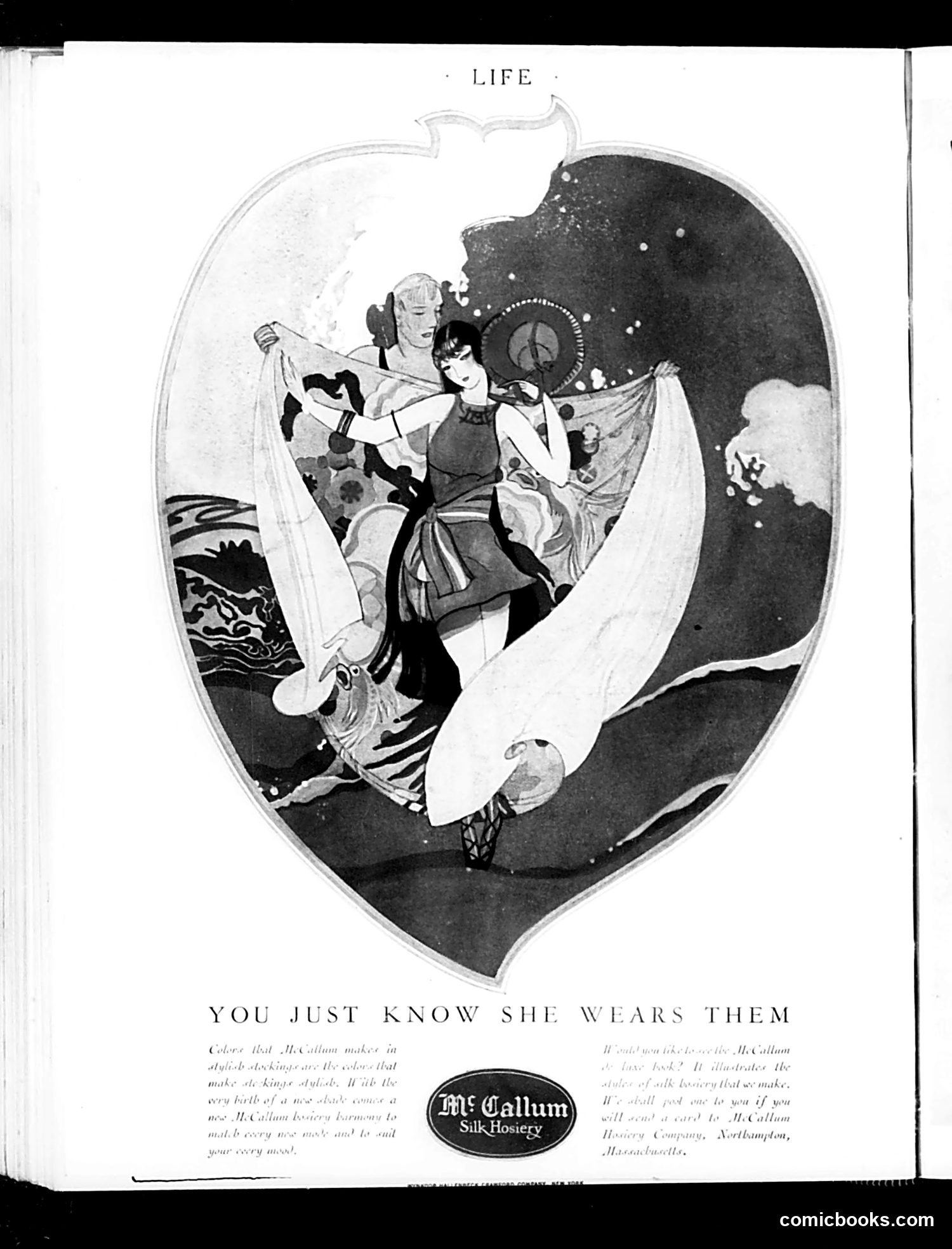
This is a **commercial advertisement** for McCallum Silk Hosiery, not political satire. The illustration shows fashionably dressed figures in an Art Deco style, typical of 1920s advertising. The headline "YOU JUST KNOW SHE WEARS THEM" uses aspirational messaging—suggesting that a stylish, sophisticated woman obviously chooses this brand of stockings. The accompanying text emphasizes that McCallum stockings come in fashionable colors that coordinate with modern clothing. The ornate oval frame and elegant illustration style appealed to aspirational female consumers of the era. This is period advertising promoting women's hosiery through association with glamour and social status.