
A complete issue · 38 pages · 1924
Life — May 29, 1924
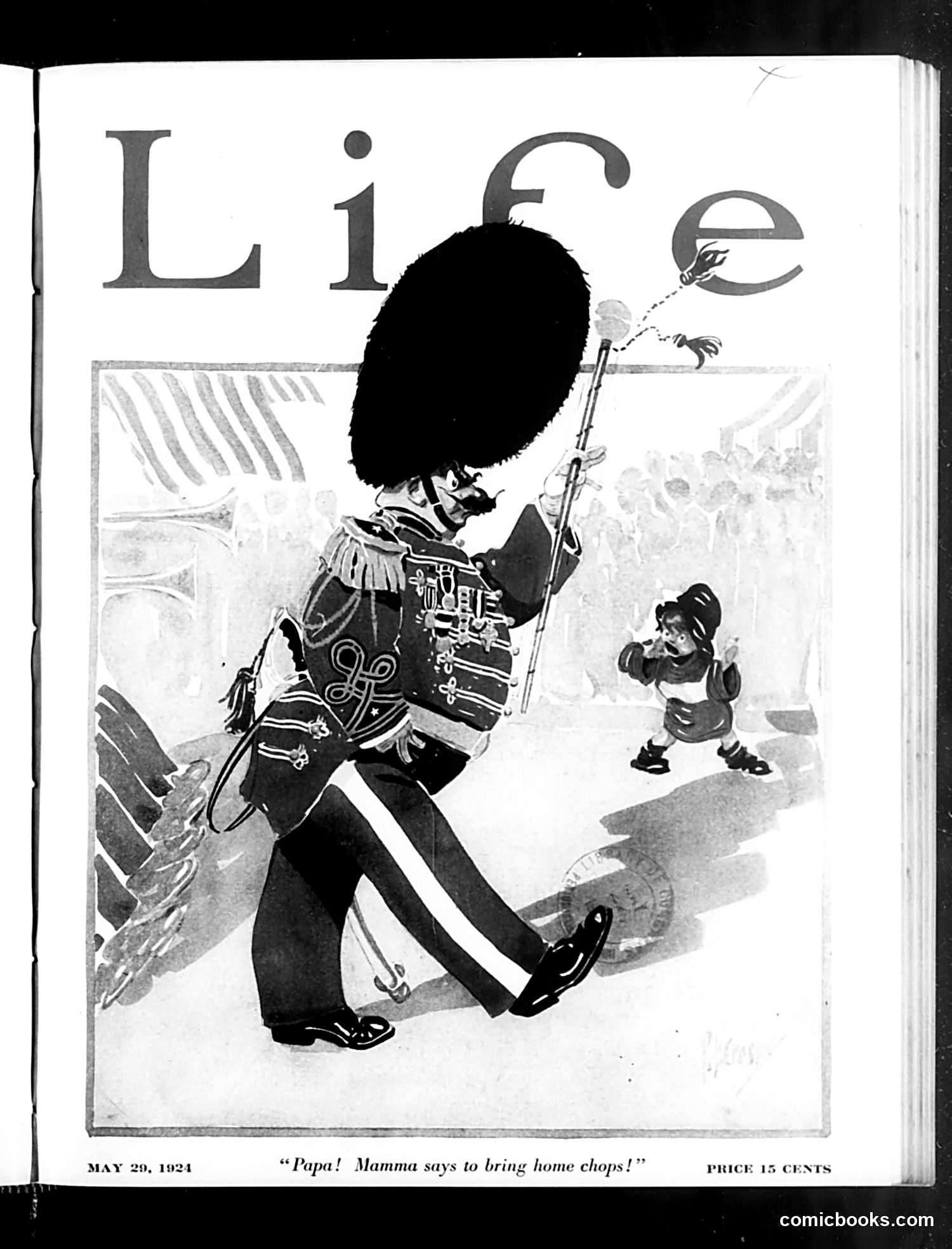
This satirical cover depicts a tall British soldier with an enormous bearskin cap (the distinctive headgear of the Guards) holding a rifle with bayonet. The soldier's head is completely obscured by the oversized bearskin. A small child figure labeled "Papa! Mamma says to bring home chops!" stands nearby. The joke appears to satirize British military pageantry and uniform excess—the absurdly large bearskin cap renders the soldier's head invisible, suggesting that military formality and tradition have made the soldier faceless or impersonal. The child's mundane domestic request ("bring home chops") contrasts sharply with the soldier's ornate, imposing uniform, highlighting the gap between martial grandeur and ordinary family life. The 15-cent price indicates this is from Life's comedy-focused era.
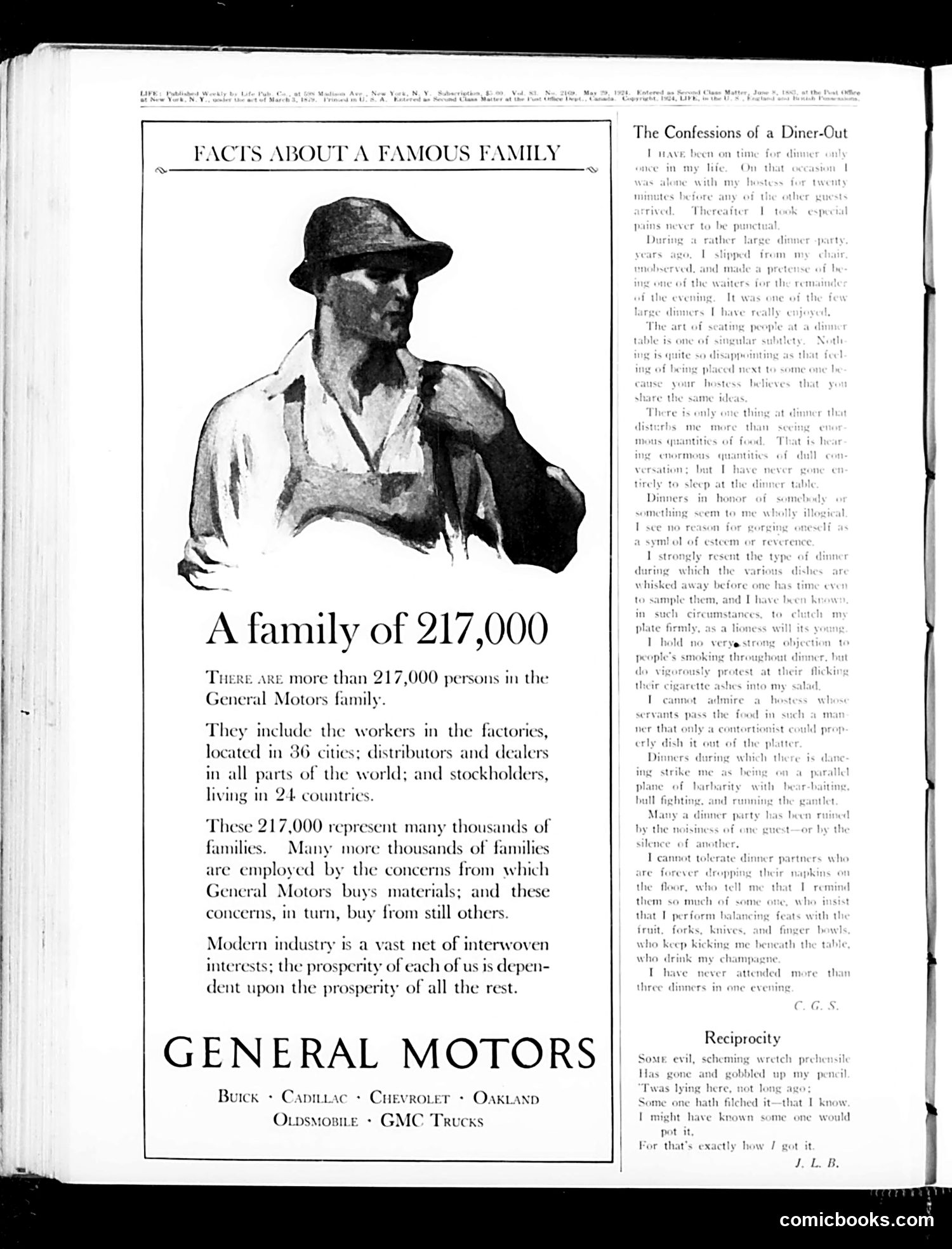
This page is primarily a **General Motors advertisement**, not satire. The left side features a portrait of an industrial worker with the headline "A family of 217,000," explaining that General Motors employs over 217,000 people across 36 cities in 24 countries, representing many thousands of families. The ad emphasizes interconnected industrial prosperity: GM's success depends on suppliers and workers, whose success depends on GM. The right side contains two separate editorial pieces: "The Confessions of a Diner-Out" and "Reciprocity"—both humorous personal essays unrelated to the GM advertisement. These appear to be typical Life magazine social commentary pieces, not political cartoons. This is essentially an **advertorial layout**, combining corporate messaging with unrelated satirical content.
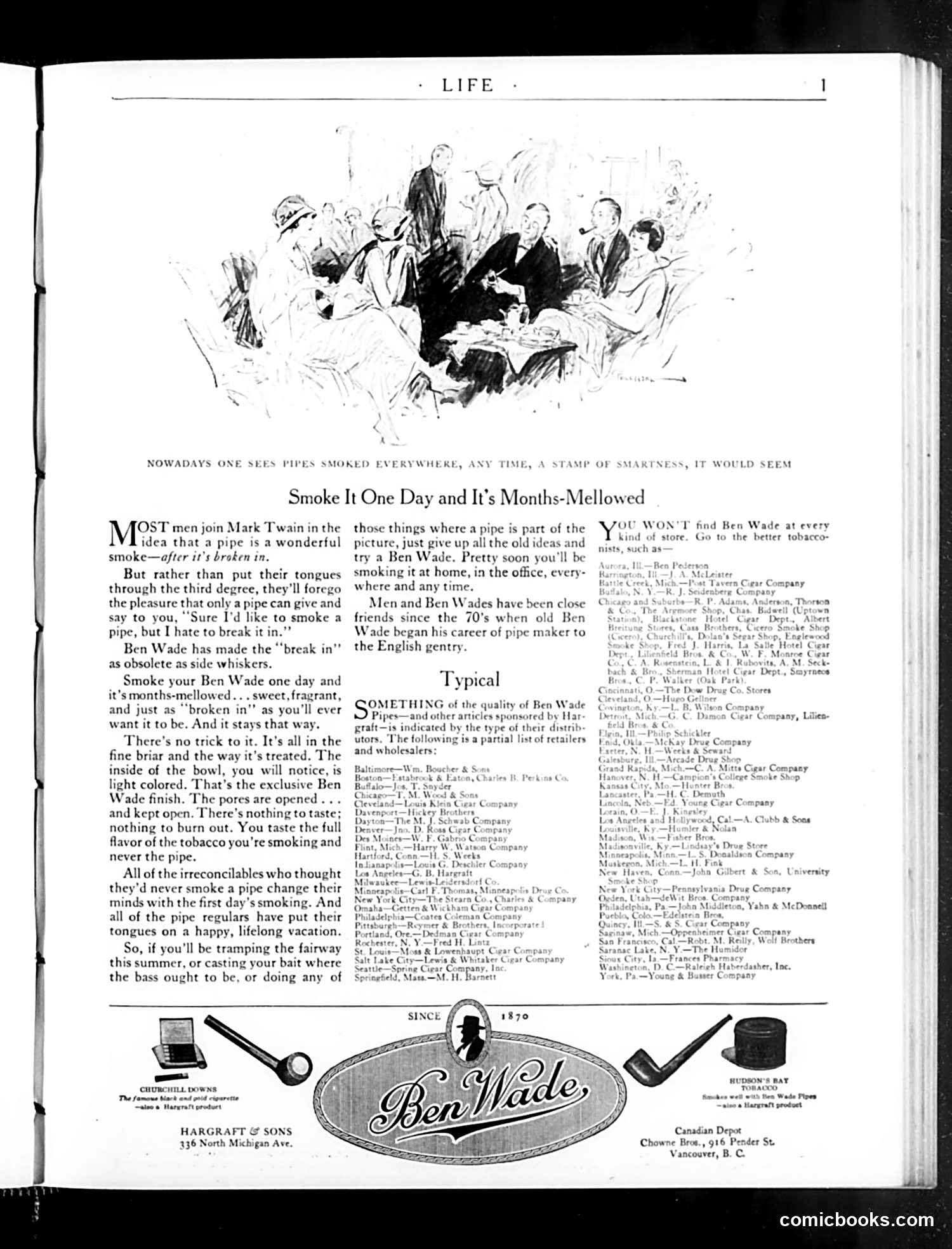
This page is primarily a **Ben Wade pipe advertisement** masquerading as editorial content. The illustration at top shows well-dressed men in a social gathering, smoking pipes—a scene of genteel leisure. The text uses Mark Twain as a celebrity endorsement, claiming pipes are "a wonderful smoke." The article emphasizes that Ben Wade pipes are superior products, noting their "exclusive finish" and quality materials. The advertisement lists numerous retailers across North America, positioning Ben Wade as an established brand "since 1870." The bottom features the company's logo and two pipe illustrations. This represents **early 20th-century advertorial marketing**—blending promotional content with magazine editorial to appear as genuine journalism rather than advertising. The focus on masculine sophistication and celebrity association reflects era-typical consumer messaging.
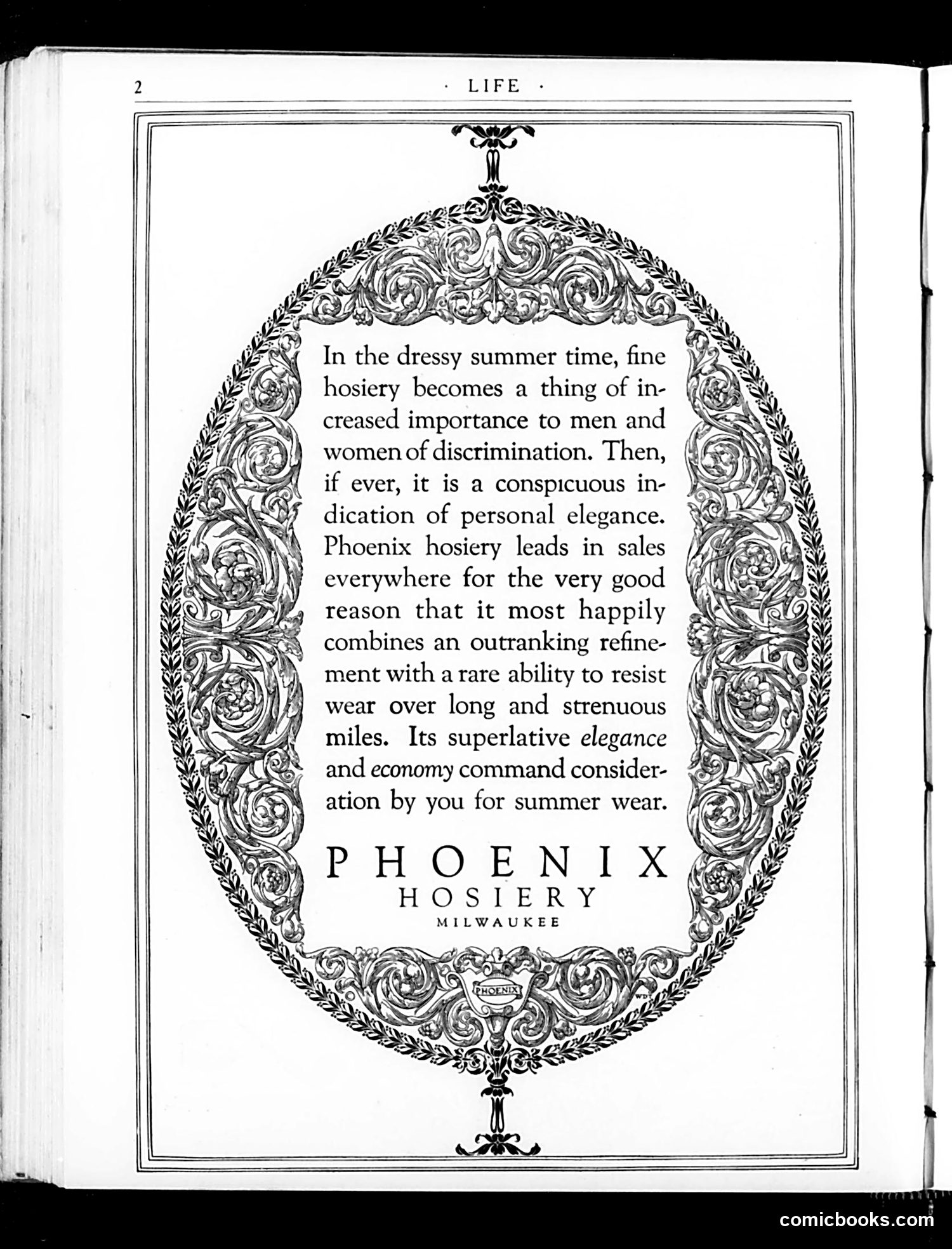
This is **not a cartoon or satire** — it's a **straightforward advertisement** for Phoenix Hosiery from Milwaukee. The page contains no political or social commentary to decode. The ad promotes fine hosiery as a marker of personal elegance and refinement, particularly important during summer when legs are more visible. It emphasizes Phoenix brand's superior quality: combining elegance with durability for long wear. The ornate oval border with decorative flourishes is typical of early 20th-century advertising design, conveying luxury and sophistication through visual presentation. The italicized words ("elegance" and "economy") highlight the key selling points. This reflects the era's emphasis on hosiery as an essential status symbol for discriminating consumers.
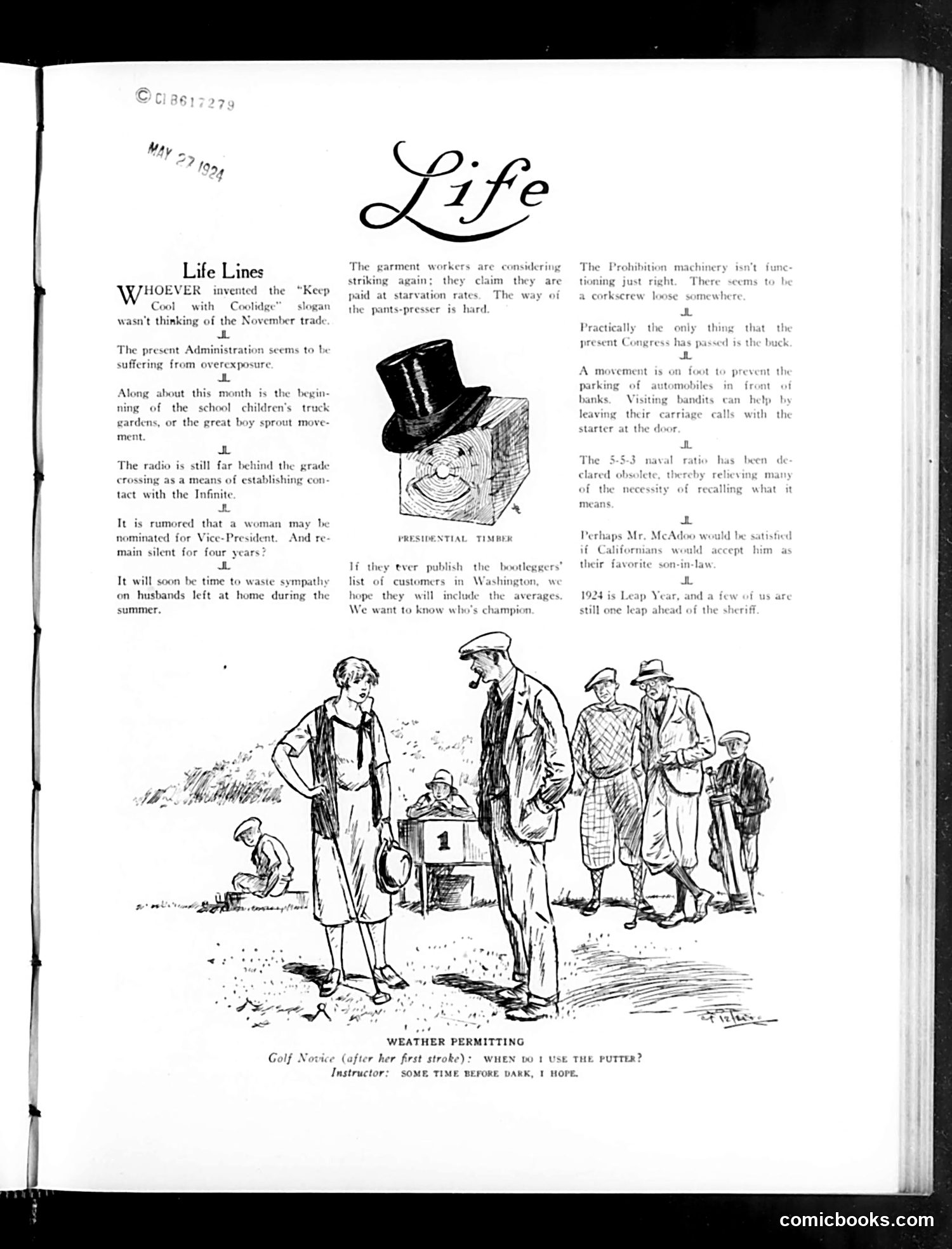
**Main Cartoon: "Weather Permitting"** This cartoon satirizes women's entry into golf, a traditionally male-dominated sport. A female golfer asks her instructor "when do I use the putter?" He replies "some time before dark, I hope"—mocking women's perceived incompetence and slow play. **"Life Lines" Column Commentary:** The page discusses contemporary 1920s issues: labor strikes over starvation wages, Prohibition enforcement failures ("the only thing Congress has passed is the buck"), and automobile parking problems. A humorous note mentions 1924 being a Leap Year and references the "sheriff" in context of potential vice-presidential nomination of a woman—likely satirizing progressive political possibilities of the era. The overall tone reflects conservative skepticism toward social changes of the 1920s.
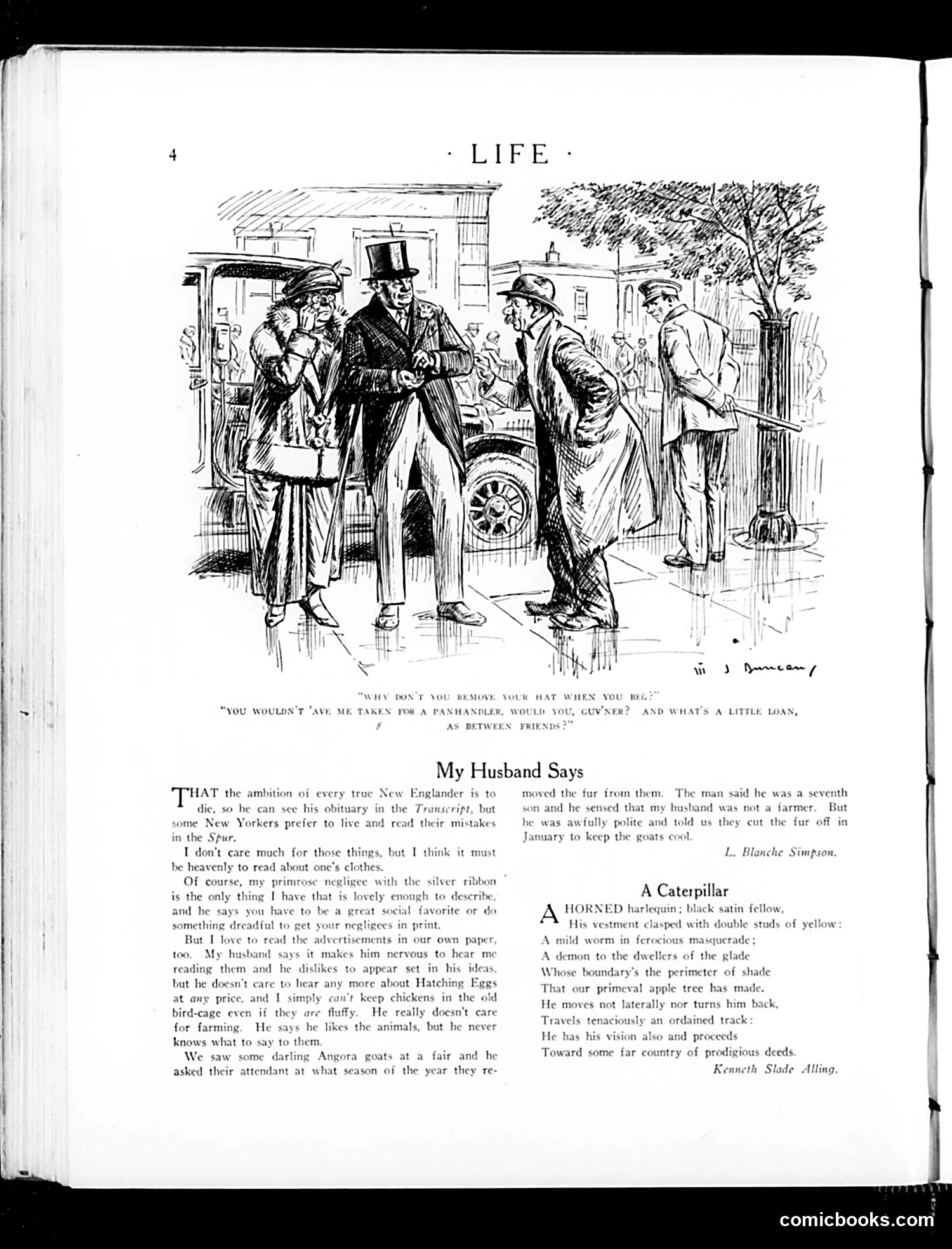
The main cartoon depicts a street scene with well-dressed men in top hats and coats gathered around an automobile. The caption reads: "Why isn't you remove your hat when you bow?" / "You wouldn't ave me taken for a panhandler, would you, guv'nor? and what's a little loan, as between friends?" **The satire:** This appears to mock nouveau riche or pretentious urban men using affected speech ("guv'nor," "panhandler") while requesting money. The automobile—a status symbol of wealth—contrasts with the beggar-like behavior, suggesting wealthy men's shameless borrowing from friends despite their ostentatious displays of affluence. The page also contains two unrelated pieces: "My Husband Says" (domestic humor) and "A Caterpillar" (a poem by Kenneth Slade Alling).
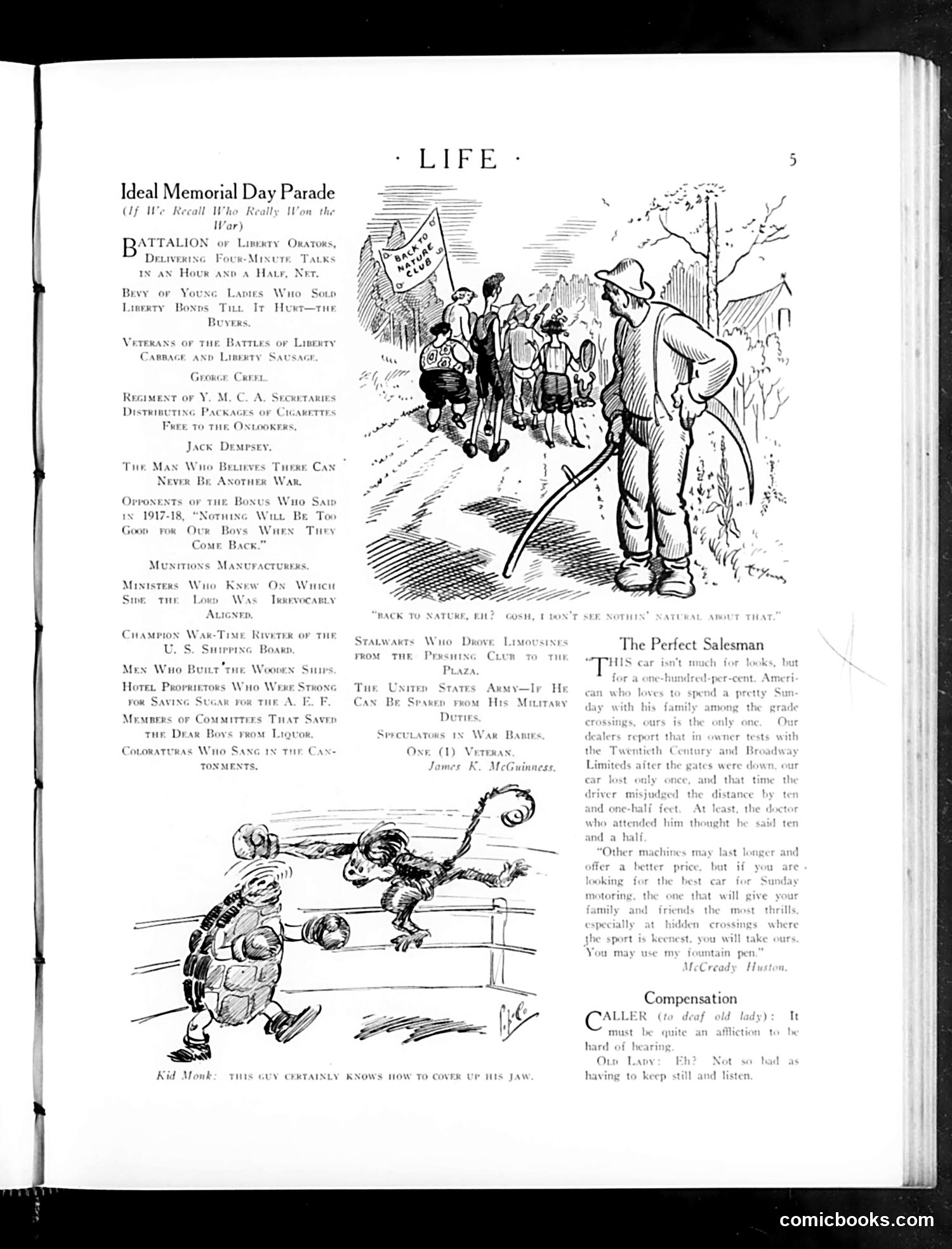
This page satirizes post-WWI America through two main pieces: **Top cartoon**: "Ideal Memorial Day Parade" depicts a boy scout cheerfully directing a parade of disabled war veterans—amputees with crutches and prosthetics—toward onlookers. The caption quotes the boy saying "Back to nature, eh? Gosh, I don't see nothin' natural about that." The satire criticizes the contradiction between patriotic celebration of war and the grim physical reality of returning soldiers. **Bottom cartoon**: "Kid Monk" shows a boxing child, captioned "this guy certainly knows how to cover up his jaw"—a pun about hiding injury or weakness. Both pieces mock the disconnect between cheerful American patriotism and war's actual human cost, reflecting post-war disillusionment common in 1920s satirical magazines.
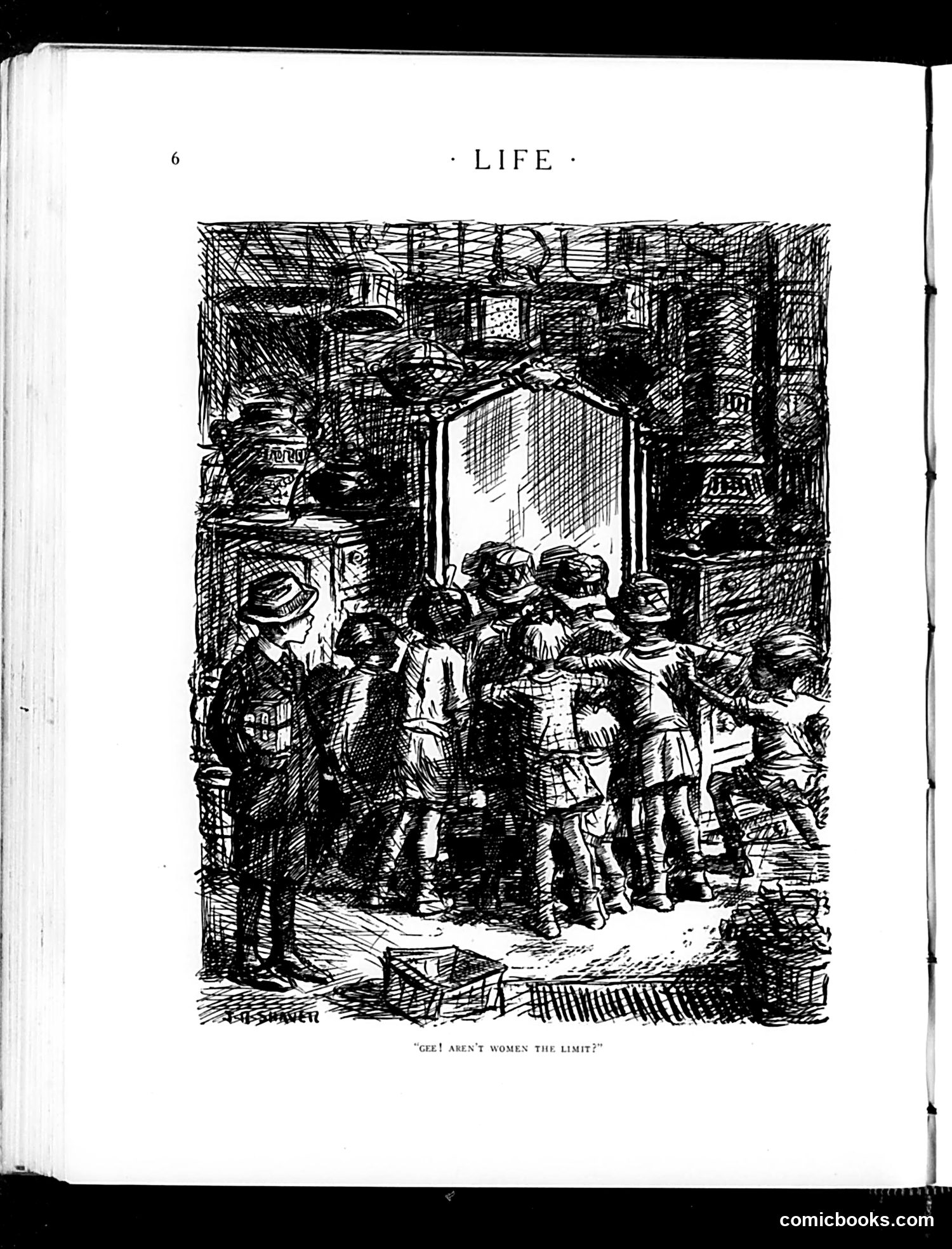
This sketch by H.H. Shirvey depicts a crowded street scene with military or uniformed figures gathered around what appears to be a doorway or building entrance. The caption reads: "GEE! AREN'T WOMEN THE LIMIT?" The cartoon satirizes attitudes toward women, likely during or after World War I when women increasingly entered public and professional spaces. The gathering of uniformed men reacting with apparent surprise or exasperation to women's presence suggests the satire targets outdated male attitudes about women's social roles and visibility. The phrase "the limit" (meaning "the worst" or "too much") captures contemporary masculine complaints about expanding female autonomy and participation in society—portrayed here as inherently absurd and worthy of ridicule.
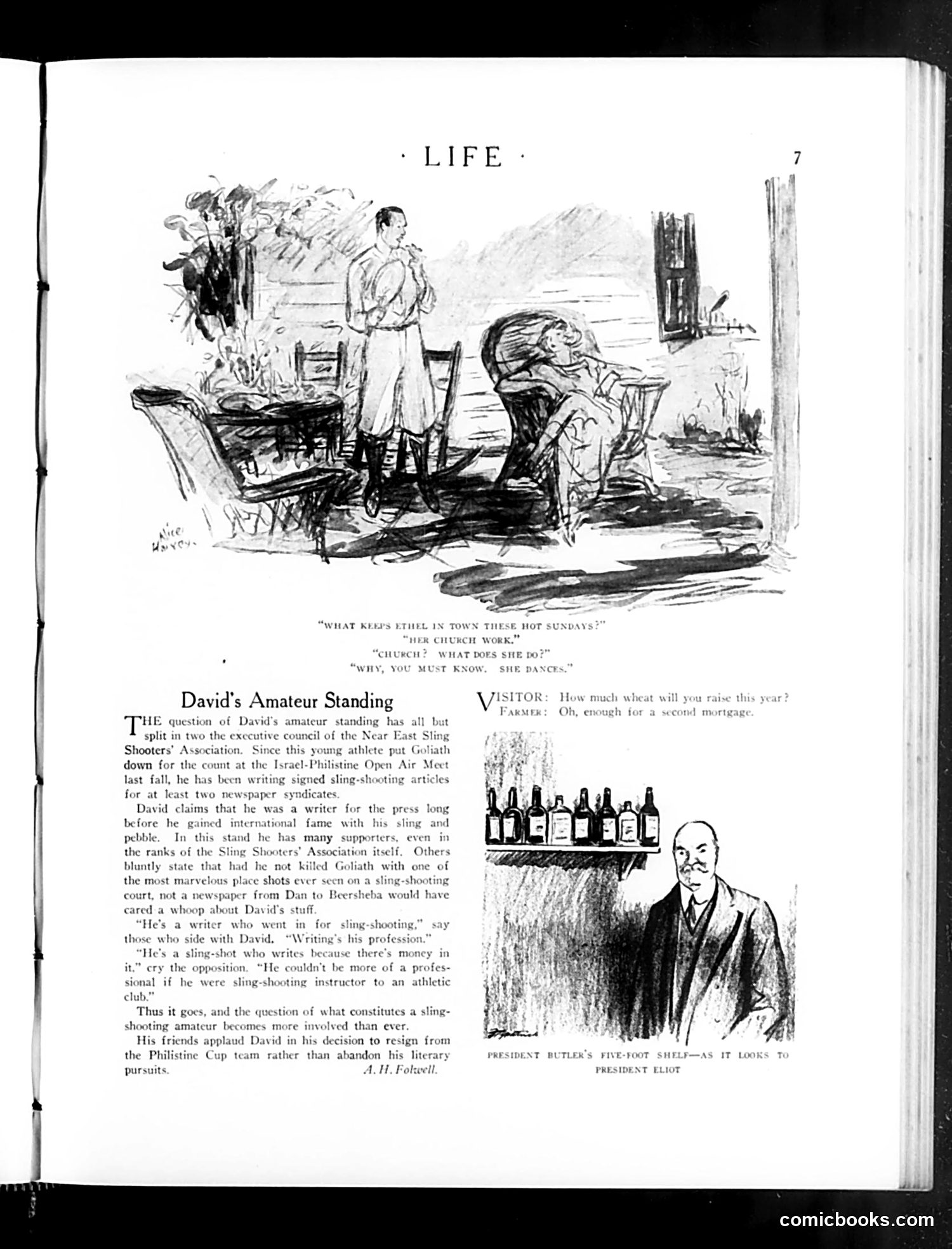
The top sketch depicts a domestic scene with dialogue about church attendance on hot Sundays—a lighthearted comment on summer religious commitment. The main article, "David's Amateur Standing," discusses controversy over whether David (likely a sling-shooting athlete) qualifies as an amateur. The piece satirizes debates about what constitutes amateur versus professional status in sports, noting his previous writing career and newspaper syndication work complicate his amateur classification. The lower illustration shows "President Butler's Five-Foot Shelf" next to "President Eliot"—apparently comparing two university presidents' intellectual resources or accomplishments, though the specific reference remains unclear without additional context. The page combines social commentary on religion, amateur sports regulations, and academic leadership through sketch and prose satire typical of Life's early editorial style.
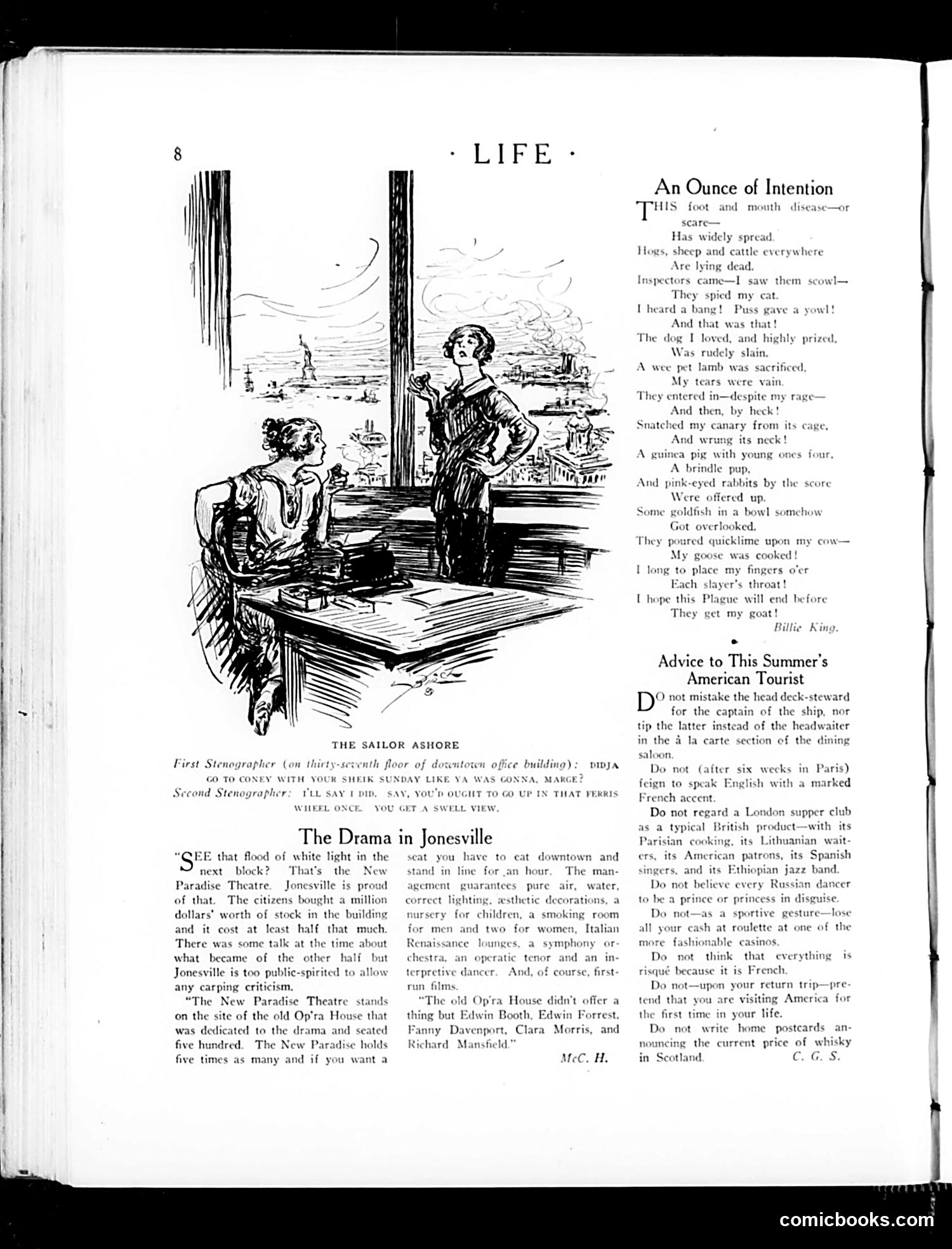
This page contains two separate items: **"The Sailor Ashore"** is a cartoon featuring two stenographers in a downtown office building. The joke plays on a miscommunication: a sailor asks for directions to "New York," and one stenographer mishears it as "New Dork," leading to comedic confusion about what he's actually looking for. **"An Ounce of Intention"** is a poem by Billie King describing the devastating impact of foot-and-mouth disease on livestock and farm animals. The poem catalogs losses—dead hogs, sheep, cattle, pets, and poultry—expressing the speaker's anguish and desire for revenge ("I long to place my fingers o'er Each slaverer's throat"). **"The Drama in Jonesville"** discusses a new theater building in what appears to be a small American town, with commentary on its architectural significance and cultural impact.
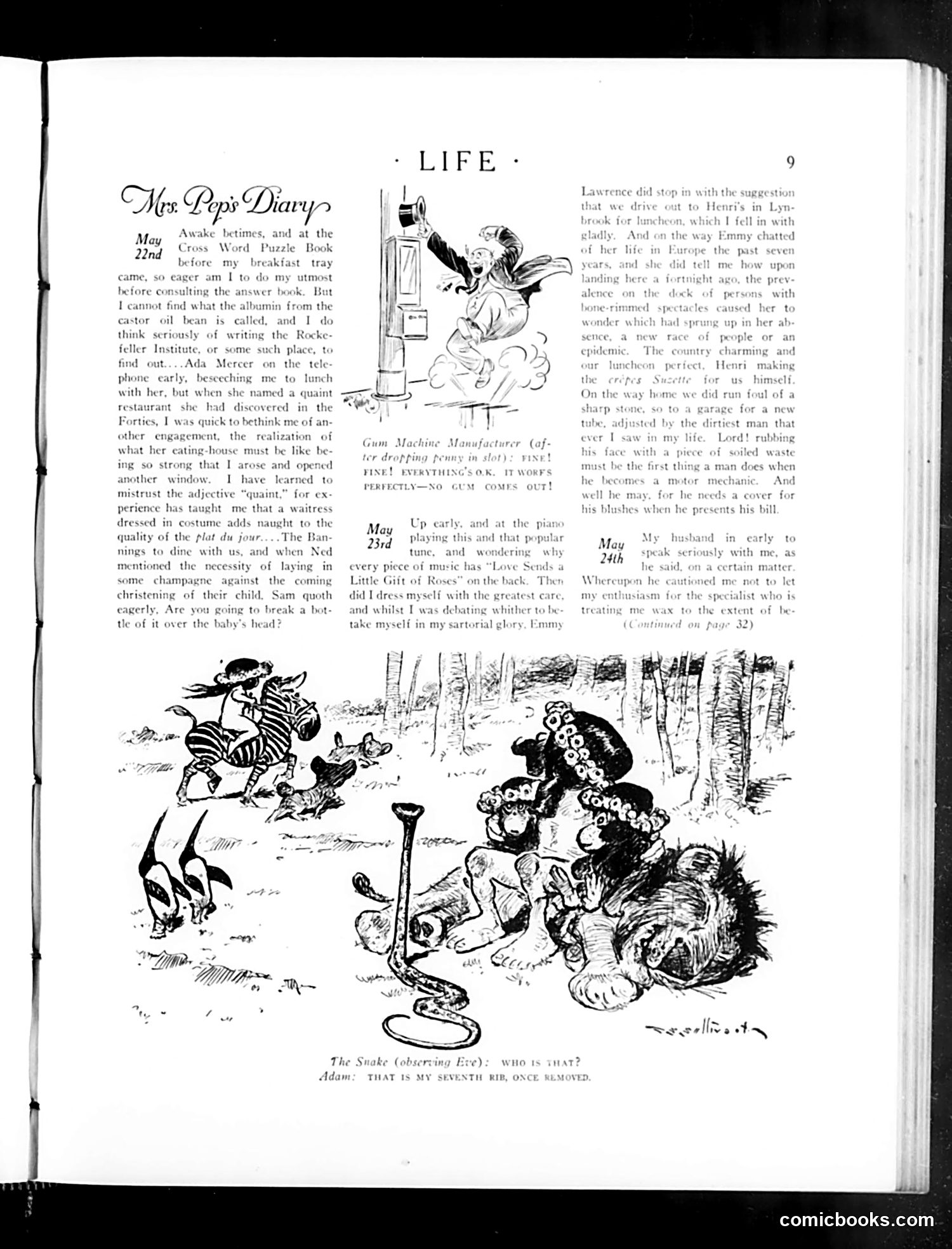
This page contains "Mrs. Peps Diary," a satirical column about domestic life. The dated entries (May 22nd-24th) humorously chronicle a wife's frustrations with household matters: a missing photograph album, attempting to appear refined before breakfast, and navigating marital disagreements about medical specialists. The lower cartoon depicts Adam and Eve with a serpent in a wooded setting. The caption reads: "The Snake (observing Eve): WHO IS THAT? / Adam: THAT IS MY SEVENTH RIB, ONCE REMOVED." This is a pun joke about the biblical creation story—Adam's rib becoming Eve—reinterpreted as a domestic separation ("removed"). The humor plays on the double meaning of "rib" as both anatomical reference and a colloquial term for a spouse. It satirizes marital discord through biblical allegory.
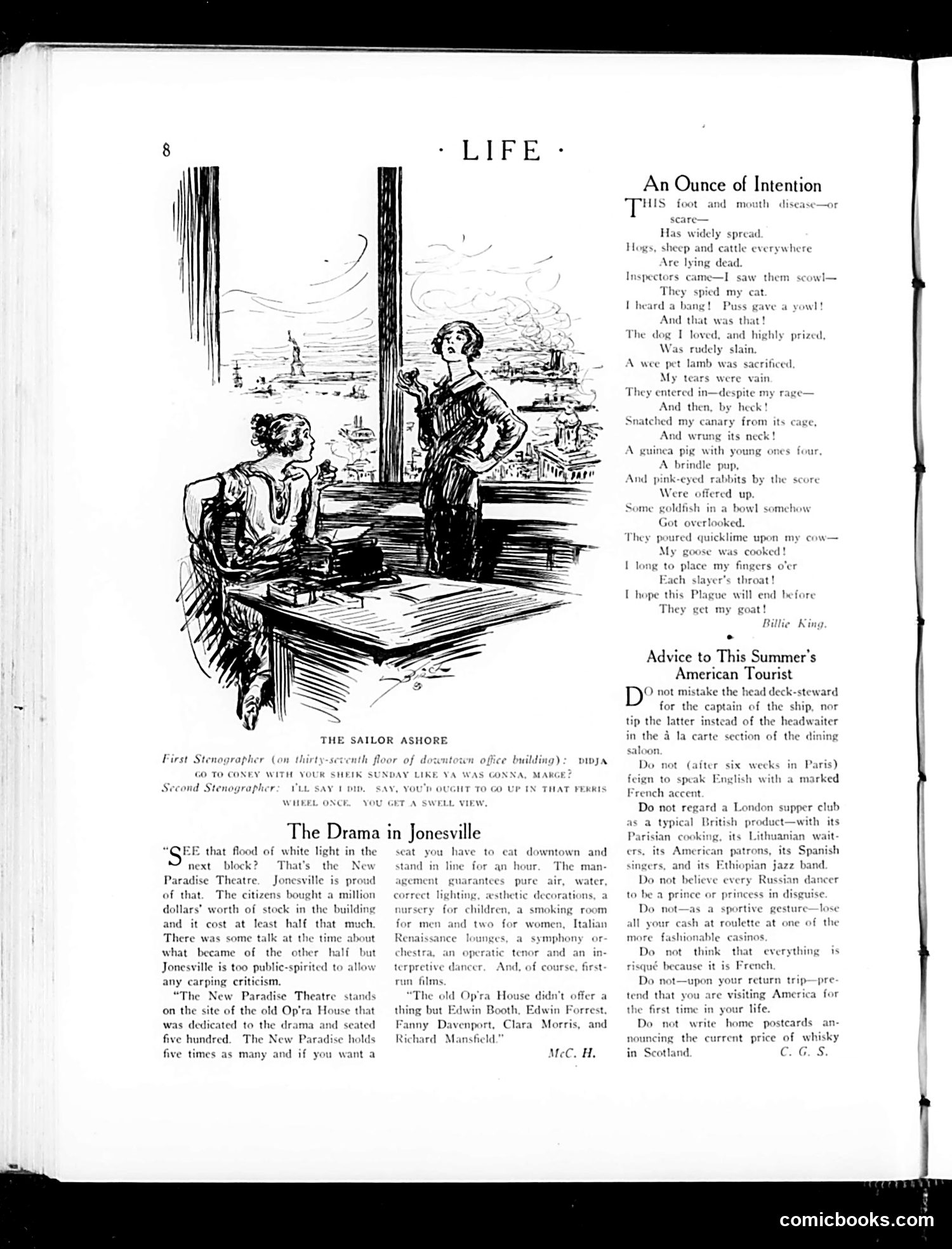
This cartoon depicts two figures on a ship or dock: one sailor sitting, one standing. The accompanying dialogue references a "sheik" and "Monna, March," suggesting early 1920s slang where "sheik" meant a romantic, attractive man (popularized by Rudolph Valentino films). The joke appears to center on the sailor's romantic exploits while on shore leave—a common theme in period humor. The standing figure's posture and the seated figure's reaction suggest a boastful retelling of romantic encounters. The page also contains unrelated content: a poem titled "An Ounce of Intention" by Billie King about livestock disease, and travel advice for American tourists, indicating this is a typical Life magazine miscellany page mixing humor, verse, and practical information.
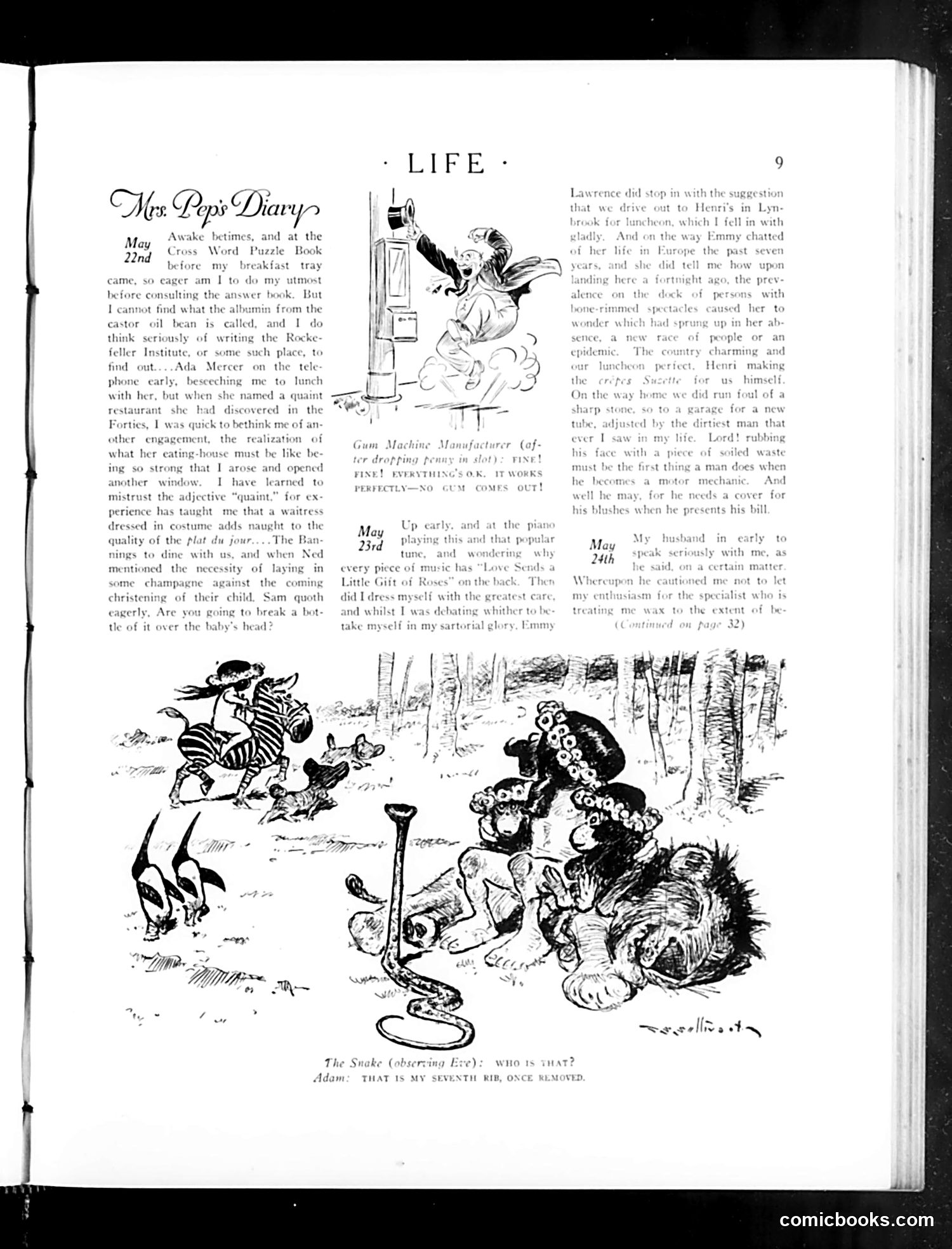
This page features "Mrs. Pop's Diary," a humorous domestic column dated May 22nd-24th. The satirical content mocks everyday middle-class life and anxieties. The main cartoon depicts a scene with a snake, an adult figure, and children. The caption reads: "The Snake (observing Eve): WHO IS THAT? / Adam: THAT IS MY SEVENTH RIB, ONCE REMOVED." This is a biblical joke playing on the Genesis creation story—God created Eve from Adam's rib. The humor derives from treating the wife/woman as merely a derivative creation, referenced sarcastically as a "rib" and marked as "once removed" (suggesting distance or removal from the original). It's satirizing outdated patriarchal attitudes toward women and marriage, common in early 20th-century humor. The snake observing suggests Eve's biblical association with temptation.
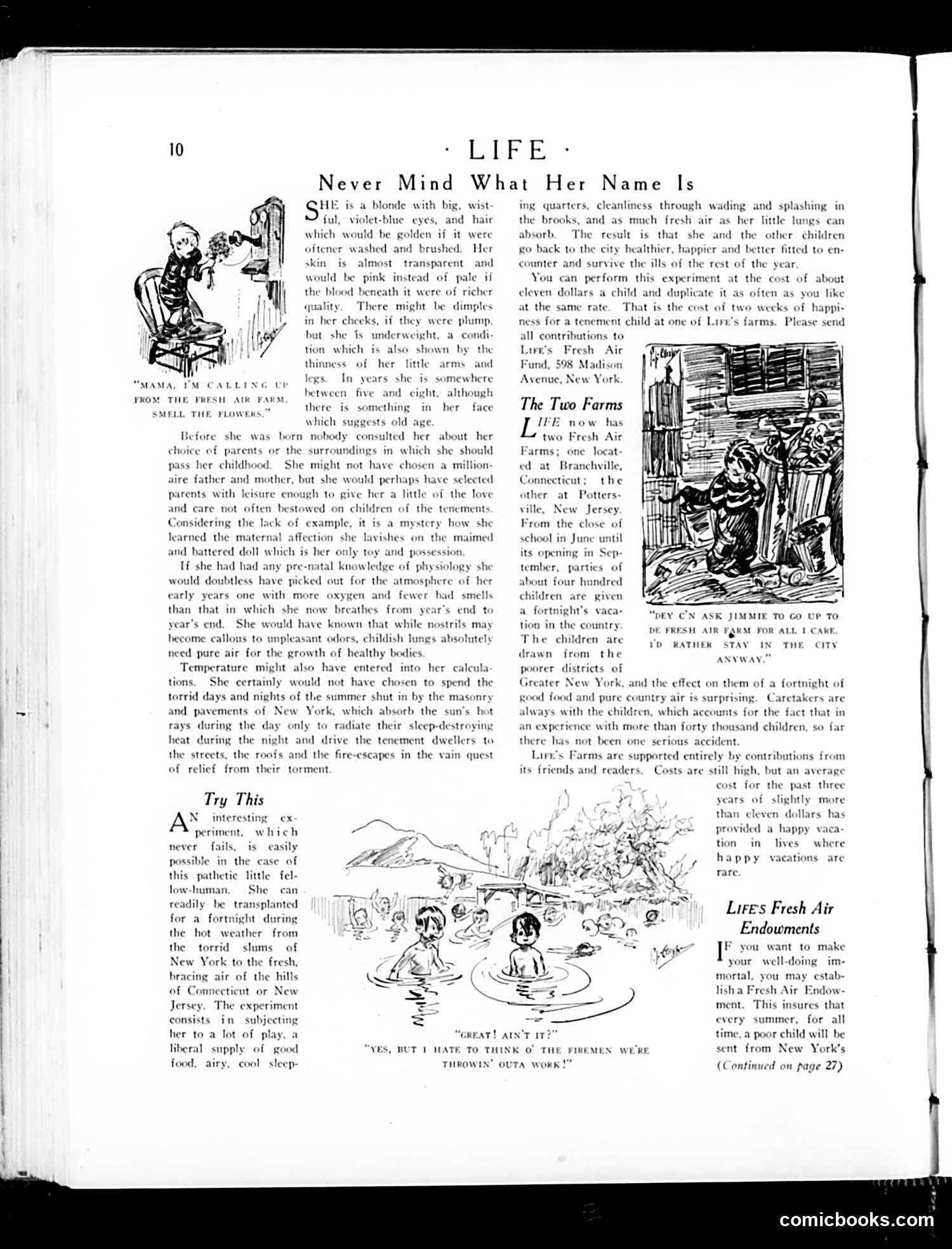
This page promotes **Life's Fresh Air Fund**, a charitable initiative sending poor urban children to country farms during summer. The main article, "Never Mind What Her Name Is," describes a sickly tenement child transformed by fresh air and country living. The cartoon below ("Great! Ain't it?") depicts children playing in water, with one child saying they'd rather stay in the city than think of firemen working. This is satire: it contrasts children's carefree summer play against urban workers' difficult conditions, suggesting the contrast between privileged leisure and working-class hardship. The page essentially advertises charitable giving while subtly acknowledging class disparities in early 20th-century America.
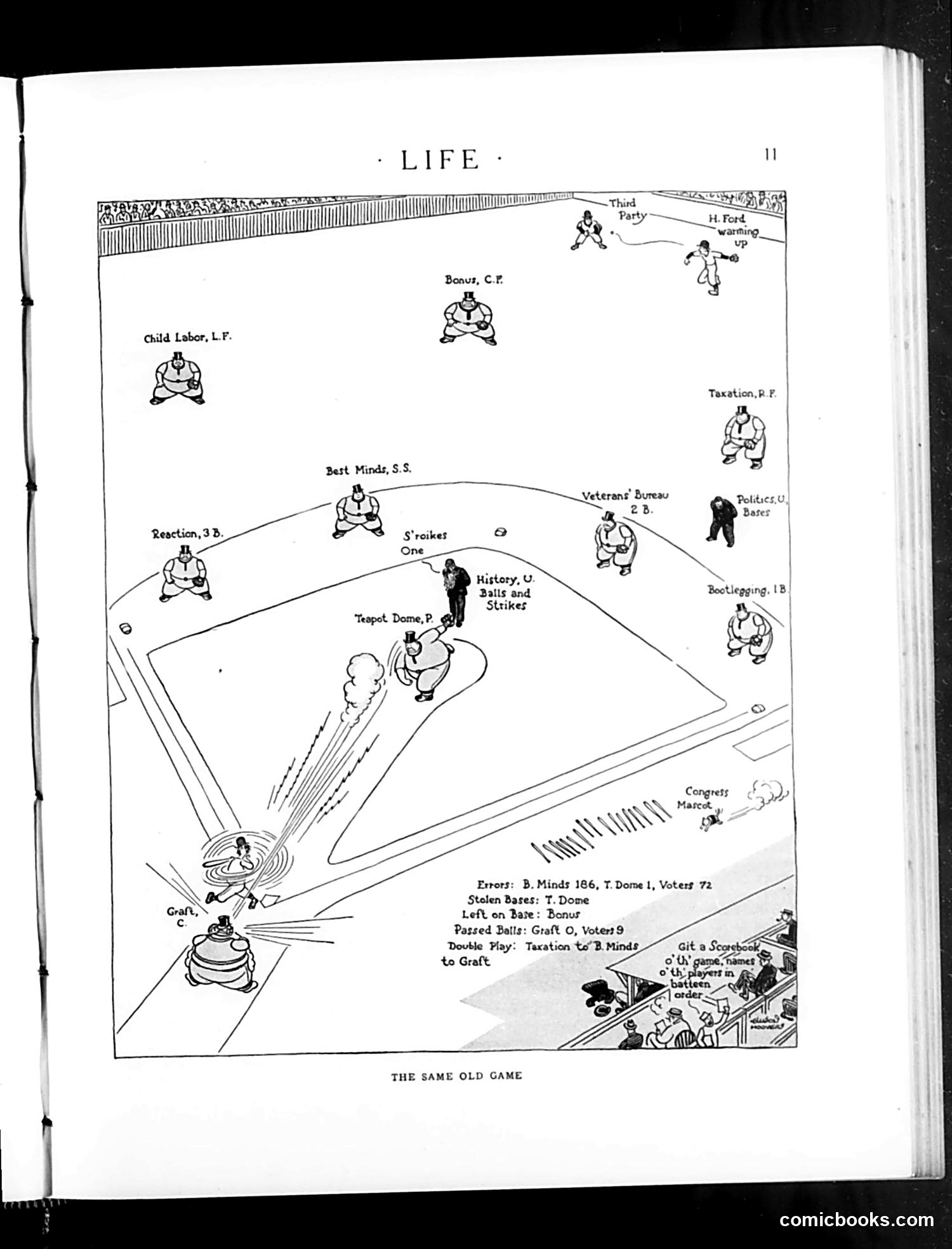
This is a baseball diamond diagram satirizing American political corruption. The cartoon maps various government scandals and improprieties onto baseball positions, suggesting that corrupt practices are cyclical—"the same old game." Key figures and references visible include: - **Graft** at the center (home plate), depicted as the core corruption - Various government departments positioned around the field (Taxation, Veterans Bureau, Bootlegging, etc.) - References to specific scandals: "S'triker One" and "History, U. Balls and Strikes" suggest investigations into wrongdoing - **Congress** mentioned as standing apart, possibly implying complicity or detachment The satire suggests that despite investigations and revelations, governmental corruption persists as an institutional constant—players rotate but the game of graft continues unchanged.
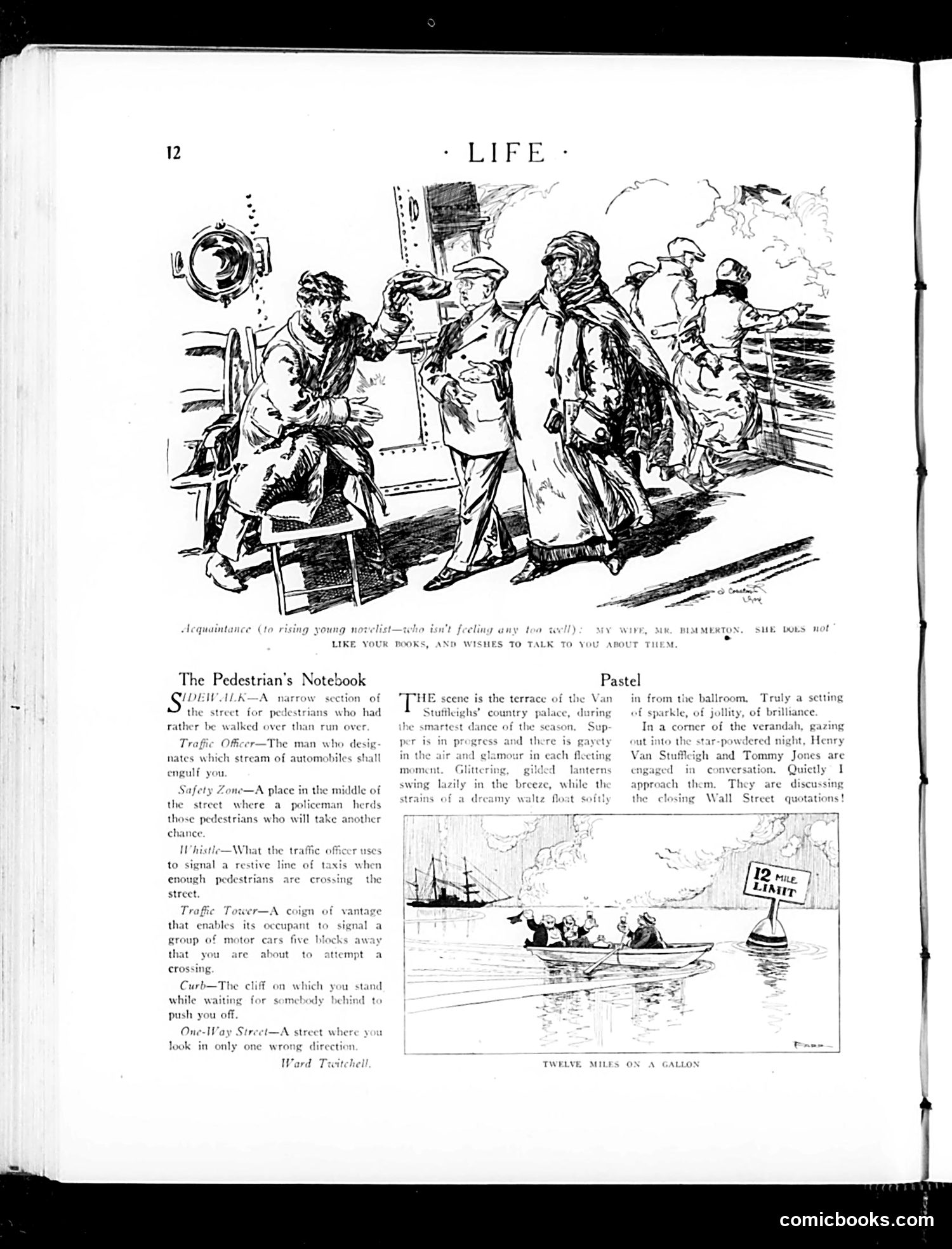
This page contains satirical commentary on urban street life and social encounters. The main cartoon depicts well-dressed pedestrians and what appears to be a traffic officer or policeman on a city street. The caption references "a rising young novelist" who lacks social warmth, suggesting the satire targets pretentious literary figures or social climbers. Below are humorous definitions of street-related terms ("Safety Zone," "Whistle," "Traffic Tower," "Curl," "One-Way Street") using Ward Twitchell's comedic style to mock pedestrian behavior and urban traffic conditions. The secondary illustration shows a pleasure boat scene labeled "Twelve Miles on a Gallon," likely satirizing boating or automobile efficiency during the era. The overall page satirizes modern urban society's social pretensions and transportation culture.
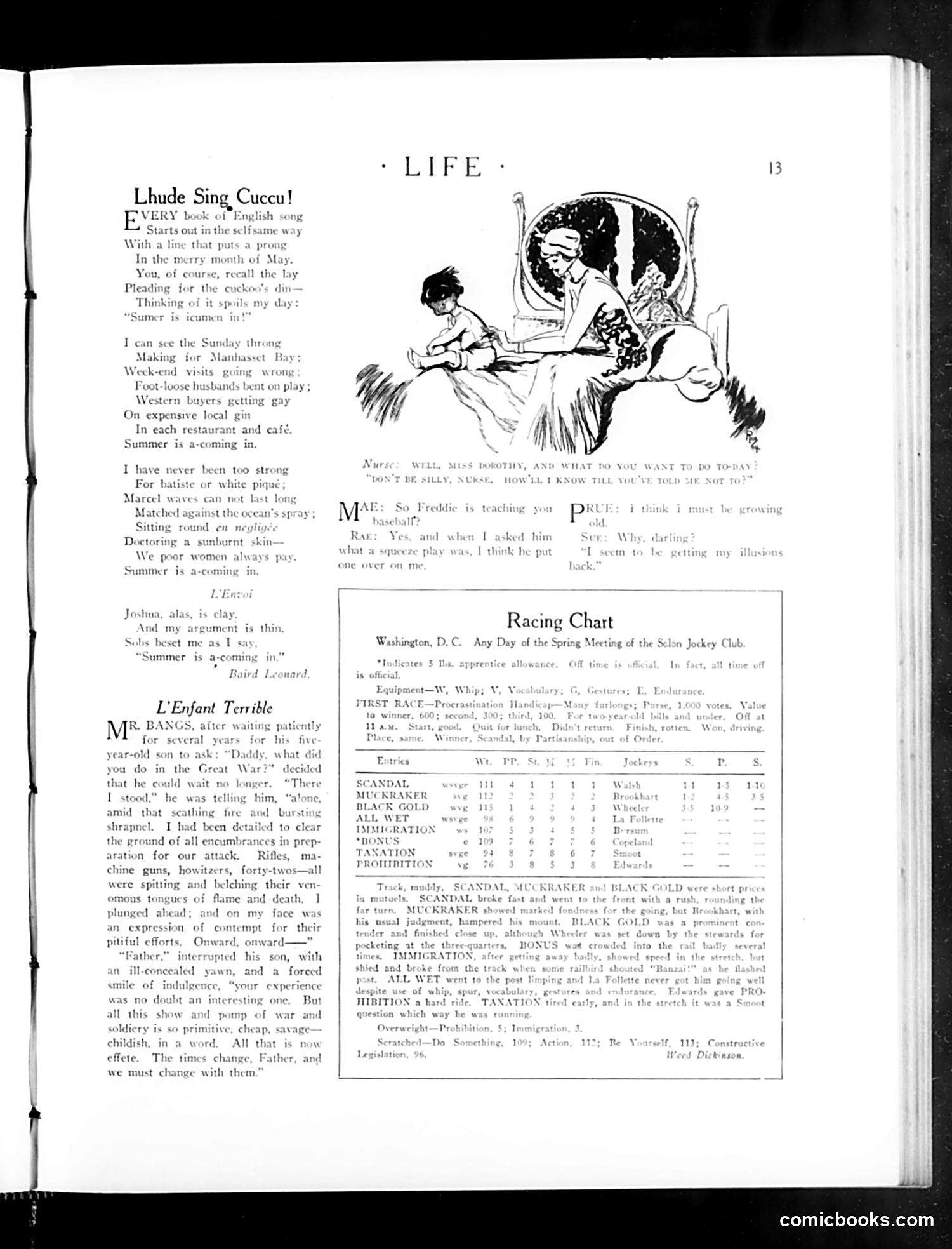
This page contains three separate pieces: 1. **"Llude Sing Cuckoo!"** - A poem satirizing English summer, mocking romantic notions of the season while cataloging its actual disappointments: crowded restaurants, unfaithful partners, sunburns, and poor weather. 2. **An illustration** showing a nurse and child in a domestic scene, with dialogue about a character named Freddie teaching baseball, touching on themes of growing up and losing childhood illusions. 3. **A racing chart** from Washington, D.C., documenting a horse race from the Salon Jockey Club's spring meeting, complete with detailed statistics, horse names, and performance data. The page blends satirical social commentary about seasonal disappointments with a domestic scene and specialized sporting content—typical of *Life* magazine's mix of humor, illustration, and leisure-class interests.
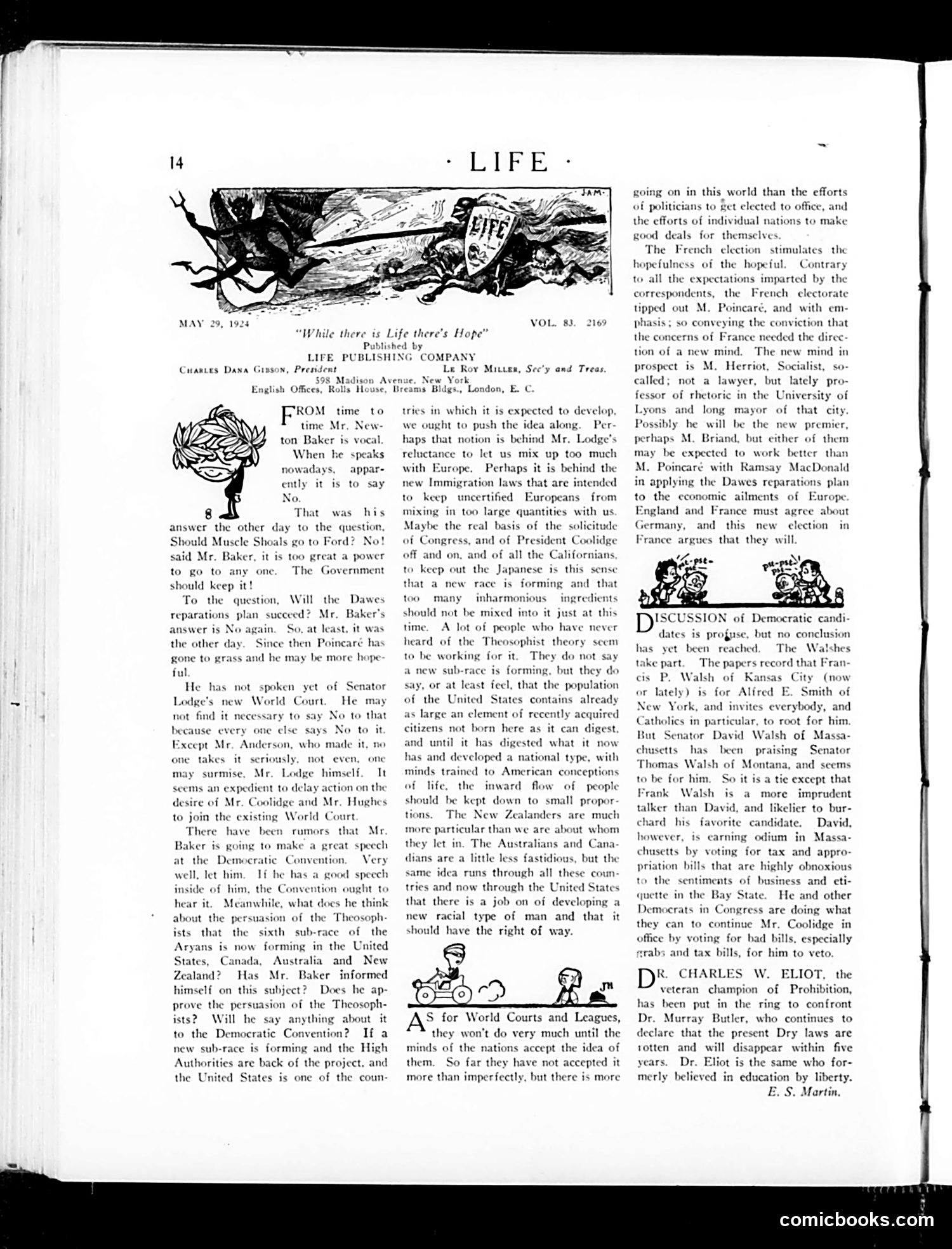
This page satirizes Newton Baker, a prominent Democrat who frequently makes public pronouncements. The cartoonist mocks Baker's tendency to say "No" to major policy questions—opposing government control of Muscle Shoals, doubting the Dawes reparations plan would succeed, and being skeptical of Senator Lodge's World Court proposal. The satire then pivots absurdly: the author asks whether Baker has addressed the Theosophist theory that a "sixth sub-race" is forming among English-speaking nations (US, Canada, Australia, New Zealand). This appears to be satirical—suggesting that hidden mystical concerns, rather than rational debate, may actually drive restrictive immigration policies and Congressional reluctance to engage internationally. The piece sardonically implies that America's isolationism and anti-immigration stance might stem from occult racial theories rather than stated political reasons, mocking the disconnect between public justifications and possible unstated motivations in 1924 policy debates.
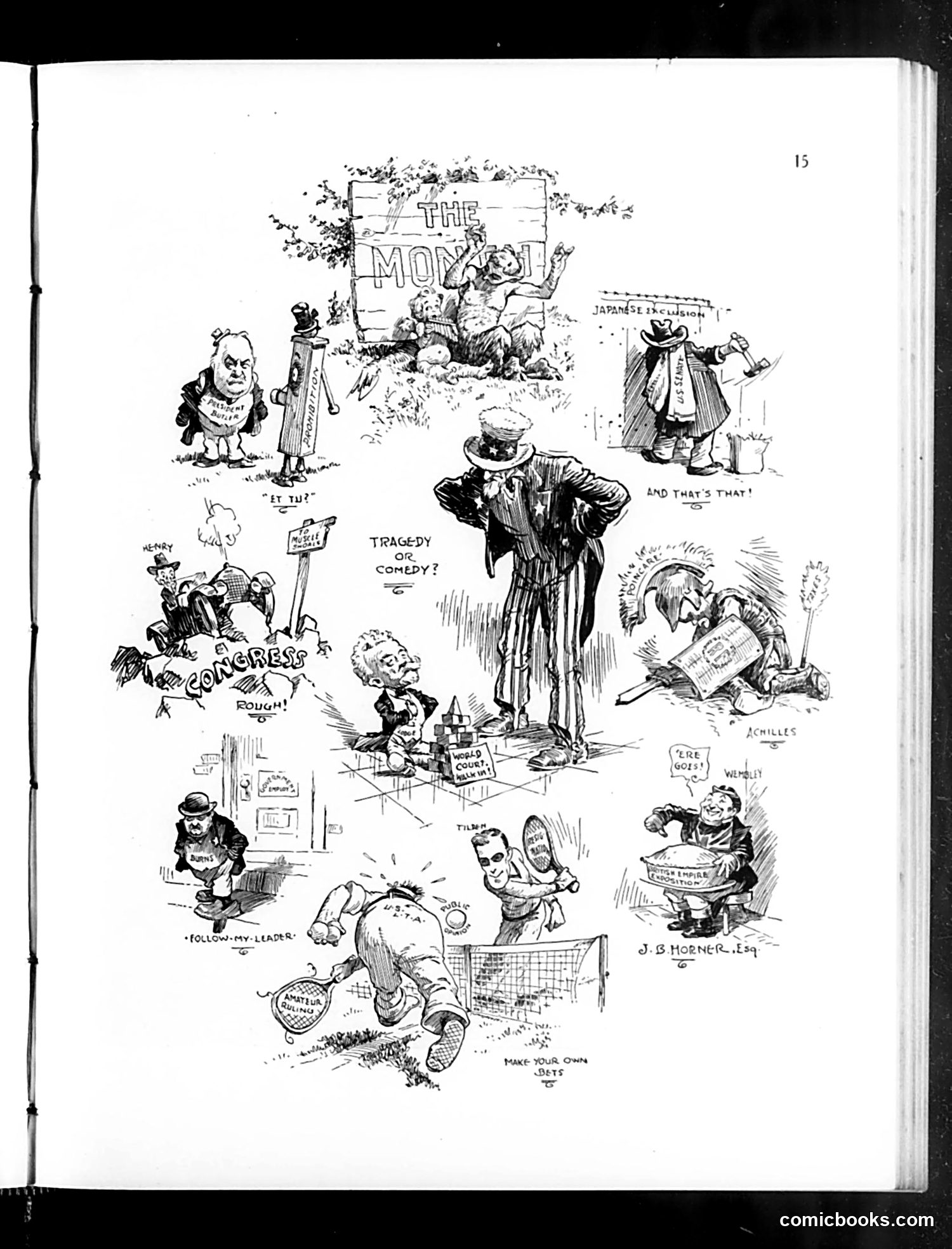
This satirical cartoon depicts "The Monkey" (likely Congress or a political body) as a central chaos-generating entity surrounded by caricatured figures representing various political actors and concerns. The central question—"TRAGEDY OR COMEDY?"—suggests uncertainty about whether current events should be taken seriously or dismissed as absurd theater. Labeled figures include references to "Japanese Exclusion," "Congress," "Follow My Leader," and other political positions, suggesting early 20th-century debates. The scattered, tumbling composition implies political disorder and lack of coherent direction. Various politicians appear as small, struggling figures attempting to manage or react to the central monkey's chaos. The overall message critiques political incompetence, infighting, and the seeming inability of government to effectively address serious issues—treating grave matters with either tragic seriousness or farcical comedy.
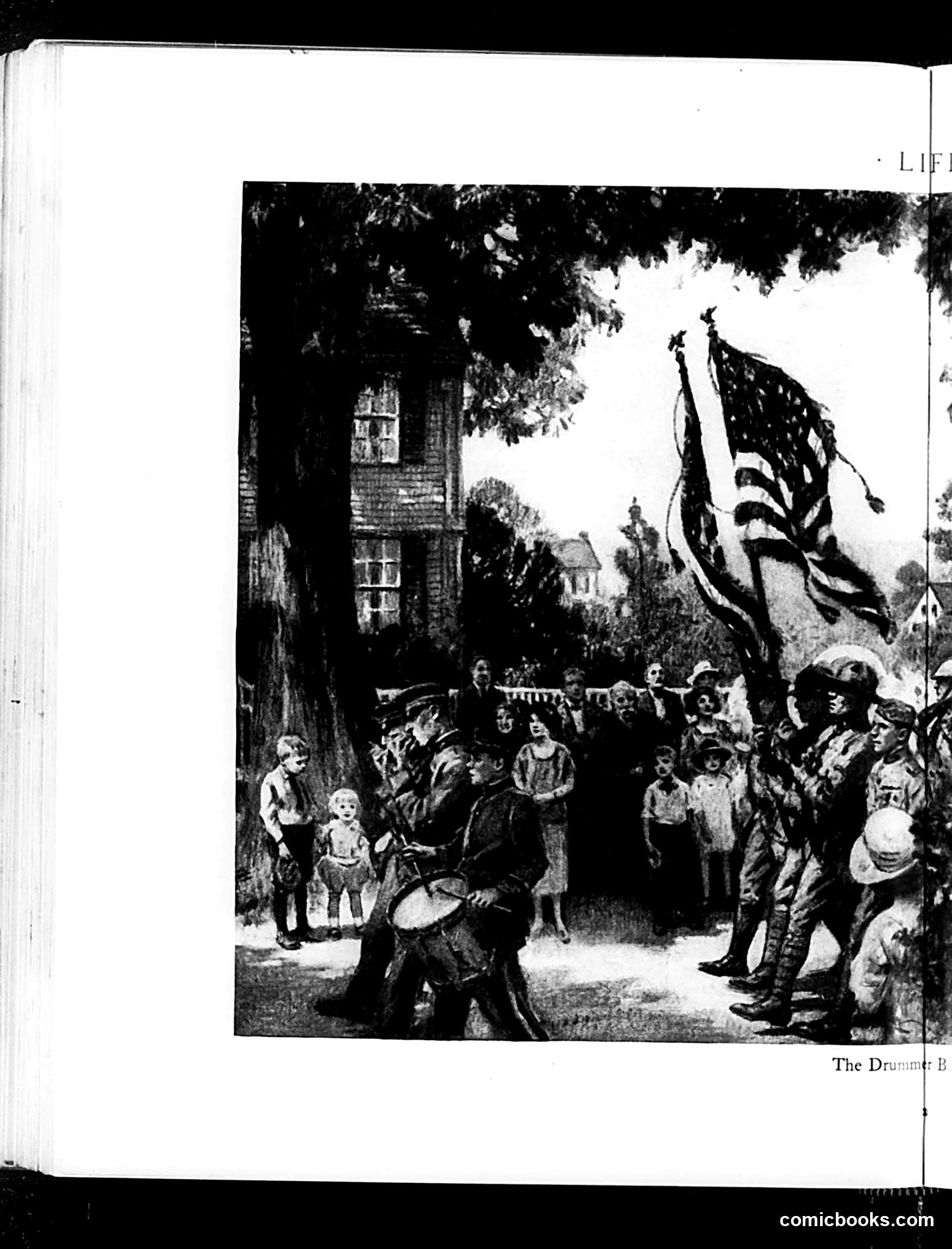
The OCR text is illegible, so I'm relying on the image alone. This black-and-white illustration depicts a public gathering or ceremony beneath large trees, with a building visible in the background. A prominent American flag is displayed on the right side. The scene shows civilians and what appear to be military or uniformed figures, with a drummer visible in the foreground. The caption reads "The Drummer B[...]" (text cut off). Without legible OCR text or a visible publication date, I cannot definitively identify the specific event, figures, or satirical intent. The gathering's formal nature and flag prominence suggest a patriotic or civic ceremony, but the particular historical context—and whether this is satire or straightforward illustration—remains unclear. Additional context would be needed for accurate interpretation.
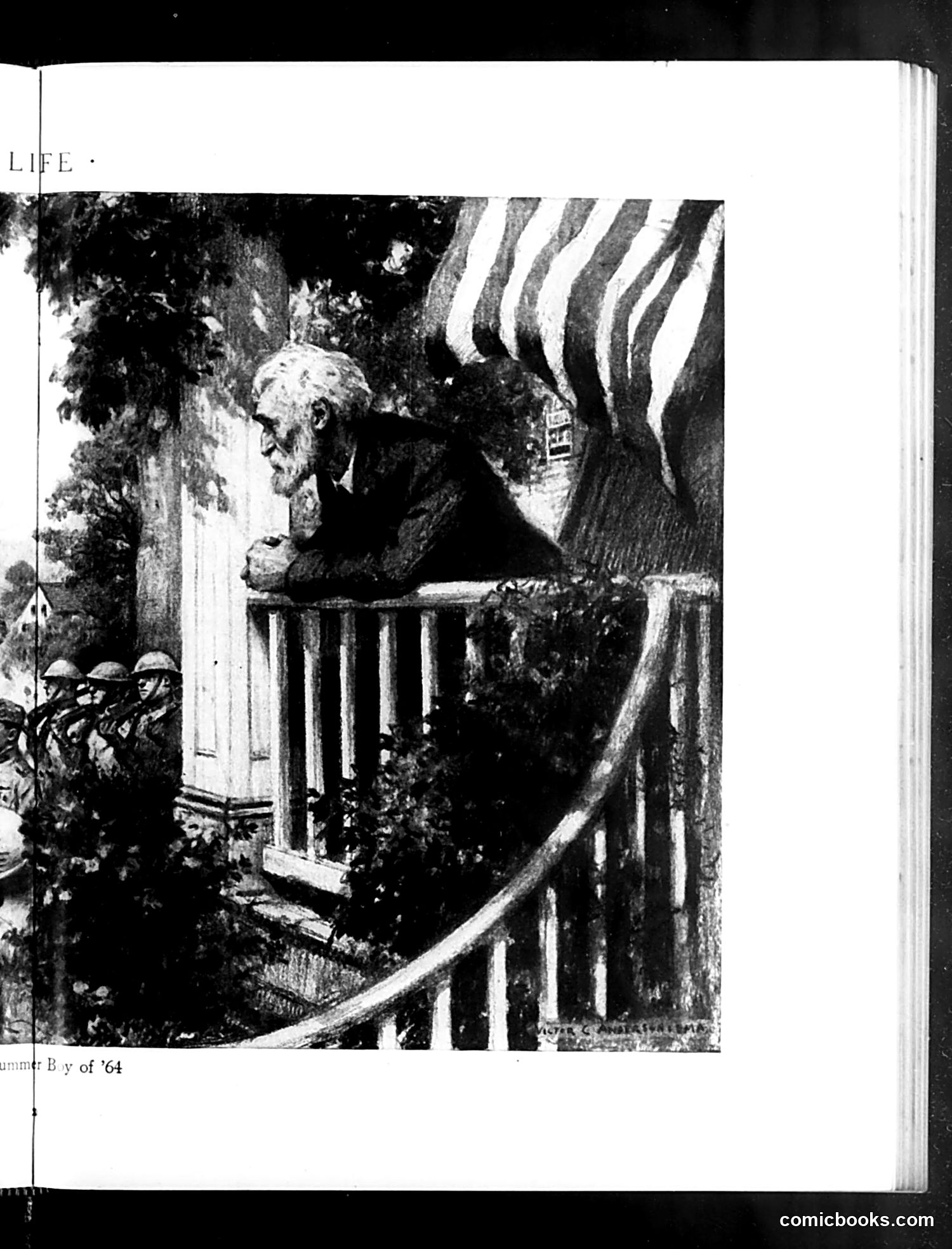
This page from *Life* magazine shows a black and white photograph rather than a drawn political cartoon. The image depicts an elderly man in formal attire (appearing to be a bust or statue) positioned on what looks like a balcony or railing, with soldiers visible below wearing military helmets and uniforms. The "Summer By of '64" caption at the bottom suggests this relates to summer 1964 events, likely during a military or political conflict. Without clearer text identifying the specific figure or context, I cannot definitively state which historical event or political figure this references. The composition suggests commentary on military authority or leadership during a crisis, but the exact satirical message requires additional context to interpret accurately.
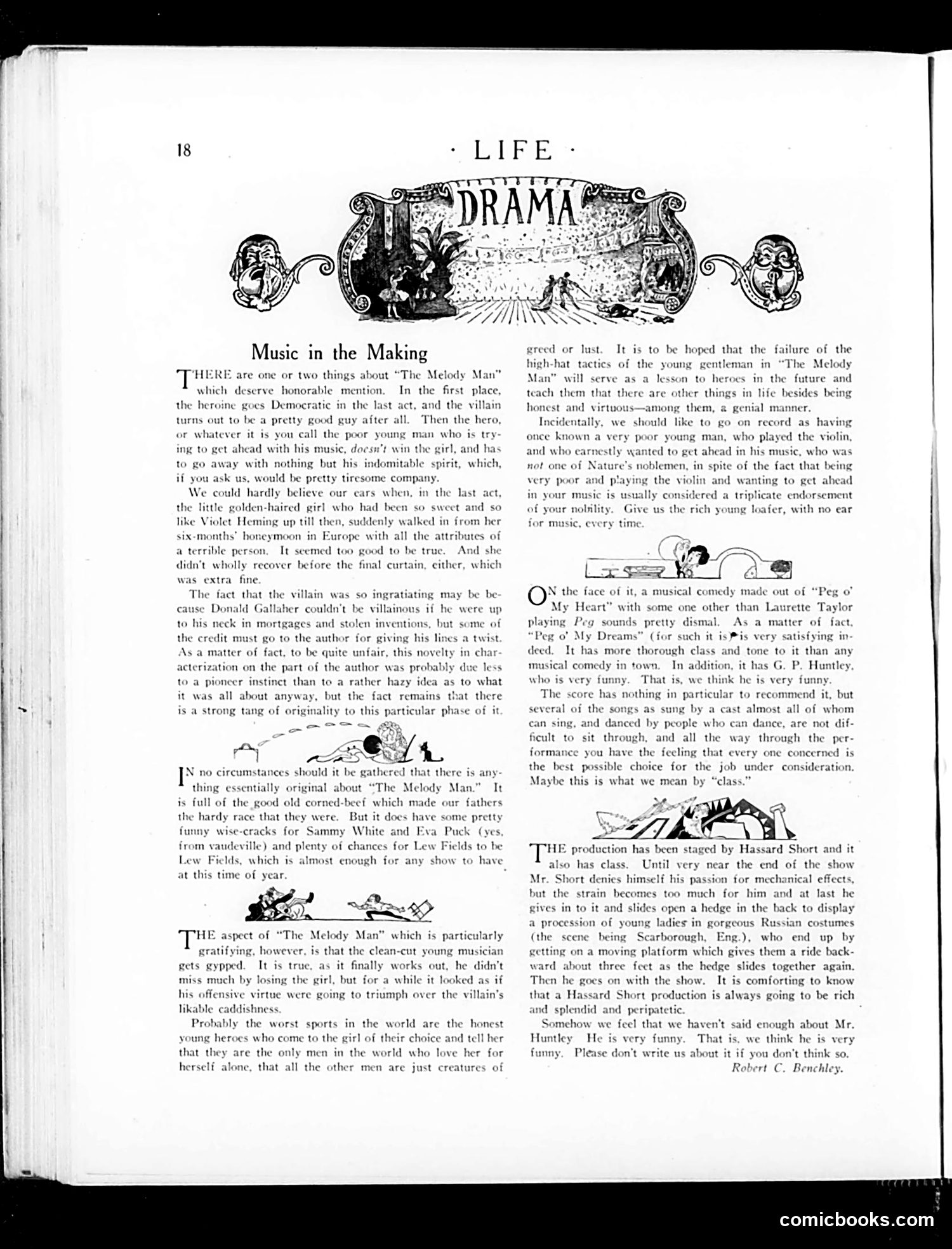
This page reviews two musical comedies: "The Melody Man" and "Peg o' My Dreams." The author critiques "The Melody Man" for its conventional plot—a virtuous young musician loses the girl to a charming villain. The satire targets the moral clichés of theatrical romance: the author mocks the "worst sports in the world" (honest young men who claim exclusive love), suggesting such self-righteous virtue is tiresome rather than admirable. The review praises an unexpected character twist where the golden-haired heroine reveals herself as selfish after a European honeymoon. For "Peg o' My Dreams," the reviewer praises its superior "class and tone" compared to typical musical comedy fare, and highlights performer G.P. Huntley as genuinely funny. The overall tone is witty, using theatrical incompetence and romantic tropes as vehicles for satirizing naive male earnestness and theatrical predictability.
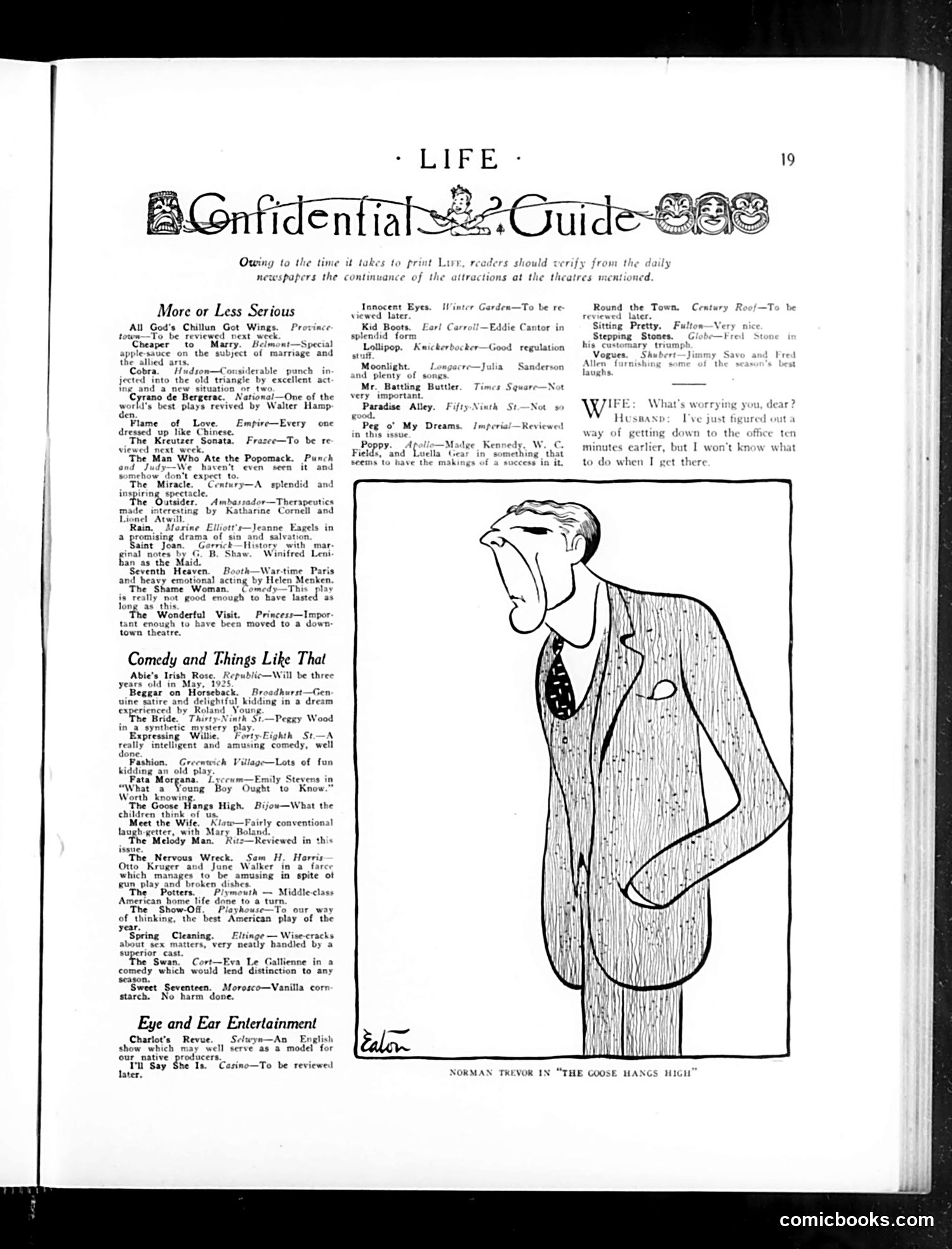
This page is a **theater review guide** listing Broadway productions currently running in New York. The main illustration depicts **Norman Trevor** in a scene from "The Goose Hangs High"—a play about generational conflict where children judge their parents' values and behavior. The cartoon shows a middle-aged man with an exaggerated expression of worry or distress, capturing the play's comedic premise about how young people view their elders. The surrounding text catalogs shows divided into categories: "More or Less Serious," "Comedy and Things Like That," and "Eye and Ear Entertainment." Notable entries include *Abie's Irish Rose* (a hit about interfaith marriage), *The Show-Off* (praised as "the best American play of the year"), and various musical comedies and dramas popular during the Jazz Age. The brief dialogue snippet about a husband explaining office delays reflects the era's domestic humor. This is essentially **entertainment listings and criticism** for contemporary theater-goers, not political satire.
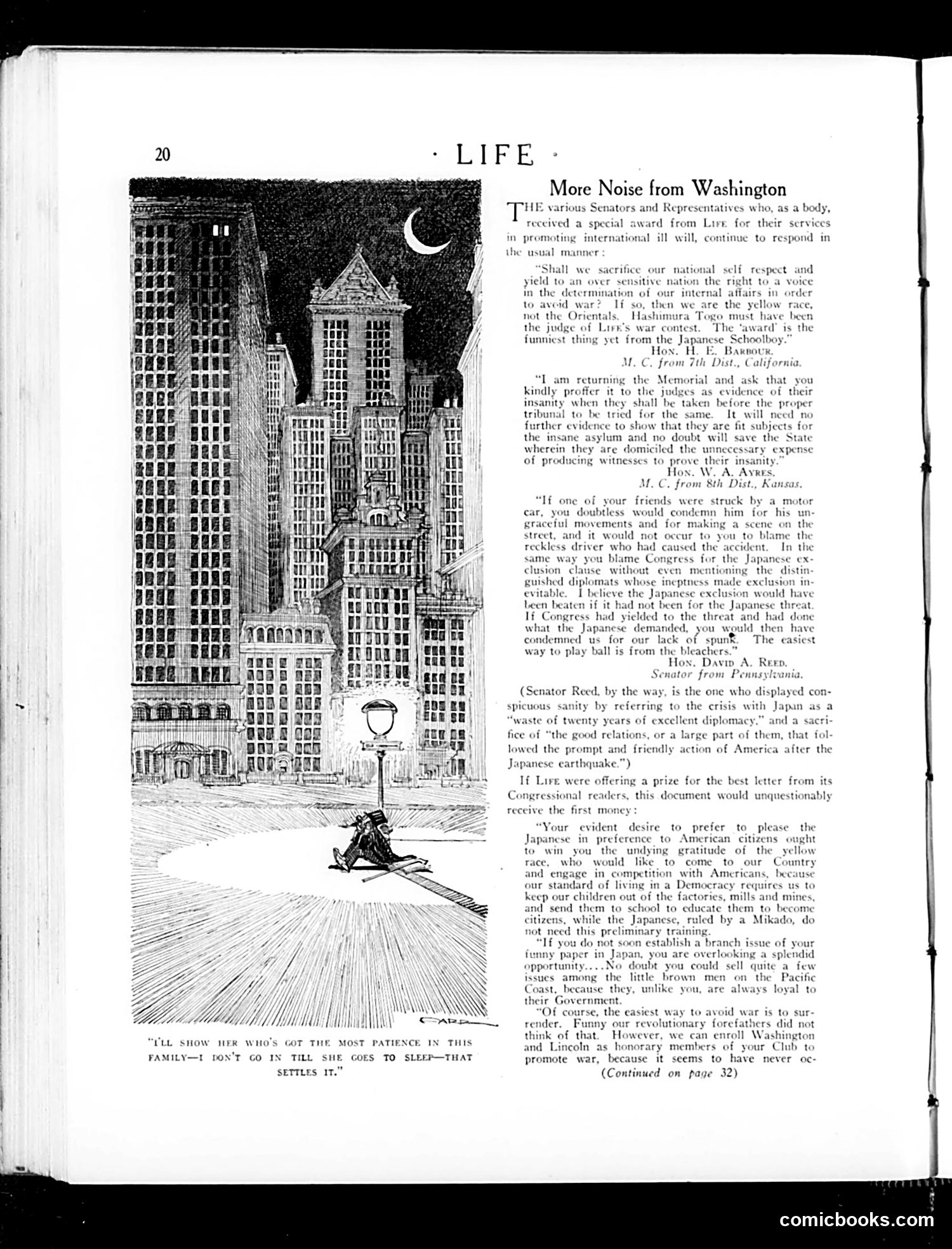
This page satirizes Congressional members who received a "special award from Life for their services in promoting international ill will" regarding Japanese-American relations. The cartoonist mocks politicians who publicly denounced Japan following tensions (likely related to the 1906 San Francisco earthquake or immigration disputes), while appearing hypocritical about diplomacy. The large illustration shows a nighttime cityscape with a sleeping figure below—likely representing America or the public, oblivious to political turmoil above. The accompanying letters mockingly present various Congressional justifications for anti-Japanese rhetoric, each revealing shallow reasoning or contradictions. The satire targets politicians who grandstand on foreign policy without considering consequences, who blame Japan while ignoring American diplomatic failures, and who disguise racist exclusionism as patriotism. One senator's admission that this represents a "waste of twenty years of excellent diplomacy" particularly undercuts their position. The overall message: Congressional posturing on Japan serves domestic political purposes rather than genuine national interest.
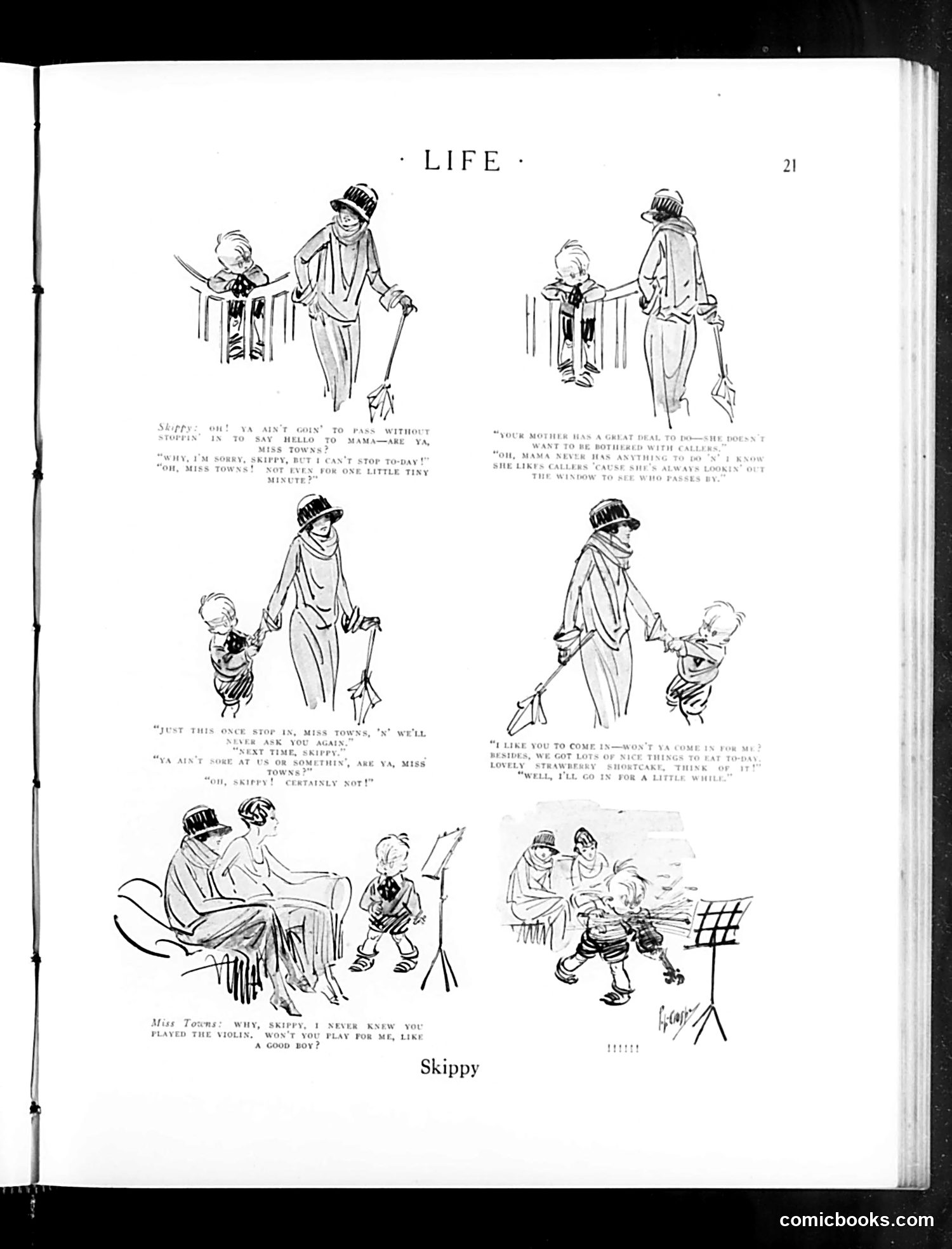
This page presents a comic strip titled "Skippy" featuring a young boy and various adults (likely his mother and other townspeople). The humor revolves around Skippy's interactions and requests—he wants Miss Towne to stop and chat, asks his mother about eating strawberry shortcake, and pleads with Miss Towne to play violin for him "like a good boy." The satire gently mocks childhood persistence and manipulation: Skippy employs flattery, persistent questioning, and emotional appeals to get what he wants from adults. The comic captures universal childhood behavior—negotiating with parents and neighbors, making deals, and using charm to achieve goals. The strip's humor is situational rather than political, representing typical domestic comedy of the 1920s-30s era when *Life* magazine was primarily known for lighthearted social commentary and family-oriented humor.
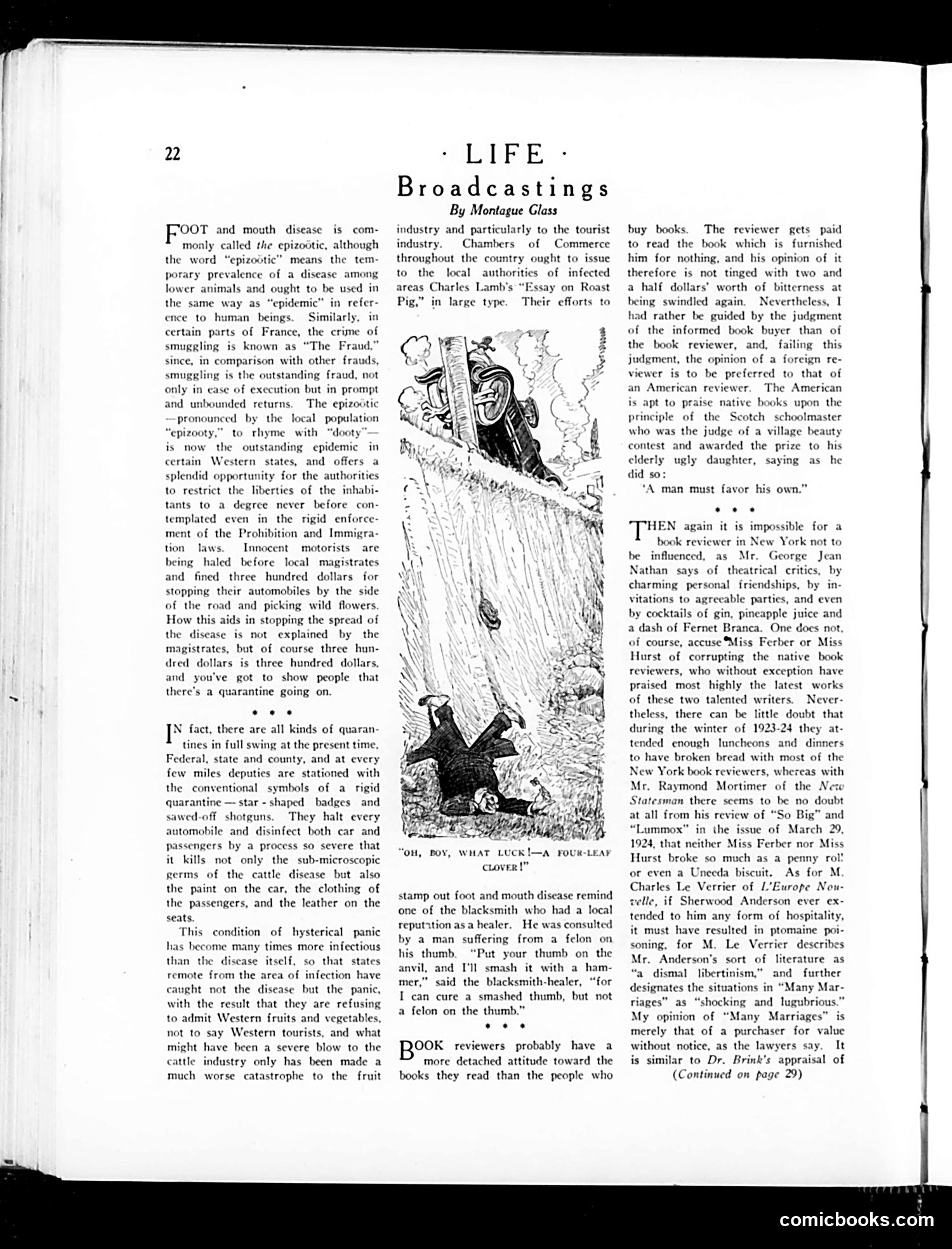
This page satirizes government overreach during the 1924 foot-and-mouth disease crisis affecting Western livestock. The cartoon shows authorities frantically implementing absurd quarantine measures—fining motorists $300 for picking wildflowers by roadsides, establishing checkpoints with armed deputies, and disinfecting vehicles so harshly they destroy the paint and leather. The satire's point: panic-driven bureaucracy is worse than the disease itself. Authorities stopped actual disease transmission and instead created economic catastrophe for fruit and tourism industries through irrational enforcement. The author compares it to a blacksmith who "cures" a thumb infection by smashing it with a hammer—solving the problem through destruction. The four-leaf clover cartoon caption ("Oh, boy, what luck!") sarcastically comments on citizens' desperate hope amid government chaos. The piece criticizes how fear spreads faster than disease, causing states to ban Western produce and tourists unnecessarily.
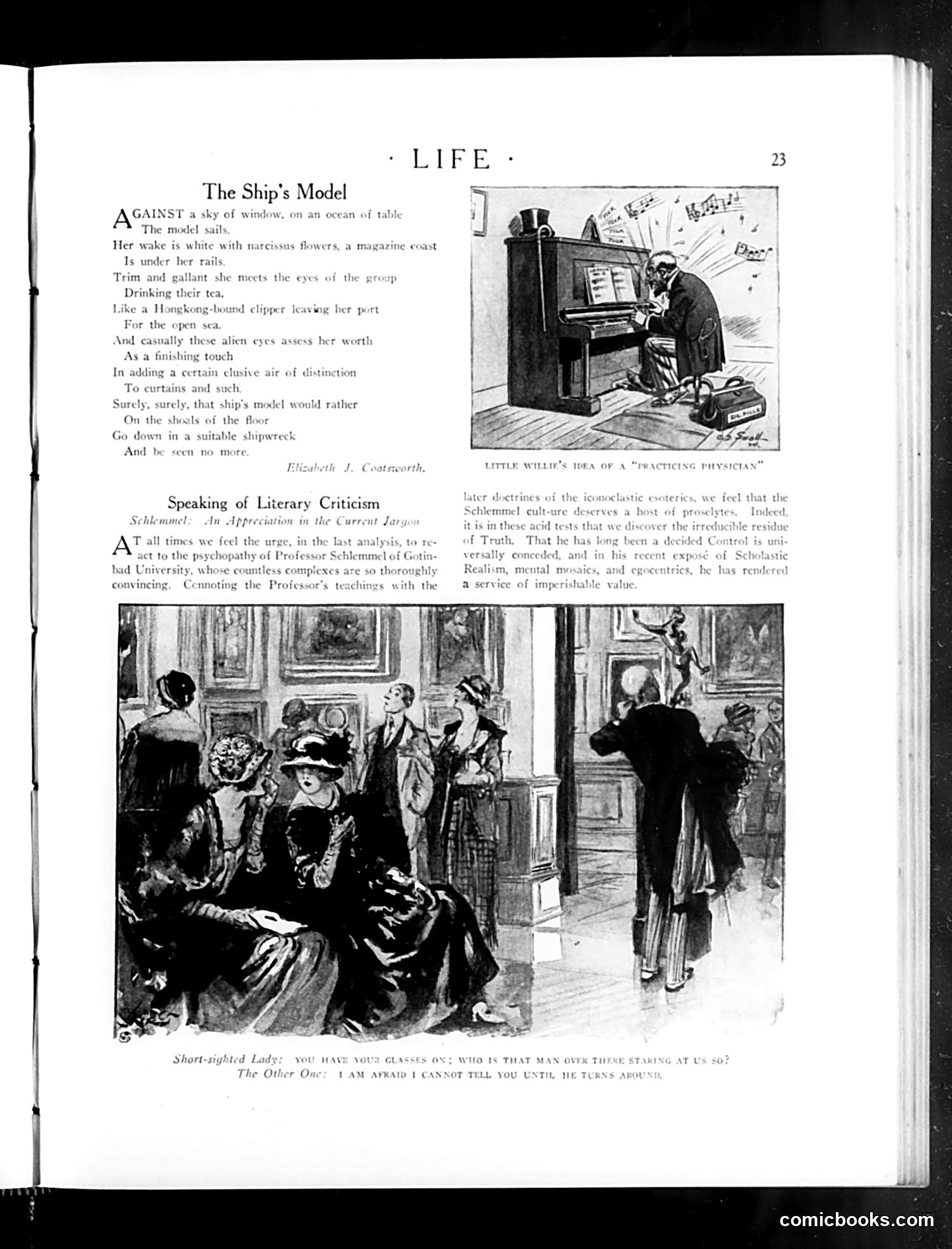
This page contains two distinct satirical pieces: **"The Ship's Model"** (top): A poem by Elizabeth J. Coatsworth about a decorative ship model in a window. The accompanying sketch shows a man examining a model ship on what appears to be a shelf or display. The satire is gentle—mocking the pretentious display of such ornaments and the casual dismissal ("be seen no more") of decorative objects that accumulate in homes. **"Speaking of Literary Criticism"** (bottom): The cartoon depicts socialites at what appears to be a gallery or salon. One short-sighted woman asks another about a mysterious man they're both staring at. The Other replies she cannot identify him "until he turns around"—the joke being that she's equally unable to see clearly, yet feels obligated to pretend knowledge of notable figures. This satirizes shallow social pretension and the performance of cultural sophistication among the wealthy. Both pieces mock genteel society's affectations.
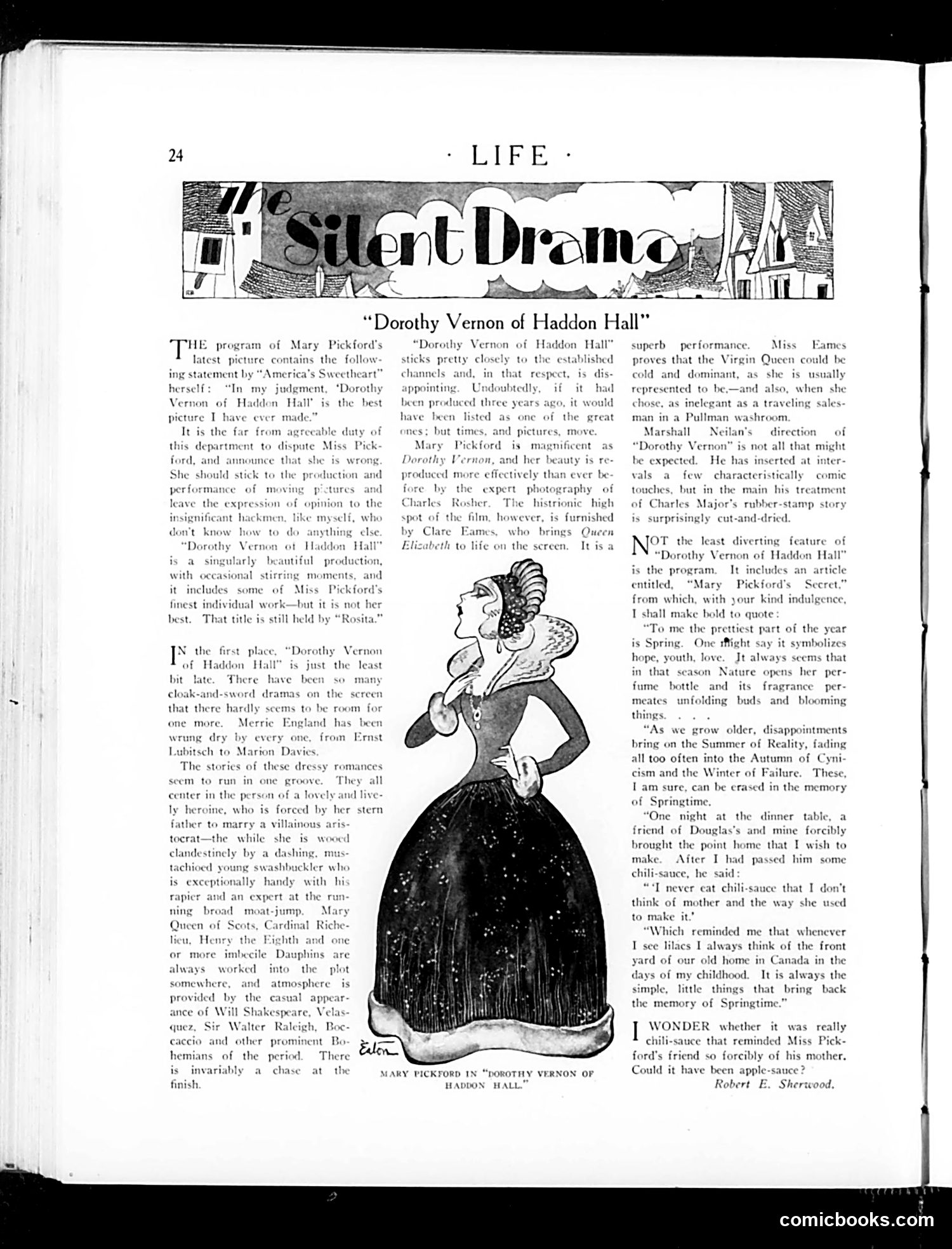
This is a theater review of Mary Pickford's silent film, not a political cartoon. The page critiques Pickford's latest picture, a costume drama set in historical England. The reviewer acknowledges the film follows a tired formula: a heroine forced into marriage by her stern father, a dashing young suitor, comic relief characters, and Shakespeare/historical figures added for atmosphere. He notes such "dressy romance" stories have been exhausted by filmmakers from Ernst Lubitsch to Marion Davies. Despite the formulaic plot, the reviewer praises Pickford's performance and cinematographer Charles Rosher's work. He criticizes director Marshall Neilan's direction as uninspired and notes actress Clare Eames's portrayal of Queen Elizabeth surprisingly effective—unglamorous and realistic rather than theatrical. The review includes a sentimental essay Pickford wrote about springtime and childhood memories, which the reviewer gently mocks as possibly saccharine.
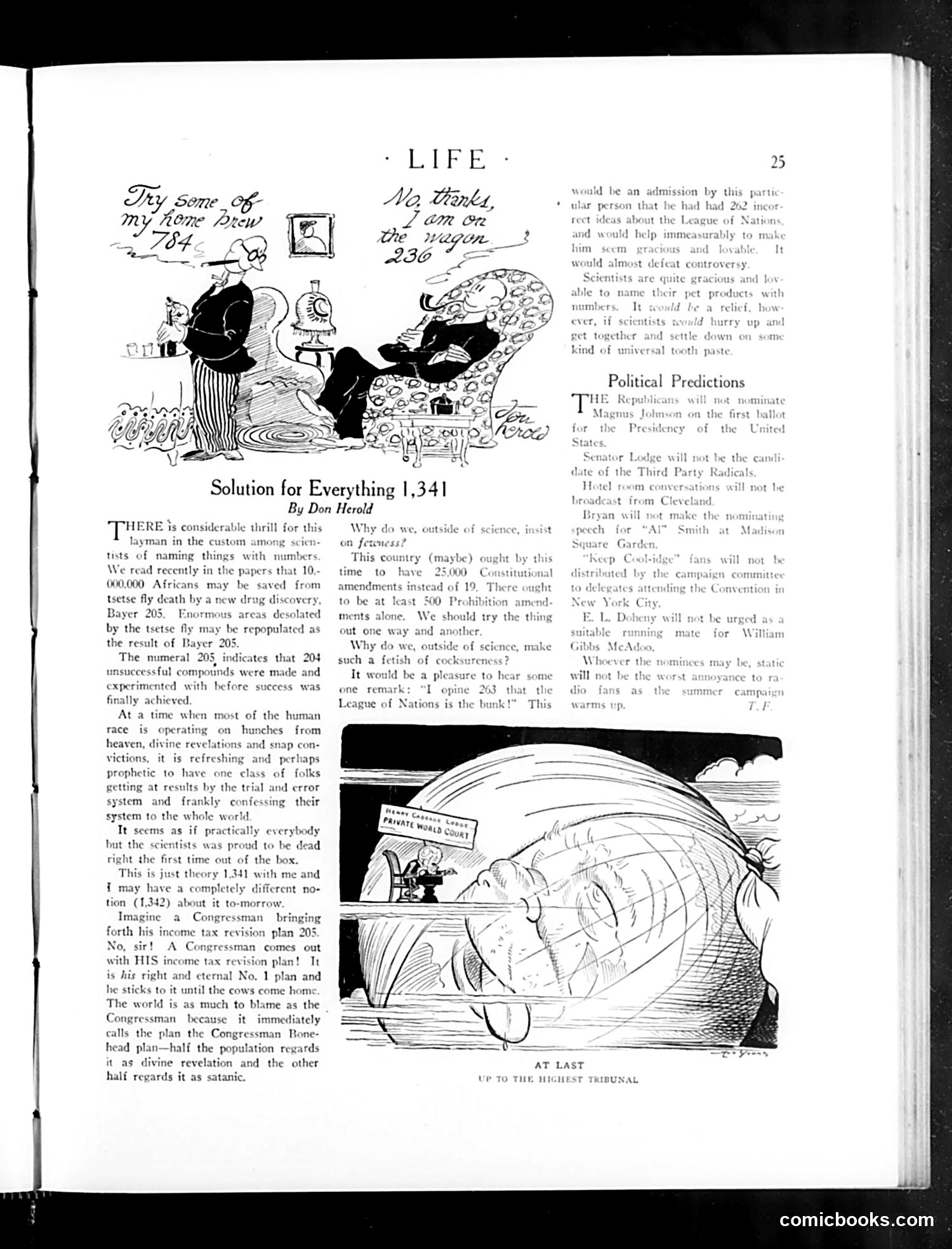
This page contains two distinct satirical pieces: **"Solution for Everything 1,341"** by Don Herold critiques scientific triumphalism. Herold mocks scientists' pride in discovering Bayer 205, a drug combating the tsetse fly in Africa. His satire suggests that numbering solutions (1,341) reflects humanity's naive faith that every problem has a technical fix. He argues scientists won't acknowledge error or work collaboratively—they insist on being "dead right the first time." **"Political Predictions"** section mocks public political discourse, predicting various politicians and public figures will *not* do expected things (Republicans won't nominate certain candidates, Senator Lodge won't run, etc.). The humor lies in these being predictable non-events presented as notable predictions. The bottom cartoon, "At Last—Up to the Highest Tribunal," appears to show a figure presenting something to a higher authority, likely satirizing how disputes get elevated through government channels. The overall tone: skepticism toward both scientific certainty and political predictability.
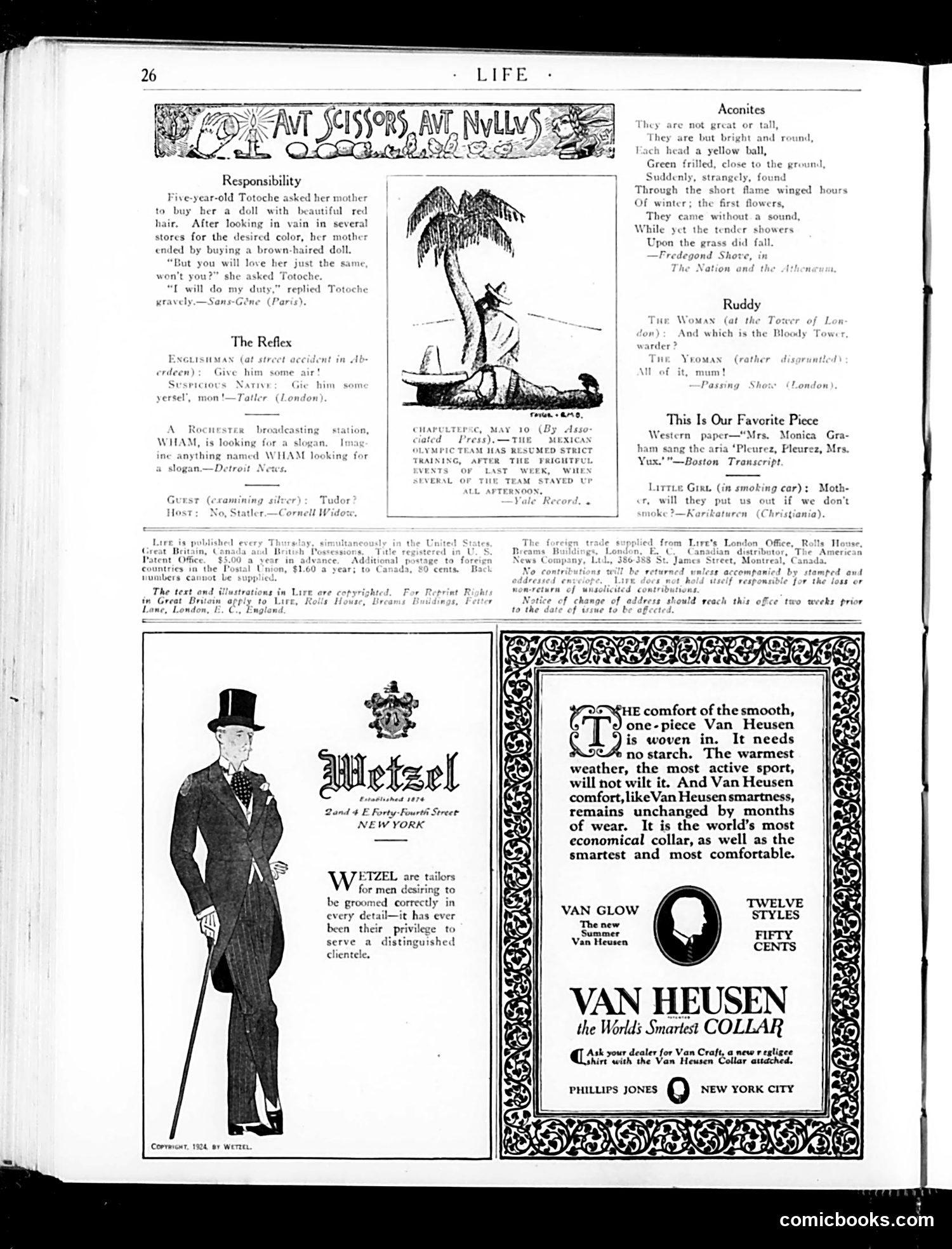
This page mixes satirical commentary with period advertising. The main cartoon "Responsibility" depicts a mother buying her daughter a brown-haired doll instead of the desired red-haired one, with the child accepting it gracefully—likely satirizing parental expectations versus children's actual desires, or post-WWI resource constraints. "The Reflex" humorously captures an Englishman's reflexive politeness even in absurd situations (asking for air while choking). The Wetzel tailoring advertisement and Van Heusen collar ads dominate the lower half—typical 1920s mens' fashion marketing emphasizing respectability and grooming. The tailored gentleman in top hat represents the aspirational professional class. "This Is Our Favorite Piece" appears to reference operatic performance, though context is fragmentary in the OCR. Overall, the page reflects 1920s concerns: social propriety, consumer goods, and gentle domestic satire—representative of *Life* magazine's lighthearted approach to modern American life.
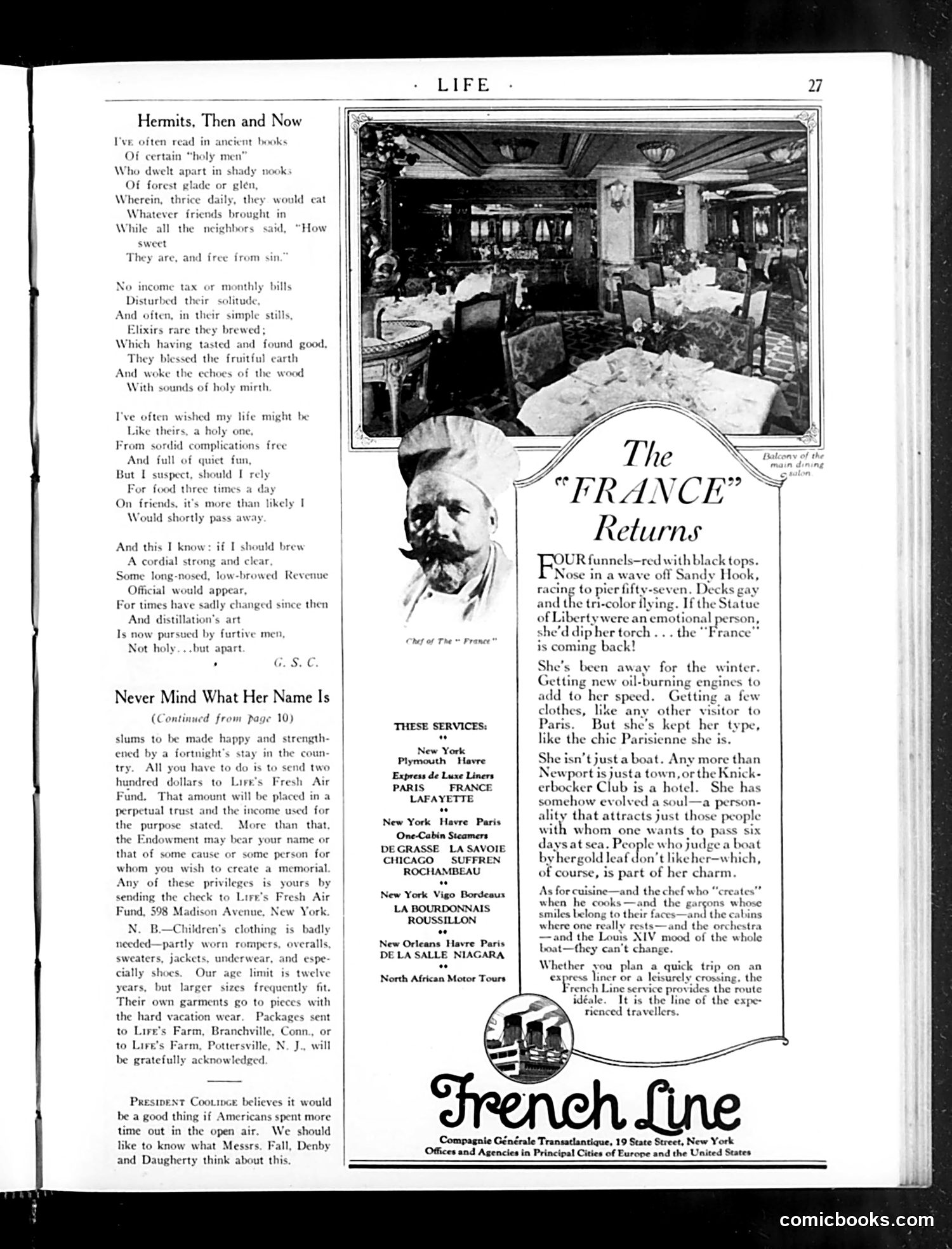
This page contains two distinct elements: a poem and an advertisement. **"Hermits, Then and Now"** is a satirical poem contrasting medieval hermits with modern life. It nostalgically describes how ancient holy men lived simply, free from taxes and bills, brewing homemade liquor ("elixirs") that neighbors praised. The satire pivots sharply: the poet wishes for such simplicity but recognizes it's impossible today. If he tried similar self-sufficiency, he'd starve relying on charity, and if he brewed alcohol, "some long-nosed, low-browed Revenue Official would appear"—a clear reference to **Prohibition enforcement**. The poem mocks both the impossibility of simple living and the government's aggressive alcohol regulation. The closing reference to Fall, Denby, and Daugherty (Harding administration officials involved in the Teapot Dome scandal) connects to themes of governmental corruption. **The "France" advertisement** promotes the French Line's ocean liner service returning for the winter season, emphasizing luxury accommodations and French cuisine.
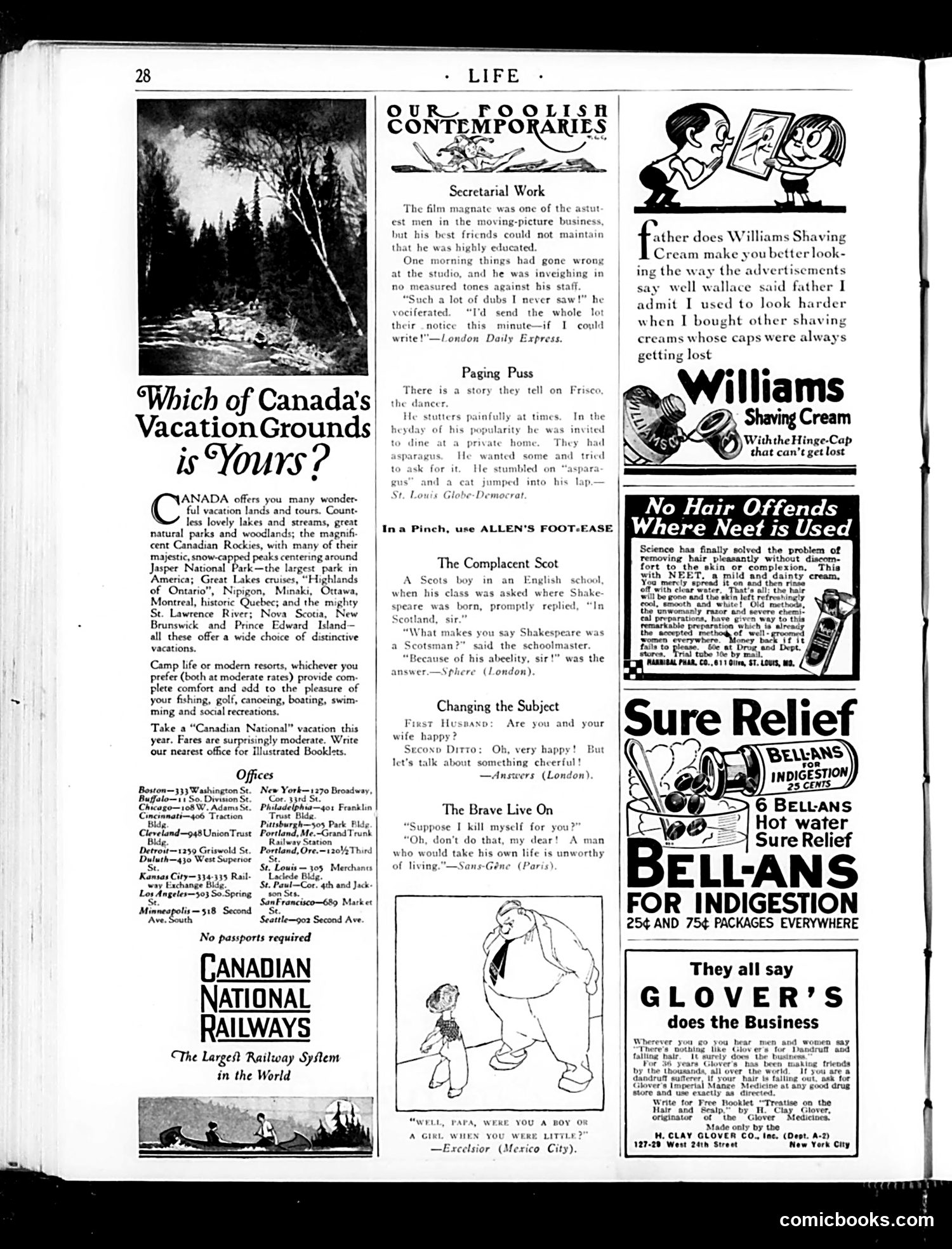
This page is primarily **advertising** with some brief humor columns interspersed. The main content includes: **Large Advertisements:** - Canadian National Railways promotes vacation destinations (no political content) - Williams Shaving Cream, Allen's Foot-Ease, Neet hair removal, Bell-Ans indigestion remedy, and Glover's products **Humor Columns** ("Our Foolish Contemporaries"): Short anecdotes mocking various subjects—a film executive who can't write, a stammering dancer, a Scottish boy claiming Shakespeare was born in Scotland because "of his abeelity, sir" (implying Scottish stubbornness). These are mild, gentle jokes about national stereotypes and character flaws rather than political satire. **Notable:** The Williams Shaving Cream ad includes a small cartoon about a father praising the product's hinge-cap design—domestic humor rather than social commentary. This appears to be a typical 1920s-era Life magazine page blending advertising revenue with light entertainment. No significant political cartoons or social satire are present.
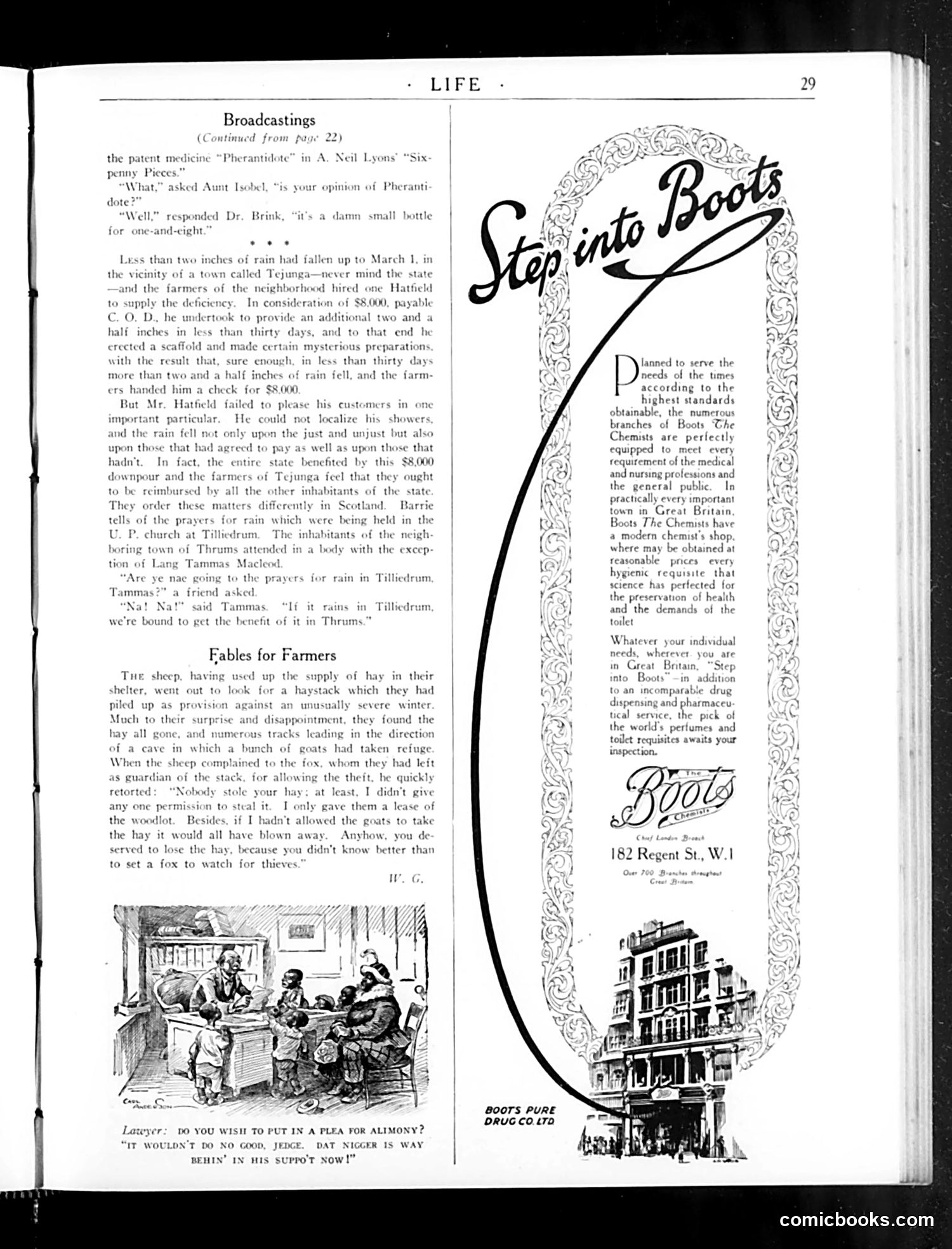
This page contains two distinct elements: **Left side - "Fables for Farmers":** A satirical short story about a sheep who lost hay to goats, then complained to a fox (hired as guardian). The fox's defense—that he actually *helped* by allowing the goats to take it (preventing wind damage) and that the sheep deserved loss for poor judgment—is a cynical commentary on responsibility and blame-shifting. The fable appears to critique those who shirk accountability. **Below that cartoon:** A crude racist courtroom joke depicting a Black man being denied alimony because he's "behind" on support payments. This reflects deeply prejudiced attitudes common in early 20th-century American humor. **Right side:** A full-page advertisement for Boots Chemists (drugstore), a British chain, promoting their pharmaceutical and hygiene products available nationwide. The page is primarily advertising-driven, with satirical content serving as editorial filler between ads—typical of Life magazine's format.
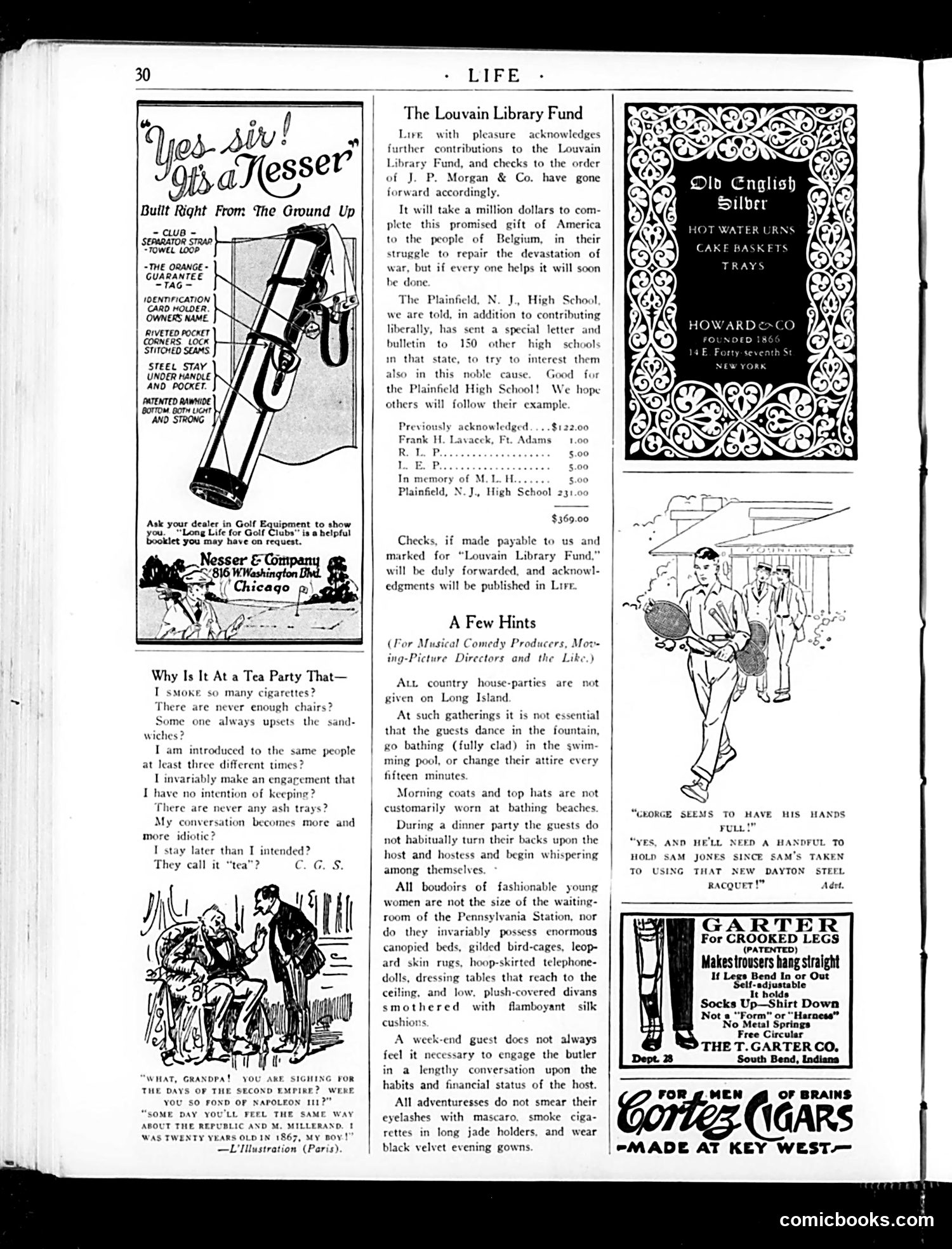
This page contains three distinct elements: 1. **"Why Is It At a Tea Party That—"** (left): A humorous social commentary mocking the tedious predictability of upper-class tea parties—too many cigarettes, insufficient chairs, repetitive introductions, and guests overstaying their welcome. It's satirizing the artificiality and boredom of genteel social gatherings. 2. **French Political Cartoon** (bottom left): A grandson asks his grandfather about nostalgia for Napoleon III's Second Empire. The grandfather responds he'll understand such nostalgia about the current Republic and Alexandre Millerand when older. This appears to criticize French political instability post-WWI, suggesting even the Republic will become as disliked as past regimes. 3. **"A Few Hints"** (center-right): Satirizes theatrical and film productions for their exaggerated depictions of wealthy society—absurdly large boudoirs, melodramatic behaviors, and clichéd character types. It mocks how entertainment media distorts reality. The remaining content is fundraising announcements and period advertisements.
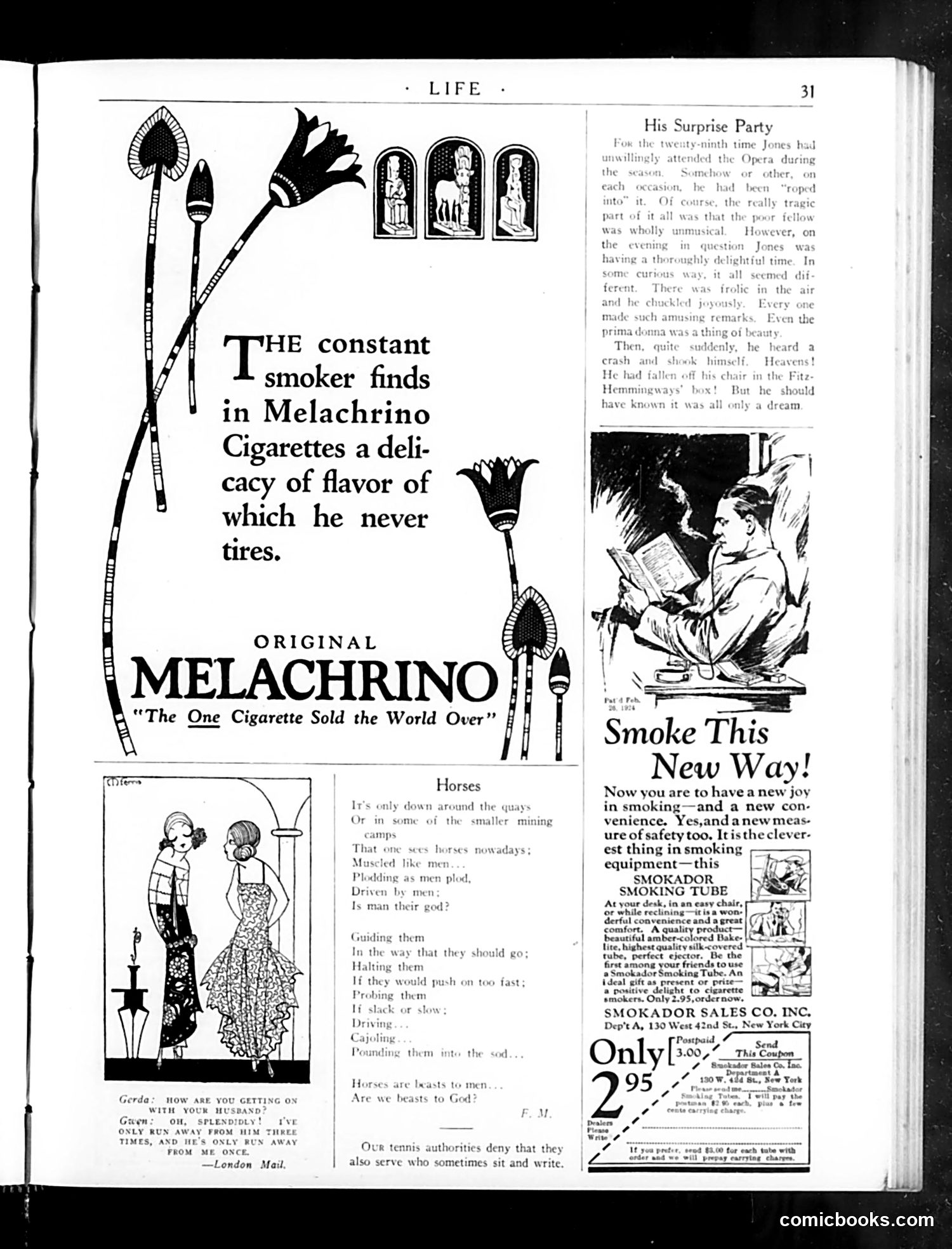
This page contains **two separate cigarette advertisements** and a brief **marriage humor cartoon**. The **Melachrino Cigarettes ad** (left) emphasizes sophisticated flavor for "constant smokers" with decorative botanical illustrations, positioning the product as globally prestigious ("The One Cigarette Sold the World Over"). The **Smokador Smoking Tube ad** (right) promotes a new accessory—an amber Bakelite tube with silk covering—as a modern convenience and status symbol for smokers, priced at $2.95. The small **cartoon below** shows a couple (Gerda and her husband) joking about infidelity: she's run away three times, he only once, implying she's the unfaithful one. It's a cynical marital joke typical of 1920s-30s humor. The page is primarily **commercial advertising rather than editorial satire**, reflecting the era's unregulated promotion of cigarettes as luxury consumer goods with no health warnings.
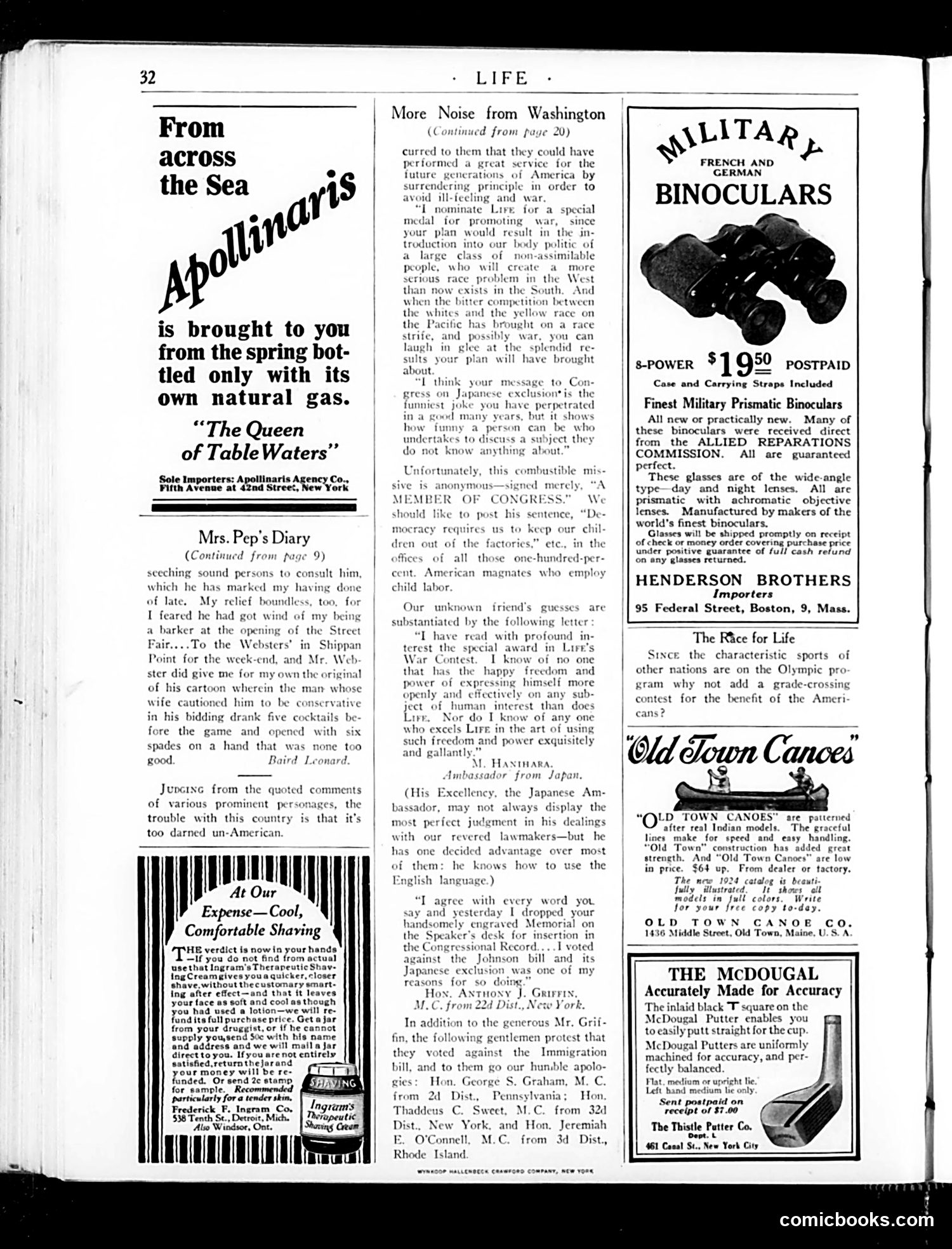
This page from *Life* magazine contains primarily **advertisements and opinion columns** rather than traditional political cartoons. The main content of note is the "More Noise from Washington" column (continued from earlier), which satirizes Congressional responses to what appears to be a **Japanese exclusion bill** (likely the Immigration Act context of early 1900s). The satire targets: 1. **American politicians' hypocrisy** — they preach democracy while proposing racial exclusion laws 2. **Child labor** — criticized as the height of American moral failure while lecturing other nations 3. **Congressional ignorance** — mocked for debating serious matters without understanding them An **anonymous Congressman** is quoted defending exclusion as necessary to prevent "race problems," while an **Japanese Ambassador (M. Hanihara)** responds with diplomatic restraint, praising *Life*'s editorial freedom. The page's point: American politicians lecturing morality while simultaneously supporting racism and labor exploitation represents shameful national hypocrisy. The rest of the page consists of product advertisements (shaving cream, water bottles, binoculars, canoes, and putters).
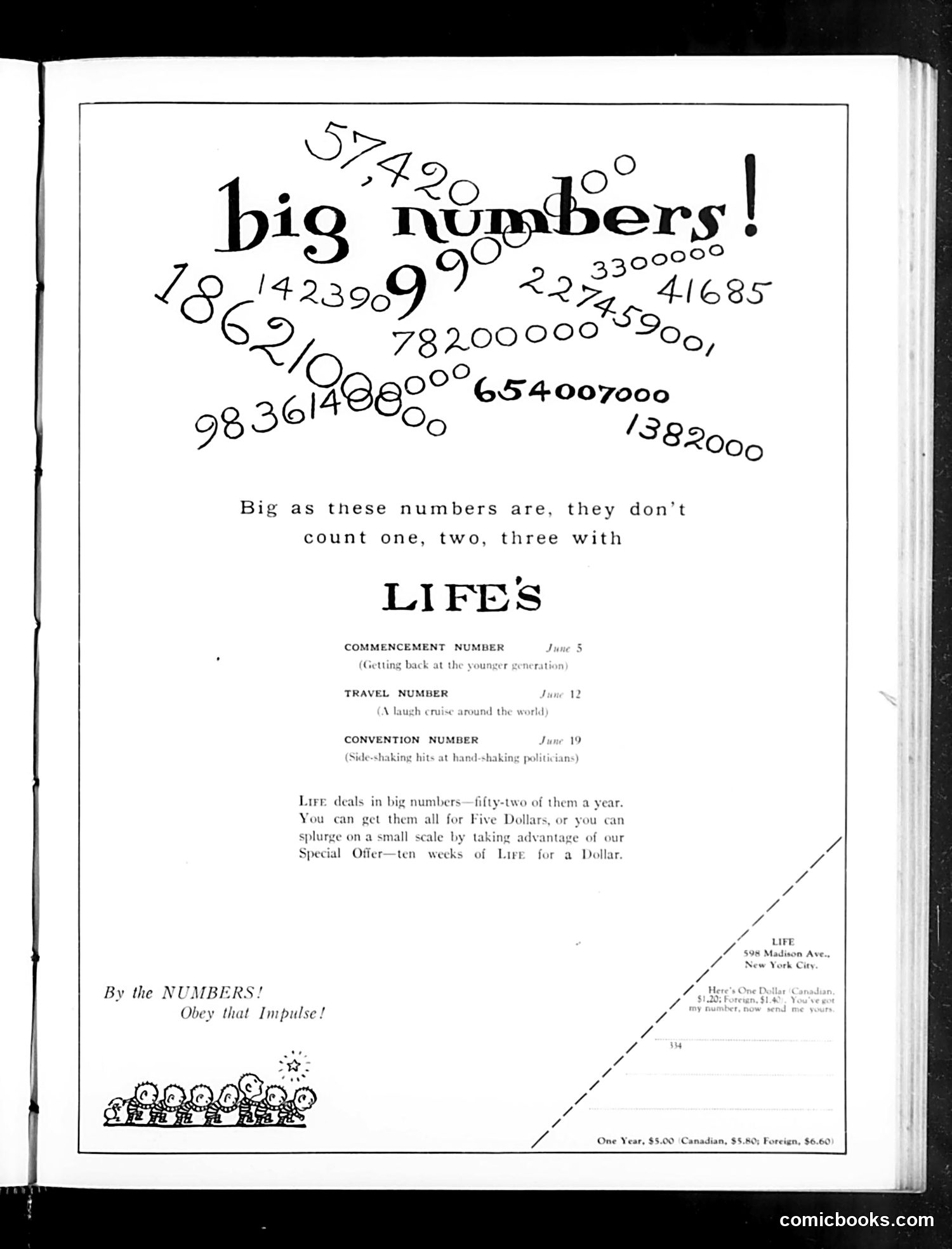
This is primarily a **subscription advertisement** for *Life* magazine, not a political cartoon. The "big numbers" at the top are satirical visual elements—enormous figures arranged chaotically—used to mock the obsession with statistics and numerical data that characterized early 20th-century American culture. The humor lies in the contrast: despite these massive numbers dominating the page, they're "worthless" compared to *Life*'s content. The ad promotes three upcoming special issues (Commencement, Travel, and Convention numbers), each with brief humorous descriptions of their satirical focus. The final line—"By the NUMBERS! / Obey that Impulse!"—is ironic wordplay: while the ad itself uses big numbers to grab attention, it's urging readers to impulse-buy rather than think logically. The small illustration at bottom shows cheerful children, suggesting *Life* appeals to families seeking intelligent humor and social commentary.
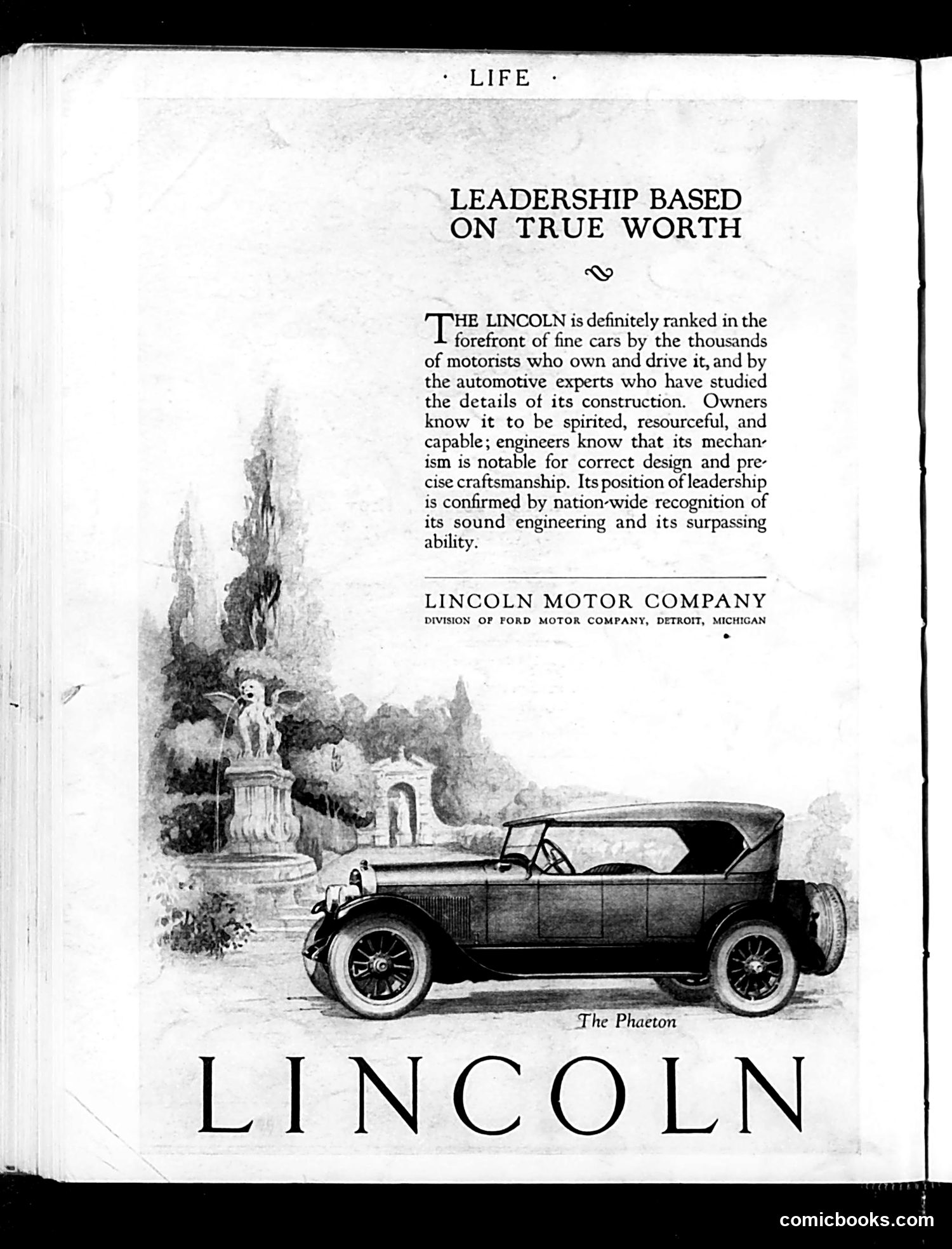
This is primarily a **Lincoln automobile advertisement**, not satirical content. The page uses the phrase "Leadership Based on True Worth" as both a marketing slogan and an implicit social commentary. The ad claims Lincoln automobiles achieve their market leadership through genuine quality—"correct design and precise craftsmanship"—rather than mere reputation or marketing. The classical garden statue and elegant setting in the illustration reinforce associations with refinement and timeless value. For a modern reader: This reflects early automotive marketing emphasizing engineering credibility. The phrase "true worth" suggests competing luxury cars of the era (likely Packard, Pierce-Arrow) relied on brand prestige rather than substantive superiority. The "Phaeton" model shown represents an upscale open-air touring car. This is Ford Motor Company's Lincoln division positioning itself as the thoughtful buyer's choice among luxury automobiles.