
Life, 1924-05-29 · page 28 of 38
Life — May 29, 1924 — page 28: what you’re looking at
What you’re looking at
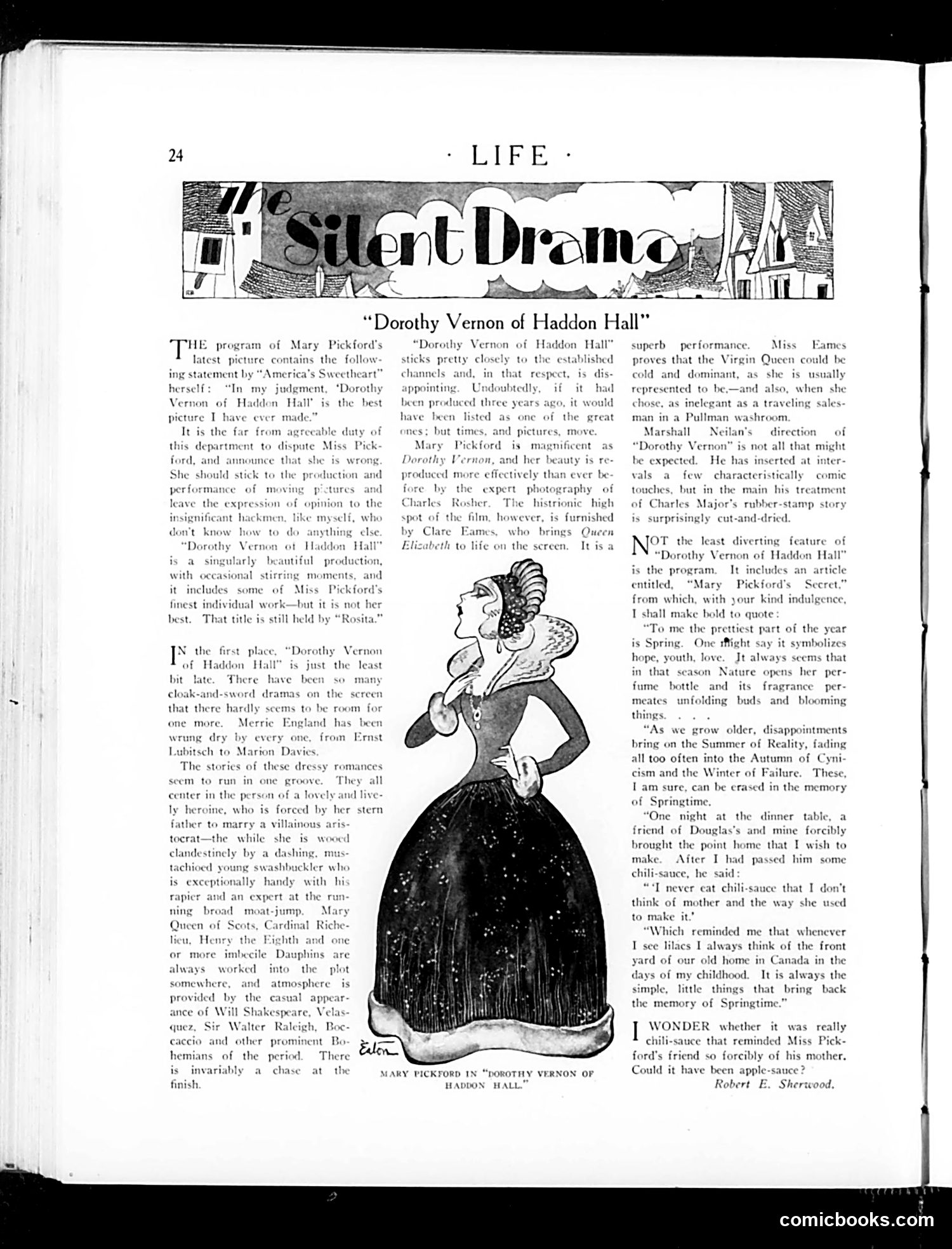
This is a theater review of Mary Pickford's silent film, not a political cartoon. The page critiques Pickford's latest picture, a costume drama set in historical England. The reviewer acknowledges the film follows a tired formula: a heroine forced into marriage by her stern father, a dashing young suitor, comic relief characters, and Shakespeare/historical figures added for atmosphere. He notes such "dressy romance" stories have been exhausted by filmmakers from Ernst Lubitsch to Marion Davies. Despite the formulaic plot, the reviewer praises Pickford's performance and cinematographer Charles Rosher's work. He criticizes director Marshall Neilan's direction as uninspired and notes actress Clare Eames's portrayal of Queen Elizabeth surprisingly effective—unglamorous and realistic rather than theatrical. The review includes a sentimental essay Pickford wrote about springtime and childhood memories, which the reviewer gently mocks as possibly saccharine.
📄 Transcribed text from this page (OCR, searchable)
Machine-transcribed from the original scan — historical spelling and the odd misread are preserved.
“Dorothy Vernon of Haddon Hall” latest picture c¢ n of Mary Pickford's ains the foll “In my ju of Haddon T have ever made.” ent to dispute Mi th; stick to the 4 |, and announce ction and ard She shou! performance of moving pictures leave the expres insignificant hackmen t now ow to do “Dorothy Vern a singularly ke myself, wh anything else Haddon Hall” is prod and Pickford’s with occasional stirr mc Miss but it is not it includes some of finest individual work best. That title is still held by * [8 the first place, “Dorothy Vernon of Haddon Hall” is just the least bit The ave been so many that there hardly scems to be room for one more England ha wrung dry by every one, from Ernst Lubitsch to Marion Davies The stories of these dressy romances center in the person of a lovely and live- seem to run in one groove all ly heroine, who is forced by her stern father to marry a villainou: tocrat clandestinely by a ¢ the while she # swashbuckler who ly handy with hi rapicr and an expert at the r Mary ning broad moat-jump. Queen of S lieu, Henry or more imbecile : always worked into. the plot somewhere, and atmosphere is provided by the casual appear- ance of Will Shakespeare, Velas quez, Sir Walter Rale R and other prominent Bo ns of the period. There is invariably a chase at the finish “Dorothy Vernon of Hade Hall" sticks pretty closely to. the established nels and, in that respect, is dis- ing. Undoubtedly, if it had have been listed as one of the great nes; but times, and pictures, move Mary Pickford is magnificent as Dorothy Verno' 1 her be produced more effectively th fore by the expert pl Charles Rosher. The spot « film, however, is furnished y Eames, who brings Queen th to life on the screen, It is a HADDON HALL.” MARY PICKFORD IN “DOROTHY VERNON OF perfec Miss Eames proves that the Virgin Queen could be superb mance she is usually dd also, chose, as inelegant as a traveling sales cold and dominant, represented to be when she man in a Pullman washroom. Marshall Ne “Dorothy Vernor s direction of is not all that might be expected. He has inserted at inter- vals a few characteristically comic touches, but in the main his tre pent of Charles Majo is surprisingly cut-and-dried. No the least diverting feature of Dorothy Vernon of Haddon Hall” is the program. It includes a entitled, “Mary Pickford’ from which, with your kind indy I shall make t “To me the prettiest part of the year One tight say it symbolizes s rubber-stamp story ‘0 quote is Spring hope, youth, love. Jt always seems that in that season Nature opens her per- fume bottle and its fragrance per- meates unfolding buds and blooming things. s we grow older, disappointments bring on the Summer of Reality, fading all too often into the Autumn Cyni cism and the Winter of Failure. These, Iam sure, can be erased in the memory { Springtime “One night friend of I “sand mine forcibly brought the point home that T wish to make. After I had pa chili-sauce, he said the dinner table, a at 1 him some “‘T never eat chili-sauce that I think of mother and the way she u to make it.’ “Which reminded me that whenever s I always think of the front old home in Canada in the yard o days of my childhood. It is always the little | thi that memory of Springtime.” simple, bring back the WONDER whether it was really chili-sauce that reminded Miss Pick- ford’s friend so forcibly of his mother. Could it have been apple- Robert E tice ? comicbooks.com