
Life, 1924-05-29 · page 26 of 38
Life — May 29, 1924 — page 26: what you’re looking at
What you’re looking at
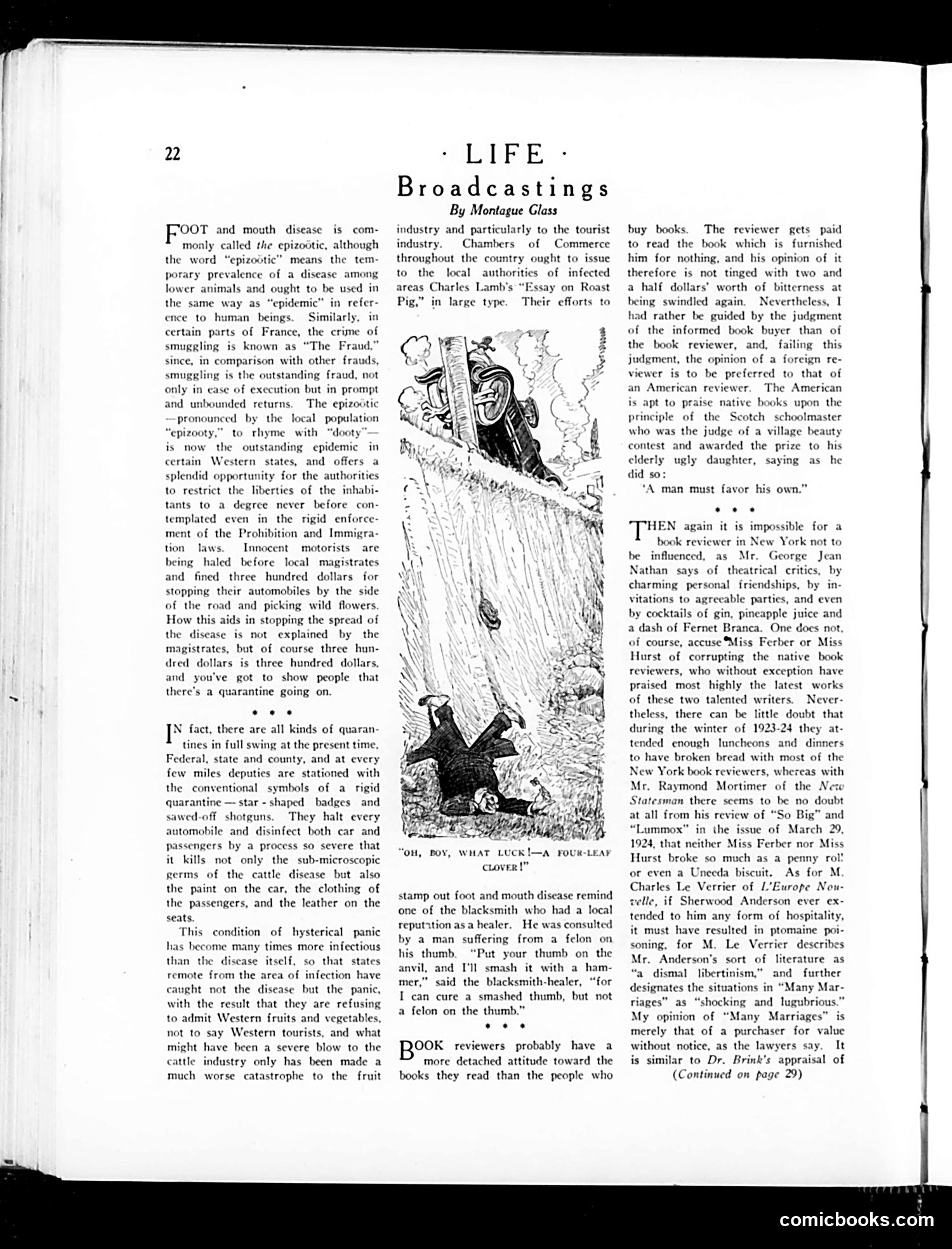
This page satirizes government overreach during the 1924 foot-and-mouth disease crisis affecting Western livestock. The cartoon shows authorities frantically implementing absurd quarantine measures—fining motorists $300 for picking wildflowers by roadsides, establishing checkpoints with armed deputies, and disinfecting vehicles so harshly they destroy the paint and leather. The satire's point: panic-driven bureaucracy is worse than the disease itself. Authorities stopped actual disease transmission and instead created economic catastrophe for fruit and tourism industries through irrational enforcement. The author compares it to a blacksmith who "cures" a thumb infection by smashing it with a hammer—solving the problem through destruction. The four-leaf clover cartoon caption ("Oh, boy, what luck!") sarcastically comments on citizens' desperate hope amid government chaos. The piece criticizes how fear spreads faster than disease, causing states to ban Western produce and tourists unnecessarily.
📄 Transcribed text from this page (OCR, searchable)
Machine-transcribed from the original scan — historical spelling and the odd misread are preserved.
22 ‘OOT and mouth disease is com- monly called the epizootic, although the word “epizootic” means the tem- porary prevalence of a disease among lower animals and ought to be used in the same way as “epidemic” in refer- ence to human beings. Similarly, in certain parts of France, the crime of smuggling is known as he Fraud.” since, in comparison with other frauds, smuggling is the outstanding fraud, not only in ease of execution but in prompt and unbounded returns. The epizootic pronounced by the local population “epizooty,” to rhyme with “dooty” is now the outstanding epidemic in certain Western states, and offers a splendid opportunity for the authorities to restrict the liberties of the inhal tants to a degree never before con- templated even in the rigid enforce- ment of the Prohibition and Immigra- Innocent motorists being haled before local magist and fined three hundred dollars stopping their automobiles by the side of the road and picking wild flowers. How this aids in stopping the spread of the disease is not explained by the magistrates, but of course three hun- dred dollars is three hundred dollars, and you've got to show people that there’s a quarantine going on. tion laws. eee N fact, there are all kinds of quaran tines in full swing at the present time, Federal, state and county, and at every few miles deputies are stationed with the conventional symbols of a rigid quarantine — star - shaped badges and sawed-off shotguns. They halt every and disinfect both car and passengers by a process so severe that it kills not only the sub-microscopic germs of the cattle disease but also the paint on the car, the clothing of the passengers, and the leather on the seat This condition of hysterical panic has become many times more infectious than the disease itself, so that states remote from the area of infection have caught not the disease but the panic, with the result that they are refusing to admit Western fruits and vegetables, not to say Western tourists, and what might have been a severe blow to the cattle industry only has been made a much worse catastrophe to the fruit automobile “TEE E. « Broadcastings By Montague Glass industry and particularly to the tourist industry. Chambers of Commerce throughout the country ought to issue to the local authorities of infected areas Charles Lamb's “Essay on Roast Pig,” in large type. Their efforts to “OH, BOY, WHAT LUCKI—A FOUR-LEAF cuover!” stamp out foot and mouth disease remind one of the blacksmith who had a local reputation asa healer. He was consulted by a man suffering from a felon on his thumb. “Put your thumb on the anvil, and I'll smash it with a ham- mer,” said the blacksmith-healer, “for I can cure a smashed thumb, but not a felon on the thumb.” eee OOK reviewers probably have a more detached attitude toward the books they read than the people who buy books. The reviewer gets paid to read the book which is furnished him for nothing, and his opinion of it therefore is not tinged with two and a half dollars’ worth of bitterness at being swindled again. Nevertheless, I had rather be guided by the judgment of the informed book buyer than of the book reviewer, and, failing this judgment, the opinion of a foreign re- viewer is to be preferred to that of an American reviewer. The American is apt to praise native books upon the principle of the atch schoolmaster who was the judge of a village beauty contest and awarded the prize to his elderly ugly daughter, saying as he did so: ‘A man must favor his own.” THEN again it is impossible for a book reviewer in New York not to be influenced, as Mr. George Jean Nathan says of theatrical critics, by charming personal friendships, by in- vitations to agreeable parties, and even by cocktails of gin, pineapple juice and a dash of Fernet Branca. One does not, course, accuse “Miss Ferber or Miss Hurst of corrupting the native book reviewers, who without exception have praised most highly the latest works of these two talented writers. Never- theless, there can be little doubt that during the winter of 1923-24 they at- tended enough luncheons and dinners to have broken bread with most of the New York book reviewers, whereas with Mr. Raymond Mortimer of the New Statesman there seems to be no doubt at all from his review of “So Big” and “Lummox” in the issue of March 29, 1924, that neither Miss Ferber nor Miss Hurst broke so much as a penny rol! or even a Uneeda biscuit. As for M Charles Le Verrier of L’Europe Nou- elle, if Sherwood Anderson ever ex- tended to him any form of hospitality, it must have resulted in ptomaine poi- soning, for M. Le Verrier describes Mr. Anderson's sort of literature as “a dismal libertinism,” and further designates the situations in “Many Mar- riages” as “shocking and lugubrious.” My opinion of “Many Marriages” is merely that of a purchaser for value without notice, as the lawyers say, It is similar to Dr. Brink's appraisal of (Continued on page 29) comicbooks.com