
Life, 1924-05-29 · page 22 of 38
Life — May 29, 1924 — page 22: what you’re looking at
What you’re looking at
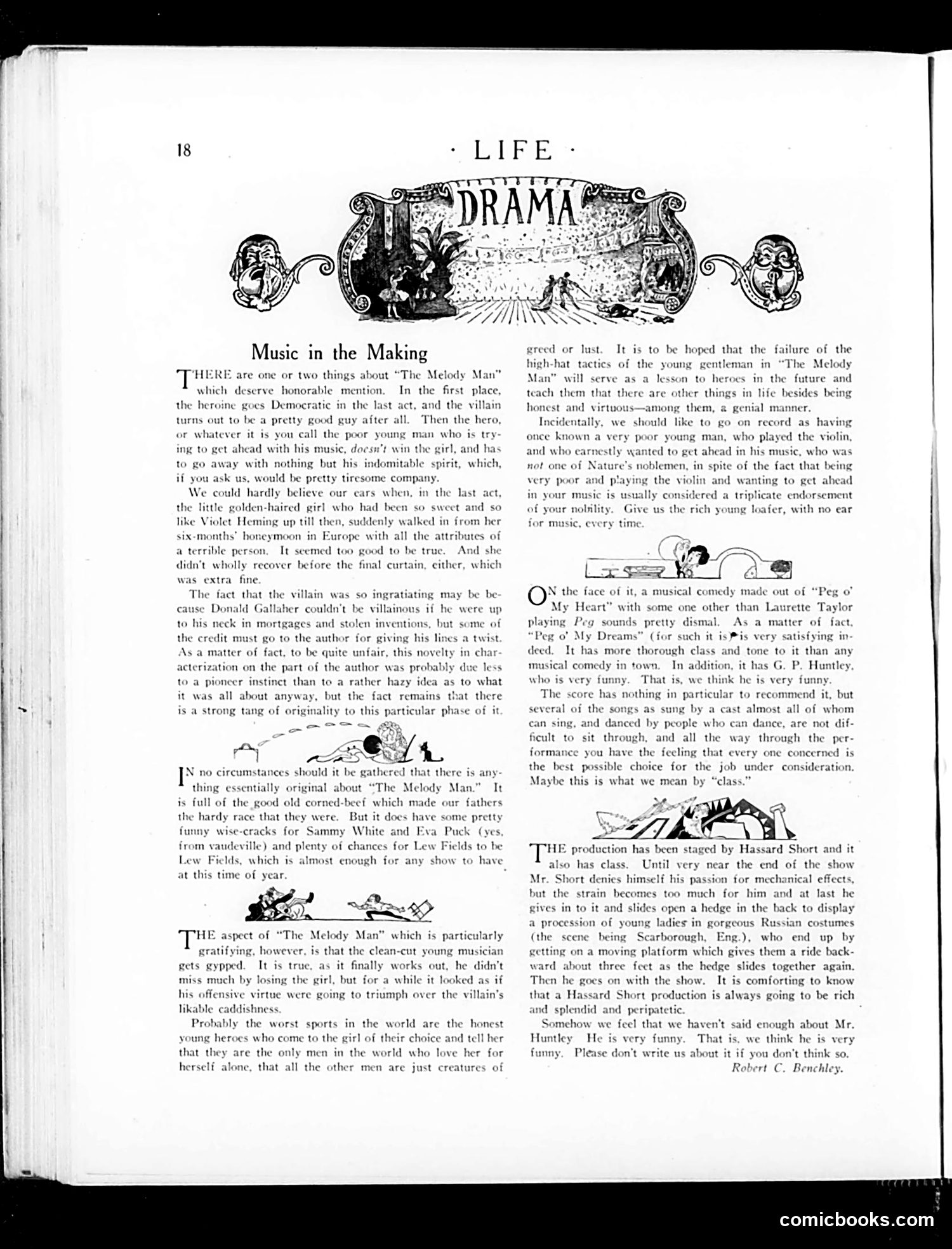
This page reviews two musical comedies: "The Melody Man" and "Peg o' My Dreams." The author critiques "The Melody Man" for its conventional plot—a virtuous young musician loses the girl to a charming villain. The satire targets the moral clichés of theatrical romance: the author mocks the "worst sports in the world" (honest young men who claim exclusive love), suggesting such self-righteous virtue is tiresome rather than admirable. The review praises an unexpected character twist where the golden-haired heroine reveals herself as selfish after a European honeymoon. For "Peg o' My Dreams," the reviewer praises its superior "class and tone" compared to typical musical comedy fare, and highlights performer G.P. Huntley as genuinely funny. The overall tone is witty, using theatrical incompetence and romantic tropes as vehicles for satirizing naive male earnestness and theatrical predictability.
📄 Transcribed text from this page (OCR, searchable)
Machine-transcribed from the original scan — historical spelling and the odd misread are preserved.
Music in the Making HERE are about “The Melody Man” which deserve honorable mention. In the first place, the heroine goes Deme turns out to be a pretty good guy after all. Then the hero, « or two thing: cratic in the last act, and the villair or whatever it is you call the poor young man who is try- ing to get ahead with his music, doesn’t win the girl, and has to go away with nothing but his indomitable spirit, which, if you ask us, would be pretty tiresome company. We could hardly believe our ears when, in the last act, the little golden-haired girl who had been so sweet and so like Violet Heming up till then, suddenly walked in from her 1 the attributes of a terrible person. It scemed too good to be true. Ar six-months’ honeymoon in Europe with didn't wholly recover before the final curtain, either, which was extra fine. The fact that the villain was so ingratiating may be be cause Donald G laher couldn't be villainous if he were up to his neck in mortgages and stolen inventions, but some of the credit n st go to the author for giving his lines a twist As a matter of fact, to be quite unfair, this novelty in char acterization on the part of the author was probably due less to a pioncer instinct than to a rather hazy idea as to what it was all about anyway, but the fact remains that there ginality to this particular phase of it is a strong tang of or Hom gE N no circumstances should it be gathered that there is any “The Melody Man.” It is full of the good old corned-beei which made our fathers the hardy race that they were. But it does have some pretty funny wise-cracks for Sammy White and Eva Puck (yes irom vaudeville) and pler thing essentially original abe y of chances for Lew Fields to be Lew Fields, which is almost enough for any show to have time of year a he Melody Man” which is partict gratifying, however, is that the clean-cut young musician HE aspect of lar} gets gypped. It is true, as it finally works out, he didn’t . while it looked as if his offensive virtue were going to triumph over the villain’s likable caddishness miss much losing the girl, but for Probably the worst sports in the world are the honest young heroes who come to the girl of their choice and tel r that they are the only men in the world who love her for herself alone, that all the other men are just creatures of eed or lust. It is to be hoped that the failure of the high-hat tactics of the young gentleman in “The Melody Man” will serve as a lesson to h es in the future and teach them that there are other things in life besides being he stand virtuc Ine us—among them, a genial manner, Jentally, we should like » go on record as having n, who played the violin gm ed to get ahead in his mu once known a very poor yo and who earnestly w . who was ¢ of Nature’s noblemen, in spite of the fact that being very poor and playing the violin and wanting to get ahead sually considered a triy of your nobility. Give us the ric for music, every ti in your music is v ate endorsement ¢ loafer, with no ear — as N the face of it, a musical comedy made out of My Heart” with some o1 e other than Laurette Taylor playing Peg sounds pretty dismal, As a matter of fact “Peg o' My Dreams” (for such it is deed, It has more thorough class and tone to it than any s very satisfying in musical comedy in town. In addition, it has G. P. Huntley who is very funny. That is, we think he is very funny The score has nothing in particular to recommend it, but several of the songs as sung by a cast almost all of whom can sing, and d ‘ed by people who can dance, are not dif- ficult to sit through, and all the way through the per- formance you have the feeling that every one concerned is the best possible choice for the job under consideration. Maybe this is what we mean by “class.” ae production has been staged by Hassard Short and it has class. Until very near the end of the show Mr. Short denies himself his passic for mechanical effects, but the strain becomes too much for him and at last he gives in to it ind slides open a hedge in the back to display a procession of young ladies in gorgeous Russian costur (the scene being arborough, Eng.), who end up by getting on a moving platform which gives them a ride back- ward about three feet as the hedge slides together again. Then he gocs on with the show. It is comforting to know that a Hassard Short production is always going to be rich 1 splendid and peripatetic o»mehow we feel that we haven't said enough about Mr. Huntley He is very funny. That is, we think he is very funny. Please don’t write us about it if you don't think so. Robert C. Benchley. comicbooks.com