
A complete issue · 42 pages · 1924
Life — May 8, 1924
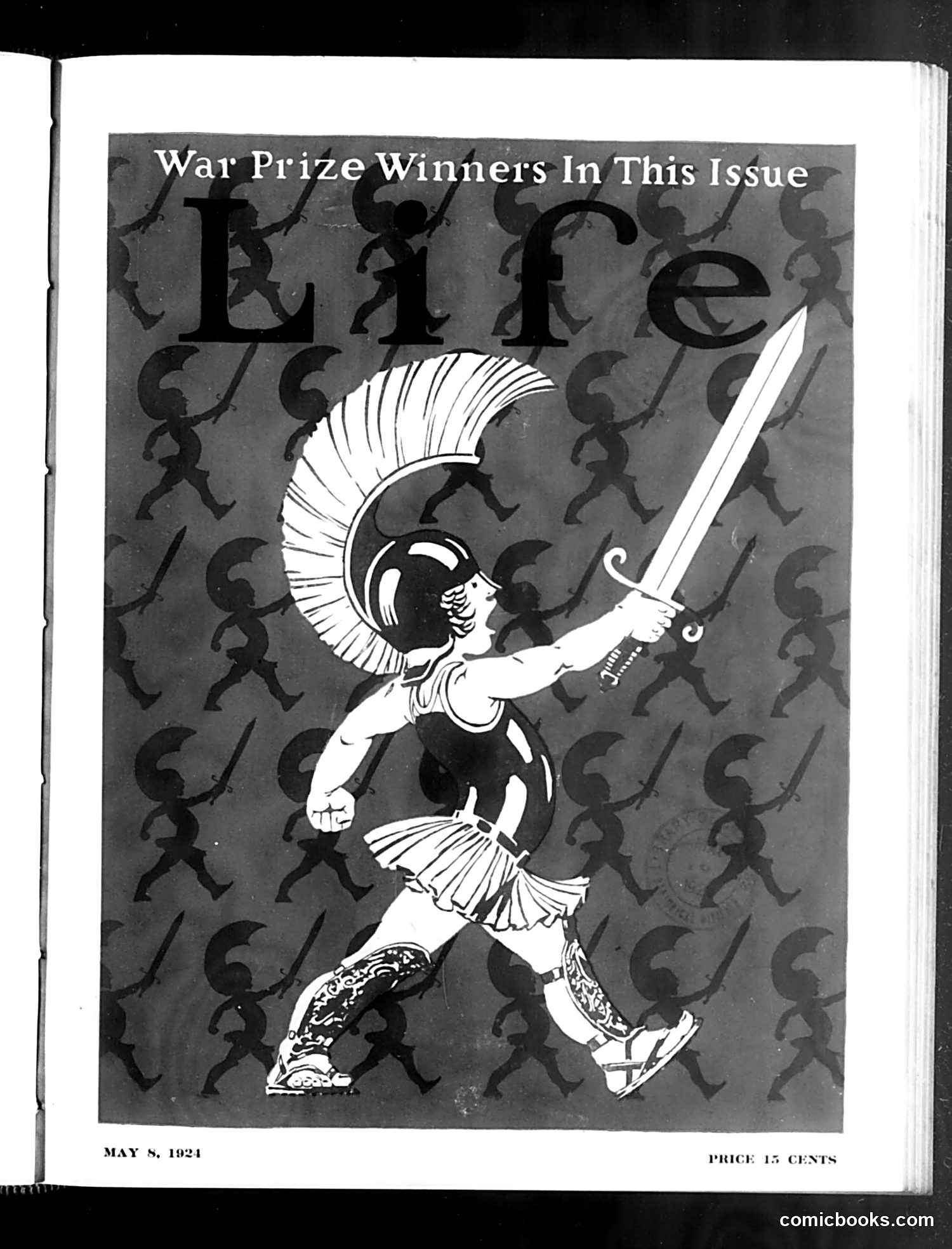
This cover depicts a classical warrior figure—likely representing "Life" magazine itself or American culture personified—wielding a sword against a background of repeated swastika symbols. The title reads "Life" and announces "War Prize Winners In This Issue." The swastikas appear decorative rather than ideological here; in 1924, the symbol retained ancient geometric meaning before its later association with Nazism. The warrior imagery suggests the magazine is celebrating martial victory or conquest. The classical armor, sword, and dynamic pose evoke triumph. Given the date and "War Prize Winners" headline, this likely references post-WWI American cultural or artistic achievements being recognized, presenting them through heroic, victorious symbolism typical of 1920s patriotic imagery.
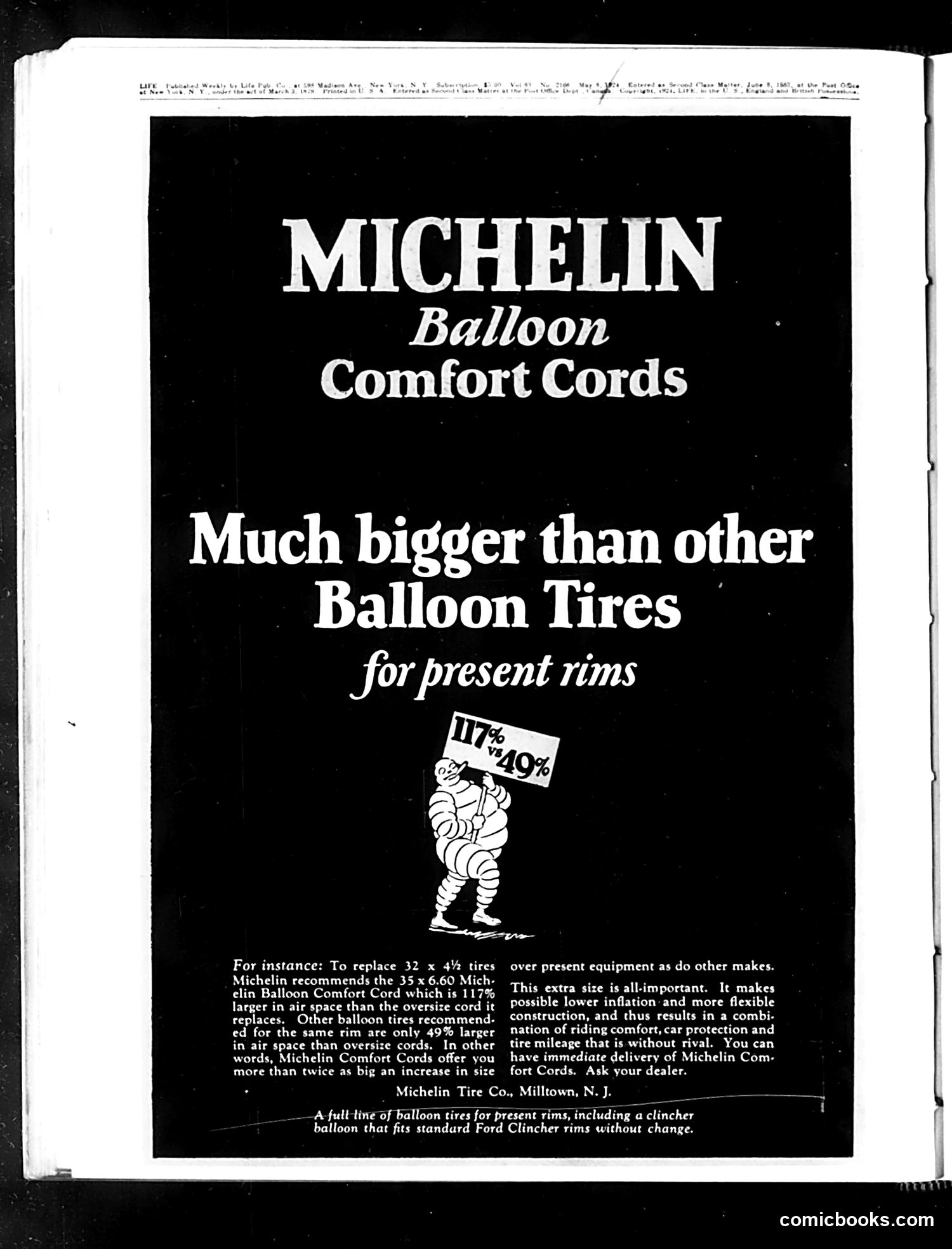
This is **not a satirical cartoon page** — it's a straightforward **advertisement for Michelin Balloon Comfort Cords tires**, placed in Life magazine. The page features the Michelin Man (Bibendum), the company's long-running mascot, holding a sign claiming an "117% to 49%" size advantage over competitor balloon tires. The ad argues that Michelin's larger tires fit standard Ford rims without modification, offering benefits like lower inflation pressure, improved flexibility, better riding comfort, and superior mileage. There is no political or social satire here. This is commercial advertising typical of early-to-mid 20th century automotive magazines, using the recognizable Michelin mascot to promote tire superiority through comparative sizing claims.
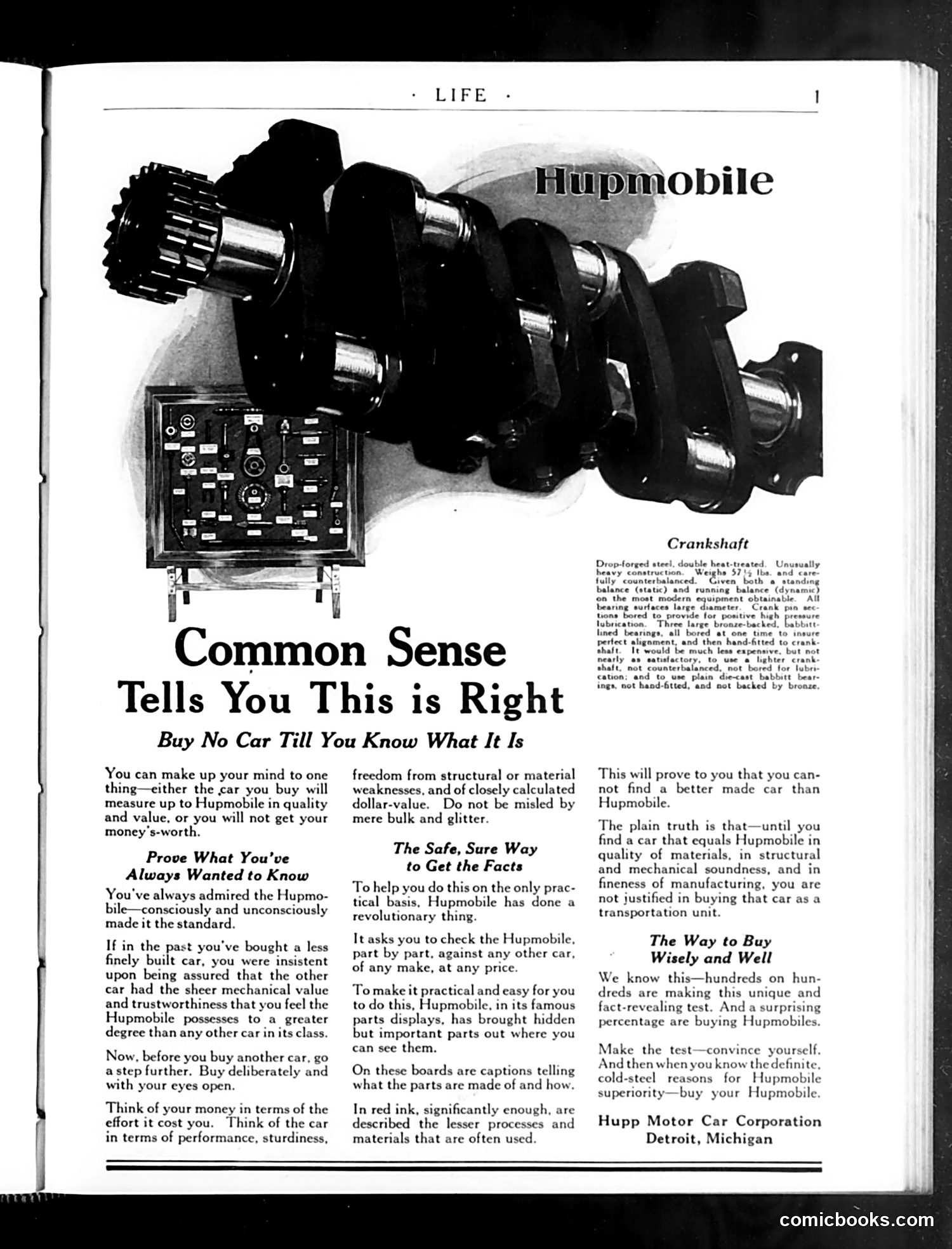
This is primarily a **Hupmobile automobile advertisement**, not political satire. The page features a detailed technical illustration of a crankshaft mechanism and control panel, accompanied by persuasive marketing copy. The ad's rhetorical strategy appeals to buyer intelligence: "Common Sense Tells You This is Right" and "Prove What You've Always Wanted to Know." It invites consumers to compare Hupmobiles part-by-part against competitors, emphasizing superior construction, materials, and mechanical soundness. The copywriting attempts to position the Hupmobile as the rational choice through transparency and technical demonstration—a sales approach common in early automotive advertising when the industry was still educating consumers about mechanical quality and durability as purchasing criteria.
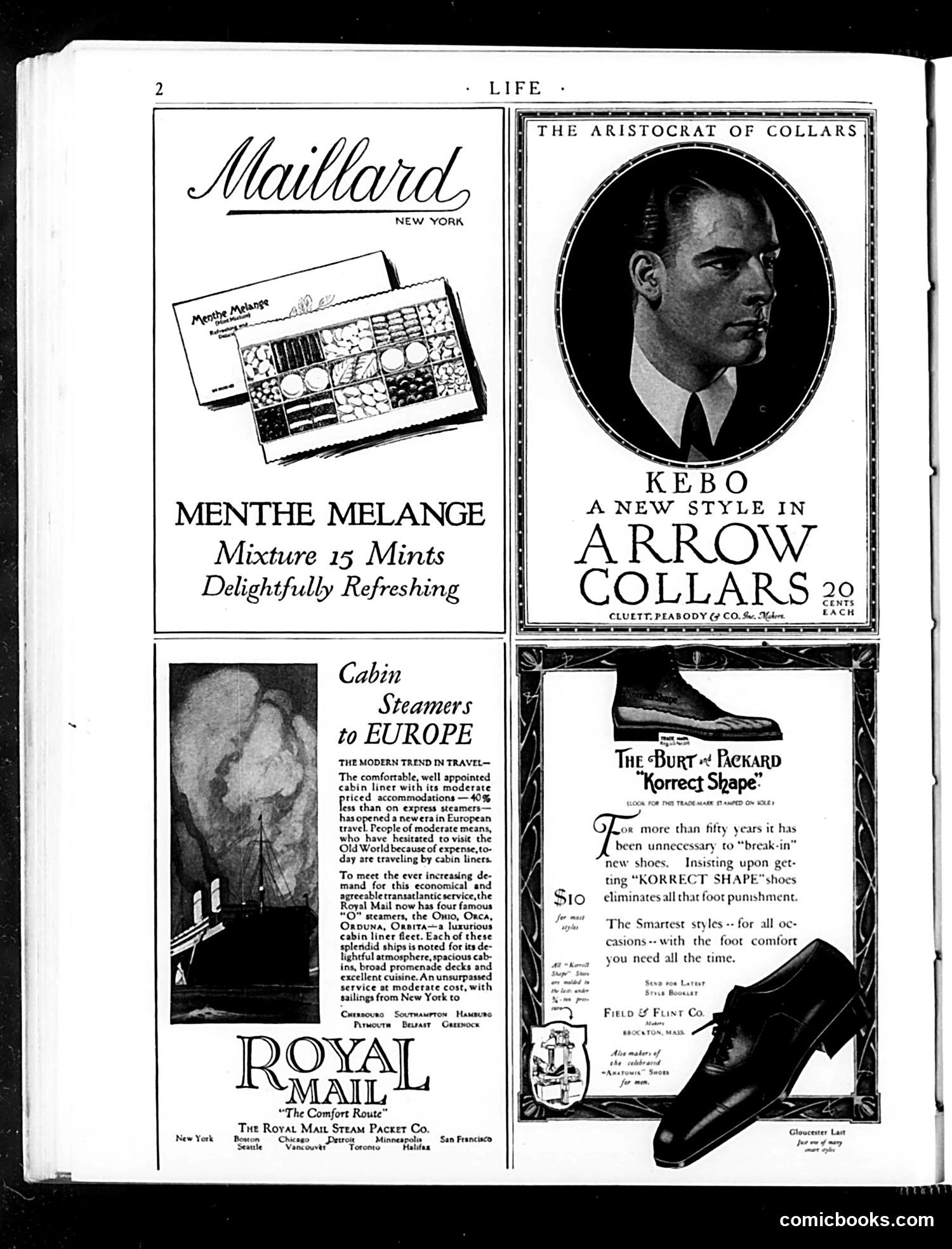
This page is **primarily advertising**, not political satire or editorial content. It contains four advertisements from what appears to be the 1920s-1930s era: 1. **Maillard (New York)**: Mint candy product ("Menthe Melange") 2. **Kebo Arrow Collars**: Men's collar fashion, featuring a portrait of a well-dressed man 3. **Royal Mail**: Cabin steamship services to Europe, emphasizing affordable luxury travel 4. **Burt & Packard Shoes**: "Korrect Shape" footwear claiming to eliminate foot discomfort There is no political cartoon or satirical commentary present. The page demonstrates early 20th-century consumer advertising targeting affluent male readers, with emphasis on fashion, leisure travel, and grooming products.
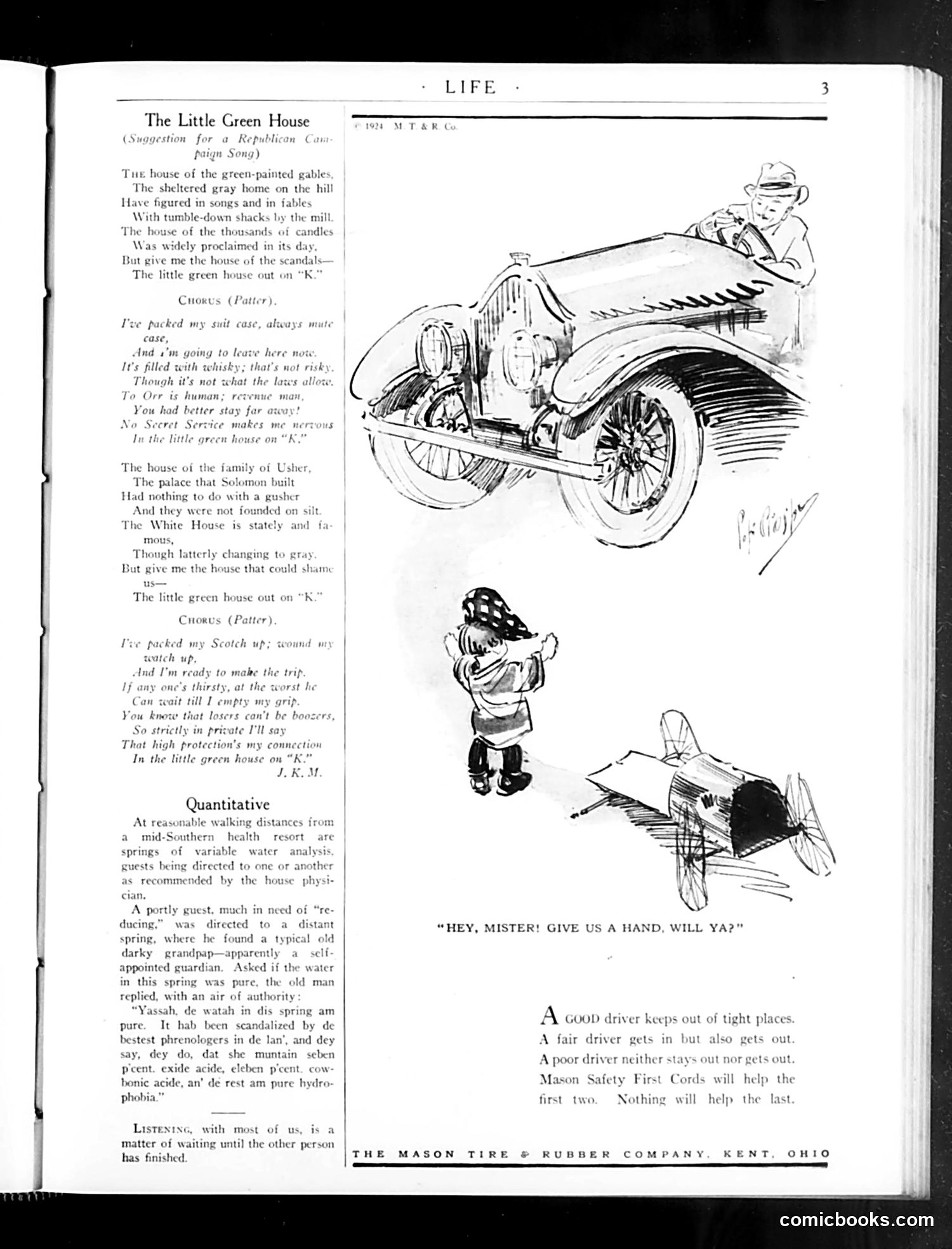
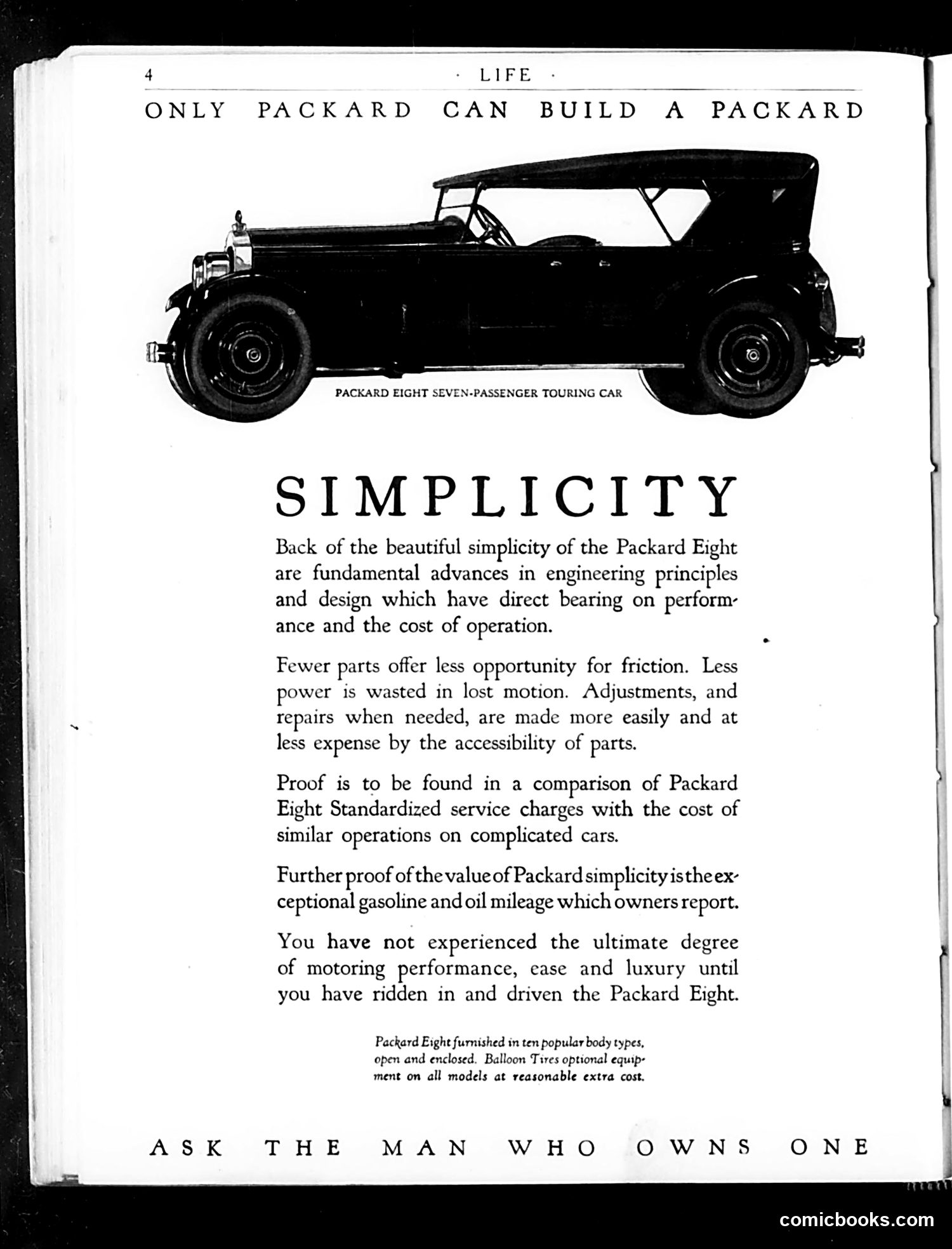
This is **not a cartoon or satire**—it's a straightforward advertisement for the Packard Eight automobile, appearing in Life magazine. The page features a technical illustration of a luxury touring car accompanied by marketing copy emphasizing "simplicity" as a design virtue. The advertisement argues that the Packard Eight's fewer parts mean reduced friction, lower operating costs, easier repairs, and better fuel efficiency than competing vehicles. The closing line—"ASK THE MAN WHO OWNS ONE"—was Packard's actual advertising slogan, appealing to testimonials from satisfied owners as proof of quality. This represents early-to-mid 20th century luxury car marketing, targeting affluent readers of Life who could afford premium automobiles. There is no satirical intent.
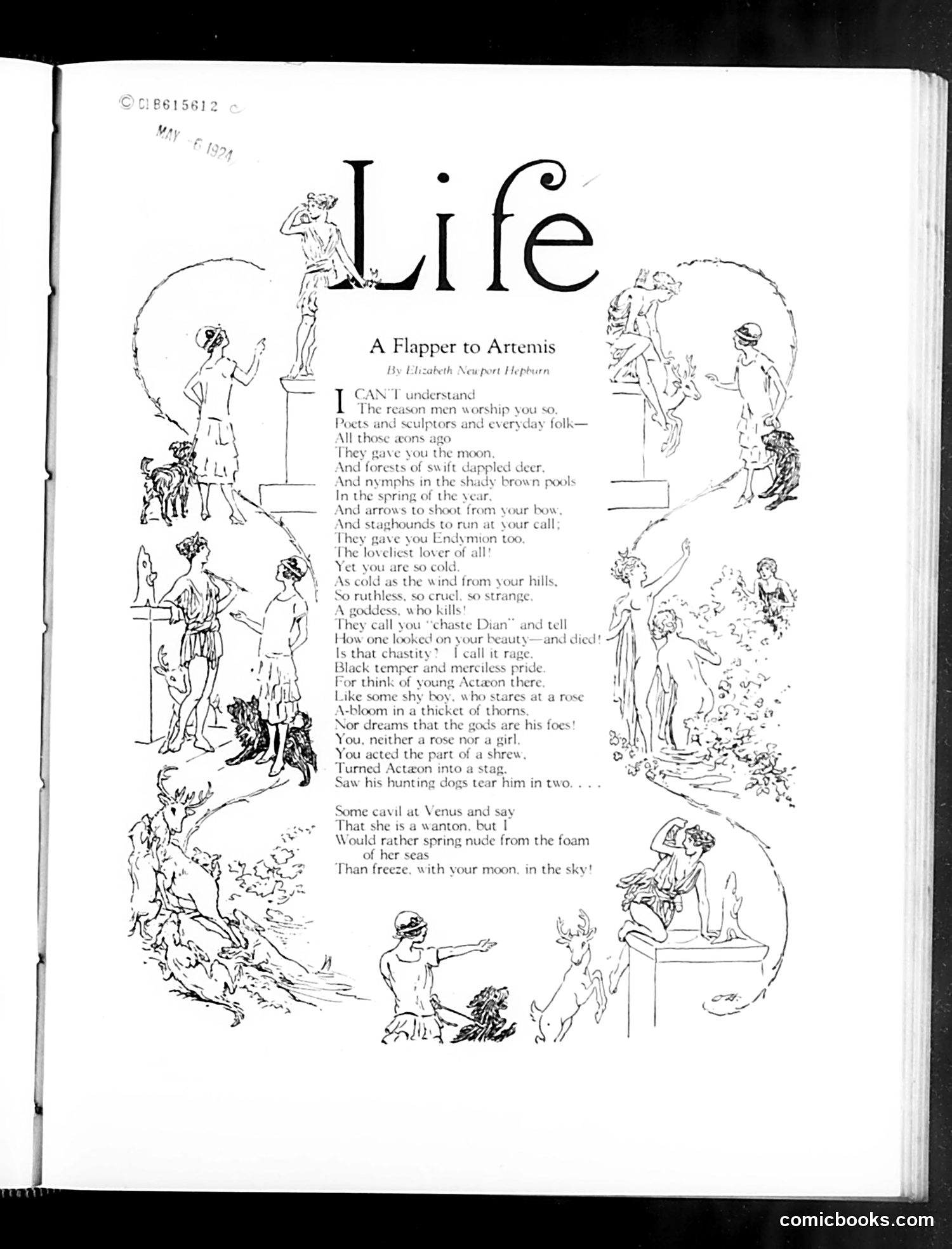
This is a satirical poem addressing the goddess Artemis (Diana), contrasting ancient ideals of chastity and hunting prowess with 1920s "flapper" culture. The illustrated figures show modern women in contemporary dress alongside classical mythological imagery. The satire mocks young women of the Jazz Age for abandoning traditional virtues—the poem accuses them of being "cold," "ruthless," and "strange" rather than embodying Artemis's noble qualities. References to "chaste Diana," hunting, and staghounds contrast with critiques of modern behavior, including the line about "Actaeon" (the hunter turned to stag), suggesting moral transgressions. The piece represents conservative criticism of 1920s women's liberation and changing sexual mores during the flapper era.
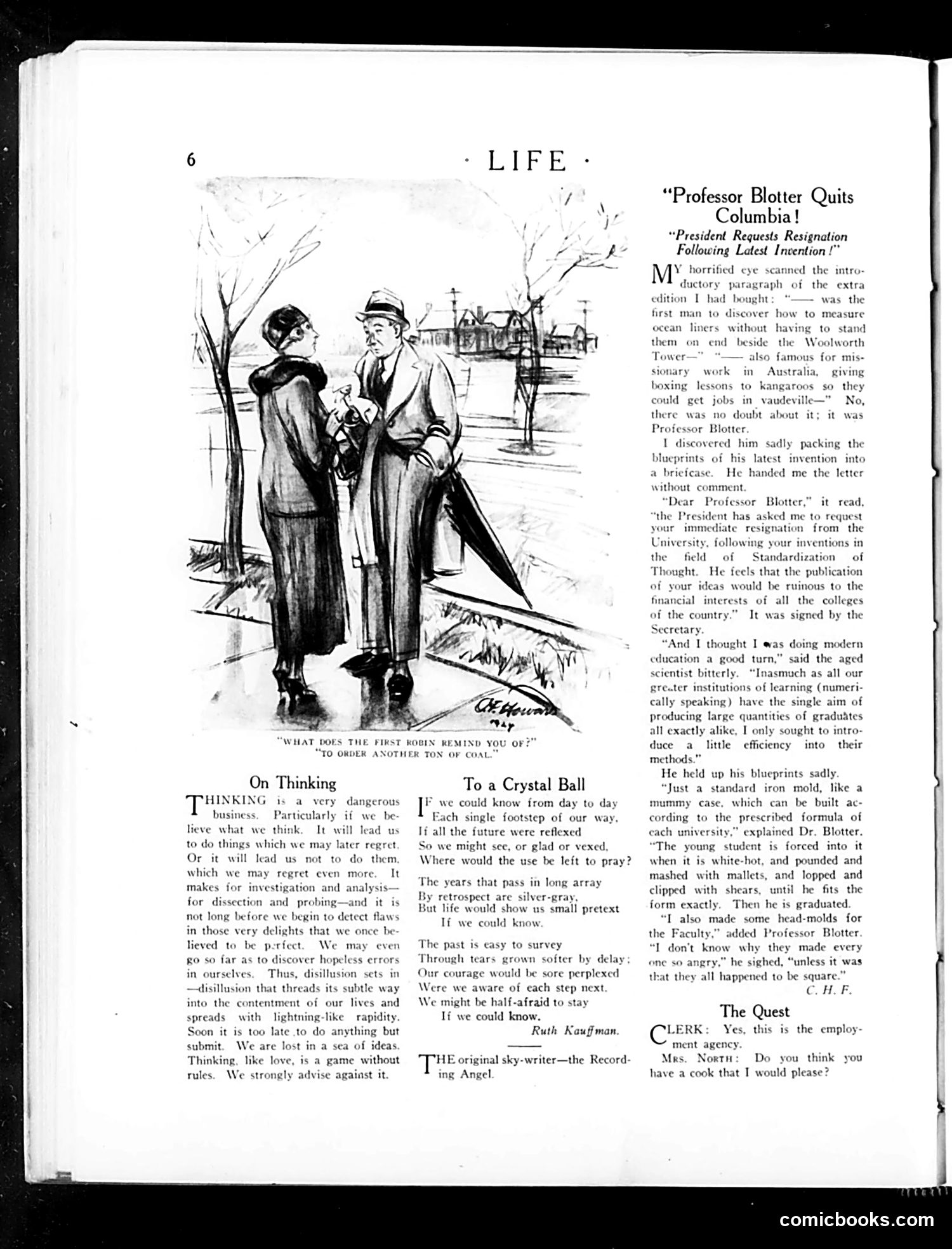
**Main Cartoon:** The illustration shows two figures on a street—a woman and a man in formal attire carrying what appears to be rolled blueprints. The caption reads: "What does the first robin remind you of? To order another ton of coal." **Context:** This appears to be satirizing the coal shortage or heating crisis affecting Americans (likely post-WWI era, given the magazine's style). The "first robin" traditionally signals spring's arrival, but the joke inverts this: instead of hoping for warm weather, people remain preoccupied with securing coal for heating, suggesting ongoing scarcity or economic hardship. **Sidebar Content:** Multiple short pieces address Professor Blotter's resignation from Columbia University over inventions he sought to patent. The satire criticizes standardized educational methods that stifle innovation.
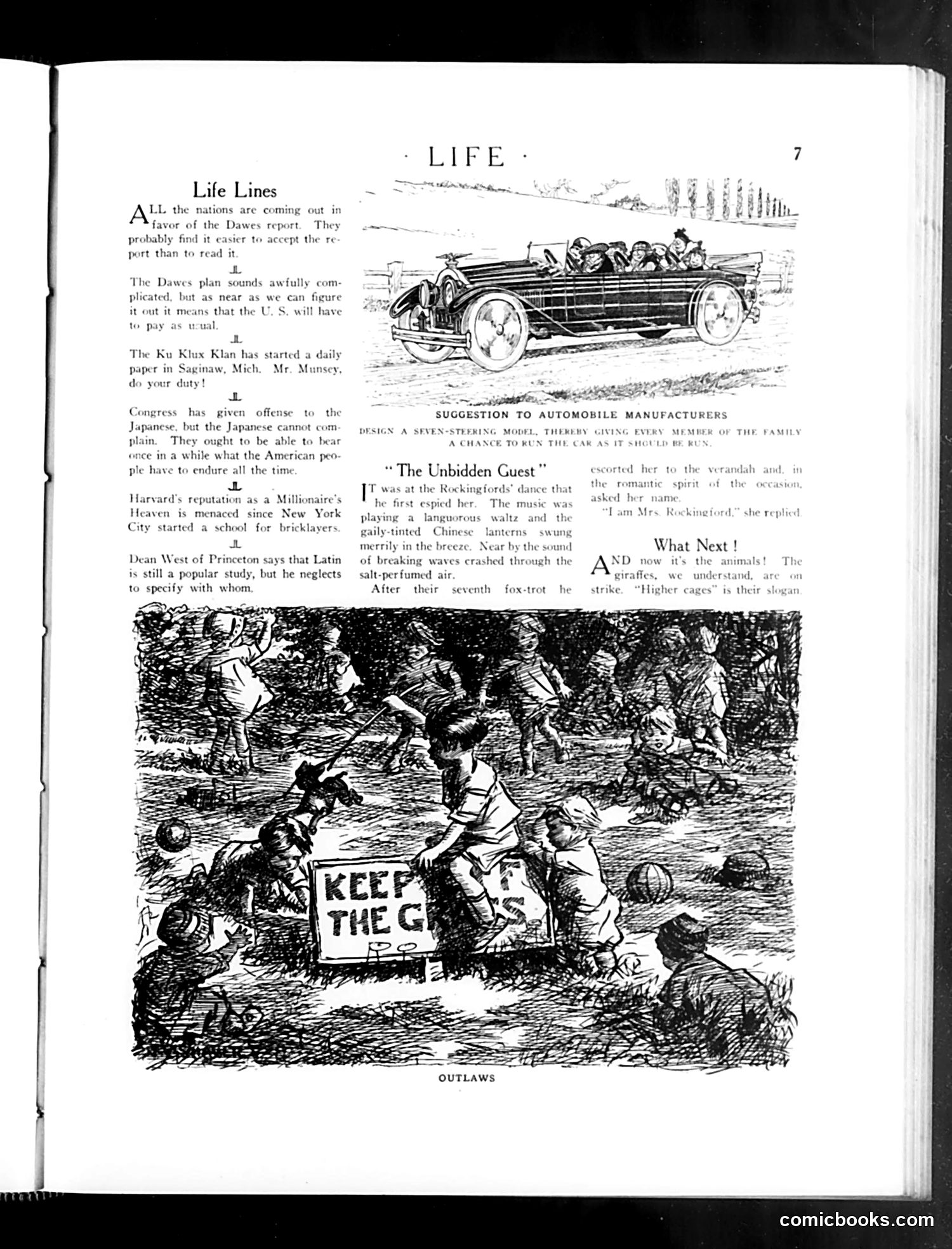
This page contains social commentary and satirical content from early 20th-century America. The top illustration depicts an automobile with multiple passengers, captioned as a "suggestion to automobile manufacturers" for a seven-steering model—a joke about the chaos of family car trips where everyone wants control. The lower cartoon titled "Outlaws" shows children at play with a sign reading "KEEP THE G[ATE]S" (partially obscured). This appears to satirize playground games or children's mischief-making, using "outlaws" as the humorous framing. The dense cross-hatching and chaotic composition emphasize youthful disorder. The text sections between discuss various contemporary social topics including the Dawes Report, the Ku Klux Klan's newspaper activities, and Harvard's reputation—typical of Life's satirical social criticism of the era.
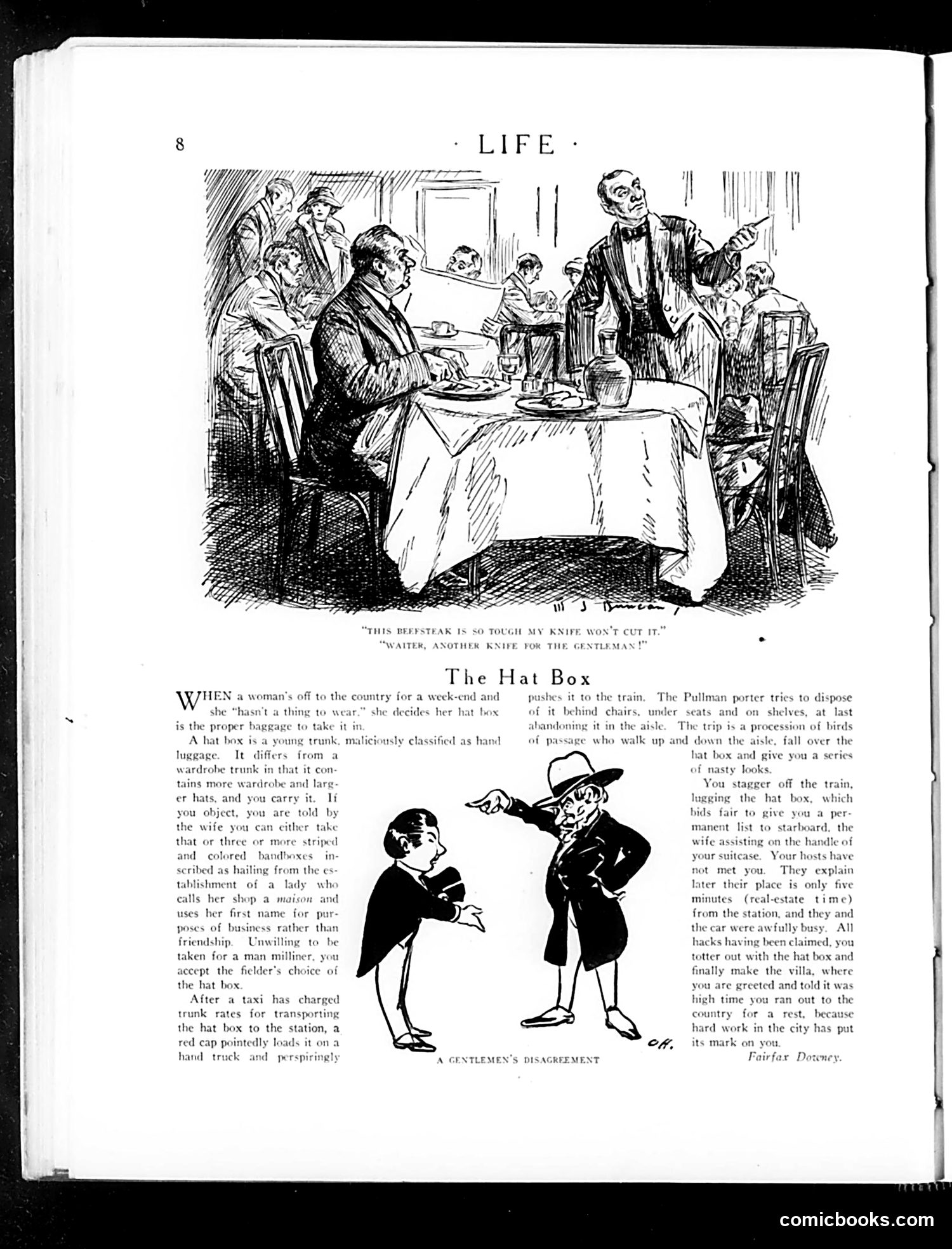
This humorous piece mocks the impracticality of women's travel luggage, specifically the hat box. The top illustration depicts a formal dinner scene where guests struggle with an oversized hat box—the caption reads: "This beefsteak is so tough my knife won't cut it. Waiter, another knife for the gentleman!" The text explains that a hat box, unlike practical wardrobe trunks, is classified as hand luggage and creates logistical nightmares for travelers and hotel staff. The cartoon below ("A Gentleman's Disagreement") shows two men arguing over the awkward hat box, illustrating the frustration it causes. The satire targets early 20th-century women's fashion priorities—prioritizing hat presentation over practical travel—and the social complications this creates for everyone involved.
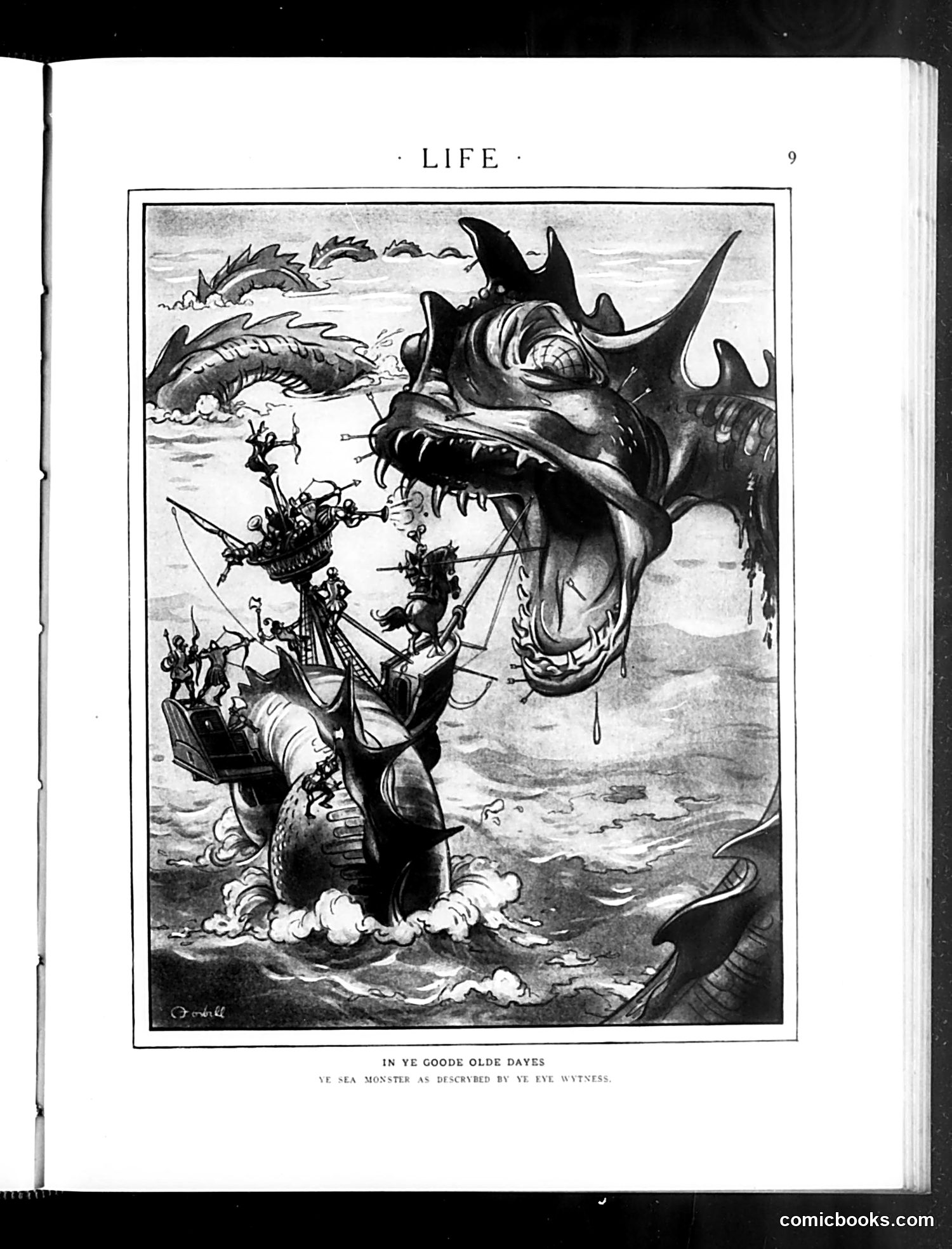
This cartoon satirizes exaggerated eyewitness accounts of sea monsters in historical times. The image shows a massive, grotesque sea creature with multiple heads and horns confronting sailors in a small boat. The satire works on two levels: 1. **The exaggeration itself**: The monster is deliberately drawn as absurdly oversized and fantastical compared to the tiny, realistic sailors, mocking how historical accounts supposedly magnified ordinary creatures into legendary beasts. 2. **"Ye Goode Olde Dayes" conceit**: The archaic spelling mimics old maritime tales and chronicles, suggesting these accounts were products of imagination rather than observation—the "eye witness" saw something and transformed it into legend through retelling. The cartoon criticizes unreliable historical documentation and sensationalized reporting.
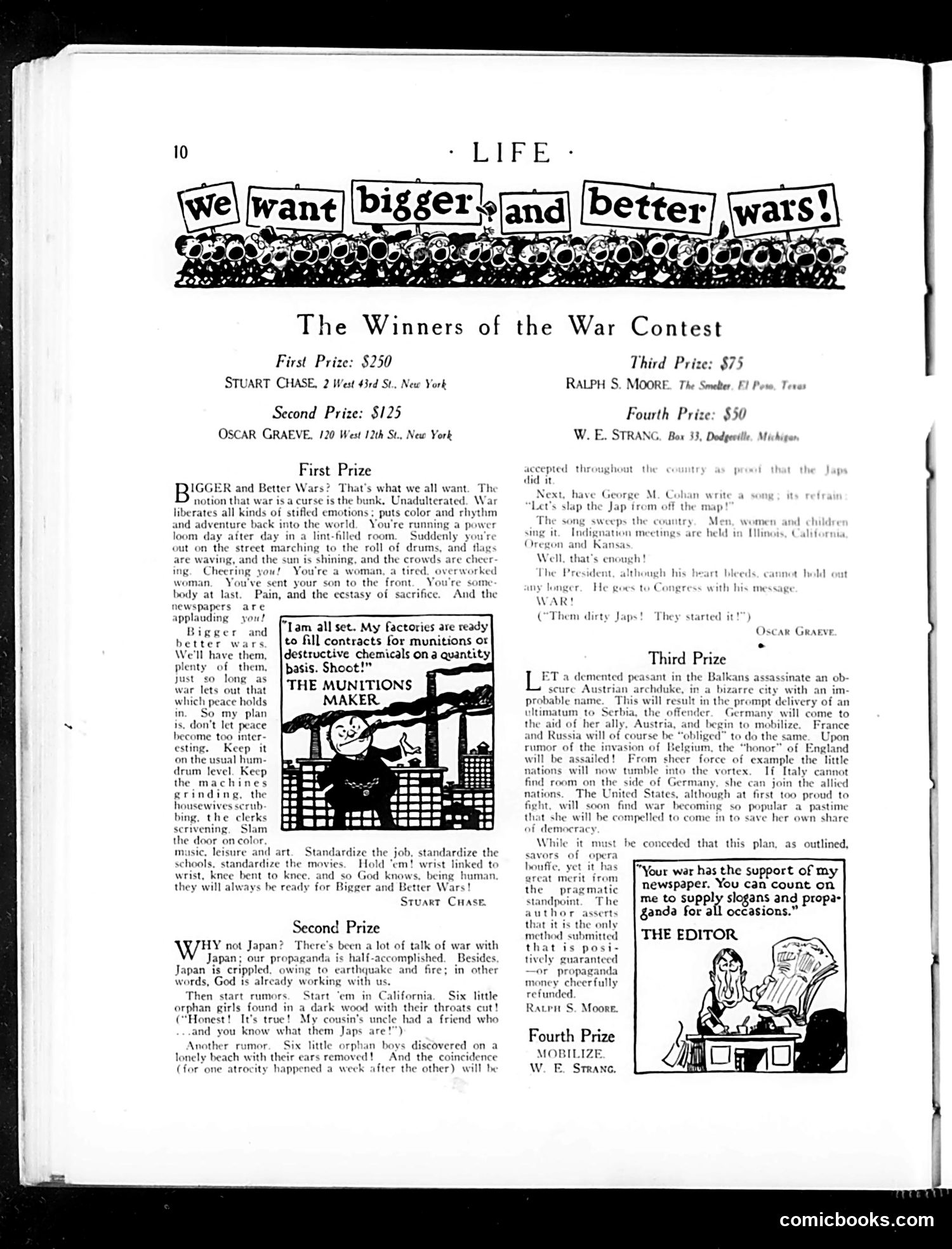
This page presents a 1917-era "War Contest" where readers submitted satirical proposals for defeating Japan. The winning entries mock both wartime propaganda and American attitudes toward the conflict. **The First Prize winner ("The Munitions Maker" cartoon)** depicts factory production as the solution—standardizing warfare through assembly-line manufacturing. The satire suggests Americans naively believed industrial capacity alone would win wars. **Subsequent entries parody propaganda techniques**: one proposes assassinating Austrian archduke (dark humor about diplomatic solutions); another suggests sending orphaned children to slice Japanese throats (grotesque satire of recruitment rhetoric); a third mocks newspaper propaganda support. The overall point: *Life* satirizes both American overconfidence in mechanized warfare and the absurdity of wartime propaganda that had saturated public discourse. The contest format allows readers to see their own pro-war rhetoric reflected back as obvious nonsense.
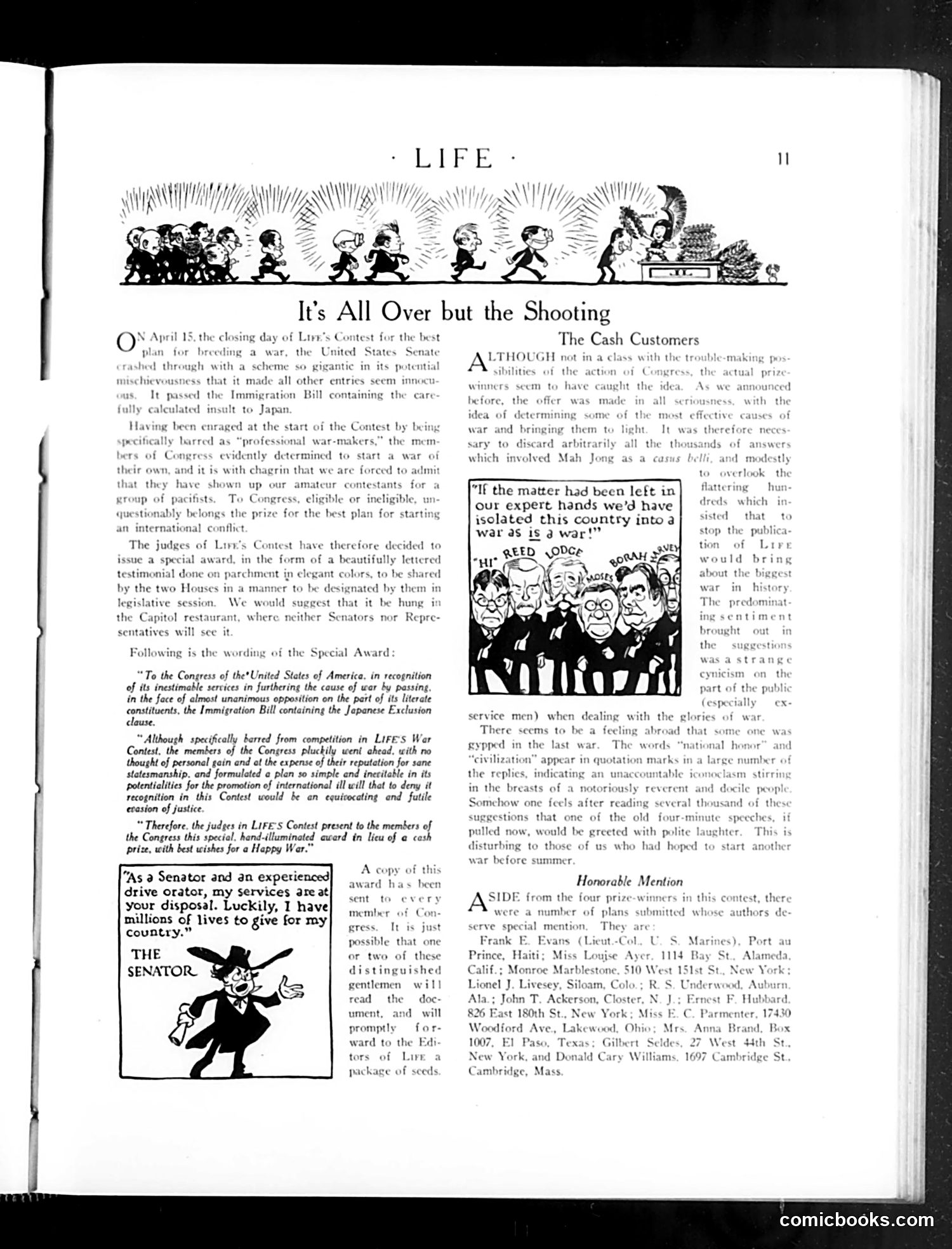
This page mocks Congressional members who launched a "War Contest" for the best plan to start an international conflict, only to abandon the effort when facing actual diplomatic consequences. The cartoon depicts congressmen as eager warmongers. The text quotes a senator claiming he could isolate the country "into a war," suggesting naive confidence about initiating conflict. The satire's point: these politicians enthusiastically promote war in the abstract but lack the courage for actual consequences. The reference to "The Cash Customers" indicates they're motivated by profit rather than principle. The page ridicules the gap between bellicose rhetoric and political action—congressmen want war's glory without responsibility. This reflects early-20th-century anti-war sentiment and skepticism toward political leaders who talk toughly about conflict.
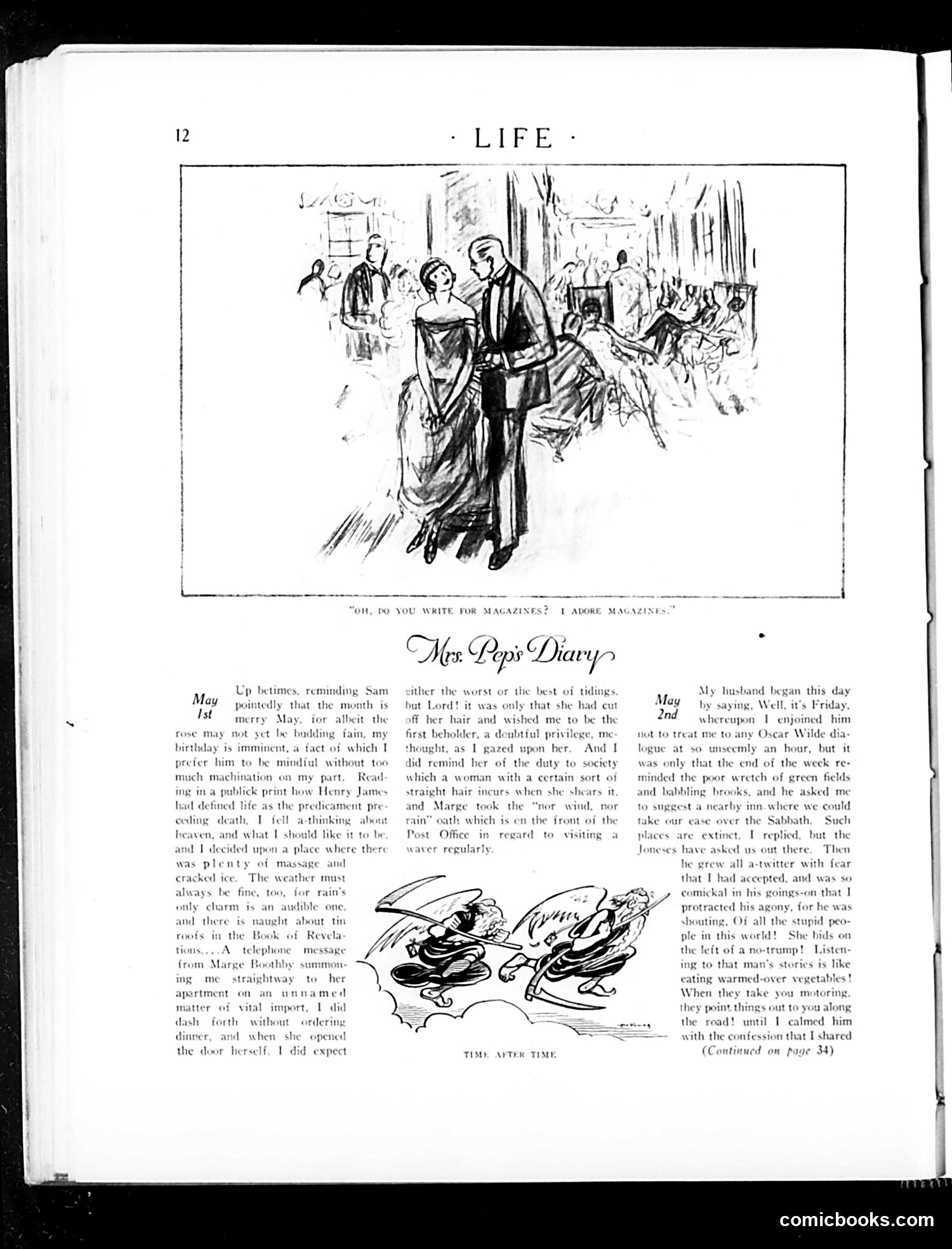
This page contains a humorous domestic diary entry and accompanying illustrations. The top sketch shows a formal social gathering, illustrating the diarist's mention of social obligations. The main cartoon ("Time After Time") depicts two figures in what appears to be a motorcar, drawn in a comedic style showing exaggerated expressions. The diary entry itself is satirical commentary on married life and social expectations. The writer humorously complains about domestic obligations—hair appointments, entertaining, weekend plans—while her husband dismissively references "Oscar Wilde" and suggests "taking it easy." The satire targets the gap between spouses' perspectives on leisure and social responsibility, a common domestic comedy theme in early 20th-century publications. The "Continued on page 34" notation indicates this was a serialized humor column.
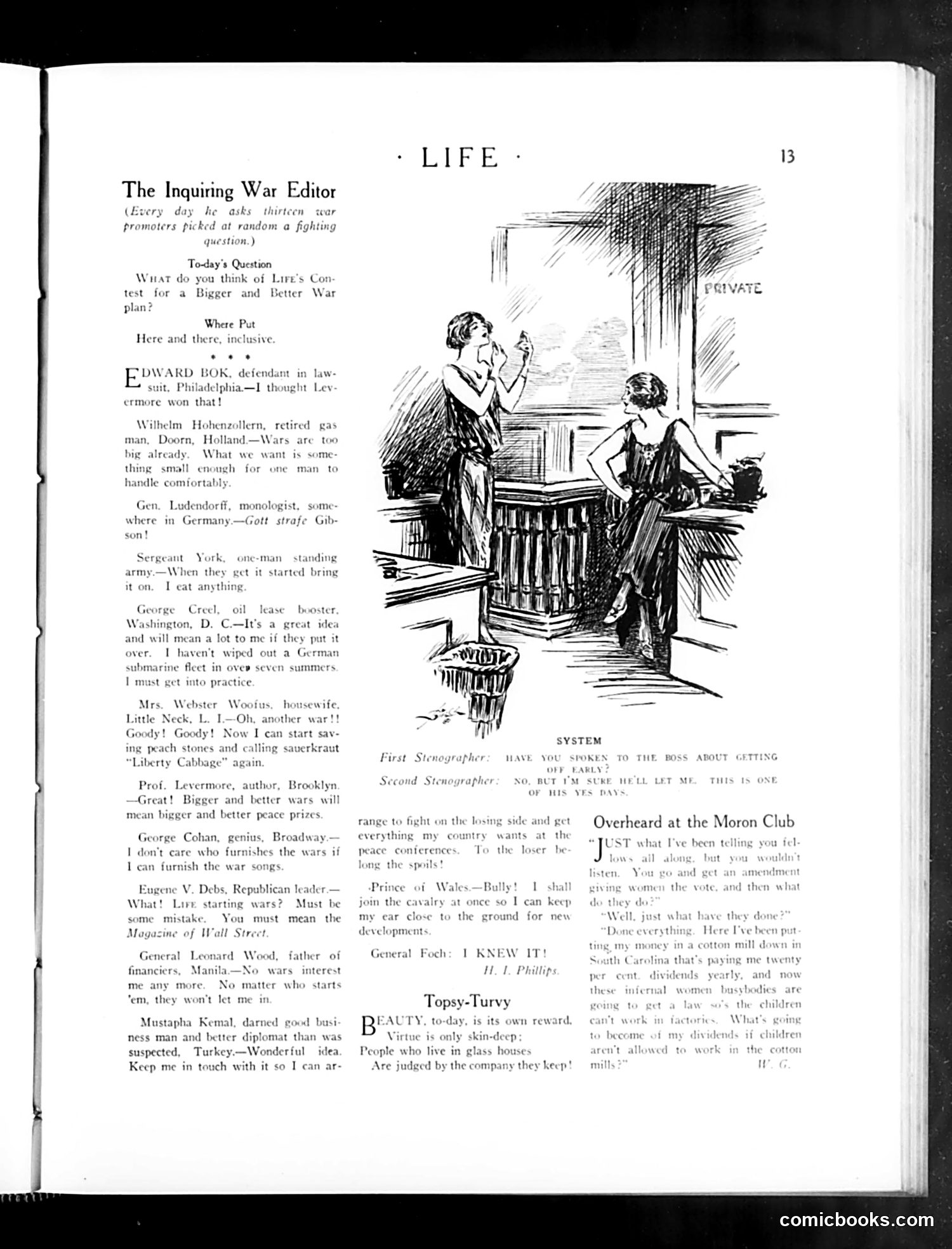
The main cartoon depicts two stenographers in an office labeled "PRIVATE." The joke illustrates workplace dynamics: the first stenographer asks the boss about getting a raise, and the second stenographer responds that she'll "let me know—this is one of his yes days," suggesting the boss's moods determine employee outcomes rather than merit. The page also contains "The Inquiring War Editor" column, which satirizes public opinion on World War I by collecting random citizens' responses to questions about war strategy. Contributors range from German immigrants to military figures, their varied (often contradictory) opinions mocking the notion that ordinary people had coherent war plans. The satire targets both workplace power dynamics and wartime public discourse.
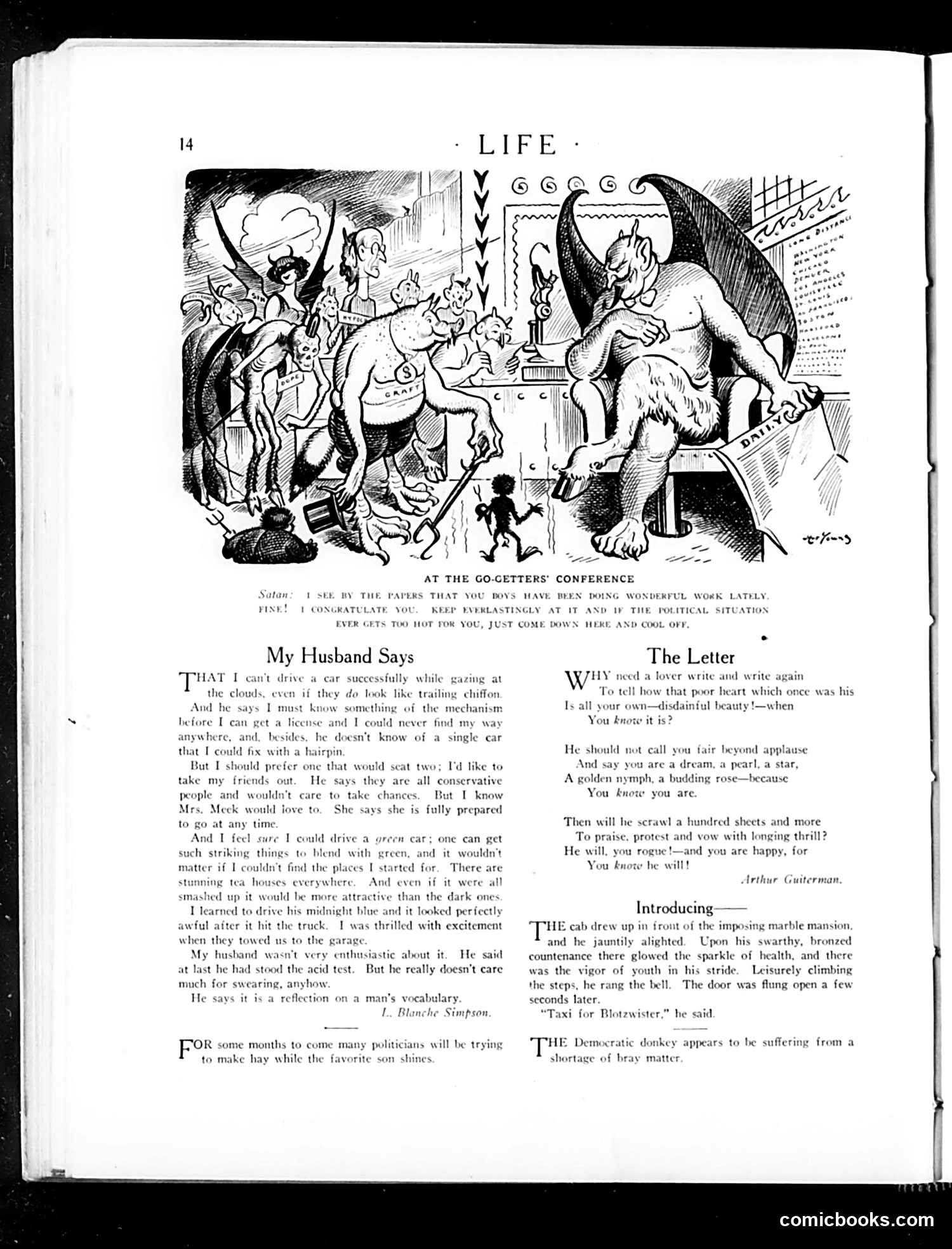
This political cartoon satirizes a gathering of ambitious businessmen and politicians (depicted as devils and demons). Satan congratulates "the boys" on their recent work, urging them to maintain intensity "if the political situation ever gets too hot for you." The satire targets the era's "go-getter" business culture—aggressive capitalists pursuing profit without ethical restraint. By depicting these figures as demonic, the cartoonist suggests their activities are morally corrupt or socially destructive. The cartoon likely critiques corporate excess, unfair labor practices, or political corruption characteristic of the early 20th century. The "go-getter" was a popular period archetype representing ruthless ambition; here it's mocked as genuinely evil rather than admirable.
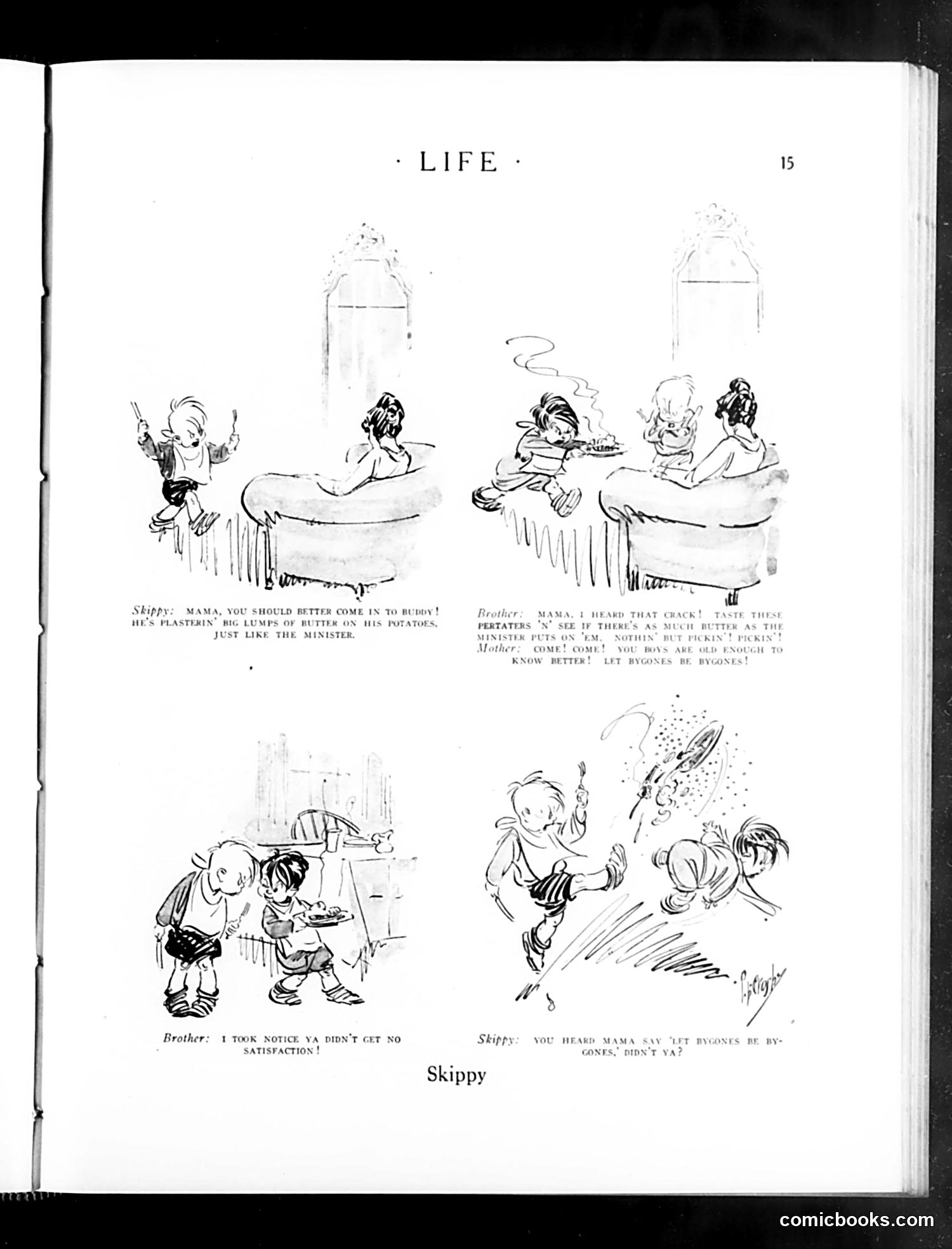
This page features a children's comic strip called "Skippy," showing a mischievous boy and his interactions with family members. The humor centers on domestic chaos: **Top panels**: Skippy's mother scolds him for bringing butter-covered potatoes to the table "just like the minister," while his brother complains about insufficient butter on his own food. **Bottom panels**: Skippy appears to have caused kitchen destruction, with his brother confronting him ("I took notice ya didn't get no satisfaction"), while Skippy responds to his mother's warning about "let bygones be bygones" with characteristic mischief. The satire gently mocks childhood disobedience, sibling dynamics, and parental attempts at discipline. "Skippy" was a popular early-20th-century comic strip depicting typical middle-class family life and childhood pranks.
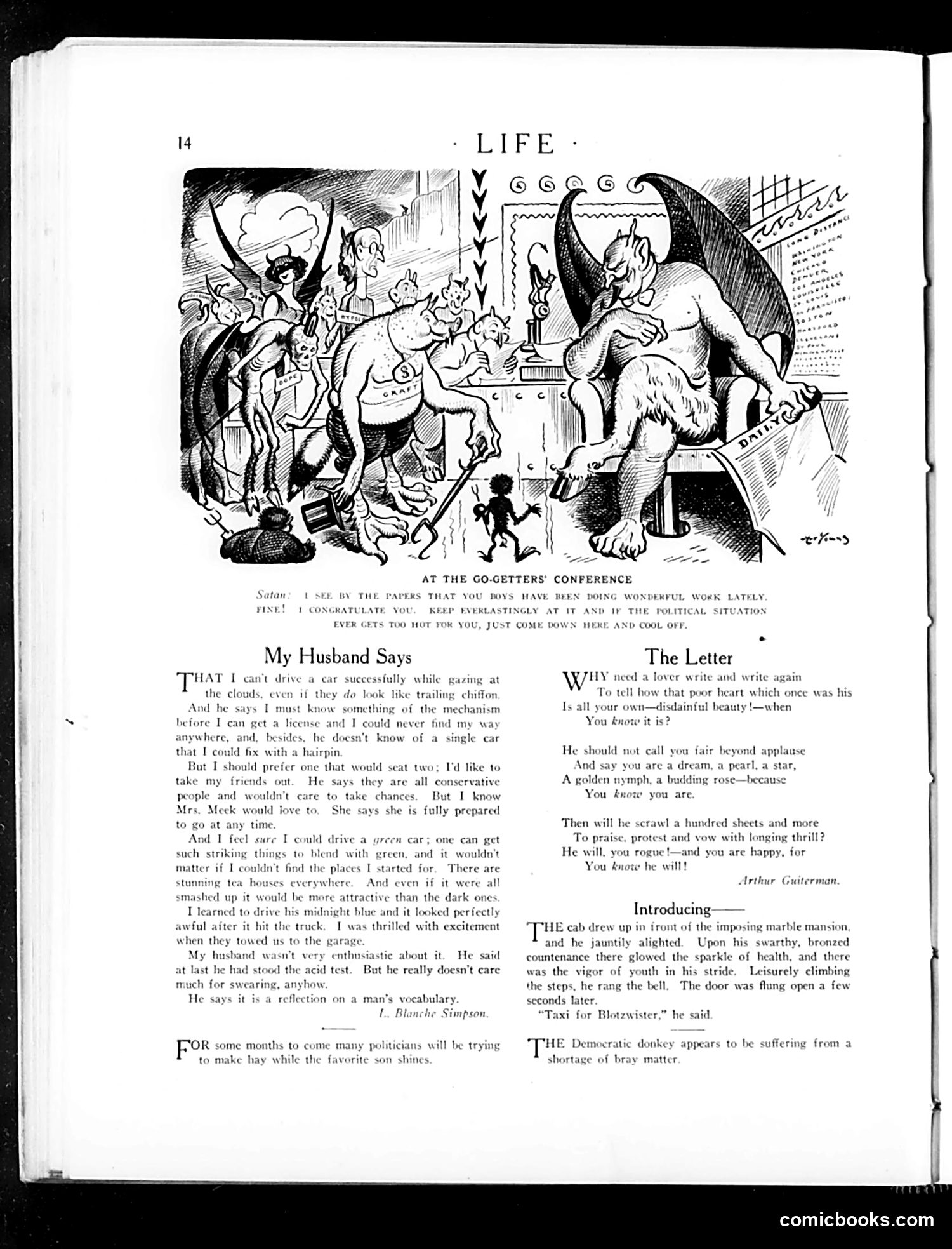
The top cartoon depicts a satirical "Go-Getters' Conference" where Satan compliments politicians on their "wonderful work" and offers them refuge if "the political situation ever gets too hot." This mocks corrupt or unethical politicians and businessmen of the era, suggesting they're essentially doing the devil's work through their schemes. The page also contains three literary pieces: "My Husband Says" humorously critiques a woman's impractical approach to driving; "The Letter" is a romantic poem about love's persistence; and "Introducing—" begins a short story about someone arriving at a mansion. The final line quips that "the Democratic donkey appears to be suffering from a shortage of bray matter"—a political jab suggesting Democratic politicians lack substance or meaningful speech. The donkey was the Democratic Party's symbol. The cartoons and pieces reflect early 20th-century American attitudes toward politics, gender roles, and romantic conventions.
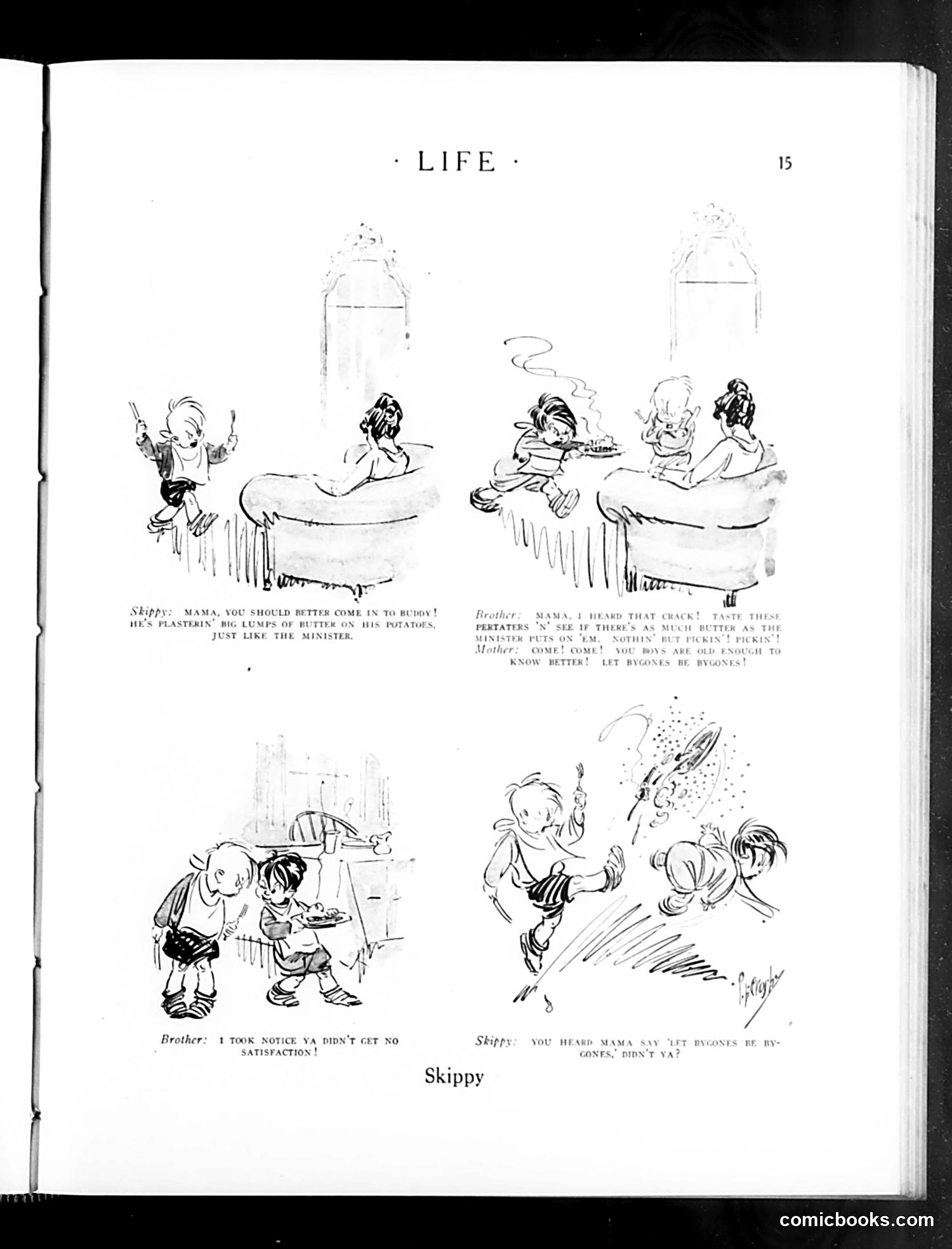
This is a humorous domestic scene featuring children named Skippy and his brother. The satire works on two levels: **Top panels**: Skippy reports that their brother Buddy is wastefully slathering butter on potatoes "just like the minister"—implying the minister is known for excessive indulgence or gluttony, a gentle jab at clergy excess. **Bottom panels**: The brother complains he "didn't get no satisfaction," while Skippy references their mother's comment about "bygones be bygones," suggesting childhood mischief and reconciliation. The humor targets both clerical stereotypes (ministers living luxuriously) and everyday family dynamics of children playing, eating, and bickering. It's gentle social satire reflecting early 20th-century attitudes toward religious figures and domestic life.
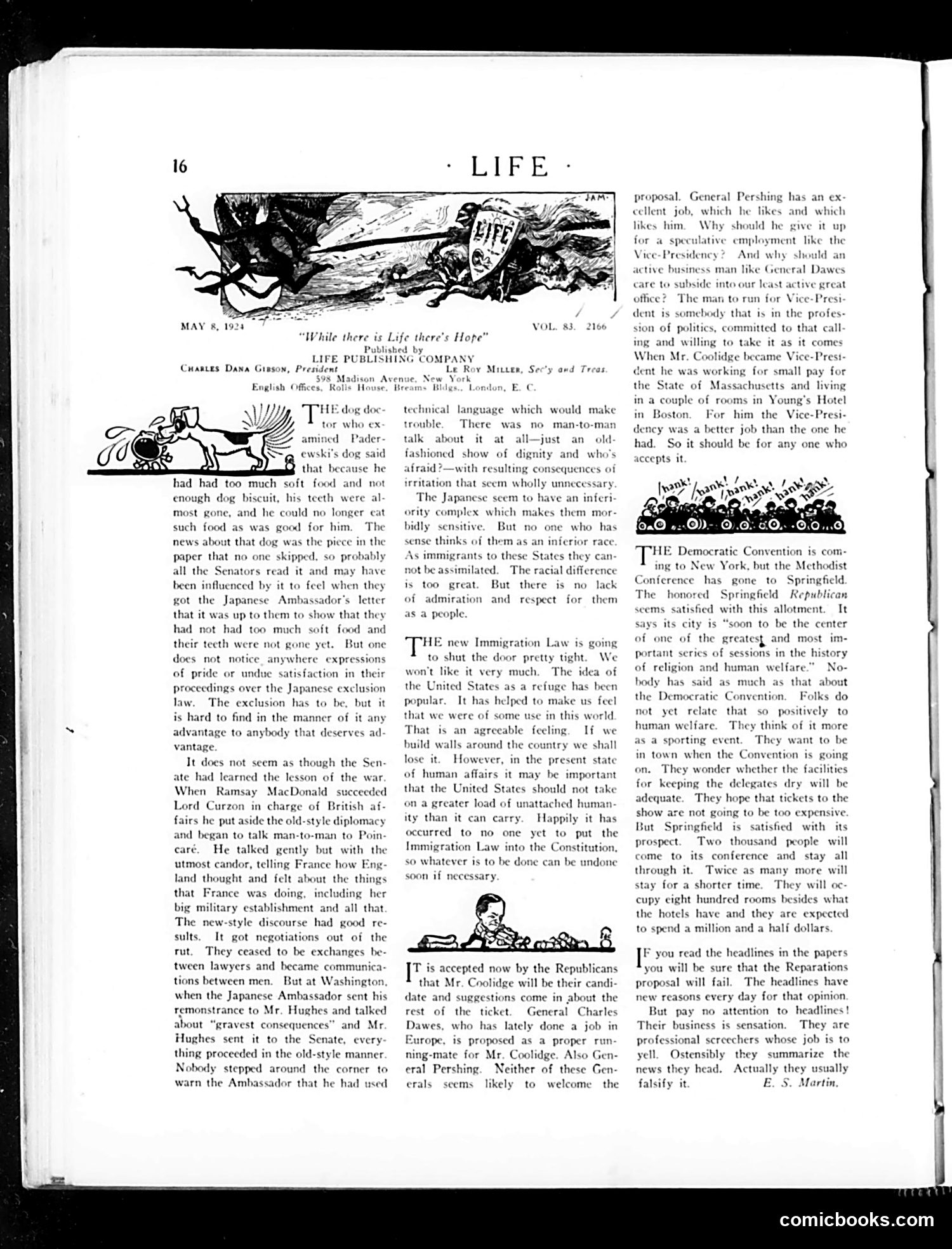
This page contains editorial commentary on three major political issues of 1923: **The Japanese Immigration Exclusion Law**: The author critiques the Senate's harsh manner in passing the law, comparing it unfavorably to Ramsay MacDonald's gentler diplomatic approach with France. The piece suggests the Senate handled Japanese objections clumsily rather than diplomatically. **The Immigration Law Generally**: The author expresses ambivalence—acknowledging America's appeal as a refuge has been valuable, but accepting that the nation may legitimately limit immigration of "unattached" foreigners. **The 1924 Presidential Ticket**: The commentary questions why prominent generals (Charles Dawes and John Pershing) would accept Vice-Presidential nominations when they hold prestigious current positions. The author suggests this is beneath their station. The small cartoon (top left) appears to reference Paderewski's dog's dental problems as metaphorical commentary on Senate decisions, though the connection is oblique. The overall tone is conservative but thoughtful—criticizing execution rather than principle.
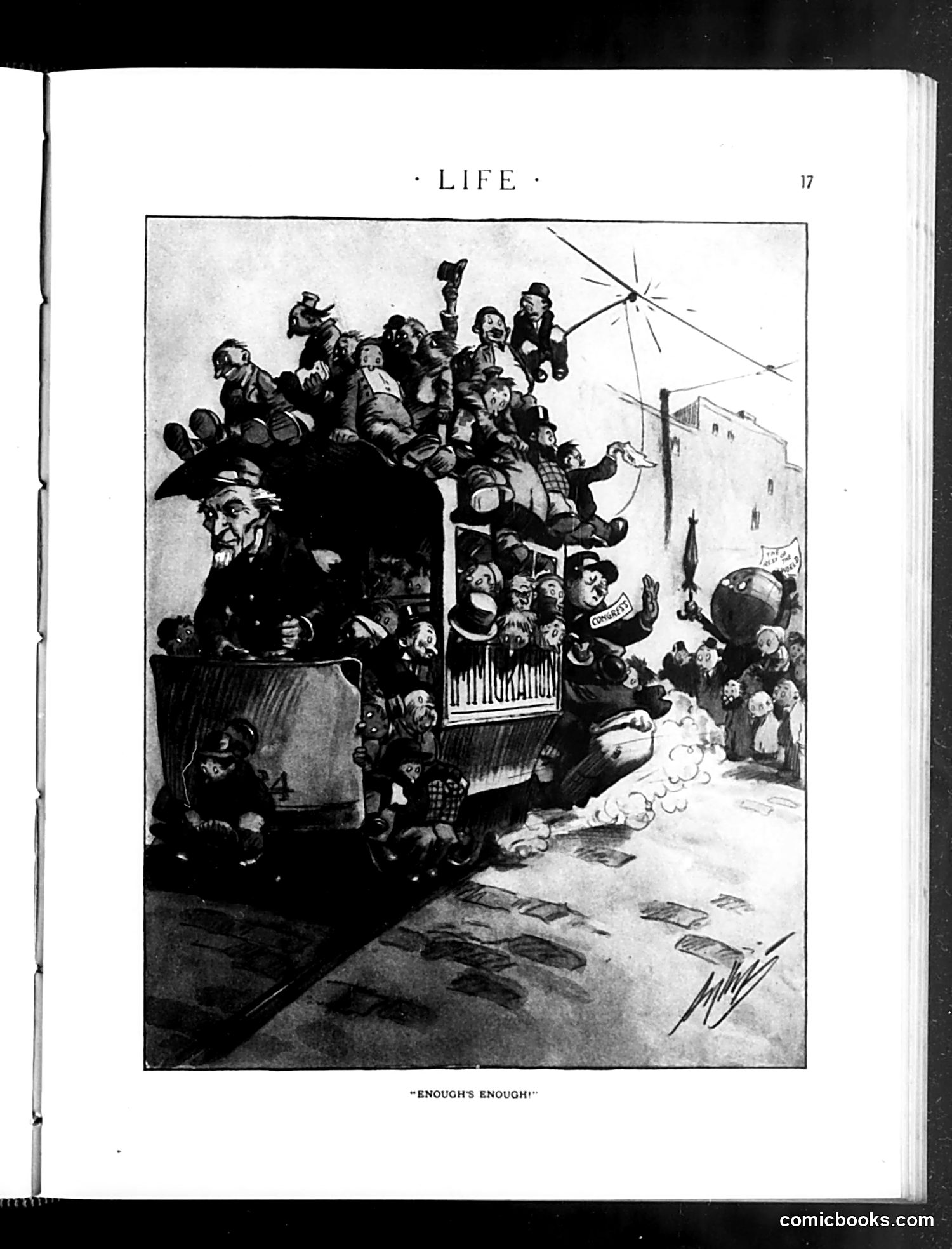
This political cartoon depicts a chaotic scene of numerous figures piled atop a large vehicle or platform, with an elderly man with a prominent nose observing from the left side. The caption "Enough's Enough!" suggests satire about overcrowding or excess—likely commenting on immigration, political patronage, or population concerns contemporary to Life magazine's publication. The caricatured faces and exaggerated expressions typical of early-to-mid 20th century satirical art indicate mockery of a specific group or policy. Without clearer identification of the figures or the specific historical moment, the exact target remains unclear—it could reference immigration quotas, political appointments, or social overcrowding debates common to that era. The artist's signature appears in the lower right.
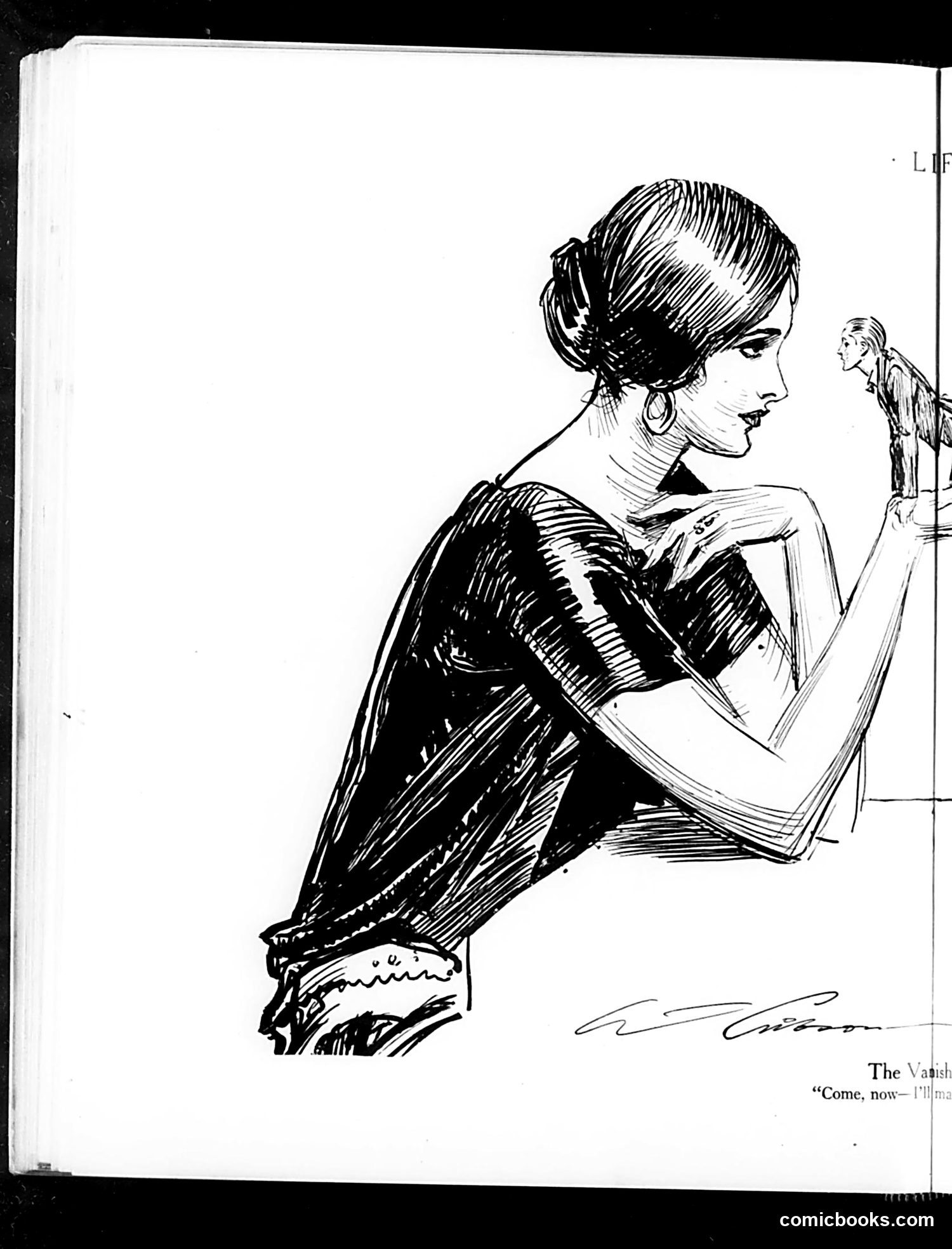
This page shows an ink illustration of a stylishly dressed woman in profile, wearing a black dress with dramatic draping, hoop earrings, and her hair pinned up in a 1920s-era style. A small figure of a man appears on her shoulder. The visible text references "The Vais[h]" and includes dialogue beginning "Come, now—" The illustration appears to be signed by the artist. Without the complete caption and surrounding context, the specific satire is unclear. However, given Life magazine's early 20th-century focus on social commentary, this likely mocks either fashion trends, gender relations, or social pretensions of the era. The miniature man figure suggests commentary on women's power or influence over men, a common satirical theme of the period. The incomplete OCR text prevents definitive interpretation of the cartoon's precise meaning.
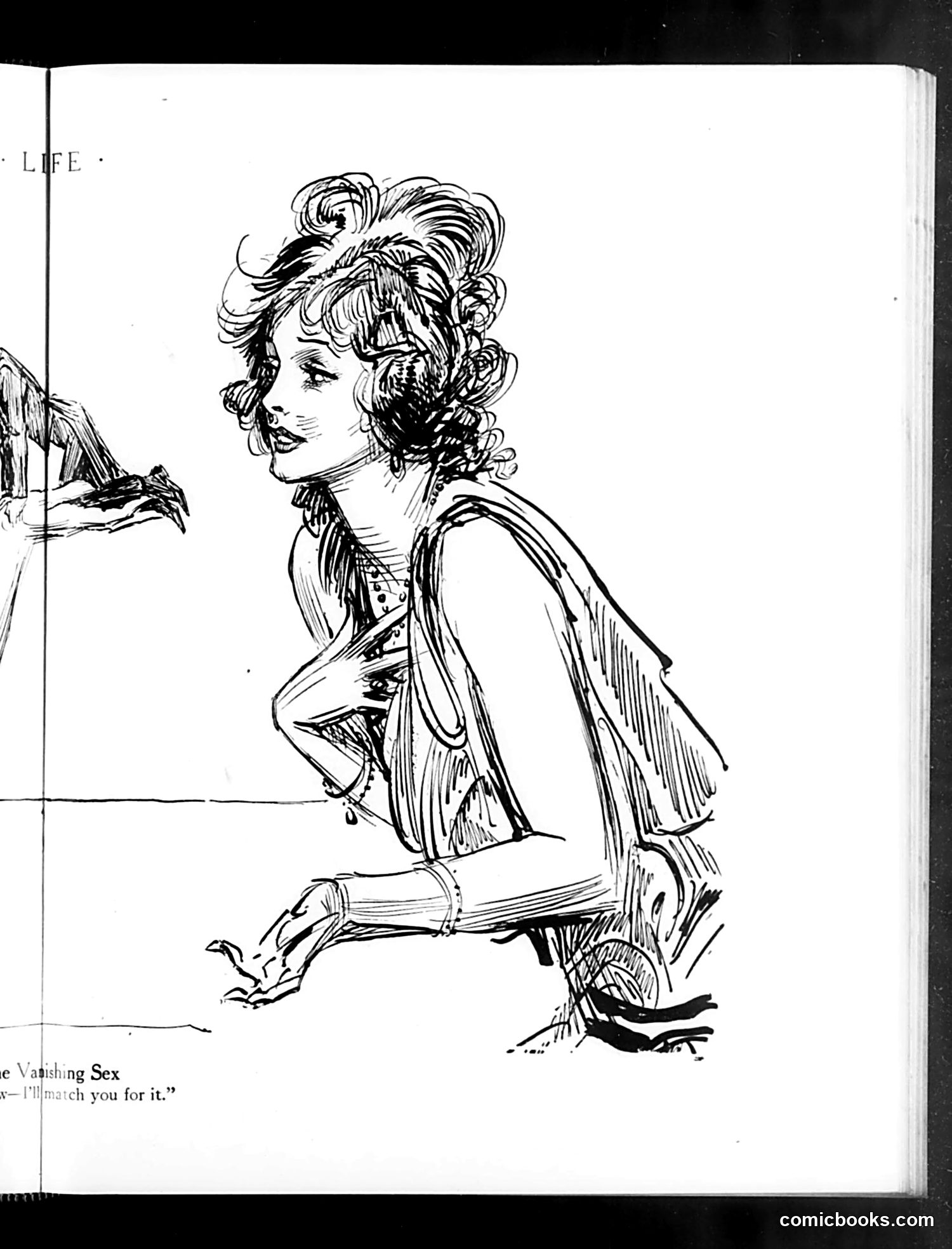
This appears to be a satirical illustration from Life magazine addressing gender dynamics, likely from the early 20th century based on the art style. The cartoon depicts a woman in fashionable dress with elaborate curled hair, shown in profile with a confident, somewhat mischievous expression. The caption "The Vanishing Sex" paired with "I'll match you for it" suggests satire about changing female roles and independence. The woman's assertive posture and the gambling reference ("match you for it") imply she's engaging in traditionally male behaviors—potentially commentary on women entering public life, working, or claiming equal social standing during a period of shifting gender norms. The "vanishing" likely refers to the disappearance of traditional feminine domesticity.
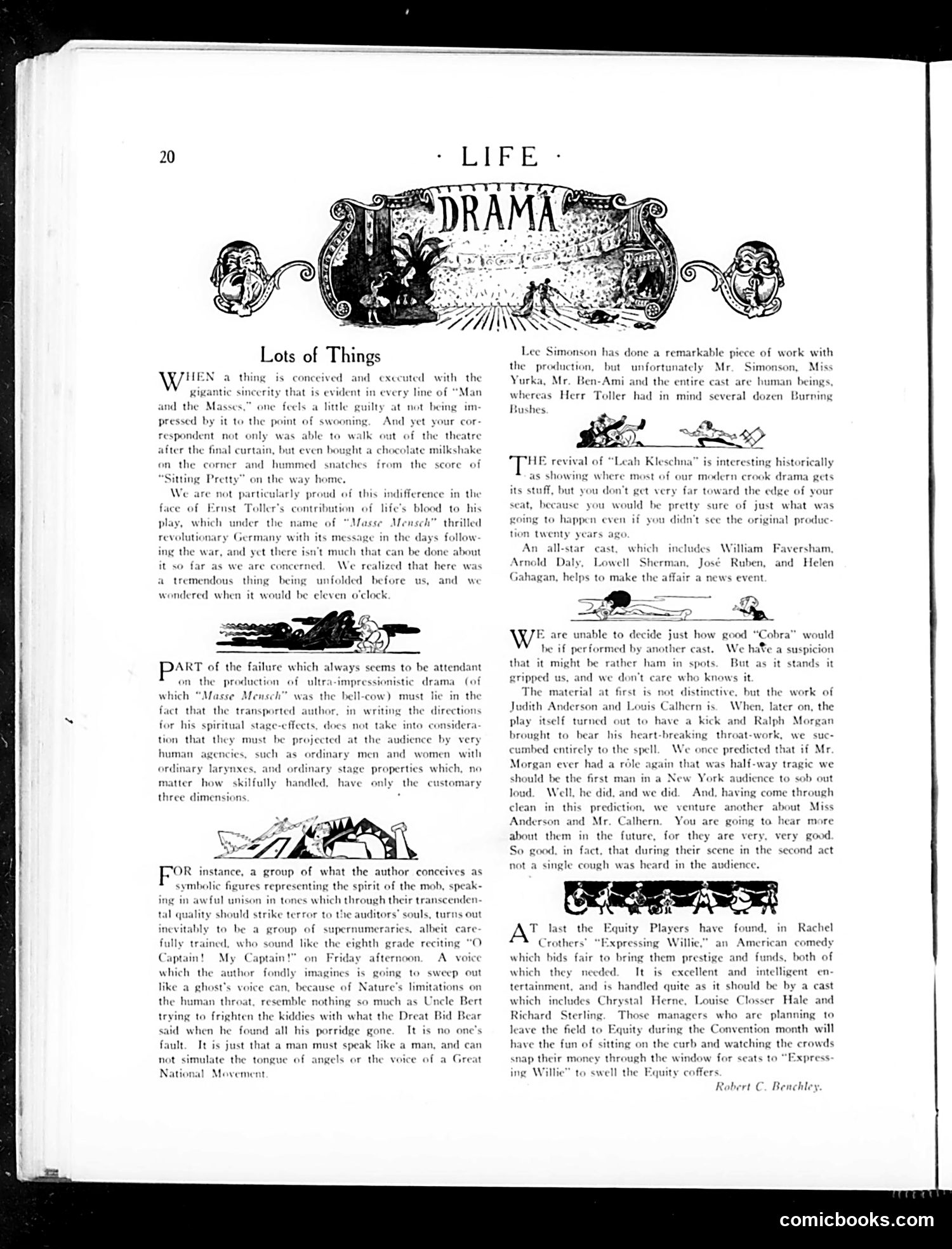
This page contains theater reviews by Robert Benchley, a prominent American humorist and critic. The main critiques address two productions: **"Masse-Mensch"** (or "Man and the Masses"): Benchley reviews Ernst Toller's expressionist play about revolutionary Germany. He argues the work is intellectually ambitious but dramatically fails because ordinary actors cannot convincingly perform the author's symbolic, grandiose vision. His complaint: when actors attempt to represent "the spirit of the mob" speaking in unison as terrifying angels, they sound instead like "Uncle Bert trying to frighten the kiddies"—mundane and ridiculous. The satire targets the gap between ambitious artistic intention and practical theatrical reality. **"Leah Kleschna"**: A revival of a twenty-year-old crime drama featuring an all-star cast (William Faversham, Arnold Daly, others). Benchley praises performances by Judith Anderson and Louis Calhern but finds the material itself predictable. The humor lies in Benchley's deflating commentary on theatrical pretension—high-minded drama undermined by human limitations.
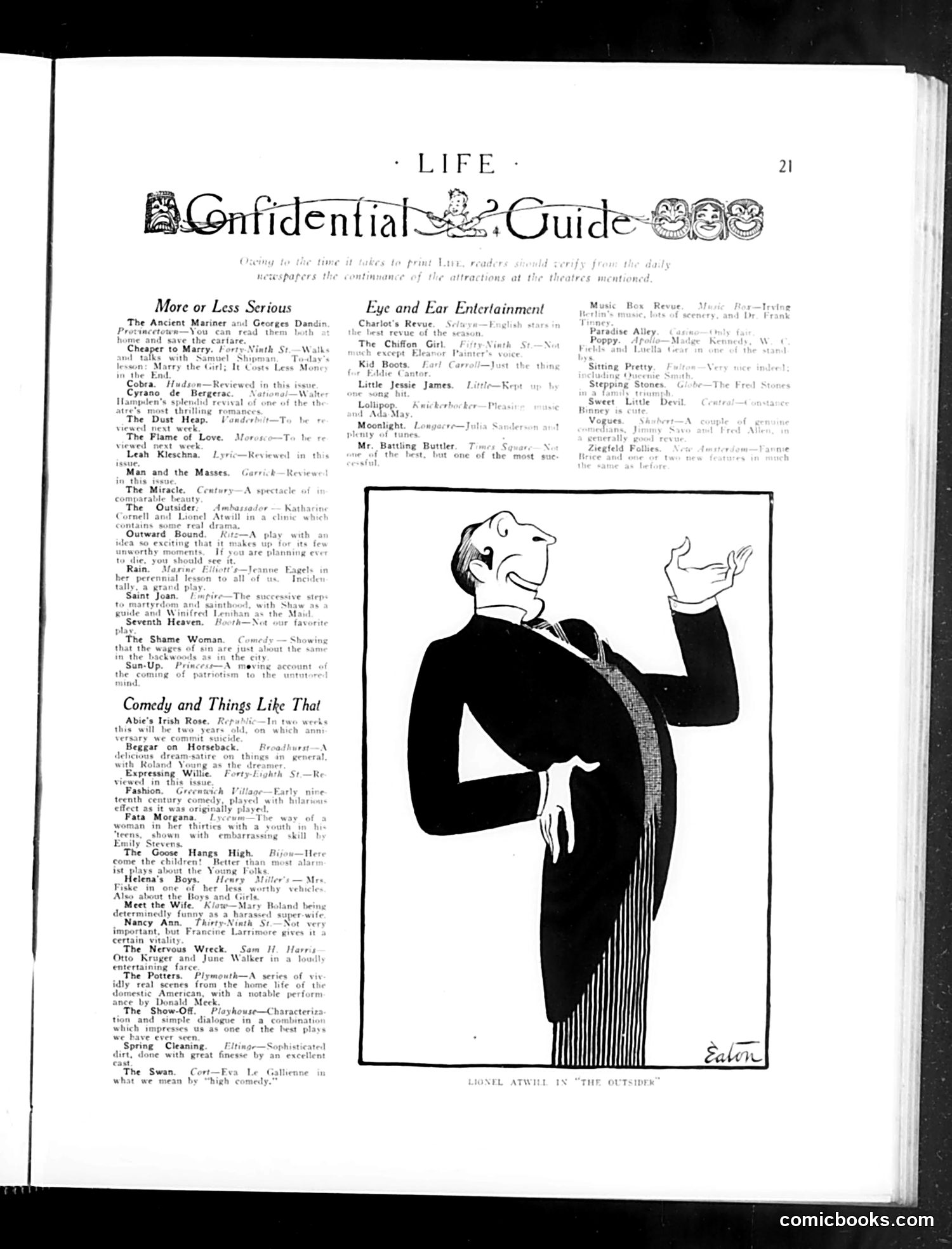
This is an illustration accompanying a theater review, not a political cartoon. The image shows **Lionel Atwill** in a scene from the play "The Outsider" (listed under "More or Less Serious" theatrical reviews). The drawing depicts a man in formal attire with an exaggerated, theatrical expression—head tilted back, hand gesturing dramatically. This stylized pose captures the melodramatic performance style typical of 1920s stage acting. The cartoonist (signed "Evan") is satirizing theatrical pretension through caricature: the overwrought posture and affected gesture mock the earnest intensity actors brought to dramatic roles of the era. The page itself is a "Confidential Guide" to current Broadway productions with brief reviews. This particular illustration simply highlights a notable performance, using satirical exaggeration to poke gentle fun at theatrical conventions rather than making a political or social statement.
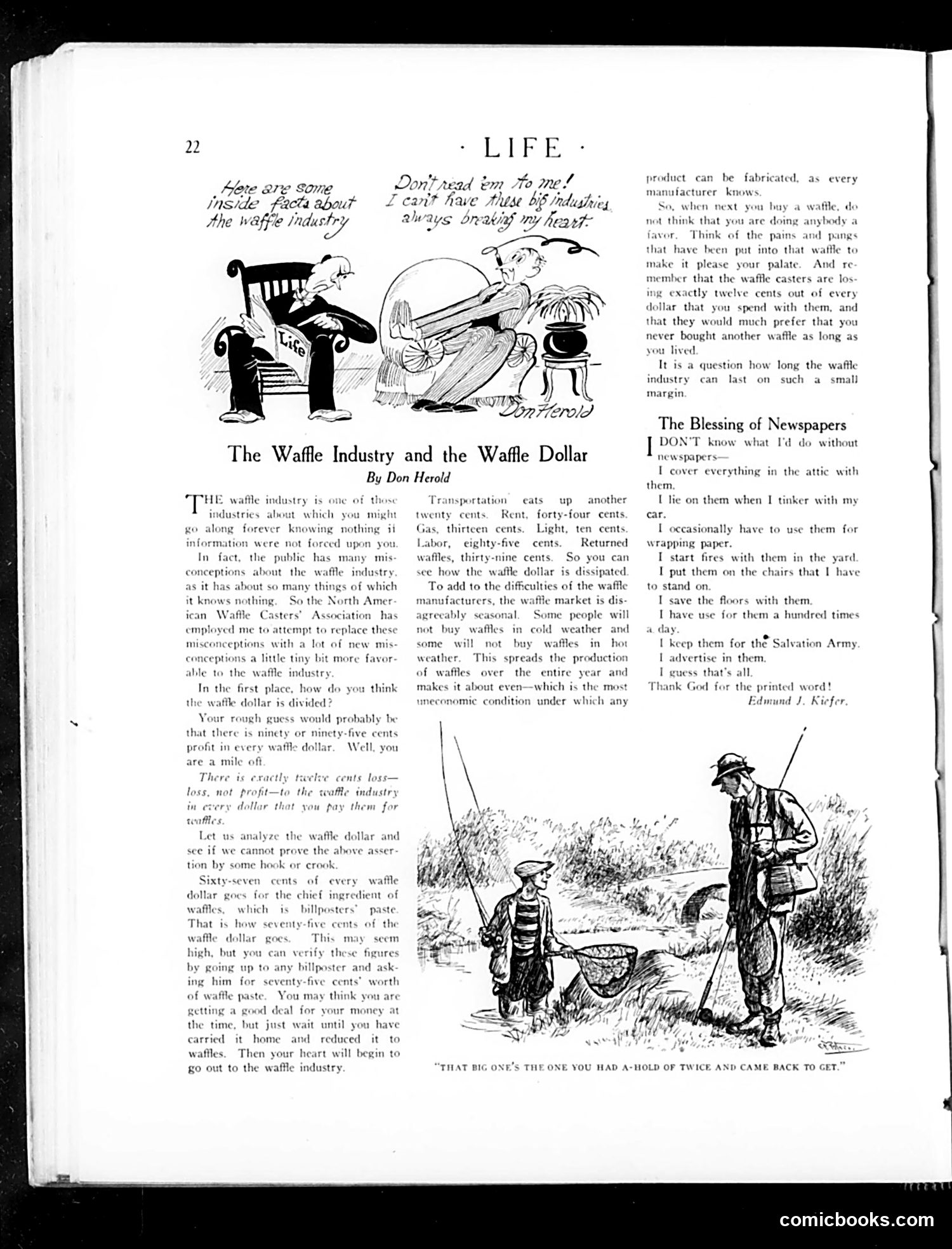
This is satirical economic commentary by Don Herold mocking American manufacturing inefficiency. The article breaks down the "waffle dollar" to show how costs consume profits: flour costs 67 cents, transportation 20 cents, labor 85 cents—leaving waffles' makers losing money on every sale. The joke is that this absurdly unprofitable industry somehow exists. The cartoon shows a pompous figure labeled "Life" presenting "facts" to an incredulous listener—the satire being that these "facts" are actually ridiculous. The point: American industries operate on razor-thin or negative margins through poor cost management, seasonal demand fluctuations, and inflated overhead. It's mocking both the waffle industry specifically *and* broader American business practices for their fundamental economic illogic. The accompanying piece "The Blessing of Newspapers" shifts tone entirely, becoming earnest gratitude for newspapers' practical utility in everyday life.
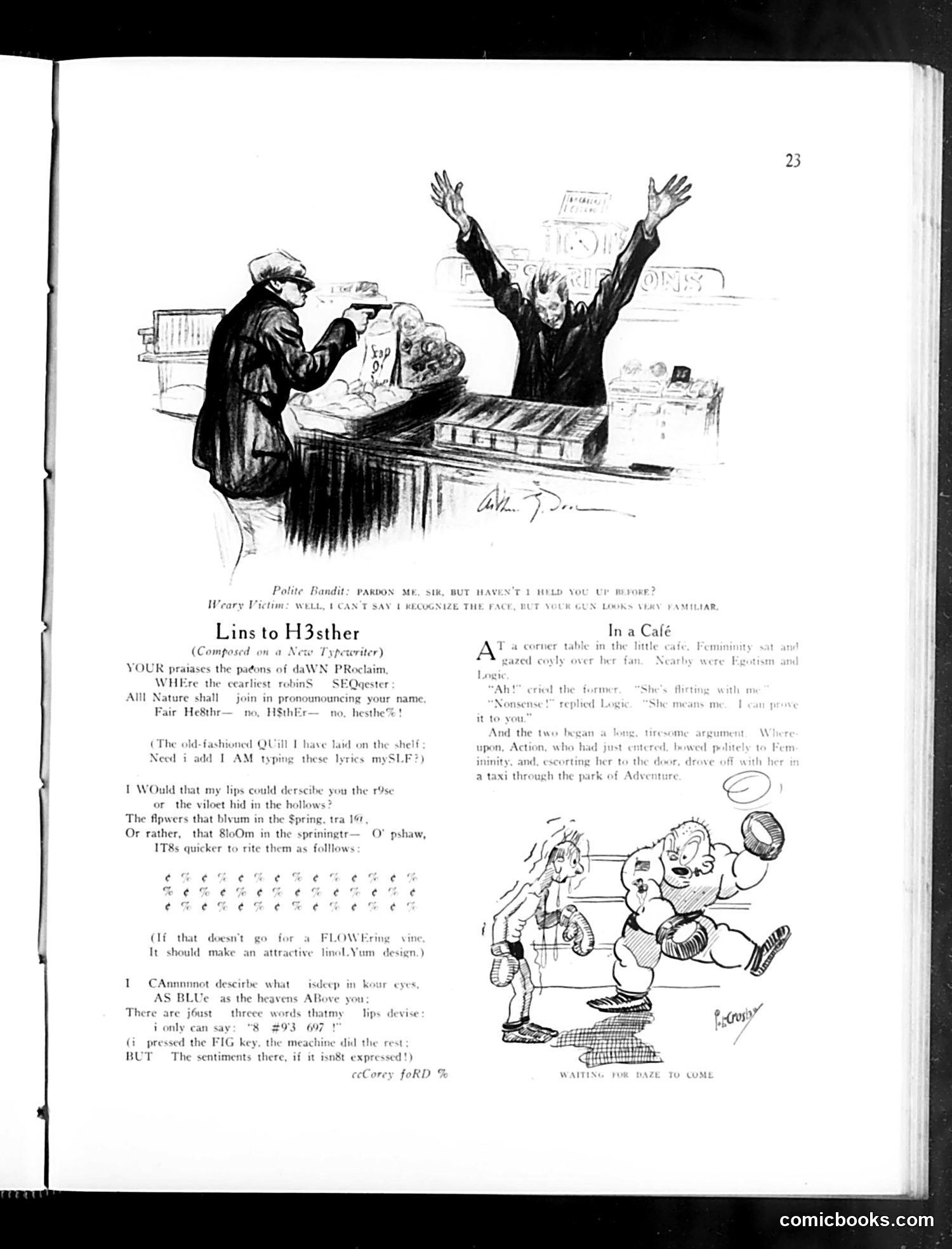
**Top Cartoon:** A bandit apologizes to his robbery victim, saying he doesn't recognize the victim's face. The satire appears to mock either police incompetence or the prevalence of crime—suggesting criminals operate so frequently they can't keep track of their victims. **"Lins to H3esther":** A humorous poem satirizing romantic verse-writing on an old typewriter. The author complains the machine malfunctions (producing "H3esther" instead of "Hester," "$" symbols, etc.), making it impossible to compose flowery romantic language. The joke: modern technology undermines traditional poetic sensibility. The deliberately bad OCR-like text mirrors the typewriter's failures. **"In a Café":** A brief narrative about a couple arguing, with illustration showing playful domestic discord. The page mocks romantic conventions and mechanical/technological frustrations common to early 20th-century Life magazine satire.
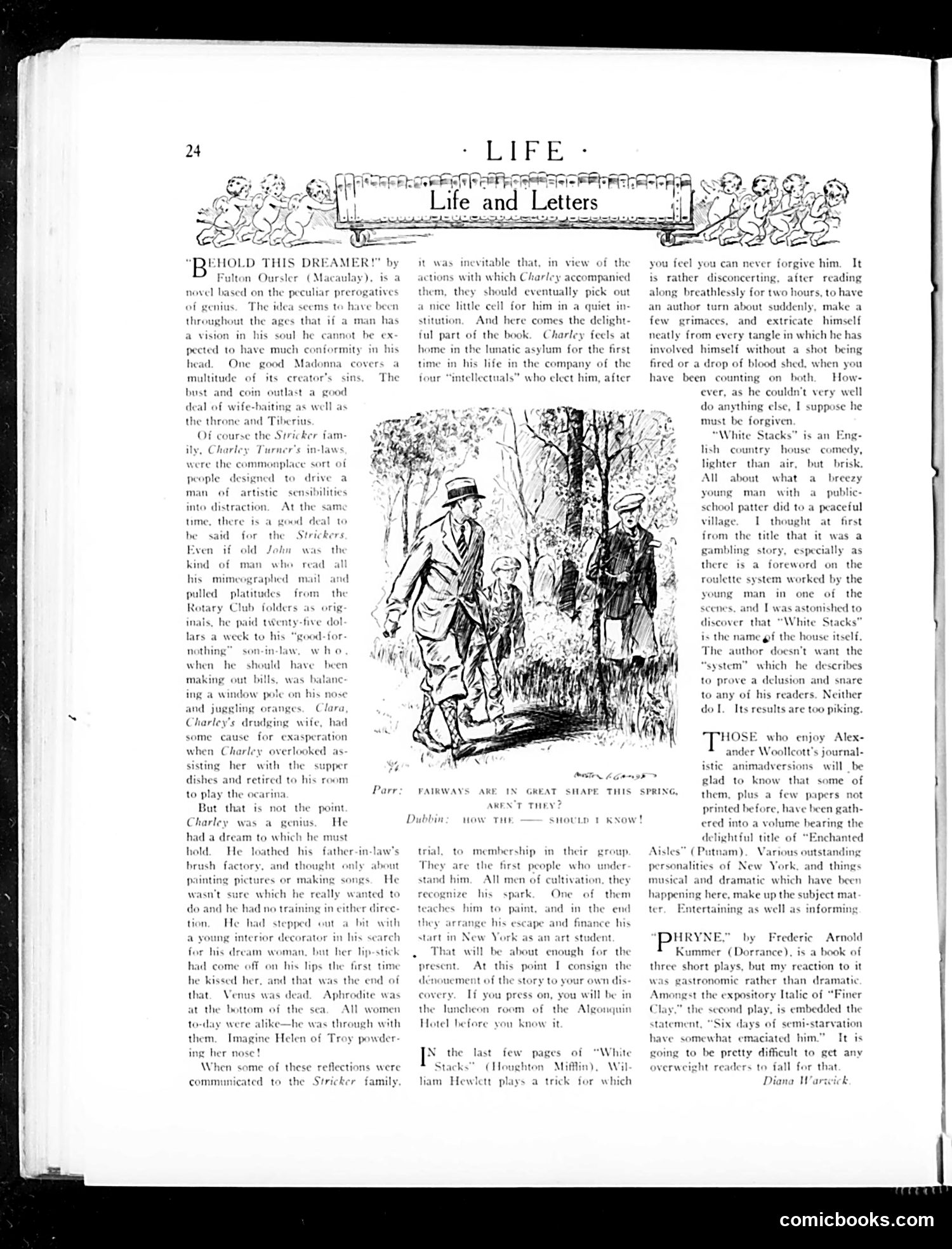
This page from *Life* magazine reviews several recent books, primarily focusing on "Behold This Dreamer!" by Fulton Oursler. **The Main Review:** The illustration shows two men in conversation outdoors, likely depicting characters from Oursler's novel. The review discusses a protagonist named Charley, described as an artistic genius trapped in mundane circumstances—stuck supporting a philistine family (particularly a father-in-law who runs a brush factory) while working tedious jobs. The satire centers on the tension between artistic aspiration and bourgeois mediocrity: Charley is intelligent enough to dream of better things but lacks the discipline or opportunity to achieve them, instead reduced to petty office work and domestic frustration. **Social Commentary:** The review satirizes both the dreamer's impracticality and the philistine world that crushes artistic sensibility. Charley's family represents American materialism and cultural indifference. **Other Reviews Mentioned:** Brief mentions of "White Stacks" (a country-house comedy) and "Phryne" (short plays) appear, offering lighter literary fare in contrast.
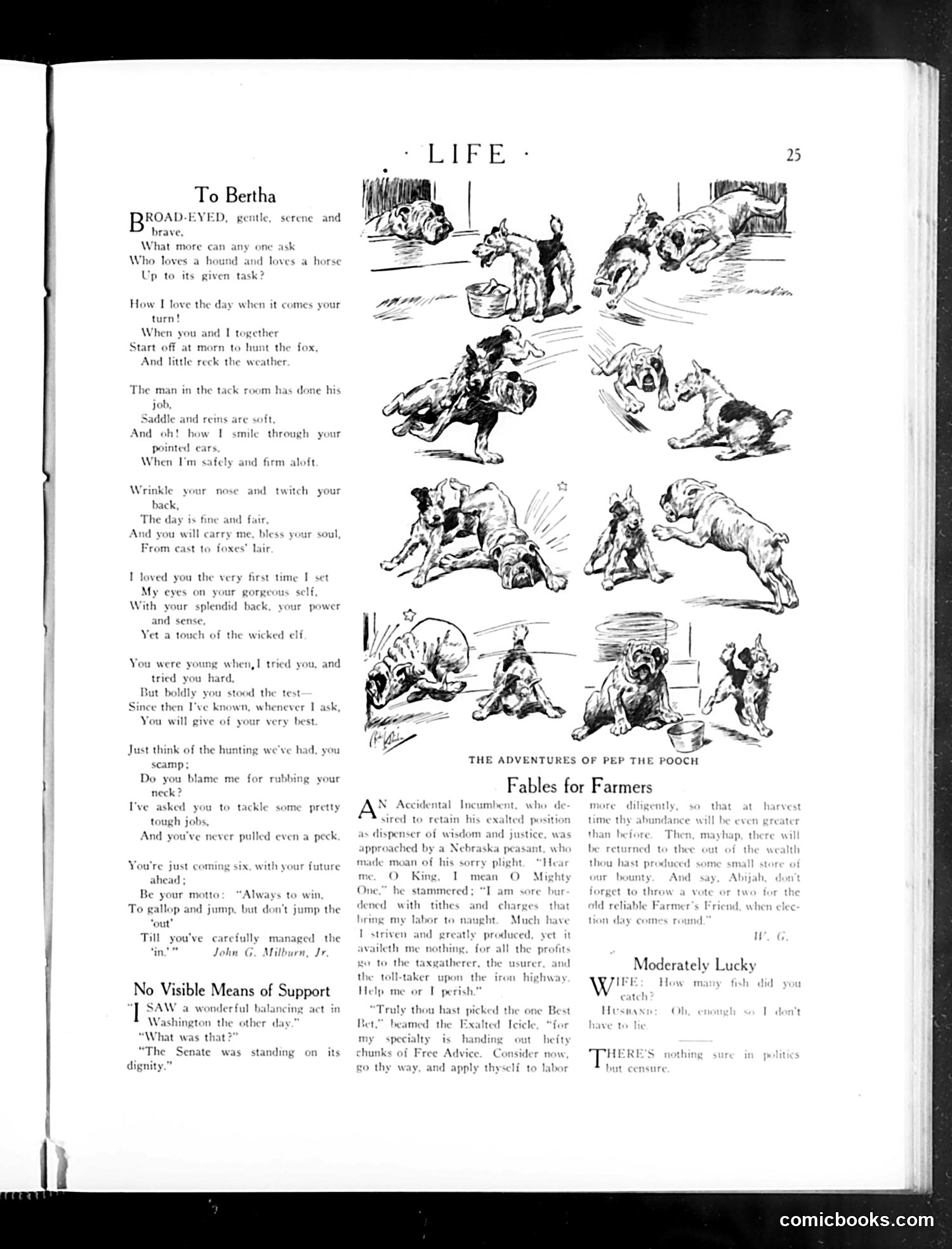
This page contains several distinct pieces of satirical content: **"To Bertha"** is a sentimental poem addressed to a hunting horse, celebrating its courage, reliability, and partnership in fox hunting—a leisure pursuit of the wealthy. The humor lies in its earnest, elevated tone treating a horse as a beloved companion worthy of such romantic praise. **"The Adventures of Pep the Pooch"** shows various cartoon dogs in comedic situations, illustrating physical humor through their misadventures. **"Fables for Farmers"** section includes two brief satirical pieces: one mocking an incompetent politician ("Accidental Incumbent") who peddles worthless advice to farmers, and another titled "Moderately Lucky" making a cynical quip about political uncertainty. **"No Visible Means of Support"** jokes about the U.S. Senate standing on "dignity" alone—satirizing Congress as an institution lacking substantive foundation or productivity, relying only on pretense and decorum. The overall page reflects *Life* magazine's typical blend of gentle social satire targeting both the wealthy (fox hunting) and political institutions (Congress).
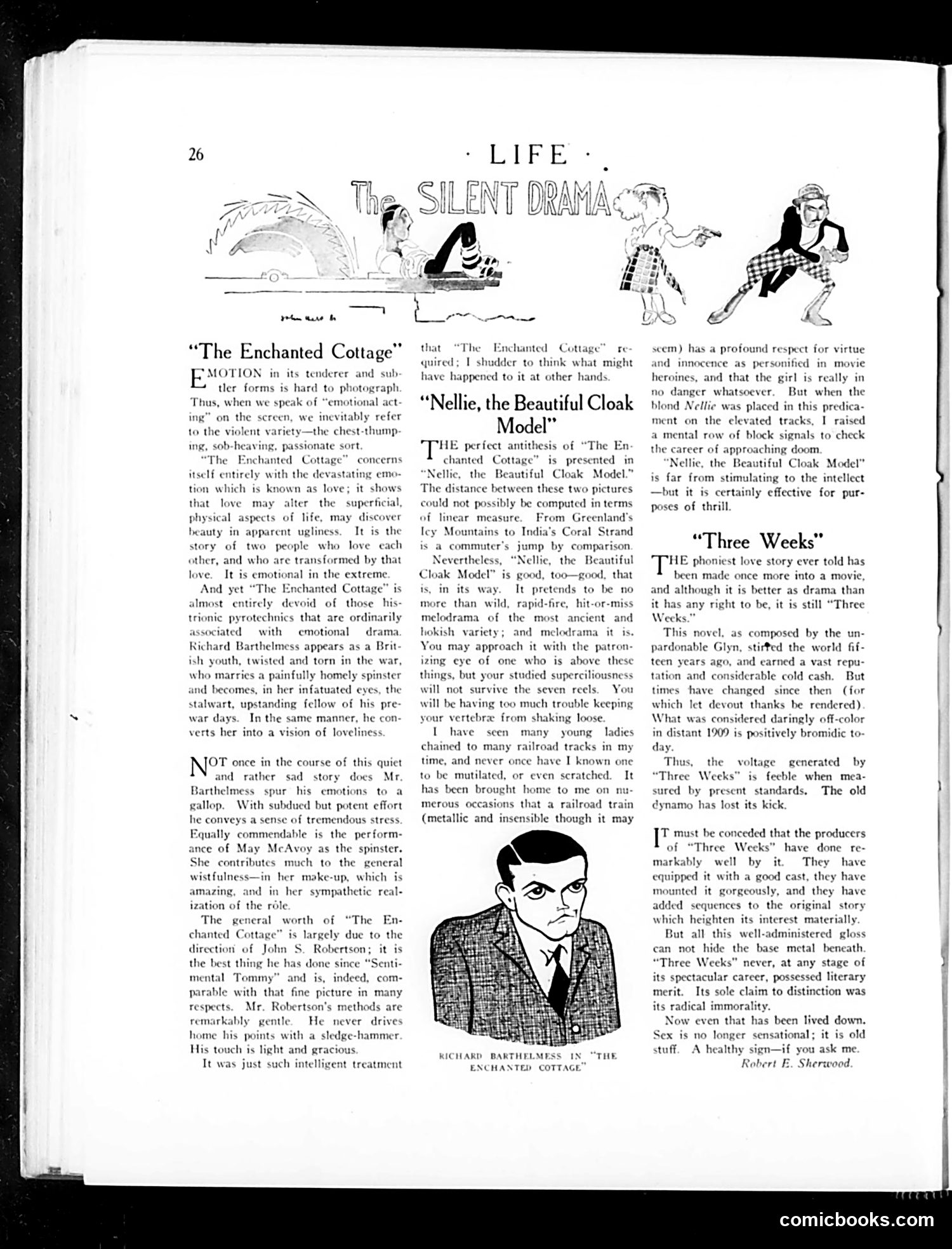
This page reviews three silent films, comparing their artistic merit. The main cartoon depicts **Richard Barthelmess** in "The Enchanted Cottage," portrayed as a serious, brooding figure—reflecting the film's restrained, emotionally subtle approach to storytelling. The reviewer contrasts this film favorably with "Nellie, the Beautiful Cloak Model," a melodramatic potboiler relying on sensational stunts (like heroines chained to railroad tracks). The satire suggests that while both are "emotional" cinema, one achieves depth through restraint and intelligent direction (John S. Robertson's), while the other cynically manufactures cheap thrills for audiences. The third film, "Three Weeks," is dismissed as "the phoniest love story ever told"—apparently already remade multiple times, suggesting Hollywood's tendency toward recycling tired material for profit rather than artistic merit. The page critiques how 1920s studios exploited romance and melodrama.
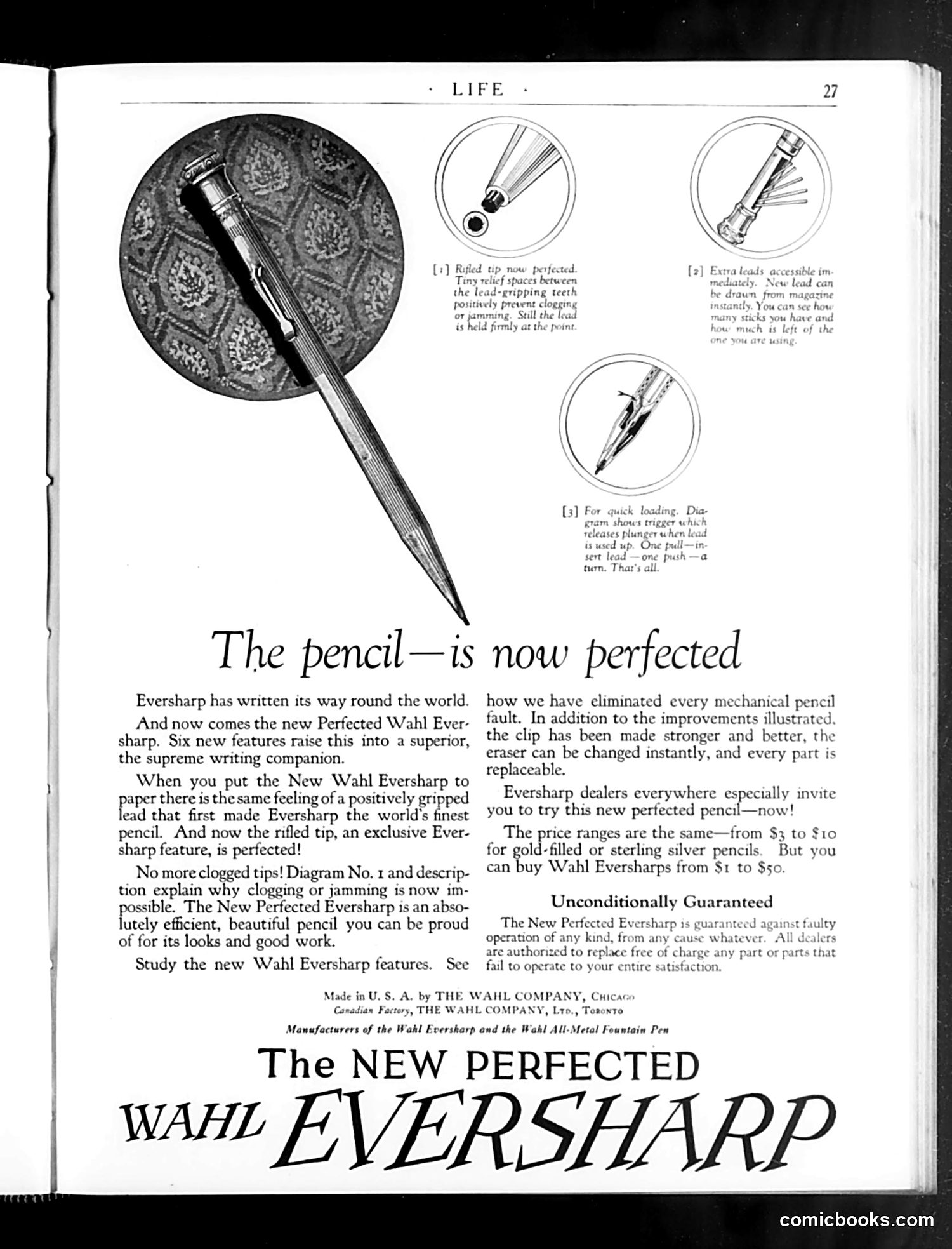
This page is **not a political cartoon or satire**—it's a full-page advertisement for the Wahl Eversharp mechanical pencil, appearing in Life magazine. The ad promotes the "New Perfected" Eversharp by highlighting six mechanical improvements: a rifled tip to prevent clogging, accessible extra lead cartridges, and an improved trigger mechanism (shown in three circular diagrams). The copy emphasizes reliability and replaceable parts. The large circular image shows the pencil on decorative fabric, presenting it as a premium writing instrument. Pricing ranges from $1 to $50 depending on materials. Modern readers would recognize this as vintage product advertising using common early-20th-century techniques: technical diagrams explaining features, aspirational design photography, and guarantees. There is no satire or political commentary—Life's editorial pages contained humor and commentary elsewhere; this is straightforward commercial promotion typical of the era.
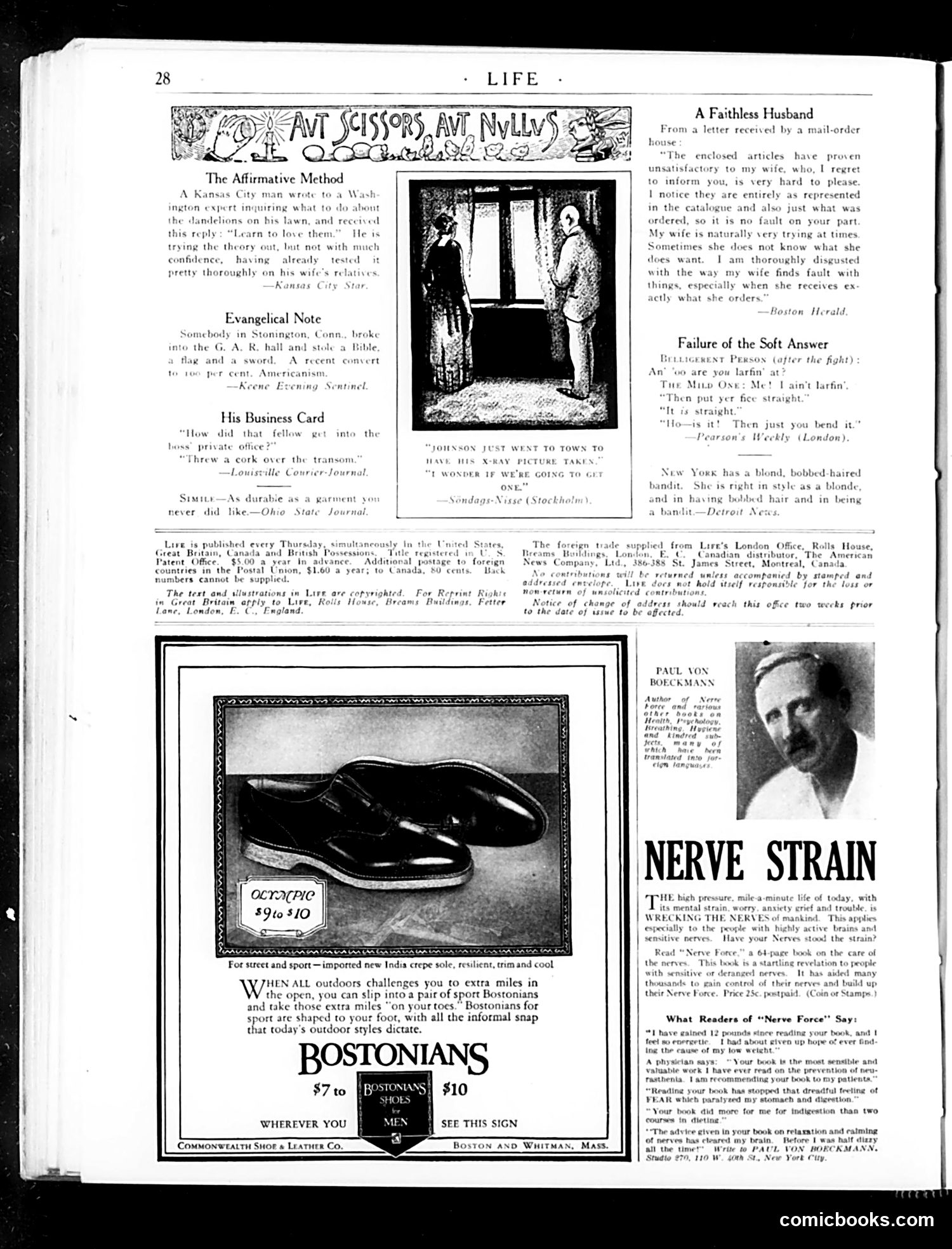
This page contains multiple short humorous items typical of Life's satirical format, plus advertisements. **The cartoons/jokes:** The main illustrated item shows a domestic scene captioned "Johnson just went to town to have his X-ray picture taken. I wonder if he's going to get one." The humor plays on the then-novel technology of X-rays—the joke implies Johnson is vain or self-conscious about his appearance, wanting his internal anatomy photographed like a portrait. Other brief items include marital complaints (a husband griping about his wife's mail-order purchases), and exchanges about fighting and posture that rely on wordplay and misunderstanding. **Context for modern readers:** These are pre-1920s jokes assuming familiarity with X-rays as a recent, somewhat mysterious technology. The domestic complaints reflect early-20th-century gender tensions about consumption and wives' autonomy. The overall tone is gently mocking of ordinary people's pretensions and marital friction—standard Life magazine satire of the era. The page is primarily filler and advertising rather than major political or social commentary.
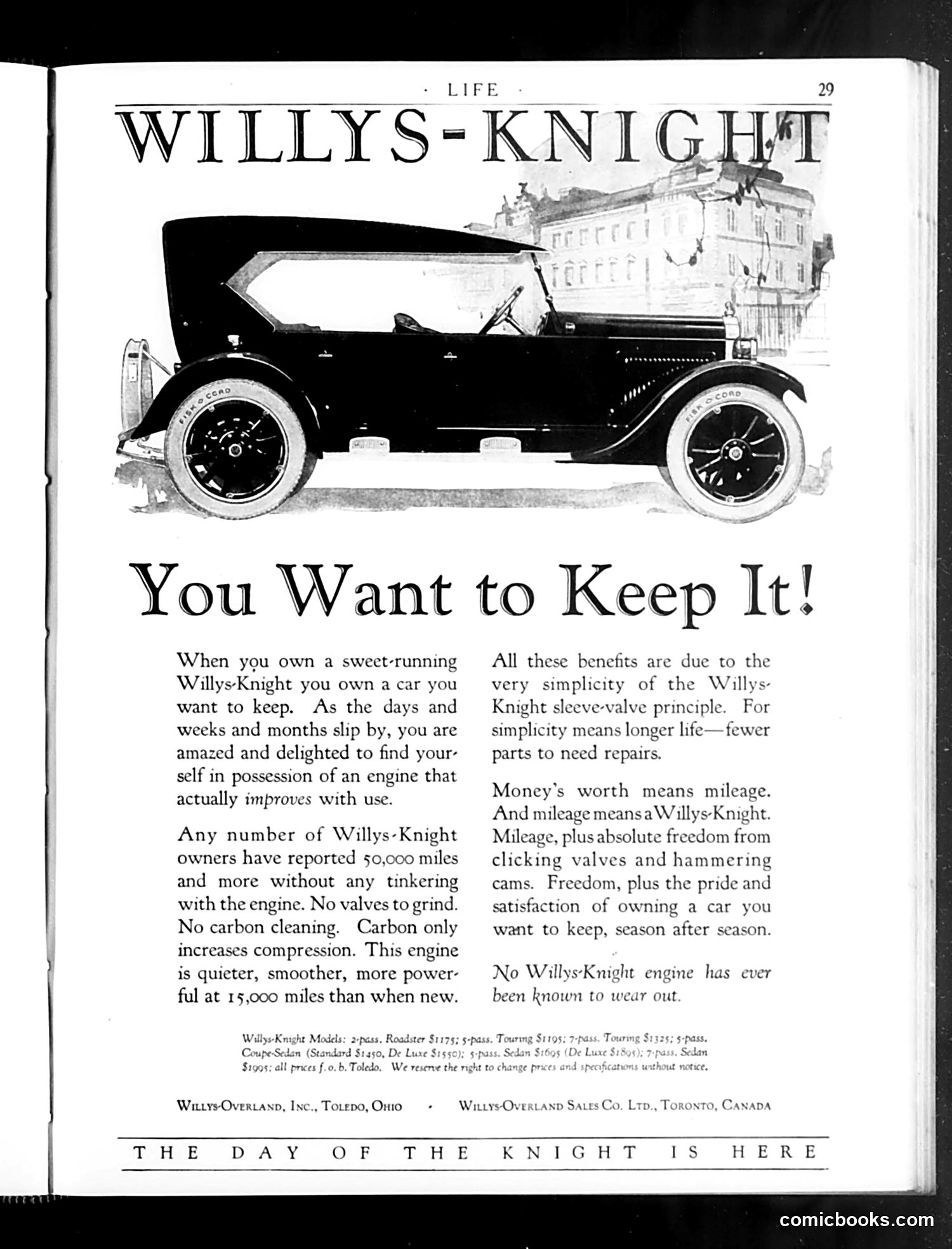
This is a **full-page automobile advertisement**, not a political cartoon or satire. It promotes the Willys-Knight car to a 1920s audience. The ad's central claim—that the engine "improves with use" and won't wear out—appears designed to address buyer anxiety about automotive reliability during an era when cars were still relatively new and expensive purchases. The emphasis on "50,000 miles without tinkering" and "no valves to grind" suggests these were common maintenance complaints with competing vehicles. The advertisement uses aspirational language ("pride and satisfaction of owning a car you want to keep") to appeal to middle-class buyers seeking durability and status. The architectural rendering in the background implies wealth and permanence. For modern readers: this represents early auto-marketing before government regulation required substantiation of product claims. The promise that an engine becomes more powerful after 15,000 miles would be considered fraudulent advertising today.
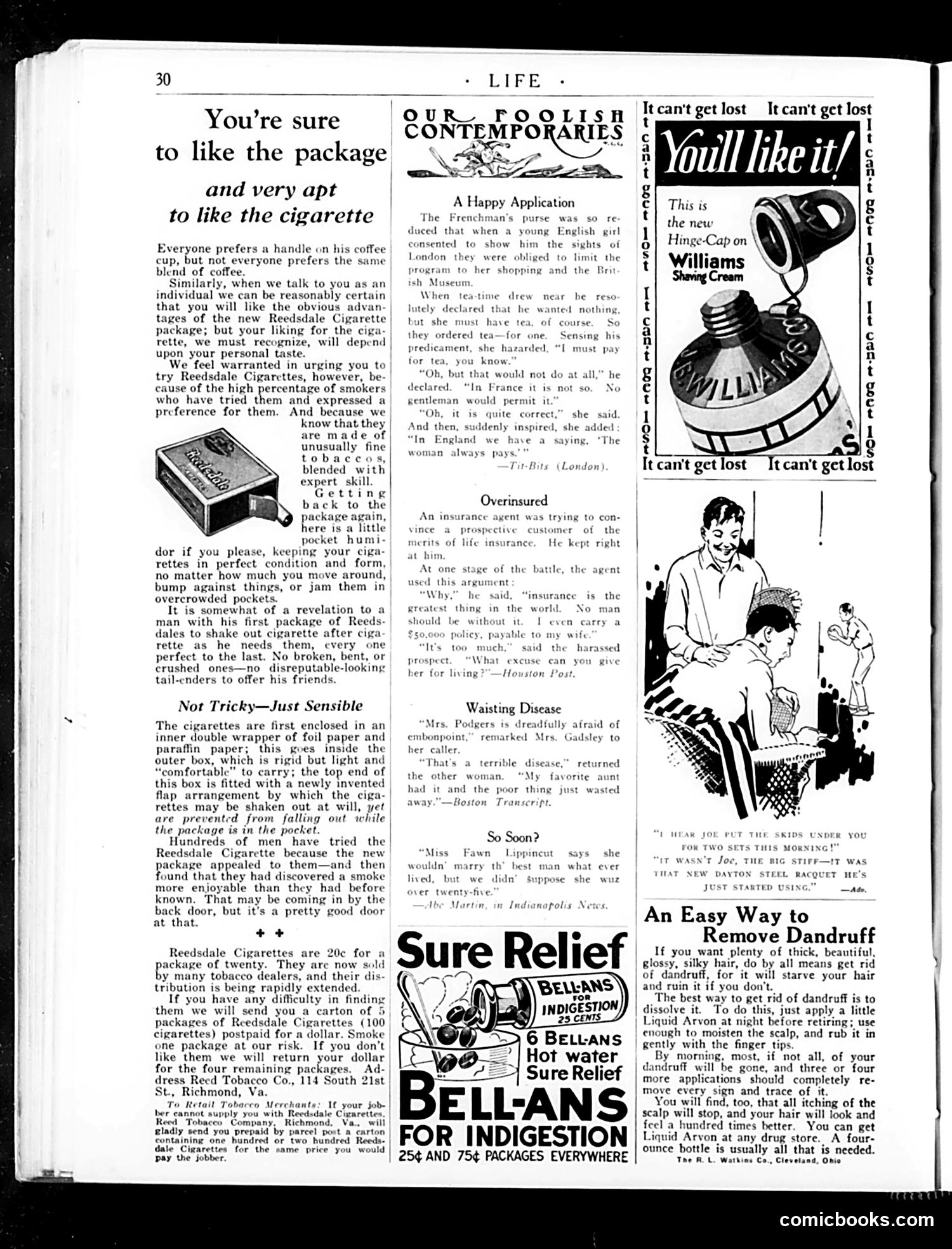
This page primarily features **cigarette advertising** for Reedsdale Cigarettes, occupying most of the space with marketing copy emphasizing the product's packaging innovation (a pocket humidor) and quality control. The sidebar titled "Our Foolish Contemporaries" contains brief satirical anecdotes mocking contemporary social attitudes: 1. **"A Happy Application"**: Jokes about French versus British attitudes toward paying for tea—suggesting cultural differences in gender etiquette around who should pay. 2. **"Overinsured"**: Mocks an overzealous insurance salesman who carries excessive life insurance policies, treating it as absurd overkill. 3. **"Waisting Disease"**: A brief, unclear joke about a woman's concern with her figure ("embonpoint" means excessive weight). These are lightweight social humor pieces typical of Life's satirical tradition—poking gentle fun at contemporary manners, commercial excess, and gender relations rather than serious political critique. The page reflects early 20th-century American attitudes toward consumption, insurance, and social propriety.
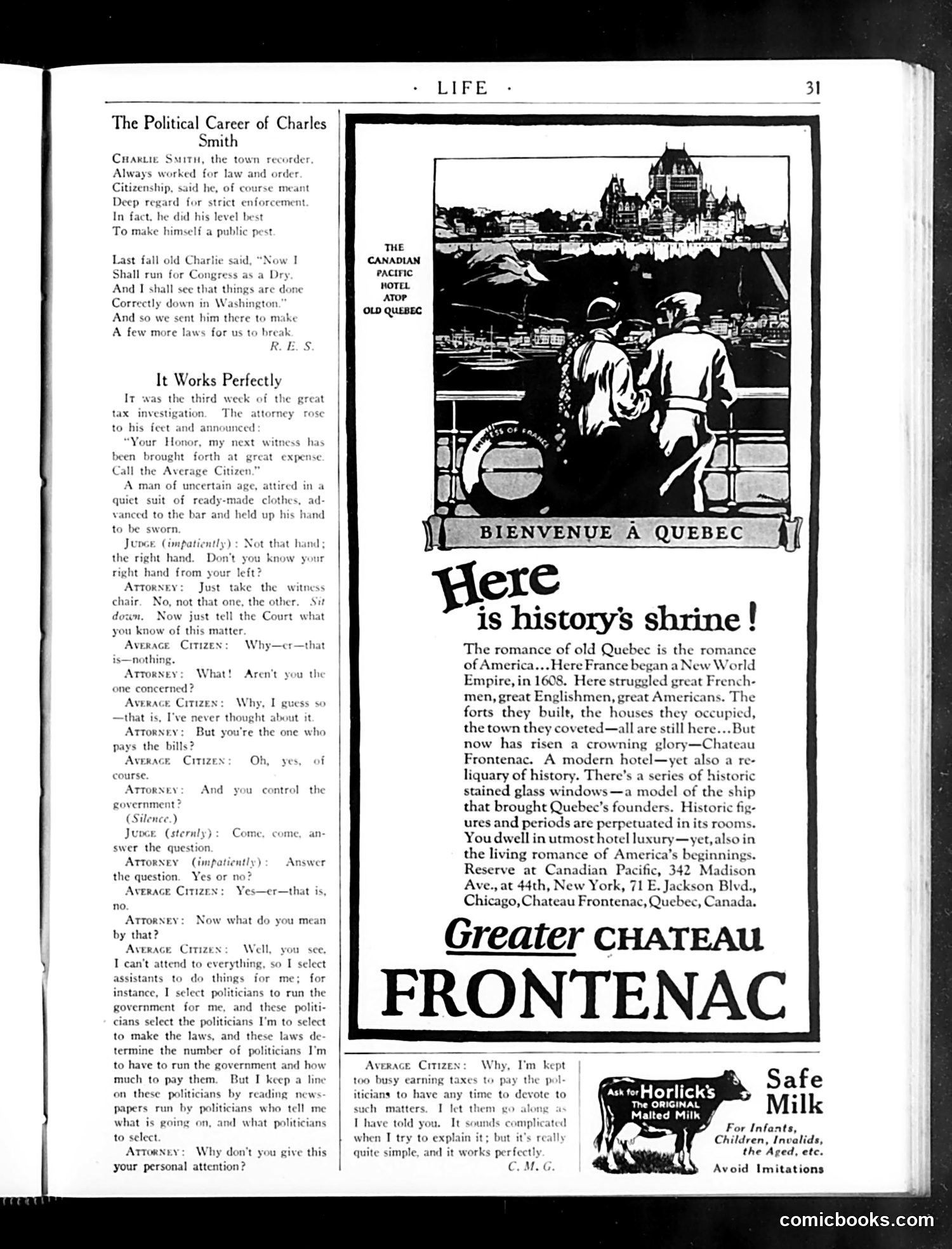
This page contains two pieces of political satire. The main cartoon, titled "It Works Perfectly," mocks American democratic governance through a courtroom dialogue. An "Average Citizen" is called as a witness in a tax investigation but admits he's too busy *earning* taxes to pay politicians to actually participate in government. He explains his bewildering system: he selects politicians who select other politicians to make laws, whose number is determined by those laws—creating a circular, self-perpetuating bureaucratic loop that he doesn't understand or control. The satire's point: ordinary citizens are disconnected from governance despite theoretically controlling it. They're trapped paying for a system they can't manage, reading politician-run newspapers that tell them what politicians to select. The title's irony—"it works perfectly"—underscores the complaint: the system functions *for politicians*, not citizens. This appears to critique Progressive Era concerns about governmental inefficiency and citizen apathy.
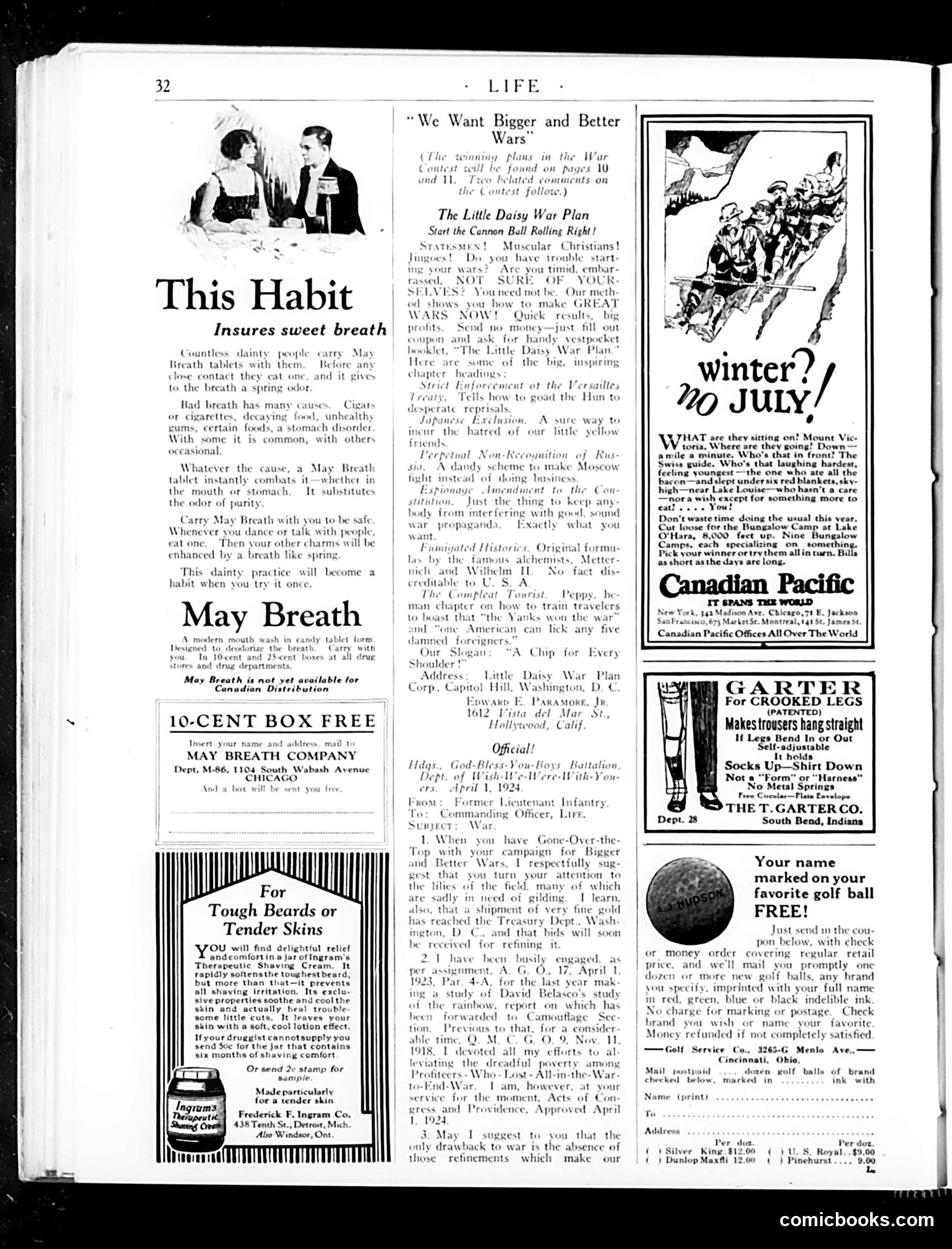
This page satirizes American militarism and warmongering through a mock advertisement. "The Little Daisy War Plan" parodies self-help instruction booklets, treating war-making as a consumer product requiring confidence-building guidance for timid nations. The satire targets U.S. foreign policy, likely referencing tensions with Soviet Russia and Japan that dominated 1924 politics. The joke: Americans are selling warfare like patent medicine or correspondence courses, complete with coupon-ready "quick results" and promises that "any American can lick any five foreigners." The accompanying letters mock official justifications for military intervention, sarcastically suggesting attention should go to domestic poverty instead. This represents *Life* magazine's satirical tradition of mocking American jingoism and imperialist impulses through absurdist advertising parodies—making the ridiculous seem reasonable to expose the actual ridiculousness of warmongering rhetoric.
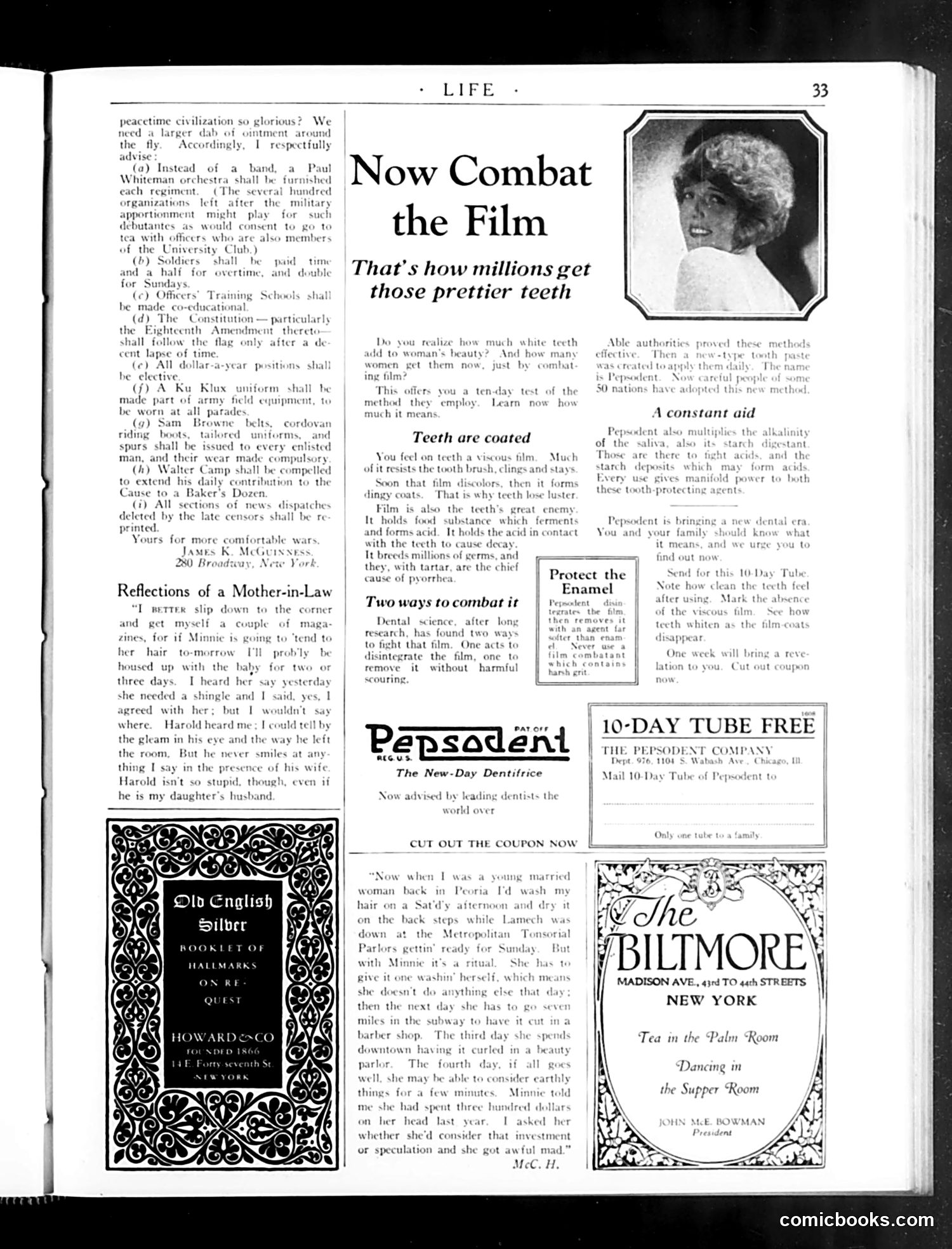
This page is primarily **advertising, not political satire**. The main feature is a Pepsodent toothpaste advertisement promoting a new dental hygiene method. **The "Combat" Concept:** The ad uses military language ("combat the film") to describe fighting plaque buildup on teeth. It explains that teeth develop a coating that resists brushing and harbors acid-producing germs causing decay and tartar. **The Sales Pitch:** Pepsodent claims two approaches: one to disintegrate film, one to remove it without "harmful scouring." The ad offers a free 10-day trial tube, reflecting early 20th-century marketing tactics. **Context:** This represents the emerging scientific marketing era where dental products adopted quasi-medical credibility ("Dental science...has found...") and featured "leading dentists" endorsements—a common persuasion technique of the 1920s era. The surrounding content includes unrelated social commentary and a mother-in-law anecdote, typical of *Life* magazine's miscellaneous layout.
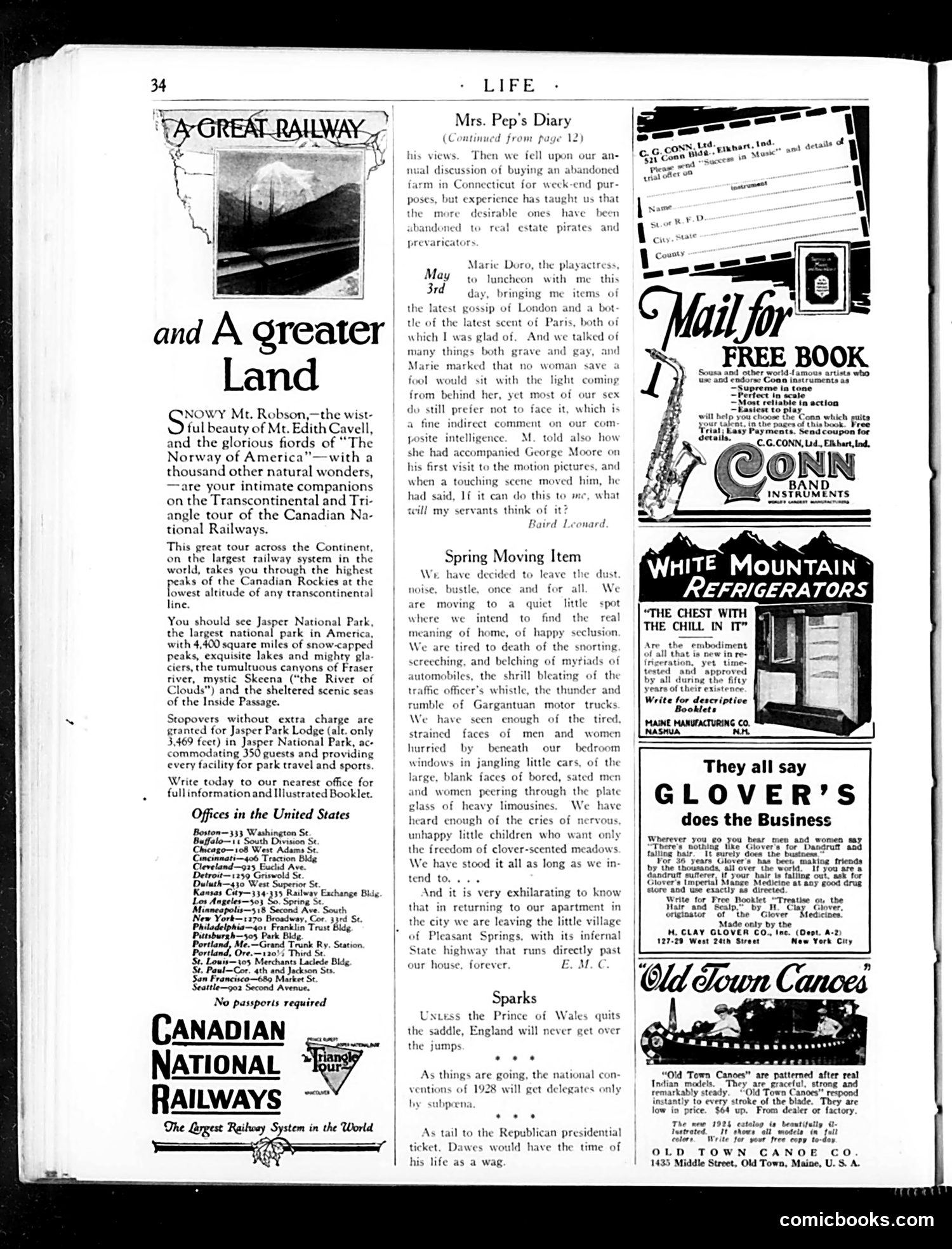
This page is primarily **advertising and lifestyle editorial** rather than political satire. The main content consists of: 1. **Canadian National Railways advertisement** (left side): A travelogue promoting transcontinental rail tours through Canadian Rockies, Jasper National Park, and scenic landscapes. It emphasizes natural beauty and tourist amenities, with office locations listed across U.S. cities. 2. **Mrs. Pep's Diary entries** (center): Gossip column snippets including lunch with actress Marie Doro discussing London gossip and Paris perfume, and a humorous account of moving from the city to "Pleasant Springs" to escape urban noise and congestion. 3. **Various product advertisements** (right side): Including "Mail for Free Book" (Conn Band Instruments), White Mountain Refrigerators, Glover's hair product, and Old Town Canoe Company. The diary entry's complaint about city noise—automobiles, traffic whistles, motor trucks—reflects 1920s urban congestion anxieties. There is **no political cartoon** on this page; it's a standard magazine layout mixing travel promotion, society gossip, and consumer goods advertising typical of the era.
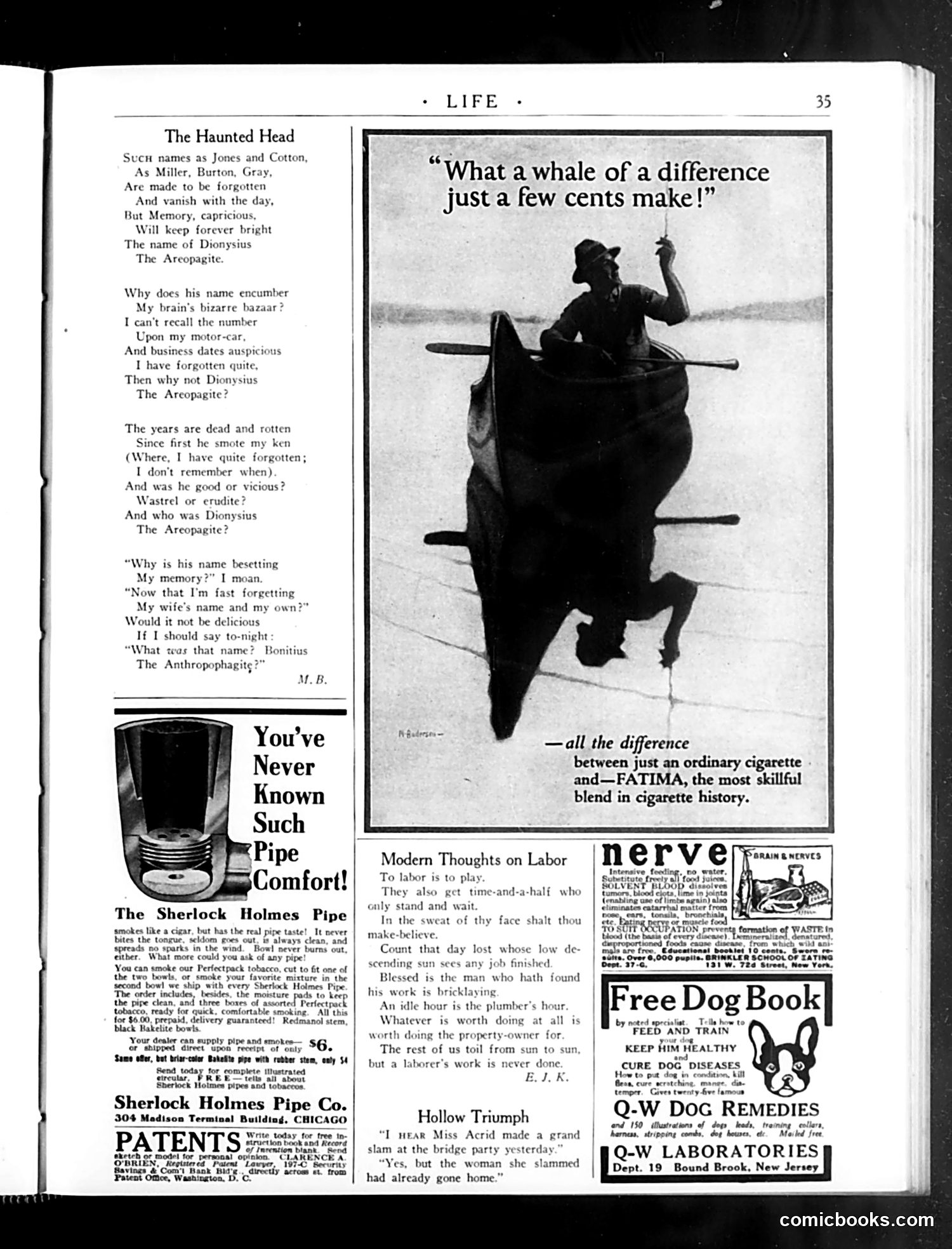
This page mixes poetry, advertisements, and humor typical of early 20th-century *Life* magazine. **"The Haunted Head"** is a humorous poem about the quirk of human memory—the author can't recall his car's license plate or business dates, yet the obscure name "Dionysius the Areopagite" (a biblical/historical figure) stubbornly lodges in his brain. The joke satirizes how memory works irrationally, keeping useless information while losing important details. He humorously worries he'll soon forget his *wife's name* too. **The advertisements** are period-typical promotions for Fatima cigarettes, Sherlock Holmes pipes, and dog remedies—unrelated to the editorial content. **"Hollow Triumph"** is a brief joke: Miss Acrid made a dramatic scene at a bridge party by slamming a door, but her target had already left—undercutting the drama with anticlimactic timing. The page reflects *Life's* satirical focus on the absurdities of everyday life and human nature.
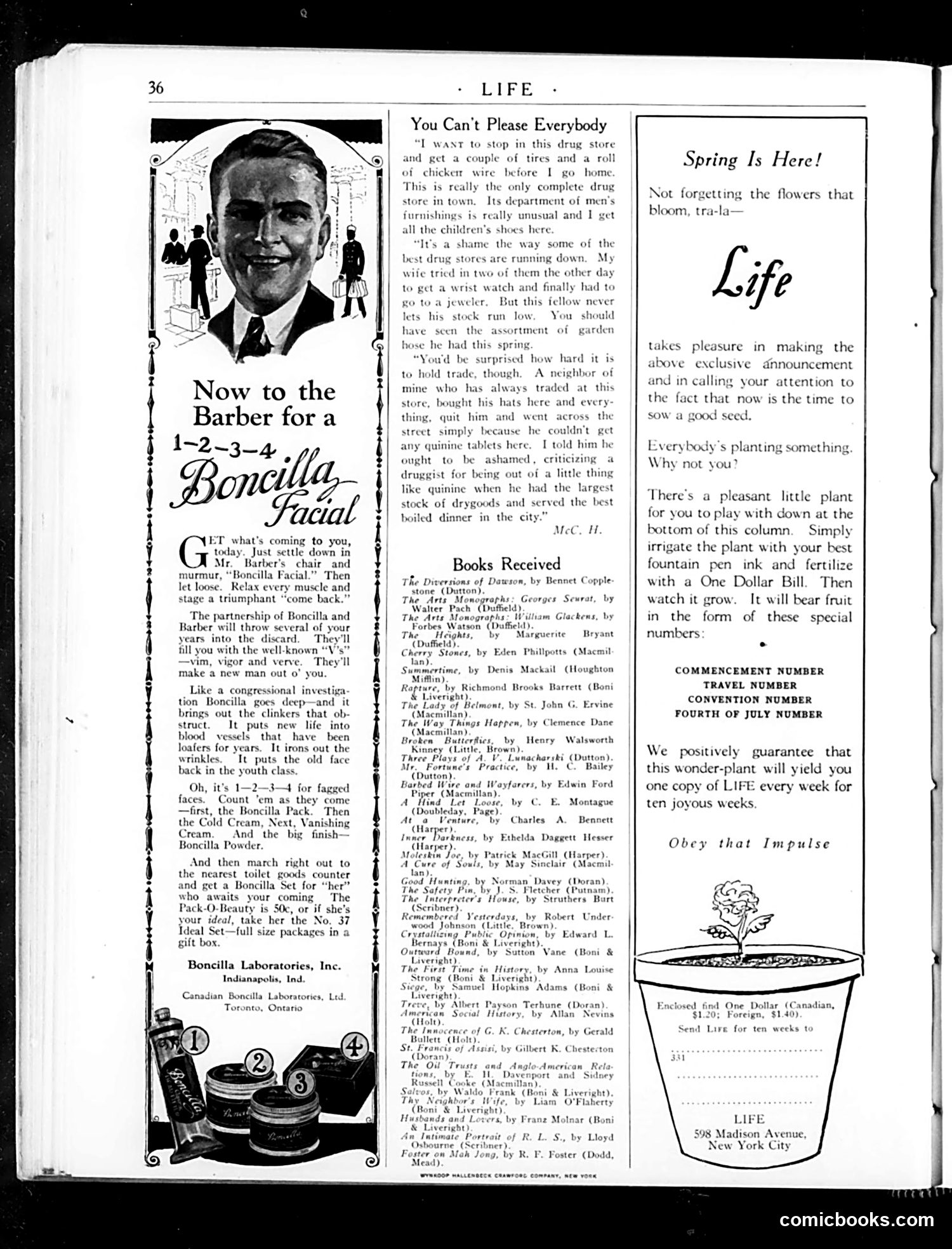
This page contains **advertising and satirical commentary**, not political cartoons. The main content is a **Boncilla beauty product advertisement** (left side) using the common 1920s marketing trope of promising youth restoration through cosmetic treatments. The numbered steps (1-2-3-4) mock the era's obsession with quick-fix beauty routines. The satirical piece "**You Can't Please Everybody**" (center) mocks small-town druggists who've expanded into general stores—selling tires, chicken wire, furnishings, shoes, and food alongside actual medicine. The complaint about lacking quinine tablets while serving "the best boiled dinner in the city" absurdly illustrates how these stores lost focus. It's satire on commercial overexpansion and specialty dilution. The right side announces spring planting and advertises Life's subscription offer via an illustrated plant. The **"Books Received"** section simply lists contemporary 1920s literary publications—a standard magazine feature, not satirical content.
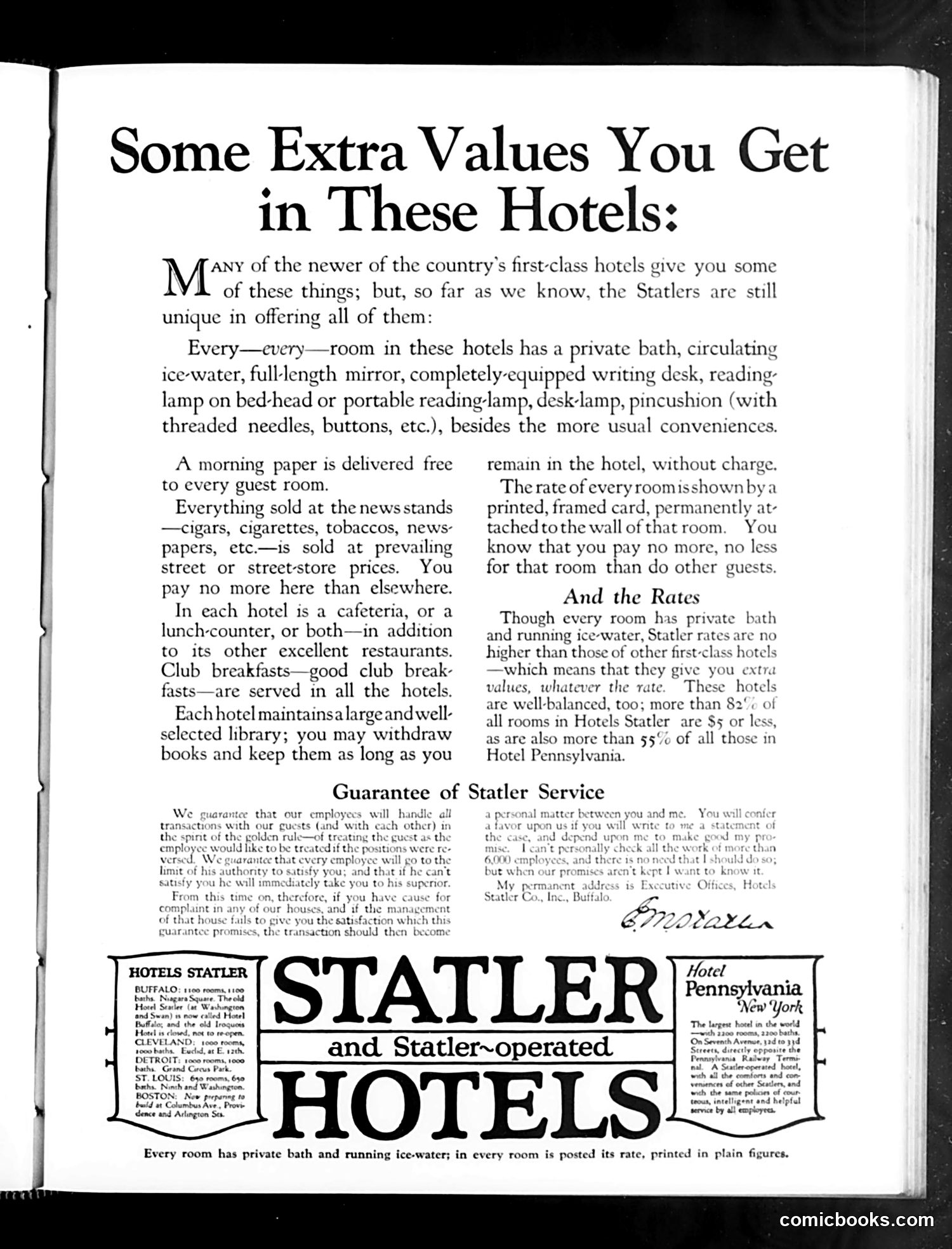
This is a **hotel advertisement** for Statler Hotels, not a political cartoon or satire. It's a straightforward commercial promoting the Statler chain's amenities and pricing. The page emphasizes what made Statler Hotels distinctive for the era: every room guaranteed private bath, running ice-water, full-length mirror, desk, reading lamps, and other conveniences—luxuries not universal in hotels at the time. The ad stresses transparency (posted room rates), competitive pricing (news stand items at street prices), and service guarantees. The signature at bottom appears to be from the Statler company leadership, adding authority to the "Guarantee of Statler Service" section, which promises courteous employee treatment. For modern readers, this reflects an early 20th-century hospitality standard where private bathrooms in every room were still novel enough to advertise as major selling points—now basic expectations in hotels.
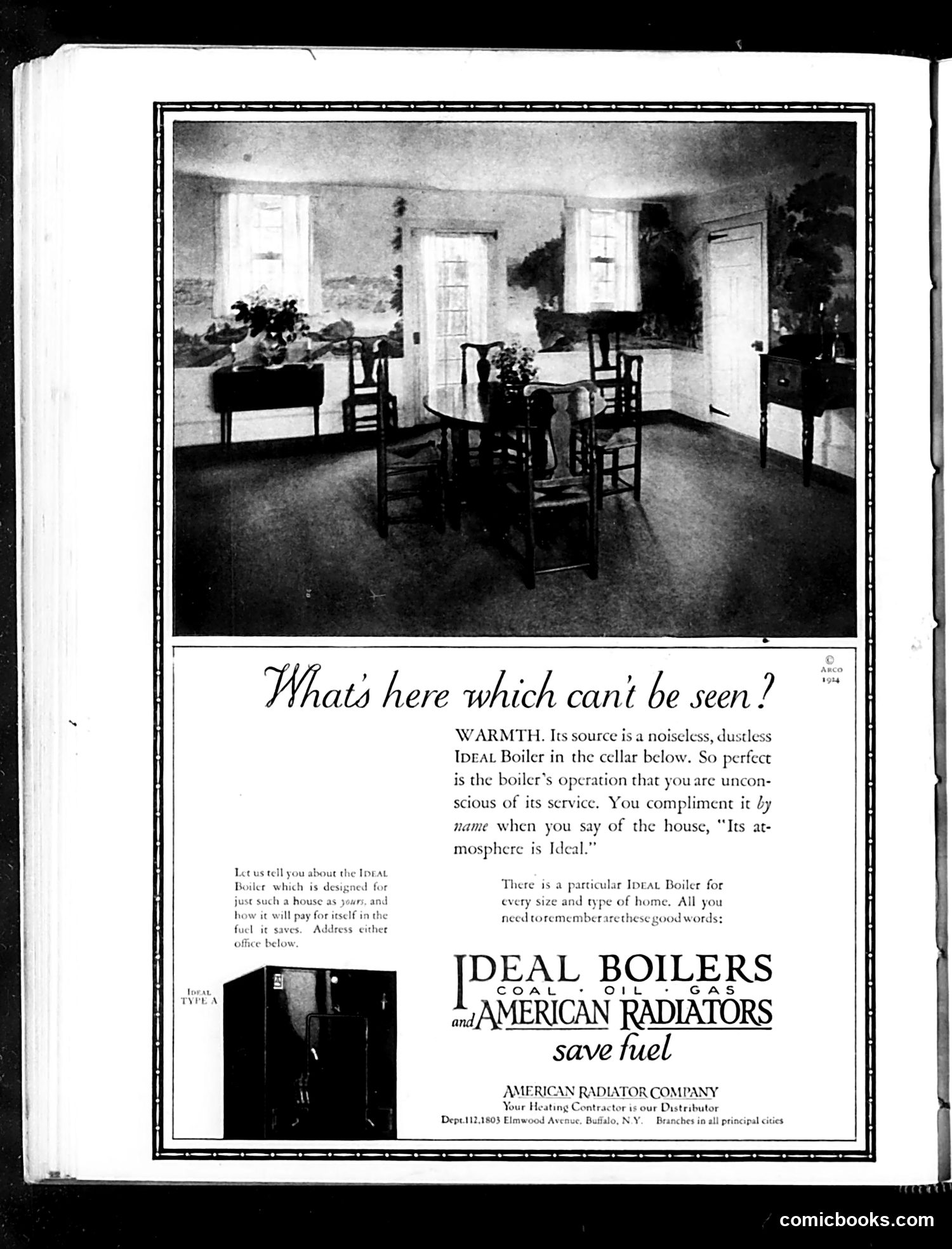
This is **not a cartoon or satire**, but rather a **straightforward advertisement** for Ideal Boilers and American Radiators heating systems. The page shows a photograph of an elegant, well-appointed living room with multiple doorways and furnishings. The advertisement's rhetorical question—"What's here which can't be seen?"—refers to the **central heating system itself**: an Ideal Boiler in the cellar below. The advertising pitch emphasizes the boiler's invisibility and silence as selling points. Because the heating system operates "noiseless" and "dustless" in the basement, homeowners enjoy warmth without being aware of the mechanism producing it. The ad suggests this seamless comfort is so complete that people praise the house's "atmosphere" without realizing they're actually complimenting the hidden boiler. This is a period advertisement targeting middle-to-upper-class homeowners, promoting modern convenience and the desirability of mechanical systems that work invisibly in the background.