
Life, 1924-05-08 · page 24 of 42
Life — May 8, 1924 — page 24: what you’re looking at
What you’re looking at
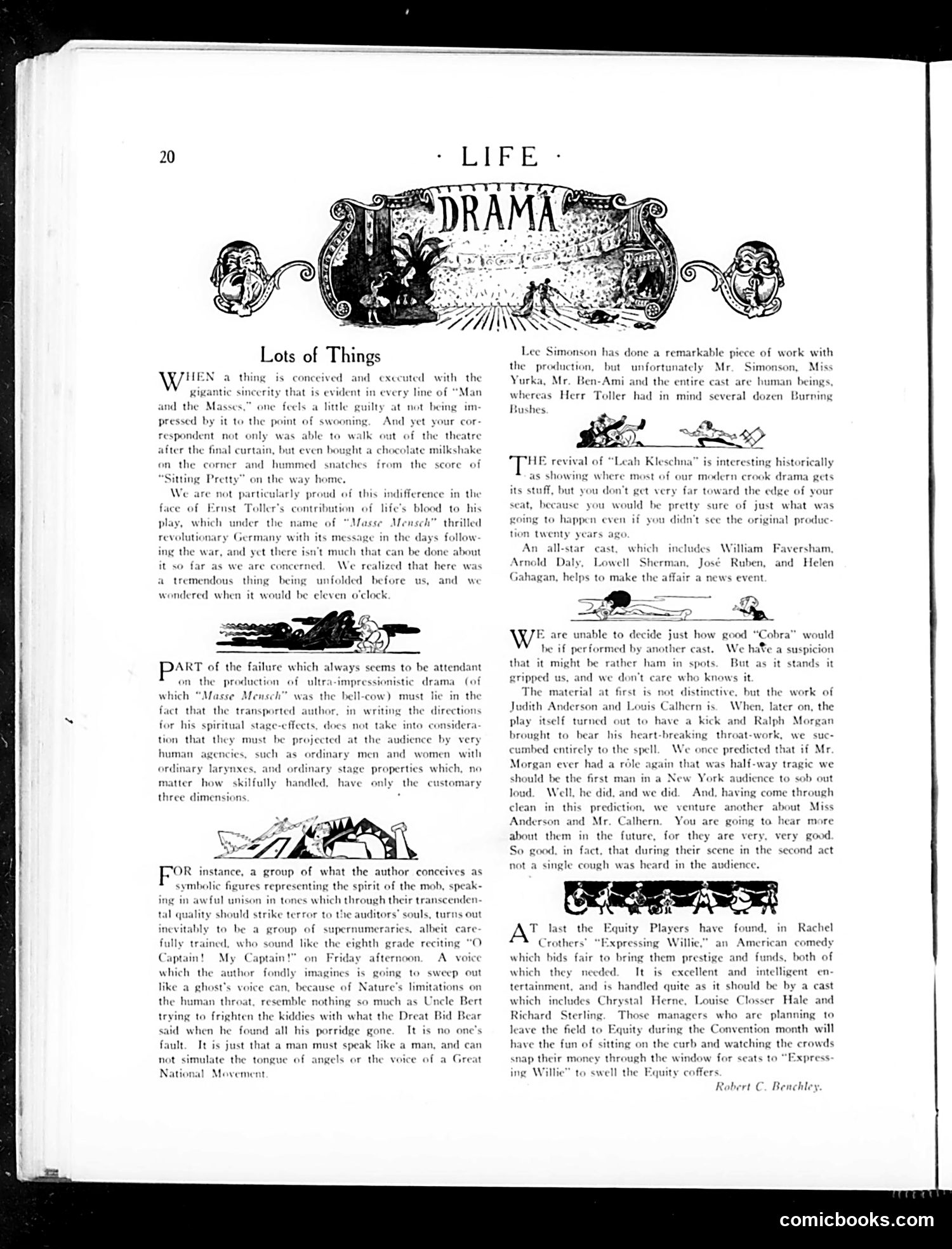
This page contains theater reviews by Robert Benchley, a prominent American humorist and critic. The main critiques address two productions: **"Masse-Mensch"** (or "Man and the Masses"): Benchley reviews Ernst Toller's expressionist play about revolutionary Germany. He argues the work is intellectually ambitious but dramatically fails because ordinary actors cannot convincingly perform the author's symbolic, grandiose vision. His complaint: when actors attempt to represent "the spirit of the mob" speaking in unison as terrifying angels, they sound instead like "Uncle Bert trying to frighten the kiddies"—mundane and ridiculous. The satire targets the gap between ambitious artistic intention and practical theatrical reality. **"Leah Kleschna"**: A revival of a twenty-year-old crime drama featuring an all-star cast (William Faversham, Arnold Daly, others). Benchley praises performances by Judith Anderson and Louis Calhern but finds the material itself predictable. The humor lies in Benchley's deflating commentary on theatrical pretension—high-minded drama undermined by human limitations.
📄 Transcribed text from this page (OCR, searchable)
Machine-transcribed from the original scan — historical spelling and the odd misread are preserved.
Lots of Things WIEN a thing is Rigantic sincerity that is evident mnceived and executed with the very line of “Man the Masses,” one feels a little guilty at not being im: pressed by it to the point of swooning respondent not only was able to walk out of the theatre after the final curtain, bi chocolate milkshake And yet your cor even bought n the corner and hummed snatches from the score of iting Pretty” on the way home. We are not particularly proud of this indifference in the face of Ernst Toller’s contribution of life's blood to his Mensch” thrilled in the days follow play, which under the name of “Masse revolutionary Germany with its messag ing the war, and yet there isn't much t it so far as we are concerned. We realized that here was can be done about tremendous thing bei unfolded before us, and we wondered when it would be eleven o'clock am Part of the failure which always seems to be attendant 1 the produc imp: mistic drama (of which “Masse A ow) must lie in the fact that the transported in writing the directions his spiritual stage-effects, does not take into considera tion that they must be projected at the audience by very human agencies, such as ordinary men and women with ordinary larynxes, and ordinary stage properties which, no matter how. skilfully handled, have only the customary three dimensions YR instance, a group of what the author conceives as symbolic figures representing the spirit of the mob, speak- ing in awful unison in t tal qu es which through their transcenden y should strike terror to the auditors’ souls, turns out inevitably to be a group of supernumeraries, albeit. car¢ fully trained, who sound like the eighth grade reciting "O Captain!) My Captain!” on Friday afternoon. A voice which the author fondly imagines is going to sweep out like a ghost’s voice can, because of Nature's limitations on the human throat, resemble nothing so much as Uncle Bert trying to frighten the kiddies with what the Dreat Bid Bear said when he found all his porridge gone, It is no one’s fault. It is just that a man must speak like a man, and can not simulate the tongue of angels or the voice ¢ National Movement a Great Lee Simonson has d rkable piece of work with the production, but unfortunately Mr. Simonson, Miss Yurka, Mr whereas Herr en-Ami and the entire cast are human beings, Toller had in mind several dozen Burning 4 3B Pai ue Bushes. HE revival of * Kleschna”™ is interesting historically as showing where tof our modern crook drama gets its stuff, but you don't get very far toward the edge of your seat, because you would be pretty sure of just what was ng to happen even if you didn’t see the original produc- twenty years a William) Faversham Ruben, and Helen An all-star cast, whic nold Daly, Lowell agan, helps to make the would ¢ a suspicion ham ins But as it stands it » are un: a” be if per hat that it might be rather gripped us, and we don't care who knows it The material at first is not distinctive. but the work of Judith Anderson and 1 Calhern is. When, later on, the play itself turned out to have a kick and Ralph \ brought to bear his heart-breaking throat-work, we suc- We once predicted that if Mr Morgan ever had a role again that was half-way tragic we cumbed entirely to the spell should be the first man in a New York audience to sob out low Well, he did, and we did. And, having come through clean in this prediction, we venture another about Miss Anderson and Mr. Calhern. You are going to hear more about them in. the ec, for they are very, very good. So good, in fact, that during their scene in the second act nugh was heard in the audience. em AQT last the Equity Players have found, in Rachel Willie,” an American comedy not a sin Crothers’ “Expres: which bids fair to bring them prestige and funds, both of which they needed. It is excellent and intelligent en- tertainment, and is handled quite as it should be by a cast which includes Chrystal Herne, Louise Closser Hale and Richard Sterling. Those managers who are planning to leave the field to Equity during the Convention month will the curb an h the window for seats to “Express have the fun of sitting watching the crowds snap their money th ing Willie” to swell the Equity coffers Robert ( hley comicbooks.com