
Life, 1924-05-08 · page 30 of 42
Life — May 8, 1924 — page 30: what you’re looking at
What you’re looking at
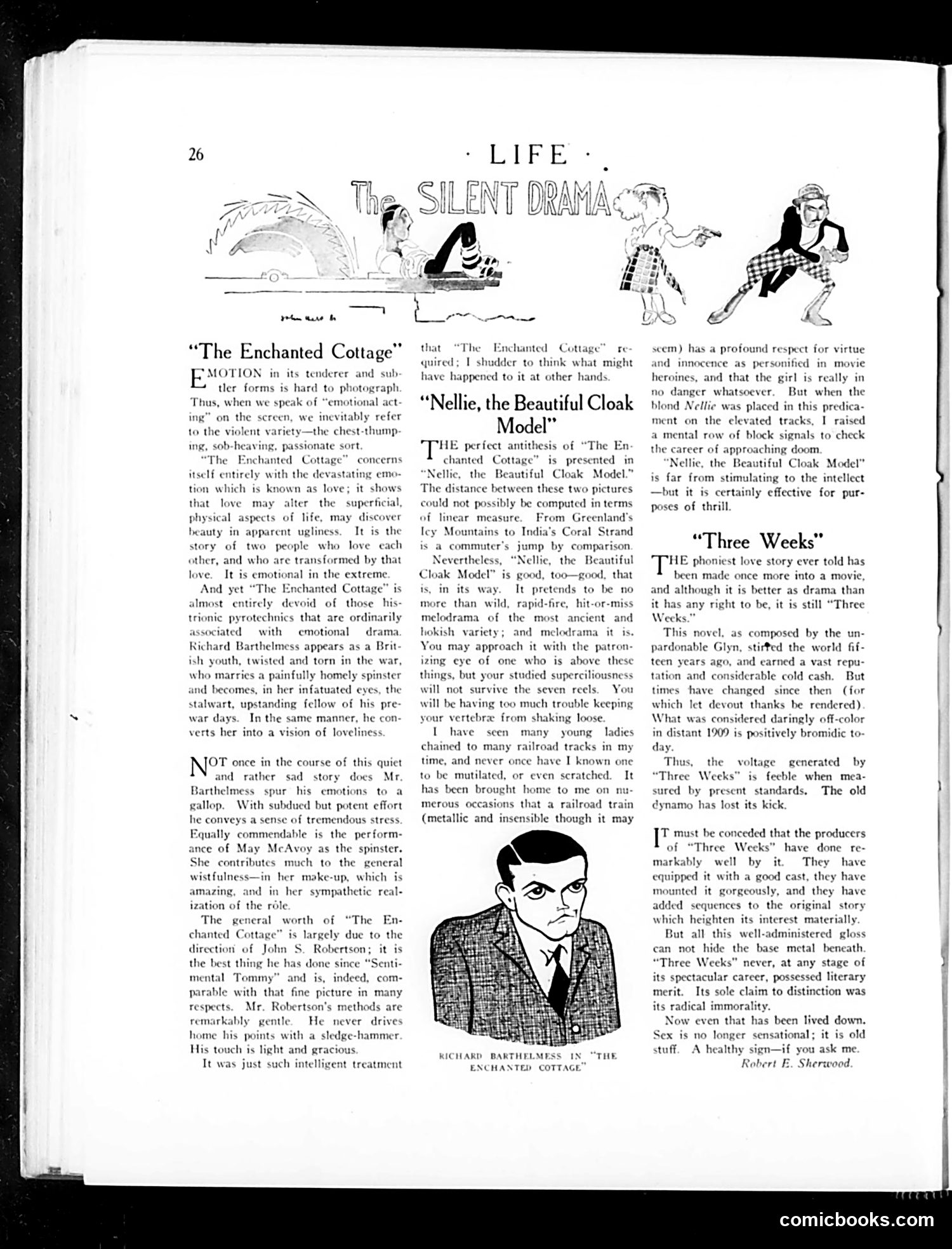
This page reviews three silent films, comparing their artistic merit. The main cartoon depicts **Richard Barthelmess** in "The Enchanted Cottage," portrayed as a serious, brooding figure—reflecting the film's restrained, emotionally subtle approach to storytelling. The reviewer contrasts this film favorably with "Nellie, the Beautiful Cloak Model," a melodramatic potboiler relying on sensational stunts (like heroines chained to railroad tracks). The satire suggests that while both are "emotional" cinema, one achieves depth through restraint and intelligent direction (John S. Robertson's), while the other cynically manufactures cheap thrills for audiences. The third film, "Three Weeks," is dismissed as "the phoniest love story ever told"—apparently already remade multiple times, suggesting Hollywood's tendency toward recycling tired material for profit rather than artistic merit. The page critiques how 1920s studios exploited romance and melodrama.
📄 Transcribed text from this page (OCR, searchable)
Machine-transcribed from the original scan — historical spelling and the odd misread are preserved.
“The Enchanted Cottage” *MOTION in its tenderer and sub. tler forms is hard to photograph t on the screen, we inevitably refer Thus, when we speak of “emotional a ir to the violent variety—the chest-thump: ing, sob-heaving, passionate sort “The Enchanted Cot itself entirely with the dev tion which is known as love; it shows e” concerns stating emo- that love may alter the superficial, physical aspects of life, may discover beauty in apparent ugliness. It is the ry of two people who love each other, and who are transformed by that love. It is emotic in the extreme. And yet “The Eni almost entirely devoid of those his- trionic pyrotechnics that are ordinarily associated with cmotional drama hanted Cottage” is ard Barthelmess appears as a Brit h youth, twisted and torn in the war, who marries a painfully homely spinster and becomes, in her infatuated eyes, the stalwart, upstanding fellow of his pre- war days. In the same manner, he con- verts her into a vision of loveliness. ‘OT once in the course of this quiet and rather sad story does Mr Barthelmess spur his emotions to a gallop. With subdued but potent effort he conveys a sense of tremendous stress Equally commendable is the perform- ance of May McAvoy as the spinster. She contributes much to the general wistfulness—in her make-up, which is amazing, J in her sympatheti ization of the role. The general worth of “The E chanted Cottage” is largely due to the direction of John S. Robertson; it is the best thing he has done since enti- mental mmy” and is, indeed, com- parable with that fine picture in many respects. Mr. Robertson's methods are le. He never drives remarkably g home his points with a sledge-hammer, His touch is light and gra It was just such intelligent treatment that “The Enchanted Cottage" re quired; | shudder to think what might have happened to it at other hands. “Nellie, the Beautiful Cloak Model” HE. perfect antitl chanted Cottage” is presented in “Nellic, the Beautiful Cloak Model.” The distance between these two pictures could not possibly be computed in terms linear measure. From Greenland’s Icy Mountains to India’s Coral Strand is a commuter’s jump by comparison Nevertheless, ‘ellie, the Beautiful Cloak Model” is good, —good, that is, in its way. It pretends to be no more than wild, rapid-fire, hit-or-miss melodrama of the most ancient and hokish variety; and melodrama it is. You may approach it with the pat izing eye of one who is above these esis of “The in things, but your studied superciliousness will not survive the seven reels. You will be having too much trouble keeping your vertebra from shaking loose. I have seen many young ladies chained to many railroad tracks in my time, and never once have I known one to be mutilated, or even scratched. It has been brought home to me on merous occasions that a railroad train (metallic and insensible though it may KICHARD BARTHELMESS IN. “THE ENCHANTED COTTAGE scem) has a profound respect for virtue and innocence as personified in movie heroines, and that the girl is really in no danger whatsoever. But when the blond Nellie was placed in this predic ment on the elevated tracks, I raised a mental row of block signals to check the c reer of approaching doom Hie, the Beautiful Cloak Model” is far from stimulating to the intellect —but it is certainly effective for pur- poses of thrill “Three Weeks” I HE phoniest love story ever told has been made once more into a movie, and although it is better as drama than it has any right to be, it is still “Three Weeks.” This novel, as composed by the un- pardonable Glyn, stirfed the world fif- teen years ago, and earned a vast repu- tation and considerable cold cash. But times have changed since then (for which let devout thanks be rendered) What was considered daringly off-color in distant 1909 is positively bromidic to- day Thus, the voltage generated by “Three Weeks” is feeble when mea sured by present standards. The old dynamo has lost its kick. T must be conceded that the producers of “Three Weeks” have done re- markably well by it. They have sipped it with a good cast, they have c mounted it gorgeously, and they have added sequences to the original story which heighten its interest materially. But all this well-administered gloss can not hide the base metal beneath. ‘Three Weeks” never, at any stage of its spectacular career, possessed literary merit. Its sole claim to distinction was its radical immorality. Now even that has been lived down. Sex is no longer sensational; it is old stuff. A healthy sign—if you ask me Robert E. Sherwood. comicbooks.com