
A complete issue · 40 pages · 1924
Life — March 13, 1924
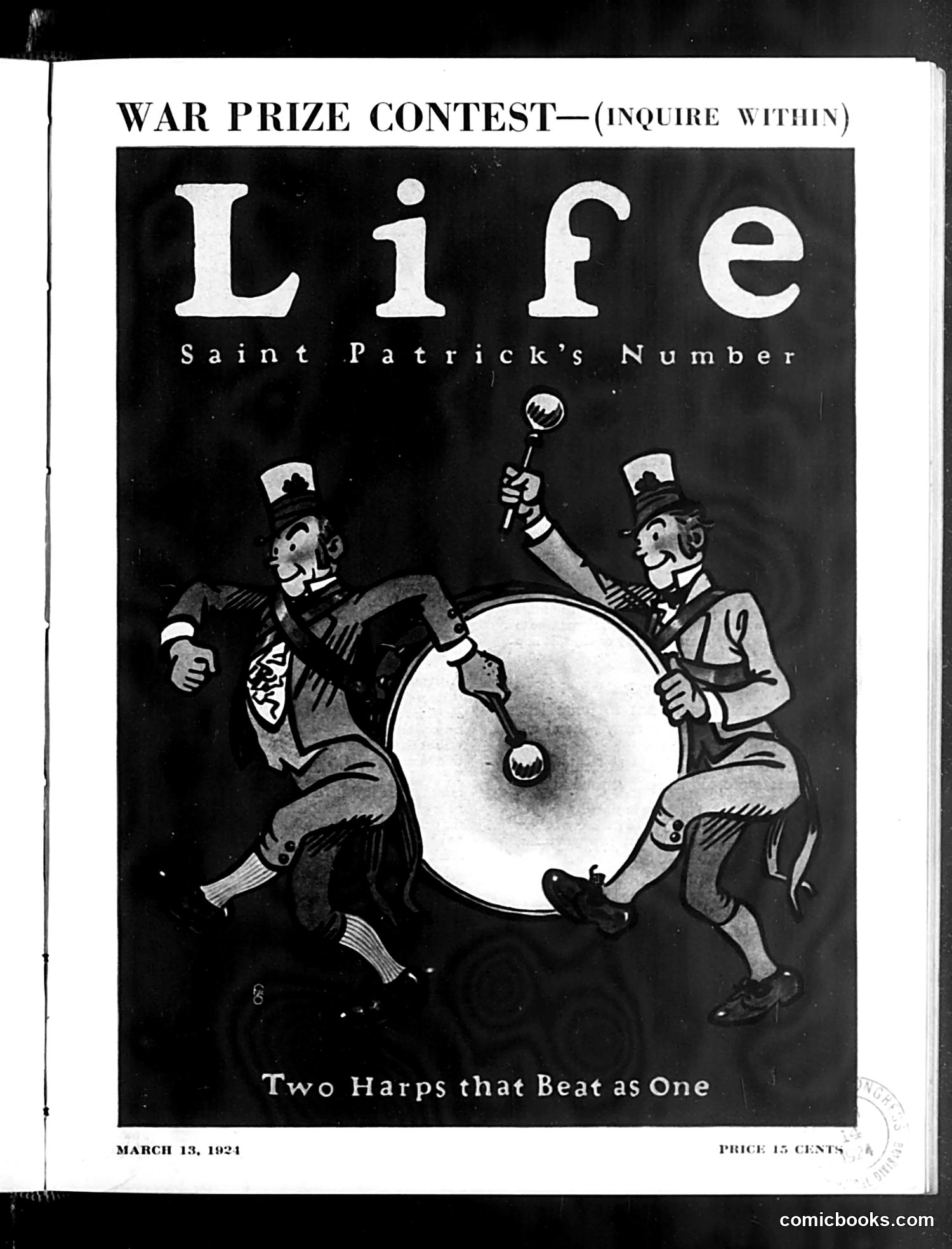
This is a cover for Life magazine's "War Prize Contest," featuring two caricatured figures in top hats and formal dress playing an enormous drum marked "19." They're depicted as leprechauns or Irish characters, given the shamrock imagery and "Saint Patrick's Number" subtitle. The tagline "Two Harps that Beat as One" is a pun referencing Ireland's harp symbol. The contest likely references contemporary Irish political turmoil—possibly the Irish Civil War (1922-23) or ongoing independence negotiations. The figures appear to represent competing Irish political factions or leaders, satirizing their conflict as a comedic performance rather than serious politics. The "war prize" framing suggests readers could guess the outcome of Irish political disputes for a prize.
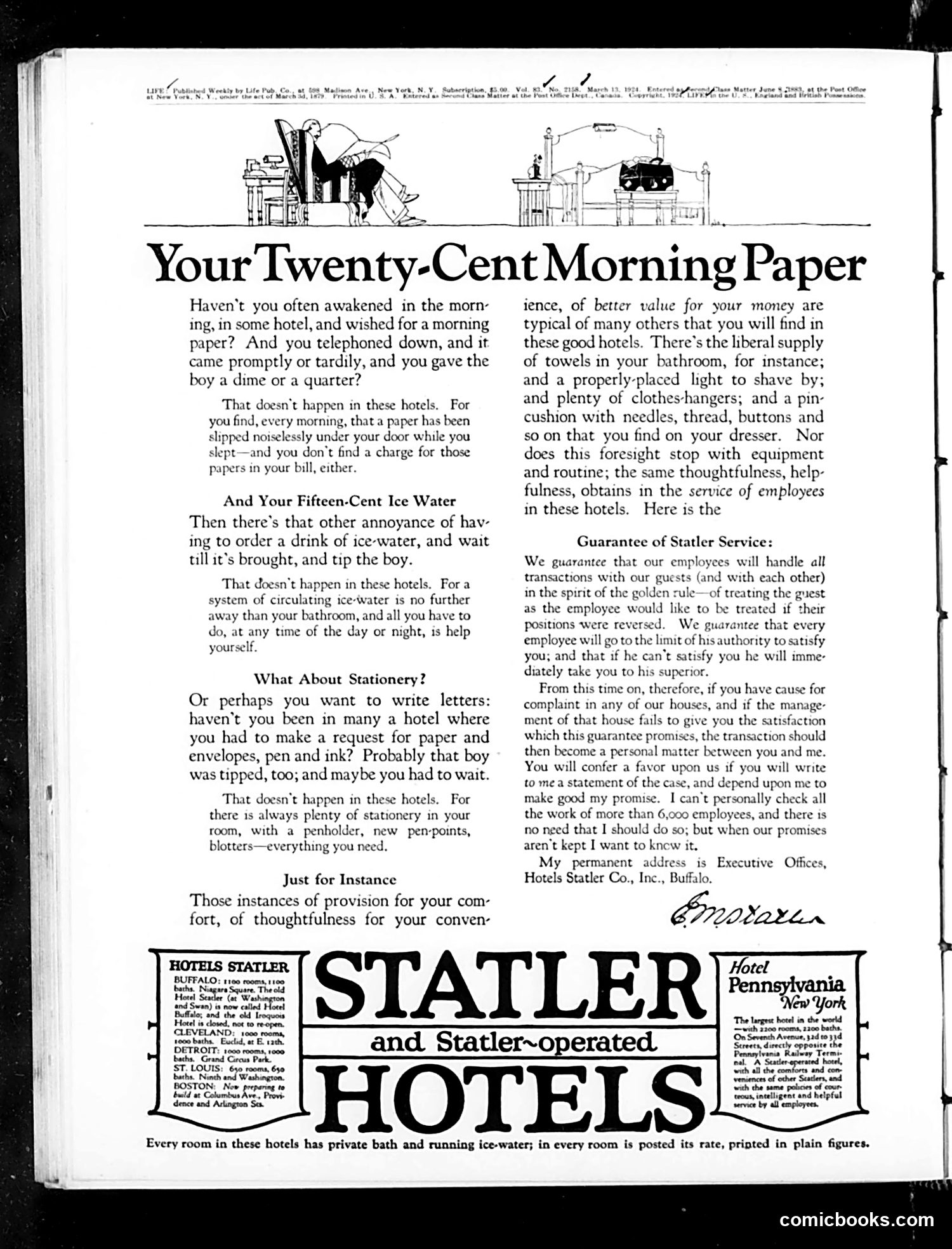
This page is primarily **advertising for Statler Hotels**, not satire. The headline "Your Twenty-Cent Morning Paper" introduces the hotel chain's value proposition by contrasting guest complaints about cheap hotels with Statler's superior service. The small cartoon vignettes at the top illustrate common hotel annoyances: delayed newspapers, waiting for ice water, and lacking stationery. These depict the petty frustrations guests faced at budget accommodations of the era. The advertisement promises modern conveniences—complimentary newspapers, efficient water service, and room stationery—positioning Statler as an upscale alternative. The signed "Guarantee of Statler Service" emphasizes employee training and guest satisfaction, a novel marketing approach for early 20th-century hospitality. This is straightforward advertising rather than political commentary, targeting middle-class travelers seeking quality accommodations.
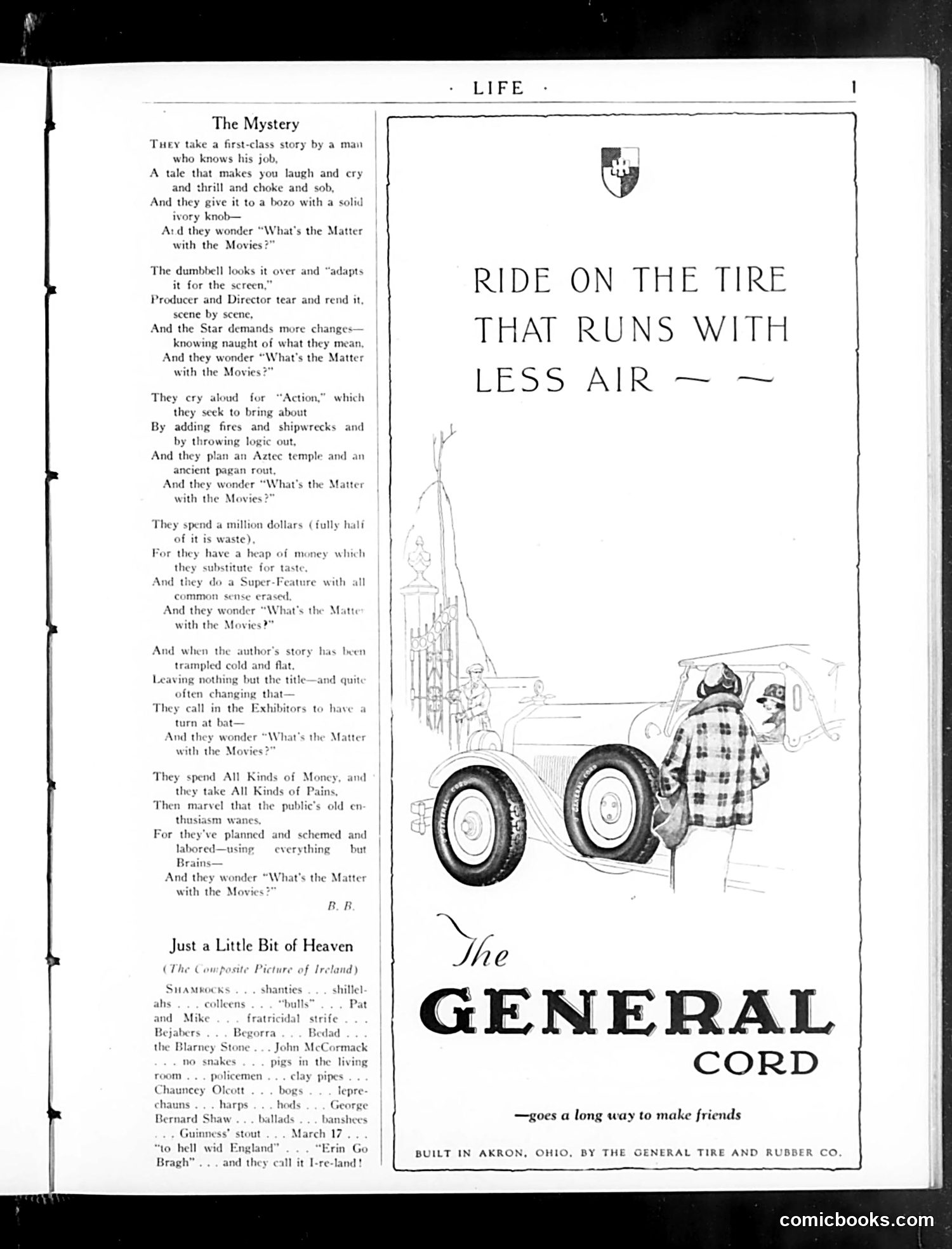
This page contains two distinct elements: **Left side:** A poem titled "The Mystery" by B.R. satirizing early Hollywood filmmaking. It mocks how screenwriters and producers create expensive, elaborate pictures with minimal artistic merit—spending "a million dollars" on spectacle while abandoning logic and good taste. The repeated refrain "What's the Matter with the Movies?" reflects contemporary criticism of the film industry's perceived commercialism and creative bankruptcy during the silent era. **Right side:** A General Cord tire advertisement featuring an illustration of a woman with a deflated tire alongside the headline "Ride on the Tire That Runs with Less Air." The ad emphasizes durability and practicality—appealing to motorists concerned about tire reliability. The juxtaposition is purely coincidental product placement rather than intentional satire.
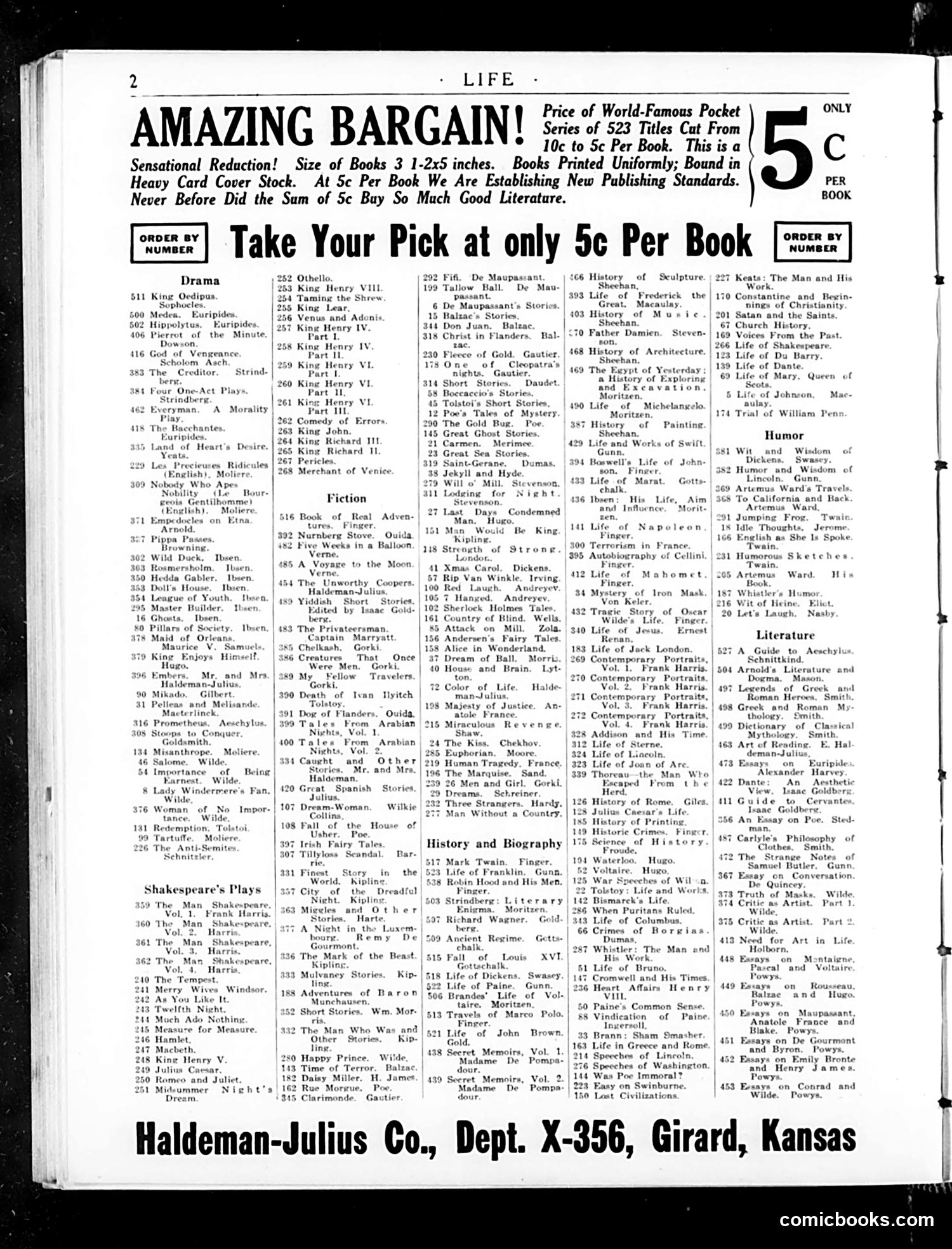
This page is **almost entirely advertising**, not editorial content or cartoons. It consists of a catalog listing for a book bargain offer from Haldeman-Julius Co. of Girard, Kansas. The header announces "Amazing Bargain!" promoting their "World-Famous Pocket Series of 523 Titles" at five cents per book. The bulk of the page is an itemized list organized by category—Drama, Fiction, Shakespeare's Plays, History and Biography, Humor, and Literature—with numbered entries allowing customers to "Order by Number." There are **no political cartoons or satirical illustrations** visible. This is a commercial mail-order catalog page, typical of early 20th-century magazine advertising, designed to drive impulse purchases of inexpensive reprinted classic texts and popular literature.
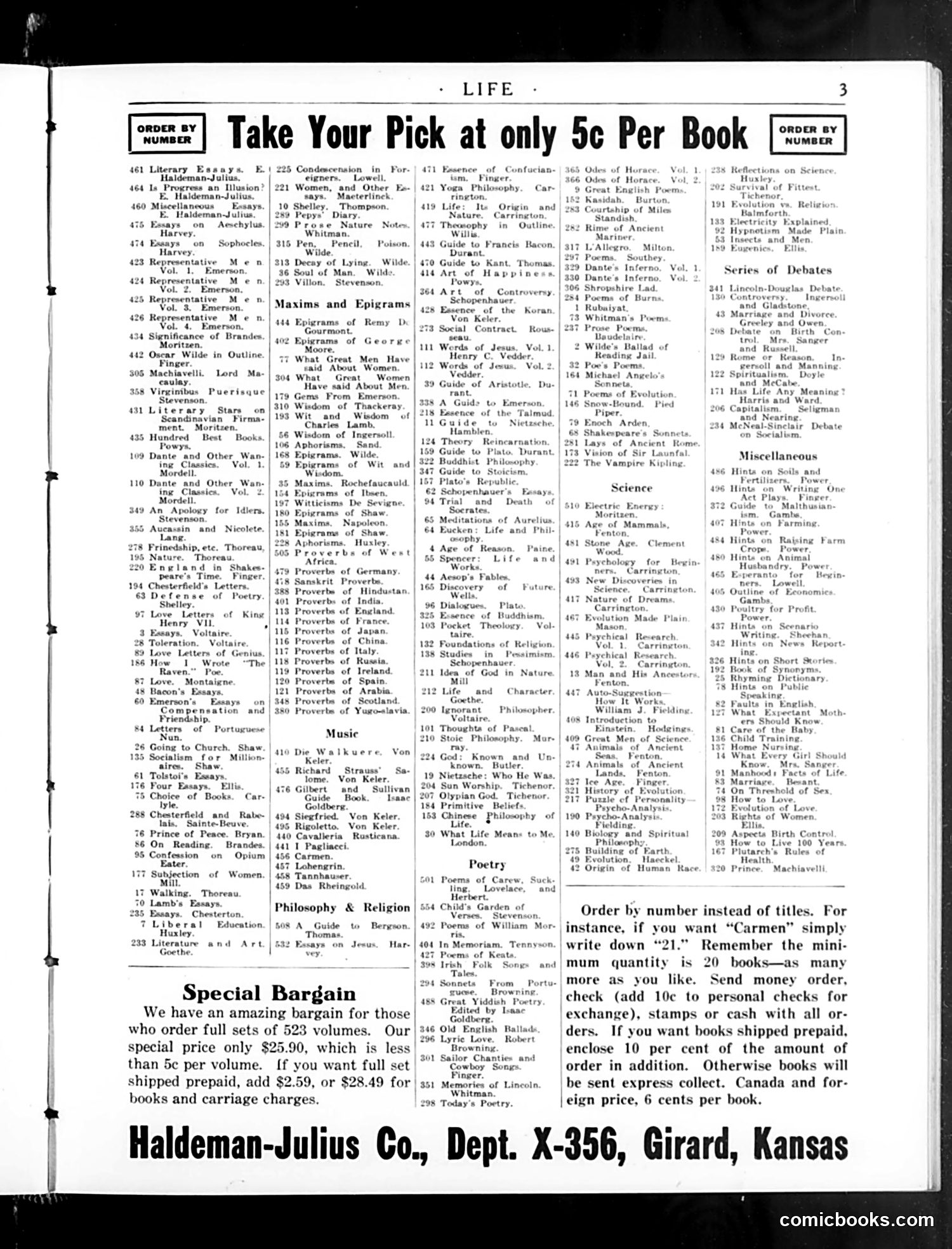
This page is primarily **advertising**, not editorial content. It consists almost entirely of a book catalog listing hundreds of titles available through Haldeman-Julius Co. for 5 cents each, organized by category (Literature, Philosophy & Religion, Science, Poetry, Music, etc.). The only non-catalog element is a "Special Bargain" notice promoting a 625-volume set for $25.90 (under 5 cents per book). There are **no political cartoons or satirical illustrations** visible on this page. The content reflects early 20th-century mass-market publishing, emphasizing affordable access to classic literature and educational material—a significant democratization of reading at the time.
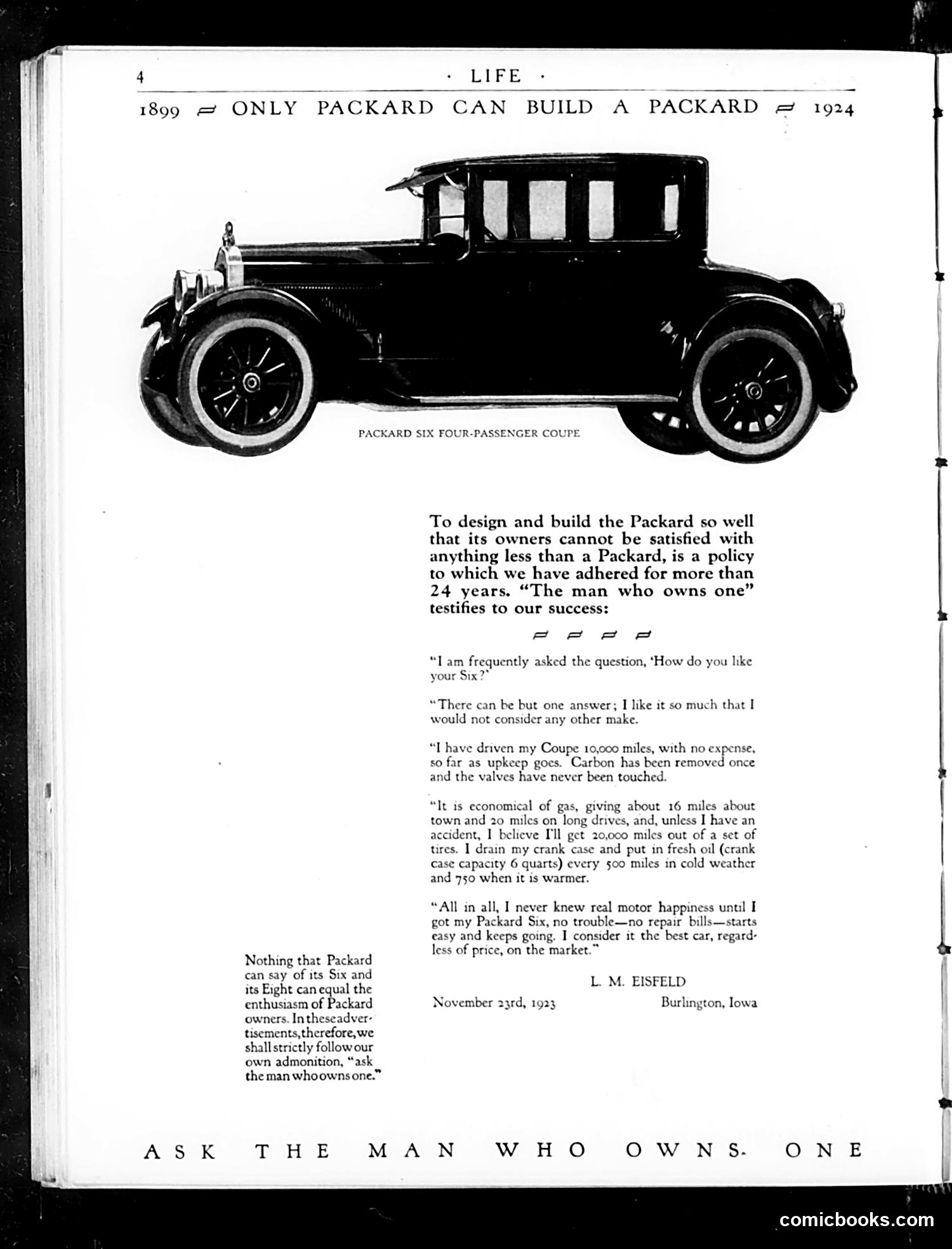
This page is primarily **advertising, not satire or political commentary**. It's a 1924 Packard automobile advertisement from Life magazine. The content features a testimonial from L.M. Eisfeld of Burlington, Iowa, praising his Packard Six coupe. He describes its reliability, fuel efficiency (16-20 mpg), and low maintenance costs over 10,000 miles of driving. The advertisement emphasizes Packard's luxury brand positioning through the slogan "Only Packard can build a Packard" and uses the customer testimonial strategy ("ask the man who owns one") to establish credibility. The illustration shows a sleek, closed-cabin automobile—a relatively new feature for the era. There is no political satire or social commentary present; this is straightforward product advertising targeting affluent consumers.
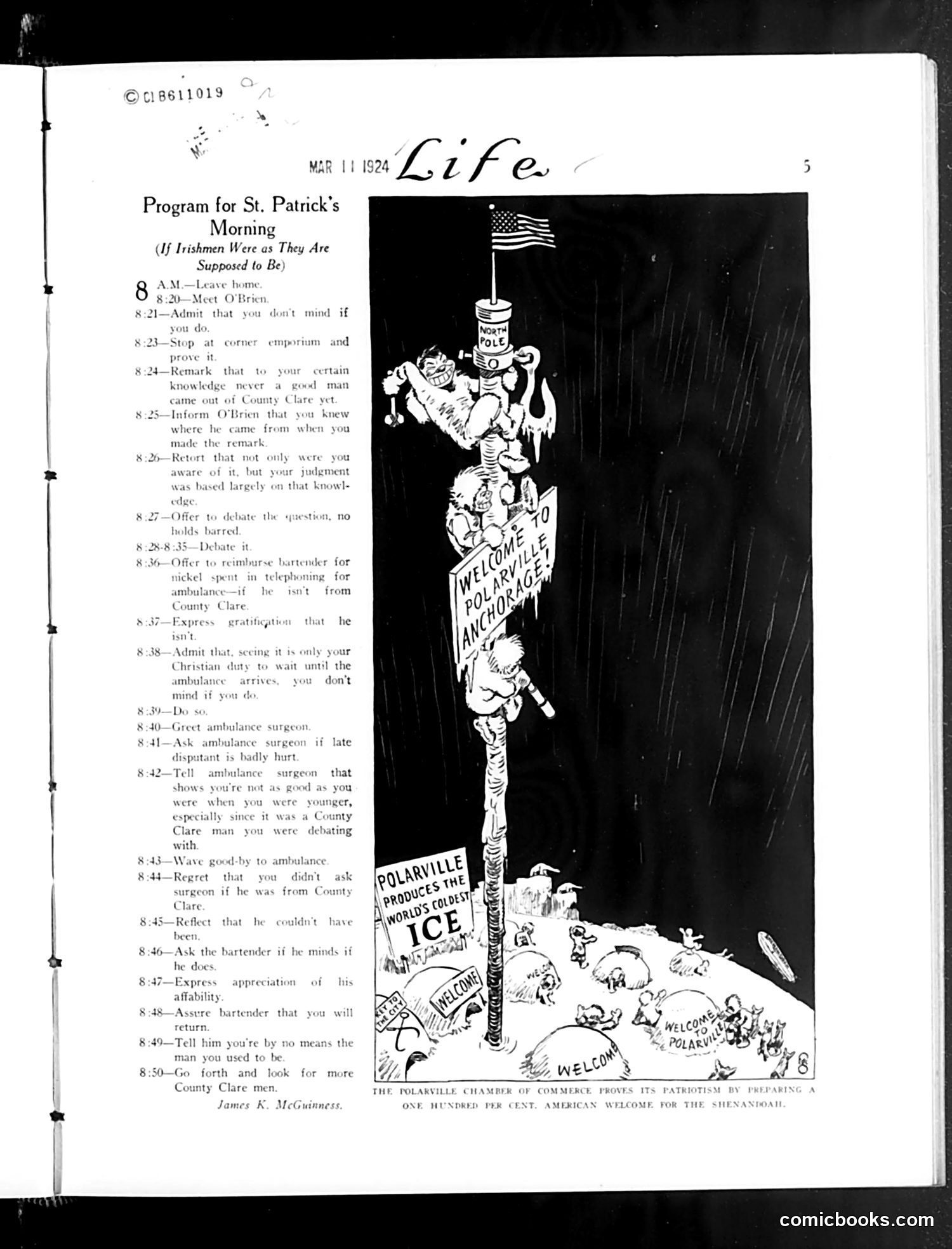
This cartoon satirizes the Shenandoah airship disaster through Irish-American civic pride. The image depicts the Polarville Chamber of Commerce erecting a welcoming monument to the USS Shenandoah, a military dirigible that crashed in 1924, killing 14 crew members. The satire appears to mock how a small town (Polarville, likely fictional) opportunistically capitalizes on a tragedy by celebrating a "100 percent American welcome." The grotesque tower of stacked Irish leprechauns and patriotic symbols suggests absurdity—turning a military disaster into civic boosterism. The left page contains a comedic "Program for St. Patrick's Morning" detailing petty social interactions, emphasizing Irish-American stereotypes and neighborhood dynamics. Together, the content satirizes both ethnic identity politics and small-town opportunism.
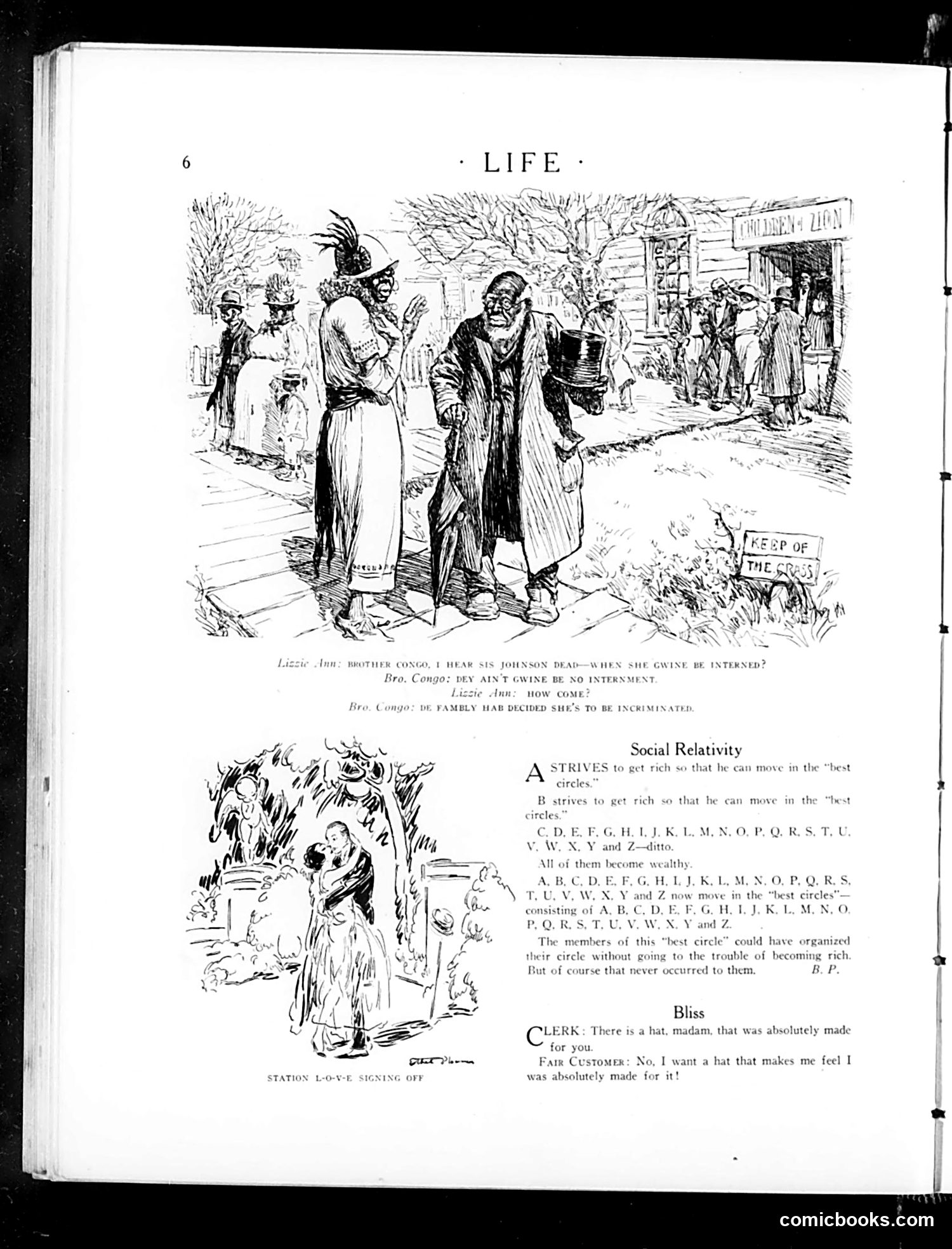
**Top Cartoon:** Shows a street scene where two figures discuss a funeral. "Lizzie Ann" asks "Brother Congo" about Sir Johnson's burial; Brother Congo replies it won't be "interred" but "incinerated." This appears to mock racial dialect humor common in early 20th-century American satire, using caricatured Black characters as comedic figures. **Middle Section - "Social Relativity":** A satirical piece about wealth and social climbing. It uses alphabet letters (A through Z) to illustrate how acquiring money allows people to move into "best circles," ultimately rendering the concept meaningless when everyone becomes wealthy simultaneously. **Bottom - "Bliss":** A brief comic dialogue between a clerk and fair customer about a hat, playing on the phrase "made for you."
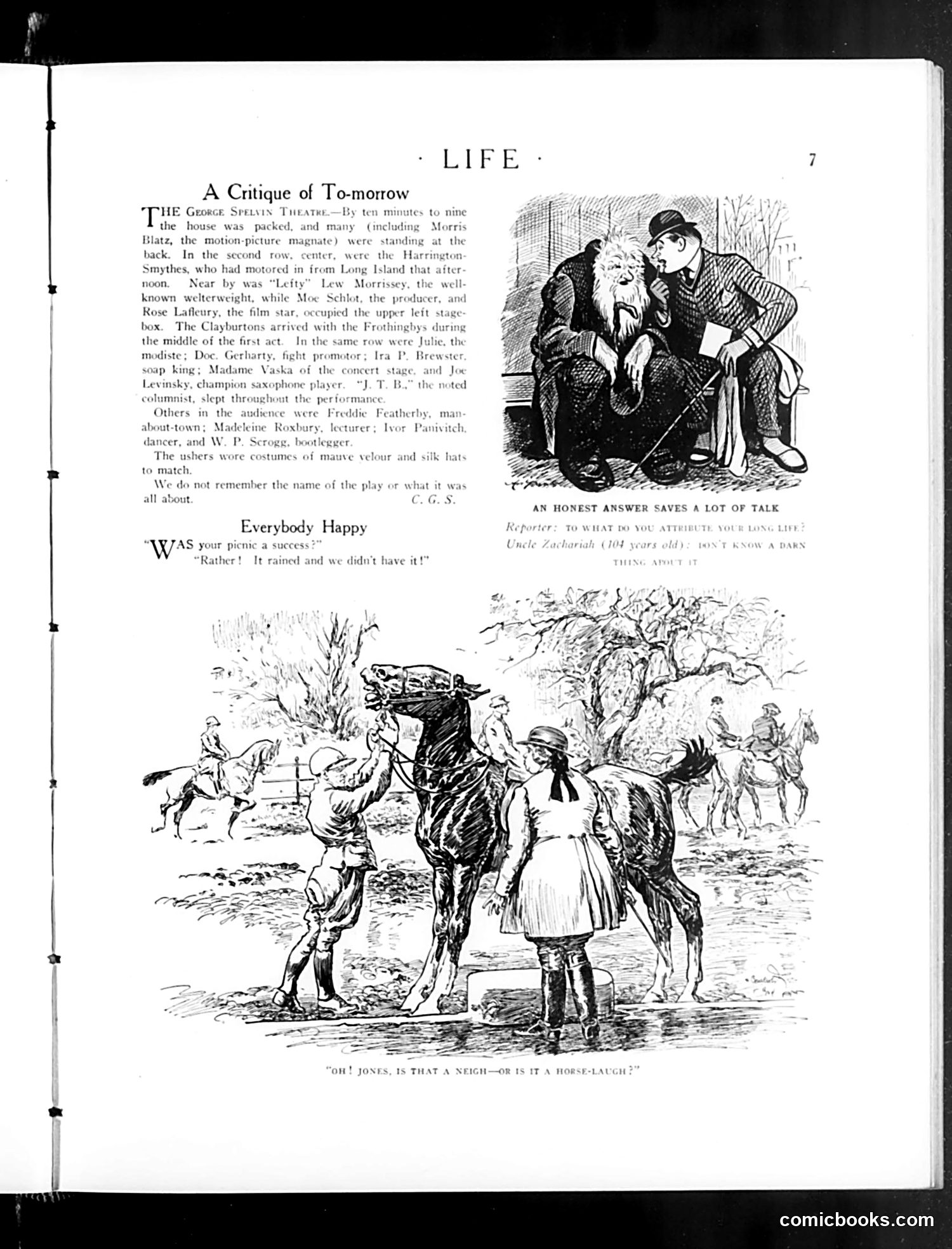
This page contains theater criticism and comedic illustrations rather than political satire. **"A Critique of To-morrow"** reviews a theatrical production at the Grand Theatre, listing prominent actors and stage personalities of the era (Rose Lafeury, Morris Blake, and others). The critic, C.G.S., admits not remembering the play's plot or name—suggesting it was forgettable. **"Everybody Happy"** presents two jokes: one about a rained-out picnic, and a larger illustration depicting a countryside accident where a horse has apparently malfunctioned, with the caption "'Oh! Jones, is that a sleigh—or is it a horse-laugh?'" The visual pun plays on "horse-laugh" (derisive laughter) and literal horse mishap. This is entertainment criticism and wordplay humor, not political commentary.
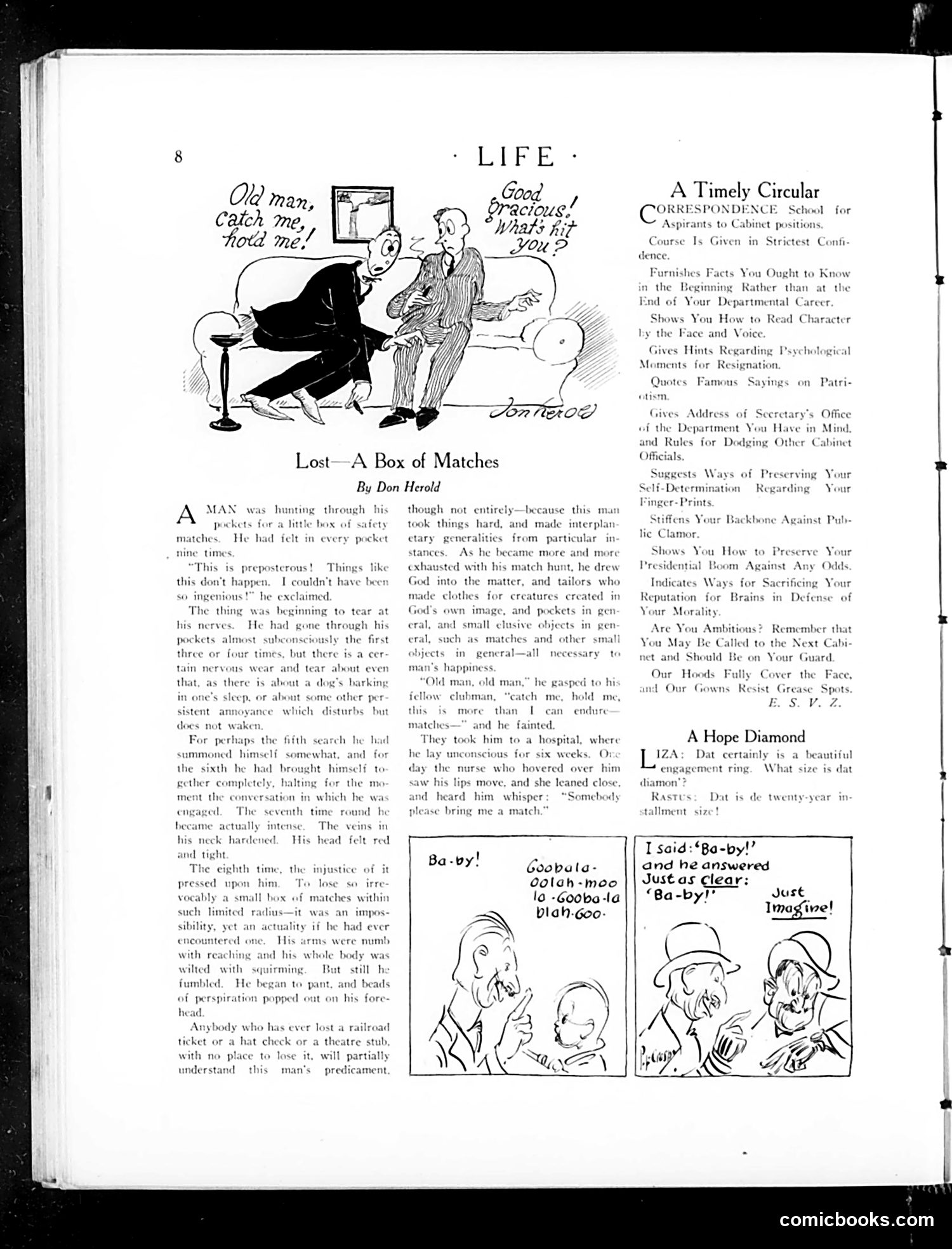
**Main Story: "Lost—A Box of Matches" by Don Herald** This is a humorous short story about a man obsessively searching for a lost box of matches through his pockets. The narrative satirizes male absent-mindedness and the disproportionate anxiety men experience over trivial lost items. The story mocks how men blame external circumstances rather than accepting personal carelessness. **Top Cartoon (unsigned, appears to be by Cesare)** Shows two well-dressed men in conversation, with one asking "Good gracious! What's hit you?" The other responds "Old man, catch me, hold me!" This appears to be wordplay about physical or emotional distress, typical of Life's absurdist humor. **Bottom Comics: "Ba-by!"** A three-panel baby comedy strip showing adults attempting to amuse an infant with exaggerated expressions and sounds. **Right Column: Service Features** Advertisements for Life's advice columns on cabinet positions, character-reading, and patriotic quotes.
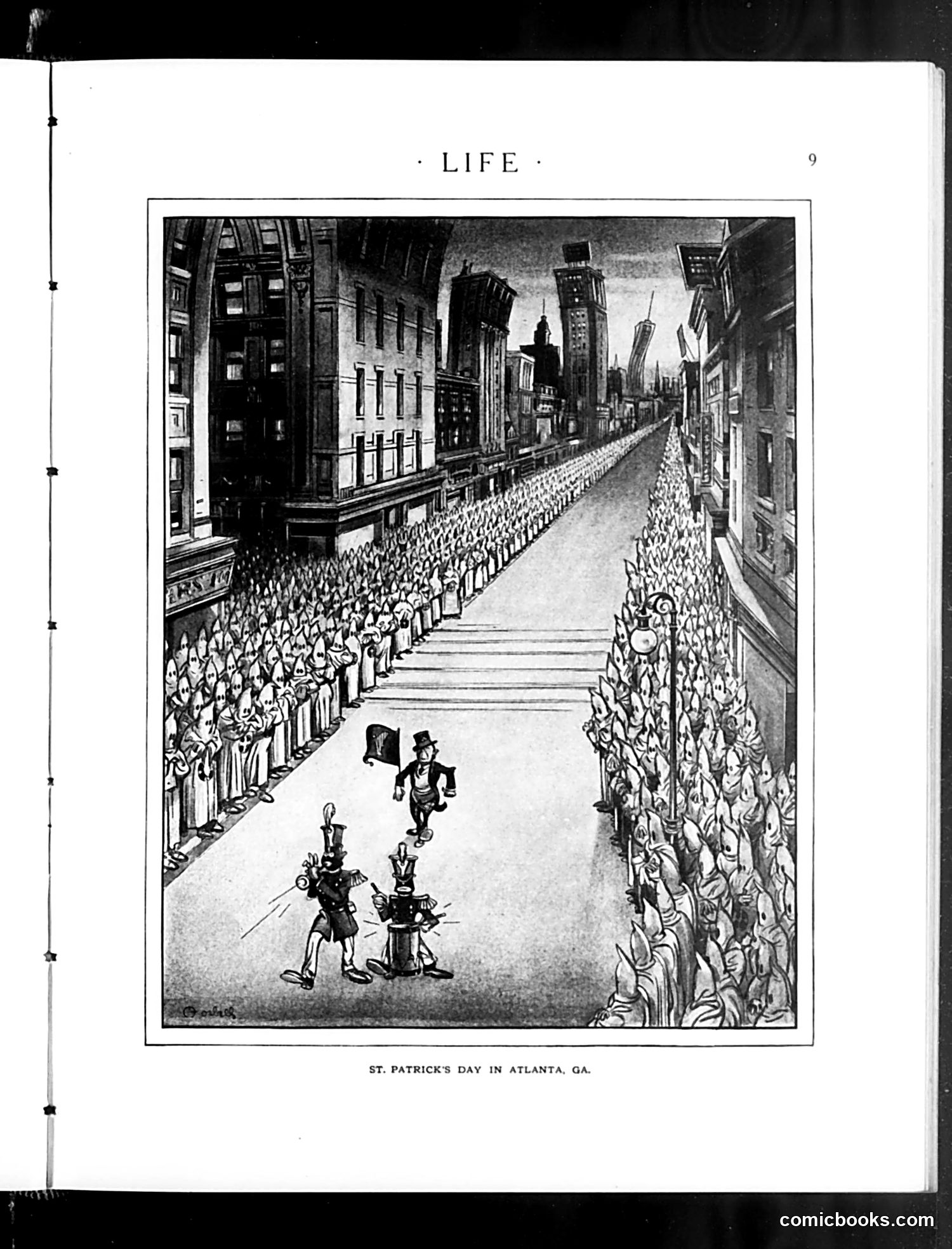
This satirical illustration depicts a St. Patrick's Day parade in Atlanta with exaggerated caricatures. Three figures march down a city street lined with enormous crowds of onlookers. The marchers appear to be cartoon characters in costume or military dress, carrying flags. The style is typical of early 20th-century political satire in *Life* magazine. Without additional context or visible identifying labels, the specific figures are unclear, though they likely represent prominent local or national personalities of the era. The satire seems to mock either the parade itself, the participants, or the spectacle of Irish-American civic celebration in the South. The enormous crowd and theatrical presentation suggest commentary on public enthusiasm or civic pretense.
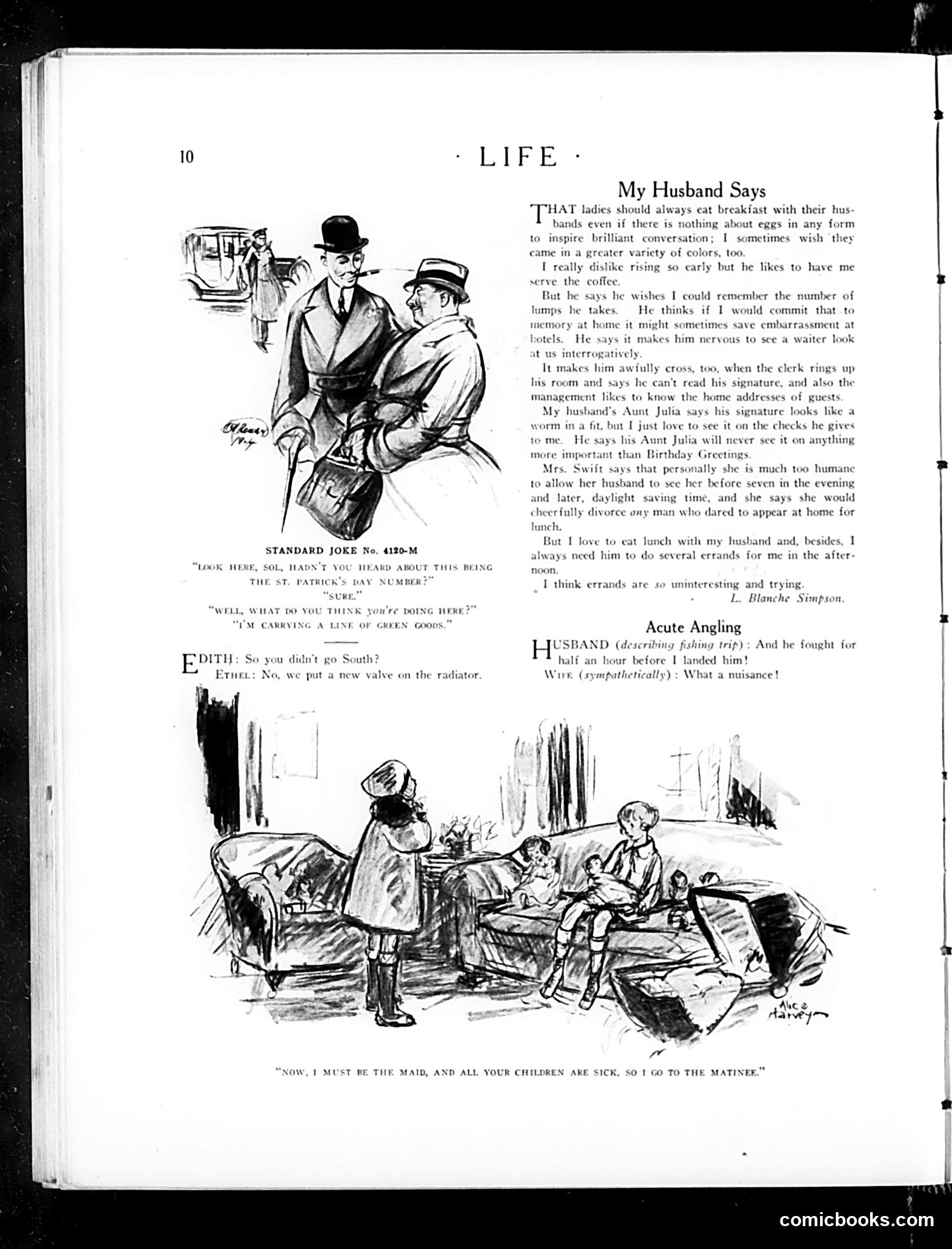
This page from *Life* magazine contains three separate humorous pieces about domestic life. The top cartoon ("Standard Joke No. 4150-M") depicts two men discussing St. Patrick's Day—one carrying "a line of green goods" (likely counterfeit merchandise), a play on the holiday and commercial deception. The middle section, "My Husband Says," is a brief essay by L. Blanche Simpsonabout marital negotiations over breakfast habits and lunch dates—satirizing how wives must manage husbands' preferences and schedules. The bottom cartoon, "Acute Angling," shows a wife sympathetically responding to her husband's fishing story with exaggerated sarcasm ("What a nuisance!"), while he describes catching nothing. The final caption reveals the wife's actual concern: she must attend a matinee while the maid and children are sick. All pieces mock traditional gender roles and domestic expectations of the era.
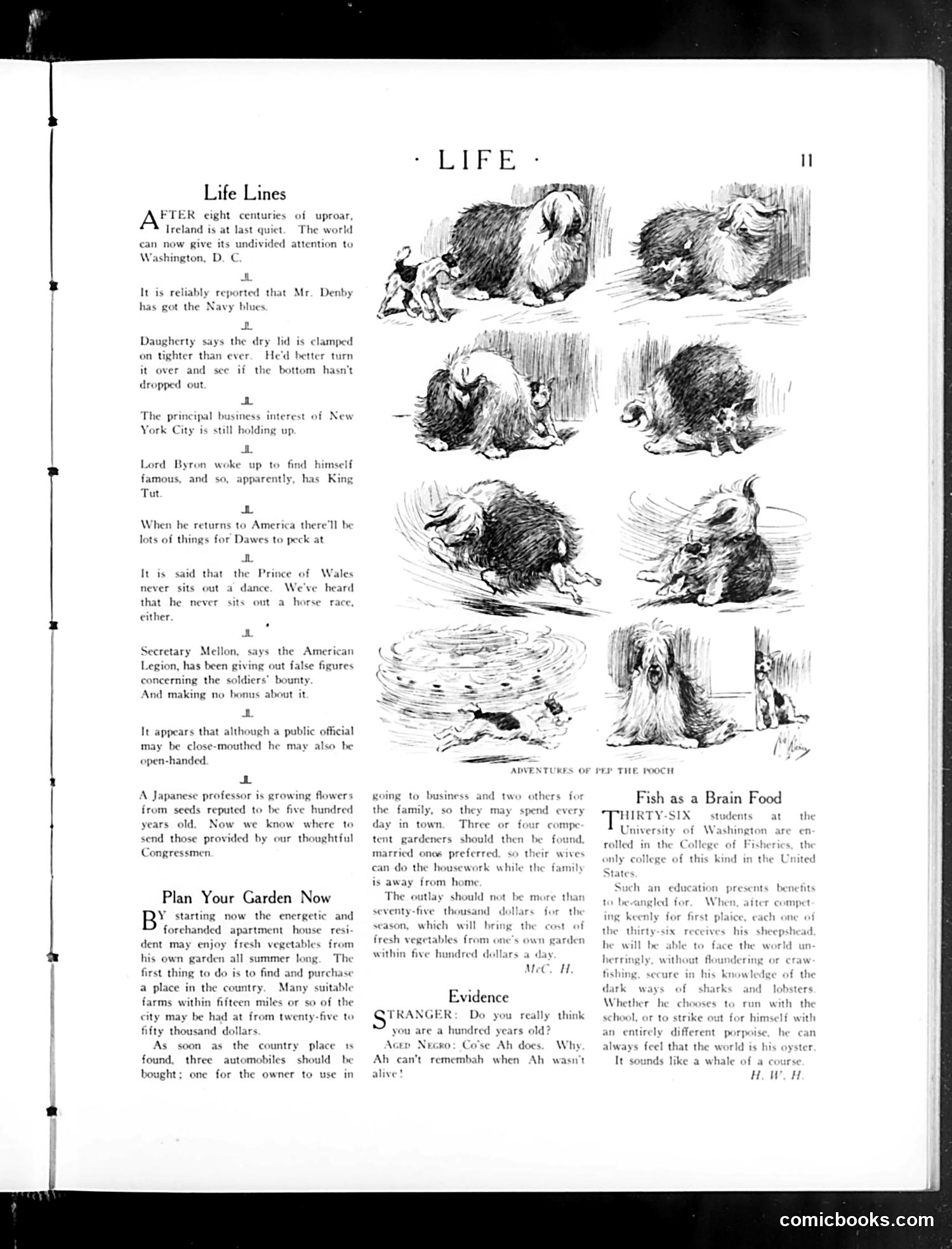
This page from *Life* magazine features a series of ink sketches depicting a small dog named "Pep the Pooch" in various comedic situations. The cartoon strip shows the dog encountering larger animals—including what appears to be chickens or other poultry—in humorous, exaggerated scenarios. The drawings emphasize physical comedy through the dog's expressions and body language as it interacts with its environment. The accompanying "Life Lines" section contains brief satirical news items and social commentary about contemporary figures (Mr. Denby, Lord Byron, the Prince of Wales, Secretary Mellon) and events, presented in the magazine's characteristic witty, gossipy style. There's also practical advice about planning a garden and an article on fish as brain food for students.
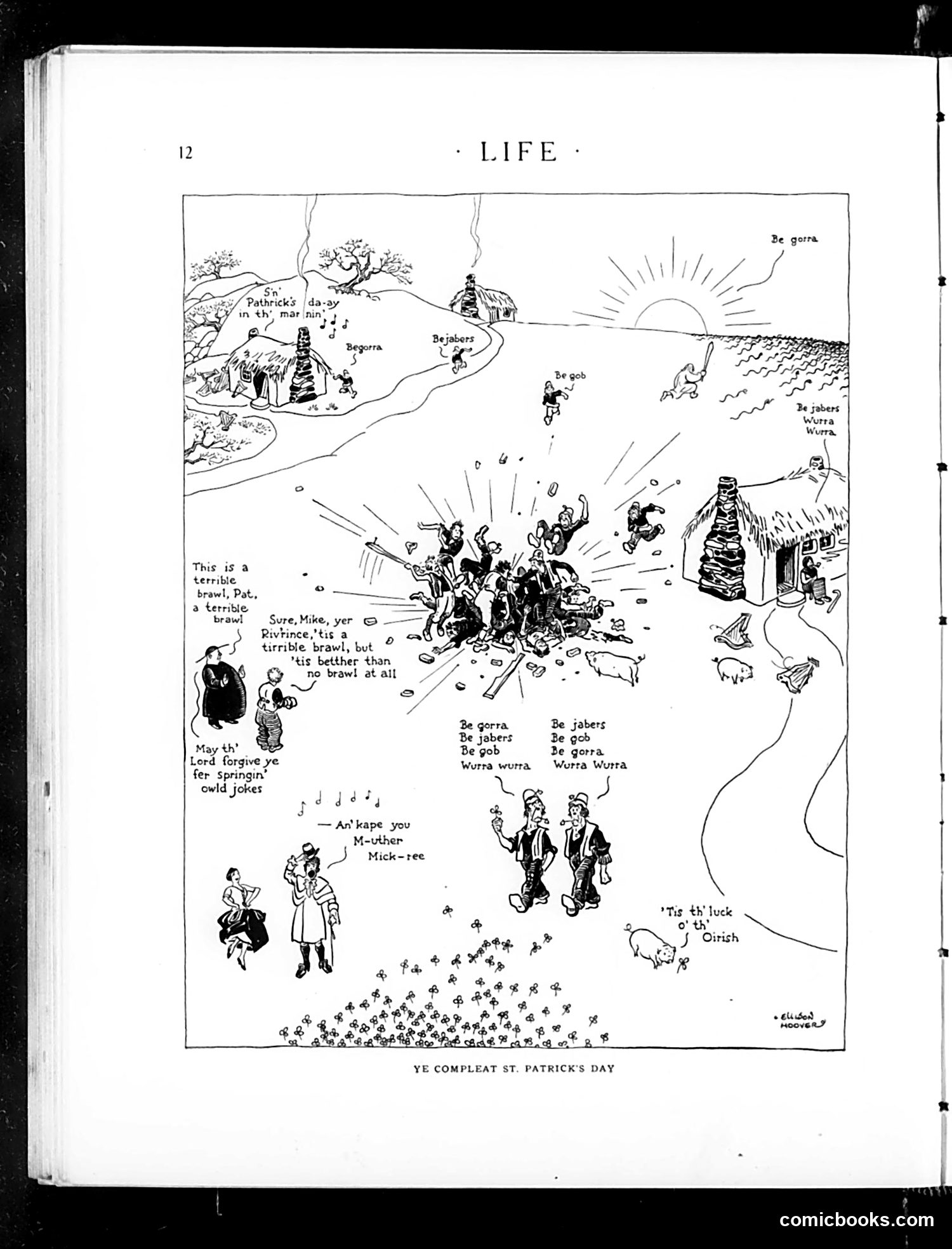
This Life magazine cartoon satirizes Irish-American St. Patrick's Day celebrations. The central scene depicts a chaotic street brawl with fighting figures and scattered coins, labeled "This is a terrible brawl, Pat. A Leprechaun brawl" with the response "Sure, Mike, yer brother's in a terrible brawl, but his bother no brawl at all." The cartoon stereotypes Irish immigrants through exaggerated dialect ("Be gorra," "Wurra Wurra," "Erin's luck o' th' Oirish") and depicts drinking, fighting, and general rowdiness as characteristic of St. Patrick's Day observance. Additional vignettes show singing figures and rural Irish scenes, reinforcing period ethnic caricatures about Irish-American culture that were common in early 20th-century American humor.
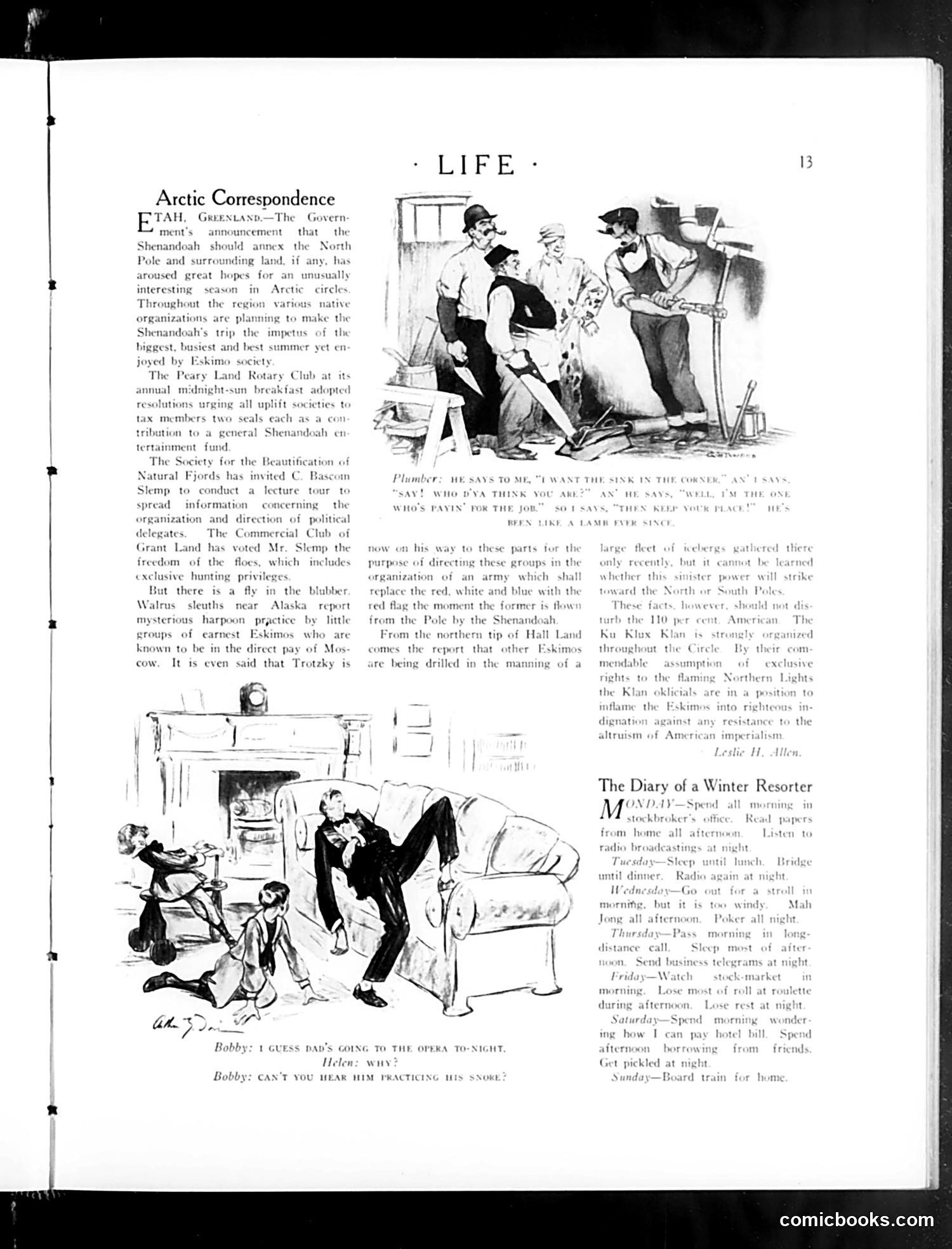
This page contains two separate cartoons and a satirical diary entry from the 1920s era. **Top cartoon**: Depicts men discussing Arctic exploration and Shenandoah expeditions. The dialogue references plumbing issues ("I want the sink in the corner") as metaphor for organizational problems in polar exploration efforts. **Bottom cartoon**: Shows a father relaxing on a couch while children play nearby. The caption jokes about the father attending the opera that evening, with a child asking if he can hear his snoring—a classic domestic humor trope mocking fathers' sleeping habits at cultural events. **"Diary of a Winter Resorter"**: A satirical weekly account of a stockbroker's tedious resort stay, with activities (radio, poker, train travel) presented as mundane and monotonous. The overall tone reflects 1920s middle-class leisure anxieties and domestic comedy conventions typical of *Life*'s satirical approach.
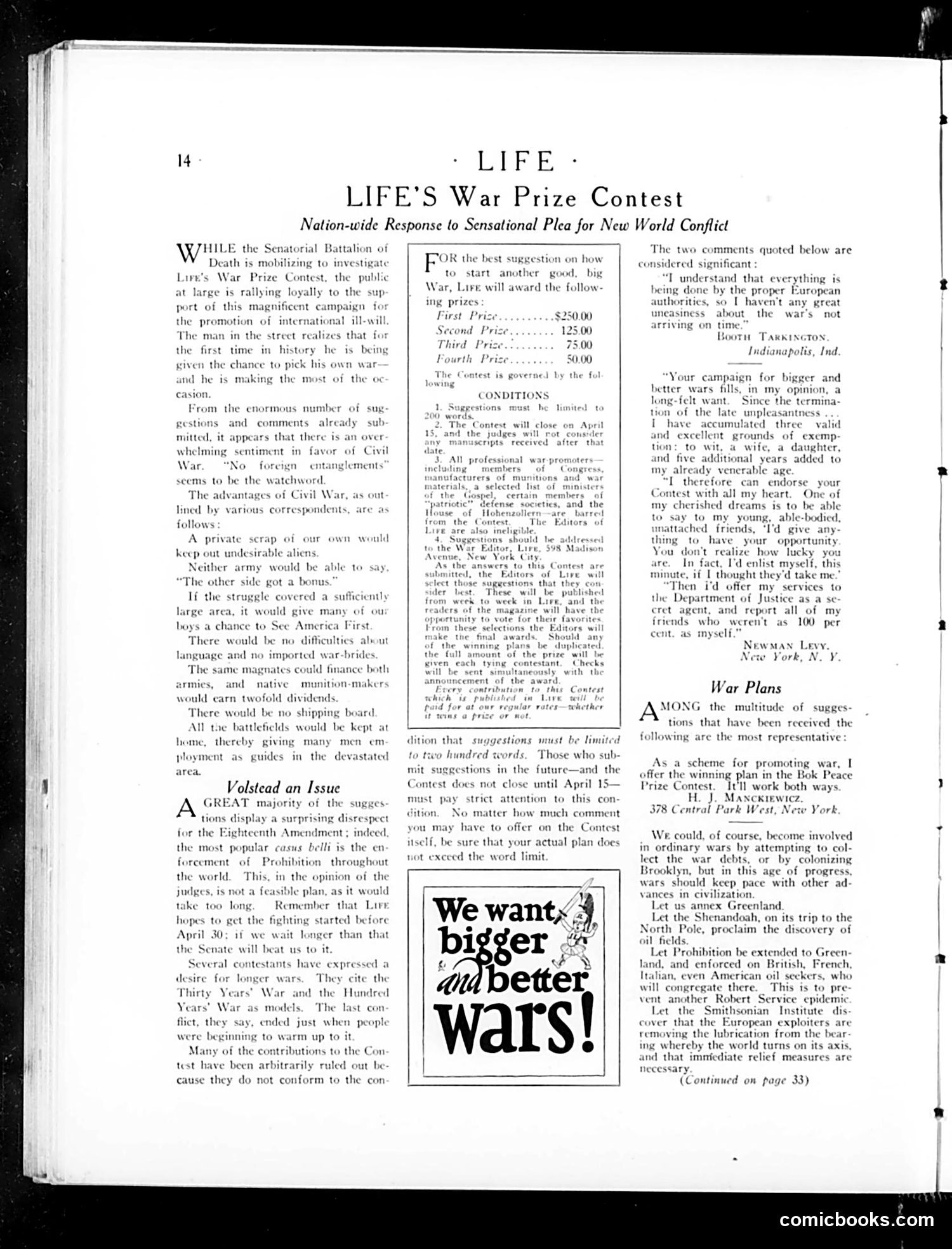
This page announces Life's "War Prize Contest," soliciting public suggestions for how to "start another good, big War." The satirical premise inverts typical competition structures by offering cash prizes ($250 for first place) for the *best ideas* to provoke future conflict. The accompanying cartoon depicts an Uncle Sam-like figure declaring "We want bigger and better wars!" — a blunt critique of American militarism and what the editors viewed as dangerous warmongering sentiment. The page publishes reader submissions suggesting various geopolitical schemes (annexing Greenland, extending Prohibition internationally, etc.), presented as absurdist commentary on American foreign policy ambitions and imperial fantasies of the era. This represents Life's satirical opposition to military expansion.
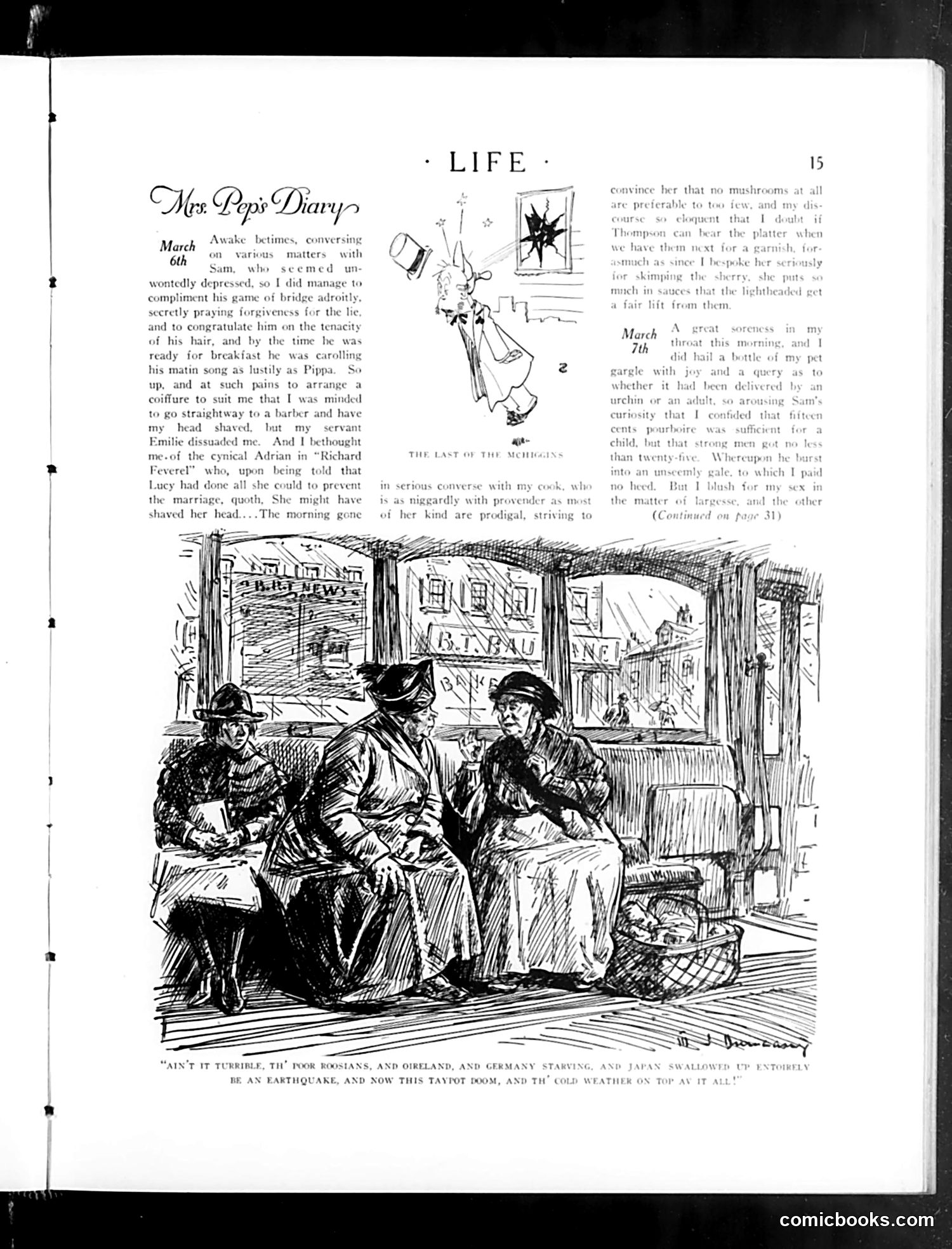
This page presents a diary entry satirizing domestic life and social commentary. The main illustration shows three working-class women in what appears to be a tavern or public house, engaged in conversation. The caption beneath reads: "Ain't it terrible, th' poor Russians, and Ireland, and Germany starving, and Japan swallowed up entirely by an earthquake, and now this taypot room, and th' cold weather on top of it all!" The satire targets the disconnect between global crises (Russian poverty, Irish troubles, German hardship, Japanese disaster) and the trivial domestic complaints of ordinary people obsessing over local inconveniences like a broken teapot and cold weather. It mocks how citizens focus on petty personal grievances while ignoring or minimizing larger humanitarian suffering occurring worldwide.
This page satirizes the Teapot Dome scandal and broader corruption in the Coolidge administration. The text discusses Secretary of Interior Albert Fall (though not named directly) and Secretary of Navy Edwin Denby, who were implicated in secretly leasing federal oil reserves to private interests. The cartoon mocks President Coolidge's passivity: he met boxer Jack Dempsey on his birthday—apparently to ask about "knockouts"—a joke suggesting Coolidge needs lessons in decisively removing corrupt officials. The author E.S. Martin argues that while Democratic Senators publicly attack the administration, allowing corruption to remain hidden in government is worse than exposing it publicly. The piece critiques how Washington's political class tolerates scandals rather than addressing them decisively, framing it as a test of American virtue. The humor relies on readers' familiarity with ongoing corruption investigations during this period.
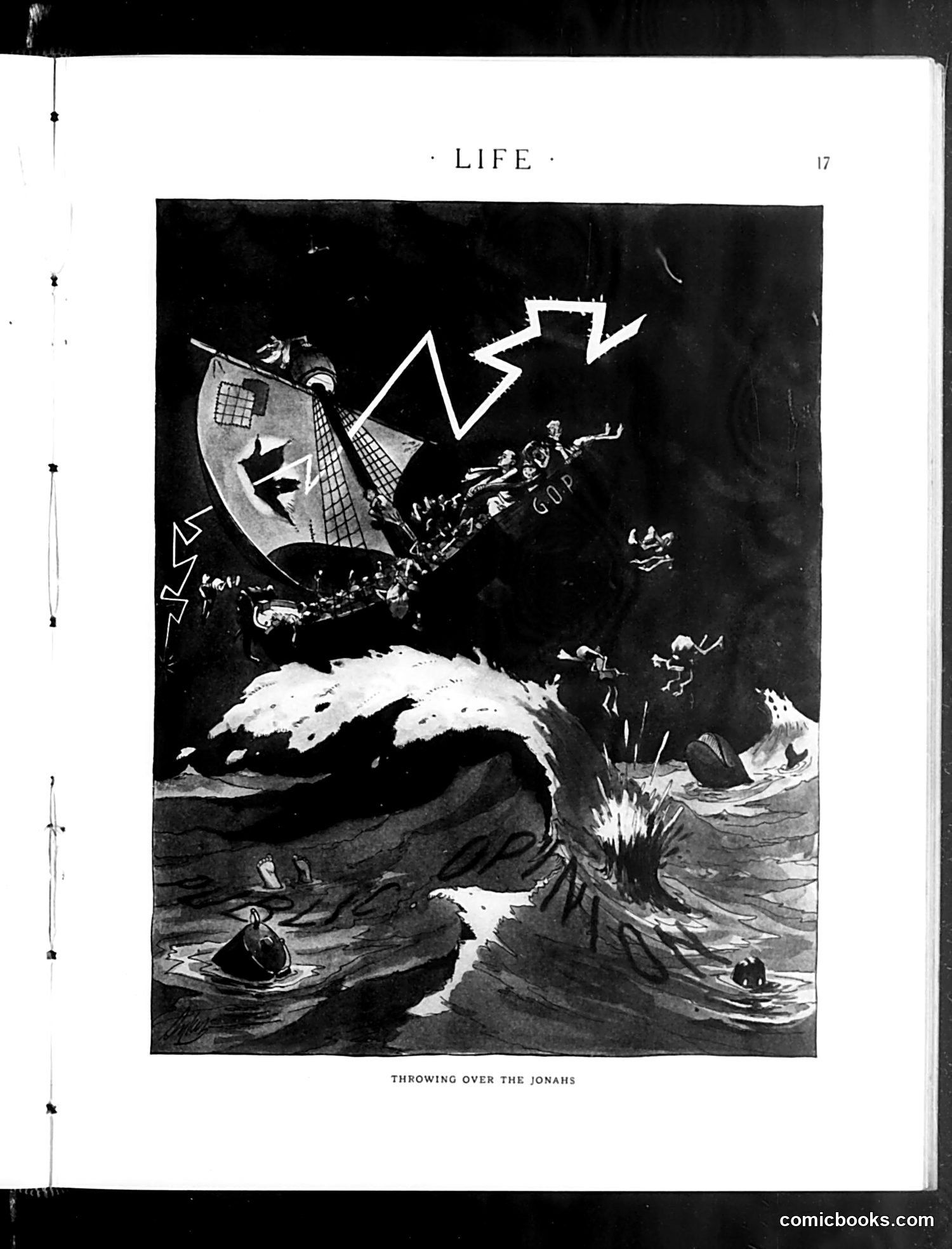
This political cartoon depicts a ship in stormy seas with lightning bolts striking overhead. Figures labeled "GOP" appear to be aboard the vessel, while other figures are being thrown overboard into the turbulent water below. The caption "Throwing Over the Jonahs" references the biblical story of Jonah, whose presence supposedly brought bad luck and storms to his ship. The satire suggests that Republican (GOP) leadership is jettisoning certain members or policies they blame for political misfortune or electoral failure. "Jonahs" here means scapegoats—people or ideas held responsible for the party's troubles. The cartoon critiques internal GOP conflict during a period of political difficulty, illustrating the party's strategy of discarding unpopular elements to restore fortunes.
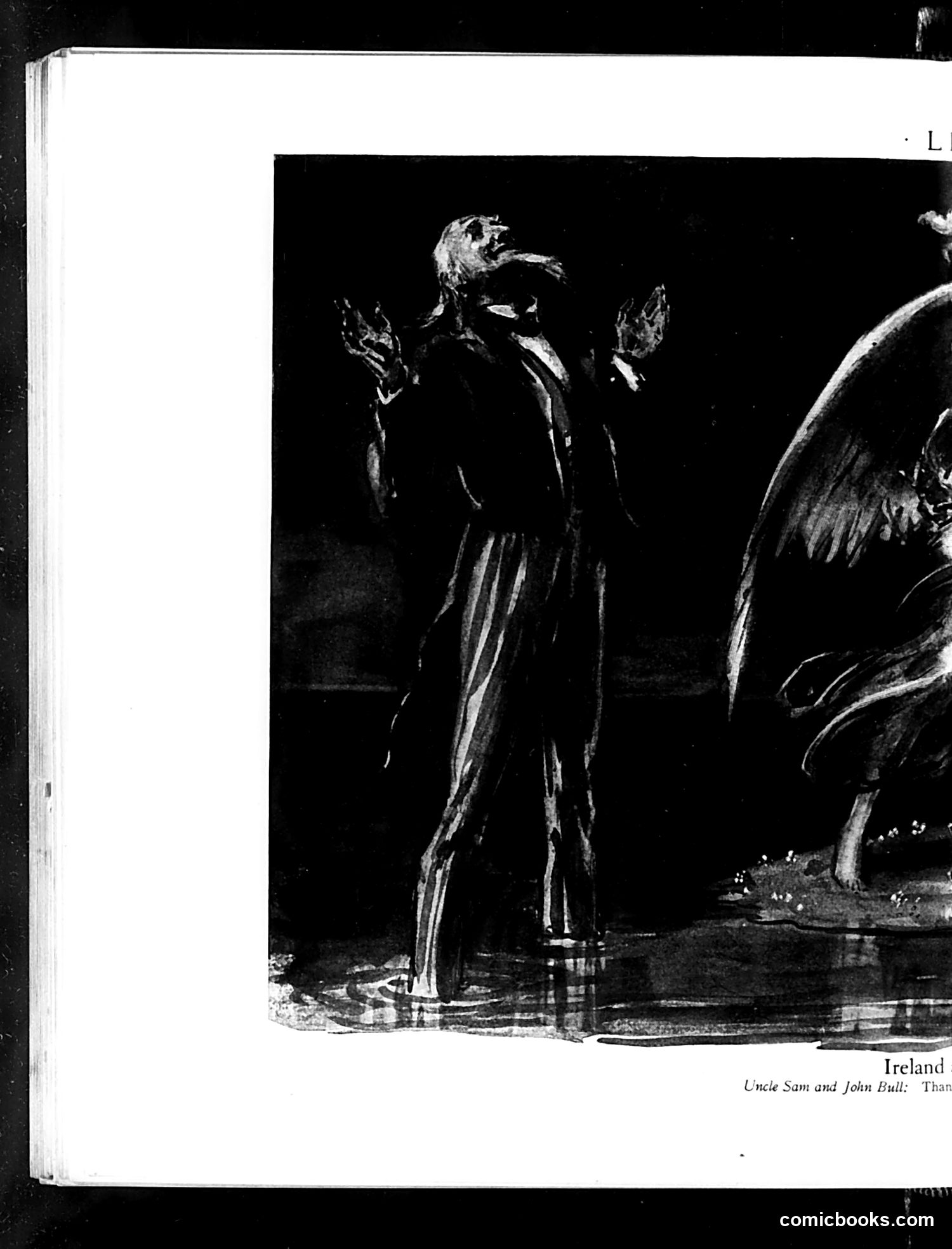
This political cartoon depicts two figures in a nighttime Irish setting near water. The caption identifies them as "Uncle Sam" (representing the United States) and "John Bull" (representing Britain). The cartoon appears to satirize Anglo-American relations regarding Ireland. Uncle Sam and John Bull are shown as anthropomorphic national personifications—a common convention in 19th-century political cartoons. The Irish setting and the two powers' presence there likely comment on British control of Ireland and American attitudes toward Irish independence or Irish-American interests. The specific historical context—whether referencing Irish independence movements, immigration, or diplomatic tensions—remains unclear without the full article text and publication date.
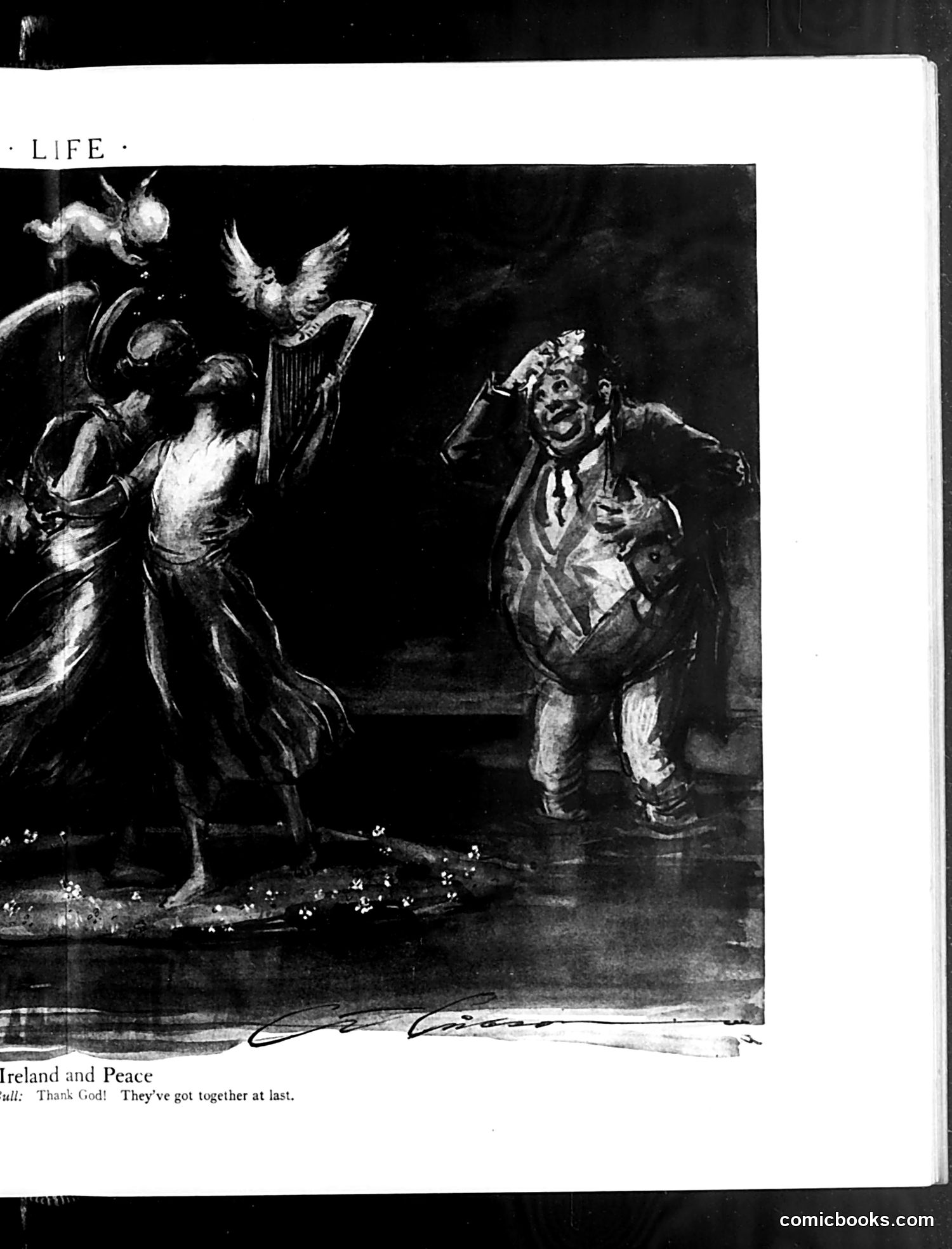
This political cartoon depicts two figures meeting, with the caption "Thank God! They've got together at last." The title "Ireland and Peace" suggests this satirizes diplomatic efforts to resolve Irish conflicts. The figure on the left appears to be **Ireland** (represented allegorically, possibly with Hibernia symbolism), while the grotesque caricature on the right likely represents a political figure or personification of **Peace**. The cartoon's satire centers on the ironic contrast between Ireland's violent history and the difficulty of achieving stable peace. The grotesque rendering of the "Peace" figure suggests skepticism about whether genuine peace was actually achievable or desirable to those involved in the Irish conflict. The exact historical moment remains unclear without a date.
This page contains theater reviews from *Life* magazine's drama section. The reviews critique three productions: **"The Moon-Flower"** stars Elsie Ferguson as a courtesan in a plot about a poor law student posing as nobility. The critic dismisses it as frivolous romantic melodrama (comparing it to novelist Ouida's saccharine work). Actor Sidney Blackmer is criticized for delivering flowery speeches that undermine comedic effect. The review notes the off-stage orchestra played only "Twenty Classical Gems for Mandolin and Piano"—apparently a pedestrian, high-school-level musical selection—for incidental music. **"Antony and Cleopatra"** features Jane Cowl as Cleopatra. The critic praises her "intelligent and untheatrical interpretation," noting that any thrilling Shakespearean production is unexpected bonus entertainment. Actor Peters as Antony receives less favorable mention. The satire targets theatrical pretension and mediocre dramatic writing disguised as sophistication.
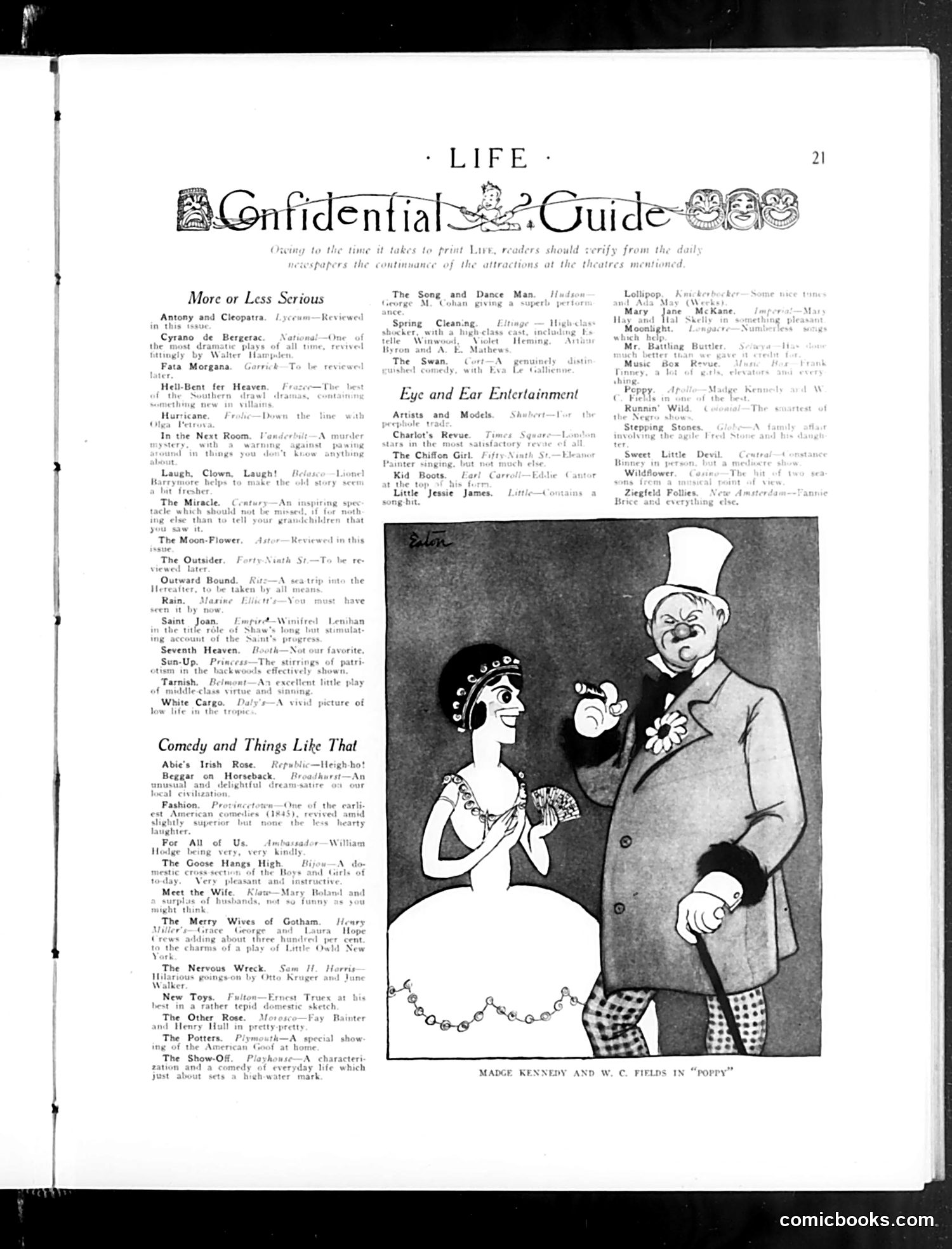
This page is primarily a **theater listing guide** for Broadway shows of the early 1920s, organized by genre ("More or Less Serious," "Comedy and Things Like That," "Eye and Ear Entertainment"). The single illustration shows a cartoon captioned **"Madge Kennedy and W.C. Fields in 'Poppy'"** — a sketch depicting the comedic interaction between these two performers in that stage production. Fields appears as a somewhat disheveled older man in checkered pants, while Kennedy is drawn as an elegant woman with a decorative headpiece. The cartoon likely captures a humorous moment from the play, playing on Fields' characteristic grumpy persona and physical comedy style. The "Confidential Guide" header suggests Life magazine was providing readers with insider theater recommendations and brief, sometimes satirical commentary on current Broadway offerings—a common feature in entertainment journalism of that era.
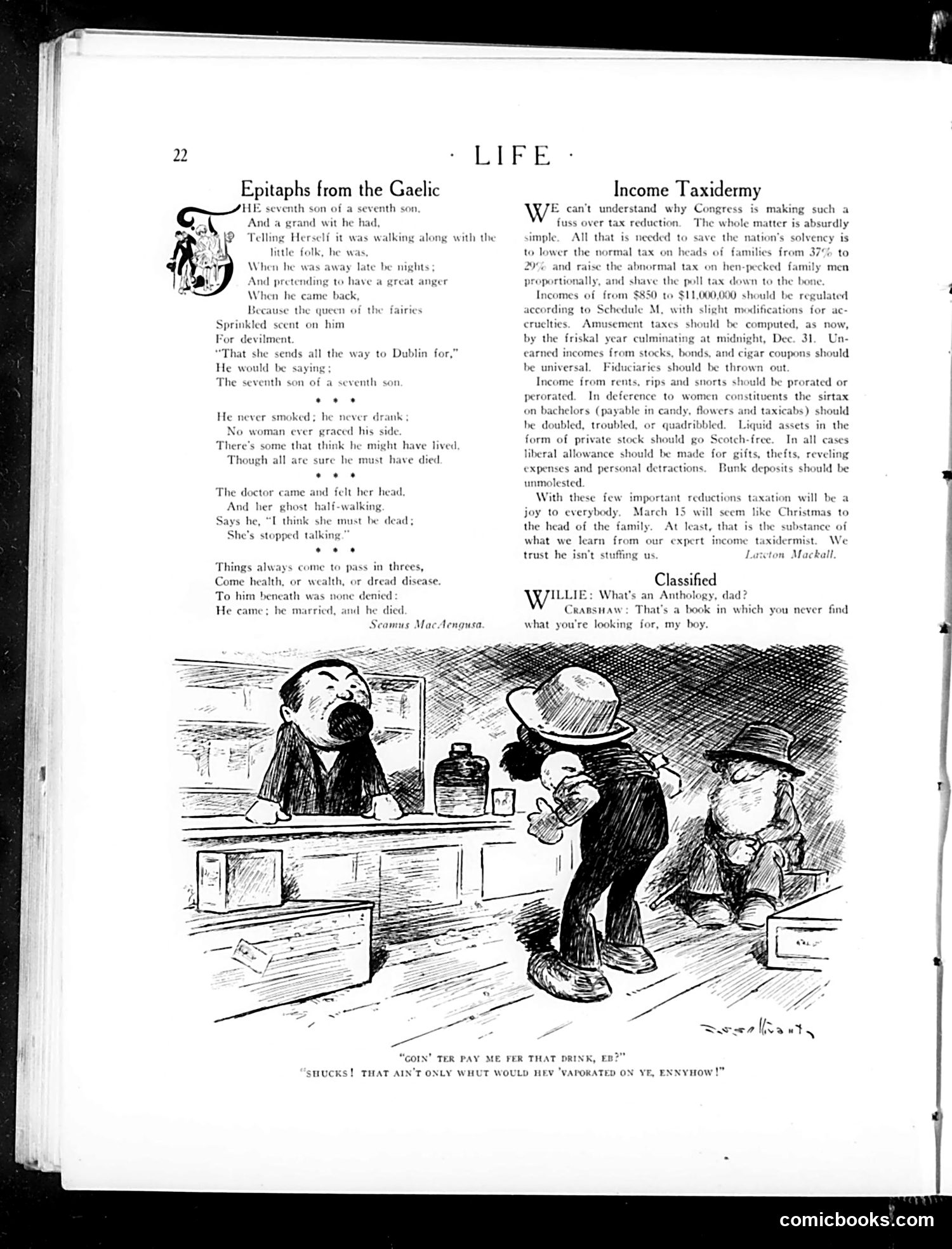
**Main Cartoon (Bottom):** A bartender confronts a customer about payment for a drink. The customer's response reveals the satirical point: the drink would have evaporated anyway due to heat/time, so he's claiming he owes nothing for its consumption. This is a joke about financial rationalization and dodging debts through absurd logic. **"Income Taxidermy" Article (Right):** A lengthy satirical proposal mocking Congressional tax reform debates. The author proposes absurd tax schemes—taxing "hen-pecked family men," making bachelors pay in "candy and flowers," and various other ridiculous provisions. The satire targets the complexity and perceived irrationality of tax legislation, suggesting Congress is equally nonsensical in its actual proposals. **"Epitaphs from the Gaelic" (Top Left):** Traditional Irish epitaphs presented as literary content, unrelated to the cartoons' satire. **Context:** This appears to be from the post-WWI era when tax debates were contentious. The satire mocks both Congressional incompetence and public tax avoidance schemes.
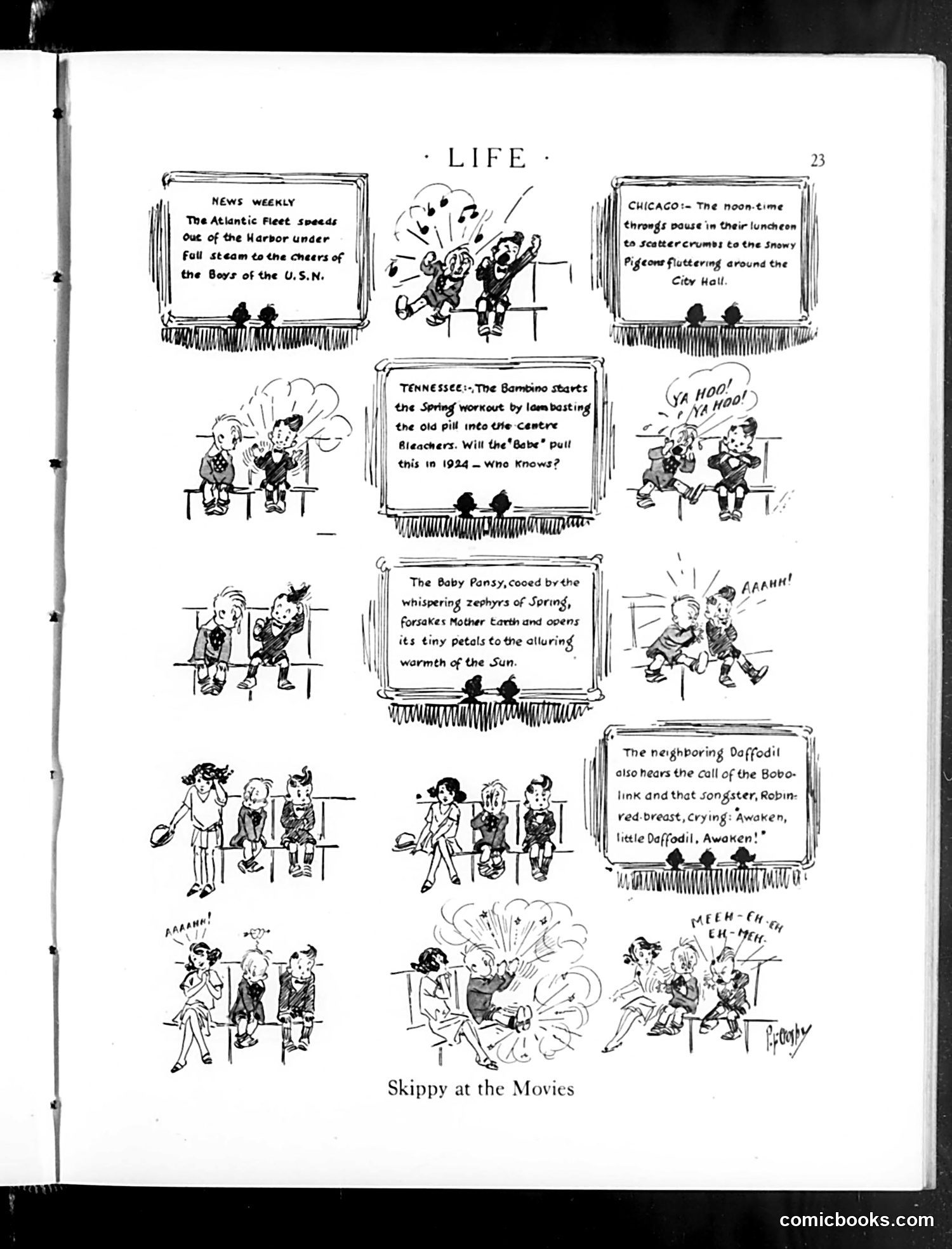
This page presents a comic strip titled "Skippy at the Movies" showing a child's spring activities through several vignettes. The humor derives from contrasting sophisticated, poetic descriptions of spring events with childish reactions. The top panels reference contemporary 1920s news: the Atlantic Fleet departing harbor and Babe Ruth (the "Bambino") performing spring training in Tennessee. The middle sections employ mock-romantic language about spring flowers ("Baby Pansy," "Daffodil," "Bobolink") — the sort of sentimental nature writing readers would recognize from genteel literature. The joke is that Skippy, an energetic child character, responds to these dignified scenarios with boisterous chaos: scattering pigeons, making loud sounds ("AARGH!"), and causing general mayhem at the movies (shown in the final explosive panel). The satire mocks the contrast between refined adult appreciation of spring and current events versus children's anarchic, exuberant responses to the same world.
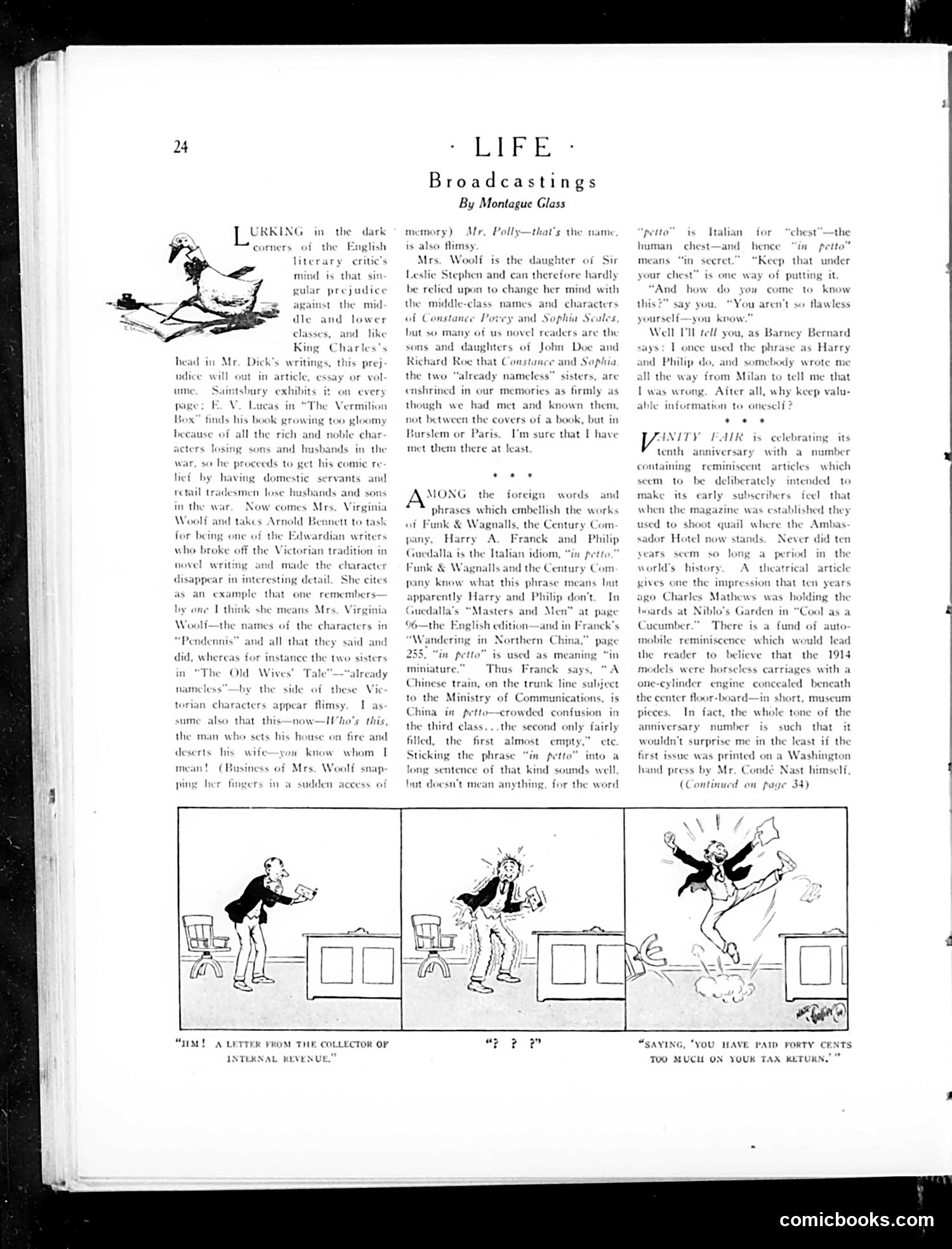
This page contains a literary column by Montague Glass discussing English literary criticism and foreign phrases, paired with a three-panel comic strip below. ## The Literary Column Glass critiques English critics' class prejudices, citing Saintsbury and others who dismiss working-class characters in novels as "flimsy" compared to Victorian-era figures. He defends popular fictional characters like Mr. Polly (appearing to reference H.G. Wells) as memorable and real to readers despite their humble origins. The column also discusses the Italian phrase "in petto" (meaning "in secret" or "in the chest") as used in various literary works by Funk & Wagnalls and Century Company publications. ## The Comic Strip The three panels show a comedic tax audit scenario: a man receives a letter from the Internal Revenue Collector (panel 1), appears confused ("? ?"), then reacts with exaggerated panic when told he overpaid forty cents on his tax return (panel 3)—the humor lying in his absurdly disproportionate reaction to a trivial amount.
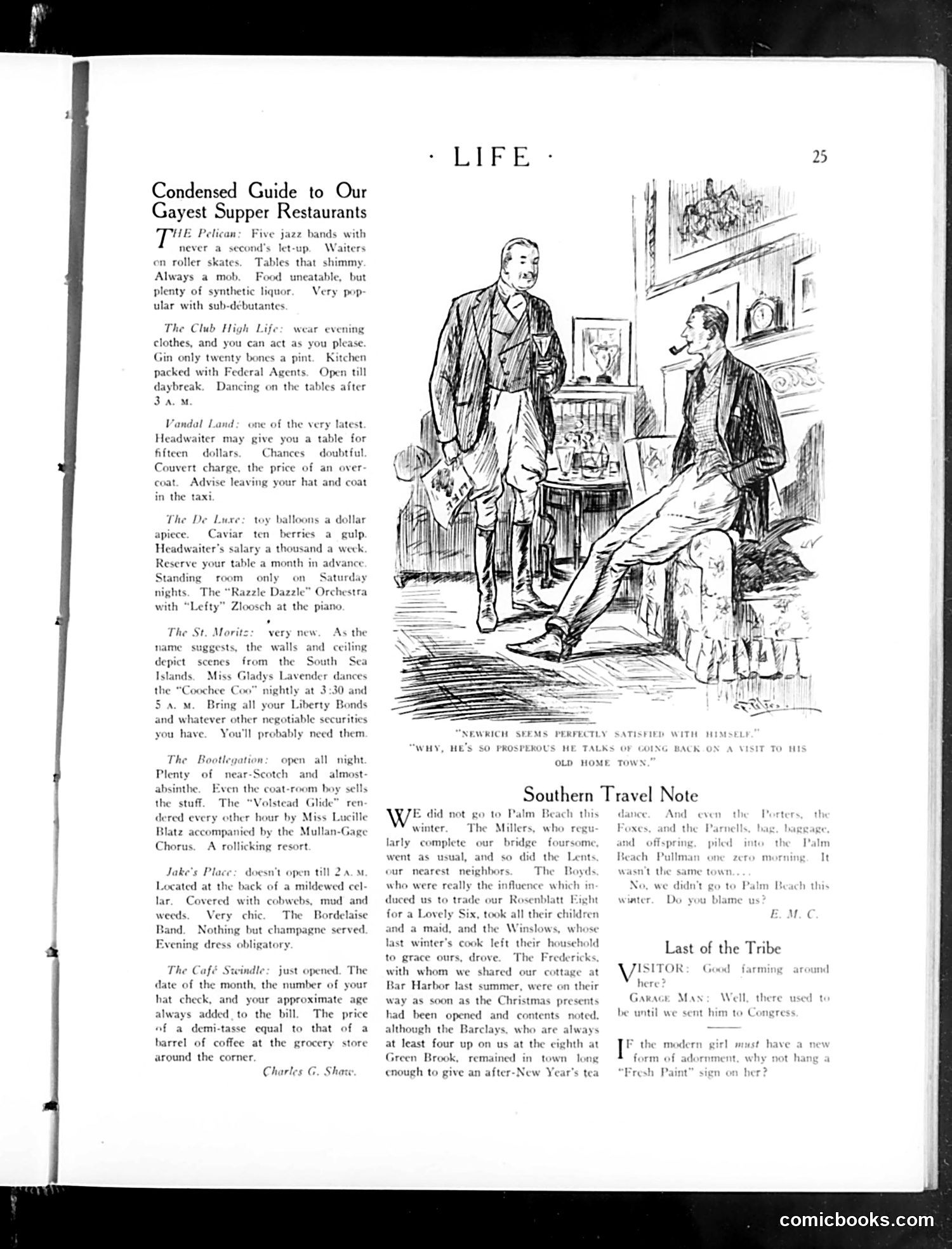
This page satirizes the Prohibition era's "speakeasy" culture through mock restaurant reviews. During Prohibition (1920-1933), illegal establishments served alcohol despite the law, and the piece humorously exposes their absurd practices and inflated prices. The cartoon (top right) depicts a wealthy "new rich" man boasting about his prosperity to someone visiting from his small hometown—a dig at nouveau riche pretension of the Jazz Age. The reviews mock speakeasies by highlighting their actual conditions: "Federal Agents" in kitchens (law enforcement presence), exorbitant prices, poor food quality, the need to "reserve your table a month in advance," and references to bringing "Liberty Bonds" to afford them. The "Volstead Glide" dance references the Volstead Act (Prohibition's legal basis). The lower sections include unrelated travel humor and domestic comedy, typical of Life's miscellaneous content. The satire targets both the illegal establishments' brazen operation and the wealthy patrons willing to pay absurdly for mediocre, illicit service.
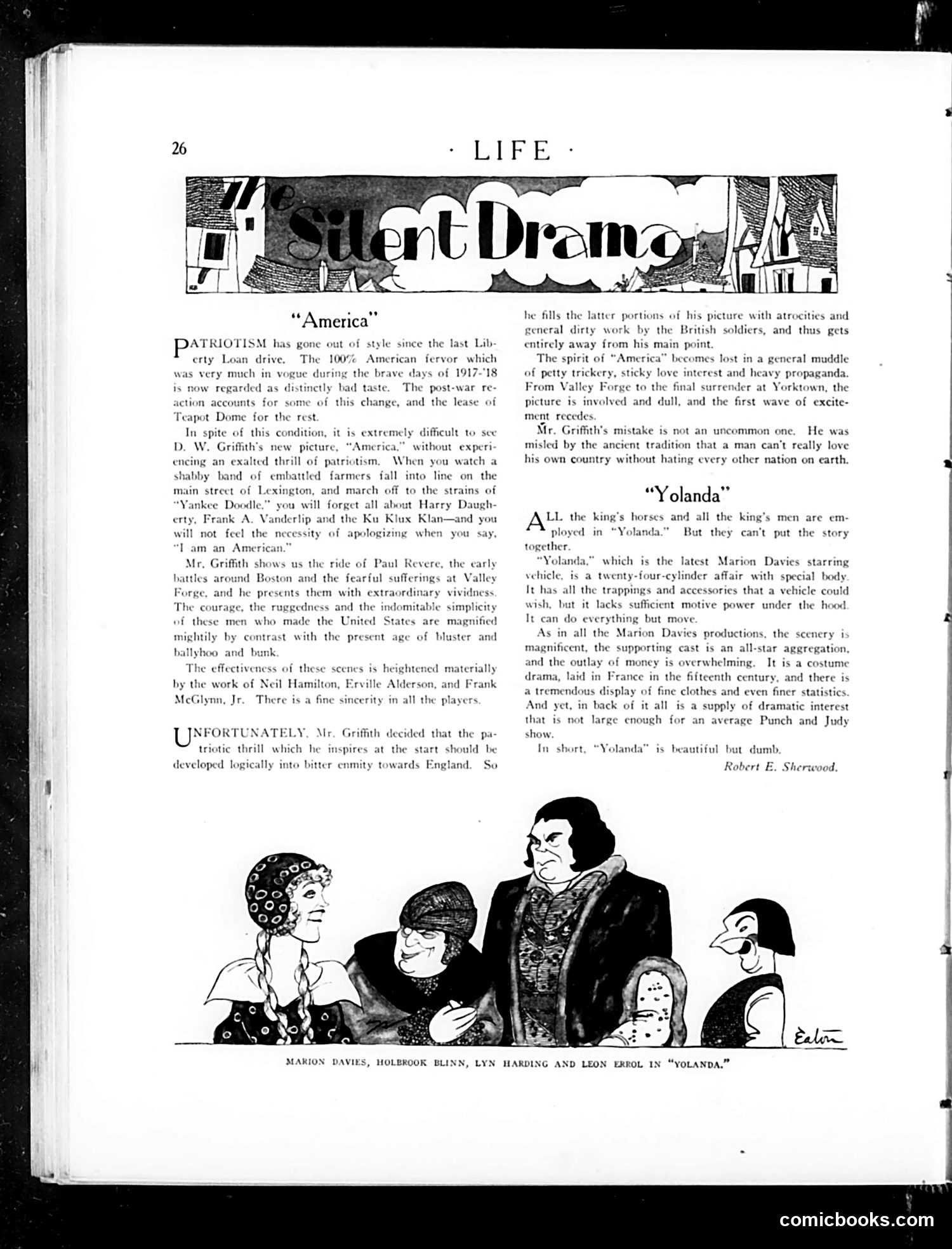
This page contains two film reviews from Life magazine's "Silent Drama" section, critiquing D.W. Griffith's "America" and a Marion Davies vehicle called "Yolanda." **"America"**: The reviewer praises Griffith's depiction of Revolutionary War scenes (Paul Revere, Valley Forge) as genuinely stirring. However, he criticizes Griffith's decision to portray British soldiers committing "atrocities," arguing this anti-British propaganda undermines the film's patriotic message. The implicit critique: post-WWI America shouldn't need to demonize former allies to inspire patriotism—a jab at outdated 1917-18 jingoism. **"Yolanda"**: A dismissive review of a lavish Marion Davies costume drama. Despite expensive production values, elaborate sets, and an all-star cast, the film lacks dramatic substance—it "can do everything but move." The joke is that spectacle without meaningful story is empty. Both reviews reflect 1920s skepticism about empty patriotic and commercial filmmaking.
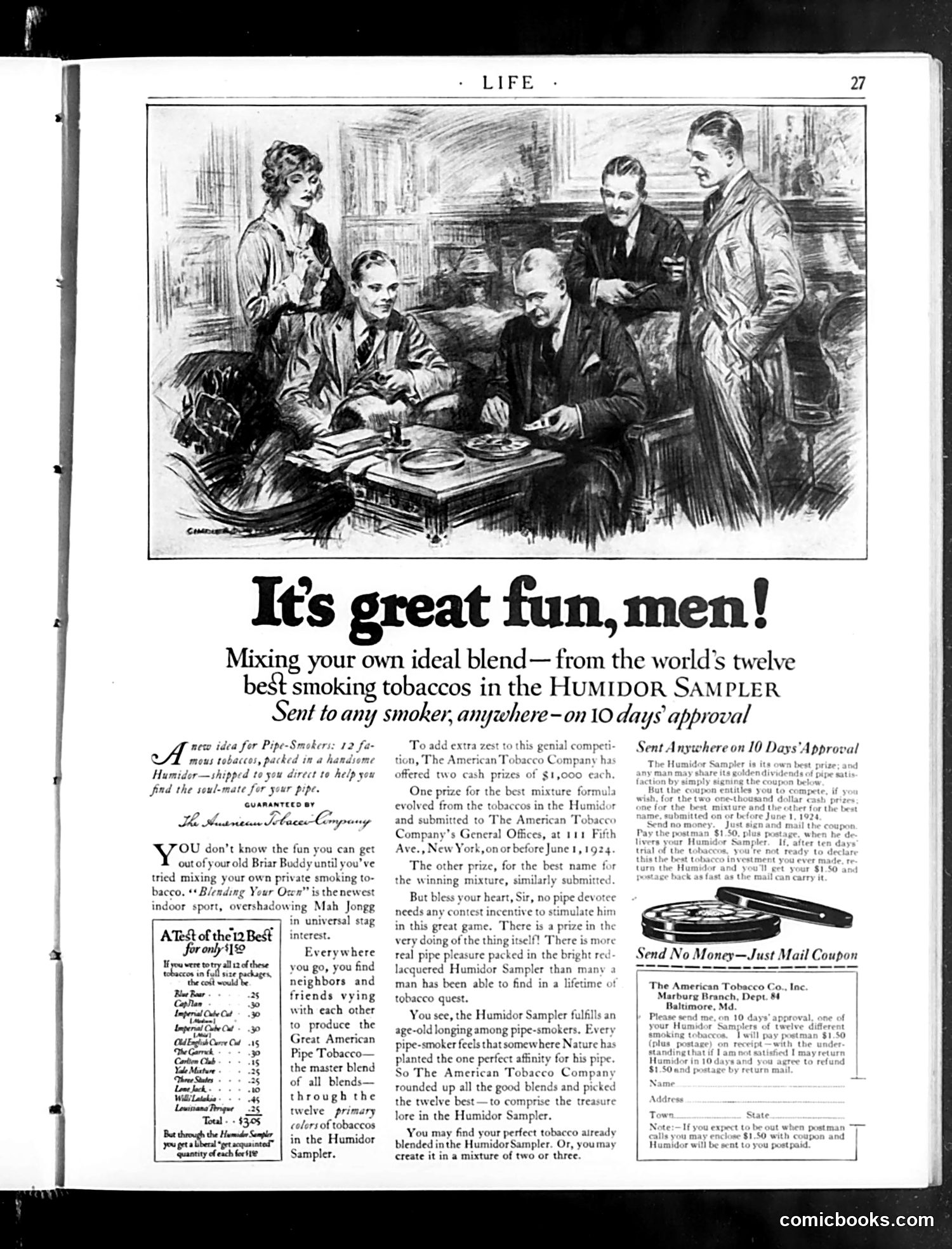
This is primarily a **tobacco advertisement**, not satire or political commentary. It appears in Life magazine circa 1924. The illustration shows gentlemen in a well-appointed parlor examining tobacco blends—a scene designed to make pipe-smoking appear sophisticated and social. The ad promotes the "Humidor Sampler," which contains twelve different tobacco varieties that customers can mix to create their own custom blend. The marketing angle plays on the era's leisurely pastimes: the text references "Mah Jongg" (a popular 1920s game) and frames tobacco-blending as the newest "indoor sport" among men. Two contests offered cash prizes ($1,000 each) for the best custom blend formula and the best name for a winning mixture. This reflects **1920s consumer culture** when such contests and customization were novel marketing tactics. The appeal to masculinity, leisure, and self-expression was typical advertising strategy of the period. No political figures or satire are present—this is straightforward period advertising.
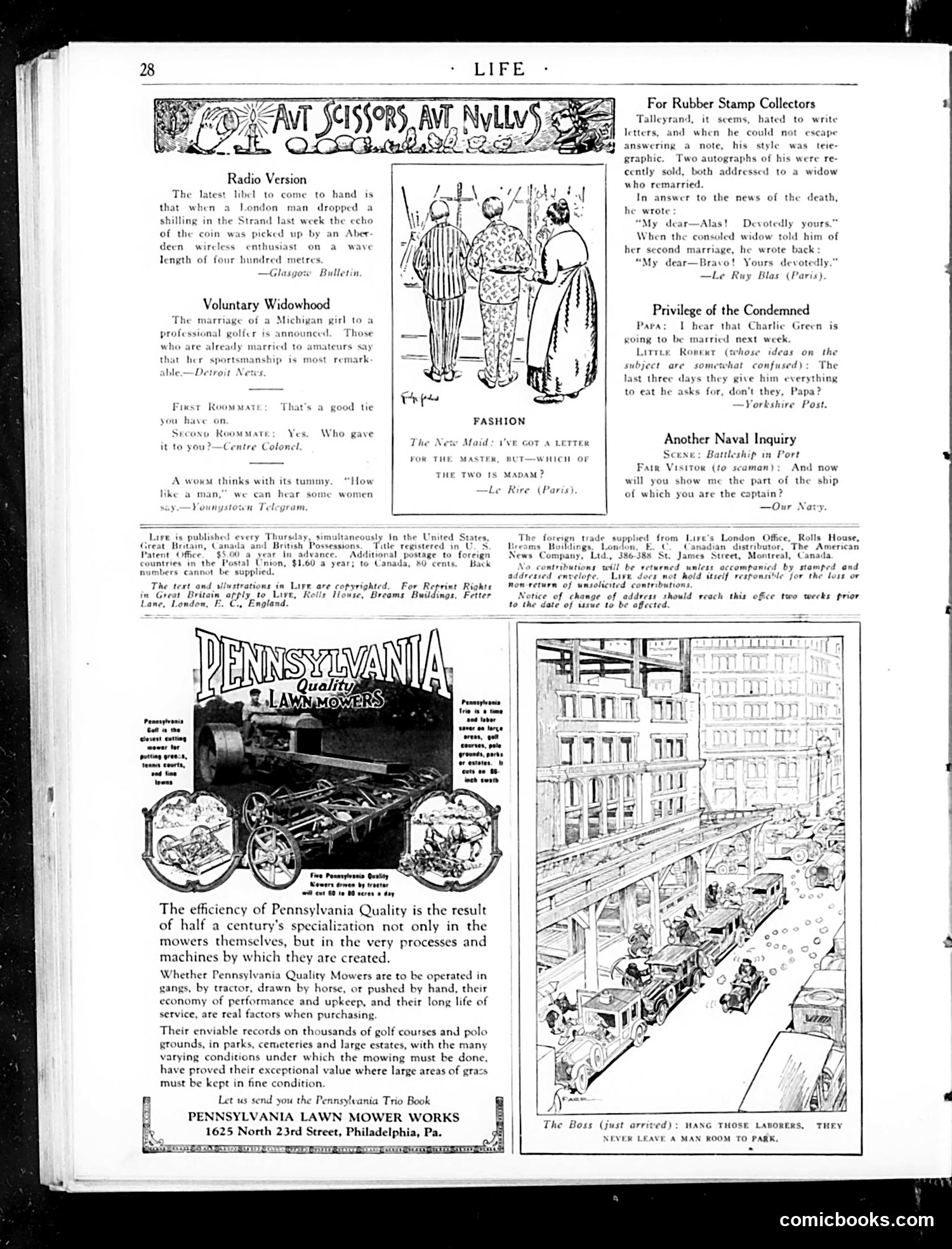
This page from *Life* magazine contains several brief humor items and advertisements typical of the publication's satirical format. **The humor pieces** are mostly short-form jokes playing on wordplay and social observations: - "Radio Version" jokes about sound traveling distance (a modern technology reference) - "Voluntary Widowhood" mocks a woman marrying a golfer when already married to an amateur sportsman—satirizing women's sports enthusiasm - Exchanges between roommates about neckties and maids pun on fashion and servant dynamics - The naval inquiry cartoon appears to mock miscommunication between officers and sailors **The cartoons** use simple visual gags: confused conversations about who is "the captain" of a ship, and a final image showing congested parking/labor issues at what appears to be a construction site or industrial area. The page primarily showcases *Life's* trademark style: brief, punchy satirical observations about contemporary middle-class life, gender relations, and modern conveniences, interspersed with advertisements (notably for Pennsylvania Lawnmowers). Nothing requires specific historical context beyond understanding early-20th-century social attitudes about marriage, class, and workplace dynamics.
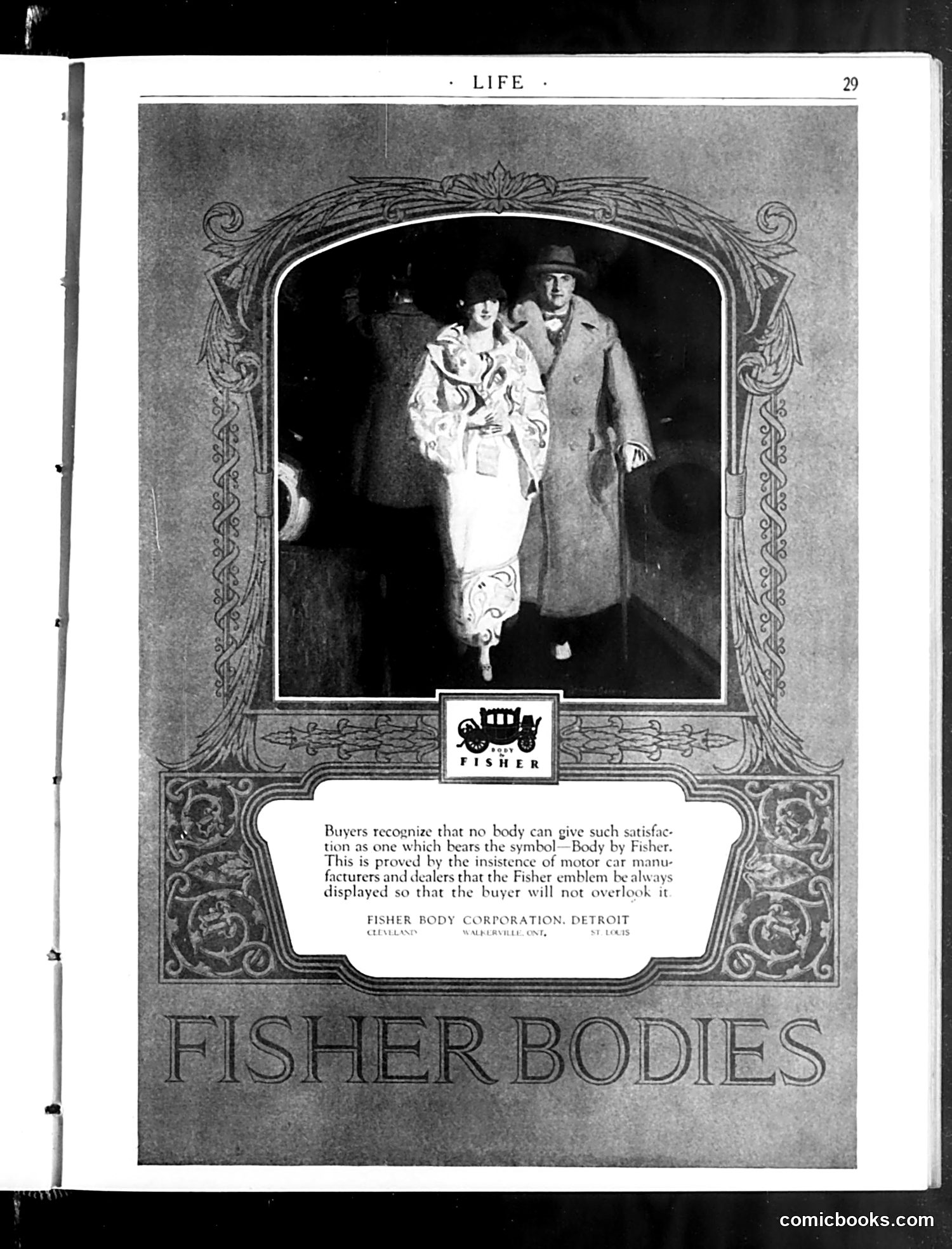
This is a Fisher Bodies automobile advertisement, not a political cartoon. It features a photograph of a well-dressed couple (woman in white dress and fur stole, man in overcoat and hat) exiting what appears to be a vehicle, framed in an ornate decorative border typical of 1920s advertising design. The ad's message targets car buyers, arguing that Fisher Bodies' reputation for quality is so valuable that manufacturers insist on prominently displaying the Fisher emblem. The point is that the Fisher brand name itself—the "symbol"—guarantees satisfaction and should influence purchasing decisions. This represents early brand-marketing strategy, where the component manufacturer's prestige becomes a selling point for the finished automobile.
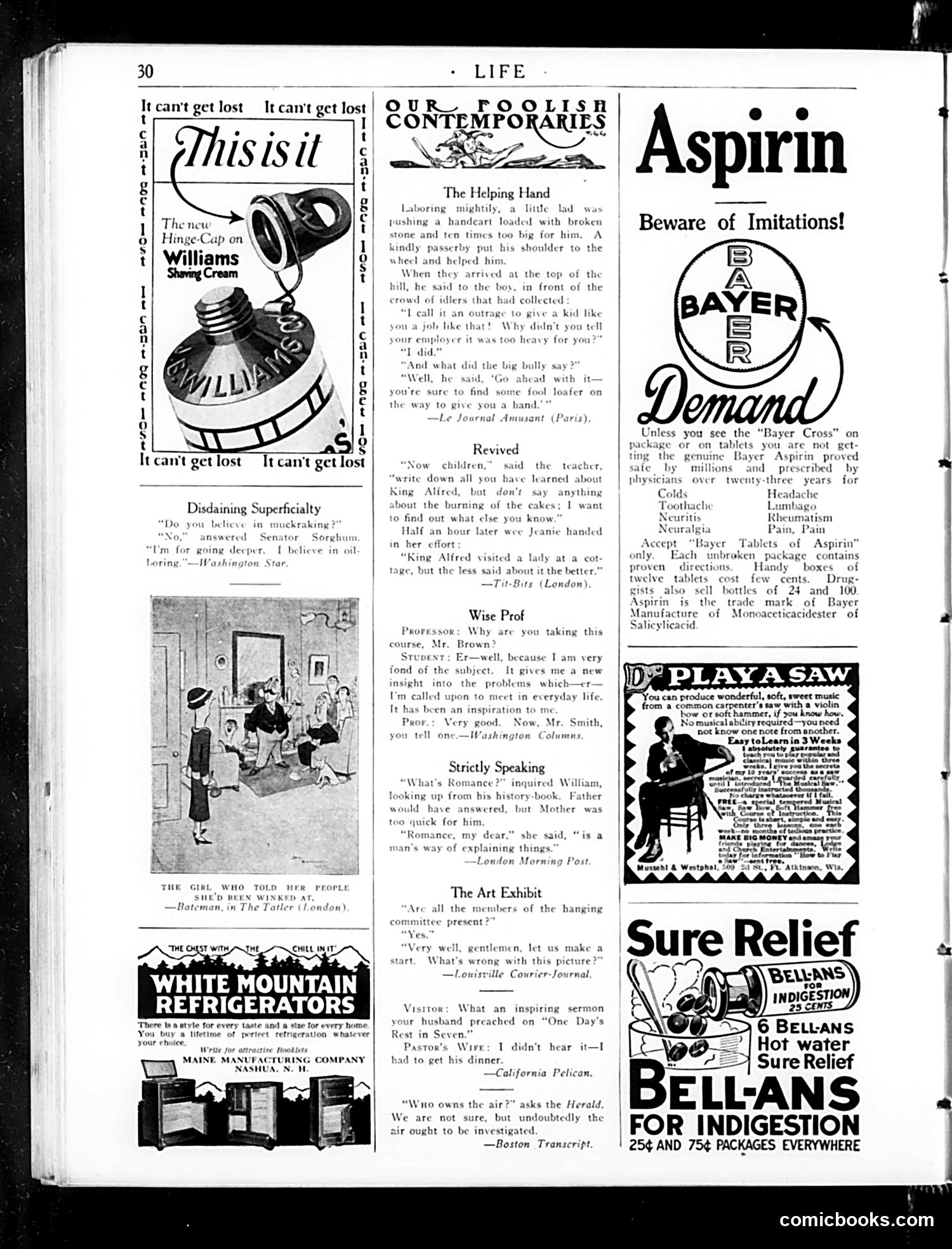
This page contains several short satirical anecdotes and advertisements from Life magazine's humor section. **"The Helping Hand"** mocks performative kindness. A boy struggles pushing a heavy cart uphill; a man helps him reach the top, then publicly shames the boy for accepting aid, claiming no employer would assign such difficult work. The joke: the "helpful" man actually insults the child while appearing virtuous to onlookers. **"Revived"** satirizes rigid education. A teacher instructs students to write only what they learned about King Alfred, explicitly forbidding mention of him burning cakes (a famous historical detail). A student later produces a blank paper—she learned nothing else. The satire targets how restrictions on thought produce ignorance. **Other items** include brief jokes about superficiality, professorial pretension, and romance definitions—typical humor-magazine fare emphasizing social hypocrisy. The page is largely **advertisements** (Williams Shaving Cream, Aspirin, refrigerators, music saw lessons, Bellans antacid) interspersed with these short comic pieces—standard Life magazine format from the early 20th century.
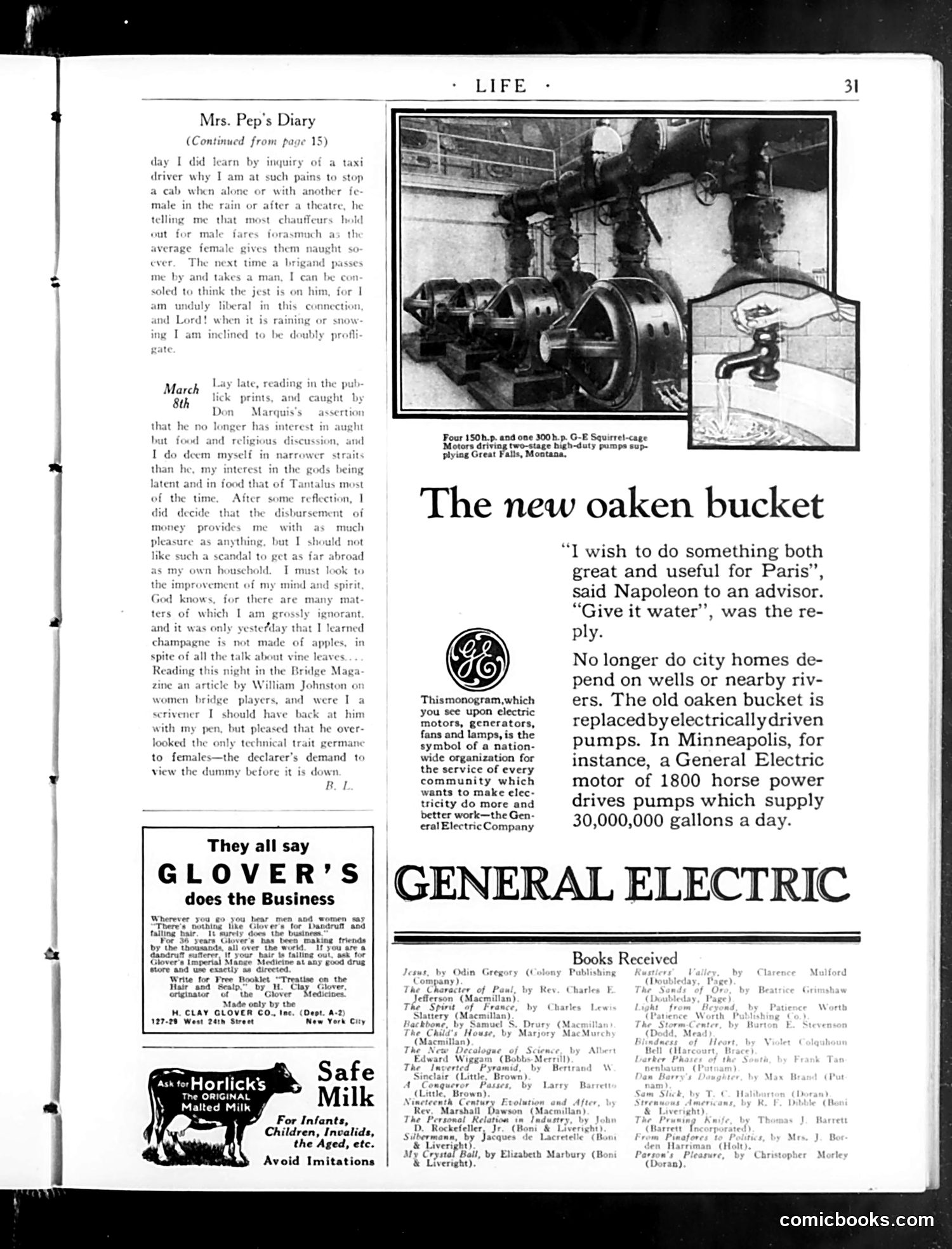
This page is primarily **advertising**, not satire or political commentary. The main content is a General Electric advertisement disguised as an article titled "The new oaken bucket." The ad uses a historical reference: Napoleon supposedly said he wished to do something "great and useful for Paris" and was advised to "Give it water"—referencing the famous folk song "The Old Oaken Bucket." GE uses this to argue that modern **electric pumps have replaced traditional wells**, positioning electricity as progress. The ad highlights a specific example: a Minneapolis GE motor supplying 30,000,000 gallons daily. The page also contains: - **Mrs. Pep's Diary** (continued from previous page)—gossip/social commentary - **"They all say Glover's does the Business"**—a testimonial ad for hair/scalp treatment - **Horlick's Malted Milk** advertisement - A **Books Received** section There is no significant political cartoon or satire; this is essentially a magazine page mixing editorial content with period advertisements.
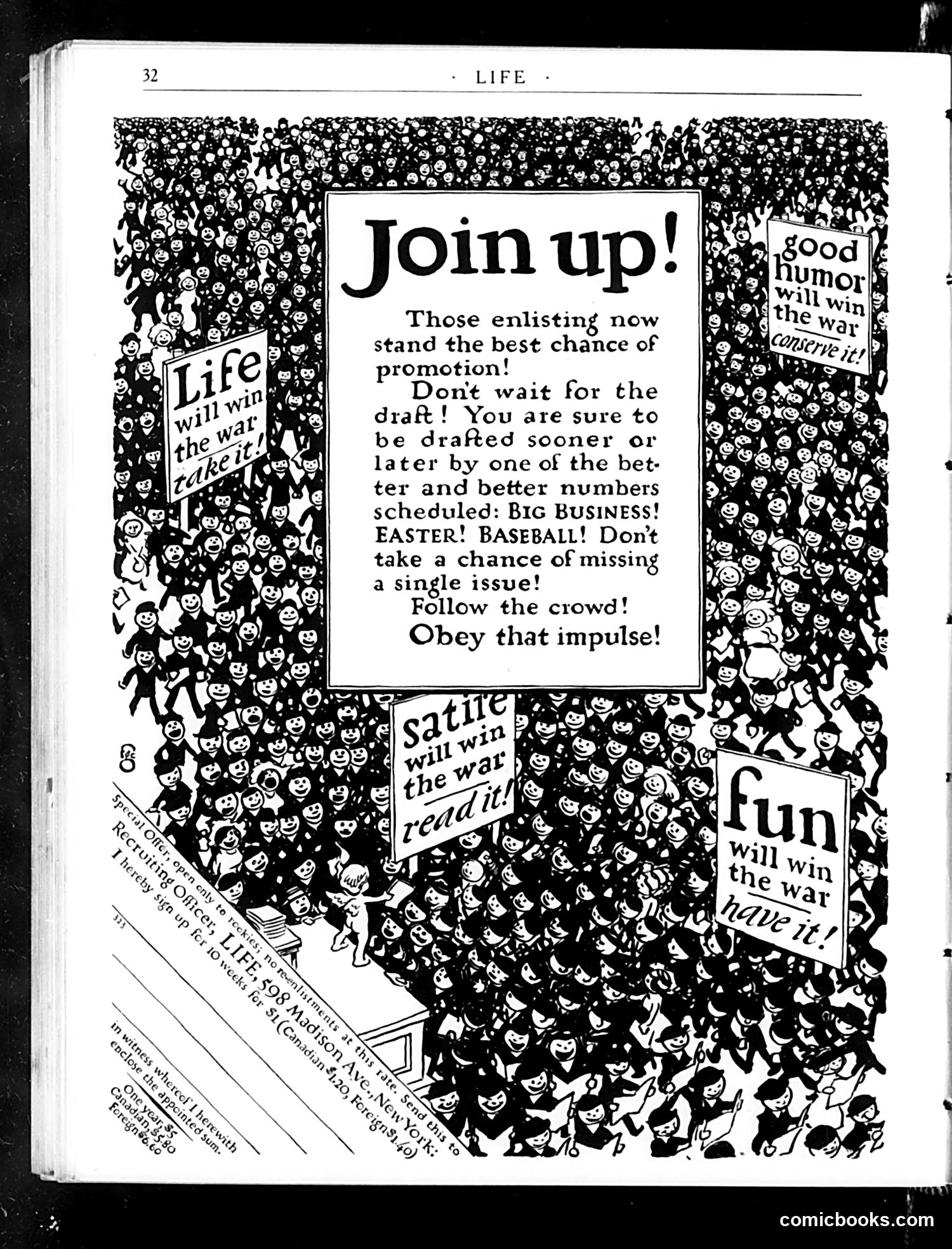
This is a **World War I military recruitment advertisement** disguised as satirical commentary. The central message urges young men to enlist voluntarily rather than wait to be drafted, promising better promotion chances for early volunteers. The satire works by openly acknowledging the manipulation: the ad explicitly tells readers to "Follow the crowd! Obey that impulse!"—revealing the peer-pressure tactics being used. Surrounding text boxes promise that "Life will win the war," "Saving will win the war," and "Fun will win the war"—cynically suggesting Americans can win through mere entertainment and consumerism. The sea of identical smiling faces represents mass conformity and the dehumanizing effect of military mobilization. By admitting its own propagandistic techniques ("Don't take a chance of missing a single issue!"), the advertisement mockingly exposes how wartime recruitment exploits emotional appeals and manufactured enthusiasm. The overall effect satirizes American war culture while simultaneously advancing its recruitment goals.
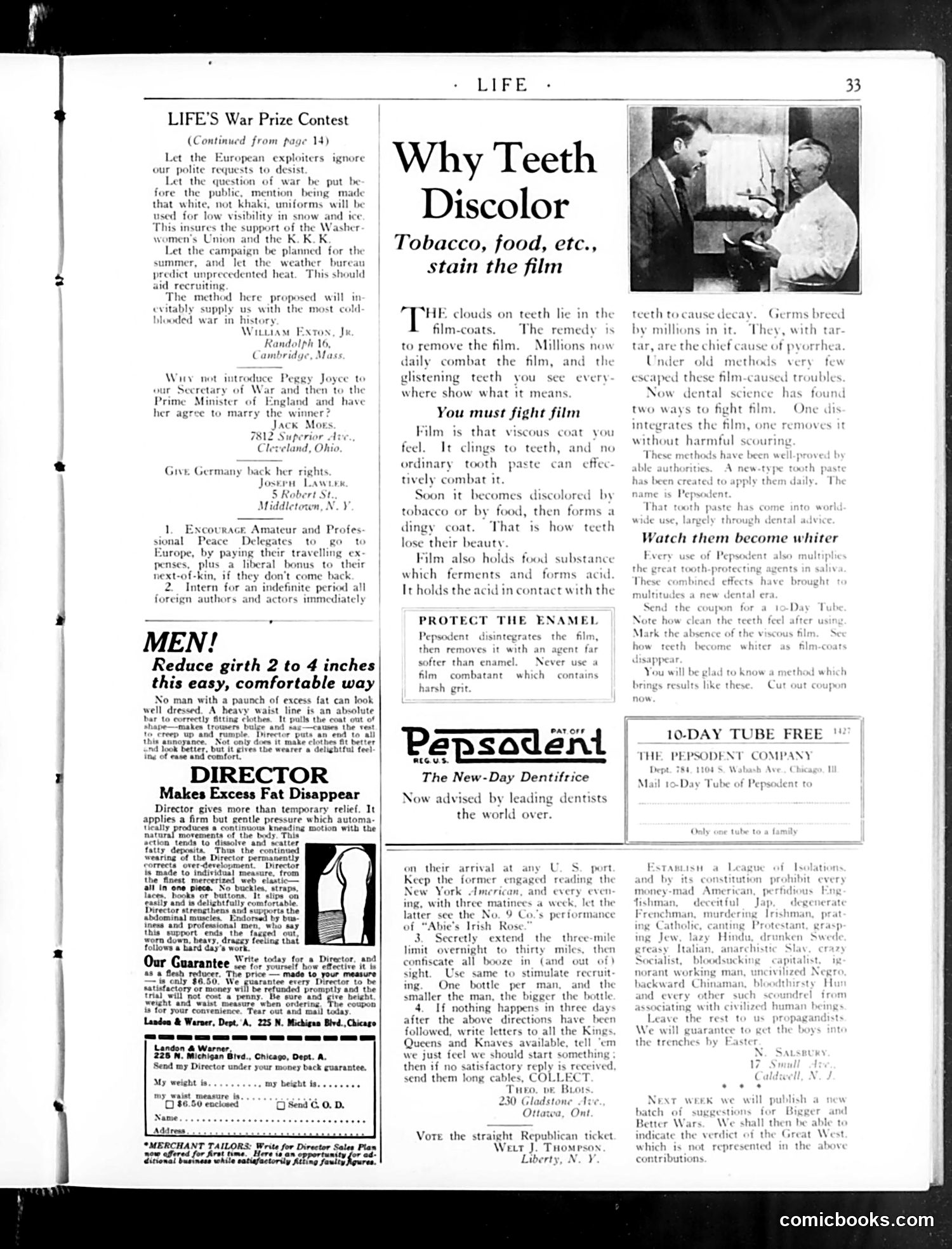
This page contains two distinct sections: **Left side:** Reader submissions to "Life's War Prize Contest," asking for satirical suggestions on how to conduct war. Proposals include absurdist ideas like making soldiers wear white uniforms for visibility (mocking pacifists and the KKK), introducing actress Peggy Joyce to seduce war officials, and paying bonuses to families of killed peace delegates. The satire targets both pro-war and anti-war factions with equal ridicule. **Right side:** A Pepsodent toothpaste advertisement, the dominant content. The ad explains tooth discoloration through "film" buildup from tobacco and food, positioning Pepsodent as the scientific solution. It includes promotional offers and testimonials from dentists. The juxtaposition is characteristic of Life magazine's format: political satire and consumer advertising coexist on the same page. The contest mocks America's conflicting positions on international involvement (likely post-WWI era), while the advertisement represents the era's faith in modern consumer products solving everyday problems.
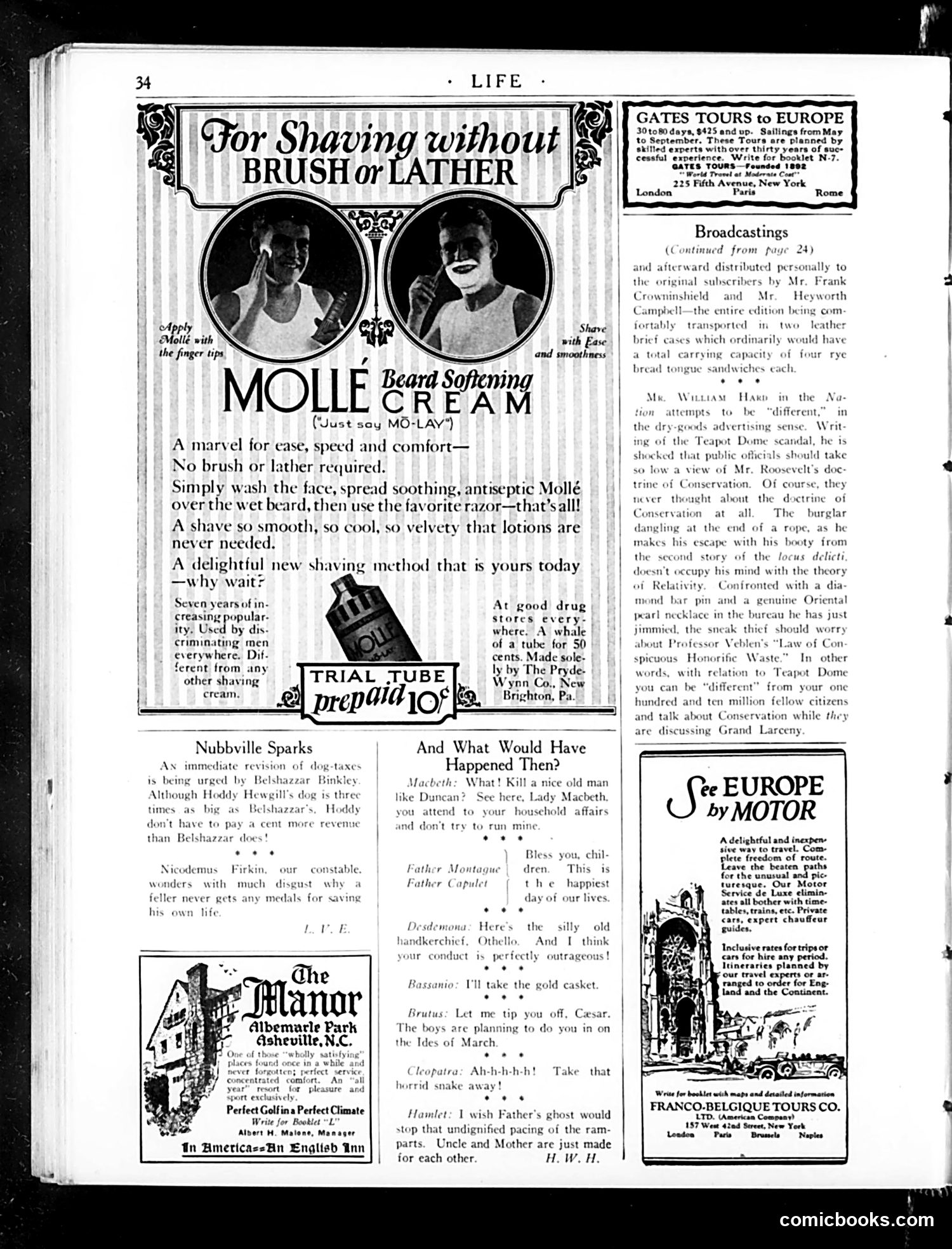
This page is primarily **advertising mixed with light satirical content**. The dominant feature is a Mollé Beard Softening Cream advertisement promoting a brushless shaving method—positioned as modern convenience over traditional techniques. The satirical section, titled "And What Would Have Happened Then?," contains brief comic reworkings of famous Shakespeare scenes. The jokes imagine how classic tragic characters would behave if they adopted modern concerns: Macbeth worries about "household affairs," Othello frets over a handkerchief in mundane ways, and Hamlet complains about undignified pacing. The humor lies in **deflating tragic drama with domestic banality**—treating momentous literary moments as if the characters were ordinary people preoccupied with petty details. "Nubbville Sparks" below offers light local humor about dog taxes and a constable. The remaining content comprises travel advertisements (Gates Tours to Europe, Franco-Belgique Motor Tours) and hotel promotions, typical of Life's revenue model during this era.
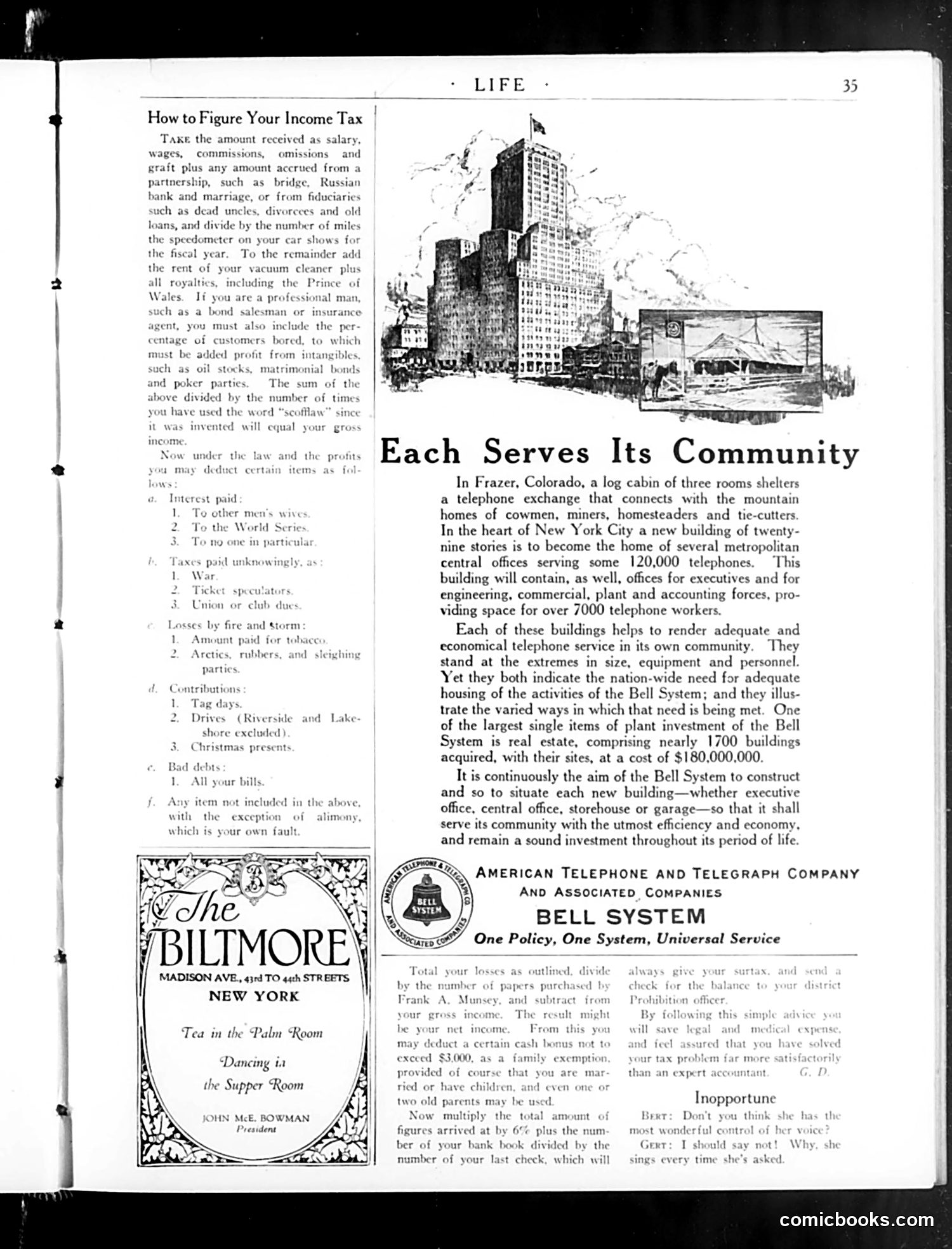
This page contains **two distinct pieces of content**: **1. The Income Tax Satire (Left Column):** A humorous "guide" mocking the newly complex U.S. income tax system. The absurdist instructions—dividing salary by car odometer readings, deducting vacuum cleaner rentals, counting uses of the word "graft"—satirize how confusing and arbitrary tax calculations felt to ordinary Americans. This likely dates to the early 1900s when income tax was new and labyrinthine. **2. The Bell System Advertisement (Main Content):** Corporate messaging from American Telephone & Telegraph celebrating infrastructure investment. It contrasts a tiny Colorado log-cabin telephone exchange with a 29-story NYC building serving 120,000 phones, arguing both serve their communities equally. The advertisement emphasizes Bell's massive real-estate portfolio ($180 million) as proof of commitment to "universal service." The page juxtaposes citizen frustration (incomprehensible taxes) with corporate self-promotion (essential services), creating implicit commentary on who bears financial burdens versus who profits from infrastructure—though this may be unintentional.
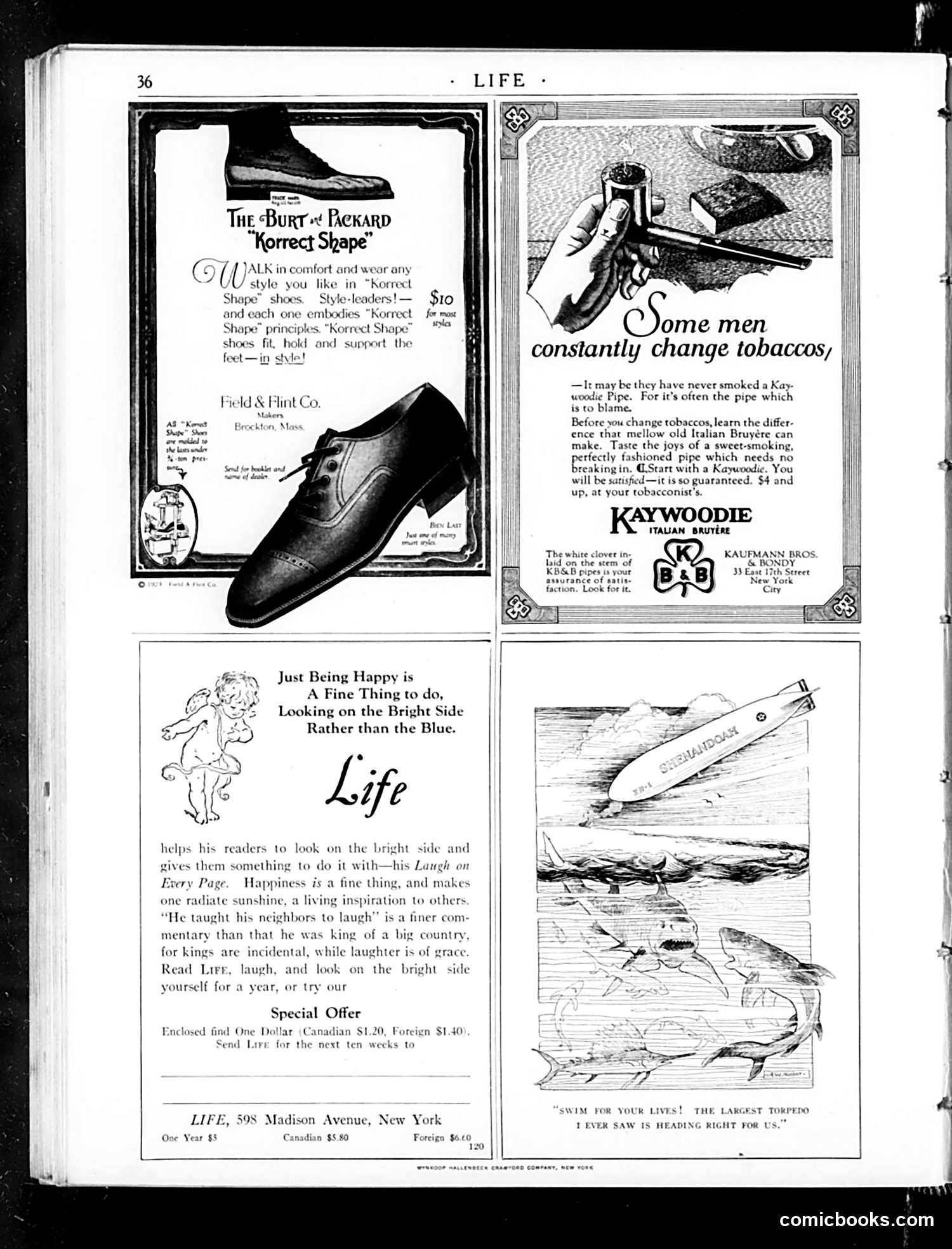
This page contains three distinct advertisements and promotional content, not political cartoons. The top ads promote consumer goods: "Korrect Shape" shoes (Field & Flint Co.) emphasizing comfort and style, and Kaywoodie Italian pipes ($4 up), suggesting pipe quality matters more than tobacco choice. The center promotes Life magazine itself, using a cherub illustration and philosophy about happiness. It frames Life as providing humor and optimism ("Lunch on Every Page"), positioning reading as a moral good that inspires others through laughter. The bottom illustration appears to be humorous content from Life—a cartoon showing figures in water spotting a large torpedo approaching, with the caption "SWIM FOR YOUR LIVES! THE LARGEST TORPEDO I EVER SAW IS HEADING RIGHT FOR US." This likely references WWI-era submarine warfare anxieties, using exaggeration for comedic effect rather than serious satire. The page is primarily advertisement and self-promotion.
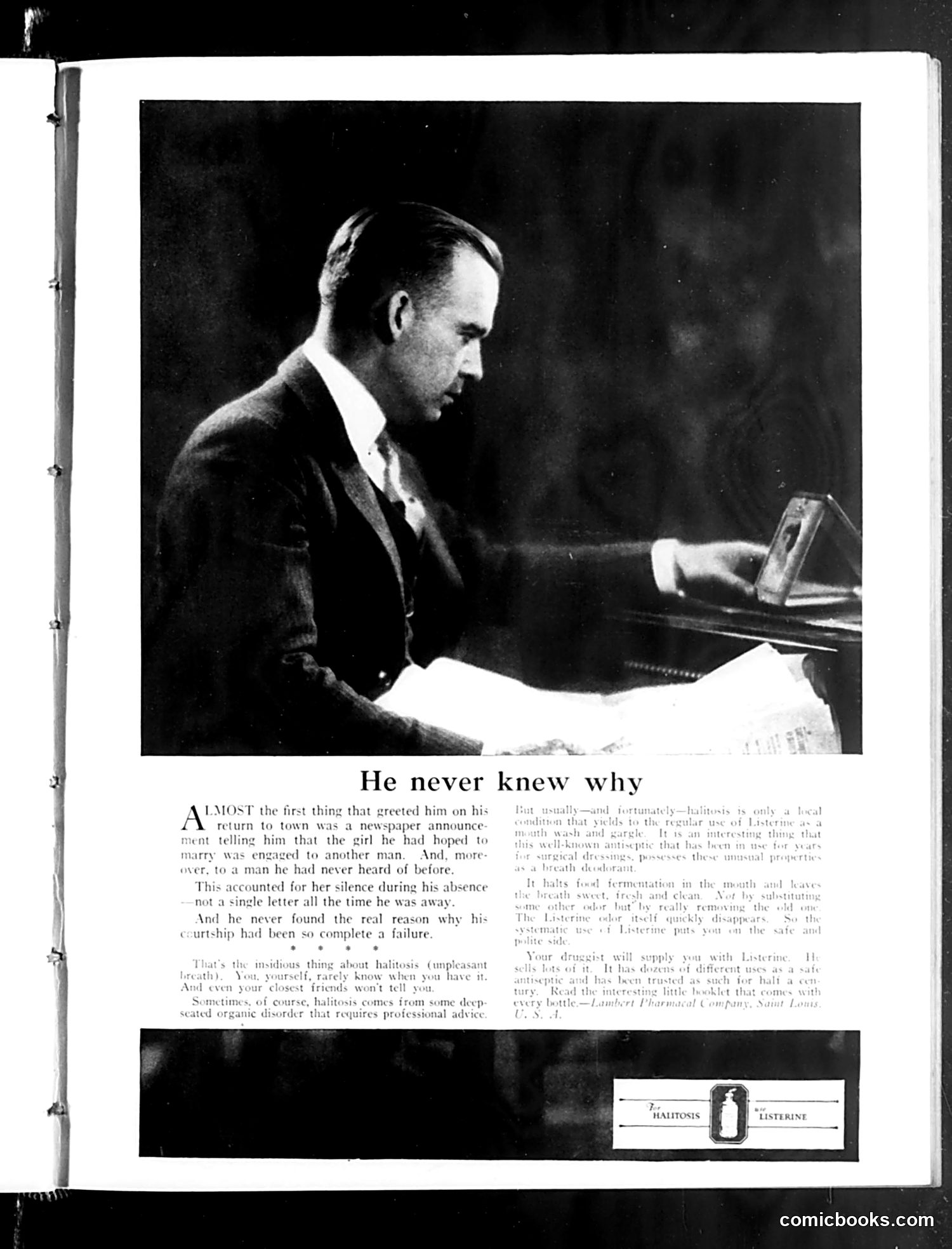
This appears to be a **Listerine advertisement** disguised as satirical commentary on marriage and social embarrassment. The narrative describes a man who discovers—via newspaper announcement—that his fiancée has become engaged to someone else during his absence, leaving him mystified about why his courtship "failed." The implicit joke: his halitosis (bad breath) was the real reason she rejected him, though no one had the courage to tell him directly. The text explicitly references "halitosis" as an "unpleasant" condition people won't discuss candidly, even with close friends. The advertisement then pivots to promoting **Listerine** as the solution—a mouthwash that supposedly prevents social rejection by eliminating the odor condition. This was a common advertising strategy of the era: create social anxiety, then sell the cure. The brand name appears at the bottom with the slogan. This represents vintage advertising that weaponized shame and embarrassment to drive consumer behavior.
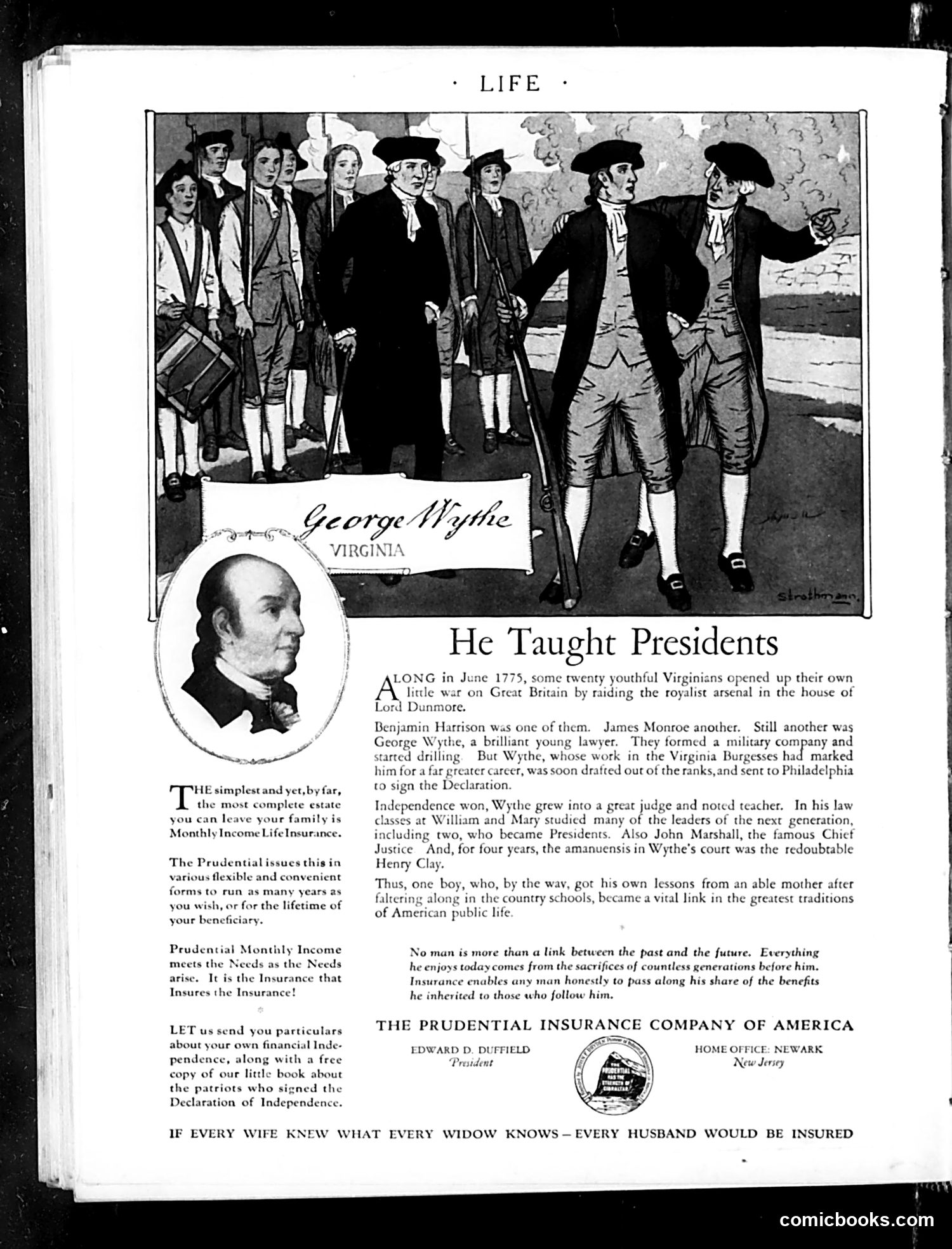
This is primarily an insurance advertisement using American history as its hook. The page features George Wythe, a Virginia lawyer and judge (shown in the portrait), who taught multiple future U.S. Presidents—including James Monroe and John Marshall—at William and Mary College. The illustration depicts Wythe drilling with other young Virginians in 1775 before being drafted to sign the Declaration of Independence. The satirical point: Prudential Insurance positions itself as a link between generations, much like Wythe connected past and future through education and example. The ad's tagline—"If every wife knew what every widow knows, every husband would be insured"—uses dark humor, implying widows understand financial hardship better than living husbands. The message: insurance provides security across generations, echoing Wythe's role as a transmitter of values and knowledge to America's future leaders.