
Life, 1924-03-13 · page 22 of 40
Life — March 13, 1924 — page 22: what you’re looking at
What you’re looking at
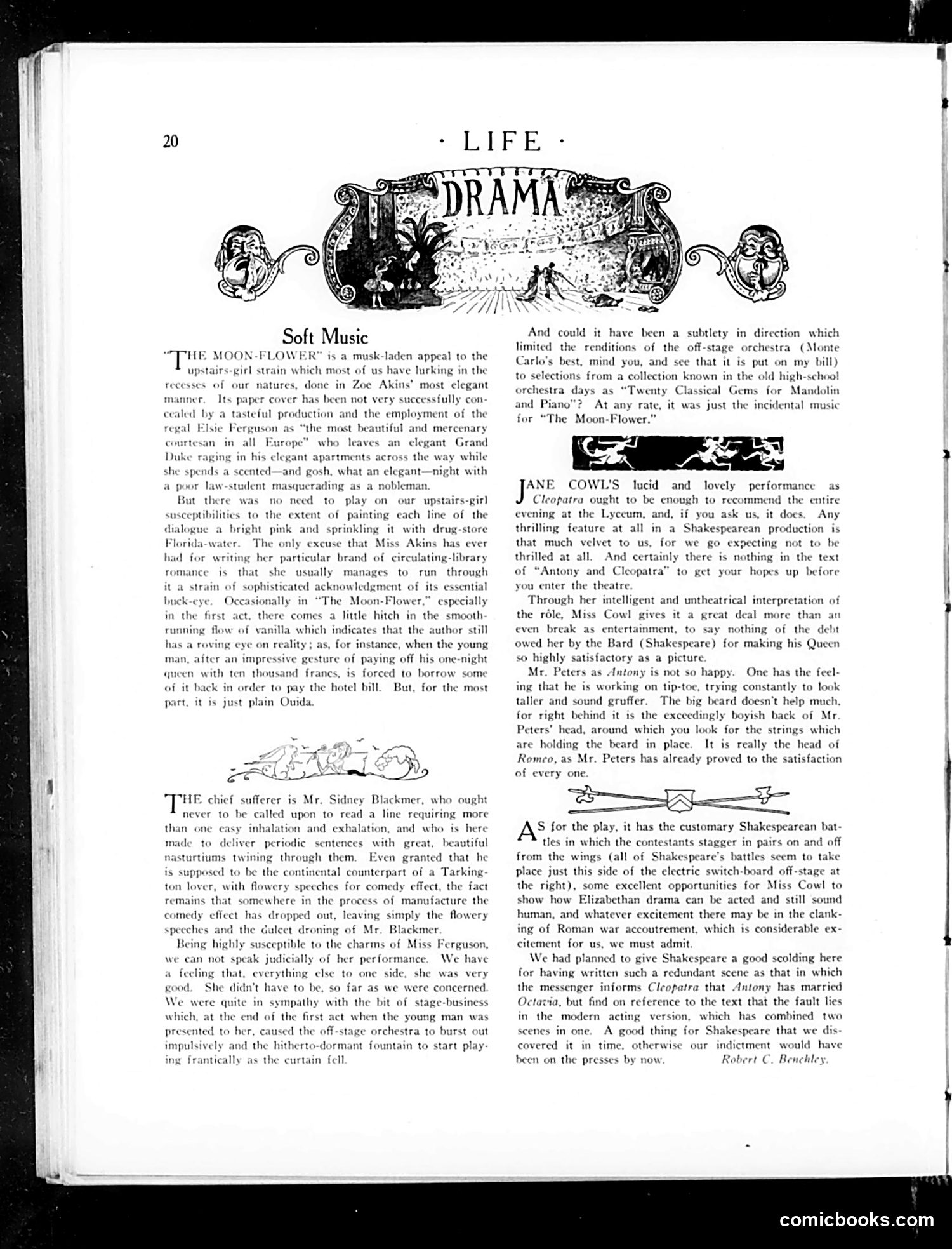
This page contains theater reviews from *Life* magazine's drama section. The reviews critique three productions: **"The Moon-Flower"** stars Elsie Ferguson as a courtesan in a plot about a poor law student posing as nobility. The critic dismisses it as frivolous romantic melodrama (comparing it to novelist Ouida's saccharine work). Actor Sidney Blackmer is criticized for delivering flowery speeches that undermine comedic effect. The review notes the off-stage orchestra played only "Twenty Classical Gems for Mandolin and Piano"—apparently a pedestrian, high-school-level musical selection—for incidental music. **"Antony and Cleopatra"** features Jane Cowl as Cleopatra. The critic praises her "intelligent and untheatrical interpretation," noting that any thrilling Shakespearean production is unexpected bonus entertainment. Actor Peters as Antony receives less favorable mention. The satire targets theatrical pretension and mediocre dramatic writing disguised as sophistication.
📄 Transcribed text from this page (OCR, searchable)
Machine-transcribed from the original scan — historical spelling and the odd misread are preserved.
Soft Music “THE MOON-FLOWER™ is a musk-laden appeal to the upstairs-girl strain which most of us have lurking in the recesses of our natures, done in Zoe Akins’ most elegant manner, Its paper cover has been not very successfully con cealed by a tasteful production and the employment of the regal Elsie Ferguson as “the most beautiful and mercenary courtesan in all I elegant: Grand Duke raging in his elegant apartments across the way while ype” who leaves she spends a scented—and gosh, what an elegant—night with a poor law-student masquerading as a nobleman. But th was no need to play on our upstairs-girl susceptibilities to the extent of painting each line of the dialogue a bright pink and sprinkling it with drug-store Florida-water. The only excuse that Miss Akins has ever had for writing her particular brand of circulating-library romance is that she usually manages to run through it a strain of sophisticated acknowledgment of its essential nally in “The Moon-Flower,” especially buck-eye. Occasi in the first act, there comes a little hitch in the smooth running flow of vant a which indicates that the author still has a roving eye on reality; as, for instance, when the young man, after an impressive gesture of paying off his one-night en with ten thousand francs, is forced to borrow some of it back in order to pay the hotel bill. But, for the most part, it is just plain Ouida. THe chief sufferer is Mr. Sidney Blackmer, who ought never to be called upon to read a line requiring more than one easy inhalation and exhalation, and who is here made to deliver periodic sentences with great, beautiful hasturtiums twining through them, Even granted that he is supposed to be the continental counterpart of a Tarking t lover, with flowery speeches for comedy effect, the fact remains that somewhere in the process of manufacture the comedy effect has dropped out, leaving simply the flowery 1 the dulect droning of Mr. Blackmer the charms of Miss Ferguson speeches Being highly susceptible we can not speak judicially of her performance. We have a feeling that, everything else to one side, she was very Kc She didn’t have to be, so far as we were concerned We were quite in sympathy with the bit of stage-business which. at the end of the first act when the young man was presented to her, caused the off-stage orchestra to burst out impulsively and the hitherto-dormant fountain to start antically as the curtain fell And could it have been a subtlety in direction which limited the renditions of the off-stage orchestra (Monte Carlo’s best, mind you, and sce that it is put on my bill) to selections from a lection known in the high-school orchestra days as * of Mandolin and I 2 At any rate, it was just the incidental music for “The Moon-Flower.’ ANE COWL'S lucid and lovely performance as Cleopatra ought to be enough to recommend the entire evening at the Lyceum, and, if you ask us, it does. Any thrilling feature at all in a Shakespearean production is that much velvet to us, for we go expecting not to be wenty Classical Gems no’ thrilled at all. And certainly there is nothing in the text of “Antony and Cleopatra” to get your hopes up before you enter the theatre. Through her intelligent and untheatrical interpretation of the rdle, Miss Cowl gives it a great deal more than an even break as entertainment, to say nothing of the debt owed her by the Bard (Shakespeare) for making his Queen so highly satisfactory as a picture. Mr, Peters as Antony is not so happy. One has the feel- ing that he is working on tip-toe, trying constantly to look taller and sound gruffer. The big beard doesn't help much, for right behind it is the exceedingly boyish back of Mr. Peters’ head, around which you look for he strings which are holding the beard in place. It is really the head of Romeo, as Mr. Peters has already proved to the satisfaction of every one. oS S for the play, it has the customary Shakespearean bat- tles in which the contestants sta ger in pairs on and off from the wings (all of Shakespeare's battles seem to take place just this side of the electric switch-board off-sta the right), some excellent opportunities for Miss Cowl to show how Elizabethan drama can be acted and still sound human, and whatever excitement there may be in the clank- ing of Roman war accoutrement, which is considerable ex- citement for us, we must admit We had planned to give Shakespeare a good scolding here for having written such a redundant scene as that in which the messenger informs Cleopatra that Antony has married Octavia, but find on reference to the text that the fault lies in the modern acting version, which has combined two scenes in one. A good thing for Shakespeare that we dis- covered it in time, otherwise our indictment would have been on the presses by now Robert C. Benchley comicbooks.com