
Life, 1924-03-13 · page 26 of 40
Life — March 13, 1924 — page 26: what you’re looking at
What you’re looking at
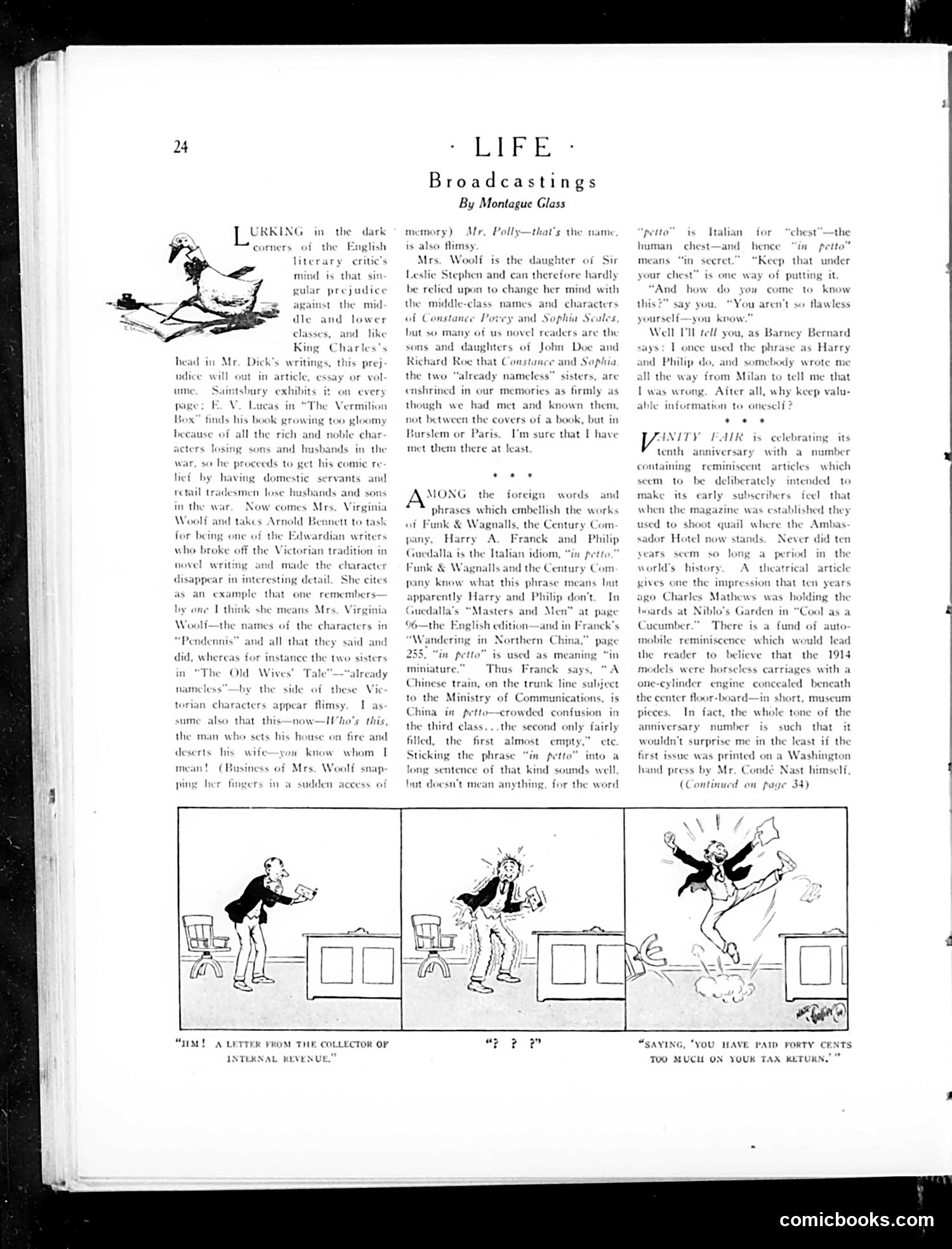
This page contains a literary column by Montague Glass discussing English literary criticism and foreign phrases, paired with a three-panel comic strip below. ## The Literary Column Glass critiques English critics' class prejudices, citing Saintsbury and others who dismiss working-class characters in novels as "flimsy" compared to Victorian-era figures. He defends popular fictional characters like Mr. Polly (appearing to reference H.G. Wells) as memorable and real to readers despite their humble origins. The column also discusses the Italian phrase "in petto" (meaning "in secret" or "in the chest") as used in various literary works by Funk & Wagnalls and Century Company publications. ## The Comic Strip The three panels show a comedic tax audit scenario: a man receives a letter from the Internal Revenue Collector (panel 1), appears confused ("? ?"), then reacts with exaggerated panic when told he overpaid forty cents on his tax return (panel 3)—the humor lying in his absurdly disproportionate reaction to a trivial amount.
📄 Transcribed text from this page (OCR, searchable)
Machine-transcribed from the original scan — historical spelling and the odd misread are preserved.
Lt RKING the dark corners of the English literary critic's mind is that sir gular prejudice classes, and Kin, S writings, this prej Char head in Mr udice will « ticle, essay or vol ume, Saintsbury exhibits it on every page; E. V. Lucas in “The Vermilion Box” finds his book growing t because of all the h and acters | " and hush r proceeds to get his comic re lief by having domi retail tradesmen lose hi rvants ands and in the war. Now comes M Virginia Woolf and takes Arnold Bennett to task for being one of Edwardian writer who broke off t cl writing Victorian tra and on tion in the character She pear in interesti 4s an example that one remem hy one [think she means Woolf—the n: mes of the characters in and all that they did, whereas for instance the two Wives’ Tale” nameless”—hy the side of in “The O} these torian characters appear flimsy at this. Who's use on fire know sume now th the man who sets his h and deserts his wife—you whom I LIFE - Broadcastings By Montague Glass memory) Mr, Polly “s the name is also flimsy Mrs. Woolf ter of Sir Leslie Stephen and can therefore hardly is the dat be relied upon to change her mind with the middle-class names and characters but so many of us novel readers the sons and daughters of John Doe and Richard Roe that Cc ady 1 and Sop! the two * meless’ sters, are enshrined in our memories as firmly as h we had met known them. not between the covers of a book, but in Burslem or Paris. at I have I'm sure met them there at least MONG | the phrases which embellish the works of Funk & W pany, Harry foreign words and ls, the Century Com F Philip Guedalla is the Italian idiom, “in pet Funk & Wagnalls and the Century Com pany know what this phr nck and apparently Harry and Ph Guedalla’s “Masters and Me %6—the English edition—and in Franck’s Wandering in North Ch “in petto” is used as mean ture Thus Fr. Chinese train, on the tr Ministry ack 1k line subject says of Comr ications, is na in pet the third class fill the first Sticking the crowded confusion in the se 1 only fairly npty,” almost ¢ phrase ete “inp into a mean! ness of Mrs, Woolf snap- long sentence of that kind sounds well 4 cr IM! A LETTER FROM THE COLLECTOR OF INTERNAL KEVENUE is ior “chest"—the nan ches| hence “in petto" means “in sec “Keep that under your chest” is one way of putting it “And how do you come to know this?” say you. “You aren't so flawless you know.” Well I'll tell you, as Barney Be u as H. and somebody w nm Milan to yourself 1 once used the nd Philip the way fr me tell me that wrong. After all, why keep valu- able i rmation to oneself ? eee IR is celebrating its | ee / tenth c niversary number h with a containing reminiscent icles whic seem to be deliberately intended to m: its early when the magazine was established Ambas Never did ten period in tl ed to shoot quail where the dor He years sec world’s history A article ves one the impre Charles Mathe mm that ten years s was holding. the rds at Niblo’s Garden in “Cool a a Cucumber.” There is a fund of auto mobile reminiscence which would lead the reader to the 1914 models were h es with a one-cylinder engine concealed beneath the center floor-board museum pieces. In fact, the ne of the anniversary numb such that it wouldn't surprise me in the least if the first issue was printed on a Washington hand press by Mr. Condé Nast himself t (Ce on page 34) “SAYING, ‘YOU HAVE PAID FORTY CENTS TUO MUCH ON YOUR TAX RETURN,’ comicbooks.com