
A complete issue · 37 pages · 1923
Life — December 27, 1923
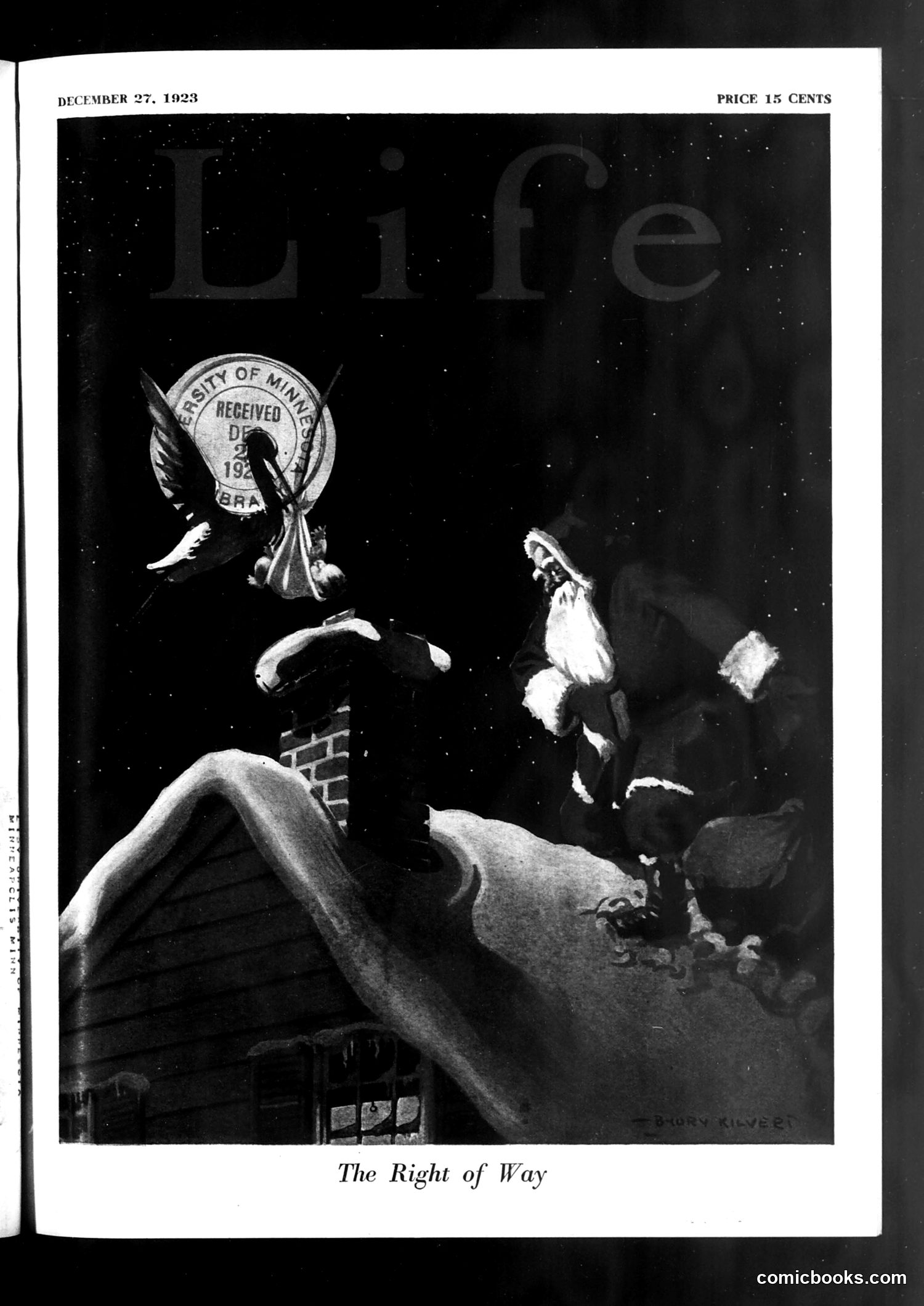
This cartoon satirizes pedestrian traffic safety, a growing concern in 1920s America as automobiles proliferated. The image shows a well-dressed woman whose head has been replaced with a "University of Minnesota" seal/emblem, suggesting she represents institutional authority or academic pretension. She appears to be confronting or yielding to a small dog in the street. The title "The Right of Way" is a legal/traffic term referring to who has priority in traffic situations. The joke seems to criticize how institutions or educated elites handle practical street safety—perhaps suggesting they're so absorbed in formal authority that they fail to notice actual dangers (the dog), or conversely, that pedestrians foolishly assume their status grants them traffic privileges over actual obstacles. The satire targets urban safety absurdity.
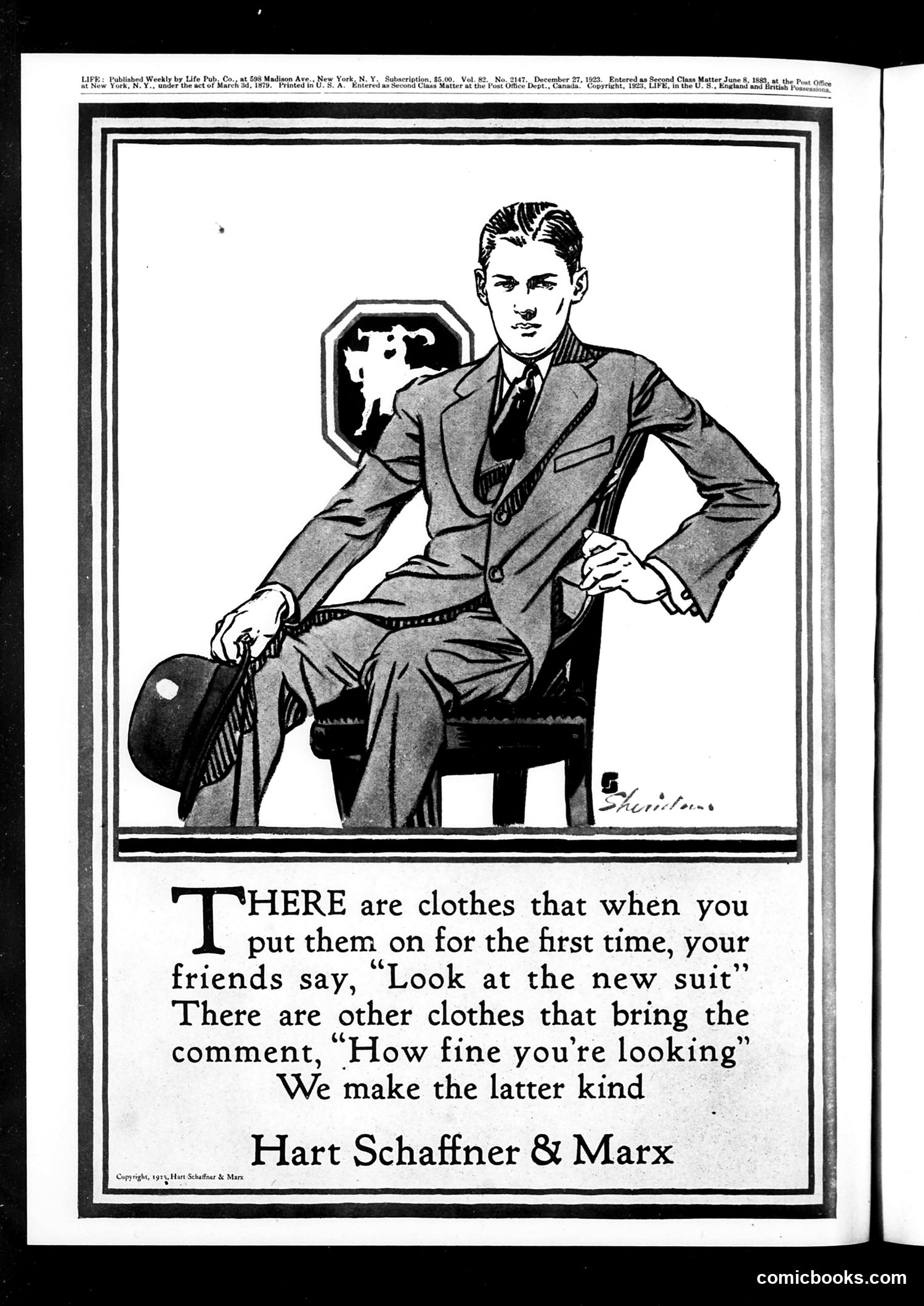
This is a **clothing advertisement**, not political satire. The page features a well-dressed man in a suit sitting confidently, holding a hat and briefcase. The ad distinguishes between two types of clothing: 1. Clothes that prompt friends to notice the **garment itself** ("Look at the new suit") 2. Clothes that prompt compliments about **the wearer** ("How fine you're looking") Hart Schaffner & Marx claims to make the latter kind—garments so well-made and flattering that they enhance the person wearing them rather than calling attention to themselves as novelties. The message targets middle-class men concerned with appearing refined and well-groomed. This represents early 20th-century aspirational marketing emphasizing quality and subtle sophistication.
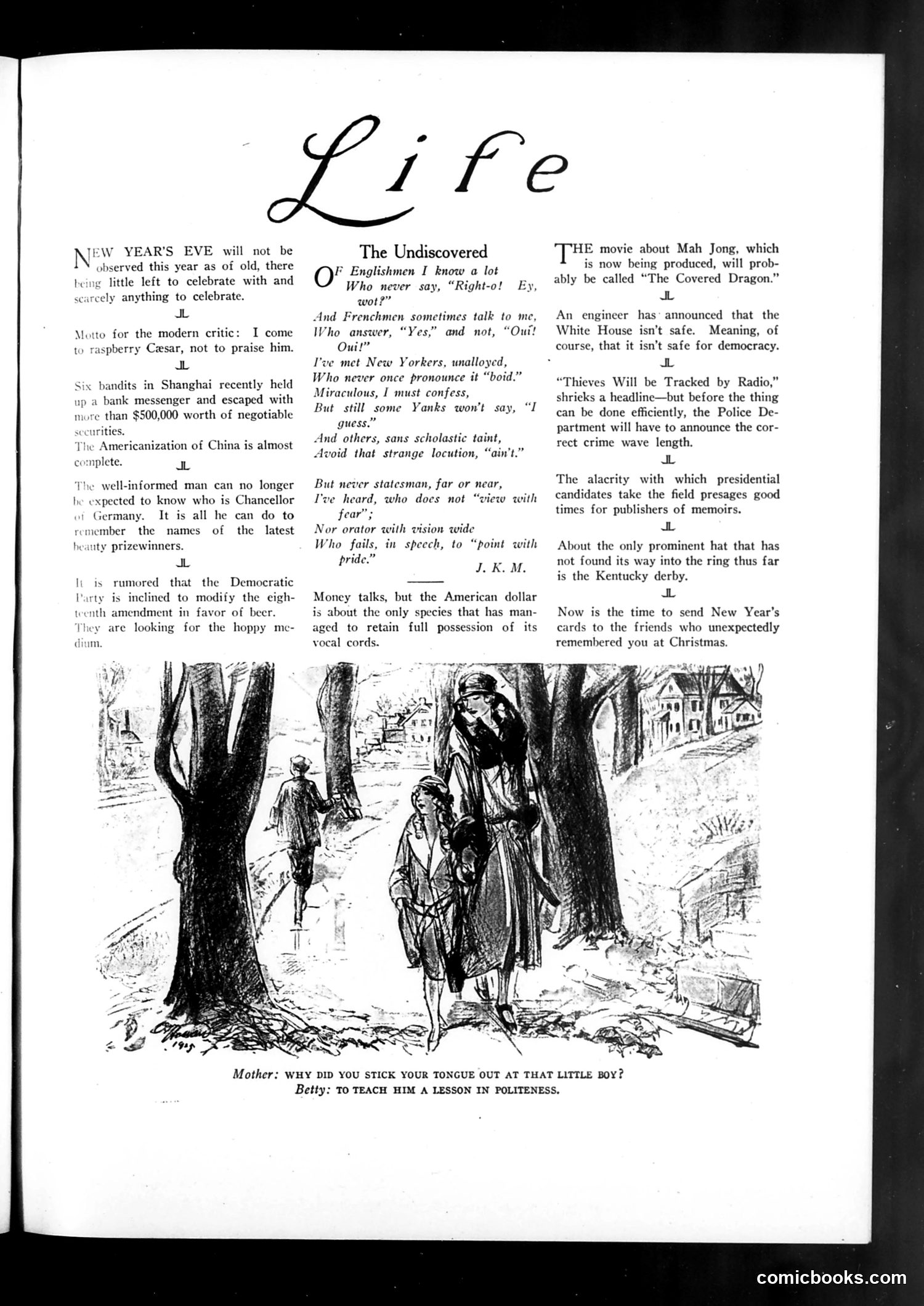
This page contains satirical commentary and a single cartoon. The top section includes brief observations on contemporary topics: New Year's Eve celebrations, the "Americanization of China," chancellors in Germany, the Democratic Party's potential modification of the Eighteenth Amendment, and American currency's stability. The cartoon depicts a mother scolding a young boy outdoors, with dialogue establishing a domestic morality lesson. The mother asks why the boy stuck his tongue out at "that little boy," and he responds he was "teaching him a lesson in politeness." The satire here is straightforward: the child's rude behavior contradicts his claimed educational purpose—a commentary on hypocritical moral instruction or the absurdity of teaching manners through impolite means. The humor relies on the child's innocent yet obviously flawed logic.
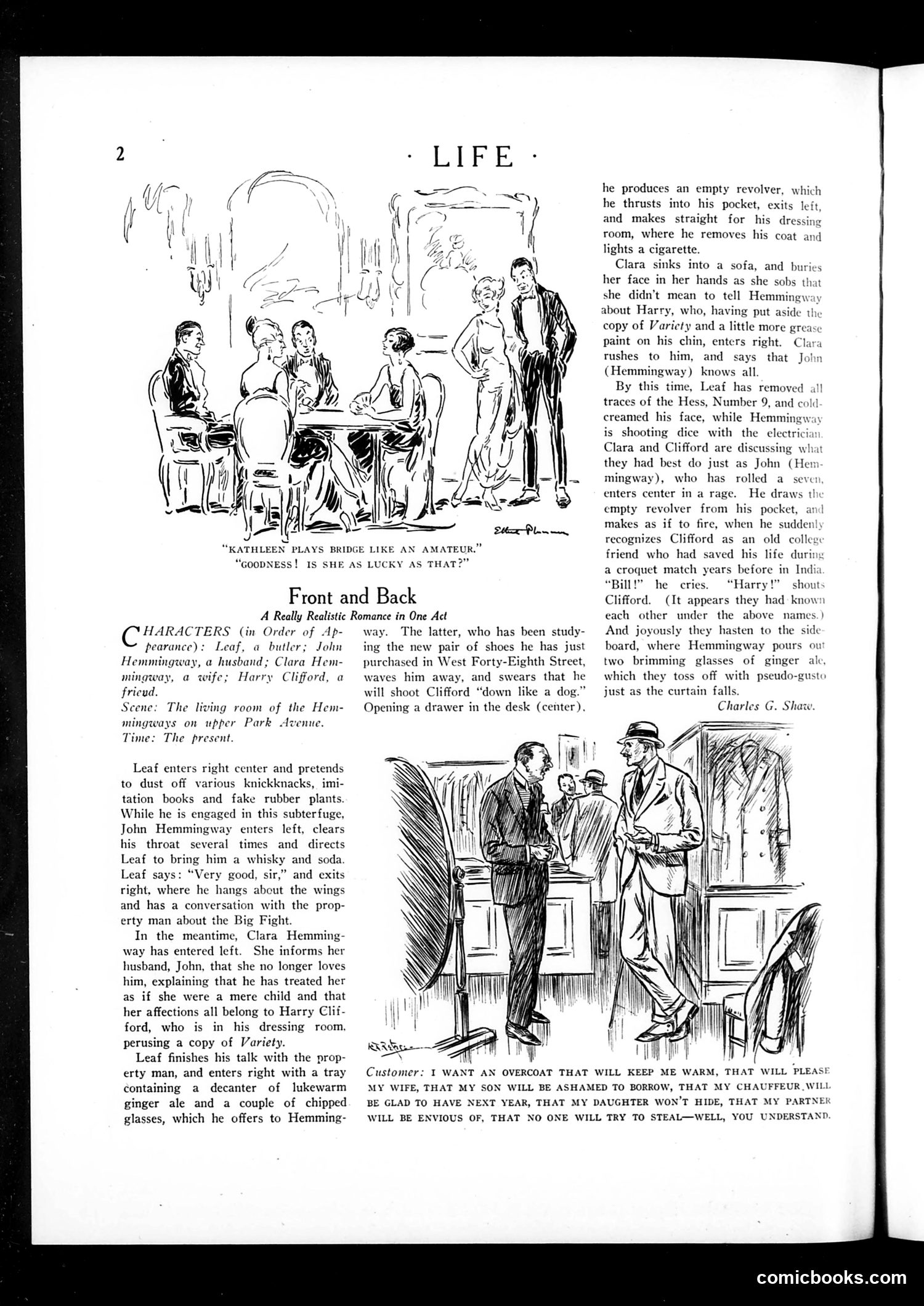
This is a satirical one-act play about marriage and infidelity set in a Manhattan apartment. The plot involves Leaf (a butler), John Hemmingway (a husband), Clara Hemmingway (his wife), and Harry Clifford (a friend). The satire centers on marital deception: Clara believes her husband no longer loves her and has transferred her affections to Harry Clifford. Meanwhile, John is preoccupied with mundane concerns like shoes and whisky. The joke appears to be about how couples misread each other's intentions and emotional states, with the "front and back" title suggesting the gap between public appearances and private realities in marriage. The cartoons illustrate various comedic domestic moments with period-typical drawing style.
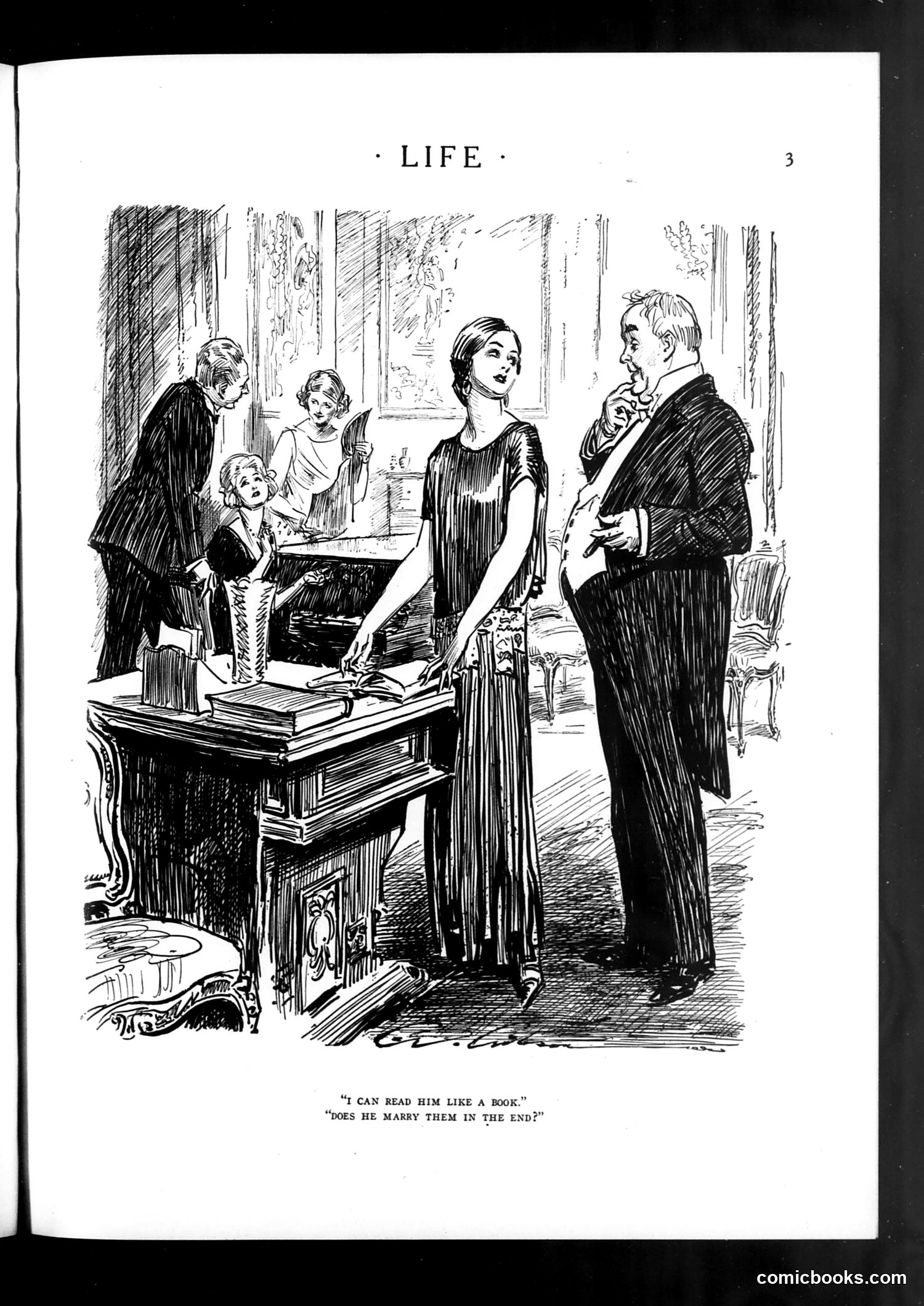
This is a satirical cartoon from *Life* magazine depicting a domestic scene. A woman stands at a desk while a man in a suit gestures toward her, speaking to another man. The caption reads: "I CAN READ HIM LIKE A BOOK." / "DOES HE MARRY THEM IN THE END?" The joke satirizes women's literary tastes and romantic expectations. The woman claims to understand men as easily as reading a book, while her companion jokes that the real question is whether these "readable" men actually marry women—implying that women's novels or popular fiction feature romantic storylines culminating in marriage, and that the woman is naively applying fictional expectations to real men. The cartoon mocks both sentimental women's literature and the gap between romantic fantasy and reality.
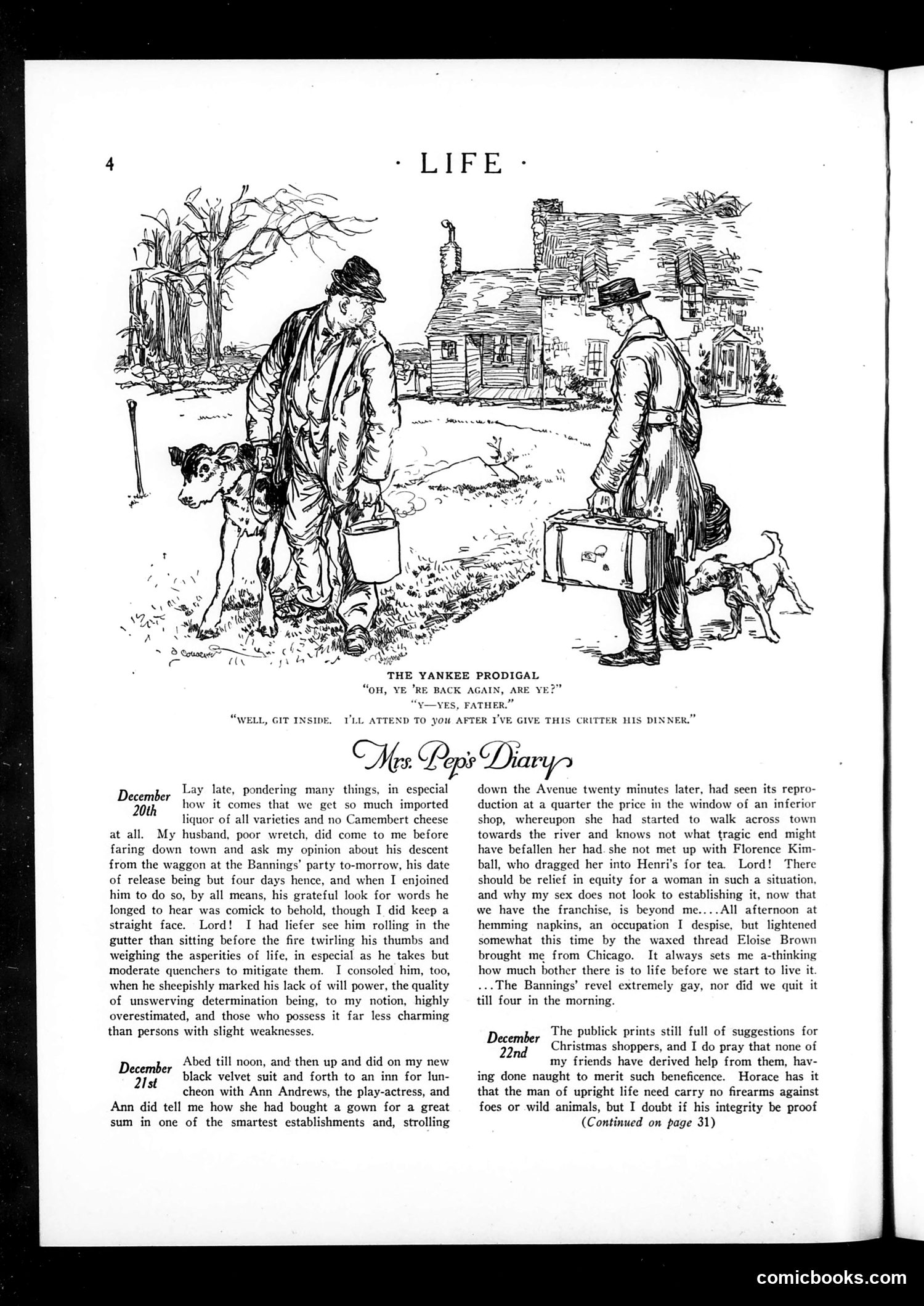
This cartoon depicts two men meeting on a rural road—one arriving with a suitcase, the other a local resident. The dialogue establishes the narrative: the traveler has returned home ("you're back again, are ye?"), and he plans to feed his dog before attending to local matters. The satire plays on the American archetype of the "prodigal son"—the wanderer returning from the city. The cartoon likely mocks either the returnee's priorities (feeding his dog before greeting people properly) or satirizes urban attitudes toward rural life and family obligations. The accompanying diary entries from December discuss holiday shopping and social gatherings, suggesting this page addresses seasonal themes of homecoming and social propriety during the Christmas season.
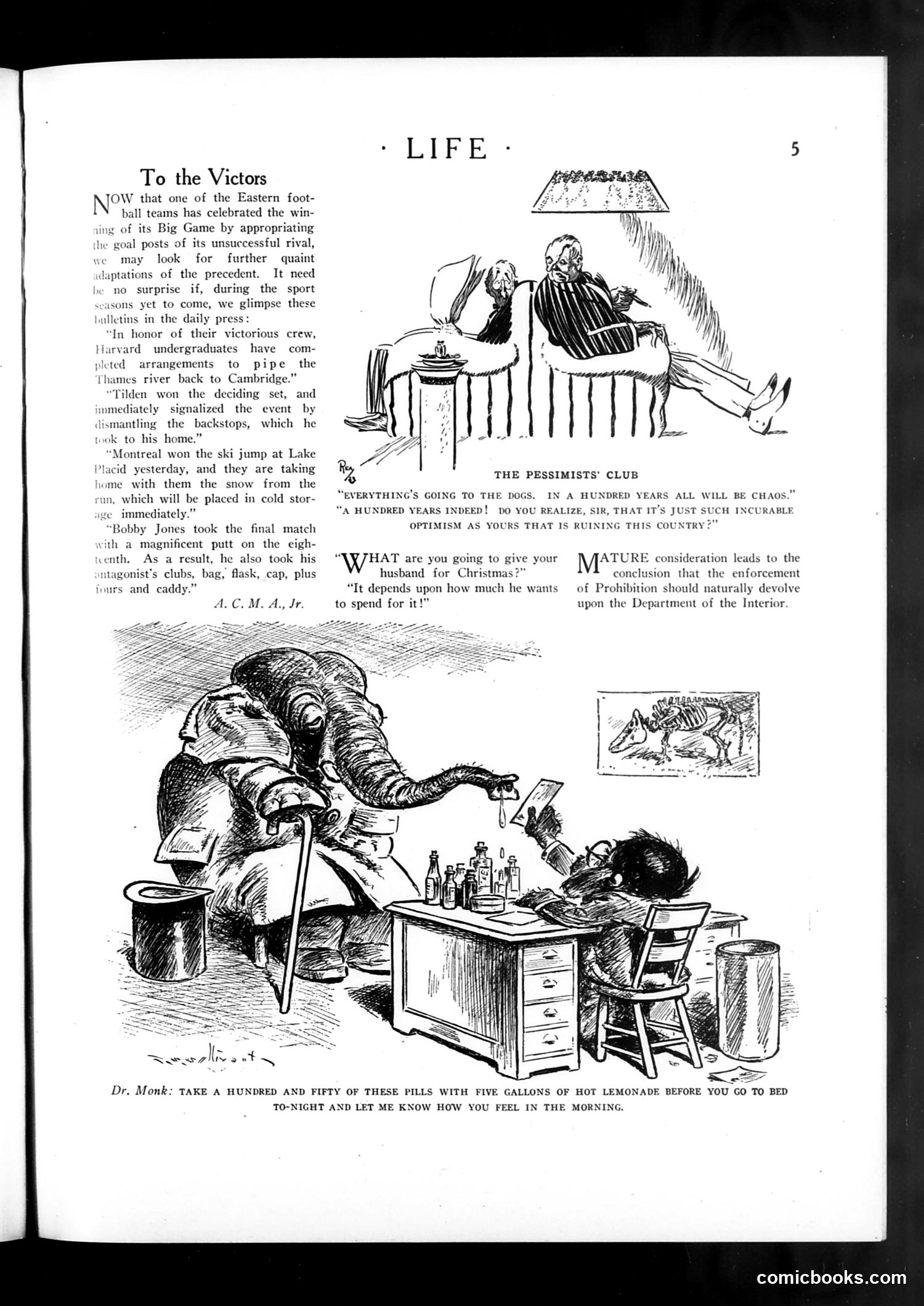
This page contains political satire about Prohibition enforcement. The top cartoon ("The Pessimists' Club") shows two men discussing whether Prohibition will create chaos—one optimistically dismissing such concerns. The larger cartoon features **Dr. Monk** (likely a reference to a real or fictional character) as an elephant sitting at a desk surrounded by bottles and medicine, being prescribed an absurd remedy: "a hundred and fifty pills with five gallons of hot lemonade" to cure his ailment. The elephant represents the **Department of Interior**, tasked with Prohibition enforcement—an impossible, unwieldy job. The satire mocks both the department's struggle with enforcing unpopular laws and the period's widespread skepticism about Prohibition's viability. The absurd "cure" symbolizes the futility of enforcement efforts.
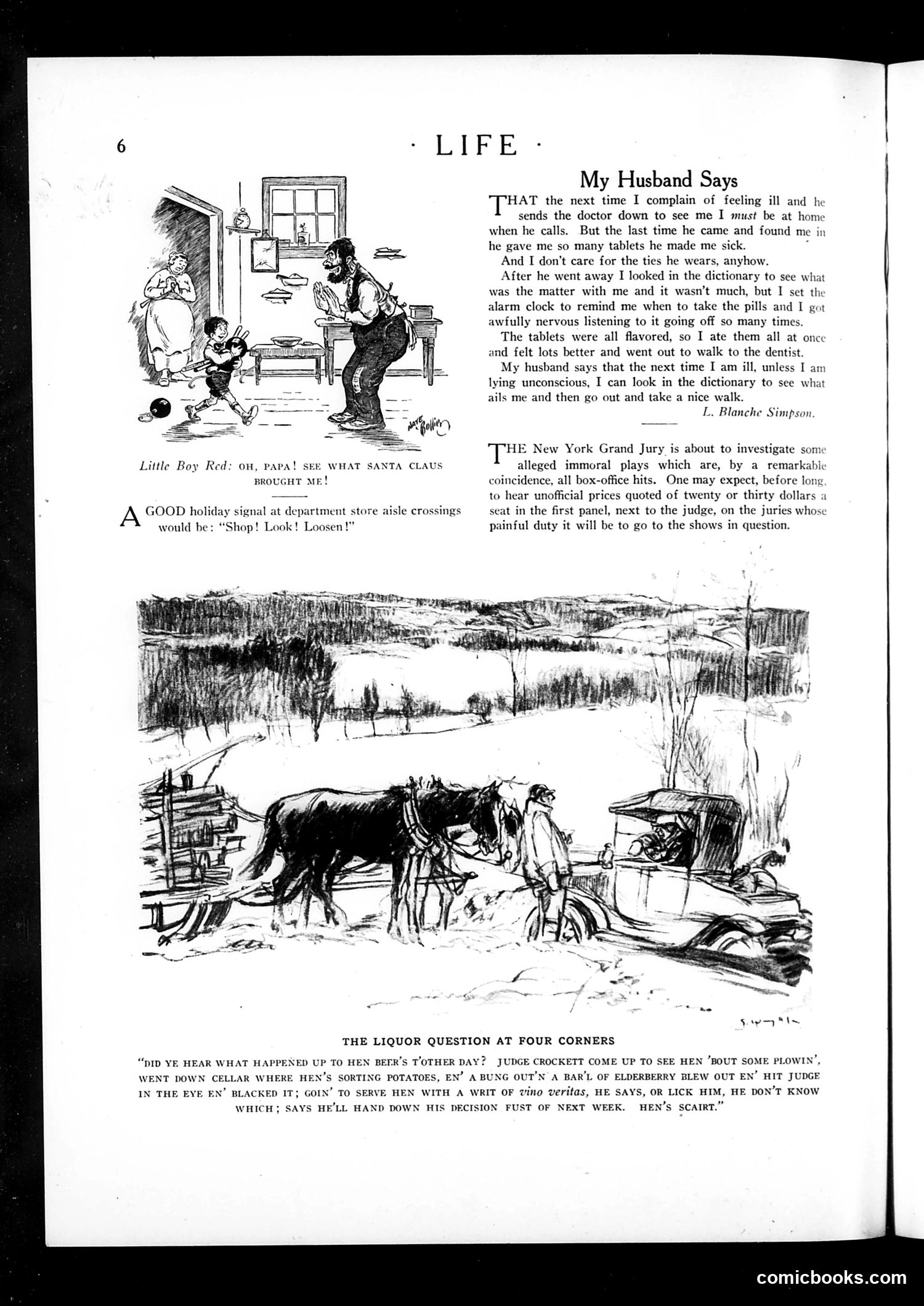
The top cartoon illustrates a domestic dispute where a wife complains about her husband's response to her illness—he dismisses her ailments and sends her to the doctor, then suggests she take pills and go for walks rather than receive his sympathy. The satire targets unsympathetic husbands who minimize their wives' health concerns. The bottom illustration depicts a rural scene involving a horse-drawn vehicle and references "the liquor question"—likely alluding to Prohibition-era debates. The caption mentions a judge's involvement in a case involving someone's "potatoes" (possibly code for illegal alcohol), satirizing how Prohibition enforcement created absurd legal situations and judicial confusion around what constituted contraband.
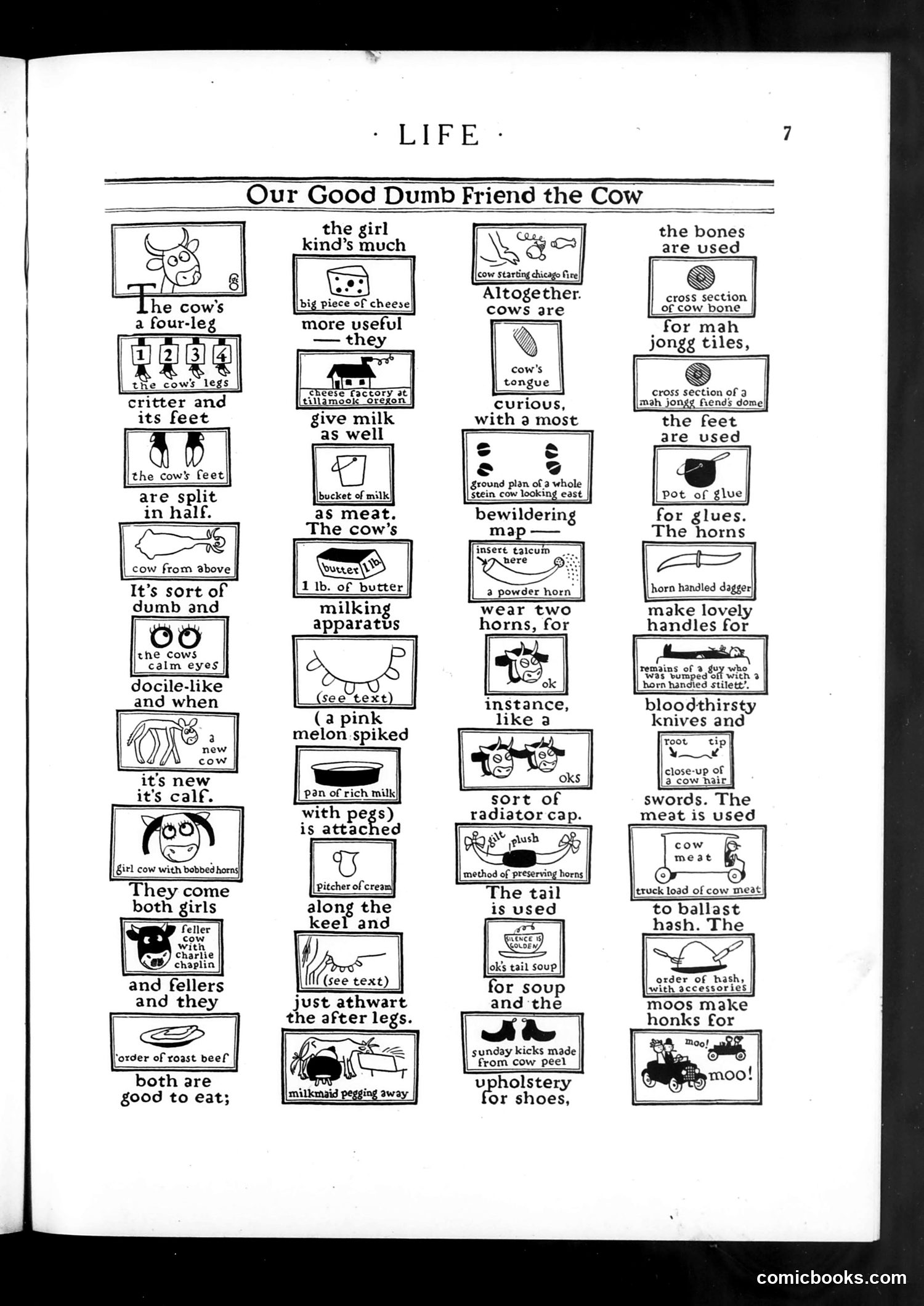
This is a humorous illustrated essay celebrating the cow's utility. The page uses small cartoon panels to catalog everything derived from cattle: milk, cheese, butter, meat, bones, horns, hide, and tail—even cow dung for fuel ("sunky kick made from cow peet"). The satire appears gentle rather than biting. It mocks the cow as "dumb" while ironically praising its complete usefulness to humans. Panel captions like "Oocile-like and when" and "It's sort of dumb and" emphasize bovine stupidity, yet the overwhelming inventory of products suggests the cow's indispensability despite—or because of—its perceived dimwittedness. The style and vernacular ("peet," "moo!") suggest early-to-mid 20th century American humor, celebrating agricultural abundance through affectionate mockery.
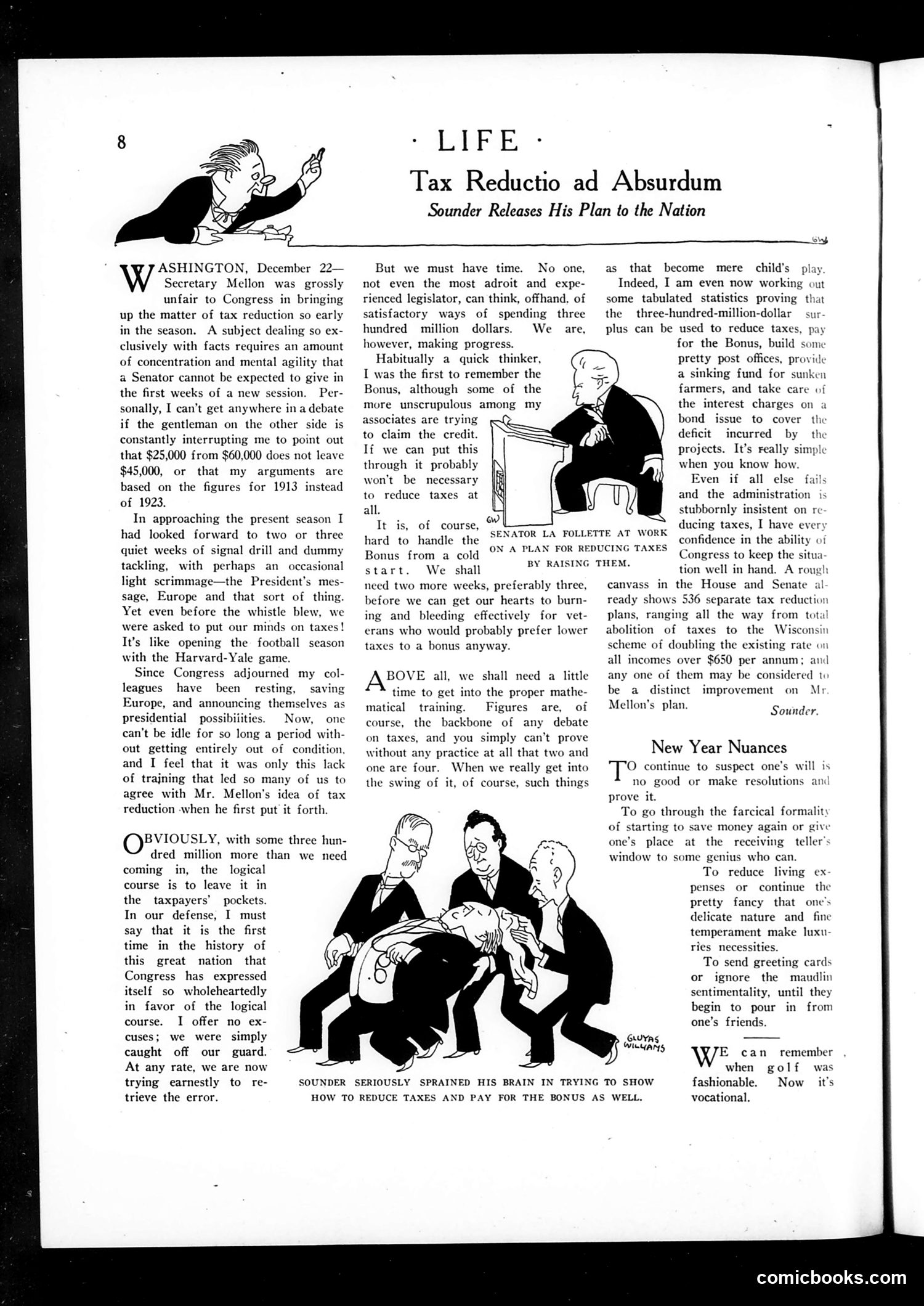
This Life magazine page satirizes Secretary of the Treasury Andrew Mellon's tax reduction proposal. The article, titled "Tax Reductio ad Absurdum," mocks Mellon's plan through both text and cartoons. The main cartoon depicts a figure labeled "Senator La Follette at work on a plan for reducing taxes by raising them"—a direct attack on the logical contradiction in the tax proposal. The second illustration shows men attempting to solve the tax-and-bonus problem, humorously depicting their mental strain. The satire's point: Mellon's scheme is mathematically impossible or absurdly counterintuitive. The magazine criticizes both the complexity of tax debate and the apparent contradiction of reducing taxes while funding veterans' bonuses. The cartoons mock politicians' inability to solve this fiscal puzzle logically.
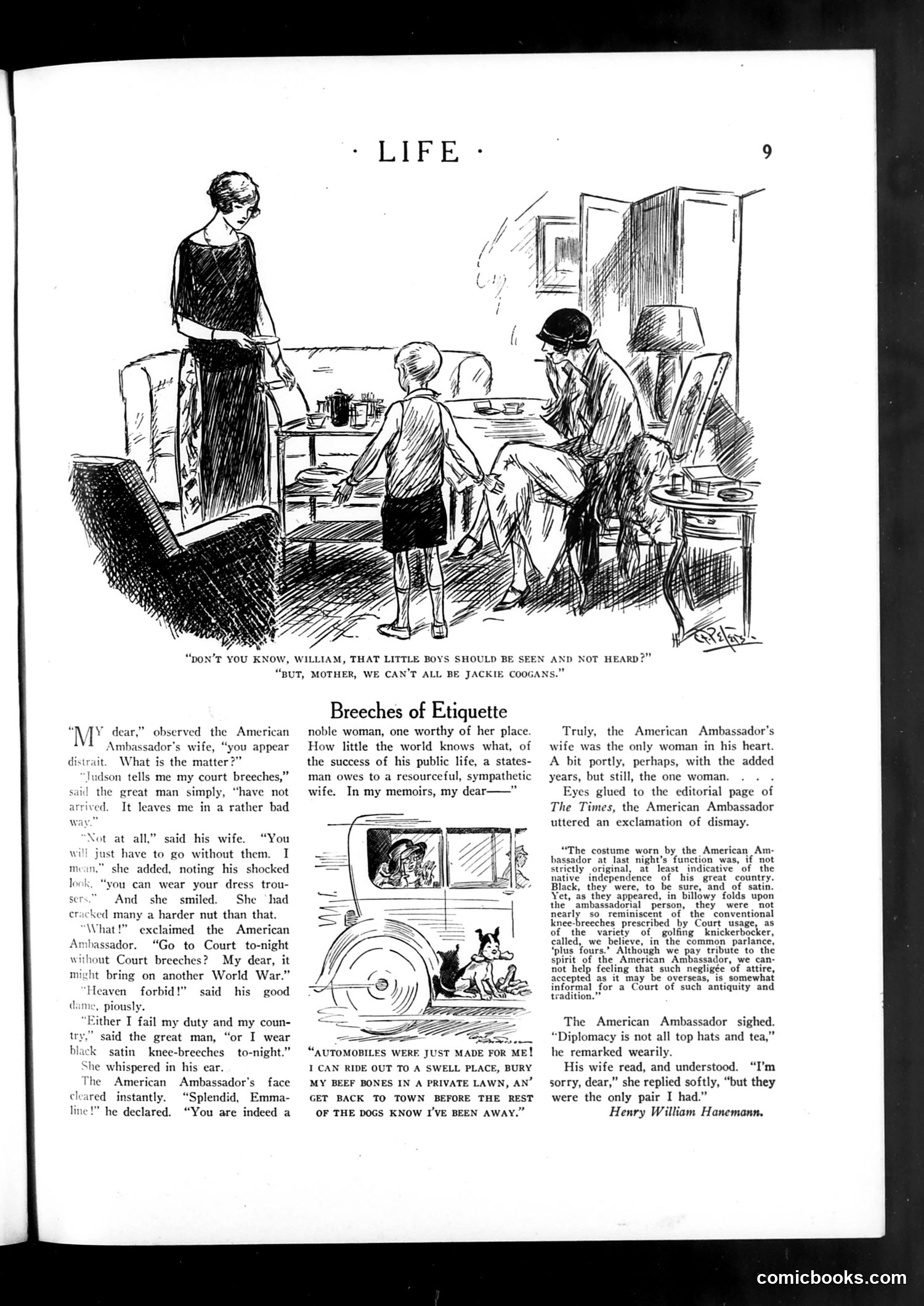
This satirical piece concerns an American Ambassador who appeared at a formal Court function wearing **breeches instead of proper evening dress**—a breach of diplomatic protocol. The main cartoon depicts a domestic scene where the Ambassador's wife explains the incident. The humor centers on the Ambassador's unconventional justification: he claims automobiles were "just made for me" and he needed to ride out to a swell place to bury his beef bones in a private lawn, returning late before the dogs discovered his absence. The satire mocks both the **pretensions of American diplomacy** and the absurdity of using automobiles as an excuse for violating centuries-old Court traditions. The piece gently ridicules American informality clashing with European formal expectations, suggesting American success in modern technology doesn't excuse breaches of traditional etiquette.
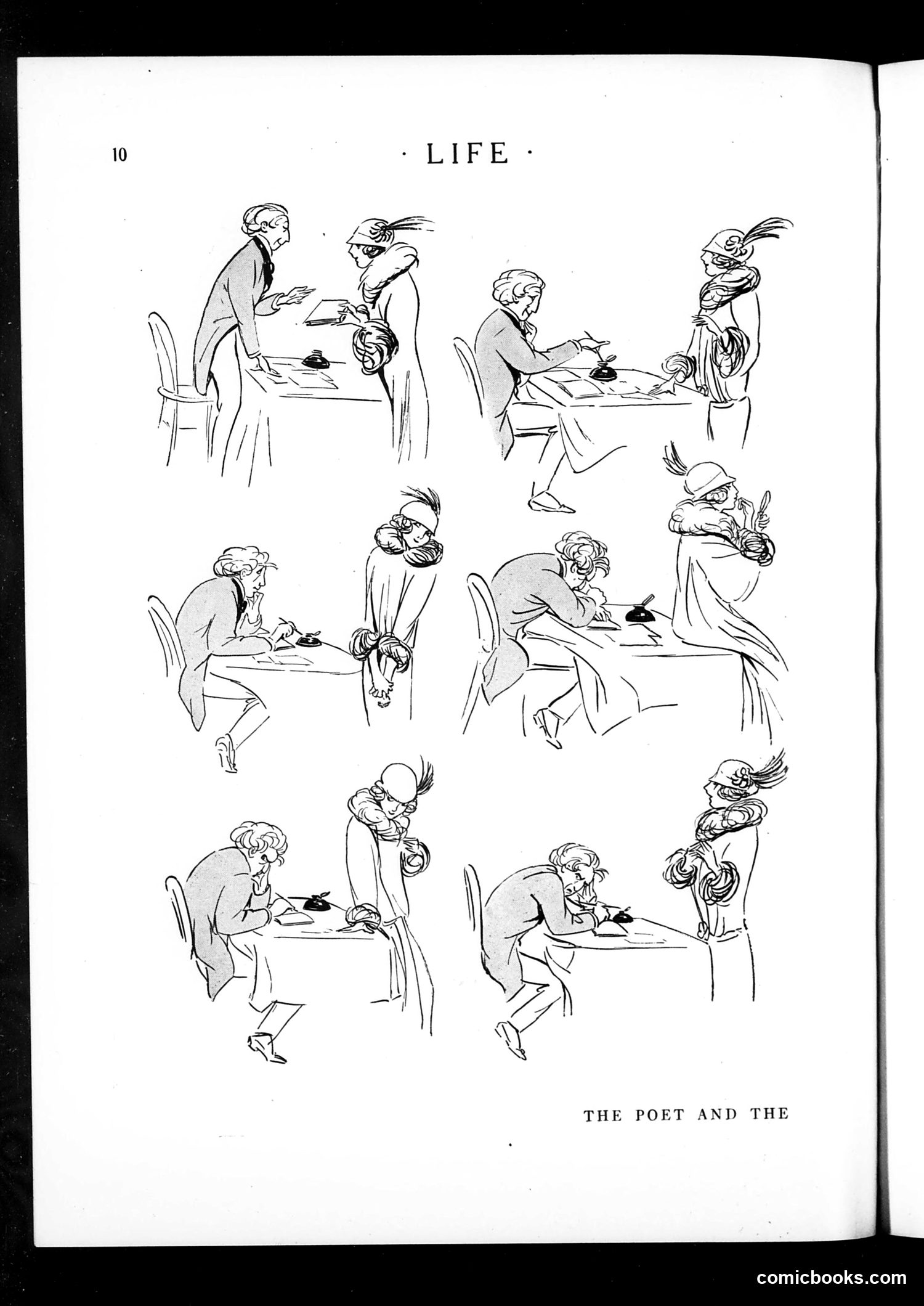
This page from *Life* magazine presents a series of satirical sketches depicting various dining scenarios. The title at the bottom reads "THE POET AND THE," suggesting this is part of a larger narrative or series. The cartoons appear to mock social interactions, particularly between men and women at tables. The exaggerated facial expressions and body language—featuring figures with elaborate hats and period clothing—suggest commentary on courtship, romantic pursuit, or social pretension. The recurring table-and-chair setting emphasizes the "performance" aspect of social dining. Without additional context about the specific historical period or cultural references, the exact targets remain unclear, though the overall tone suggests ridicule of affected social behavior, particularly regarding gender dynamics and romantic conventions of the era.
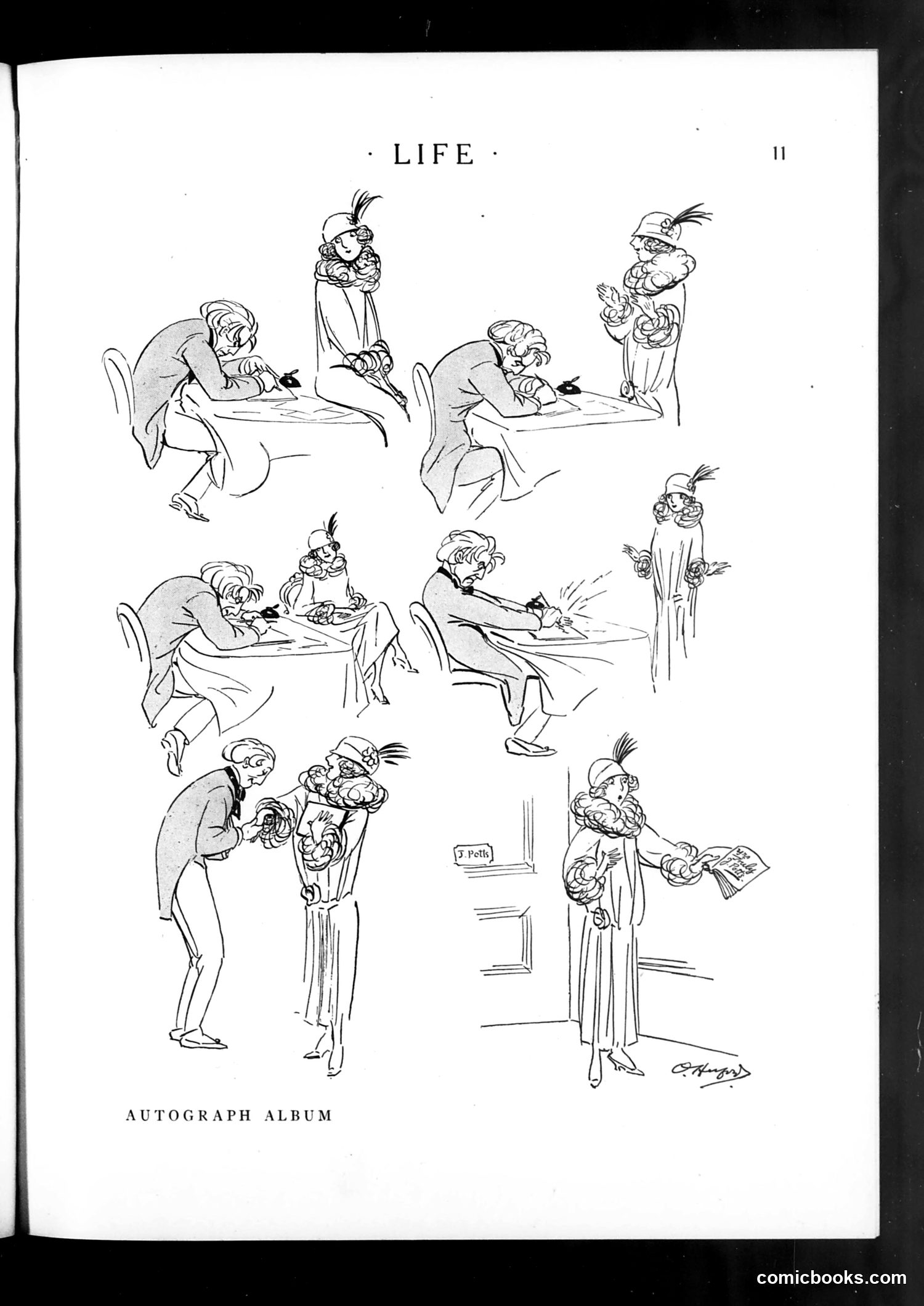
This page from *Life* magazine presents a series of comic vignettes titled "Autograph Album," depicting various social scenarios from what appears to be the early 20th century. The sketches show men pursuing women for autographs in exaggerated, comedic situations—some women are dining, others are being chased or cornered. The humor satirizes the era's celebrity culture and the desperation of autograph-seekers, while also gently mocking the vanity of those who grant signatures. The cartoonist (signature appears to read "Cesare") uses physical comedy and caricature to exaggerate both the pursuer's determination and the pursued's reactions. The page humorously captures the social absurdity of autograph-collecting as a popular leisure activity among the period's upper classes.
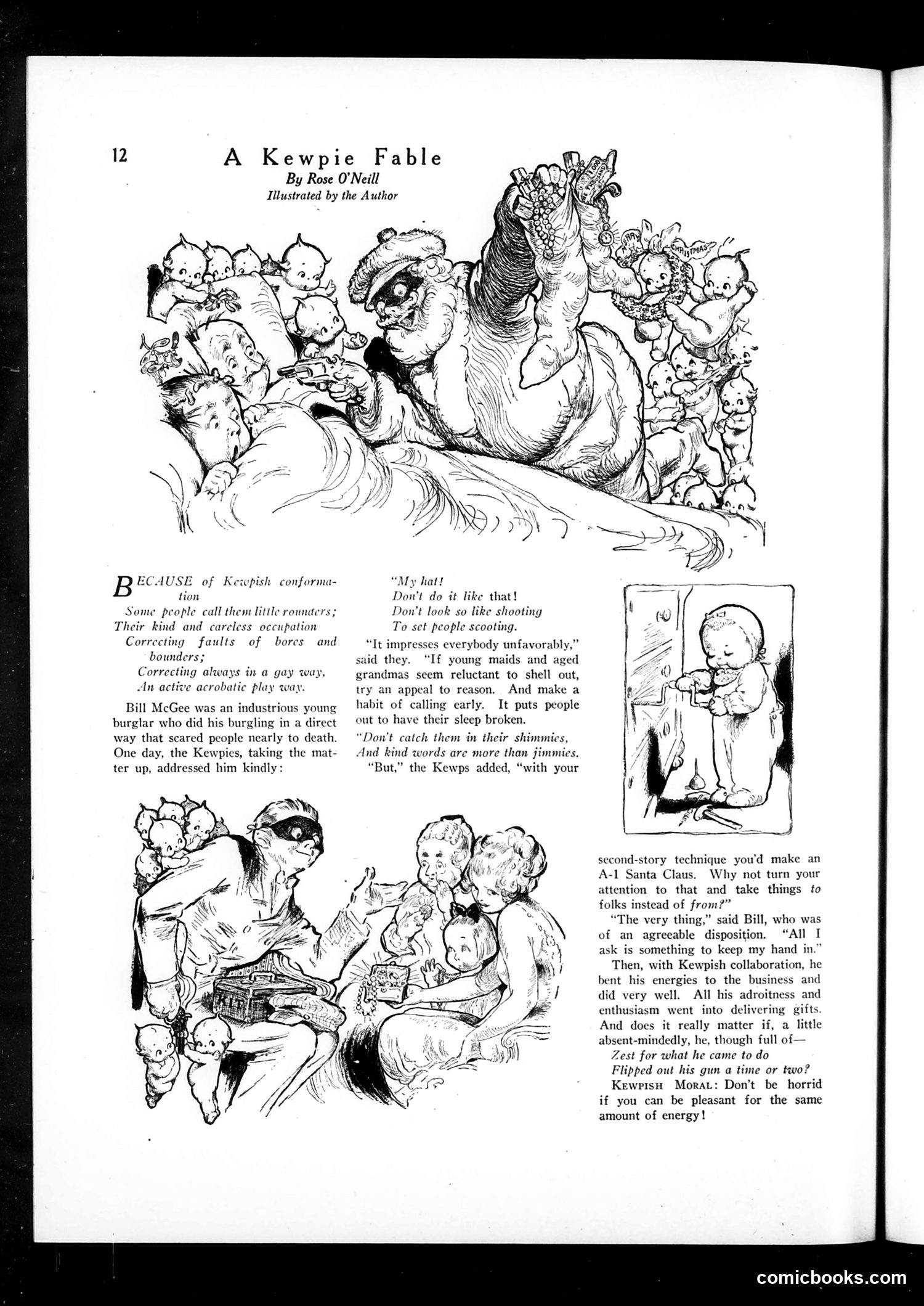
This is a satirical fable by Rose O'Neill (the Kewpies' creator) illustrated with her characteristic cherubic characters. The story concerns Bill McGee, an industrious young burglar who frightens people nearly to death during robberies. The Kewpies correct his behavior by suggesting he become a more pleasant Santa Claus-like gift-deliverer instead, using the same energy for good rather than crime. The satire targets the notion that criminality stems from bad character rather than circumstances—that a "careless occupation" can be redirected through moral persuasion. The fable's moral warns against being "horrid" when you can accomplish the same work "pleasantly." It's a gentle moral lesson about redirecting destructive energy toward socially beneficial ends, typical of O'Neill's whimsical yet didactic approach to her Kewpie stories.
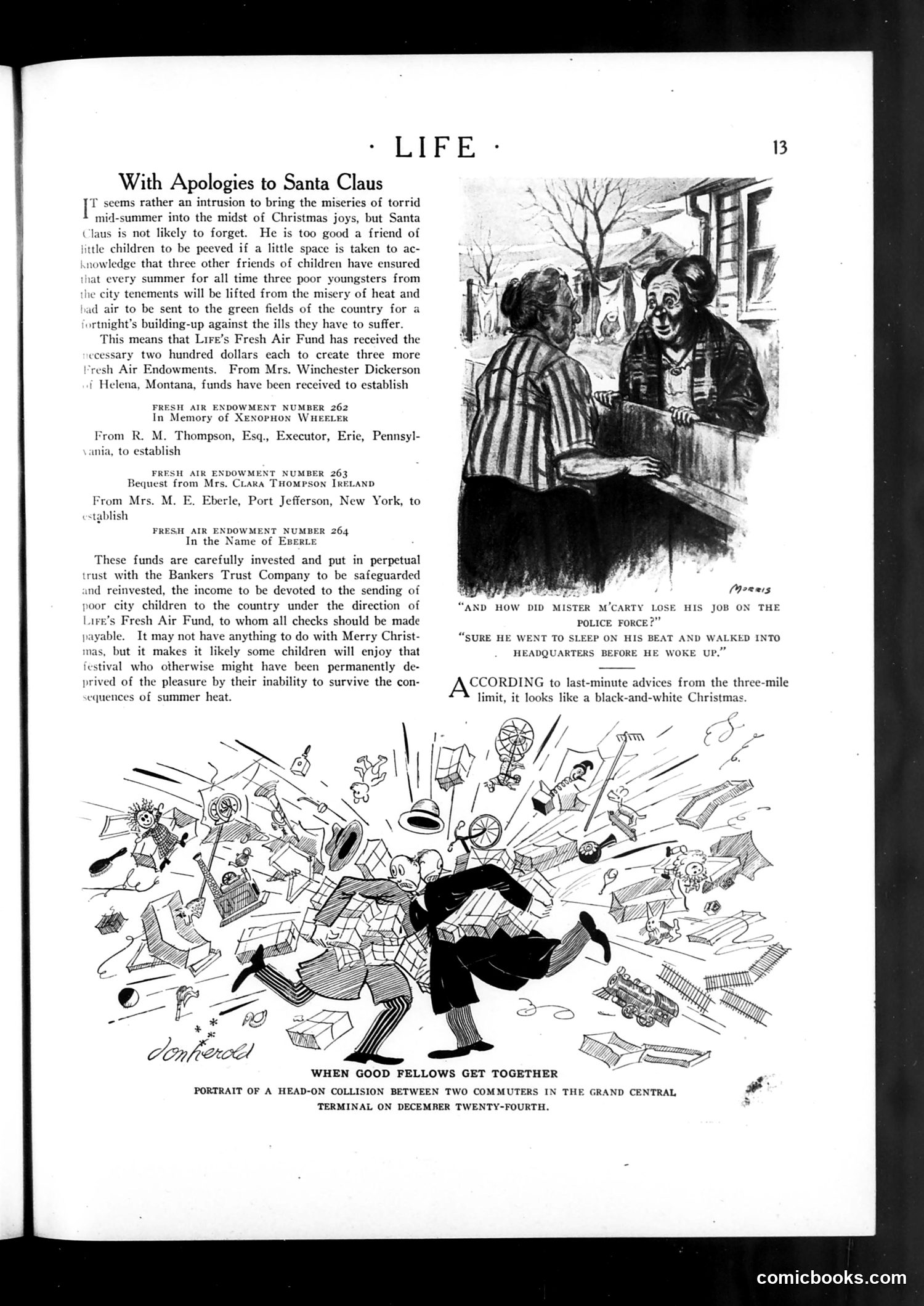
This page contains two separate satirical cartoons and related text about charitable giving. **Top cartoon**: Shows what appears to be a police officer or authority figure at a window, with accompanying text joking about someone losing their job on the police force after sleeping on duty and arriving late to headquarters. **Bottom cartoon**: Titled "When Good Fellows Get Together," it depicts a chaotic collision between two commuters at Grand Central Terminal on December 24th (Christmas Eve). The figure is surrounded by exploding luggage, packages, and debris, satirizing the frenzied holiday shopping chaos and crowded conditions at the train station during the Christmas season. The main text discusses Life's Fresh Air Fund charitable endowments supporting poor children's summer trips to the countryside—a contemporary charitable cause.
The main cartoon depicts a figure labeled "William Allen White" of Kansas lying prone, apparently exhausted or defeated. The article discusses White's recent public statements defending Prohibition and criticizing New York's resistance to the law. The satire targets White's moral absolutism: he advocates strict Prohibition enforcement while appearing to support using "dynamite bombs" against those who violate it—a violent contradiction the author finds ridiculous. The cartoon visualizes White's rhetorical overreach. The text mocks White's comparison of New York to Constantinople under Turkish rule, suggesting his Prohibition zealotry is absurdly extreme. The overall point: even prominent reformers like White undermine their own credible arguments through exaggerated, contradictory rhetoric about Prohibition's enforcement.
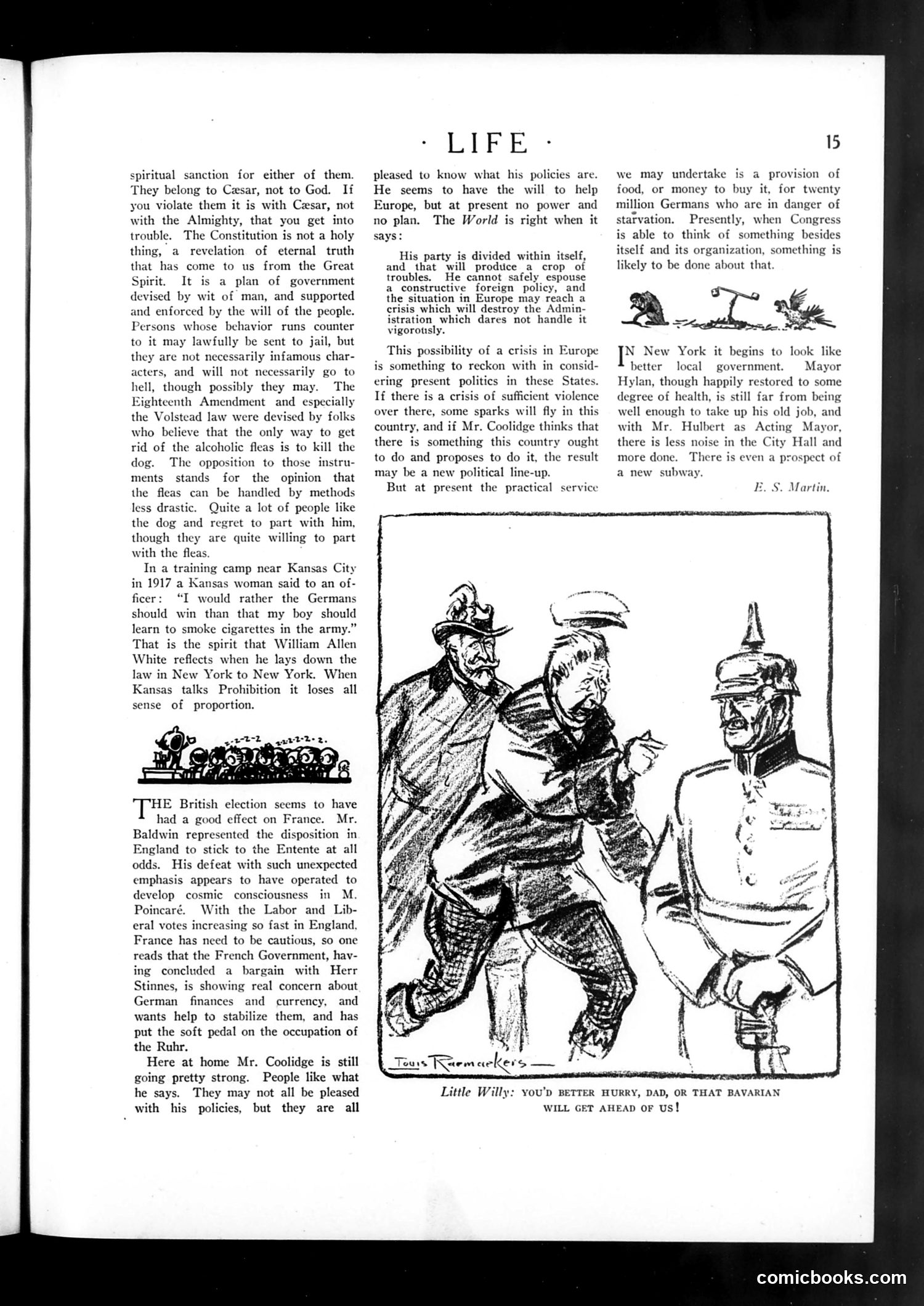
This page contains a political cartoon titled "Little Willy: You'd Better Hurry, Dad, or That Bavarian Will Get Ahead of Us!" The cartoon depicts three military figures in a race. "Little Willy" (the young figure on left, likely the German Crown Prince) urges his father forward, warning that "that Bavarian" (the figure on right, appearing to be a German general or officer) will overtake them. The cartoon satirizes internal German military/political competition and rivalry during World War I, suggesting tension between different German factions or leaders about who will achieve dominance or victory. The surrounding text discusses European politics, Mr. Coolidge's policies, and American domestic matters like Prohibition, providing historical context for the period's political climate.
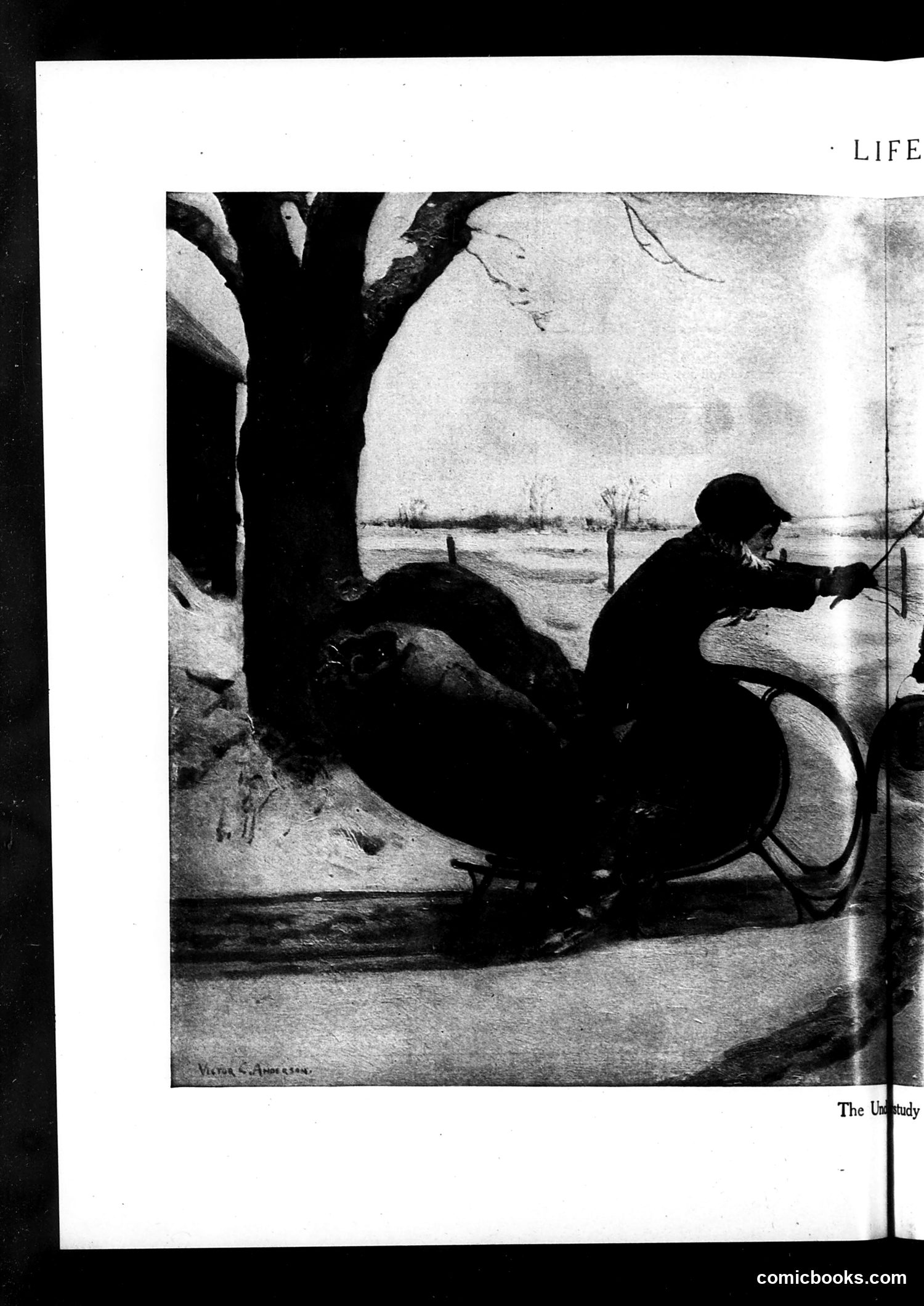
This page shows a black and white photograph rather than a cartoon. The image depicts a figure in dark clothing leaning over what appears to be a bicycle by a tree, with a body of water and flat landscape visible in the background. The photograph is credited to "Victor S. Armacost" (visible in lower left). The page is titled "The Un-study" (partially visible at bottom right), suggesting this is a humorous photographic feature rather than political satire. Without additional context or caption text, the specific joke or social commentary remains unclear from the image alone. The composition and subject matter suggest it may be satirizing leisure, poverty, or unemployment during a particular era, but the exact meaning requires the missing caption text.
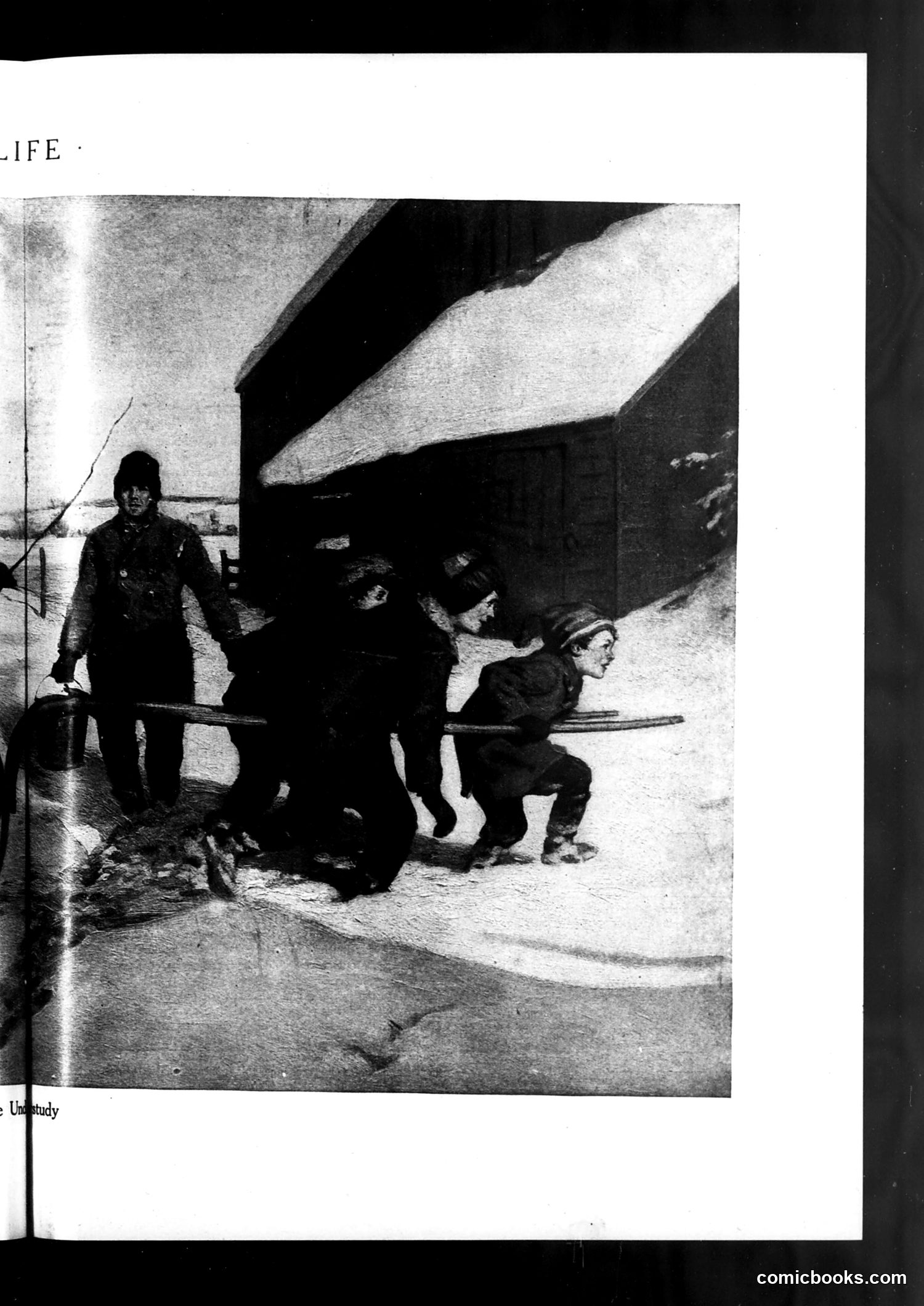
This page contains a single black and white photograph rather than a traditional political cartoon. It depicts what appears to be a street scene with several figures in early-to-mid 20th century clothing. A man on the left stands near what looks like a pole or rope, while other figures (appearing to include children) are positioned nearby under or near a large structural overhang or awning. Without clear caption text visible in the image, the specific satirical intent is difficult to determine with certainty. The composition suggests social commentary—possibly about urban poverty, childhood labor, or public life conditions of the era—but the exact subject and Life magazine's critical angle remain unclear from this reproduction alone.
This page reviews three Broadway plays from what appears to be the early 1920s. The critic discusses: **"Pelléas and Mélisande"**: A symbolic play by Maeterlinck that the reviewer finds so absurdly written (characters debating whether they went downstairs at 10:30 or 10:45 during a "creepy scene") that it self-parodies. The critic praises actress Jane Cowl for making the incomprehensible dialogue seem human. **"The Potters"**: Praised as successfully capturing everyday American life—ordinary people having mundane conversations (humorously, a couple arguing about whether the husband shaved). The reviewer credits actor Donald Meek with elevating ordinary dialogue through skilled performance. **"The Business Widow"**: Dismissed as formulaic, derivative "synthetic comedy" that the critic found so forgettable he slept through most of it yet could recite from memory. The satire centers on what makes theater work: authentic human behavior versus artificial sophistication, and an actor's ability to make dialogue meaningful.
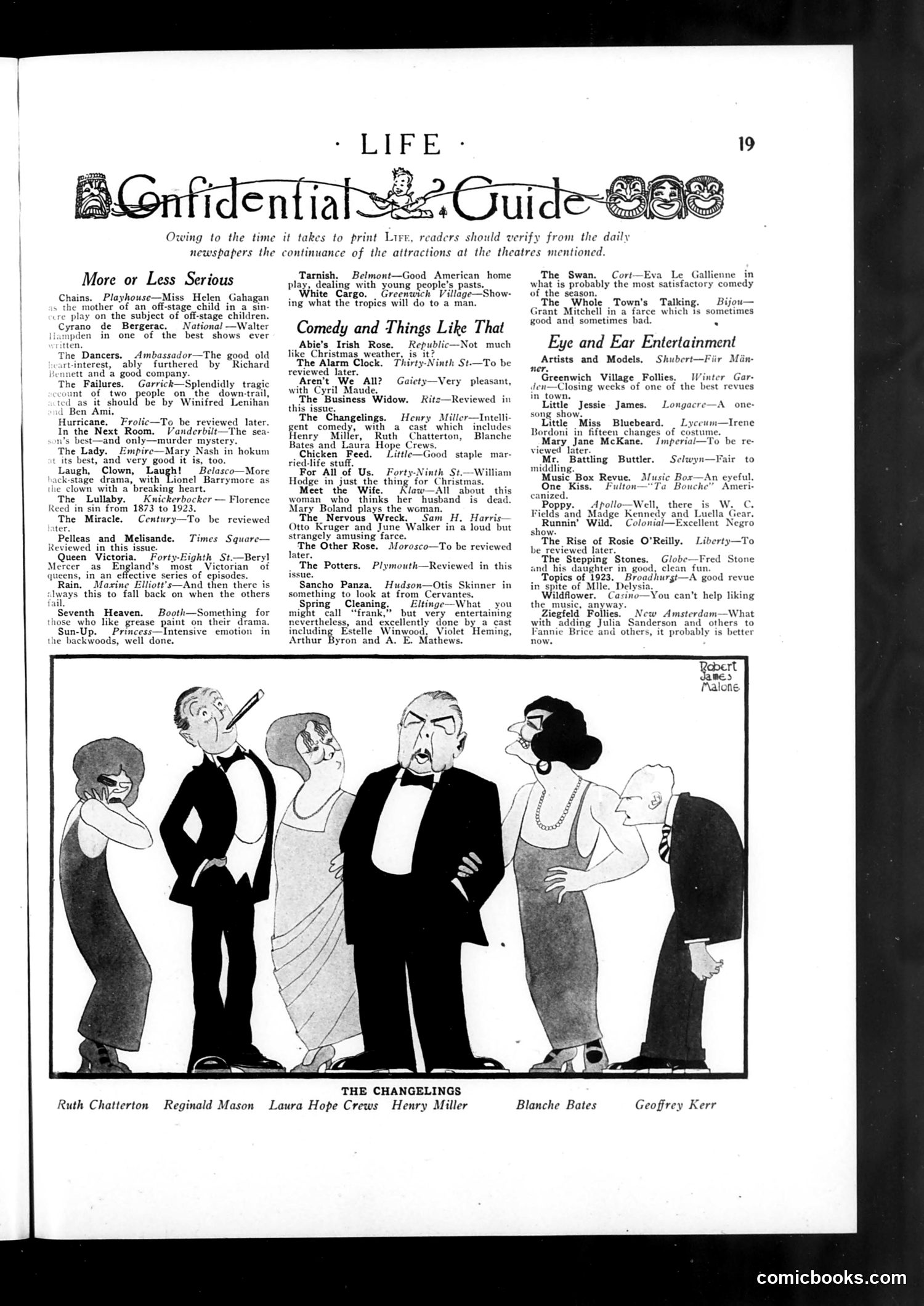
This page is a **theater guide and review section** from Life magazine, listing Broadway shows currently running. The cartoon at the bottom illustrates **"The Changelings,"** a comedy playing at the Henry Miller Theatre, featuring the cast members named below the image. The sketch depicts **six characters in formal attire** (tuxedos and evening wear), drawn in exaggerated caricature style typical of 1920s comedy illustration. The figures appear to represent the play's characters in a humorous scene—the central male figure's prominent facial features and body language suggest physical comedy or farcical situation. **The satire here is theatrical rather than political**: Life's cartoons typically mocked stage productions themselves through character caricature and visual gags, rather than commenting on external events. The oversized noses and contorted poses emphasize the play's comedic nature for potential theatergoers browsing this entertainment guide.
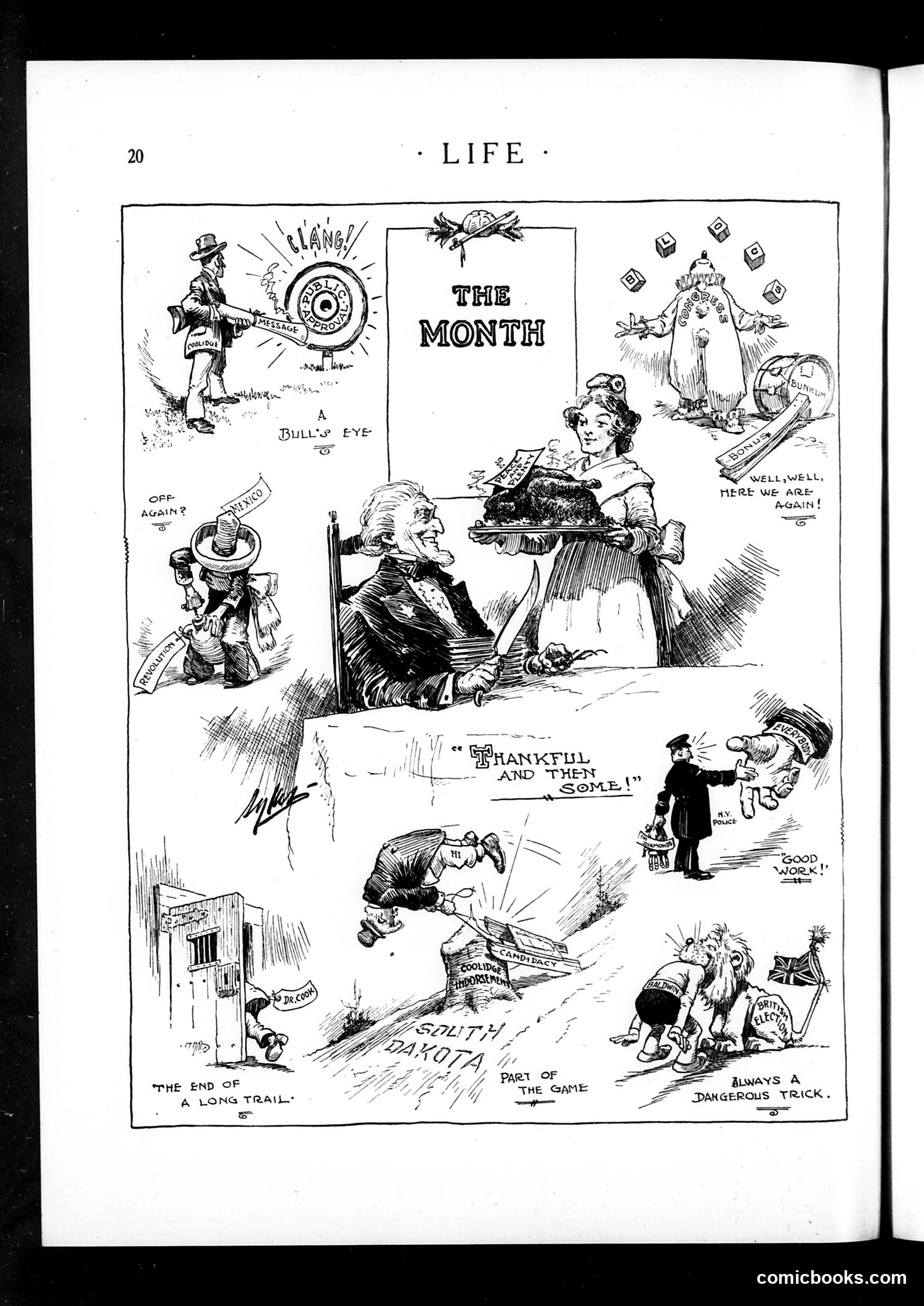
This satirical cartoon from Life magazine depicts various political figures engaged in "the game" of politics during what appears to be a contentious period. The central image shows a woman (likely Lady Liberty or Columbia, representing America) serving up consequences to a seated politician. The surrounding vignettes illustrate political machinations: "Bull's Eye" shows someone taking aim at a target; "The End of a Long Trail" depicts conflict or pursuit; "Part of the Game" shows underhanded dealings; and "Always a Dangerous Trick" warns of political risks. The overall message satirizes American politics as a dangerous, ongoing game where politicians face unpredictable consequences. Without specific dates visible, the exact political context remains unclear, but the cartoon criticizes the cyclical nature of political scheming and its hazards.
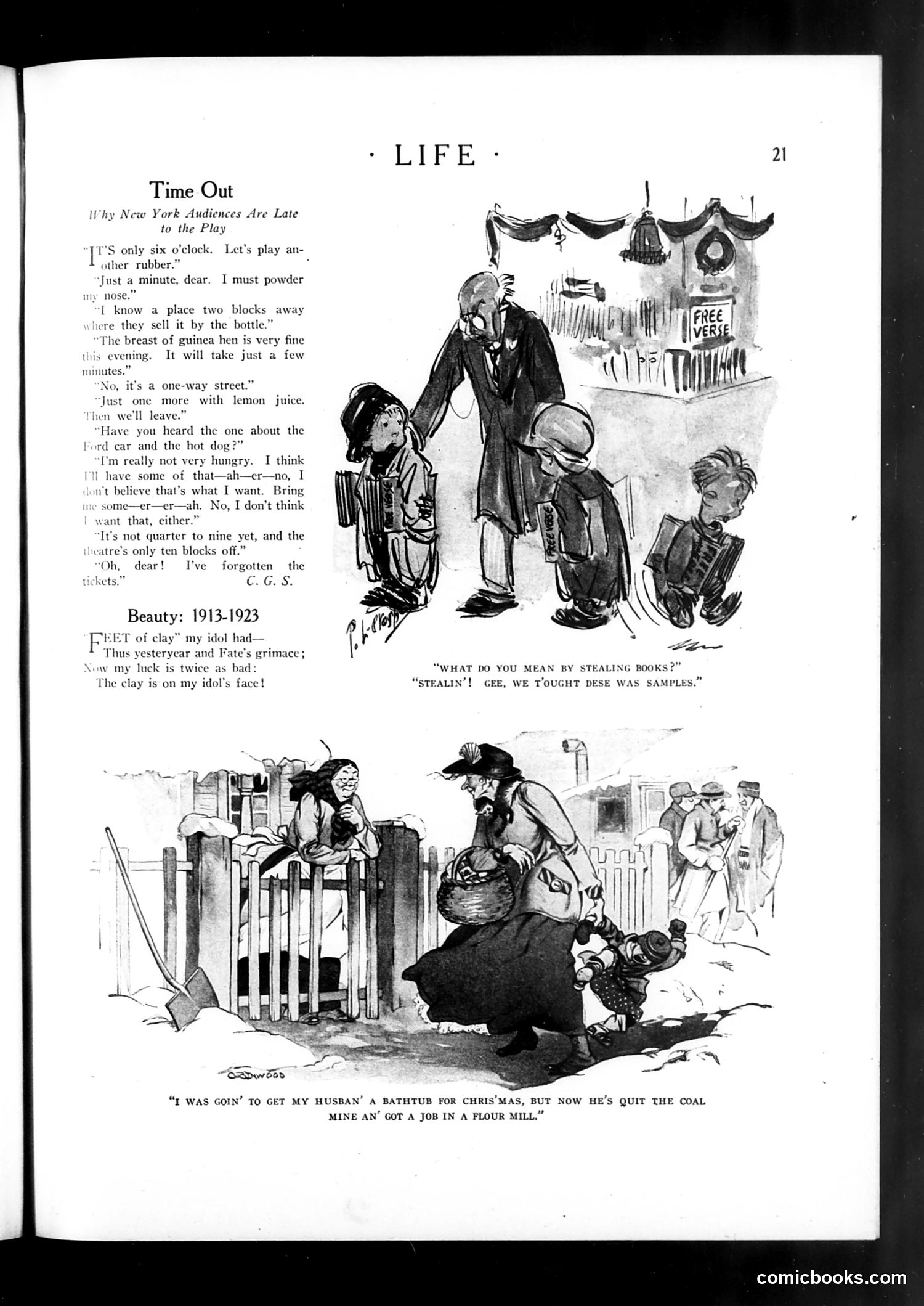
This Life magazine page satirizes two distinct American social issues circa 1913-1923: **Top section ("Time Out"):** Mocks wealthy New Yorkers' chronic theater tardiness. The dialogue shows upper-class excuses—powdering noses, lingering cocktails, elaborate dinners, indecision about clothing—revealing self-absorbed procrastination. The cartoon depicts well-dressed theater-goers perpetually delayed by frivolous concerns, satirizing their obliviousness to time and others waiting. **Bottom cartoons:** Comment on working-class economic hardship. The first shows street children confusing free book samples with stealing, reflecting urban poverty. The second depicts a woman's resignation about her husband leaving coal mining for flour mill work—both brutal, low-wage jobs. The humor is darkly ironic: she'd planned a Christmas gift (bathtub), but now faces continued economic struggle regardless of employment. Together, the page contrasts wealthy leisure-class self-indulgence against working-poor desperation, typical of early 20th-century American social commentary.
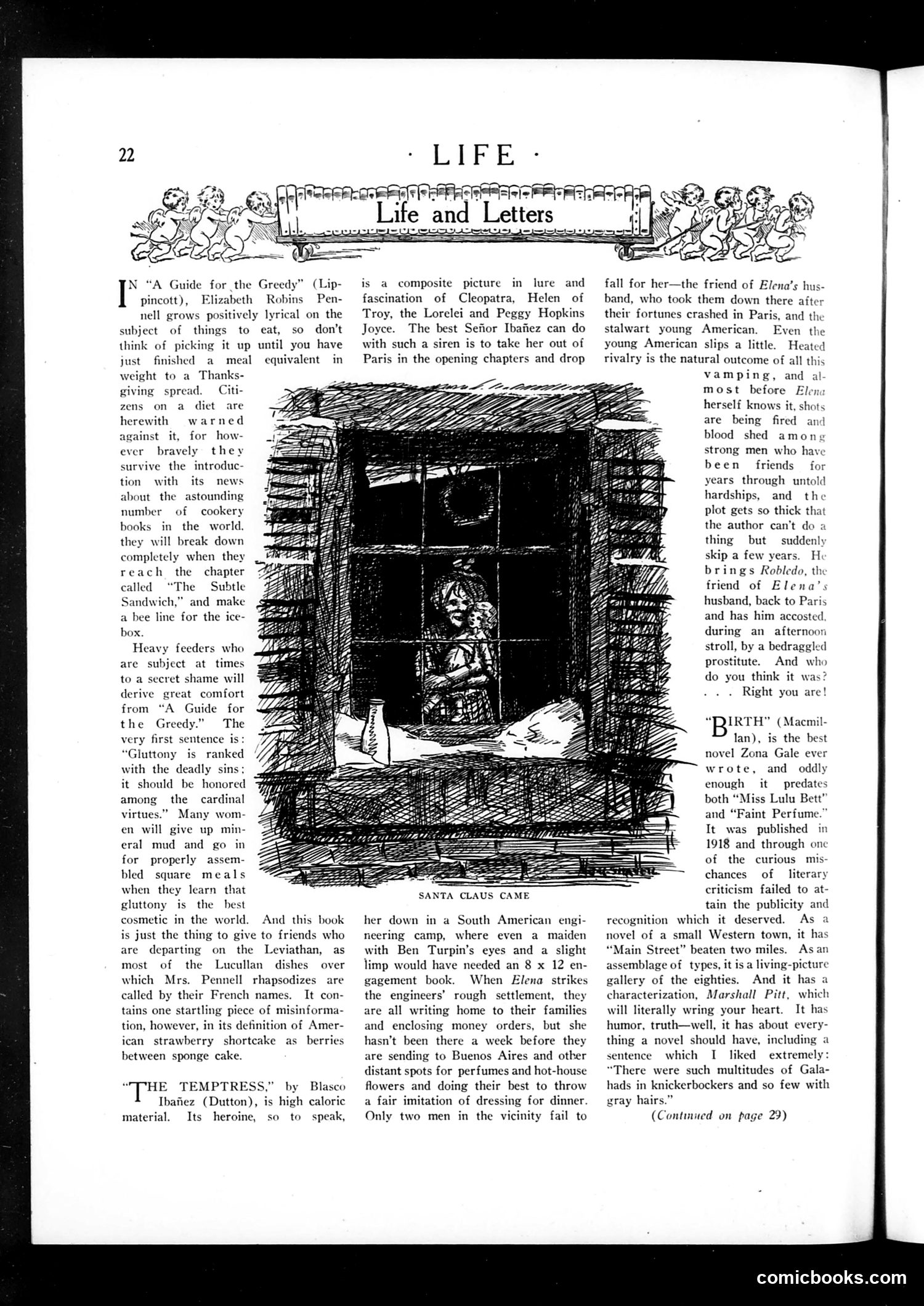
This page contains literary reviews rather than political cartoons. The reviews discuss three books: 1. **"A Guide for the Greedy"** by Elizabeth Robins Pennell—a cookbook that the reviewer humorously warns dieters against reading, fearing it will tempt them to abandon their diets. 2. **"The Temptress"** by Blasco Ibáñez—a melodramatic novel about a seductive woman (Elena) who arrives at a South American engineering camp and causes chaos among the workers through her charms, ultimately leading to violence and tragedy. 3. **"Birth"** by Zona Gale—praised as her best novel, set in a small Western town during the 1880s, featuring strong characterization. The illustration shows a window scene, likely depicting a moment from one of the novels discussed. The page is primarily book criticism, not satire or political commentary.
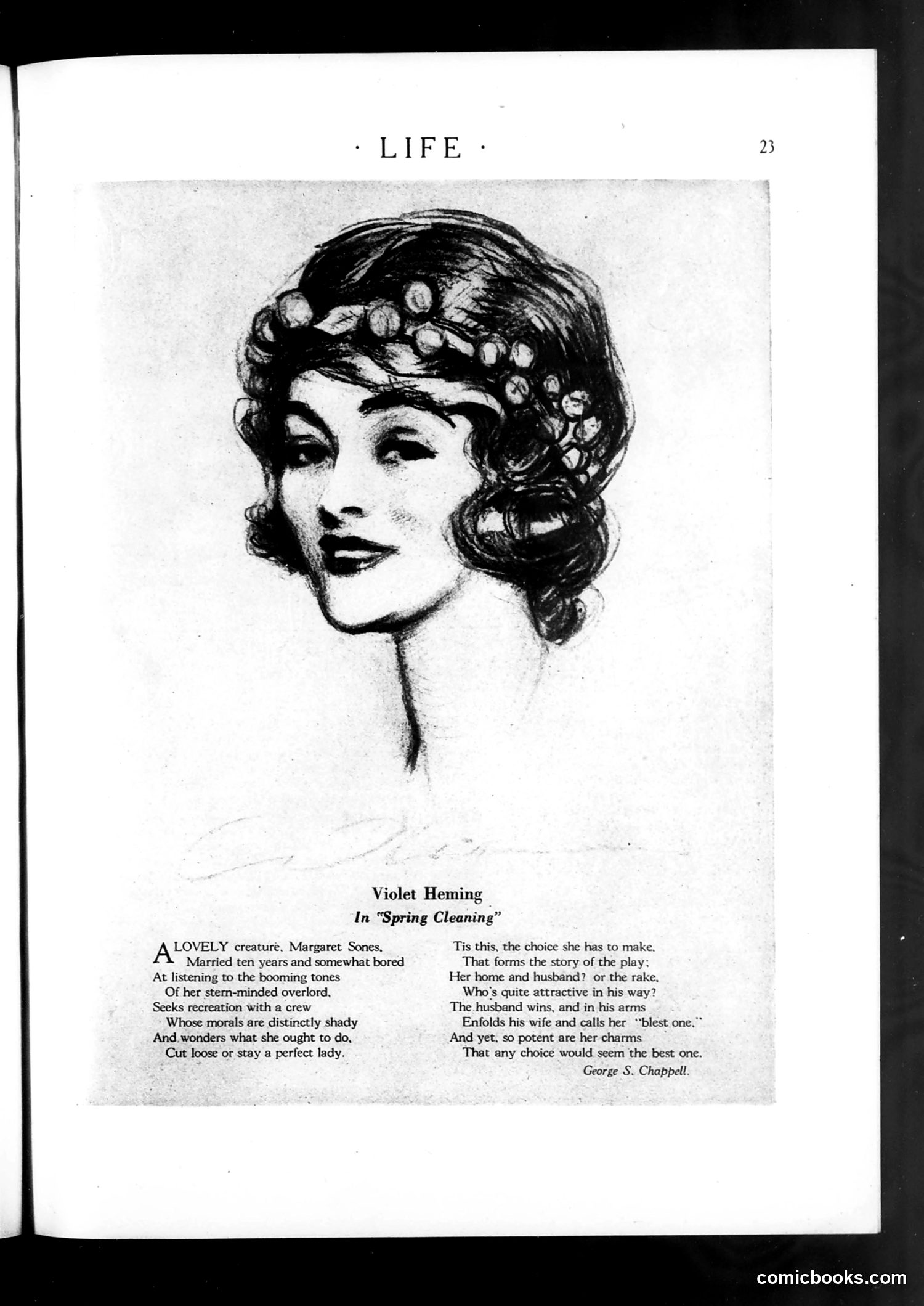
This page features **Violet Heming**, an actress, in connection with the play *"Spring Cleaning."* The accompanying poem by George S. Chappell describes the plot: Margaret Sones, a bored wife of ten years, must choose between her stern husband and an attractive rake. The satire operates on multiple levels. It mocks the moral dilemma of the play itself—presenting infidelity as a serious dramatic choice—while simultaneously praising the heroine's beauty so effusively ("so potent are her charms / That any choice would seem the best one") that it undercuts the play's moral gravity. The piece represents **1920s social commentary**: critiquing both restrictive marriages and the era's fascination with sophisticated adultery plots in theater. The elegant portrait and refined language mask cynicism about marital boredom and female agency, reflecting Jazz Age anxieties about traditional morality.
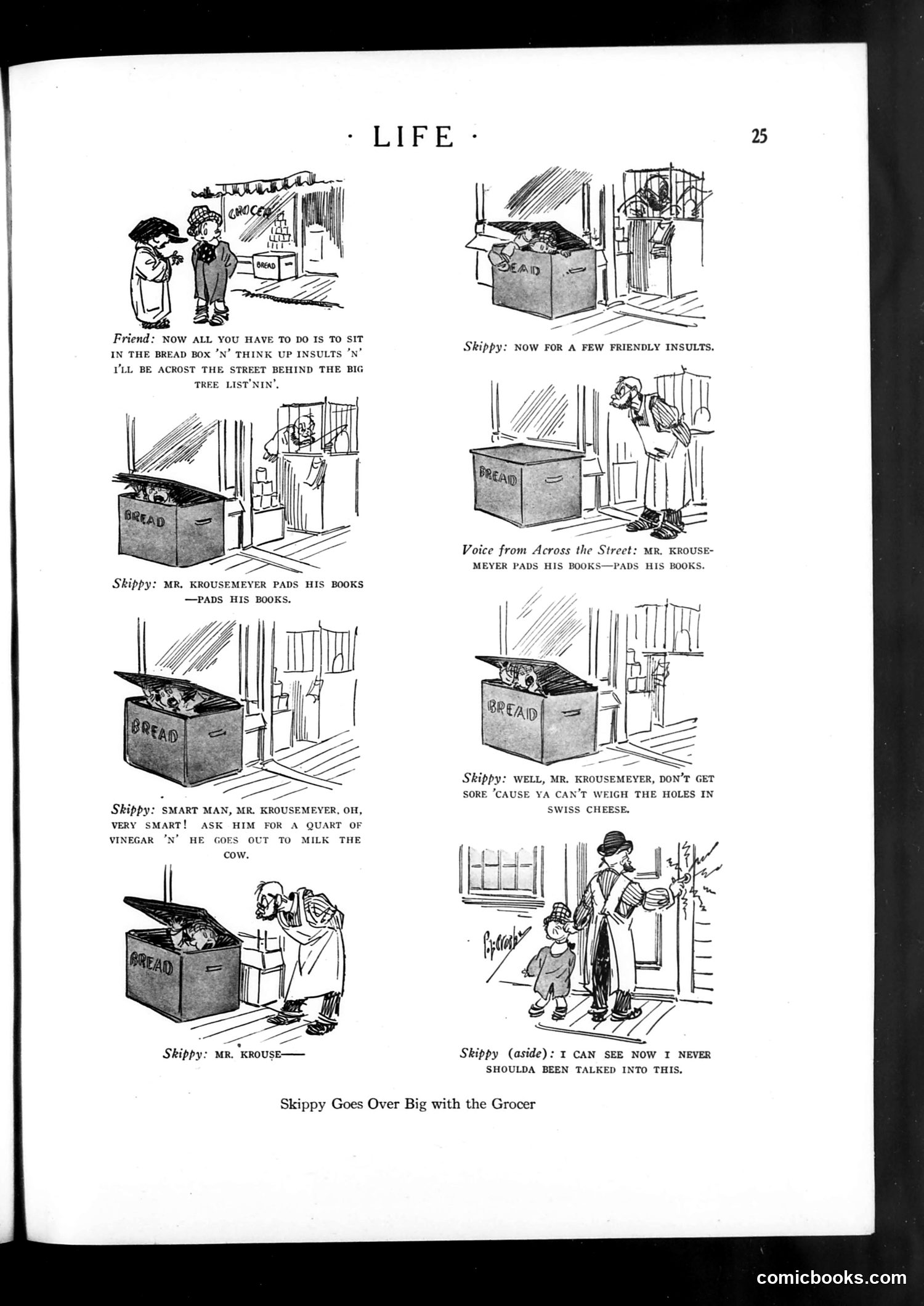
This comic strip depicts a prank where a child named Skippy is coached by a friend to sit in a bread box and shout insults at a local grocer, Mr. Krousemeyer, while the friend listens from across the street. The insults mock the grocer's business practices—"pads his books" (falsifies accounting), can't weigh goods properly, and attempts to sell vinegar as milk. The satire targets petty neighborhood merchants accused of cheating customers through dishonest weights, measures, and accounting. Skippy's escalating pranks (each increasingly absurd) humiliate Mr. Krousemeyer publicly. The final panel shows Skippy regretting the scheme—suggesting the "joke" has gone too far or backfired. The humor relies on period expectations about urban youth mischief and small-business dishonesty.
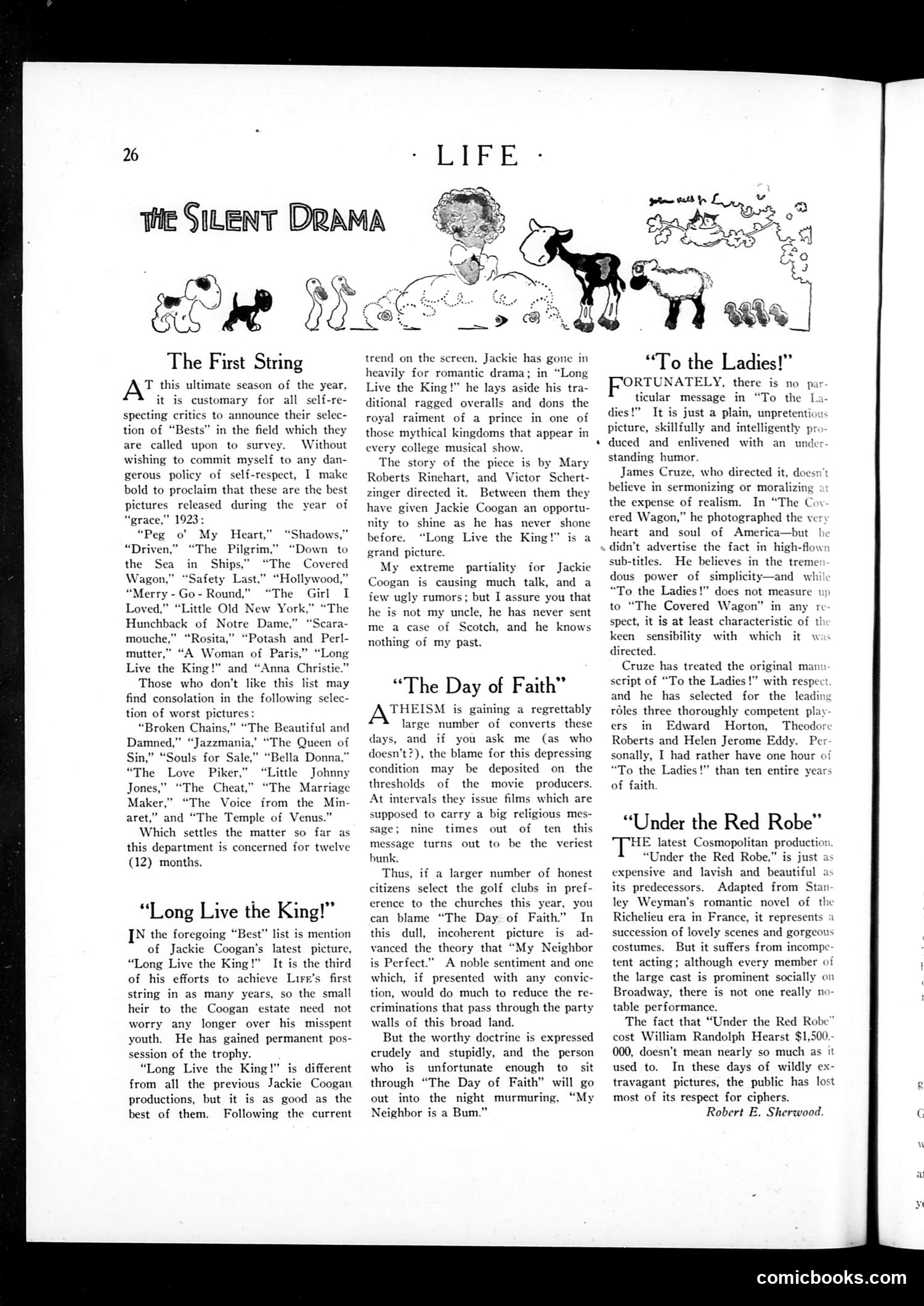
This page contains film reviews and criticism from Life magazine's "Silent Drama" column, circa 1923. The cartoonish header illustration depicts various animals and scenes, serving as decorative framing for the column. The content reviews several silent films, including Jackie Coogan's "Long Live the King!" (praised as his best work, departing from his typical ragged-child roles to play a prince). The reviewer dismisses "The Day of Faith" as incompetent religious propaganda that ironically drives people *away* from churches. The column also lists what the critic considers the year's best and worst pictures—essentially quality rankings of 1923 releases. "To the Ladies!" receives favorable mention for avoiding pretentious messaging. The tone is witty and sardonic, characteristic of Life's satirical approach. The phrase "year of grace, 1923" employs gentle mockery. No specific political figures are caricatured; the satire targets the film industry's tendency toward heavy-handed moralizing in cinema.
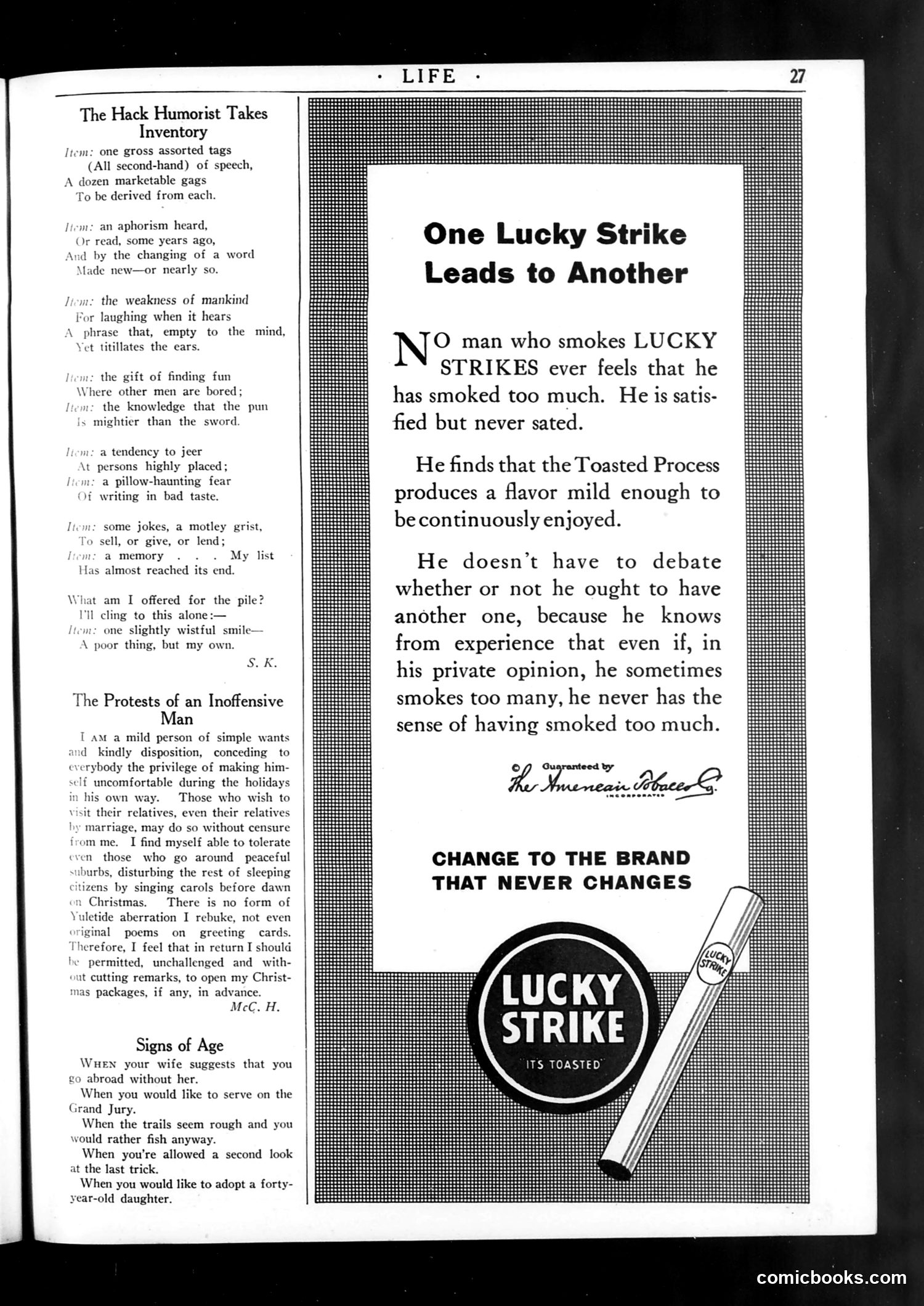
This page combines satirical humor pieces with a Lucky Strike cigarette advertisement. **Left Column Content:** Three separate humor pieces mock various subjects. "The Hack Humorist Takes Inventory" satirizes lazy comedy writers who recycle tired jokes and clichés. "The Protests of an Inoffensive Man" humorously depicts someone tolerant of holiday chaos but frustrated he can't open Christmas presents early. "Signs of Age" lists relatable indicators of aging (preferring fishing to hiking, adopting older children). **Advertisement (Right Side):** A Lucky Strike ad uses circular logic to promote cigarettes—claiming smokers never feel they've smoked "too much" because they lack that sensation, only feeling "satisfied but never sated." The advertisement's tagline promises "The Brand That Never Changes." **Historical Context:** This appears from the pre-1950s era when cigarette advertising was ubiquitous in mainstream publications and health warnings were absent. The ad's argument would strike modern readers as absurd or even darkly ironic given what we now know about tobacco addiction and health risks.
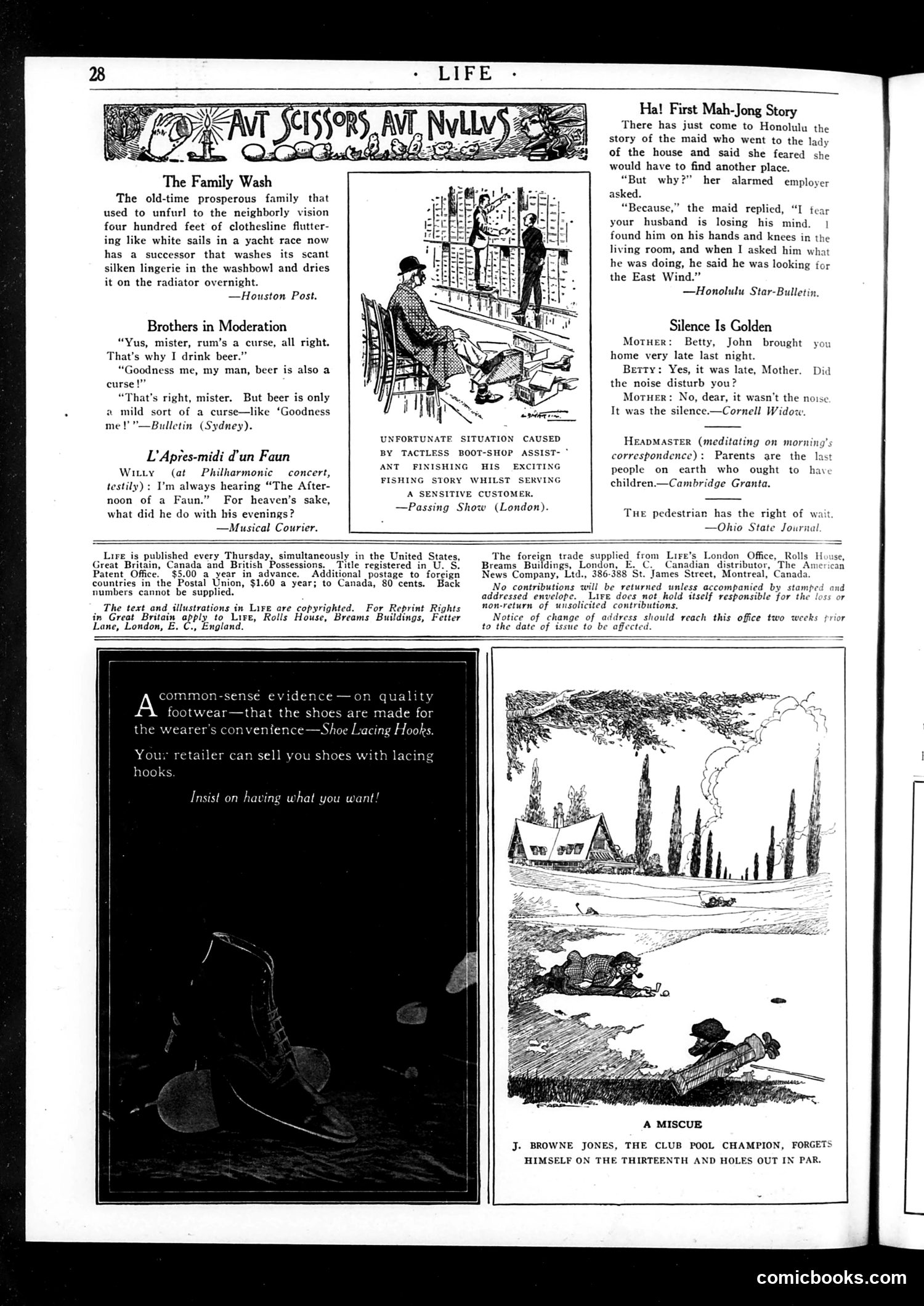
This page contains several brief humorous anecdotes and one advertisement, typical of Life's satirical format. **The humor pieces mock:** - **"The Family Wash"**: Economic decline—prosperous families once displayed wealth through massive clotheslines of laundry; now the wealthy wash only delicate silks in bowls, drying them on radiators. The joke satirizes reduced circumstances. - **"Brothers in Moderation"**: Prohibition-era drinking culture. A man claims beer is "only a mild curse" compared to rum, using circular logic to justify drinking despite temperance rhetoric. - **"L'Après-midi d'un Faun"**: High-culture pretension. The joke mocks concert attendees' bafflement at the classical piece's title, asking what the faun did with his *evenings*—treating it as a literal narrative rather than abstract music. - **Mah-Jong/East Wind story**: A husband searches for the "East Wind" (a Mah-Jong tile term), implying he's mentally deteriorating—a topical joke about the newly-popular game. **The advertisement** promotes shoe lacing hooks as a consumer convenience, appealing to practical self-interest: "Insist on having what you want!"
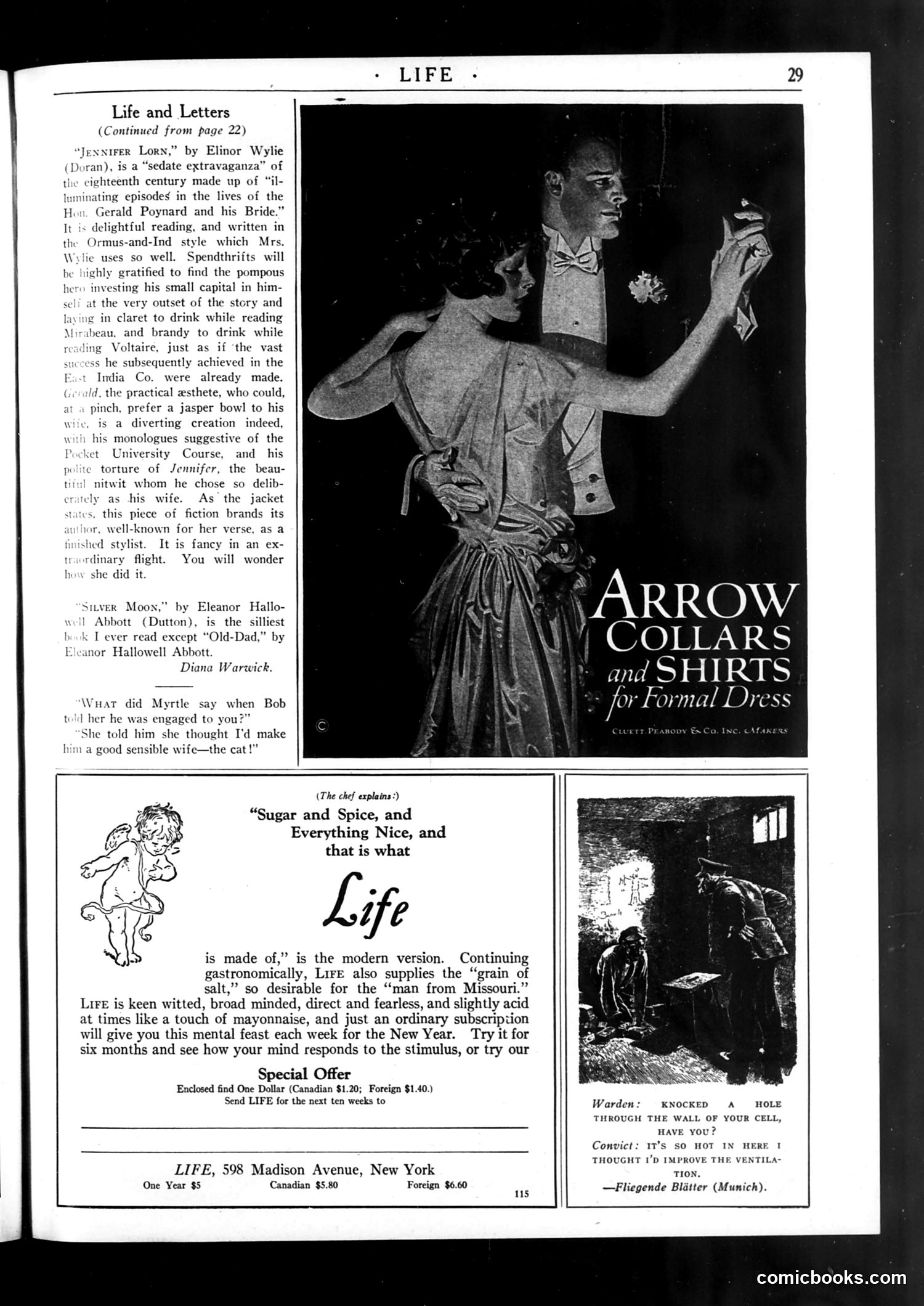
This page combines book reviews with advertisements and a single cartoon. The reviews discuss two novels: Elinor Wylie's *Jennifer Lorn*, praised as witty eighteenth-century fiction with stylish prose, and Eleanor Hallowell Abbott's *Silver Moon*, dismissed as silly. A brief joke follows about a woman claiming she'd make a "sensible wife"—the punchline being the dismissive epithet "the cat!" The main cartoon (bottom right) shows a prison conversation: a warden asks a convict if he knocked a hole through his cell wall; the convict quips he did so to "improve the ventilation" because it's hot. This is credited to *Fliegende Blätter*, a German satirical publication, suggesting Life reprinted foreign humor. The joke relies on deadpan absurdity—the convict's obvious escape attempt is reframed as innocent air-conditioning. The Arrow Collars advertisement occupies the upper right, marketing formal wear through glamorous imagery.
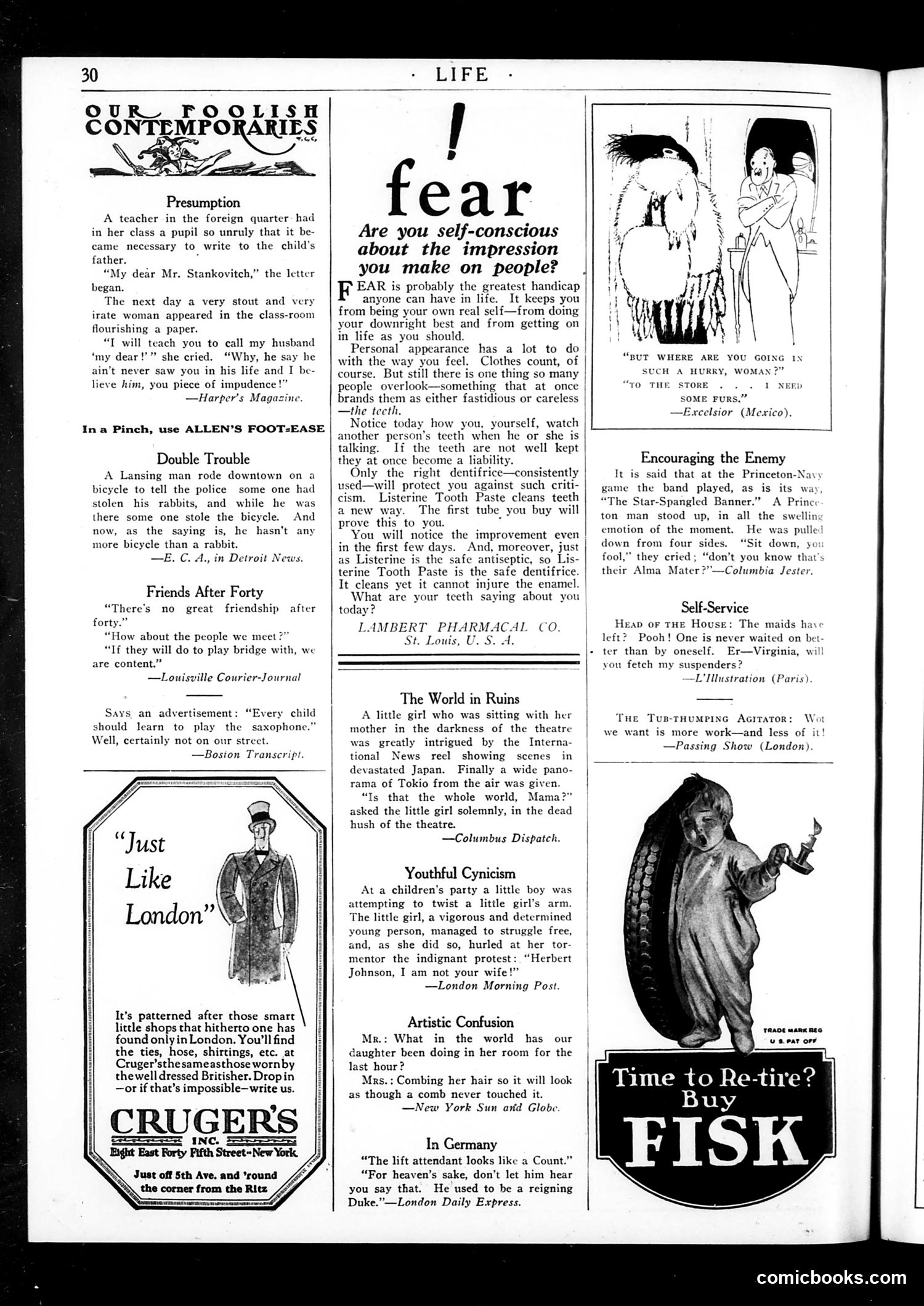
This page from *Life* magazine presents a collection of brief satirical anecdotes and advertisements reflecting early 20th-century American and British social commentary. **Key Content:** The humor targets social pretension and class anxiety. "Presumption" mocks a teacher's formality with a working-class parent. "Friends After Forty" satirizes superficial adult friendships based on bridge-playing rather than genuine connection. "In Germany" jokes about post-WWI social upheaval—a former reigning Duke now works as a lift attendant, suggesting the collapse of European aristocracy. The central advertisement for Listerine Tooth Paste uses psychological manipulation, equating dental hygiene with self-confidence and social acceptance—a period marketing technique exploiting modern anxieties about appearance. "The World in Ruins" references the devastation of post-war Japan shown in newsreels, presenting a child's innocent question about global destruction. The satire focuses on class mobility, appearance anxiety, and post-war social displacement—concerns of 1920s readers navigating modern commercial culture.
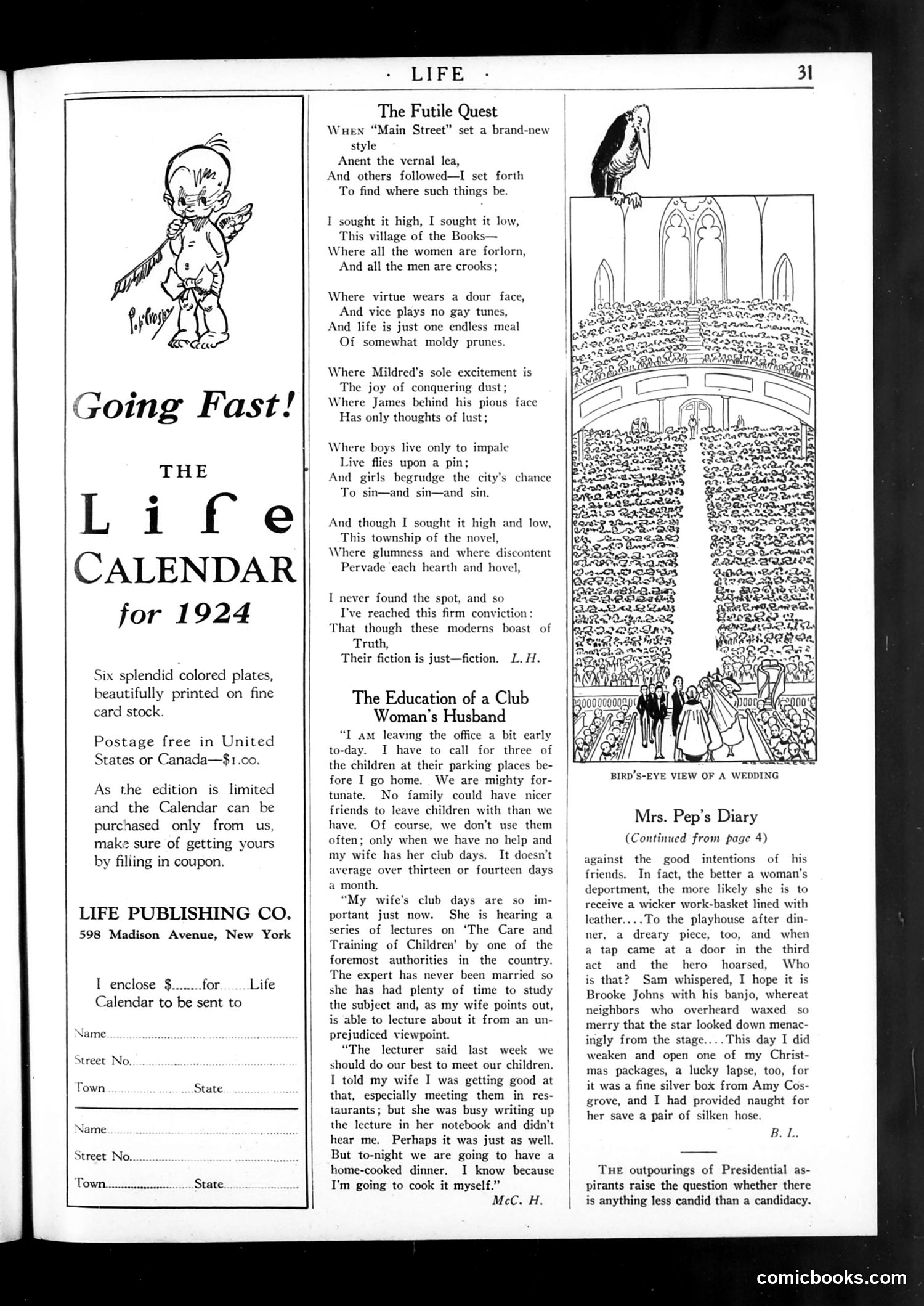
This page mixes advertising with satirical commentary on 1920s American life. **"The Futile Quest"** parodies Sinclair Lewis's *Main Street* (1920), a famous novel satirizing small-town American hypocrisy. The poem mocks readers seeking the book's depicted moral decay—arguing that while moderns claim to value truth, their fiction remains mere fiction. The joke: people want scandalous realism but won't find it. **"The Education of a Club Woman's Husband"** satirizes women's increasing club participation and self-improvement lectures. A husband describes ferrying children while his wife attends lectures on child-rearing from an unmarried "expert"—the irony being obvious. He cooks dinner himself while she studies theory. The satire targets both women's activism and the contradiction between expert advice and lived domestic reality. Both pieces reflect 1920s anxieties about changing gender roles and modern authenticity. The *Life* calendar advertisement uses the cartoon of a rushing child ("Going Fast!") to promote the publication itself.
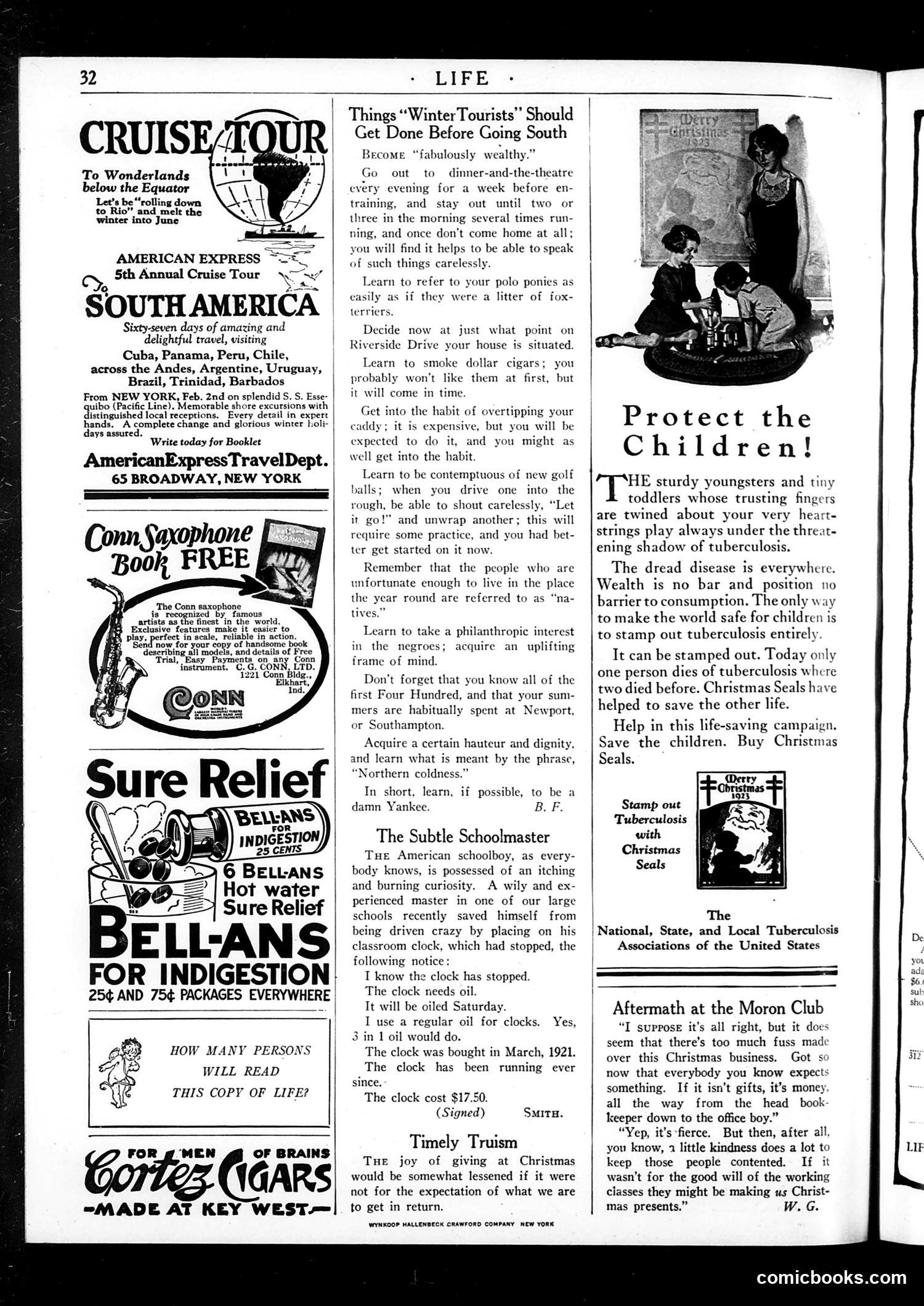
This page is primarily **advertising** with satirical editorial content interspersed. The main satire appears in "Things 'Winter Tourists' Should Get Done Before Going South"—a tongue-in-cheek guide mocking wealthy Americans preparing for winter vacations to South America. The piece satirizes the pretensions of the wealthy elite by advising them to ostentatiously display wealth (smoking expensive cigars, overtipping, casually losing golf balls), name-drop Newport summers, adopt a superior attitude toward locals, and perform tokenistic charity toward Black residents. The humor lies in exposing how the wealthy cultivate an artificial persona of casual superiority. "The Subtle Schoolmaster" humorously describes a teacher's method of managing student curiosity by posting exhaustively detailed, tedious notes on a broken classroom clock—defeating questions through bureaucratic overkill. The remaining content consists of travel advertisements (American Express South America cruise), product ads (Conn saxophones, Bellans indigestion remedy, Cortez cigars), and a serious tuberculosis awareness campaign urging Christmas Seal purchases to protect children.
This is a **subscription advertisement** for *Life* magazine, not a political cartoon. The smiling character at top is the magazine's mascot—a cheerful, wide-grinning figure used to represent the publication's humorous identity. The ad uses **emotional persuasion typical of 1920s marketing**: it warns readers that *not* subscribing means facing "the coming year in a veil of gloom," while subscribing guarantees weekly laughs throughout 1924. The phrase "Smile-post" appears to be *Life*'s branded term for humorous content. The tone is playfully threatening ("due warning," "the laugh's on you")—a common sales tactic of the era. The coupon on the left invited readers to subscribe for $5 (Canada: $5.80; Foreign: $6). **Key context**: *Life* was a major American humor and satire magazine (distinct from the later *Life* founded in 1936). This ad appeals to readers' desire for entertainment during what the text suggests was an anxious period.
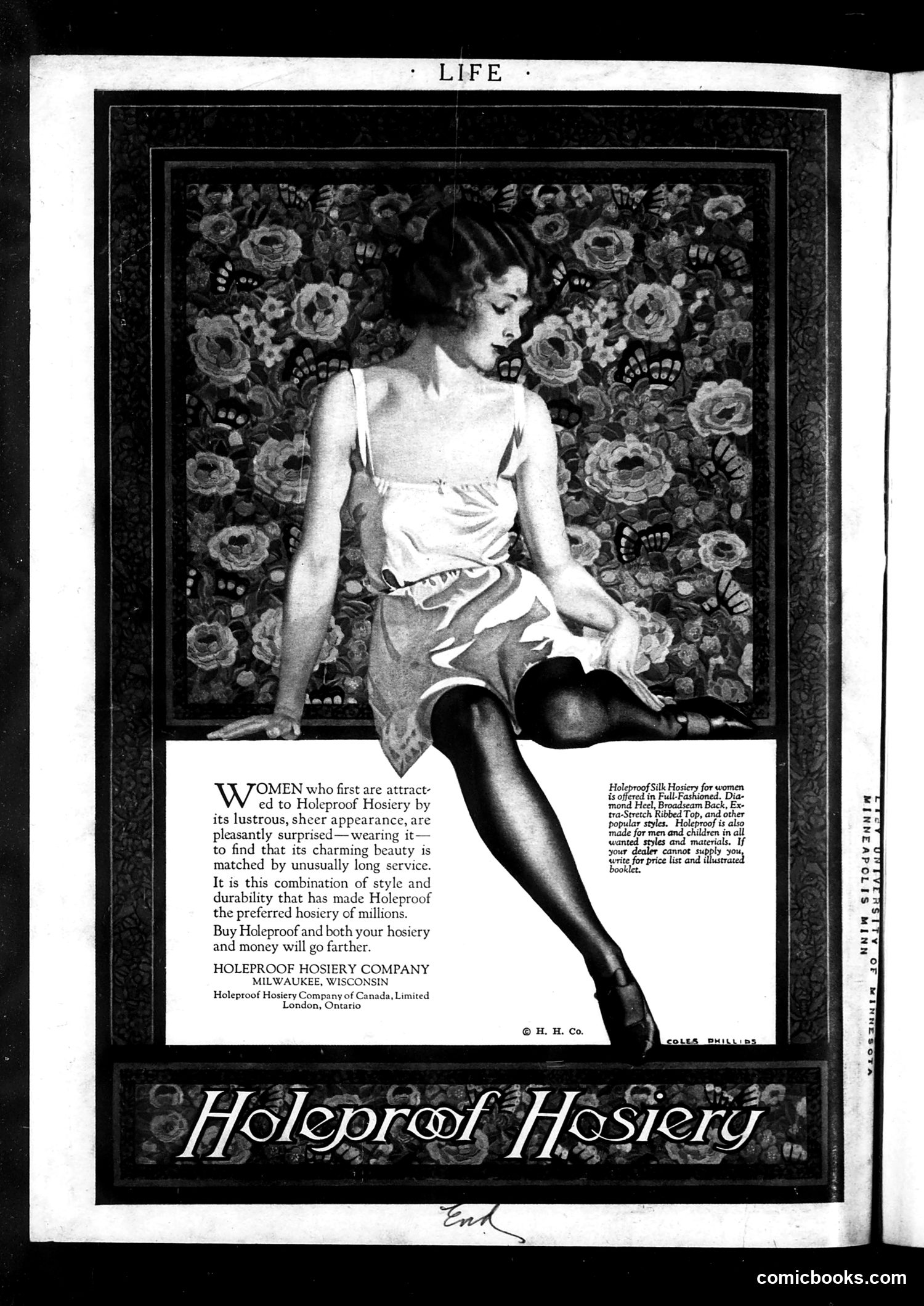
This is **not a cartoon or satire**, but rather a **commercial advertisement** for Holeproof Hosiery. The page features a glamorous photograph of a woman in 1920s attire, posed against a floral backdrop, displaying her stockinged legs. The advertisement emphasizes the product's dual appeal: aesthetic beauty ("lustrous, sheer appearance") combined with practical durability and longevity ("unusually long service"). The marketing strategy targets women by suggesting that Holeproof stockings offer both style and value—a common selling point during this era when hosiery was a significant clothing expense. The ad lists various styles available and provides company information for Milwaukee and Canada. This is a straightforward product advertisement typical of *Life* magazine's commercial content, not editorial satire or political commentary.

I can see this is a page from Life magazine, but the image shows primarily a blank white page with only some text markers visible on the left margin and what appears to be "OF MINNESOTA" at the bottom right. The OCR text is largely illegible characters and fragments, making it impossible to determine the actual content. Without being able to read the cartoon caption, article text, or see clear illustrations, I cannot identify specific political figures, historical references, or explain the satire's meaning to a modern reader. This appears to be either a blank page, a title page, or a page where the scan quality has rendered the content unreadable. A clearer image would be needed for proper analysis.