
Life, 1923-12-27 · page 20 of 37
Life — December 27, 1923 — page 20: what you’re looking at
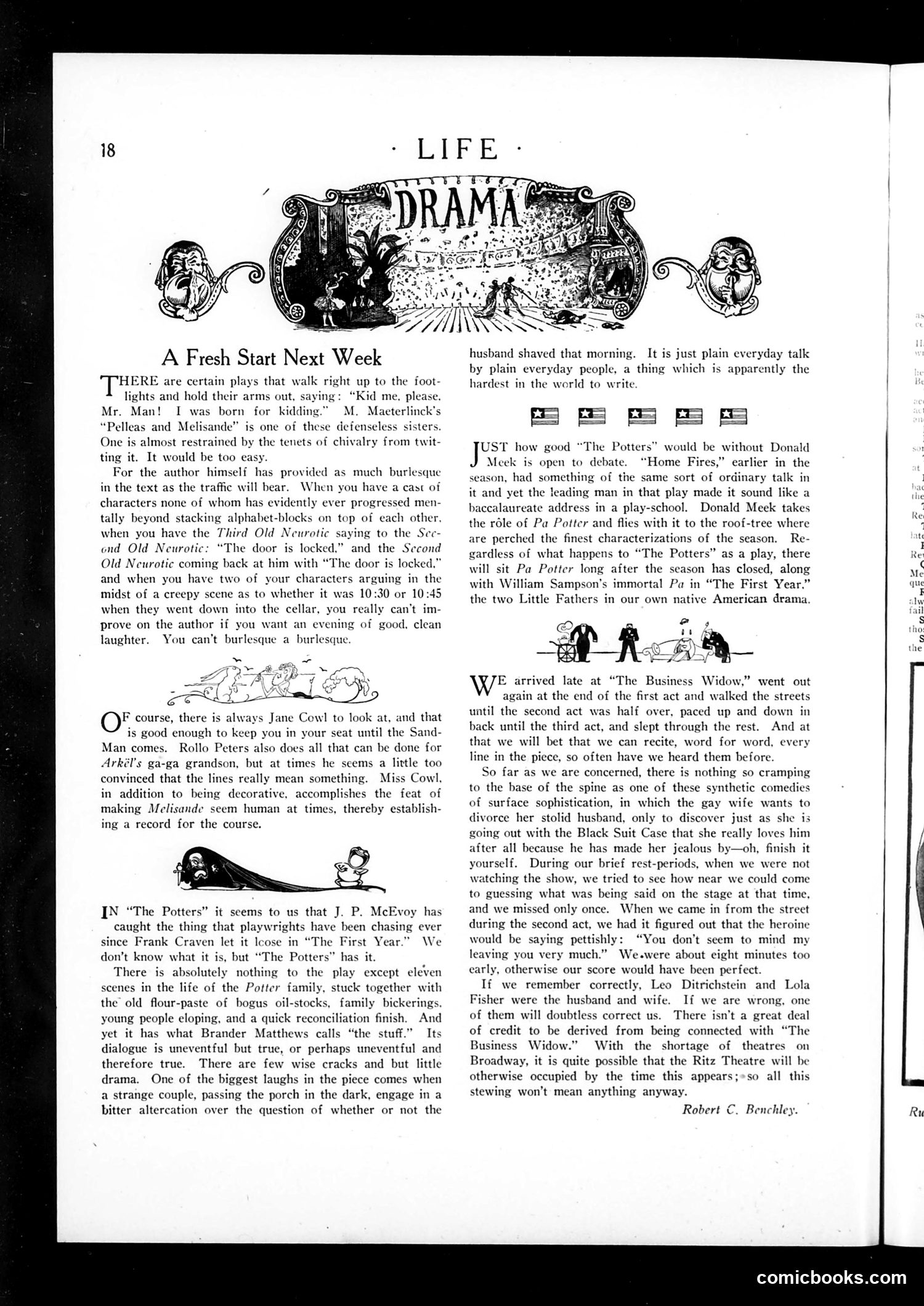
What you’re looking at
This page reviews three Broadway plays from what appears to be the early 1920s. The critic discusses: **"Pelléas and Mélisande"**: A symbolic play by Maeterlinck that the reviewer finds so absurdly written (characters debating whether they went downstairs at 10:30 or 10:45 during a "creepy scene") that it self-parodies. The critic praises actress Jane Cowl for making the incomprehensible dialogue seem human. **"The Potters"**: Praised as successfully capturing everyday American life—ordinary people having mundane conversations (humorously, a couple arguing about whether the husband shaved). The reviewer credits actor Donald Meek with elevating ordinary dialogue through skilled performance. **"The Business Widow"**: Dismissed as formulaic, derivative "synthetic comedy" that the critic found so forgettable he slept through most of it yet could recite from memory. The satire centers on what makes theater work: authentic human behavior versus artificial sophistication, and an actor's ability to make dialogue meaningful.
📄 Transcribed text from this page (OCR, searchable)
Machine-transcribed from the original scan — historical spelling and the odd misread are preserved.
A Fresh Start Next Week HERE are certain plays that walk right up to the foot- lights and hold their arms out, saying: “Kid me, pleas Mr. Man! I was born for kiddi M. Maeterline “Pelleas and Melisande” is one of these defenseless sisters. One is almost restrained by the tenets of chivalry from twit- ting it. It would be too ea For the author himself has provided as much burlesque in the text as the traffic will bear. When you have a cast of characters none of whom has evidently ever progre: ed men- ach other, ying to the Sec. and the Second Old Neurotic coming back at him with “The door is locked,” and when you have two of your characters arguing in the midst of a creepy scene as to whether it was 10:30 or 10:45 when they went down into the cellar, you really can't im- prove on the author if you want an evening of good, clean laughter. You can’t burlesque a burlesque. tally beyond stacking alphabet-blocks on top of when you have the Third Old Neurotic s ond Old Neurotic: “The door is locked.” ae F course, there is always Jane Cowl to look at, and that is good enough to keep you in your seat until the Sand- Man comes. Rollo Peters also does all that can be done for Arkél’s ga-ga grandson, but at times he seems a little too convinced that the lines really mean something. Miss Cowl, in addition to being decorati accomplishes the feat of making Melisande seem human at times, thereby establish- ing a record for the course. IN “The Potters” it seems to us that J. P. McEvoy has caught the thing that playwrights have been chasing ever since Frank Craven let it Icose in “The First Year.” We don’t know what it is, but “The Potters” has it. There is absolutely nothing to the play except eleven scenes in the life of the Potter family, stuck together with the old flour-paste of bogus oil-stocks, family bickerings. young people eloping, and a quick reconciliation finish. And yet it has what Brander Matthews calls “the stuff.” Its dialogue is uneventful but true, or perhaps uneventful and therefore true. There are few wise cracks and but little drama. One of the biggest laughs in the piece comes when a strange couple, passing the porch in the dark, engage in a bitter altercation over the question of whether or not the husband shaved that morning. It is just plain everyday talk by plain everyday people, a thing which is apparently the hardest in the world to write. UST how good “The Potters” would be without Donald Meek is open to debate. “Home Fires,” earlier in the season, had something of the same sort of ordinary talk in it and yet the leading man in that play made it sound like a baccalaureate address in a play-school. Donald Meek takes the role of Pa Potter and flies with it to the roof-tree where are perched the finest characterizations of the season. Re- gardless of what happens to “The Potters” as a play, there will sit Pa Potter long after the season has closed, along with William Sampson's immortal Pa in “The First Year.” the two Little Fathers in our own native American drama. E arrived late at “The Business Widow,” went out again at the end of the first act and walked the streets until the second act was half over, paced up and down in back until the third act, and slept through the rest. And at that we will bet that we can recite, word for word, every line in the piece, so often have we heard them before. So far as we are concerned, there is nothing so cramping to the base of the spine as one of these synthetic comedies of surface sophistication, in which the gay wife wants to divorce her stolid husband, only to discover just as she is going out with the Black Suit Case that she really loves him after all because he has made her jealous by—oh, finish it yourself. During our brief rest-periods, when we were not atching the show, we tried to see how near we could come to guessing what was being said on the stage at that time, and we missed only once. When we came in from the street during the second act, we had it figured out that the heroine would be saying pettishly You don’t seem to mind my leaving you very much.” We.were about eight minutes too early, otherwise our score would have been perfect. If we remember correctly, Leo Ditrichstein and Lola Fisher were the husband and wife. If we are wrong, one of them will doubtless correct us. There isn't a great deal of credit to be derived from being connected with “The Business Widow.” With the shortage of theatres on Broadway, it is quite possible that the Ritz Theatre will be otherwise occupied by the time this appears;*so all this stewing won’t mean anything anyway. Robert C. Benchley. comicbooks.com