
Life, 1923-12-27 · page 11 of 37
Life — December 27, 1923 — page 11: what you’re looking at
What you’re looking at
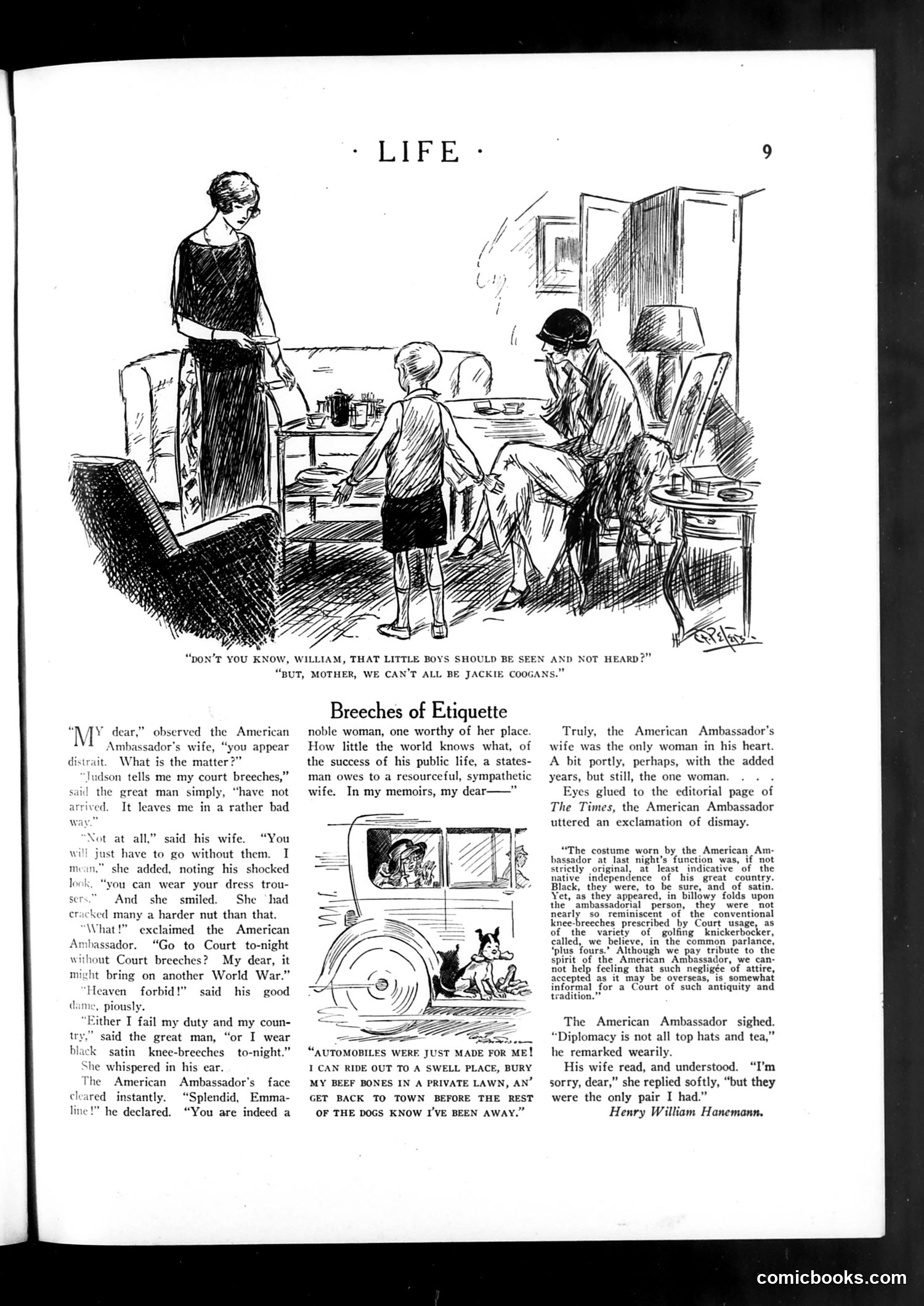
This satirical piece concerns an American Ambassador who appeared at a formal Court function wearing **breeches instead of proper evening dress**—a breach of diplomatic protocol. The main cartoon depicts a domestic scene where the Ambassador's wife explains the incident. The humor centers on the Ambassador's unconventional justification: he claims automobiles were "just made for me" and he needed to ride out to a swell place to bury his beef bones in a private lawn, returning late before the dogs discovered his absence. The satire mocks both the **pretensions of American diplomacy** and the absurdity of using automobiles as an excuse for violating centuries-old Court traditions. The piece gently ridicules American informality clashing with European formal expectations, suggesting American success in modern technology doesn't excuse breaches of traditional etiquette.
📄 Transcribed text from this page (OCR, searchable)
Machine-transcribed from the original scan — historical spelling and the odd misread are preserved.
“poNn’T YOU KNOW, WILLIAM, THAT LITTLE BOYS SHOULD “BUT, MOTHER, WE CAN'T ALL BE JACKIE COO( dear,” observed the American Ambassador's wife, “you appear ‘M* istrait. What is the matter?” ison tells me my court breeches,” the great man simply, “have not arrived. It leaves me in a rather bad way.” “You just have to go without them. I she added, noting his shocked ‘you can wear your dress trou- And she smiled. She ‘had ‘ed many a harder nut than that. What!" exclaimed the American Ambassador. “Go to Court to-night without Court breeches? My dear, it might bring on another World War.” aven forbid!” said good piously. ther I fail my duty and my coun- said the great man, “or I wear black satin knee-breeches _ to-night.” She whispered in his ear. The American Ambassador's face cleared instantly. “Splendid, Emma- line!" he declared. “You are indeed a Not at all,” said his wife. cr: his Breeches of Etiquette noble woman, one worthy of her place. How little the world knows what, of the success of his public life, a states- man owes to a resourceful, sympathetic wife. In my memoirs, my dear——” ZZ 2 zz! “AUTOMOBILES WERE JUST MADE FOR ME! 1 CAN RIDE OUT TO A SWELL PLACE, BURY MY BEEF BONES IN A PRIVATE LAWN, AN’ GET BACK TO TOWN BEFORE THE REST OF THE DOGS KNOW I'VE BEEN AWAY.” Y AND NOT HEARD?” Ns. Truly, the American Ambassador's wife was the only woman in his heart. A bit portly, perhaps, with the added years, but still, the one woman. . . . Eyes glued to the editorial page of The Times, the American Ambassador uttered an exclamation of dismay. “The costume worn by the American Am- bassador at last night's function was, if not strictly original, at least indicative of the native independence of his great country. Black, they were, to be sure, and of satin. Yet, as they appeared, in billowy folds upon the’ ambassadorial person, they were not nearly so reminiscent of’ the conventional knee-breeches prescribed by Court usage, as of the variety of golfing knickerbocker, called, we believe, in the common parlance, ‘plus fours.’ Although we pay tribute to the spirit of the American Ambassador, we can- not help feeling that such negligée ‘of attire, accepted as it may be overseas, is somewhat informal for a Court of such ‘antiquity and tradition.” The American Ambassador sighed. “Diplomacy is not all top hats and tea,” he remarked wearily. His wife read, and understood. “I’m sorry, dear,” she replied softly, “but they were the only pair I had.” Henry William Hanemann. comicbooks.com