
Life, 1923-12-27 · page 28 of 37
Life — December 27, 1923 — page 28: what you’re looking at
What you’re looking at
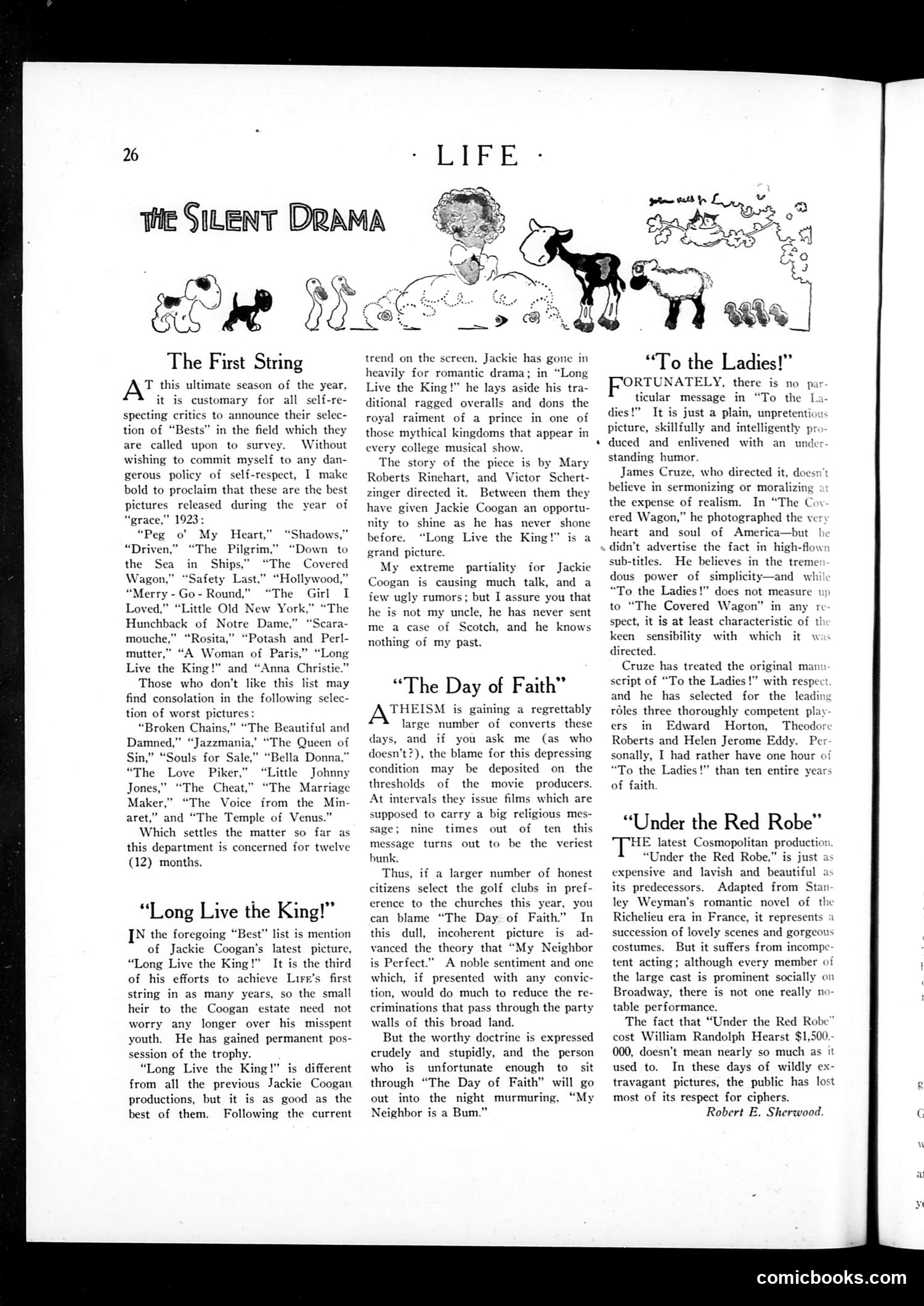
This page contains film reviews and criticism from Life magazine's "Silent Drama" column, circa 1923. The cartoonish header illustration depicts various animals and scenes, serving as decorative framing for the column. The content reviews several silent films, including Jackie Coogan's "Long Live the King!" (praised as his best work, departing from his typical ragged-child roles to play a prince). The reviewer dismisses "The Day of Faith" as incompetent religious propaganda that ironically drives people *away* from churches. The column also lists what the critic considers the year's best and worst pictures—essentially quality rankings of 1923 releases. "To the Ladies!" receives favorable mention for avoiding pretentious messaging. The tone is witty and sardonic, characteristic of Life's satirical approach. The phrase "year of grace, 1923" employs gentle mockery. No specific political figures are caricatured; the satire targets the film industry's tendency toward heavy-handed moralizing in cinema.
📄 Transcribed text from this page (OCR, searchable)
Machine-transcribed from the original scan — historical spelling and the odd misread are preserved.
26 The First String T this ultimate season of the year, it is customary for all self-re- specting critics to announce their selec- tion of “Bests” in the field which they are called upon to survey. Without wishing to commit myself to any dan- gerous policy of self-respect, I make bold to proclaim that these are the best pictures released during the year of “grace,” 1923: “Peg o' My Heart,” “Driven,” “The Pilgrim,” to the Sea in Ships,” “The Covered Wagon,” “Safety Last,” “Hollywood,” “Merry-Go-Round,” “The Girl I Loved,” “Little Old New York,” “The Hunchback of Notre Dame,” “Scara- mouche,” “Rosita,” “Potash and Perl- mutter,” “A Woman of Paris,” “Long Live the King!” and “Anna Christie.” Those who don’t like this list may find consolation in the following selec- tion of worst pictures: “Broken Chain The Beautiful and Damned,” “Jazzmania,’ “The Queen of Sin,” “Souls for Sale,” “Bella Donna,” “The Love Piker,” “Little Johnny Jones,” “The Cheat,” “The Marriage Maker,” “The Voice from the Min- aret,” and “The Temple of Venus.” Which settles the matter so far as this department is concerned for twelve (12) months. ° i : . “Long Live the King! IN the foregoing “Best” list is mention of Jackie Coogan’s latest picture, “Long Live the King!” It is the third of his efforts to achieve Lire’s first string in as many years, so the small heir to the Coogan estate need not worry any longer over his misspent youth. He has gained permanent pos- session of the trophy. “Long Live the King!” is different from all the previous Jackie Coogan productions, but it is as good as the best of them. Following the current trend on the screen, Jackie has gone in heavily for romantic drama; in “Long Live the King!” he lays aside his tra- ditional ragged overalls and dons the royal raiment of a prince in one of those mythical kingdoms that appear in every college musical show. The story of the piece is by Mary Roberts Rinehart, and Victor Schert- zinger directed it. Between them they have given Jackie Coogan an opportu- nity to shine as he has never shone before. “Long Live the King!” grand picture. My extreme partiality for Jackie Coogan is causing much talk, and a few ugly rumors; but I assure you that he is not my uncle, he has never sent me a case of Scotch, and he knows nothing of my past. is a “The Day of Faith” ATE SM is gaining a regrettably large number of converts these ys, and if you ask me (as who doesn’t?), the blame for this depressing condition may be deposited on the thresholds of the movie producers. At intervals they issue films which are supposed to carry a big religious mes- sage; times out of ten this message turns out to be the veriest bunk. Thus, if a larger number of honest citizens select the golf clubs in pref- erence to the churches this year, you can blame “The Day of Faith.” In this dull, incoherent picture is ad- vanced the theory that “My Neighbor is Perfect.” A noble sentiment and one which, if presented with any convi tion, would do much to reduce the re- criminations that pass through the party walls of this broad land. But the worthy doctrine is expressed crudely and stupidly, and the person who is unfortunate enough to sit through “The Day of Faith” will go out into the night murmuring, “My Neighbor is a Bum.” nine * duced and enlivened “To the Ladies!” 'ORTUNATELY, there is no par ticular message in “To the | dies!” It is just a plain, unpretentious picture, skillfully and intelligently pr: with an und standing humor. James Cruze, who directed it, doesn't believe in sermonizing or moralizing the expense of realism. In “The Coy ered Wagon,” he photographed the ver heart and soul of America—but didn’t advertise the fact in high-flown sub-titles. He believes in the treme dous power of simplicity—and wh “To the Ladies!” does not measure to “The Covered Wagon” in any re spect, it is at least characteristic of tl keen sensibility with which it w directed. Cruze has treated the original mar script of “To the Ladies!” with respect and he has selected for the leading rdles three thoroughly competent play ers in Edward Horton, Theodor Roberts and Helen Jerome Eddy. Pe: sonally, I had rather have one hour o “To the Ladies!” than ten entire year: of faith “Under the Red Robe” T latest Cosmopolitan production “Under the Red Robe,” is just as expensive and lavish and beautiful a its predecessors. Adapted from Star ley Weyman’s romantic novel of the Richelieu era in France, it represents a succession of lovely scenes and gorgeous costumes. But it suffers from incompe- tent acting; although every member of ' the large cast is prominent socially on Broadway, there is not one really no- table performance. The fact that “Under the Red Robe cost William Randolph Hearst $1,500.- 000, doesn’t mean nearly so much as it used to. In these days of wildly ex- travagant pictures, the public has lost g most of its respect for ciphers. Robert E. Sherwood. ( comicbooks.com