
A complete issue · 37 pages · 1923
Life — May 31, 1923
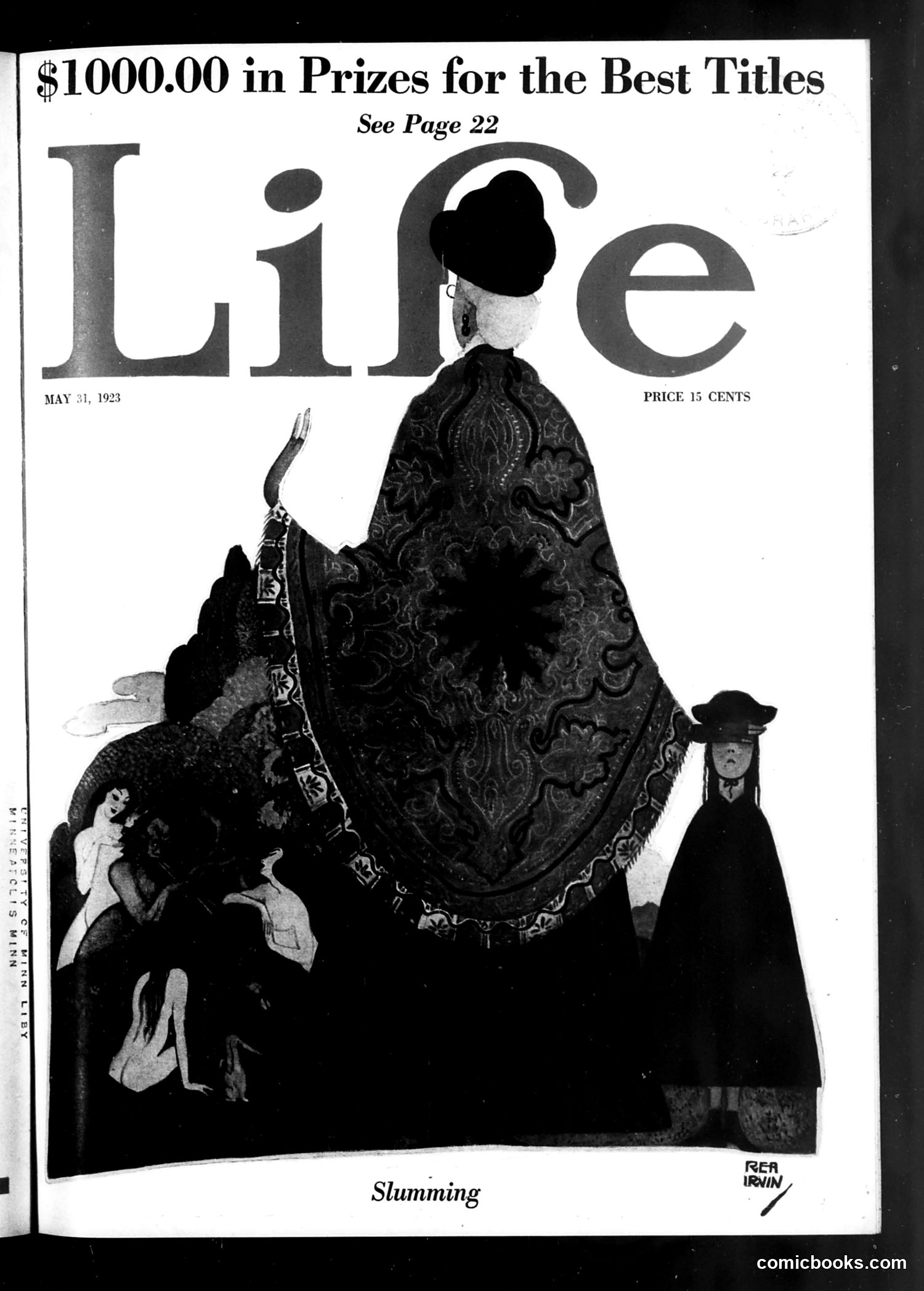
This cover depicts "Slumming"—a social commentary on wealthy people visiting poor neighborhoods for entertainment. The central figure, wearing an ornate cloak and elaborate hat, represents a wealthy person surveying poverty with detachment. The figure's posture and costume suggest aristocratic condescension. The two smaller figures (left and right) appear to represent residents of impoverished areas—one gesturing, the other observing. The cartoon critiques the voyeuristic nature of "slumming," a real 1920s practice where affluent urbanites would tour poor districts as amusement, treating poverty as spectacle rather than engaging with genuine social problems. The satirical point: wealthy society views poverty as entertainment rather than a serious social issue demanding action.
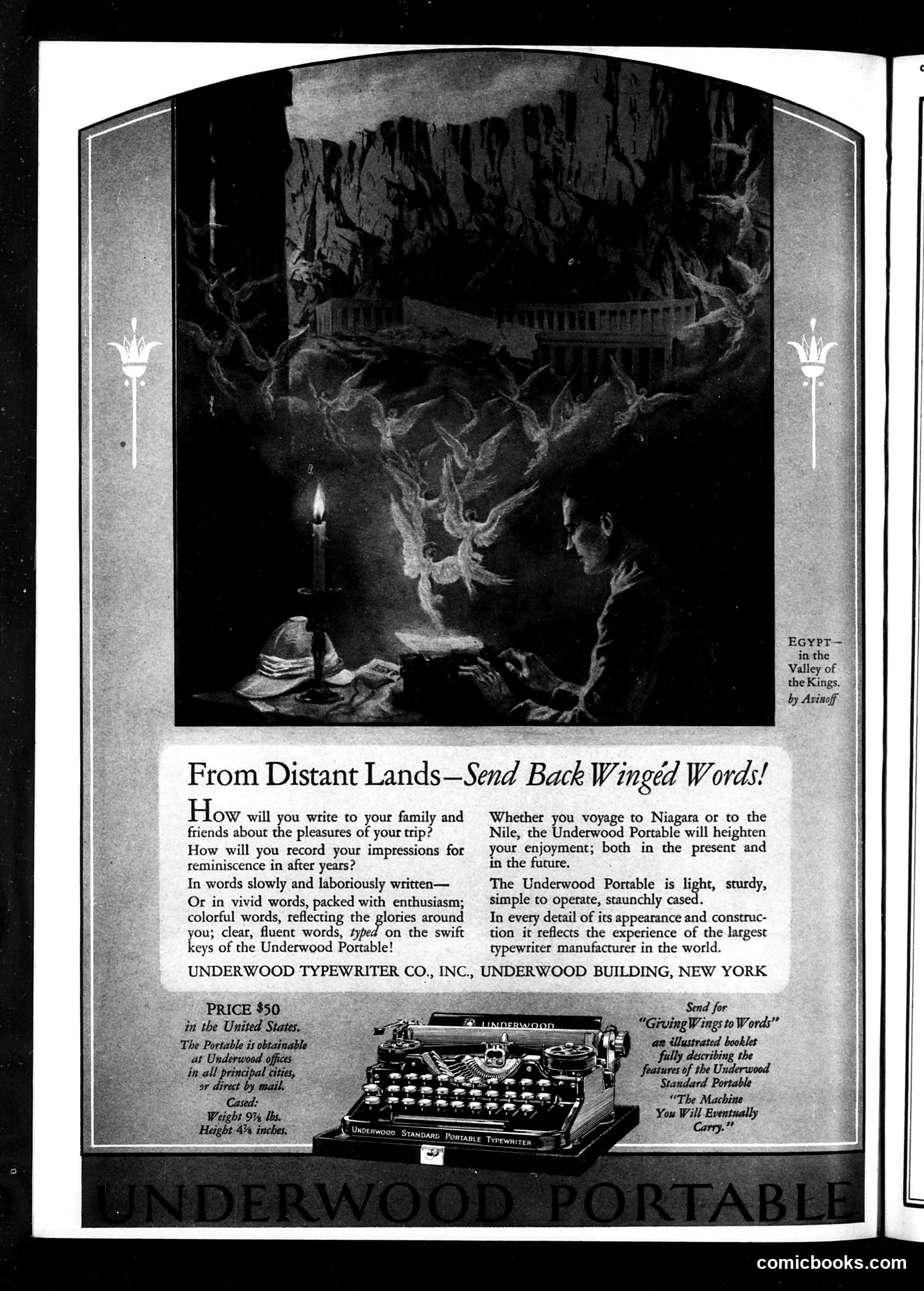
This page is primarily an **advertisement for the Underwood Portable Typewriter**, not a political cartoon. The main image depicts a dramatic, atmospheric scene—appearing to show figures in an underground cavern or tomb (titled "Egypt in the Valley of the Kings" by the artist Arzag)—used as evocative marketing imagery. The advertisement's pitch targets travelers: it encourages tourists to document their journeys by typewriter rather than by hand. The copy emphasizes the machine's portability, durability, and ease of use for recording "impressions" and "glories" while traveling to exotic destinations like Niagara or the Nile. The price is listed as $50. This represents early 20th-century consumer advertising leveraging wanderlust and the appeal of modern technology for leisure travelers.
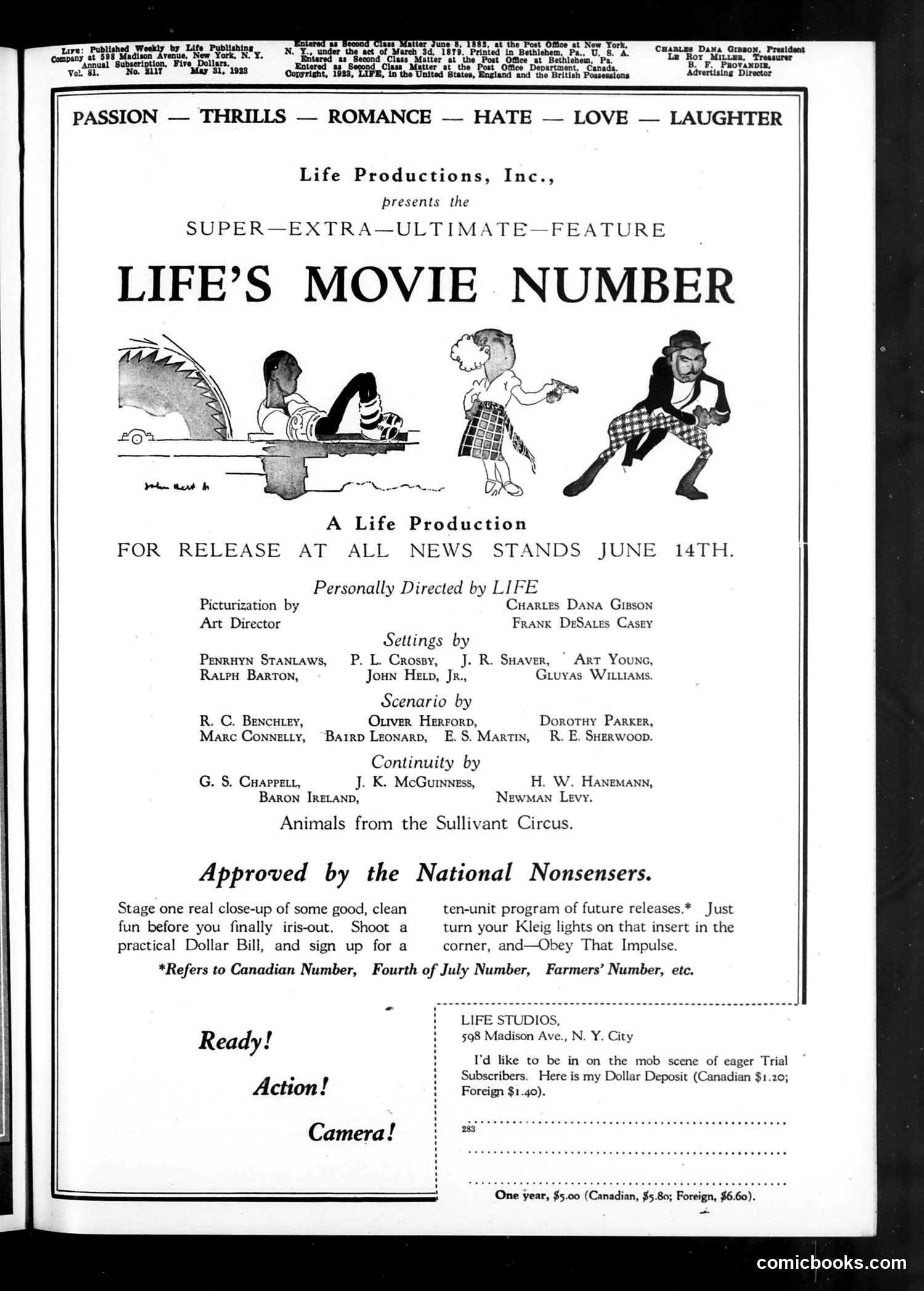
This page is primarily an **advertisement** for "Life's Movie Number"—a special issue of Life magazine featuring film-related content, released June 14th. The cartoon illustrations show **slapstick comedy scenes**: characters engaged in physical humor including someone on a seesaw with animals and people in exaggerated poses. These images reference **silent film comedy conventions** of the era, likely evoking popular slapstick performers. The tagline "Approved by the National Nonsensers" is self-satirical humor—Life positioning itself as deliberately absurd rather than serious. The bottom text references "Trial Subscribers" and a "Dollar Deposit," indicating this promoted a subscription offer. The page's emphasis on "Passion—Thrills—Romance—Hate—Love—Laughter" reflects how 1920s-30s films marketed themselves to audiences seeking entertainment escapism.
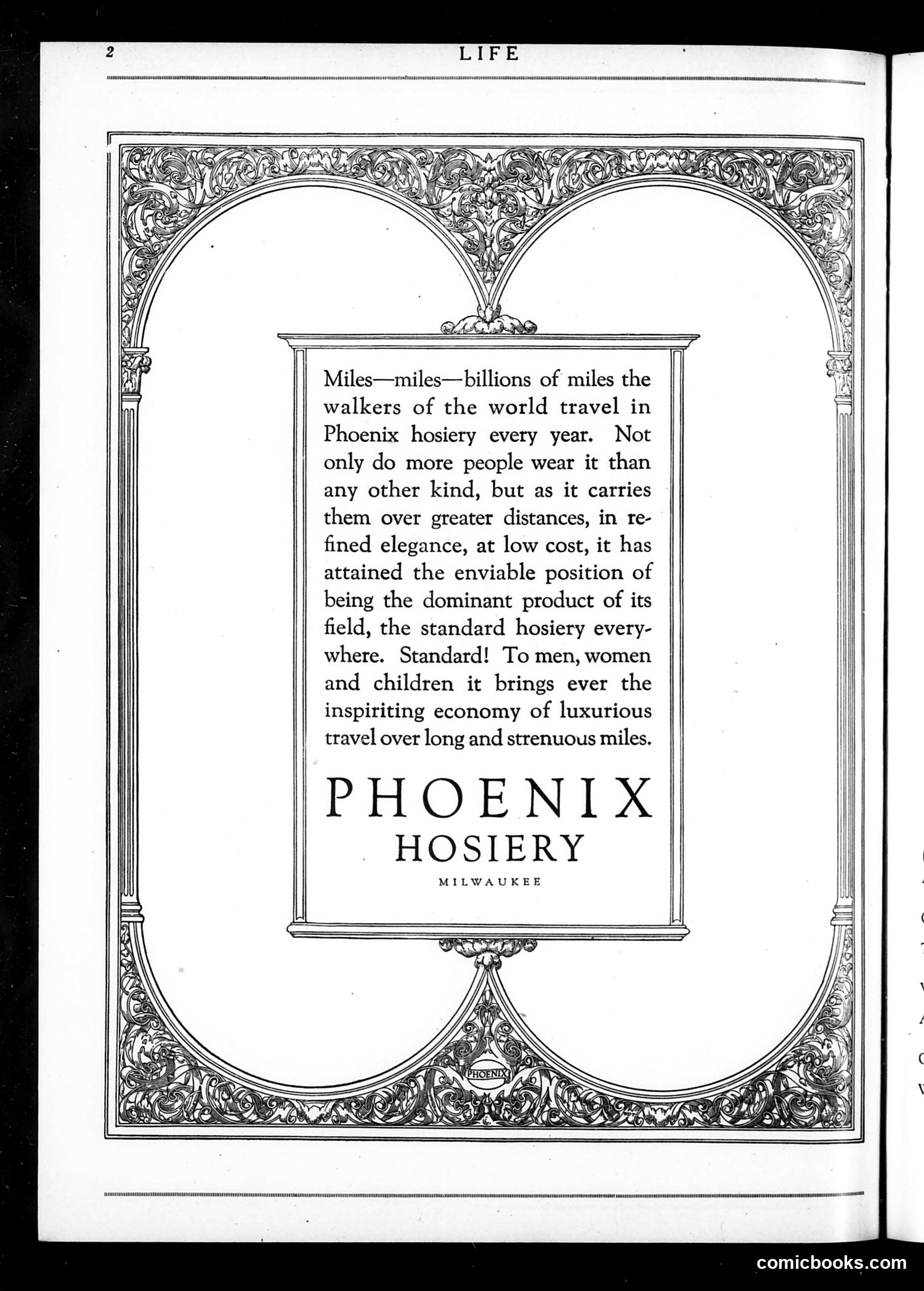
This page is primarily **advertising copy**, not political satire or editorial cartoons. It's a full-page advertisement for Phoenix Hosiery from Milwaukee. The ad uses hyperbolic marketing language typical of early 20th-century advertising, claiming that "billions of miles" of their hosiery are worn annually by "walkers of the world." It positions Phoenix as the "standard hosiery everywhere" and emphasizes durability, elegance, low cost, and comfort for "long and strenuous miles" of travel. The ornate decorative border and formal layout are characteristic of *Life* magazine's design aesthetic. There is no political commentary, caricature, or satire present—this is straightforward commercial advertising presented with the visual sophistication the magazine was known for.
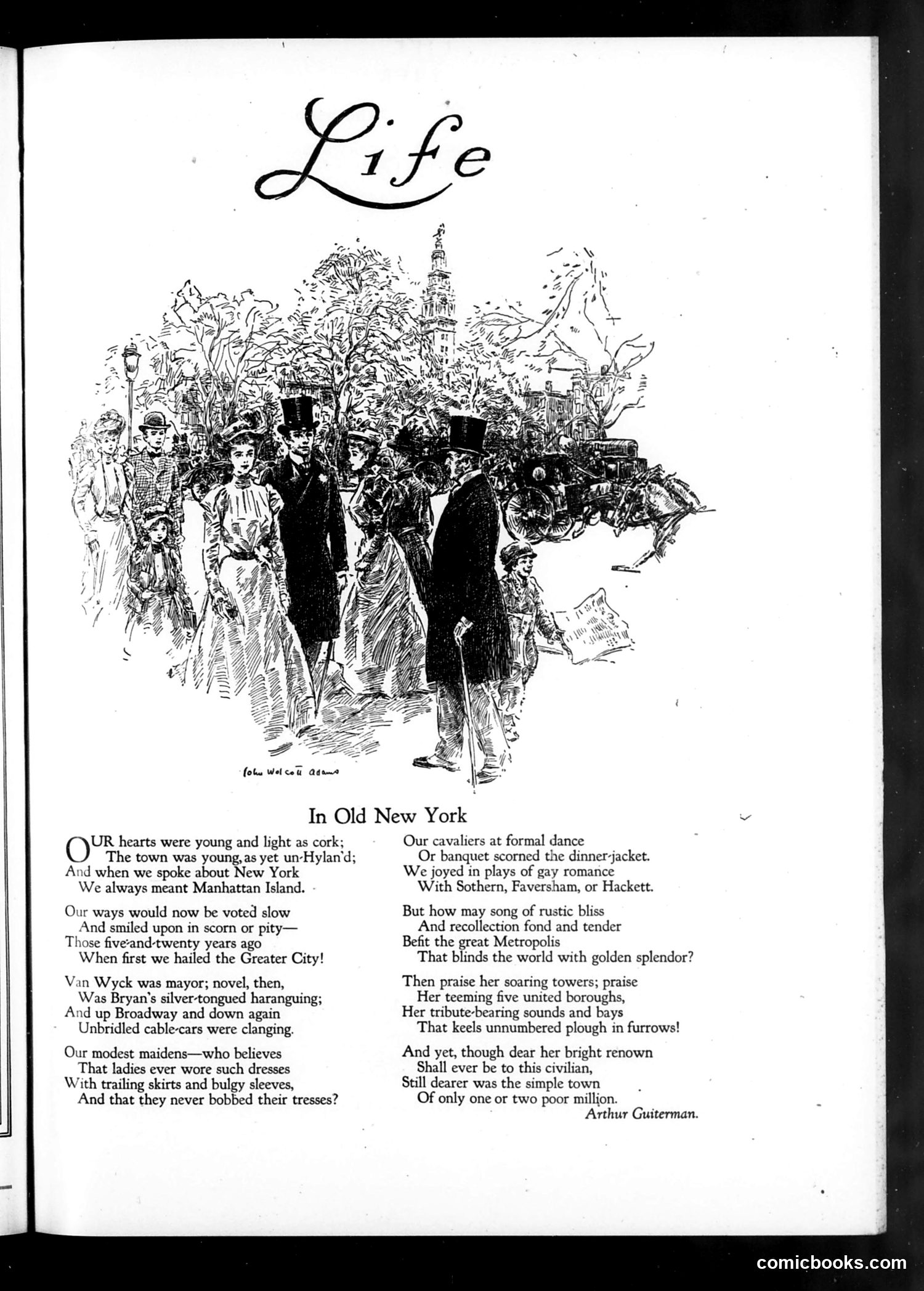
This poem satirizes nostalgic romanticization of New York's past. The text mocks those who sentimentally recall an idealized "Old New York" from "five-and-twenty years ago," claiming their hearts were "young and light as cork" and their manners superior. The satire targets specific nostalgia: references to Van Wyck (likely Mayor Van Wyck), "formal dance," and "plays of gay romance" evoke a supposedly genteel era. However, Guiterman undercuts this by questioning whether that past was genuinely superior—noting ladies' impractical fashions and the reality that New York was always primarily about commerce and ambition ("Broadway and down again"). The final lines deflate the romance: the "simple town / Of only one or two poor million" was never truly quaint. The illustration shows crowded urban life, supporting the poem's message that nostalgic memory distorts reality.
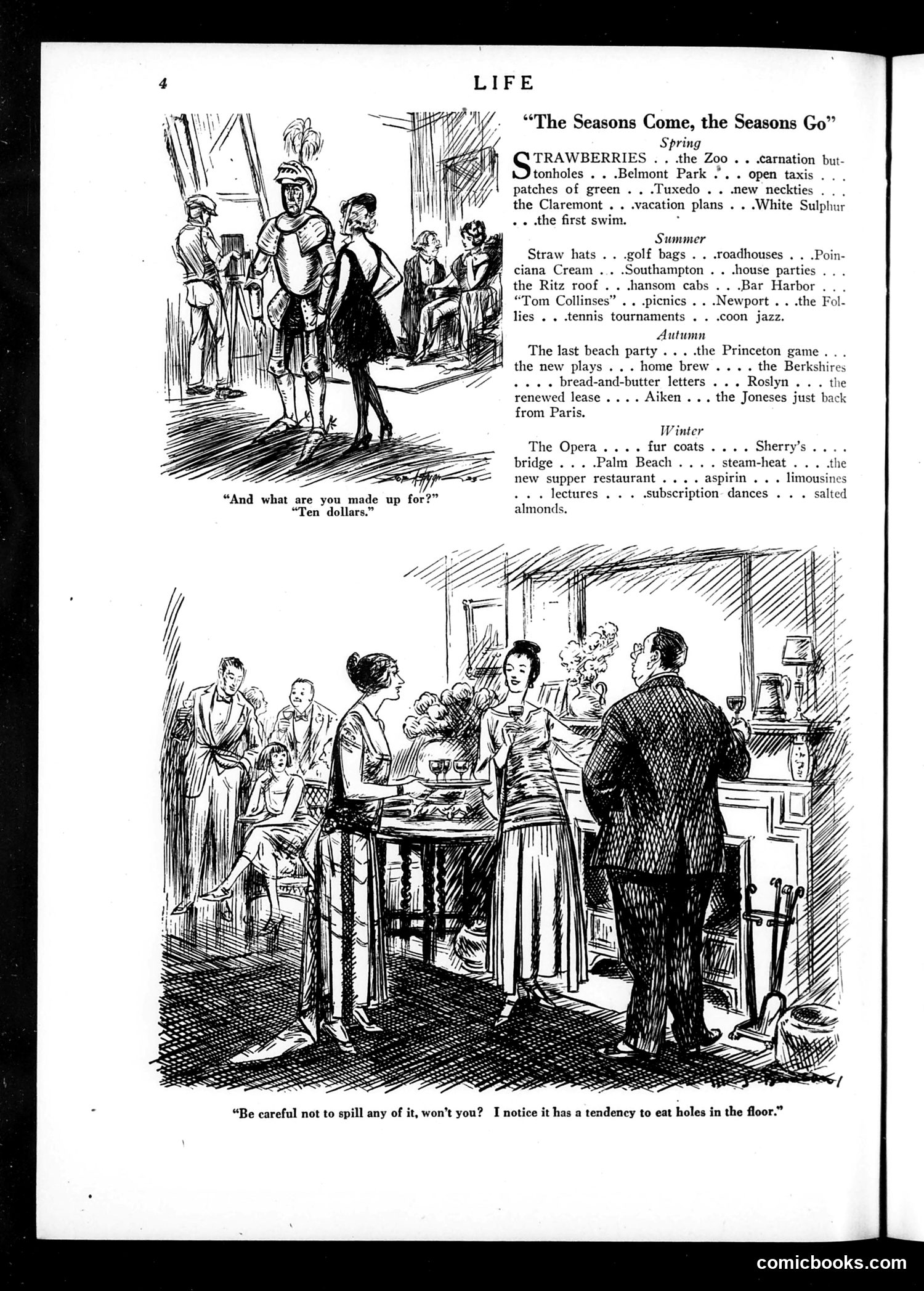
This page contains two cartoon vignettes satirizing early 20th-century social life. **Top cartoon**: Shows a street scene with what appears to be a beggar or vagrant asking someone "And what are you made up for?" with the reply "Ten dollars." The satire likely mocks wealthy people's extravagant spending on entertainment or appearance. **Bottom cartoon**: Depicts a cocktail party or social gathering where a hostess warns a guest about a liquid (likely alcohol, given Prohibition-era context) that "has a tendency to eat holes in the floor." This is humorous commentary on bootleg liquor quality during Prohibition—suggesting homemade or illegally-produced alcohol was dangerously potent. The column "'The Seasons Come, the Seasons Go'" catalogs seasonal social activities (strawberries, golf, opera) reflecting upper-class leisure culture.
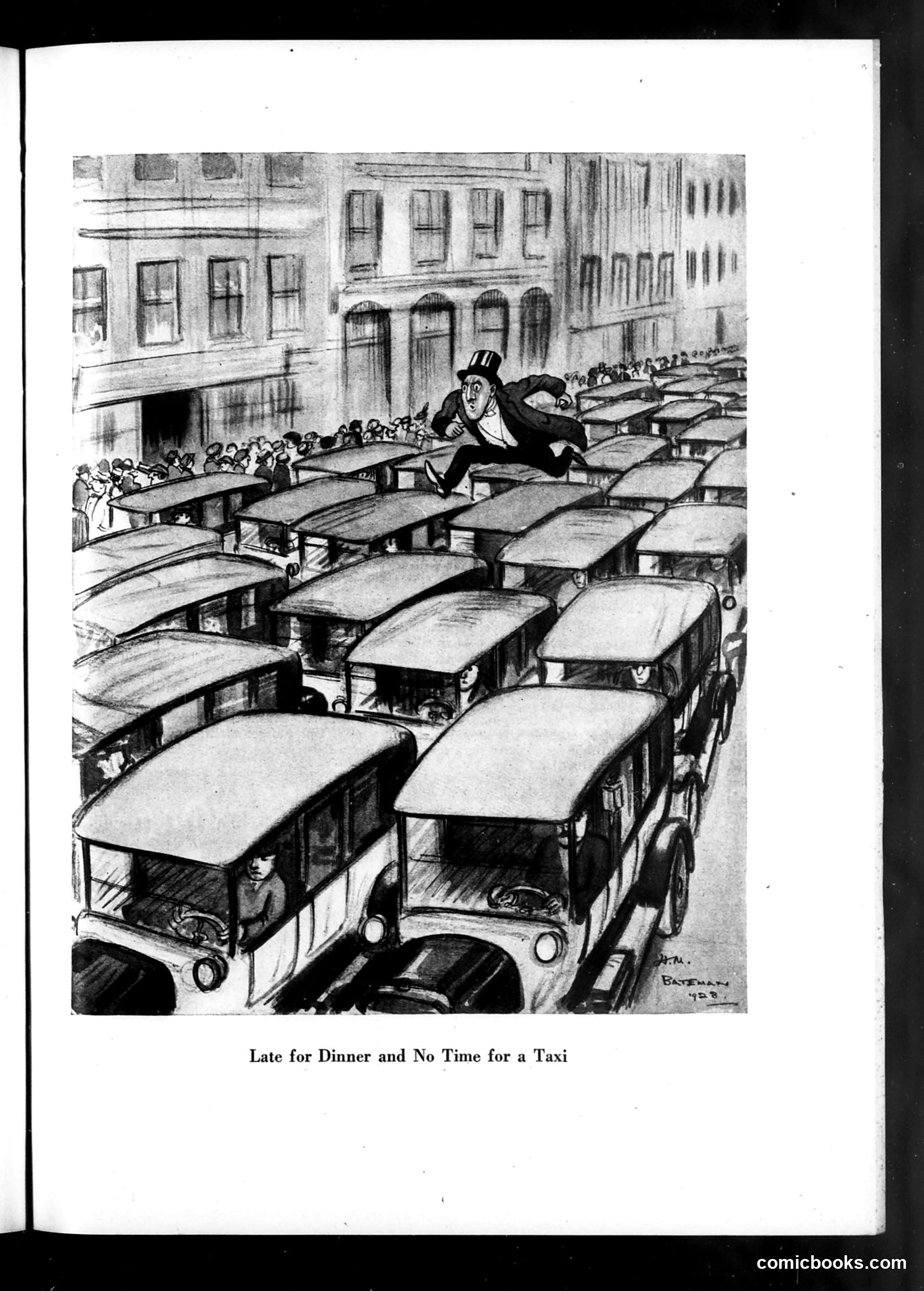
This cartoon satirizes the severe taxi shortage in New York City, likely from the 1940s-50s based on the vehicle styles. The image depicts a well-dressed man in a top hat literally leaping across the roofs of dozens of parked taxis, desperately trying to find one available for hire. The joke plays on the common urban frustration: despite an apparent abundance of taxis filling the street, none are actually available to passengers. The man's exaggerated acrobatic desperation emphasizes how paradoxical and maddening this situation was—surrounded by hundreds of vehicles yet unable to secure transportation. The cartoon critiques a systemic problem in taxi service availability rather than targeting a specific political figure.
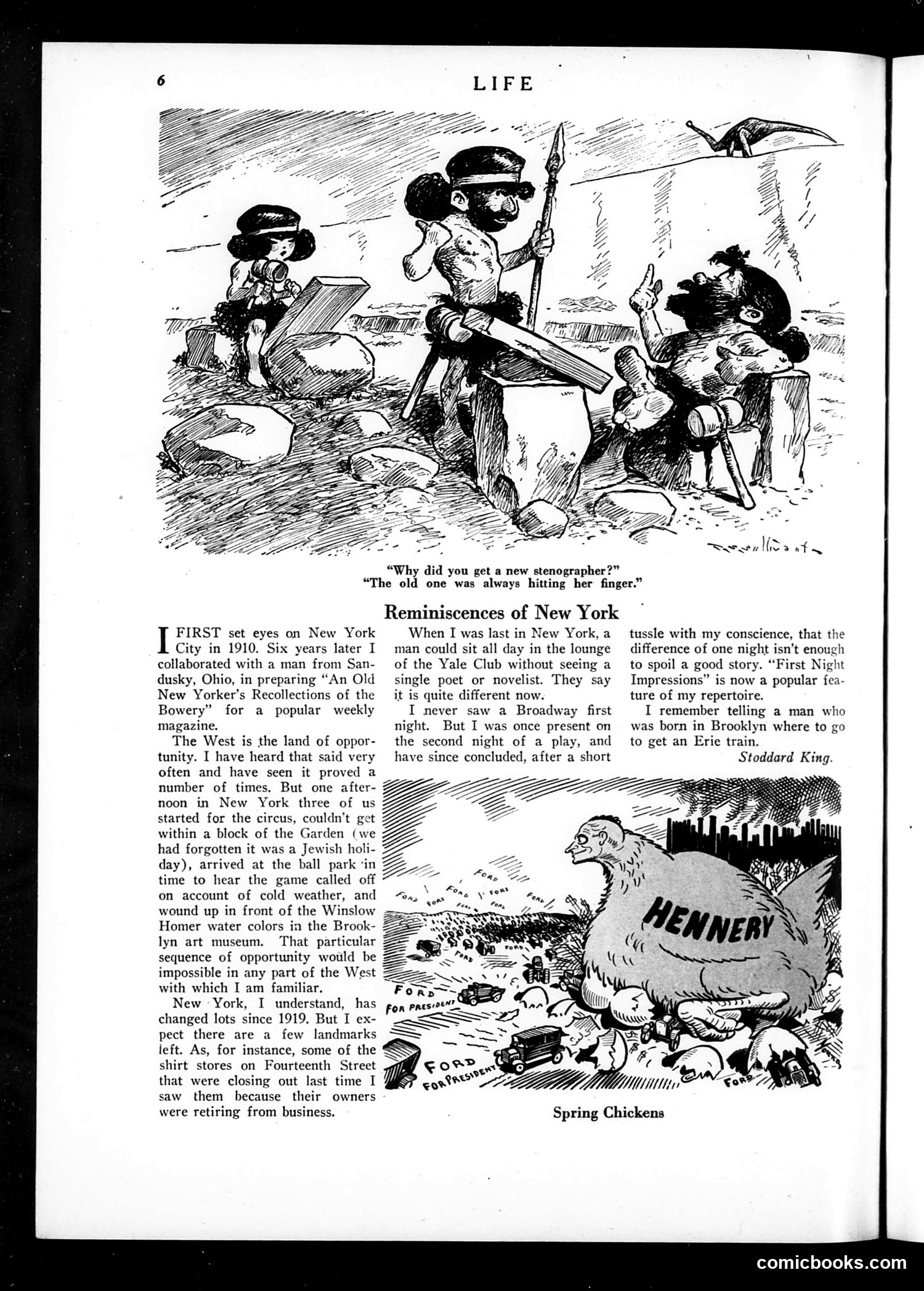
**Top Cartoon:** A humorous domestic scene showing a man with a spear and military helmet, surrounded by children in primitive-style clothing. The caption reads: "Why did you get a new stenographer?" / "The old one was always hitting her finger." This is workplace humor playing on the stereotype that stenographers (typists) frequently hit their fingers while operating manual typewriters—a common occupational hazard. The absurd military fantasy context adds comedic exaggeration to justify replacing an employee. **Bottom Cartoon ("Spring Chickens"):** Depicts a large bird labeled "HENNERY" surrounded by buildings labeled "FORD" and "FOR PROHIBITION," with small chicks nearby. This appears to satirize commercial enterprise around poultry farming, possibly referencing Ford's industrial methods or Prohibition-era entrepreneurship. **Text Section:** "Reminiscences of New York" discusses changes in Manhattan since 1910, mentioning Broadway theaters and nostalgia for earlier eras.
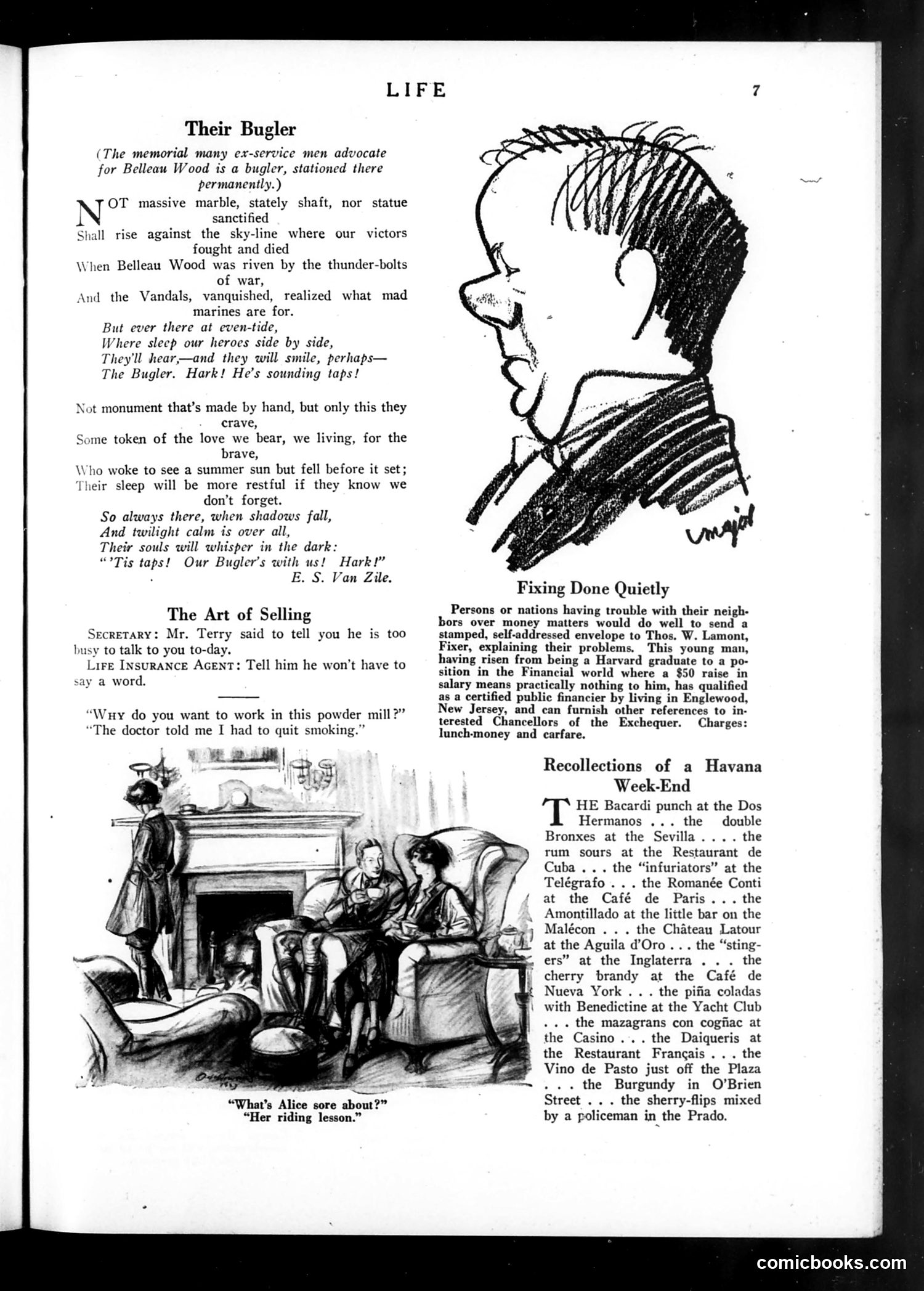
This page contains several distinct pieces: **"Their Bugler"** is a poem mourning soldiers who died at Belleau Wood (a WWI battle), proposing a bugler rather than a monument to commemorate fallen soldiers. **"The Art of Selling"** is a brief comic dialogue where a secretary tells an insurance agent that a doctor advised the agent to quit smoking—so the agent should leave without speaking. The joke targets pushy salesmen. **"Fixing Done Quietly"** appears to be a small advertisement for a financial advisor/fixer named Fannon, offering services to settle money disputes discreetly. **"Recollections of a Havana Week-End"** is a nostalgic list of Havana bars and restaurants, likely appealing to wealthy American readers familiar with pre-Prohibition Cuban nightlife. The illustration shows a woman in a living room; the caption "What's Alice sore about? / Her riding lesson" suggests domestic humor about a woman's activities.
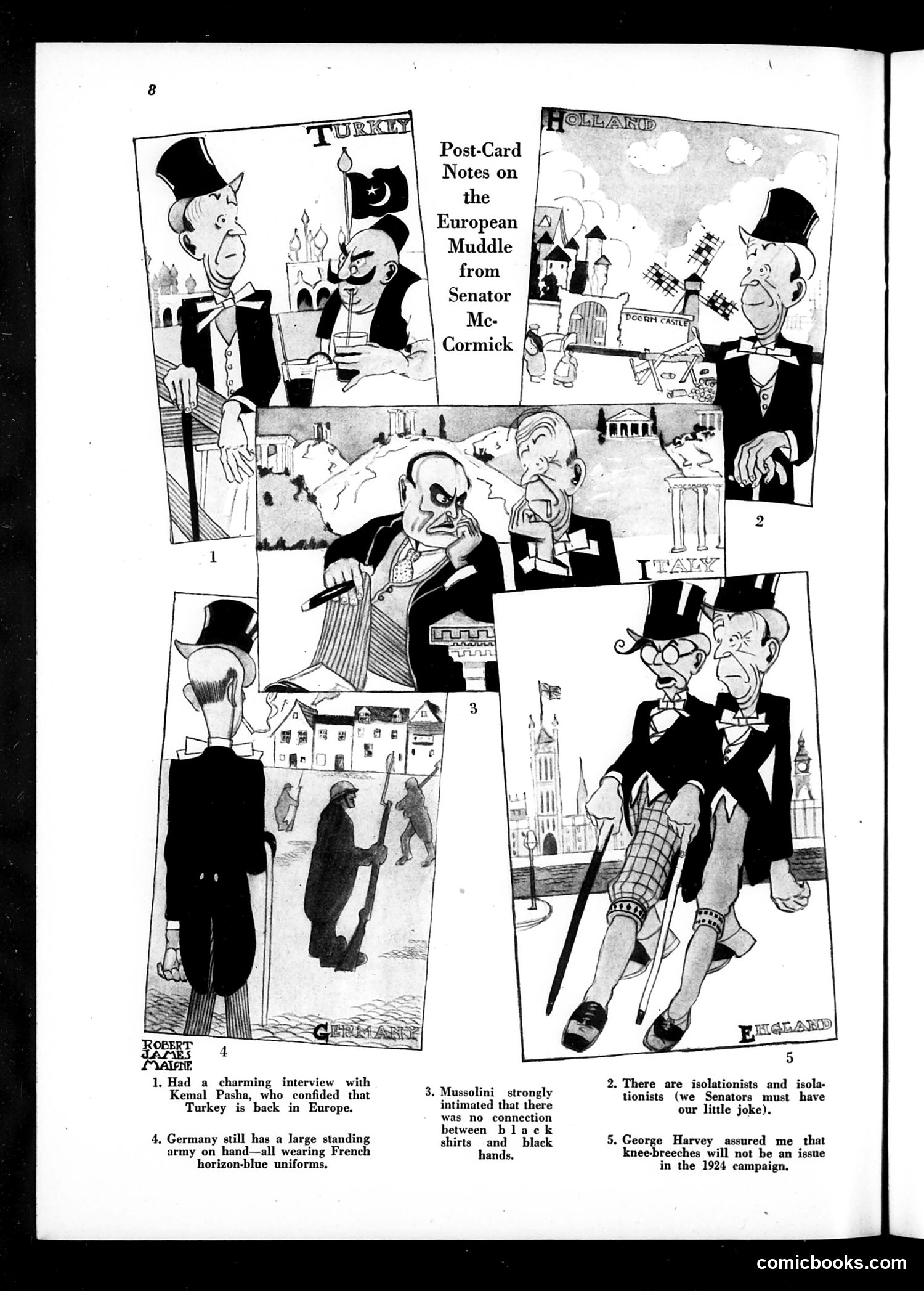
This page presents five political cartoons by caricaturist Robert Paul Malone, allegedly based on Senator McCormick's observations of post-WWI Europe. The sketches satirize European political figures and conditions: 1. **Turkey**: References Kemal Pasha and Turkish stability 2. **Holland**: Depicts "isolationists" (two senators are the joke) 3. **Mussolini/Italy**: Alludes to tensions between fascism and communism ("black shirts and black hands") 4. **Germany**: Shows the large standing army in French uniforms 5. **England**: Features George Harvey discussing 1924 election issues (knee-breeches fashion) The cartoons mock American senators' naïveté about European affairs while commenting on post-war political instability, militarism, and fascism emerging across Europe.
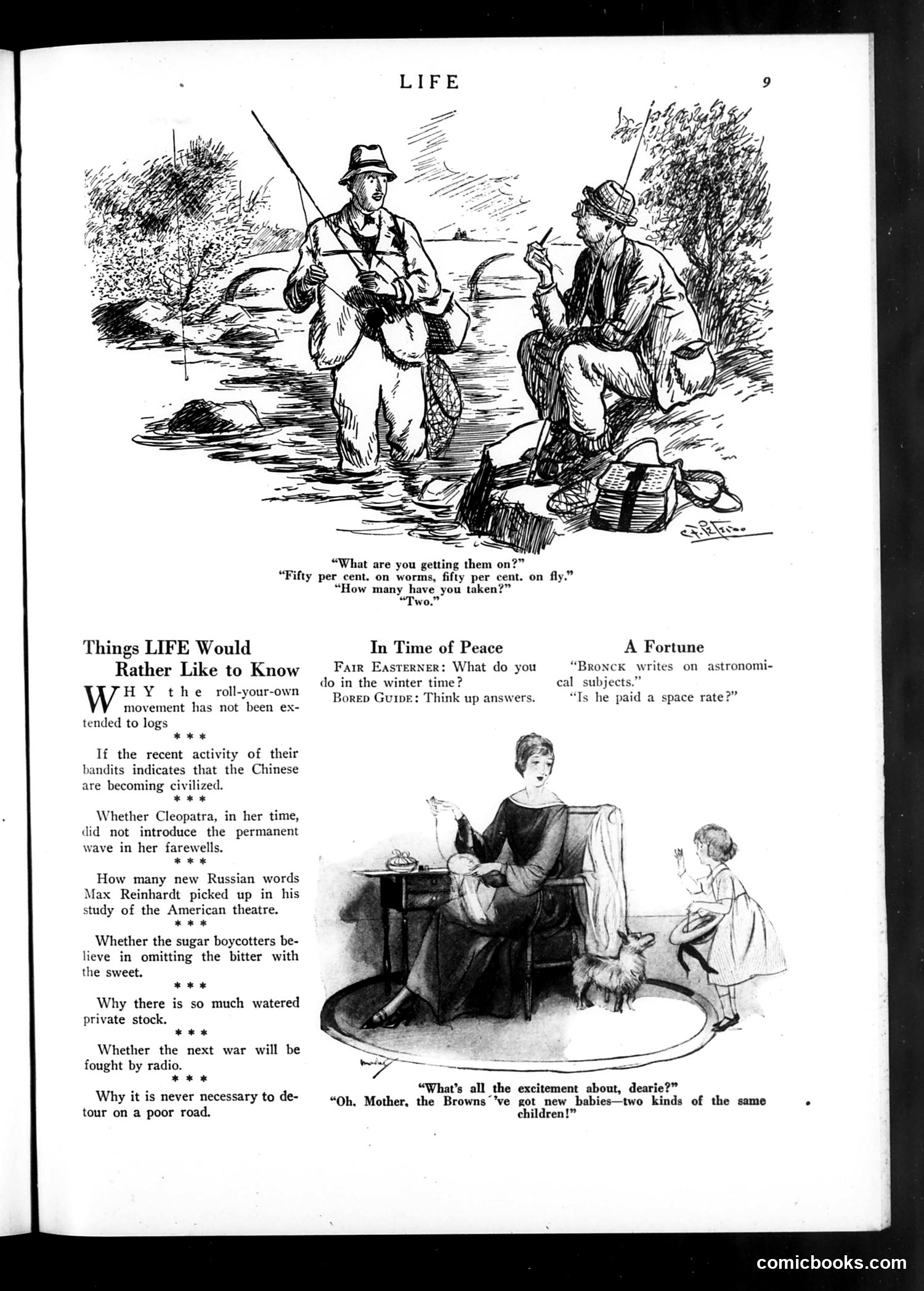
**Top Cartoon:** Two fishermen discuss catch statistics. One claims "fifty per cent. on worms, fifty per cent. on fly" while the other reports catching only two fish. This is a straightforward fishing humor joke about exaggeration—a common theme where anglers boast of their success rates, though results may differ dramatically. **"Things LIFE Would Rather Like to Know":** A satirical list of contemporary curiosities, including questions about Chinese civilization, Cleopatra's farewell wave, Russian vocabulary, sugar boycotts, watered stock, and radio warfare. These suggest early 20th-century social preoccupations and anxieties. **Bottom Cartoon:** "A Fortune" - A woman reads fortunes while a child listens. The joke concerns the Browns' identical babies, playing on fortune-telling stereotypes and domestic humor about child-rearing surprises.
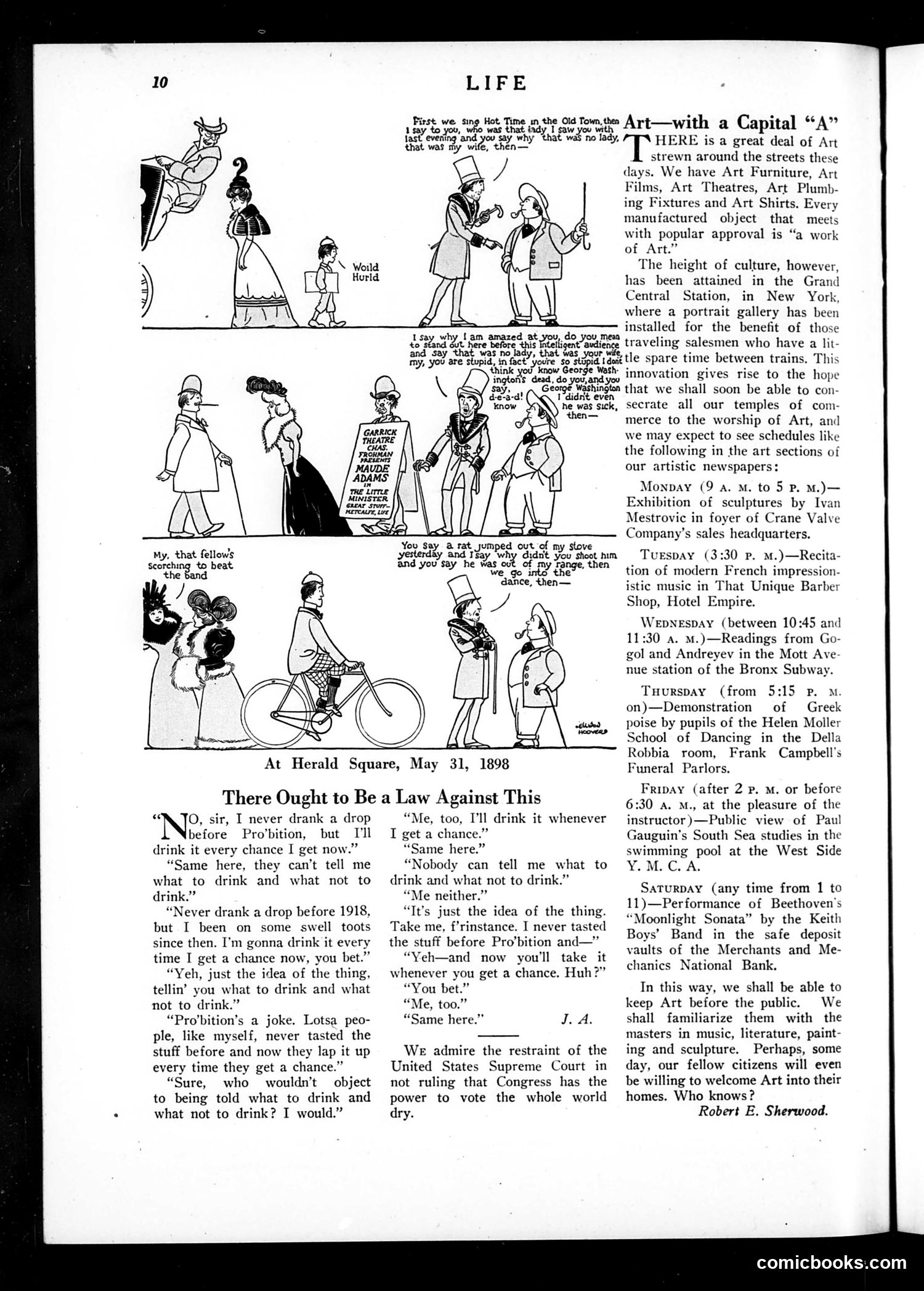
The top cartoon satirizes the pretentious embrace of "Art" in 1890s society. Various figures—appearing to be fashionable New Yorkers—discuss art in pompous, contradictory ways while conducting ordinary activities. One character quotes George Washington; another admits he "didn't even know what was sick." The satire targets how people adopted "art" as cultural status without genuine understanding, treating it as fashionable consumption rather than meaningful appreciation. The accompanying article supports this, noting Grand Central Station's portrait gallery for traveling salesmen—mocking how art became commercialized décor. The lower cartoon "There Ought to Be a Law Against This" humorously presents Prohibition-era drinking—people boasting they'll drink "whenever you get a chance," defying the new law through casual lawbreaking.
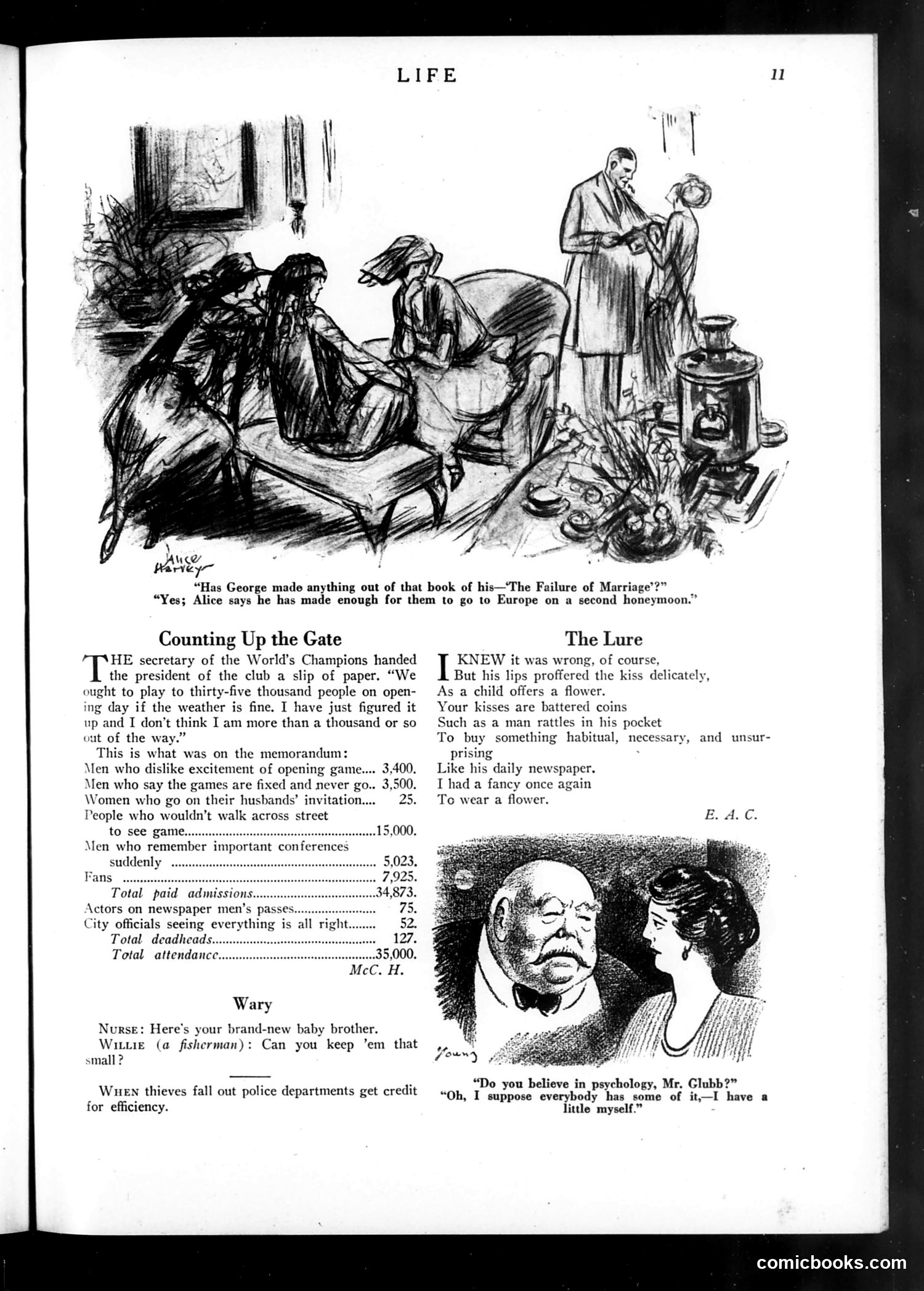
This page contains several satirical pieces mocking early 20th-century social pretensions and gender dynamics. **"Counting Up the Gate"** (by McC.H.) satirizes sports club management, listing attendance figures and expenses for an event. The joke appears to mock how organizations obsess over financial calculations rather than the actual experience. **"The Lure"** (by E.A.C.) is a poem mocking romantic gestures—comparing a man's kisses to "battered coins" and suggesting romantic flattery is merely habitual consumer behavior, like buying a newspaper daily. The cartoon at top shows a couple discussing a book called "The Failure of Marriage," with the woman noting they've profited enough to fund a European honeymoon—satirizing how marriage advice literature had become commercialized. **"Wary"** mocks a nurse and fisherman's conversation about a newborn, using the fisherman's occupation as setup for wordplay about keeping babies "small."
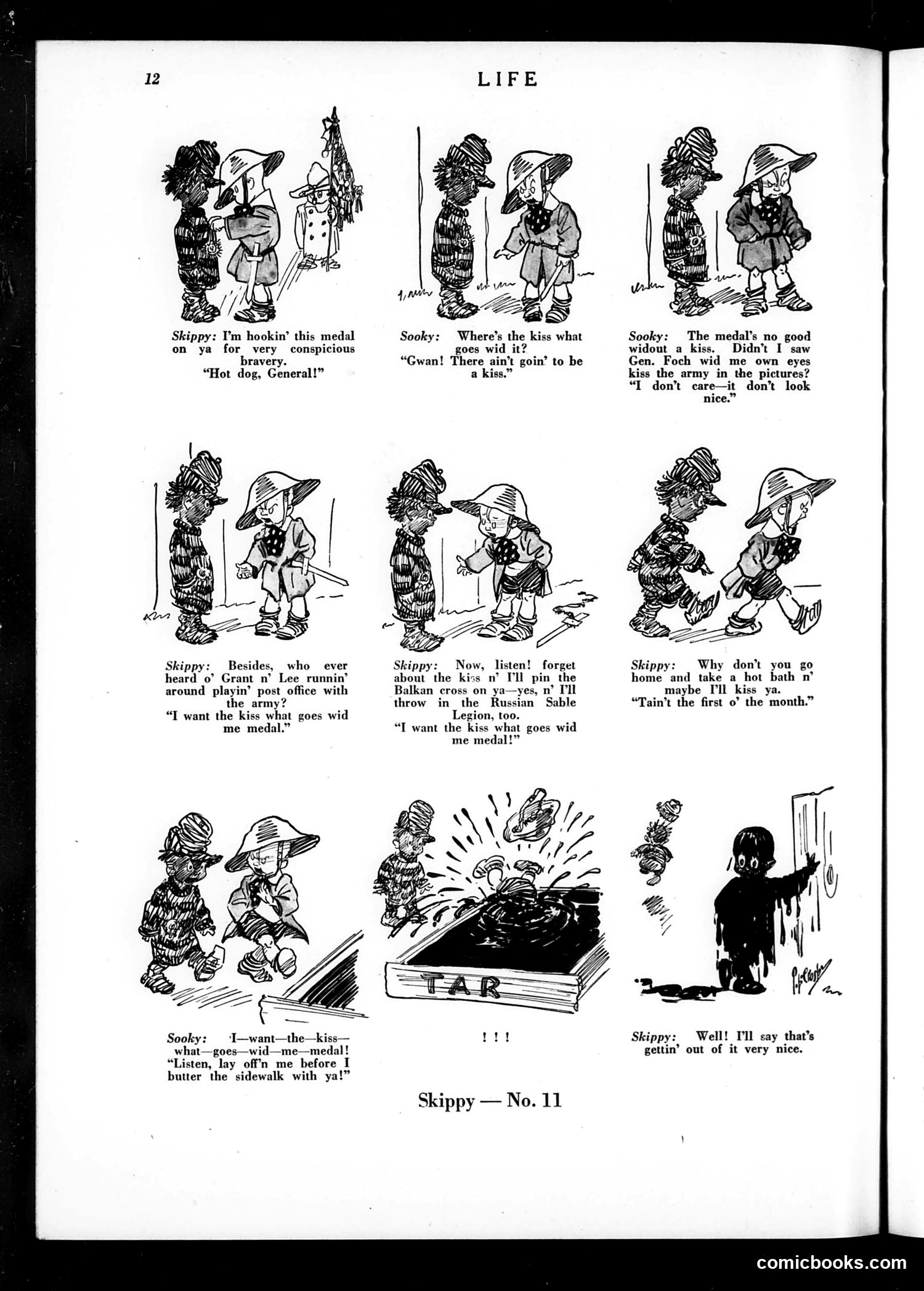
This is a children's comic strip featuring two young characters, Skippy and Sooky, debating a military medal. Skippy wants the medal for its appearance ("very conspicuous"), while Sooky insists on the kiss that traditionally accompanies it. The humor stems from their disagreement about what makes the medal valuable. The references—Grant, Lee, the Balkan cross, Russian Sable Legion—suggest this appears during or shortly after World War I, when such military decorations were topical. The satire mocks how children misunderstand adult military traditions, prioritizing superficial aspects (the medal's visibility or a kiss) over genuine military honor. The final panel shows tar being dumped, likely punishing Sooky for his stubbornness—typical slapstick comedy of the era.
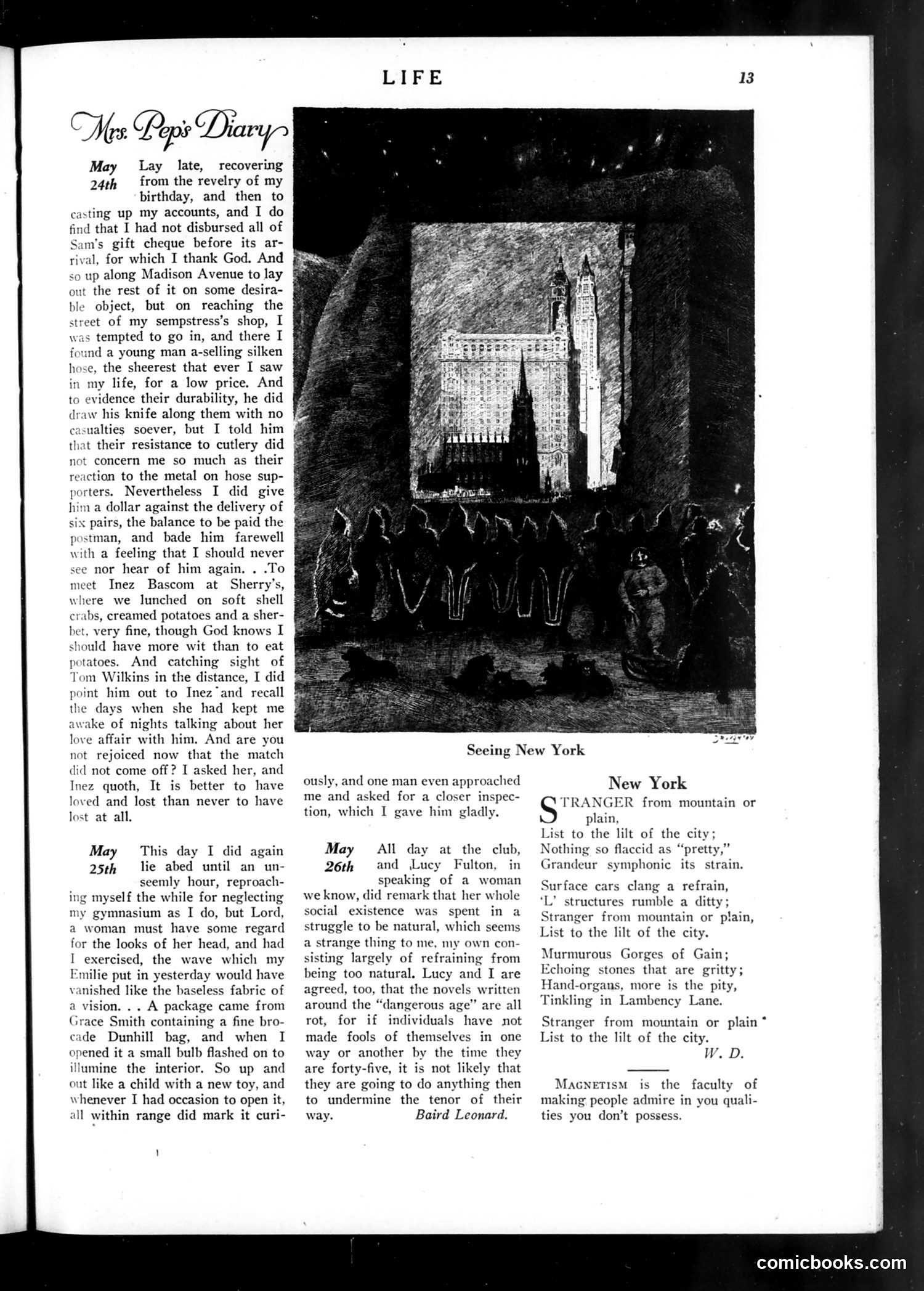
This page contains two distinct sections: **Left side:** "Mrs. Pep's Diary" - a personal diary entry column discussing social activities, including lunch at Sherry's restaurant and observations about matchmaking. This is lifestyle journalism rather than satire. **Right side:** A section titled "New York" featuring a black and white photograph labeled "Seeing New York" showing what appears to be a nighttime city street scene with buildings and people. Below the photo is a poem or essay about New York, contrasting the city's grandeur with its actual character. The text uses paradoxical descriptions ("Stranger from mountain or plain / List to the lilt of the city") to satirize how visitors romanticize urban life. At the bottom, there's a definition of "Magnetism" as "the faculty of making people admire in you qualities you don't possess" - likely social satire about superficial city sophistication. This appears to be general social commentary rather than political satire.
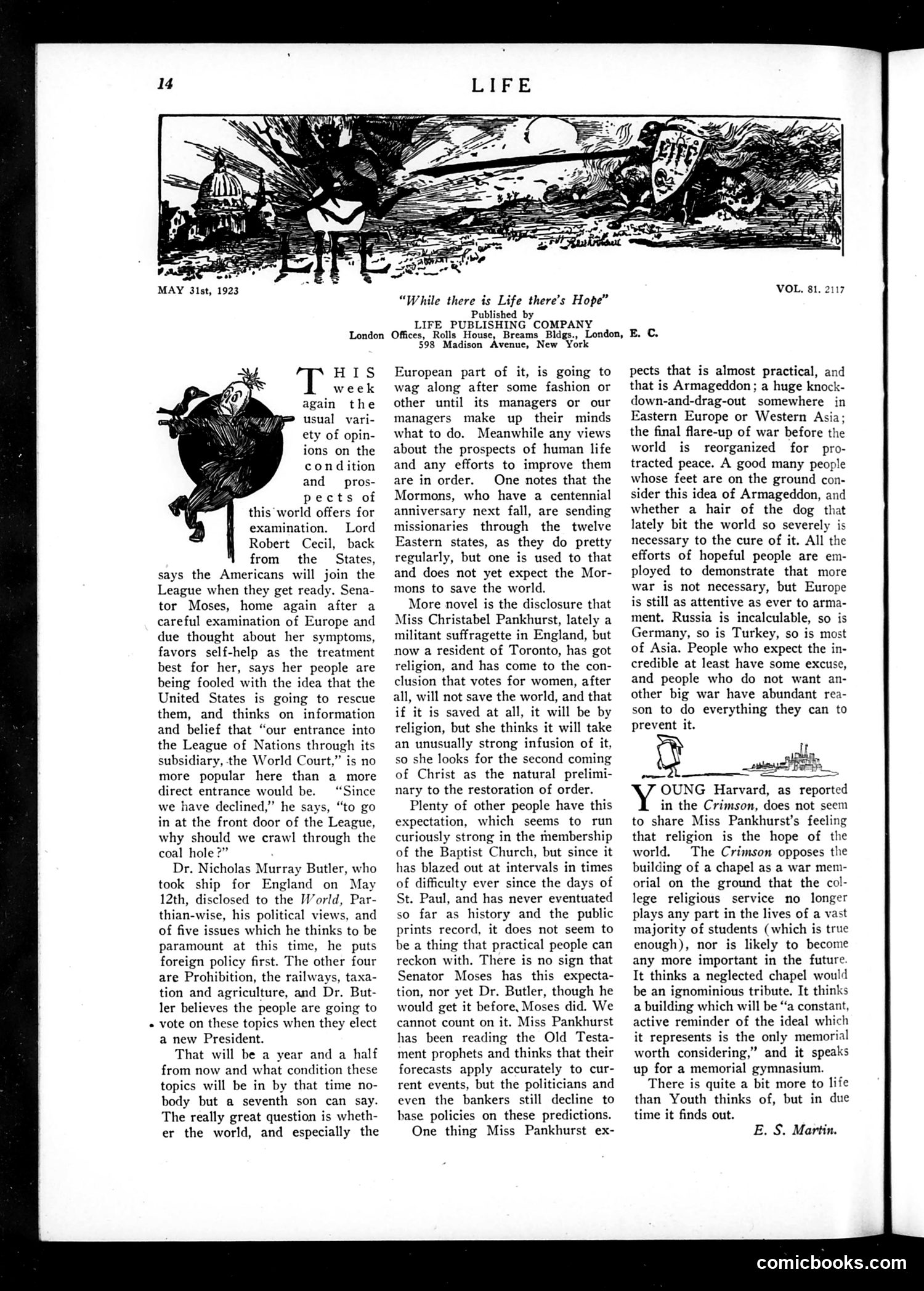
The masthead cartoon depicts a chaotic scene with European landmarks (a domed building, possibly representing government institutions) amid explosions and destruction, symbolizing post-WWI European instability. The main article discusses European instability and American isolationism. It criticizes the idea that the U.S. should "rescue" Europe through League of Nations involvement, arguing Americans are being "fooled" by this notion. The author references Robert Cecil and Dr. Nicholas Murray Butler's arguments about foreign policy. The piece expresses skepticism about various post-war solutions—women's suffrage as a cure-all, religious revival, and political predictions—while emphasizing the U.S. should avoid entanglement in European affairs. The tone is satirical toward both European disorder and American interventionist impulses.
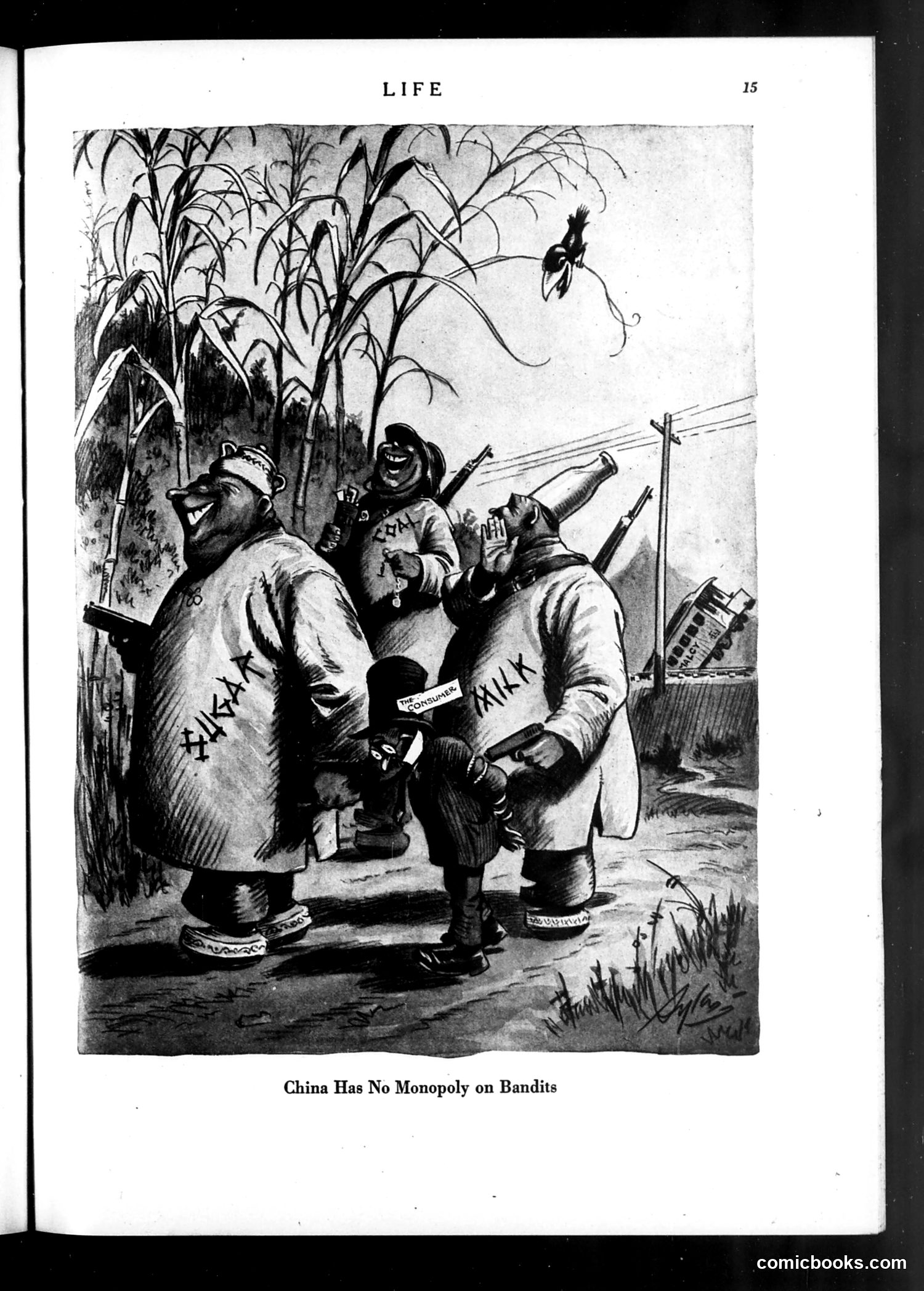
This satirical cartoon depicts three armed men wearing jackets labeled "HIJACK" gathered in what appears to be a rural American setting, with corn stalks visible and a tilted structure in the background. A bird flies overhead. The caption's title suggests a direct comparison: just as banditry was a notorious problem in China, America too suffers from criminal activity—specifically highway robbery and hijacking. The cartoon appears to critique either the prevalence of armed robbery in America or perhaps to deflate American moral superiority when commenting on lawlessness abroad. The three figures likely represent common American criminals or gangsters engaged in hijacking—a pressing crime concern during Prohibition and the early 20th century.
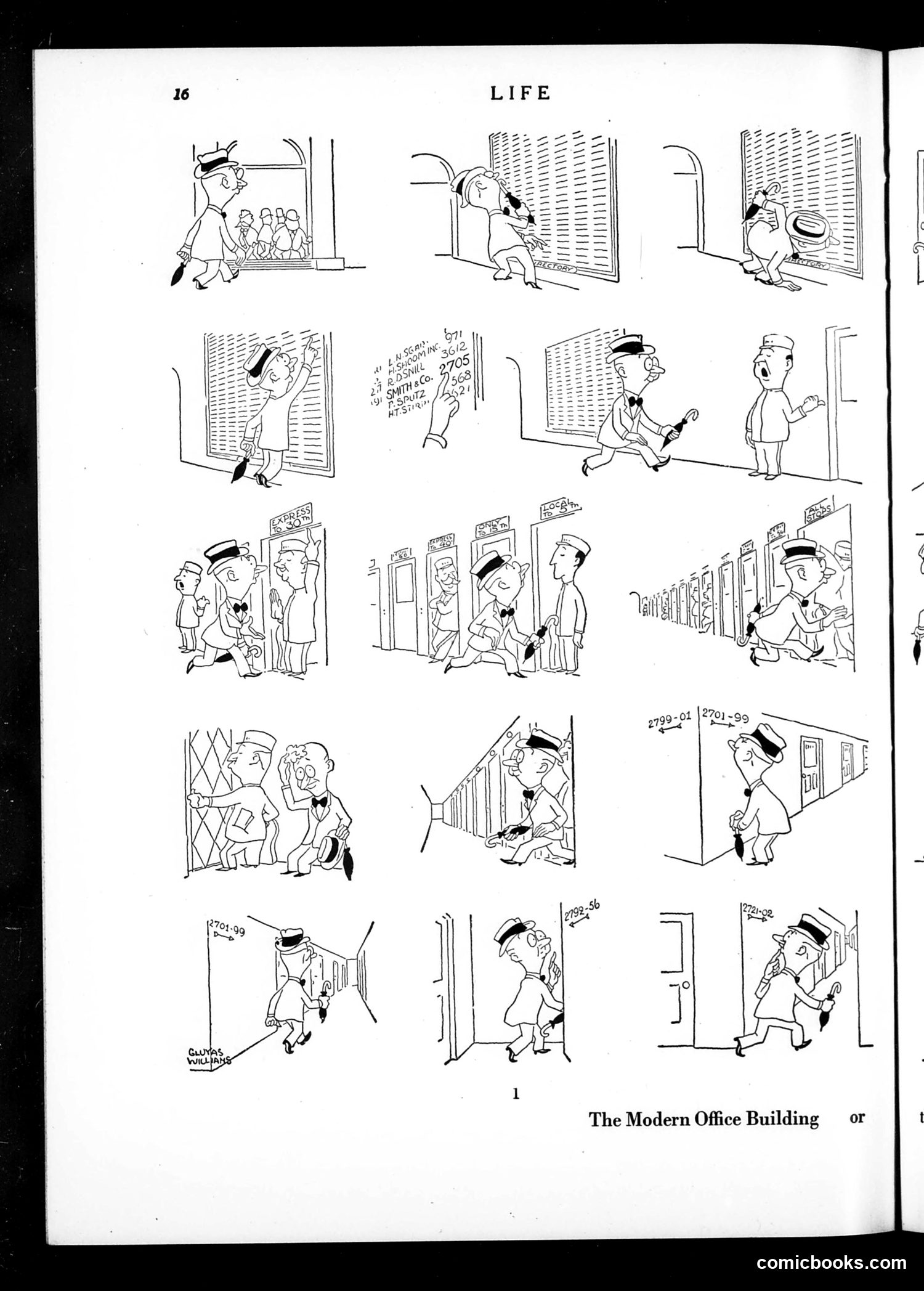
This page presents a sequential cartoon strip satirizing daily life in a contemporary office building. The comic follows an unnamed businessman through various workplace scenarios: checking a bulletin board, navigating elevator crowds, riding in packed transit cars, and dealing with office doors and corridors. The satire targets the absurdities of modern office culture—the impersonal crowding, bureaucratic inefficiency, and repetitive monotony of corporate work. The repeated imagery of doors, elevators, and identical-looking corridors suggests the dehumanizing sameness of office environments. The style is typical of early-to-mid 20th century American humor magazines, using simple line drawings and physical comedy to comment on contemporary social anxieties about industrialization and standardized work life. The title promises to examine this modern institution, delivering gentle, observational satire rather than sharp political critique.
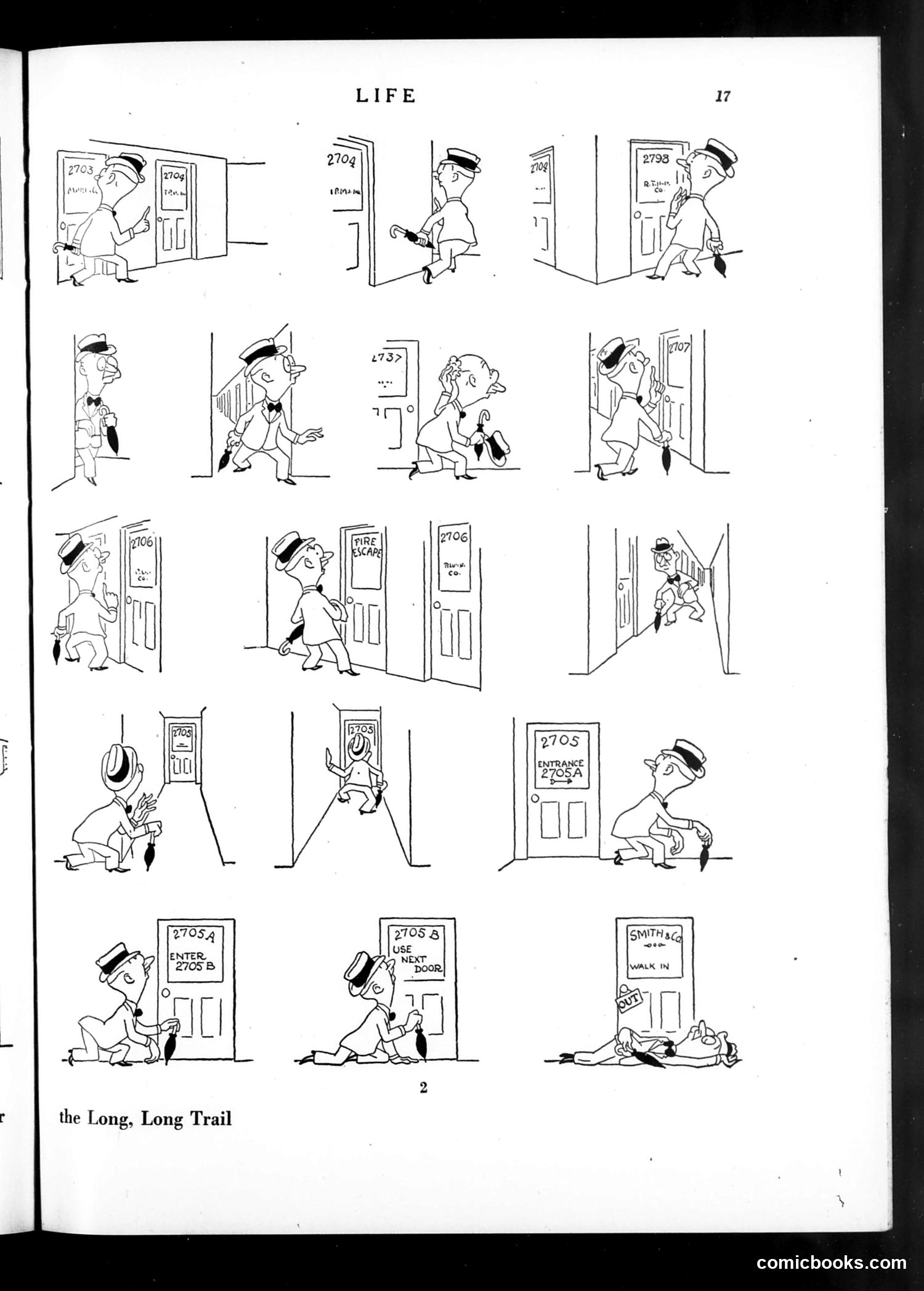
This comic strip satirizes apartment-hunting in early 20th-century urban America. A man in a bowler hat repeatedly visits numbered apartments (2703, 2730, 2706, etc.), encountering various obstacles and disappointments at each door. The humor derives from the exhausting, futile nature of searching for housing—a relatable frustration for city dwellers. Each panel shows him encountering locked doors, wrong addresses, fire escapes, or other obstacles. The final panels suggest he's reduced to sleeping outside after his fruitless search at "Smith & Co." The title "The Long, Long Trail" (likely referencing the WWI song) emphasizes the arduous, seemingly endless journey. This reflects genuine housing shortages and difficulties that made apartment-hunting a common urban complaint during the early 1900s.
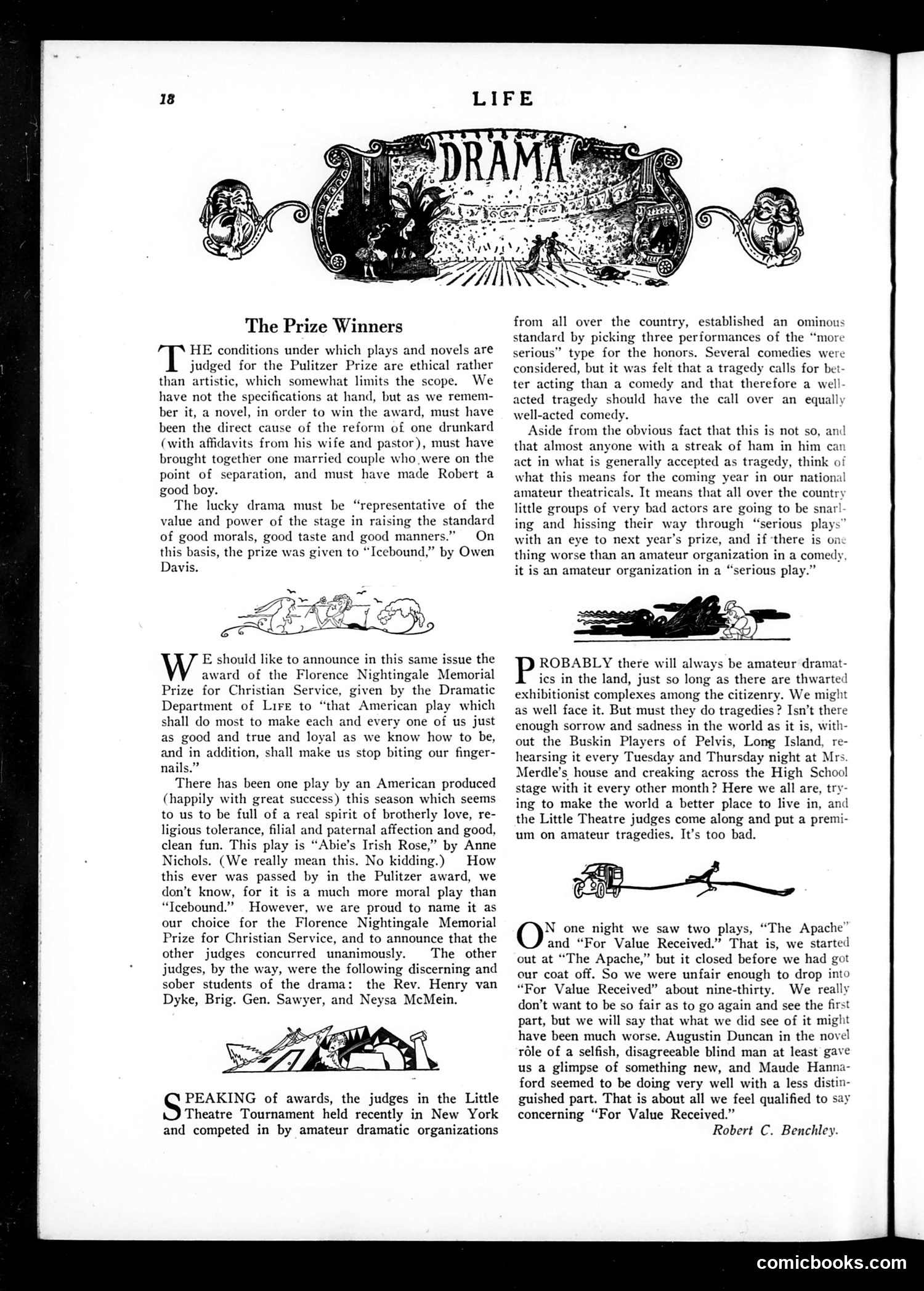
This is satirical commentary on theatrical award standards. The article mocks the **Pulitzer Prize's ethical (rather than artistic) criteria** for judging plays, claiming absurdly that winning novels must reform drunkards or reconcile separated couples—pure exaggeration for comic effect. Life sarcastically announces its own "Florence Nightingale Memorial Prize" for Christian Service, awarded to **"Abie's Irish Rose"** by Anne Nichols (a popular 1920s comedy about interfaith romance). The joke: this crowd-pleasing play was overlooked by Pulitzer judges, yet Life argues it embodies genuine moral values better than the actual winner, "Icebound." The article then criticizes amateur theater competitions for **favoring "serious" tragedies over comedies**, predicting this will encourage mediocre amateur groups to badly perform heavy dramatic material. The underlying satire: judges equate tragedy with artistic merit, when in reality, amateur actors perform comedy better than melodrama. Life advocates for encouraging amateurs toward their actual talents rather than pretentious "serious" work.
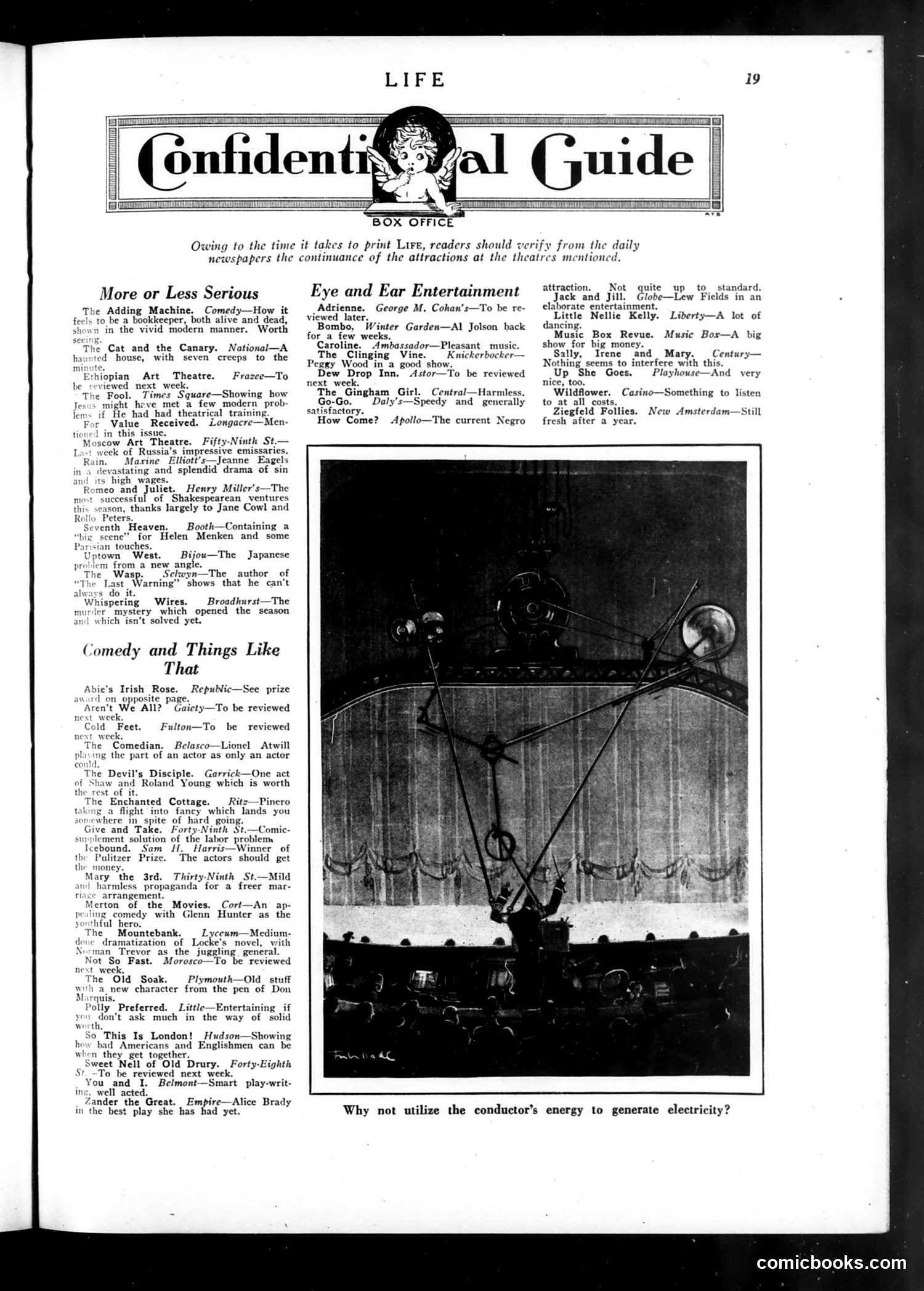
This page is a **theater guide and review section** for Broadway shows and musical revues, not a political cartoon. It lists current and upcoming theatrical attractions with brief critical assessments. The image shows a **conductor leading an orchestra in a theater pit**, illustrating the live musical accompaniment essential to 1920s theater. The caption's joke—"Why not utilize the conductor's energy to generate electricity?"—is a lighthearted suggestion that the conductor's vigorous movements could theoretically power the theater, a humorous commentary on the conductor's animated style. The text reviews shows ranging from serious drama (*Rain*, *Romeo and Juliet*) to comedies and musicals (*Bombo* with Al Jolson, *Sally*, *Ziegfeld Follies*). Several shows are noted as "to be reviewed next week," indicating this is a current-season guide. The tone is casual and consumer-focused, helping readers decide what entertainment to pursue—typical of Life's satirical but accessible approach to contemporary culture.
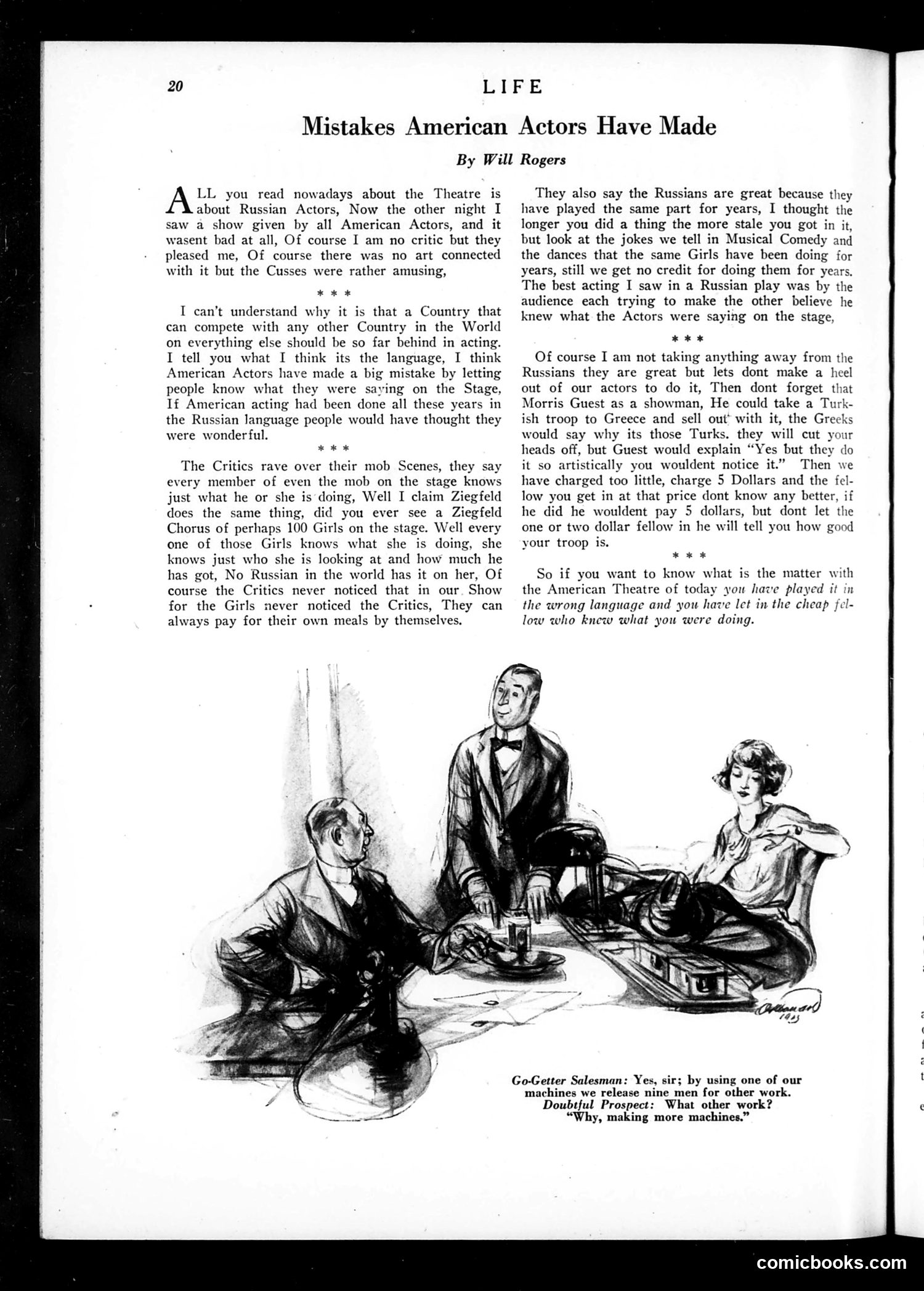
This is a humorous essay by Will Rogers comparing American theater unfavorably to Russian theater, which was fashionable among critics in the 1920s. Rogers argues Americans made a strategic error by performing in English—if they'd used Russian, audiences would find them impressive simply because they wouldn't understand the dialogue. He sarcastically credits Russian actors with originality despite doing identical work to American performers (like Florenz Ziegfeld's chorus girls). The bottom cartoon satirizes industrial salesmen pitching labor-saving machines: the salesman claims nine workers are "released for other work," which the prospect shrewdly recognizes means building more machines—an endless cycle of manufacturing for manufacturing's sake, mocking unchecked mechanization and productivity propaganda of the era. Rogers's point: American theater suffers not from poor acting but from misguided cultural deference to Russian trends and underpricing performances.
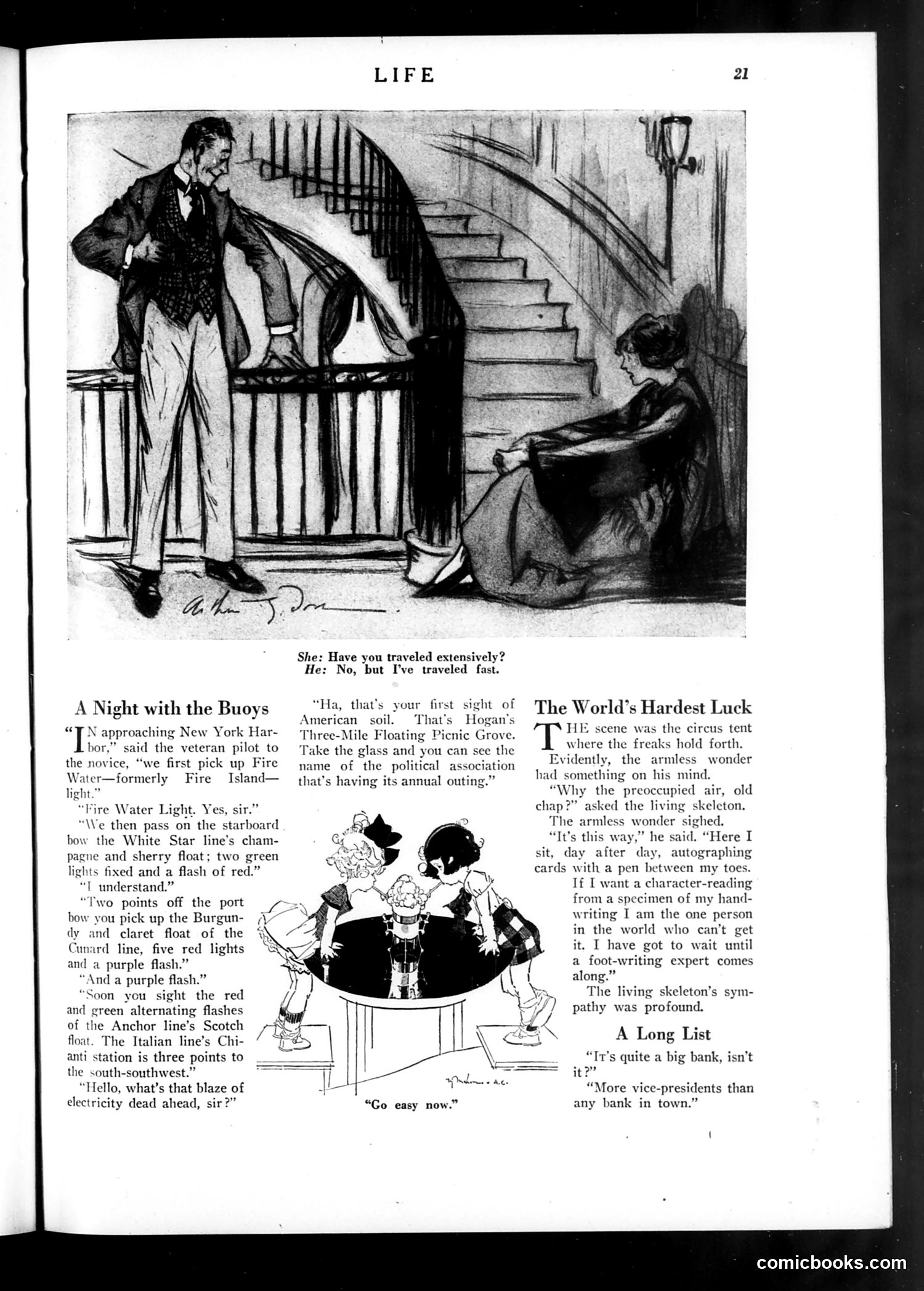
**"A Night with the Buoys"** mocks Prohibition-era America. The pilot humorously renames New York Harbor navigation lights after alcoholic beverages—"Fire Water Light," "Champagne and Sherry float," "Burgundy and Claret float," and "Scotch float"—suggesting alcohol was ubiquitous despite the ban. The punchline references "Hogan's Three-Mile Floating Picnic Grove," likely a speakeasy or illegal drinking establishment, implying even political associations flouted Prohibition laws at their outings. **"The World's Hardest Luck"** depicts circus freaks (an armless wonder and living skeleton) in a darkly comedic absurdist joke: the armless man cannot obtain handwriting analysis because he must sign his name with his feet, requiring a "foot-writing expert" instead—a profession that doesn't exist. **"A Long List"** is a brief banker's joke suggesting the bank has many vice-presidents, implying either bureaucratic bloat or corruption in the banking industry.
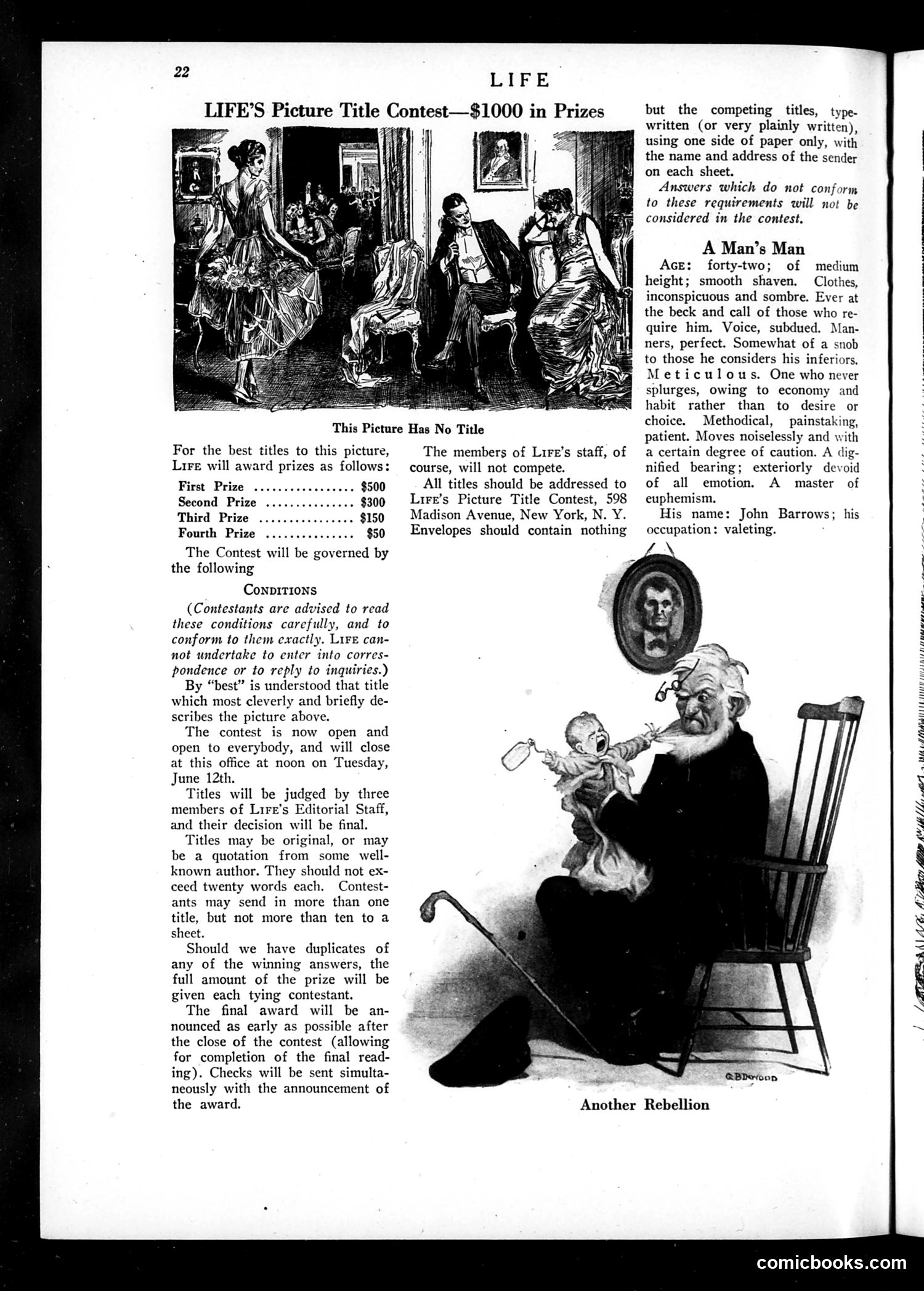
This page contains two distinct items: **Picture Title Contest**: Life magazine solicits reader-submitted titles for an untitled illustration (top left) showing what appears to be a social gathering. First prize is $500. The contest reflects Life's interactive engagement with readers. **"A Man's Man"**: A character profile describing John Barrows, a 42-year-old valet—a servant figure. The satire lies in the ironic phrase "A Man's Man": despite his perfect manners, discretion, and meticulous service, he's defined entirely by subservience to others. The description emphasizes his emotional restraint and lack of personal expression, suggesting the era's class system where servants were valued precisely for their self-effacement. **"Another Rebellion"**: The accompanying illustration (bottom right) shows a child sitting on a chair while an adult (likely the valet or parent) holds up a portrait—presumably depicting the "rebellion" of childhood defiance or misbehavior, contrasting with the adult world's rigid propriety described above.
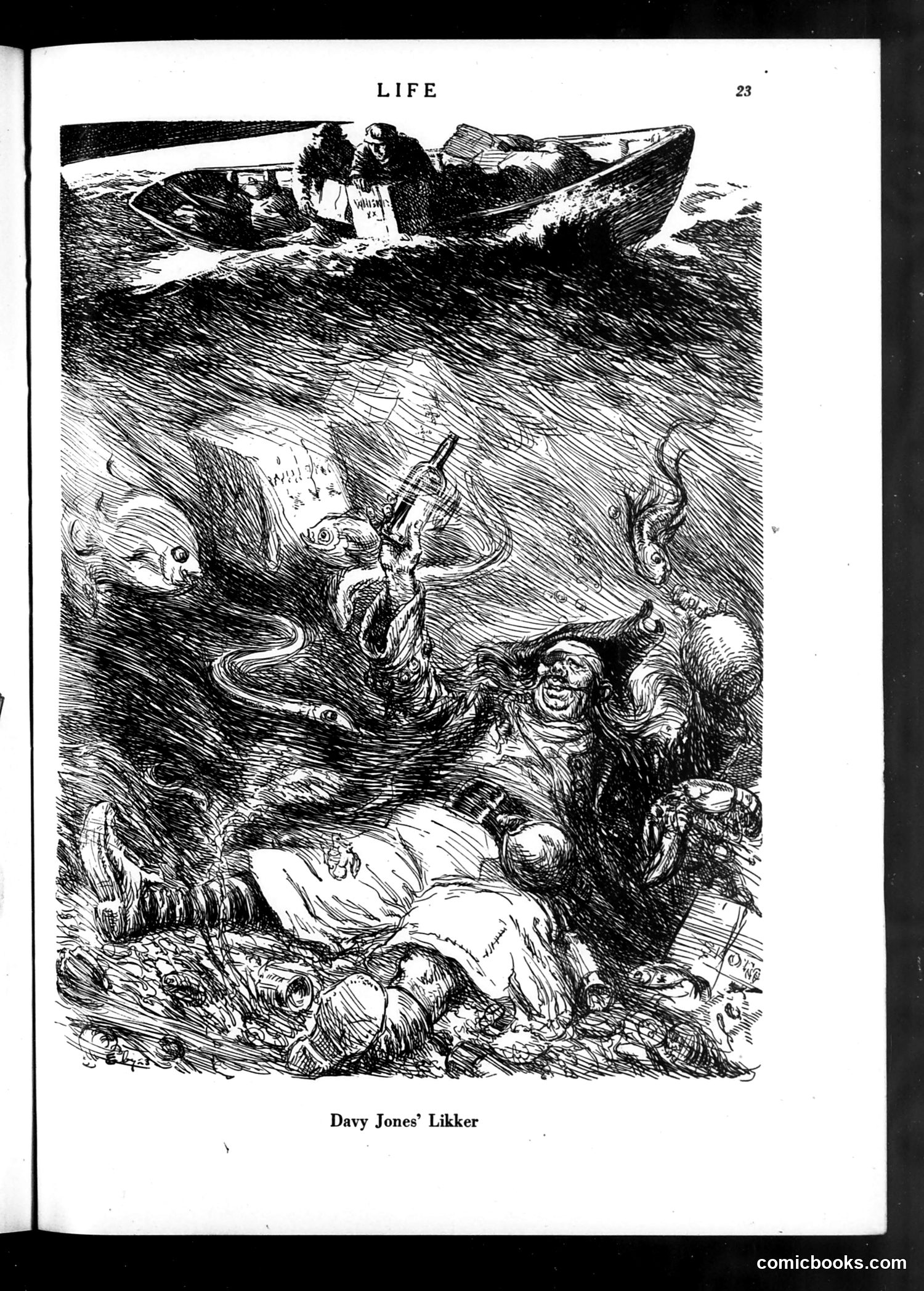
This appears to be a satirical illustration referencing the nautical legend of Davy Jones' Locker (a sailors' phrase for the ocean depths/death at sea). The image depicts what appears to be sea creatures or supernatural beings in turbulent water, with a boat and sailors above. The title "Davy Jones' Likker" is a pun—substituting "likker" (slang for liquor/alcohol) for "Locker." This suggests the cartoon satirizes either sailors' drinking habits or possibly alcohol-related regulations (Life magazine frequently carried Prohibition-era satire). The grotesque underwater imagery and chaotic composition emphasize the satirical tone, likely mocking maritime drinking culture or related social concerns of early 20th-century America.
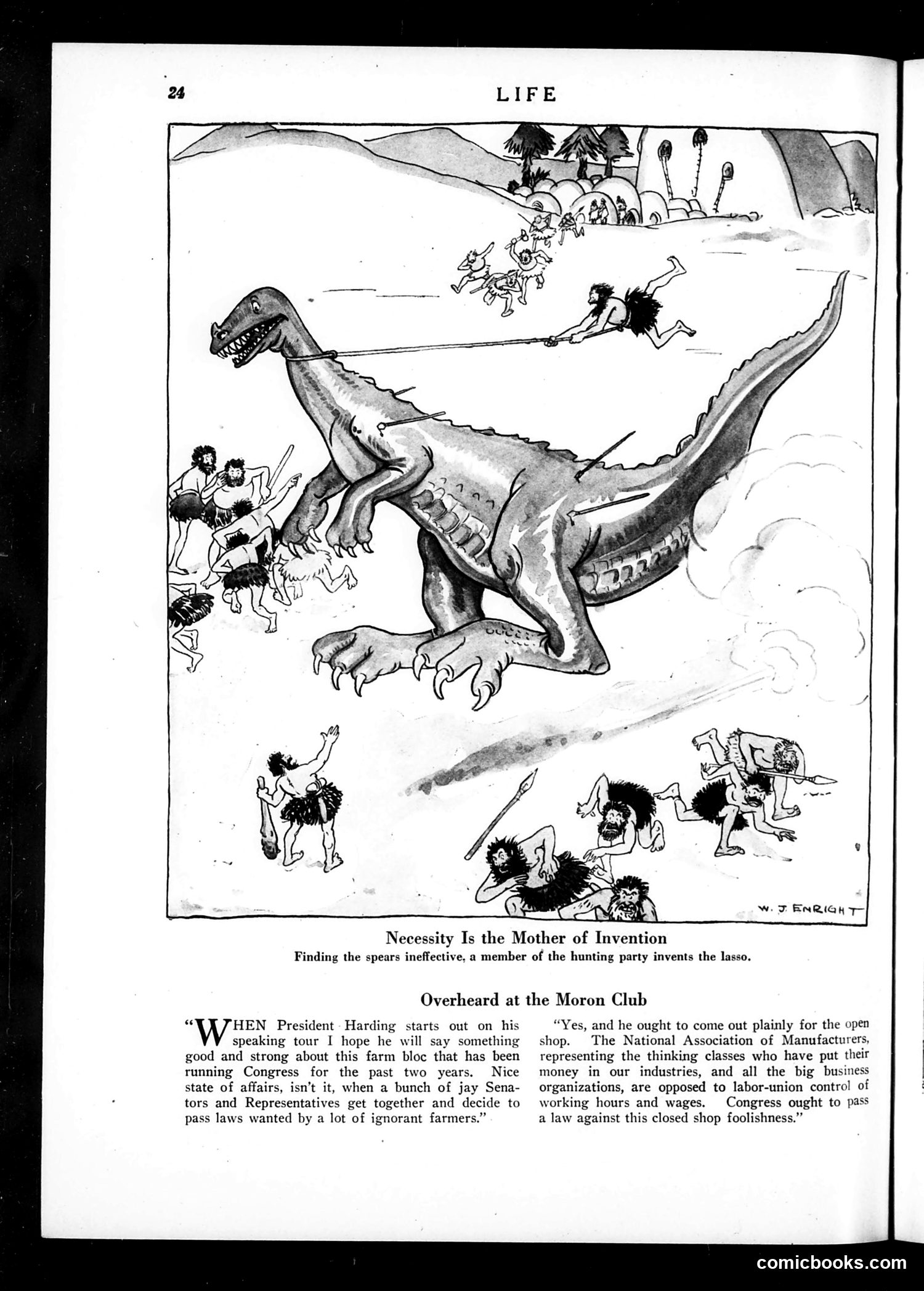
This page contains two satirical pieces from Life magazine (likely early 1920s, given the Harding reference). **Top cartoon**: A humorous prehistoric scene where hunters pursue a dinosaur with spears that prove ineffective, so one invents the lasso out of necessity. This is a visual pun on the title—a lighthearted joke requiring no political context. **Bottom piece**: "Overheard at the Moron Club" mocks wealthy businessmen and manufacturers. Two speakers dismiss farmers as "ignorant" and praise "the thinking classes" (industrialists) while opposing labor unions and the "closed shop." The satire lies in the title—Life is calling these supposedly intelligent business leaders "morons" for their elitist dismissal of farmers and their anti-labor stance. This reflects 1920s tensions between agricultural interests, big business, and organized labor, with the magazine satirizing the manufacturers' arrogant assumption that only wealthy industrialists represent genuine intelligence.
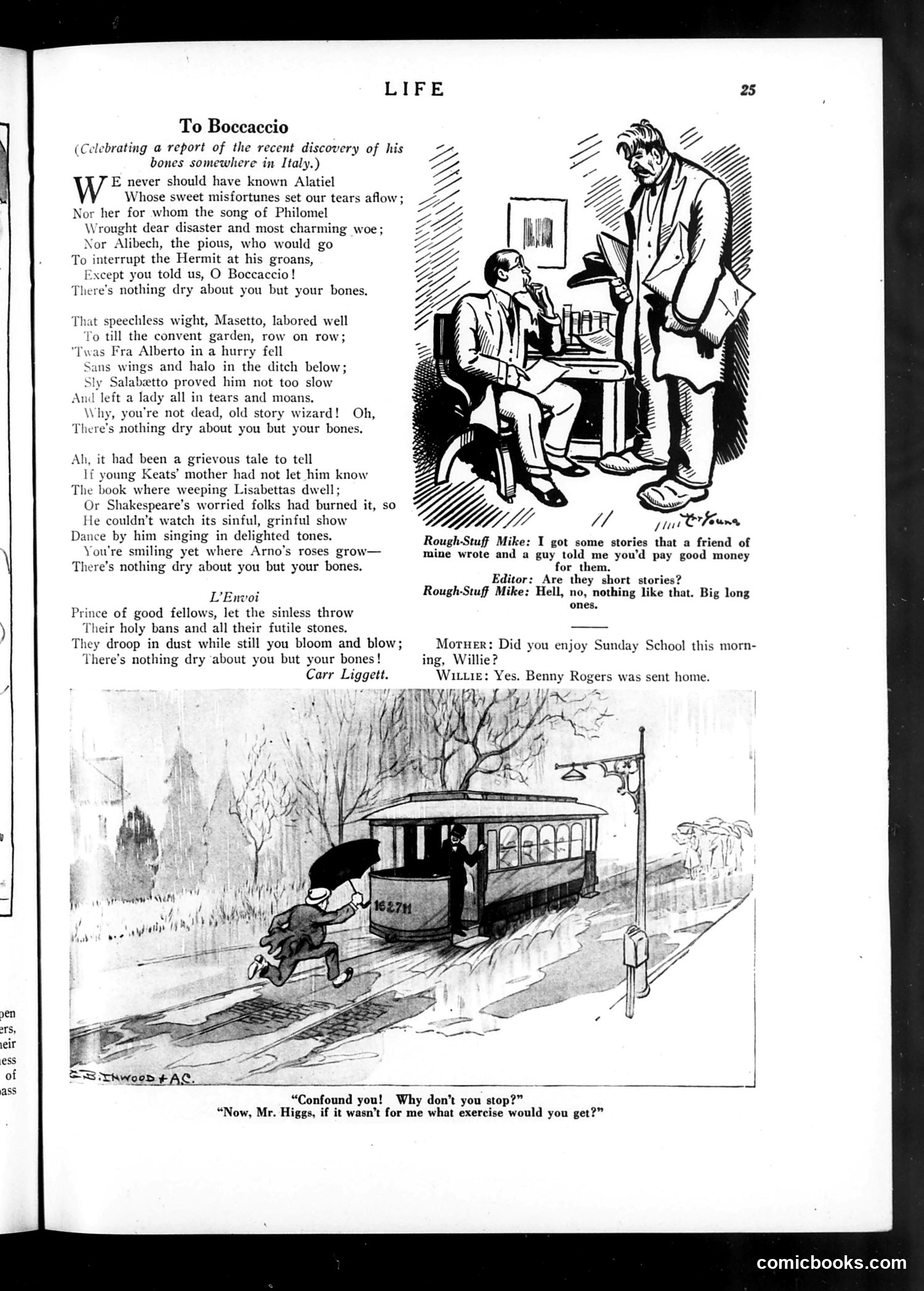
**Top Content:** A poem celebrating the discovery of Boccaccio's bones in Italy. The poem references characters from *The Decameron* (Alatiel, Masetto, Fra Alberto, Lisabetta)—tales known for their bawdy, romantic, and morally questionable content. The repeated refrain "There's nothing dry about you but your bones" is a double entendre: Boccaccio's stories are anything *but* dry (they're sensual and entertaining), yet only his bones remain. **Social Context:** The poem pokes fun at how Boccaccio's works were censored or hidden from proper Victorian society—references to Keats' mother and Shakespeare suggest how such "sinful" literature was kept from young people. The joke celebrates Boccaccio's enduring appeal despite moral disapproval. **Bottom Cartoons:** Two unrelated gags—one about a manuscript-peddler hawking "big long" stories (implying low quality), and another about a boy at Sunday School noting a troublemaker was "sent home." These are simple humor pieces typical of Life's satirical format.
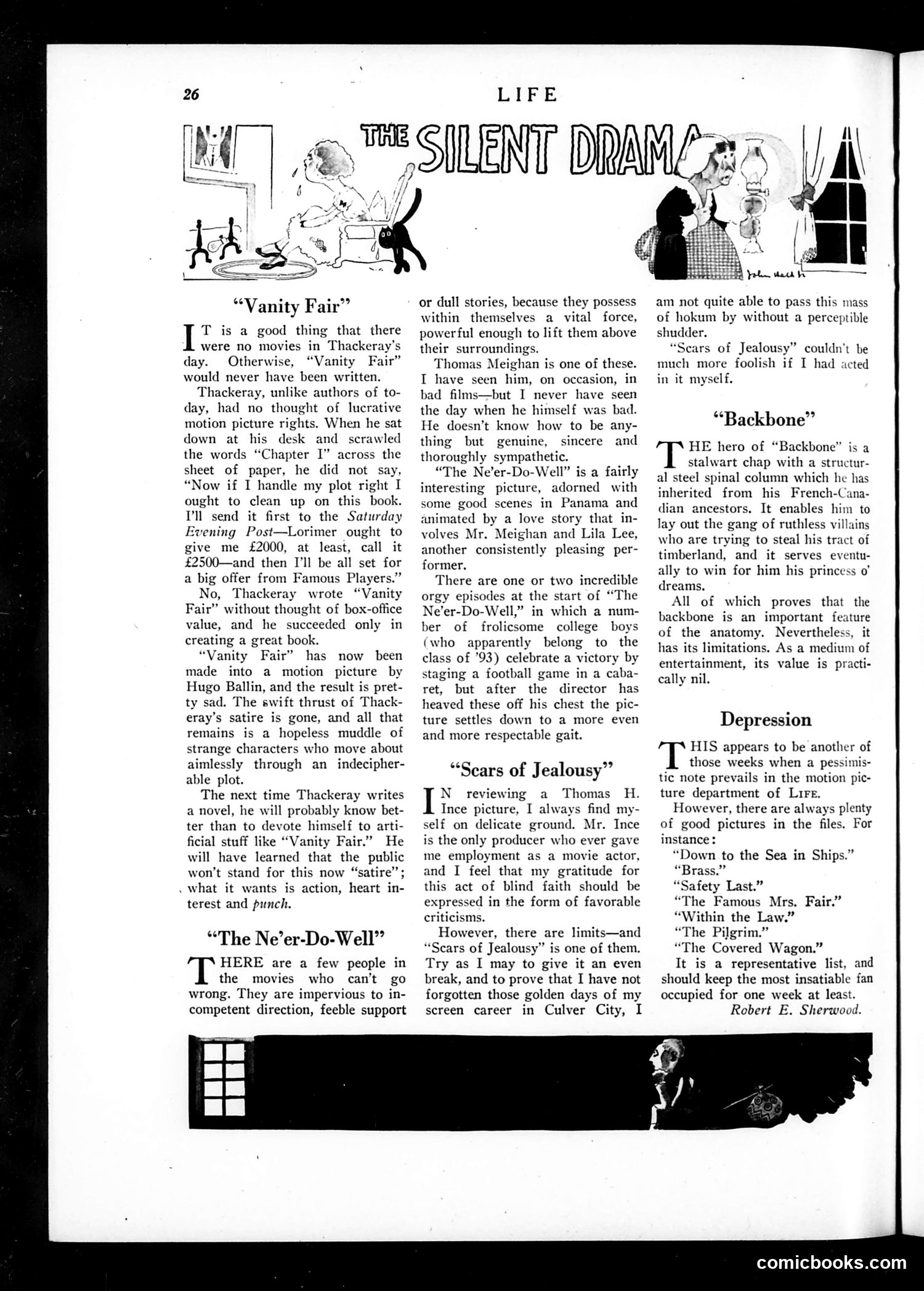
This page contains satirical film reviews from Life magazine's early cinema era (likely 1920s). The critic reviews four silent films, using humor to critique both the movies and Hollywood's commercialism. **Key satire:** The "Vanity Fair" review mocks how modern authors obsess over movie rights and profits, contrasting this with Thackeray's artistic purity. The joke: adapting great literature for cinema often produces mediocre results—the "hopeless muddle" film version lacks the novel's sharp satire. **Other reviews** praise actor Thomas Meighan's genuine talent (he elevates weak material) and criticize producer Thomas H. Ince's "Scars of Jealousy" as foolish hokum—the critic humorously notes his gratitude toward Ince prevents him from being harsher. The "Backbone" review similarly mocks a plot where physical backbone (inherited strength) conveniently defeats villains, dismissing entertainment value as "practically nil." **Overall tone:** Sophistication mixed with exasperation at early Hollywood's formula-driven plots and adaptation failures. The cartoons (top and bottom) appear to satirize domestic scenes, though details are unclear.
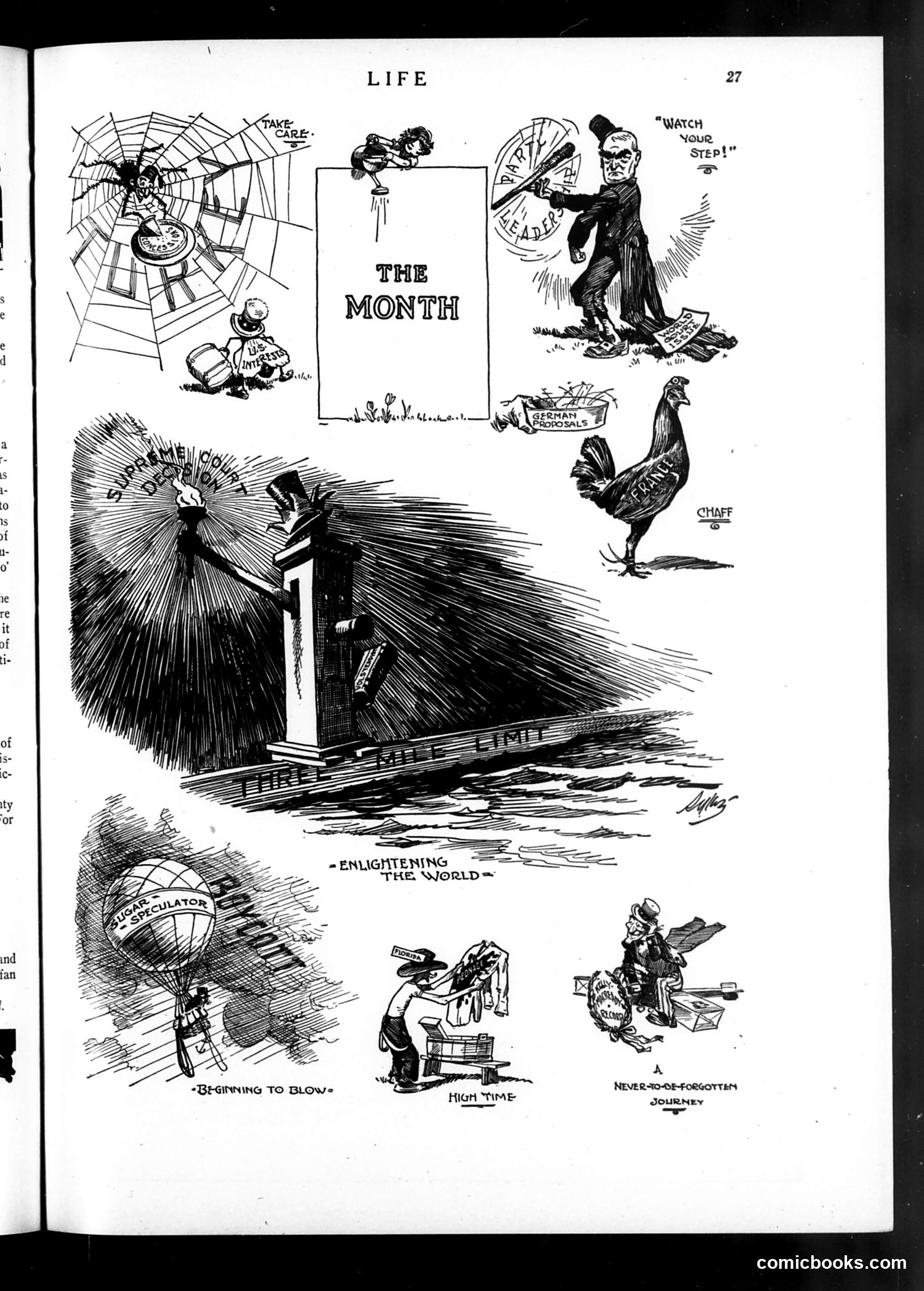
This page presents satirical cartoons about early 20th-century imperialism and global politics. The central figure labeled "The Month" appears to be a large, aggressive character trampling or dominating a smaller figure, with "Enlightening the World" as its caption—likely mocking Western imperial powers' justifications for colonization. Surrounding vignettes include references to: - "Beginning to Blow" (a globe labeled "Circulator") - "High Time" - "A Never-to-be-Forgotten Journey" - Various other small scenes depicting exploitation The cartoons satirize how Western powers claimed their imperial expansion was "enlightening" or civilizing mission, when the imagery suggests domination and extraction instead. The rooster labeled "Chaff" and spider web imagery reinforce themes of predation and entrapment. This reflects anti-imperialist sentiment common in American satirical publications of the era.
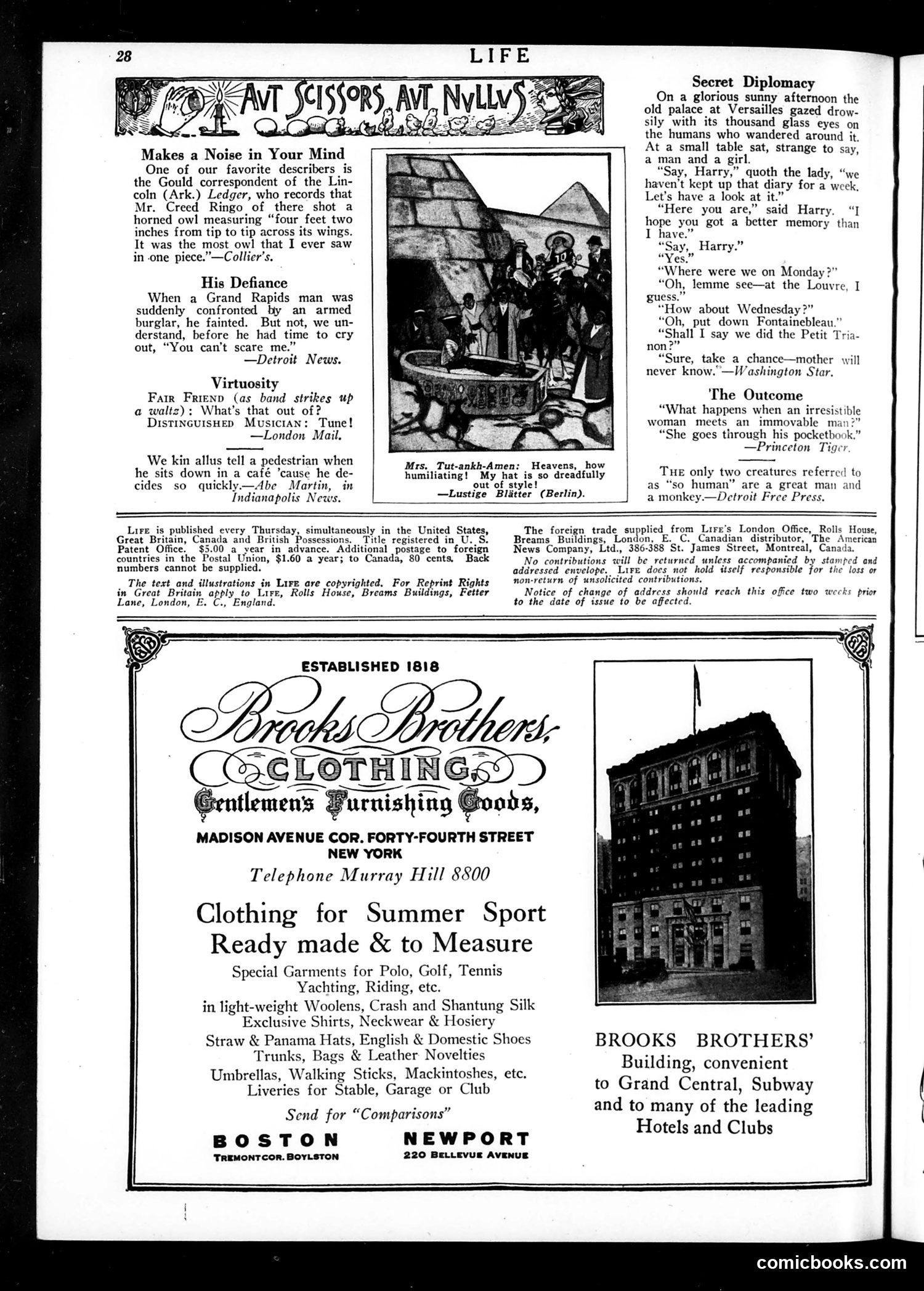
This page is primarily **advertising** (Brooks Brothers dominates the lower half) interspersed with short **humorous anecdotes** rather than political cartoons. The humor pieces are light social satire typical of 1920s Life magazine: - "Secret Diplomacy" jokes about tourists at Versailles during peace negotiations - "Makes a Noise in Your Mind" mocks rural exaggeration (a hunter's implausible owl catch) - "His Defiance" ridicules a fainting burglar who tries to appear brave - Various one-liners satirize pedestrians, musicians, and romantic couples The one topical reference is **"Mrs. Tut-ankh-Amen"** (Tutankhamun), the Egyptian pharaoh whose tomb was famously discovered in 1922, causing international sensation. The joke treats his wife as a modern society woman complaining her hat is out of fashion—mocking both contemporary fashion obsession and the Egyptomania craze gripping America. The final joke about "irresistible woman" and "immovable man" is cynical about romantic relationships and women's financial motivations. **Context for modern readers:** This represents Life as a sophisticated urban humor magazine for educated readers, mixing gossip-column wit with gentle social observation.
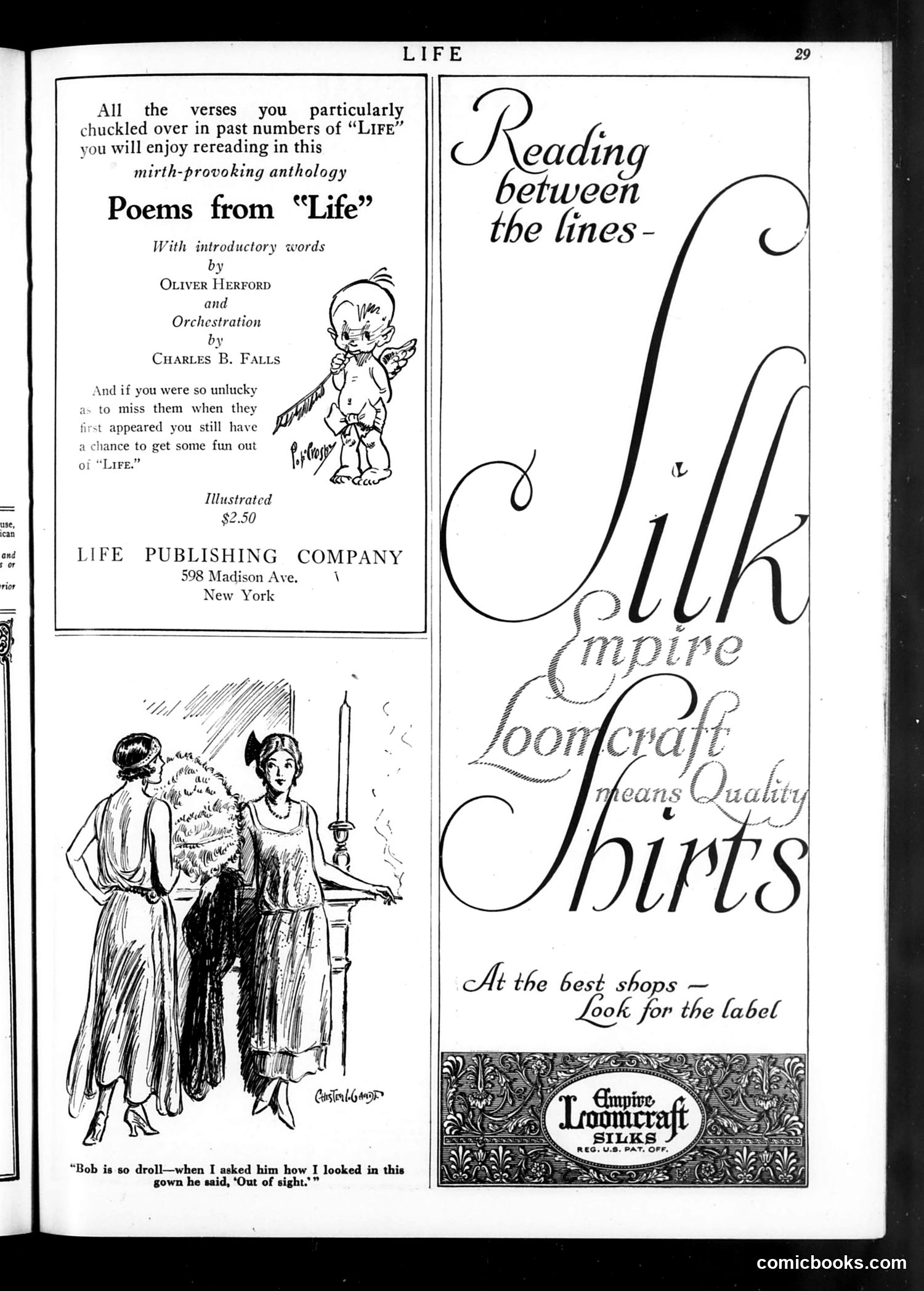
This page contains two distinct elements: **Left side:** An advertisement for a book collection titled "Poems from 'Life'" featuring introductory words by Oliver Herford and orchestration by Charles B. Falls, priced at $2.50. Below is a cartoon showing two fashionable women, one commenting that when she asked a man named Bob how she looked in her gown, he said "Out of sight"—a compliment she finds amusing, suggesting Bob is charming or flattering. **Right side:** An advertisement for Empire Loomcraft Silks, using decorative typography to suggest that quality loomcraft "means Quality Shirts." The phrase "Reading between the lines" appears as a visual pun, with ornamental script emphasizing the product's refined nature. This is primarily a **vintage advertising page** from Life magazine, mixing self-promotion of the magazine's own publications with paid advertisements for consumer goods. The humor is gentle and domestic, typical of early 20th-century American satirical magazine advertising.
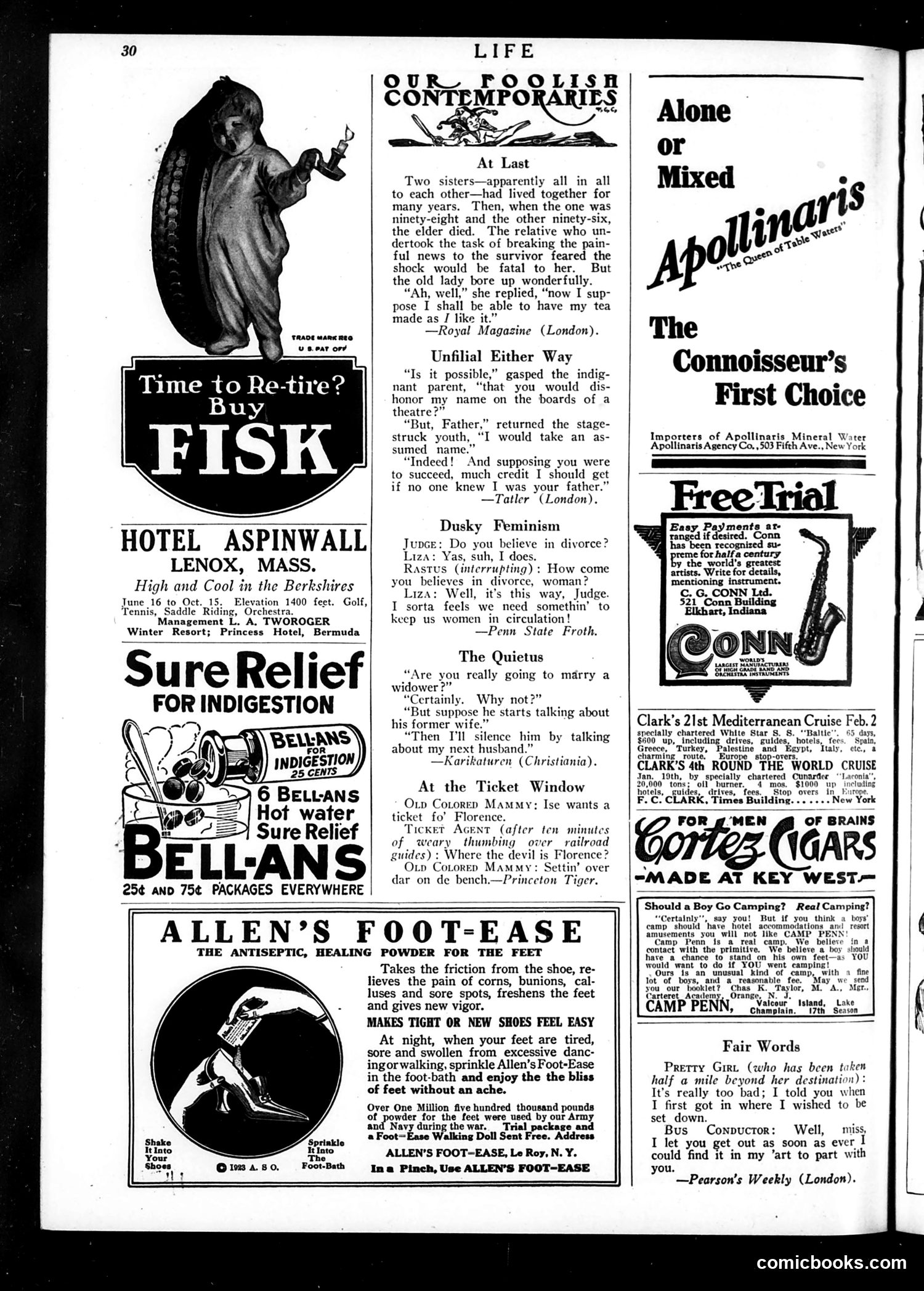
This page consists primarily of **advertisements and humor reprints** rather than original political cartoons. The "Foolish Contemporaries" section collects jokes from other publications satirizing social attitudes of the era. Notable content includes: **"Dusky Feminism"** — A racist dialect joke portraying an African American woman arguing that divorce keeps women "in circulation," mocking both women's autonomy and Black speech patterns through stereotypical caricature. **"Unfilial Either Way"** — A class-conscious joke about a father's dilemma: his son's stage success under an assumed name brings no family honor, but using the family name would disgrace it. This reflects period anxieties about theatrical respectability. **"At the Ticket Window"** — Another racist stereotype using exaggerated dialect, depicting confusion over a woman's name. The advertisements (Bellans indigestion powder, Allen's Foot-Ease) are period-typical. The page reflects early 20th-century attitudes normalizing racial caricature and comedic mockery of class anxieties.
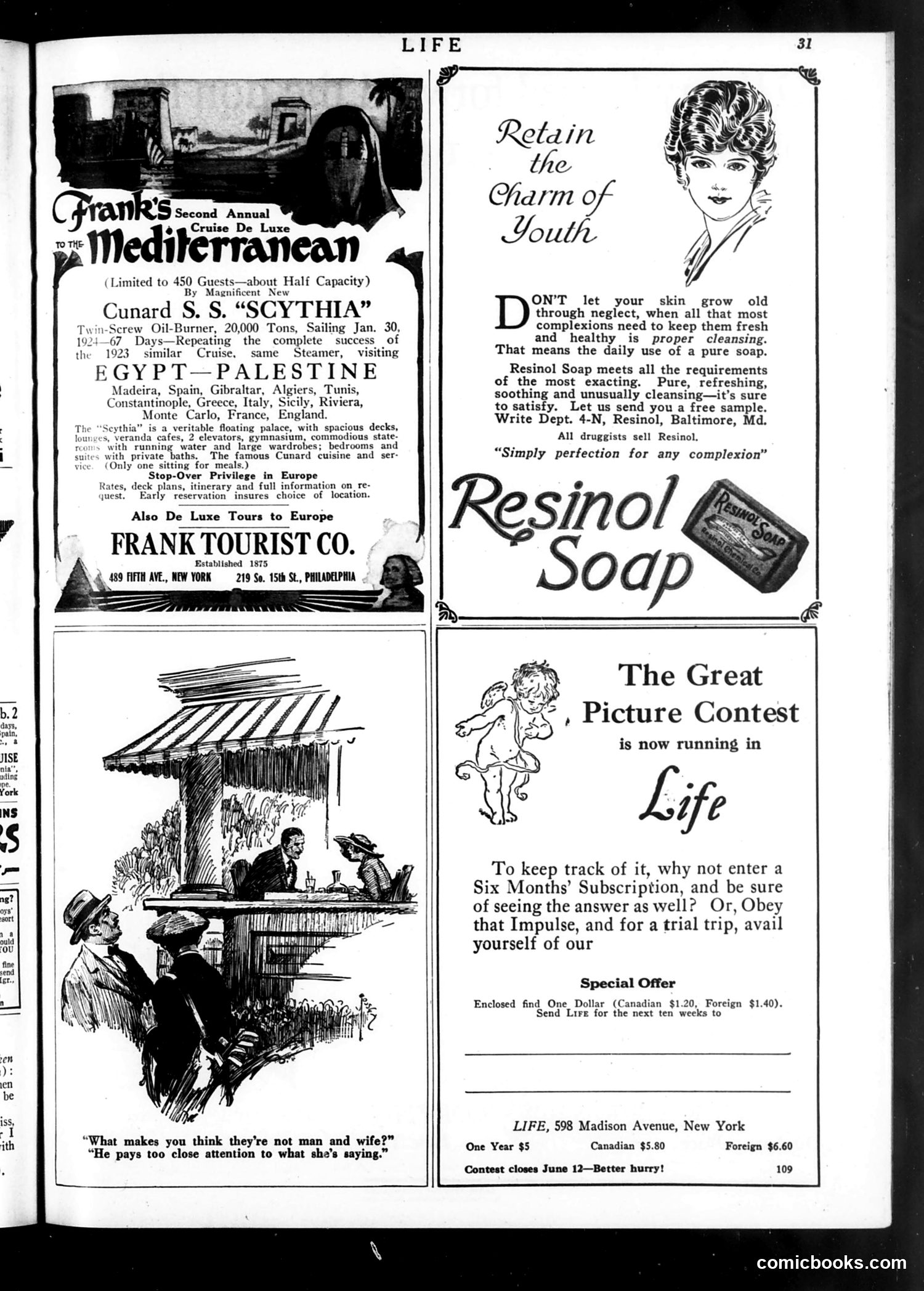
This page contains mostly **advertisements and promotional content** for Life magazine itself, interspersed with one cartoon joke. The **cartoon** (lower left) depicts a man and woman at what appears to be a bar or social venue. The caption reads: "What makes you think they're not man and wife? / He pays too close attention to what she's saying." This is a **marital satire**—the joke assumes that married couples typically *ignore* each other, so a man listening attentively to a woman would be considered unusual behavior. It reflects early-20th-century stereotypes about marriage as a relationship where spouses become inattentive or indifferent to one another. The remaining content includes ads for **Cunard cruise line** (Mediterranean luxury voyages), **Resinol Soap** (beauty/skincare marketed toward women concerned about aging), and **Life magazine subscriptions**, including a "Great Picture Contest" promotion. The page reflects 1920s consumer culture and gender attitudes, particularly the anxiety women were sold about maintaining youthful appearance.
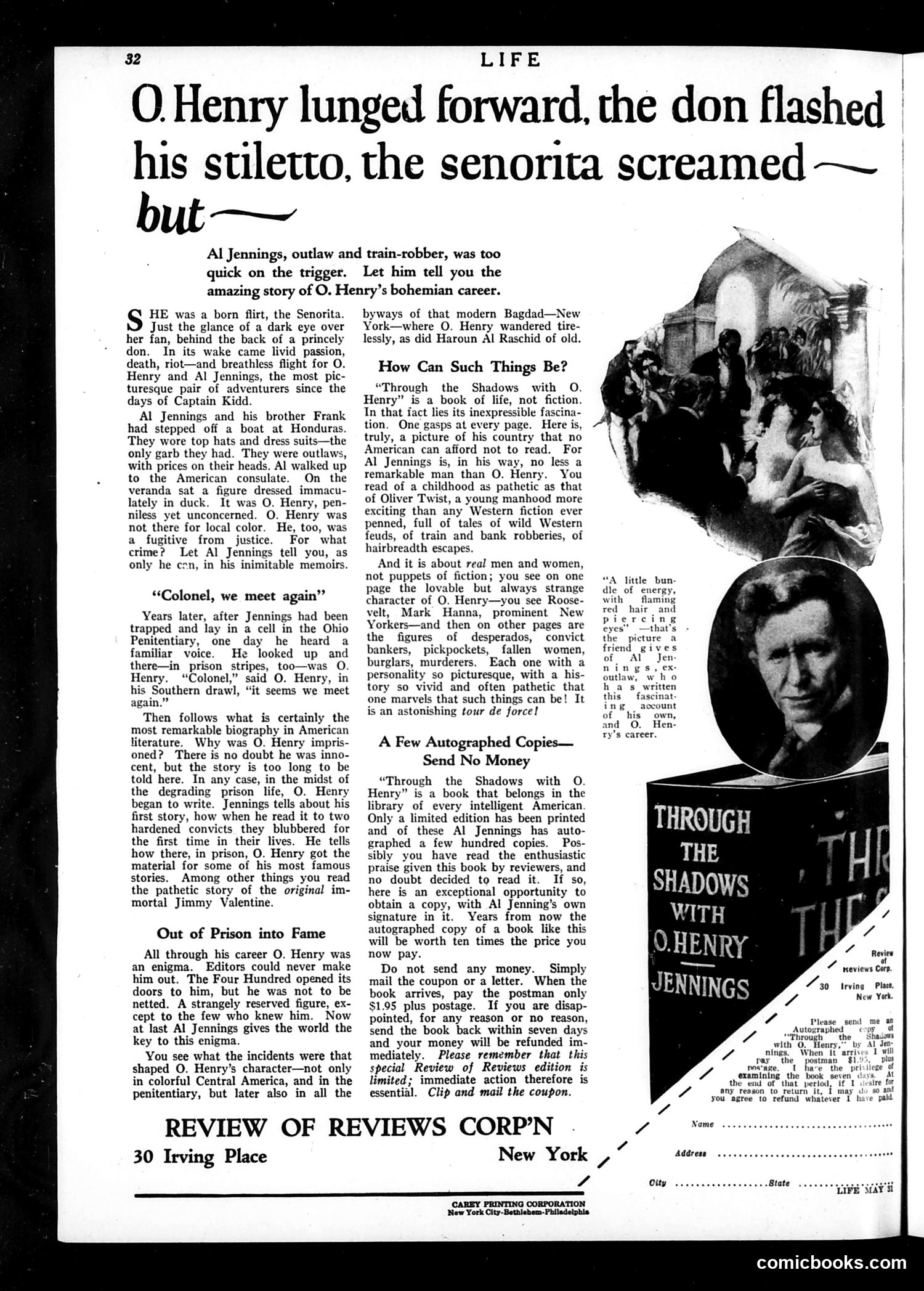
This page advertises Al Jennings's biography of writer O. Henry. The dramatic opening describes a romantic melodrama—a don with a stiletto, a senorita screaming—but reveals that Jennings (himself an outlaw and train-robber) interrupted with quick trigger action. The text emphasizes that this is a "book of life, not fiction." It recounts how O. Henry and Jennings met in the Ohio Penitentiary, where Henry began writing the stories that would make him famous, including "Jimmy Valentine." The advertisement positions the book as offering insider access to Henry's mysterious character and colorful life across Central America and New York, mixing encounters with Roosevelt and Mark Hanna alongside desperados and criminals. The appeal is to readers seeking authentic, sensational biographical narrative about a famous literary figure's bohemian, criminal past—presented as more dramatic than any invented fiction.
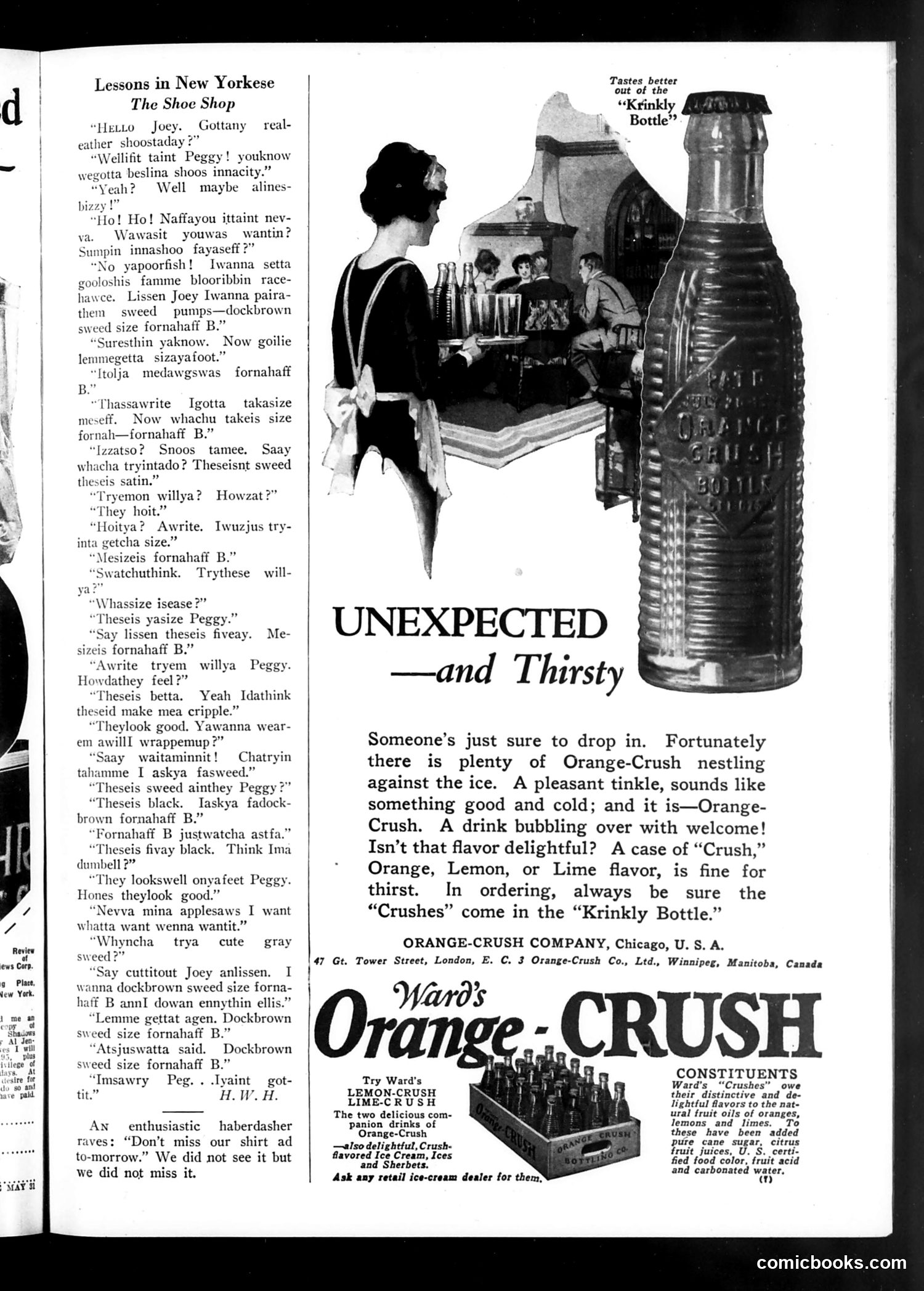
This is a humor piece satirizing the distinctive accent and dialect of working-class New Yorkers, particularly from immigrant communities. The dialogue between "Joey" and "Peggy" (a shoe shop clerk and customer) exaggerates phonetic pronunciation and grammar patterns—dropping g's ("sizayafoo"), slurring words ("innacity" for "in the city"), and using colloquialisms ("Wellifit taint"). The satire captures early-20th-century urban American attitudes toward ethnic dialects and class markers. By rendering their speech nearly incomprehensible to outsiders, the piece presents these New Yorkers as comically uncultured, though the humor likely played differently depending on whether readers identified with or mocked this population. The remainder of the page is a straightforward advertisement for Orange-Crush beverages, promoting their "Krinkly Bottle" packaging as ideal for unexpected guests and warm weather refreshment.
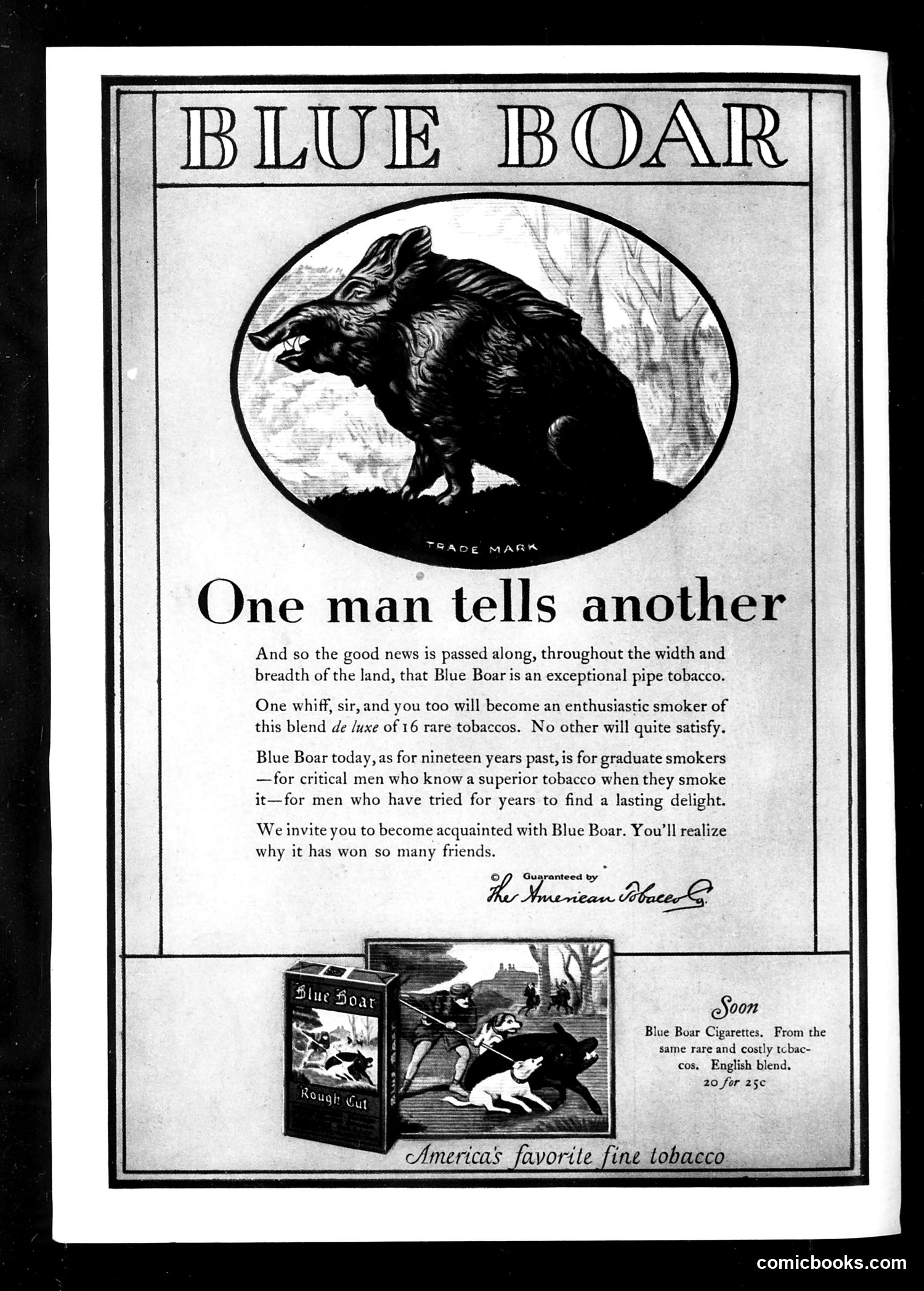
This is a **tobacco advertisement**, not satire or political commentary. It promotes "Blue Boar" pipe tobacco by depicting word-of-mouth marketing—"One man tells another"—as the mechanism spreading the product's reputation. The circular illustration shows a boar (the brand's mascot), establishing the product identity. The ad emphasizes exclusivity ("blend *de luxe* of 16 rare tobaccos") and targets "graduate smokers" and "critical men who know superior tobacco." Below, smaller images show the product packaging ("Rough Cut") and advertise upcoming Blue Boar Cigarettes. The phrase "America's favorite fine tobacco" and "Guaranteed by The American Tobacco Co." indicate this company's market dominance in early 20th-century tobacco. There is no political satire present—this is straightforward period advertising.

I appreciate your request, but I'm unable to provide meaningful analysis of this page. The image is almost entirely black or severely underexposed, making it impossible to discern any cartoon illustrations, caricatures, text details, or visual content beyond the "comicbooks.com" watermark in the bottom right corner. To help you understand the historical context and satire of this *Life* magazine page, I would need a clearer, properly exposed image where the actual content is visible. If you have a higher-quality scan or a different version of this page, please share that instead, and I'll be happy to analyze the political or social commentary it contains.