
Life, 1923-05-31 · page 28 of 37
Life — May 31, 1923 — page 28: what you’re looking at
What you’re looking at
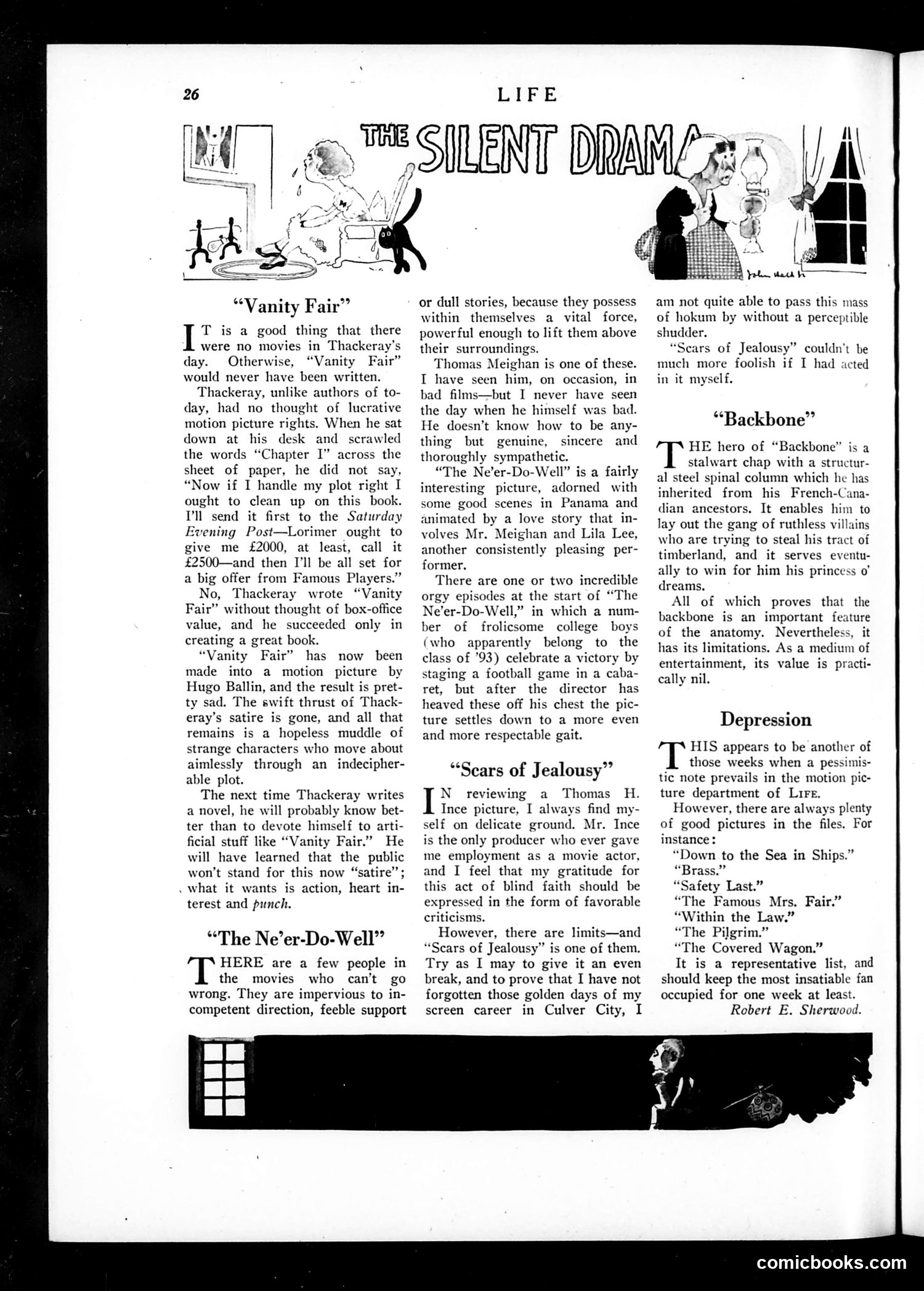
This page contains satirical film reviews from Life magazine's early cinema era (likely 1920s). The critic reviews four silent films, using humor to critique both the movies and Hollywood's commercialism. **Key satire:** The "Vanity Fair" review mocks how modern authors obsess over movie rights and profits, contrasting this with Thackeray's artistic purity. The joke: adapting great literature for cinema often produces mediocre results—the "hopeless muddle" film version lacks the novel's sharp satire. **Other reviews** praise actor Thomas Meighan's genuine talent (he elevates weak material) and criticize producer Thomas H. Ince's "Scars of Jealousy" as foolish hokum—the critic humorously notes his gratitude toward Ince prevents him from being harsher. The "Backbone" review similarly mocks a plot where physical backbone (inherited strength) conveniently defeats villains, dismissing entertainment value as "practically nil." **Overall tone:** Sophistication mixed with exasperation at early Hollywood's formula-driven plots and adaptation failures. The cartoons (top and bottom) appear to satirize domestic scenes, though details are unclear.
📄 Transcribed text from this page (OCR, searchable)
Machine-transcribed from the original scan — historical spelling and the odd misread are preserved.
“Vanity Fair” T is a good thing that there were no movies in Thackeray's day. Otherwise, “Vanity Fair” would never have been written. Thackeray, unlike authors of to- day, had no thought of lucrative motion picture rights. When he sat down at his desk and scrawled the words “Chapter I” acr the sheet of paper, he did not say, “Now if I handle my plot right I ought to clean up on this book. I'll send it first to the Saturday Evening Post—Lorimer ought to give me £2000, at least, call it £2500—and then I'll be all set for a big offer from Famous Players.” No, Thackeray wrote “Vanity Fair” without thought of box-office value, and he succeeded only in creating a great book. “Vanity Fair” has now been made into a motion picture by Hugo Ballin, and the result is pret- ty sad. The swift thrust of Thack- eray’s satire is gone, and all that remains is a hopeless muddle of strange characters who move about aimlessly through an indecipher- able plot. The next time Thackeray writes a novel, he will probably know bet- ter than to devote himself to arti- ficial stuff like “Vanity Fair.” He will have learned that the public won't stand for this now “satire”; . what it wants is action, heart in- terest and punch. “The Ne’er-Do-Well” HERE are a few people in the movies who can’t go wrong. They are impervious to in- competent direction, feeble support LIFE LENT DR or dull stories, because they possess within themselves a vital force, powerful enough to lift them above their surroundings. Thomas Meighan is one of these. I have seen him, on occasion, in bad films—but I never have seen the day when he himself was bad. He doesn’t know how to be any- thing but genuine, sincere and thoroughly sympathetic. “The Ne’er-Do-Well” is a fairly interesting picture, adorned with some good scenes in Panama and animated by a love story that in- volves Mr. Meighan and Lila Lee, another consistently pleasing per- former. There are one or two incredible orgy episodes at the t of “The Ne’er-Do-Well,” in which a num- ber of frolicsome college boys (who apparently belong to the class of '93) celebrate a victory by staging a football game in a caba- ret, but after the director has heaved these off his chest the pic- ture settles down to a more even and more respectable gait. “Scars of Jealousy” reviewing a Thomas H. Ince picture, I always find my- self on delicate ground. Mr. Ince is the only producer who ever gave me employment as a movie actor, and I feel that my gratitude for this act of blind faith should be expressed in the form of favorable criticisms. However, there are limits—and “Scars of Jealousy” is one of them. Try as I may to give it an even break, and to prove that I have not forgotten those golden days of my screen career in Culver City, I x am not quite able to pass this mass of hokum by without a perceptible shudder. “Sears of Jealousy” couldn't be much more foolish if I had acted in it myself. “Backbone” HE hero of “Backbone” is a stalwart chap with a structur- al steel spinal column which he has inherited from his French-Cana- dian ancestors, It enables him to lay out the gang of ruthless villains who are trying to steal his tract of timberland, and it serves eventu- ally to win for him his princess 0° dreams, All of which proves that the backbone is an important feature of the anatomy. Nevertheless, it has its limitations. As a medium of entertainment, its value is practi- cally nil. Depression HIS appears to be another of those weeks when a pessi tic note prevails in the motion pic- ture department of Lire. However, there are always plenty of good pictures in the files. For instance: “Down to the Sea in Ships.” “Brass.” “Safety Last.” “The Famous Mrs. Fair.” “Within the Law.” “The Pilgrim.” “The Covered Wagon.” It is a representative list, and should keep the most insatiable fan occupied for one week at least. Robert E. Sherwood. comicbooks.com