
Life, 1923-05-31 · page 20 of 37
Life — May 31, 1923 — page 20: what you’re looking at
What you’re looking at
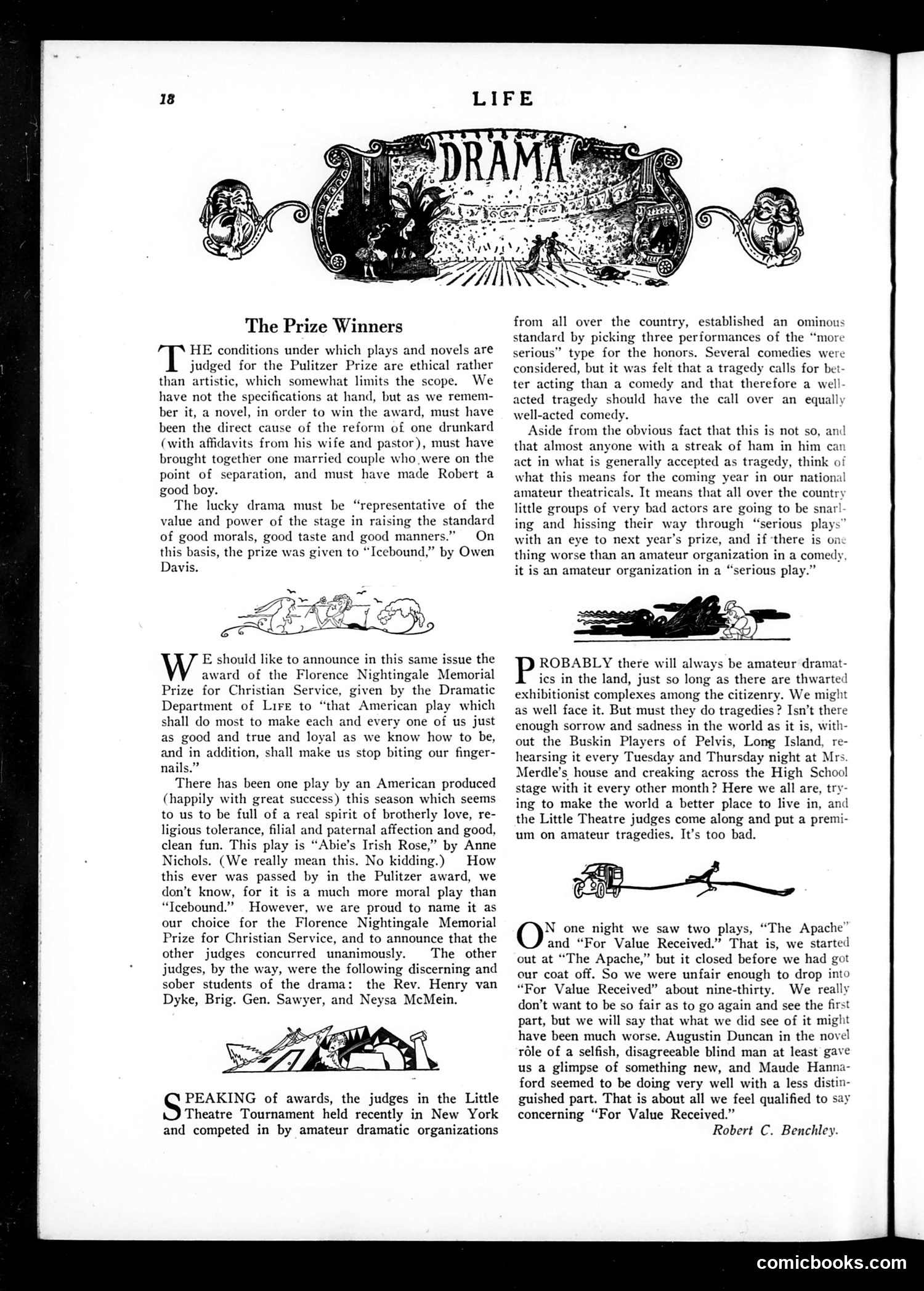
This is satirical commentary on theatrical award standards. The article mocks the **Pulitzer Prize's ethical (rather than artistic) criteria** for judging plays, claiming absurdly that winning novels must reform drunkards or reconcile separated couples—pure exaggeration for comic effect. Life sarcastically announces its own "Florence Nightingale Memorial Prize" for Christian Service, awarded to **"Abie's Irish Rose"** by Anne Nichols (a popular 1920s comedy about interfaith romance). The joke: this crowd-pleasing play was overlooked by Pulitzer judges, yet Life argues it embodies genuine moral values better than the actual winner, "Icebound." The article then criticizes amateur theater competitions for **favoring "serious" tragedies over comedies**, predicting this will encourage mediocre amateur groups to badly perform heavy dramatic material. The underlying satire: judges equate tragedy with artistic merit, when in reality, amateur actors perform comedy better than melodrama. Life advocates for encouraging amateurs toward their actual talents rather than pretentious "serious" work.
📄 Transcribed text from this page (OCR, searchable)
Machine-transcribed from the original scan — historical spelling and the odd misread are preserved.
The Prize Winners HE conditions under which plays and novels are judged for the Pulitzer Prize are ethical rather than artistic, which somewhat limits the scope. We have not the specifications at hand, but as we remem- ber it, a novel, in order to win the award, must have been the direct cause of the reform of one drunkard (with affidavits from his wife and pastor), must have brought together one married couple who were on the point of separation, and must have made Robert a good boy. The lucky drama must be “representative of the value and power of the stage in raising the standard of good morals, good taste and good manners.” On this basis, the prize was given to “Icebound,” by Owen Davis. E should like to announce in this same issue the award of the Florence Nightingale Memorial Prize for Christian Service, given by the Dramatic Department of Lire to “that American play which shall do most to make each and every one of us just as good and true and loyal as we know how to be, and in addition, shall make us stop biting our finger- nails.” There has been one play by an American produced (happily with great success) this season which seems to us to be full of a real spirit of brotherly love, re- ligious tolerance, filial and paternal affection and good, clean fun. This play is “Abie’s Irish Rose,” by Anne Nichols. (We really mean this. No kidding.) | How this ever was passed by in the Pulitzer award, we don’t know, for it is a much more moral play than “Tcebound.” However, we are proud to name it as our choice for the Florence Nightingale Memorial Prize for Christian Service, and to announce that the other judges concurred unanimously. The other judges, by the way, were the following discerning and sober students of the drama: the Rev. Henry van Dyke, Brig. Gen. Sawyer, and Neysa McMein. PEAKING of awards, the judges in the Little Theatre Tournament held recently in New York and competed in by amateur dramatic organizations from all over the country, established an ominous standard by picking three performances of the “more serious” type for the honors. Several comedies were considered, but it was felt that a tragedy calls for bet- ter acting than a comedy and that therefore a well- acted tragedy should have the call over an equally well-acted comedy. Aside from the obvious fact that this is not so, and that almost anyone with a streak of ham in him can act in what is generally accepted as tragedy, think of what this means for the coming year in our national amateur theatricals. It means that all over the country little groups of very bad actors are going to be snar! ing and hissing their way through “serious plays” with an eye to next year’s prize, and if ‘there is one thing worse than an amateur organization in a comedy. it is an amateur organization in a “serious play.” ROBABLY there will always be amateur dramat- cs in the land, just so long as there are thwarted exhibitionist complexes among the citizenry. We might as well face it. But must they do tragedies? Isn’t there enough sorrow and sadness in the world as it is, with- out the Buskin Players of Pelvis, Long Island, re- hearsing it every Tuesday and Thursday night at Mrs Merdle’s house and creaking across the High School stage with it every other month? Here we all are, try- ing to make the world a better place to live in, and the Little Theatre judges come along and put a premi- um on amateur tragedies. It’s too bad. e_——_. N one night we saw two plays, “The Apache” and “For Value Received.” That is, we started out at “The Apache,” but it closed before we had got our coat off. So we were unfair enough to drop into “For Value Received” about nine-thirty. We really don’t want to be so fair as to go again and see the first part, but we will say that what we did see of it might have been much worse. Augustin Duncan in the novel role of a selfish, disagreeable blind man at least gave us a glimpse of something new, and Maude Hanna- ford seemed to be doing very well with a less distin- guished part. That is about all we feel qualified to say concerning “For Value Received.” Robert C. Benchley. comicbooks.com