
Life, 1923-05-31 · page 16 of 37
Life — May 31, 1923 — page 16: what you’re looking at
What you’re looking at
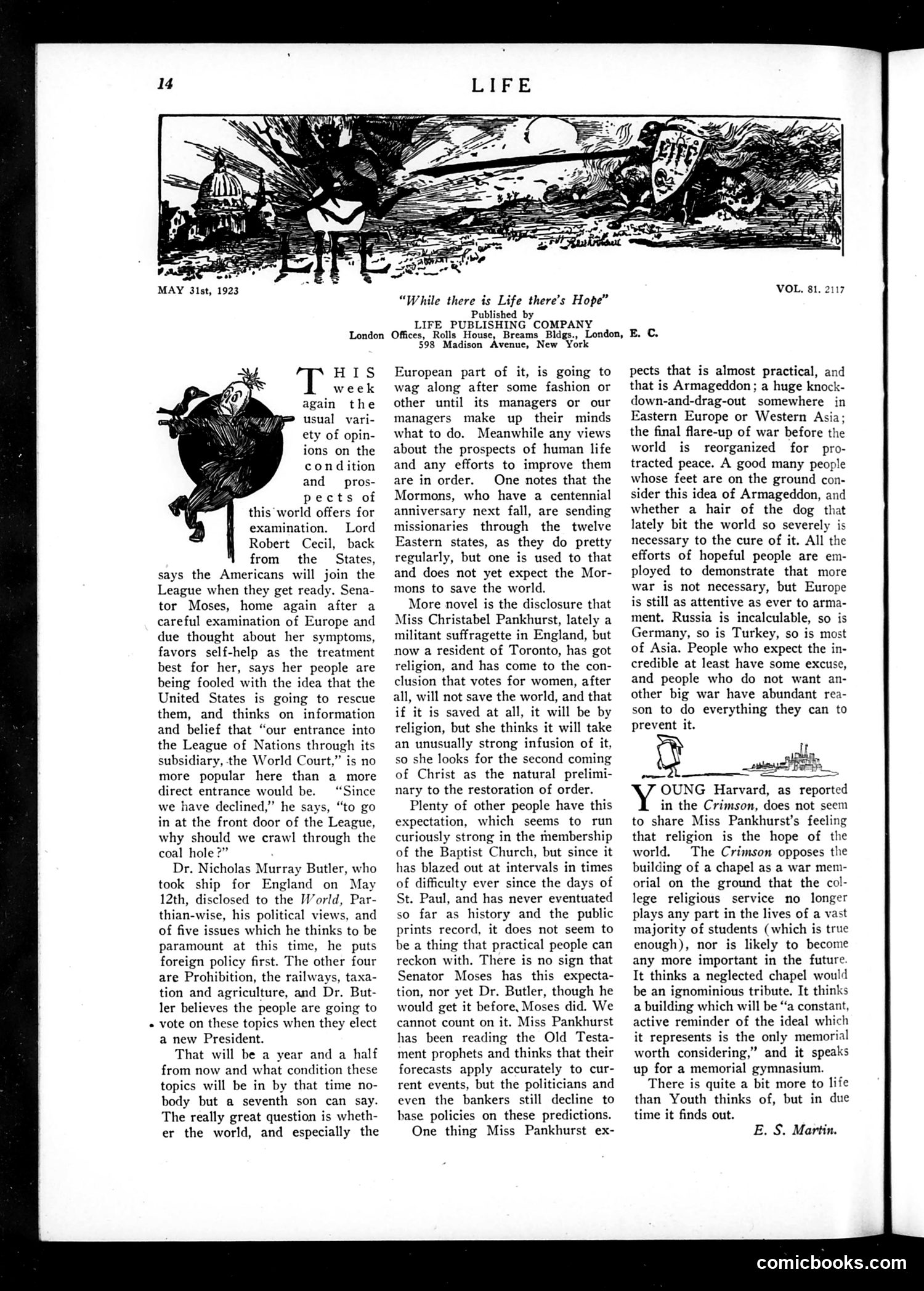
The masthead cartoon depicts a chaotic scene with European landmarks (a domed building, possibly representing government institutions) amid explosions and destruction, symbolizing post-WWI European instability. The main article discusses European instability and American isolationism. It criticizes the idea that the U.S. should "rescue" Europe through League of Nations involvement, arguing Americans are being "fooled" by this notion. The author references Robert Cecil and Dr. Nicholas Murray Butler's arguments about foreign policy. The piece expresses skepticism about various post-war solutions—women's suffrage as a cure-all, religious revival, and political predictions—while emphasizing the U.S. should avoid entanglement in European affairs. The tone is satirical toward both European disorder and American interventionist impulses.
📄 Transcribed text from this page (OCR, searchable)
Machine-transcribed from the original scan — historical spelling and the odd misread are preserved.
MAY 3ist, 1923 “While there is Life there’s Hope” Published by LIFE PUBLISHING COMPANY London Offices, Rolls House, Breams Bldgs., London, E. C. HIS week again the usual vari- ety of opin- ions on the condition and pros- pects of this world offers for examination. Lord Robert Cecil, back from the States, says the Americans will join the League when they get ready. Sena- tor Moses, home again after a careful examination of Europe and due thought about her symptoms, favors self-help as the treatment best for her, says her people are being fooled with the idea that the United States is going to rescue them, and thinks on information and belief that “our entrance into the League of Nations through its subsidiary, the World Court,” is no more popular here than a more direct entrance would be. “Since we have declined,” he says, “to go in at the front door of the League, why should we crawl through the coal hole?” Dr. Nicholas Murray Butler, who took ship for England on May 12th, disclosed to the World, Par- thian-wise, his political views, and of five issues which he thinks to be paramount at this time, he puts foreign policy first. The other four are Prohibition, the railways, taxa- tion and agriculture, and Dr. But- ler believes the people are going to vote on these topics when they elect a new President. That will be a year and a half from now and what condition these topics will be in by that time no- body but a seventh son can say. The really great question is wheth- er the world, and especially the 598 Madison Avenue, New York European part of it, is going to wag along after some fashion or other until its managers or our managers make up their minds what to do. Meanwhile any views about the prospects of human life and any efforts to improve them are in order. One notes that the Mormons, who have a centennial anniversary next fall, are sending missionaries through the twelve Eastern states, as they do pretty regularly, but one is used to that and does not yet expect the Mor- mons to save the world. More novel is the disclosure that Miss Christabel Pankhurst, lately a militant suffragette in England, but now a resident of Toronto, has got religion, and has come to the con- clusion that votes for women, after all, will not save the world, and that if it is saved at all, it will be by religion, but she thinks it will take an unusually strong infusion of it, so she looks for the second coming of Christ as the natural prelimi- nary to the restoration of order. Plenty of other people have this expectation, which seems to run curiously strong in the membership of the Baptist Church, but since it has blazed out at intervals in times of difficulty ever since the days of St. Paul, and has never eventuated so far as history and the public prints record, it does not seem to be a thing that practical people can reckon with. There is no sign that Senator Moses has this expecta- tion, nor yet Dr. Butler, though he would get it before, Moses did. We cannot count on it. Miss Pankhurst has been reading the Old Testa- ment prophets and thinks that their forecasts apply accurately to cur- rent events, but the politicians and even the bankers still decline to hase policies on these predictions. One thing Miss Pankhurst ex- pects that is almost practical, and that is Armageddon; a huge knock- down-and-drag-out somewhere in Eastern Europe or Western Asia; the final flare-up of war before the world is reorganized for pro- tracted peace. A good many people whose feet are on the ground con- sider this idea of Armageddon, and whether a hair of the dog that lately bit the world so severely is necessary to the cure of it. All the efforts of hopeful people are em- ployed to demonstrate that more war is not necessary, but Europe is still as attentive as ever to arma- ment. Russia is incalculable, so is Germany, so is Turkey, so is most of Asia. People who expect the in- credible at least have some excuse, and people who do not want an- other big war have abundant rea- son to do everything they can to prevent it. all, OUNG Harvard, as reported in the Crimson, does not seem to share Miss Pankhurst’s feeling that religion is the hope of the world. The Crimson opposes the building of a chapel as a war mem- orial on the ground that the col- lege religious service no longer plays any part in the lives of a vast majority of students (which is true enough), nor is likely to become any more important in the future. It thinks a neglected chapel would be an ignominious tribute. It thinks a building which will be “‘a constant, active reminder of the ideal which it represents is the only memorial worth considering,” and it speaks up for a memorial gymnasium. There is quite a bit more to life than Youth thinks of, but in due time it finds out. E. S. Martin. comicbooks.com