
A complete issue · 36 pages · 1923
Life — March 22, 1923
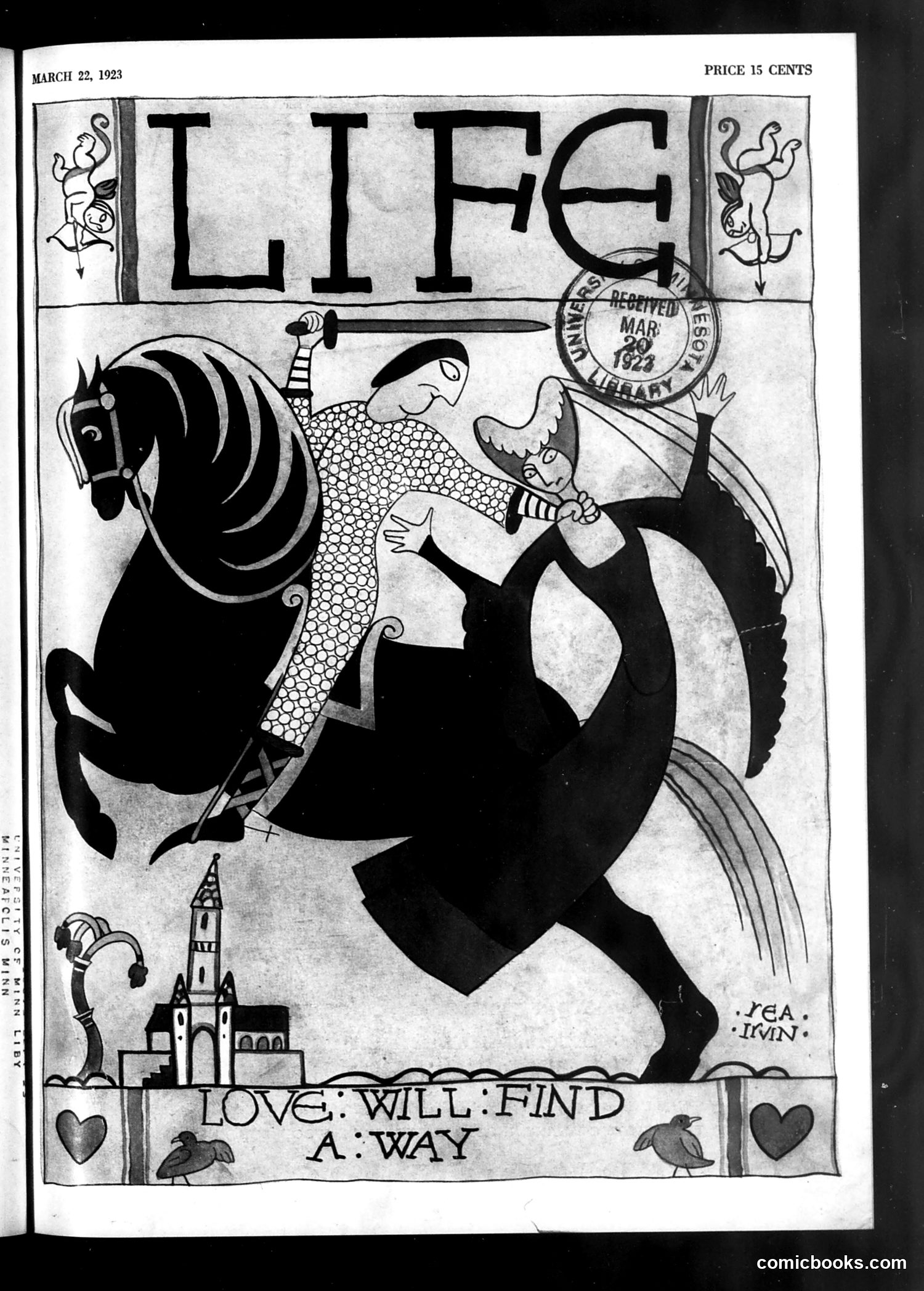
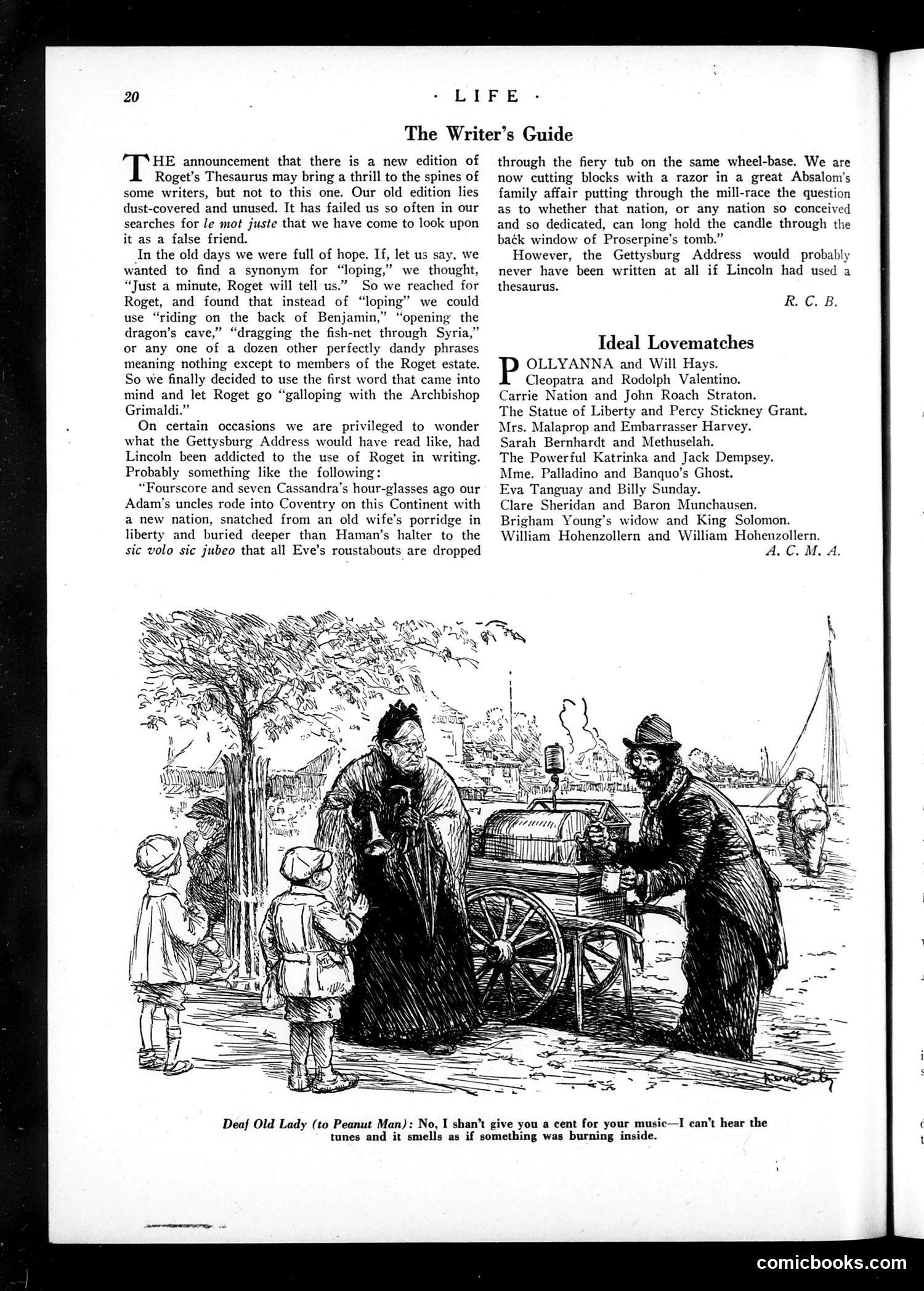
This cover illustration by F.A. Irvin depicts a romantic fantasy scenario with the caption "Love Will Find a Way." A man in formal attire rides a horse while wielding a sword, appearing to rescue or elope with a woman in a black dress. The scene includes romantic imagery: a castle, hearts, and a Cupid figure in the corner. The satire likely comments on contemporary romance or courtship customs of the 1920s—possibly mocking idealized notions of chivalry or dramatic romantic gestures. The exaggerated, theatrical poses suggest gentle humor about unrealistic romantic expectations. The specific identities of the figures remain unclear, though they may reference a contemporary social trend, scandal, or theatrical production popular in 1923.
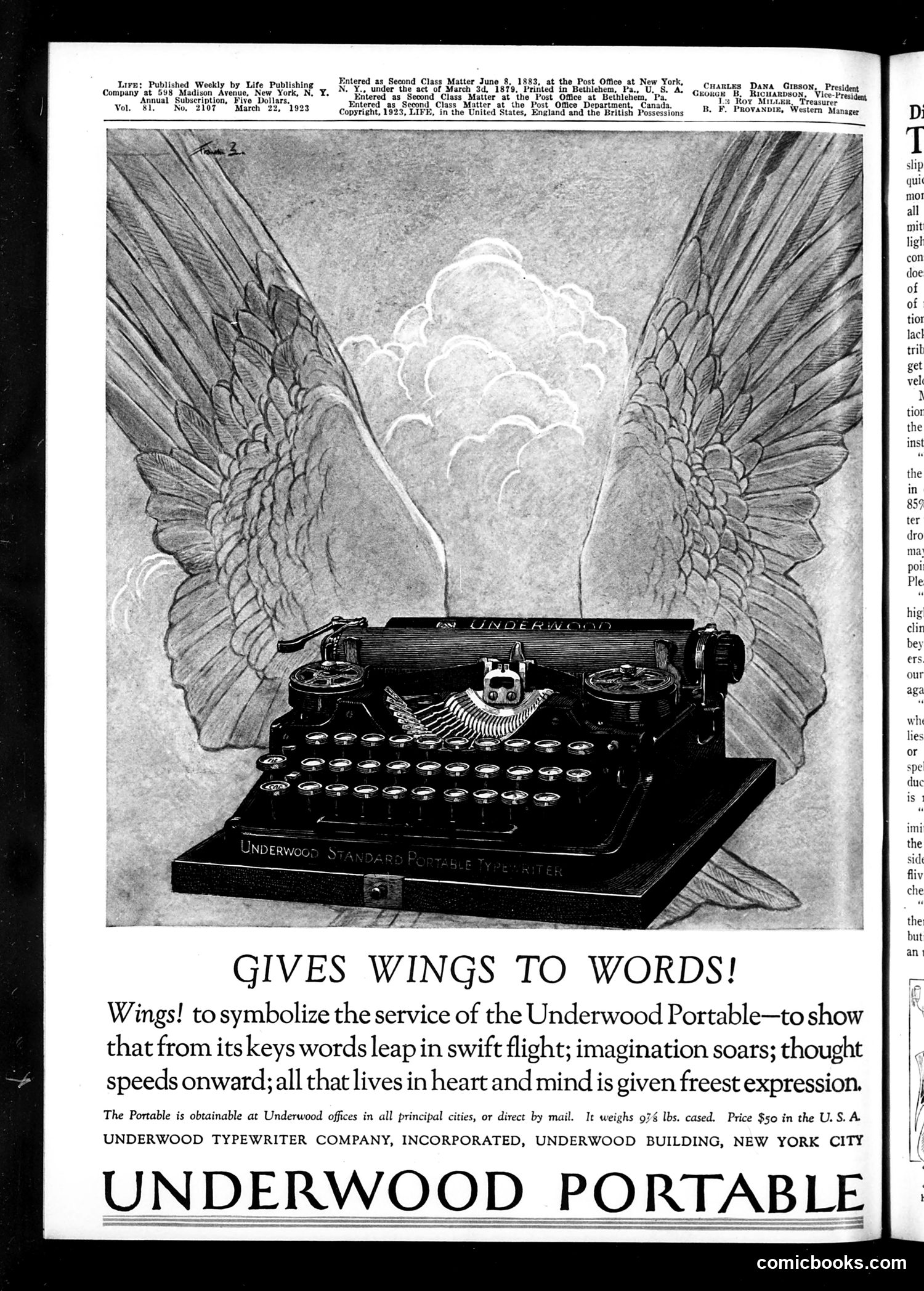
This page is primarily **advertising, not satire or political commentary**. It's a 1923 advertisement for the Underwood Portable typewriter. The image features a typewriter nestled between large angelic wings, with clouds above. The tagline "GIVES WINGS TO WORDS" uses metaphorical language common to early 20th-century advertising. The accompanying text emphasizes that the typewriter enables swift expression of human creativity and emotion—words "leap in swift flight," "imagination soars," and "thought speeds onward." This is aspirational marketing that frames typing technology as liberating the mind's potential. The ad notes the machine weighs 9.75 lbs, costs $30 in the U.S., and is available through Underwood offices nationwide. There is no political cartoon or satire present on this page.
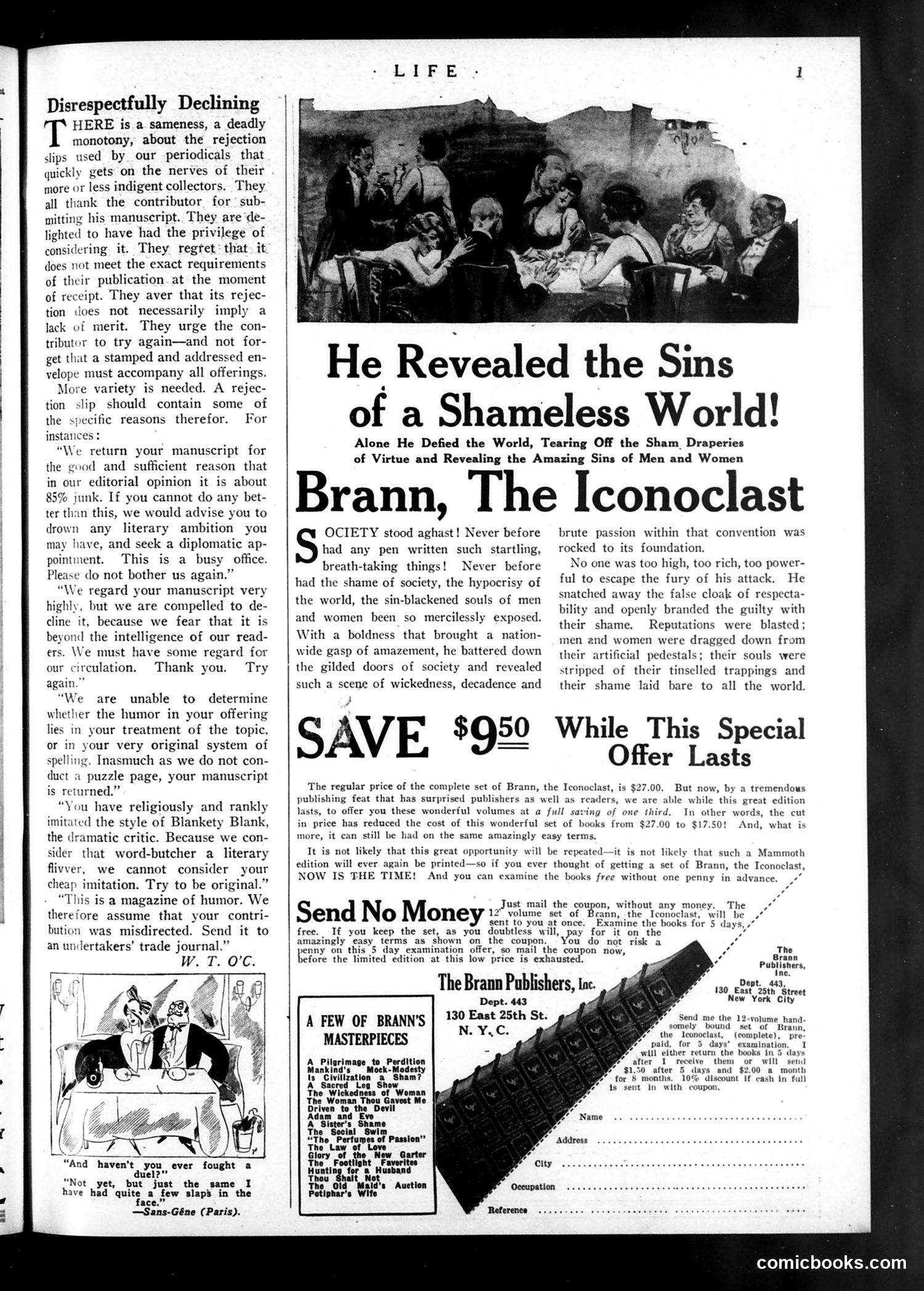
This page is primarily **advertising for a book series** ("Brann, the Iconoclast") rather than satirical content. The main image shows a dramatic scene of social condemnation, advertising a publication that "revealed the sins of a shameless world." The small cartoon at bottom-left appears to be unrelated humor about fighting, with the caption referencing someone getting "slaps in the face" — likely a separate, minor comic strip. The bulk of the page consists of: - Editorial rejection letters (top-left) explaining why manuscripts weren't accepted - A large advertisement offering the Brann book series at a discounted price ($9.50 versus $27) - Order form for the 12-volume set This represents Life magazine's mixed content model: satirical commentary alongside commercial advertising and unrelated humor strips.
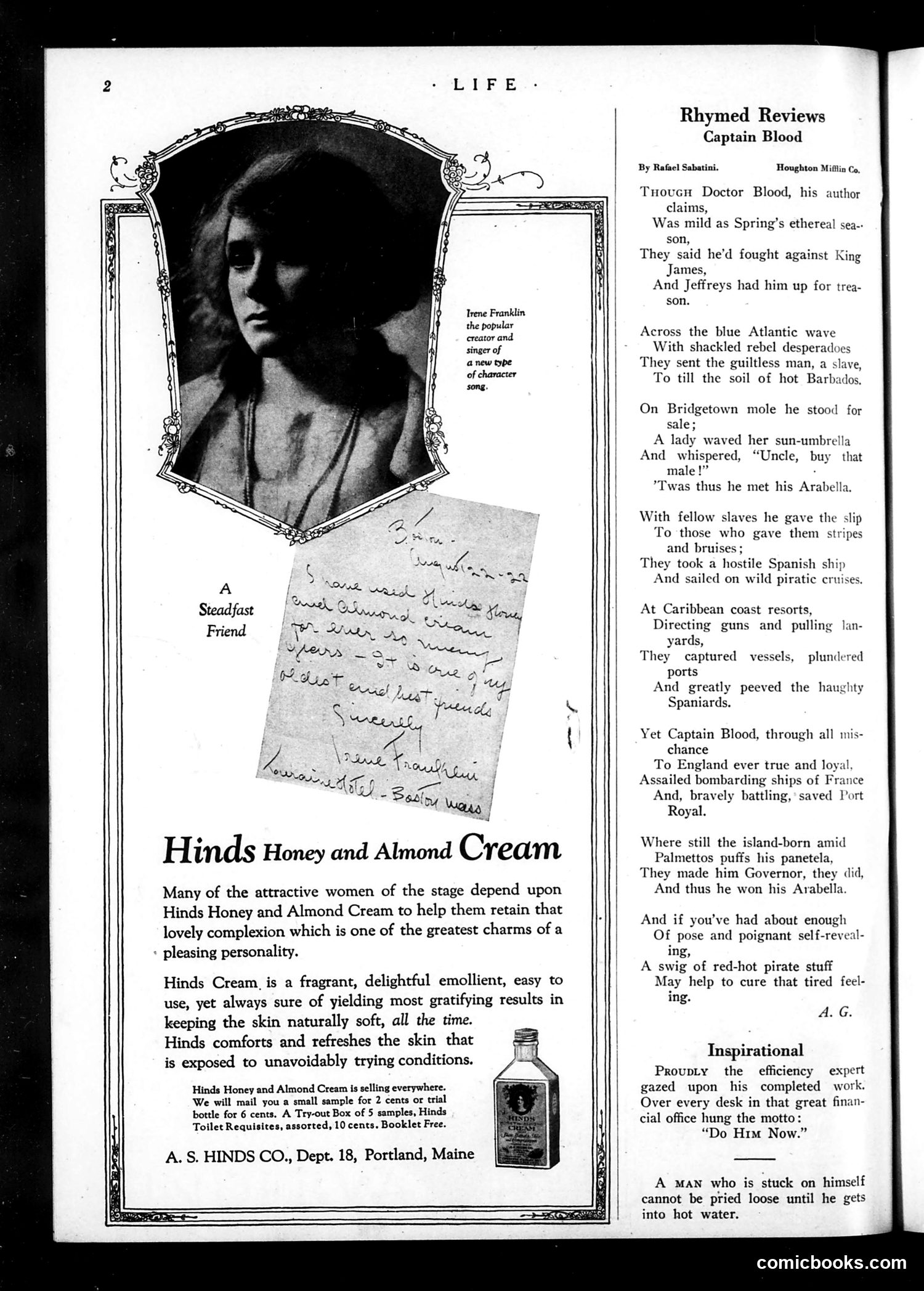
This page is primarily **advertising**, not political satire. The left side features an advertisement for **Hinds Honey and Almond Cream**, a skincare product. It includes a photograph labeled "A Breakfast Friend" showing a woman (identified as "Irene Franklin the popular creator and singer of character songs"), accompanied by handwritten text praising the product. The right side contains a poem titled **"Captain Blood"** by Rafael Sabatini, reviewing a work about a historical pirate character. Below that are two brief inspirational items: one about workplace efficiency and another aphorism about self-improvement. There is **no political cartoon or satire** on this page. It represents typical early-20th-century magazine content mixing advertisements with literary reviews and moral epigrams.
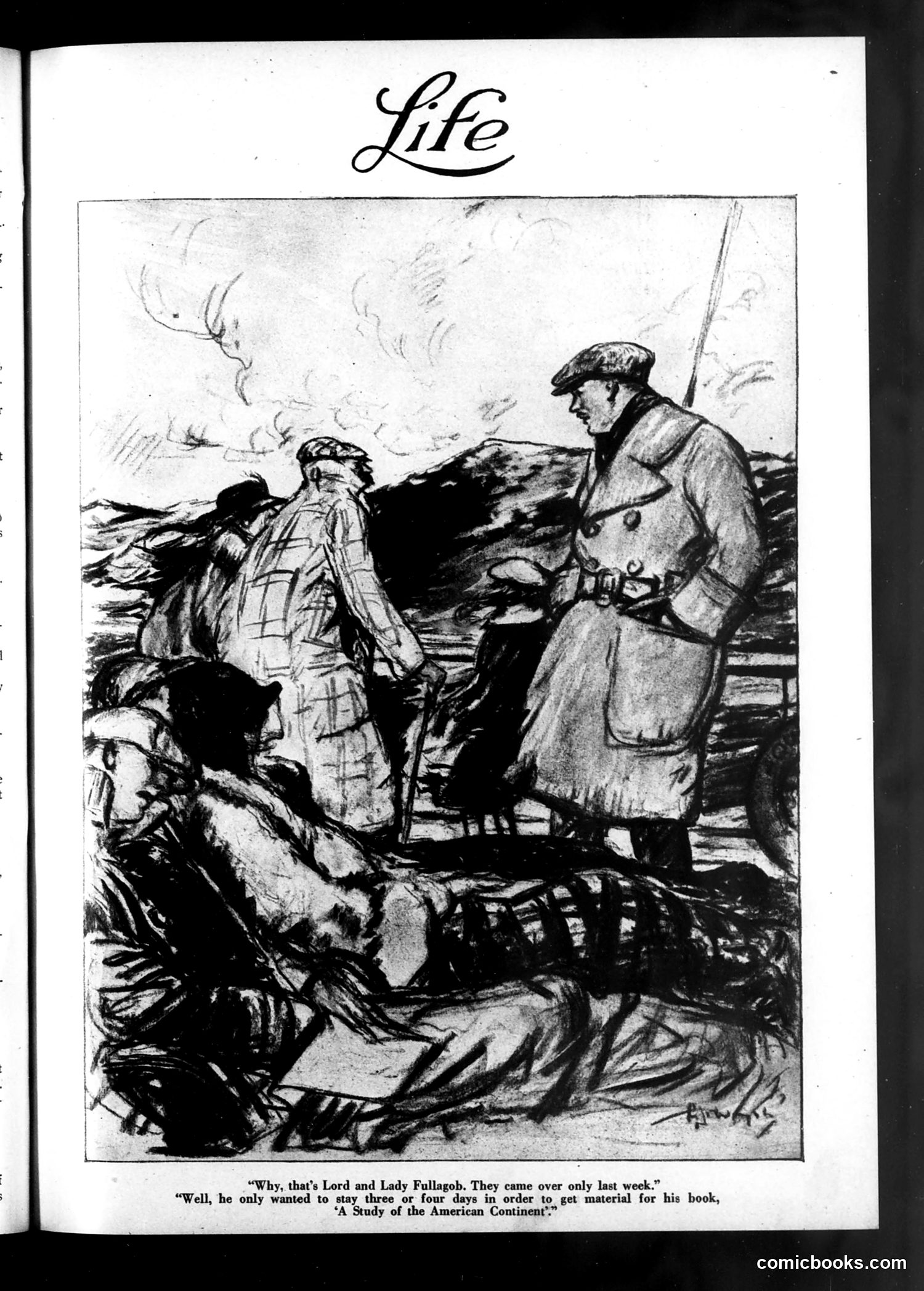
This satirical cartoon depicts a social encounter in what appears to be a rural or frontier setting. The dialogue references "Lord and Lady Fullalop," visitors who arrived "only last week" to gather material for a book titled "A Study of the American Continent." The humor satirizes wealthy British aristocrats touring America as amateur scholars or adventurers. The phrase "A Study of the American Continent" mocks their pretentious intellectual ambitions, while their brief stay ("three or four days") suggests they're superficial observers claiming expertise without genuine understanding. The ragged, weathered appearance of the Americans being "studied" contrasts sharply with the visitors' refined dress, emphasizing class difference and the condescension inherent in such colonial-minded cultural tourism.
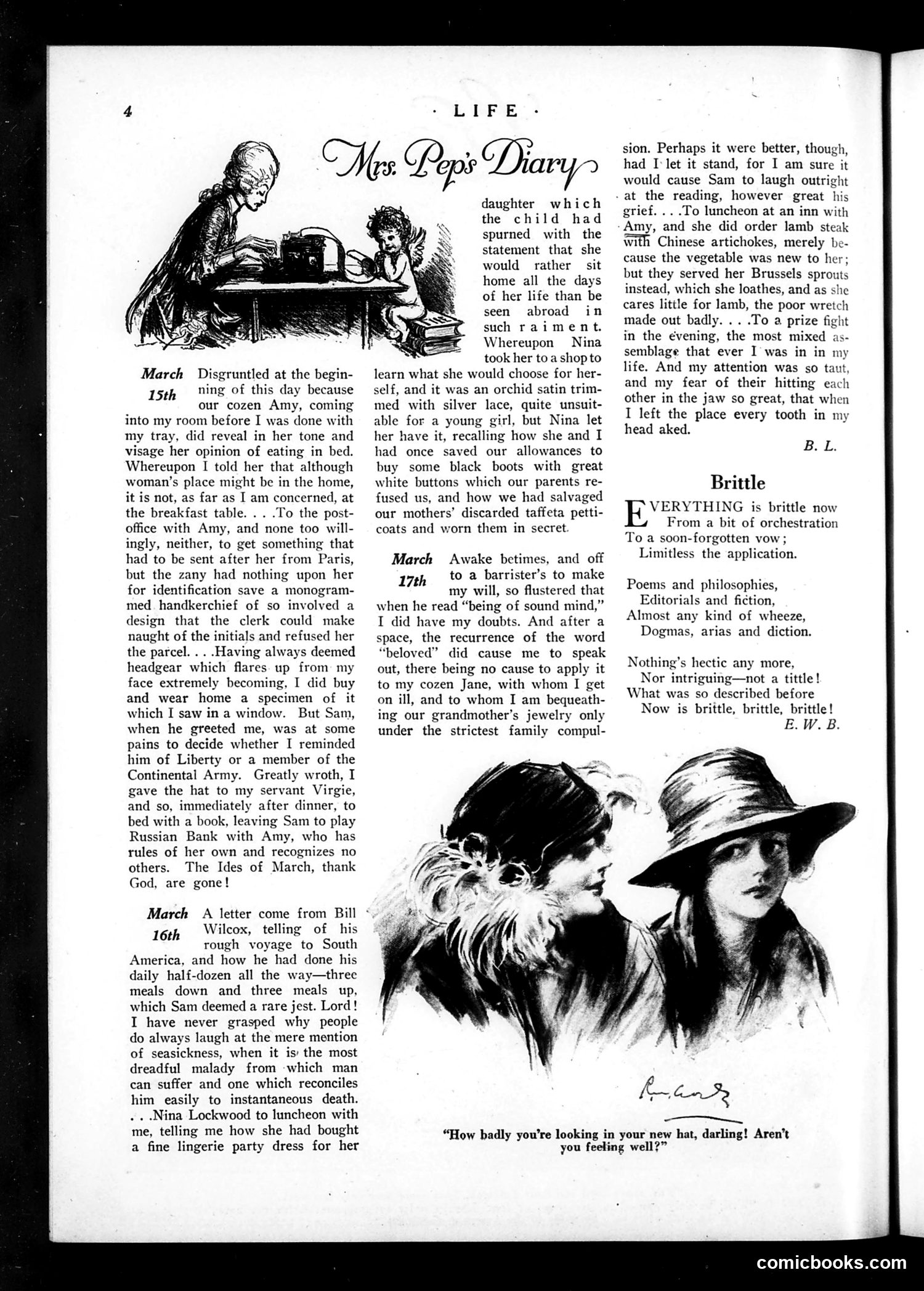
This page contains "Mrs. Peps Diary," a serial humor column featuring a woman's observations on domestic life and society. The diary entries (March 15th-17th) mock various upper-class concerns: a daughter refusing foreign travel, debates over dining etiquette, and receiving a visitor from South America. Below the diary is a poem titled "Brittle" by E.W.B., criticizing contemporary attitudes as overly sensitive and fragile—likely commentary on early 20th-century social pretension. The illustration at bottom shows two figures in conversation, with caption: "How badly you're looking in your new hat, darling! Aren't you feeling well?" This satirizes superficial social interaction where insults are masked as concern. The overall page mocks upper-class affectation and shallow social conventions of the era.
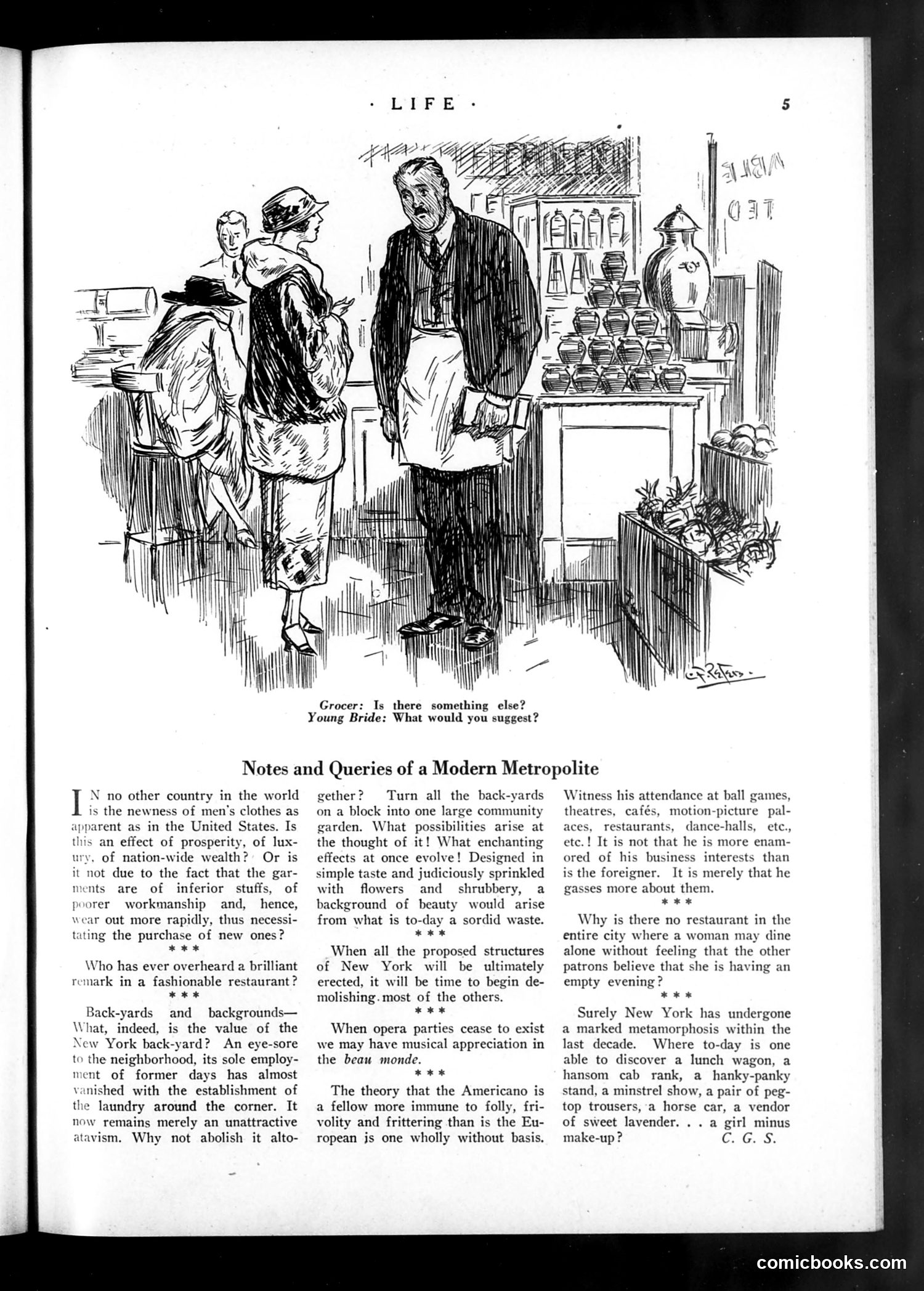
This cartoon depicts a grocer in his shop with a young bride and her companion. The grocer asks, "Is there something else?" and the young bride responds, "What would you suggest?" The joke satirizes newlyweds—specifically new wives—as inexperienced in household management and shopping. The bride's question implies she doesn't know what groceries to purchase, suggesting that young women of this era lacked practical domestic knowledge despite their social status. The grocer's bemused expression suggests the absurdity of a customer unable to shop independently. The accompanying article critiques modern New York life, discussing urban decay, fashion, and social changes. The satire targets upper-class pretension and the perceived decline of city living standards, consistent with *Life* magazine's commentary on contemporary American society.
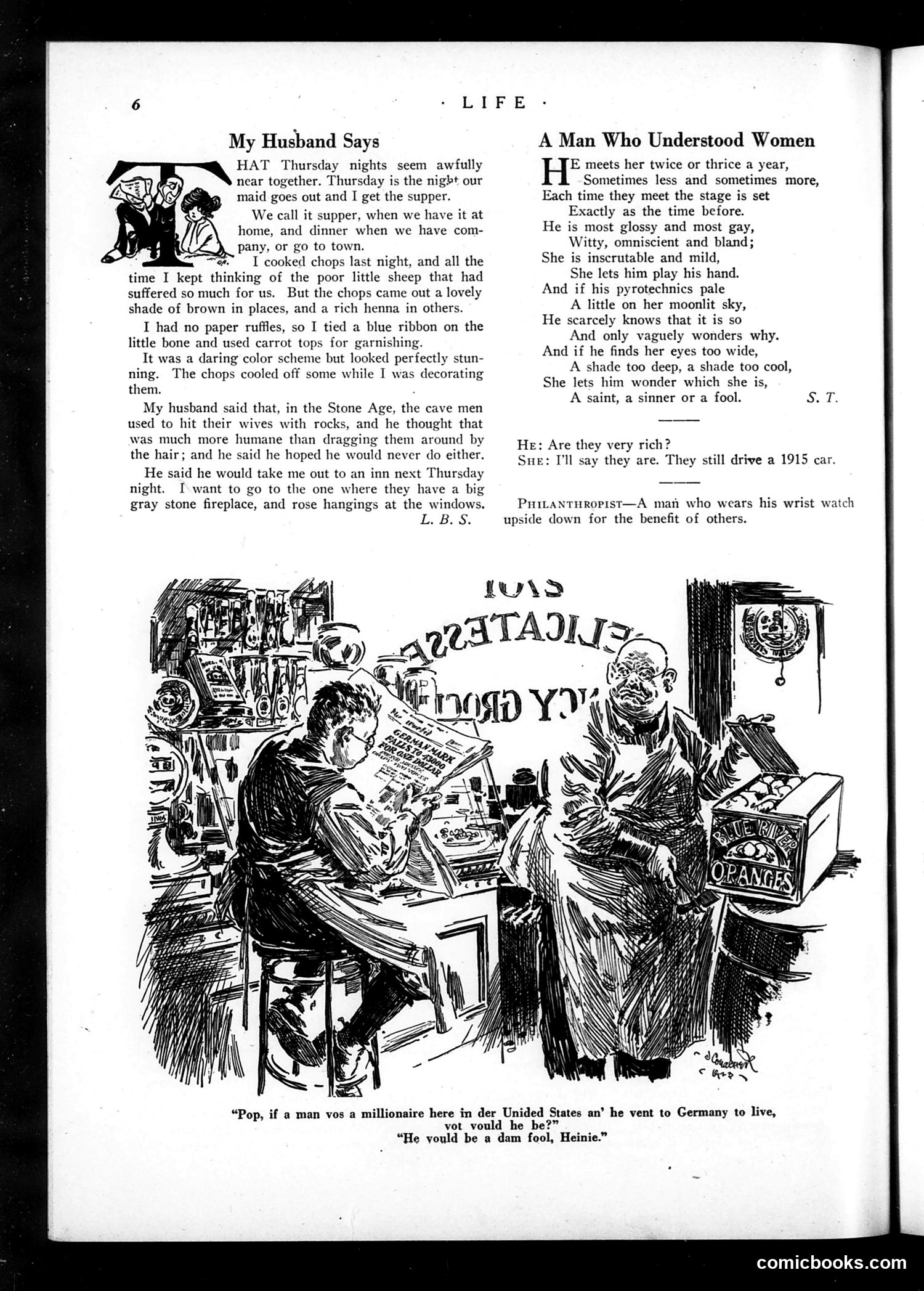
This page contains three distinct pieces of humor: 1. **"My Husband Says"** (L.B.S.): A domestic comedy column about a wife's decorated lamb chops and her husband's prehistoric joke about Stone Age men hitting wives with rocks—he reassures her he won't do this. He promises to take her to a nice inn next Thursday. 2. **"A Man Who Understood Women"** (S.T.): A poem describing a man who meets women frequently but remains emotionally detached and inscrutably indifferent to their feelings. 3. **The cartoon**: Shows a newspaper vendor or publisher speaking with a customer. The German-language caption (roughly translated) mocks the idea that a wealthy American millionaire would abandon the U.S. to live in Germany, calling such a person a "damn fool." This appears to reference post-WWI skepticism about Germany's economic prospects.
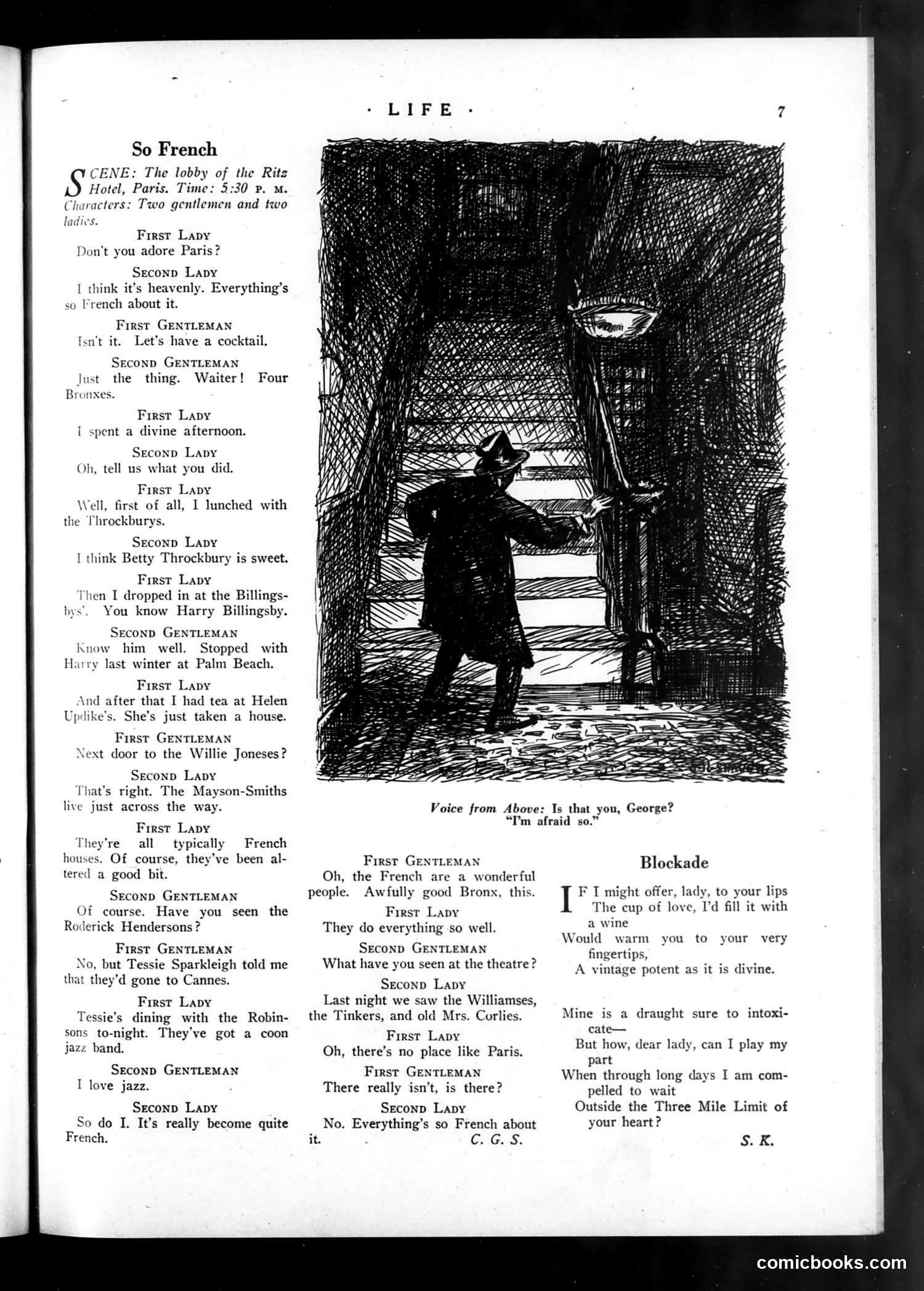
This page contains a satirical sketch titled "So French," set in the Ritz Hotel lobby in Paris. The comedy relies on American characters enthusiastically imitating French sophistication and mannerisms—mentioning lunch with the Throckburys, tea at Helen Updike's house, and attending the theater to see the Williamses and Tinkers. The joke targets American social climbers' pretentious attempts to adopt French culture and lifestyle as markers of status. The accompanying illustration shows a silhouetted figure in a hat, likely depicting a typical "Parisian" character type. The page also includes a poem titled "Blockade" by S.K., a romantic piece unrelated to the main sketch. Overall, the content satirizes American aspirational Francophilia during what appears to be the early-to-mid twentieth century.
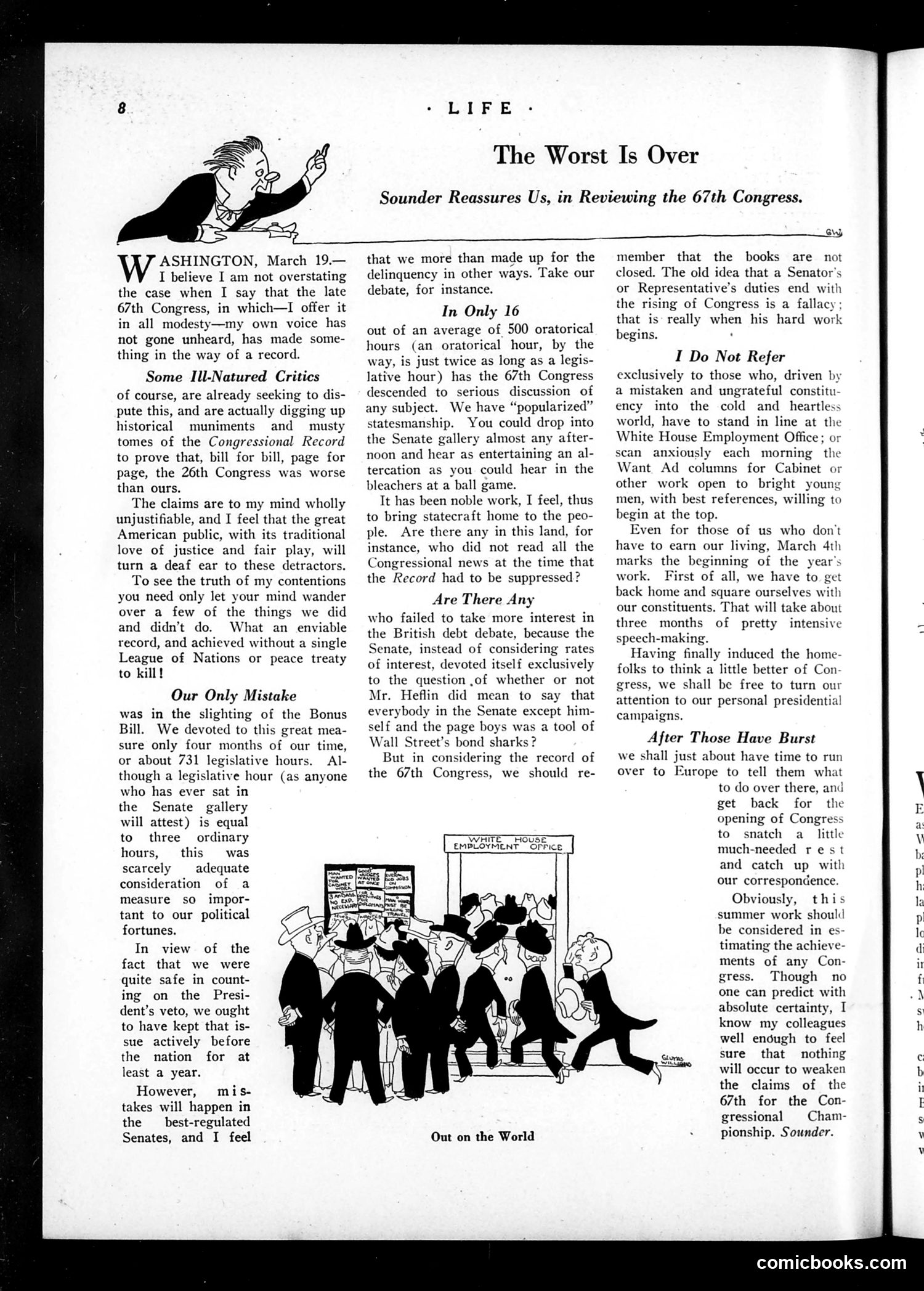
This Life magazine article critiques the recently-concluded 67th Congress. The author ("Sounder") argues that while critics claim the Congress failed, it actually achieved reasonably well given constraints—particularly noting they spent only 16 oratorical hours debating serious matters, contrasting favorably with previous sessions. The main cartoon depicts celebratory figures leaving an "Employment Office," satirizing post-Congress job-seeking. The author's point: Congress members are now free to pursue private employment and lobbying opportunities—suggesting politicians view Congressional service as a temporary position before returning to more lucrative private work. The piece defends the Congress's record while indirectly mocking the transactional nature of American politics and the revolving door between government and private business.
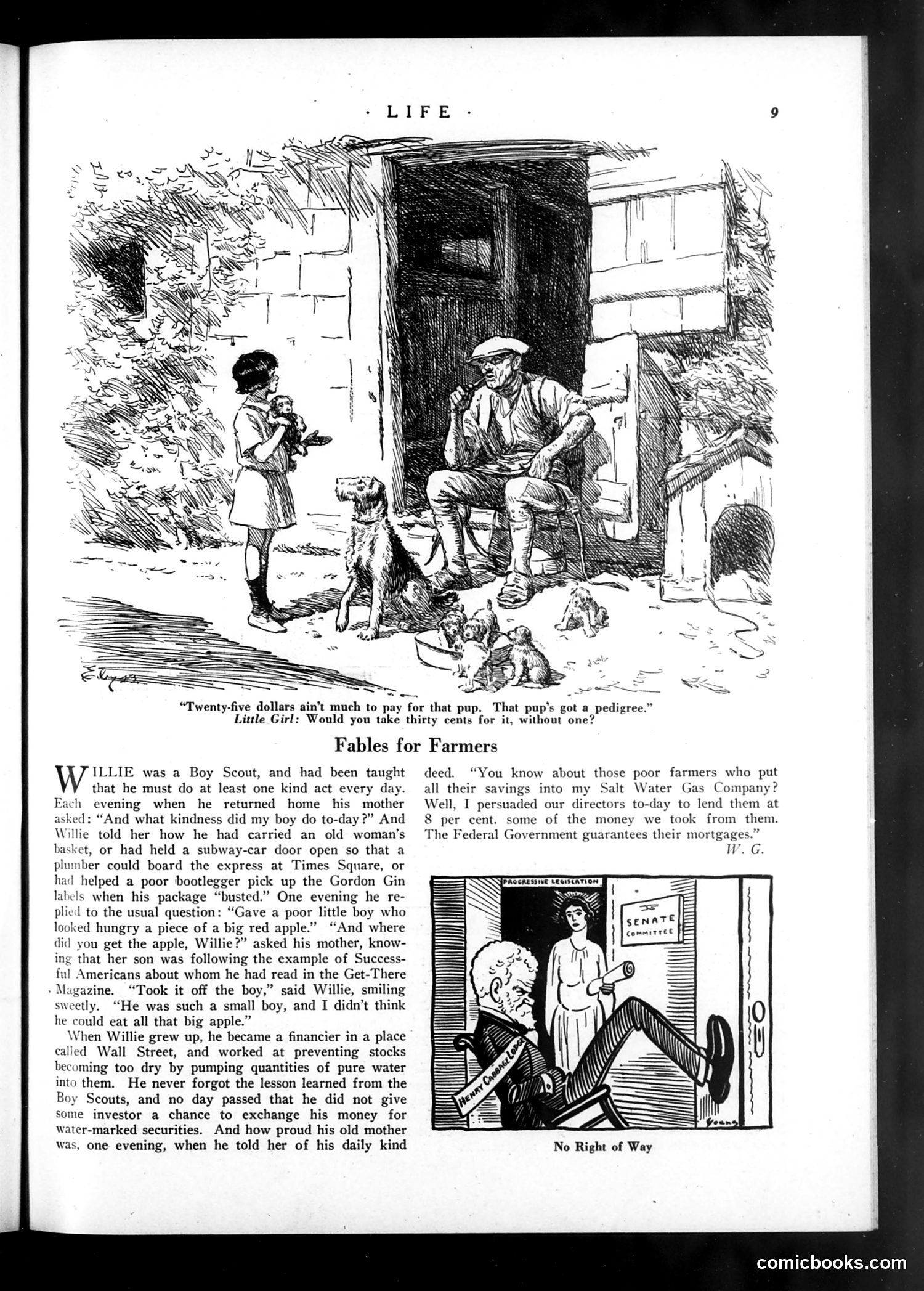
The page contains two pieces of satirical content: **Top Illustration - "Fables for Farmers":** A sketch showing a man (likely a financial advisor or con artist) with a dog, speaking to a young girl about purchasing a pedigree pup for $25. The humor lies in the girl's shrewd response: she'll pay only 30 cents "without one"—mocking how people overpay for pedigree claims. **Story Below:** Details Willie, a Boy Scout who practices daily kindness. The narrative follows him into adulthood as a Wall Street financier who "pumps quantities of pure water into them [stocks]" and manipulates water-marked securities. The satire targets financial fraud and stock manipulation during the Progressive Era, contrasting Willie's Boy Scout ethics with his later dishonest practices—suggesting capitalism corrupts youthful idealism. **Right Cartoon - "No Right of Way":** Appears to satirize regulatory or safety issues involving transportation or labor, though specific context is unclear from the visible image.
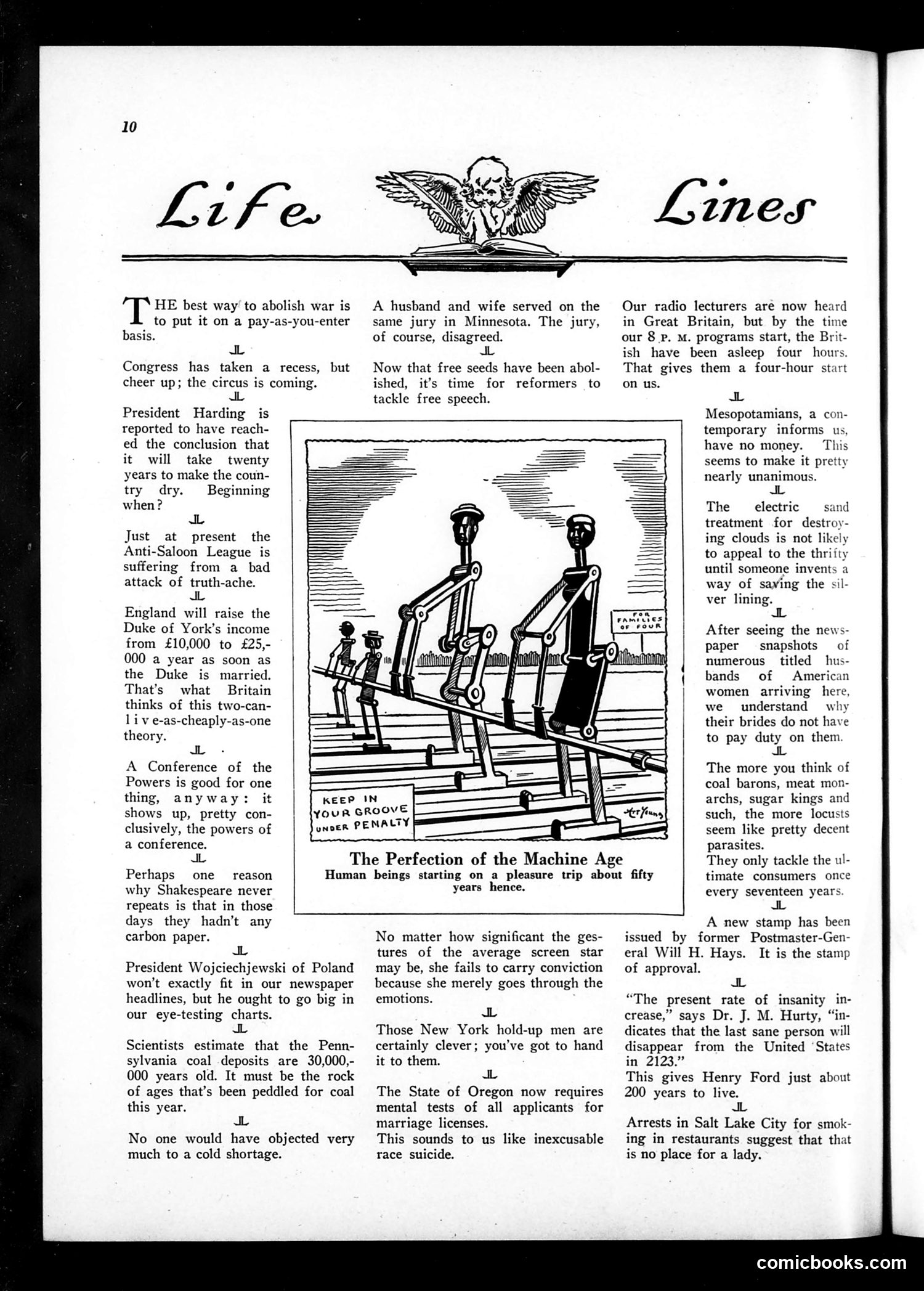
This cartoon satirizes mechanization and future automation. Two grotesquely elongated robotic figures with mechanical limbs operate a pleasure device, while tiny human figures operate controls below. The caption reads: "Human beings starting on a pleasure trip about fifty years hence." The satire critiques fears that machines will become so dominant that humans will be reduced to insignificant operators of their own leisure. The exaggerated proportions—massive mechanical bodies dwarfing tiny humans—suggest anxiety about technological control and dehumanization. The surrounding text contains unrelated satirical commentary on contemporary topics: war prevention, free speech, radio broadcasting, and various social observations typical of Life magazine's humor. The cartoon's perspective reflects early-20th-century concerns about industrial progress potentially diminishing human agency and importance.
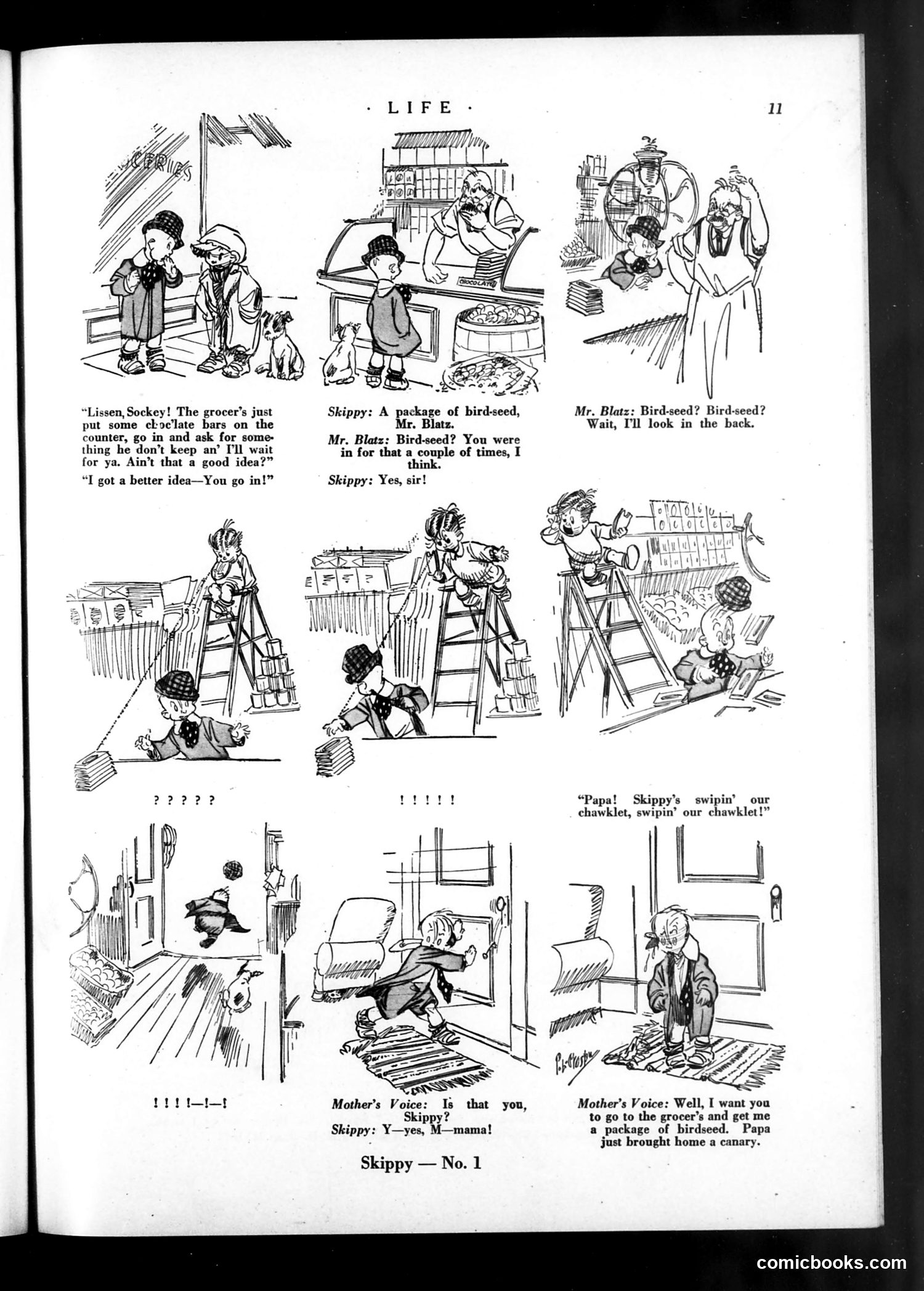
This is a children's comic strip (not political satire) featuring a mischievous boy named Skippy. The narrative shows Skippy attempting to buy chocolate bars from a grocer, then pivoting to purchase birdseed instead when that plan fails. The humor derives from Skippy's escalating scheme: he tries to send a younger boy ("Sockey") into the store, then attempts to steal birdseed from Mr. Blatz's counter. When discovered, Skippy climbs a ladder to hide the contraband, creating chaos. The strip concludes with Skippy's mother sending him back to the grocer—ironically to buy birdseed legitimately for a pet canary. The strip plays on typical childhood mischief and parental authority, with no political references visible.
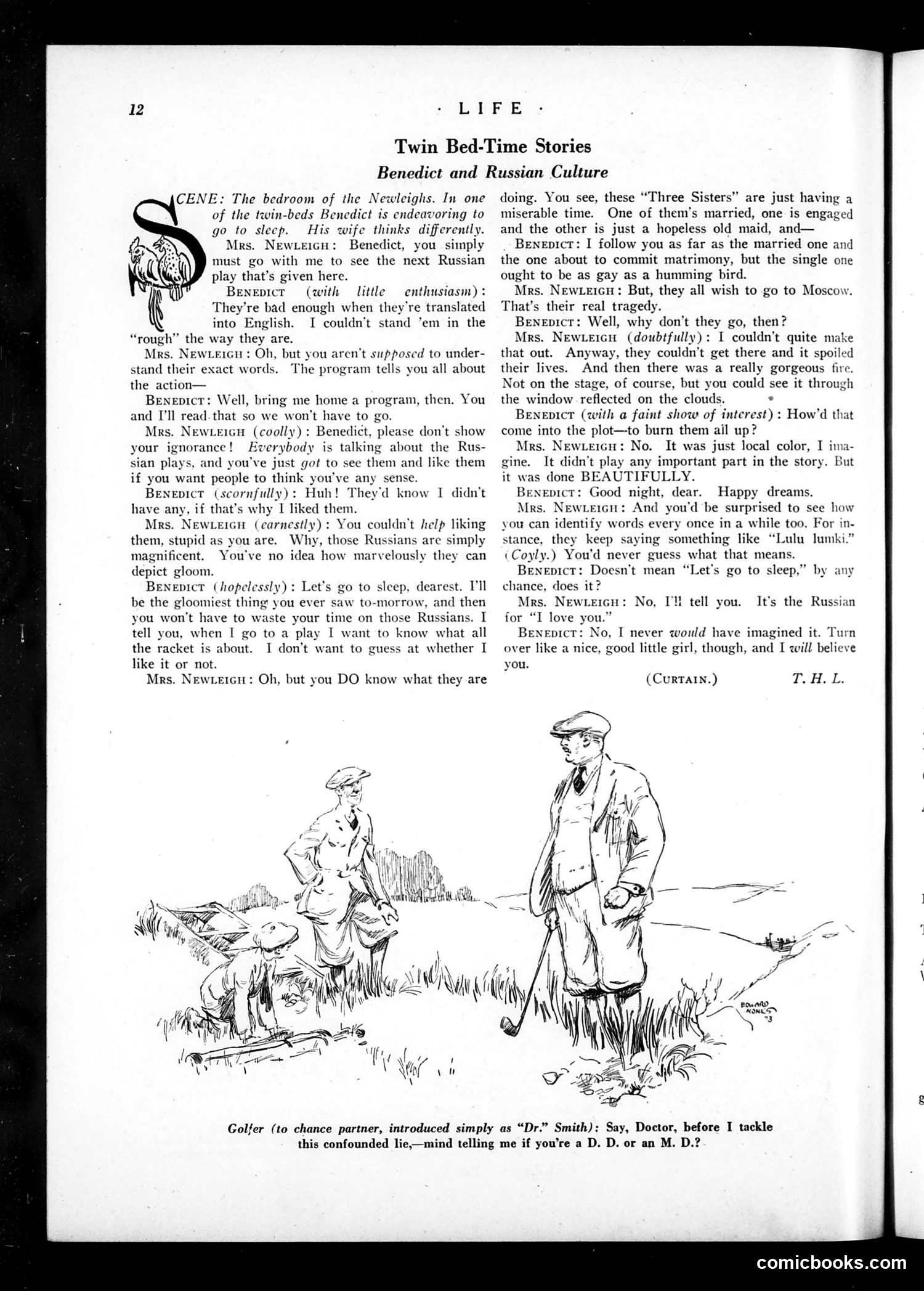
This page presents a comedic dialogue between **Benedict** and **Mrs. Newleigh** about attending a Russian play. The satire targets American audiences' fashionable but superficial engagement with Russian culture—likely reflecting early 20th-century interest in Russian theater and literature. **The joke:** Mrs. Newleigh insists they attend to seem cultured, despite neither understanding nor enjoying Russian drama. Benedict protests the plays are incomprehensible and depressing, but she dismisses his objections as ignorance. The punchline reveals she admires the Russian word "I love you" said prettily—suggesting her appreciation is purely aesthetic, not substantive. **The cartoon below** depicts golfers; its caption jokes about mistaking a doctor's credentials. The satire mocks upper-class pretension and performative sophistication regarding foreign art.
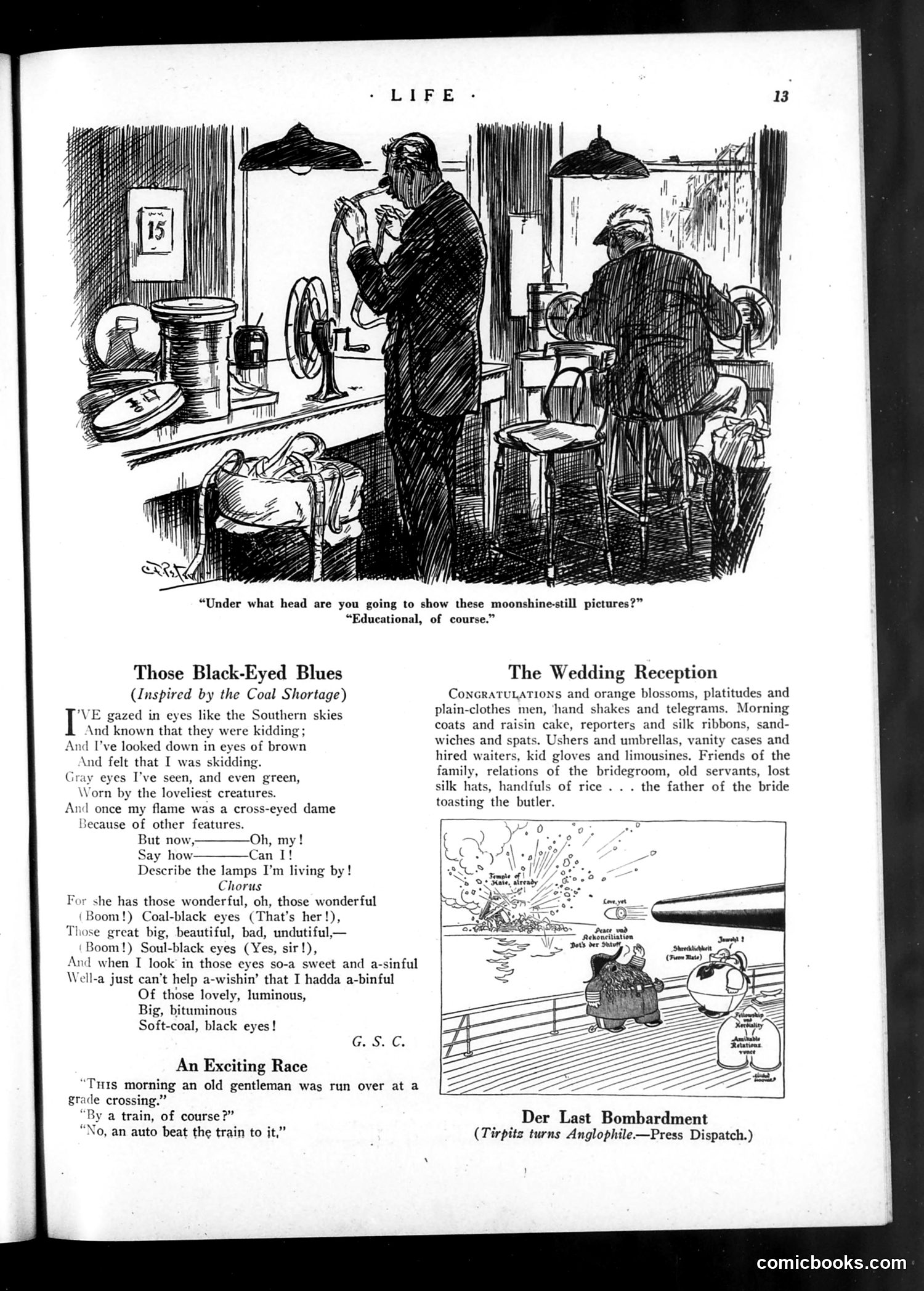
**The Top Cartoon** depicts a man in what appears to be an industrial or factory setting showing "moonshine-still pictures" (likely photographic slides or films) to workers. The caption jokes that these are being presented as "Educational, of course"—a transparent euphemism suggesting the images are actually illicit alcohol production during Prohibition. The satire mocks how people disguised illegal booze-making as legitimate educational content. **The Three Articles Below** include poetry and brief humorous pieces unrelated to the cartoon. "Those Black-Eyed Blues" is romantic verse; "The Wedding Reception" describes a formal event; "An Exciting Race" and "Der Last Bombardment" appear to be additional satirical pieces, though their full context is unclear from this excerpt.
This page contains an editorial article discussing reform and reformers, rather than a political cartoon. The text criticizes several public figures, including Edward W. Bok (editor of *Ladies' Home Journal*), Colonel George Harvey, and John Drew. The article's main argument appears to be skepticism about genuine reform—the author suggests that successful reformers often revert to old practices or simply change their public persona while maintaining questionable conduct. Specific references include the Volstead Act (Prohibition) enforcement and the Mulllan-Gage Law. The piece uses these contemporary figures as examples of how reformers' credibility can be questioned when their actions don't match their stated principles. The tone is satirical and cynical about the authenticity of reform movements in 1920s America.
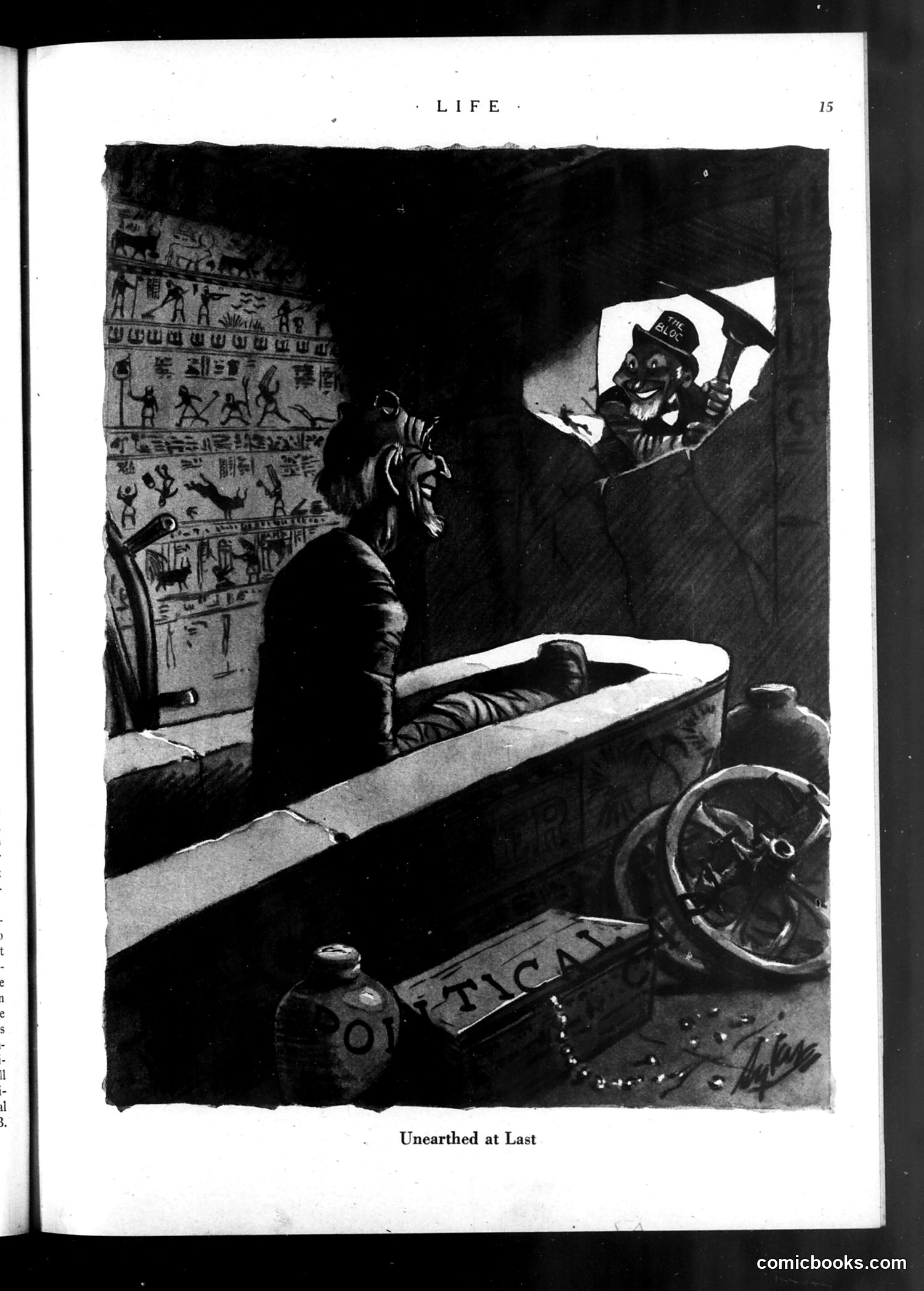
This satirical illustration depicts an archaeological discovery scene. A figure in period clothing examines a sarcophagus containing a mummy, while another figure peers through an opening above, wearing what appears to be a cap or hat and making an exaggerated facial expression. Egyptian hieroglyphics decorate the tomb wall behind them. The cartoon appears to satirize either archaeological sensationalism or—given the theatrical, grotesque expression of the figure above—possibly mocks popular fascination with mummy discoveries and their associated myths. The title "Unearthed at Last" suggests this unearths something previously hidden, likely commenting on contemporary attitudes toward Egyptology or the commercialization of archaeological findings that was popular in early 20th-century America. Without additional context about Life magazine's publication date or current events, the specific satirical target remains unclear.
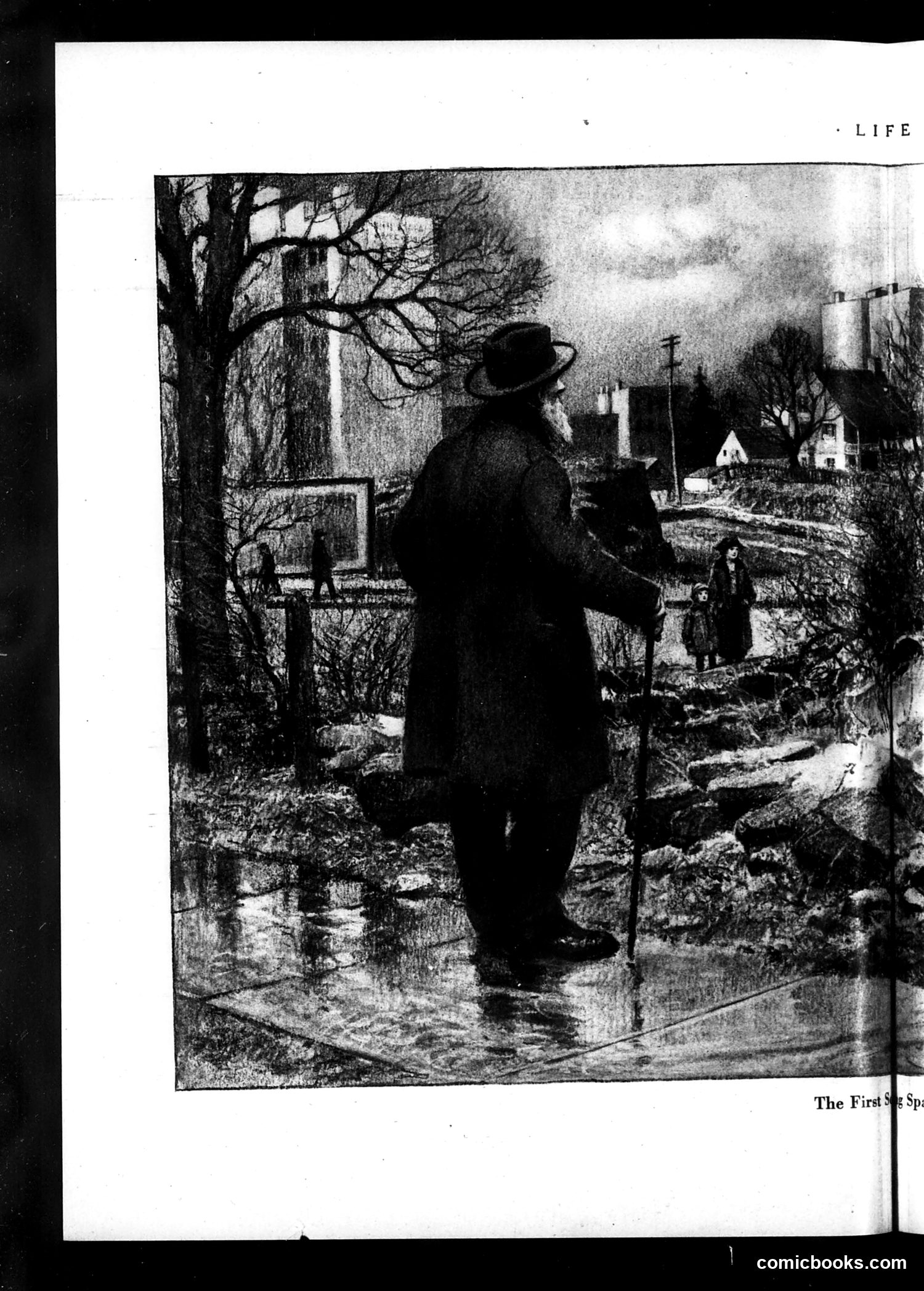
This appears to be a solemn black-and-white photograph rather than a satirical cartoon. It shows a man in dark clothing and a hat standing in what looks like a cemetery or graveyard, with bare trees, crosses, and buildings visible in the background. A child stands at a distance. The caption reads "The First 5@ Sp[...]" (text is cut off, making full meaning unclear). Without the complete caption or surrounding article text, the precise historical reference is difficult to determine. However, the image's somber tone and graveyard setting suggest it may be addressing a serious social or political issue—possibly related to war, loss, or poverty. The presence of the child adds poignancy to the composition. The page header indicates this is from *Life* magazine, which frequently used photography alongside satirical commentary.
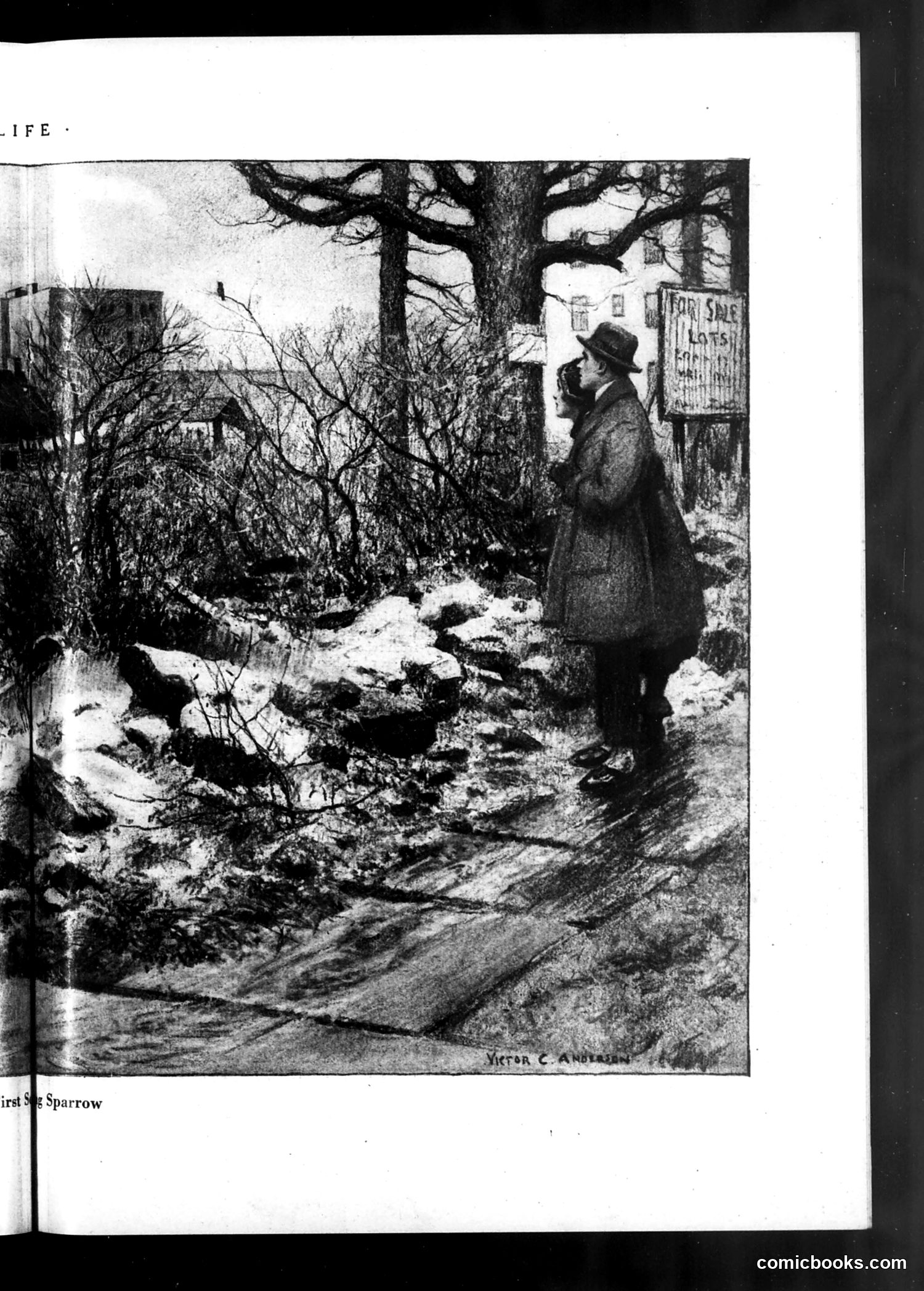
This appears to be a page from *Life* magazine featuring a photograph rather than a cartoon. The image shows a man in a dark coat and hat standing in a winter landscape with bare trees, snow, and what appears to be a "For Sale" sign visible in the background. The photograph's satirical intent likely critiques real estate speculation or property sales during an economic downturn (possibly the Great Depression era, given the photographic style). The solitary figure examining barren land with a "For Sale" sign suggests commentary on failed investments, abandoned properties, or the hollowness of land speculation promises. The credit reads "VICTOR C ANDERSON," identifying the photographer. Without additional context or caption text, the specific political target remains unclear.
This theater criticism page reviews three plays and their performances. The main subjects are: **Moscow Art Theatre productions**: The writer praises Russian dramatic acting but satirizes their comedic performances, claiming American actors handle comedy better. The joke is that Russian tragedians overact comedic moments with exaggerated mugging and voice-cracking. **"Humoresque"**: A melodramatic play adapted from a story, criticized for manipulative sentimentality (including an off-stage Marseillaise and a mother-son parting scene). The review praises actress Laurette Taylor's genuine talent despite the play's "bad taste" - she's an Irish performer playing a Jewish character unconvincingly but acting so well it doesn't matter. **"Roger Bloomer"**: Described as nervously ineffectual but potentially significant, compared to how "pale, nervous" schoolboys sometimes become leading artists. The cartoons (small theatrical vignettes visible) appear to illustrate these performance critiques, though specific details are unclear in reproduction.
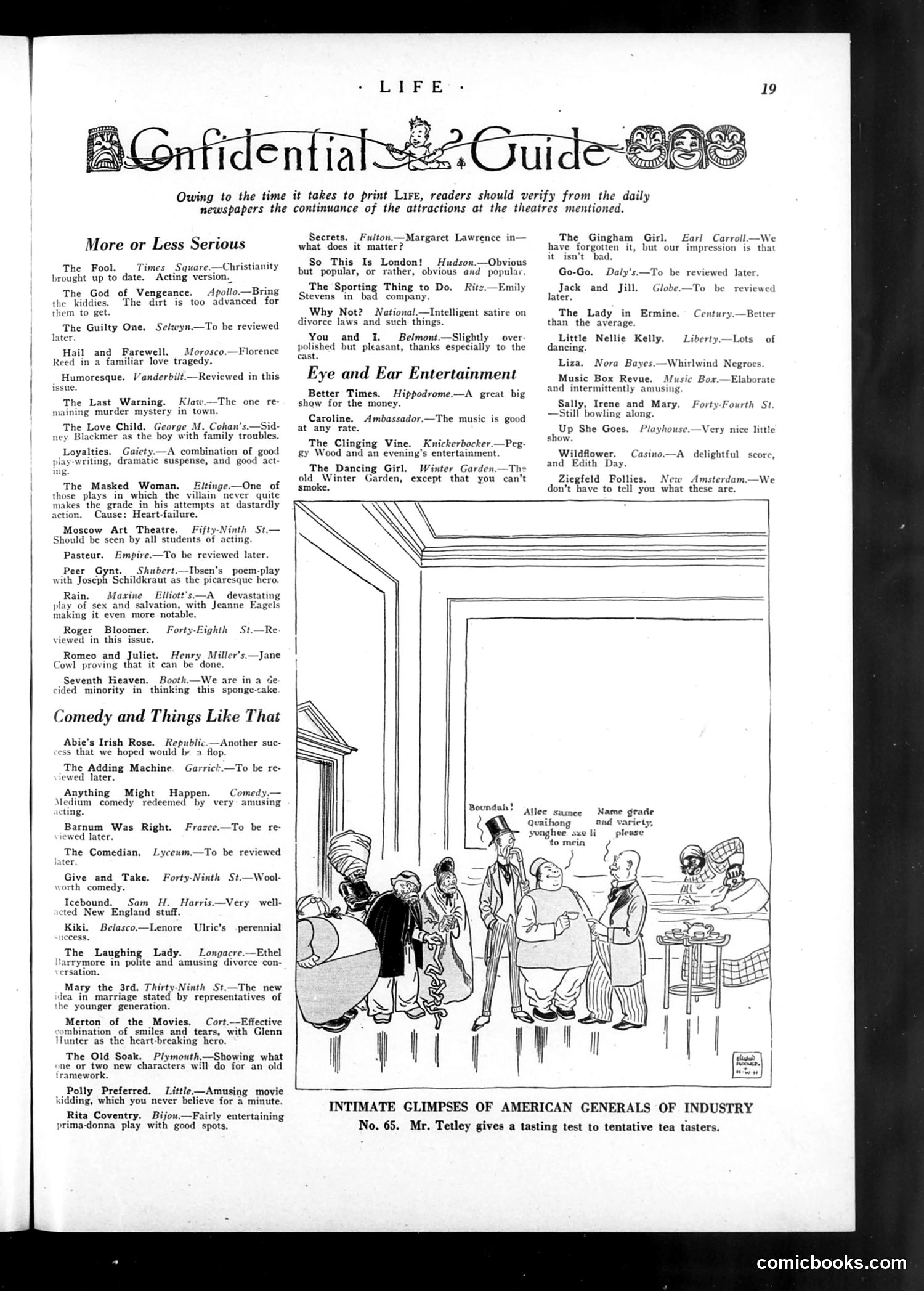
This page is a theater and entertainment guide for New York City productions, likely from the early 1920s (based on references to plays like "Rain," "Abie's Irish Rose," and "Seventh Heaven"). The main illustration at bottom shows "**Intimate Glimpses of American Generals of Industry**" — specifically "Mr. Tetley" conducting a tea-tasting test. This is gentle corporate satire: the "general of industry" (a businessman, likely a tea company executive) is humorously elevated to military rank while performing the mundane task of taste-testing tea with his staff gathered around him in a formal indoor setting. The humor lies in the **contrast between grand titles and ordinary activities** — treating commercial enterprise with mock-military solemnity was a common satirical technique of the era, poking fun at American business culture's self-importance. The bulk of the page consists of cynical, dismissive theater reviews that mock both productions and audiences' tastes.
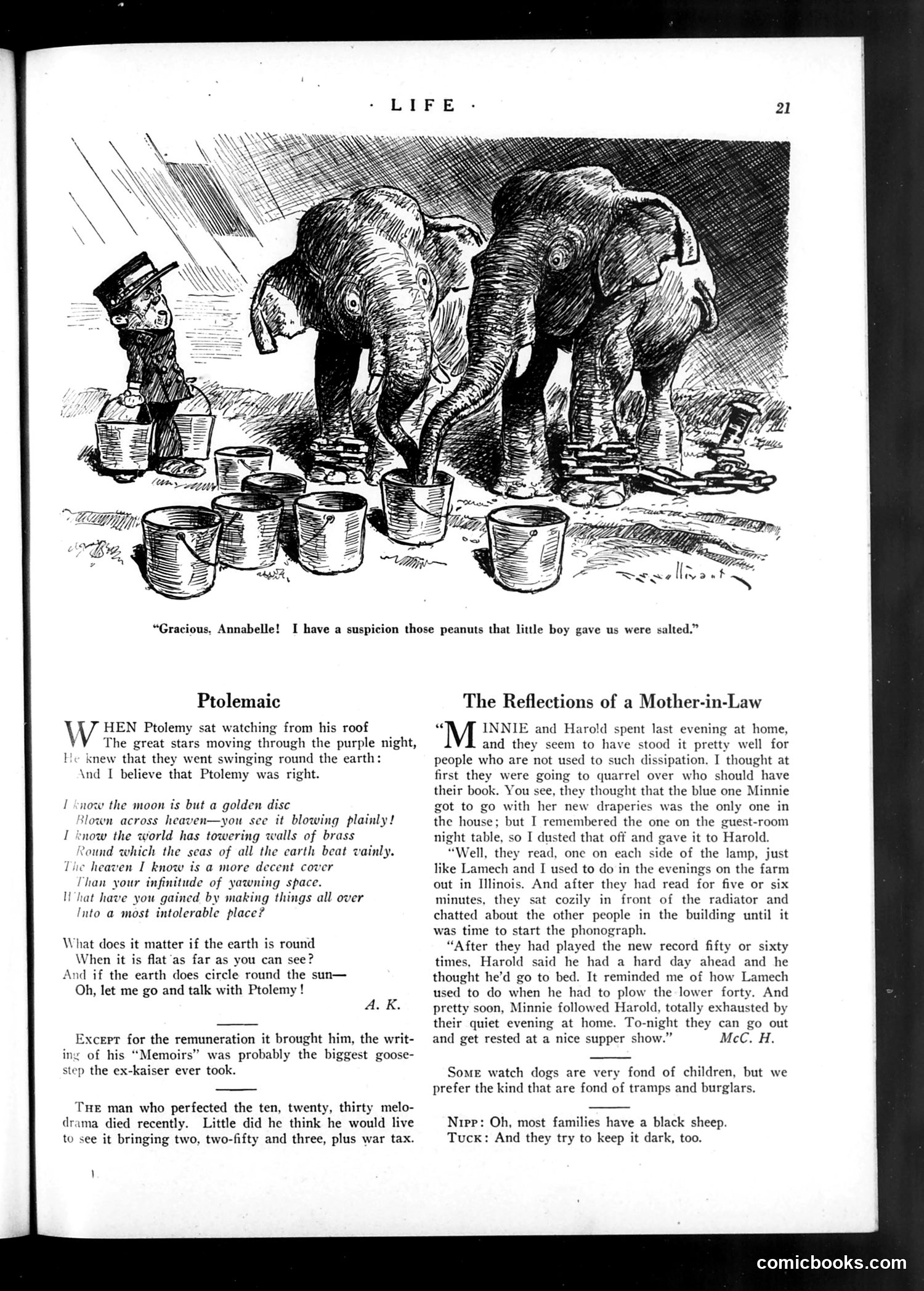
**The Main Cartoon:** Shows elephants eating from buckets while a uniformed figure watches suspiciously. The caption suggests the peanuts given to the elephants were salted—implying someone sabotaged them, likely as a prank or act of mischief. **"Ptolemaic" (Poem by A.K.):** A satirical defense of outdated astronomical beliefs. The speaker argues for accepting Ptolemy's geocentric model (Earth at center) over modern heliocentric science, claiming ignorance brings comfort. It mocks anti-intellectual attitudes and resistance to scientific progress—a common theme in early 20th-century satire about obscurantism. **"The Reflections of a Mother-in-Law":** A humorous domestic sketch where an overbearing mother-in-law describes her son-in-law Harold and daughter Minnie's "quiet evening"—reading, chatting, playing records repeatedly—as exhausting. The satire targets both the mundane married life and the meddling in-law stereotype. **Brief quips below:** Jokes about melodrama pricing inflation (post-WWI), watch dogs preferring burglars to children, and families hiding "black sheep."
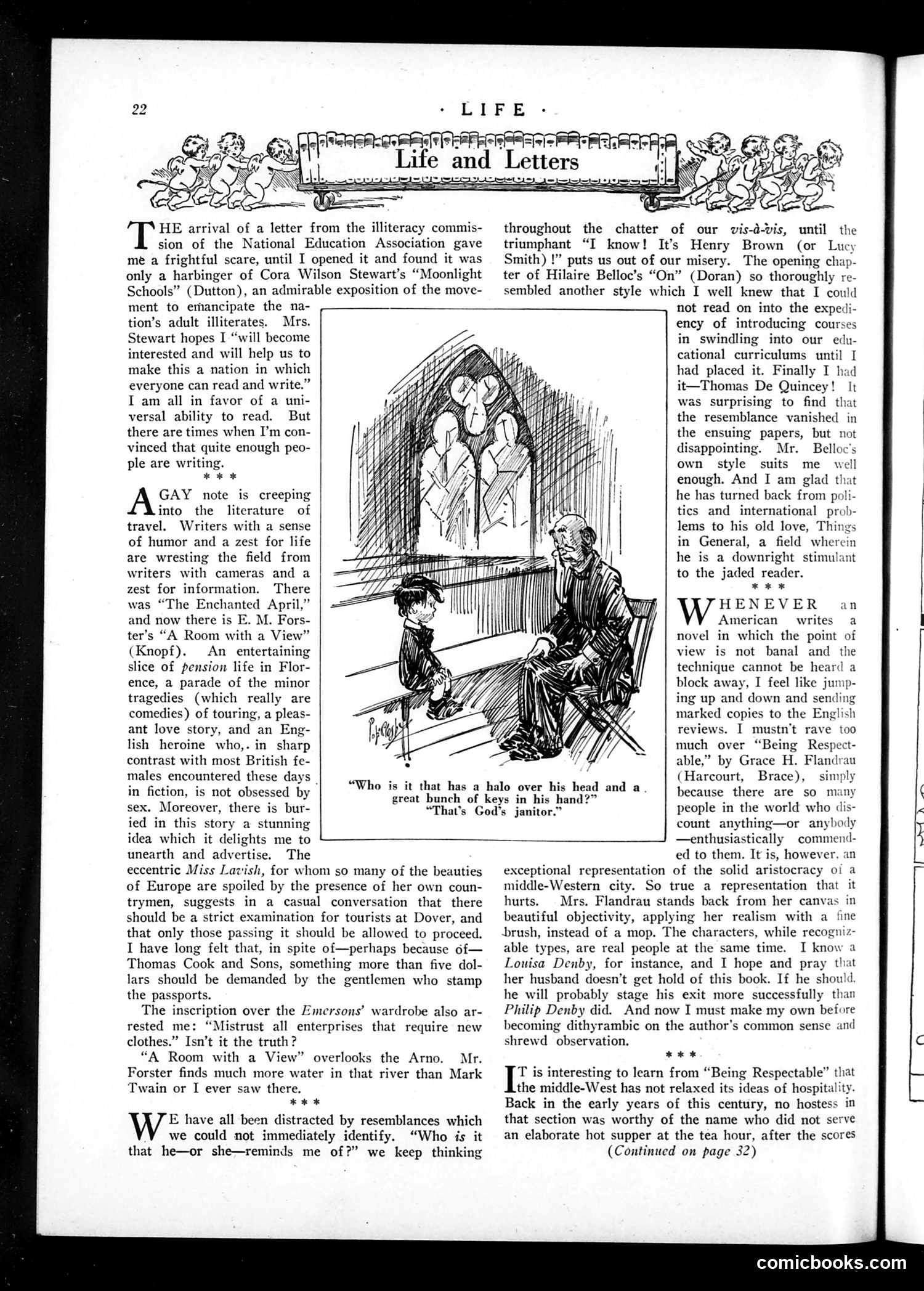
This page from *Life* magazine's "Books and Letters" section contains a book review column with one integrated cartoon. The cartoon depicts two figures in what appears to be a church or institutional setting, with one asking the other: "Who is it that has a halo over his head and a great bunch of keys in his hand?" The answer: "That's God's janitor." The joke satirizes the mundane reality behind supposedly sacred or important positions—a janitor maintains the physical space of God's house, yet performs unglamorous labor. It reflects early 20th-century class commentary, poking fun at the gap between ceremonial importance and actual work. The surrounding text reviews contemporary books, including E.M. Forster's *A Room with a View* and Grace H. Flandrau's *Being Respectable*. The reviewer humorously criticizes American tourism and advocates for stricter examination of travelers at Dover, suggesting Americans lack proper refinement for European travel.
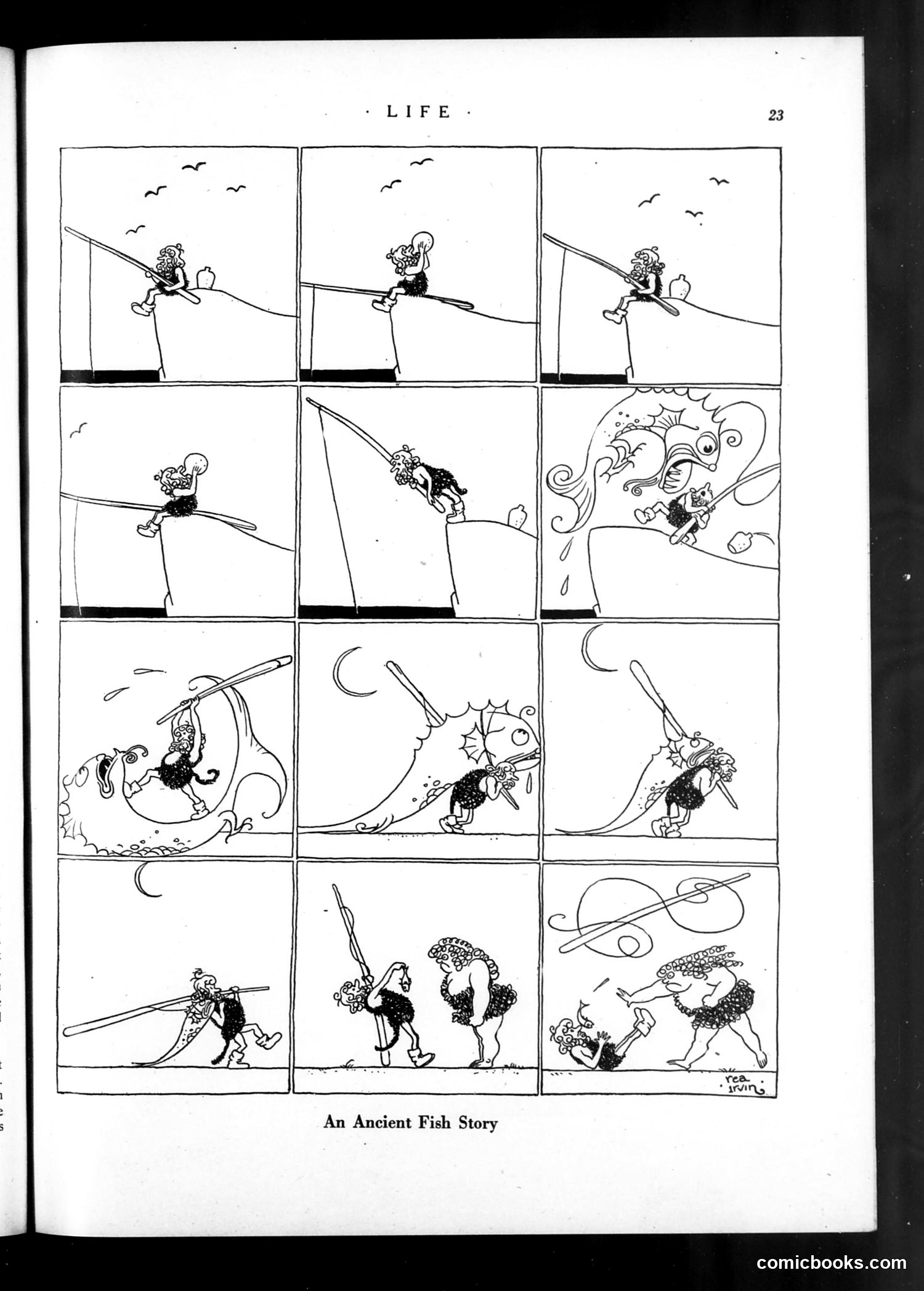
This is a humorous 12-panel comic strip depicting a character fishing from what appears to be a platform or dock. The narrative follows a classic "tall tale" structure: The fisherman begins calmly fishing during the day (top panels), then catches an increasingly enormous fish as night falls. The fish grows so large that it pulls the fisherman around dramatically—he's dragged through the water, swung through the air, and ultimately overwhelmed by the creature's size and power. The joke plays on the archetypal "fish story" or exaggerated hunting/fishing tale—the kind of boastful narrative where each retelling makes the catch bigger and more outlandish. By literally showing the fish becoming progressively larger and more fantastical, the comic satirizes how fishermen embellish their accounts. The title "An Ancient Fish Story" reinforces this as a commentary on a timeless human tendency toward hyperbole.
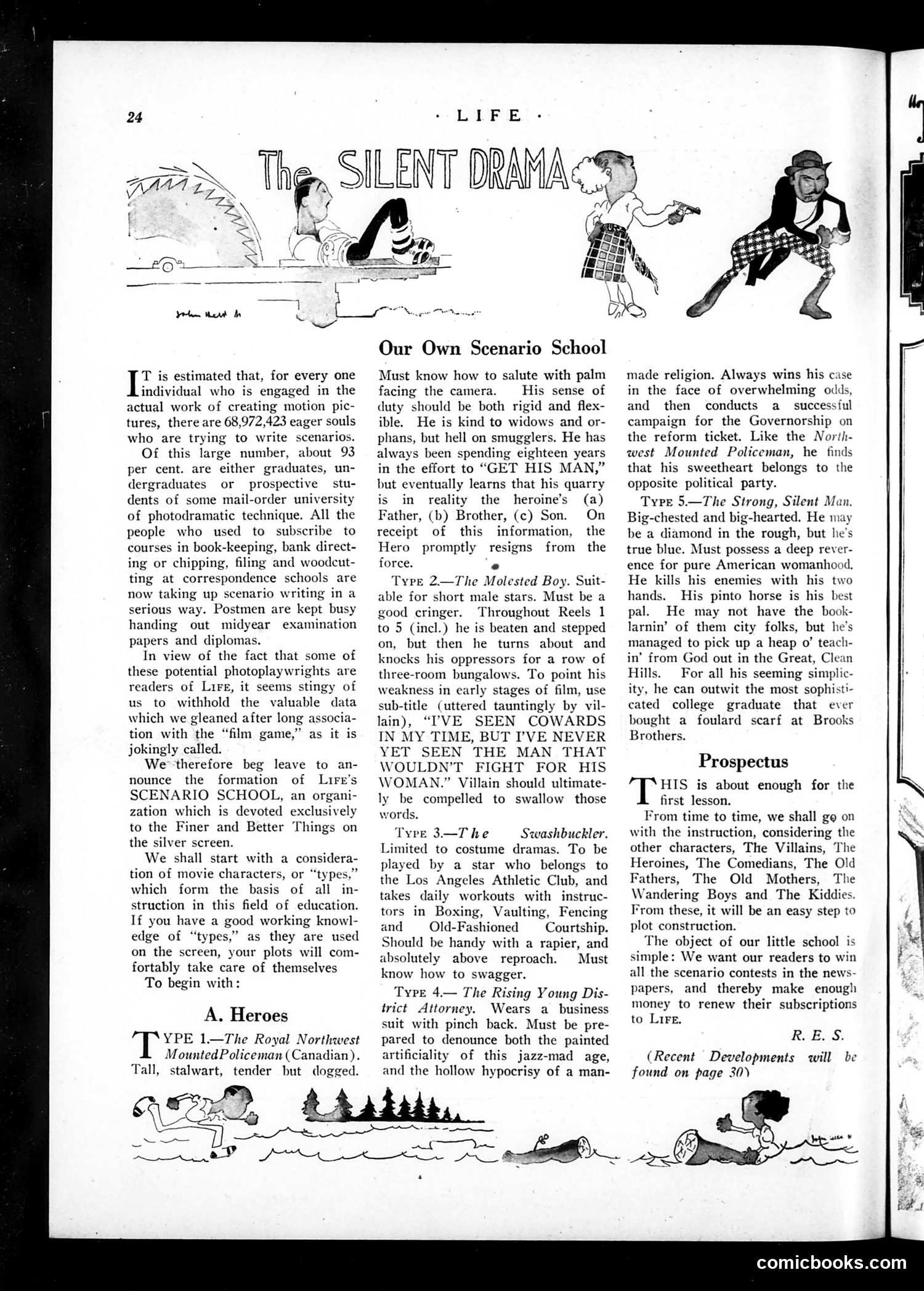
This 1920s page satirizes the silent-film industry's explosive growth and the amateur screenwriting craze it inspired. Life mocks mail-order "photodramatic" correspondence courses flooding the market, joking that nearly 69 million people are attempting to write movie scenarios. The "Scenario School" feature catalogs stock silent-film character types—the virtuous Royal Northwest Mounted Policeman, the persecuted boy-hero, the swashbuckling romantic lead, the reformist District Attorney, and the strong, taciturn cowboy. Each type is described with exaggerated conventions: rigid moral codes, predictable plot resolutions, and archetypal traits (the cowboy's "book-larnin'" lacks despite rural wisdom). The satire targets both the formulaic predictability of silent cinema and the get-rich-quick appeal of screenwriting to ordinary Americans. By codifying these "types" as teachable templates, Life ridicules both the industry's creative bankruptcy and the naive ambitions of aspiring writers believing they can master filmmaking through mail-order instruction.
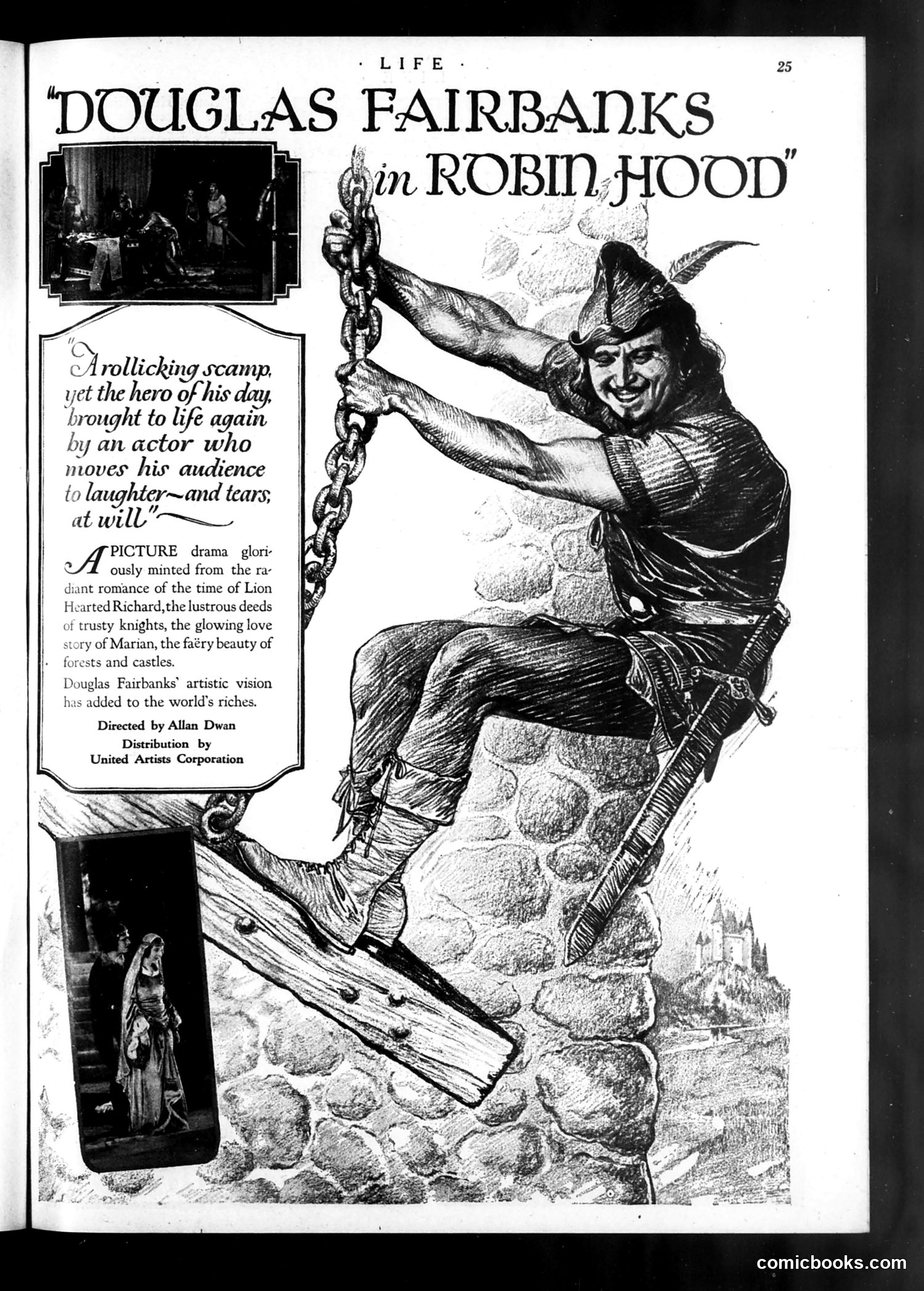
This is a **movie advertisement**, not political satire. It promotes Douglas Fairbanks' film adaptation of *Robin Hood*, directed by Allan Dwan and distributed by United Artists Corporation. The page celebrates Fairbanks as a charismatic actor who brings the legendary outlaw to life as a "rollicking scamp"—charming and roguish rather than villainous. The advertisement emphasizes the film's romantic elements (Marian, the love story) and medieval pageantry (Lion-Hearted Richard, trusty knights, castles). The illustration shows Fairbanks in costume scaling a stone wall with a chain, embodying the swashbuckling action audiences expected from him. The smaller photos show dramatic scenes from the film. **Context for today**: This represents early Hollywood's adaptation of classic legends into lavish adventure films, showcasing a major silent-era star's physical prowess and dramatic range. Fairbanks was famous for performing his own stunts.
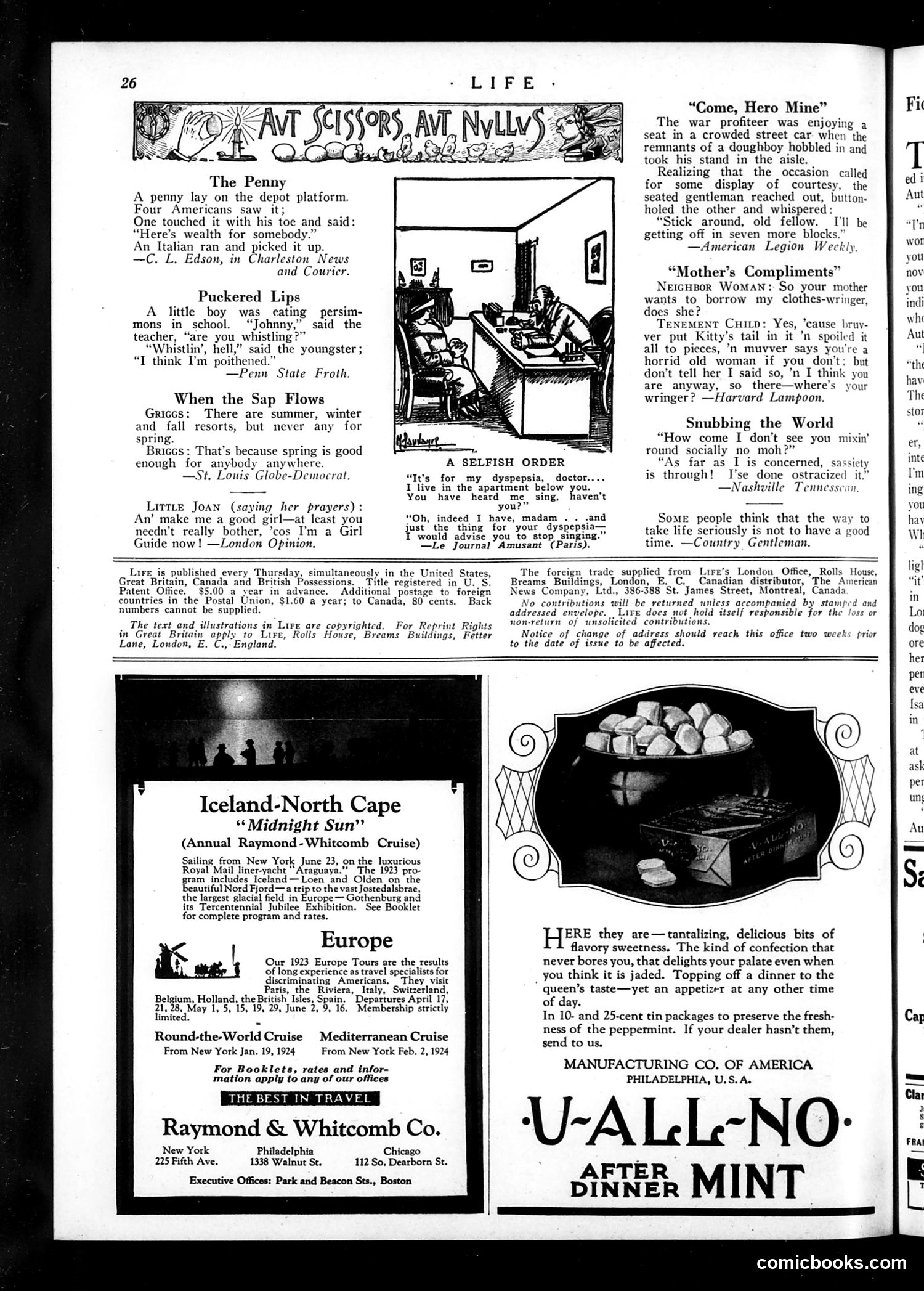
This page contains **short humorous anecdotes** rather than political cartoons. The jokes satirize American social attitudes and behaviors circa 1923: **"The Penny"** mocks American indifference to small money—four Americans ignore a penny, but an Italian immigrant immediately picks it up, suggesting Americans waste resources while immigrants value thrift. **"Come, Hero Mine"** critiques war profiteers. A wealthy businessman enjoys a streetcar seat while a disabled veteran (doughboy) stands. When the profiteer offers courtesy, it's hollow—he merely tells the veteran to "stick around" while he exits in seven blocks, suggesting the profiteer's patriotism is performative rather than genuine. **"Mother's Compliments"** features tenement-dwelling children speaking in exaggerated dialect, used humorously in period publications to portray working-class immigrants as comic figures. **"Snubbing the World"** uses similar dialect humor about social ostracism. The page's tone reflects 1920s attitudes toward immigrants, war profiteers, and class differences—satirizing American hypocrisy while employing ethnic stereotypes considered acceptable at the time.
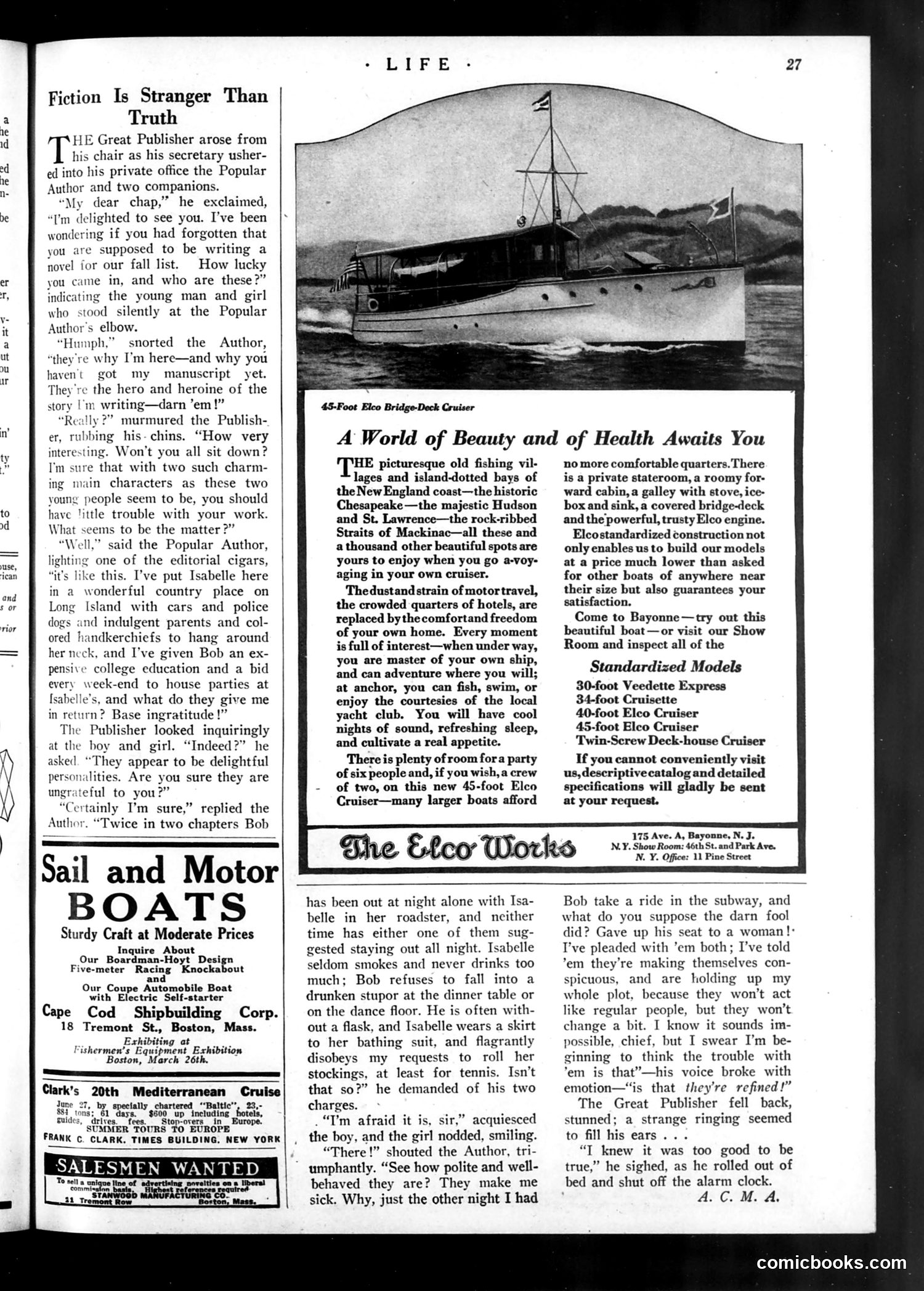
This page contains a satirical short story titled "Fiction Is Stranger Than Truth" rather than a political cartoon. The humor concerns a popular novelist complaining to his publisher about his fictional characters—the hero and heroine of his novel-in-progress. The joke plays on the absurdity of treating fictional creations as real people with agency: the Author claims his characters are ungrateful despite all the advantages he's written for them (wealth, education, attractive circumstances). He demands they behave according to his plot requirements, but they apparently refuse to cooperate with his narrative. The satire mocks both pretentious authors who anthropomorphize their characters and the creative frustrations of writing itself. By literalizing the common complaint that "characters won't do what I want them to," Life's writers create an absurdist scenario where a publisher must mediate between an author and his disobedient fictional creations—treating the imaginary people as though they're real conversation partners. The remainder of the page contains period boat and cruise advertisements.
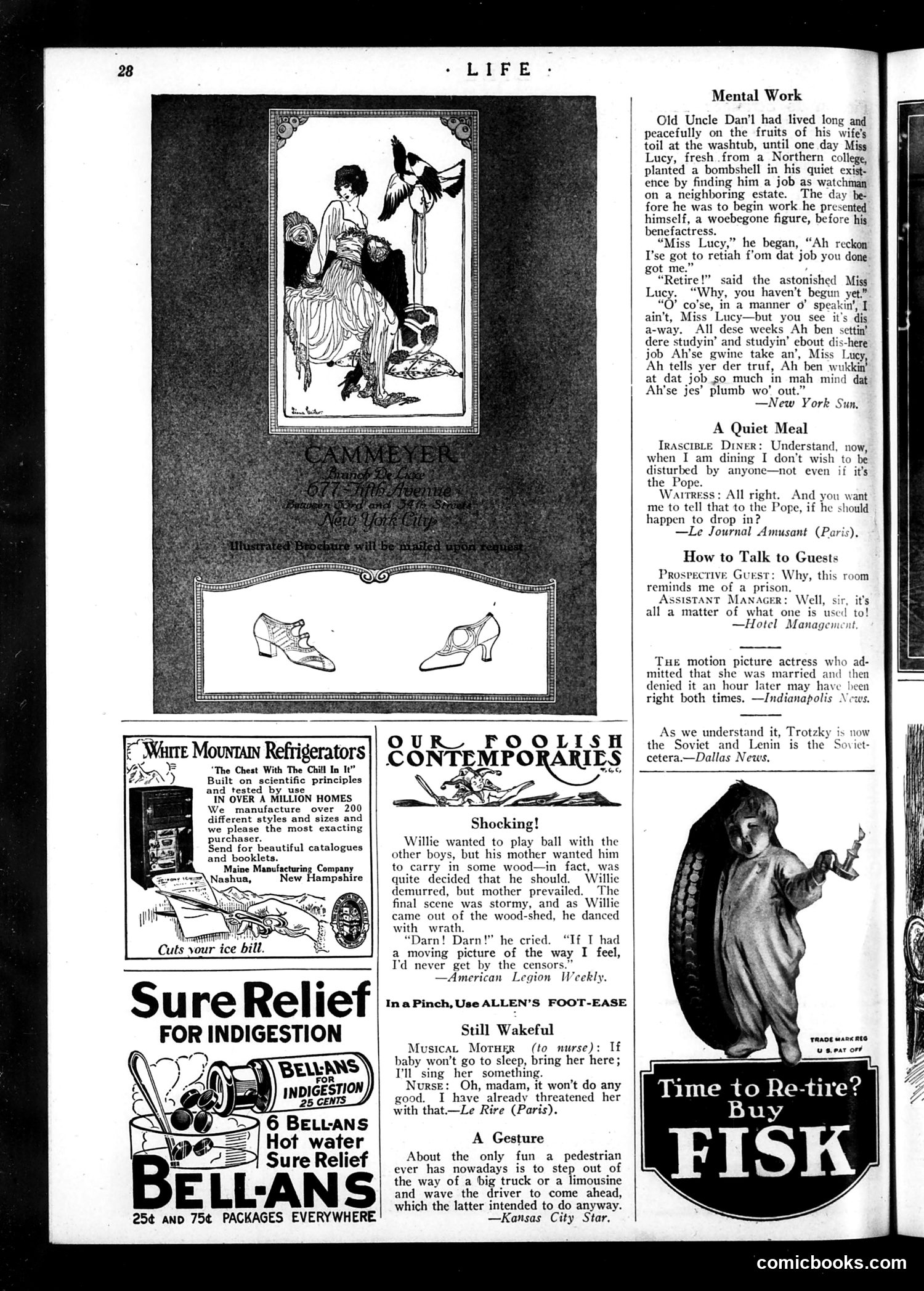
This page from *Life* magazine contains primarily **humorous short anecdotes and advertisements** rather than political cartoons. The main content includes several comic vignettes satirizing everyday situations: - **"Mental Work"**: A dialect-heavy story about an elderly Black man (Uncle Dan'l) who claims mental exhaustion from *thinking* about a new job before even starting it—satirizing the absurdity of overthinking. - **"Still Wakeful"**: A joke about a musical mother whose lullabies are so bad the nurse has already used them as threats to discipline the child. - **"A Gesture"**: Brief commentary on modern pedestrians' only remaining "fun"—waving traffic along after narrowly avoiding it. Other items mock hotel managers, motion picture actresses' contradictory statements, and Soviet leadership. The page is dominated by **period advertisements** for refrigerators, foot powder, and Fisk tires. The overall tone is lighthearted social commentary typical of 1920s American humor magazines, with no serious political agenda visible.
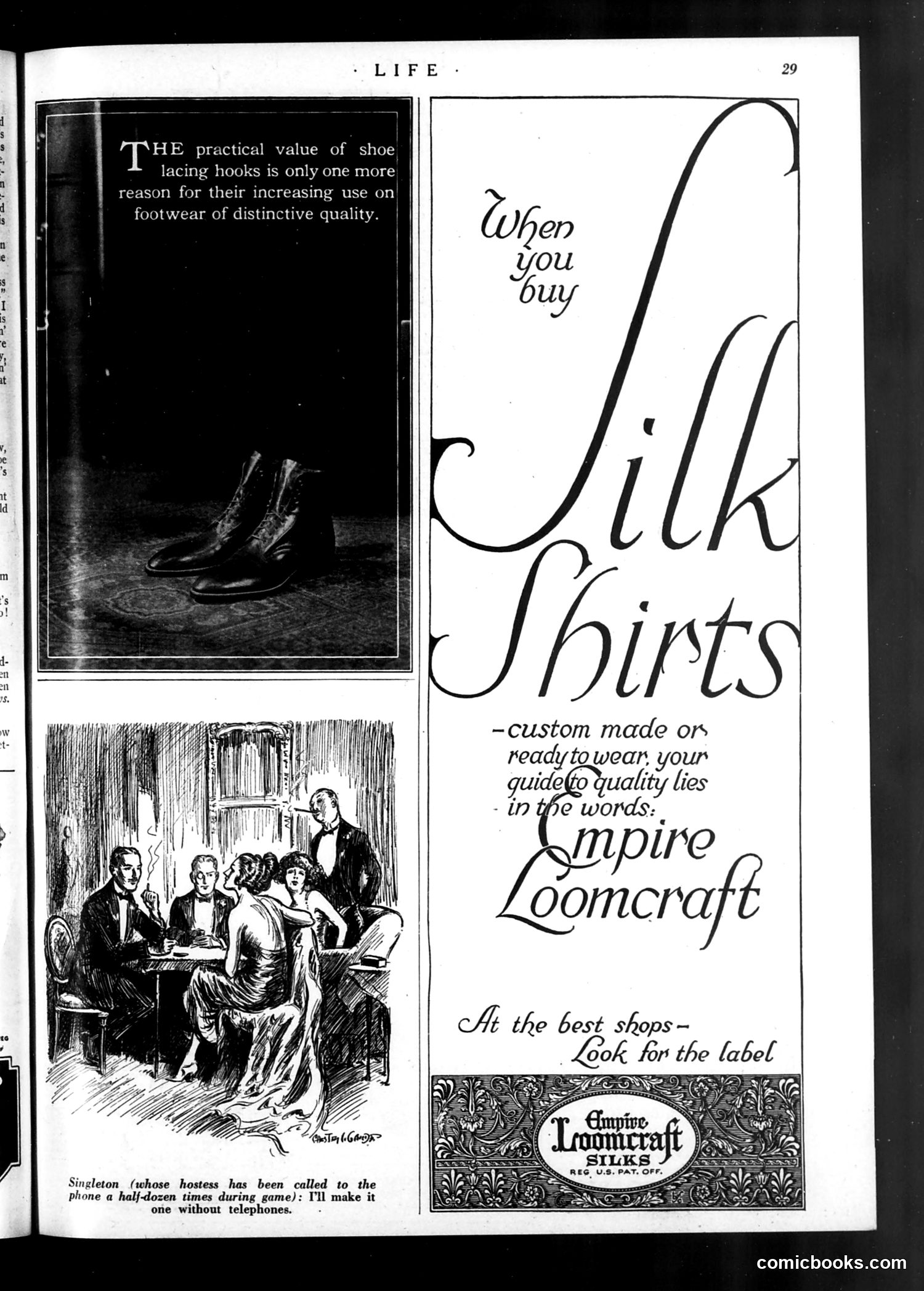
This page combines a cartoon and advertisement. The cartoon depicts "Singleton," a guest at what appears to be a social gathering (card game or similar), complaining to his hostess. He's frustrated because she's been called away to answer the telephone repeatedly—at least half a dozen times. His sarcastic comment "I'll make it one without telephones" satirizes the intrusive nature of the newly ubiquitous telephone in early 20th-century American homes. The joke captures a common social annoyance of the era: telephones interrupting domestic leisure and entertaining guests. It's nostalgic humor about technology disrupting social etiquette. The right side advertises Empire Loomcraft silk shirts, promoting quality through brand recognition—a straightforward commercial ad with no satirical content.
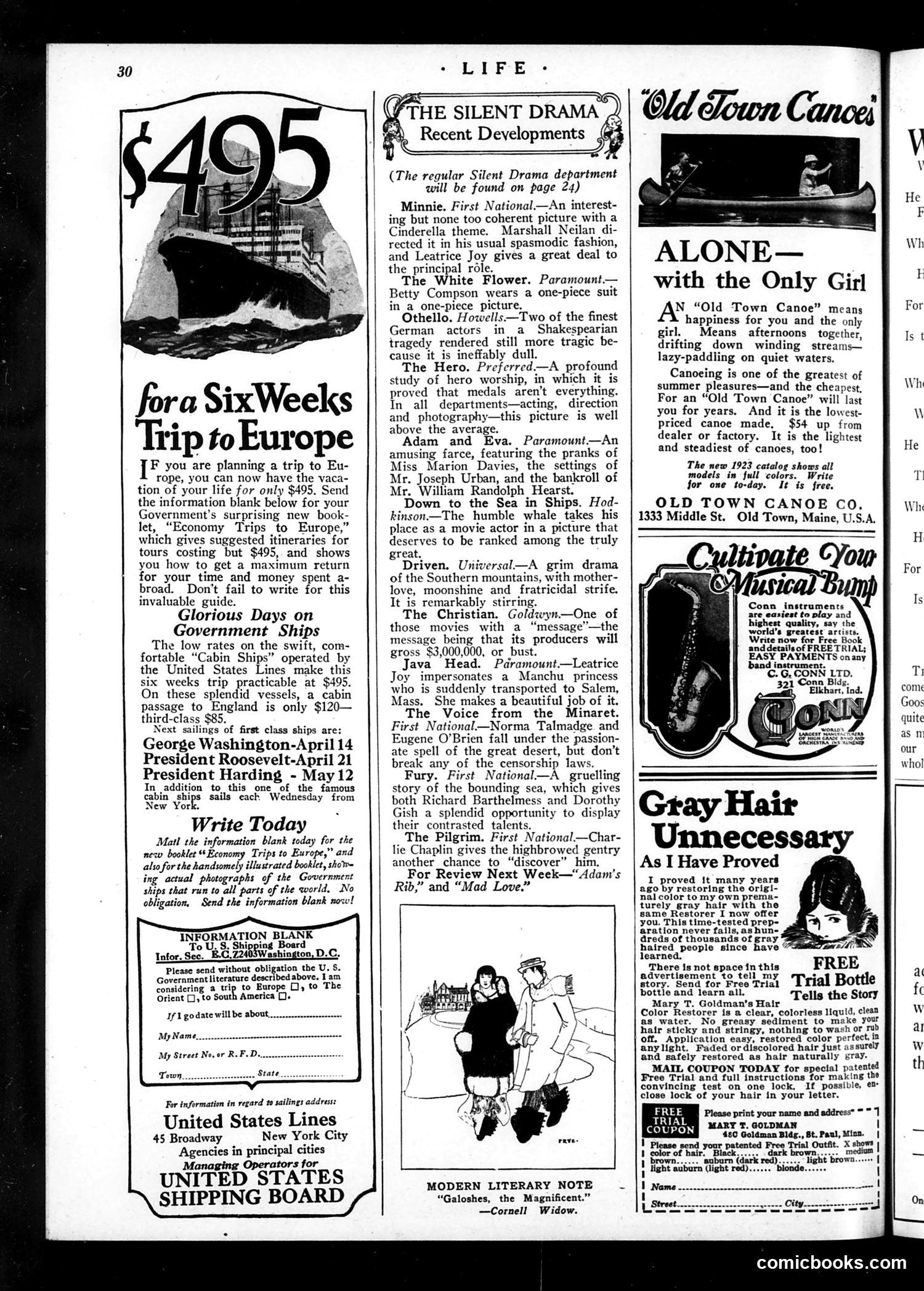
This page is primarily **advertising and entertainment content**, not political satire. The dominant feature is a U.S. Shipping Board advertisement promoting affordable European travel ($495 for six weeks), listing government ships like the *George Washington* and *President Harding*. The right side contains **"The Silent Drama" movie reviews**—brief critiques of contemporary silent films. These reviews employ **light satire** typical of Life's entertainment coverage. For example, the review of *The Christian* mockingly suggests the film's real "message" is that producers will "gross $3,000,000, or bust"—satirizing Hollywood's commercial motivations disguised as artistic statements. The reviews reference popular actors of the era (Marion Davies, Leatrice Joy, Charlie Chaplin, Norma Talmadge) and directors like Marshall Neilan, reflecting what contemporary readers would have recognized as current cinema. The page contains **no political cartoons or caricatures**—it's a straightforward commercial and entertainment section.
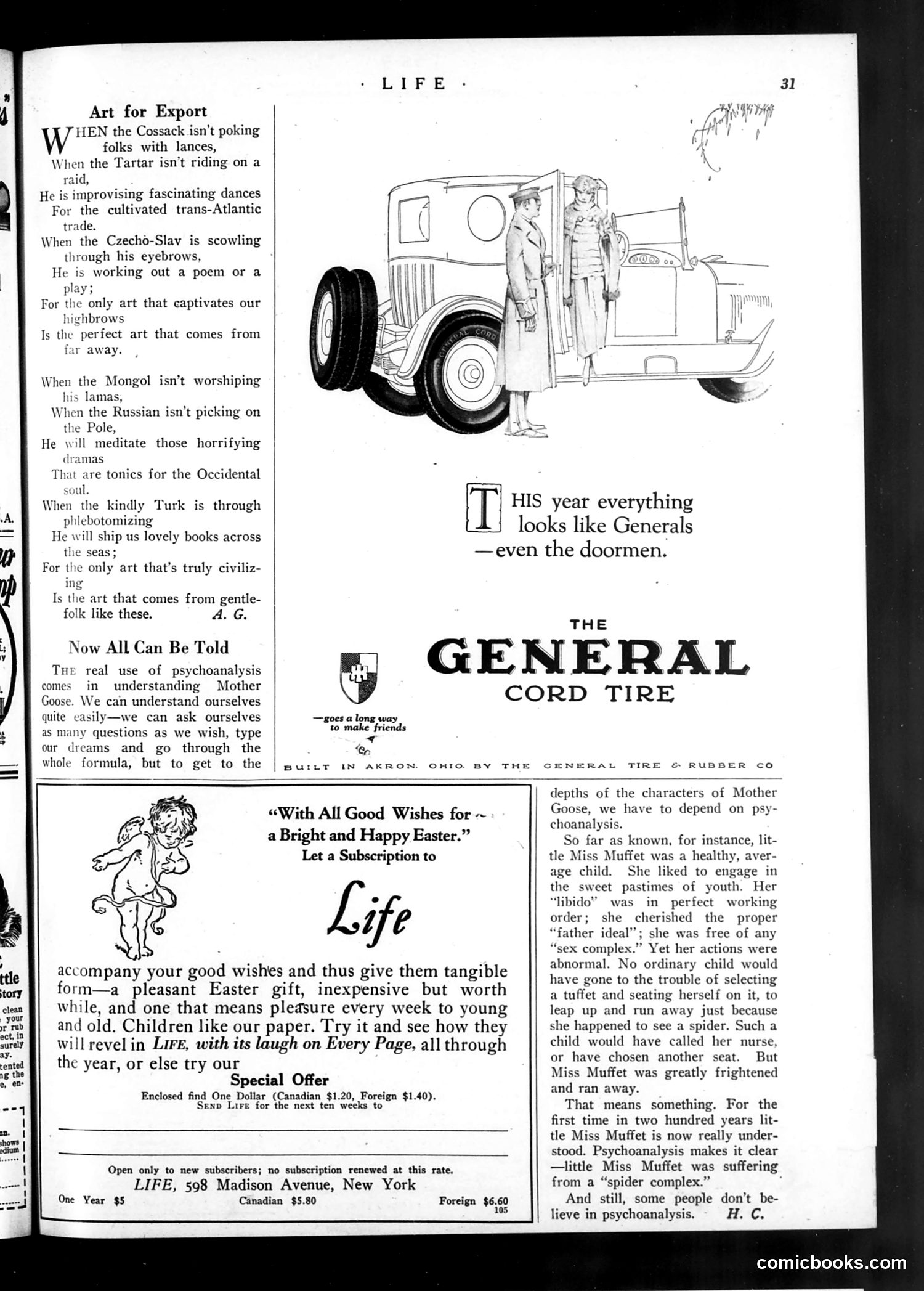
This page satirizes Western highbrow fascination with "exotic" art from Eastern Europe and Asia. The poem mocks how Americans romanticize foreign cultures—viewing Cossacks, Tartars, Mongols, and Russians as inherently artistic and dramatic precisely *because* they're stereotyped as violent or "uncivilized" when not performing. The satire's point: Western intellectuals value art from "far away" and "gentle-folk" abroad while dismissing homegrown work. The poem suggests this is absurd snobbery—we're importing manufactured "authentic exoticism" for consumption by highbrows. Below, a humorous "Now All Can Be Told" section parodies Freudian psychoanalysis by applying it to Mother Goose's Miss Muffet, diagnosing her spider-fear as a "spider complex." This mocks the era's trendy overuse of psychoanalytic jargon to pathologize ordinary behavior. The General Cord Tire advertisement occupies the center—typical commercial placement in Life magazine.
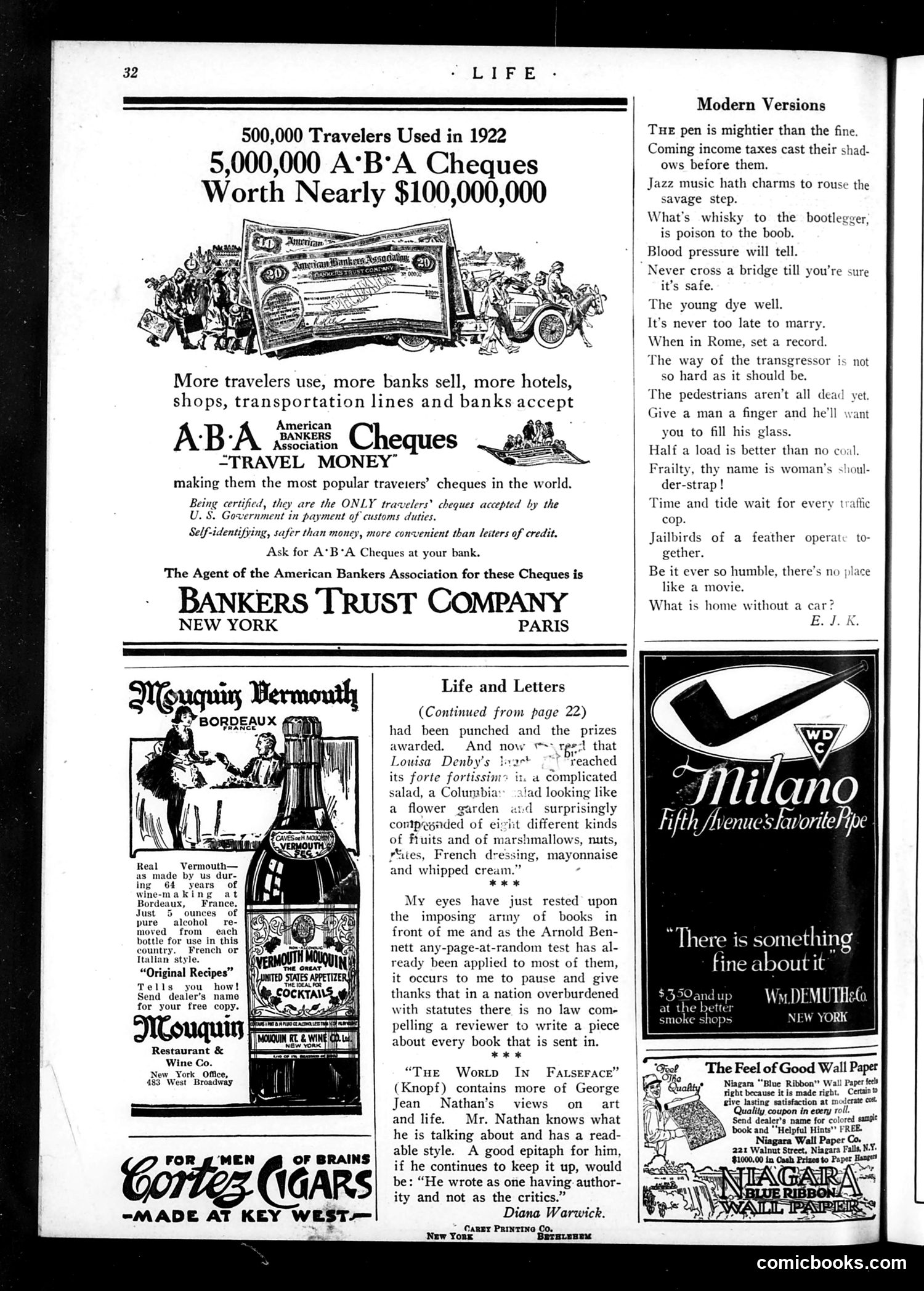
This page is primarily **advertising and literary content**, not political satire. The dominant feature is an advertisement for **A·B·A Traveler's Cheques**—checks issued by the American Bankers Association that 500,000 travelers used in 1922. The ad emphasizes these cheques' popularity and government acceptance for customs payments, positioning them as safer than carrying cash or letters of credit during the post-WWI travel boom. The right column, titled "Modern Versions," contains **satirical aphorisms**—brief witty observations on contemporary life. These are not cartoons but humorous one-liners touching on 1920s concerns: Prohibition ("whisky to the bootlegger, is poison to the boob"), income taxes, jazz, women's fashion ("woman's shoulder-strap"), and automobile culture ("What is home without a car?"). The "Life and Letters" section reviews books, including George Jean Nathan's *The World in Falseface*. The remaining ads promote Vermouth, cigars, wall paper, and pipe tobacco—typical 1920s magazine advertising.
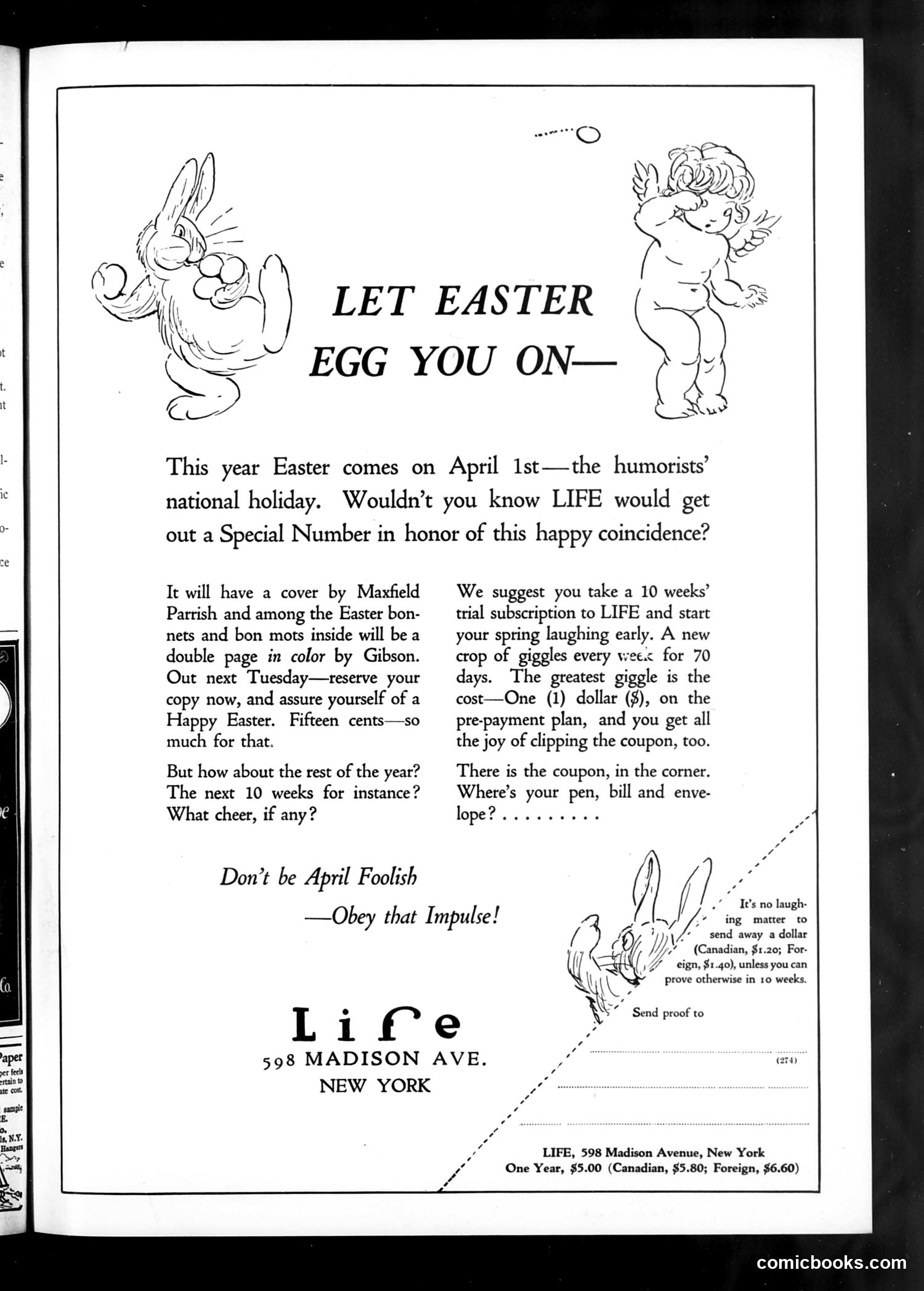
This is primarily a subscription advertisement for *Life* magazine, the American humor publication. The page exploits the coincidence that Easter falls on April 1st (April Fools' Day) in the year of publication. The cartoon features a playful Easter Bunny and cherub flanking promotional text. *Life* announces a special Easter issue with covers by famous illustrators Maxfield Parrish and (likely) Charles Dana Gibson, priced at fifteen cents. The main pitch offers a 10-week trial subscription for just one dollar—presented as an irresistible bargain. The copy uses humor typical of the era ("giggle," "bon mots"), appealing to readers' desire for weekly laughs during spring. The phrase "Don't be April Foolish—Obey that Impulse!" plays on the April Fools' context, framing subscription as the sensible choice rather than a fool's errand. This reflects *Life*'s status as a prestigious humor magazine in the early-to-mid twentieth century.
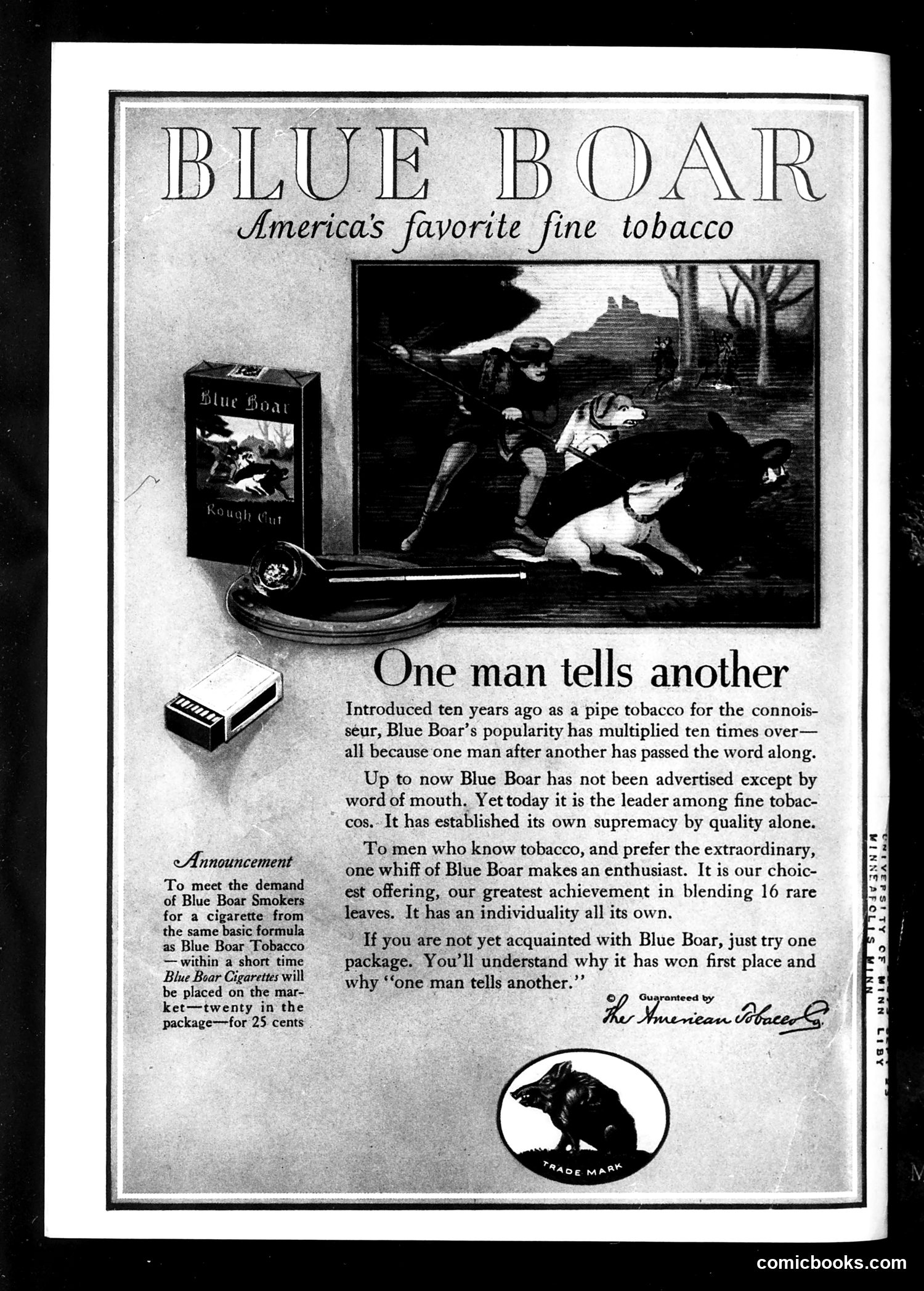
This is primarily a **tobacco advertisement**, not political satire. The page promotes Blue Boar pipe tobacco and its new cigarette line to early 20th-century readers. The central image depicts a hunting scene with men and dogs, establishing the product's association with masculine leisure and outdoors pursuits—common in vintage tobacco marketing. The ad's main claim is that Blue Boar succeeded through word-of-mouth recommendation alone ("one man tells another"), requiring no paid advertising. This was presented as evidence of superior quality. The announcement box notes that Blue Boar Cigarettes will soon be "placed on the market—twenty in the package—for 25 cents," indicating this was a product launch or expansion. The boar trademark at bottom reinforces the brand identity. For modern readers, this reflects the era when tobacco was openly advertised without health warnings, and marketing emphasized quality, masculinity, and social prestige rather than health concerns.