
Life, 1923-03-22 · page 24 of 36
Life — March 22, 1923 — page 24: what you’re looking at
What you’re looking at
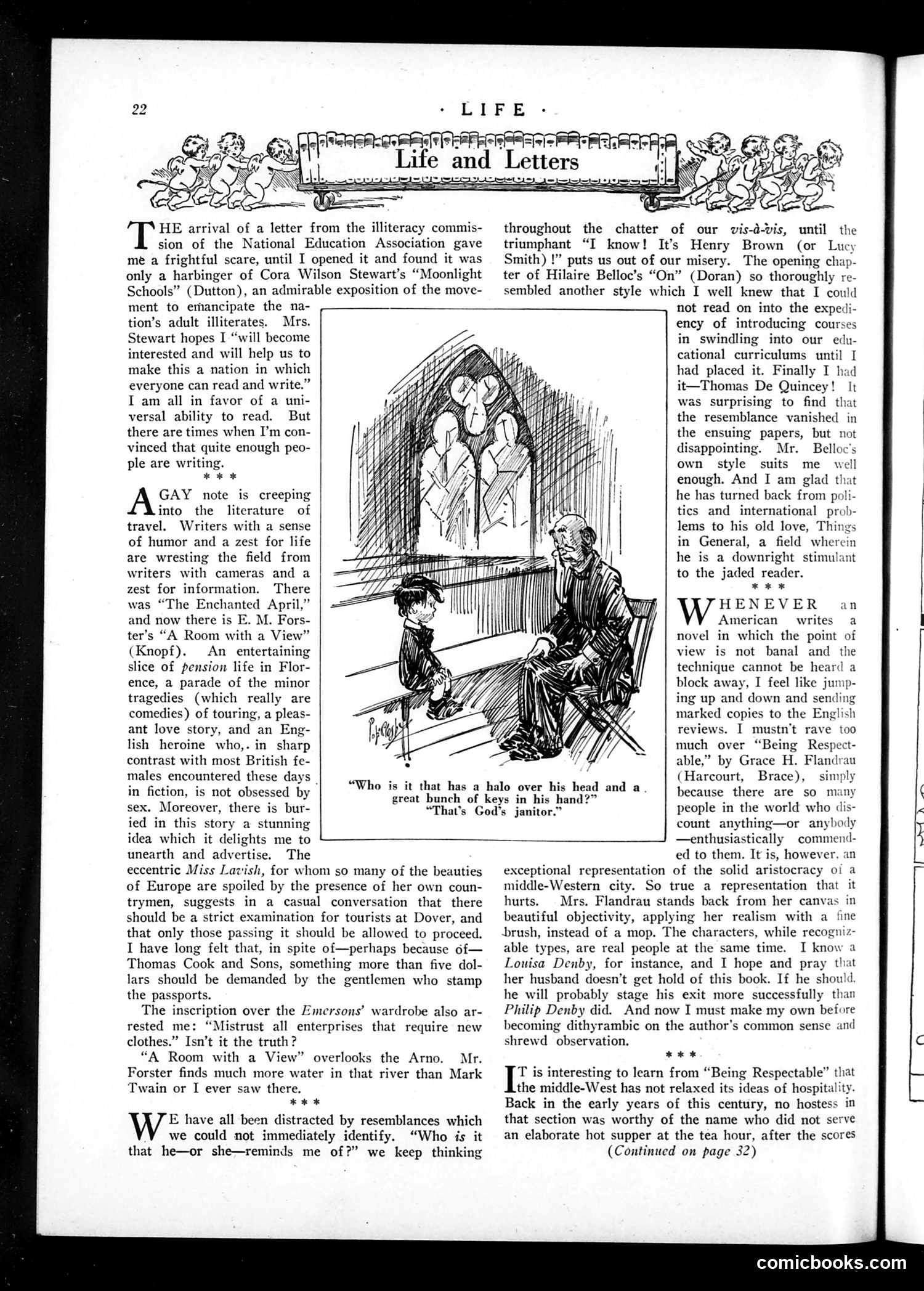
This page from *Life* magazine's "Books and Letters" section contains a book review column with one integrated cartoon. The cartoon depicts two figures in what appears to be a church or institutional setting, with one asking the other: "Who is it that has a halo over his head and a great bunch of keys in his hand?" The answer: "That's God's janitor." The joke satirizes the mundane reality behind supposedly sacred or important positions—a janitor maintains the physical space of God's house, yet performs unglamorous labor. It reflects early 20th-century class commentary, poking fun at the gap between ceremonial importance and actual work. The surrounding text reviews contemporary books, including E.M. Forster's *A Room with a View* and Grace H. Flandrau's *Being Respectable*. The reviewer humorously criticizes American tourism and advocates for stricter examination of travelers at Dover, suggesting Americans lack proper refinement for European travel.
📄 Transcribed text from this page (OCR, searchable)
Machine-transcribed from the original scan — historical spelling and the odd misread are preserved.
Bed ———— HE arrival of a letter from the illiteracy commis- sion of the National Education Association gave mé a frightful scare, until I opened it and found it was only a harbinger of Cora Wilson Stewart’s “Moonlight Schools” (Dutton), an admirable exposition of the move- ment to ernancipate the na- throughout the chatter of our vis-a-vis, until the triumphant “I know! It’s Henry Brown (or Lucy Smith) !” puts us out of our misery. The opening chap- ter of Hilaire Belloc’s “On” (Doran) so thoroughly re- sembled another style which I well knew that I could not read on into the expedi- tion’s adult illiterates. Mrs. Stewart hopes I “will become interested and will help us to make this a nation in which everyone can read and write.” I am all in favor of a uni- versal ability to read. But there are times when I’m con- vinced that quite enough peo- ple are writing. * eK GAY note is creeping into the literature of travel. Writers with a sense of humor and a zest for life are wresting the field from writers with cameras and a zest for information. There was “The Enchanted April,” and now there is E. M. Fors- ter’s “A Room with a View” (Knopf). An entertaining slice of pension life in Flor- ence, a parade of the minor tragedies (which really are comedies) of touring, a pleas- ant love story, and an Eng- lish heroine who,. in sharp contrast with most British fe- males encountered these days _ in fiction, is not obsessed by sex. Moreover, there is bur- ied in this story a stunning “Who is it that has a halo over his head and a. great bunch of keys in his hand?” “That’s God’s janitor.” ency of introducing courses in swindling into our edu- cational curriculums until I had placed it. Finally I had it—Thomas De Quincey! It was surprising to find that the resemblance vanished in the ensuing papers, but not disappointing. Mr. Belloc’s own style suits me well enough. And I am glad that he has turned back from poli- tics and international prob- lems to his old love, Things in General, a field wherein he is a downright stimulant to the jaded reader. **e * HENEVER an American writes a novel in which the point of view is not banal and the technique cannot be heard a block away, I feel like jump- ing up and down and sending marked copies to the Eng reviews. I mustn't rave too much over “Being Respect- able,” by Grace H. Flandrau (Harcourt, Brace), simply because there are so many people in the world who dis- | count anything—or anybody idea which it delights me to unearth and advertise. The eccentric Miss Lavish, for whom so many of the beauties of Europe are spoiled by the presence of her own coun- trymen, suggests in a casual conversation that there should be a strict examination for tourists at Dover, and that only those passing it should be allowed to proceed. I have long felt that, in spite ofi—perhaps because 6f— Thomas Cook and Sons, something more than five dol- lars should be demanded by the gentlemen who stamp the passports. The inscription over the Emersons’ wardrobe also ar- rested me: “Mistrust all enterprises that require new clothes.” Isn’t it the truth? “A Room with a View” overlooks the Arno. Mr. Forster finds much more water in that river than Mark Twain or I ever saw there. **k* E have all been distracted by resemblances which we could not immediately identify. “Who is it that he—or she—reminds me of?” we keep thinking enthusiastically commend- ed to them. It is, however, an exceptional representation of the solid aristocracy of a middle-Western city. So true a representation that it hurts. Mrs, Flandrau stands back from her canvas in beautiful objectivity, applying her realism with a fine brush, instead of a mop. The characters, while recogniz- able types, are real people at the same time. I know a Louisa Denby, for instance, and I hope and pray that her husband doesn’t get hold of this book. If he should he will probably stage his exit more successfully than Philip Denby did. And now I must make my own before becoming dithyrambic on the author’s common sense and shrewd observation. xk * T is interesting to learn from “Being Respectable” that the middle-West has not relaxed its ideas of hospitality. Back in the early years of this century, no hostess in that section was worthy of the name who did not serve an elaborate hot supper at the tea hour, after the scores (Continued on page 32) comicbooks.com <a came IY