
Life, 1923-03-22 · page 16 of 36
Life — March 22, 1923 — page 16: what you’re looking at
What you’re looking at
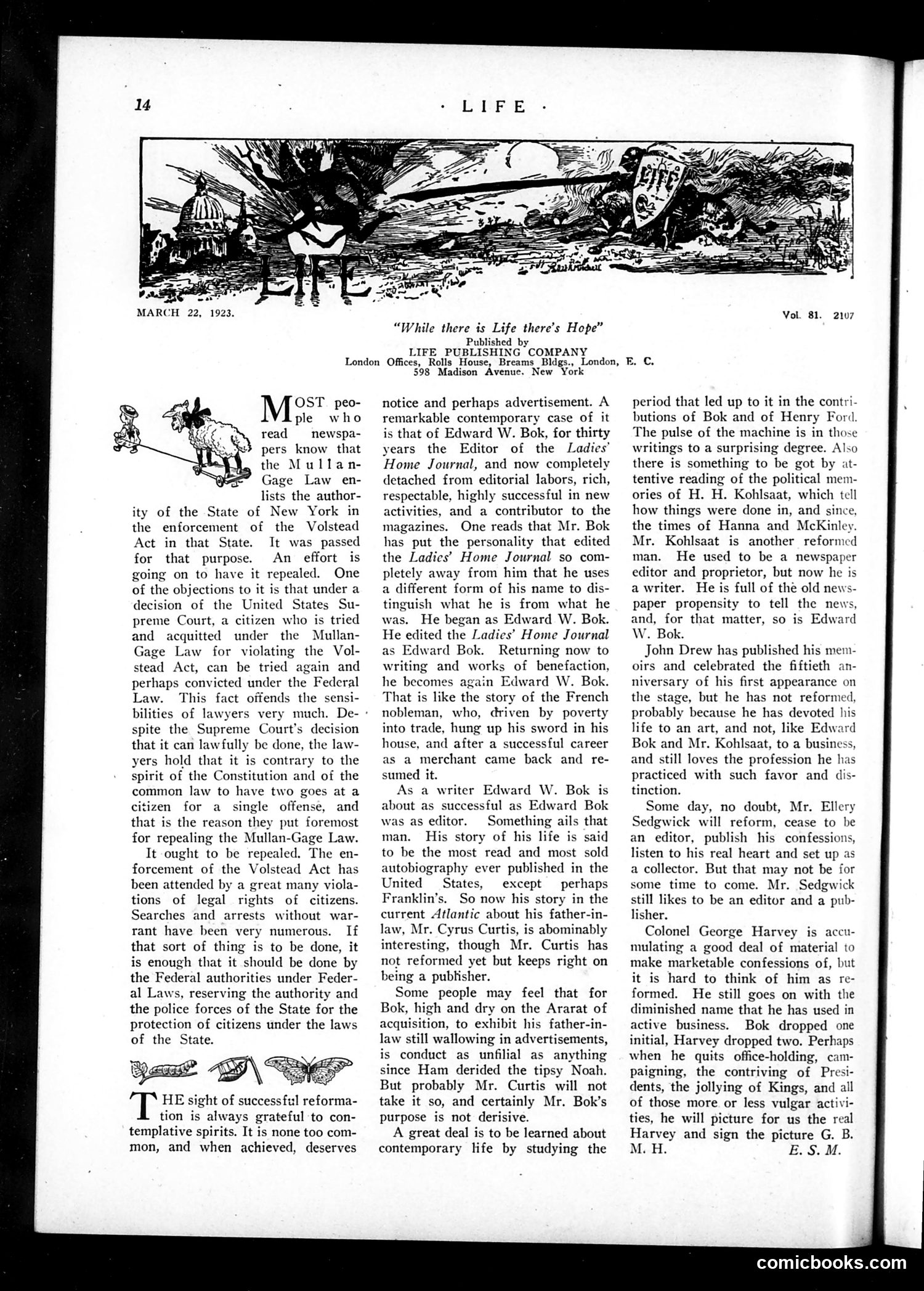
This page contains an editorial article discussing reform and reformers, rather than a political cartoon. The text criticizes several public figures, including Edward W. Bok (editor of *Ladies' Home Journal*), Colonel George Harvey, and John Drew. The article's main argument appears to be skepticism about genuine reform—the author suggests that successful reformers often revert to old practices or simply change their public persona while maintaining questionable conduct. Specific references include the Volstead Act (Prohibition) enforcement and the Mulllan-Gage Law. The piece uses these contemporary figures as examples of how reformers' credibility can be questioned when their actions don't match their stated principles. The tone is satirical and cynical about the authenticity of reform movements in 1920s America.
📄 Transcribed text from this page (OCR, searchable)
Machine-transcribed from the original scan — historical spelling and the odd misread are preserved.
MARCH 22, 1923. “While there is Life there’s Hope” Published by LIFE PUBLISHING COMPANY Vol. 81. 2107 London Offices, Rolls House, Breams Bldgs., London, E. C. OST peo- ple who read = newspa- pers know that the Mullan- Gage Law en- lists the author- ity of the State of New York in the enforcement of the Volstead Act in that State. It was passed for that purpose. An effort is going on to have it repealed. One of the objections to it is that under a decision of the United States Su- preme Court, a citizen who is tried and acquitted under the Mullan- Gage Law for violating the Vol- stead Act, can be tried again and perhaps convicted under the Federal Law. This fact offends the sensi- bilities of lawyers very much. De- : spite the Supreme Court's decision that it can lawfully be done, the law- yers hold that it is contrary to the spirit of the Constitution and of the common law to have two goes at a citizen for a single offense, and that is the reason they put foremost for repealing the Mullan-Gage Law. It ought to be repealed. The en- forcement of the Volstead Act has been attended by a great many viola- tions of legal rights of citizens. Searches and arrests without war- rant have been very numerous. If that sort of thing is to be done, it is enough that it should be done by the Federal authorities under Feder- al Laws, reserving the authority and the police forces of the State for the protection of citizens under the laws of the State. past \ MP HE sight of successful reforma- tion is always grateful to con- templative spirits. It is none too com- mon, and when achieved, deserves 598 Madison Avenue. New York notice and perhaps advertisement. A remarkable contemporary case of it is that of Edward W. Bok, for thirty years the Editor of the Ladies’ Home Journal, and now completely detached from editorial labors, rich, respectable, highly successful in new activities, and a contributor to the magazines. One reads that Mr. Bok has put the personality that edited the Ladies’ Home Journal so com- pletely away from him that he uses a different form of his name to dis- tinguish what he is from what he was. He began as Edward W. Bok. He edited the Ladies’ Home Journal as Edward Bok. Returning now to writing and works of benefaction, he becomes again Edward W. Bok. That is like the story of the French nobleman, who, driven by poverty into trade, hung up his sword in his house, and after a successful career as a merchant came back and re- sumed it. As a writer Edward W. Bok is about as successful as Edward Bok was as editor. Something ails that man. His story of his life is said to be the most read and most sold autobiography ever published in the United States, except perhaps Franklin’s. So now his story in the current Atlantic about his father-in- law, Mr. Cyrus Curtis, is abominably interesting, though Mr. Curtis has not reformed yet but keeps right on being a publisher. Some people may feel that for Bok, high and dry on the Ararat of acquisition, to exhibit his father-in- law still wallowing in advertisements, is conduct as unfilial as anything since Ham derided the tipsy Noah. But probably Mr. Curtis will not take it so, and certainly Mr. Bok’s purpose is not derisive. A great deal is to be learned about contemporary life by studying the period that led up to it in the contri- butions of Bok and of Henry Ford. The pulse of the machine is in those writings to a surprising degree. Also there is something to be got by at- tentive reading of the political mem- ories of H. H. Kohlsaat, which tell how things were done in, and since, the times of Hanna and McKinley. Mr. Kohlsaat is another reformed man. He used to be a newspaper editor and proprietor, but now he is a writer. He is full of the old news- paper propensity to tell the news, and, for that matter, so is Edward W. Bok. John Drew has published his mem- oirs and celebrated the fiftieth an- niversary of his first appearance on the stage, but he has not reformed, probably because he has devoted his life to an art, and not, like Edward Bok and Mr. Kohlsaat, to a business, and still loves the profession he has practiced with such favor and dis- tinction. Some day, no doubt, Mr. Ellery Sedgwick will reform, cease to be an editor, publish his confessions, listen to his real heart and set up as a collector. But that may not be for some time to come. Mr. Sedgwick still likes to be an editor and a pub- lisher. Colonel George Harvey is accu- mulating a good deal of material to make marketable confessions of, but it is hard to think of him as re- formed. He still goes on with the diminished name that he has used in active business. Bok dropped one initial, Harvey dropped two. Perhaps when he quits office-holding, cam- paigning, the contriving of Presi- dents, the jollying of Kings, and all of those more or less vulgar activi- ties, he will picture for us the real Harvey and sign the picture G. B. M. H. E. S. M. comicbooks.com