
A complete issue · 35 pages · 1921
Life — August 18, 1921
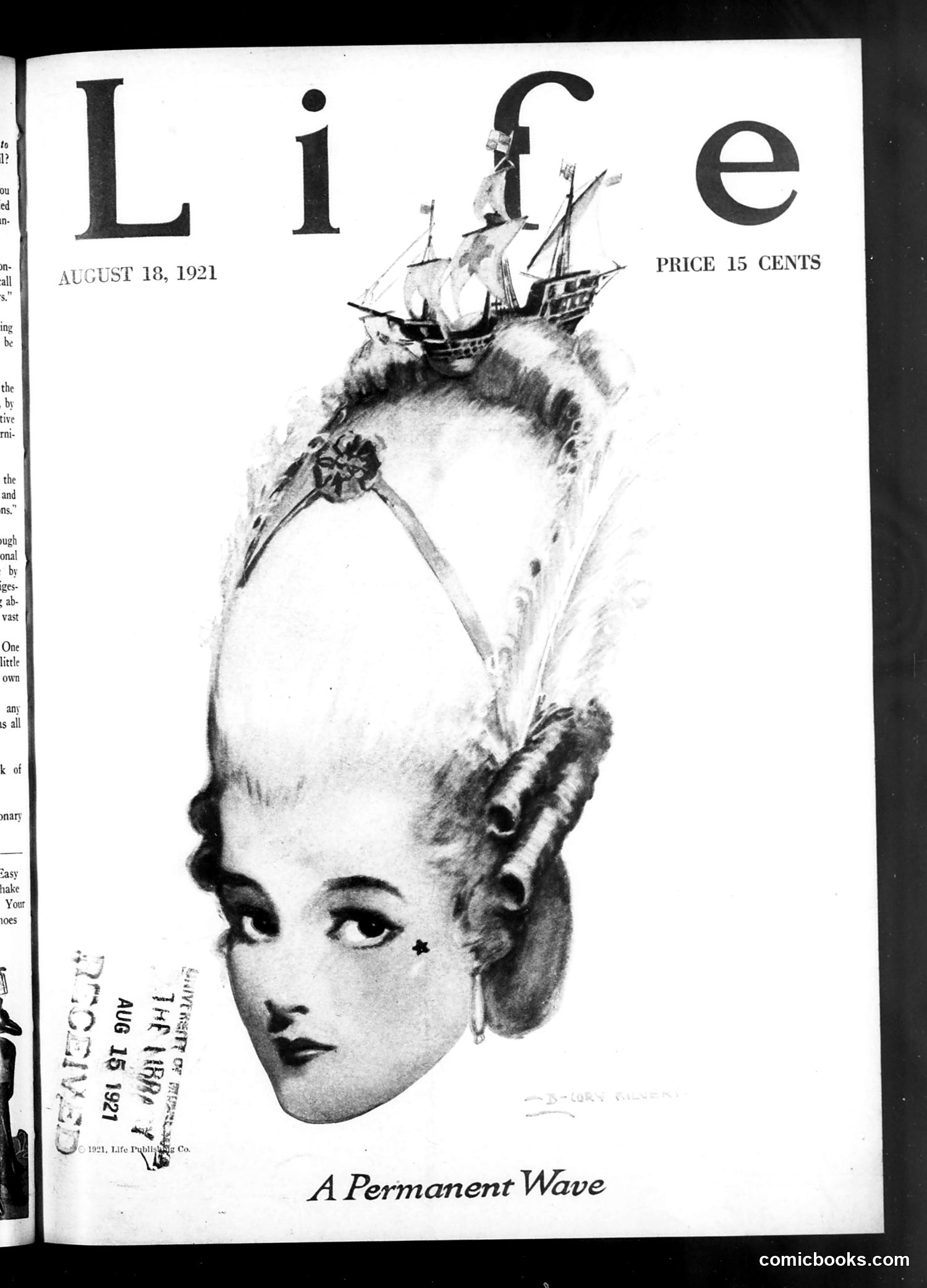
This cover is primarily **advertising disguised as editorial content**—a common practice in early 1920s magazines. The illustration shows a woman's head in profile with an elaborate upswept hairstyle, crowned by a sailing ship. The caption reads "A Permanent Wave." The satire plays on the double meaning of "permanent wave"—both the newly fashionable hair treatment and literal ocean waves. By placing a ship atop the woman's head, the artist suggests the absurdity of advertising promises: women were being sold the idea that their waves could be as grand and enduring as maritime vessels. This mocks both the vanity of beauty trends and the exaggerated marketing claims of the beauty industry in the Jazz Age.
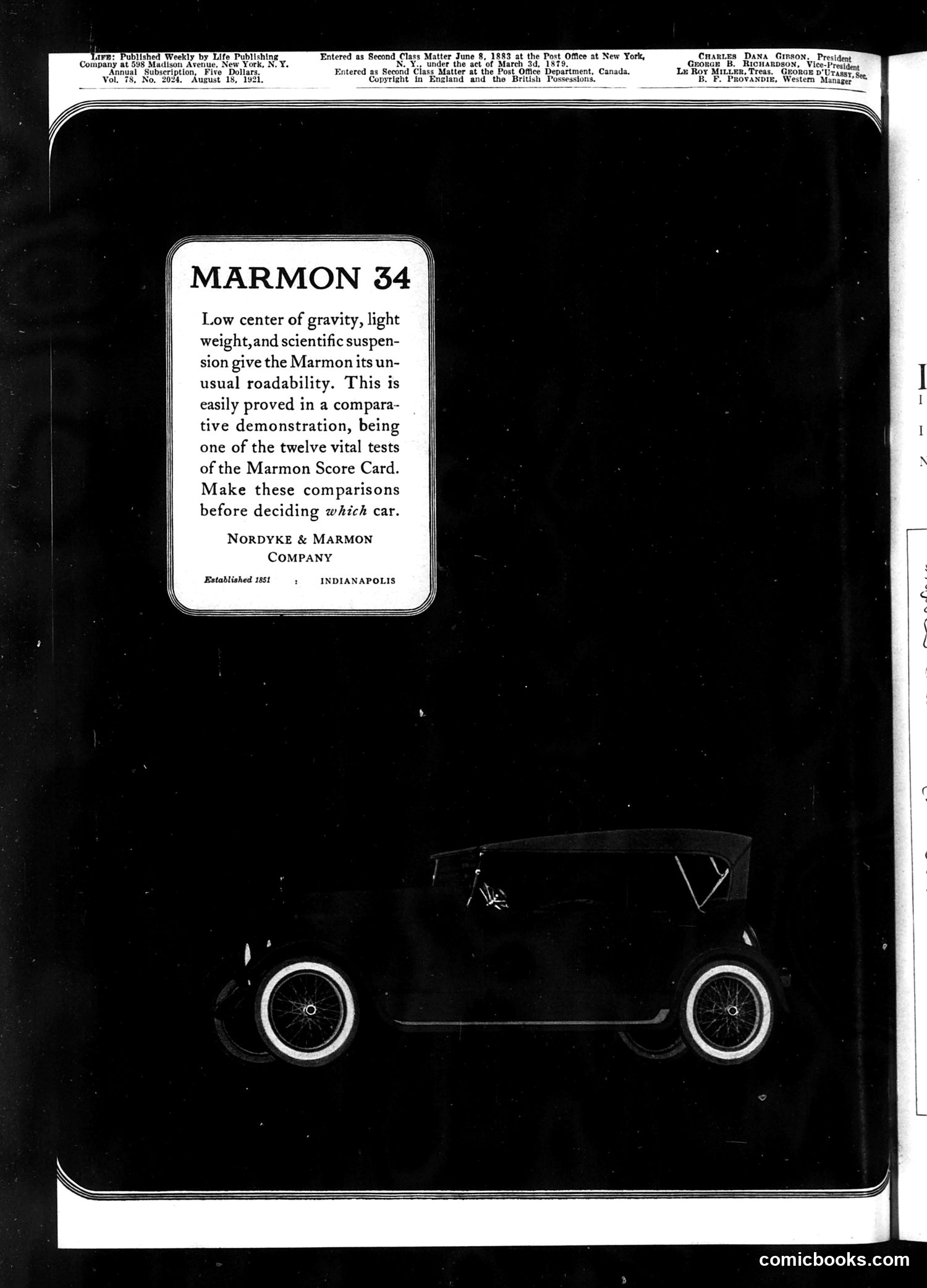
This is a straightforward automobile advertisement, not satire or political commentary. The Marmon Company, established in Indianapolis in 1851, promotes their Model 34 car by highlighting engineering features: "Low center of gravity, light weight, and scientific suspension" that supposedly provide "unusual roadability." The ad emphasizes that these qualities are "easily proved in a comparative demonstration" and form part of "the twelve vital tests of the Marmon Score Card." Consumers are encouraged to compare the Marmon 34 against competitors "before deciding *which* car." The page displays a side-view silhouette of the vehicle against a dark background, showcasing its sleek profile. This represents typical early-twentieth-century automotive advertising that stressed technical specifications and direct performance comparisons to justify purchasing decisions.
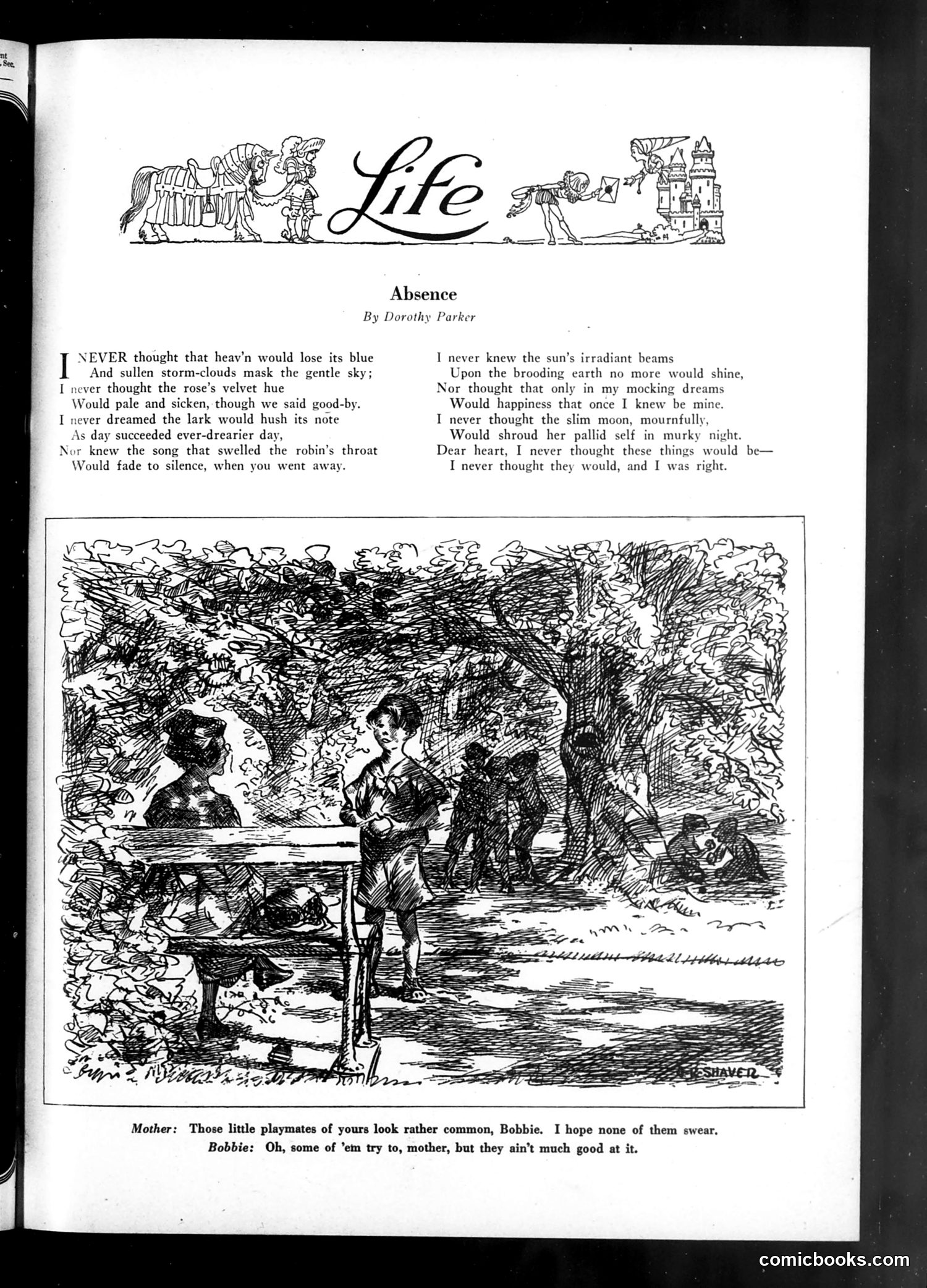
This page presents a poem titled "Absence" by Dorothy Parker, a celebrated American writer known for witty, often melancholic verse about relationships. The poem explores emotional loss—the speaker never anticipated how profoundly their beloved's departure would affect nature itself (the sky losing color, birds ceasing song). The accompanying illustration depicts a mother and child by a fence near water, with the child ("Bobbie") explaining to his mother that his playmates are teaching him to swear. The caption's gentle humor—the boy admitting they "ain't much good at it"—provides comic relief to Parker's more serious meditation on absence and the unexpected ways loss reshapes our perception of the world.
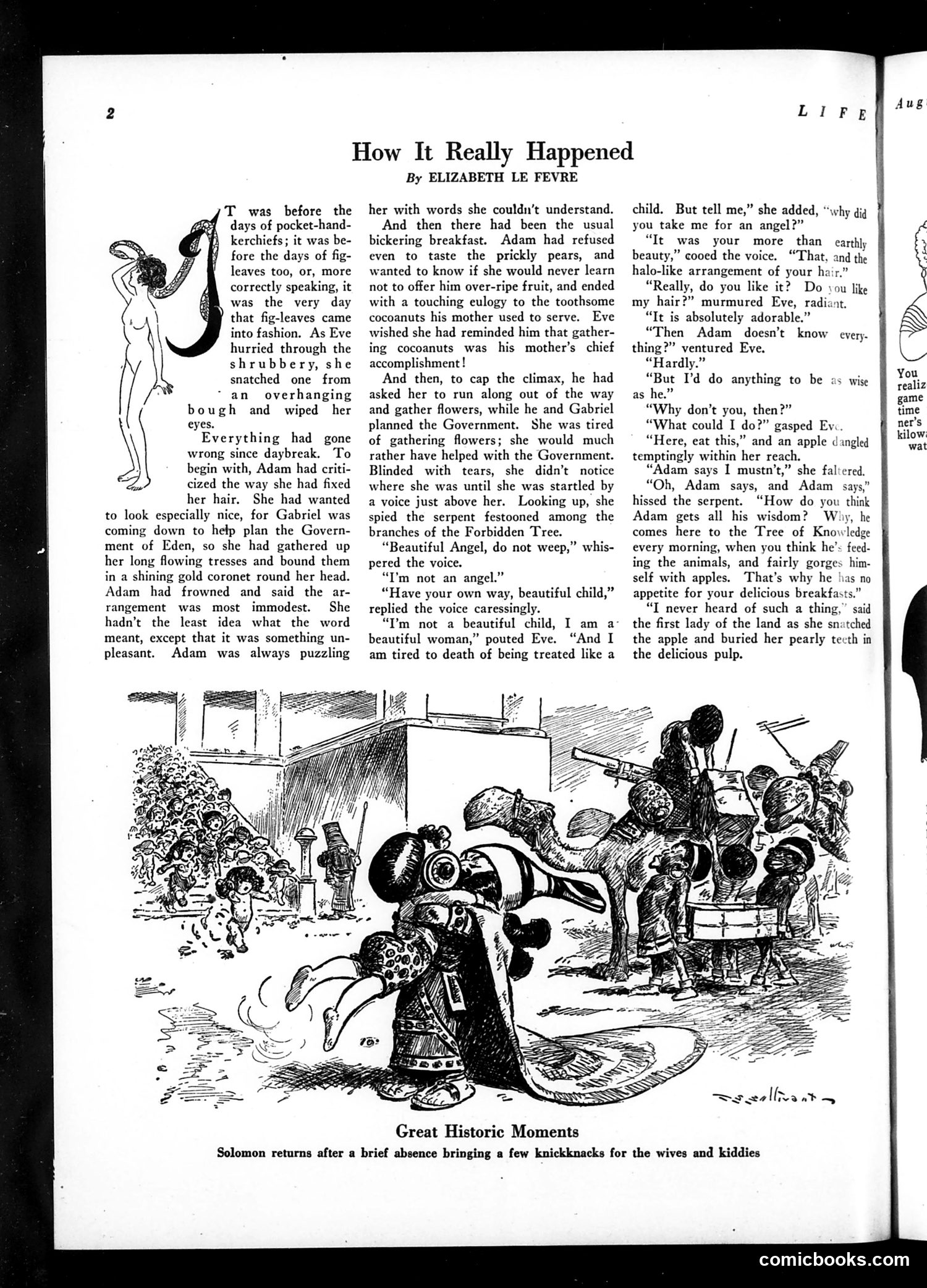
This page contains a satirical story "How It Really Happened" by Elizabeth Le Fevre, illustrated with two distinct cartoons. The upper illustration depicts a nude figure (likely Eve from the Biblical creation story), used as a humorous framing device for the narrative about Adam's complaints regarding Eve's behavior and appearance. The lower cartoon, titled "Great Historic Moments," shows **Solomon returning after a brief absence bringing a few knickknacks for the wives and kiddies**. This is a satirical jab at Solomon, the Biblical king famously known for having numerous wives. The cartoon mocks him as a domestic figure bringing home trivial gifts, reducing the historical/religious figure to a mundane husband figure—satirizing both excessive polygamy and the banality of domestic gift-giving as appeasement. Both cartoons use Biblical references for comedic effect, targeting gender relations and male behavior through humor.
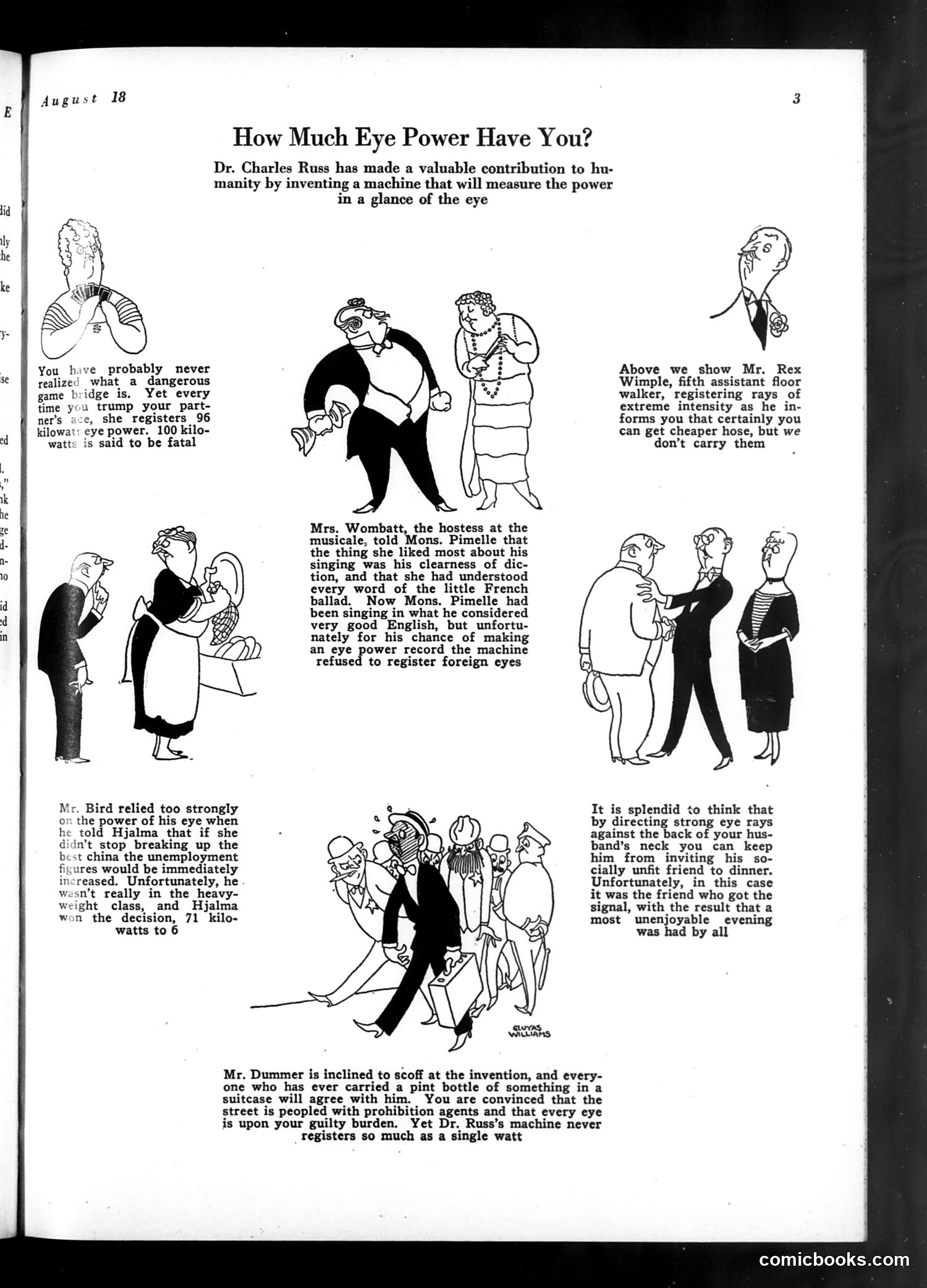
This satirical piece mocks Dr. Charles Russ's invention—a machine measuring eye power (intensity of a person's gaze) in kilowatts. The article presents humorous anecdotes about the machine's practical failures: - **Mrs. Wombat** (a hostess): The machine refused to register her foreign eyes when measuring her diction clarity - **Mr. Bird**: His eye power was so intense it threatened to break chinaware; the machine only registered 1 kilowatt when he actually possessed much more - **Mr. Dummer**: His skepticism about the invention proved justified—the machine's unreliability suggests it's pseudoscience The satire ridicules both the invention itself and people's gullibility toward pseudo-scientific gadgetry popular in the early 20th century. The cartoon jokes that everyday situations prove the machine worthless.
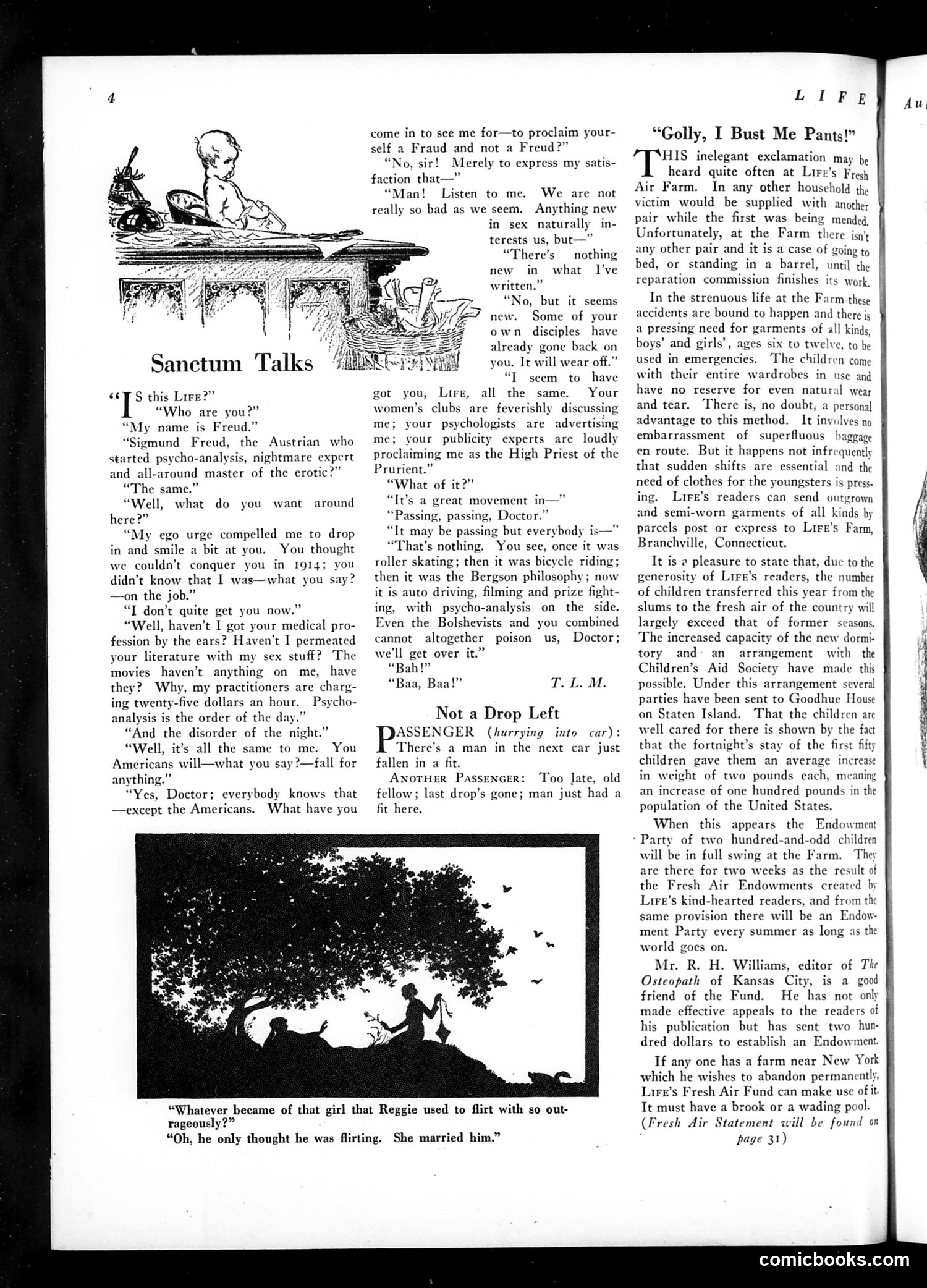
This page contains two distinct sections: **"Sanctum Talks"** features a satirical interview with "Sigmund Freud, the Austrian who started psycho-analysis." The dialogue mocks psychoanalysis as a fad—Freud claims Life's readers discuss him constantly while practitioners charge exorbitant fees. The humor targets the era's enthusiasm for Freudian psychology as both trendy and exploitative. **"Not a Drop Left"** shows a silhouette cartoon of two figures under a tree, with a joke about a girl named Reggie. The caption explains she "only thought he was flirting. She married him"—a mild joke about misread romantic intentions. The right column discusses Life's Fresh Air Fund, a charitable program sending underprivileged children to farms for summer endowments, showing the magazine's social welfare interests alongside its satire.
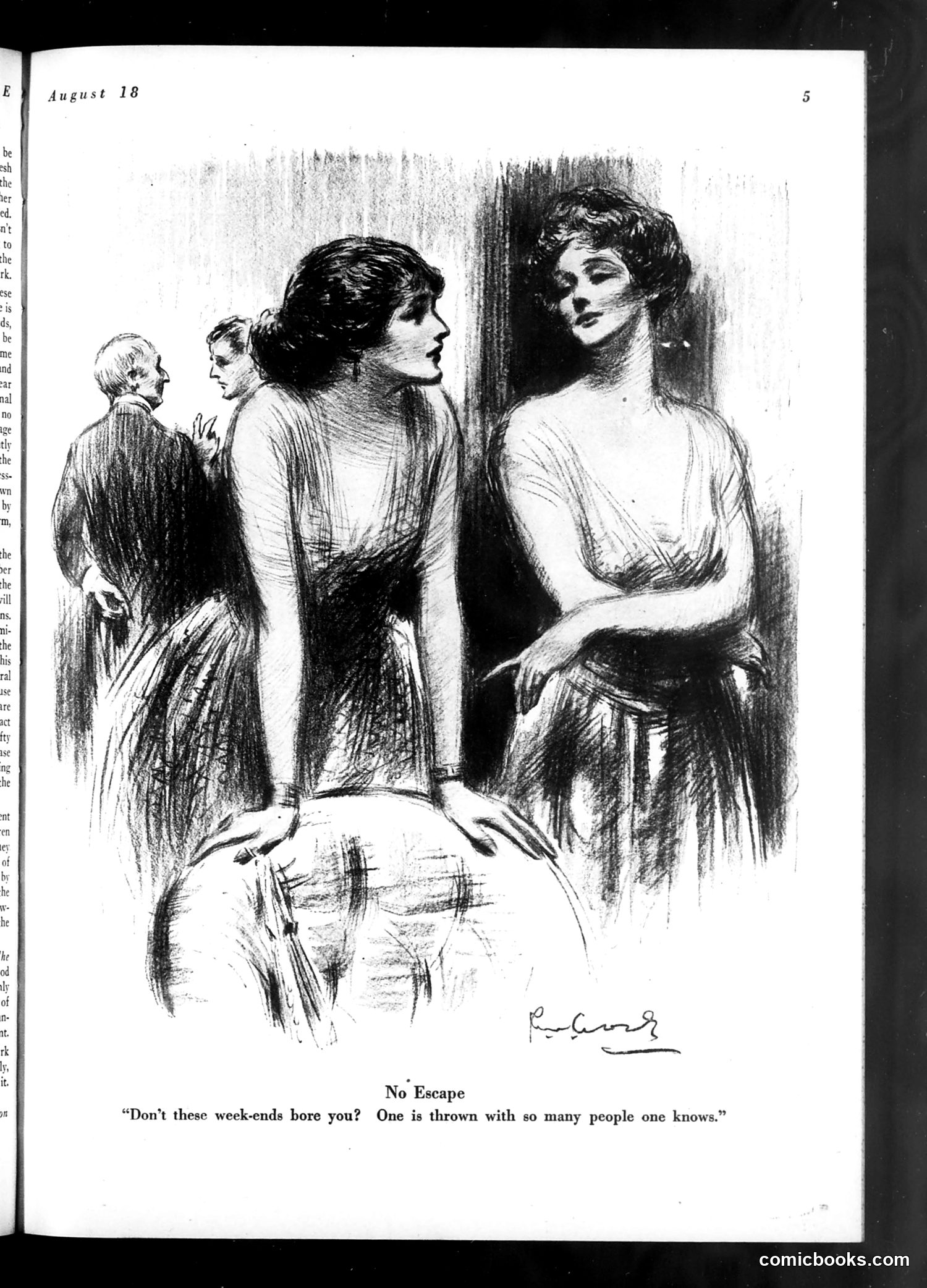
This sketch by John Held Jr. depicts three women in conversation, with the caption: "Don't these week-ends bore you? One is thrown with so many people one knows." The satire targets the social constraints faced by women of leisure in the 1920s. Despite having "free" weekends away from their regular obligations, these women find themselves unable to escape their social circles—they inevitably encounter the same acquaintances wherever they go. The joke critiques both the limited social mobility of affluent women and the suffocating nature of high-society social expectations. Even in supposed leisure time, they cannot achieve genuine escape or privacy; their world remains confined and predictable.
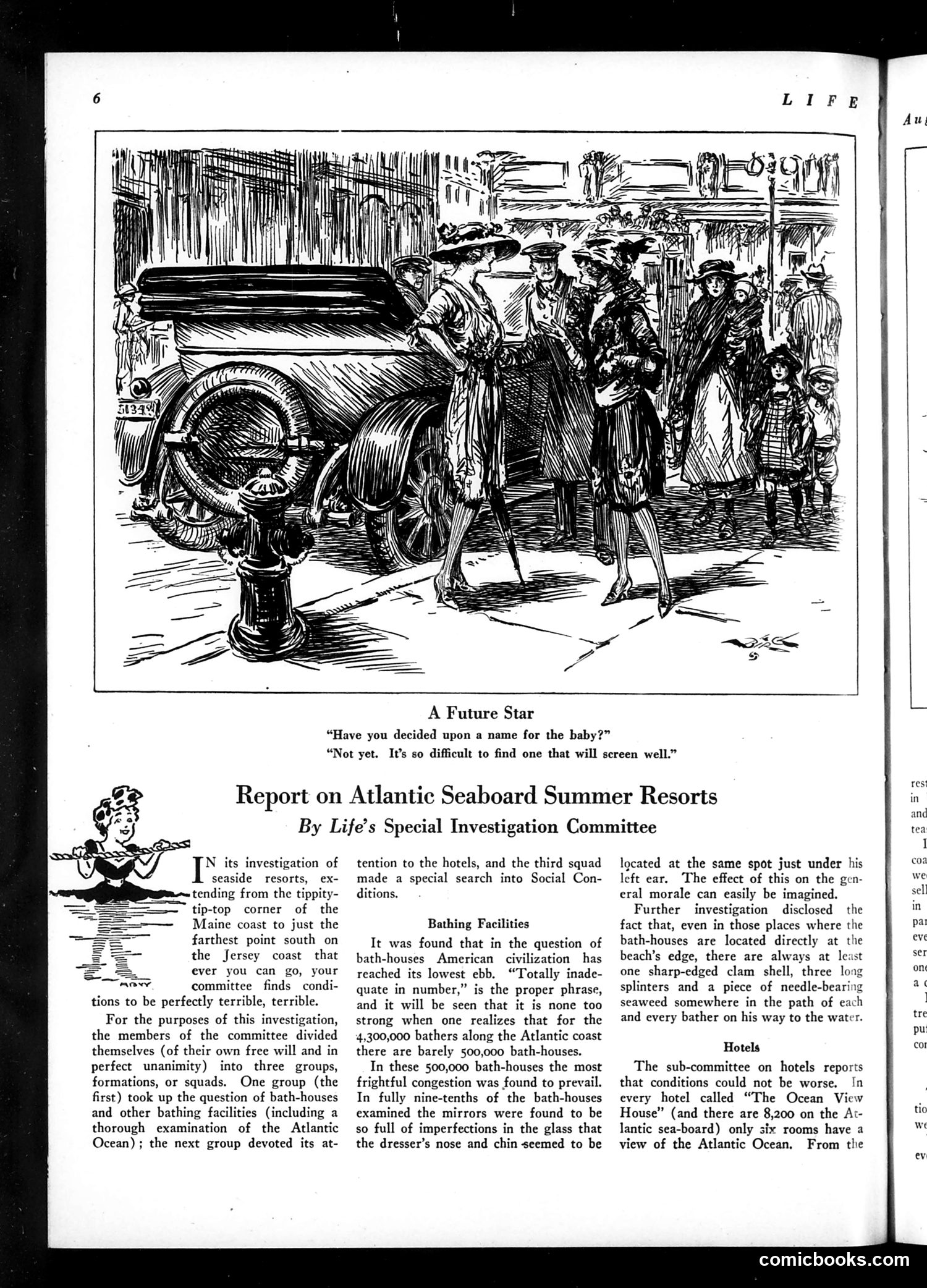
The top cartoon depicts a street scene with an early automobile and well-dressed onlookers. The caption reads: "Have you decided upon a name for the baby?" / "Not yet. It's so difficult to find one that will screen well." This is satire about the early film industry's practice of screening or testing names for public appeal. The joke plays on the absurdity of naming a newborn child based on marketing considerations—treating the baby like a Hollywood product rather than a person. This reflects Life magazine's satirical commentary on how the emerging entertainment industry was reshaping American culture, reducing even personal decisions to commercial calculation.
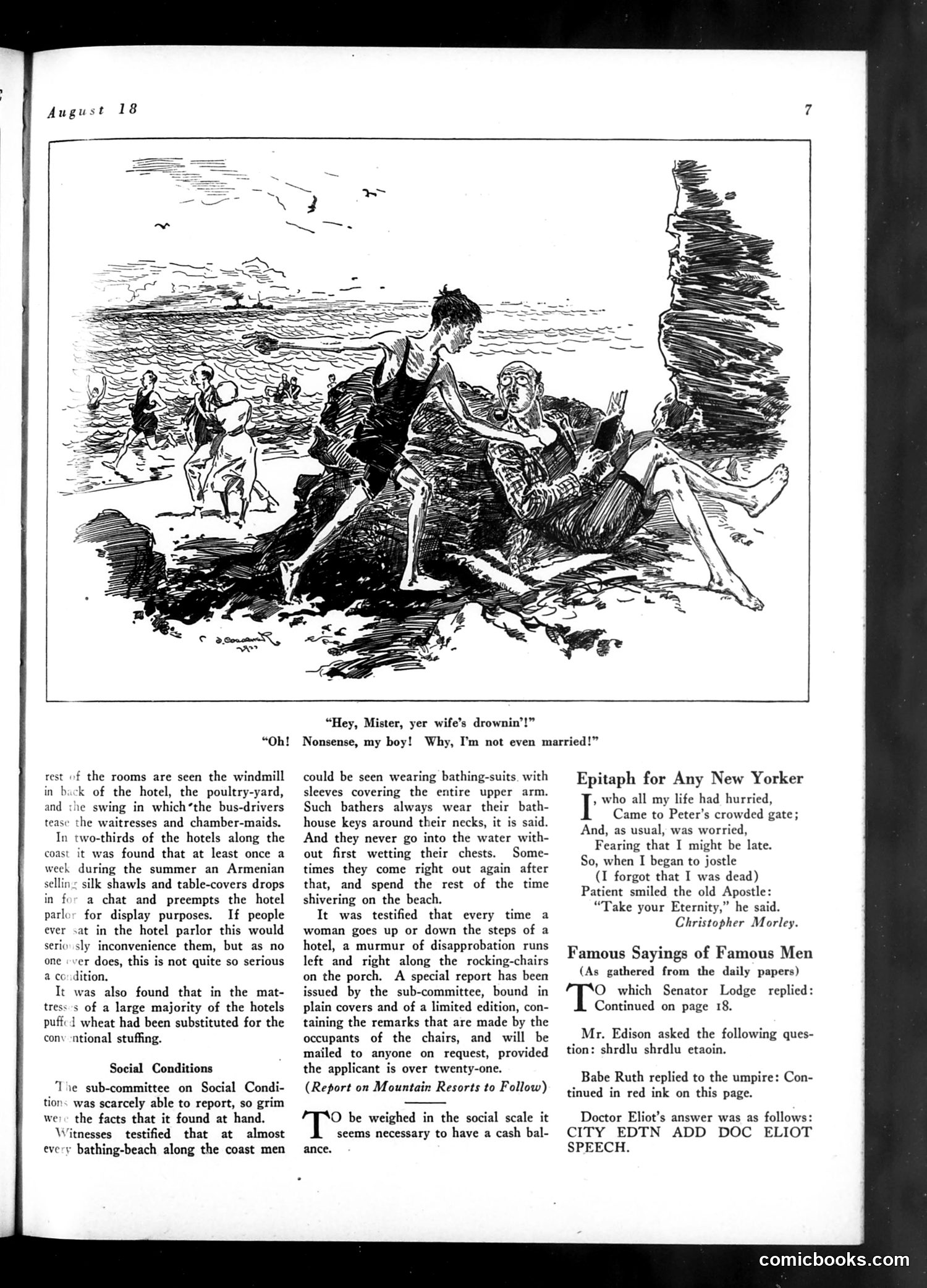
This cartoon depicts a beach scene where a man is being told "Hey, Mister, yer wife's drownin'!" He responds dismissively: "Oh! Nonsense, my boy! Why, I'm not even married!" The satire appears to be a simple joke about a bachelor's indifference to a drowning woman—playing on period attitudes about unmarried men having no responsibility toward unknown women. The humor relies on the absurdist logic of his response: he denies responsibility because she isn't *his* wife, implying he'd only care if she were. The accompanying text discusses hotel and bathing conditions at Armenian resorts, suggesting this cartoon illustrates contemporary beach culture and social attitudes of the era.
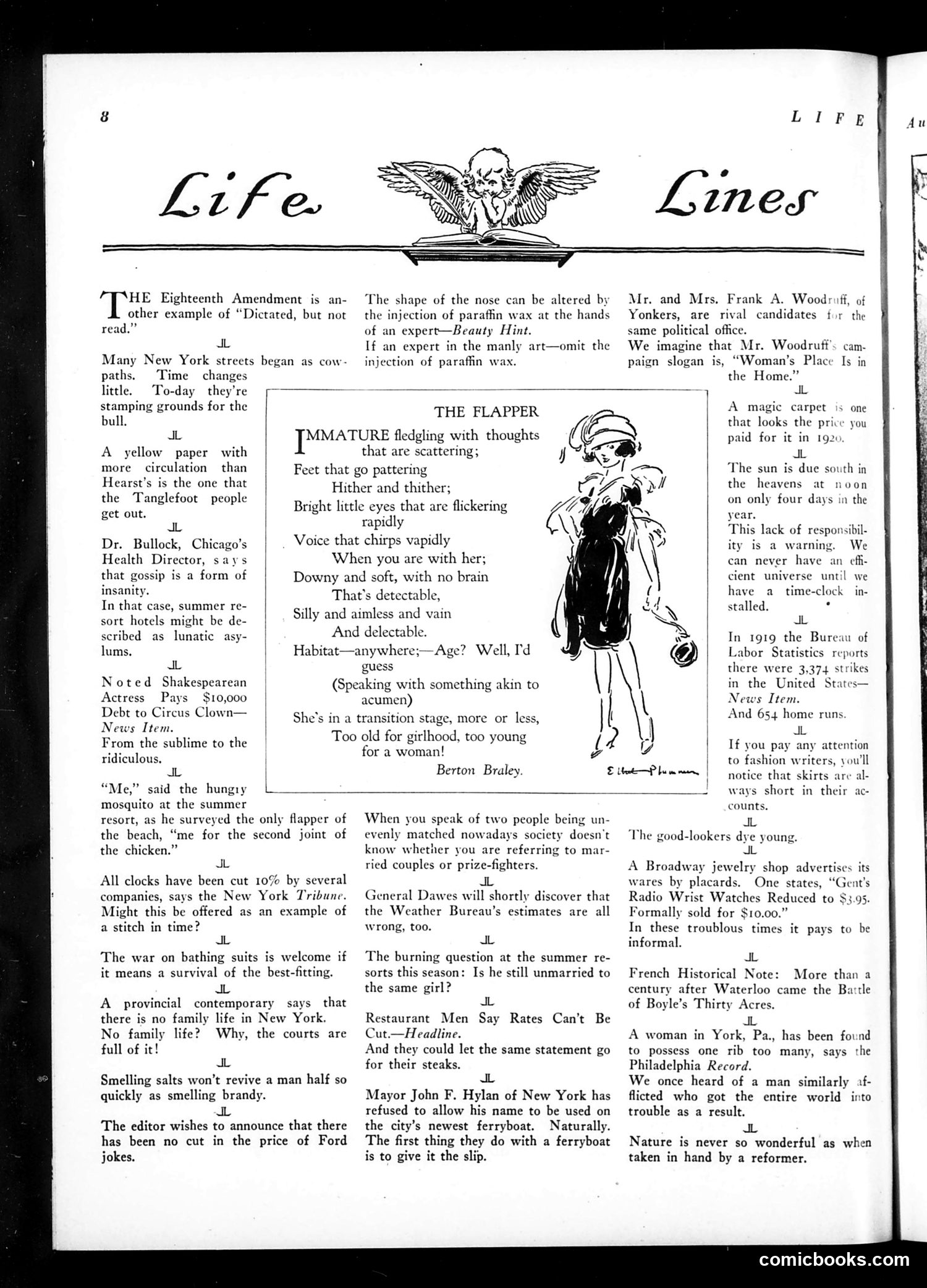
This illustration depicts a young woman in 1920s fashion—the "flapper" style that shocked conservative America. The accompanying poem by Berton Bradley satirizes the flapper archetype: an "immature fledgling" with scattered thoughts, bright eyes, and a "silly and aimless" demeanor. The poem mockingly catalogs flapper characteristics—frivolous, transitional between girlhood and womanhood, unmarriageable by traditional standards. The cartoon's energetic pose and fashionable dress (short skirt, cloche hat) visualize this new independent young woman who defied Victorian propriety through clothing, behavior, and social freedom. The satire captures generational anxiety about modernizing youth culture during the post-WWI era, when flappers represented radical social change and challenged traditional gender roles.
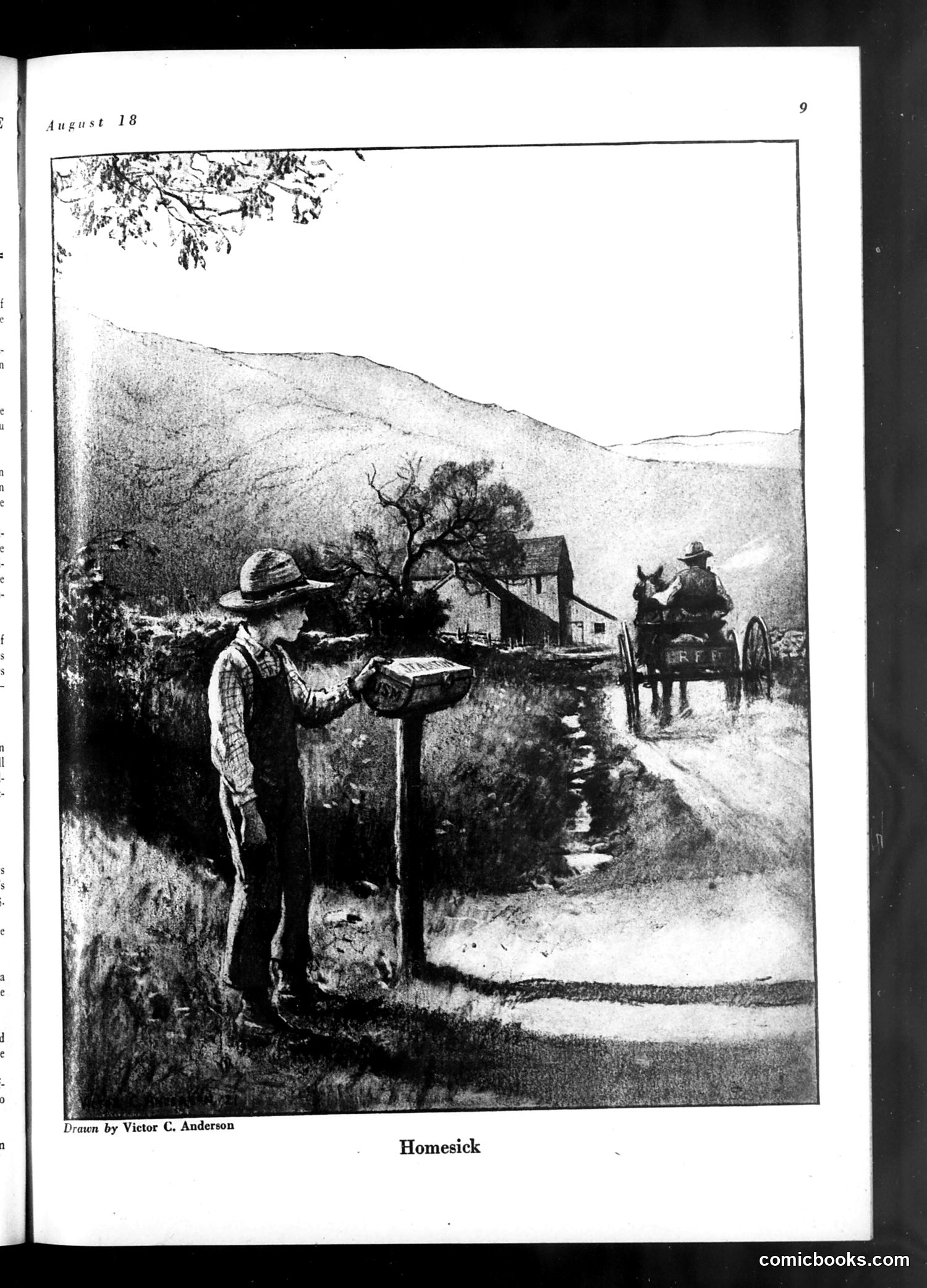
This illustration by Victor C. Anderson depicts a rural scene titled "Homesick." A man in work clothes and a hat stands at a mailbox beside a country road, appearing to receive mail. In the background, a farmhouse is visible with a horse-drawn cart approaching on the road, set against rolling hills. The satirical point appears to concern rural isolation and longing—the "homesick" figure likely represents either a farmer separated from urban comforts or, conversely, someone from the city pining for rural life. The mailbox symbolizes connection to the outside world. Without additional context from the magazine's surrounding articles, the specific target of satire remains unclear, though it likely comments on rural-urban tensions or lifestyle preferences common to early 20th-century American discourse.
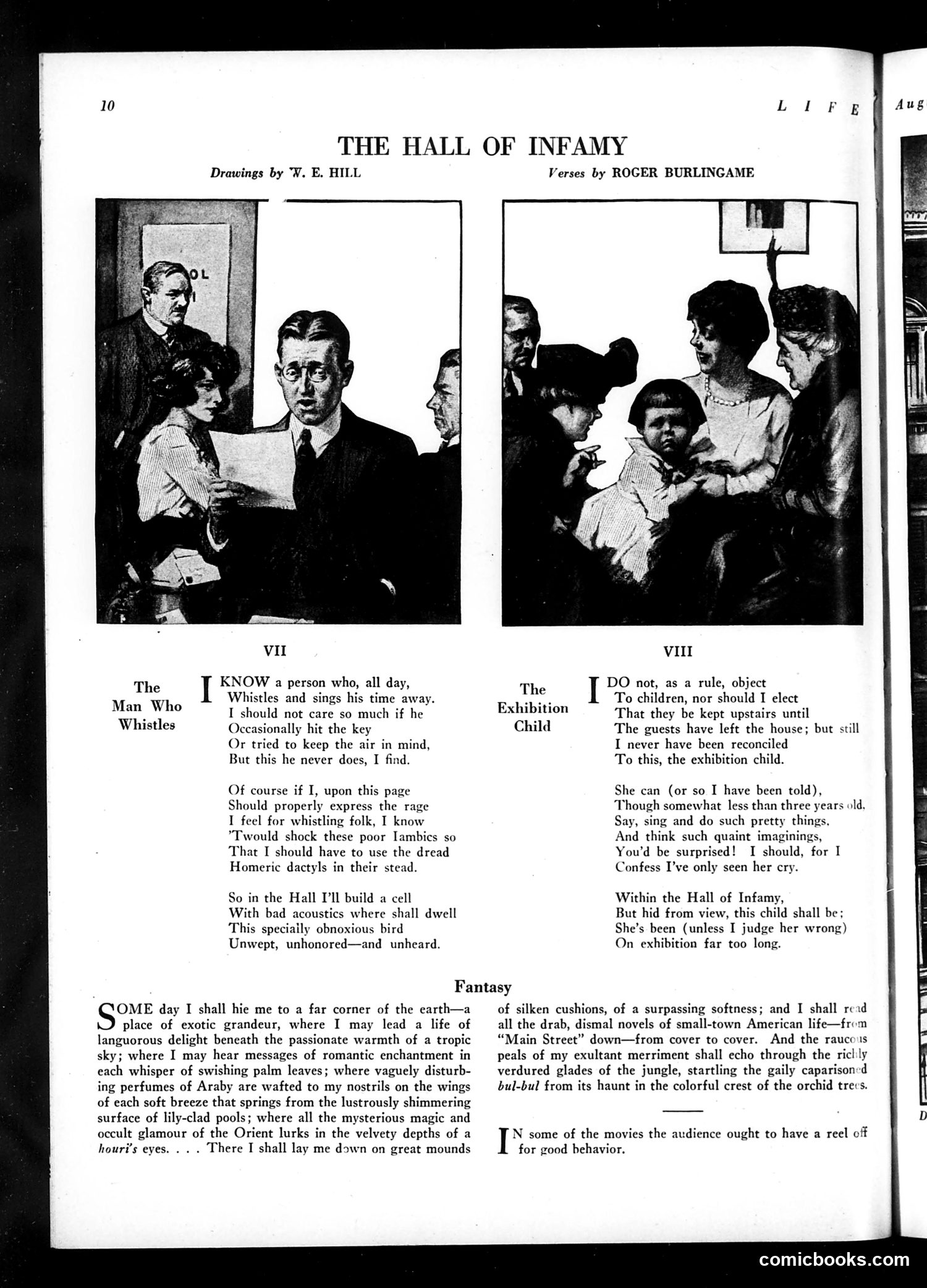
This satirical piece presents two scenarios mocking social types. Panel VII, "The Man Who Whistles," ridicules someone who constantly whistles and hums, disrupting others. The poet wishes to place such an annoying person in a "Hall of Infamy" with poor acoustics as punishment. Panel VIII, "The Exhibition Child," satirizes parents who parade their precocious young children as entertainment for guests. The verse criticizes keeping such children "upstairs" initially, then displaying them as curiosities—the child has been "on exhibition far too long." The "Fantasy" section below expresses the author's desire to escape to an idealized tropical paradise, contrasting with urban American life. The final note humorously suggests movies need "a reel for good behavior"—mocking audience conduct at screenings.
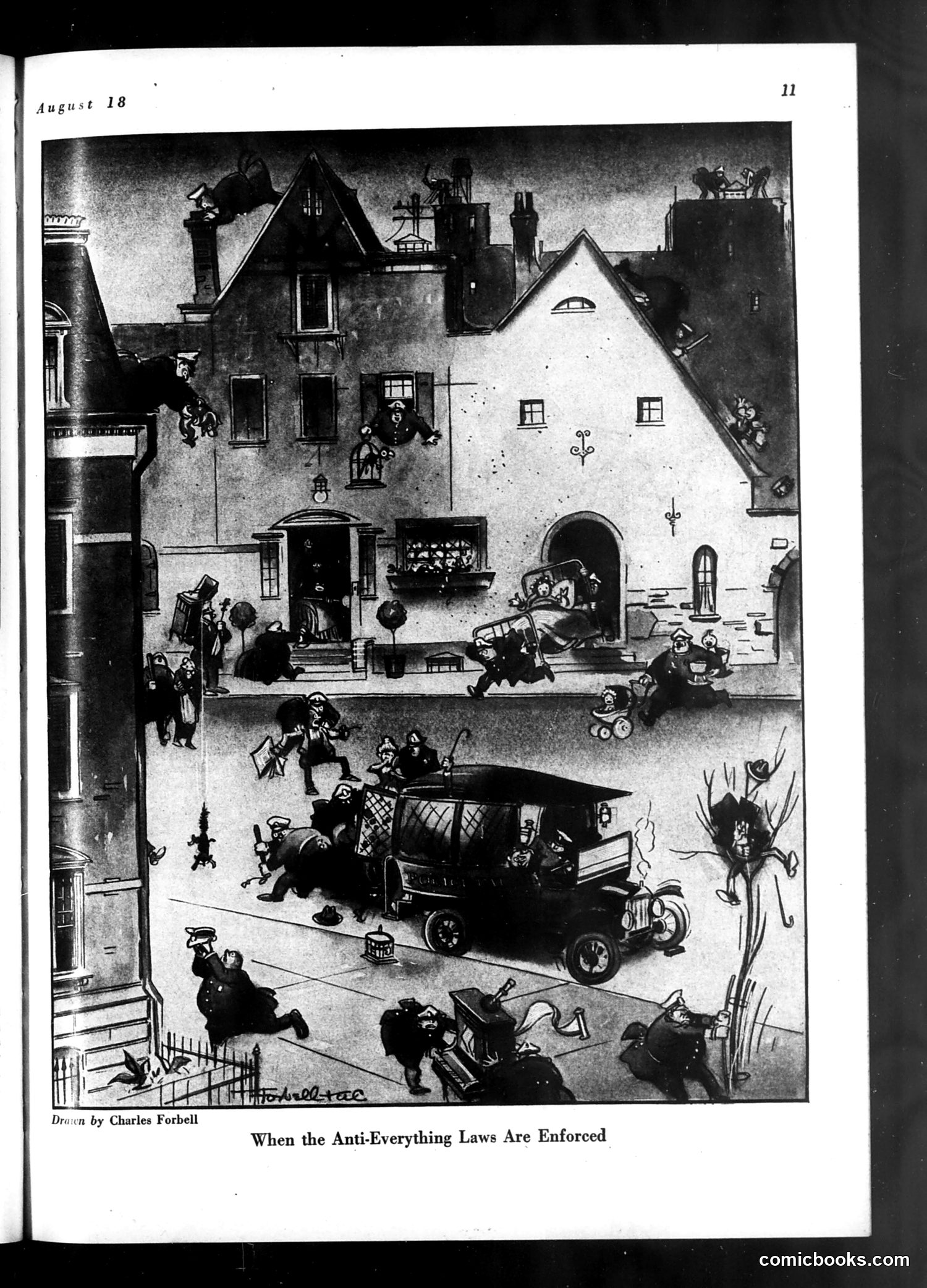
This satirical cartoon by Charles Forbell depicts a chaotic street scene showing the absurd consequences of overly restrictive legislation. The drawing shows authorities aggressively enforcing numerous prohibitive laws simultaneously—officers appear to be arresting or stopping citizens for various minor infractions in an urban courtyard setting. The satire critiques what the cartoonist calls "anti-everything laws"—likely referencing the proliferation of regulatory restrictions during the Progressive Era (early 1900s). The cartoon suggests that excessive legal restrictions create mayhem rather than order, with enforcement becoming oppressive and ridiculous. The scene's disorder—with vehicles, figures scattered chaotically, and apparent pandemonium—visually demonstrates the cartoon's argument: that too many restrictive laws produce societal chaos rather than improvement. The title itself mocks the tendency toward legislative prohibition.
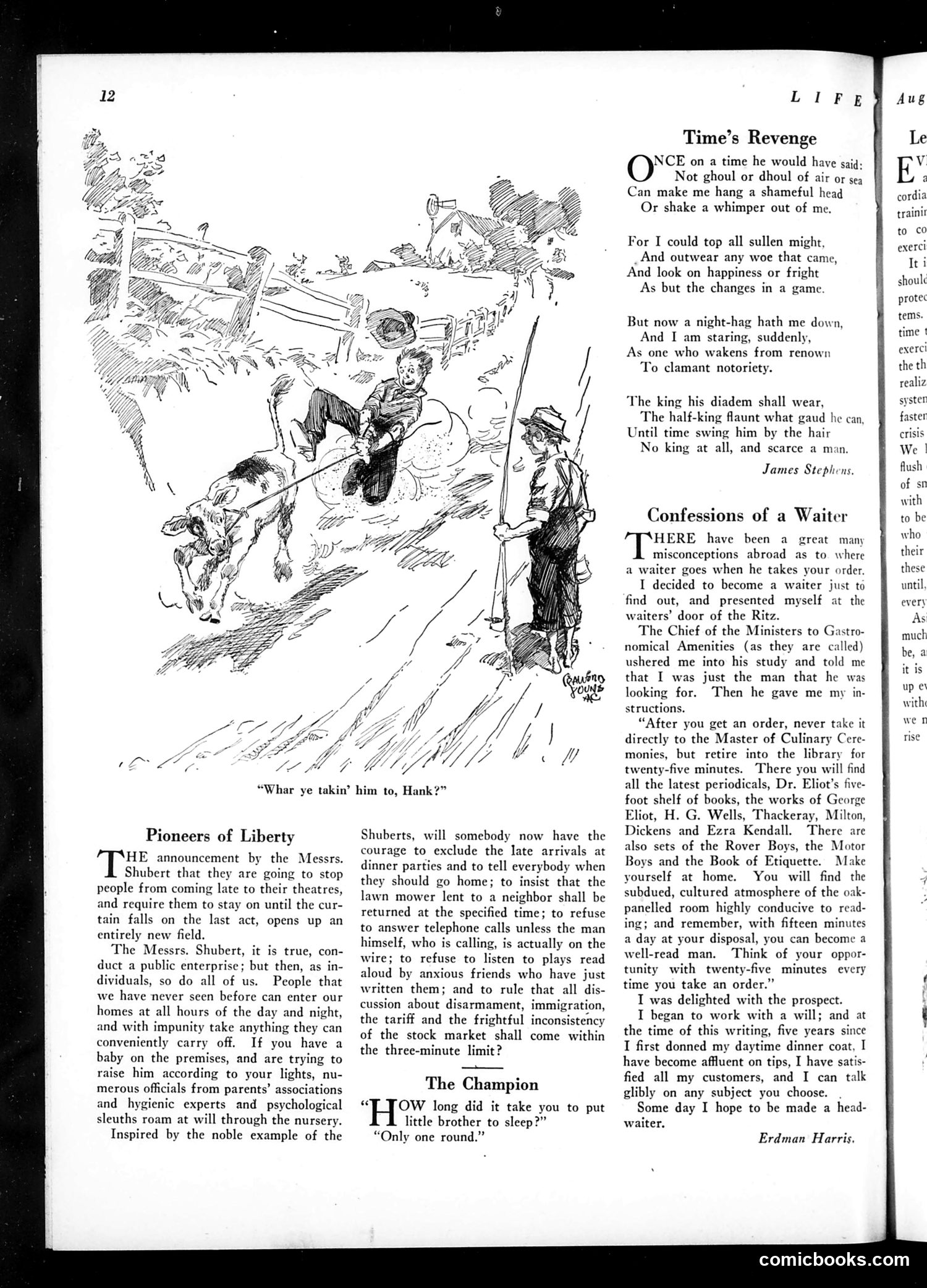
The main cartoon, titled **"Whar ye takin' him to, Hank?"** shows two men herding what appears to be a donkey or mule down a rural road. This is political satire about the 1912 election cycle, likely referencing the split in the Republican Party between incumbent President Taft and Theodore Roosevelt—the "stubborn mule" representing one faction. The rural setting and crude humor were typical of Life's satirical style. The page also contains three text pieces: poems titled **"Time's Revenge"** and **"The Champion,"** plus a humorous essay, **"Confessions of a Waiter,"** offering social commentary on restaurant service and class dynamics in early-20th-century America. The accompanying illustration shows period-dressed figures in an awkward social situation.
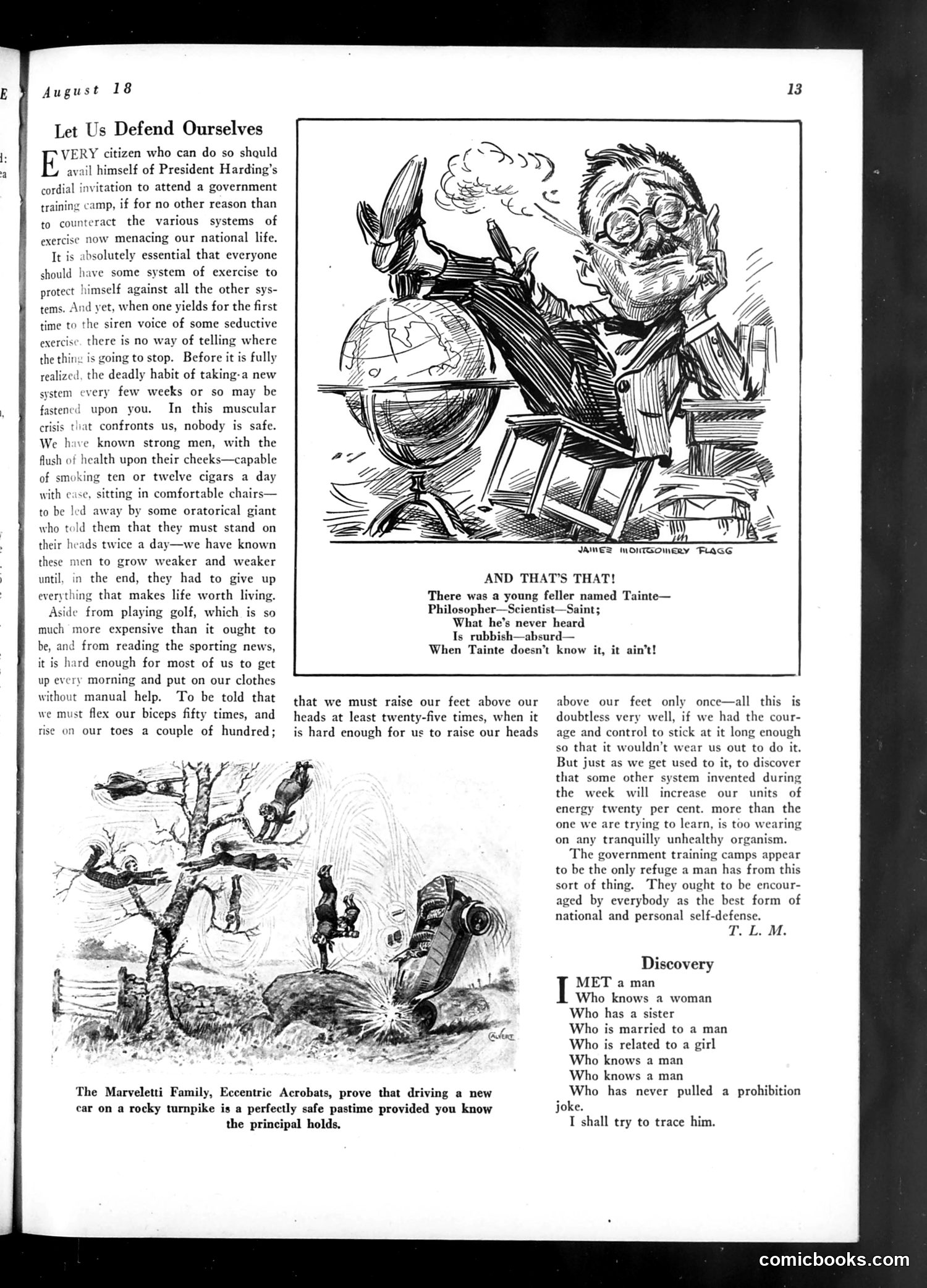
**Main Article**: "Let Us Defend Ourselves" advocates for President Harding's government physical training camps, arguing citizens need exercise systems to protect health against modern sedentary life. **Top Cartoon** ("And That's That!"): Depicts a figure struggling with exercise equipment, satirizing a pseudo-intellectual ("Tainte—Philosopher—Scientist—Saint") who lectures about systems he doesn't understand. The humor lies in the gap between theoretical knowledge and practical ability. **Bottom Illustration**: Shows the "Marveletti Family, Eccentric Acrobats" performing dangerous stunts in a car on a rocky turnpike—presented as a cautionary example that such risky behavior is unsafe, contrasting with the article's endorsement of *controlled* government training. The page argues exercise is healthful only when systematized and supervised, not improvised dangerously.
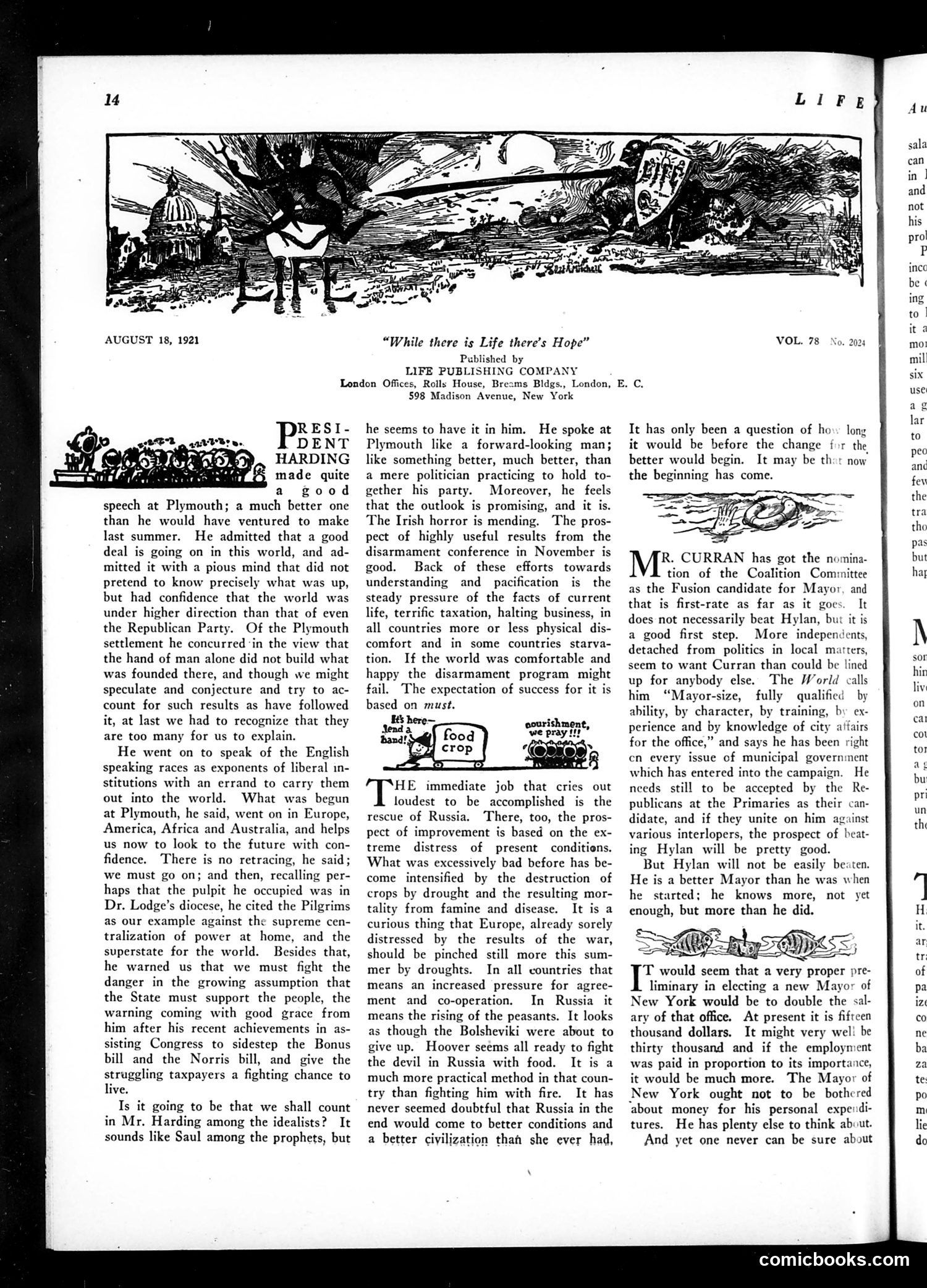
This page contains editorial commentary rather than cartoons. The main illustrated element is a decorative header showing a classical figure overlooking a landscape. The text discusses President Harding's recent speech at Plymouth, praising his optimistic outlook and confidence in world direction. It references his support for disarmament and pacification efforts, contrasting him favorably with Republican politicians. The editorial then shifts to criticizing Russia's famine crisis and crop destruction from drought, arguing Europe should pressure Russia toward better conditions. Finally, it addresses New York City's mayoral election, suggesting the position requires a qualified, experienced candidate rather than simply someone wealthy enough to afford the salary. The satire targets political inexperience and incompetence in municipal governance.
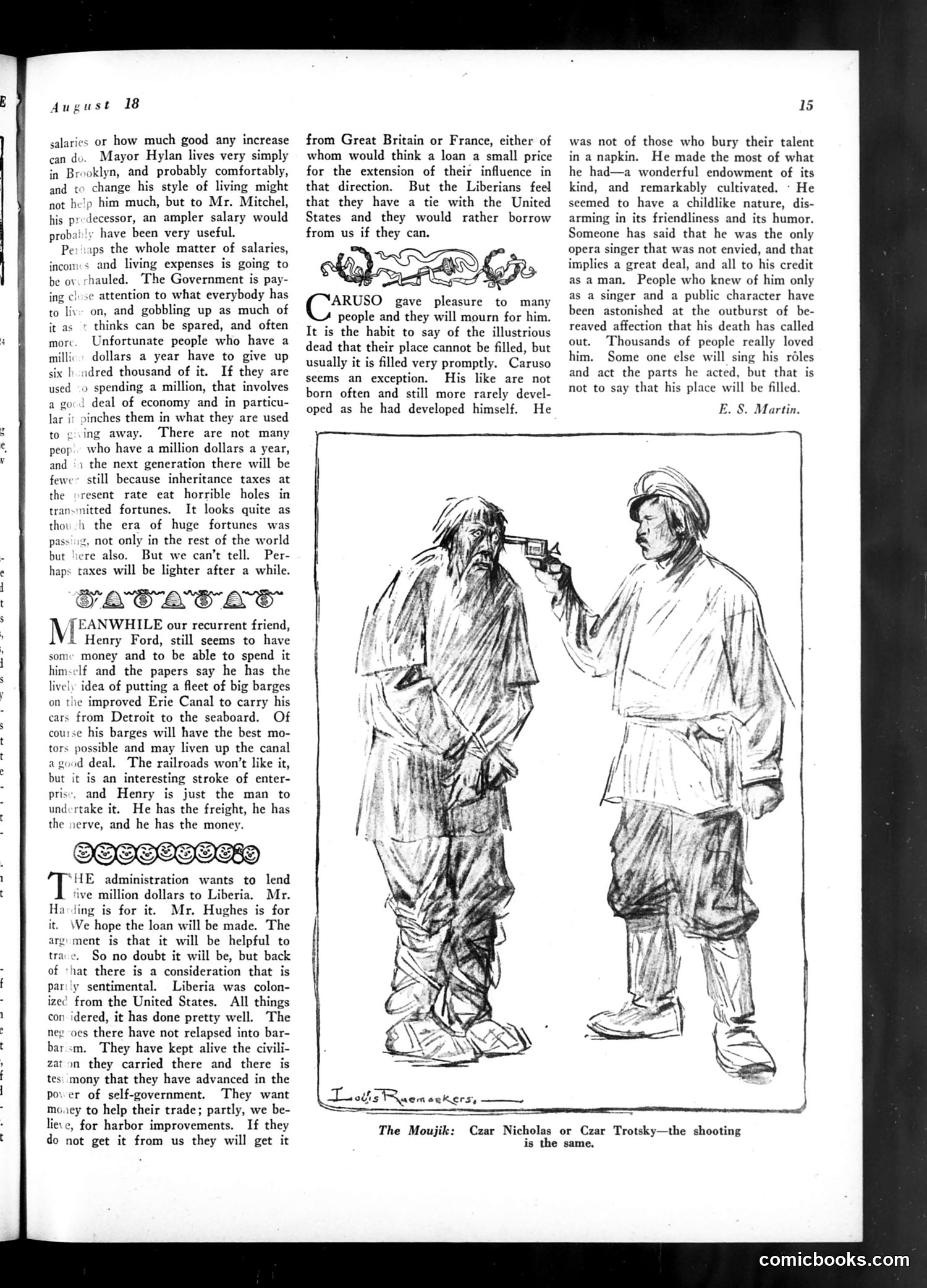
This August 18 page from *Life* magazine contains political and social commentary typical of the era. The main cartoon depicts two figures in peasant clothing labeled "The Moujik: Czar Nicholas or Czar Trotsky—the shooting is the same." This satirizes the Russian Revolution, suggesting that whether ruled by the Tsar or the Bolsheviks (Trotsky), ordinary Russian peasants face identical hardship and violence. The identical poses and "shooting" reference imply that revolutionary change brought no material improvement for common people. The text discusses Henry Ford's Erie Canal barge scheme, a proposed loan to Liberia, and tributes to opera singer Enrico Caruso. The Liberia section reveals anxiety about American influence competing against British and French colonial interests during the post-WWI period. Overall, the page reflects early 1920s concerns about labor, capitalism, international power dynamics, and the Russian Revolution's aftermath.
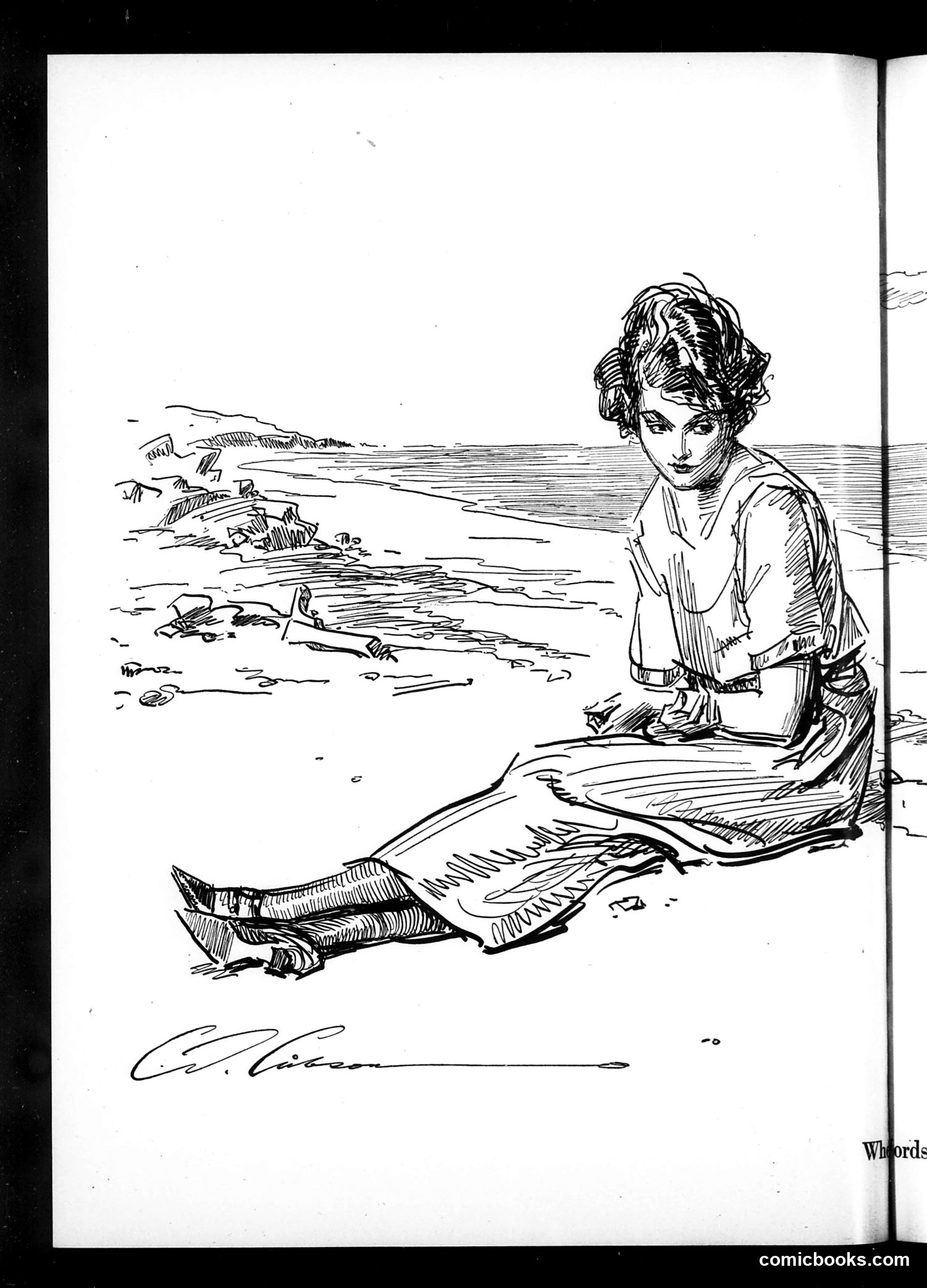
This appears to be an illustration from *Life* magazine, signed by the artist (signature visible at bottom). The image shows a woman in early 20th-century dress sitting on a beach, looking pensively toward the water where debris or wreckage is visible. Without additional OCR text or context from the page, the specific satirical point is unclear. The scene could reference: - A romantic or melodramatic narrative common to the era's fiction - Social commentary on women's circumstances or emotions - A literary or theatrical reference contemporary readers would recognize The introspective pose and beach setting suggest emotional or existential themes typical of *Life* magazine's satirical commentary on modern life and relationships during this period.
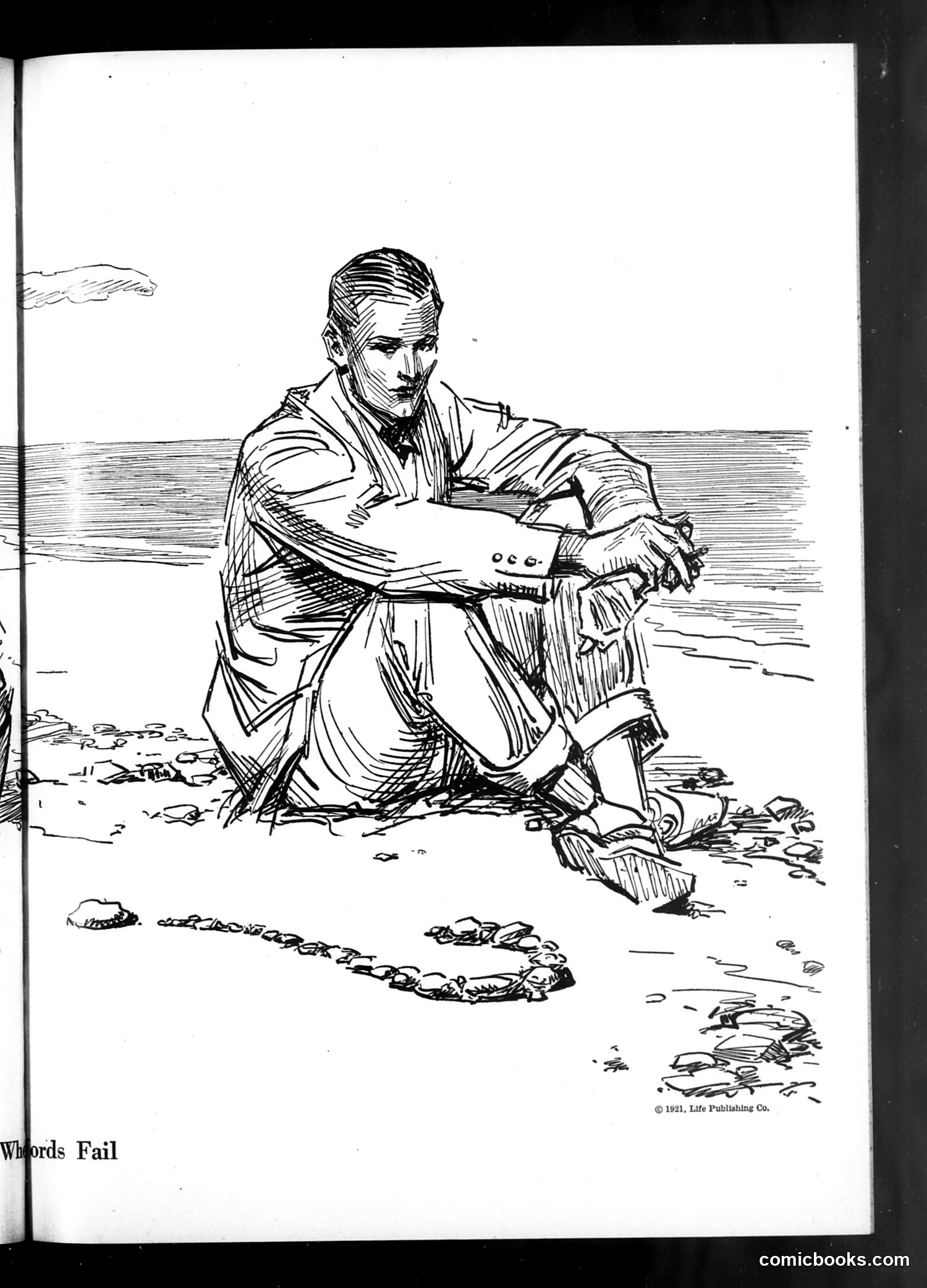
This 1921 Life magazine cartoon depicts a well-dressed man crouching on a beach, apparently trying to communicate with or measure something in the sand and water. The title "Words Fail" suggests the figure is at a loss for expression—unable to articulate his thoughts or feelings about what he observes. The specific subject remains unclear from the image alone. Without additional context about 1921 events, I cannot definitively identify the figure or pinpoint the exact political or social commentary. The beach setting and the man's gesture toward scattered objects or patterns in the sand suggest he's confronting something significant that defies easy explanation—fitting the "words fail" concept—but the precise reference requires historical documentation beyond what's visible here.
This page contains theater reviews from Life magazine's drama section, circa 1921. The main article critiques "Getting Gertie's Garter," a Broadway farce, written by Robert C. Benchley (a celebrated humorist and critic). **The Satire:** Benchley mocks both the play and its audience. "Getting Gertie's Garter" relies on crude humor—slamming doors, whisky gags—yet attracts audiences seeking titillation. Benchley notes the "preponderatingly feminine" laughter is "hysterical" and suggests Sigmund Freud could study the psychology of women giggling at innuendo-laden titles. He sardonically praises the B.V.D.'s reference (underwear brand) as a "tremendous hit"—mocking how audiences find risqué product placement hilarious. **The Joke:** The play itself isn't particularly naughty despite its suggestive title; audiences are disappointed but amused anyway. Benchley gently ridicules both the mediocre production and the easily entertained crowd. The page also includes brief reviews of "The Teaser" and other productions, offering context for 1921 Broadway entertainment standards.
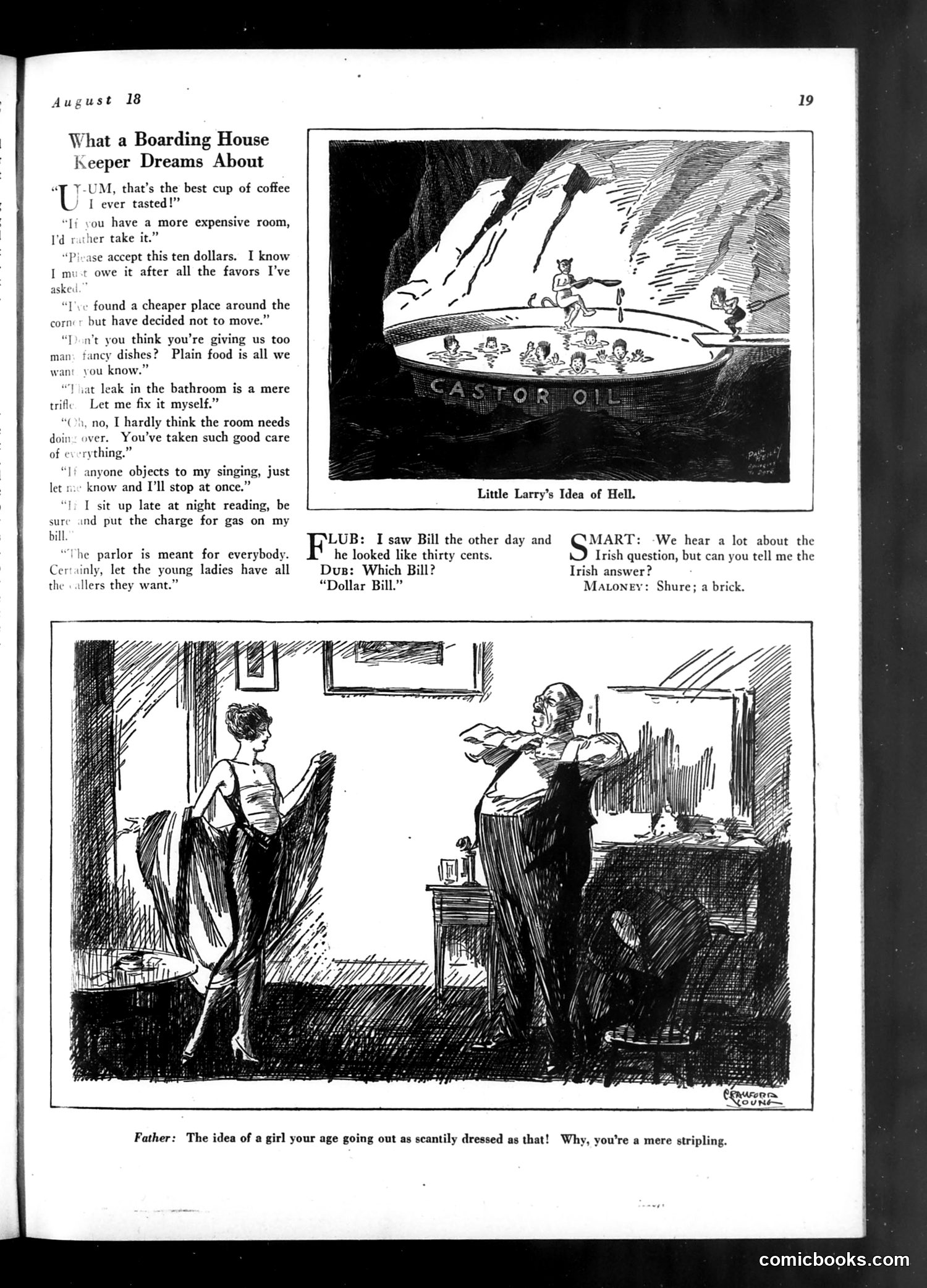
**Top Section - "What a Boarding House Keeper Dreams About":** This satirizes the unrealistic fantasies of boarding house operators. The quoted statements represent impossible tenants—those who praise the coffee, pay extra voluntarily, don't complain about leaks, sing at night without objection, and allow young women to entertain male callers freely. The satire mocks how landlords dream of ideal, compliant renters while reality delivers demanding, troublesome ones. **Middle Cartoon - "Little Larry's Idea of Hell":** A child's drawing depicts hell as a giant Castor Oil container filled with people. This jokes about children's universal hatred of castor oil, a common (foul-tasting) laxative administered to kids in this era. The satire equates the punishment of hell with being force-fed medicine. **Bottom Cartoon:** A father scolds his daughter for wearing revealing clothing, calling her "a mere stripling" (a thin, young person). This satirizes parental anxiety about 1920s fashion trends showing more skin—a moral panic of the era about loosening dress codes and youth behavior.
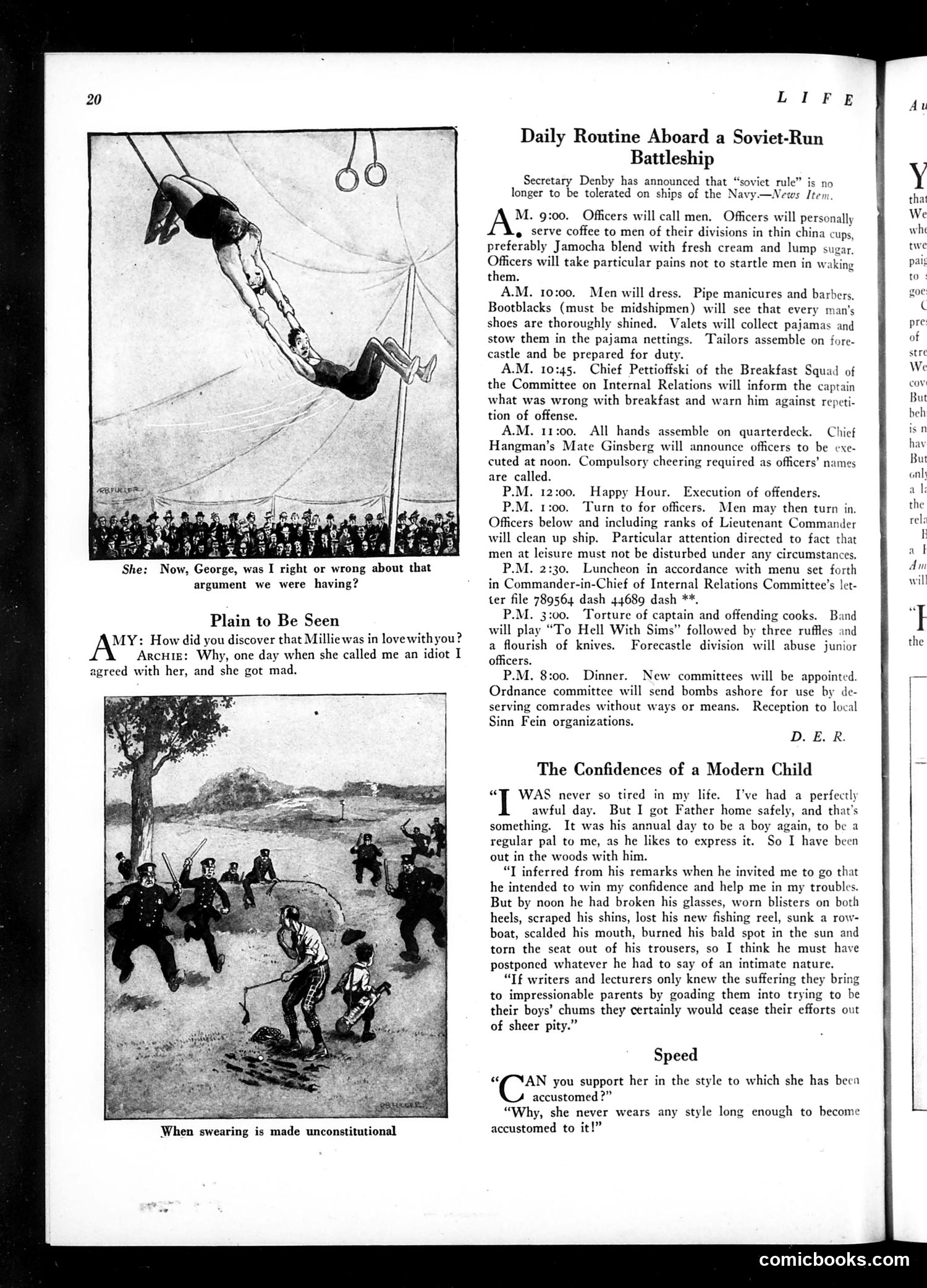
This page contains three satirical pieces reflecting post-WWI American anxieties: **Top cartoon**: A couple argues; the woman asks if she was "right or wrong." The humor relies on the visual joke that she's literally *right*—she's positioned on the right side of the image—making the argument about perspective absurd. **Middle section**: A lengthy satirical "Daily Routine Aboard a Soviet-Run Battleship" mocking Bolshevik ideology. Secretary Denby announced Soviet influence wouldn't be tolerated in the Navy. The piece sarcastically lists absurd inversions of naval hierarchy: officers serving coffee to men, executions as "Happy Hour," torture of captains, and alliances with Sinn Féin (Irish nationalist organization). This reflects 1920s Red Scare fears of communist infiltration. **Lower cartoons**: Standard domestic humor about courtship and marriage dynamics—unrelated to political content. The page satirizes American fears of Soviet-style class revolution threatening traditional military and social order.
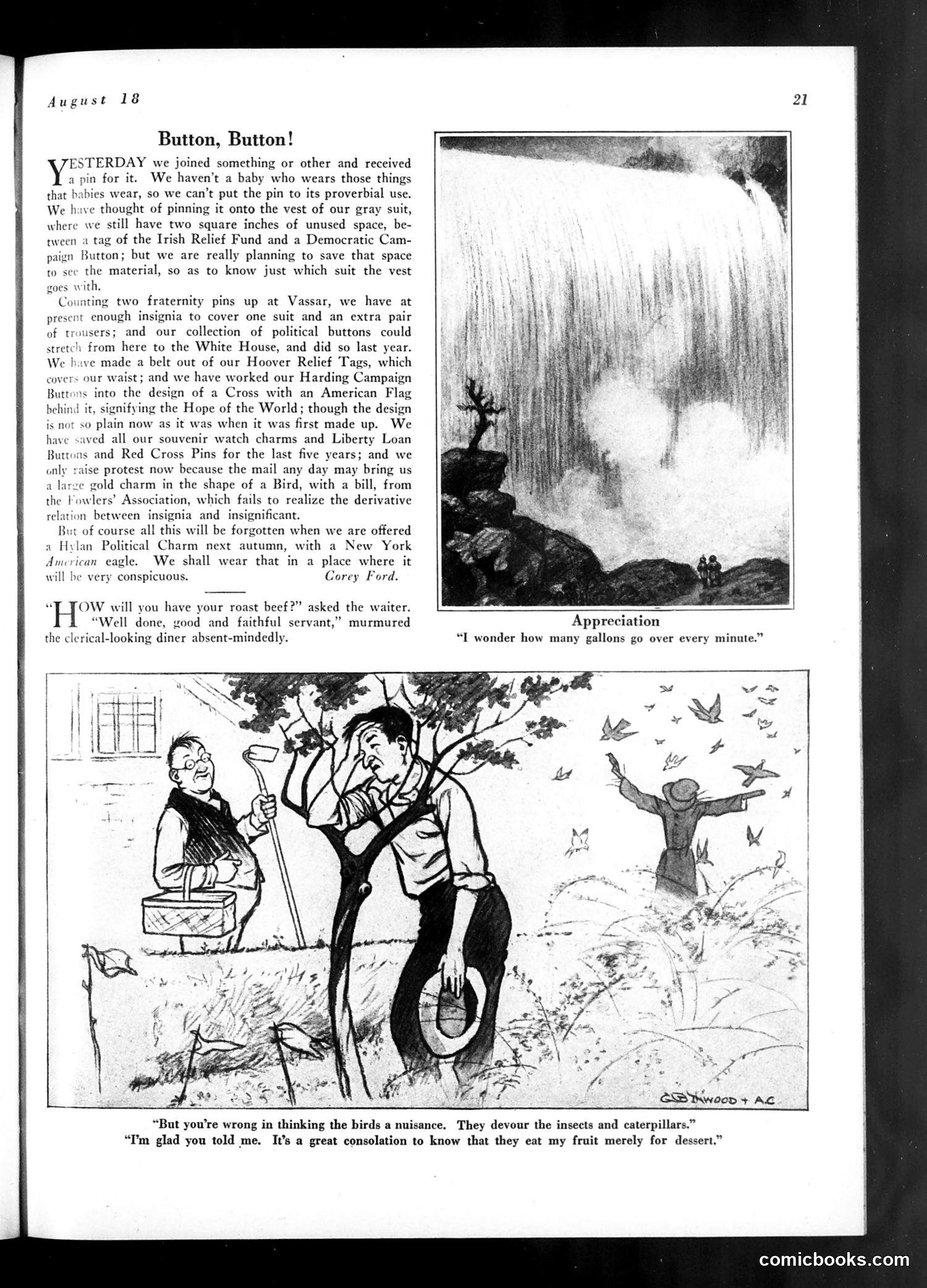
**"Button, Button!" Essay (Corey Ford):** A humorous complaint about accumulating commemorative pins and buttons from various causes—Irish Relief Fund, Democratic Campaign, Harding Campaign, Liberty Loans, Red Cross. The author sardonically describes fashioning them into belts and suit decorations, suggesting Americans are drowning in political/charitable insignia. The joke hinges on the absurdity of collecting so many trinkets that they become meaningless—conflating "insignia" with "insignificant." **Diner Cartoon:** A waiter asks a clerical-looking man about roast beef preparation. The diner, lost in thought, responds with a biblical phrase ("Well done, good and faithful servant"), confusing the mundane food question with religious language. It's a gentle joke about absent-mindedness and how professional/spiritual roles can intrude into everyday conversation. **Garden Cartoon:** A farmer protests that birds eating his fruit are actually beneficial because they consume insects. The farmer responds dryly that while appreciated, he'd prefer they ate insects *instead* of his fruit "for dessert"—highlighting how logic doesn't comfort someone losing their harvest.
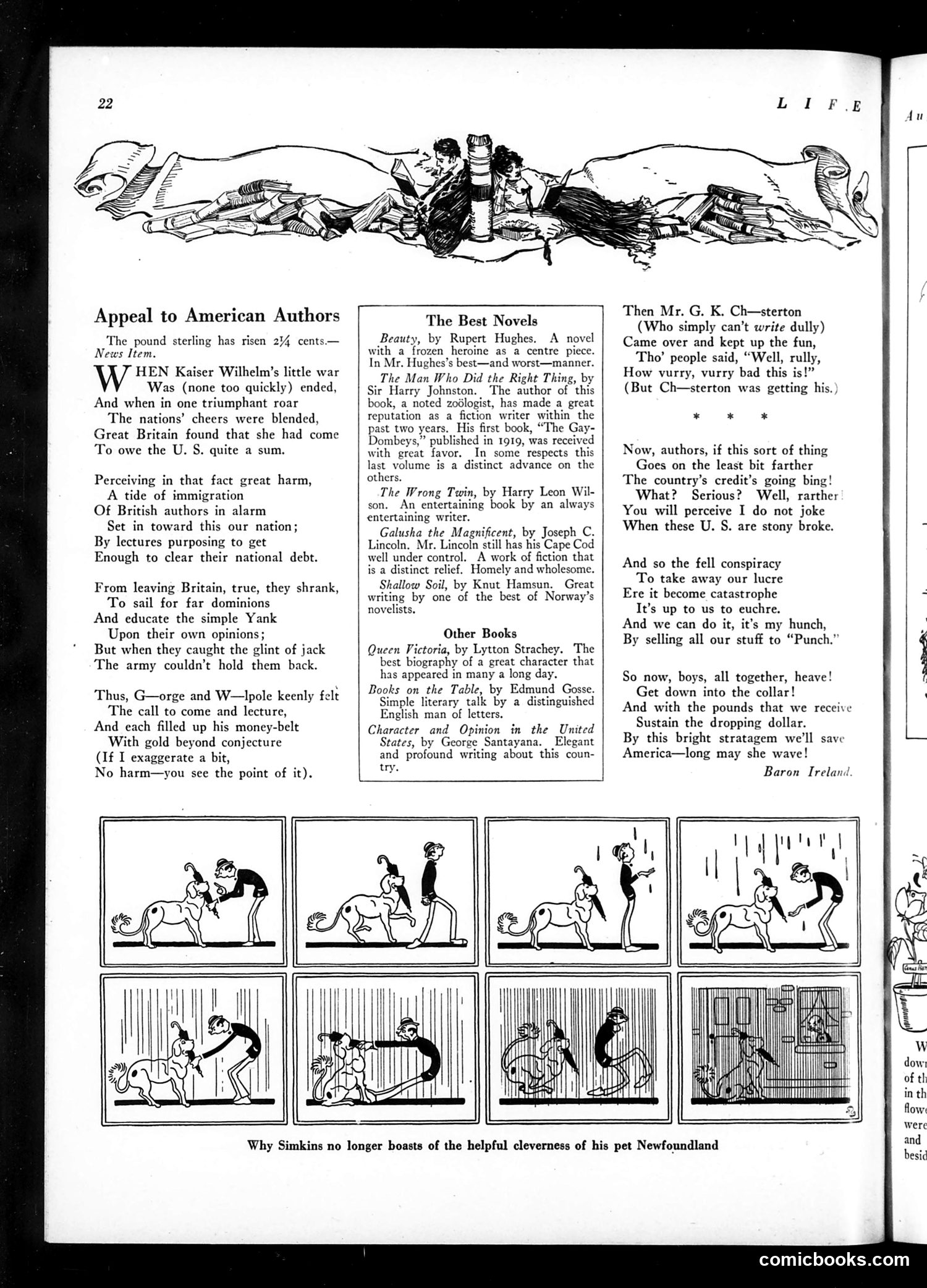
This page satirizes British authors lecturing in America after World War I to earn money—specifically referencing the financial debt Britain owed the U.S. following the war. The poem names **G.K. Chesterton** and **H.G. Wells** ("G—orge and W—lpole") as prominent British writers who came to America on lucrative lecture tours, supposedly to help repay Britain's war debt. The satire mocks this supposed patriotic motivation, suggesting they were simply chasing American money ("the glint of jack"). The joke: Britain, now financially desperate, is "exporting" its literary talent to extract dollars from wealthy Americans. The author warns that if this continues, America itself will go broke—the irony being that Britain hired these writers *because* America was wealthy enough to pay them. The byline "Baron Ireland" underscores the satirical tone of this economic anxiety about British cultural and financial influence in post-war America. The bottom cartoon strip about Simkins's Newfoundland appears unrelated to the main content.
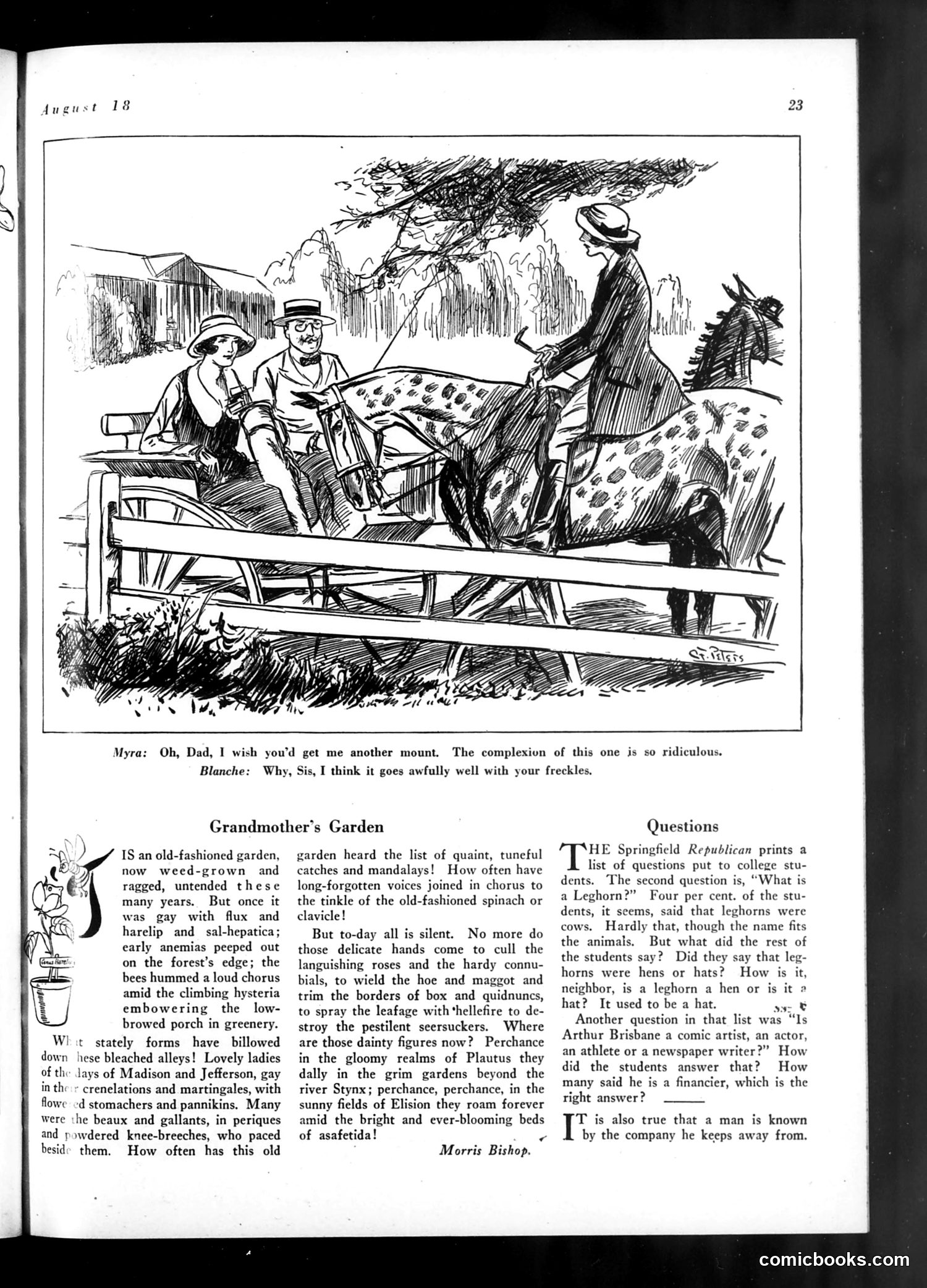
**The Cartoon (top):** A father and daughter are riding horses near a fence. The daughter (Myra) complains about her horse's "ridiculous" complexion, asking for another mount. The father (implied speaker) responds that the horse's coloring "goes awfully well with your freckles"—a gentle, teasing joke about the daughter's own complexion. The satire mocks the vanity of privileged young women who fuss over superficial appearances. **The Text Content:** Morris Bishop's nostalgic piece "Grandmother's Garden" romanticizes an old, now-neglected garden that once hosted elegant social gatherings. It's sentimental period humor using exaggerated medical terms ("harelip," "hysteria") as flower names—a playful linguistic joke for educated readers. **The Questions Section:** This mocks college students' ignorance. A Leghorn is a breed of chicken, yet students called it a cow or hat. Arthur Brisbane is a newspaper writer/editor, yet students answered incorrectly. The final quip—"a man is known by the company he keeps away from"—is witty social commentary on choosing good associates.
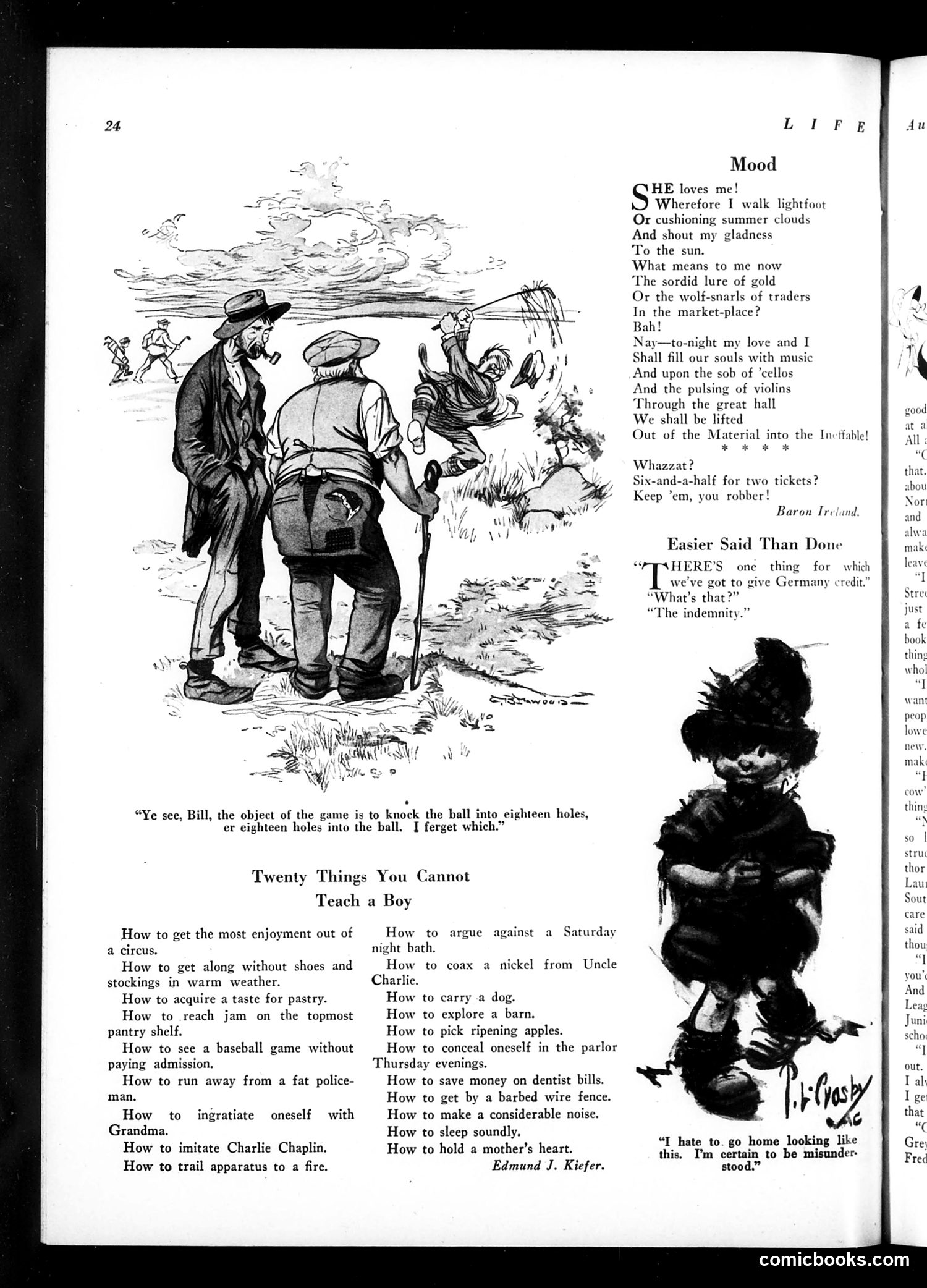
This page contains three distinct pieces of humor: **Top cartoon**: A man in formal attire interrupts two others discussing golf, asking about "eighteen holes." The joke plays on the speaker's confusion about golf rules—he's forgotten whether the object is knocking the ball into holes or holes into the ball. It's gentle absurdist humor about the complexity (or apparent absurdity) of golf. **"Mood" poem**: A satirical romantic poem where a lovesick man waxes poetic about love and music, until interrupted by the practical reality: concert tickets cost "six-and-a-half" (dollars), prompting him to angrily refuse. The satire punctures romantic idealism with working-class economics. **"Easier Said Than Done"**: A brief joke about post-WWI politics—Germany must be credited with something: paying war indemnities. This references reparations Germany owed after World War I. **"Twenty Things You Cannot Teach a Boy"**: A humorous list by Edmund J. Kiefer cataloging boyish mischief and independence—truancy, sneaking into baseball games, running from police—capturing early 20th-century childhood antics with affectionate exasperation.
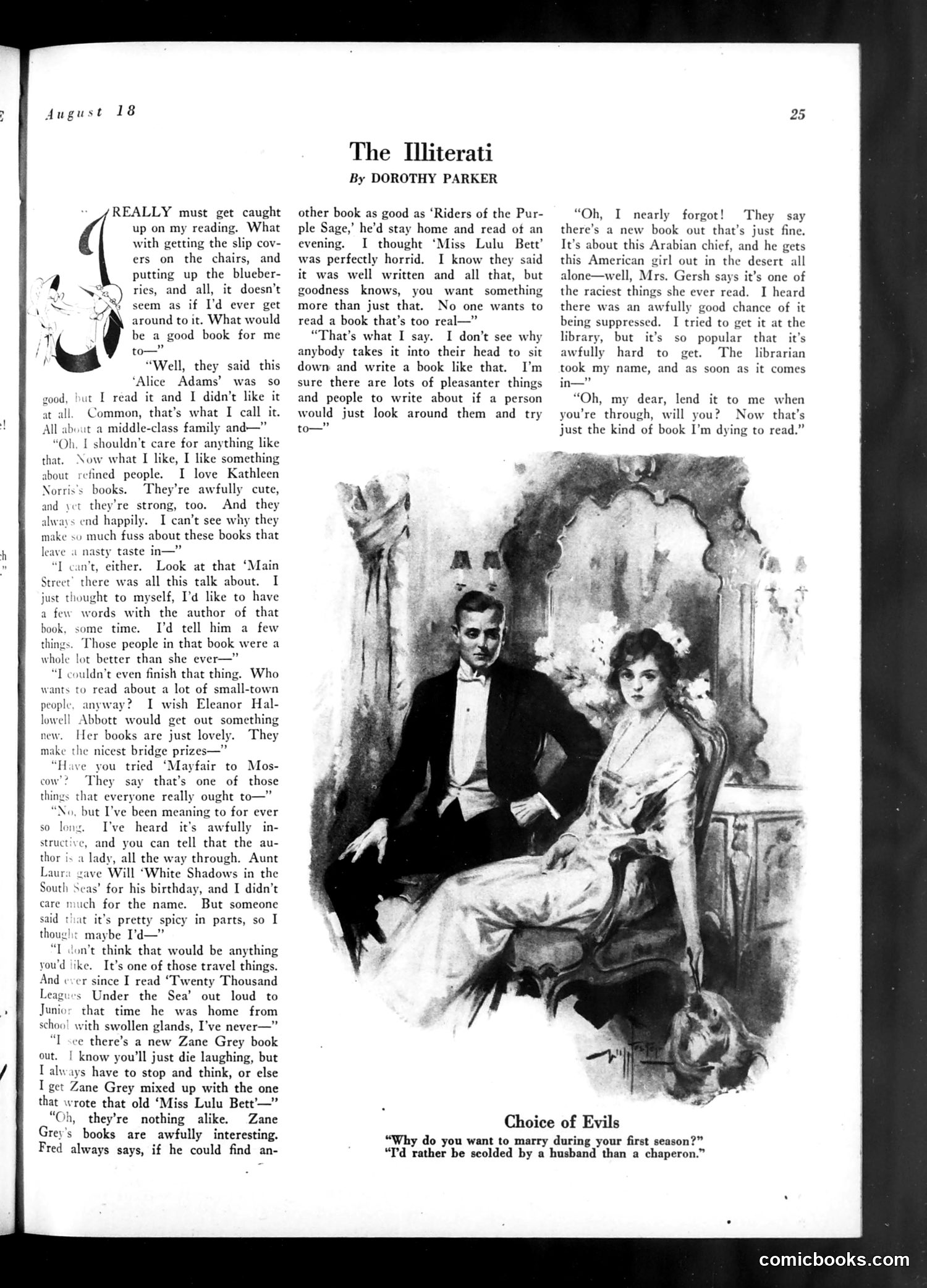
This satirical piece mocks upper-middle-class women's pretentious but shallow reading habits. The two women discuss books they haven't read or disliked ("Alice Adams," "Main Street"), dismiss serious literature as "too real," and favor sentimental romances by Kathleen Norris and Zane Grey. They confuse authors, judge books by social status rather than merit, and primarily want books that "end happily" or serve as bridge-party prizes. Parker's title—"The Illiterati"—is a play on "literati" (the educated). The satire targets women who claim cultural refinement while actually avoiding challenging literature. The illustration and accompanying cartoon caption ("I'd rather be scolded by a husband than a chaperon") reinforce the era's gender assumptions about women's limited intellectual autonomy. The piece reflects 1920s anxieties about women's reading and education during a period of increasing female independence.
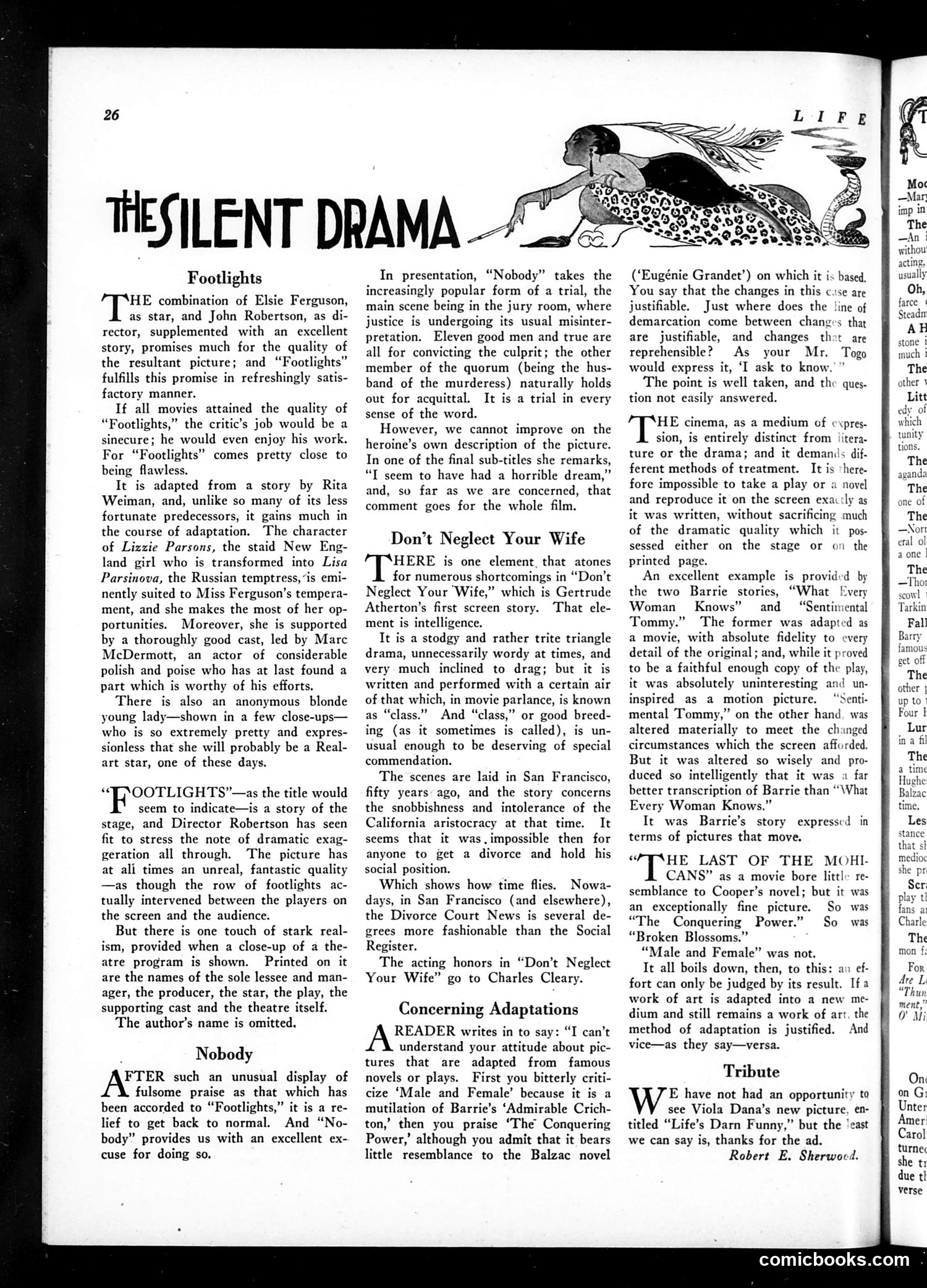
This page contains three film reviews from Life's cinema section. The critic discusses three silent films: **"Footlights"** - Praised as nearly flawless, starring Elsie Ferguson as a New England girl transformed into a Russian temptress. The reviewer praises the adaptation and cast, though notably points out the author's name is omitted from the theater program credits shown on screen—a satirical jab at Hollywood's treatment of writers. **"Nobody"** - Criticized as tedious, structured around a jury trial where eleven jurors want conviction but one (a husband of the accused murderess) holds out for acquittal. The reviewer dismisses it as a "horrible dream." **"Don't Neglect Your Wife"** - A triangle drama set in 1870s San Francisco, addressing divorce and social class. The critic gives backhanded praise for its "intelligence" and "class," then makes a satirical observation: society's attitudes toward divorce have reversed—once socially ruinous, it's now commonplace. The satire targets both filmmaking quality and social hypocrisy regarding divorce.
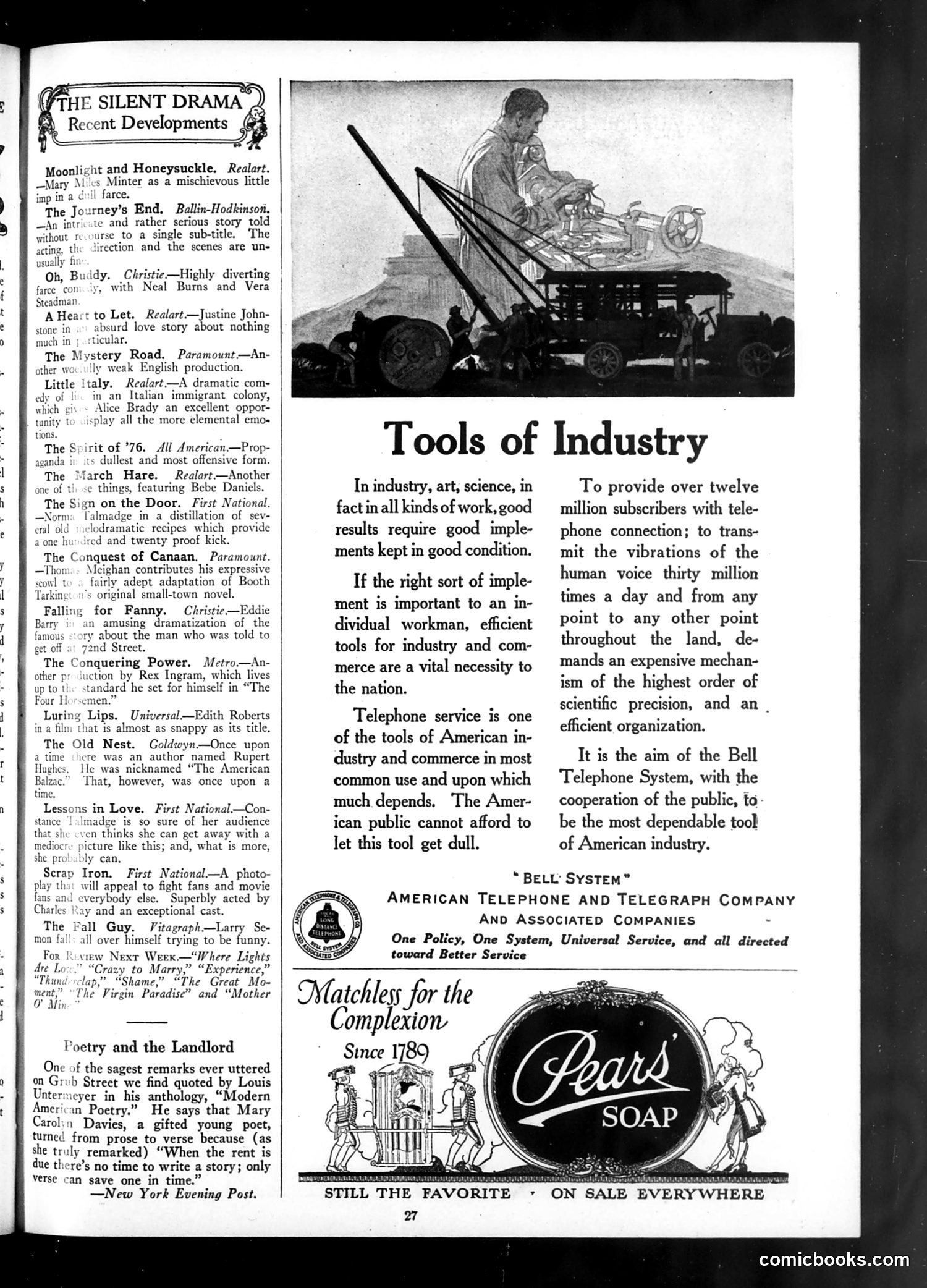
This page is primarily **advertising content**, not satire or political commentary. The main visual shows a worker operating industrial machinery, paired with a Bell Telephone System advertisement arguing that telephone service is essential infrastructure for American business. The "Tools of Industry" ad makes a straightforward corporate argument: just as individual workers need proper equipment, the nation requires robust telephone infrastructure. Bell positions itself as a patriotic service provider—claiming the American public "cannot afford to let this tool get dull." The left column lists brief film reviews from *Life*'s "Silent Drama" section, covering contemporary motion pictures with standard critical assessments. Below is a *Pear's Soap* advertisement boasting continuous popularity "Since 1789." There is no discernible satire or political critique here—this appears to be a standard magazine page mixing entertainment reviews with corporate advertising, characteristic of early-1920s American magazines.
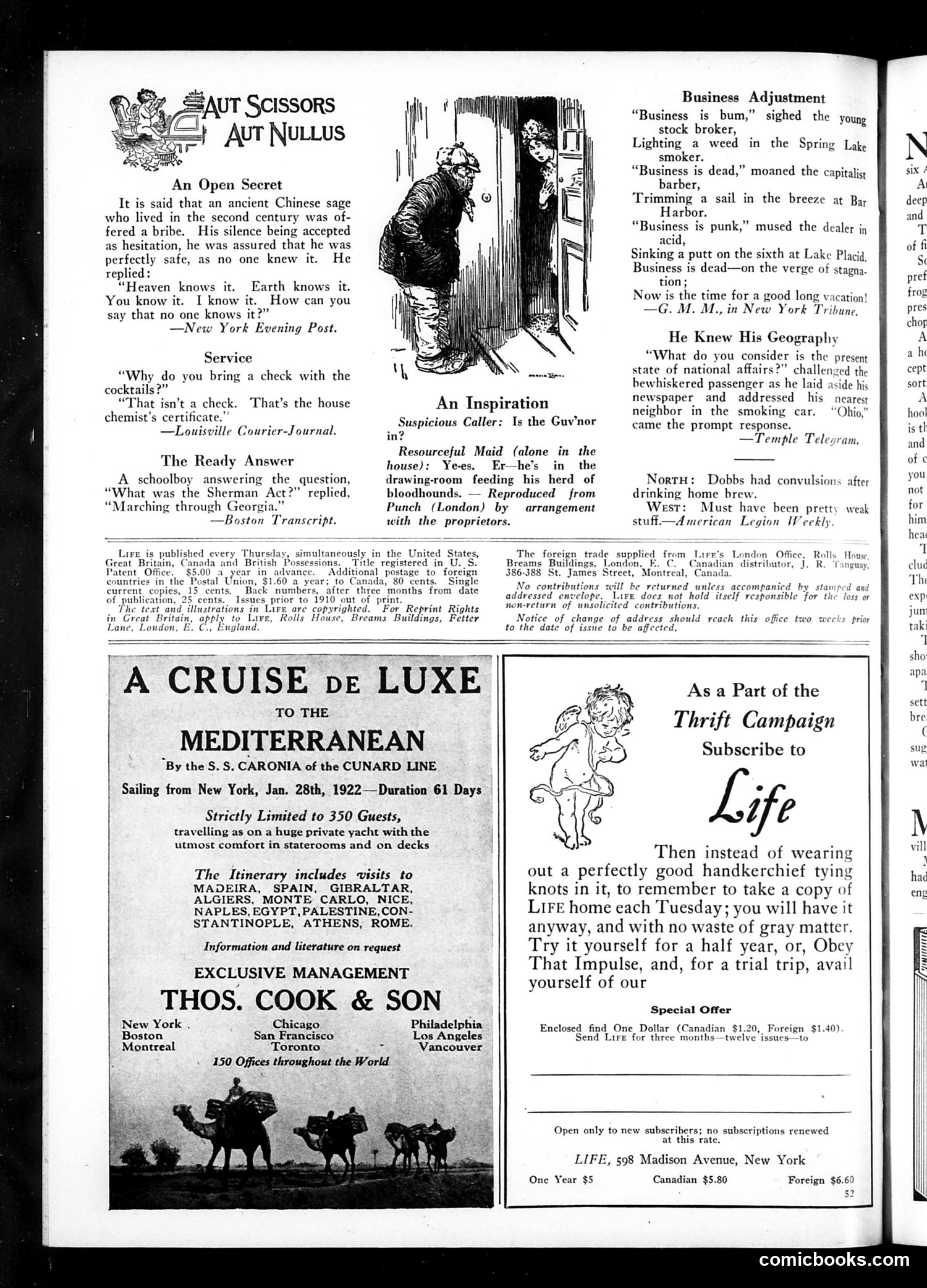
This page from Life magazine (circa 1922) contains several short humorous pieces and advertisements reflecting post-WWI American concerns. ## The Cartoons/Jokes: **"Business Adjustment"** satirizes economic pessimism during the early 1920s recession. A stock broker, capitalist barber, and acid dealer all claim "business is dead/bum/punk" while enjoying leisure activities (smoking, sailing, golfing)—the irony being that anyone with leisure time and vacation money isn't actually suffering economically. The joke mocks those who exaggerate hardship while living comfortably. **"He Knew His Geography"** uses Prohibition-era humor. A passenger asks about "the present state of national affairs," and receives the answer "Ohio"—likely referencing Ohio's importance as a swing state or possibly alluding to Warren G. Harding (Ohio's senator, soon-to-be president in 1921). The vagueness of the response satirizes political evasiveness. **The remaining items** are brief anecdotes: one about bootleg ("home brew") causing illness, another about a resourceful maid feeding bloodhounds to a suspicious caller. The page also advertises luxury Mediterranean cruises and Life magazine subscriptions—targeting affluent readers despite economic uncertainty.
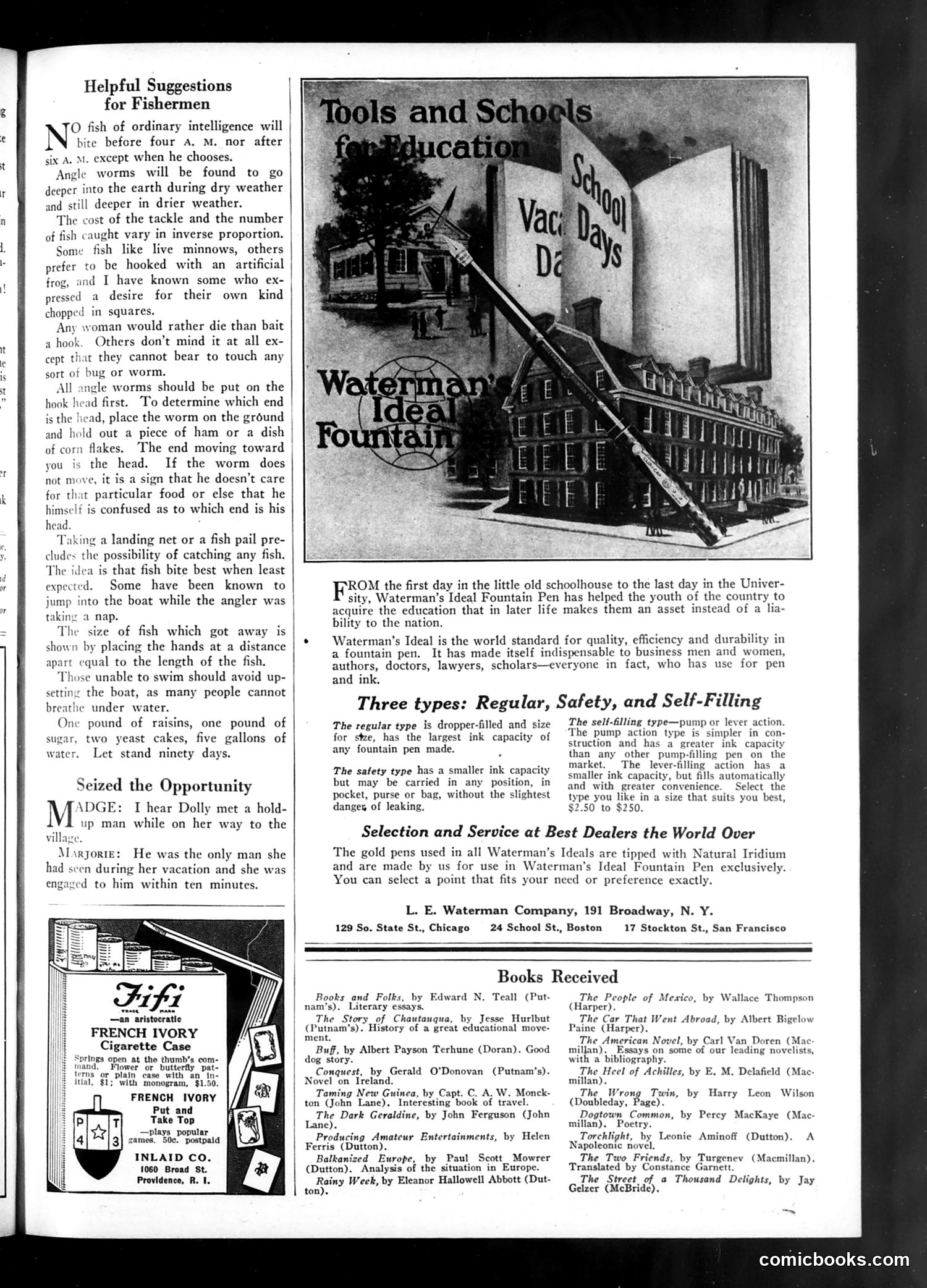
This page contains **humor and advertisements**, not political cartoons. The main satirical content is a section titled "Helpful Suggestions for Fishermen"—humorous, absurdist advice about fishing habits. It jokes that fish won't bite at certain hours, that their size varies inversely with tackle cost, and offers ridiculous tips like determining a worm's head by offering it ham or corn flakes. The humor relies on exaggeration and illogical reasoning typical of early 20th-century comic writing. A brief anecdote titled "Seized the Opportunity" jokes that a young woman (Dolly) became engaged to a hold-up man simply because he was the only man she'd encountered during her vacation—satirizing women's desperation for romance. The page primarily features **advertisements** for Waterman's Ideal Fountain Pens, a French Ivory cigarette case, and a book list. The Waterman's ad emphasizes the pen's indispensability to educated professionals and students.
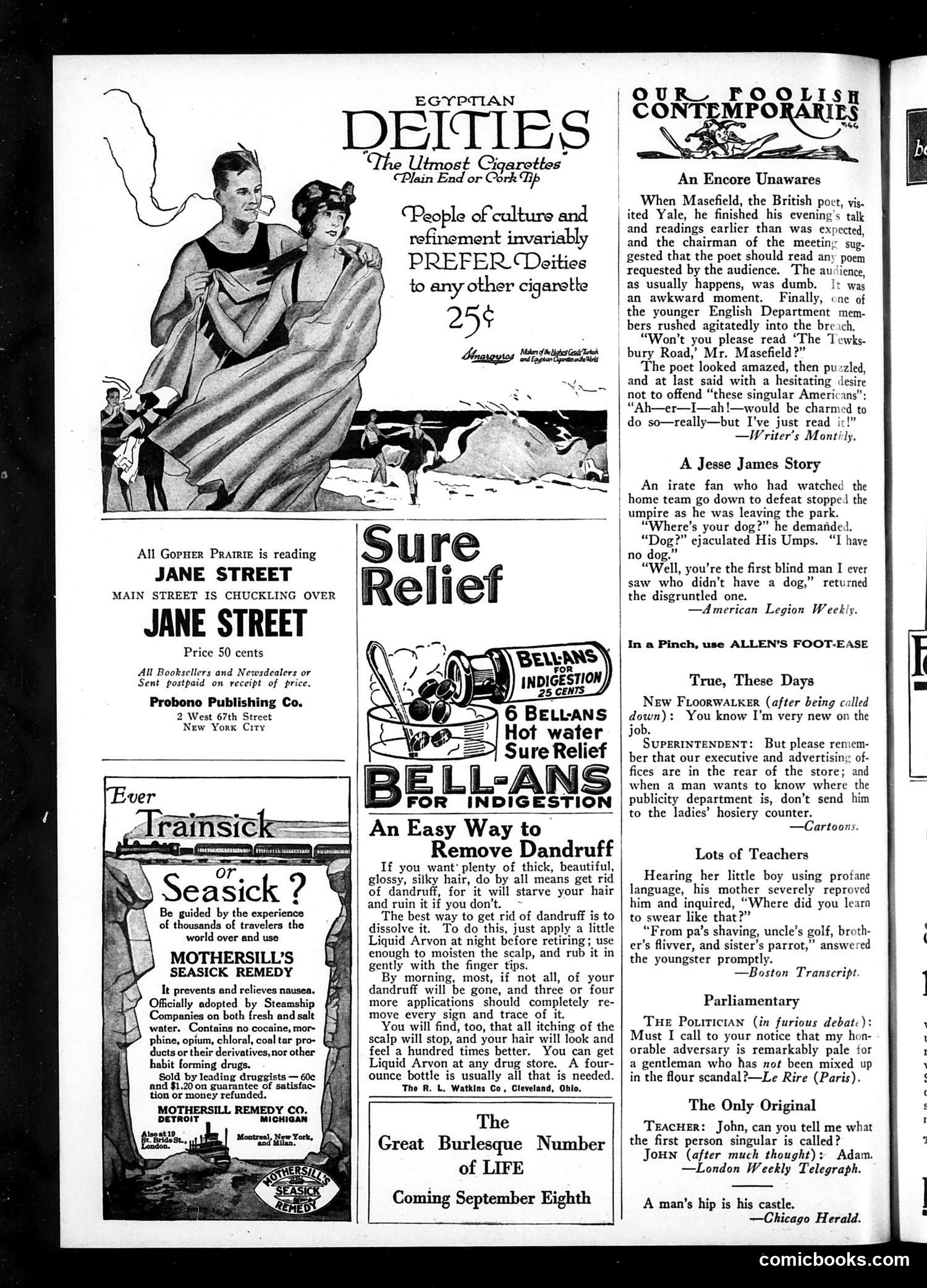
This **Life magazine page is primarily advertisements and humor pieces**, not political cartoons requiring historical context. The top features a **Deities cigarette ad** using a classical appeal—suggesting cigarettes signal "culture and refinement." The imagery shows classical figures, a common advertising tactic of the era. Below are **product advertisements** (Mothersill's Seasick Remedy, Bellans indigestion tablets, Liquid Arvon dandruff treatment) typical of early 20th-century magazines. The **right column contains brief humorous anecdotes**: - A story about British poet John Masefield at Yale, awkwardly asked to re-read a poem he'd just finished - A baseball fan insulting an umpire's blindness - A boy listing profane influences (father shaving, uncle golfing, sister's parrot) - Workplace satire about a new floor-walker These jokes rely on gentle social observation rather than political commentary—mostly poking fun at everyday embarrassments and generational differences. The humor is mild by modern standards.
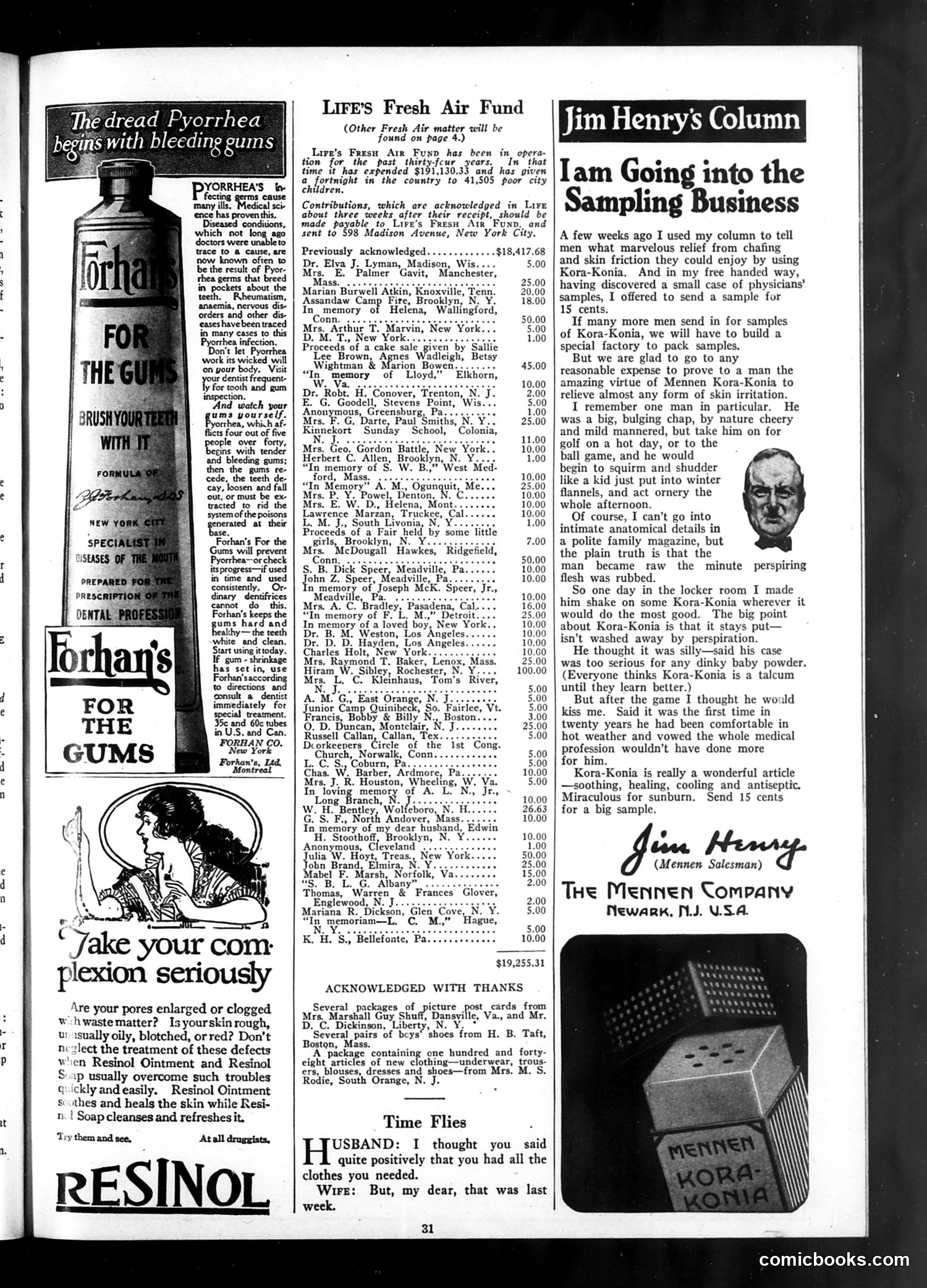
This page is primarily **advertising and charitable fundraising content**, not political satire. The main elements are: 1. **Forhan's and Resinol ads** (left side): vintage patent medicine advertisements claiming to prevent/cure tooth decay and skin problems through oral hygiene and ointments. These represent early 20th-century medical marketing common to the era. 2. **Life's Fresh Air Fund** (center): a charitable appeal listing donations to send poor city children on vacations to the country. The fund had operated 34 years and raised over $191,000—a legitimate charitable endeavor. 3. **Jim Henry's Column** (right): Henry humorously discusses his discovery that Kora-Konia (appears to be a powder product) relieves skin irritation, written in an endorsement style. The accompanying illustration shows the product. 4. **"Time Flies" joke** (bottom): A brief married couple exchange about clothes. The page contains **no political cartoons or satire**—it's a mix of period advertising, charitable fundraising, and light humor typical of Life magazine's editorial content.
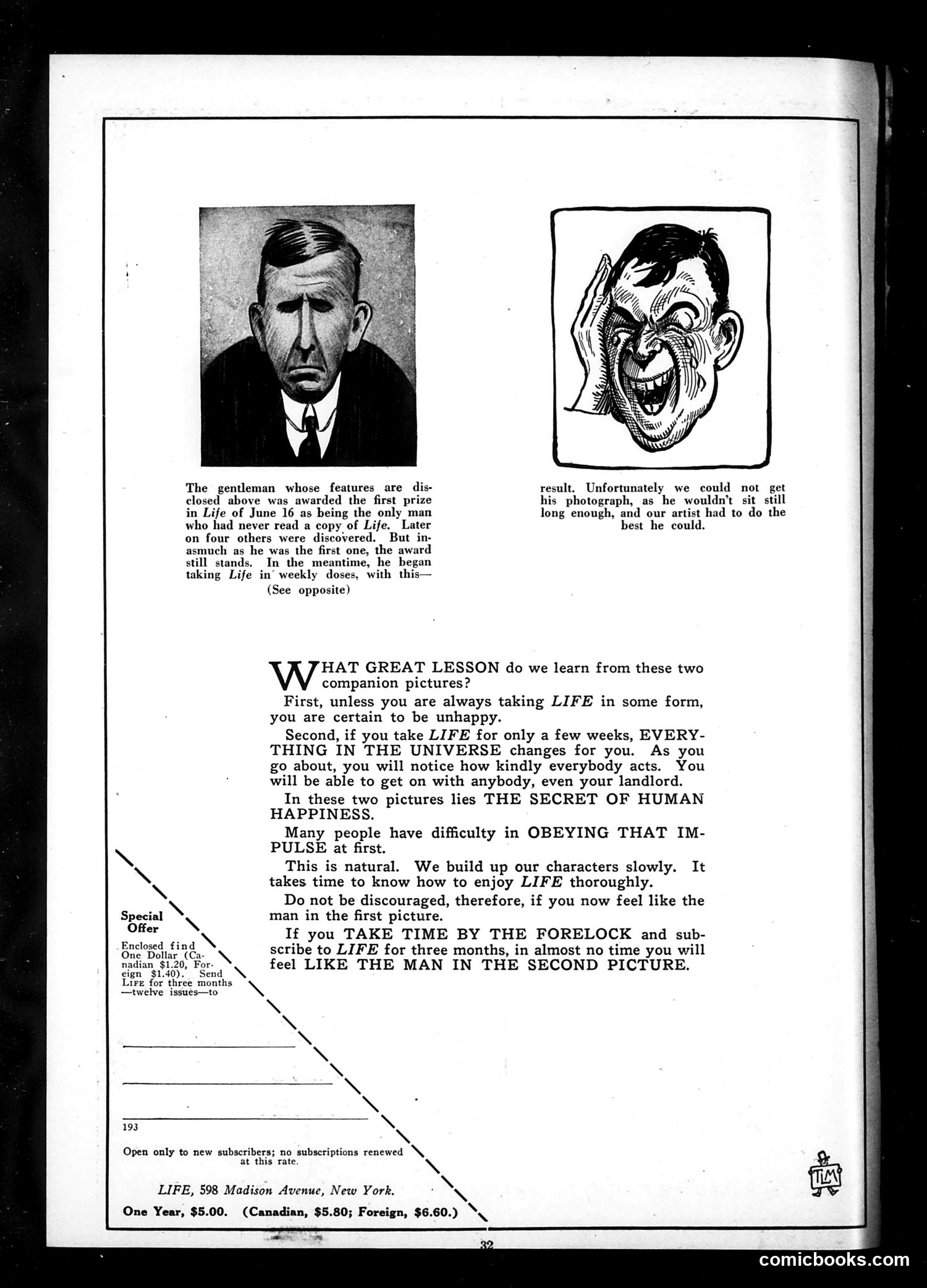
This is primarily a **subscription advertisement** disguised as humor. The page contrasts two images: a dour, unhappy-looking man (left) versus a grinning, exaggerated caricature (right) with grotesque features. The satirical "joke" claims the left man won a Life magazine prize for never reading a copy. After subscribing for a few weeks, he supposedly transforms into the cheerful (if absurdly drawn) figure on the right. **The pitch:** Reading Life magazine regularly will make you happier, improve your social relationships, and change your outlook. The exaggerated caricature on the right parodies the promised transformation—it's deliberately ugly-comic, suggesting the promised happiness is somewhat ridiculous. This is typical early-20th-century magazine advertising using self-referential humor: Life promotes itself as essential to happiness while mocking the premise through the absurd "before/after" contrast. The special offer (one dollar for three months' subscription) appears in the left margin.

I can see this is a very dark, low-contrast black and white page that appears to show decorative or ornamental patterns - possibly circular medallions or design elements arranged vertically. However, the image quality is too poor for me to reliably discern specific cartoon figures, facial features, or satirical details that would allow me to identify the subjects or explain the political/social commentary. The watermark indicates this is from comicbooks.com, and the page appears to be from a historical magazine, but without clearer visibility of the actual content, I cannot accurately identify the figures, caricatures, or satirical point being made. A higher-quality or higher-contrast scan would be needed for proper analysis.