
Life, 1921-08-18 · page 28 of 35
Life — August 18, 1921 — page 28: what you’re looking at
What you’re looking at
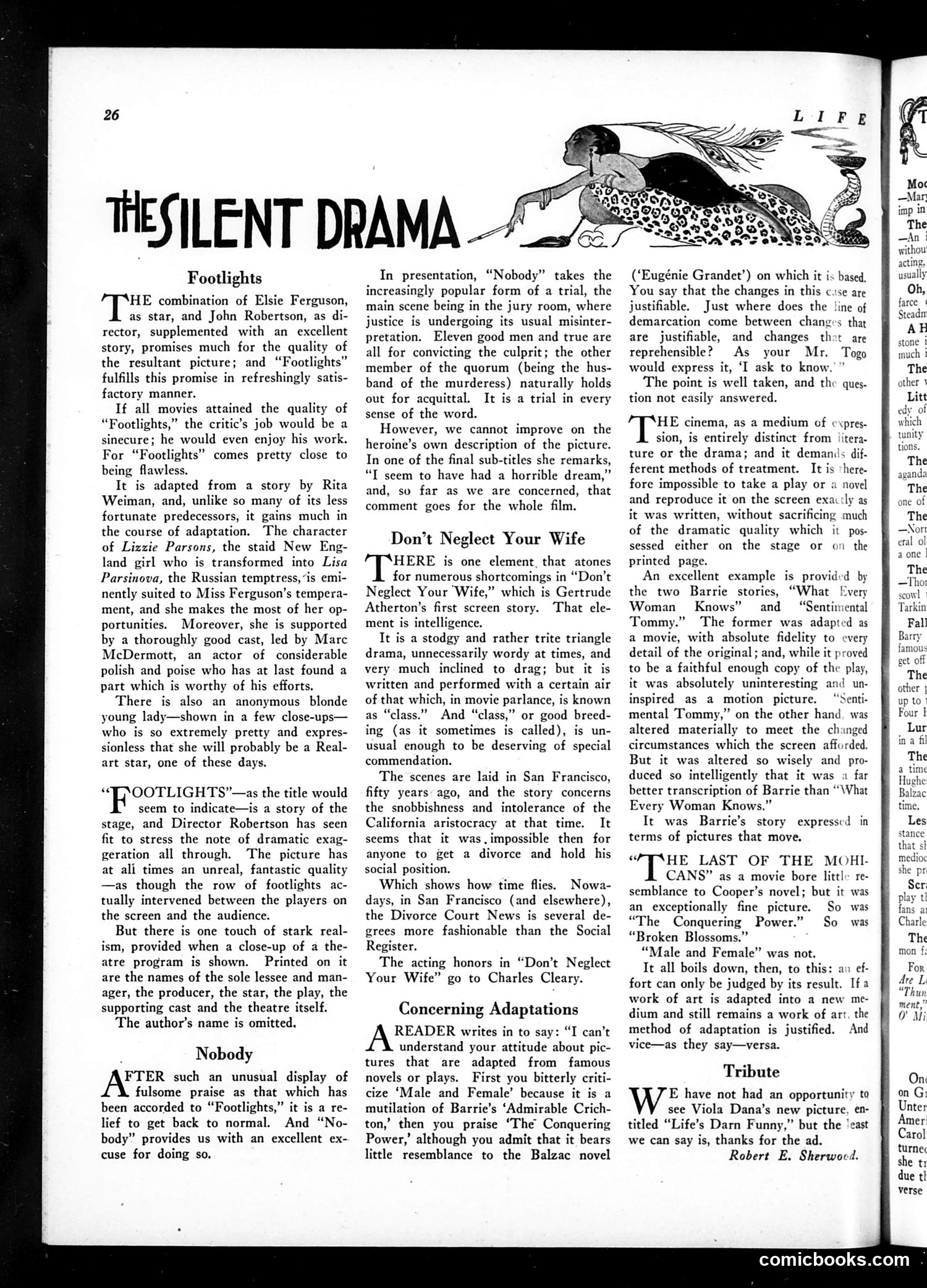
This page contains three film reviews from Life's cinema section. The critic discusses three silent films: **"Footlights"** - Praised as nearly flawless, starring Elsie Ferguson as a New England girl transformed into a Russian temptress. The reviewer praises the adaptation and cast, though notably points out the author's name is omitted from the theater program credits shown on screen—a satirical jab at Hollywood's treatment of writers. **"Nobody"** - Criticized as tedious, structured around a jury trial where eleven jurors want conviction but one (a husband of the accused murderess) holds out for acquittal. The reviewer dismisses it as a "horrible dream." **"Don't Neglect Your Wife"** - A triangle drama set in 1870s San Francisco, addressing divorce and social class. The critic gives backhanded praise for its "intelligence" and "class," then makes a satirical observation: society's attitudes toward divorce have reversed—once socially ruinous, it's now commonplace. The satire targets both filmmaking quality and social hypocrisy regarding divorce.
📄 Transcribed text from this page (OCR, searchable)
Machine-transcribed from the original scan — historical spelling and the odd misread are preserved.
TESILENT DRAMA Footlights HE combination of Elsie Ferguson, as star, and John Robertson, as di- rector, supplemented with an excellent story, promises much for the quality of the resultant picture; and “Footlights” fulfills this promise in refreshingly satis- factory manner. If all movies attained the quality of “Footlights,” the critic’s job would be a sinecure; he would even enjoy his work. For “Footlights” comes pretty close to being flawless. It is adapted from a story by Rita Weiman, and, unlike so many of its less fortunate predecessors, it gains much in the course of adaptation. The character of Lizzie Parsons, the staid New Eng- land girl who is transformed into Lisa Parsinova, the Russian temptress,“is emi- nently suited to Miss Ferguson’s tempera- ment, and she makes the most of her op- portunities. Moreover, she is supported by a thoroughly good cast, led by Marc McDermott, an actor of considerable polish and poise who has at last found a part which is worthy of his efforts. There is also an anonymous blonde young lady—shown in a few close-ups— who is so extremely pretty and expres- sionless that she will probably be a Real- art star, one of these days. “TXOOTLIGHTS”—as the title would seem to indicate—is a story of the stage, and Director Robertson has seen fit to stress the note of dramatic exag- geration all through. The picture has at ali times an unreal, fantastic quality —as though the row of footlights ac- tually intervened between the players on the screen and the audience. But there is one touch of stark real- ism, provided when a close-up of a the- atre program is shown. Printed on it are the names of the sole lessee and man- ager, the producer, the star, the play, the supporting cast and the theatre itself. The author’s name is omitted. Nobody FTER such an unusual display of fulsome praise as that which has been accorded to “Footlights,” it is a re- lief to get back to normal. And “No- body” provides us with an excellent ex- cuse for doing so, In presentation, “Nobody” takes the increasingly popular form of a trial, the main scene being in the jury room, where justice is undergoing its usual misinter- pretation. Eleven good men and true are all for convicting the culprit; the other member of the quorum (being the hus- band of the murderess) naturally holds out for acquittal. It is a trial in every sense of the word. However, we cannot improve on the heroine’s own description of the picture. In one of the final sub-titles she remarks, “T seem to have had a horrible dream,” and, so far as we are concerned, that comment goes for the whole film. Don’t Neglect Your Wife HERE is one element, that atones for numerous shortcomings in “Don’t Neglect Your Wife,” which is Gertrude Atherton’s first screen story. That ele- ment is intelligence. It is a stodgy and rather trite triangle drama, unnecessarily wordy at times, and very much inclined to drag; but it is written and performed with a certain air of that which, in movie parlance, is known as “class.” And “class,” or good breed- ing (as it sometimes is called), is un- usual enough to be deserving of special commendation. The scenes are laid in San Francisco, fifty years ago, and the story concerns the snobbishness and intolerance of the California aristocracy at that time. It seems that it was.impossible then for anyone to get a divorce and hold his social position. Which shows how time flies. Nowa- days, in San Francisco (and elsewhere), the Divorce Court News is several de- grees more fashionable than the Social Register. The acting honors in “Don’t Neglect Your Wife” go to Charles Cleary. Concerning Adaptations READER writes in to say: “I can’t understand your attitude about pic- tures that are adapted from famous novels or plays. First you bitterly criti- cize ‘Male and Female’ because it is a mutilation of Barrie’s ‘Admirable Crich- ton,’ then you praise ‘The Conquering Power,’ although you admit that it bears little resemblance to the Balzac novel (‘Eugénie Grandet’) on which it is based, You say that the changes in this c.se are justifiable. Just where does the !ine of demarcation come between changes that are justifiable, and changes thet are reprehensible? As your Mr. Togo would express it, ‘I ask to know. The point is well taken, and the ques- tion not easily answered. HE cinema, as a medium of expres- sion, is entirely distinct from |itera- ture or the drama; and it demanis dif- ferent methods of treatment. It is *here- fore impossible to take a play or a novel and reproduce it on the screen exactly as it was written, without sacrificing much of the dramatic quality which it pos- sessed either on the stage or on the printed page. An excellent example is provided by the two Barrie stories, “What [Every Woman Knows” and “Sentimental Tommy.” The former was adapted as a movie, with absolute fidelity to every detail of the original; and, while it proved to be a faithful enough copy of the play, it was absolutely uninteresting and un- inspired as a motion picture. “Senti- mental Tommy,” on the other hand. was altered materially to meet the changed circumstances which the screen afforded. But it was altered so wisely and pro- duced so intelligently that it was « far better transcription of Barrie than “What Every Woman Knows.” It was Barrie’s story expressed in terms of pictures that move. $s HE LAST OF THE MOHI- CANS” as a movie bore little re- semblance to Cooper’s novel; but it was an exceptionally fine picture. So was “The Conquering Power.” So was “Broken Blossoms.” “Male and Female” was not. It all boils down, then, to this: an ef- fort can only be judged by its result. If a work of art is adapted into a new me- dium and still remains a work of art, the method of adaptation is justified. And vice—as they say—versa. Tribute E have not had an opportunity to see Viola Dana’s new picture, en- titled “Life’s Darn Funny,” but the ‘east we can say is, thanks for the ad. Robert E. Sherwocd. Steadn AE stone inuch i The other | Litt edy of which tunity tions. The aganda The one of The —Nort eral ol a one | The —Thor scowl Tarkin Fall Barry famou: get off The other | up to | Four | Lur ina fi stance that sl fans ai Charle The mon {i For Are Li “Thur ment, 0 Mi comicbooks.com