
Life, 1921-08-18 · page 17 of 35
Life — August 18, 1921 — page 17: what you’re looking at
What you’re looking at
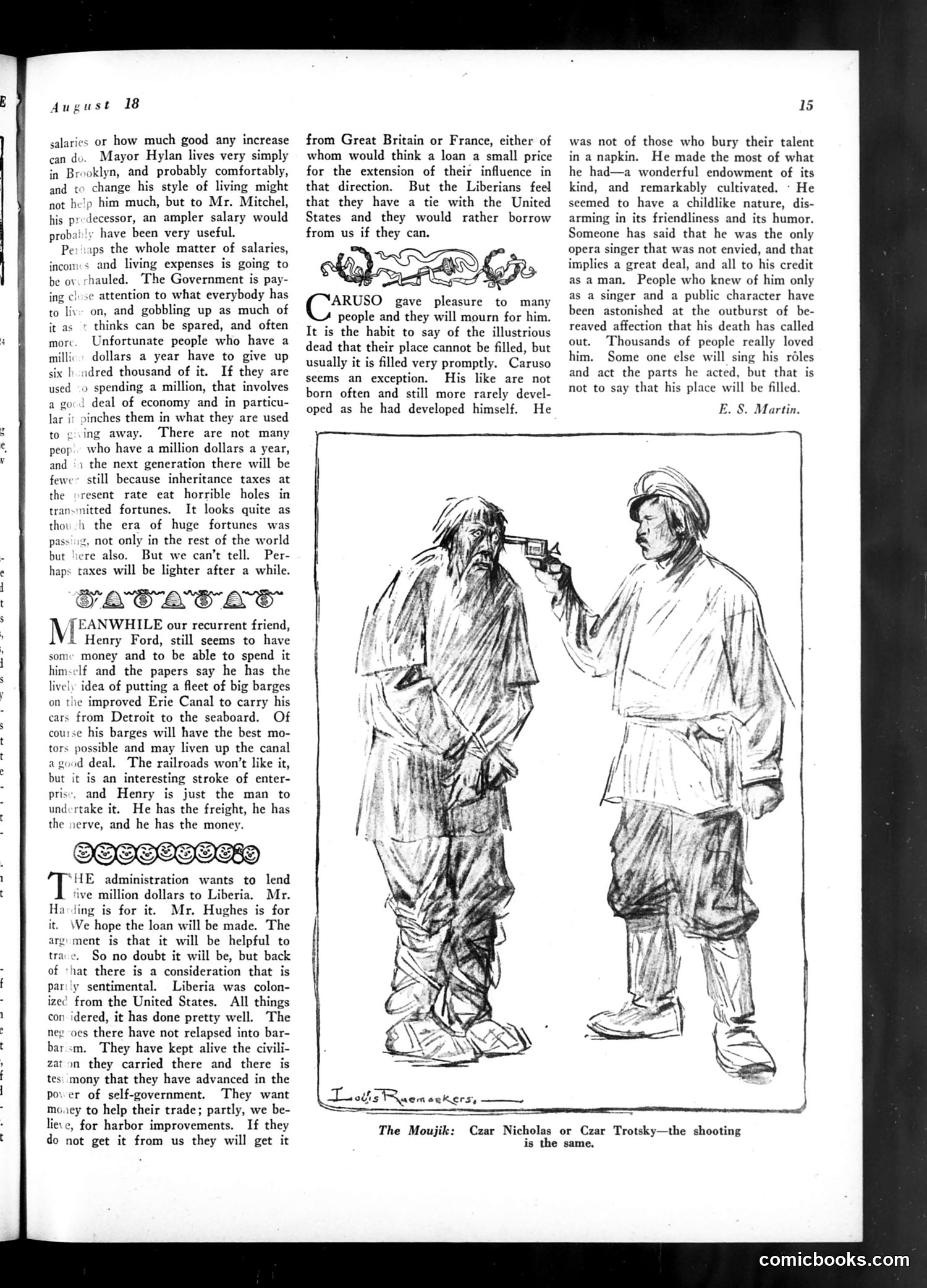
This August 18 page from *Life* magazine contains political and social commentary typical of the era. The main cartoon depicts two figures in peasant clothing labeled "The Moujik: Czar Nicholas or Czar Trotsky—the shooting is the same." This satirizes the Russian Revolution, suggesting that whether ruled by the Tsar or the Bolsheviks (Trotsky), ordinary Russian peasants face identical hardship and violence. The identical poses and "shooting" reference imply that revolutionary change brought no material improvement for common people. The text discusses Henry Ford's Erie Canal barge scheme, a proposed loan to Liberia, and tributes to opera singer Enrico Caruso. The Liberia section reveals anxiety about American influence competing against British and French colonial interests during the post-WWI period. Overall, the page reflects early 1920s concerns about labor, capitalism, international power dynamics, and the Russian Revolution's aftermath.
📄 Transcribed text from this page (OCR, searchable)
Machine-transcribed from the original scan — historical spelling and the odd misread are preserved.
18 August salaries or how much good any increase can dv. Mayor Hylan lives very simply in Brooklyn, and probably comfortably, and to change his style of living might not help him much, but to Mr. Mitchel, his predecessor, an ampler salary would probally have been very useful. Pe: saps the whole matter of salaries, s and living expenses is going to hauled. The Government is pay- se attention to what everybody has on, and gobbling up as much of thinks can be spared, and often Unfortunate people who have a dollars a year have to give up idred thousand of it. If they are ) spending a million, that involves deal of economy and in particu- »inches them in what they are used ing away. There are not many who have a million dollars a year, 1 the next generation there will be still because inheritance taxes at resent rate eat horrible holes in nitted fortunes. It looks quite as i the era of huge fortunes was z, not only in the rest of the world ere also. But we can’t tell. Per- taxes will be lighter after a while. N j EANWHILE our recurrent friend, & Henry Ford, still seems to have som: money and to be able to spend it himself and the papers say he has the lively idea of putting a fleet of big barges on the improved Erie Canal to carry his cars from Detroit to the seaboard. Of course his barges will have the best mo- tors possible and may liven up the canal a good deal, The railroads won't like it, but it is an interesting stroke of enter- prise, and Henry is just the man to undertake it. He has the freight, he has the nerve, and he has the money. SSSCOSSOEse ‘Te administration wants to lend ive million dollars to Liberia. Mr. Hading is for it. Mr. Hughes is for it. We hope the loan will be made. The arg ment is that it will be helpful to trae. So no doubt it will be, but back of ‘hat there is a consideration that is par\!y sentimental. Liberia was colon- ized from the United States. All things con idered, it has done pretty well. The neg oes there have not relapsed into bar- bar sm. They have kept alive the civili- zat on they carried there and there is tes: mony that they have advanced in the po.er of self-government. They want moaey to help their trade; partly, we be- lieve, for harbor improvements. If they do not get it from us they will get it incon be ov ing ¢ to liv it as mort milli six | used a go Jar i to ¢ peor and fewe the tran thot pass but haps from Great Britain or France, either of whom would think a loan a small price for the extension of their influence in that direction. But the Liberians feel that they have a tie with the United States and they would rather borrow from us if they can. 'ARUSO gave pleasure to many people and they will mourn for him. It is the habit to say of the illustrious dead that their place cannot be filled, but usually it is filled very promptly. Caruso seems an exception. His like are not born often and still more rarely devel- oped as he had developed himself. He | Tuts Reaemoekersy The Moujik: 15 was not of those who bury their talent in a napkin. He made the most of what he had—a wonderful endowment of its kind, and remarkably cultivated. ‘ He seemed to have a childlike nature, dis- arming in its friendliness and its humor. Someone has said that he was the only opera singer that was not envied, and that implies a great deal, and all to his credit as aman. People who knew of him only as a singer and a public character have been astonished at the outburst of be- reaved affection that his death has called out. Thousands of people really loved him. Some one else will sing his réles and act the parts he acted, but that is not to say that his place will be filled. E. 8. Martin. Czar Nicholas or Czar Trotsky—the shooting is the same. comicbooks.com