
Life, 1921-08-18 · page 20 of 35
Life — August 18, 1921 — page 20: what you’re looking at
What you’re looking at
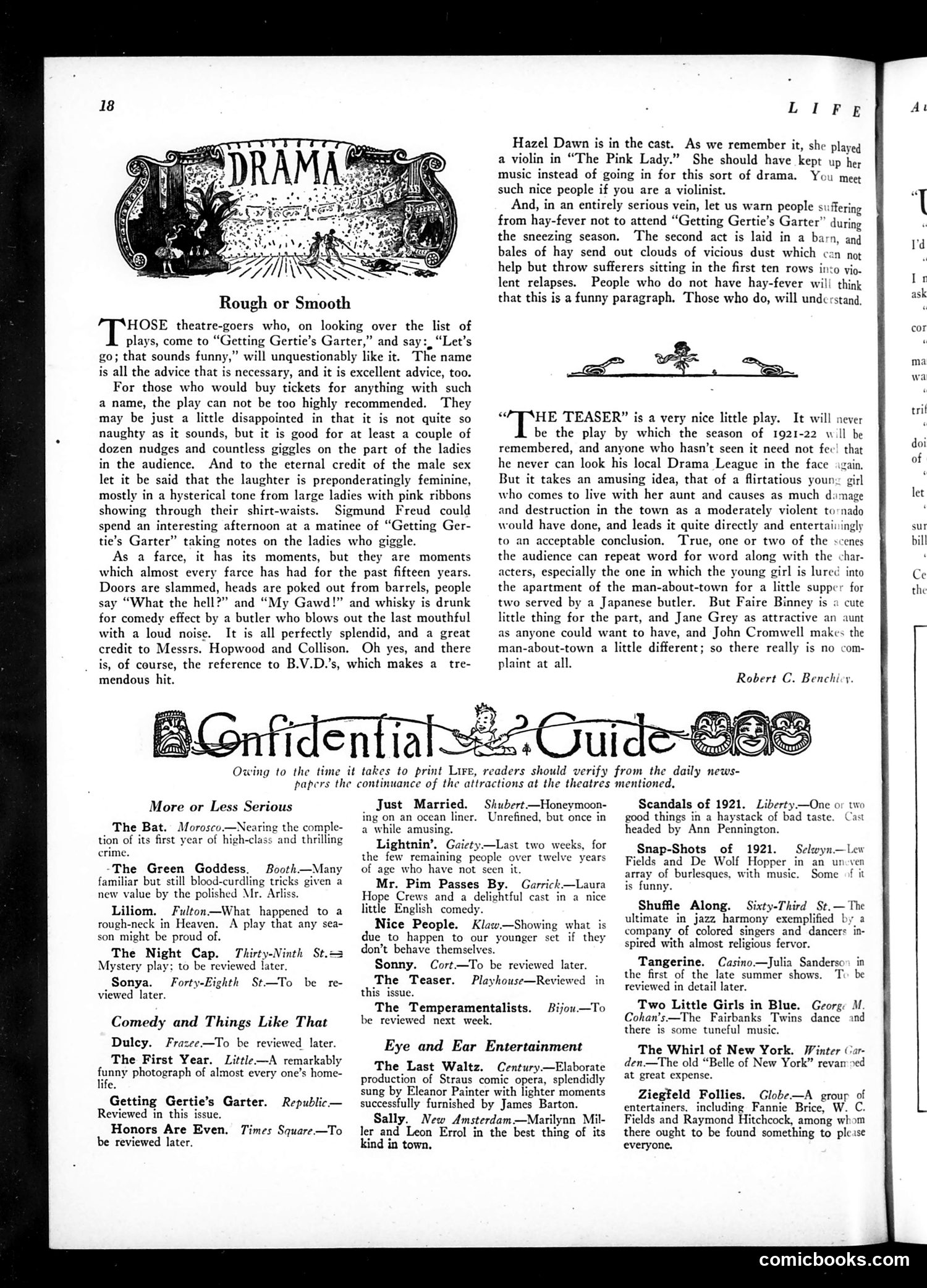
This page contains theater reviews from Life magazine's drama section, circa 1921. The main article critiques "Getting Gertie's Garter," a Broadway farce, written by Robert C. Benchley (a celebrated humorist and critic). **The Satire:** Benchley mocks both the play and its audience. "Getting Gertie's Garter" relies on crude humor—slamming doors, whisky gags—yet attracts audiences seeking titillation. Benchley notes the "preponderatingly feminine" laughter is "hysterical" and suggests Sigmund Freud could study the psychology of women giggling at innuendo-laden titles. He sardonically praises the B.V.D.'s reference (underwear brand) as a "tremendous hit"—mocking how audiences find risqué product placement hilarious. **The Joke:** The play itself isn't particularly naughty despite its suggestive title; audiences are disappointed but amused anyway. Benchley gently ridicules both the mediocre production and the easily entertained crowd. The page also includes brief reviews of "The Teaser" and other productions, offering context for 1921 Broadway entertainment standards.
📄 Transcribed text from this page (OCR, searchable)
Machine-transcribed from the original scan — historical spelling and the odd misread are preserved.
Rough or Smooth HOSE theatre-goers who, on looking over the list of plays, come to “Getting Gertie’s Garter,” and say:, “Let’s go; that sounds funny,” will unquestionably like it. The name is all the advice that is necessary, and it is excellent advice, too. For those who would buy tickets for anything with such a name, the play can not be too highly recommended. They may be just a little disappointed in that it is not quite so naughty as it sounds, but it is good for at least a couple of dozen nudges and countless giggles on the part of the ladies in the audience. And to the eternal credit of the male sex let it be said that the laughter is preponderatingly feminine, mostly in a hysterical tone from large ladies with pink ribbons showing through their shirt-waists. Sigmund Freud could spend an interesting afternoon at a matinee of “Getting Ger- tie’s Garter” taking notes on the ladies who giggle. As a farce, it has its moments, but they are moments which almost every farce has had for the past fifteen years. Doors are slammed, heads are poked out from barrels, people say “What the hell?” and “My Gawd!” and whisky is drunk for comedy effect by a butler who blows out the last mouthful with a loud noise. It is all perfectly splendid, and a great credit to Messrs. Hopwood and Collison. Oh yes, and there is, of course, the reference to B.V.D.’s, which makes a_tre- mendous hit. LIFE Hazel Dawn is in the cast. As we remember it, she played a violin in “The Pink Lady.” She should have kept up her music instead of going in for this sort of drama. You meet such nice people if you are a violinist. And, in an entirely serious vein, let us warn people s ffering from hay-fever not to attend “Getting Gertie’s Garter” during the sneezing season. The second act is laid in a barn, and bales of hay send out clouds of vicious dust which czn not help but throw sufferers sitting in the first ten rows into vio- lent relapses. People who do not have hay-fever will think that this is a funny paragraph. Those who do, will understand, ee oy HE TEASER?” is a very nice little play. It will never be the play by which the season of 1921-22 will be remembered, and anyone who hasn’t seen it need not fee! that he never can look his local Drama League in the face gain. But it takes an amusing idea, that of a flirtatious youny girl who comes to live with her aunt and causes as much damage and destruction in the town as a moderately violent to:nado would have done, and leads it quite directly and entertainingly to an acceptable conclusion. True, one or two of the scenes the audience can repeat word for word along with the char- acters, especially the one in which the young girl is lured into the apartment of the man-about-town for a little supper for two served by a Japanese butler. But Faire Binney is « cute little thing for the part, and Jane Grey as attractive an aunt as anyone could want to have, and John Cromwell makes the man-about-town a little different; so there really is no com- plaint at all. Robert C. Benchicy. Owing to the time it takes to print Lire, readers should verify from the daily news- papers the continuance of the attractions at the theatres mentioned, More or Less Serious The Bat. Morosco—Nearing the comple- tion of its first year of high-class and thrilling crime. The Green Goddess. Booth—Many familiar but still blood-curdling tricks gi new value by the polished Mr. Art Liliom. Fulton—What happened to a rough-neck in Heaven. A play that any sea- son might be proud of. The Night Cap. Thirty-Ninth St.o3 Mystery play; to be reviewed later, Sonya. Forty-Eighth St—To be re- viewed later. Comedy and Things Like That Duley. Frazee—To be reviewed later. The First Year. Little—A remarkably fay) photograph of almost every one’s home- ife. Getting Gertie’s Garter. Republic— Reviewed in this issue. Honors Are Even. Times Square —To be reviewed later. Just Married. Shubert—Honeymoon- ing on an ocean liner. Unrefined, but once in a while amusing. Lightnin’. Gaiety—Last two weeks, for the few remaining people over twelve years of age who have not seen it. Mr. Pim Passes By. Garrick—Laura Hope Crews and a delightful cast in a nice little English comedy. Nice People. Klaw.—Showing what is due to happen to our younger set if they don’t behave themselves. Sonny. Cort—To be reviewed later. The Teaser. this issue. The Temperamentalists. be reviewed next week. Playhouse—Reviewed in Bijou—To Eye and Ear Entertainment The Last Waltz. Century.—Elaborate production of Straus comic opera, splendidly sung by Eleanor Painter with lighter moments successfully furnished by James Barton. Sally. New Amsterdam—Marilynn Mil- ler and Leon Errol in the best thing of its kind in town, Scandals of 1921. Liberty—One or two good things in a haystack of bad taste. Cast headed by Ann Pennington. Snap-Shots of 1921. Selwyn.—Lew Fields and De Wolf Hopper in an uneven array of burlesques, with music. Some of it is funny. Shuffle Along. Sixty-Third St.— ultimate in jazz harmony exemplified | company of colored singers and dancers in- spired with almost religious fervor. Tangerine. Casino—Julia Sanderso» in the first of the late summer shows. Tw be reviewed in detail later. Two Little Girls in Blue. Georg: M. Cohan’s—The Fairbanks Twins dance and there is some tuneful music. The Whirl of New York. Winter Car- den.—The old “Belle of New York” revamped at great expense. Ziegfeld Follies. Globe—A group of entertainers, including Fannie Brice, W. C. Fields and Raymond Hitchcock, among whom there ought to be found something to please everyone, comicbooks.com