
A complete issue · 36 pages · 1921
Life — May 19, 1921
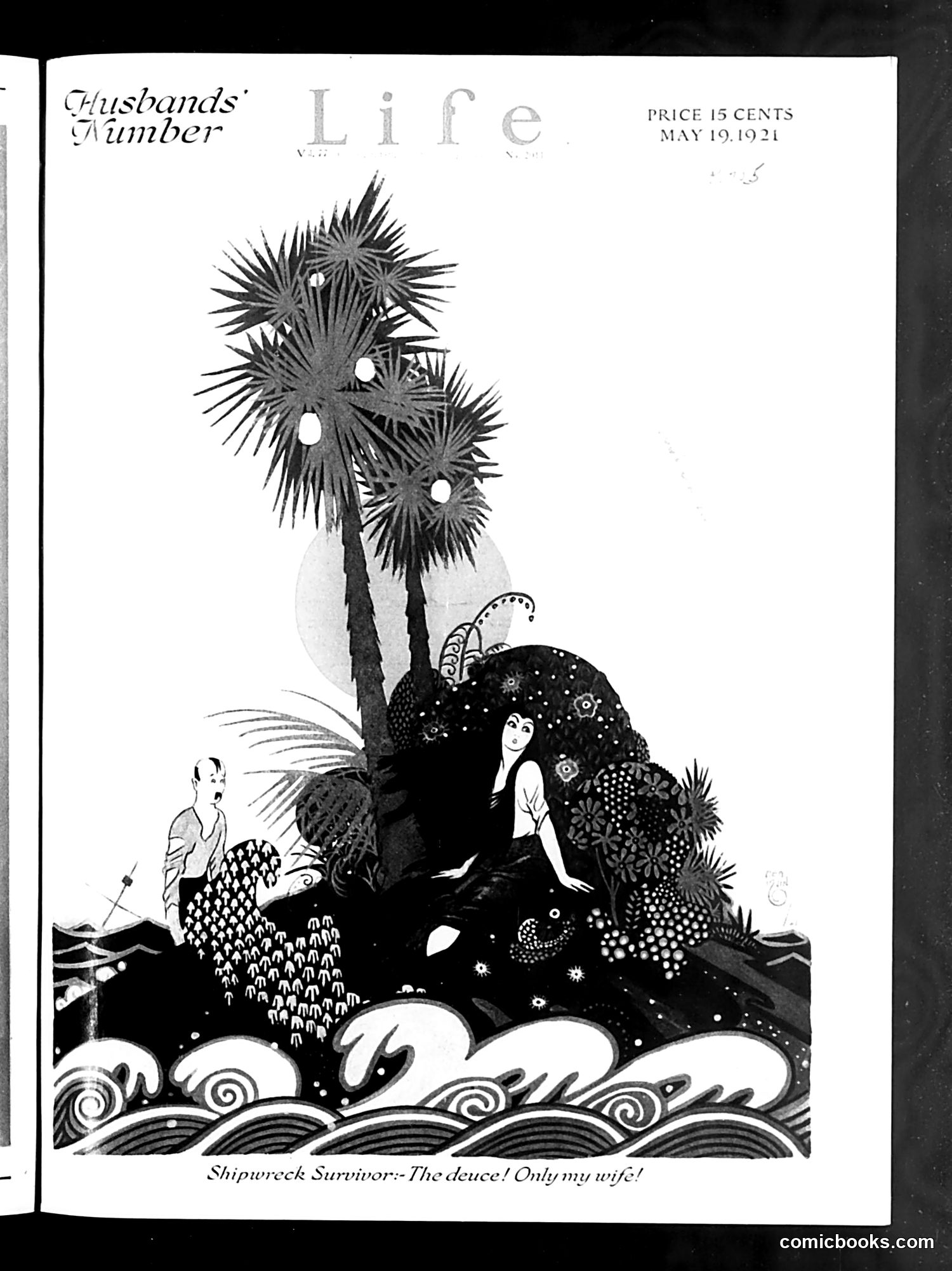
This is a "Husbands' Number" cover featuring an Art Deco-style illustration of a tropical island fantasy scene. A woman in the center reclines luxuriously surrounded by exotic vegetation, palm trees, and decorative elements. The caption reads: "Shipwreck Survivor:--The deuce! Only my wife!" **The joke**: A man has survived a shipwreck and washed ashore on an island paradise—only to discover his wife is also there, ruining his fantasy escape. This satirizes the popular male fantasy of tropical island isolation (common in 1920s literature and adventure stories) while poking fun at marriage itself, suggesting wives were something to escape from rather than experience with. The "Husbands' Number" framing suggests this entire issue was devoted to husband-centered humor.
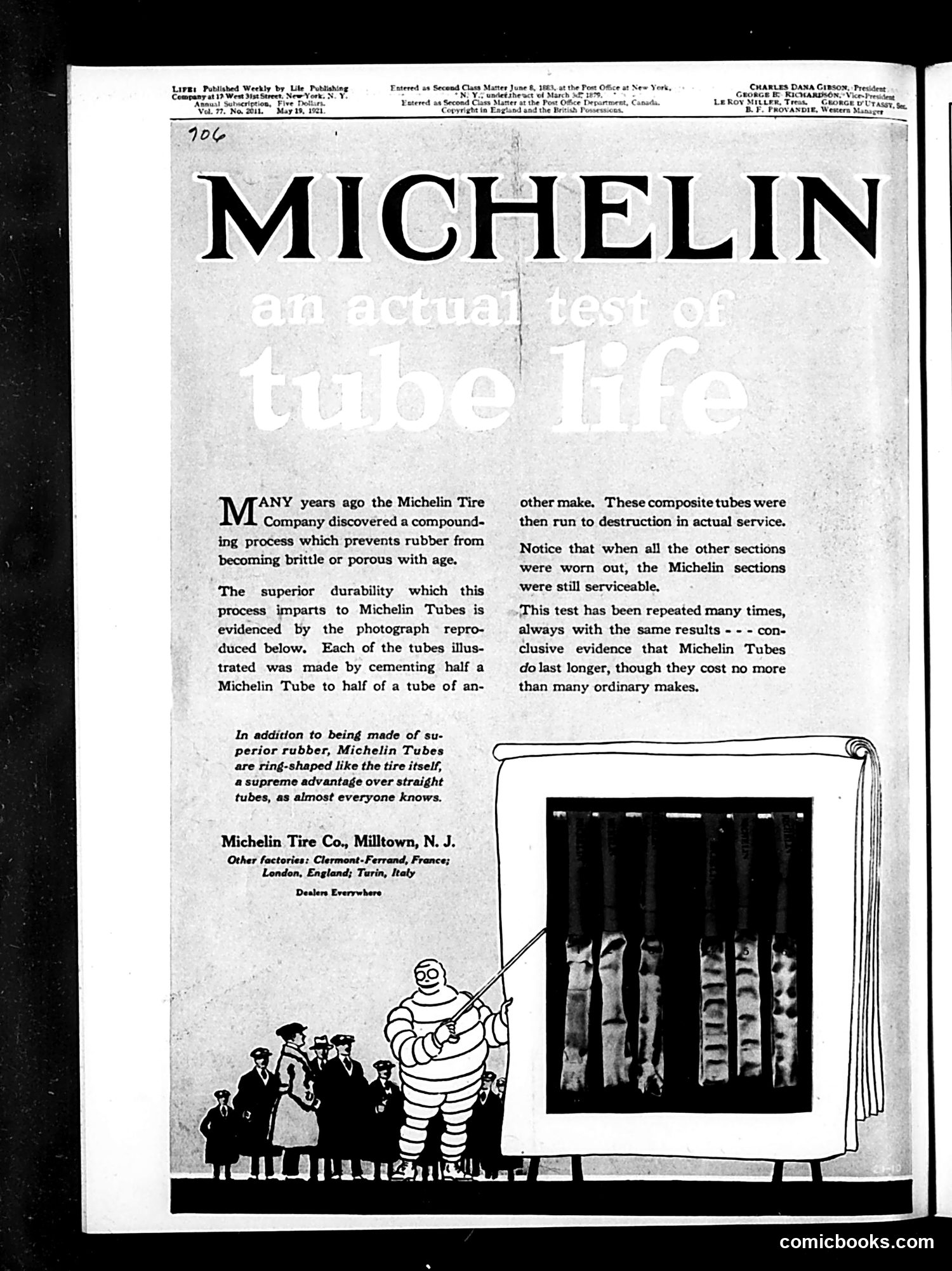
This is a **Michelin Tire Company advertisement**, not political satire. The page promotes Michelin's superior rubber compound that resists brittleness and porousness with age. The central claim: Michelin tubes outlast competitors. The advertisement describes an actual test where half a Michelin tube was cemented to half a tube from "another make," then run until failure. The other sections wore out completely while the Michelin portion remained serviceable. The cartoon illustration shows the **Michelin Man** (the company's mascot, a rotund figure made of tire rings) presenting this evidence to onlookers. The dark photograph on the right appears to show the test results—the comparative wear patterns of the tubes. The message: Michelin tubes cost no more than ordinary brands but last significantly longer, making them superior value.
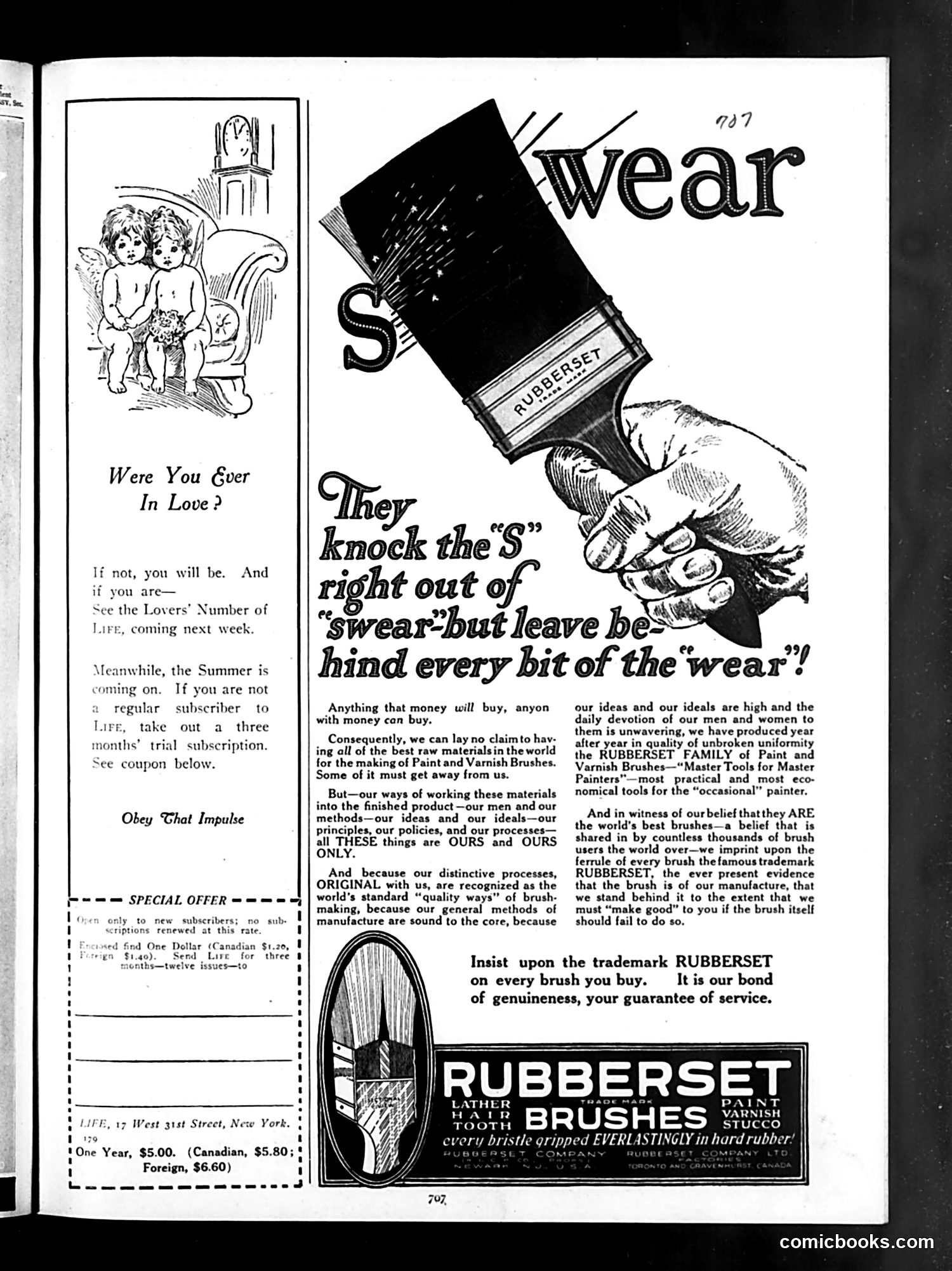
This page contains **primarily advertising** for Rubberset paint and varnish brushes, not political satire. The main visual—a paintbrush labeled "RUBBERSET" being wielded like a weapon to "knock the 'S' right out of 'swear'"—is a **commercial wordplay joke**: the ad suggests their brushes are so good they'll make painters swear less (fewer mistakes). The phrase "leave be hind every bit of the 'wear'" references product durability. The left sidebar shows a **Life magazine subscription offer** and an unrelated illustration asking "Were You Ever In Love?"—typical period magazine filler and subscription promotions. The ad emphasizes brand identity and quality manufacturing, claiming Rubberset brushes are "the world's standard" recognized for superior methods and materials.
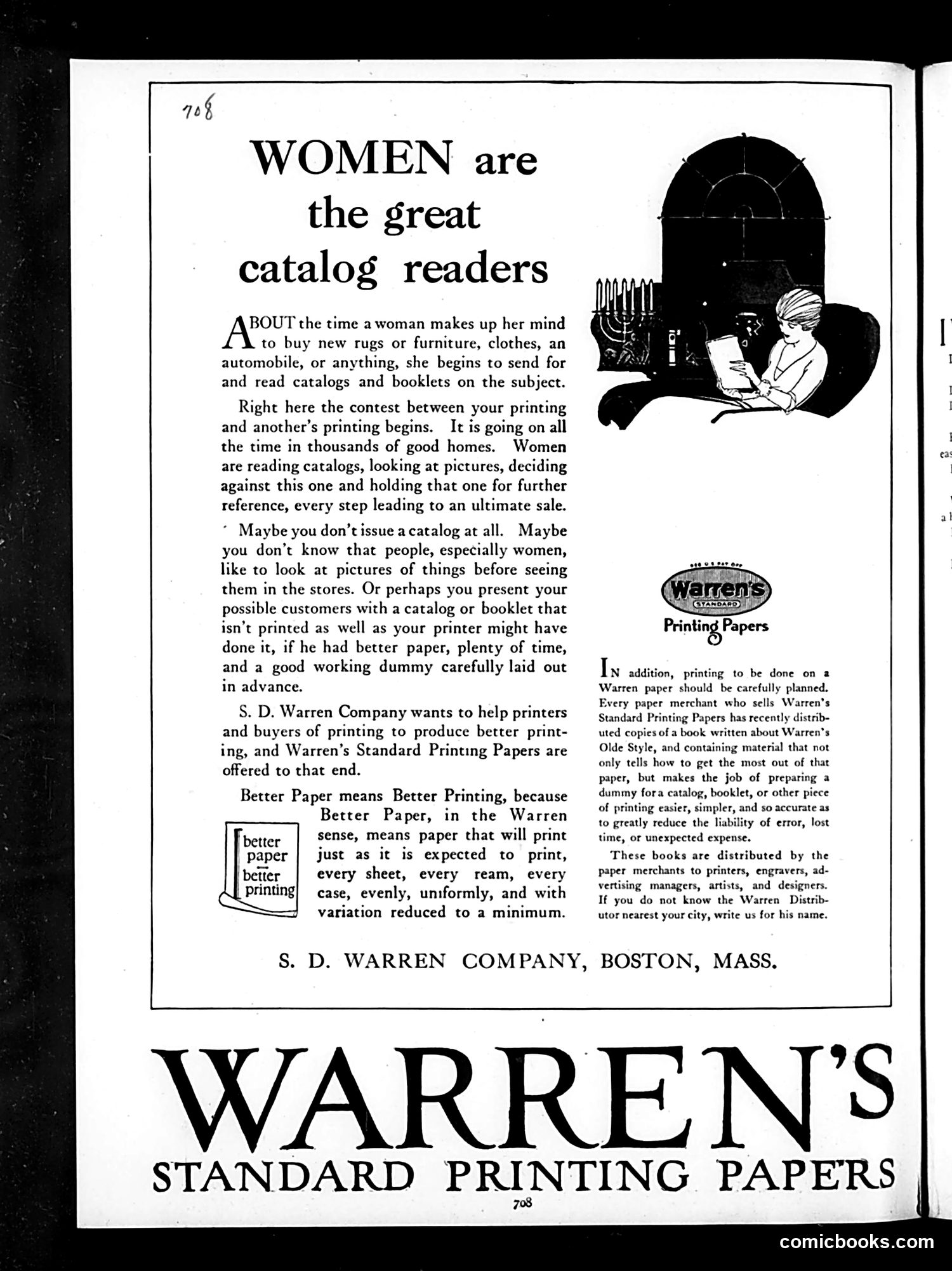
This is primarily a **Warren Company advertisement for printing paper**, not satirical content. The page uses a marketing appeal rather than satire. The illustration shows a woman reading a catalog—likely mail-order catalogs from companies like Sears or Montgomery Ward, which were extremely popular in early-to-mid 20th century America. The advertisement's argument is that women extensively study catalogs before making purchases, making them valuable targets for quality printing. The ad claims women are "the great catalog readers" and argues that superior paper quality (Warren's product) leads to better printing, which influences purchasing decisions. The text emphasizes that printing on Warren paper produces more uniform, professional results—a practical sales pitch rather than humor or satire.
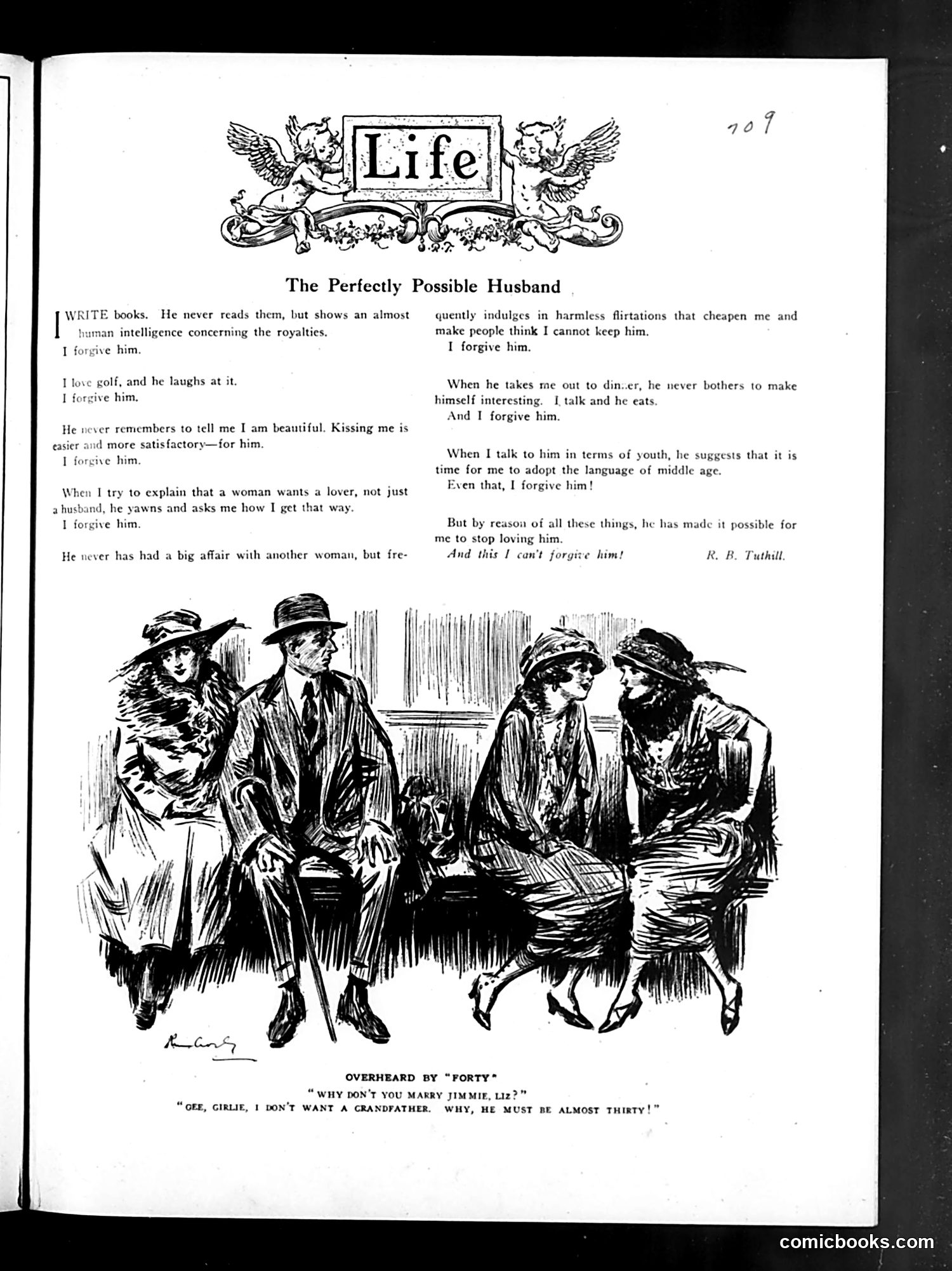
This satirical piece by R.B. Tuthill critiques an idealized husband through ironic inversion. The narrator lists his numerous faults—he writes books but shows no real intelligence, laughs at her interests, never compliments her, lacks romantic passion, makes dismissive comments about aging, and engages in flirtations—yet she "forgives" each transgression. The satire's bitter punch: by forgiving *everything*, she's made it "possible for me to stop loving him." The joke exposes how women of this era were culturally pressured to accept male indifference and infidelity as normal, normalizing emotional neglect through endless feminine forgiveness. The illustration shows four women gossiping, with a caption about "Forty" joking regarding marriage prospects—likely reinforcing themes about women's limited romantic options.
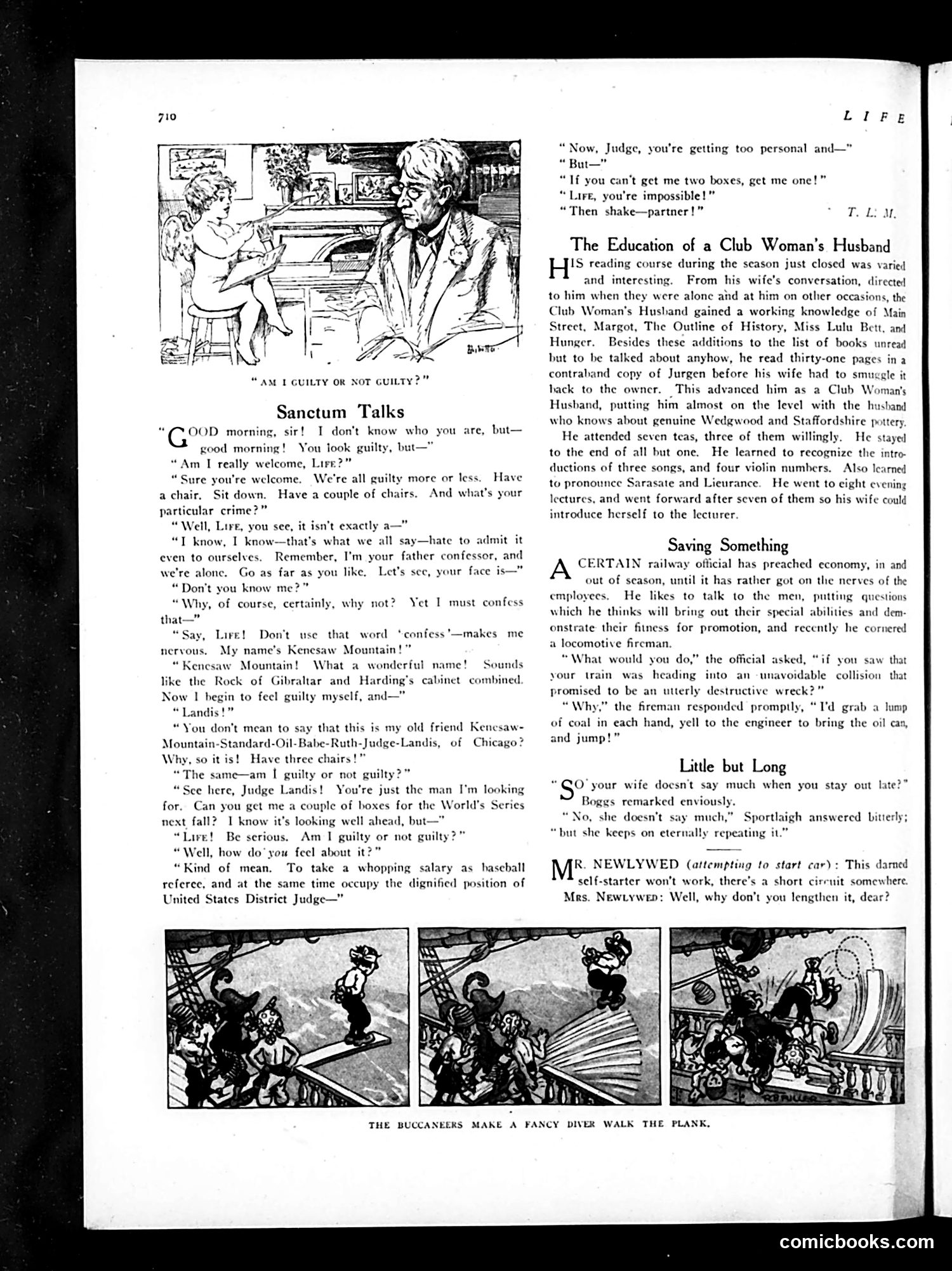
This page contains several unrelated short humor pieces typical of Life magazine's format: **"Am I Guilty or Not Guilty?"** - A cartoon depicting two figures in conversation, likely illustrating a domestic dispute or moral disagreement. **"Sanctum Talks"** - A dialogue between two men (one appears to be a judge, the other named Kenesaw Mountain Landis) discussing guilt and confession. The reference to "Kenesaw Mountain" and the detailed name suggests this may reference a real public figure, though the exact context is unclear. **Other sections** include "The Education of a Club Woman's Husband," "Saving Something" (about a railway official and economy), and brief anecdotes. **"The Buccaneers Make a Fancy Diver Walk the Plank"** - Three sequential illustrations showing what appears to be a pirate-themed scene. The page represents typical early 20th-century American satirical humor targeting domestic life, social pretension, and workplace situations.
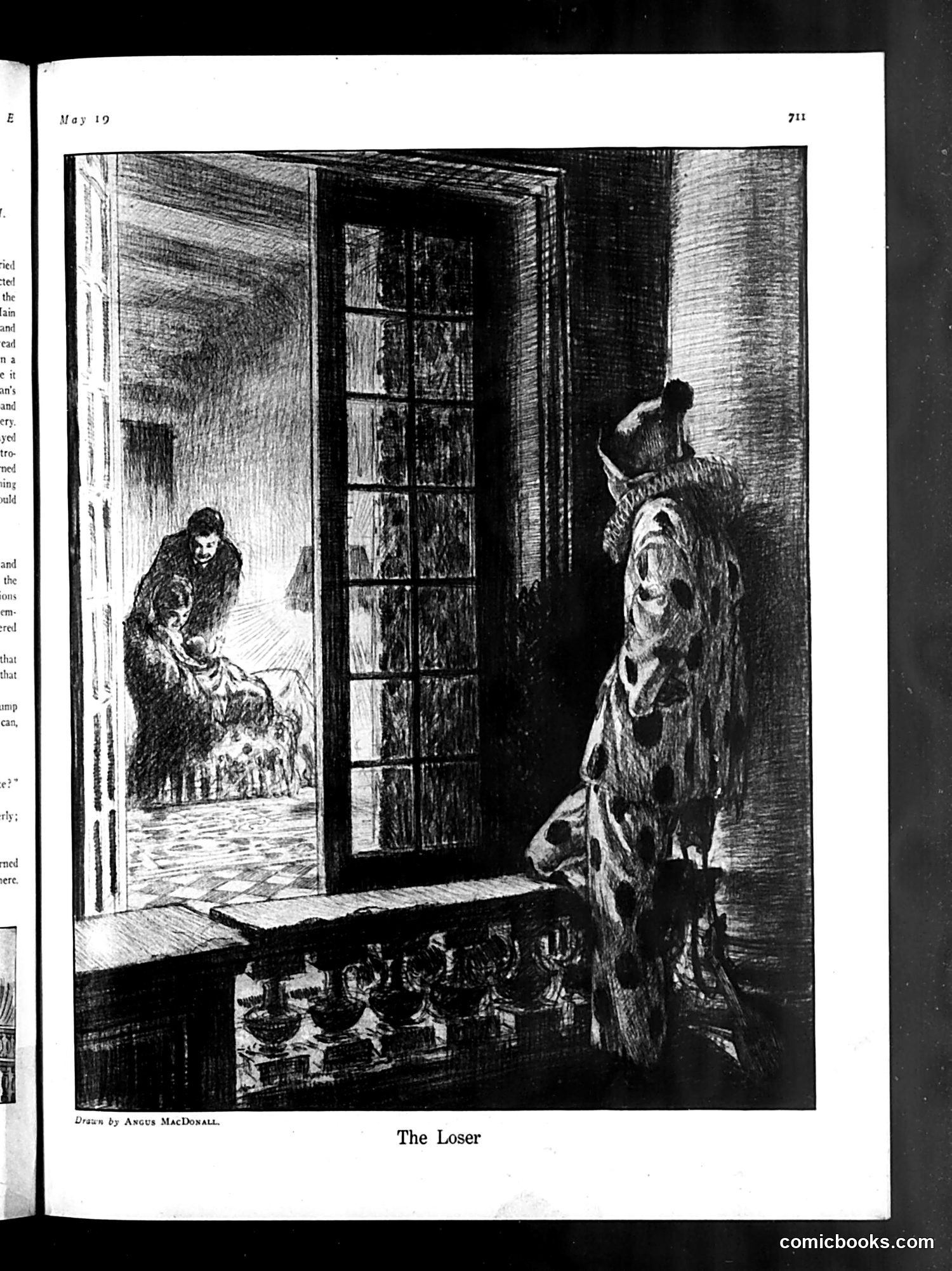
This political cartoon depicts two figures at a doorway: a woman peering out from inside a modest home, and a shabby, poorly-dressed man standing outside looking up at her with an expression of desperation or pleading. The interior shows simple furnishings and a window with panes. The title "The Loser" suggests social commentary on economic hardship or failure. The contrast between the woman (relatively sheltered indoors) and the man (displaced, outside) likely reflects early 20th-century concerns about poverty, unemployment, or class struggle. The man's ragged appearance and posture suggest he may be homeless or destitute, appealing to the woman's compassion—a commentary on inequality and social vulnerability during this period.
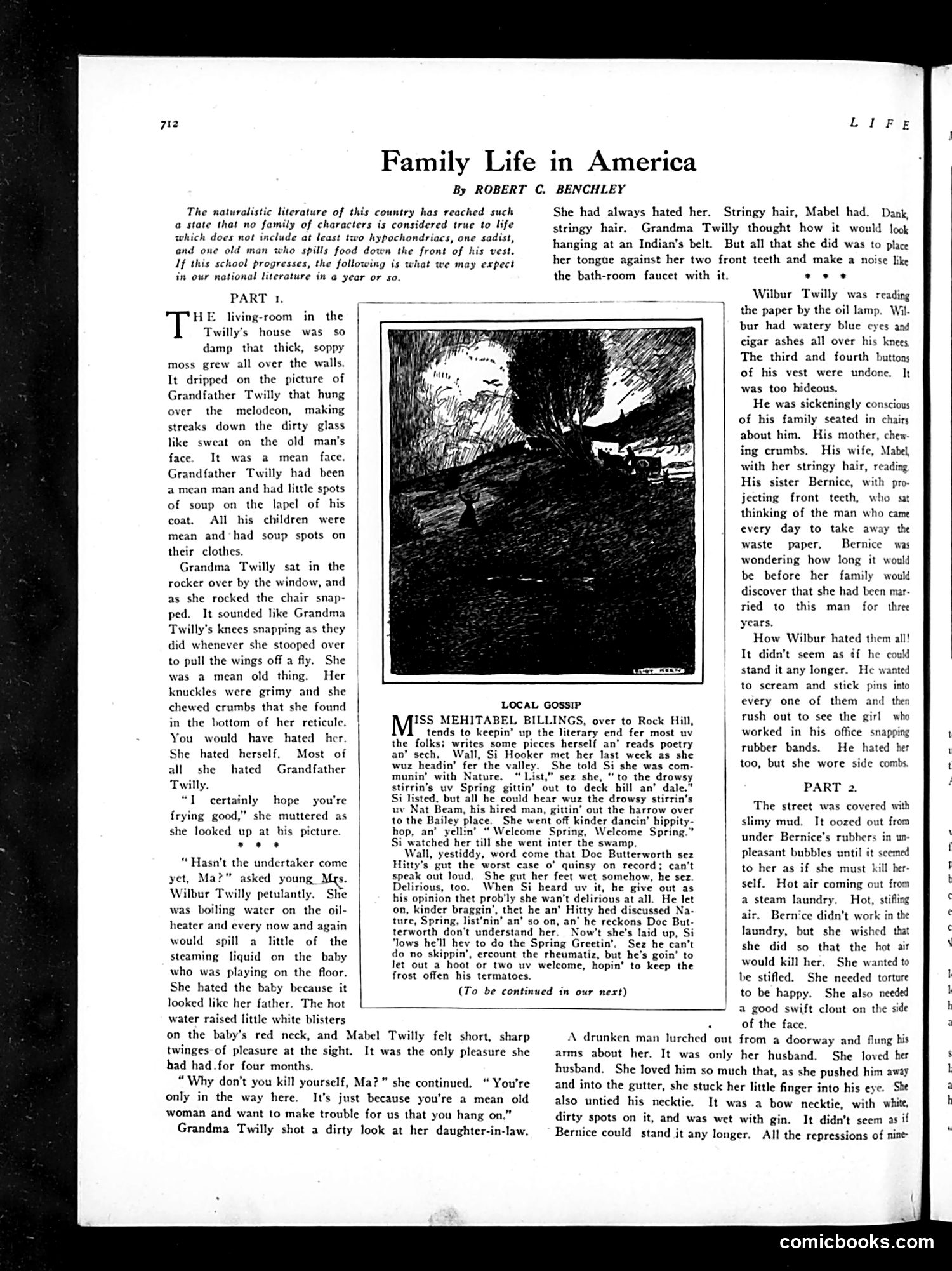
This satirical short story critiques American domestic life, focusing on the Twilly family. The illustration shows a man (Grandfather Twilly) reading a newspaper in a squalid living room with damp, moldy walls—a visual representation of poverty and neglect. The narrative depicts a dysfunctional household: Grandfather is described as "mean," with soup stains on his clothes; Grandmother is bitter and resentful; and the children have inherited their parents' unpleasantness. Benchley satirizes the gap between idealized "family life" and grim reality, portraying American domestic existence as inherently miserable, characterized by physical squalor, emotional coldness, and mutual contempt. The humor relies on blunt honesty about family dysfunction.
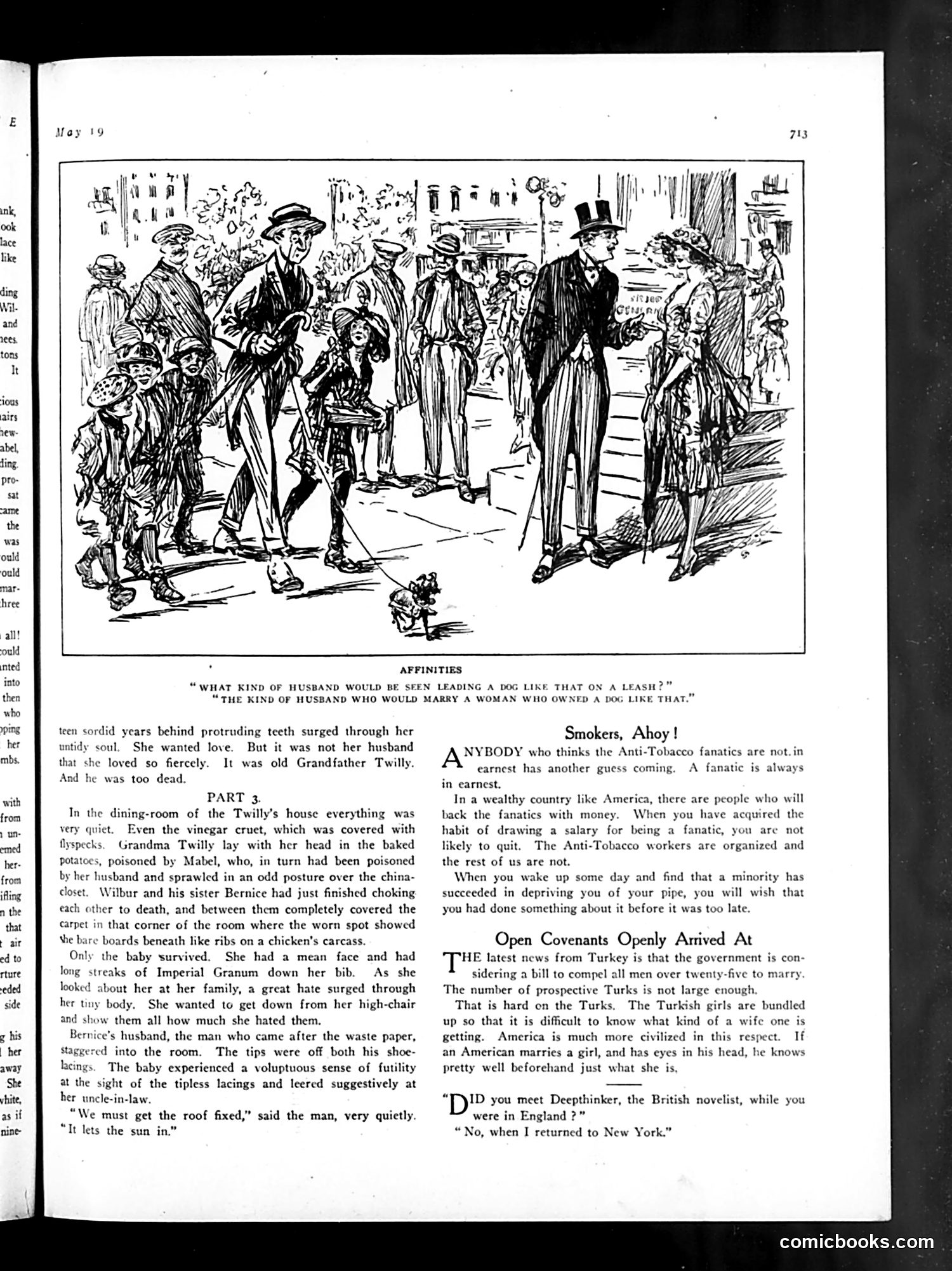
This page contains a satirical illustration titled "Affinities" depicting a street scene with well-dressed men in top hats observing a small boy leading a dog on a leash. The caption reads: "What kind of husband would be seen leading a dog like that on a leash?" / "The kind of husband who would marry a woman who owned a dog like that." The joke plays on social class anxieties of the era. The cartoon satirizes the pretensions of wealthy urbanites who keep small lap dogs as status symbols. By showing gentlemen observing this spectacle with apparent disdain, it mocks both the ostentatious display of pet ownership and the judgmental attitudes of the supposedly refined observer class. The accompanying text discusses anti-tobacco fanatics and Turkish marriage customs—unrelated social commentary typical of Life magazine's miscellaneous satirical format.
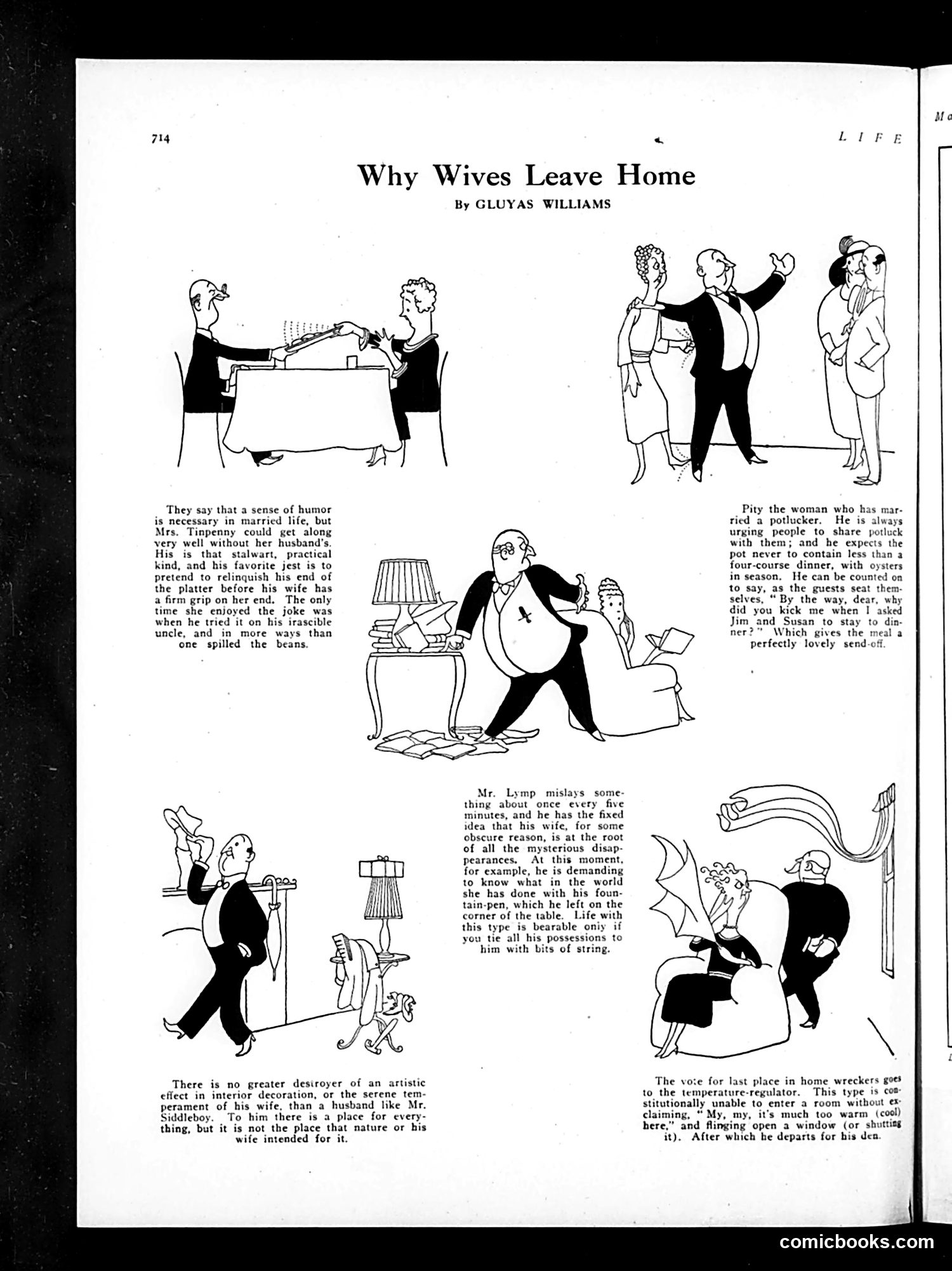
This satirical piece humorously catalogs domestic grievances that drive wives away. The cartoons depict exaggerated husband behaviors: a man struggling with household tasks (serving dinner), a husband obsessively demanding his wife locate a lost fountain pen, someone creating chaos with interior decoration, and a man manipulating temperature controls while his wife shivers by an open window. The satire targets husbands' obliviousness and selfishness—their inability to manage basic domestic responsibilities, their petty preoccupations, and their disregard for wives' comfort. Williams critiques the expectation that wives tolerate unreasonable behavior in marriage. The humor derives from recognizable domestic friction and the husband's utter bewilderment at why his wife would leave given such "reasonable" demands.
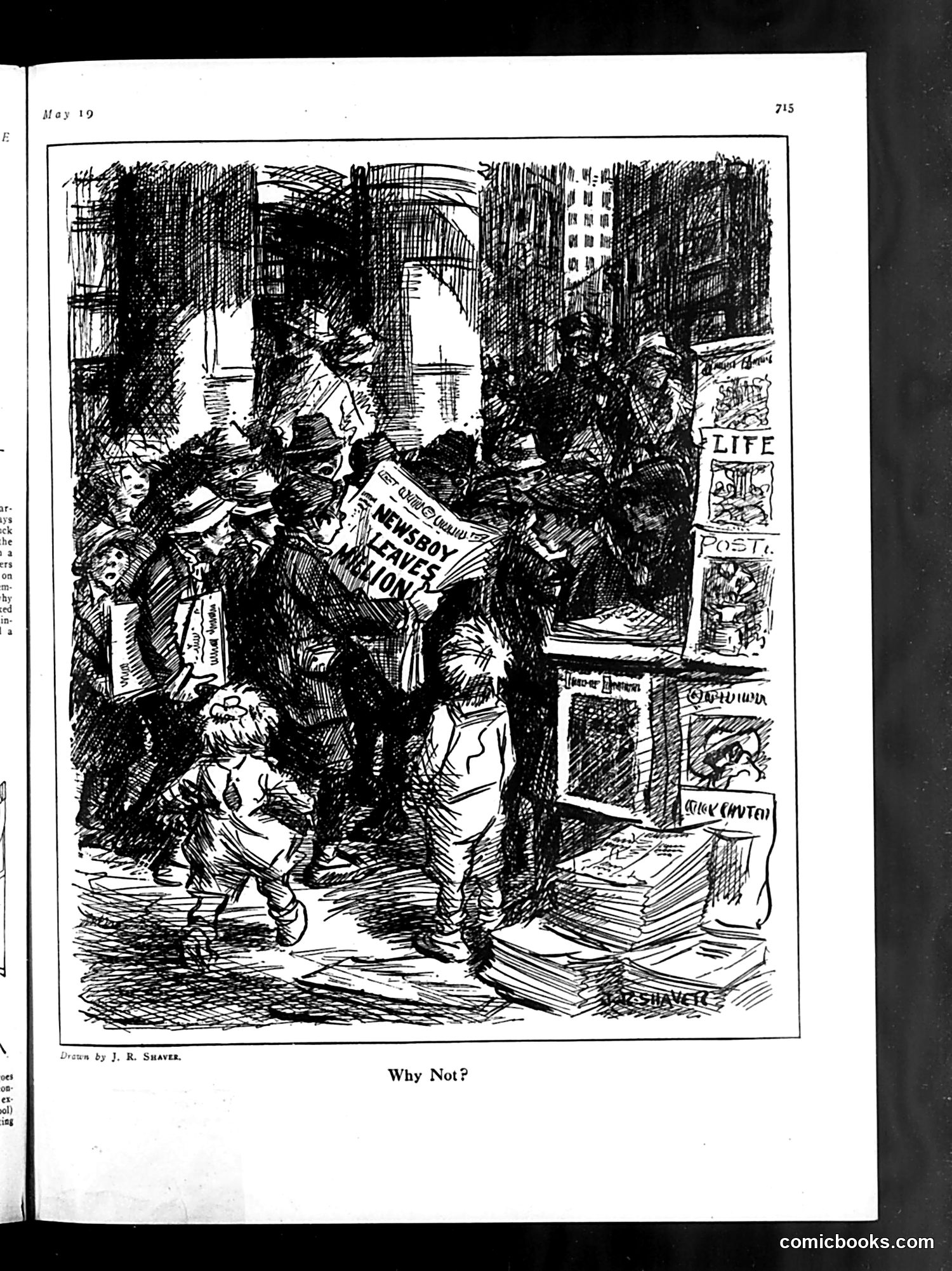
This J.R. Shaver cartoon depicts a crowded newsstand or magazine shop in an urban setting. The central figure holds a large publication labeled "NEWSBOY" (or similar), while visible on the right are magazines including *Life*, *Post*, and *Saturday* (likely *Saturday Evening Post*). The title "Why Not?" suggests satirical commentary on American publishing and consumer culture. The crowd of eager readers and the prominent display of popular magazines implies critique of mass media consumption or the commercialization of news and entertainment. The specific political or social reference remains unclear without additional context about the publication date (listed as "May 19"). The cartoon likely comments on either publishing industry practices, newspaper circulation wars, or public appetite for mass-market periodicals during the early 20th century.
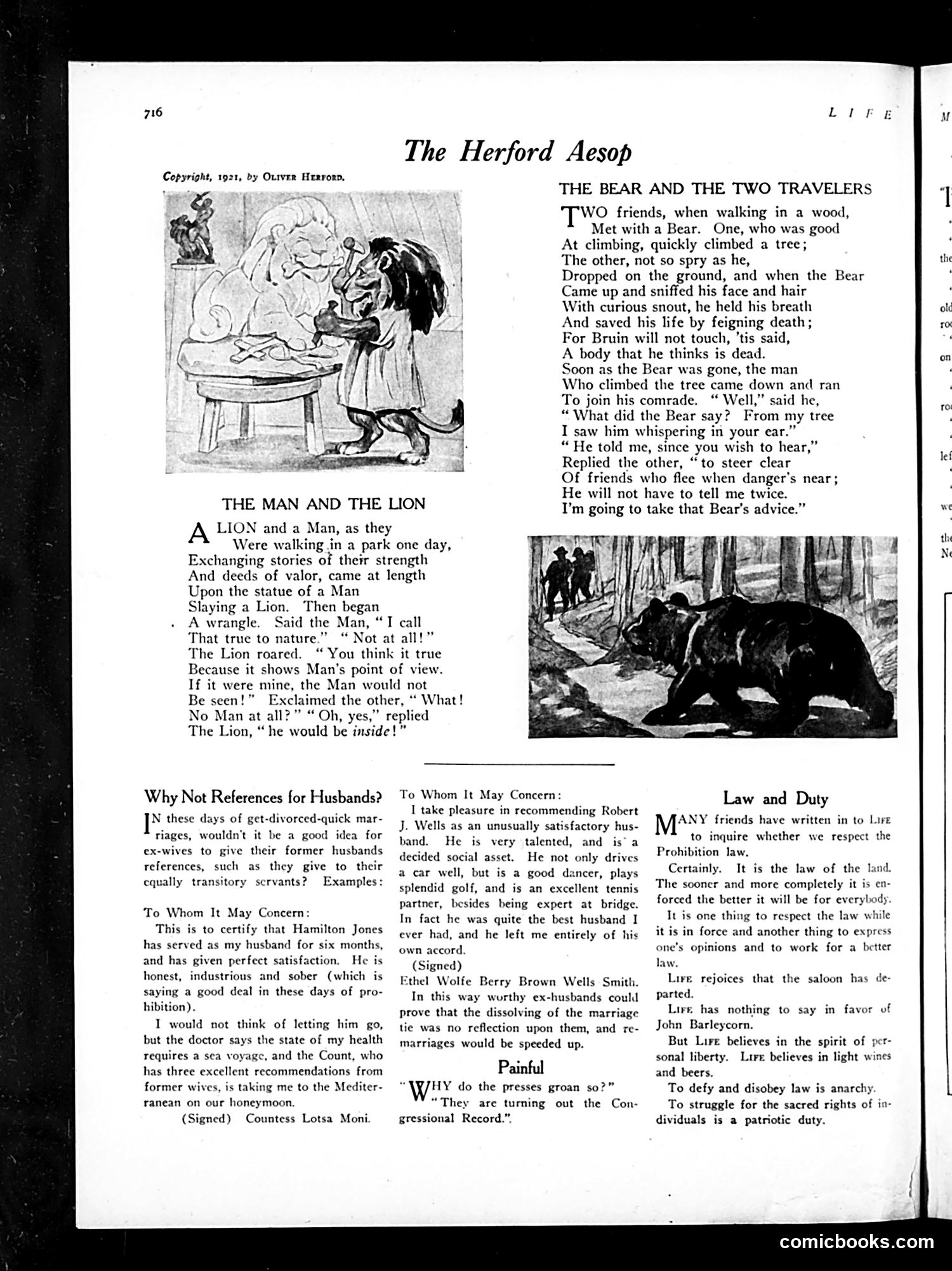
This page presents Aesop's fables illustrated by Oliver Herford (copyright 1921). The two main fables shown are classic moral tales: **"The Bear and the Two Travelers"** warns against false friendship—one traveler abandons the other when danger appears, revealing he was never a true friend. **"The Man and the Lion"** depicts a debate about whether a statue showing a man slaying a lion proves man's superiority. The lion counters that if lions made such monuments, they'd show themselves winning—illustrating how perspective shapes interpretation of evidence. The page also includes a humorous advice column about divorce references for ex-husbands and a brief political note about Prohibition. The satirical intent is gentle moral instruction rather than sharp political commentary.
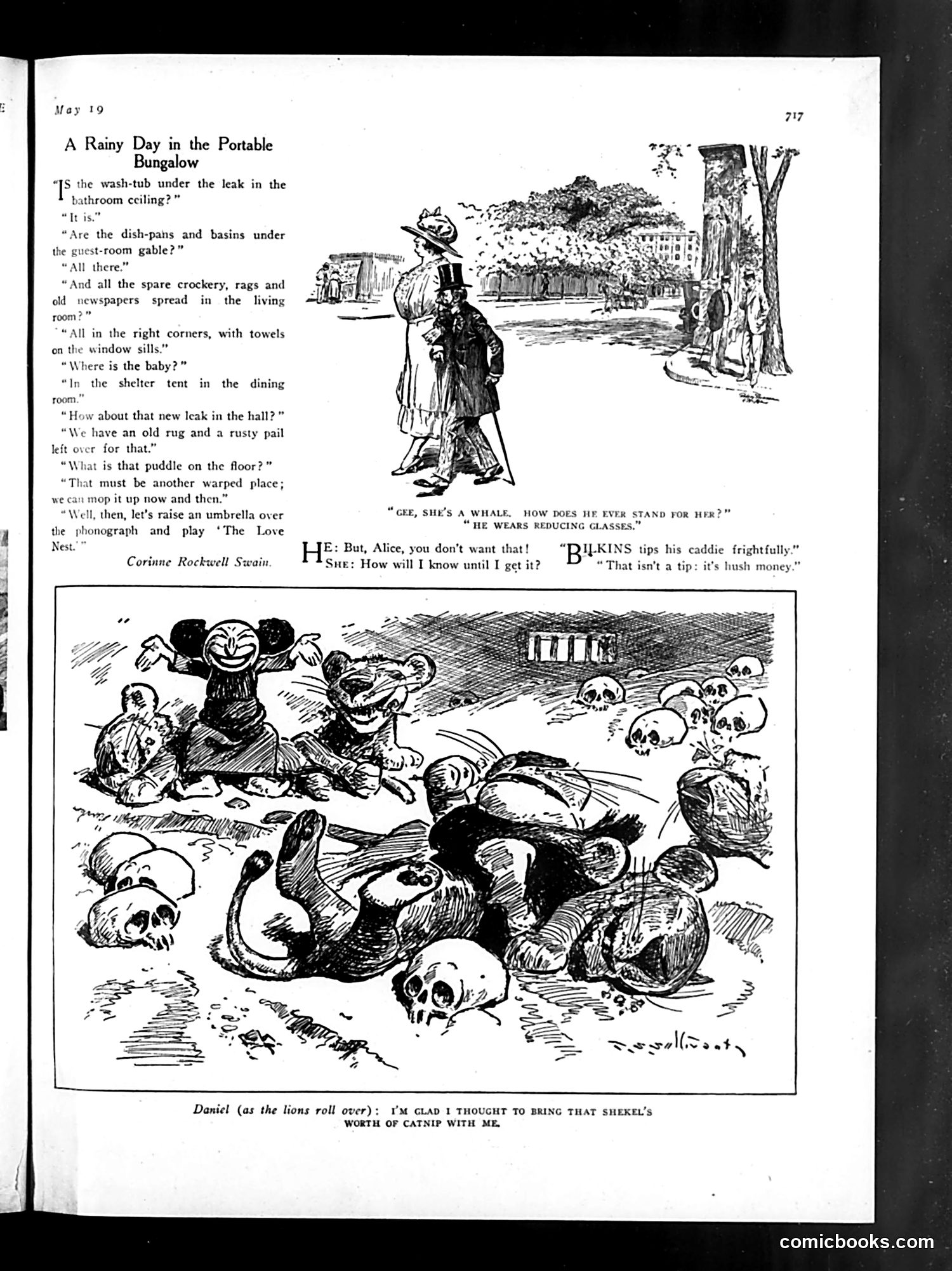
This is a humorous domestic sketch by Corinne Rockwell Swain about managing a small rental bungalow during rain. The dialogue lists typical problems: leaks in the bathroom ceiling, water under the gable, crockery scattered in the living room, a wet baby, and puddles on the floor. The solution offered is ironically theatrical—raise an umbrella over the phonograph to play "The Love Nest." The lower illustration shows a chaotic scene of cats and dogs (titled "Daniel as the Lions Roll Over"), apparently indoors during the weather emergency, suggesting domestic mayhem when pets are confined inside during a rainy day. The satire targets the impracticality of small, cheaply-built vacation rentals and the frustrations of managing confined families and animals during bad weather.
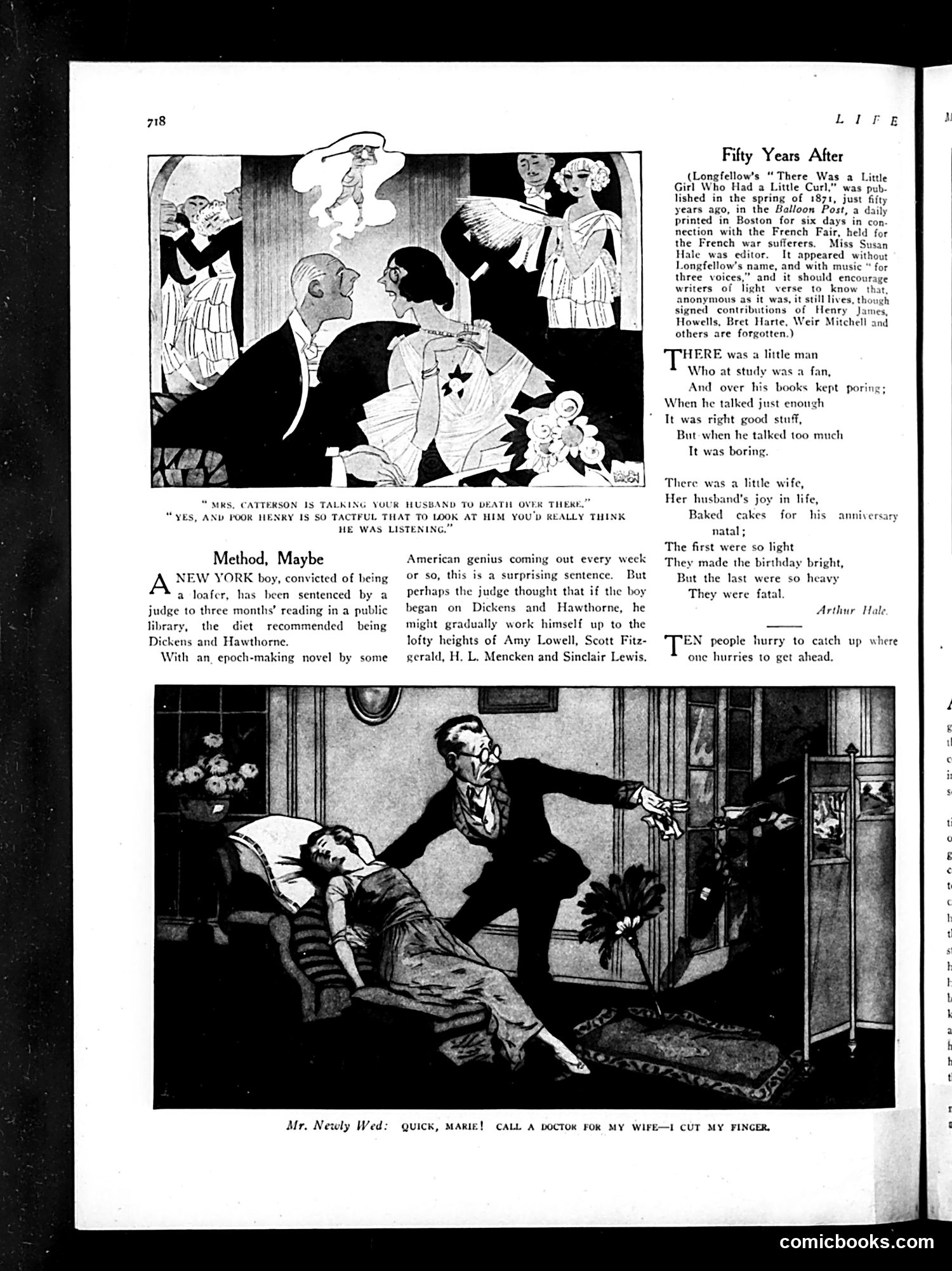
This page from *Life* magazine contains two satirical cartoons mocking domestic situations. **Top cartoon**: Shows a social gathering where a woman (Mrs. Catterson) complains to another guest about her husband's tedious conversation. The joke satirizes boring husbands who talk excessively—a common complaint in early 20th-century domestic satire. **Bottom cartoon** ("Mr. Neely Wed"): Depicts a man dramatically gesturing while his wife lies injured on a bed, with the caption "Quick, Marie! Call a doctor for my wife—I cut my finger." The satire mocks self-centered husbands who treat minor personal injuries as emergencies while ignoring their wives' serious injuries. Both cartoons target male egotism and absent-mindedness in marriage—typical subjects of *Life*'s humor during this era.
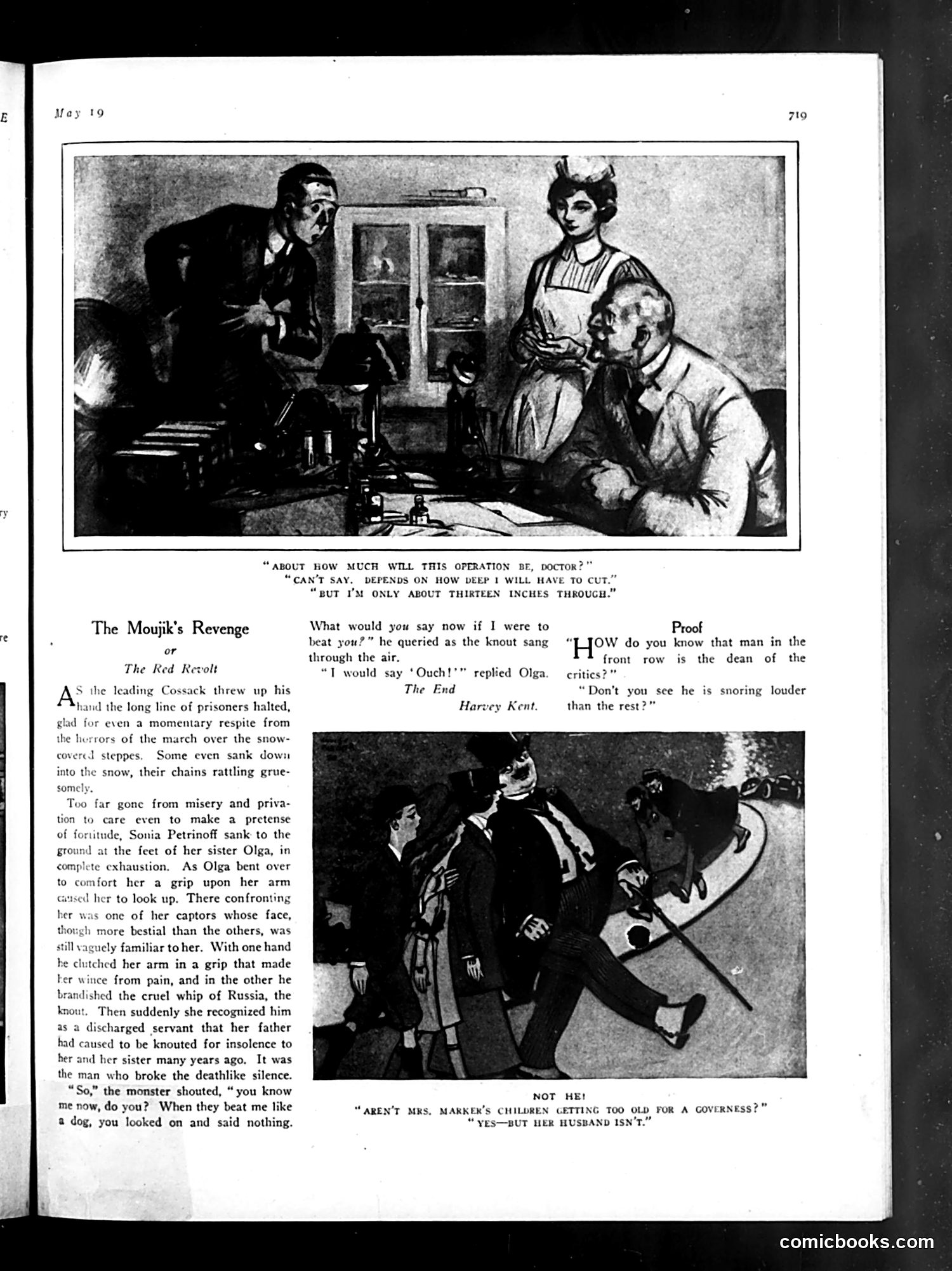
This page presents a fictional story titled "The Moujik's Revenge" (or "The Red Revolt") by Harvey Kent, accompanying two illustrations. The narrative depicts Russian peasants ("moujiks") during what appears to be a period of political upheaval—likely referencing early 20th-century Russian revolutionary tensions. The story shows a captured noblewoman, Sonia Petrioff, confronted by one of her father's former servants whom she'd brutalized years earlier. The satire suggests ironic role-reversal: the formerly powerless servant now holds authority over his former oppressor. A companion humor piece titled "Proof" jokes about identifying a "dead" critic by his loud snoring—basic comedic wordplay unrelated to the main story. The content reflects American fascination with Russian social upheaval and class conflict during this era.
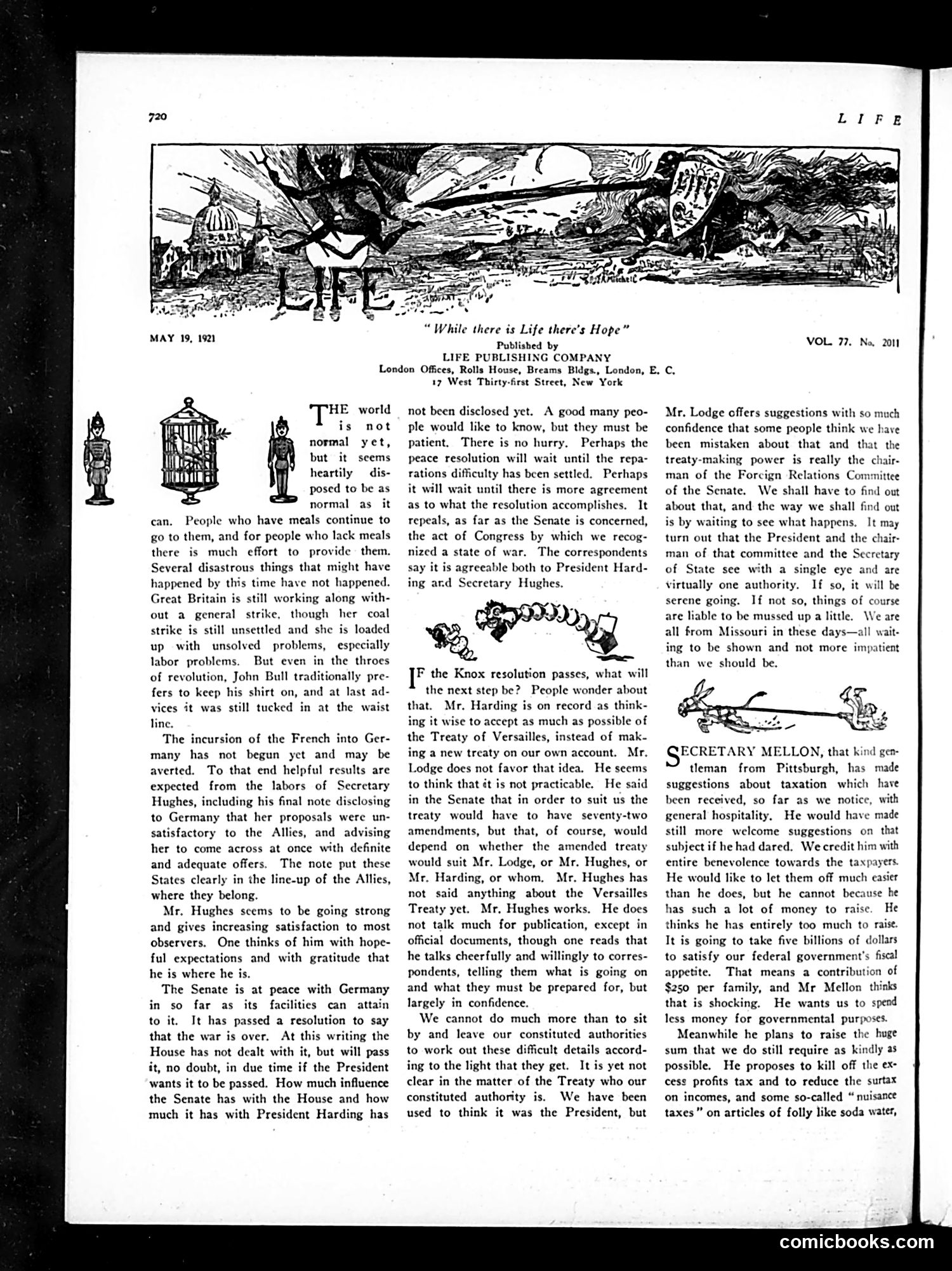
This page contains editorial commentary on post-WWI peace negotiations rather than a distinct political cartoon. The text discusses the unresolved state of peace treaties, particularly regarding Germany and France, and debates over the Treaty of Versailles. The article criticizes Secretary of State Hughes and President Harding's approach to treaty-making, suggesting they favor amending rather than creating new treaties. It also discusses Secretary Mellon's taxation proposals, arguing his suggested cuts to government spending are too aggressive. The decorative header illustration shows a figure contemplating a landscape with buildings and machinery—likely representing post-war reconstruction and uncertainty about the future. The overall tone expresses concern about whether American leadership is adequately addressing complex peace-settlement issues.
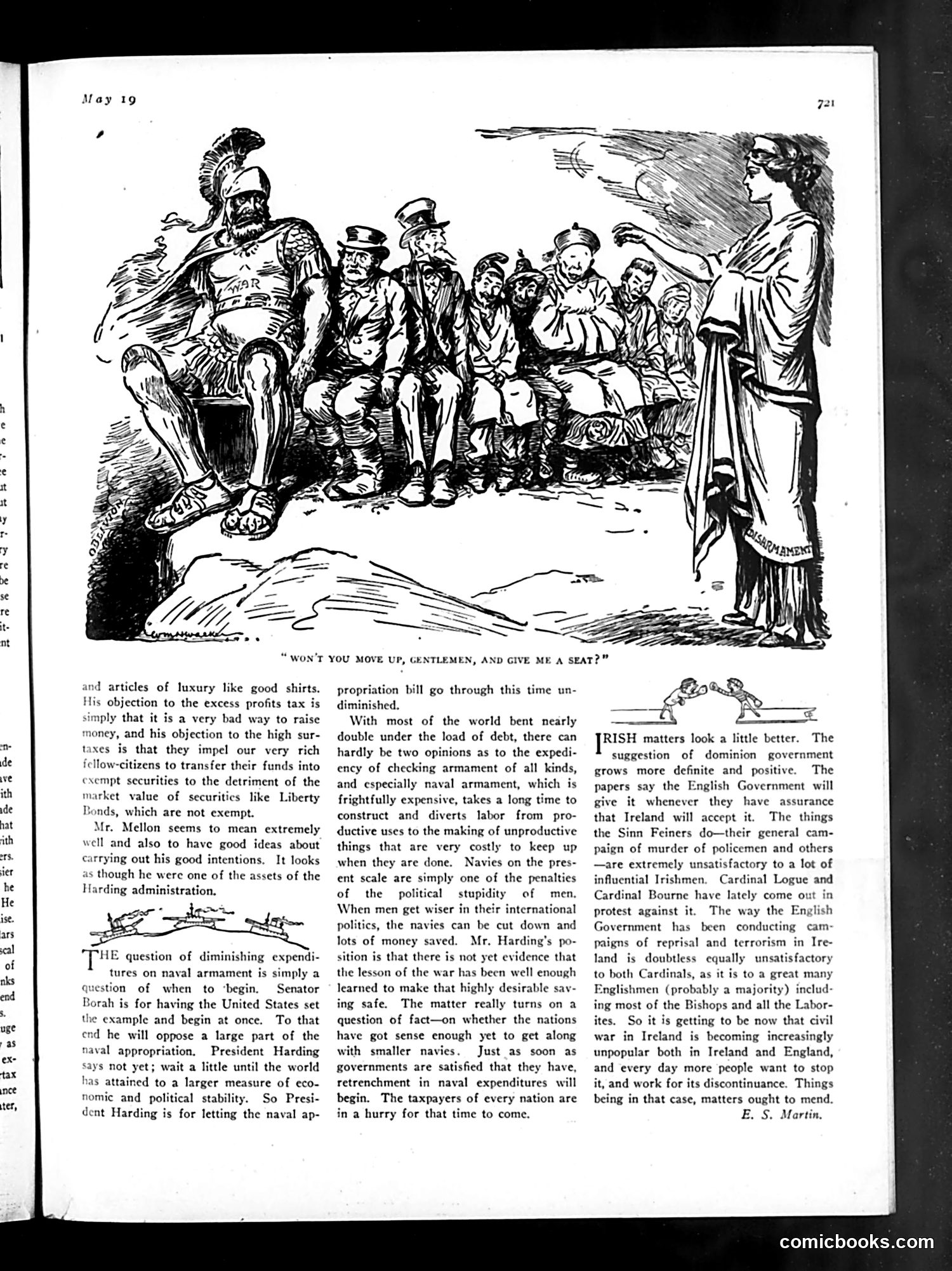
**The Cartoon:** The image depicts a crowded scene where a classical warrior or military figure (representing militarism or naval expansion) sits prominently while uniformed officials and civilians crowd around. A robed female figure (likely representing Justice, Peace, or Democracy) stands to the right, asking them to make room. **The Political Context:** This satirizes the Harding administration's naval spending debate. Senator Borah advocated immediate military cutbacks, but President Harding resisted, arguing the world wasn't yet stable enough. The cartoon criticizes this position—the bloated military figure dominates the scene while civilian needs (represented by the pleading female figure) are crowded out. **The Satire:** Life magazine argues that massive naval expenditures are wasteful given global debt and suffering. The cartoon suggests Harding's caution perpetuates unnecessary military spending, leaving no "seat" for productive civilian priorities. The accompanying text emphasizes that continued armament diverts labor and resources from beneficial uses.
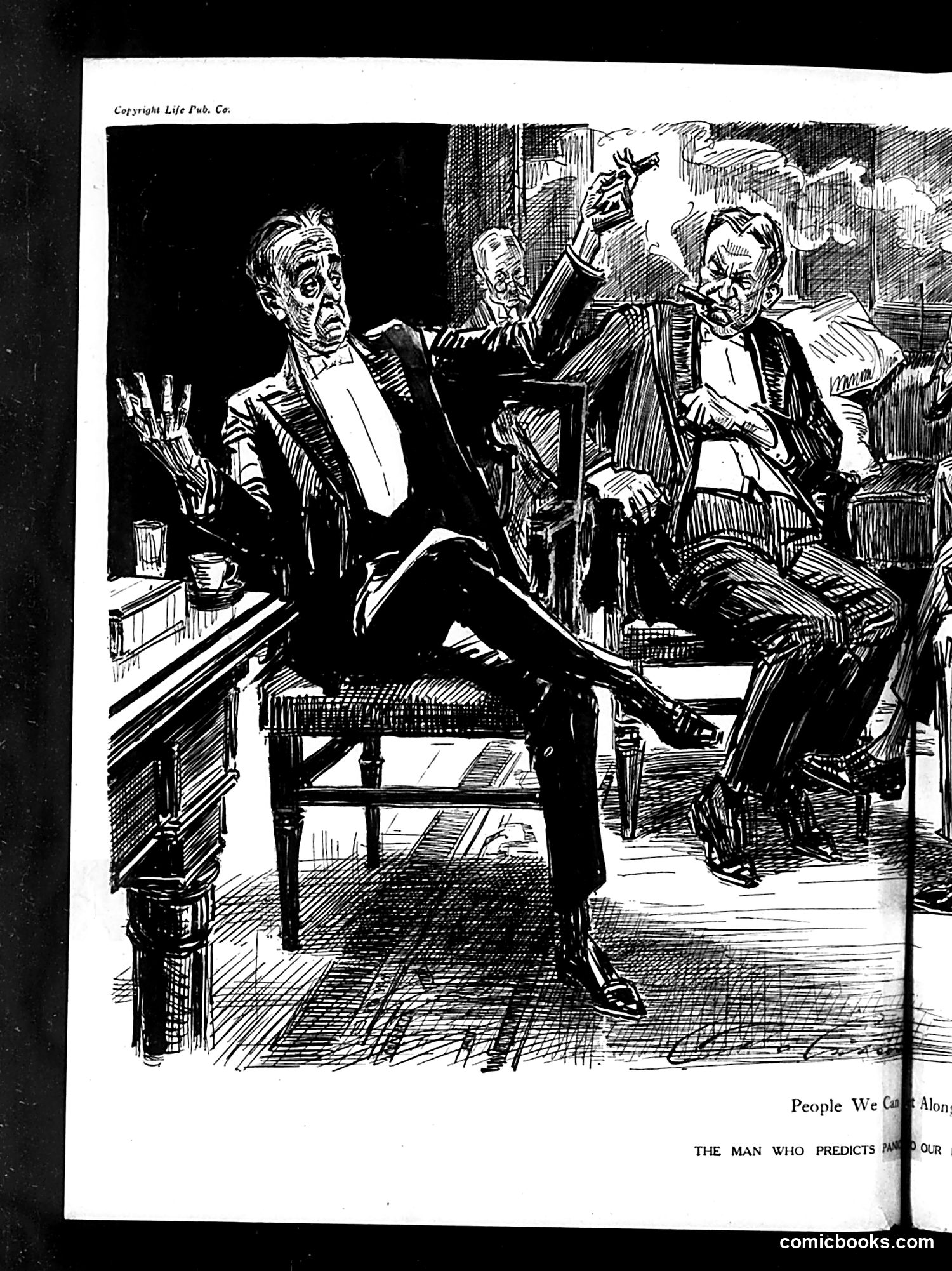
This satirical illustration depicts a man in formal evening dress (tuxedo) seated centrally, gesturing expressively while surrounded by three other formally-dressed men who appear to be listening intently. The title suggests this figure is someone known for making predictions—likely a fortune teller, astrologer, or self-proclaimed oracle of some kind. The satire appears to mock such predictive figures as entertainers or charlatans performing for an audience of credulous listeners. The dramatic poses and the central figure's animated gestures suggest theatrical showmanship rather than genuine prophetic ability. The artwork's style and the Life magazine publication context indicate this was social commentary on popular fascination with prediction and fortune-telling, likely poking fun at people who take such figures seriously.
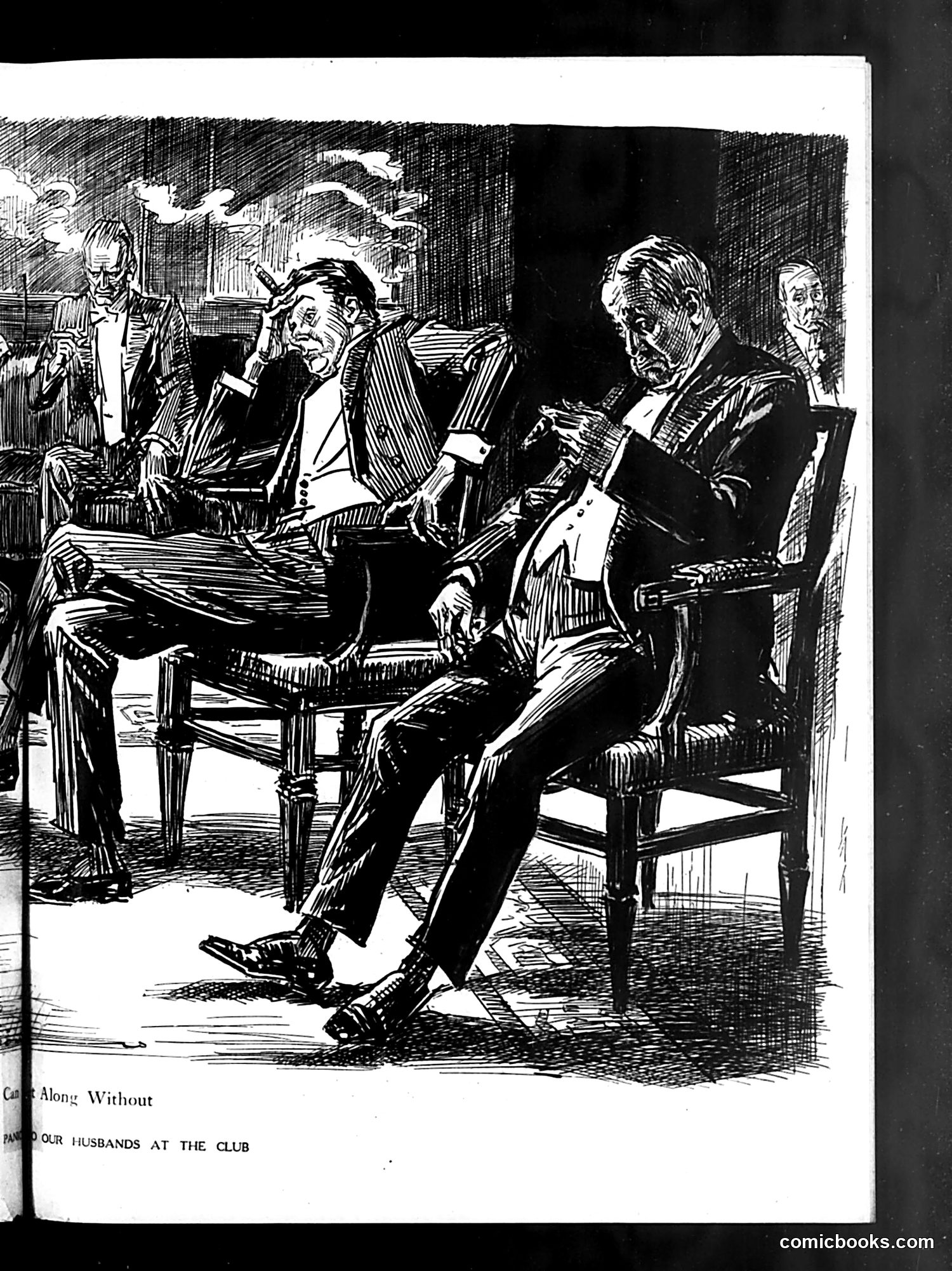
This satirical cartoon depicts four well-dressed men in suits at what appears to be a gentlemen's club, socializing and smoking. The title "Four Husbands at the Club" suggests commentary on upper-class male leisure and marital life. The humor appears to target the social customs of affluent men who frequented exclusive clubs—spaces where husbands could escape domestic responsibilities to socialize among themselves. The cartoon likely mocks either the frivolity of such club culture or the dynamics of marriage among the wealthy, where husbands spent considerable time away from home in male-only spaces. Without additional context about the specific issue of *Life* magazine, the precise satirical target remains unclear, though it comments on gender roles and class-based social segregation of the era.
This is a theater review satirizing a Greenwich Village Theatre production titled "The Sacrifice" (also advertised as "Benedict Arnold Double-Crossing the Gefiltefish"). The critic mocks the play's amateurish quality and implausible plot: Benedict Arnold is portrayed as exceptionally villainous—wearing a terrible wig and seducing a Jewish girl whose grief-stricken father dies. The girl then spends five years disguising herself as a Continental Army captain to confront Arnold. The review's humor lies in treating this melodramatic, historically absurd premise with mock-serious critique. The critic compares it to a wax museum, suggesting the actors are stiff and lifeless. References to "Eugene O'Neill" and "Chic Sale" (a vaudeville performer) add contemporary comedy. The second section praises the Actors' Equity Association's annual show for its ensemble spirit and democratic cooperation among famous and unknown performers working together—a counterpoint to the amateur play's incompetence.
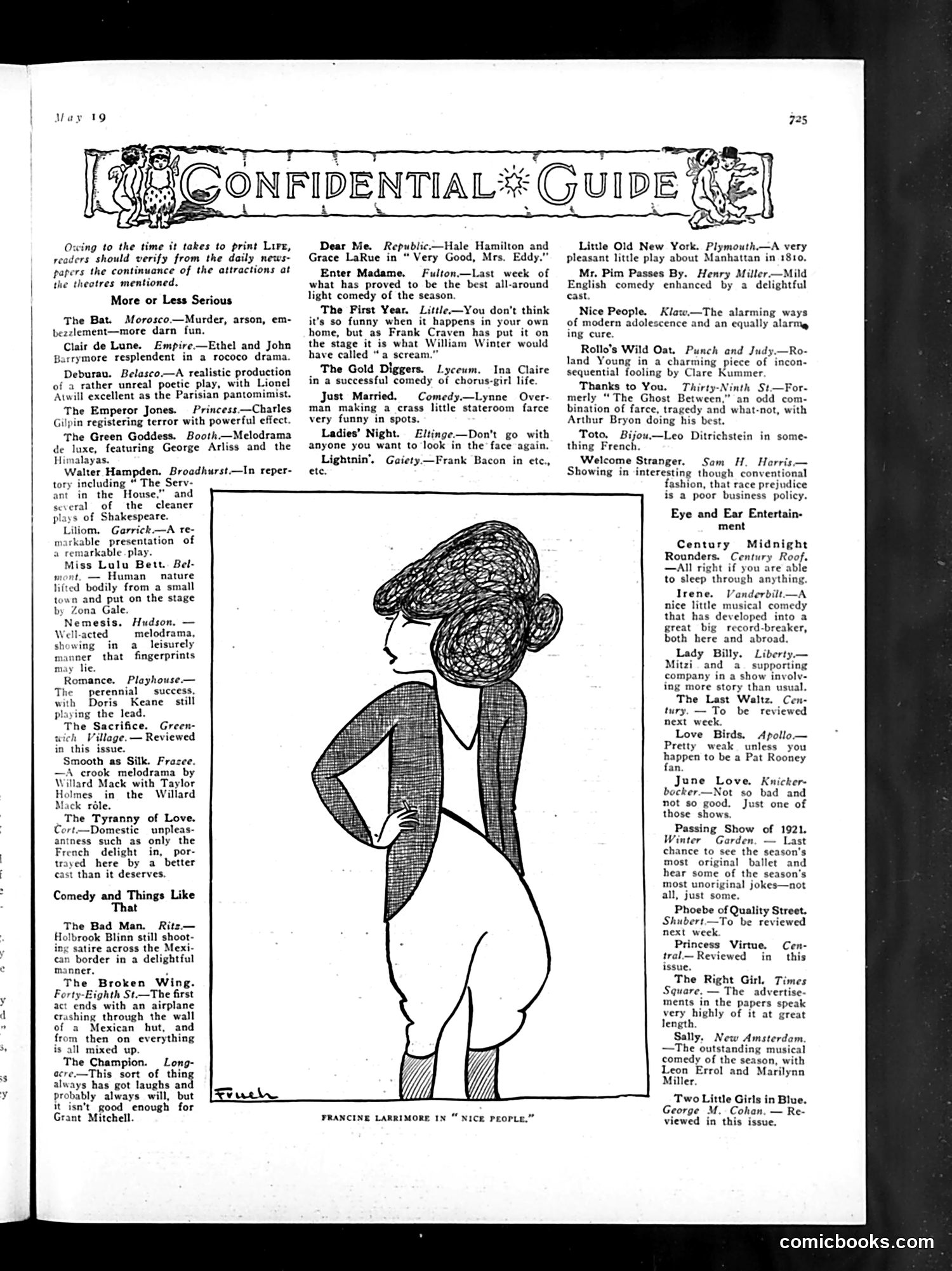
This page is a theater review section titled "Confidential Guide," listing Broadway productions with brief critical commentary. The central illustration shows **Francine Larrimore** in the play "Nice People," depicted as a fashionably dressed young woman with 1920s styling (bobbed hair, drop-waist dress). The reviews reflect post-WWI theatrical tastes: melodramas ("The Bat," "Nemesis"), light comedies ("The First Year," "Just Married"), and serious dramatic works (Charles Gilpin in "The Emperor Jones"). The language reveals period sensibilities—reviewers note that "Nice People" addresses "alarming ways of modern adolescence," suggesting contemporary anxiety about youth behavior and changing social norms in the Jazz Age. The illustration's prominence alongside this particular review suggests satire about young women's unconventional fashion and behavior—key cultural flashpoints of the 1920s. The page functions primarily as entertainment guidance rather than political satire.
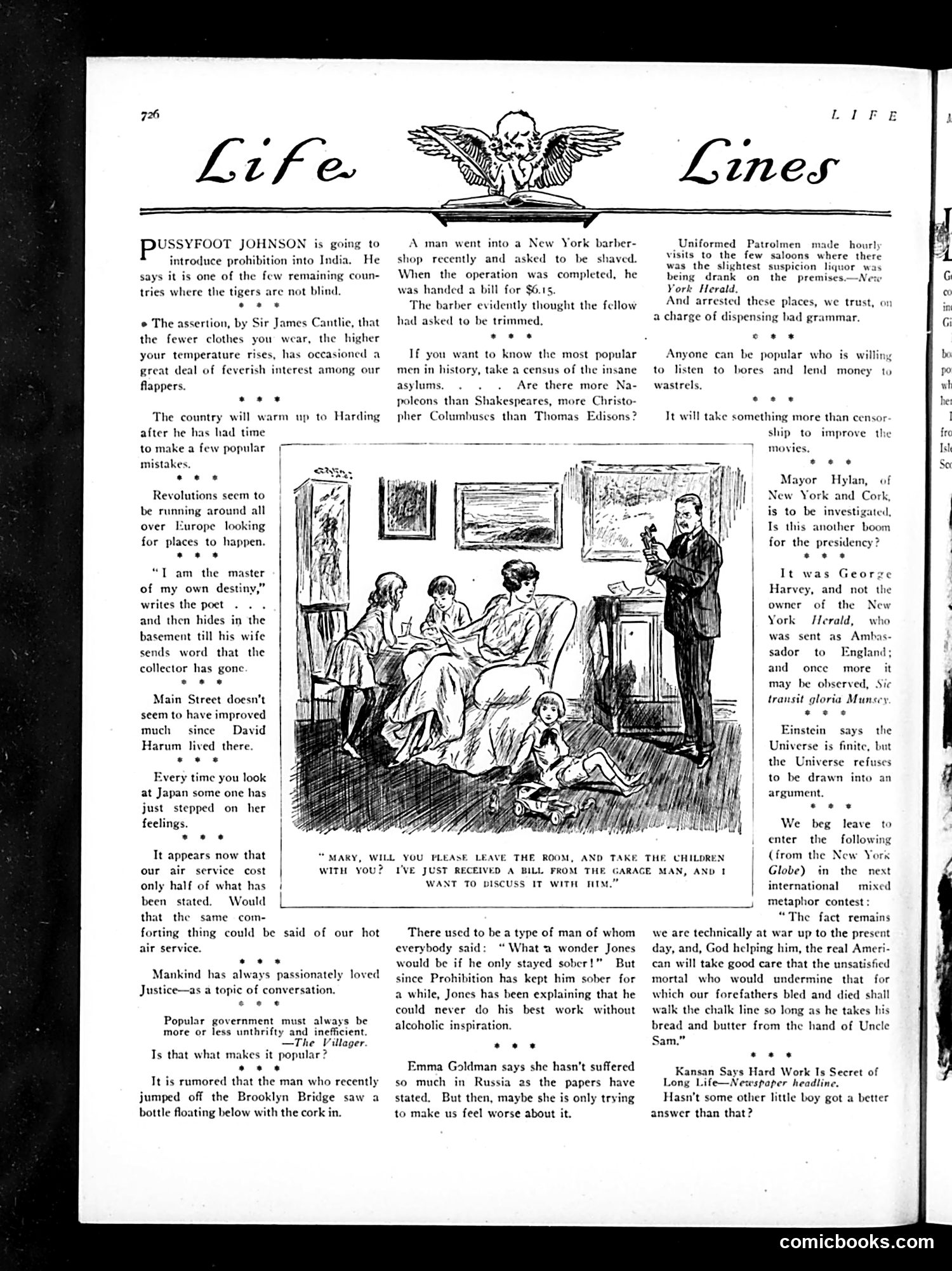
This is a collection of brief satirical commentary pieces typical of Life magazine's "Life Lines" section, targeting early 1920s American society and politics. **Key references:** - **Pussyfoot Johnson**: A real Prohibition advocate attempting to export temperance to India—mocked for claiming tigers go blind without alcohol restriction - **Harding**: President Warren G. Harding, newly elected; satirized as needing time to warm public opinion - **Barber shop bill ($6.15)**: Joke about post-WWI inflation and overpricing - **Mayor Hylan/Harvey**: NYC political figures under investigation; satire on presidential aspirations from scandal-tainted candidates - **Einstein/the Universe**: Contemporary scientific debate presented as absurdist argument - **Prohibition enforcement**: Police raids on speakeasies shown as grammar-correcting activity - **Central cartoon**: Domestic scene where a husband must discuss garage bills—satirizes marital tension over rising automobile costs The overall tone mocks Prohibition, political corruption, inflation, and post-war American society through brief, barbed observations.
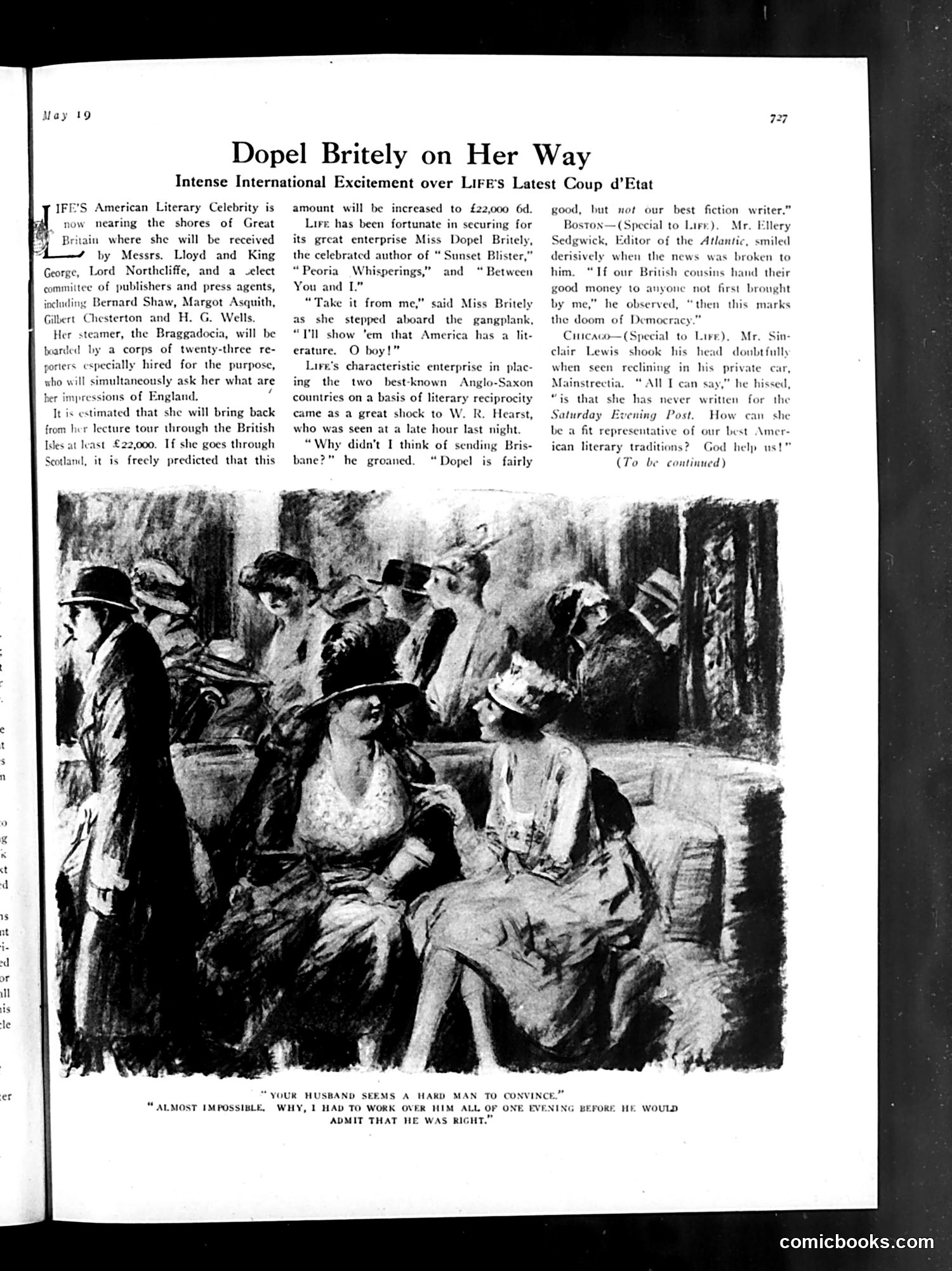
This is satirical commentary on American literary celebrity and international cultural exchange. Life magazine announces the arrival of "Miss Dopel Britely," a fictional American author, coming to Britain—presented as a major cultural event with enormous fanfare and financial expectations (£22,000). The satire mocks several targets: American literary pretension (Britely's absurd book titles like "Sunset Blister"), the competitive ego of real editors and publishers (references to W.R. Hearst and Sinclair Lewis), and anxieties about American cultural influence abroad. The quoted reactions from Boston, Chicago, and elsewhere reveal professional jealousy—these editors worry about losing prestige and money to a minor American writer. The illustration shows well-dressed crowds greeting Britely, emphasizing the manufactured celebrity spectacle. The caption quote suggests relationship strain, likely commenting on how literary success creates domestic tension. The overall joke: American cultural figures receive inflated importance, and professional rivalry drives absurd responses to minor literary events.
This is a critical essay on D.W. Griffith's *The Birth of a Nation* (1915), reviewed seven years after its original release. The author acknowledges the film's technical superiority over earlier cinema and its influence on the industry, but argues the medium has since **declined artistically despite commercial growth**. The piece criticizes film executives—described sarcastically as former con artists ("selling gold bricks and running shell games")—for prioritizing box-office returns over artistic merit. It claims movies have become formulaic and "machine made," abandoning the spontaneity of early cinema. The author argues producers assume audiences care only about sex, leading to morally degraded content. The title's pun ("Revival of the Fittest") suggests only *The Birth of a Nation* survives as genuinely worthy cinema, while other contemporary films lack artistic substance. This reflects 1920s intellectual concerns about cinema as art versus commerce.
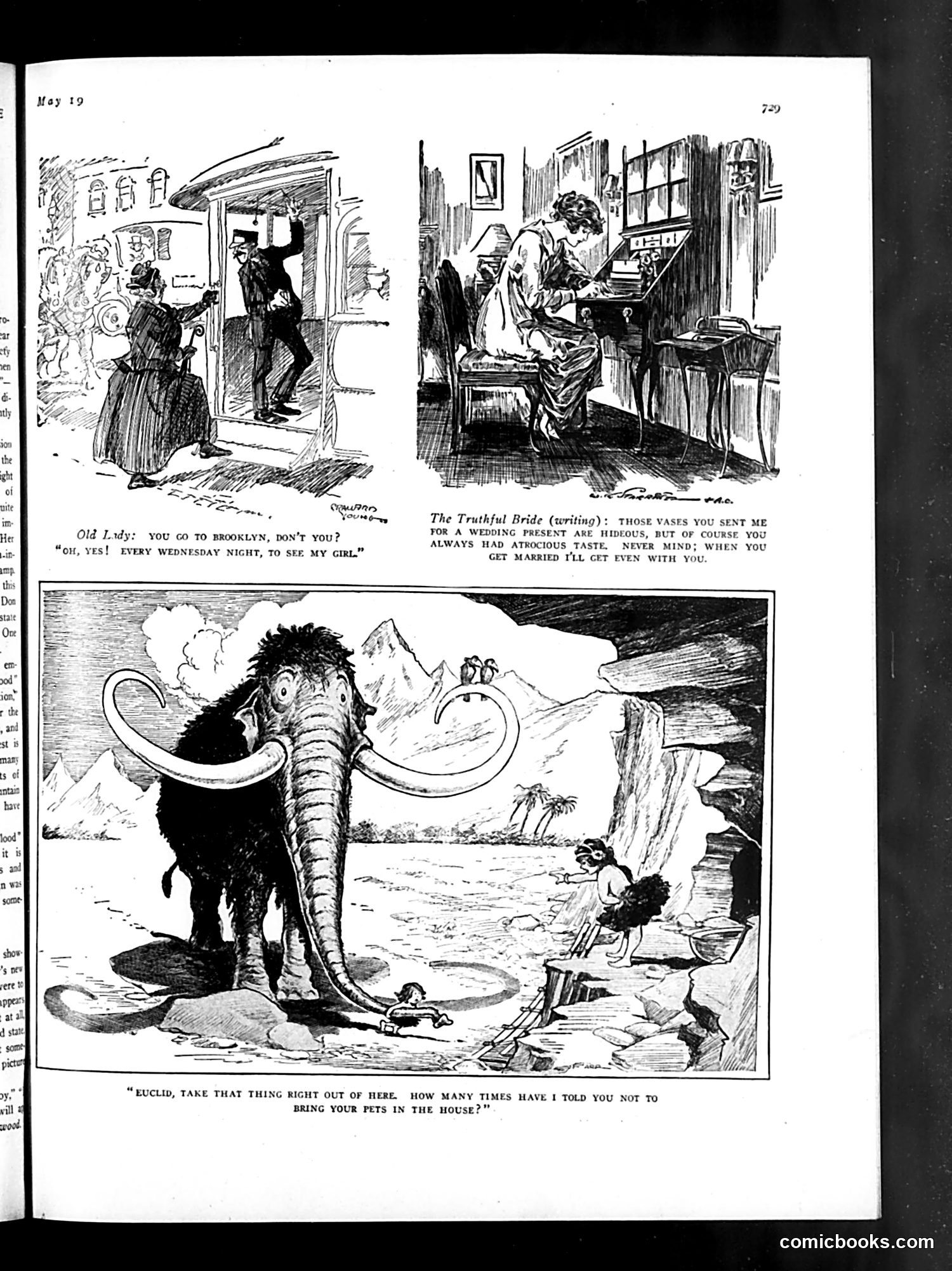
This page contains three separate humor pieces: **Top left:** A domestic comedy sketch about a man's weekly Brooklyn visits. An old lady questions why he goes to Brooklyn every Wednesday night; he replies it's to see "my girl." The joke plays on the ambiguity—she likely expects a romantic explanation, but he probably means a daughter or sweetheart, creating comic misunderstanding. **Top right:** "The Truthful Bride" satirizes newlywed dynamics. A bride writes thank-you notes for wedding gifts, brutally honest about ugly vases while promising revenge through her marriage—a commentary on women's powerlessness and how they endure unwanted gifts with forced politeness. **Bottom:** A humorous domestic scene where a character named Euclid is scolded for bringing his pet mammoth into the house. The absurdist humor comes from treating a prehistoric elephant as an ordinary household pet problem, mocking exasperated spouse complaints about pet misbehavior. All three pieces satirize domestic life and marriage conventions through exaggeration and unexpected twists.
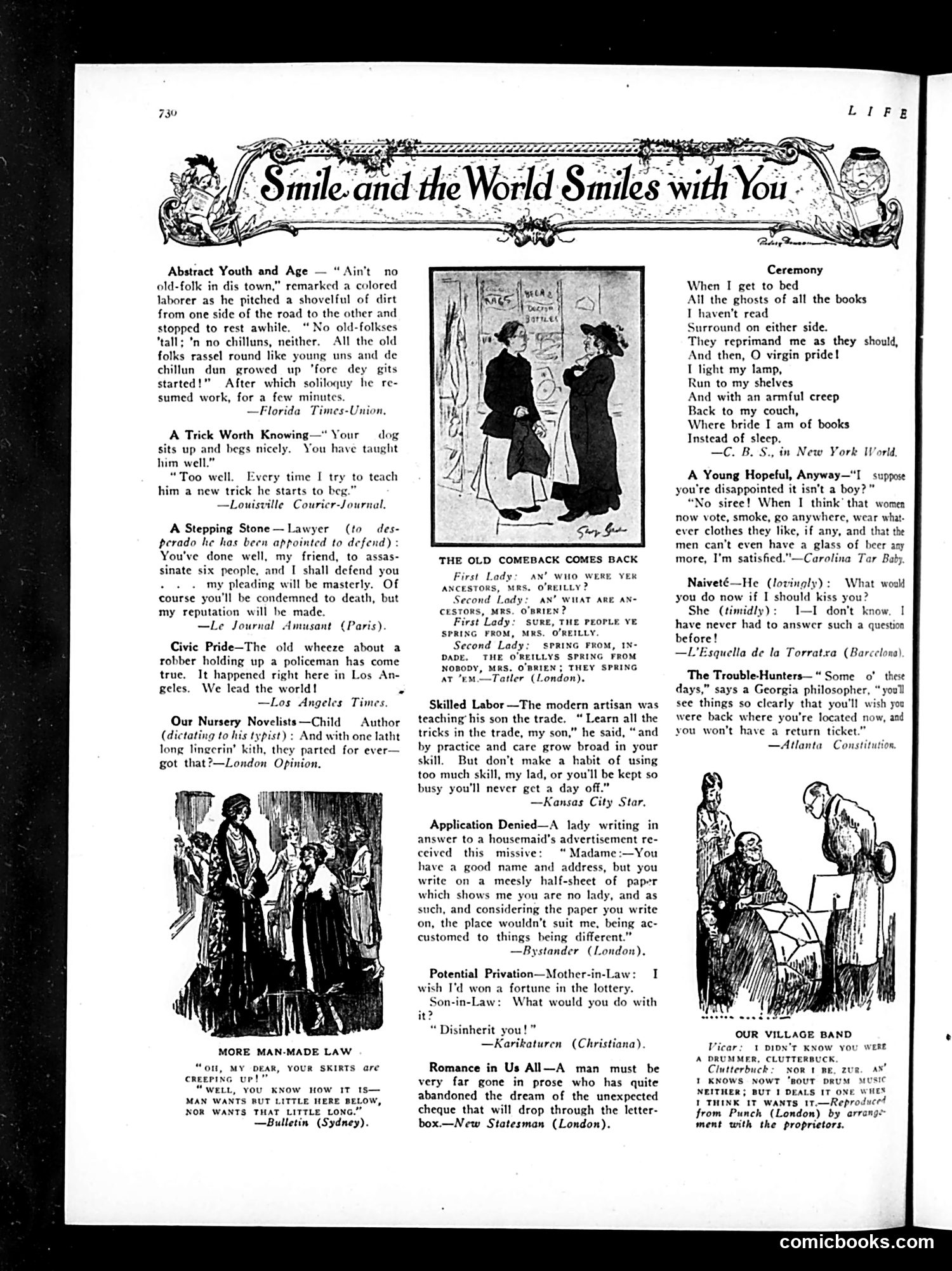
This is a humor/joke compilation page featuring satirical observations on social behavior and gender roles, circa early 20th century. Key items include: **"More Man-Made Law"** cartoon depicts a husband complaining about his wife's skirt length—a commentary on evolving women's fashion and domestic power dynamics. **"The Old Comeback Comes Back"** presents Irish immigrant women (Mrs. O'Reilly and Mrs. O'Brien) discussing ancestry, satirizing class pretensions and immigrant social climbing. **"A Young Hopeful, Anyway"** jokes about women's new freedoms (voting, smoking, fewer restrictions) following suffrage, showing relief that a newborn daughter won't face traditional male constraints. **"Ceremony"** is a poem about insomnia and seeking solace in unread books—intellectual escapism. The page reflects post-WWI social upheaval: women's changing roles, immigrant integration, labor issues, and evolving class consciousness. The tone is lighthearted but revealing of contemporary anxieties about gender, modernization, and social mobility.
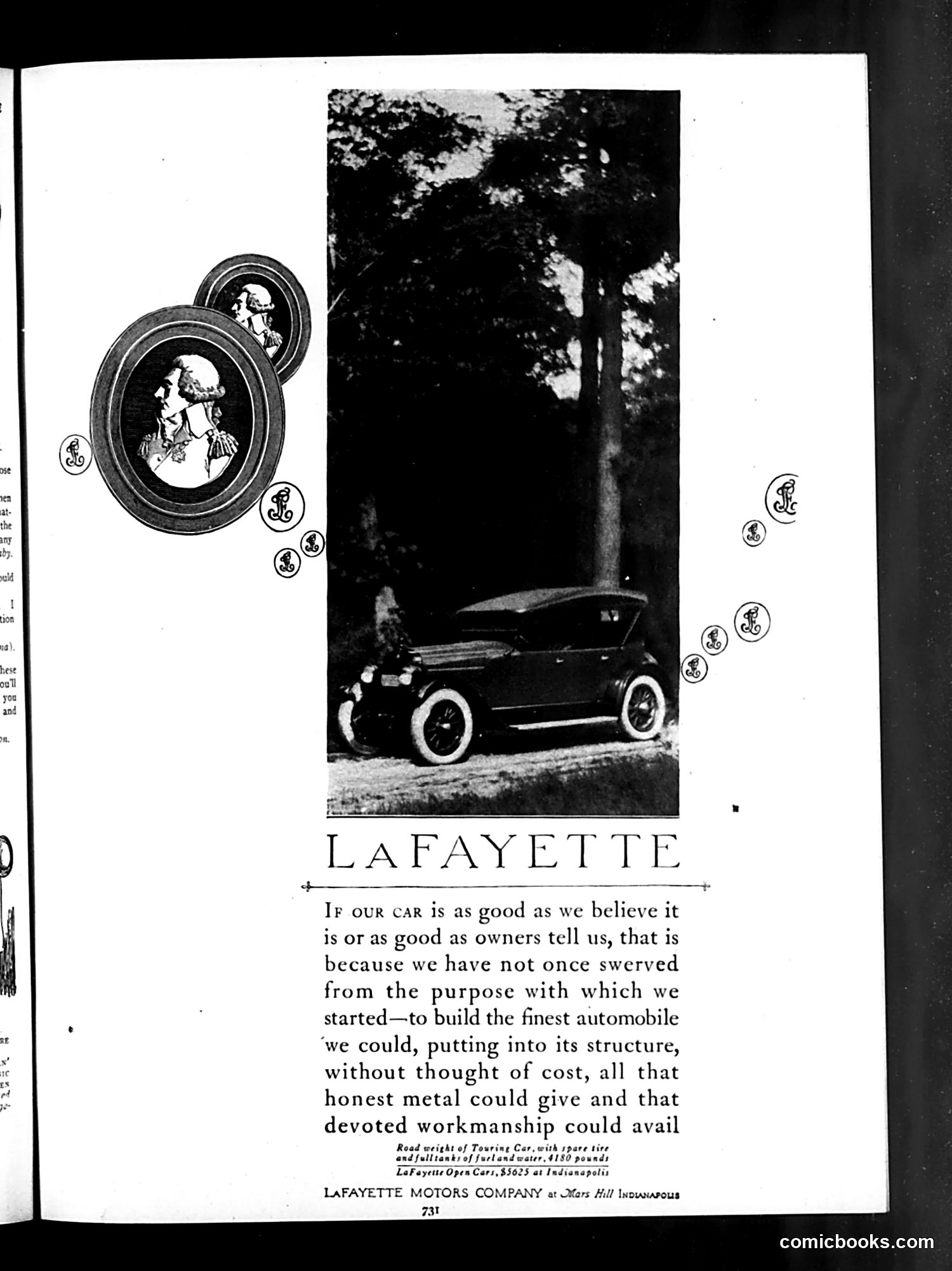
This is primarily a **product advertisement**, not a political cartoon. It promotes Lafayette automobiles through the Lafayette Motors Company of Indianapolis. The page features a vintage car photograph with two oval portrait medallions (left side) showing what appear to be historical military or political figures—likely the Marquis de Lafayette himself, given the brand name—establishing prestige through association with a revered historical figure. The advertisement's text emphasizes quality and craftsmanship: the company claims unwavering commitment to building "the finest automobile" without cost-cutting, using "honest metal" and "devoted workmanship." This appeals to early-20th-century consumer values emphasizing durability and American industrial pride. The pricing and specifications (touring car weight, Indianapolis location) target affluent buyers seeking premium automobiles during the automobile's early commercial era.
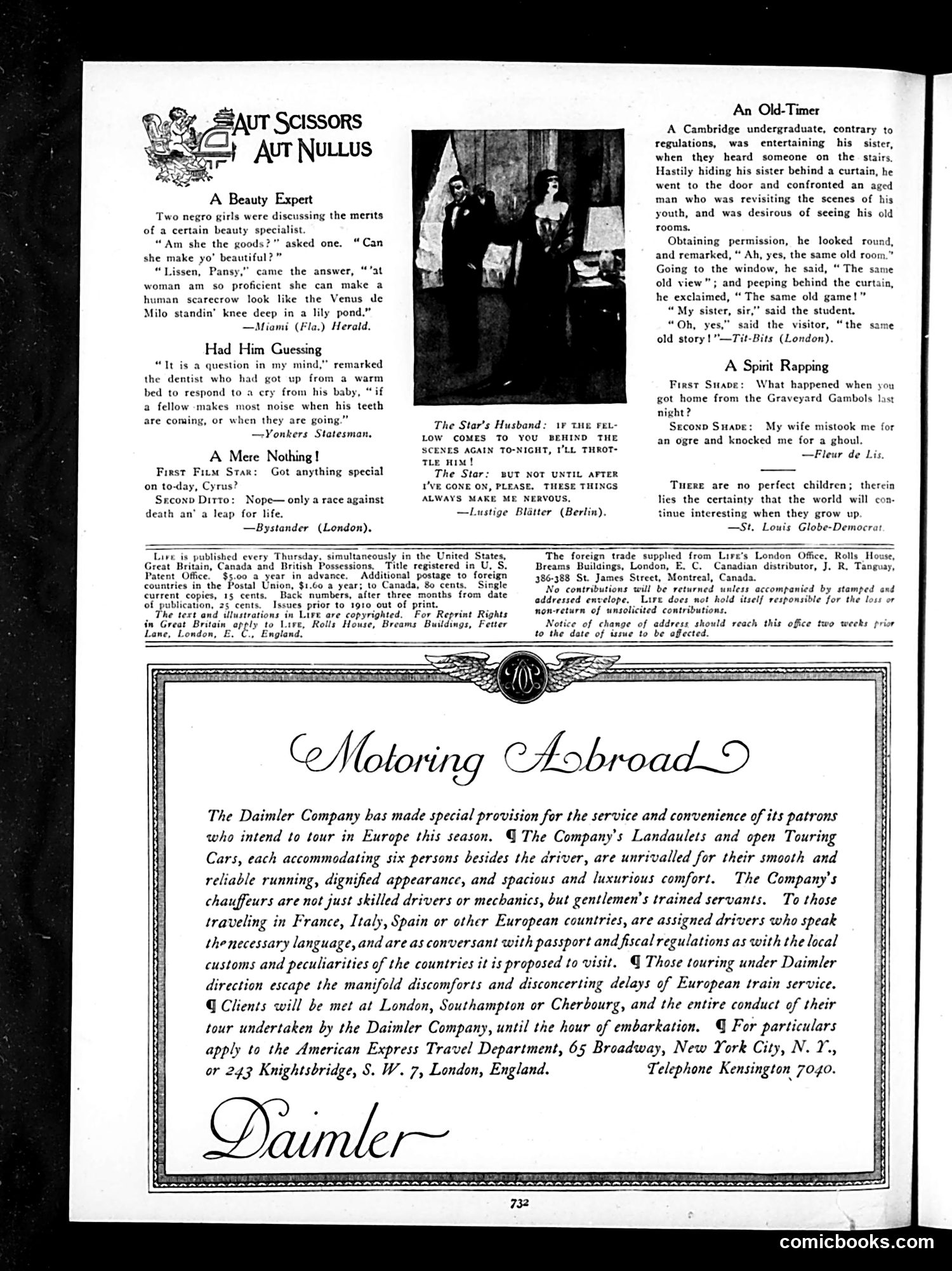
This page contains several brief humorous anecdotes ("Aut Scissors") and advertising rather than political cartoons. The jokes reflect early 20th-century attitudes and concerns: 1. **"A Beauty Expert"**: Uses dialect humor featuring African American women discussing a beauty specialist's exaggerated skills—typical of period comedy that relied on racial stereotypes. 2. **"Had Him Guessing"**: A dentist's domestic quandary about babies teething versus losing teeth—gentle domestic humor. 3. **"An Old-Timer"**: An undergraduate hides his sister (violating university rules) from a visiting alumnus; the visitor recognizes the hidden figure as "the same old game"—implying this rule-breaking was common in his own student days. 4. **"A Spirit Rapping"**: Post-party humor where a drunk husband is mistaken for a supernatural creature. The page is primarily an advertising section for Daimler automobiles offering European touring services with multilingual drivers and trained chauffeurs. The satire here is minimal—mainly light, genteel humor typical of 1920s Life magazine.
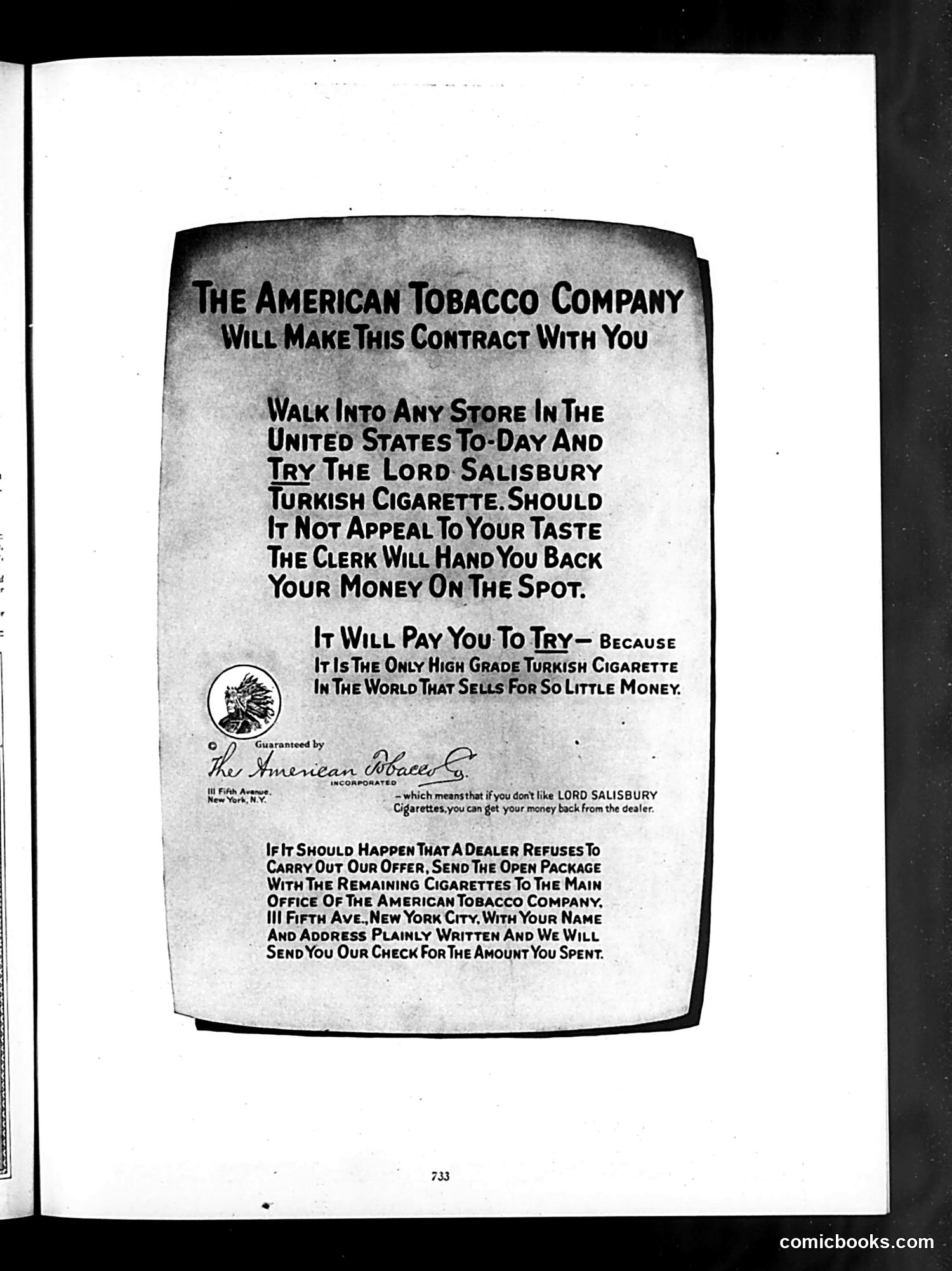
This is **not a cartoon or satire**, but rather a **full-page advertisement** for Lord Salisbury Turkish Cigarettes by the American Tobacco Company. The ad makes an early consumer-protection pitch: it guarantees satisfaction with a money-back promise. Customers could test the cigarettes in any store and return them if unsatisfied. The company emphasizes these are "the only high grade Turkish cigarette in the world that sells for so little money"—positioning them as affordable luxury. The appeal to try before committing ("It will pay you to try") and the detailed refund instructions (including a backup process if dealers refused) represent an aggressive early advertising strategy meant to overcome buyer hesitation about an unfamiliar brand. There is no political satire or social commentary here—it's straightforward period advertising using the language and guarantees typical of early 20th-century cigarette marketing.
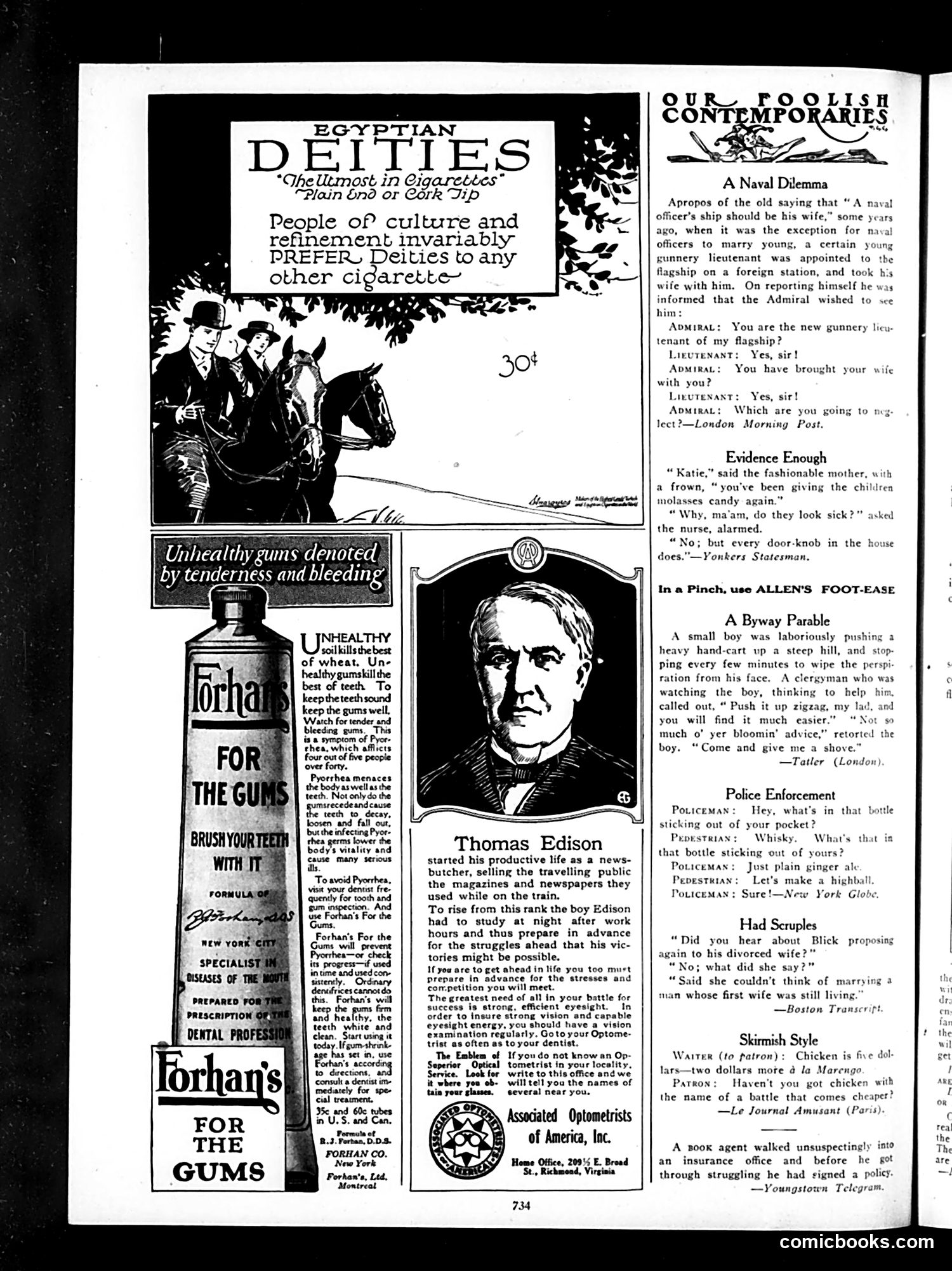
This page from *Life* magazine combines advertisements with humorous short anecdotes typical of early 20th-century American satirical journalism. **The Advertisements:** - Egyptian Deities cigarettes claim superiority based on cultural appeal - Forhan's dental product addresses "pyorrhea" (gum disease), then a widespread health concern - Thomas Edison biographical copy uses his rise from "news-butcher" (train vendor) to industrialist as motivational advertising for vision care **The Humor Sections:** Several brief jokes satirize domestic life and social conventions: - "A Naval Dilemma" mocks the old saying that officers should prioritize ships over wives - "Evidence Enough" jokes about children's sticky fingers from candy - "Police Enforcement" plays on Prohibition-era hypocrisy (both officer and civilian carry bottles) - "Had Scruples" ridicules a woman's objection to remarrying her ex-husband because his first wife still lived The page reflects early 1900s concerns: dental health, class mobility, domestic tensions, and Prohibition-era contradictions. The tone assumes reader familiarity with conventional morality and contemporary social debates.
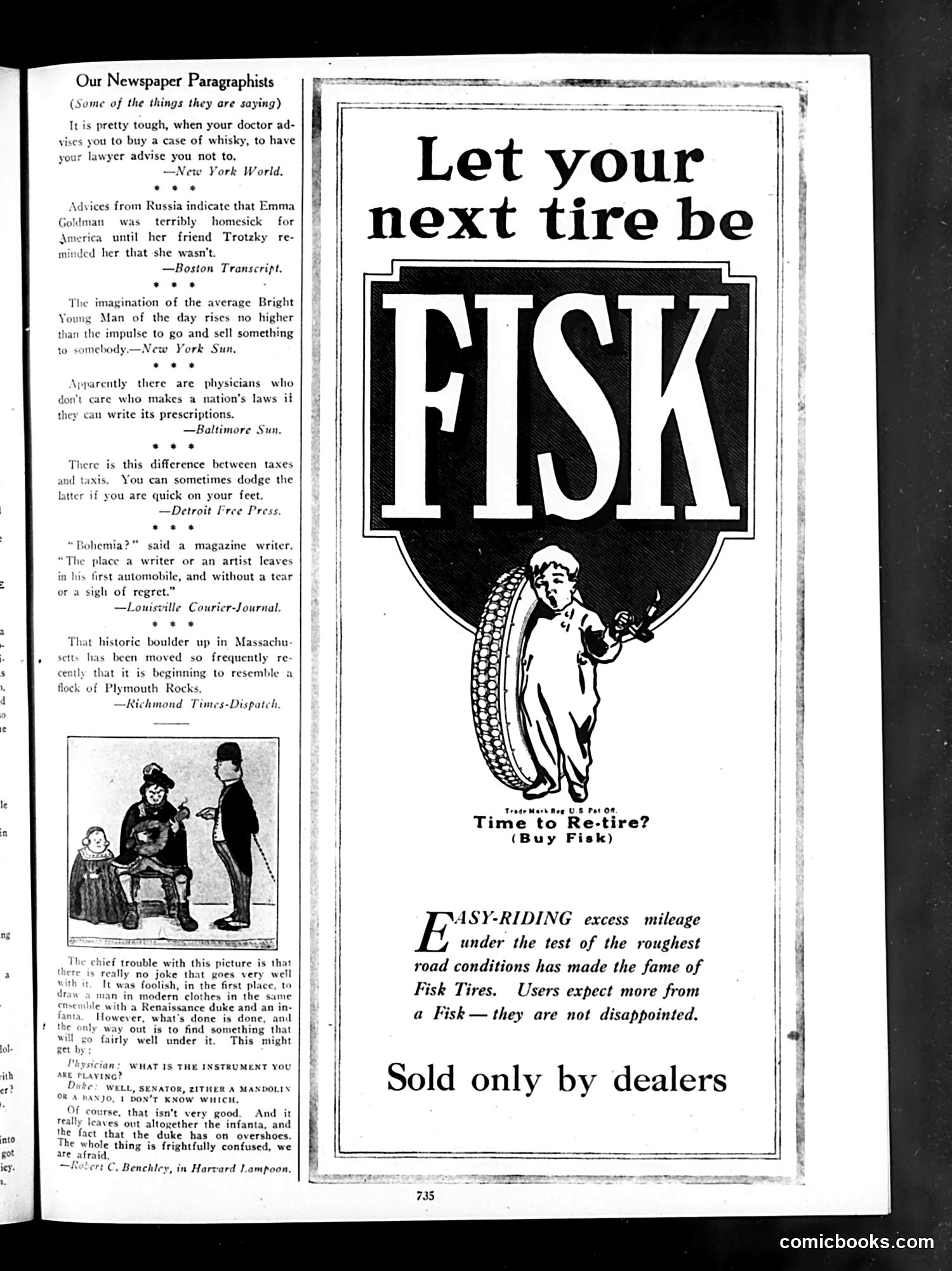
This page combines newspaper humor columns with a vintage tire advertisement. **The Newspaper Paragraphs** are short, satirical observations from various publications commenting on contemporary issues: Prohibition (doctors prescribing whisky while lawyers forbid it), Emma Goldman's Russian exile, young men's lack of ambition, physicians' political influence, tax evasion, bohemian artists, and a moving boulder in Massachusetts. **The Main Cartoon** (bottom left) shows a physician, Renaissance duke, and modern man with a child—a visual joke about incongruous mixing of time periods and social classes. The caption reveals the cartoonist struggled to make the composition work, turning the confusion itself into the joke. **The Advertisement** (right page) is a Fisk Tires ad featuring a cherub/putto figure straining under an enormous tire, with the tagline "Time to Re-tire?" This plays on the double meaning of "retire" (rest/replace). The ad emphasizes durability under "roughest road conditions." All content reflects early 20th-century American consumer culture and humor sensibilities.
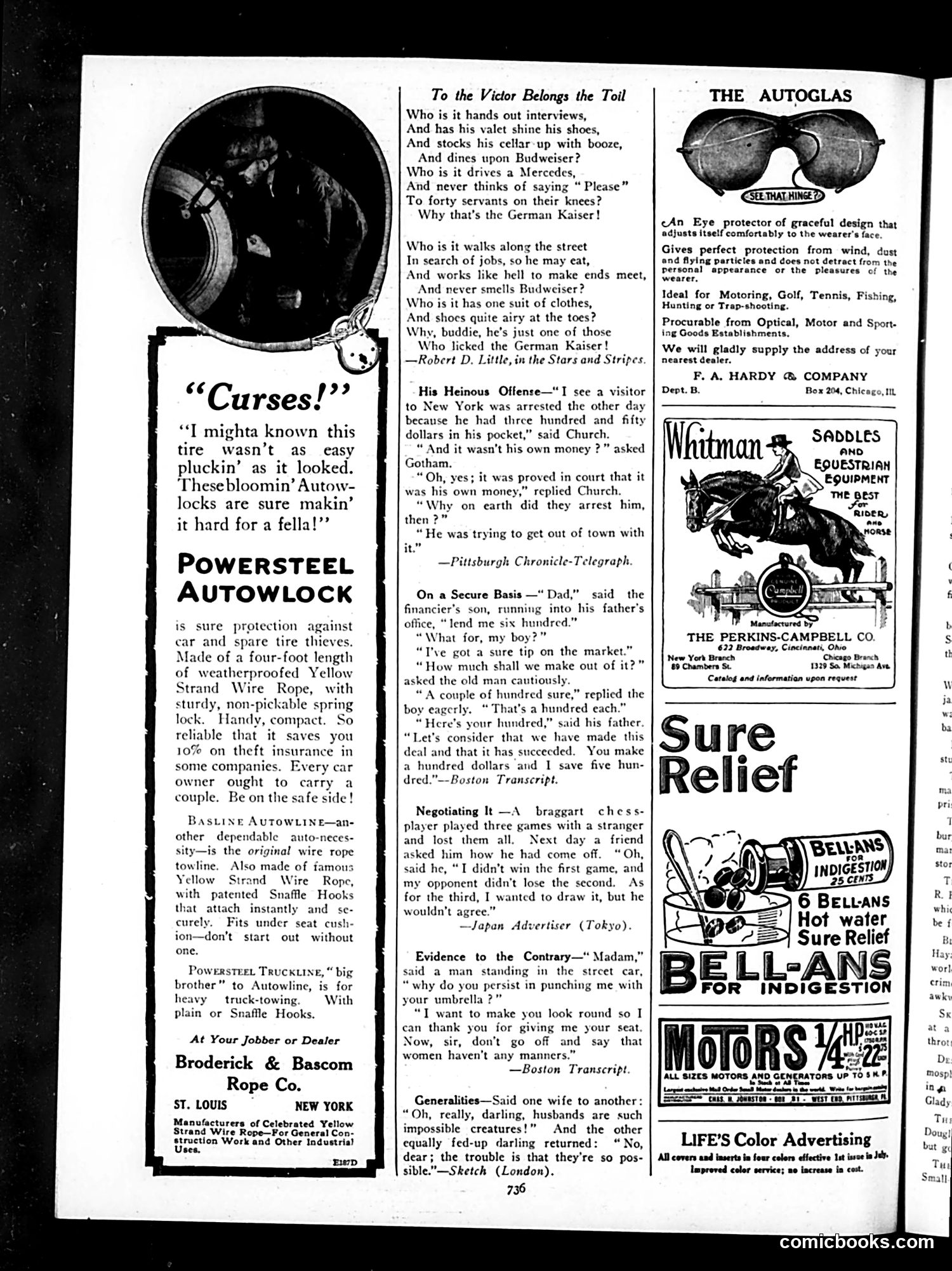
The main cartoon depicts a car thief frustrated while attempting to steal a spare tire, exclaiming that "Thesebloomin' Autolocks are sure makin' it hard for a fella!" This is satirical advertising for the Powersteel Autowlock—a security device made of wire rope and spring lock designed to prevent tire theft. The joke targets actual car thieves of the era, treating the criminal's complaint as humorous endorsement. The cartoon anthropomorphizes the thief's perspective to highlight the product's effectiveness: if even a determined criminal finds it difficult, legitimate owners should feel protected. The page also features "To the Victor Belongs the Toil," a patriotic poem by Robert D. Little contrasting the luxurious German Kaiser with the hardworking American soldier who defeated him—this appears to reference post-WWI sentiments, likely published during the 1918-1919 period when *Life* was actively anti-German. The remaining content consists of humorous anecdotes and advertisements unrelated to political commentary.
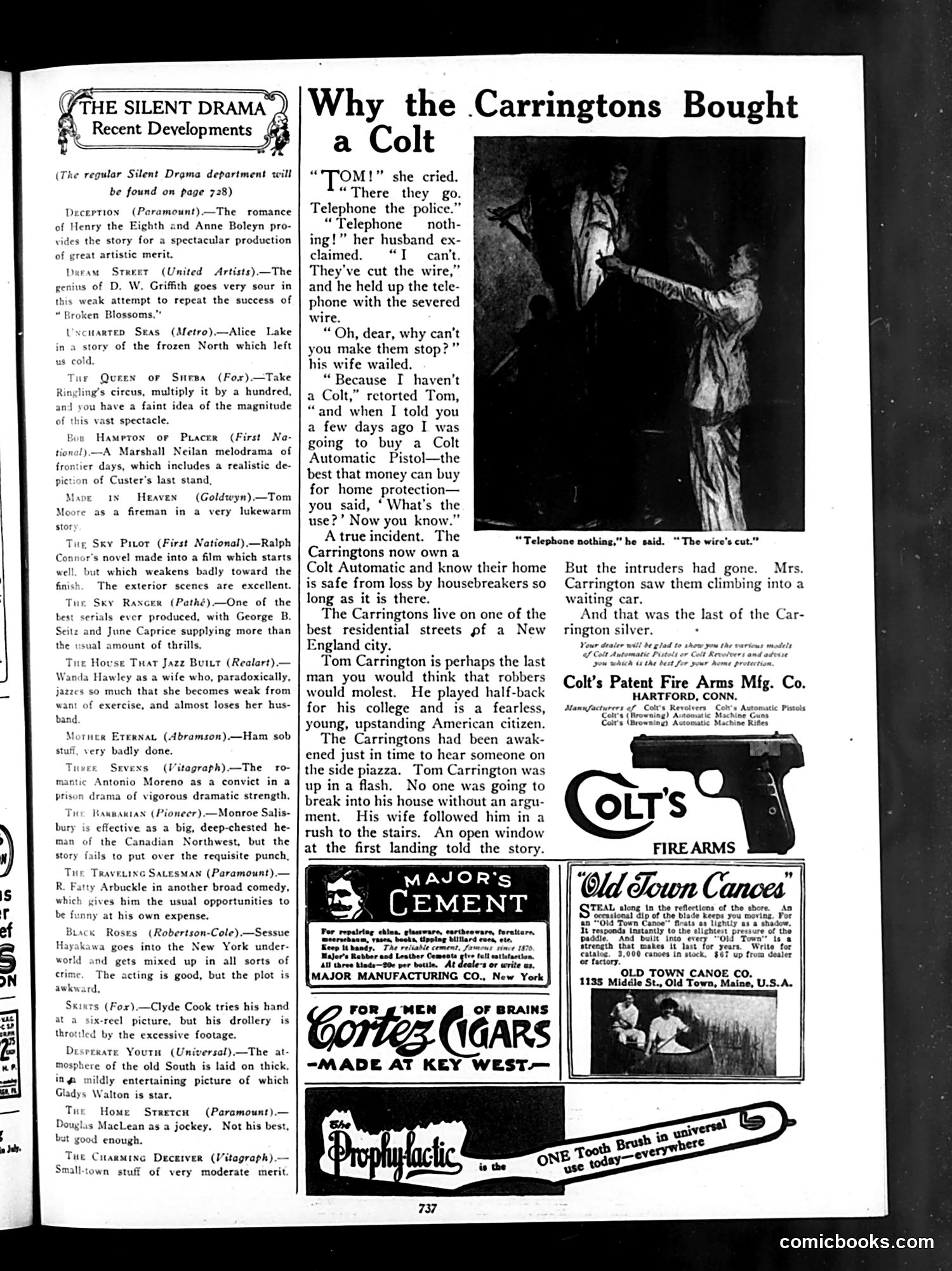
This page is primarily an advertisement disguised as a narrative story, promoting Colt Automatic Pistols for home defense. The fictional scenario depicts a burglary in progress at a wealthy New England home. When the husband discovers intruders, he's unable to call police because the criminals have cut the telephone wire—a common vulnerability of the era when homes relied on single telephone lines. The ad's "point" is that the husband previously dismissed his wife's concerns about needing a firearm for home protection, but now realizes his mistake. The Carringtons subsequently purchase a Colt Automatic, positioning the weapon as essential security for upstanding middle-class citizens. The accompanying image shows a man confronting an intruder on the home's exterior, dramatizing the threat. This advertisement reflects early-20th-century anxieties about burglary and home invasion, marketing firearms as the solution to domestic security concerns.
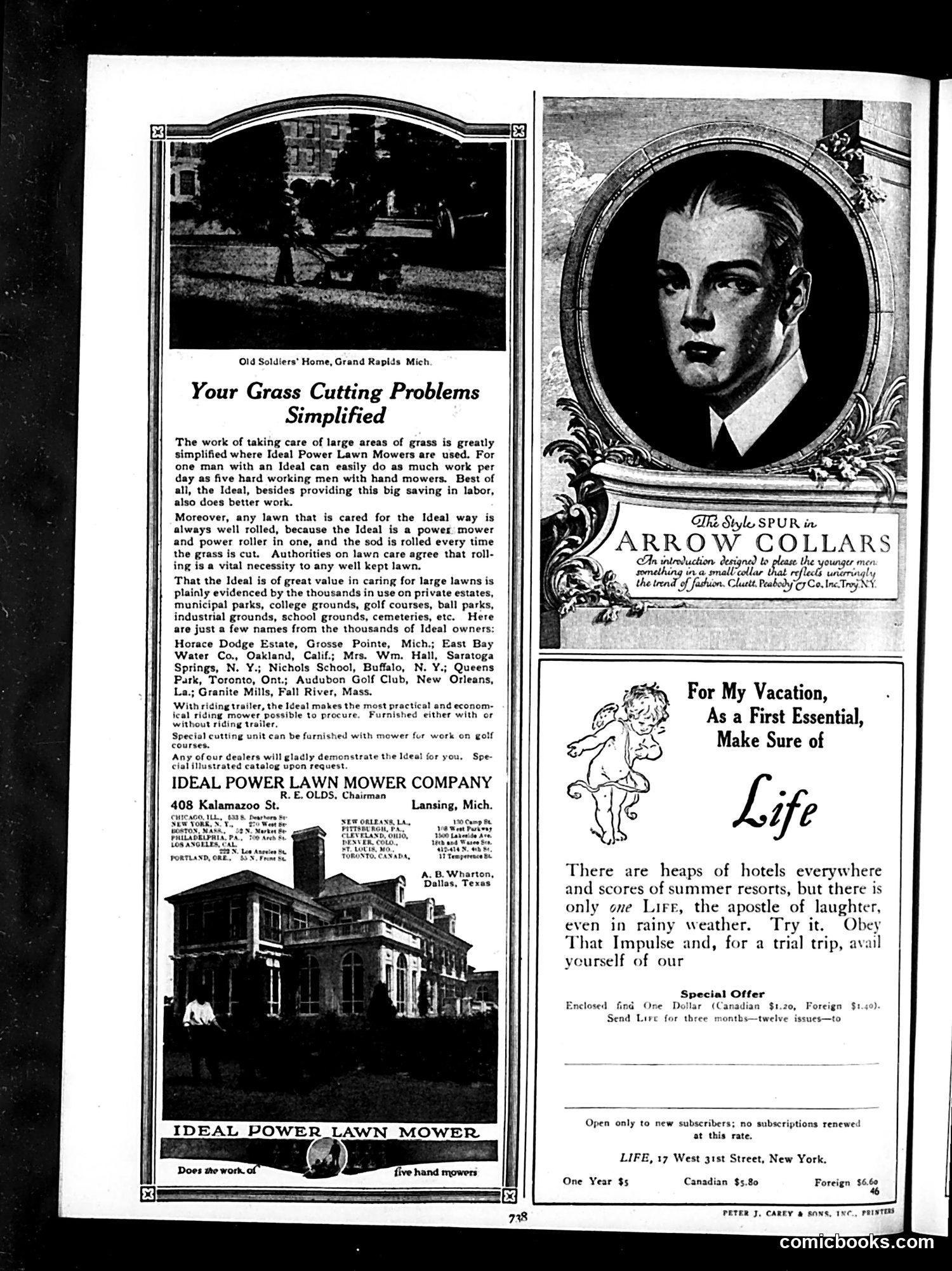
This page is primarily **advertising**, not satirical content. It contains three distinct ads: 1. **Ideal Power Lawn Mower** (left): A straightforward product advertisement promoting mechanical lawn mowers as labor-saving devices. It references the Old Soldiers' Home in Grand Rapids, suggesting institutional use, and lists prestigious clients (estates, golf clubs, parks) to establish credibility. 2. **Arrow Collars** (top right): A fashion advertisement featuring a male portrait in an ornate frame, marketing a new "small collar" style to younger men as fashionable. 3. **Life Magazine Subscription** (bottom right): A promotional offer for the *Life* magazine itself, marketed as "the apostle of laughter"—emphasizing humor as essential vacation reading. The cherub illustration reinforces the lighthearted tone. The page reflects early 20th-century consumer culture and advertising strategies, with no apparent political satire or cartoon commentary. It's a typical magazine advertisement spread from that era.
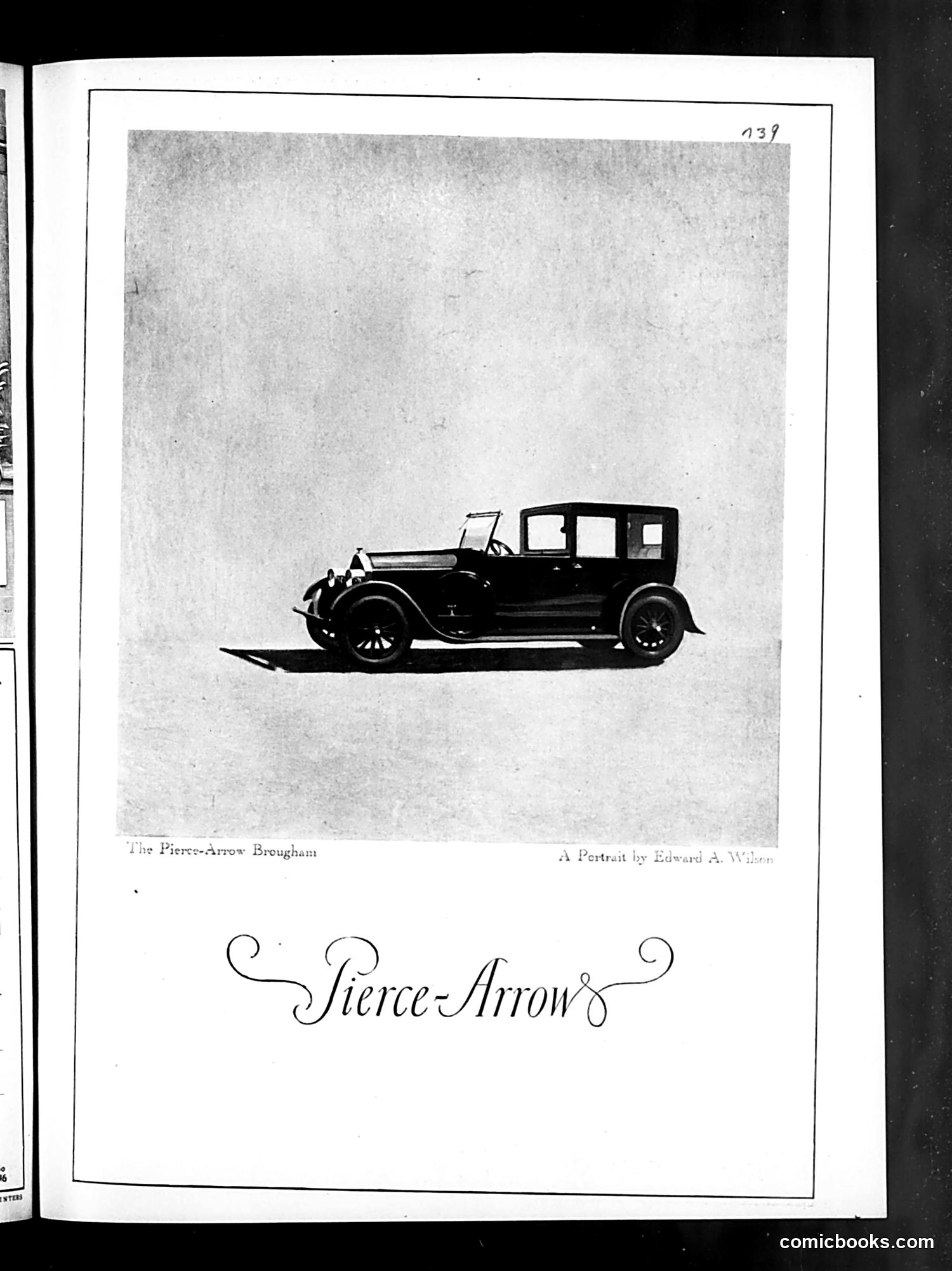
This page is primarily **advertising content** for the Pierce-Arrow automobile, specifically their "Brougham" model. The image shows a side-profile silhouette of an elegant early 1920s luxury car rendered as "A Portrait by Edward A. Wilson." The presentation is characteristic of high-end automotive advertising from this era, emphasizing the vehicle's refined, prestigious design through artistic portraiture rather than technical specifications. The decorative "Pierce-Arrow" script below suggests this targets wealthy consumers for whom automobiles were luxury status symbols. This is **not satirical content**—it's a straightforward advertisement designed to appeal to affluent readers of Life magazine by presenting the car as a work of art worthy of serious portraiture.
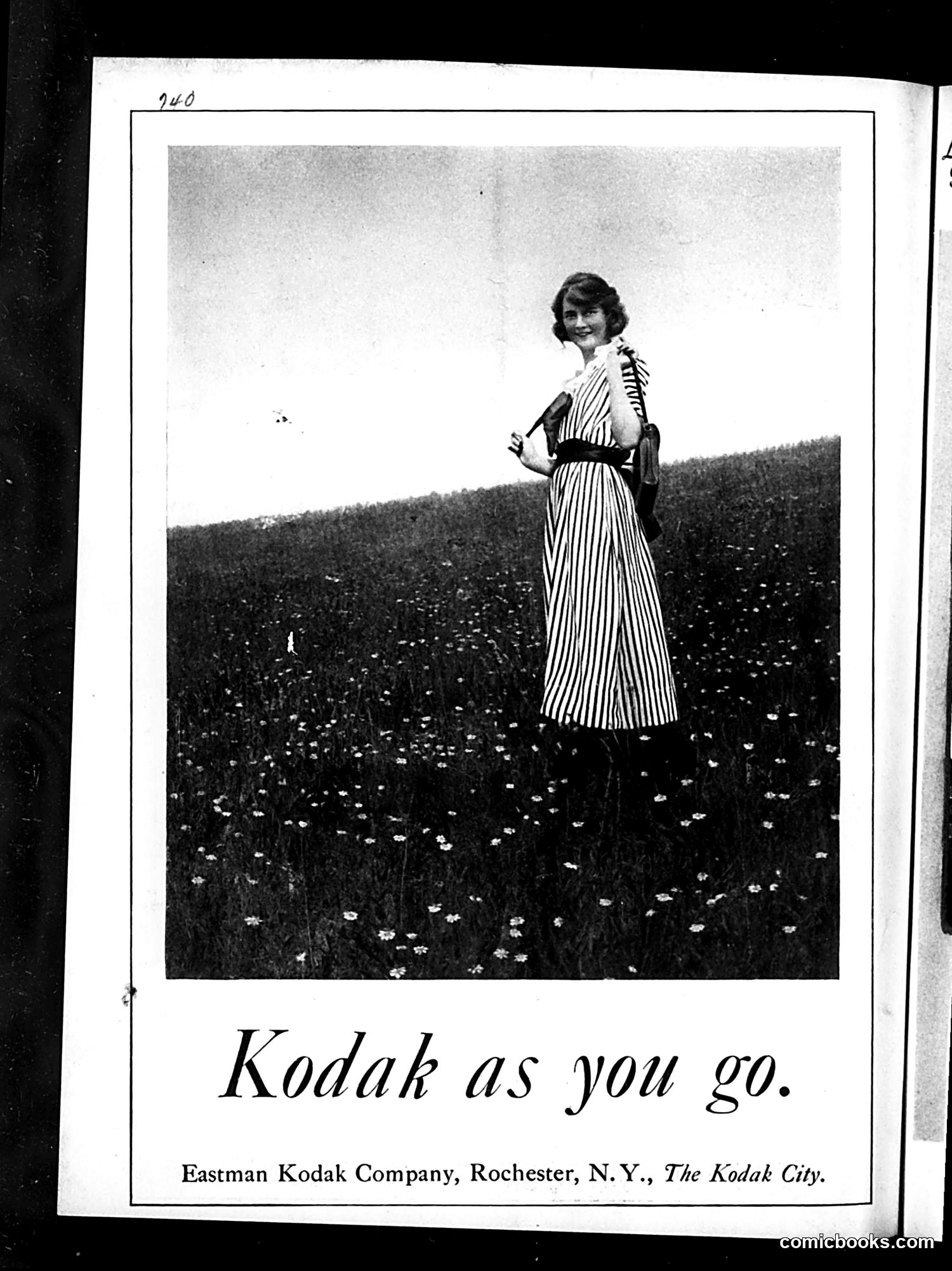
This is a **Kodak advertisement**, not political satire. The page shows a woman in a long striped dress standing in a wildflower field, posed to look over her shoulder at the camera. The tagline "Kodak as you go" promotes portable photography for everyday moments. The woman's relaxed, natural pose in a scenic outdoor setting exemplifies the aspirational lifestyle Kodak cameras enabled—casual documentation of leisure activities. This reflects early 20th-century marketing emphasizing how Kodak made photography accessible to the general public, particularly women, rather than requiring professional studios. The "Kodak City" reference identifies Eastman Kodak's Rochester, New York headquarters, a major industrial center.