
Life, 1921-05-19 · page 17 of 36
Life — May 19, 1921 — page 17: what you’re looking at
What you’re looking at
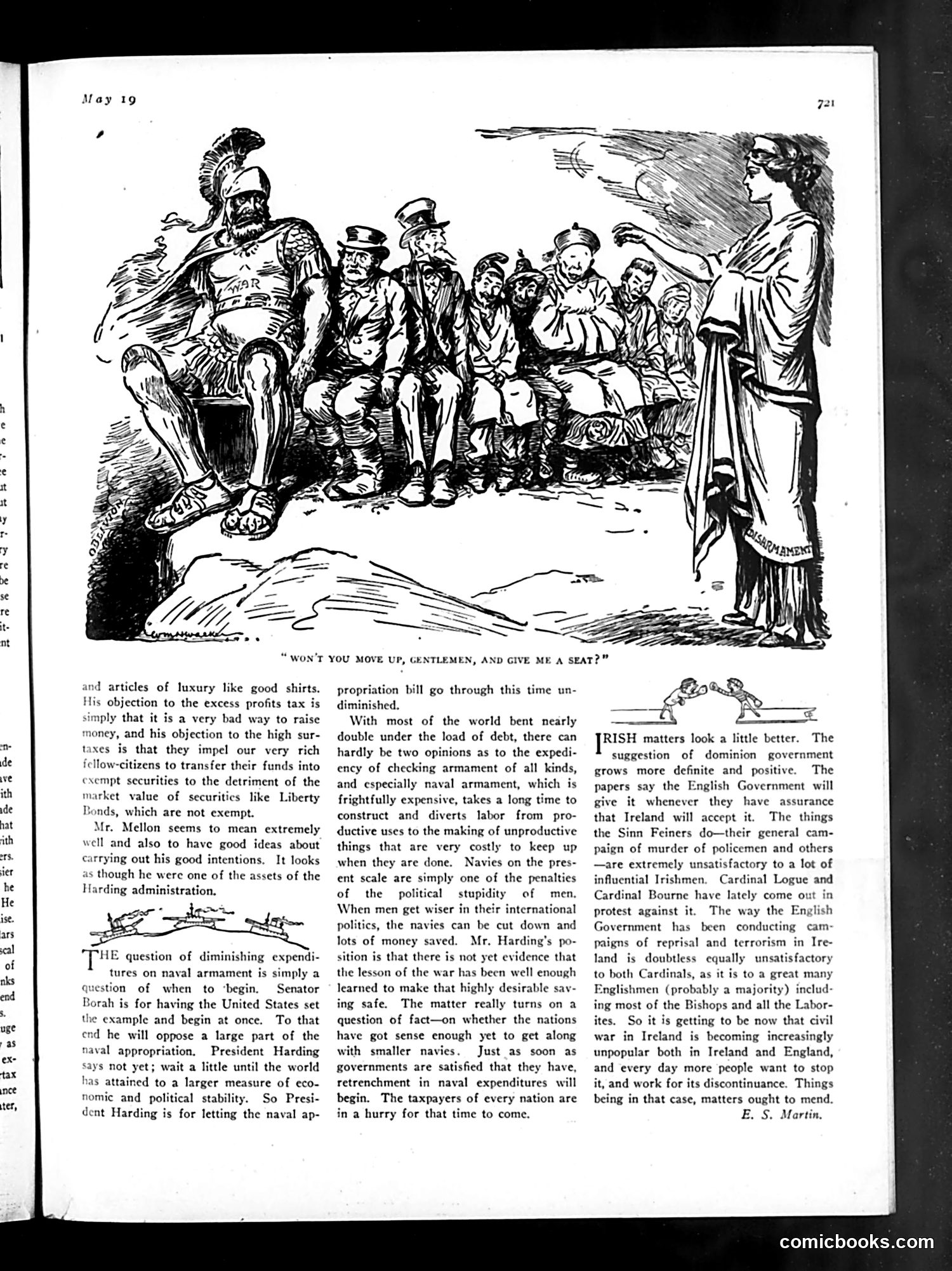
**The Cartoon:** The image depicts a crowded scene where a classical warrior or military figure (representing militarism or naval expansion) sits prominently while uniformed officials and civilians crowd around. A robed female figure (likely representing Justice, Peace, or Democracy) stands to the right, asking them to make room. **The Political Context:** This satirizes the Harding administration's naval spending debate. Senator Borah advocated immediate military cutbacks, but President Harding resisted, arguing the world wasn't yet stable enough. The cartoon criticizes this position—the bloated military figure dominates the scene while civilian needs (represented by the pleading female figure) are crowded out. **The Satire:** Life magazine argues that massive naval expenditures are wasteful given global debt and suffering. The cartoon suggests Harding's caution perpetuates unnecessary military spending, leaving no "seat" for productive civilian priorities. The accompanying text emphasizes that continued armament diverts labor and resources from beneficial uses.
📄 Transcribed text from this page (OCR, searchable)
Machine-transcribed from the original scan — historical spelling and the odd misread are preserved.
se ~Z2ZzZZFsEA “WON'T YOU MOVE UP, GENTLEMEN, AND GIVE ME A SEAT?” and articles of luxury like good shirts. His objection to the excess profits tax is simply that it is a very bad way to raise money, and his objection to the high sur- taxes is that they impel our very rich fcllow-citizens to transfer their funds into exempt securities to the detriment of the market value of securities like Liberty Bonds, which are not exempt. Mr. Mellon seems to mean extremely well and also to have good ideas about carrying out his good intentions. It looks as though he were one of the assets of the Harding administration. HE question of diminishing expendi- tures on naval armament is simply a question of when to ‘begin. Senator Borah is for having the United States set the example and begin at once. To that end he will oppose a large part of the naval appropriation, President Harding says not yet; wait a little until the world has attained to a larger measure of eco- nomic and political stability. So Presi- dent Harding is for letting the naval ap- propriation bill go through this time un- diminished. With most of the world bent nearly double under the load of debt, there can hardly be two opinions as to the expedi- ency of checking armament of all kinds, and especially naval armament, which is frightfully expensive, takes a long time to construct and diverts labor from pro- ductive uses to the making of unproductive things that are very costly to keep up when they are done. Navies on the pres- ent scale are simply one of the penalties of the political stupidity of men, When men get wiser in their international politics, the navies can be cut down and lots of money saved. Mr. Harding's po- sition is that there is not yet evidence that the lesson of the war has been well enough learned to make that highly desirable sav- ing safe. The matter really turns on a question of fact—on whether the nations have got sense enough yet to get along with smaller navies. Just as soon as governments are satisfied that they have, retrenchment in naval expenditures will begin. The taxpayers of every nation are in a hurry for that time to come, oe —A RISH matters look a little better. The suggestion of dominion government grows more definite and positive. The papers say the English Government will give it whenever they have assurance that Ireland will accept it. The things the Sinn Feiners do—their general cam- paign of murder of policemen and others —are extremely unsatisfactory to a lot of influential Irishmen, Cardinal Logue and Cardinal Bourne have lately come out in Protest against it. The way the English Government has been paigns of reprisal and terrorism in Ire- land is doubtless equally unsatisfactory to both Cardinals, as it is to a great many Englishmen (probably a majority) includ- ing most of the Bishops and all the Labor- ites. So it is getting to be now that civil war in Ireland is becoming increasingly unpopular both in Ireland and England, and every day more people want to stop it, and work for its discontinuance. Things being in that case, matters ought to mend. E. S. Martin, conducting cam- comicbooks.com