
Life, 1921-05-19 · page 20 of 36
Life — May 19, 1921 — page 20: what you’re looking at
What you’re looking at
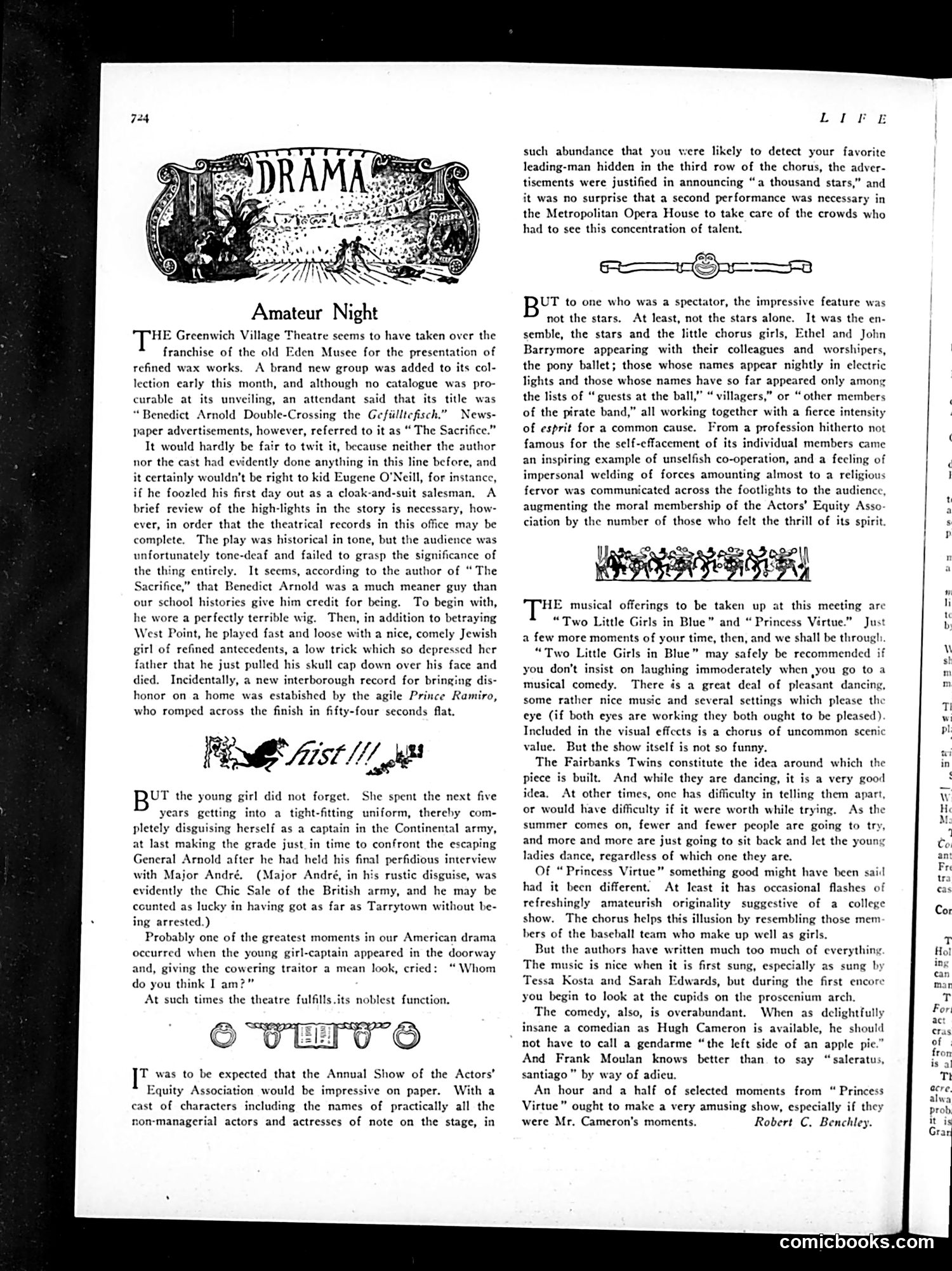
This is a theater review satirizing a Greenwich Village Theatre production titled "The Sacrifice" (also advertised as "Benedict Arnold Double-Crossing the Gefiltefish"). The critic mocks the play's amateurish quality and implausible plot: Benedict Arnold is portrayed as exceptionally villainous—wearing a terrible wig and seducing a Jewish girl whose grief-stricken father dies. The girl then spends five years disguising herself as a Continental Army captain to confront Arnold. The review's humor lies in treating this melodramatic, historically absurd premise with mock-serious critique. The critic compares it to a wax museum, suggesting the actors are stiff and lifeless. References to "Eugene O'Neill" and "Chic Sale" (a vaudeville performer) add contemporary comedy. The second section praises the Actors' Equity Association's annual show for its ensemble spirit and democratic cooperation among famous and unknown performers working together—a counterpoint to the amateur play's incompetence.
📄 Transcribed text from this page (OCR, searchable)
Machine-transcribed from the original scan — historical spelling and the odd misread are preserved.
Amateur Night HE Greenwich Village Theatre seems to have taken over the franchise of the old Eden Musee for the presentation of refined wax works. A brand new group was added to its col- lection early this month, and although no catalogue was pro- curable at its unveiling, an attendant said that its title was “Benedict Arnold Double-Crossing the Gefiilltefisch.” New: paper advertisements, however, referred to it as “ The Sacrifice.’ It would hardly be fair to twit it, because neither the author nor the cast had evidently done anything in this line before, and it certainly wouldn't be right to kid Eugene O'Neill, for instance, if he foozled his first day out as a cloak-and-suit salesman. A brief review of the high-lights in the story is necessary, how- ever, in order that the theatrical records in this office may be complete. The play was historical in tone, but the audience was unfortunately tone-deaf and failed to grasp the significance of the thing entirely. It seems, according to the author of “The Sacrifice,” that Benedict Arnold was a much meaner guy than our school histories give him credit for being. To begin with, he wore a perfectly terrible wig. Then, in addition to betraying West Point, he played fast and loose with a nice, comely Jewish girl of refined antecedents, a low trick which so depressed her father that he just pulled his skull cap down over his face and died. Incidentally, a new interborough record for bringing dis- honor on a home was estabished by the agile Prince Ramiro, who romped across the finish in fifty-four seconds flat. PEE VISTI, ghd UT the young girl did not forget. She spent the next five years getting into a tight-fitting uniform, thereby com- pletely disguising herself as a captain in the Continental arm: at last making the grade just.in time to confront the escaping General Arnold after he had held his final perfidious interview with Major André, (Major André, in his rustic disguise, was evidently the Chic Sale of the British army, and he may be counted as lucky in having got as far as Tarrytown without be- ing arrested.) Probably one of the greatest moments in our American drama occurred when the young girl-captain appeared in the doorway and, giving the cowering traitor a mean look, cried: “ Whom do you think I am?” At such times the theatre fulfills.its noblest function. T was to be expected that the Annual Show of the Actors’ Equity Association would be impressive on paper. With a cast of characters including the names of practically all the non-managerial actors and actresses of note on the stage, in such abundance that you were likely to detect your favorite leading-man hidden in the third row of the chorus, the adver- tisements were justified in announcing “a thousand stars,” and it was no surprise that a second performance was necessary in the Metropolitan Opera House to take care of the crowds who had to see this concentration of talent. Ra Sac UT to one who was a spectator, the impressive feature was not the stars. At least, not the stars alone. It was the en- semble, the stars and the little chorus girls, Ethel and John Barrymore appearing with their colleagues and worshipers, the pony ballet; those whose names appear nightly in electric lights and those whose names have so far appeared only among the lists of “ guests at the ball,” “ villagers,” or “other members of the pirate band,” all working together with a fierce intensity of esprit for a common cause. From a profession hitherto not famous for the self-effacement of its individual members came an inspiring example of unselfish co-operation, and a fecling of impersonal welding of forces amounting almost to a religious fervor was communicated across the footlights to the audience, augmenting the moral membership of the Actors’ Equity Asso- ciation by the number of those who felt the thrill of its spirit. 'HE musical offerings to be taken up at this meeting are “Two Little Girls in Blue” and “Princess Virtue.” Just a few more moments of your time, then, and we shall be through. “Two Little Girls in Blue” may safely be recommended if you don’t insist on laughing immoderately when you go to a musical comedy. There és a great deal of pleasant dancing, some rather nice music and several settings which please the eye (if both eyes are working they both ought to be pleased). Included in the visual effccts is a chorus of uncommon scenic value. But the show itself is not so funny, The Fairbanks Twins constitute the idea around which the piece is built. And while they are dancing, it is a very good idea. At other times, one has difficulty in telling them apart, or would have difficulty if it were worth while trying. As the summer comes on, fewer and fewer people are going to try, and more and more are just going to sit back and let the young ladies dance, regardless of which one they are. Of “Princess Virtue” something good might have been said had it been different. At least it has occasional flashes of refreshingly amateurish originality suggestive of a college show. The chorus helps this illusion by resembling those mem bers of the baseball team who make up well as girls. But the authors have written much too much of everything The music is nice when it is first sung, especially as sung by Tessa Kosta and Sarah wards, but during the first encore you begin to look at the cupids on the proscenium arch. The comedy, also, is overabundant. When as delightfully insane a comedian as Hugh Cameron is available, he should not have to call a gendarme “the left side of an apple pie.” And Frank Moulan knows better than to say “saleratus, santiago” by way of adieu. An hour and a half of selected moments from “ Princess Virtue” ought to make a very amusing show, especially if they were Mr. Cameron's moments. Robert C. Benchley. comicbooks.com