
Life, 1921-05-19 · page 21 of 36
Life — May 19, 1921 — page 21: what you’re looking at
What you’re looking at
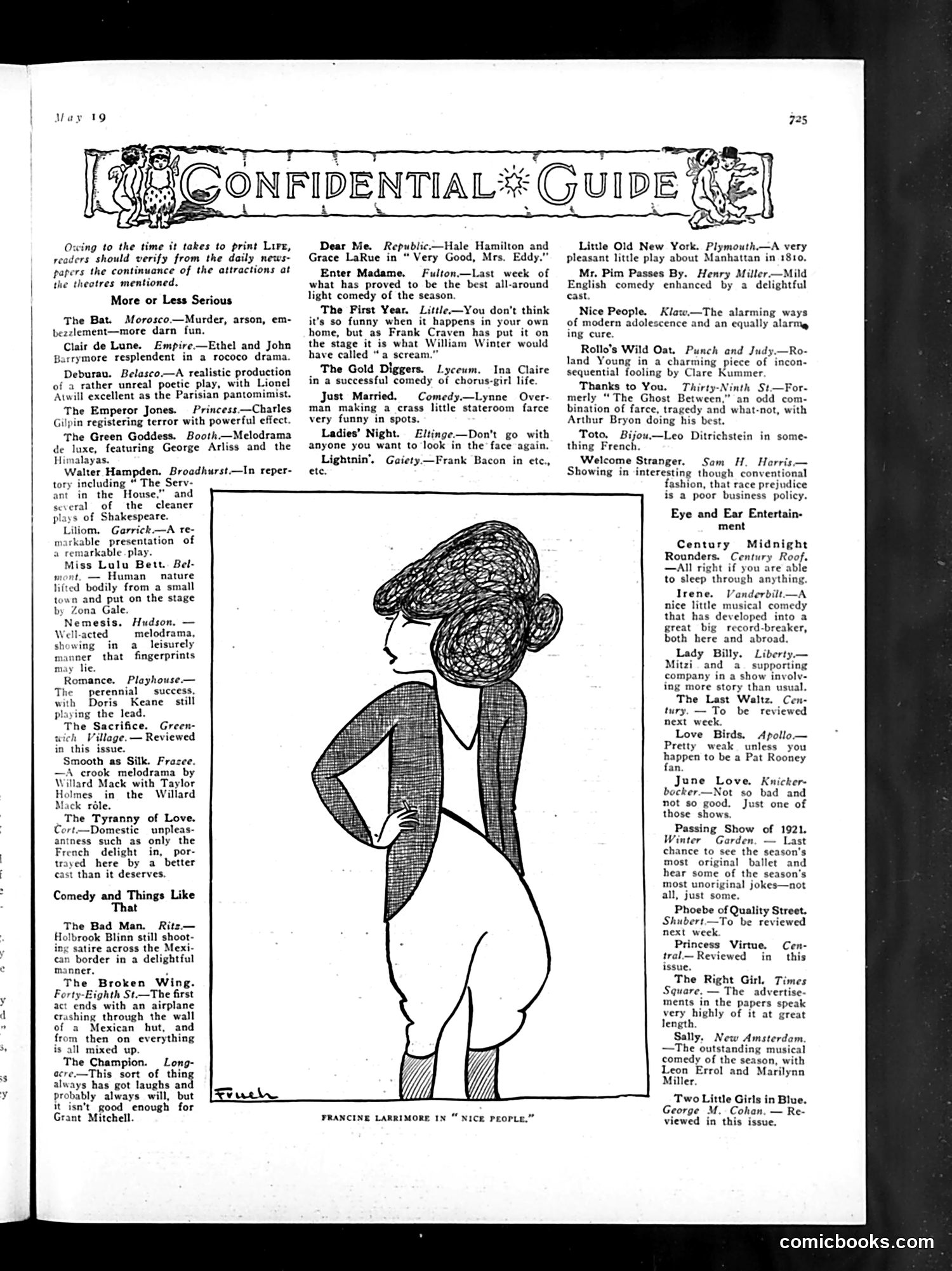
This page is a theater review section titled "Confidential Guide," listing Broadway productions with brief critical commentary. The central illustration shows **Francine Larrimore** in the play "Nice People," depicted as a fashionably dressed young woman with 1920s styling (bobbed hair, drop-waist dress). The reviews reflect post-WWI theatrical tastes: melodramas ("The Bat," "Nemesis"), light comedies ("The First Year," "Just Married"), and serious dramatic works (Charles Gilpin in "The Emperor Jones"). The language reveals period sensibilities—reviewers note that "Nice People" addresses "alarming ways of modern adolescence," suggesting contemporary anxiety about youth behavior and changing social norms in the Jazz Age. The illustration's prominence alongside this particular review suggests satire about young women's unconventional fashion and behavior—key cultural flashpoints of the 1920s. The page functions primarily as entertainment guidance rather than political satire.
📄 Transcribed text from this page (OCR, searchable)
Machine-transcribed from the original scan — historical spelling and the odd misread are preserved.
Owing to the time it takes to print Lirg, readers should verify from the daily news- papers the continuance of the attractions at the theatres mentioned, More or Less Serious The Bat. Morosco.—Murder, arson, em- bezzlement—more darn fun. Clair de Lune. Empire.—Ethel and John Barrymore resplendent in a rococo drama. Deburau. Belasco—A realistic production of a rather unreal poetic play, with Lionel Awwill excellent as the Parisian pantomimist. The Emperor Jones. Princess —Charles Gilpin registering terror with powerful effect. The Green Goddess. Booth—Melodrama de luxe, featuring George Arliss and the Himalayas. Walter Hampden. Broadhurst—In reper- tory including “ The Serv- ant in the House,” and several of the cleaner plays of Shakespeare. Liliom. Garrick —A re- markable presentation of a remarkable. play. Miss Lulu Bett. Bel- mont, — Human nature lifted bodily from a small town and put on the stage by Zona Gale. Nemesis. Hudson. — Well-acted melodrama, showing in a_ leisurely manner that fingerprints may lie. Romance. Playhouse — The perennial "success. with Doris Keane still playing the lead. The Sacrifice. Green- ch Village. — Reviewed in this issue. Smooth as Silk. Frazee. —A crook melodrama by Willard Mack with Taylor Holmes in the Willard Mack réle. The Tyranny of Love. Cort—Domestic unpleas- antness such as only the French delight in, por- trayed here by a better cast than it deserves. Comedy and Things Like That The Bad Man. Ritz.— Holbrook Blinn still shoot- ing satire across the Mexi- can border in a delightful manner, Broken Wing. ighth St.—The first act ends with an airplane crashing through the wall of a Mexican hut, and from then on everything is all mixed up. The Champion. Long- acre-—This sort of thin; always has got laughs an probably always will, but it isn't good enough for Grant Mitchell. Dear Me. Republic—Hale Hamilton and Grace LaRue in “ Very Good, Mrs, Eddy.” Enter Madame, Fulton—Last week of what has proved to be the best all-around light comedy of the season. The First Year. Little—You don’t think it’s so funny when it happens in your own home, but as Frank Craven has put it on the stage it is what William Winter would have called “a scream.” The Gold Diggers. Lyceum. Ina Claire in a successful comedy of chorus-girl life. Just Married. Comedy.—Lynne Over- man making a crass little stateroom farce very funny in spots. Ladies’ Night. Eltinge—Don't go with anyone you want to look in the face again. Lightnin’. Gaiety—Frank Bacon in ete, ete. FRANCINE LARRIMORE IN “ NICE PEOPLE.” Little Old New York. Plymouth—A very pleasant little play about Manhattan in 1810, Mr. Pim Passes By. Henry Miller—Mild English comedy enhanced by a delightful cast. Nice People. Klaw.—The alarming ways of modern adolescence and an equally alarme, ing cure. Rollo’s Wild Oat. Punch and Judy.—Ro- land Young in a charming piece of incon- sequential fooling by Clare Kummer. Thanks to You. Thirty-Ninth St—For- merly “ The Ghost Between,” an odd com- bination of farce, tragedy and what-not, with Arthur Bryon doing his best. Toto, Bijou.—Leo Ditrichstein in some- thing French. Welcome Stranger. Sam H. Horris— Showing in interesting though conventional fashion, that race prejudice is a poor business policy. Century Rounders. Century Roof. —All right if you are able to sleep through anything. Midnight Irene. Vanderbilt—A nice little musical comedy that has developed into a great big record-breaker, both here and abroad. Lady Billy. Liberty.— Mitzi and a supporting company in a show involv- ing more story than usual. The Last Waltz. Cen- tury. — To be reviewed next week. Love Birds. Apollo— Pretty weak unless you happen to be a Pat Rooney fan. June Love. Knicker: bocker—Not so bad and not so good. Just one of those shows, Passing Show of 1921. Winter Garden, — Last chance to see the season's most original ballet and hear some of the season's most unoriginal jokes—not all, just some, Phoebe of Quality Street. Shubert —To be reviewed next week Princess Virtue. Cen- tral— Reviewed in this issue. The Right Girl. Times Square. — The advertise- ments in the papers speak very highly of it at great length. Sally. New Amsterdam —The outstanding musical comedy of the season, with Leon Errol and Marilynn Miller. Two Little Girls in Blue. George M. Cohan. — Re- viewed in this issue, comicbooks.com