
A complete issue · 36 pages · 1921
Life — April 21, 1921
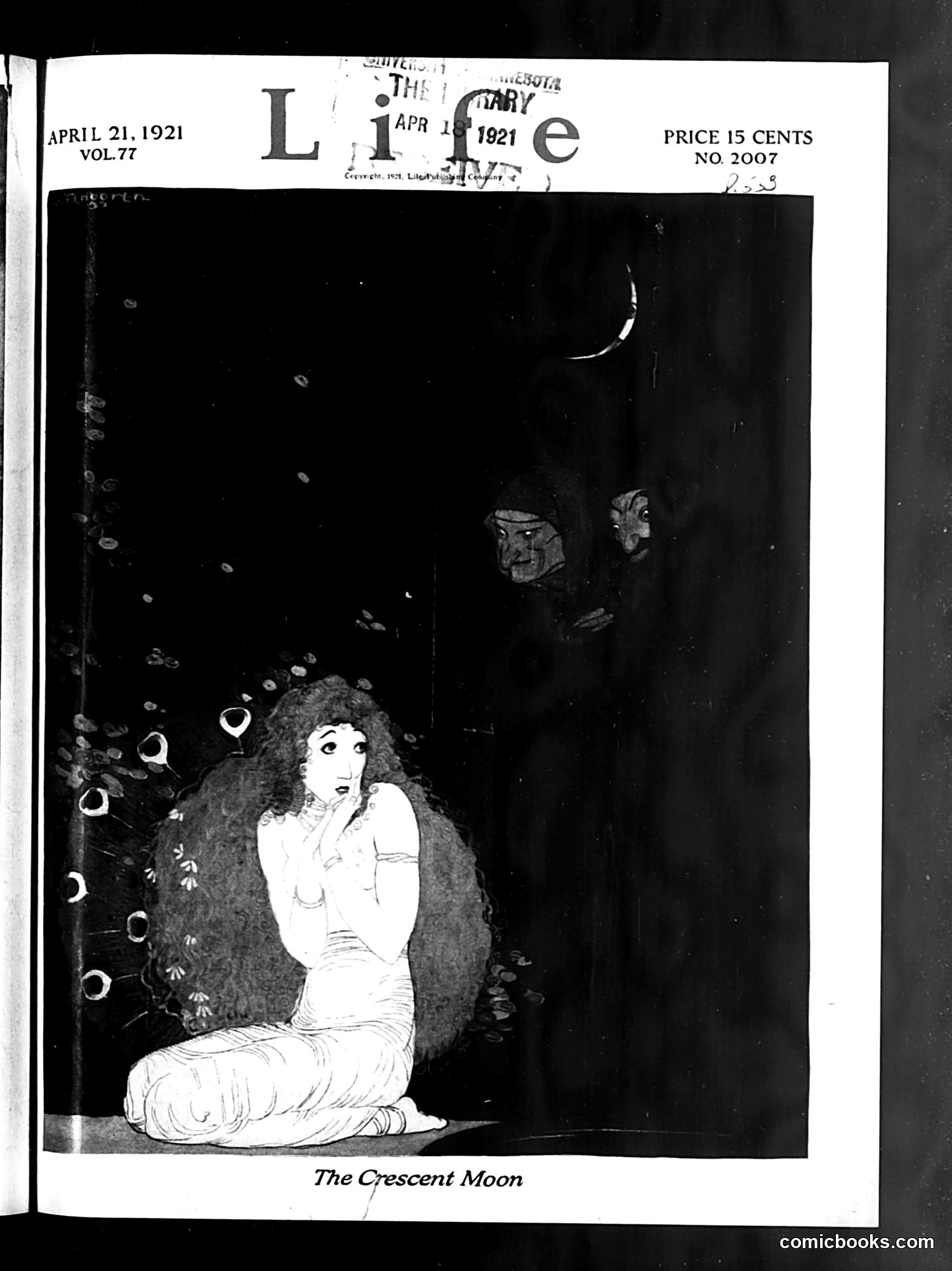
This illustration depicts a woman in classical dress, kneeling and gazing upward at a crescent moon, while grotesque male faces peer from the darkness behind her. The title "The Crescent Moon" suggests a romantic or mystical theme. The imagery appears to satirize idealized femininity and male voyeurism. The woman's pale, ethereal pose contrasts sharply with the crude, leering faces emerging from shadow—likely representing base male desire behind romantic pretense. This reflects 1920s satirical commentary on the gap between sentimentalized notions of womanhood and crude reality. The specific social commentary—whether addressing dating culture, artistic pretension, or gender relations—remains somewhat unclear without additional context from the magazine's text.
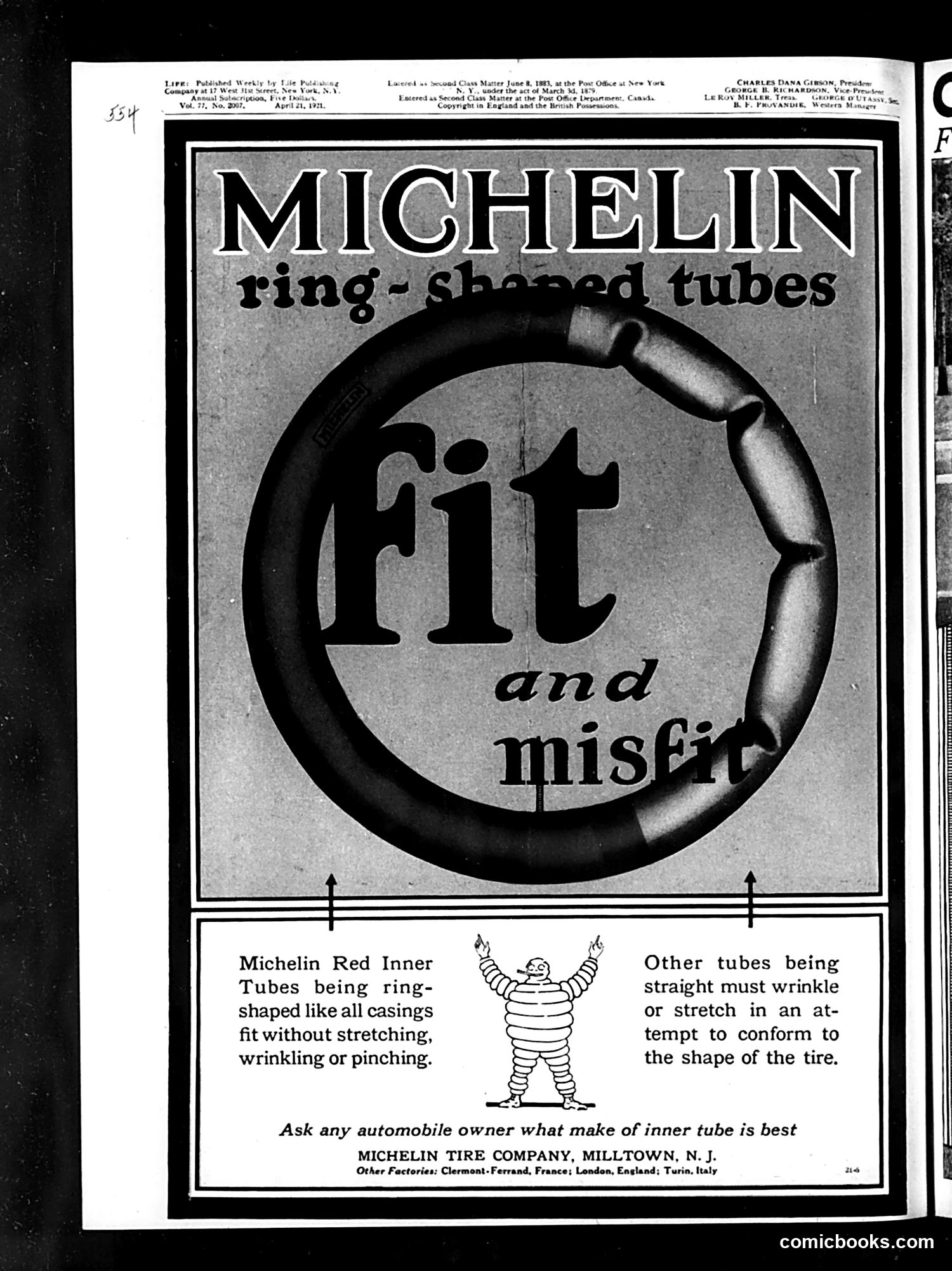
This page is primarily **a Michelin tire advertisement**, not political satire. It advertises Michelin's ring-shaped inner tubes for automobile tires. The visual joke contrasts two tire designs: Michelin's "ring-shaped" tubes (shown as a perfect circle that "fit without stretching, wrinkling or pinching") versus competitors' straight tubes that must deform to fit round tires. The cartoon character (Michelin's mascot Bibendum, the rotund "Michelin Man") illustrates the concept—his round body mirrors the ring-shaped tube design. The copy argues that asking automobile owners which tube is "best" will confirm Michelin's superiority. This reflects early 20th-century automobile advertising conventions, emphasizing technical product advantages with humorous visual comparison.
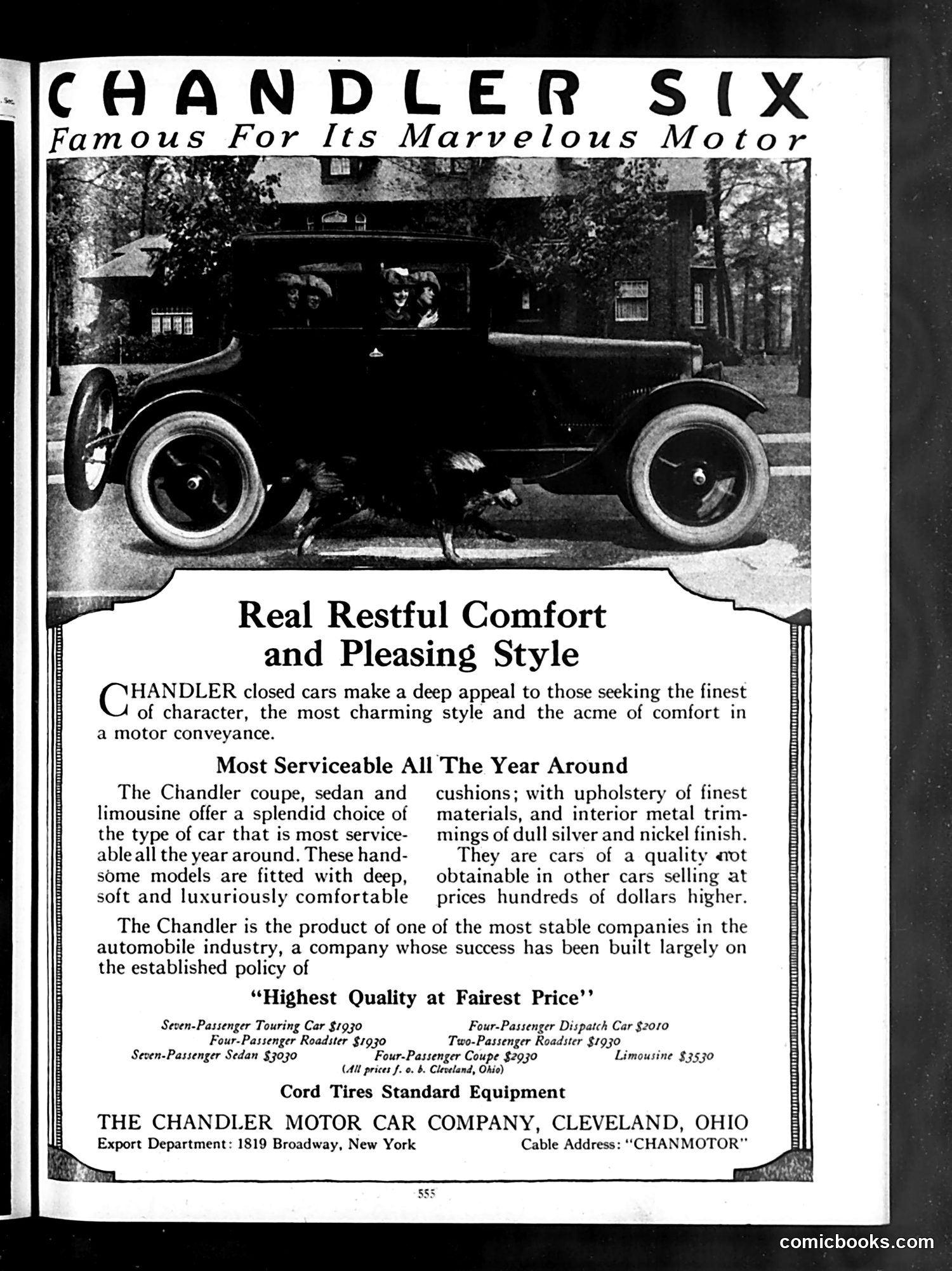
This page is **not a cartoon or satire** — it's a straightforward automobile advertisement for the Chandler Six automobile, published in *Life* magazine. The ad emphasizes the car's "marvelous motor" and appeals to buyers seeking luxury, comfort, and style at a reasonable price. Key selling points include: - Year-round reliability and serviceability - High-quality interior materials and craftsmanship - Competitive pricing ("Highest Quality at Fairest Price") - Various body styles: touring cars, roadsters, sedans, coupes, and limousines Pricing ranged from $1,930 to $3,530 (f.o.b. Cleveland, Ohio). The company was based in Cleveland with export operations in New York. This reflects the early automotive industry's competitive market for middle-to-upper-class vehicles during the 1910s-1920s era.
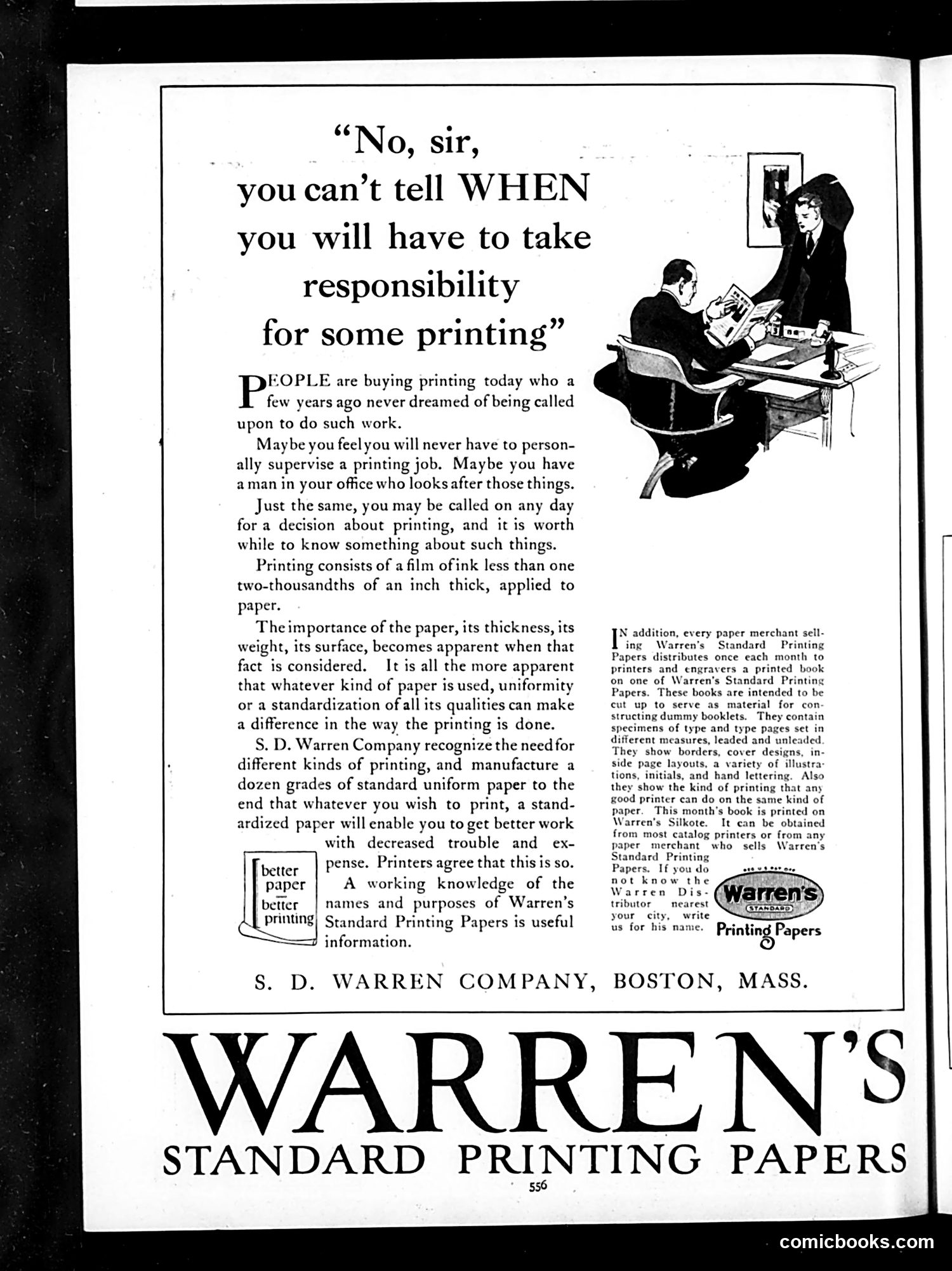
This page is primarily **advertising**, not satire or political commentary. It's a Warren Company advertisement for printing papers, disguised as editorial content. The illustration shows a business scenario: a man at a desk reviewing printing work while a woman (likely a supervisor or manager) stands nearby. The quoted headline suggests an unexpected responsibility—suddenly being asked to make printing decisions. The ad's strategy is to argue that **anyone in business might need printing knowledge**, even if they never expected to. By positioning Warren's standardized papers as a solution to this unpredictable need, the company appeals to businesspeople's anxiety about appearing unknowledgeable. The "better paper = better printing" message and the logo at bottom are straightforward product promotion. There is no political or social satire present—this is mid-century corporate marketing using relatable workplace scenarios.
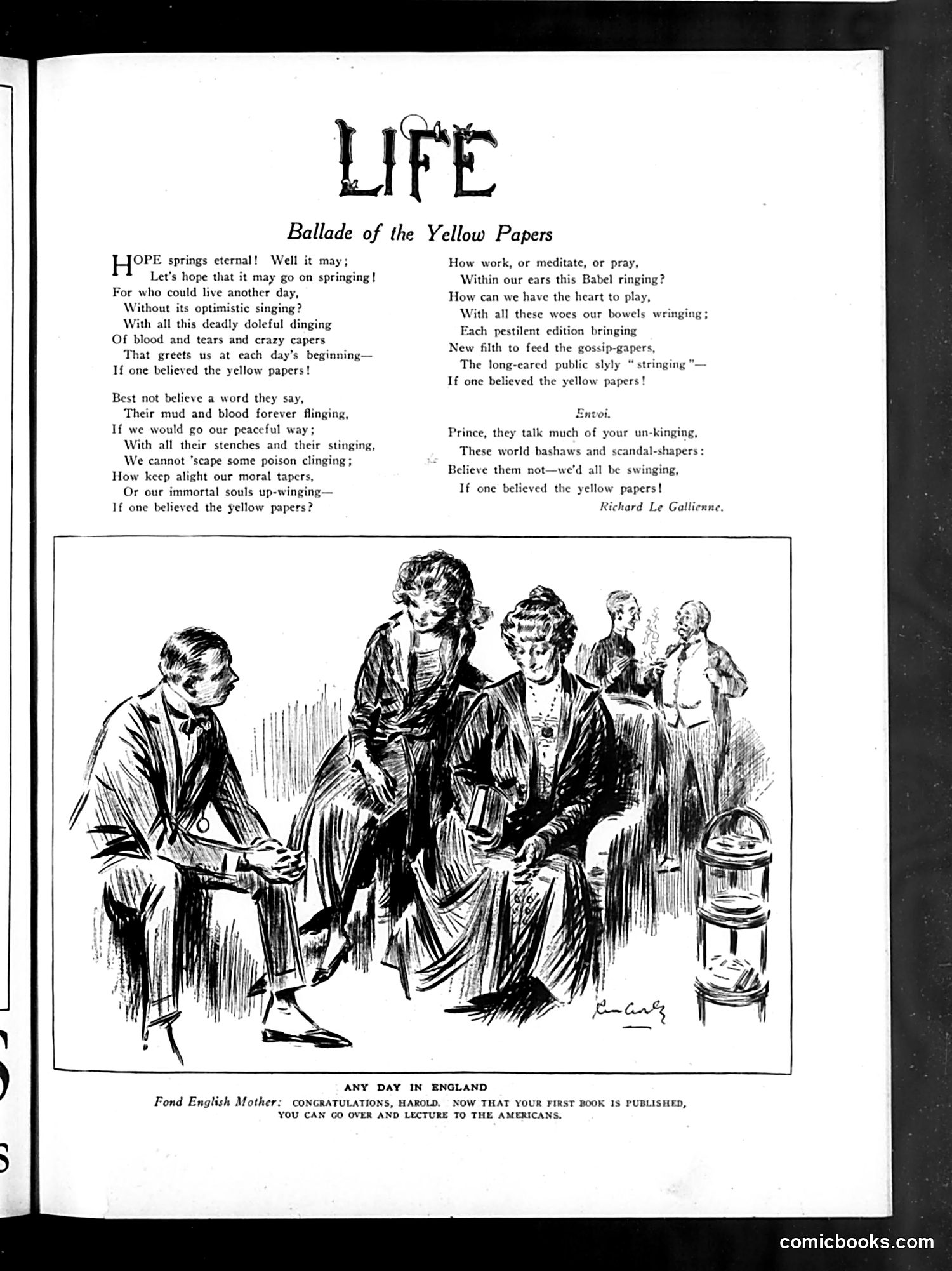
This page satirizes British newspaper scandal-mongering, particularly the "yellow press" (sensationalist tabloids). The poem mocks how these publications spread rumors and discord—"blood and tears and carry capers"—while the public mindlessly absorbs them. The cartoon depicts "Any Day in England": a man reading yellow papers while conversing with women in a parlor. The caption's sarcastic "Fond English Mother" congratulates Harold on publishing his first book, now enabling him to "lecture to the Americans"—suggesting British authors profited by exporting sensationalism abroad. The satire targets both the irresponsible press manufacturing outrage and credulous readers accepting fabrications without question. The "yellow papers" reference alludes to the infamous yellow journalism that flourished in the late 19th/early 20th centuries.
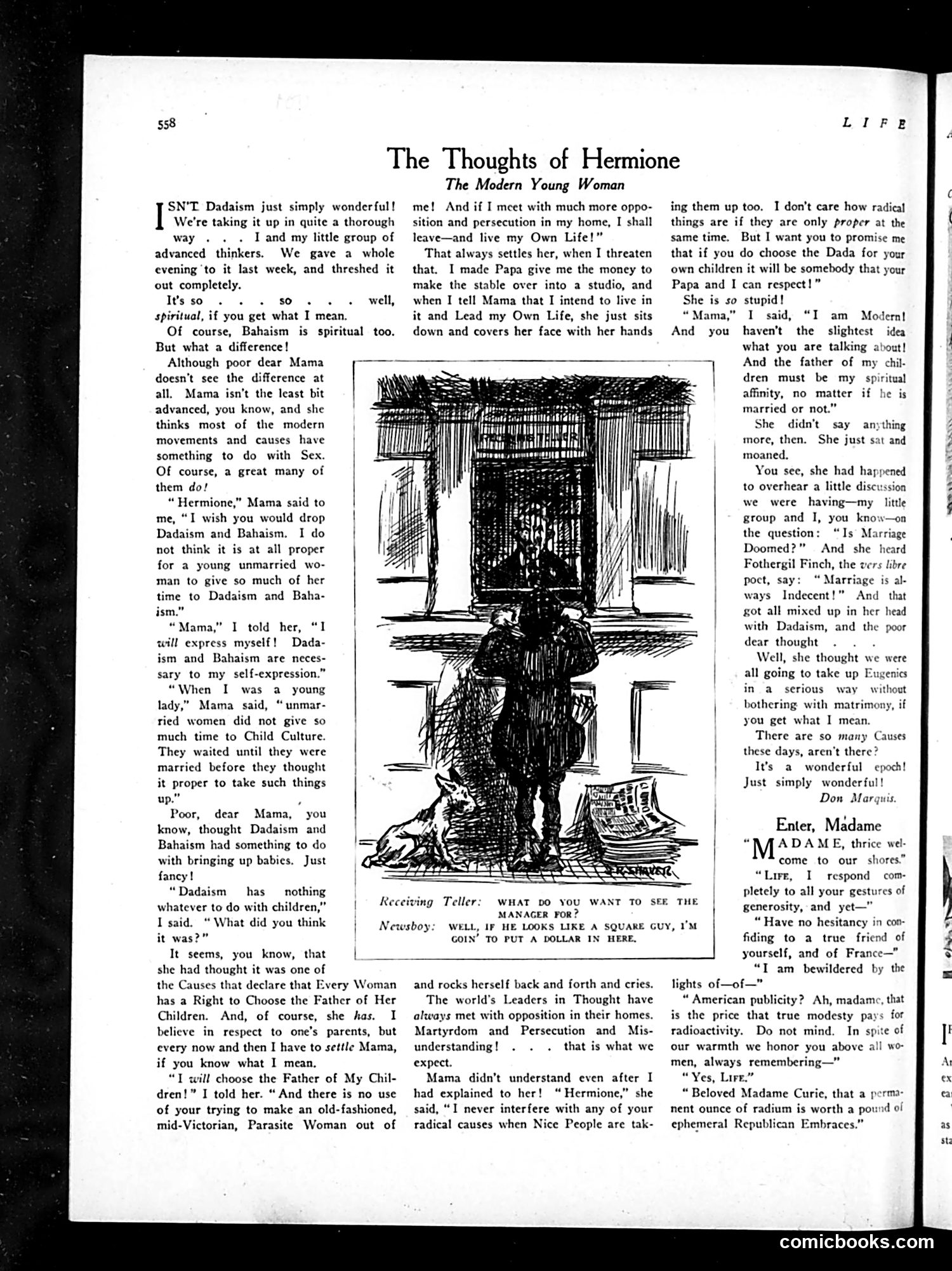
This page satirizes the "Modern Young Woman" of the 1920s. The main article presents Hermione's arguments for embracing Dada and Bahaism—avant-garde artistic and spiritual movements of the era—while rejecting traditional motherhood and marriage. The cartoon depicts a "Receiving Teller" at what appears to be a bank, with a caption about putting a dollar in. This likely mocks the commercialization of modern movements and fads. The satire targets young women who adopted radical intellectual positions (Dada, rejection of "Child Culture") while remaining financially dependent. Hermione's mother represents conventional wisdom, arguing such poses are impractical affectation. The piece ridicules both the earnest embrace of avant-garde movements and young women's attempts at sophistication detached from practical realities.
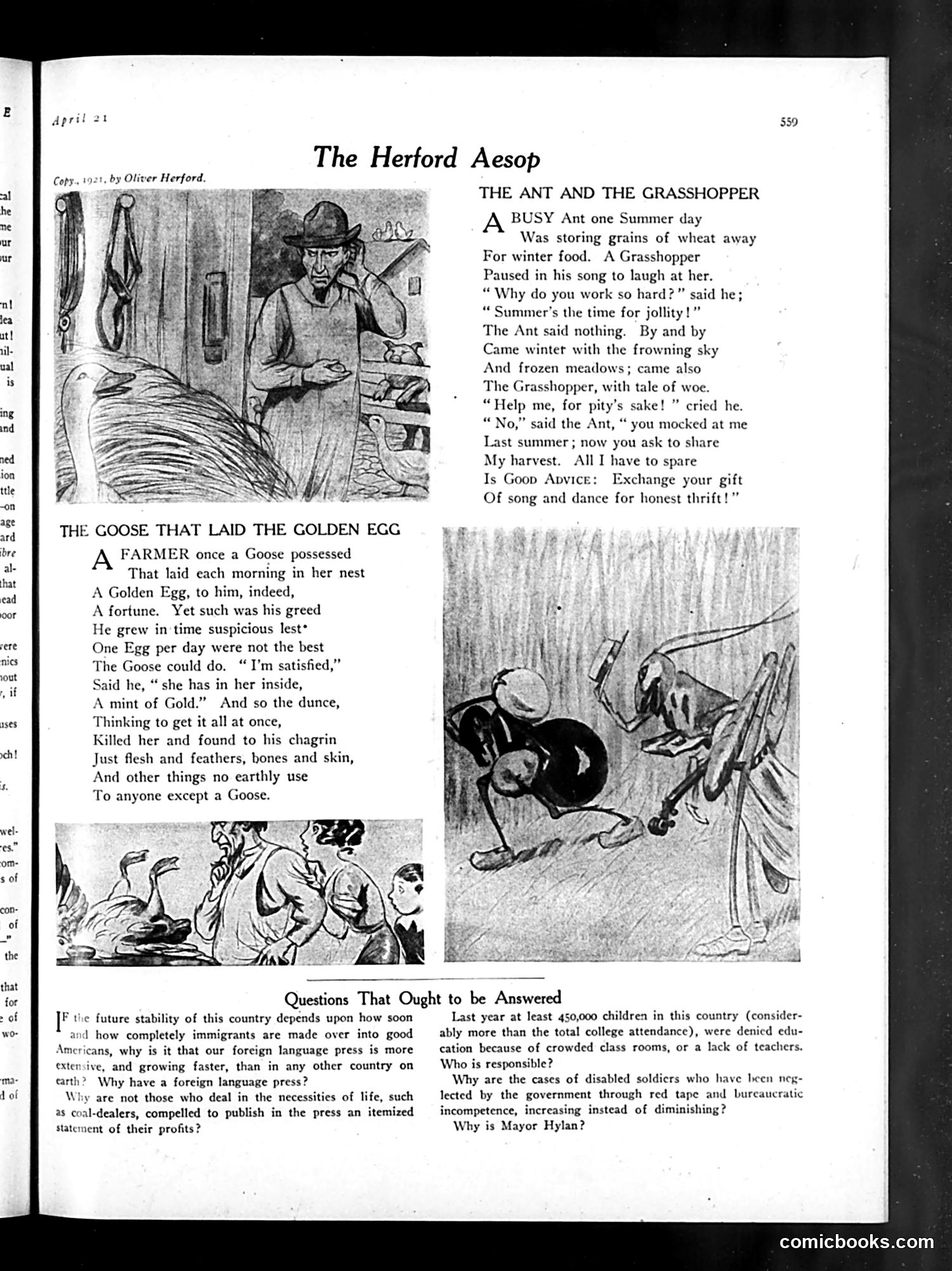
This page presents classic Aesop's fables illustrated by Oliver Herford (credited as "Copy, 1927"). **"The Ant and the Grasshopper"** depicts the moral lesson about thrift versus idleness: an ant storing grain for winter while a grasshopper plays. When winter arrives, the starving grasshopper begs for help, but the ant refuses, advising the grasshopper to have worked instead of danced. **"The Goose That Laid the Golden Egg"** shows a farmer's fatal greed: he kills his goose expecting to find gold inside, only discovering she was ordinary—a cautionary tale about destroying valuable assets through impatience. The illustrations use simple black-and-white woodcut-style drawings typical of 1920s children's literature. **"Questions That Ought to be Answered"** below shifts to contemporary social commentary, raising concerns about immigrant assimilation, education overcrowding, and government treatment of disabled soldiers—likely referencing post-WWI American anxieties.
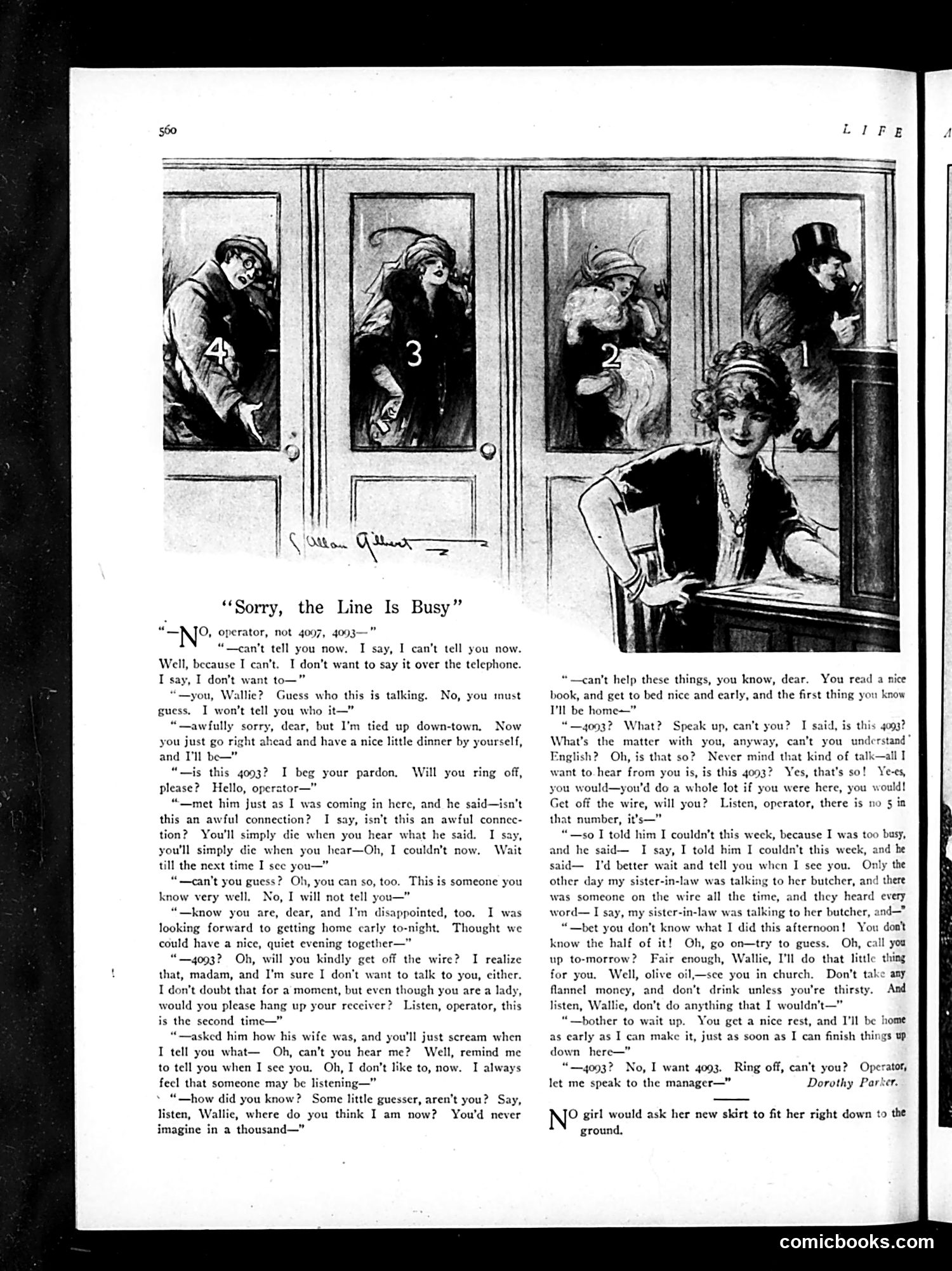
This cartoon satirizes the frustrations of early telephone communication. The illustration shows a woman at a telephone exchange switchboard dealing with multiple callers, while four men crowd into telephone booths behind her, all trying simultaneously to reach someone. The humor centers on common complaints about phone service: busy lines, long waits, and operators unable to connect calls. The dialogue captures period-authentic grievances—people unable to reach loved ones, operators who won't reveal information, and the general inefficiency of early telephone infrastructure. The satire mocks both the limitations of the technology and the social anxiety it created around communication—people's desperation to reach others and the intermediary power held by telephone operators who controlled access to conversations.
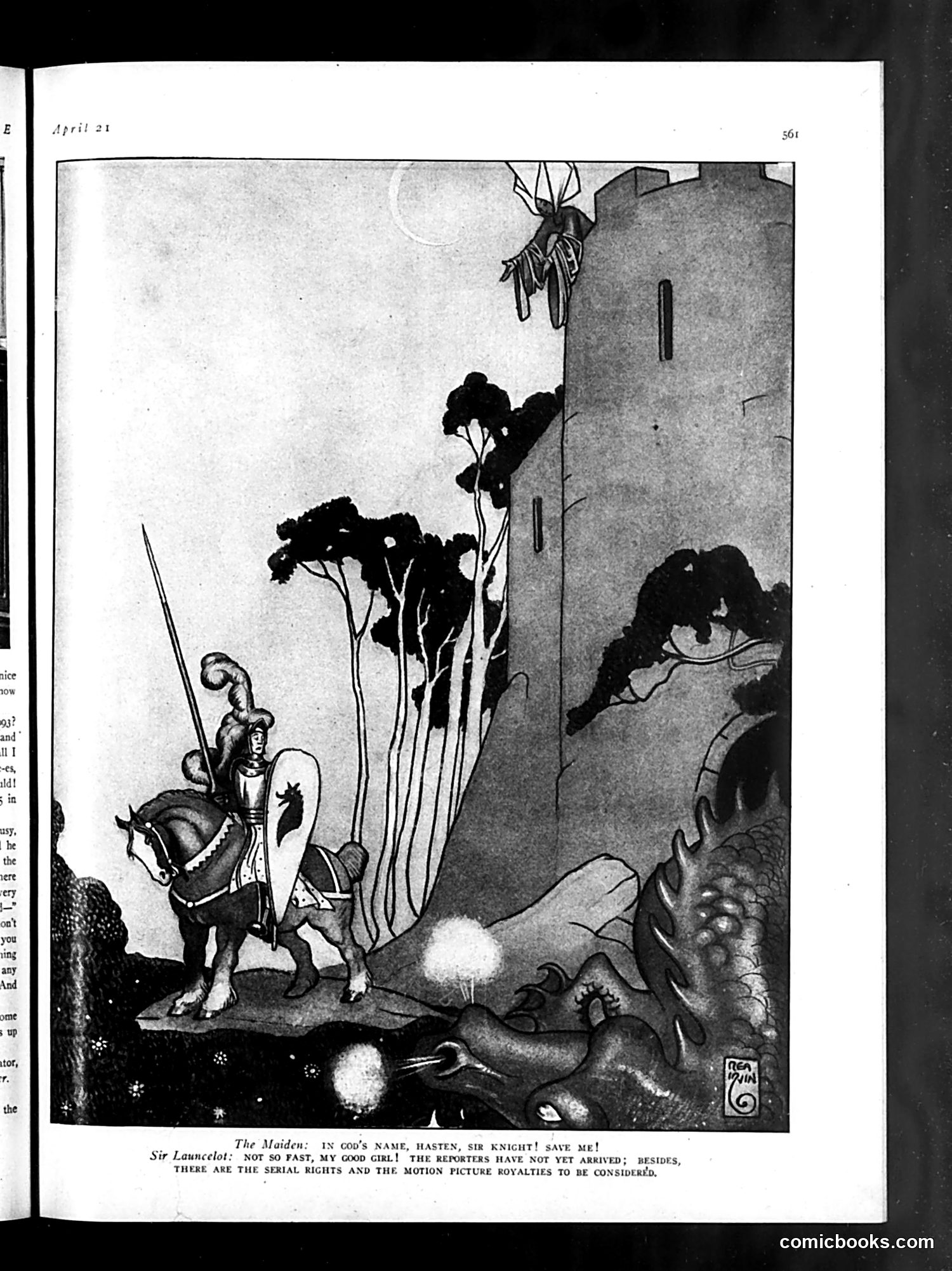
This appears to be an illustration from Life magazine (April 21, based on the header) depicting a medieval or fantasy scene. The caption reads: "Sir Lancelot: 'IS GOD'S NAME, SIR KNIGHT, NOT SO FAST, MY GOOD GIRL! THE REPORTERS HAVE NOT YET ARRIVED; BESIDES, THERE ARE THE SERIAL RIGHTS AND THE MOTION PICTURE ROYALTIES TO BE CONSIDERED.'" The satire juxtaposes medieval romance imagery—a knight, maiden, castle, and fantastical creatures—with modern commercial concerns: newspaper reporters, serialization rights, and film royalties. The joke mocks how early 20th-century media and entertainment industries had commodified even legendary romantic narratives. Sir Lancelot's concern for business deals rather than chivalrous rescue satirizes the era's transformation of classic stories into profit-driven entertainment properties.
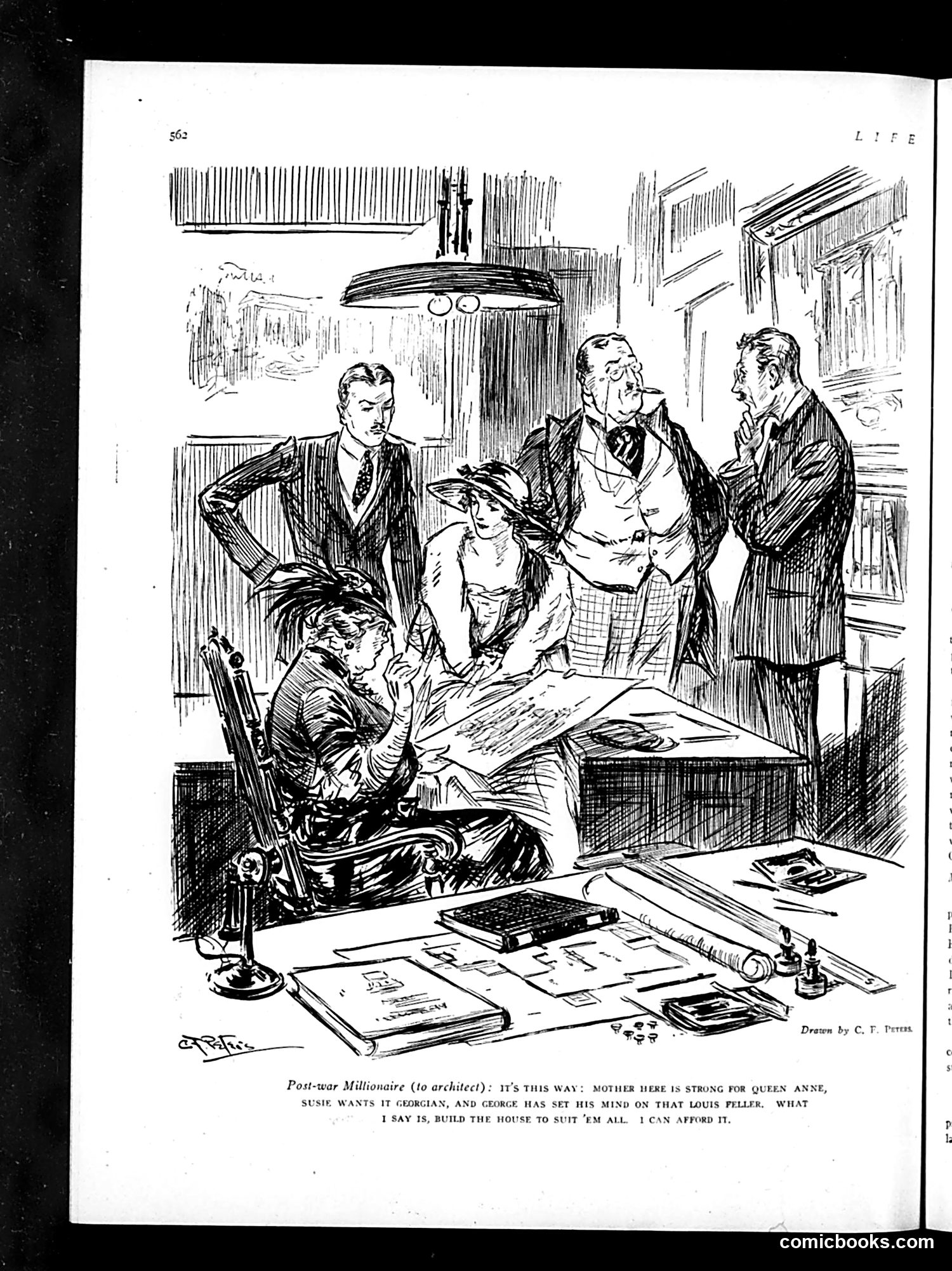
This satirical cartoon depicts an architect or designer (seated) presenting plans to wealthy patrons. The caption reveals the satire: a post-war millionaire claims to build a house suited to everyone's tastes—Queen Anne style for "Mother," Georgian for "Susie," and Louis Feller style for "George"—while asserting "I can afford it." The joke mocks the nouveaux riche (newly wealthy individuals) of the post-war period who ostentatiously display wealth by attempting to satisfy every family member's architectural whim simultaneously. The cartoon satirizes both the pretentiousness of war profiteers and the absurdity of building a single house incorporating multiple incompatible historical styles, suggesting such eclecticism reveals vulgar excess rather than refined taste.
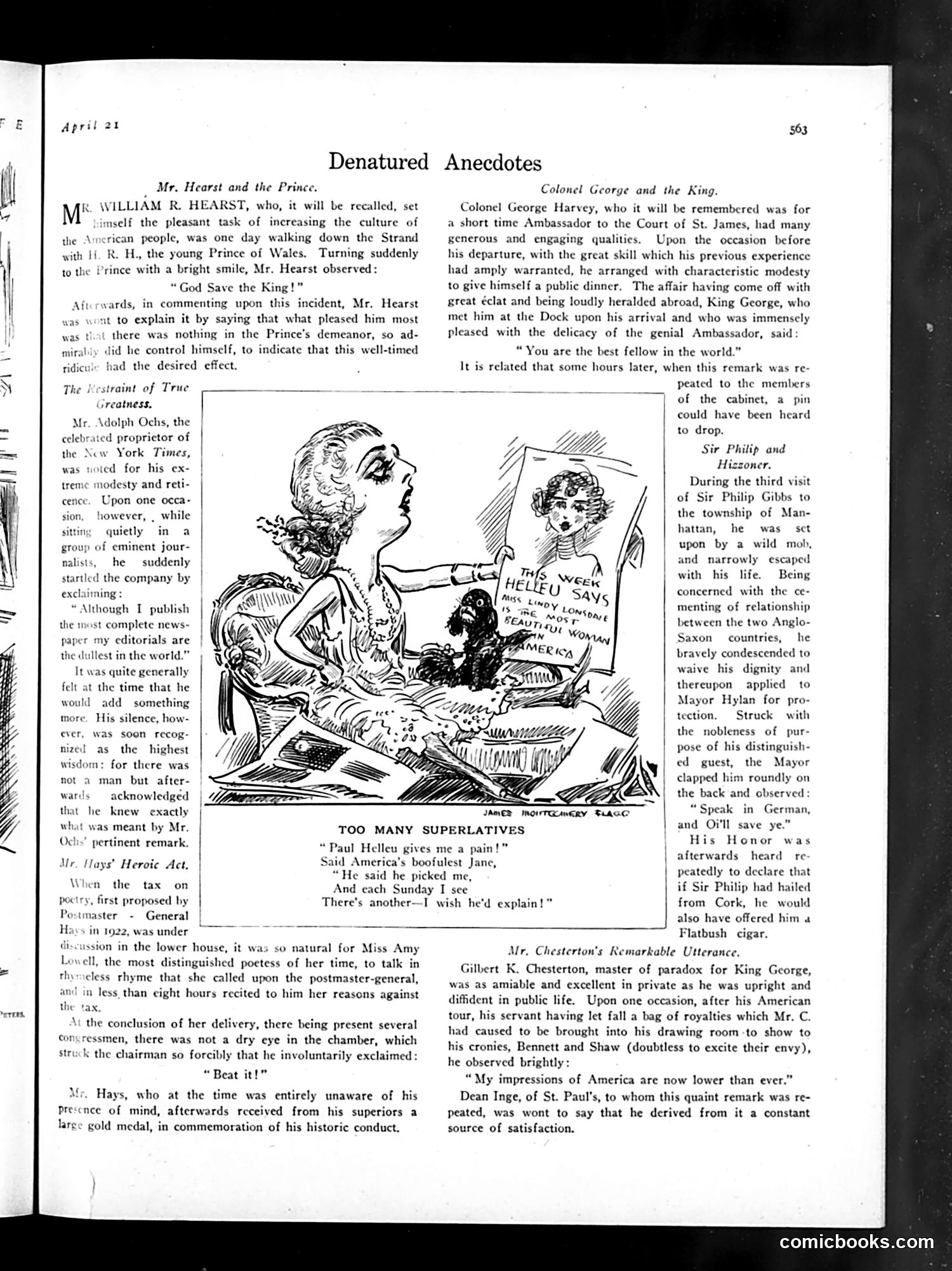
This cartoon satirizes **Paul Helleu**, a French-American artist and illustrator of the early 20th century. The joke, illustrated by James Montgomery Flagg, mocks Helleu's excessive flattery and hyperbolic praise of women—particularly American women. The caption presents Helleu's exaggerated compliments: he claims to have "picked" a woman, calls another "Sunday I see," and wishes he could "explain" yet another. The visual shows a small male figure (Helleu) surrounded by admirers reading publications with superlatives like "The Weekly Says" and praise about "Beautiful Women of America." The satire targets the contemporary trend of overwrought artistic praise and Helleu's reputation for effusive, insincere compliments toward his society subjects.
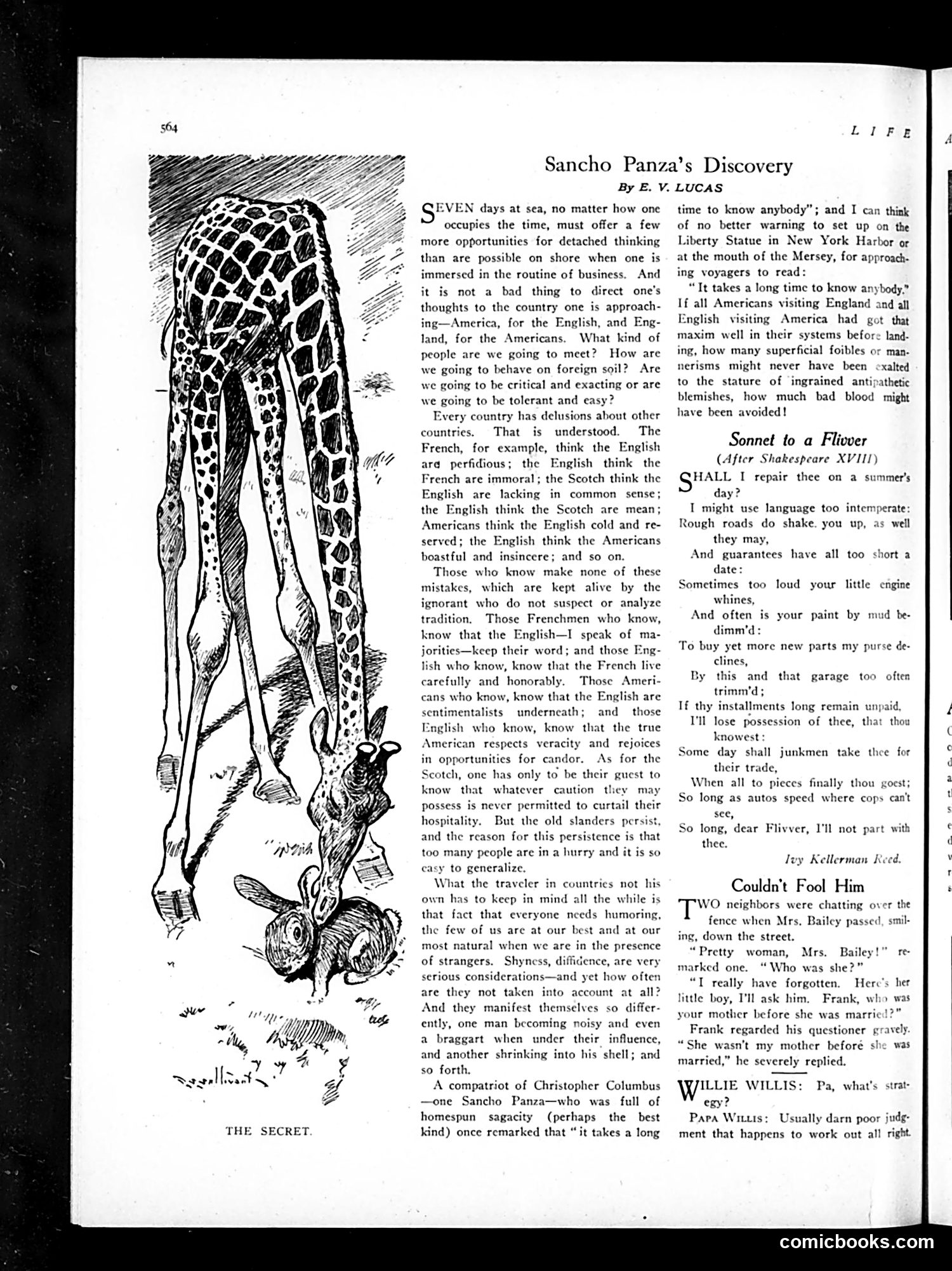
The main cartoon, titled "The Secret," depicts a giraffe's impossibly long legs. The illustration appears to be a visual joke about exaggeration or hidden truths—the "secret" being the giraffe's extreme proportions. The page also contains an essay titled "Sancho Panza's Discovery" by E.V. Lucas discussing cultural stereotypes between nations (English, French, Scottish, American). The author argues that travelers shouldn't generalize about nationalities based on limited observations. Below are two brief humor pieces: "Sonnet to a Flivver" (a comedic poem about an old car, attributed to Shakespeare), and "Couldn't Fool Him" (a short dialogue joke about a woman's remarriage). The content emphasizes satirizing both animal absurdity and human cultural pretensions.
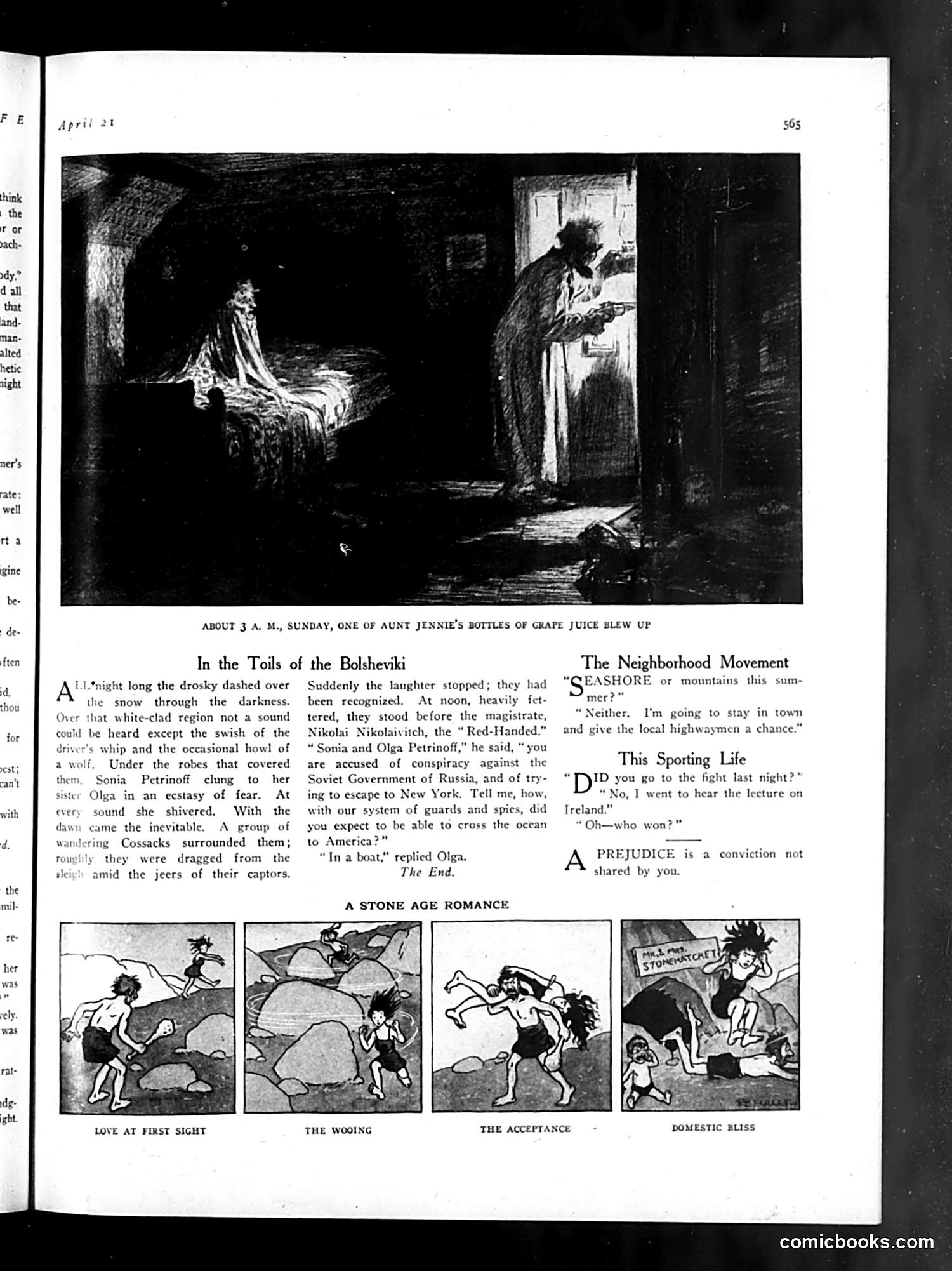
This page contains three distinct pieces of satirical content: 1. **Top illustration**: "About 3 A.M., Sunday, One of Aunt Jennie's Bottles of Grape Juice Blew Up" — appears to reference Prohibition-era humor, showing someone discovering a bottle has exploded, likely implying home-fermented alcohol disguised as "grape juice." 2. **"In the Toils of the Bolsheviki"**: A fictional story fragment about escape from Soviet Russia, reflecting 1920s anti-communist anxieties common in American satirical magazines. 3. **"A Stone Age Romance"**: A four-panel comic strip titled "Love at First Sight," "The Wooing," "The Acceptance," and "Domestic Bliss" — appears to be humor about prehistoric courtship and marriage, likely satirizing romantic conventions through anachronistic caveman scenarios. The content reflects early 1920s American preoccupations with Prohibition enforcement and communist fears.
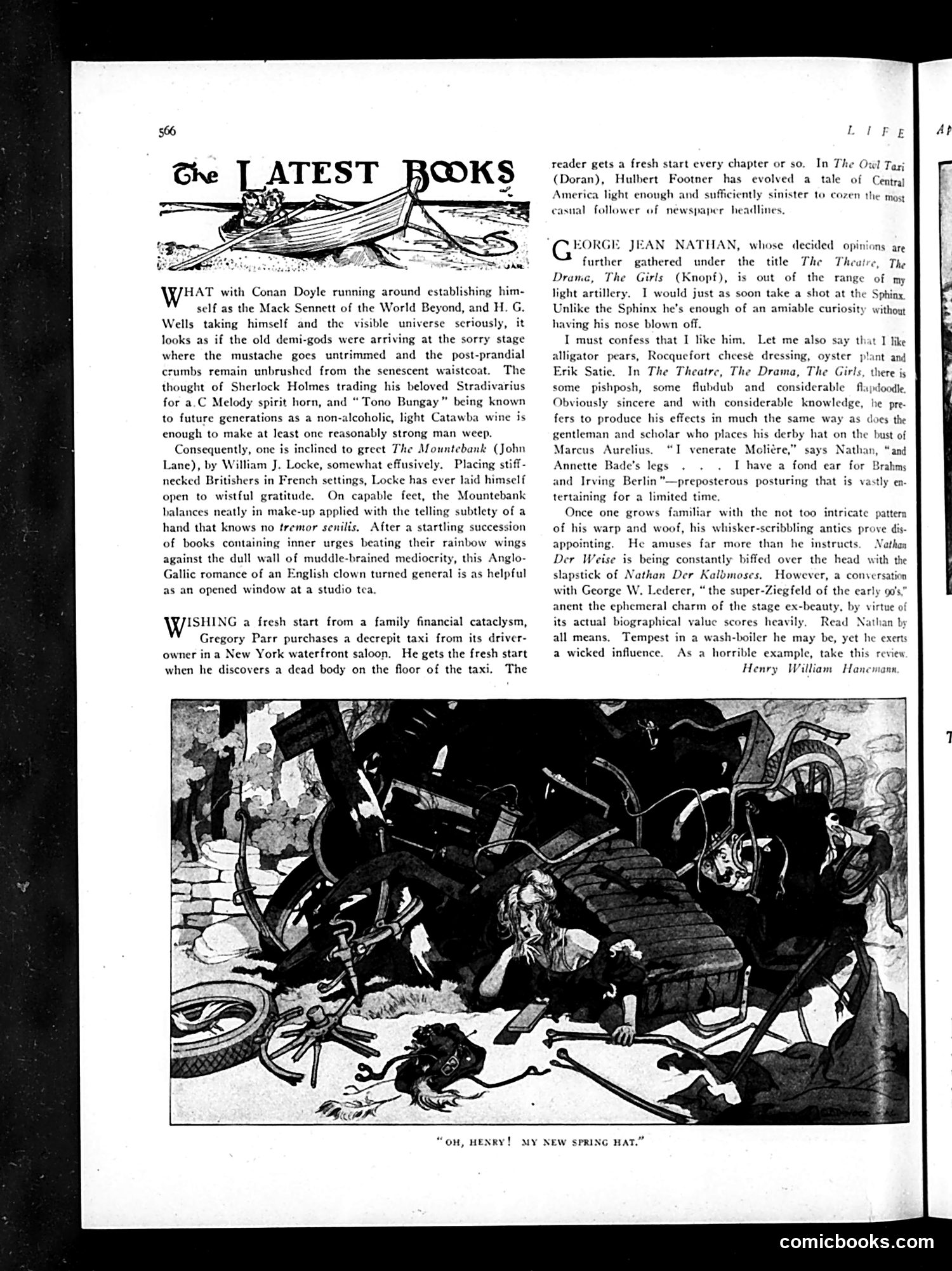
This page features literary criticism by Henry William Hanemann reviewing several contemporary works. The main illustration depicts a chaotic taxi scene captioned "Oh, Henry! My New String Hat," illustrating Gregory Parr's novel about a taxi driver who discovers a dead body in his cab. The reviews discuss works by Conan Doyle, H.G. Wells, and George Jean Nathan. Hanemann criticizes Nathan's theatrical writings as overly pretentious and self-aggrandizing, comparing his verbose style unfavorably to more straightforward literary approaches. The overall tone suggests satire of both new commercial fiction and affected literary criticism of the era.
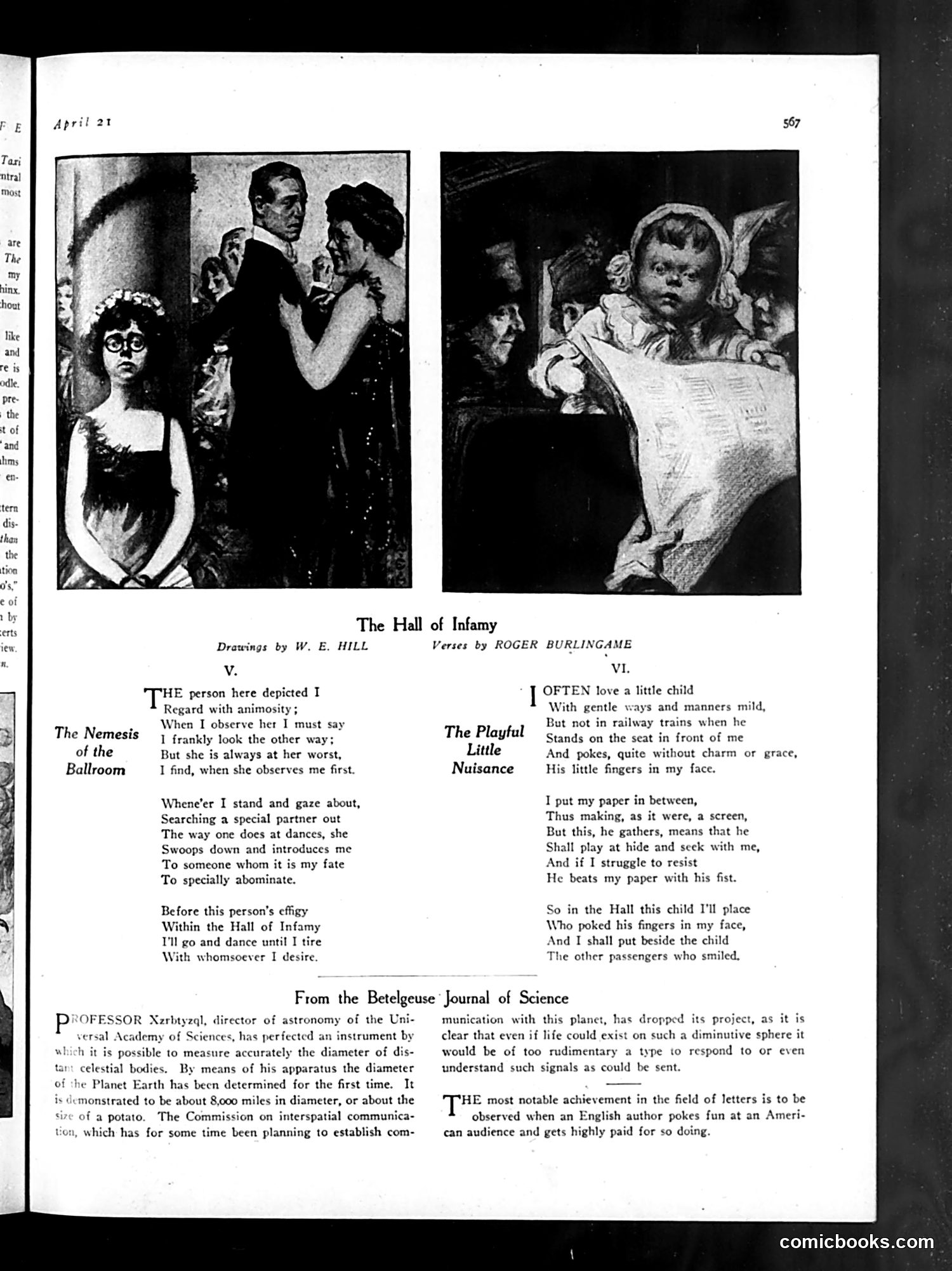
This is a satirical illustrated poem by W.E. Hill (drawings) and Roger Burlingame (verses) depicting social annoyances in public spaces. The two panels show: **Left panel ("The Nemesis of the Ballroom"):** A woman wearing glasses depicted as irritating at social dances—she stares intently, interrupts conversations, and monopolizes partners. **Right panel ("The Playful Little Nuisance"):** A child misbehaving in a railway car, poking passengers' faces, playing roughly, and disturbing other travelers. The satire targets everyday social irritants of the Edwardian era: the socially awkward woman at formal events and the undisciplined child in public transportation. These were apparently common enough frustrations to merit this humorous treatment in a major magazine.
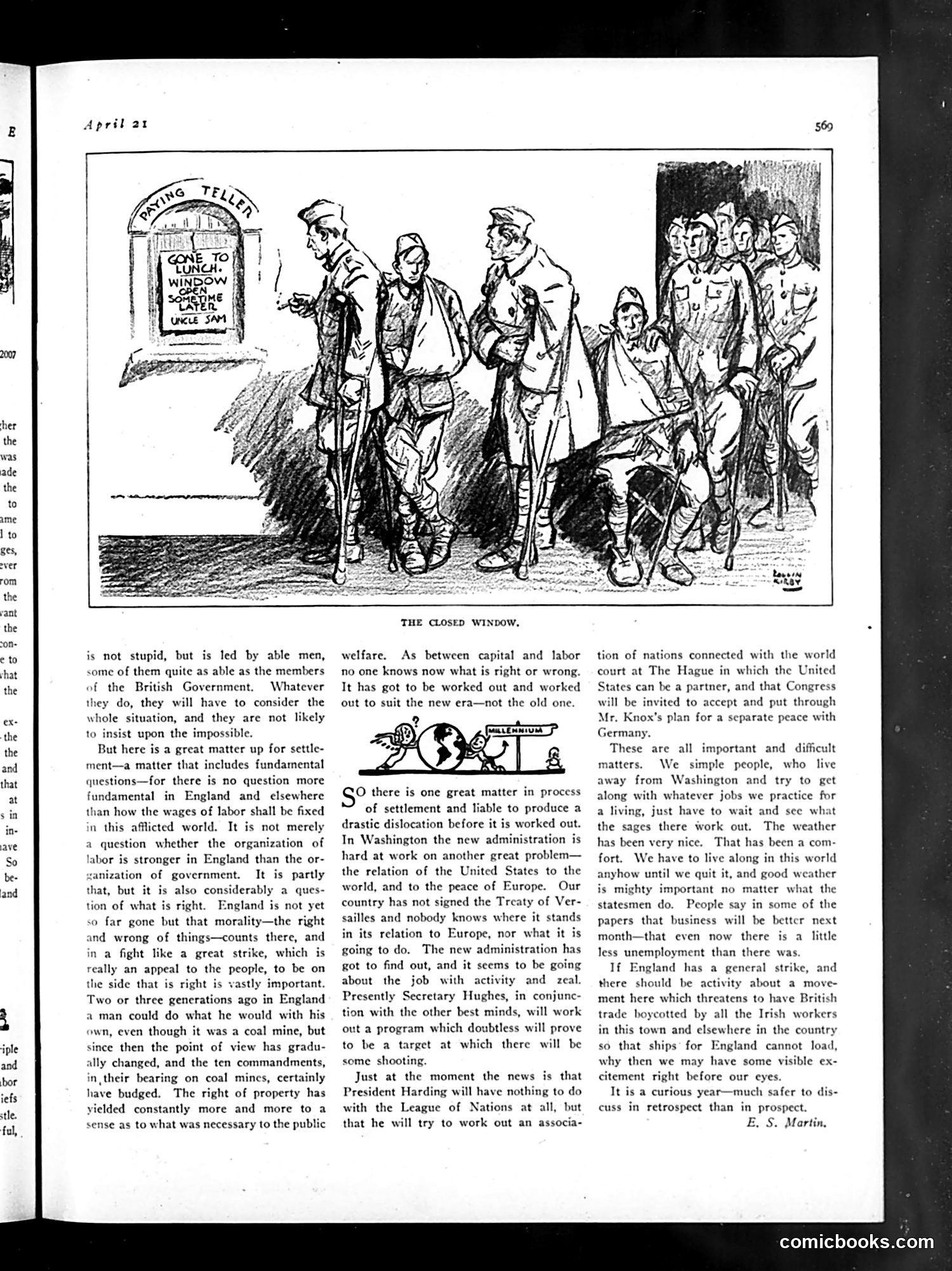
The cartoon depicts uniformed soldiers standing outside a "Posting Teller" window with a sign reading "COME TO LUNCH / WINDOW CLOSED / UNCLE SAM." The satire targets post-WWI American isolationism and economic uncertainty. The "closed window" represents the U.S. refusing international engagement—specifically President Harding's rejection of the League of Nations (mentioned in the accompanying text). The soldiers symbolize labor/working men shut out from opportunity or communication. The article discusses two major 1921 crises: England's labor unrest over wage disputes and America's uncertain foreign policy regarding Europe and the Treaty of Versailles. The cartoon suggests the U.S. government has "closed" itself off from addressing these pressing international matters, leaving citizens and soldiers in limbo—unable to access leadership or clarity on America's direction. E.S. Martin's commentary reflects contemporary anxiety about post-war economic instability, labor organization power, and America's new isolationist stance.
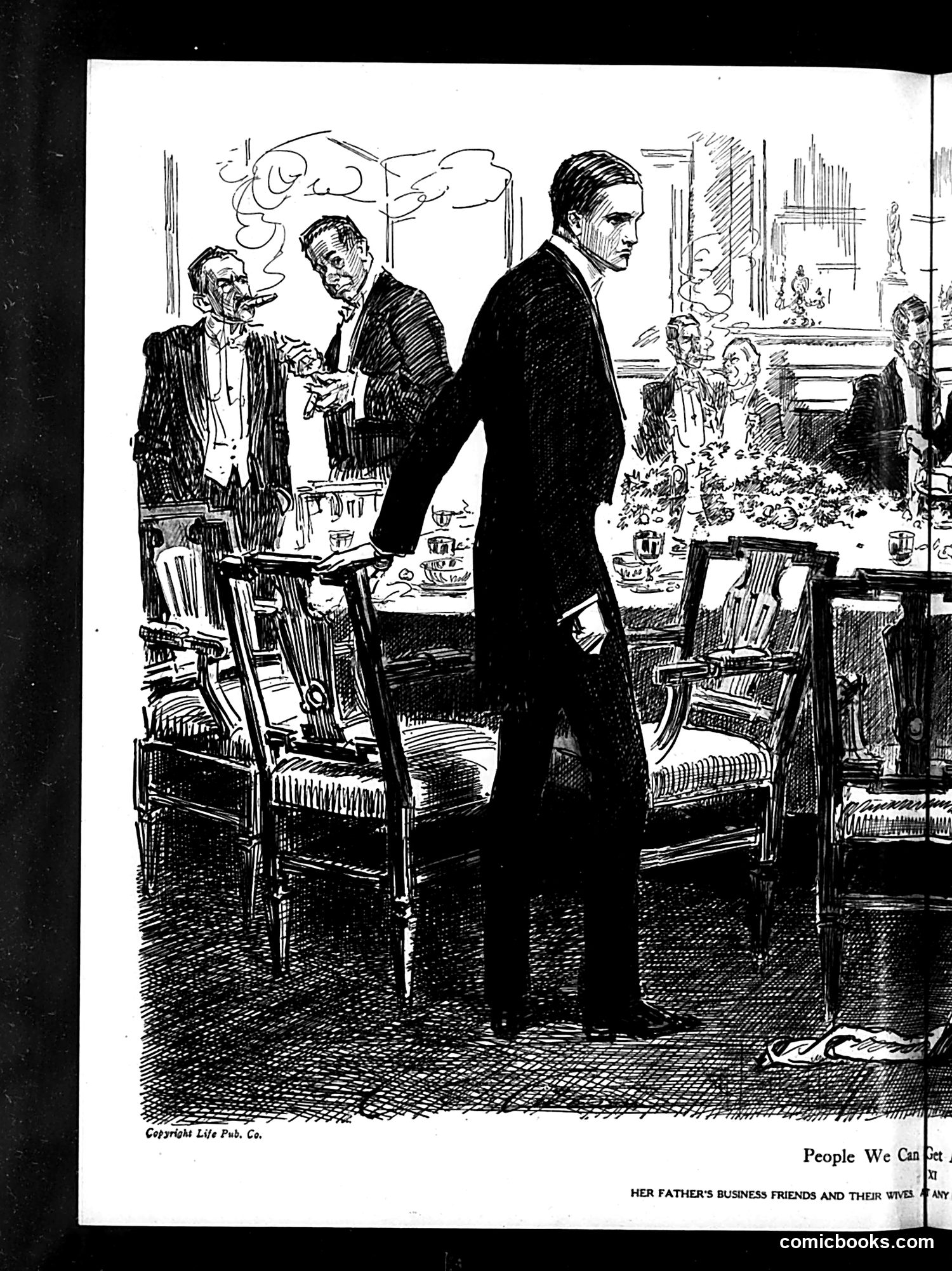
This appears to be a satirical illustration from Life magazine showing a formal social gathering. The caption "Her Father's Business Friends and Their Wives / If Any" suggests social commentary on marriage and gender dynamics among upper-class businessmen. The humor likely derives from the parenthetical "If Any"—implying that some of these businessmen may not be married, or that their wives are notably absent or insignificant to their social identity. The illustration depicts well-dressed men in what appears to be an elegant interior with elaborate furnishings and art, with women present but seemingly peripheral to the main social scene. This reflects early-to-mid 20th century satirical commentary on male-dominated business culture and the status of women in such circles.
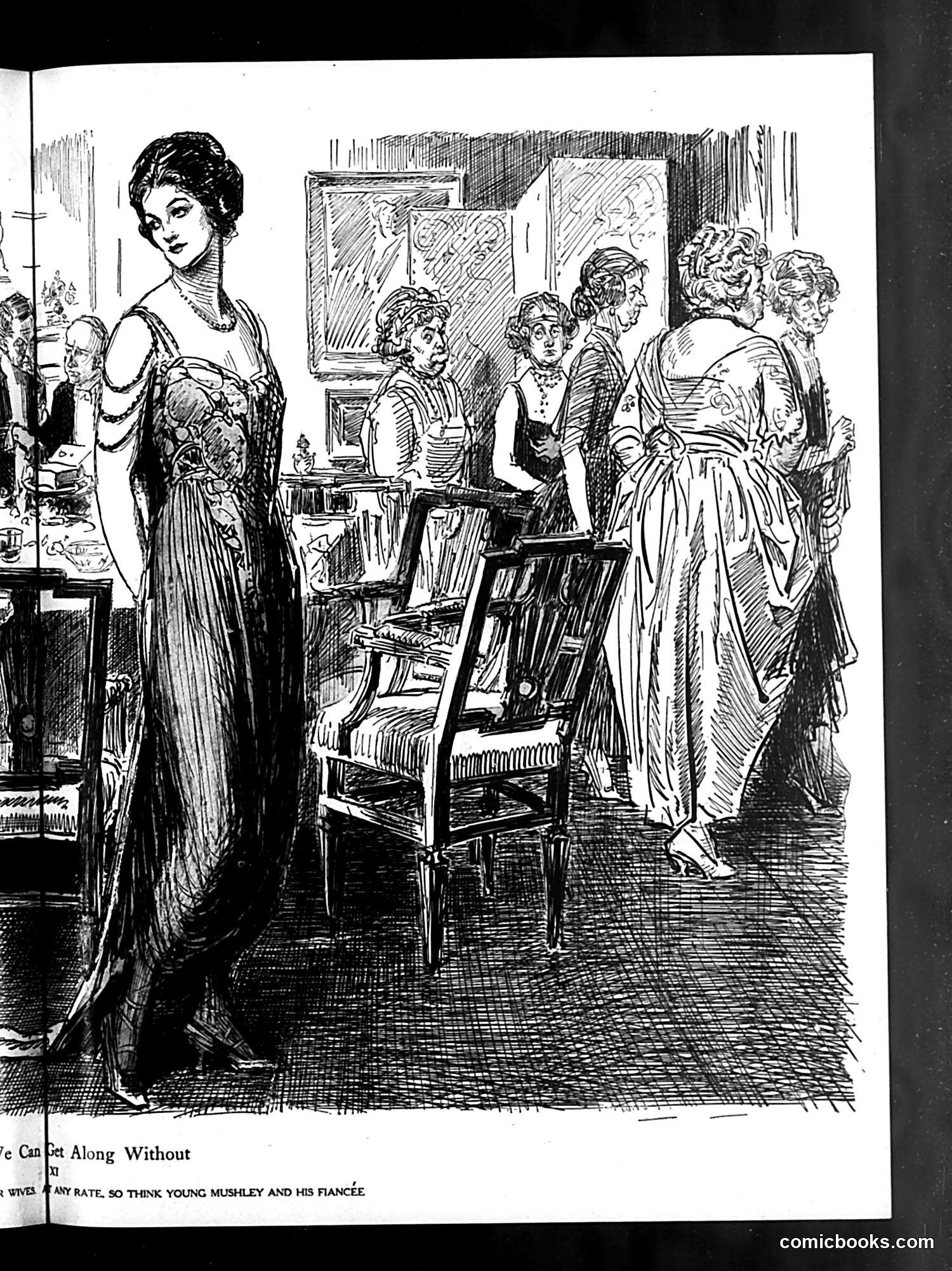
This appears to be an illustration from Life magazine depicting a social scene at what looks like a formal gathering or salon. The image shows well-dressed women in early 20th-century attire, with one prominent figure in the foreground wearing an elegant gown. The partially visible text references "young Mushley and his fiancée," suggesting the cartoon comments on marriage or engagement. The phrase about "wives" (visible at left) implies satire about matrimony or relationships. Without the complete caption and given the OCR errors, the specific satirical point remains **unclear**, but the scene appears to mock either courtship customs, social pretension, or marital concerns common to Life magazine's satirical humor of the era. The illustration style is typical of early 20th-century magazine artwork.
This page reviews Augustus Thomas's play "Another Murder," a courtroom drama critiquing capital punishment and the reliability of fingerprint evidence. The critic praises the play's central idea—an innocent man is executed based on planted fingerprints while the actual murderer escapes—as effective propaganda against these justice system failings. However, the review criticizes the execution: the opening act features pretentious drawing-room conversation about philosophy and psychology that feels artificial and out of place in a murder melodrama. The critic sarcastically notes this pseudo-intellectual dialogue belongs in small "art theatres," not a serious crime play, and mocks how actors unconvincingly quote Greek writers and discuss psychiatry as if reciting schoolboy lessons. Once the plot kicks in—featuring actress Olive Tell as a silk merchant's wife attracted to another man—the play becomes genuinely engaging. The review suggests that playwrights should recognize their casts won't consist of Phi Beta Kappa members and should write accordingly.
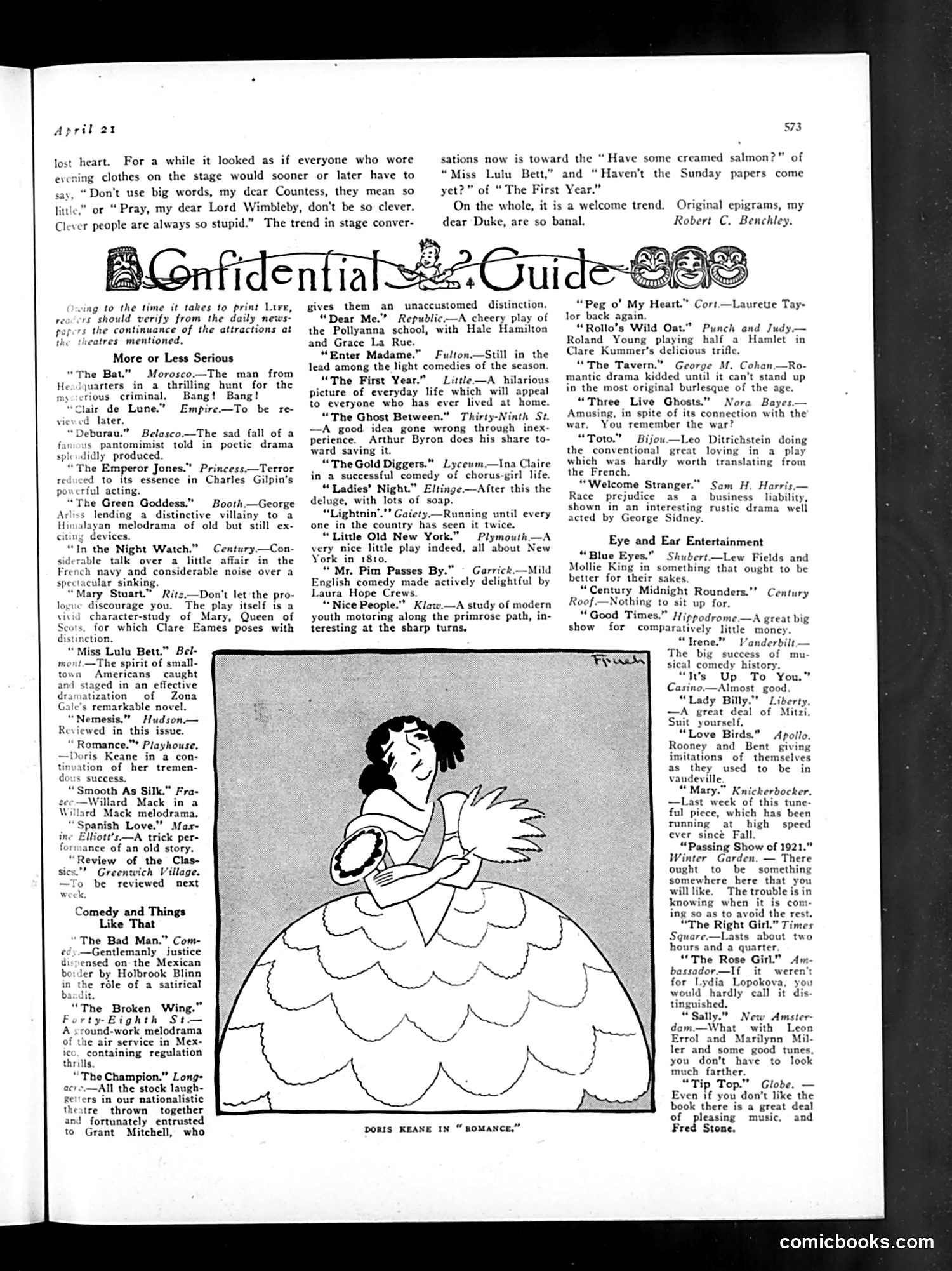
This is a theater review section from Life magazine's April 21, 1921 issue. The main illustration shows **Doris Keane in "Romance,"** depicting an actress in an elaborate, cloud-like costume—likely satirizing the ornate staging and melodrama of contemporary theater productions. The page catalogs current Broadway shows, organized by tone ("More or Less Serious," "Comedy and Things Like That"). The text includes a **social satire about stage dialogue trends**: the author mocks how characters increasingly avoid "big words" and "clever" speech, instead using simple, banal exchanges like "Have some creamed salmon?" or "Haven't the Sunday papers come yet?" The satire suggests that sophisticated, witty dialogue was falling out of fashion on stage, replaced by mundane conversation—a shift the critic views with mild disapproval as culturally regrettable. The detailed reviews reference specific actors and plots of now-forgotten plays, capturing Broadway's commercial theater landscape of the Jazz Age.
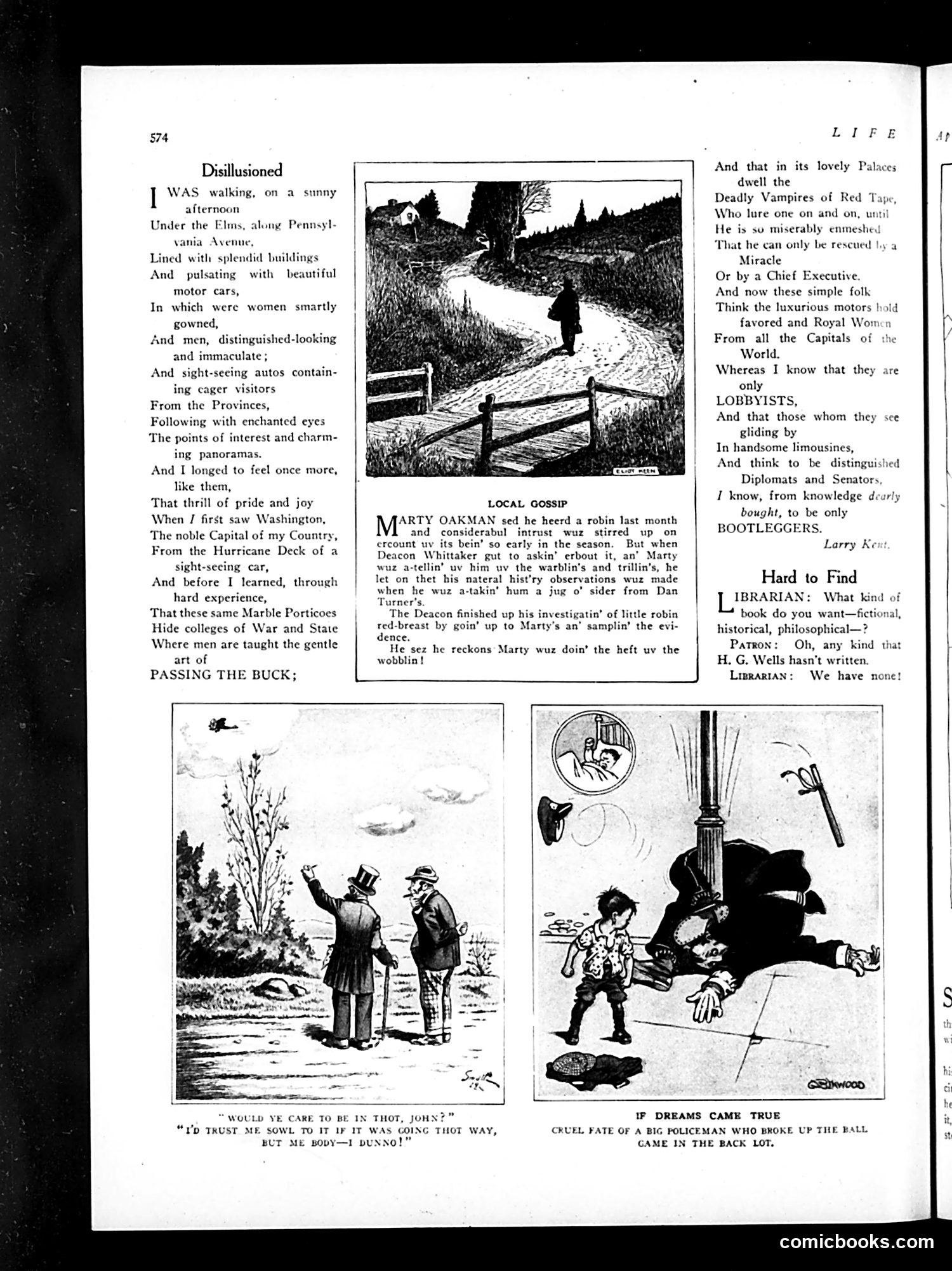
This page satirizes American political corruption during the Prohibition era. The main poem describes a visitor to Washington, D.C., initially enchanted by its grand architecture and elegant automobiles carrying well-dressed passengers. The disillusionment comes in the final lines: the visitor reveals these luxury cars actually contain "LOBBYISTS" and "BOOTLEGGERS"—not the respectable diplomats and senators they appear to be. The satire targets the gap between Washington's dignified facade and the actual corruption beneath: illegal alcohol trafficking (bootlegging) and influence-peddling by special interests. The accompanying cartoons use similar humor about deception and hidden truths. This reflects genuine 1920s concerns about Prohibition-era bootlegging networks and lobbying corruption in the nation's capital.
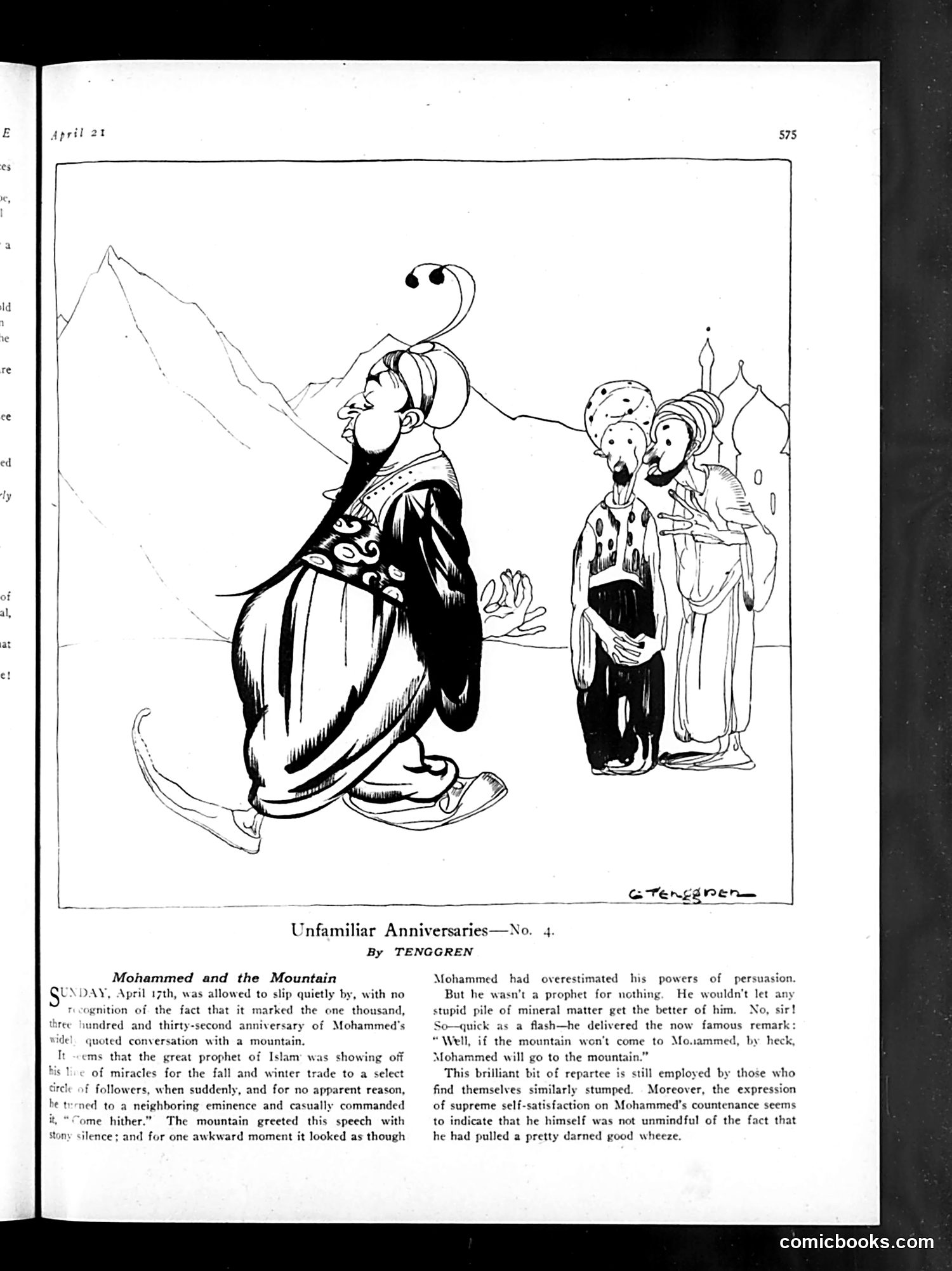
This is a satirical cartoon illustrating the famous proverb "If the mountain won't come to Mohammed, Mohammed must go to the mountain"—a saying about adapting when persuasion fails. The cartoon depicts Mohammed as a pompous figure attempting to command a mountain to approach him, presumably to impress followers with his miraculous powers. When the mountain ignores him, he pivots to walking toward it instead, then congratulates himself on his clever solution. The satire targets human ego and self-deception: Mohammed overestimated his persuasive abilities, failed at his original goal, but then treats his fallback plan as a brilliant success—patting himself on the back for what was actually a defeat. The piece mocks how people rationalize failures as victories through clever reframing, using the religious figure as a universal example of this very human tendency toward self-satisfaction.
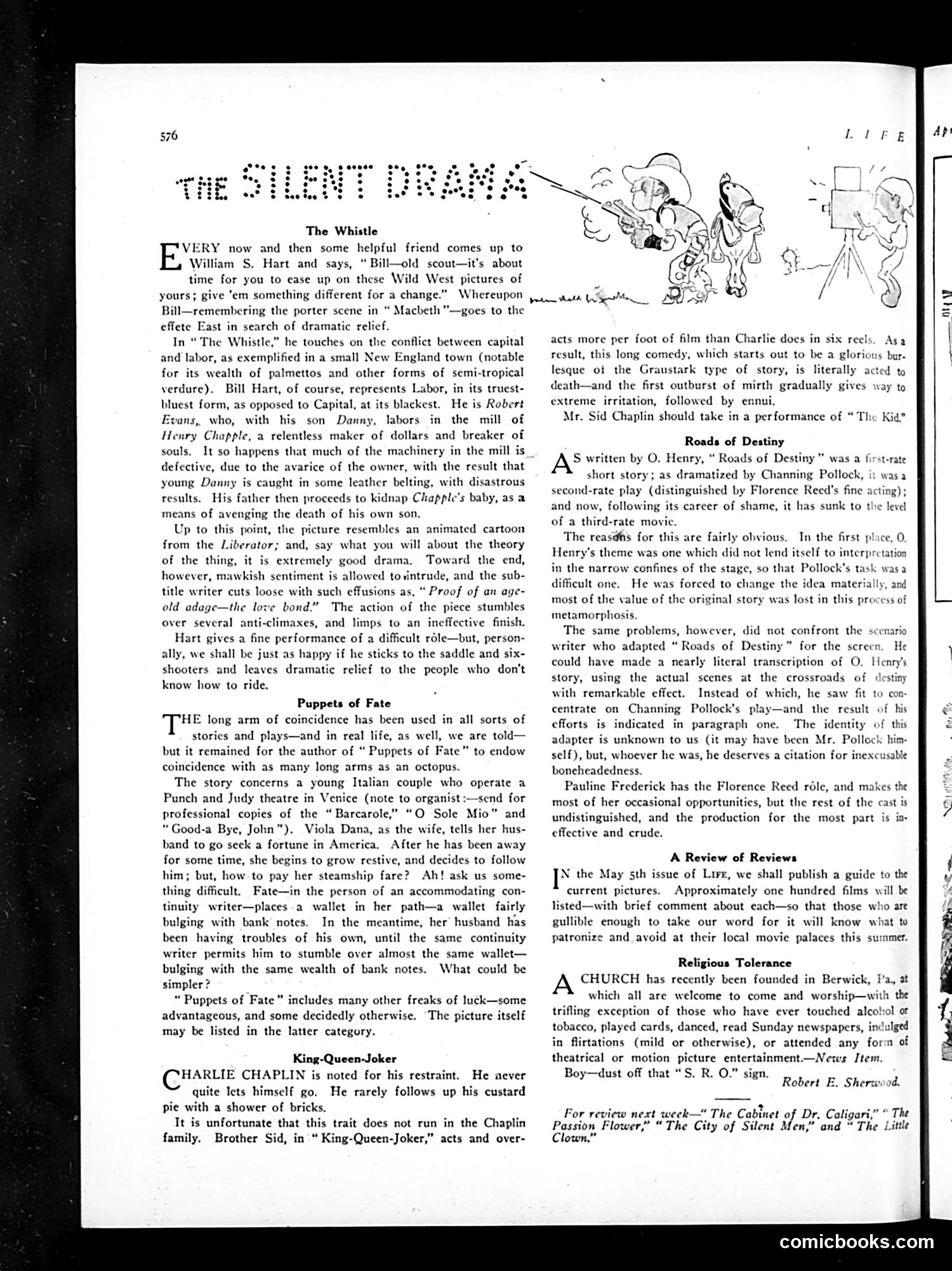
This page reviews three silent films from the early 1920s. "The Whistle" stars William S. Hart as a mill worker fighting wealthy factory owner Henry Chapple over unsafe working conditions that kill Hart's son—a labor-versus-capital story the reviewer compares to political cartoons in *The Liberator* (a socialist magazine). The reviewer praises the drama but criticizes the sentimental ending. "Puppets of Fate" uses absurd coincidences (a wallet found twice by separated spouses) that the reviewer mocks as implausible plotting. "King-Queen-Joker" stars Sid Chaplin (brother of Charlie Chaplin). The reviewer criticizes Sid for overacting excessively throughout the film, contrasting him unfavorably with Charlie's famous restraint. The review suggests Sid needs to learn subtlety from watching other performers.
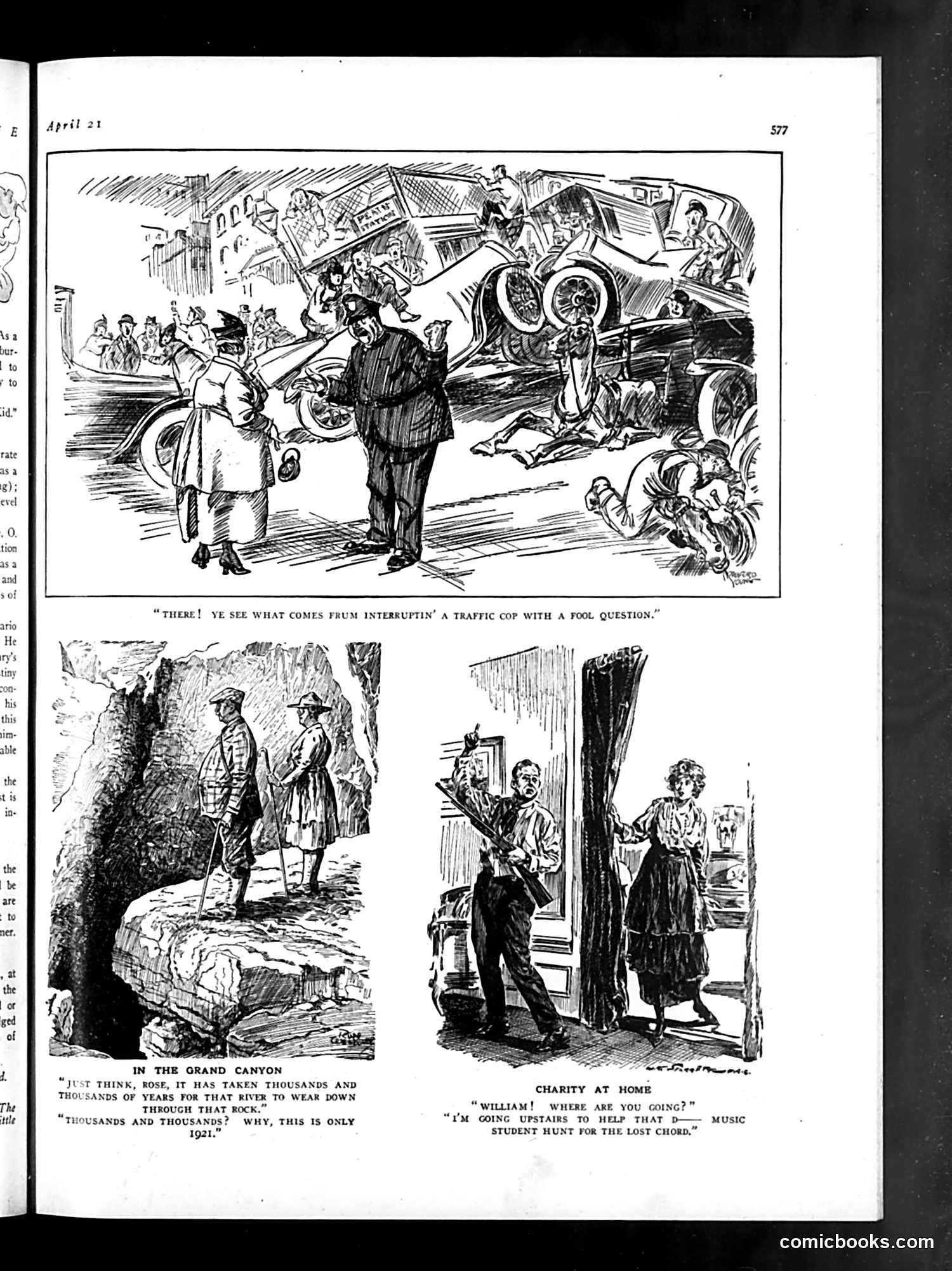
This page contains three satirical cartoons mocking different social situations: **Top cartoon**: A traffic policeman stops a car, saying interrupting the driver leads to foolish questions—the driver apparently asked something silly about the accident. **Bottom left**: A tourist couple at the Grand Canyon. The husband marvels that erosion took "thousands and thousands of years," while the wife dismissively notes it's only 1921—implying Americans' impatience and short historical perspective. **Bottom right**: "Charity at Home" depicts a woman telling her husband she's going upstairs to help a music student "hunt for the lost chord"—a euphemistic reference suggesting marital infidelity under the guise of charity work. The phrase likely references Wagner's "Tristan und Isolde." The page satirizes American impatience, naive tourism, and domestic hypocrisy.
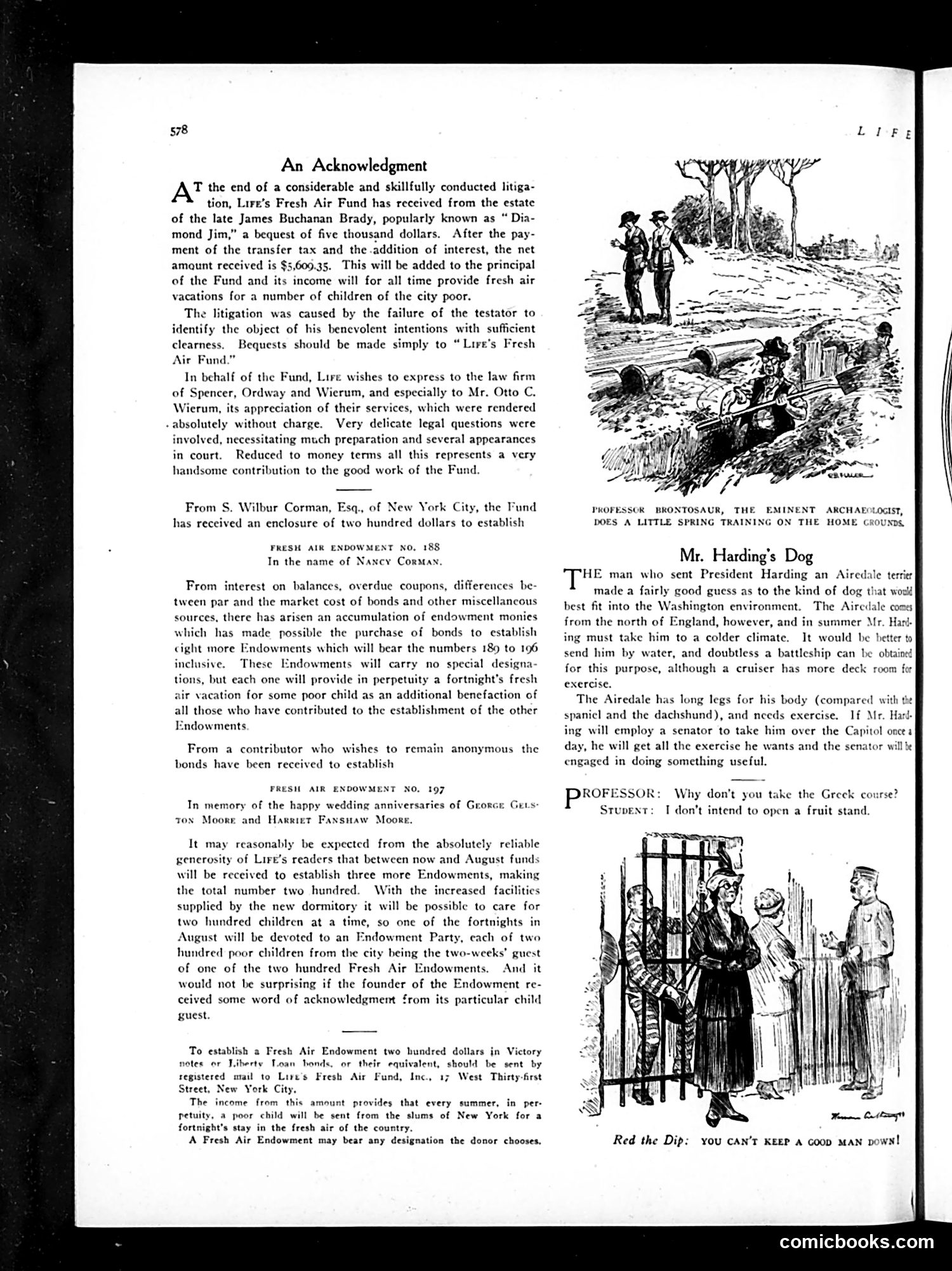
This page combines a charitable appeal with light satire. **Upper Section:** An acknowledgment of donations to Life's Fresh Air Fund, a charitable program sending poor New York City children to the countryside. The text announces receipt of $5,600+ from the estate of "Diamond Jim" Brady (a real Gilded Age businessman known for ostentatious spending) and describes establishment of multiple charitable "endowments" funded by readers. **Lower Section—"Mr. Harding's Dog":** A brief satirical comment on President Warren G. Harding receiving an Airedale terrier as a gift. The joke appears to be about the breed's suitability to Washington's environment (though the text is cut off, preventing full explanation of the satirical point). **Bottom Cartoon:** Shows a university professor asking a student why he won't take the Greek course; the student replies he doesn't intend to "open a fruit stand"—an anti-Semitic stereotype about Jewish immigrants' occupations, reflecting period prejudices.
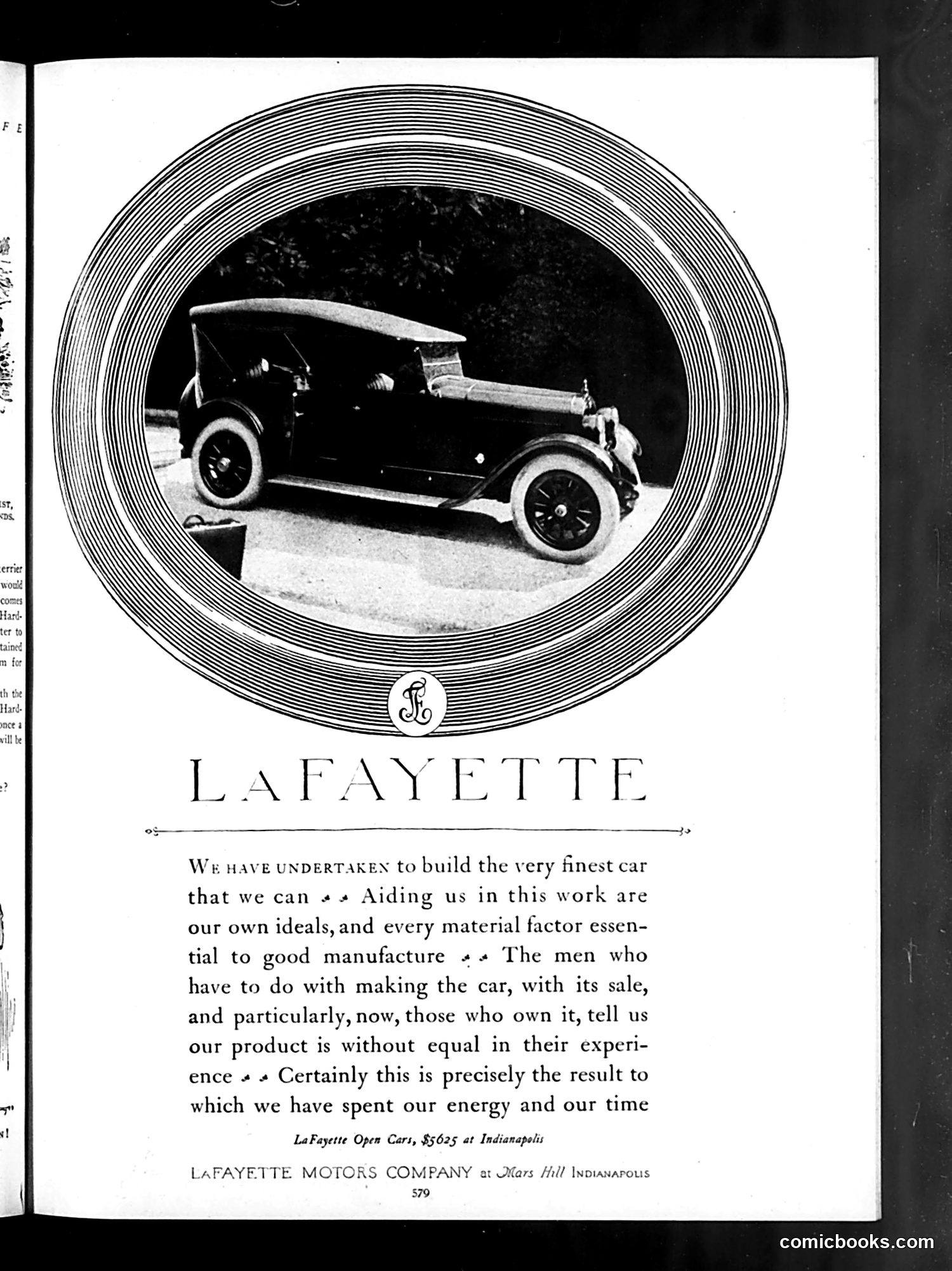
This is not a cartoon but a **car advertisement** from *Life* magazine. It promotes the Lafayette automobile, manufactured by Lafayette Motors Company in Indianapolis. The ad uses aspirational marketing language, claiming they've built "the very finest car that we can," supported by "our own ideals" and "every material factor essential to good manufacture." The text emphasizes testimonials from manufacturers, salespeople, and owners who declare the product "without equal in their experience." The circular framed photograph shows a Lafayette Open Car, priced at $5,625—a significant sum in the early automotive era (likely 1920s). The decorative oval frame and ornamental logo lend the advertisement an air of prestige and quality. This is straightforward promotional material rather than satire or political commentary.
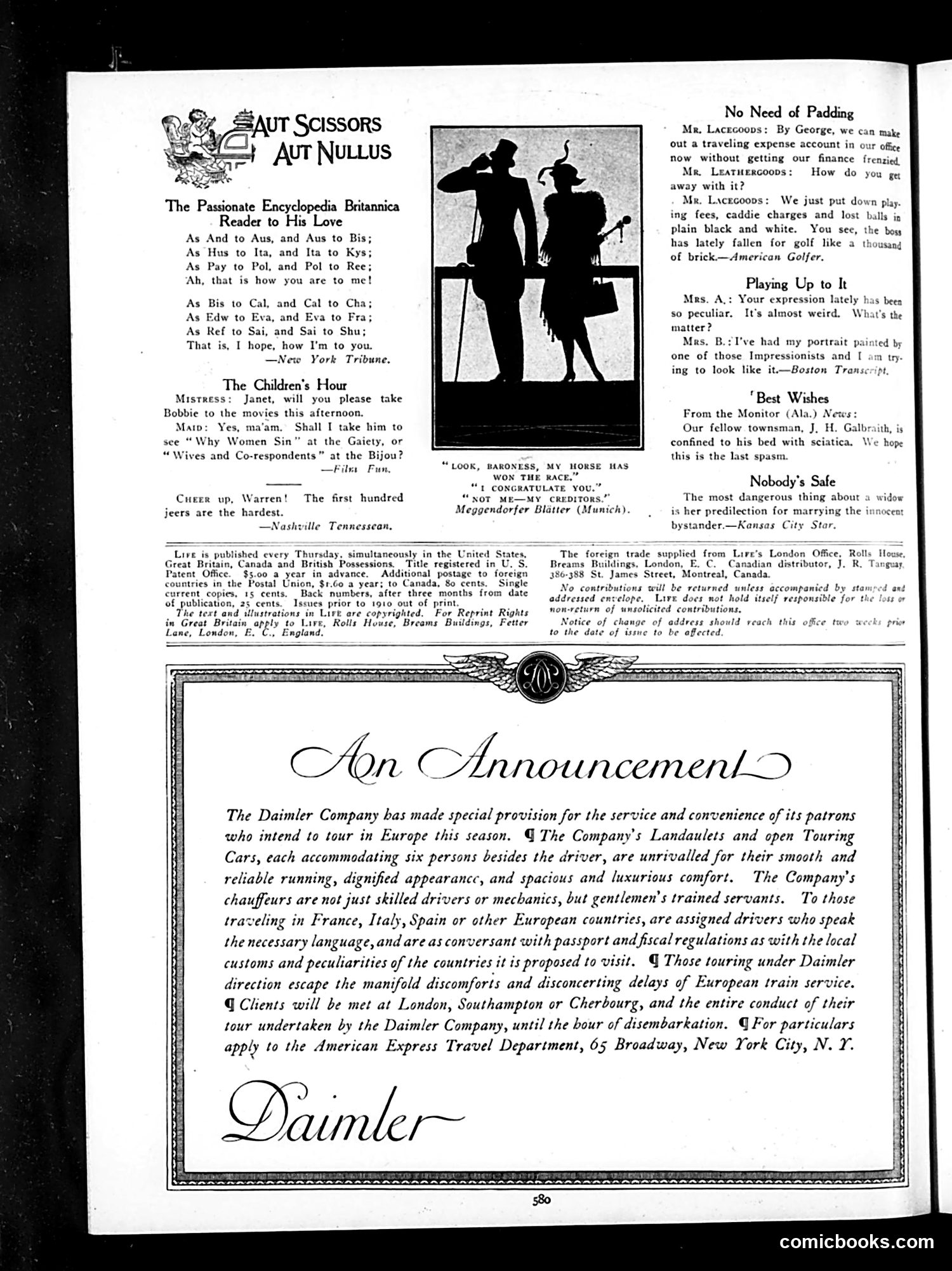
This page contains several brief satirical pieces typical of early 20th-century *Life* magazine humor: **Main cartoons/jokes:** 1. **"Passionate Encyclopedia Britannica Reader"** — A parody of romantic poetry using Encyclopedia Britannica entries (Aus, Bis, Ita, etc.) instead of conventional love metaphors. The satire mocks overly intellectual romantics who substitute dry reference material for genuine emotion. 2. **"The Children's Hour"** — A maid asks whether to take a child to see "Why Women Sin" or "Wives and Co-respondents" at the cinema. The satire critiques sensationalist silent films marketed to families, with titles suggesting infidelity and moral transgression. 3. **"Playing Up to It"** — A woman tries to physically embody an Impressionist portrait style. This mocks both Modernist art pretension and women's willingness to adopt affectations for appearance. 4. **Golf expense account joke** — Office workers falsify business accounts with golf expenses because their boss recently became obsessed with golf. The page is primarily humor content with a large **Daimler automobile advertisement** below, emphasizing luxury European touring vehicles and gentleman chauffeurs.
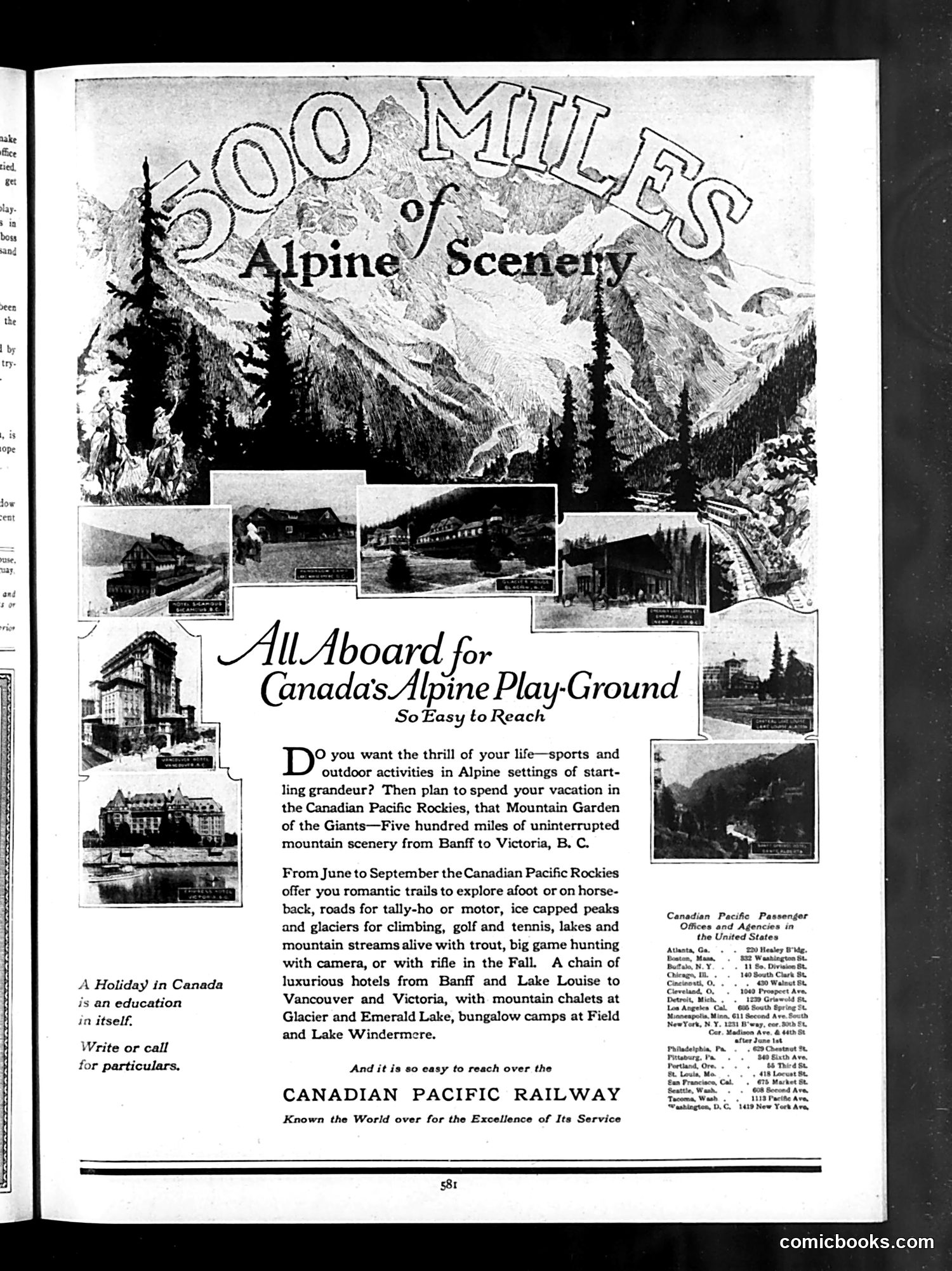
This page is primarily **advertising**, not political satire or comics. It's a Canadian Pacific Railway promotional advertisement for alpine tourism in the Canadian Rockies (Banff to Victoria, B.C.). The content features: - **Multiple photographs** of mountain scenery and resort hotels/lodges arranged around a central landscape illustration - **Marketing copy** emphasizing recreational activities: hiking, hunting, climbing, golf, tennis, and fishing from June-September - **Contact information** for Canadian Pacific offices across the United States - **The railway company's tagline**: "Known the World over for the Excellence of Its Service" The page's sole rhetorical strategy is aspirational travel marketing aimed at affluent American tourists, promoting the Canadian Rockies as an accessible vacation destination reachable via Canadian Pacific Railway. There are no political cartoons, caricatures, or satirical commentary present.
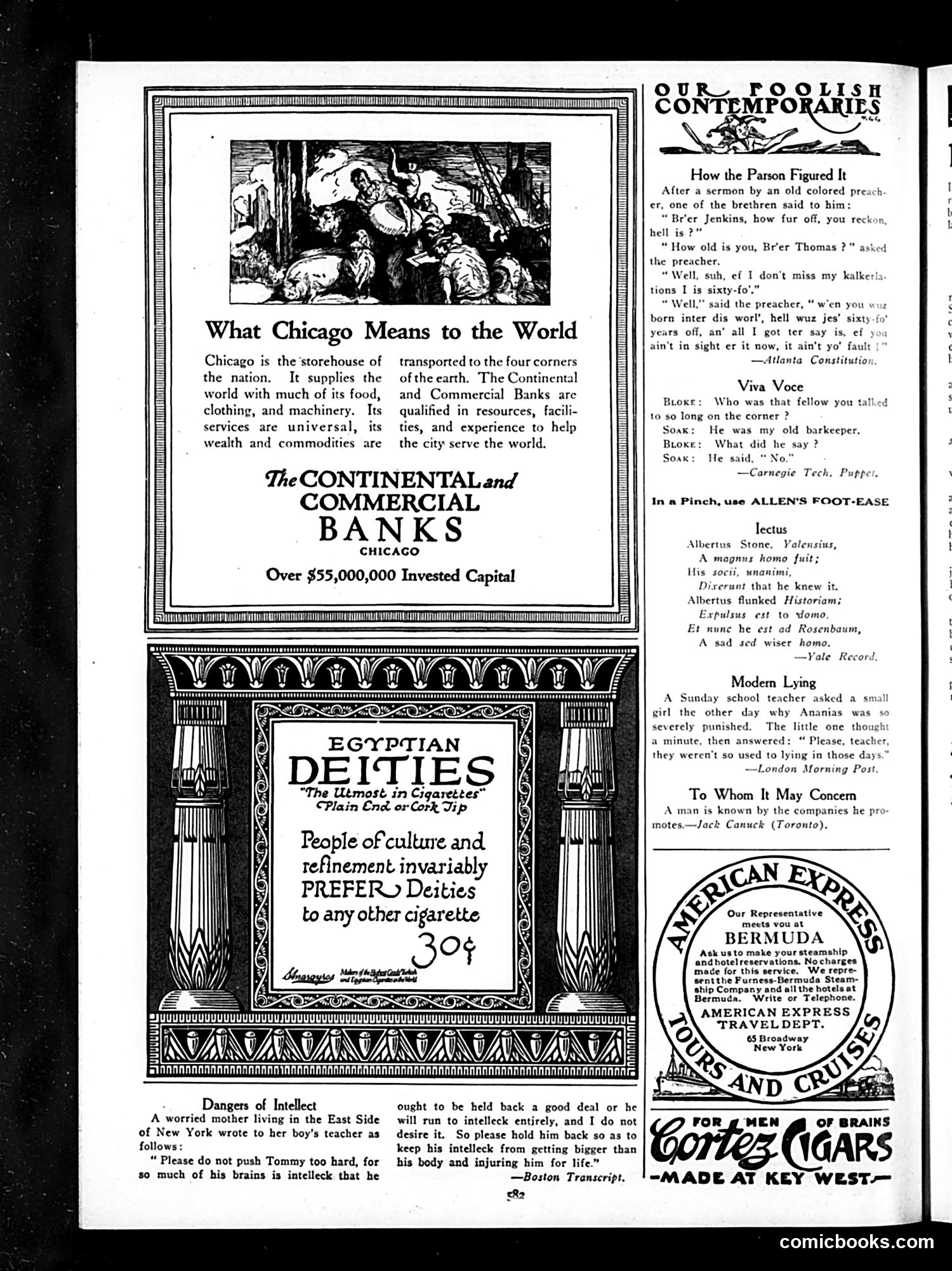
This page is primarily **advertising mixed with light humor pieces**, typical of early 20th-century Life magazine. **Main Advertisement**: The Continental and Commercial Banks of Chicago emphasizes the city's role as America's commercial hub, supplying goods and services globally—a promotional piece celebrating American industrial power and banking infrastructure. **Cigarette Ad**: Egyptian Deities cigarettes use pseudo-intellectual appeals to "people of culture and refinement," a common advertising strategy of the era. **Humor Sections**: Several brief jokes and anecdotes appear: - "Dangers of Intellect" satirizes overprotective parenting (a worried mother fears education will overstimulate her son) - "How the Parson Figured It" features African American dialect humor, where a preacher calculates hell's distance based on age - Other short comic pieces on lying, academia, and social observations The page reflects period attitudes: boosterism for American commerce, casual ethnic stereotyping in humor, and genteel satirical commentary on modern manners and education.
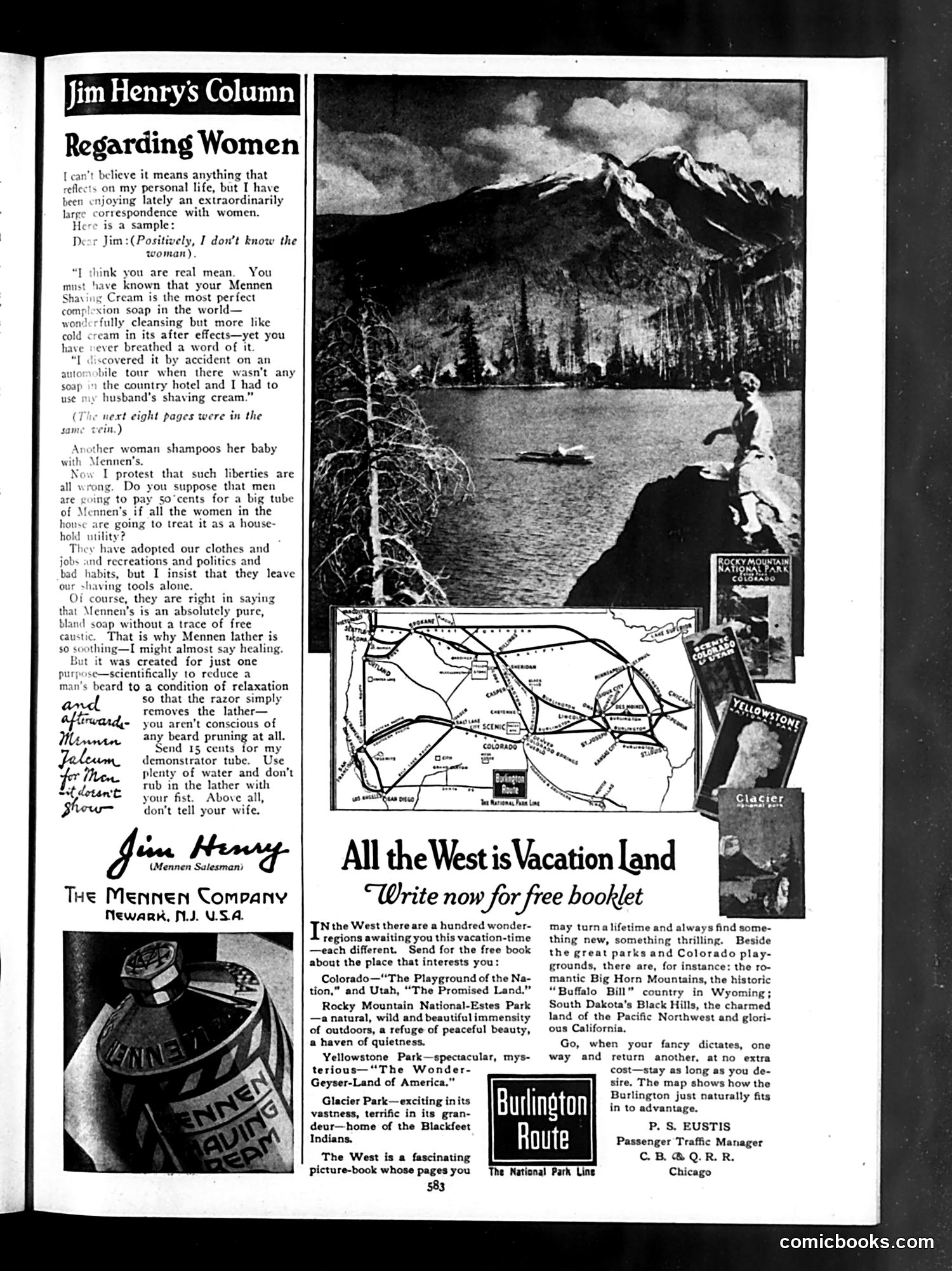
This is a satirical piece by Jim Henry (identified as a Mennen salesman) complaining about women appropriating men's products. The humor relies on **gender role anxieties of the era**: Henry receives letters from women praising Mennen's shaving cream for uses beyond shaving—one uses it as facial cleanser, another for shampooing her baby. His complaint is that if women treat male grooming products as "household utilities," men won't pay premium prices. The satire targets both **female encroachment on male spaces** and **consumer marketing anxiety**—a common 1920s-30s concern as women gained economic independence. The underlying joke: women's practical logic (why buy separate products?) versus commercial interests in maintaining gender-segregated product lines. The ironic final line—"don't tell your wife"—suggests men know women will adopt these products regardless, yet maintain the pretense of male-exclusive domains. The page is primarily **advertising**, using humor to sell Mennen's products and Western vacation travel.
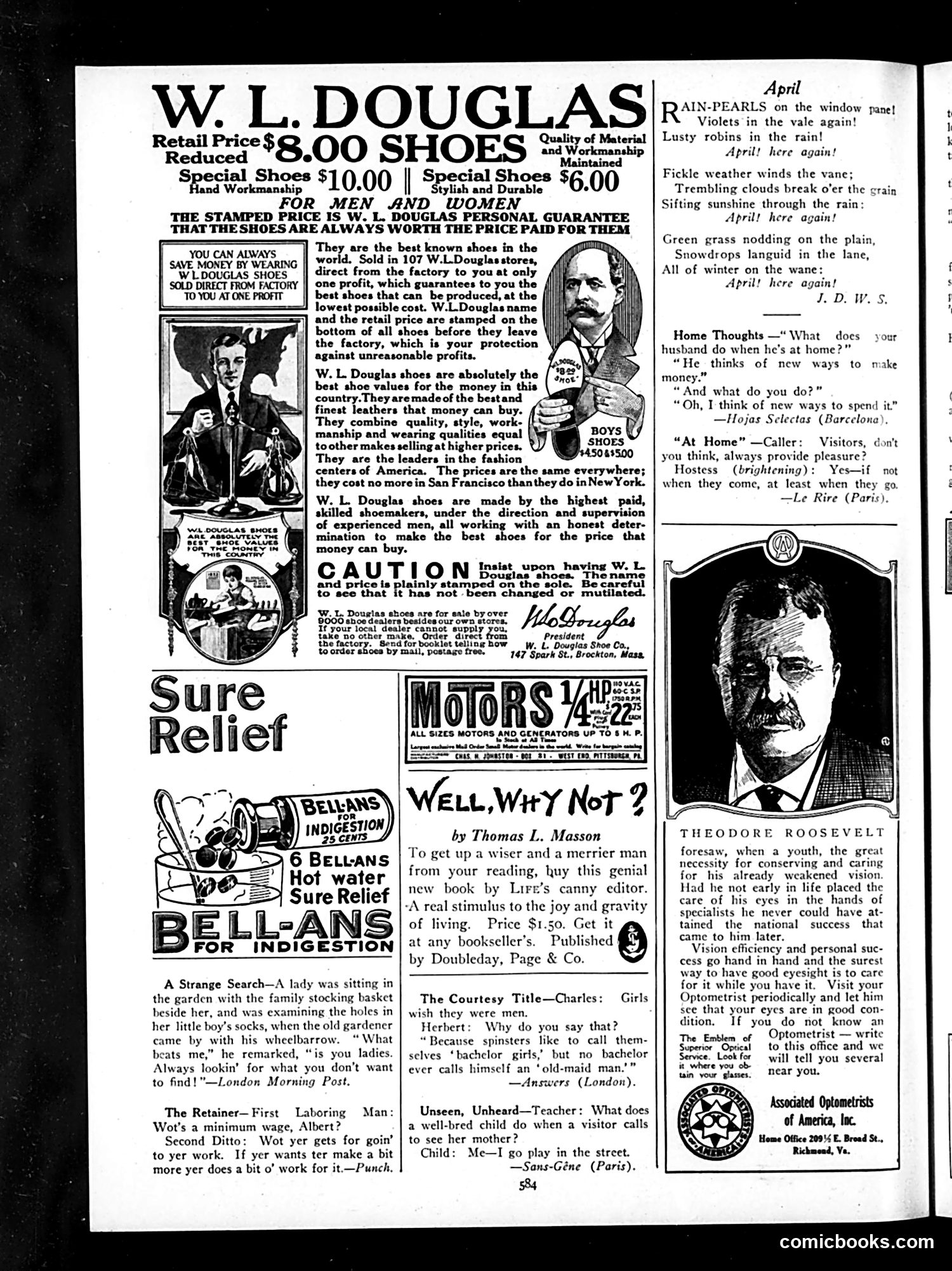
This page is primarily **advertising and filler content**, not political satire. The dominant feature is a W.L. Douglas Shoes advertisement emphasizing factory-direct pricing and quality control. The Douglas brand signature appears as a stamped guarantee on shoe bottoms—a selling point the ad repeats. The page includes minor **humorous anecdotes** typical of Life's lighter content: observations about wives seeking holes in socks, working-class banter about minimum wages, and jokes about unmarried women versus men. These are gentle social humor rather than pointed satire. A portrait of **Theodore Roosevelt** appears without accompanying text or commentary, likely a standard editorial feature rather than cartoon analysis. The only substantive non-advertising content is Thomas L. Masson's book advertisement promoting a humorous collection. Overall, this represents a typical early-20th-century magazine layout mixing commerce with light domestic humor and celebrity imagery, rather than serious political cartooning.
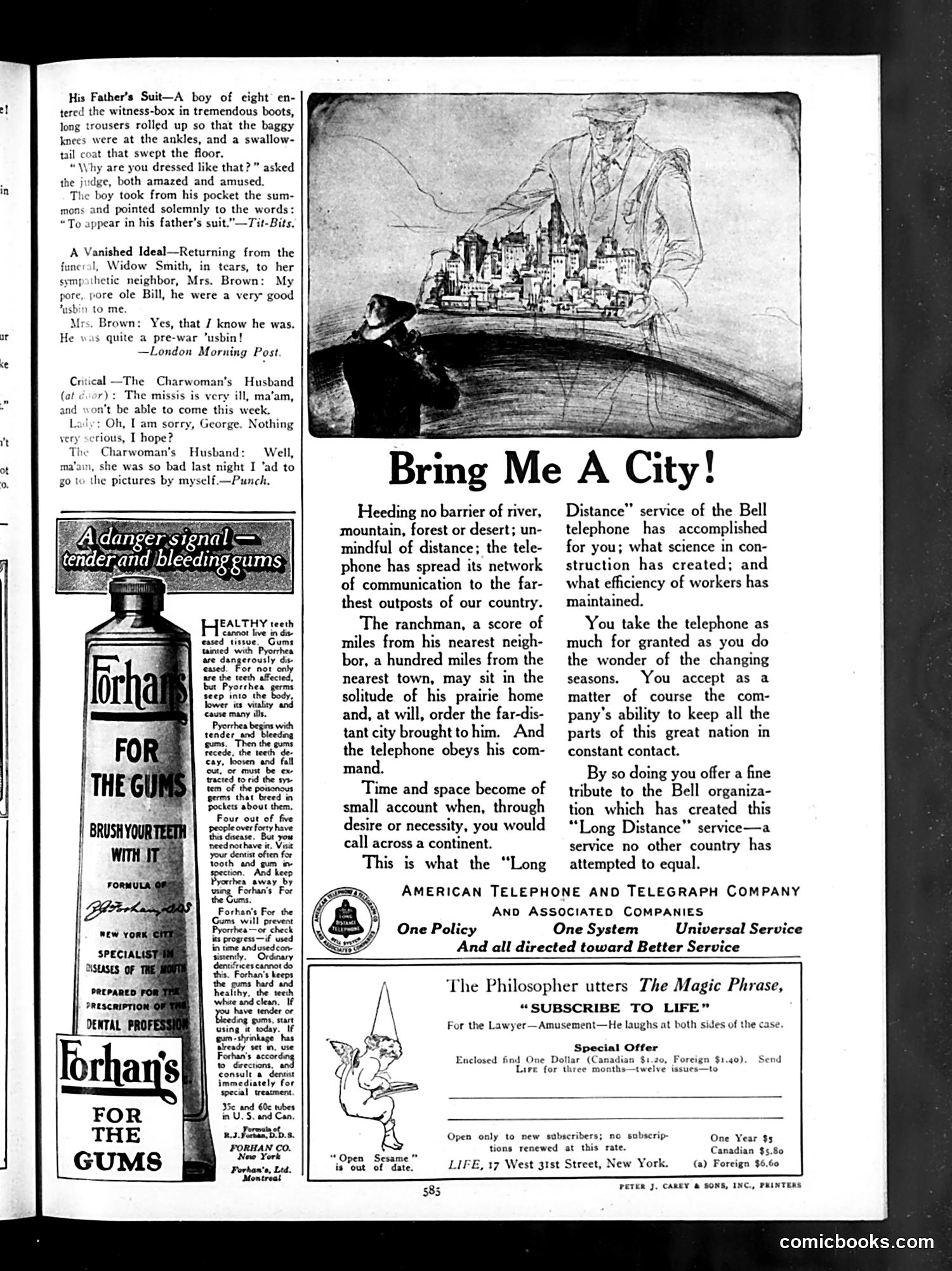
This page contains three brief humorous anecdotes typical of early 20th-century satirical magazines: 1. **"His Father's Suit"**: A child testifying in court appears wearing his father's oversized formal clothing, having literally interpreted legal summons language to "appear in his father's suit." 2. **"A Vanished Ideal"**: A widow nostalgically recalls her late husband as "a very good usbin," but her neighbor notes he was merely "pre-war"—suggesting wartime (likely WWI) improved standards or that nostalgia exaggerates the past. 3. **"Critical"**: A charwoman's husband explains his wife's absence by saying she was so ill the previous night he had to go to the pictures (movies) alone—deadpan absurdist humor about his priorities. The page primarily features an **AT&T advertisement** celebrating the telephone's ability to bring distant cities to isolated ranchers, emphasizing American technological achievement and continental connectivity. A **Forhan's toothpaste advertisement** warns about pyorrhea (gum disease), and a **Life magazine subscription offer** appears at bottom.
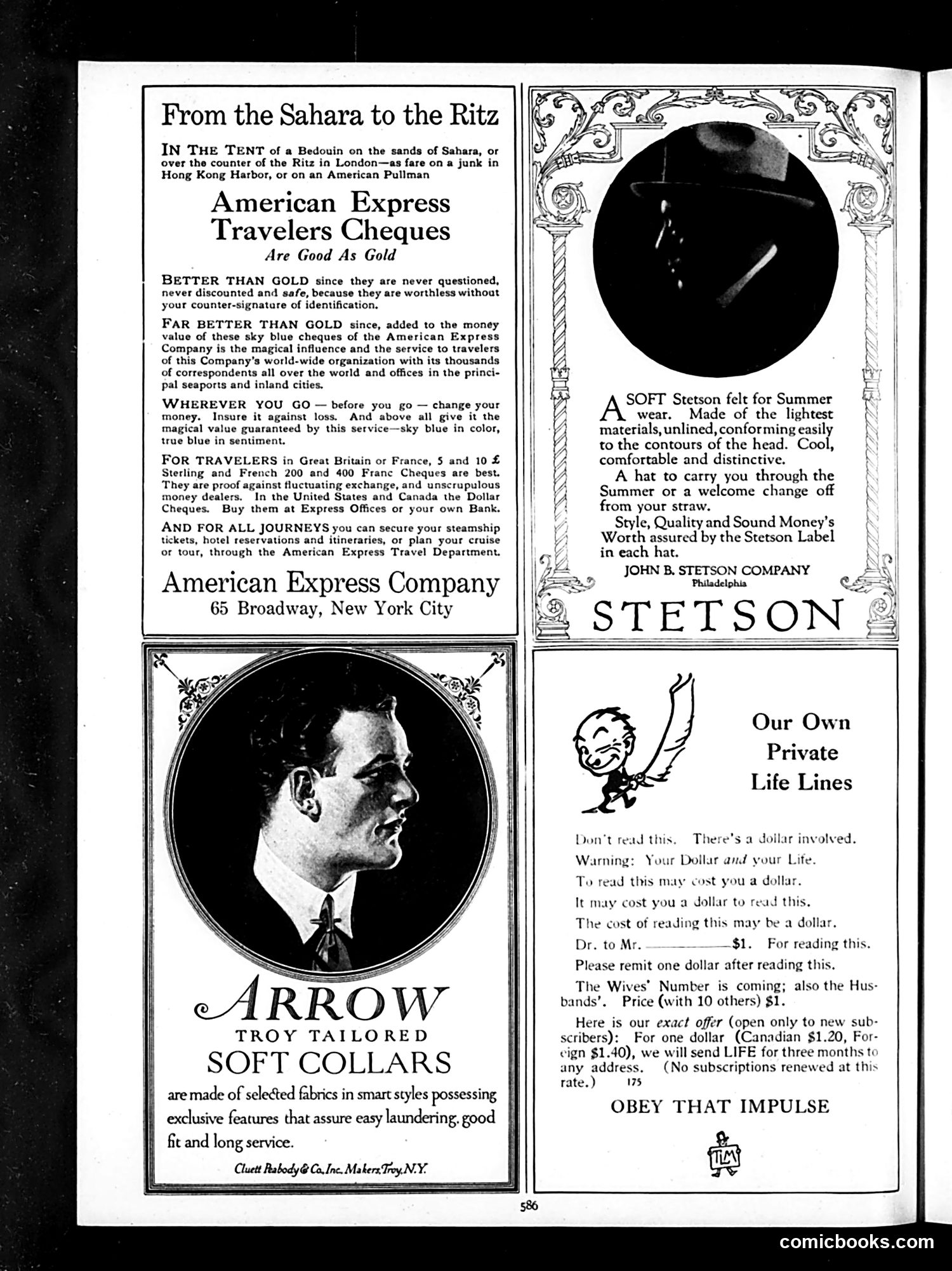
This page is primarily **advertisements**, not political satire. It contains four commercial promotions: 1. **American Express Travelers Cheques** — emphasizing their safety and global acceptance from "Sahara to the Ritz," playing on the appeal to wealthy travelers. 2. **Stetson hats** — advertising lightweight summer felt hats as practical travel wear. 3. **Arrow Troy Tailored Soft Collars** — featuring a portrait of an unidentified man in formal dress, promoting easy-care shirt collars made from quality fabrics. 4. **Life Magazine subscription** — a humorous self-promotional ad using ironic wordplay. The "Our Own Private Life Lines" section jokingly warns readers that reading the ad "may cost you a dollar," then pitches a subscription offer for new subscribers at $1 (or $1.20 Canadian). The page reflects early 20th-century consumer culture targeting affluent travelers and businessmen. The Life Magazine pitch's comedic tone—suggesting reading itself has a price—is the closest to satirical humor on the page.
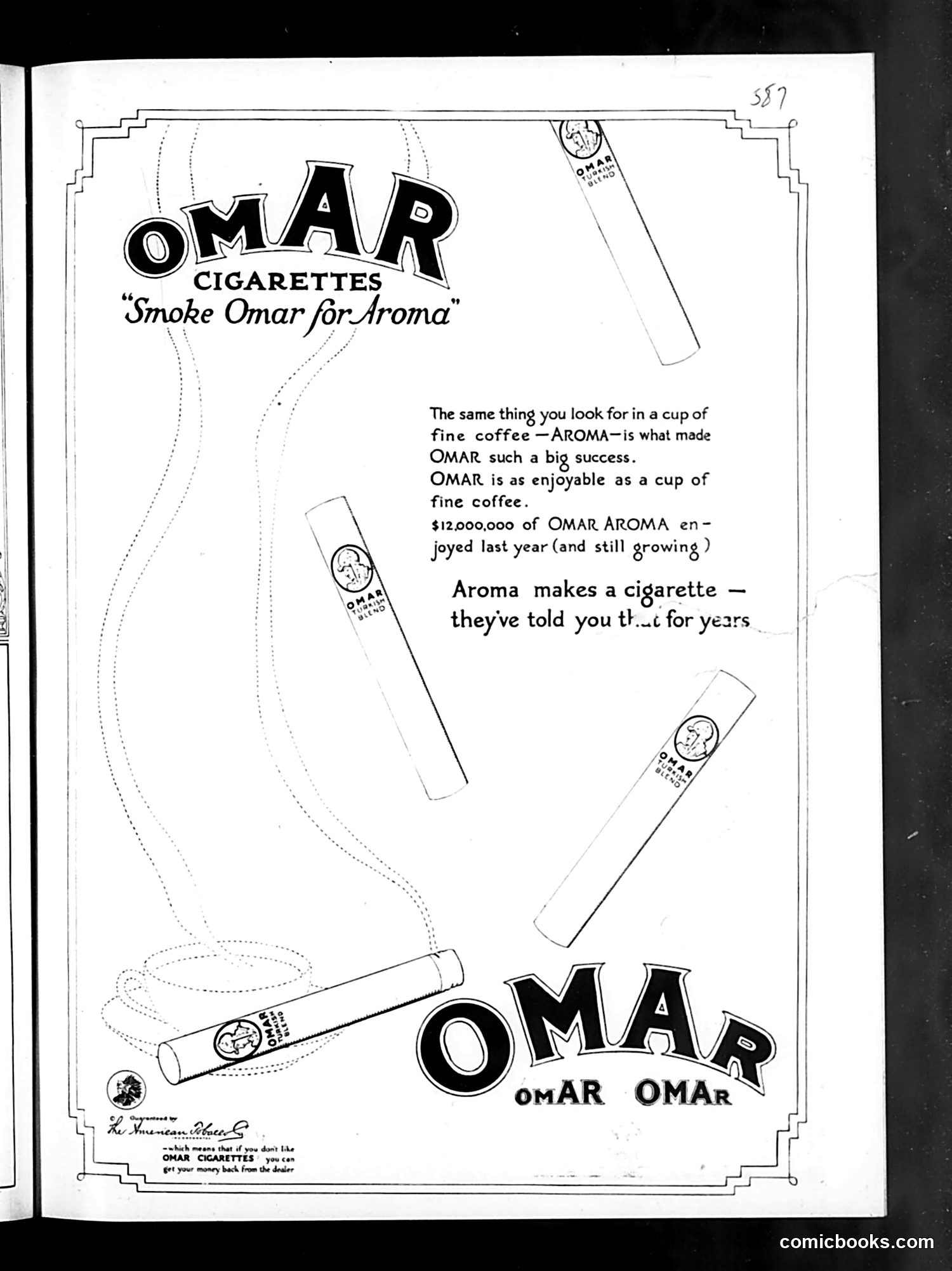
This is a **cigarette advertisement**, not a political cartoon. It promotes Omar brand cigarettes using the marketing concept that aroma makes cigarettes desirable, just as aroma makes fine coffee appealing. The ad claims $12 million in Omar cigarette sales the previous year and emphasizes that "aroma makes a cigarette"—a sales pitch repeated for years. The page features stylized illustrations of cigarettes with smoke wisps and the Omar branding repeated at the bottom. **Modern context**: This reflects early 20th-century cigarette marketing before health warnings existed. The comparison to coffee normalizes smoking as a pleasant daily habit. The large sales figures served as social proof—suggesting Omar's popularity made it a desirable product. Such openly promotional cigarette advertising in mainstream magazines would be illegal in most countries today.
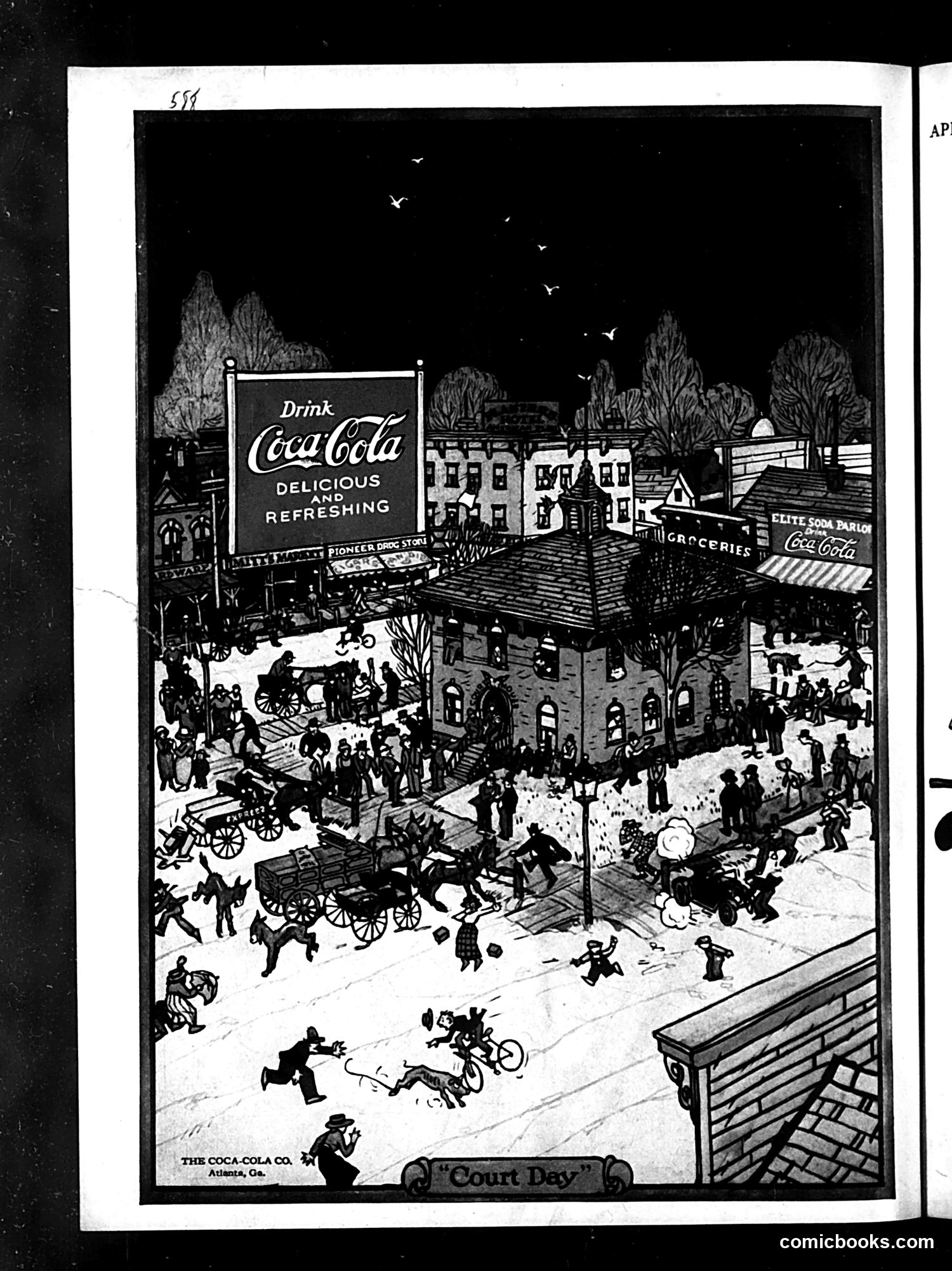
This is a Coca-Cola advertisement rather than political satire. The illustration depicts a bustling American town square or "court day" scene, likely from the early 20th century. The image shows a lively community gathering with horse-drawn wagons, pedestrians, children playing, and various townspeople conducting business and socializing in front of brick buildings and storefronts. The prominent Coca-Cola billboard advertisement reading "Drink Coca-Cola: Delicious and Refreshing" and storefront signage suggest the drink's integration into everyday American life. The "Pioneer Drug Store" and "Elite Soda Parlor" references indicate where consumers could purchase Coca-Cola locally. This appears designed to associate the beverage with wholesome American community life and leisure moments.