
Life, 1921-04-21 · page 24 of 36
Life — April 21, 1921 — page 24: what you’re looking at
What you’re looking at
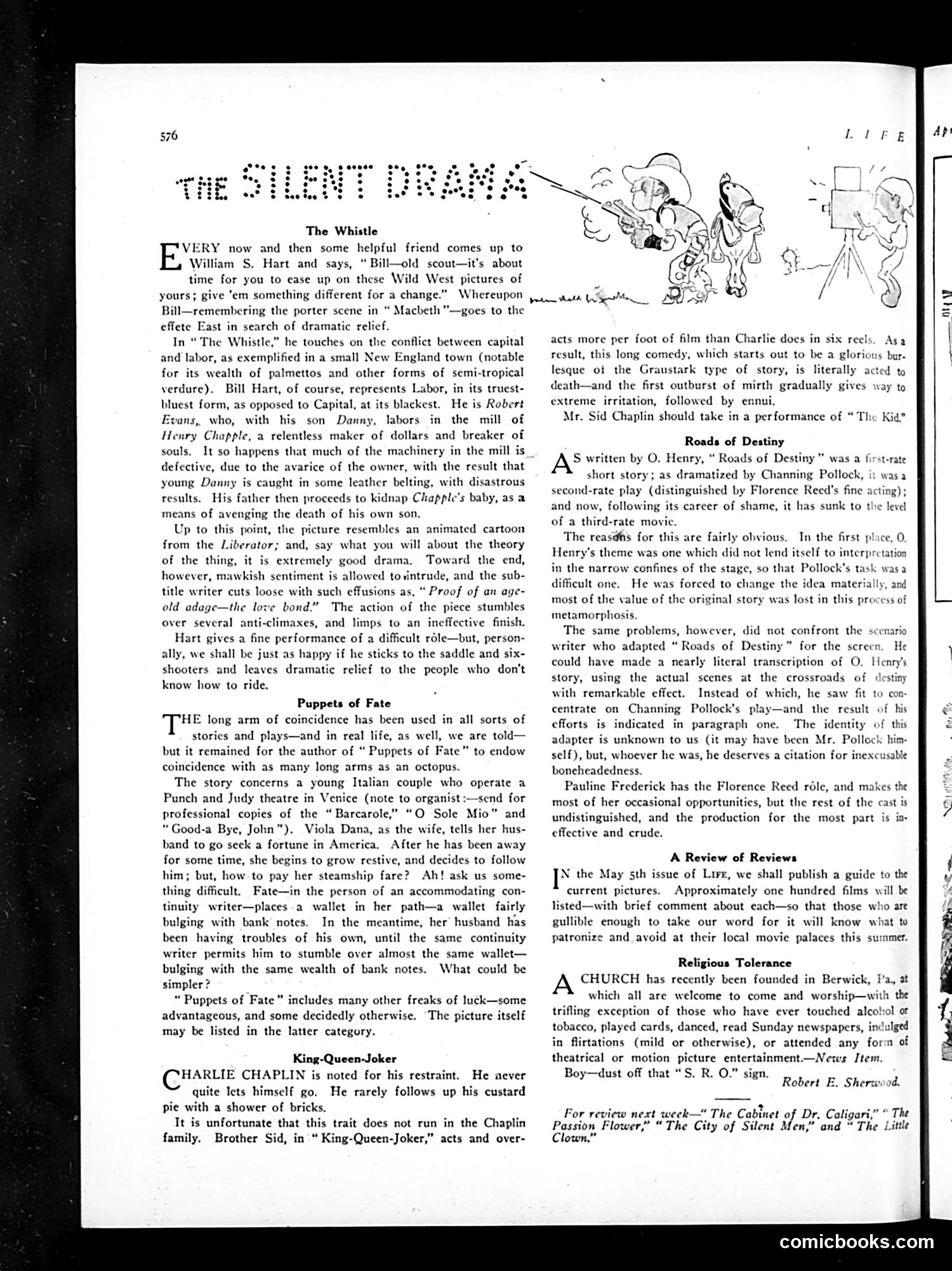
This page reviews three silent films from the early 1920s. "The Whistle" stars William S. Hart as a mill worker fighting wealthy factory owner Henry Chapple over unsafe working conditions that kill Hart's son—a labor-versus-capital story the reviewer compares to political cartoons in *The Liberator* (a socialist magazine). The reviewer praises the drama but criticizes the sentimental ending. "Puppets of Fate" uses absurd coincidences (a wallet found twice by separated spouses) that the reviewer mocks as implausible plotting. "King-Queen-Joker" stars Sid Chaplin (brother of Charlie Chaplin). The reviewer criticizes Sid for overacting excessively throughout the film, contrasting him unfavorably with Charlie's famous restraint. The review suggests Sid needs to learn subtlety from watching other performers.
📄 Transcribed text from this page (OCR, searchable)
Machine-transcribed from the original scan — historical spelling and the odd misread are preserved.
The Whistle VERY now and then some helpful friend comes up to William S. Hart and says, “ Bill—old scout—it’s about time for you to ease up on these Wild West pictures of yours; give ’em something different for a change.” Whereupon Bill—remembering the porter scene in “ Macbeth "—goes to the effete East in search of dramatic relief. In “The Whistle,” he touches on the conflict between capital and labor, as exemplified in a small New England town (notable for its wealth of palmettos and other forms of semi-tropical verdure). Bill Hart, of course, represents Labor, in its truest- bluest form, as opposed to Capital, at its blackest. He is Robert ans, who, with his son Danny, labors in the mill of Henry Chapple, a relentless maker of dollars and breaker of souls. It so happens that much of the machinery in the mill is defective, due to the avarice of the owner, with the result that young Danny is caught in some leather belting, with disastrous results. His father then proceeds to kidnap Chapple’s baby, as a means of avenging the death of his own son. Up to this point, the picture resembles an animated cartoon from the Liberator; and, say what you will about the theory of the thing, it is extremely good drama. Toward the end, however, mawkish sentiment is allowed tosintrude, and the sub- title writer cuts loose with such effusions as, “ Proof of an age- old adage—the love bond.” The action of the piece stumbles over several anti-climaxes, and limps to an ineffective finish. Hart gives a fine performance of a difficult role—but, person- ally, we shall be just as happy if he sticks to the saddle and six shooters and leaves dramatic relief to the people who don't know how to ride. Puppets of Fate HE long arm of coincidence has been used in all sorts of stories and plays—and in real life, as well, we are told— but it remained for the author of “ Puppets of Fate” to endow coincidence with as many long arms as an octopus. The story concerns a young Italian couple who operate a Punch and Judy theatre in Venice (note to organist :—send for professional copies of the “Barcarole,” “O Sole Mio” and “Good-a Bye, John”). Viola Dana, as the wife, tells her hus- band to go seek a fortune in America. After he has been away for some time, she begins to grow restive, and decides to follow him; but, how to pay her steamship fare? Ah! ask us some- thing difficult. Fate—in the person of an accommodating con- tinuity writer—places-a wallet in her path—a wallet fairly bulging with bank notes. In the meantime, her husband has been having troubles of his own, until the same continuity writer permits him to stumble over almost the same wallet— bulging with the same wealth of bank notes. What could be simpler? “ Puppets of Fate” includes many other freaks of luck—some advantageous, and some decidedly otherwise. The picture itself may be listed in the latter category. King-Queen-Joker HARLIE CHAPLIN is noted for his restraint. quite Icts himself go. pie with a shower of bricks. It is unfortunate that this trait does not run in the Chaplin family. Brother Sid, in “ King-Queen-Joker,” acts and over- He aever He rarely follows up his custard acts more per foot of film than Charlie does in six reels result, this long comedy, which starts out to be a gloric lesque ot the Graustark type of story, is literally a death—and the first outburst of mirth gradually gives \ extreme irritation, followed by ennui. Mr. Sid Chaplin should take in a performance of “ The Roads of Destiny S written by O. Henry, “ Roads of Destiny short story; as dramatized by Channing Pollock, it was a second-rate play (distinguished by Florence Reed's fine acting); and now, following its career of shame, it has sunk to the level of a third-rate movie. The reas@hs for this are fair In the first place, 0. Henry’s theme was one which did not lend itself to interpretation in the narrow confines of the stage, so that Pollock's task was a was a firs obvious. difficult one. He was forced to change the idea materially, and most of the value of the original story was lost in this process of metamorphosis. The same problems, however, did not confront the scen: writer who adapted “ Roads of Destiny” for the screen. He could have made a nearly literal transcription of O. Henry story, using the actual scenes at the crossroads of destiny with remarkable effect. Instead of which, he saw fit to centrate on Channing Pollock's play—and the result of his efforts is indicated in paragraph one. The identity of this adapter is unknown to us (it may have been Mr. Pollock him- self), but, whoever he was, he deserves a citation for inexcusable boncheadedness. Pauline Frederick has the Florence Reed rdle, and makes the most of her occasional opportunities, but the rest of the cast i undistinguished, and the production for the most part effective and crude. A Review of Reviews N the May sth issue of Lure, we shall publish a guide to the current pictures. Approximately one hundred films will be listed—with brief comment about each—so that those who are gullible enough to take our word for it will know what to patronize and avoid at their local movie palaces this surmmer. Religious Tolerance CHURCH has recently been founded in Berwick, l’a, at which all are welcome to come and worship—with the trifling exception of those who have ever touched alcolol or tobacco, played cards, danced, read Sunday newspapers, indulged in flirtations (mild or otherwise), or attended any form of theatrical or motion picture entertainment.—News Item. y—dust off that “S. R. O.” sign. Boy—dust off that “S. R. O.” sign, Robert E. Sherwood. For review next week—‘ The Cabinet of Dr. Caligari,” “ The Passion Flower," “The City of Silent Men,” and “The Little own.” comicbooks.com