
Life, 1921-04-21 · page 17 of 36
Life — April 21, 1921 — page 17: what you’re looking at
What you’re looking at
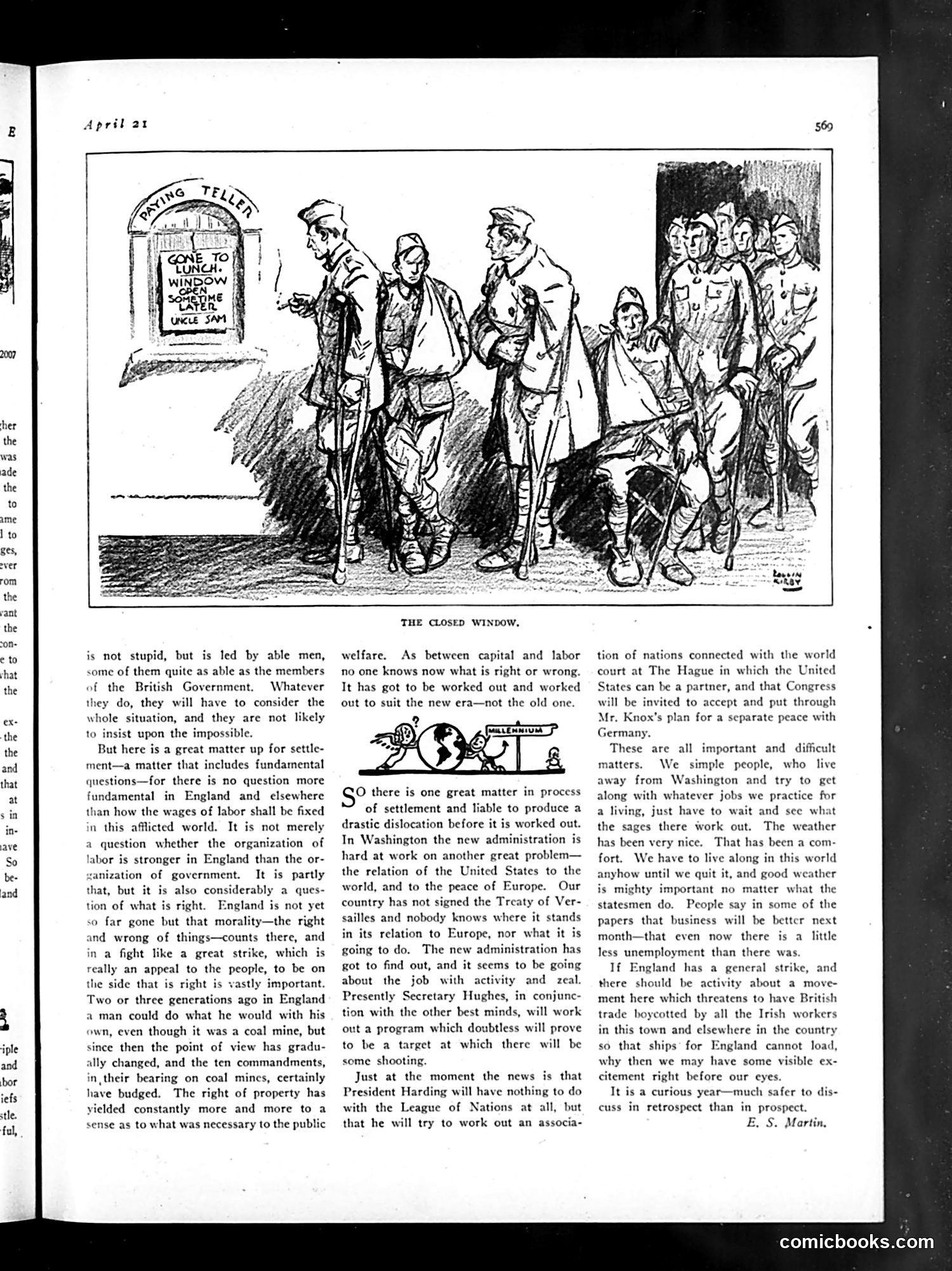
The cartoon depicts uniformed soldiers standing outside a "Posting Teller" window with a sign reading "COME TO LUNCH / WINDOW CLOSED / UNCLE SAM." The satire targets post-WWI American isolationism and economic uncertainty. The "closed window" represents the U.S. refusing international engagement—specifically President Harding's rejection of the League of Nations (mentioned in the accompanying text). The soldiers symbolize labor/working men shut out from opportunity or communication. The article discusses two major 1921 crises: England's labor unrest over wage disputes and America's uncertain foreign policy regarding Europe and the Treaty of Versailles. The cartoon suggests the U.S. government has "closed" itself off from addressing these pressing international matters, leaving citizens and soldiers in limbo—unable to access leadership or clarity on America's direction. E.S. Martin's commentary reflects contemporary anxiety about post-war economic instability, labor organization power, and America's new isolationist stance.
📄 Transcribed text from this page (OCR, searchable)
Machine-transcribed from the original scan — historical spelling and the odd misread are preserved.
is not stupid, but is led by able men, some of them quite as able as the members of the British Government. Whatever they do, they will have to consider the whole situation, and they are not likely to insist upon the impossible. But here is a great matter up for settle- ment—a matter that includes fundamental questions—for there is no question more fundamental in England and elsewhere than how the wages of labor shall be fixed in this afflicted world. It is not merely a question whether the organization of labor is stronger in England than the or- nization of government. It is partly that, but it is also considerably a ques- tion of what is right. England is not yet so far gone but that morality—the right and wrong of things—counts there, and in a fight like a great strike, which is really an appeal to the people, to be on the side that is right is vastly important. Two or three generations ago in England a man could do what he would with his own, even though it was a coal mine, but since then the point of view has gradu- ally changed, and the ten commandments, in their bearing on coal mines, certainly have budged. The right of property has yielded constantly more and more to a sense as to what was necessary to the public THE CLOSED WINDOW. welfare. As between capital and labor no one knows now what is right or wrong. It has got to be worked out and worked out to suit the new era—not the old one. O there is one great matter in process of settlement and liable to produce a drastic dislocation before it is worked out. In Washington the new administration is hard at work on another great problem— the relation of the United States to the world, and to the peace of Europe. Our country has not signed the Treaty of Ver- sailles and nobody knows where it stands in its relation to Europe, nor what it is going to do. The new administration has got to find out, and it seems to be going about the job with activity and zeal. Presently Secretary Hughes, in conjunc- tion with the other best minds, will work out a program which doubtless will prove to be a target at which there will be some shooting. Just at the moment the news is that President Harding will have nothing to do with the League of Nations at all, but that he will try to work out an associa- tion of nations connected with the world court at The Hague in which the United States can be a partner, and that Congress will be invited to accept and put through Mr. Knox's plan for a separate peace with Germany. These are all important and difficult matters. We simple people, who live away from Washington and try to get along with whatever jobs we practice for a living, just have to wait and see what the sages there work out. The weather has been very nice. That has been a com- fort. We have to live along in this world anyhow until we quit it, and good weather is mighty important no matter what the statesmen do. People say in some of the papers that business will be better next month—that even now there is a_ little less unemployment than there was. If England has a general strike, and there should be activity about a move- ment here which threatens to have British trade boycotted by all the Irish workers in this town and elsewhere in the country so that ships’ for England cannot load, why then we may have some visible ex- citement right before our eyes. It is a curious year—much safer to dis- cuss in retrospect than in prospect. E. S. Martin, comicbooks.com