
Life, 1921-04-21 · page 12 of 36
Life — April 21, 1921 — page 12: what you’re looking at
What you’re looking at
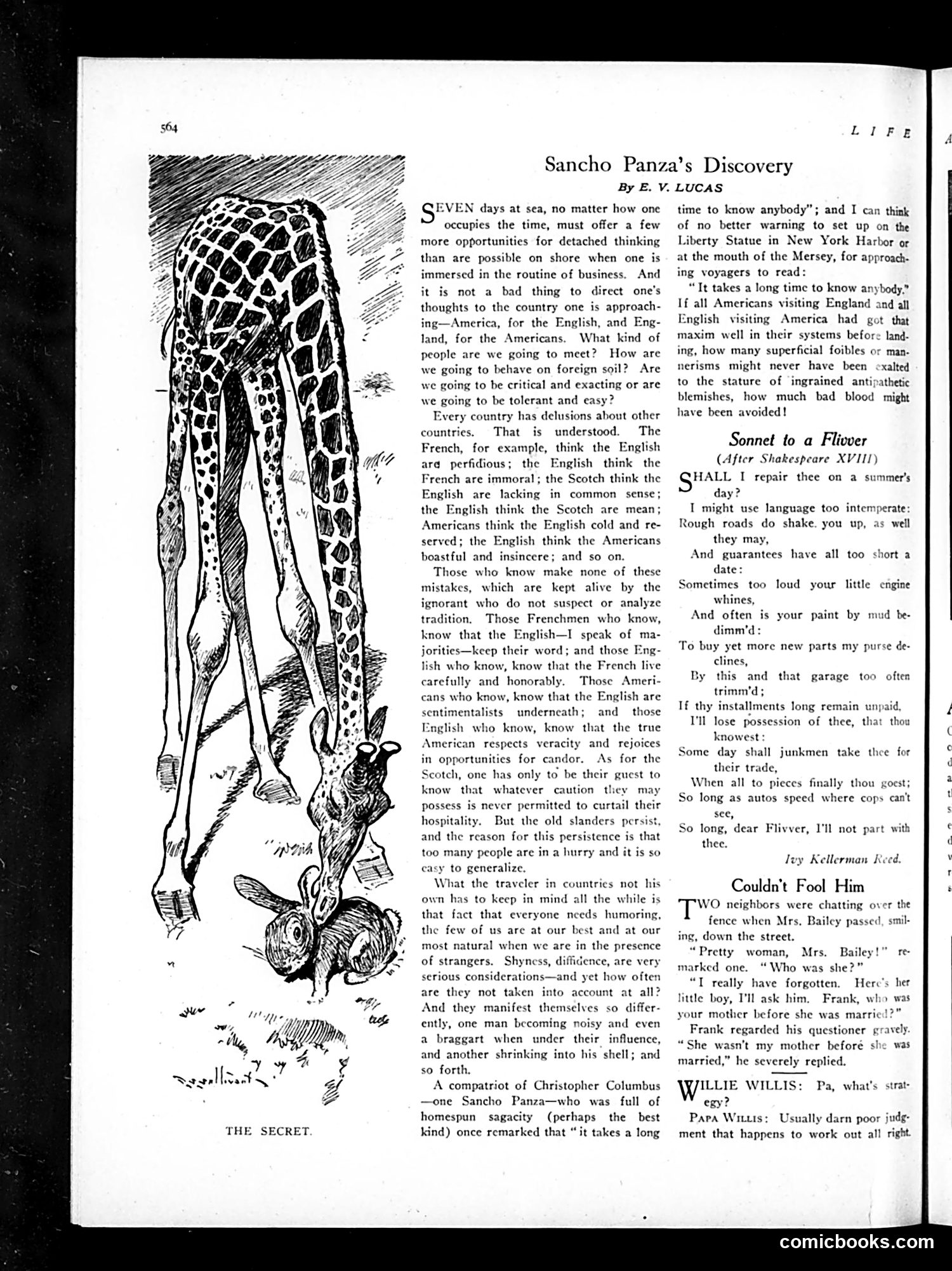
The main cartoon, titled "The Secret," depicts a giraffe's impossibly long legs. The illustration appears to be a visual joke about exaggeration or hidden truths—the "secret" being the giraffe's extreme proportions. The page also contains an essay titled "Sancho Panza's Discovery" by E.V. Lucas discussing cultural stereotypes between nations (English, French, Scottish, American). The author argues that travelers shouldn't generalize about nationalities based on limited observations. Below are two brief humor pieces: "Sonnet to a Flivver" (a comedic poem about an old car, attributed to Shakespeare), and "Couldn't Fool Him" (a short dialogue joke about a woman's remarriage). The content emphasizes satirizing both animal absurdity and human cultural pretensions.
📄 Transcribed text from this page (OCR, searchable)
Machine-transcribed from the original scan — historical spelling and the odd misread are preserved.
awe "Ney, + % ahaa well : THE SECRET. Din, te ‘¥ a Z Sancho Panza’s Discovery By E. V. LUCAS EVEN days at sea, no matter how one occupies the time, must offer a few more opportunities for detached thinking than are possible on shore when one is immersed in the routine of business. And it is not a bad thing to direct one's thoughts to the country one is approach- ing—America, for the English, and Eng- land, for the Americans. What kind of people are we going to meet? How are we going to behave on foreign soil? Are we going to be critical and exacting or are we going to be tolerant and easy? Every country has delusions about other countries. That is understood. The French, for example, think the English ara perfidious; the glish think the French are immoral; the Scotch think the English are lacking in common sense; the English think the Scotch are mean; Americans think the English cold and re- served; the English think the Americans boastful and insincere; and so on. Those who know make none of these mistakes, which are kept alive by the ignorant who do not suspect or analyze tradition. Those Frenchmen who know, know that the English—I speak of ma- jorities—keep their word; and those Eng- lish who know, know that the French live carefully and honorably. Those Ameri- cans who know, know that the English are sentimentalists underneath; and those h who know, know that the true American respects veracity and rejoices in opportunities for candor. As for the Scotch, one has only to be their guest to know that whatever caution they Engl may possess is never permitted to curtail their hospitality. But the old slanders persist, and the reason for this persistence is that too many people are in a hurry and it is so casy to generalize, What the traveler in countries not his own has to keep in mind all the while is that fact that everyone needs humoring, the few of us are at our best and at our most natural when we are in the presence of strangers. Shyness, dif serious considerations—and yet how often are they not taken into account at all? And they manifest themselves so differ- ently, one man becoming noisy and even a braggart when under their influence, and another shrinking into his shell; and so forth, A compatriot of Christopher Columbus —one Sancho Panza—who was full of homespun sagacity (perhaps the best kind) once remarked that “it takes a long nee, are very time to know anybody”; and I can think of no better warning to set up on the Liberty Statue in New York Harbor or at the mouth of the Mersey, for approach- ing voyagers to read: “It takes a long time to know anybody.” If all Americans visiting England and all English visiting America had got that maxim well in their systems before land- ing, how many superficial foibles or man- nerisms might never have been exalted to the stature of ingrained antipathetic blemishes, how much bad blood might have been avoided! Sonnet to a Flivver (After Shakespeare XVII1) HALL I repair thee on a summer's day? I might use language too intemperate: Rough roads do shake. you up, as well they may, And guarantees have all too short a date: Sometimes too loud your little engine whines, And often is your paint by mud be- dimm'd: To buy yet more new parts my purse de- clines, By this and that garage too trimm'd; If thy installments long remain unpaid, I'll lose possession of thee, that thou knowest: Some day shall junkmen take thee for their trade, When all to pieces finally thou goest; So long as autos speed where cops can't often see, So long, dear Flivver, I'll not part with thee. y Kellerman Reed. Couldn't Fool Him WO neighbors were chatting over the fence when Mrs, Bailey passed, smil- ing, down the street. “Pretty woman, Mrs. Bailey!" re- marked one. “Who was she?” “T really have forgotten. Here's her little boy, I'll ask him, Frank, who was your mother before she was marric Frank regarded his questioner gravely “She wasn't my mother beforé she was married,” he severely replied. ILLIE WIL! egy? Para Wits: Pa, what's strat- Usually darn poor judg- ment that happens to work out all right. comicbooks.com