
Life, 1921-04-21 · page 21 of 36
Life — April 21, 1921 — page 21: what you’re looking at
What you’re looking at
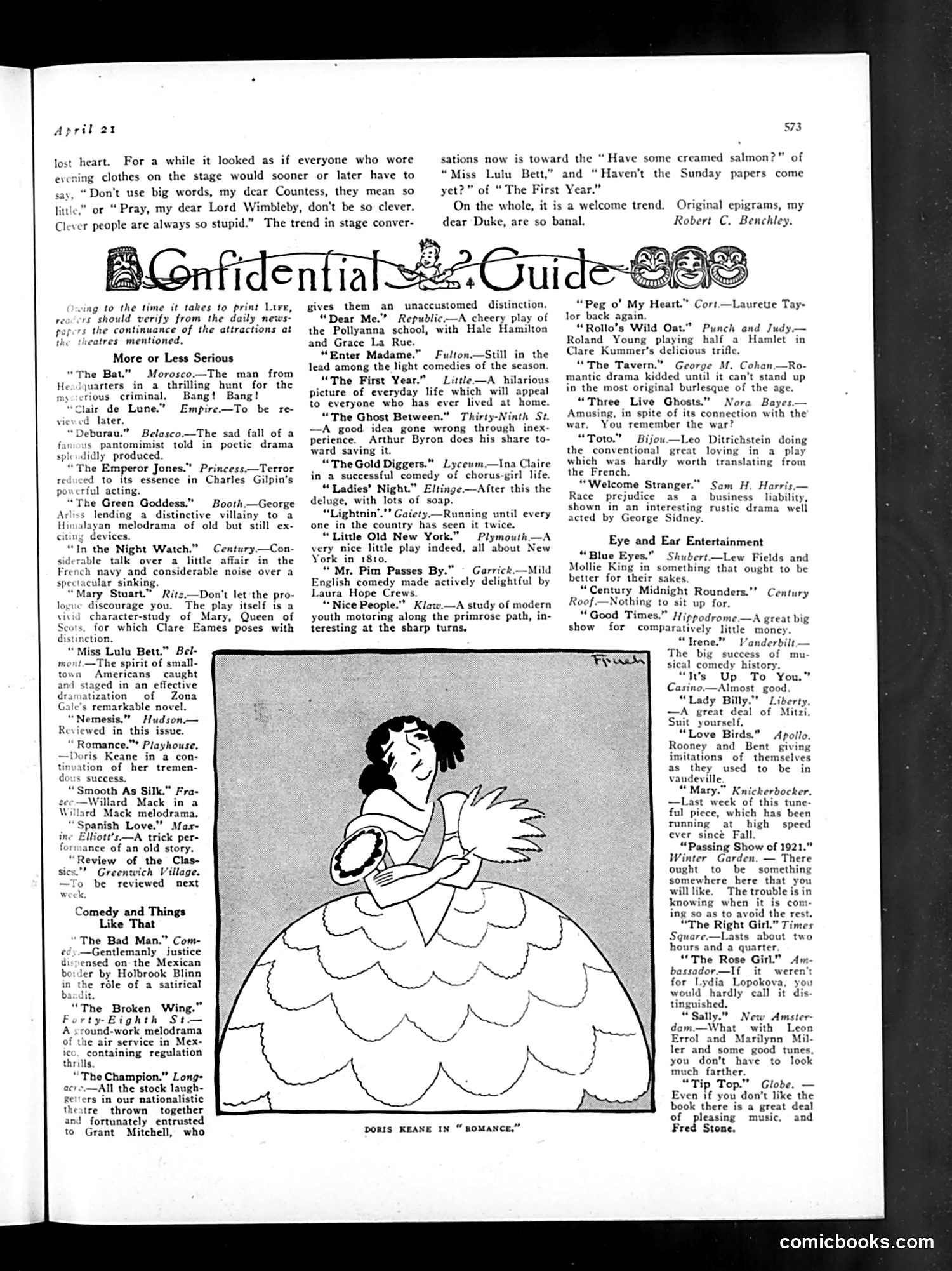
This is a theater review section from Life magazine's April 21, 1921 issue. The main illustration shows **Doris Keane in "Romance,"** depicting an actress in an elaborate, cloud-like costume—likely satirizing the ornate staging and melodrama of contemporary theater productions. The page catalogs current Broadway shows, organized by tone ("More or Less Serious," "Comedy and Things Like That"). The text includes a **social satire about stage dialogue trends**: the author mocks how characters increasingly avoid "big words" and "clever" speech, instead using simple, banal exchanges like "Have some creamed salmon?" or "Haven't the Sunday papers come yet?" The satire suggests that sophisticated, witty dialogue was falling out of fashion on stage, replaced by mundane conversation—a shift the critic views with mild disapproval as culturally regrettable. The detailed reviews reference specific actors and plots of now-forgotten plays, capturing Broadway's commercial theater landscape of the Jazz Age.
📄 Transcribed text from this page (OCR, searchable)
Machine-transcribed from the original scan — historical spelling and the odd misread are preserved.
ev say, EXGnfi ving to the time it takes to print Lire, reo crs should verify from the daily news: papers the continuance of the attractions at the theatres mentioned, More or Less Serious “The Bat.” Morosco—The man from juarters in a thrilling hunt for the jous criminal. Bang! Bang! air de Lune.” Empire—To be re- viewed later. “Deburau.” Belasco—The sad fall of a pantomimist told in poetic drama viewdidly produced. “The Emperor Jones.” Princess—Terror reduced to its essence in Charles Gilpin's powerful acting. The Green Goddess.” Booth.—George Arliss lending a distinctive villainy to a Himalayan melodrama of old but still ex- citing devices. “In the Night Watch.” Century—Con- iderable talk over a little affair in the French navy and considerable noise over a spectacular sinking. “Mary Stuart.” Ritz.—Don't let the pro- logue discourage you. The play itself is a vivid character-study of Mary, Queen of Scots, for which Clare Eames’ poses with distinction, “Miss Lulu Bett.” Bel- mont —The spirit of small- tow mericans caught and staged in an effective dramatization of Zona Gale's remarkable novel. Nemesis.” Hudson — Reviewed in this issue. Romance.”* Playhouse. is Keane in a con- ition of her tremen- dous success. Smooth As Silk.” Fra- —Willard Mack in a Willard Mack melodrama, “Spanish Love.” Maz- Mliott’s—A trick per- ance of an old story. Review of the Clas- sics."" Greenwich Village. —To be reviewed next week. Comedy and Things Like That The Bad Man.” Com- ed) —Gentlemanly justice dispensed on the Mexican border by Holbrook Blinn in role of a satirical b. ‘The Broken Wing. Forty-Eighth St— A sround-work melodrama of the air service in Mex- icc, containing regulation thrills, “The Champion.” Long- aci.—All the stock laugh- ers in our nationalistic tre thrown together fortunately entrusted to Grant Mitchell, who st heart. For a while it looked as if everyone who wore ing clothes on the stage would sooner or later have to Don't use big words, my dear Countess, they mean so little,” or “Pray, my dear Lord Wimbleby, don’t be so clever. Clever people are always so stupid.” The trend in stage conver- gives them an unaccustomed distinction. “Dear Me.” Republic—A cheery play of lor back again. the Pollyanna school, with Hale Hamilton and Grace La Rue. one in the country has seen it twice. York in 1810, dear Duke, are so banal. “ Ladies’ Night.” Eltinge—After this the , with lots of soap. ightnin’."’ Gaiety.—Running until every “Little Old New York.” —Plymouth—A nice little play indeed, all about New DORIS KEANE IN “ ROMANCE,” “Have some creamed salmon?" of “Miss Lulu Bett,” and “Haven't the Sunday papers come yet?” of “The First Year.” On the whole, it is a welcome trend. Original ¢ sations now is toward the “Peg o' My Heart.” Cort—Laurette Tay- “Rollo’s Wild Oat.” Roland Young playing half a Hamlet in “Enter Madame.” Fulton.—Still in the Clare Kummer’s delicious trifle. lead among the light comedies of the season. “The First Year.” Little-—A hilarious mantic drama kidded until it can't stand up picture of everyday life which will appeal to everyone who has ever lived at home. “The Ghost Between.” Thirty-Ninth St, Amusing, in spite of its connection with the —A good idea gone wrong through inex- $e perience. Arthur Byron does his share to- “ Toto.” ward saving it. “The Tavern.” in the most original burlesque of the age. “Three Live Ghosts.” Nora Bayes— war, You remember the war? Bijou—Leo Ditrichstein doing the conventional i “The Gold Diggers.” Lyceum.—Ina Claire Which was hardly worth translating from in a successful comedy of chorus-girl life. the French. . “Welcome Stranger.” Som H. Harris.— Race prejudice shown in an interesting rustic drama well acted by George Sidney. Eye and Ear Entertainment “Blue Eyes.” “Mr. Pim Passes By.” © Garrick.—Mild Mollie King in something that ought to be English comedy made actively delightful by Laura Hope Crews. better for their “Century Midnight Rounders.” Century “Nice People.” Klaw.—A study of modern Roof.—Nothing to s youth motoring along the primrose path, in- teresting at the sharp turns, “Good Times.” Hippodrome —A great big show comparatively little money. $73 grams, my Robert C. Benchley. Punch and Judy — George M. Cohan.—Ro- great loving in a play as a business liability, Shubert—Lew Fields and akes. up for. “Irene.” Vanderbilt — The big success of mu- sical comedy history. “It's Up To You.” Casino.—Almost good. “Lady Billy.” Liberty —A great deal of Mitzi. Suit yourself, “Love Birds.” Apollo. Rooney and Bent giving imitations of themselves as they used to be in vaudeville. Mary.” Knickerbocker. —Last week of this tune- ful piece, which has been running at_ high speed ever since Fall “Passing Show of 1921.” Winter Garden. — There ought to be something somewhere here that you will like. The trouble isin knowing when it is coi ing so as to avoid the rest. “The Right Girl.” Times Square.—Lasts about two hours and a quarter “The Rose Girl.” Am- bassador—If it weren't for Lydia Lopokova, you would hardly call it dis- tinguished. “ Sall New Amster- dam.—What_ with Leon Errol and Marilynn Mil- ler and some good tunes, you don't have to look much farther. “Tip Top.” Globe. — Even if you don’t like the book there is a great deal of pleasing music, and Fred Stone. comicbooks.com