
Life, 1921-04-21 · page 16 of 36
Life — April 21, 1921 — page 16: what you’re looking at
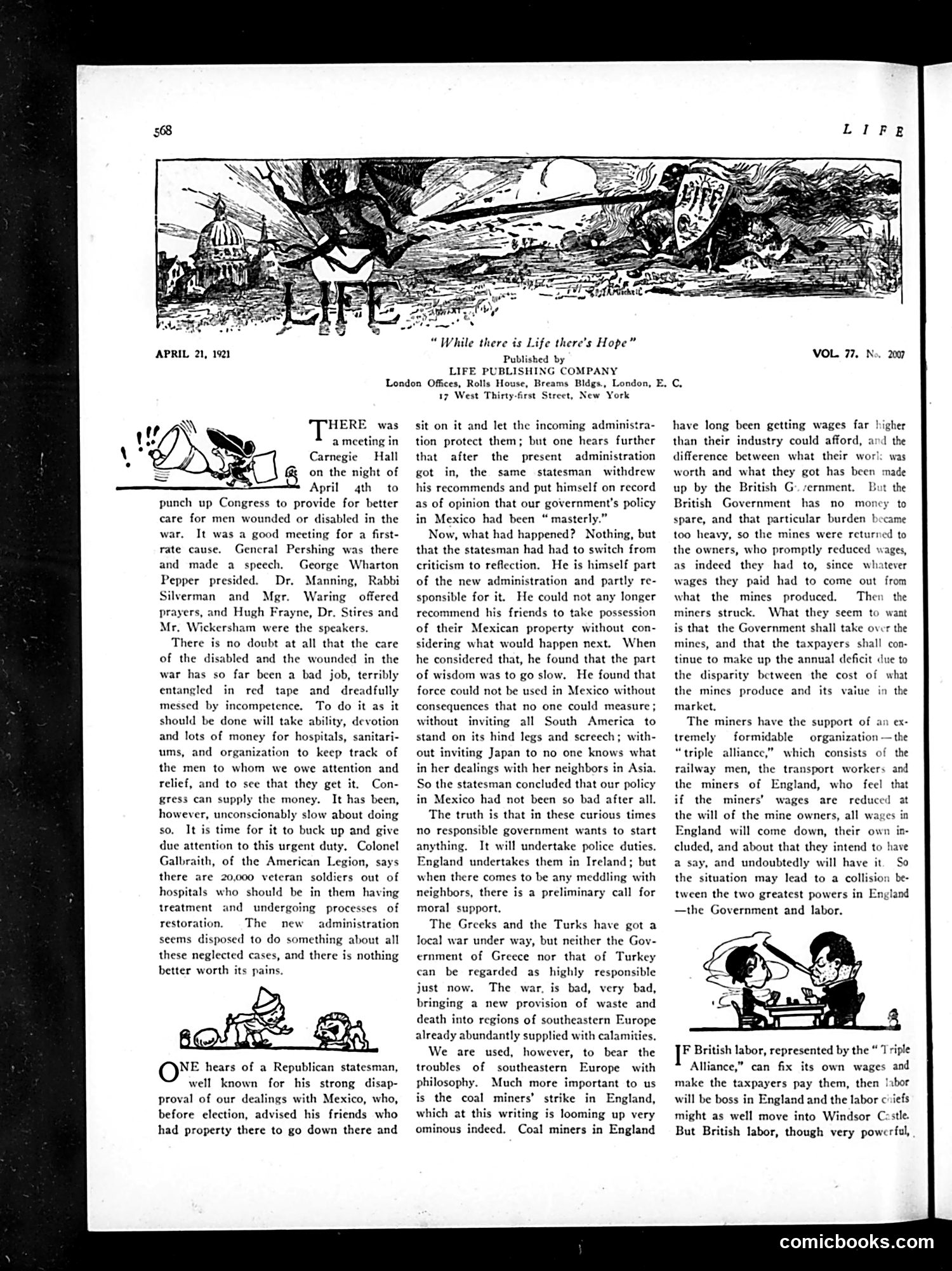
A restored page from Life, 1921-04-21. Page through the whole issue in the reader above.
📄 Transcribed text from this page (OCR, searchable)
Machine-transcribed from the original scan — historical spelling and the odd misread are preserved.
APRIL 21, 1921 “While there is Life there's Hope” Published by LIFE PUBLISHING COMPANY London Offices, Rolls House, Breams Bldgs, London, HERE was a meeting in Carnegie Hall on the night of April 4th to punch up Congress to provide for better care for men wounded or disabled in the war. It was a good meeting for a first- rate cause. Gencral Pershing was there and made a speech. George Wharton Pepper presided. Dr. Manning, Rabbi Silverman and Mgr. Waring offered prayers, and Hugh Frayne, Dr. Stires and Mr. Wickersham were the speakers, There is no doubt at all that the care of the disabled and the wounded in the war has so far been a bad job, terribly entangled in red tape and dreadfully messed by incompetence. To do it as it should be done will take ability, devotion and lots of money for hospitals, sanitari- ums, and organization to keep track of the men to whom we owe attention and relief, and to see that they get it. Con- gress can supply the money. It has been, however, unconscionably slow about doing so. It is time for it to buck up and give due attention to this urgent duty. Colonel Galbraith, of the American Legion, says there are 20,000 veteran soldiers out of hospitals who should be in them having treatment and undergoing processes of restoration. The new administration seems disposed to do something about all these neglected cases, and there is nothing better worth its p QE hears of a Republican statesman, well known for his strong disap- proval of our dealings with Mexico, who, before election, advised his friends who had property there to go down there and 17 West Thirty-first Street, New York sit on it and let the incoming administra- tion protect them; but one hears further that after the present administration got in, the same statesman withdrew his recommends and put himself on record as of opinion that our government's policy in Mexico had been “ masterly.” Now, what had happened? Nothing, but that the statesman had had to switch from criticism to reflection. He is himself part of the new administration and partly re- sponsible for it. He could not any longer recommend his friends to take possession of their Mexican property without con- sidering what would happen next. When he considered that, he found that the part of wisdom was to go slow. He found that force could not be used in Mexico without consequences that no one could measure ; without inviting all South America to stand on its hind legs and screech; with- out inviting Japan to no one knows what in her dealings with her neighbors in Asia. So the statesman concluded that our policy in Mexico had not been so bad after all. The truth is that in these curious times no responsible government wants to start anything. It will undertake police duties. England undertakes them in Ireland; but when there comes to be any meddling with neighbors, there is a preliminary call for moral support. The Greeks and the Turks have got a local war under way, but neither the Gov- ernment of Greece nor that of Turkey can be regarded as highly responsible just now. The war, is bad, very bad, bringing a new provision of waste and death into regions of southeastern Europe already abundantly supplied with calamities. We are used, however, to bear the troubles of southeastern Europe with philosophy. Much more important to us is the coal miners’ strike in England, which at this writing is looming up very ominous indeed. Coal miners in England VOL. 77, No. 2007 Cc have long been getting wages far higher than their industry could afford, and the difference between what their worl: was worth and what they got has been made up by the British G.sernment. But the British Government has no moncy to spare, and that particular burden became too heavy, so the mines were returned to the owners, who promptly reduced wages, as indeed they had to, since whatever wages they paid had to come out from what the mines produced. Then the miners struck. What they seem to want is that the Government shall take over the mines, and that the taxpayers shall con- tinue to make up the annual deficit due to the disparity between the cost of what the mines produce and its vaiue in the market, The miners have the support of an ex- tremely formidable organization —the “triple alliance,” which consists of the railway men, the transport workers and the miners of England, who feel that if the miners’ wages are reduced at the will of the mine owners, all wa ngland will come down, their own cluded, and about that they intend to have a say, and undoubtedly will have it. So the situation may lead to a colli be- tween the two greatest powers in England —the Government and labor. es in F British labor, represented by the “ Triple Alliance,” can fix its own wages and make the taxpayers pay them, then !xbor will be boss in England and the labor ciiefs might as well move into Windsor Cestle. But British labor, though very powerful, comicbooks.com