
A complete issue · 42 pages · 1921
Life — February 10, 1921
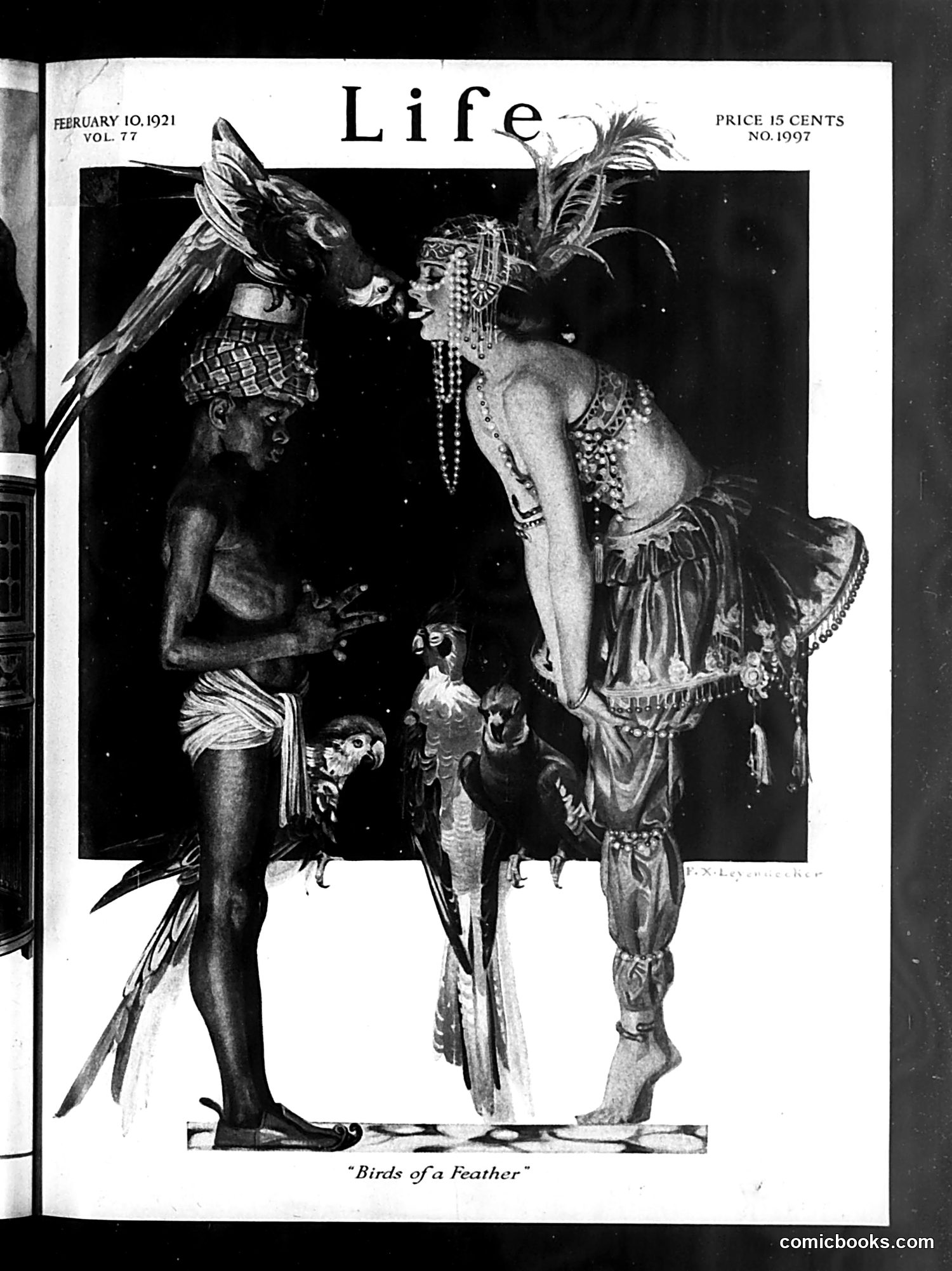
This satirical illustration depicts two figures in exotic, ornamental dress adorned with large feathered headdresses, facing each other. The title "Birds of a Feather" is a visual pun exploiting the literal feathers in their elaborate costumes. The cartoon likely satirizes 1920s fashion excess, particularly the contemporary craze for elaborate feathered accessories and exotic ornamentation among wealthy socialites. The figures' exaggerated, peacock-like presentation suggests mockery of vanity and ostentatious display during the Jazz Age. The exact identities of the figures remain unclear from the image alone, though the style and ornate details suggest critique of high-society fashion trends of the period. The artwork's quality suggests a notable illustrator, though attribution isn't visible here.
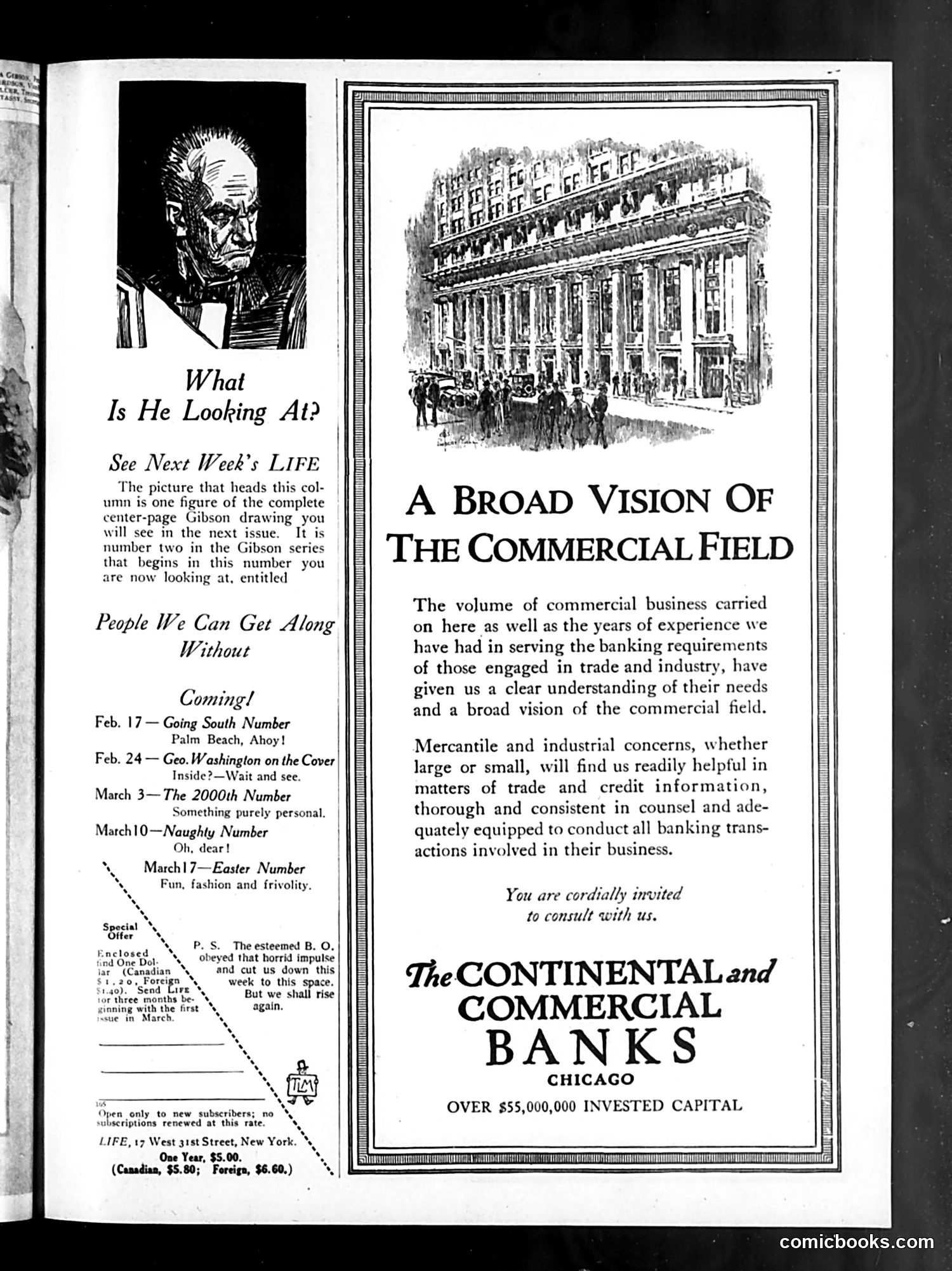
This page is primarily **advertising**, not satirical content. The right side features a full advertisement for The Continental and Commercial Bank of Chicago, highlighting their commercial banking services and $55,000,000 in invested capital. The left side contains a teaser for upcoming Life magazine issues, including a cryptic heading "What Is He Looking At?" with a stark woodcut-style portrait of an elderly man. The accompanying text promises readers will see "the complete center-page Gibson drawing" in next week's issue, part of a series titled "People We Can Get Along Without." The page also lists forthcoming special issues (South Number, Washington-themed issue, Easter Number, etc.), indicating this is a subscription promotion rather than satirical commentary.
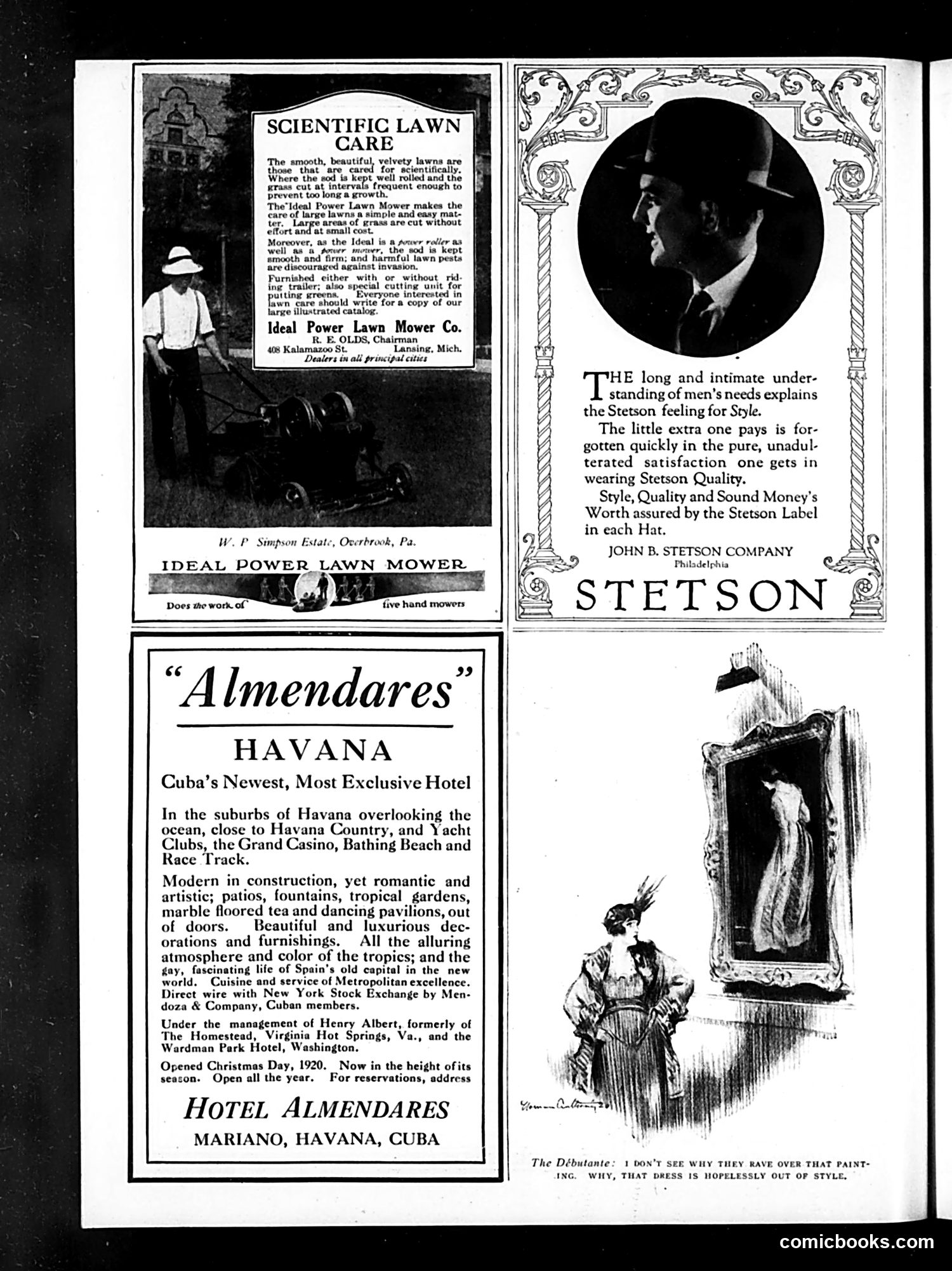
This page is **primarily advertising** from an early 20th-century issue of Life magazine, containing no political cartoons. The ads include: - **Ideal Power Lawn Mower** (top left): promotes labor-saving machinery for lawn care - **Stetson hats** (top right): a portrait-based advertisement emphasizing quality and style for men - **Hotel Almendares** (bottom left): promoting a luxury Cuban resort near Havana, opened Christmas 1920 The only satirical element is a small cartoon at bottom right titled "The Debutante," showing a woman before a mirror with commentary on fashion: "I don't see why they save over that painting. Why, that dress is hopelessly out of style." This is gentle social satire mocking fashion obsession among wealthy debutantes. The page reflects 1920s consumer culture and leisure activities for affluent Americans.
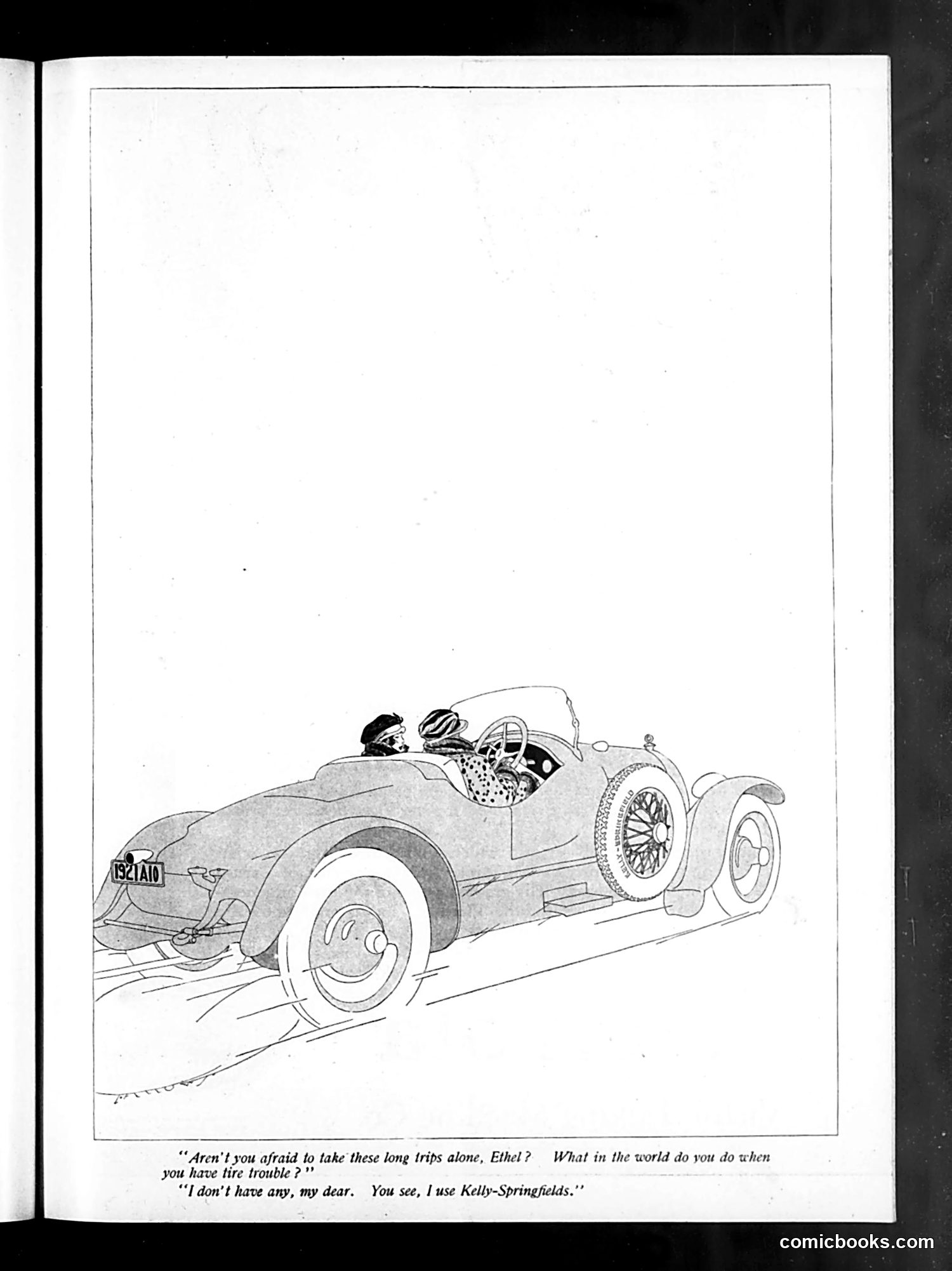
This is a vintage automobile advertisement disguised as a cartoon joke. The image shows a early 1920s roadster with two figures—a man driving and a woman passenger. The caption presents a dialogue where the woman (Ethel) asks the man if he's afraid to take long trips alone and worries about tire trouble. He responds confidently that he has no concerns because he uses "Kelly-Springfields" (a tire brand). The humor and sales pitch converge: the ad suggests that Kelly-Springfield tires are so reliable they eliminate the anxiety typically associated with early automobile travel, when tire failures were common. The cartoon format made advertising more engaging than straightforward promotional copy. The license plate "B2140" may reference a specific model or registration.
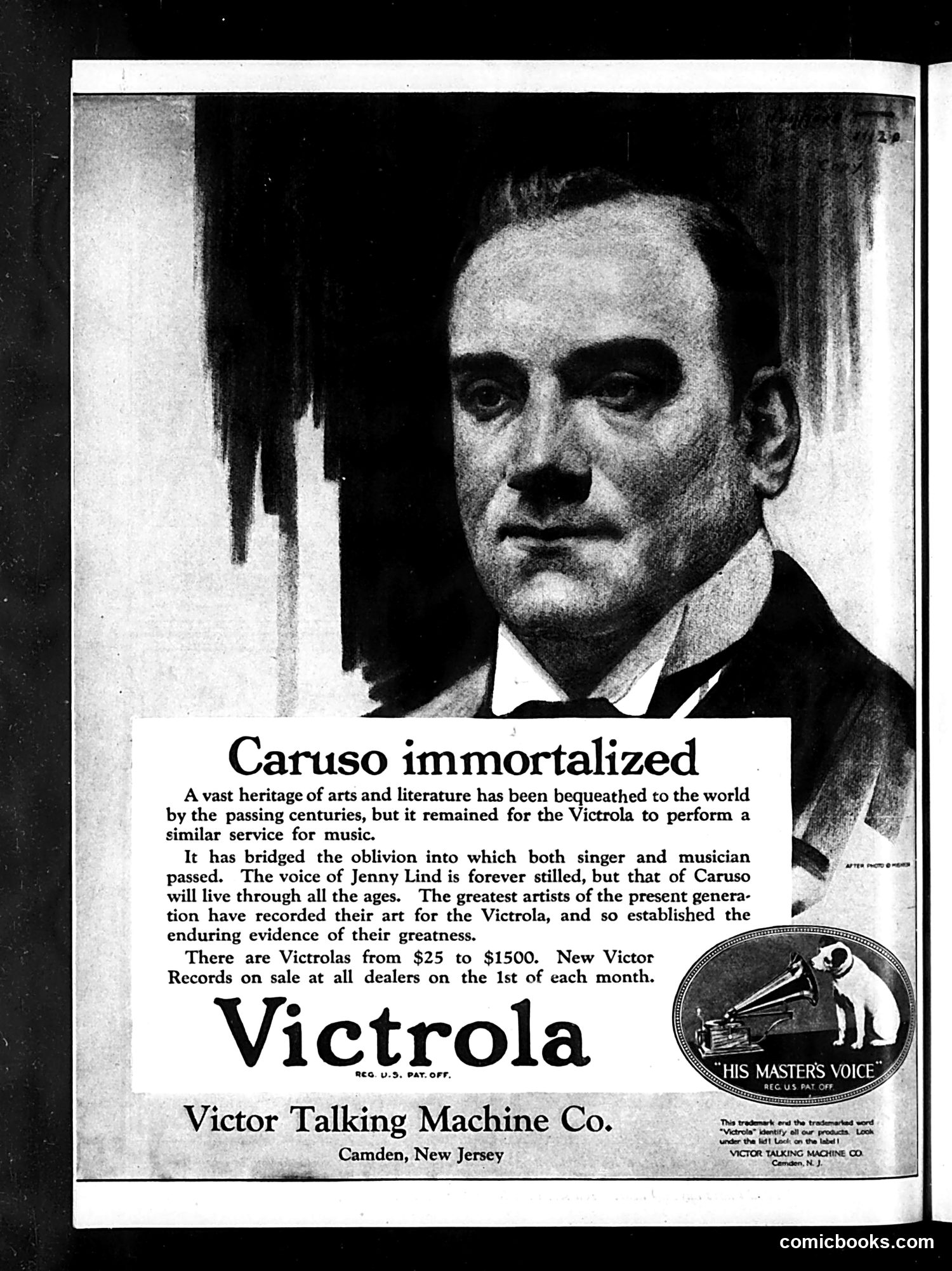
This is a **commercial advertisement**, not satire or political commentary. It's a Victor Talking Machine Company ad promoting Victrola phonographs, featuring a portrait of **Enrico Caruso**, the renowned tenor who died in 1921. The ad's central claim is that recording technology has achieved what was previously impossible: preserving great artists' performances permanently. It contrasts Caruso's recorded voice—which "will live through all the ages"—with Jenny Lind's performances, which disappeared with her death. The advertisement positions the Victrola as a cultural institution, pricing units from $25 to $1500 and claiming that owning one provides access to "the greatest artists of the present generation," thus democratizing high art through technology.
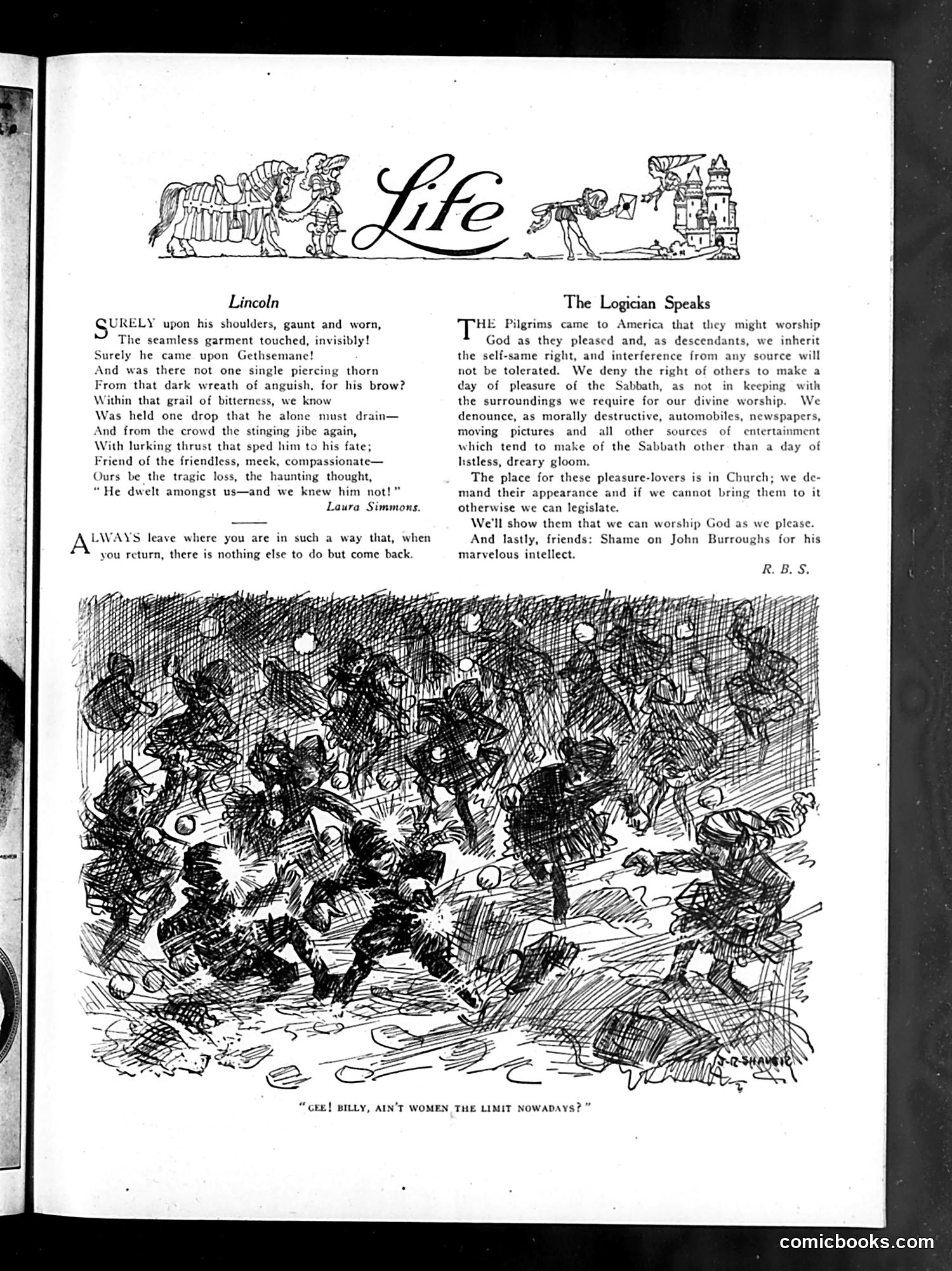
This page contains two distinct pieces: **"Lincoln"** (top left): A poem by Laura Simmons praising Lincoln's endurance despite suffering ("gaunt and worn"), emphasizing his martyrdom and the collective grief at his loss. **"The Logician Speaks"** (top right): A commentary by R.B.S. criticizing Puritan strictness about Sabbath observance. The author mocks those who prohibit entertainment and pleasure on Sundays, arguing such restrictions make the day "listless, dreary gloom." The final jab at "John Burroughs for his marvelous intellect" appears sarcastic, likely targeting someone who supported these religious restrictions. **Cartoon** (bottom): A chaotic scene of people playing ball, captioned "Gee! Billy, ain't women the limit nowadays?" This satirizes changing social attitudes toward women's participation in recreation and sports—previously considered unladylike.
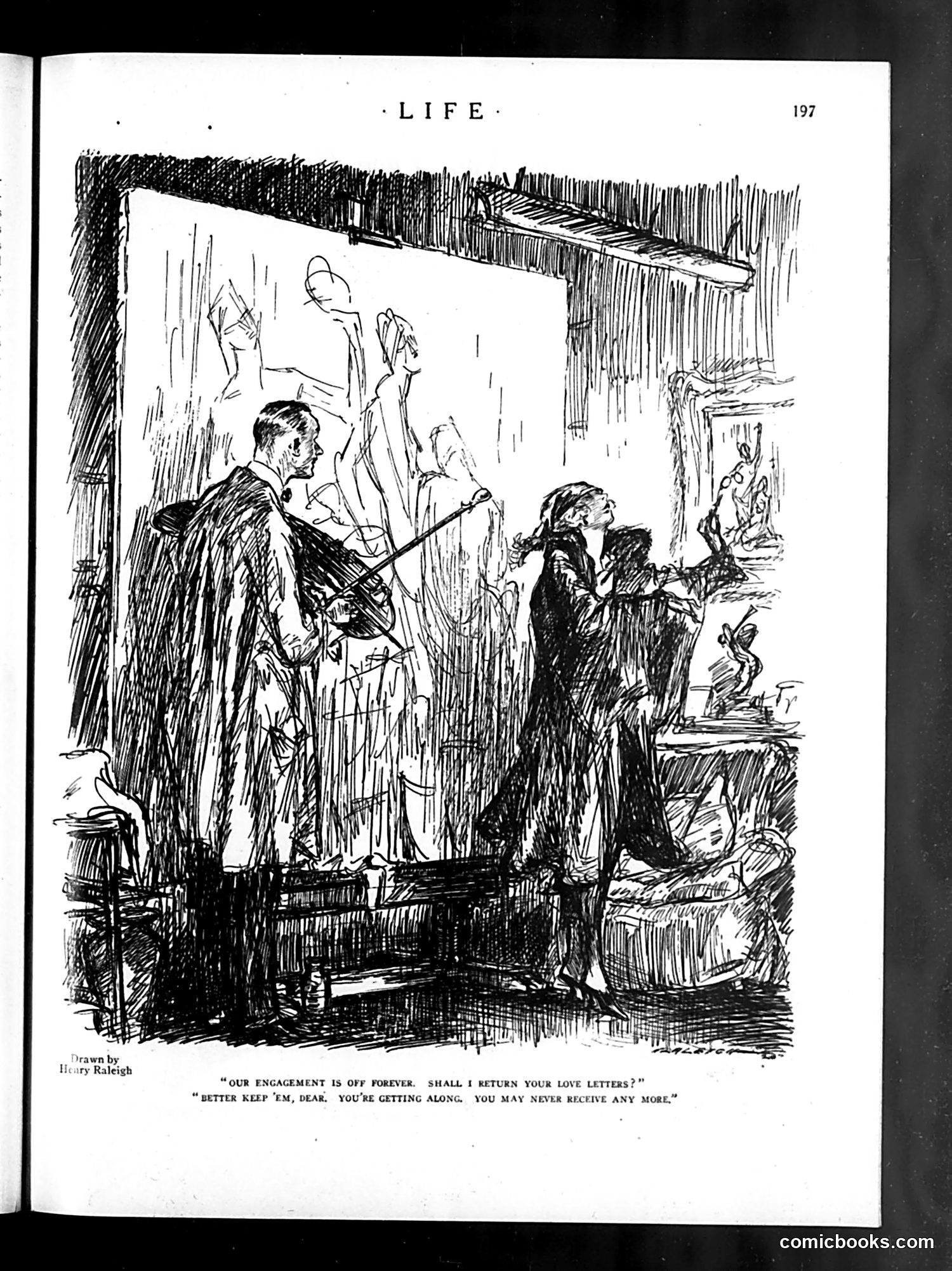
This cartoon by Henry Raleigh depicts a domestic scene where a man appears to be ending an engagement with a woman. The dialogue reveals the breakup: "Our engagement is off forever. Shall I return your love letters?" to which she replies, "Better keep 'em, dear, you're getting along. You may never receive any more." The satire targets male vanity and romantic prospects. The woman's cutting response suggests the man won't find future romantic interest, implying he's unremarkable or aging poorly. The artwork shows a drawing room with classical statuary visible, establishing an upper-class setting. This is genteel humor about romantic rejection and masculine insecurity, typical of Life magazine's early 20th-century satirical approach to courtship and relationships.
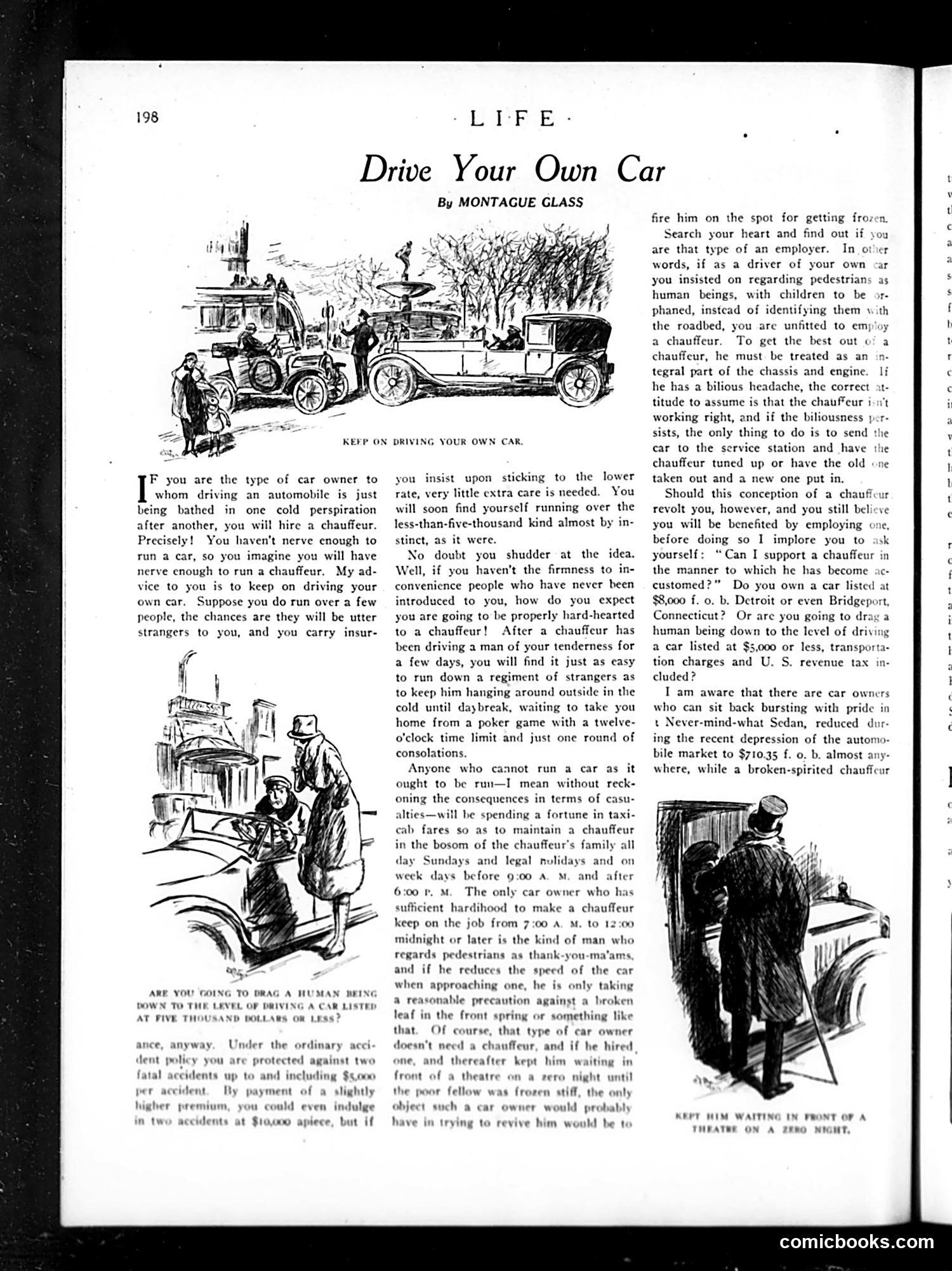
This satirical article argues that car owners should drive their own vehicles rather than hire chauffeurs. The piece mocks wealthy car owners who employ drivers, suggesting this practice is wasteful and unnecessary. The accompanying illustrations show chauffeurs in various uncomfortable situations—waiting in cold weather, standing idle outside theaters at night—highlighting the expense and inconvenience of maintaining hired drivers. Glass sardonically presents the counterargument: that some owners believe employing a chauffeur elevates their status, even if it costs substantial money. He attacks this pretension, arguing that self-driving is more practical, economical, and independent. The satire targets early 20th-century class consciousness and conspicuous consumption among the wealthy, advocating instead for practical self-reliance.
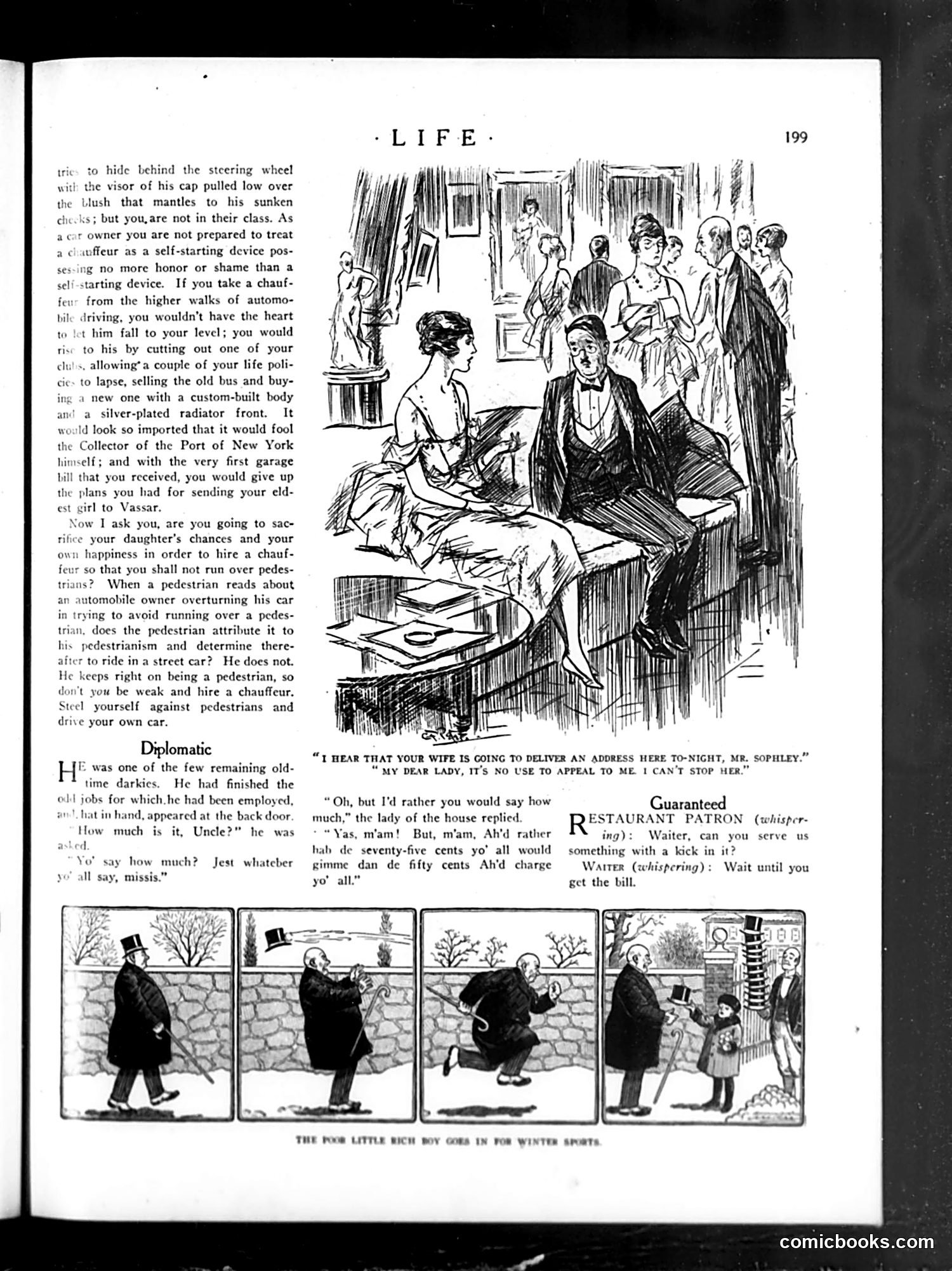
This page contains two satirical pieces about automobiles and class. **Top section:** A lengthy text column mocks wealthy car owners who refuse to employ chauffeurs, arguing they should either hire professional drivers or accept pedestrian accidents as inevitable. The satire suggests that amateur drivers cause more danger than trained professionals. **"Diplomatic" cartoon:** A brief humorous exchange where an old-time darkies (appears to use period racial terminology) negotiates cab fare, with Uncle asking "How much is it?" The joke plays on haggling stereotypes. **"Guaranteed" restaurant joke:** A waiter quips that the food comes "with a kick in it," implying quality issues—common restaurant humor. **Bottom comic strip:** Shows a wealthy boy repeatedly losing his top hat in winter sports, satirizing frivolous upper-class pastimes and wastefulness.
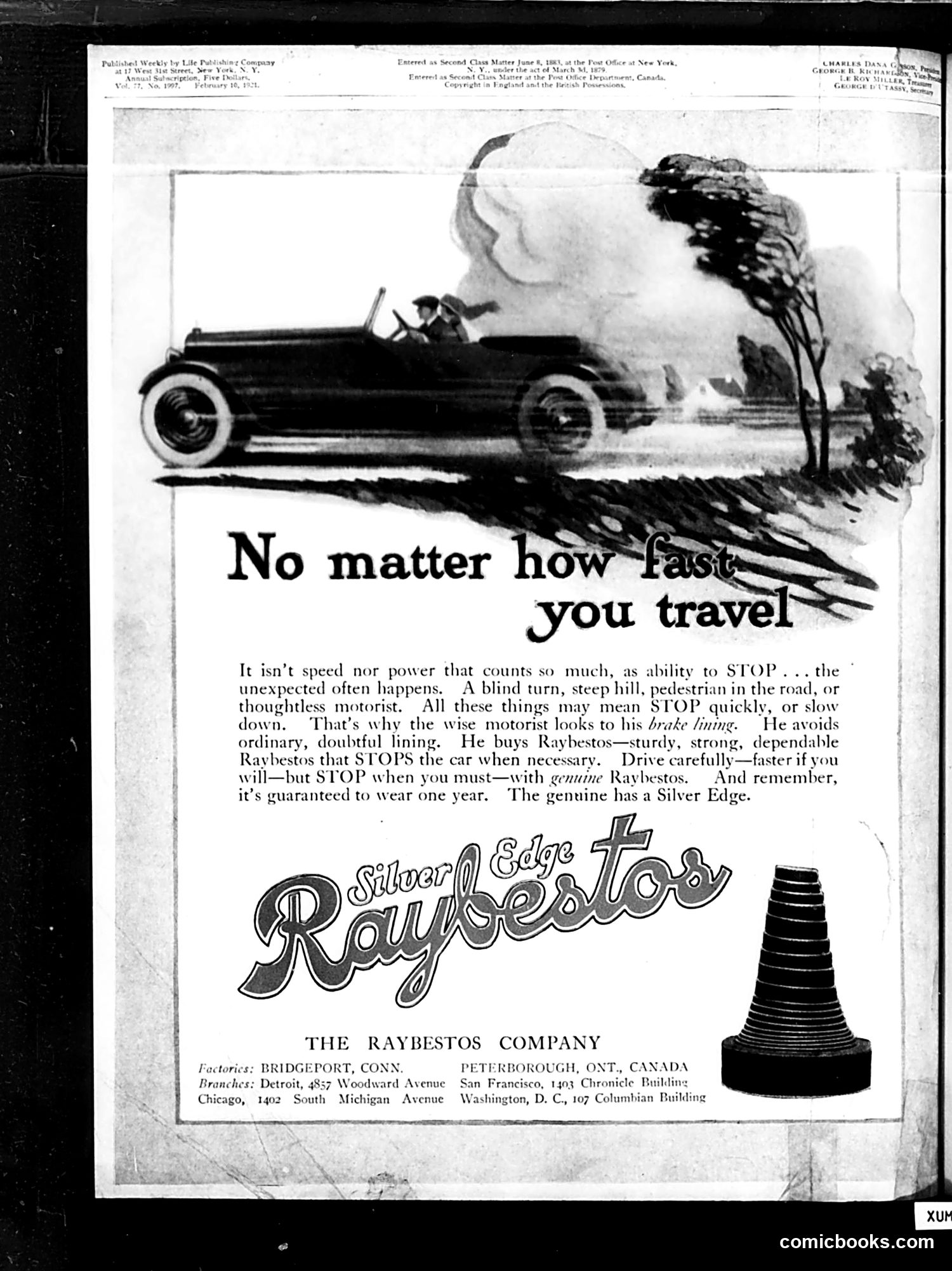
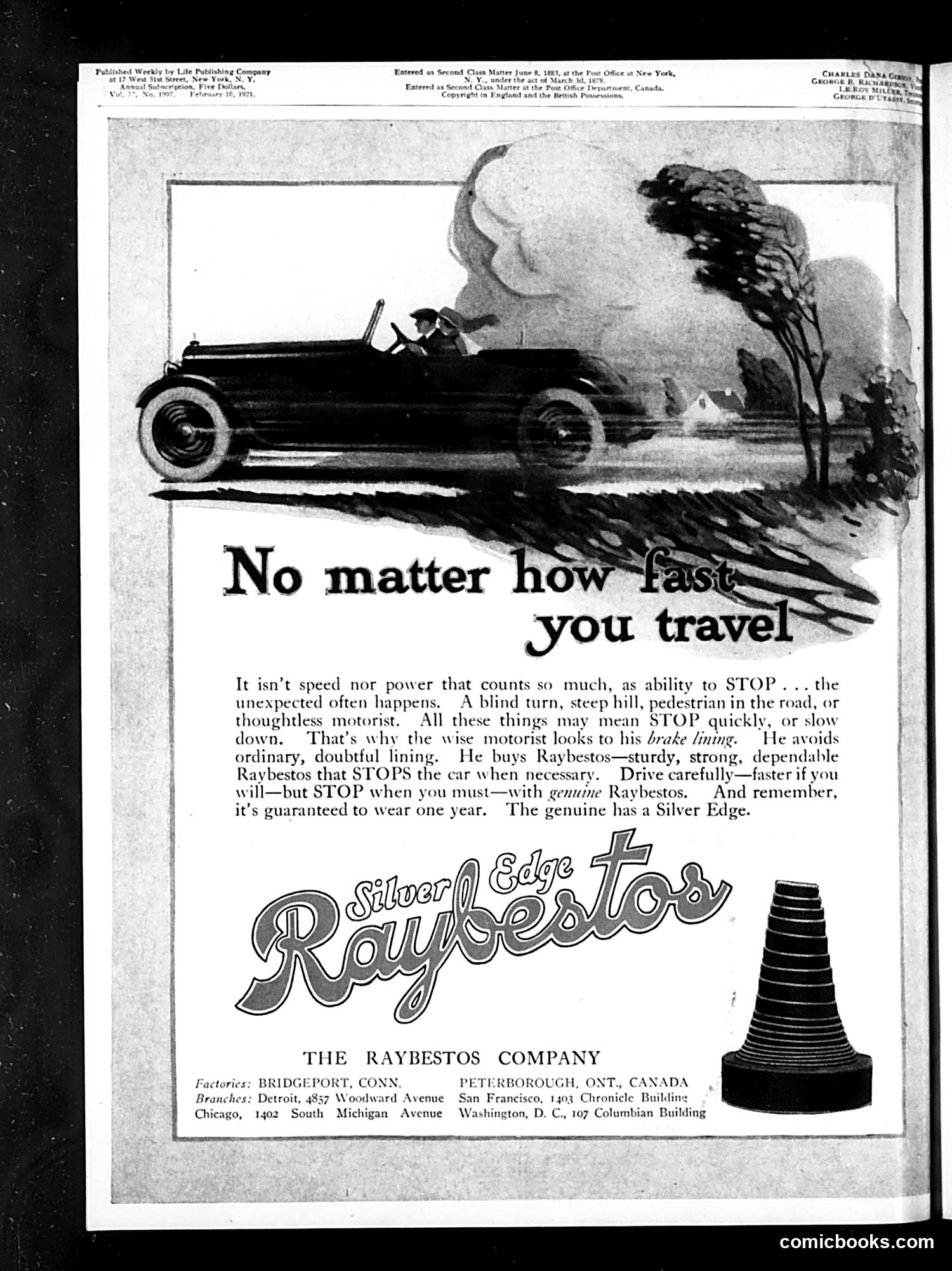
This is a **commercial advertisement, not political satire**. The page promotes Raybestos Silver Edge brake linings for automobiles. The ad uses a safety-themed narrative: a speeding car confronts unexpected hazards (a steep hill, pedestrian, blind turn) and must stop suddenly. The message emphasizes that reliable brakes matter more than raw speed—"the wise motorist looks to his brake lining." The advertisement positions Raybestos as the dependable choice, claiming its product "STOPS the car when necessary" and guarantees durability ("wear one year"). The company lists factories in Bridgeport, Connecticut and Peterborough, Ontario, with various U.S. branch offices. This represents early automotive-safety advertising targeting cautious drivers.
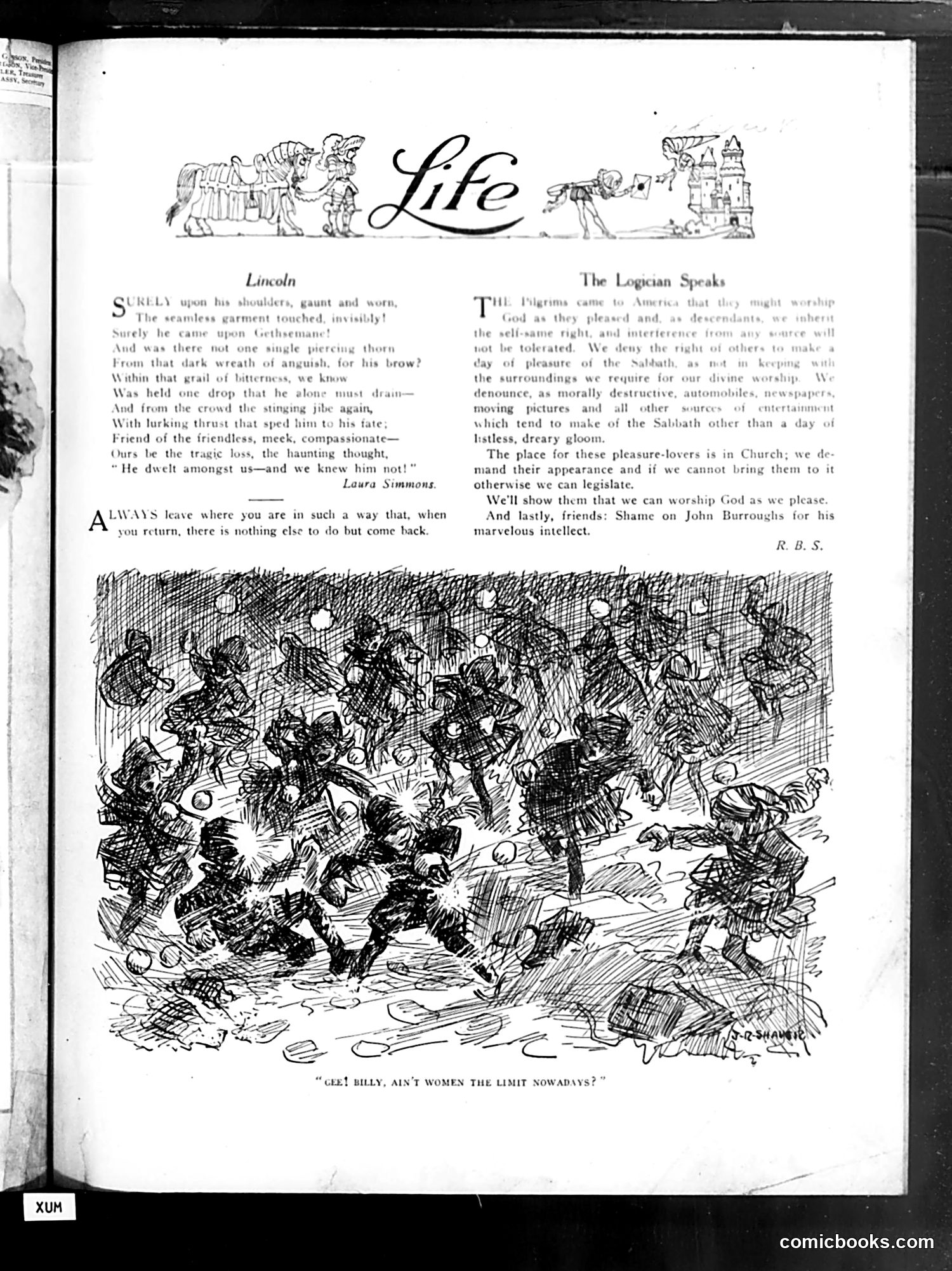
This page from *Life* magazine contains three distinct pieces: 1. **"Lincoln"** and **"The Logician Speaks"** — two short opinion pieces criticizing religious hypocrisy, particularly regarding Sabbath observance and Sunday leisure activities. 2. A **large satirical cartoon** showing a chaotic scene of people (appears to be soldiers or workers) engaged in violent conflict with spherical objects flying around. The caption reads: **"Gee! Billy, ain't women the limit nowadays?"** The cartoon appears to be commentary on women's increasing participation in war work or industrial labor during what was likely WWI or the 1920s. The "limit" phrase suggests women are pushing boundaries of acceptable behavior, while the anarchic scene mocks masculine anxiety about changing gender roles and women's expanded social participation.
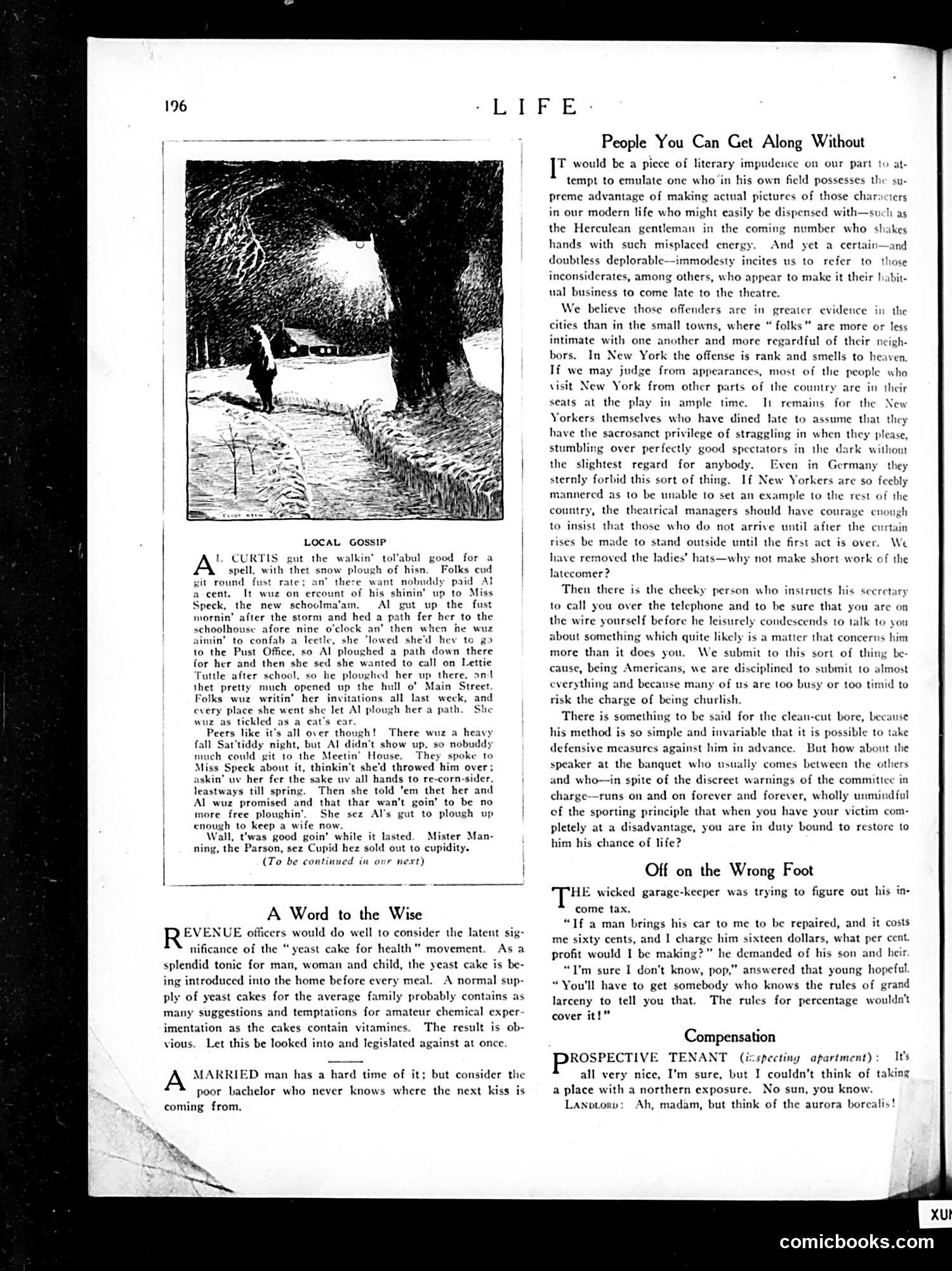
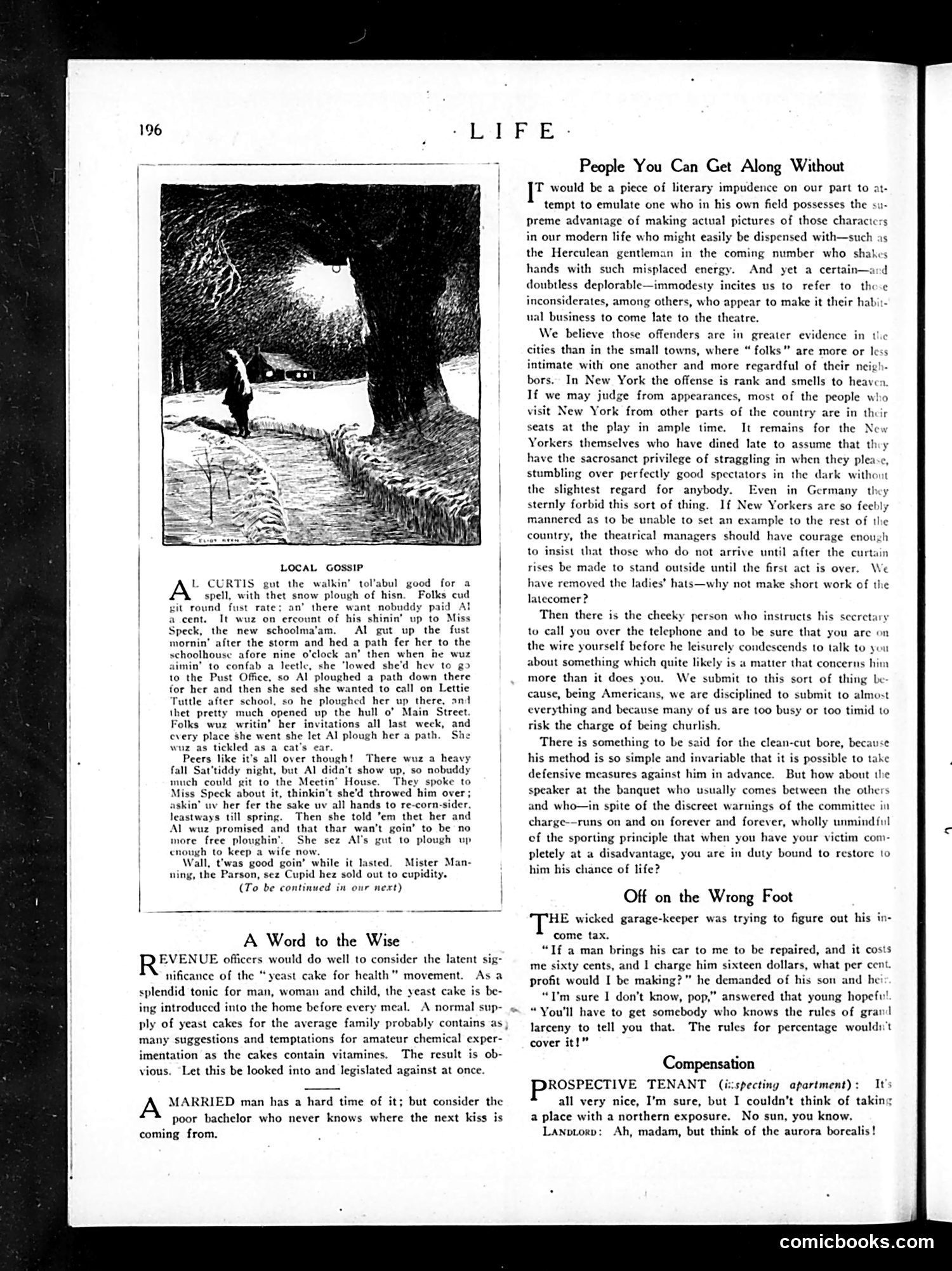
The cartoon depicts a woman (labeled "LOCAL GOSSIP") emerging from beneath a large tree, carrying what appears to be gossip or rumors. The accompanying anecdote describes her spreading neighborhood tales—specifically about a woman named Al who allegedly ploughed a path through snow. The satire targets the widespread practice of gossiping in small communities, where trivial domestic incidents become exaggerated local scandals. The story illustrates how rumors escalate: Al's innocent snow-clearing activity gets twisted into increasingly dramatic versions as it spreads through the community, eventually reaching the parson and becoming fuel for social judgment. This reflects early-20th-century concerns about how gossip, particularly by women in tight-knit communities, could damage reputations through misinformation and social pressure.
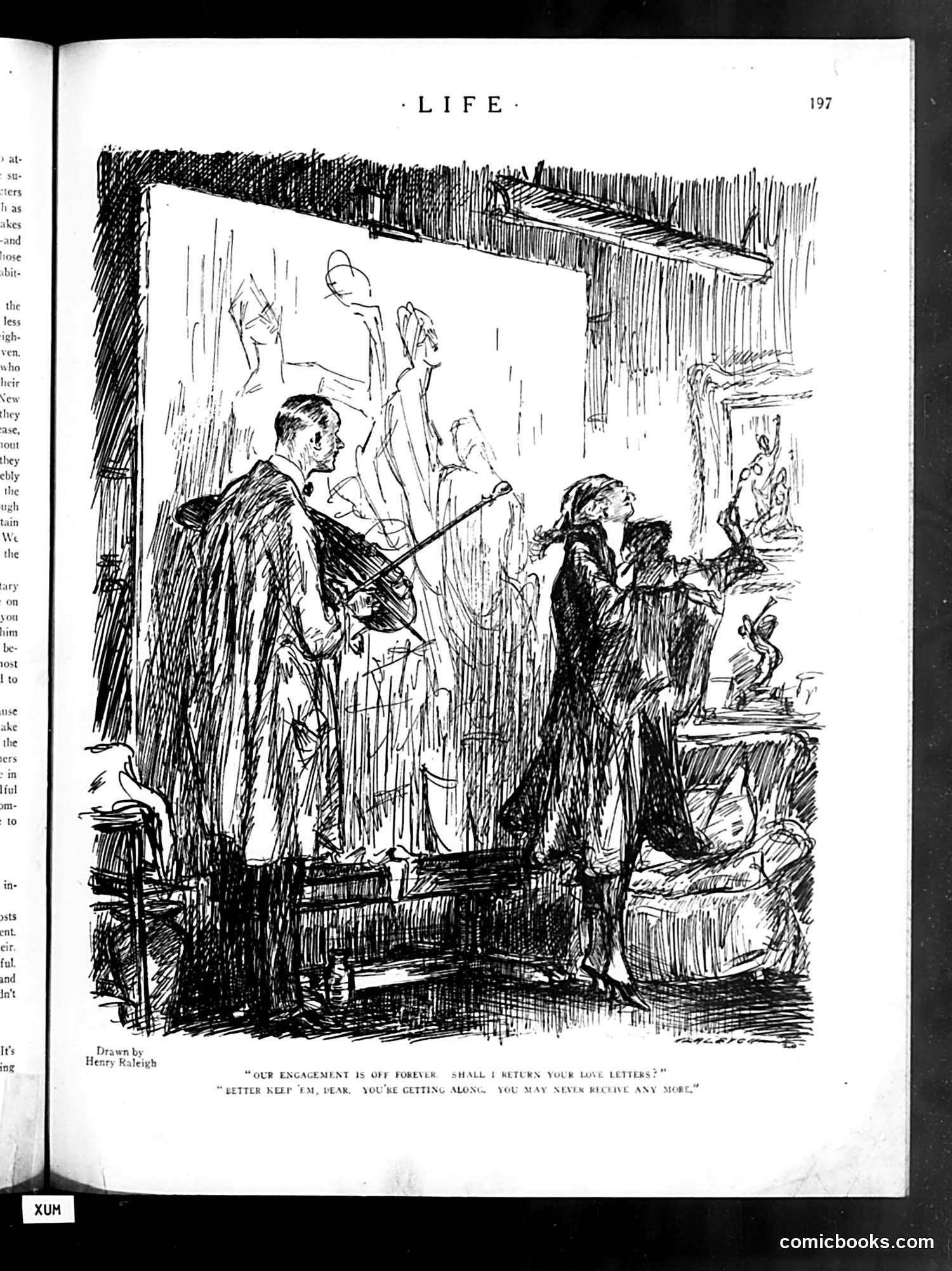
This single-panel cartoon by Henry Raleigh depicts a domestic scene where a man in military uniform addresses a woman, saying "Our engagement is off forever. Shall I return your love letters?" She responds, "Better keep 'em, dear. You're getting along. You may never receive any more." The satire targets changing gender dynamics and romantic expectations during what appears to be a wartime period (likely WWI, based on the uniform). The joke hinges on the woman's sardonic suggestion that the man's military service makes him an unattractive prospect—implying she doubts he'll receive future romantic interest. It mocks both romantic disillusionment and contemporary anxieties about soldiers' romantic prospects.
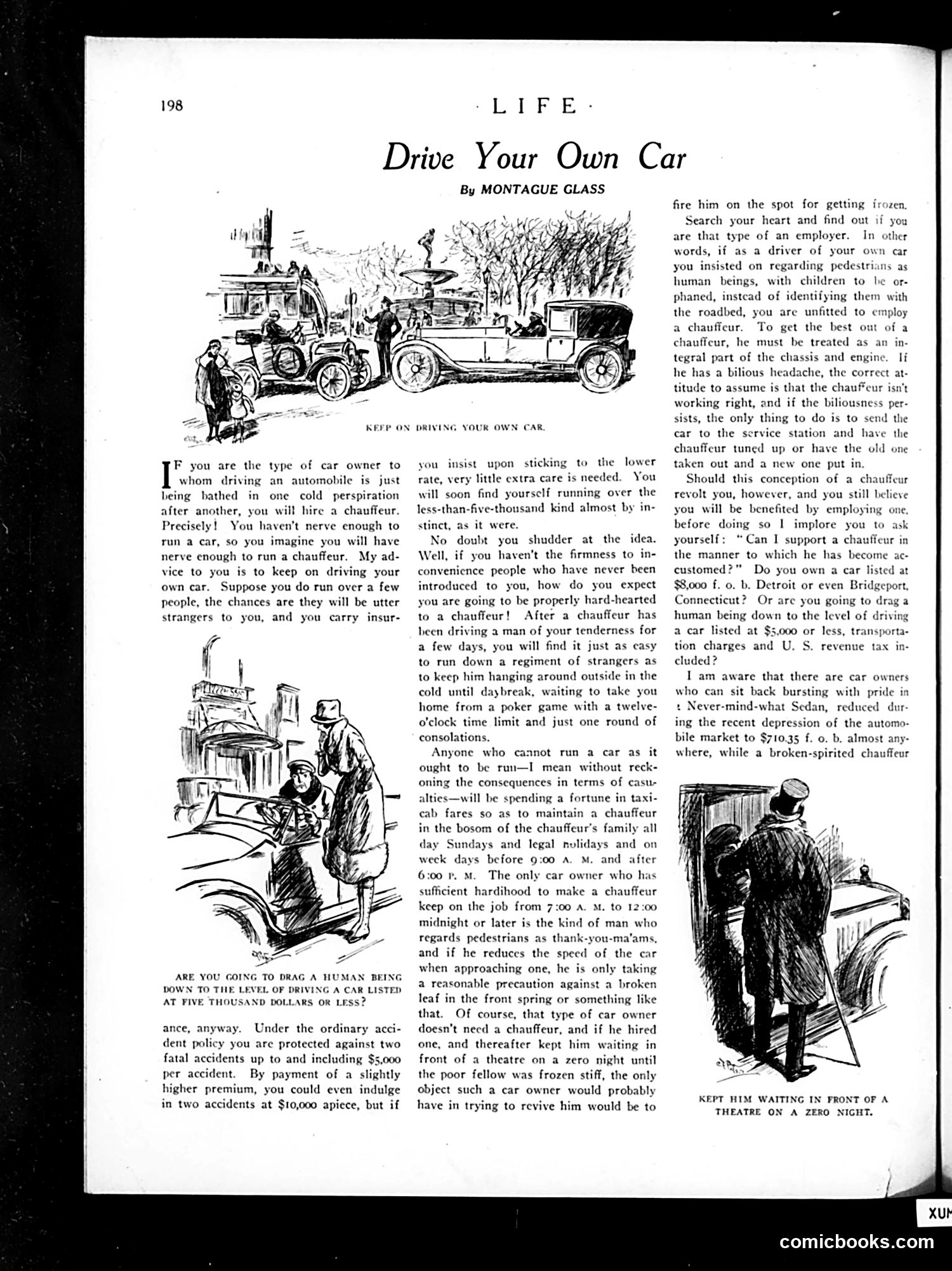
This satirical article mocks wealthy car owners who insist on driving themselves rather than hiring professional chauffeurs. The piece argues that self-driving owners are penny-pinchers who create dangerous road conditions by their inexperience, yet ironically spend enormous sums maintaining vehicles and paying insurance. The accompanying cartoons illustrate the absurdity: one shows a chauffeur standing in freezing cold outside a theater (the owner's negligent treatment), another depicts what appears to be a traffic accident or collision. Glass's satire targets the contradiction of the nouveau riche—people unwilling to pay reasonable chauffeur wages while spending lavishly elsewhere, thereby endangering pedestrians and other drivers through their amateur driving.
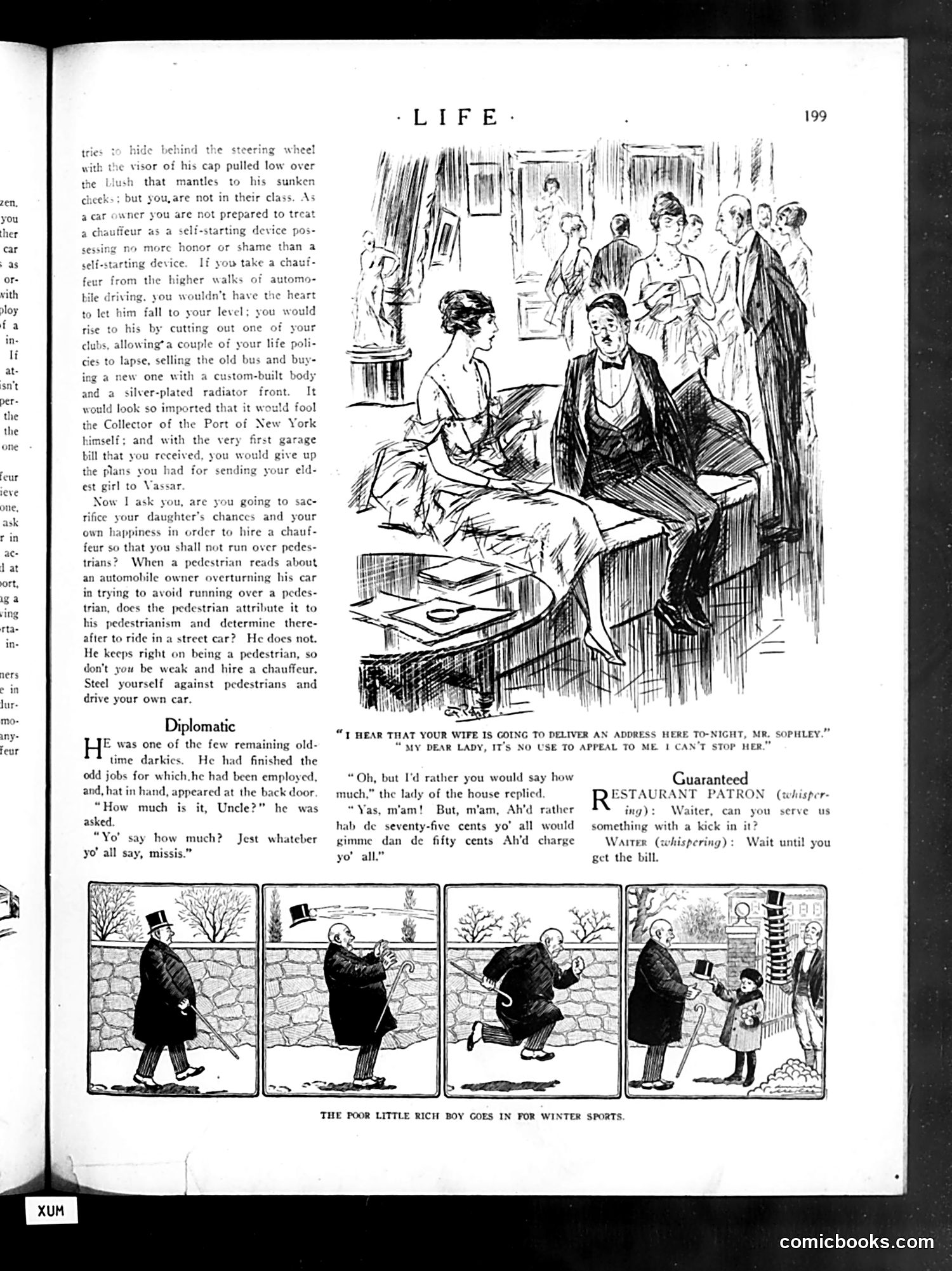
This Life magazine page contains three distinct satirical pieces: **"Diplomatic"** (top): A dialogue between a wealthy white woman and an African American servant using period racial dialect ("darkies," "yo' all"). The joke hinges on the servant's shrewd negotiation—when asked to name his own price, he asks less than what the employer might have offered, reversing expected power dynamics while still stereotyping Black workers as deferential. **"Guaranteed Restaurant Patron"** (middle): A brief joke about a restaurant patron demanding a drink "with a kick," with the waiter's punchline being that the bill itself will provide the shock. **"The Poor Little Rich Boy Goes in for Winter Sports"** (bottom): A four-panel comic strip showing a wealthy boy in formal attire attempting winter activities (sledding, skating) while maintaining his top hat and dignity—satirizing upper-class pretension and the absurdity of the wealthy trying leisure activities while remaining artificially formal. All pieces mock class distinctions and social pretension typical of early 20th-century Life satire.
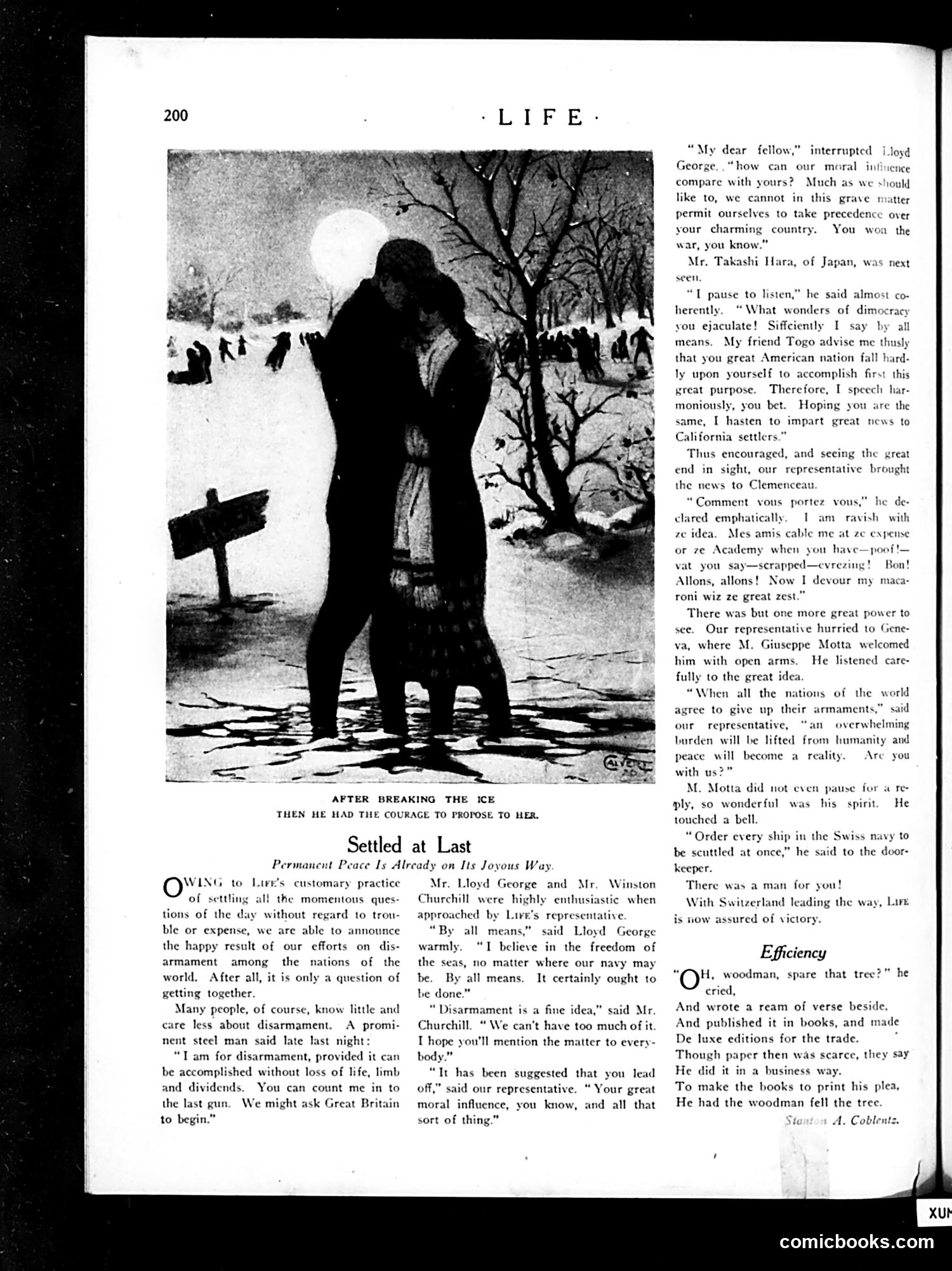
This page satirizes post-World War I disarmament efforts. The cartoon "Settled at Last" mocks world leaders' enthusiastic but hollow promises to reduce armaments. **The figures**: Lloyd George (British PM), Winston Churchill, Mr. Takashi Hara (Japanese), Clemenceau (French), and Giuseppe Motta (Swiss). Life's representative approaches each seeking support for disarmament. **The satire**: Each leader eagerly endorses the idea while deflecting responsibility—George praises "freedom of the seas" while avoiding British naval cuts; Hara claims Japan will follow American leadership; Clemenceau enthusiastically agrees in exaggerated French; Motta's absurd response (ordering Switzerland's entire navy scuttled) exposes the proposal's unreality. **The joke**: These leaders are so eager to appear peaceful that they make ridiculous statements, revealing disarmament is performative rather than genuine. The separate poem below continues this theme of hypocrisy: a woodsman who poetically opposes cutting trees nonetheless profits by selling wood for his book's publication.
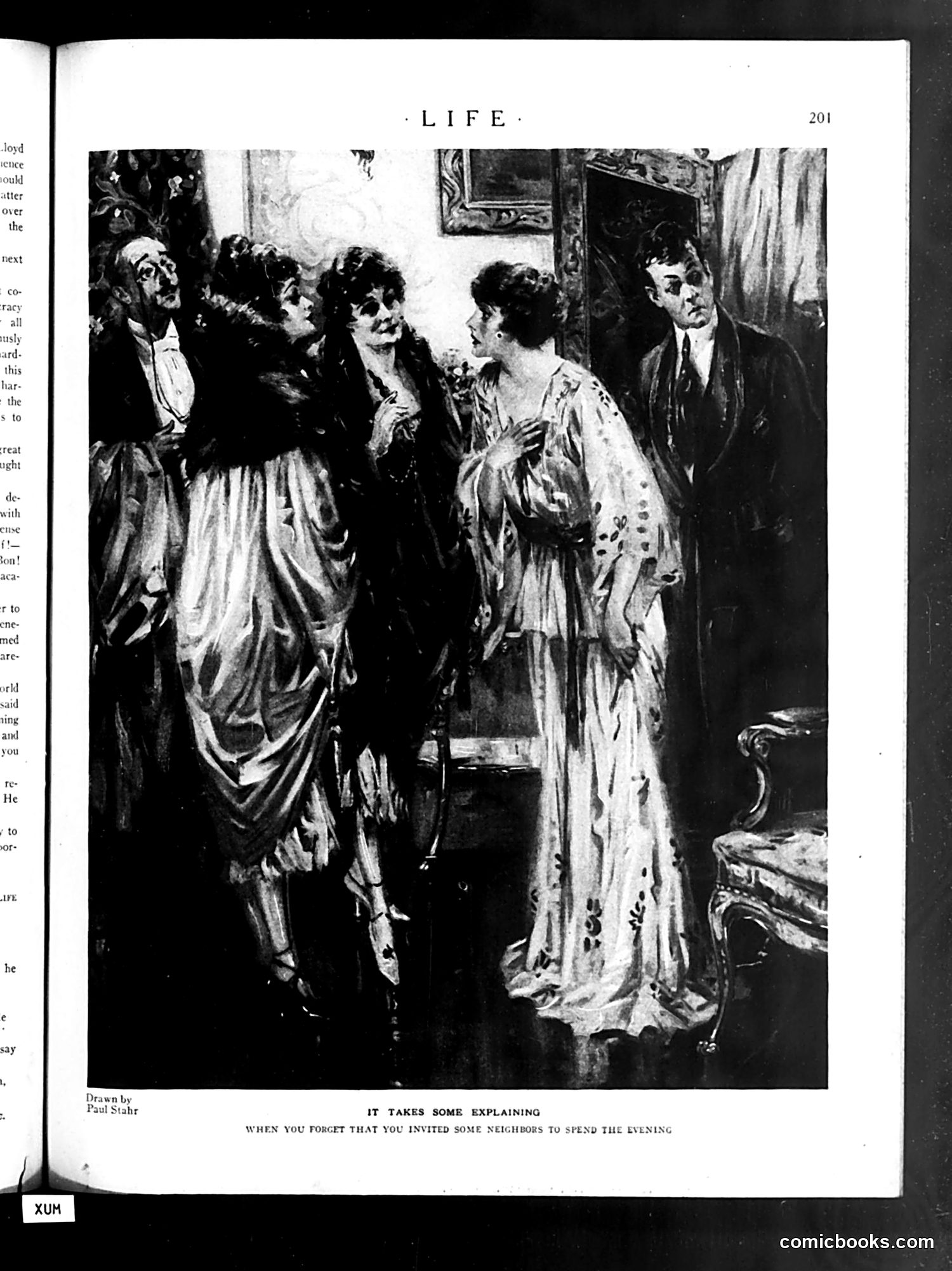
This is a social comedy illustration by Paul Stahr depicting an embarrassing domestic situation. The cartoon shows a well-dressed man (right) appearing uncomfortable as several neighbors—men in formal wear and women in evening gowns—stand in his home looking expectant and slightly awkward. The humor centers on a common social mishap: the host has apparently forgotten he invited these guests for the evening. The title suggests the awkwardness and explanation-giving required when such forgetfulness is discovered. This reflects early-20th-century middle-class social conventions where dinner parties and neighborly visits were formal, planned events. The cartoon satirizes the embarrassment of modern domestic life and the social obligations of maintaining neighborhood relationships.
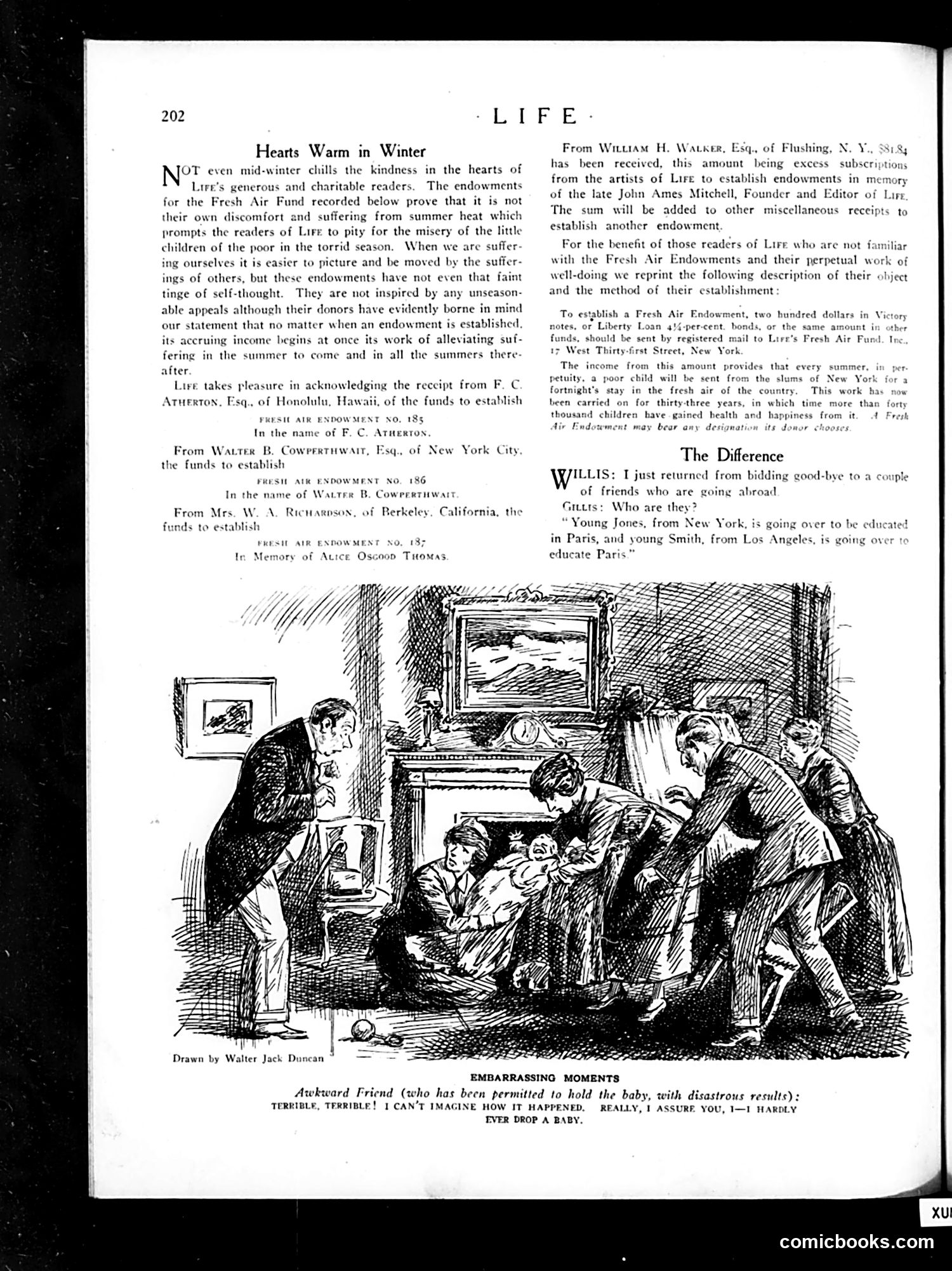
This page contains multiple elements: charitable announcements for the Fresh Air Fund (a real philanthropic effort sending poor urban children to the countryside), and a comic strip titled "The Difference." **The Comic's Point:** The joke satirizes American social pretension. When Willis mentions friends going abroad, Gillis initially assumes they're wealthy travelers going to be *entertained* in Paris and Los Angeles. The punchline reveals they're actually going to *provide education*—implying these Americans are wealthy enough to fund others' education abroad, a status symbol of the era. **"Embarrassing Moments"** (drawn by Walter Jack Duncan) depicts a separate, physical comedy sketch: an awkward guest holding a baby drops it with disastrous results, then unconvincingly claims never to drop babies. The humor relies on the obvious contradiction between the accident just witnessed and his reassurance. Both comics target common social anxieties—class performance and social embarrassment—typical of *Life* magazine's satirical approach during this period.
This page discusses post-WWI France's bitter disappointment and security anxieties. Sir Philip Gibbs, a respected war correspondent, argues that France—despite winning the war—feels cheated: she lost 2 million soldiers, suffered massive material destruction, and received neither adequate German reparations nor the promised Anglo-American military backing (the U.S. Senate rejected the Treaty of Versailles). France, distrusting the League of Nations, desperately seeks defensive alliances instead. However, Gibbs offers cautious optimism: beneath Europe's materialism and cynicism, he detects a "welling-up" of conscience and idealism among ordinary people across classes who reject the old gospel of force. He believes youth and new leadership will eventually prevail and reconcile nations. The cartoon's meaning remains unclear from the image alone.
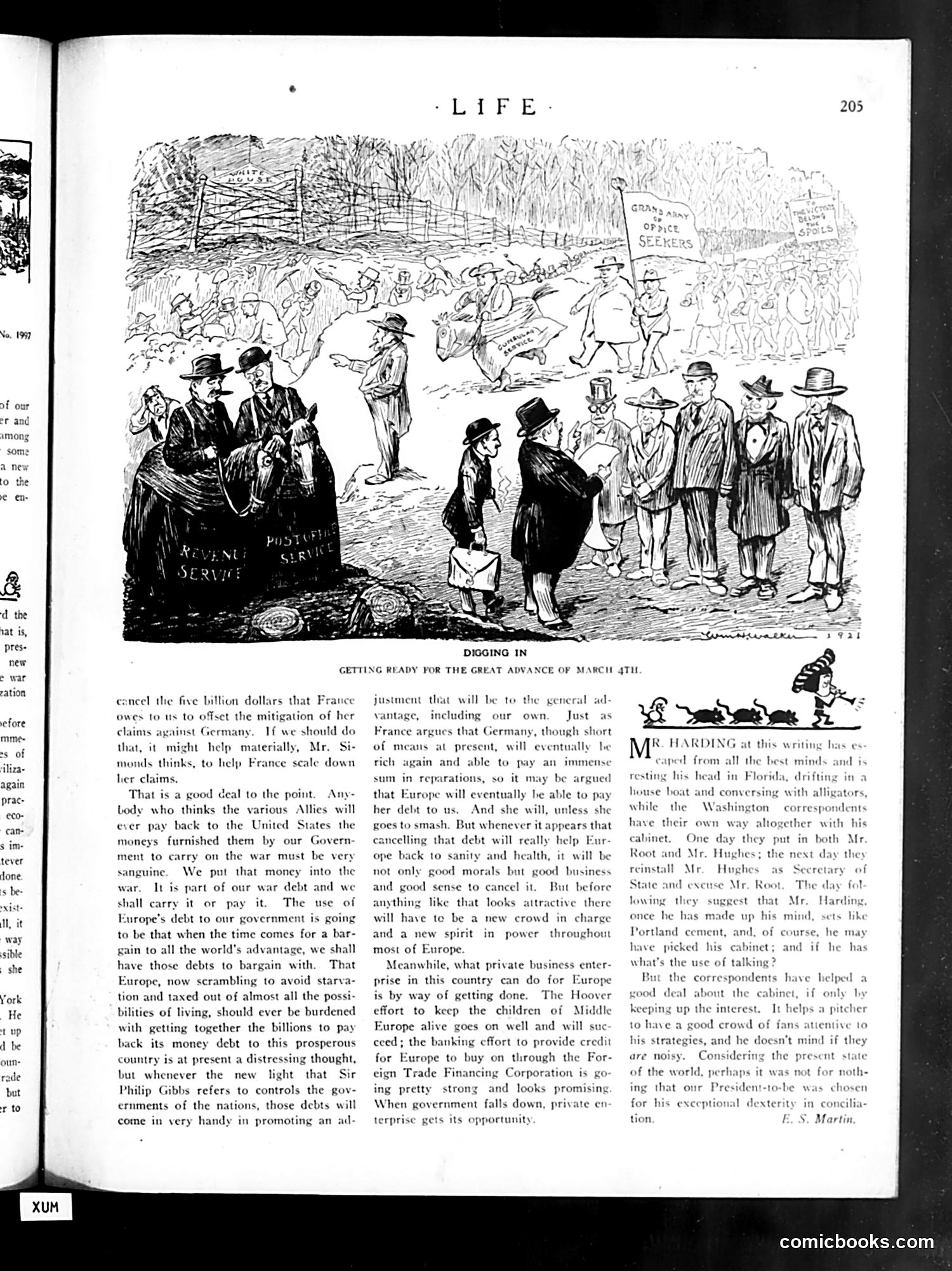
This cartoon depicts the incoming Warren G. Harding administration preparing to take office on March 4, 1921. The satirical title suggests politicians are literally "digging in" for the transition of power. The image shows various government and business figures gathered—likely representing Harding's cabinet selections (the text mentions Secretary of State candidates like Root and Hughes). The accompanying article discusses post-WWI financial issues: whether America should forgive European war debts owed to the U.S., and how private enterprise (like Hoover's relief efforts and the Foreign Trade Financing Corporation) fills gaps when government fails. The satire critiques both European debt negotiations and the media's obsessive speculation about Harding's cabinet appointments while he relaxes in Florida—suggesting journalists are actively shaping political narratives through their coverage rather than simply reporting events.
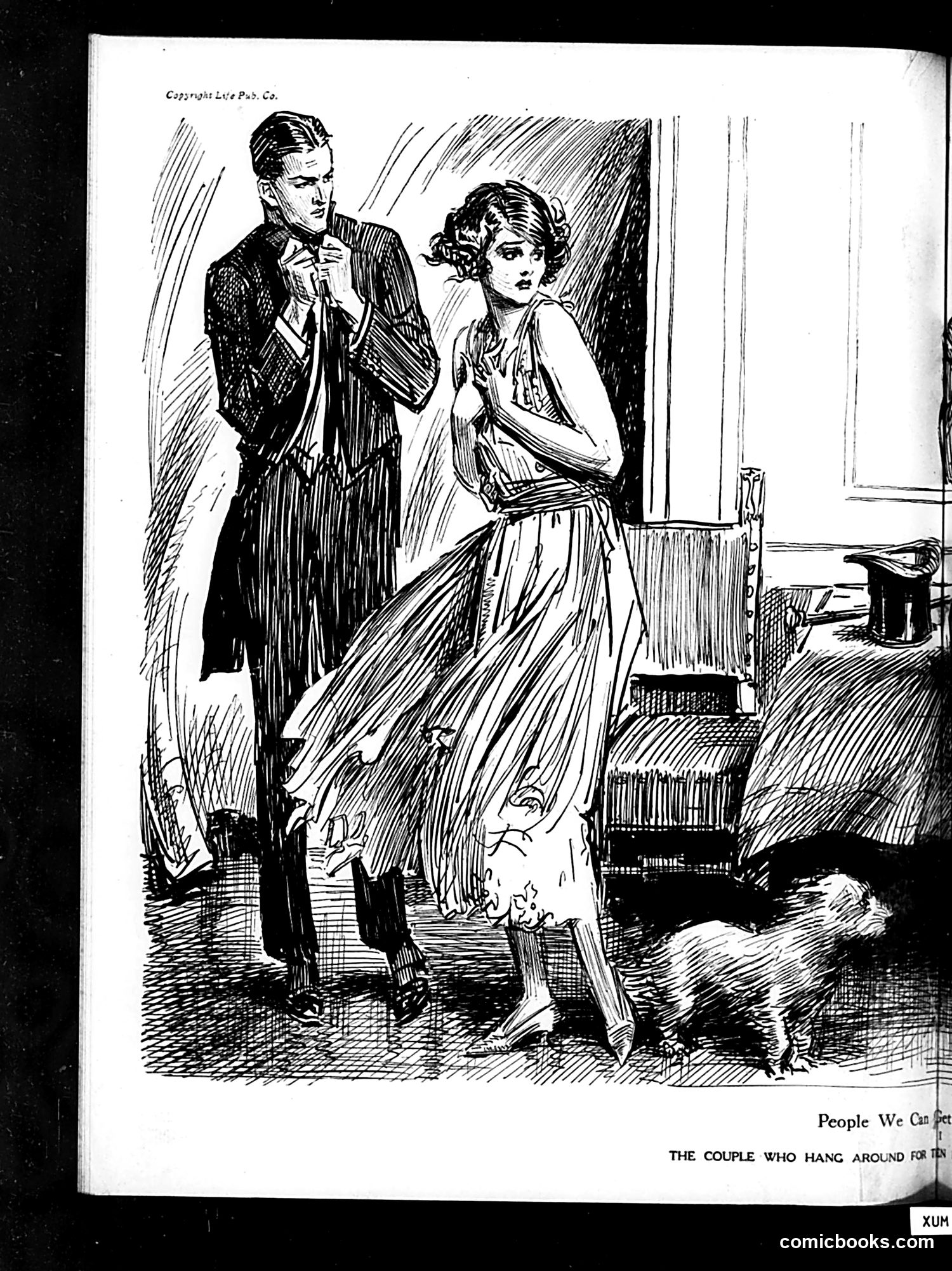
This is a satirical illustration from *Life* magazine depicting "The Couple Who Hang Around For Ten" (the caption appears cut off). The sketch shows a well-dressed man in formal attire and a woman in an elegant dress, rendered in the magazine's characteristic ink-line style. The cartoon appears to satirize a social type—likely couples who overstay their welcome at social gatherings or events. The full caption suggests they "hang around for ten" (possibly ten o'clock, or ten of something). The detailed formal clothing and interior setting suggest this targets upper-class social behavior, mocking those who linger awkwardly when hosts expect them to leave. The satire relies on recognizing this as a commentary on poor social etiquette among the fashionable set that *Life*'s readers would have found amusing.
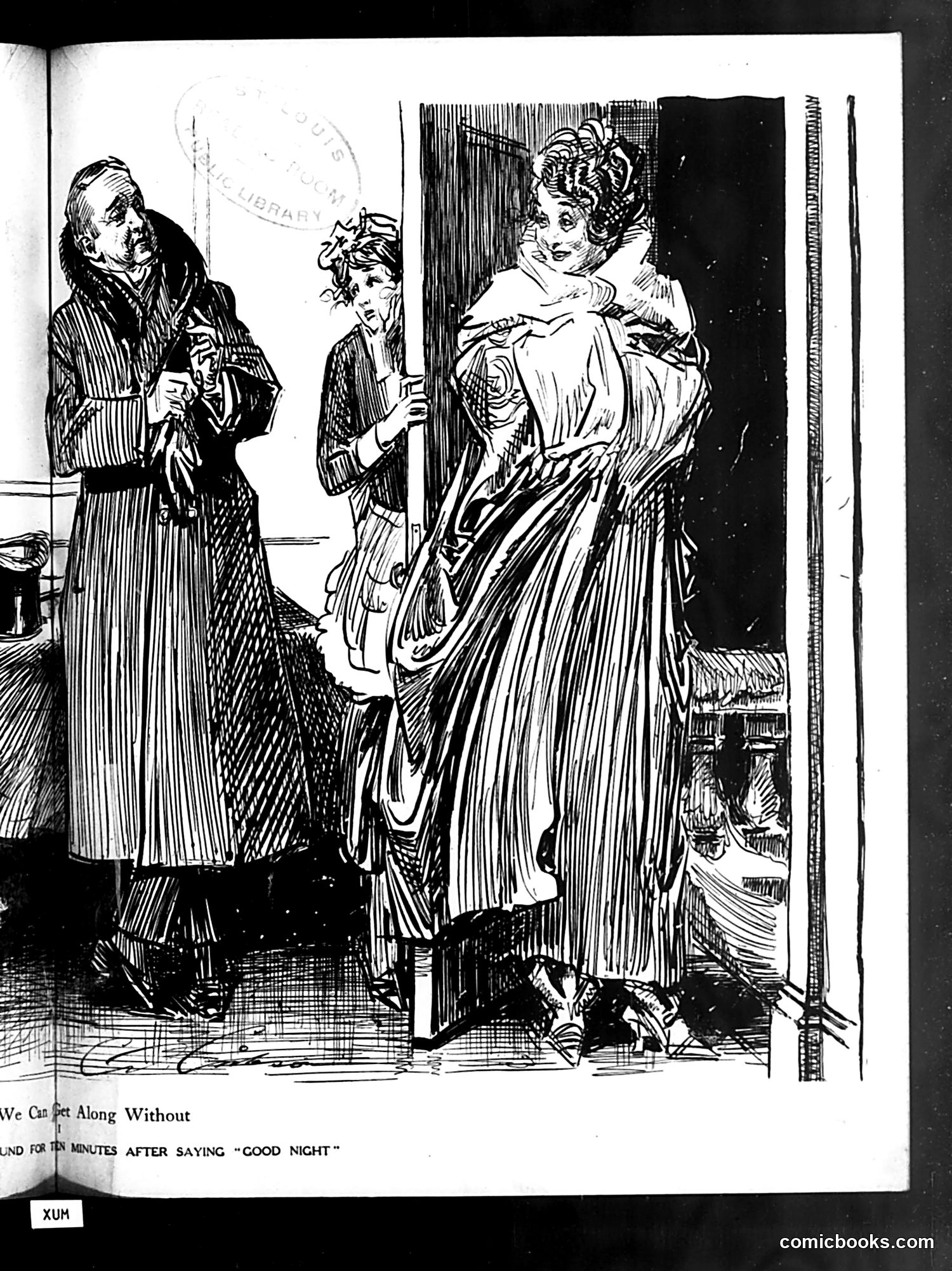
This satirical cartoon depicts an awkward domestic farewell scene. The caption suggests a couple saying goodnight, yet they remain lingering at the doorway—unable to actually part despite their stated intention to do so. The humor targets a common social observation: the gap between what people say and what they do. The couple's body language shows hesitation and reluctance, contradicting their verbal agreement to separate. The woman appears to be departing (wearing a coat), while the man holds the door, yet neither seems capable of executing the actual goodbye. This appears to be gentle satire about romantic attachment or social convention—poking fun at how people struggle with partings, particularly in courtship contexts. The title's claim that they "can get along without" each other is undermined by their inability to actually leave.
This satirical review contrasts serious theatrical productions with lowbrow entertainment. The critic reviews a Theatre Guild production of "John Hawthorne"—deemed so artistically poor that mocking it feels cruel. The author sarcastically notes the Guild's responsibility is "heavy" given their reputation for serious drama like "Heartbreak House." The piece then humorously pivots to praising a "high-class Family Burlesque" show at Union Square, where two musical comedies ("Harem Scarem Isle" and "Lost and Found") provided genuine entertainment and relief. The satire targets pretentious art theater: the critic suggests the Guild might next stage institutional patients reciting sonnets with kerosene lamps "for realism's sake"—mocking excessive adherence to naturalistic aesthetics (comparing it to Strindberg's style). The review praises the burlesque performers, particularly comedian Tom Howard and Joe Rose's German dialect, which the critic notes tactfully represents post-war American goodwill toward German people rather than their "rulers."
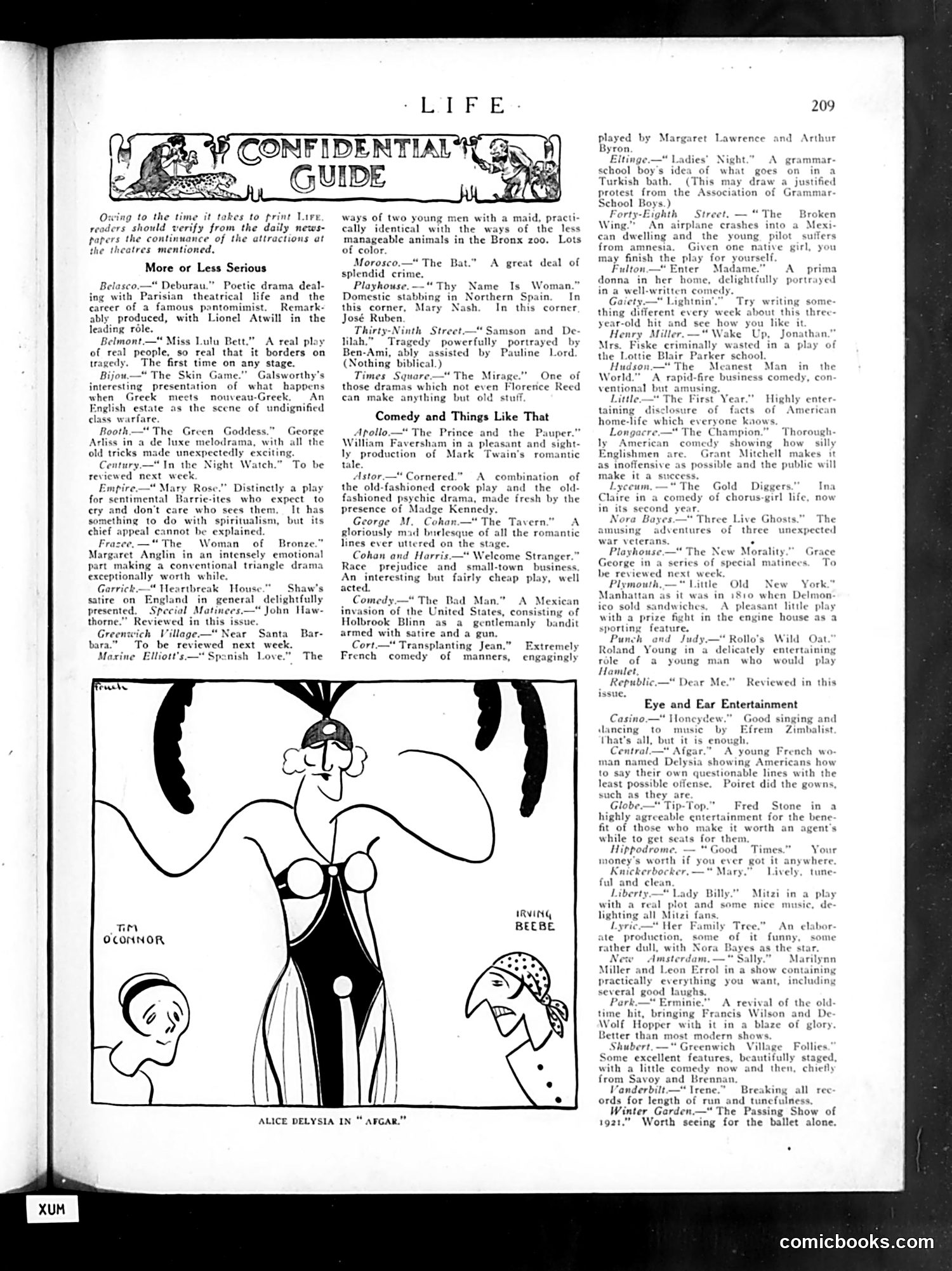
This page from *Life* magazine features a "Confidential Guide" to Broadway theater productions, reviewing current plays with satirical commentary. The main cartoon shows three caricatured figures in exaggerated poses—likely representing theatrical types or stereotypes of theatergoers. The reviews mock various productions with sharp wit. For example, *Eltinge* is criticized as a grammar school boy's naive idea of Turkish baths; *The Skin Game* is praised for depicting class warfare on an English estate; and *Mary Rose* is dismissed as sentimental Barrie-ite material. The satire targets both the plays themselves and audiences' tastes. References to actors like Lionel Atwill, William Faversham, and George M. Cohan were contemporary celebrities. The underlying joke is that Broadway offers predictable formulas—old-fashioned crook plays, domestic melodramas, and romance plots—recycled endlessly for gullible audiences.
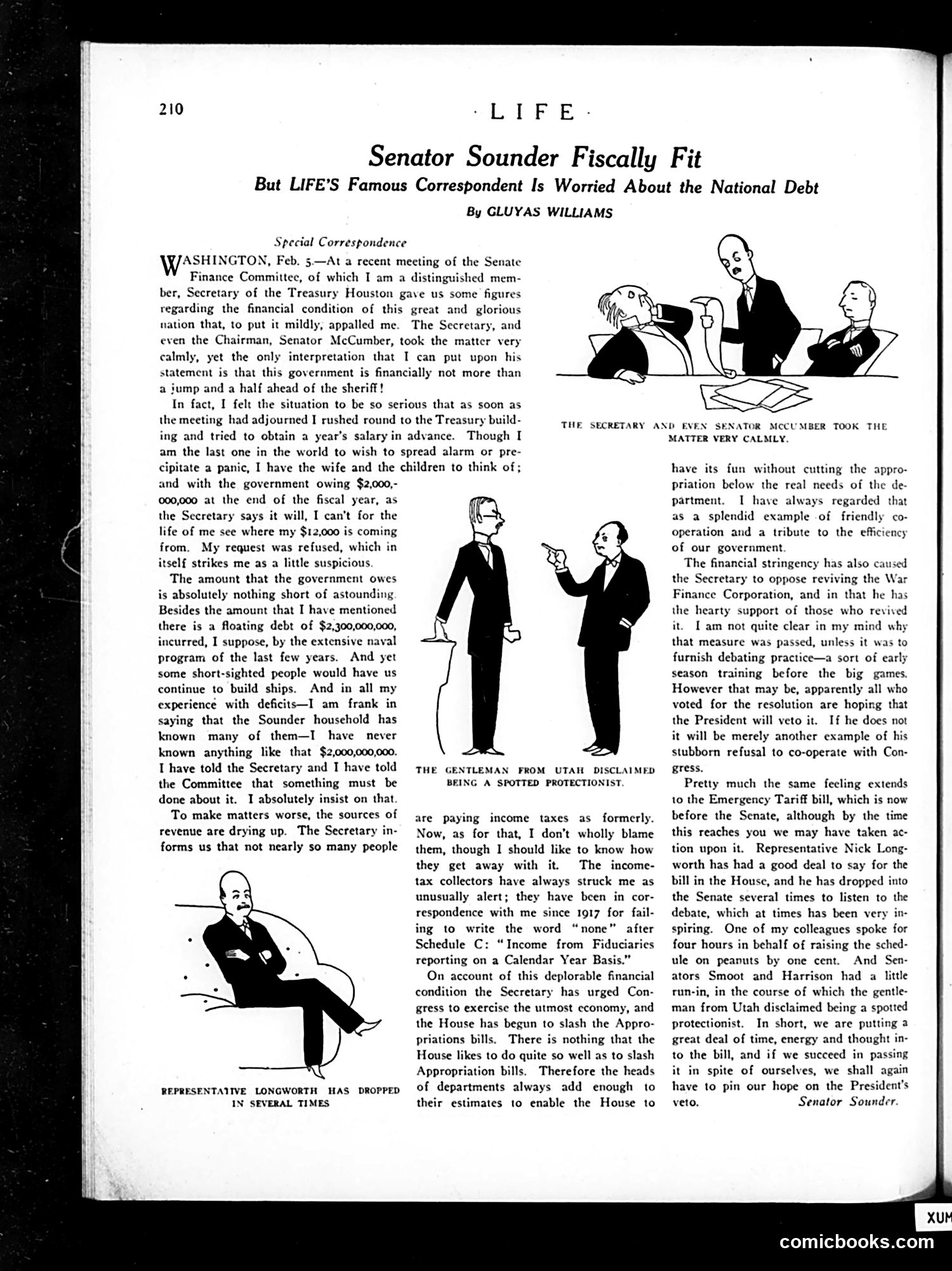
This article by Gluyas Williams satirizes Senator Sounder's complacent response to America's post-WWI national debt crisis. The correspondent expresses alarm at the $2 billion national debt and additional $2.3 billion floating debt (from naval expansion), while Sounder and Senate Finance Committee Chairman Senator McCumber remain oddly calm. The satire targets several targets: government fiscal mismanagement, the absurdity of department heads padding budget requests knowing Congress will cut them anyway, declining income tax revenue (humorously attributed to tax avoidance), and the seemingly pointless War Finance Corporation revival. References to Representative Longworth and "the gentleman from Utah" (likely a protectionist) suggest broader congressional dysfunction. The cartoons illustrate the disconnect between grave financial reality and political nonchalance, mocking both bureaucratic games and citizens' anxiety about government solvency.
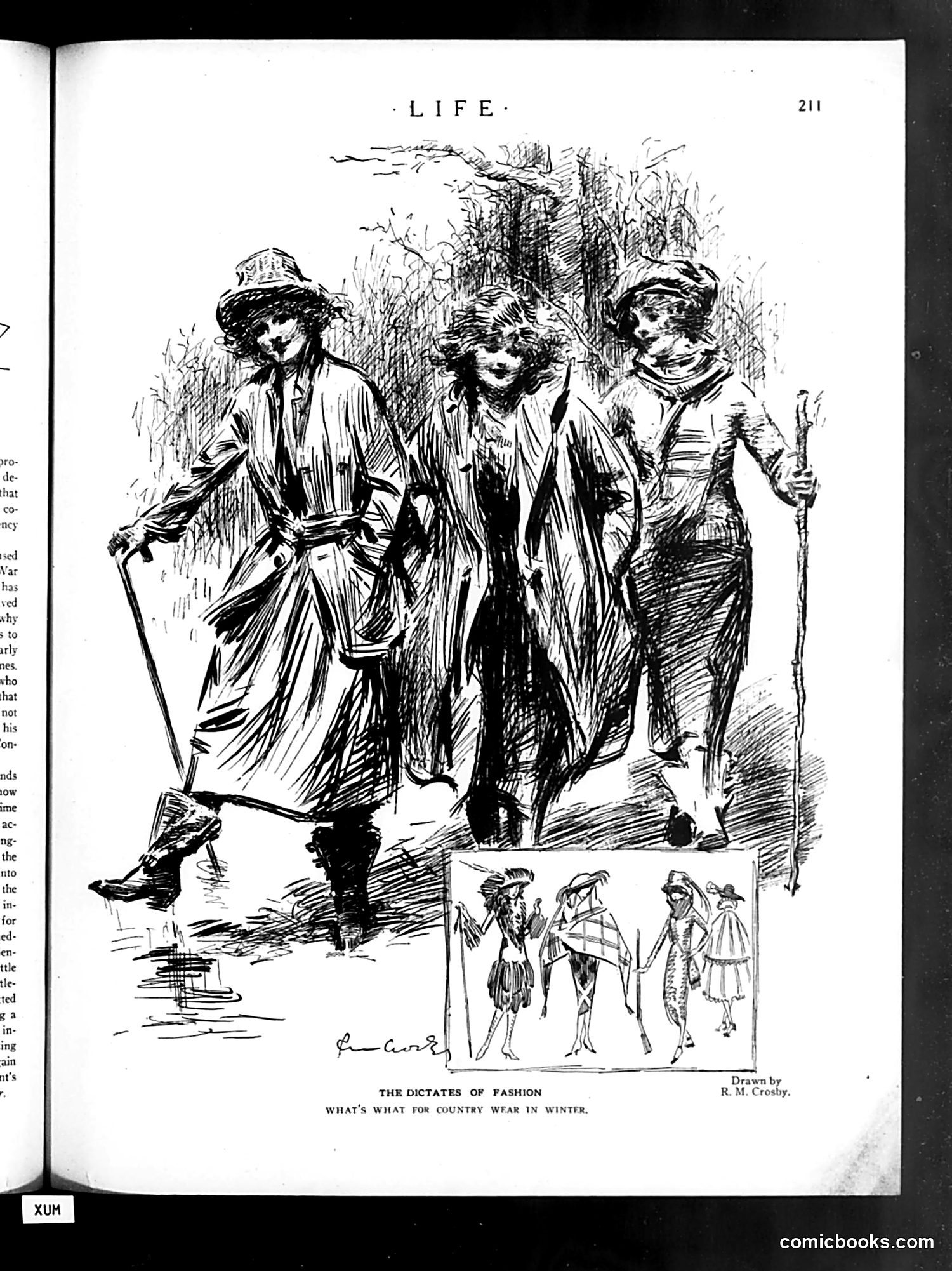
This is a satirical illustration by R.M. Crosby about winter fashion trends, titled "The Dictates of Fashion." The main panel shows three elegantly dressed women in long coats and hats, appearing to dictate or model fashionable country wear. Their postures and expressions suggest they're authoritatively presenting these styles as required fashion standards. The smaller inset panel below shows four figures in various outfits, likely illustrating different winter fashion options or variations on the theme. The satire targets how fashion arbitrarily "dictates" what people must wear—treating arbitrary style choices as absolute rules. The women's commanding poses emphasize fashion's tyrannical grip on society. For modern readers, this reflects timeless humor about how fashion industries establish trends as social requirements rather than choices.
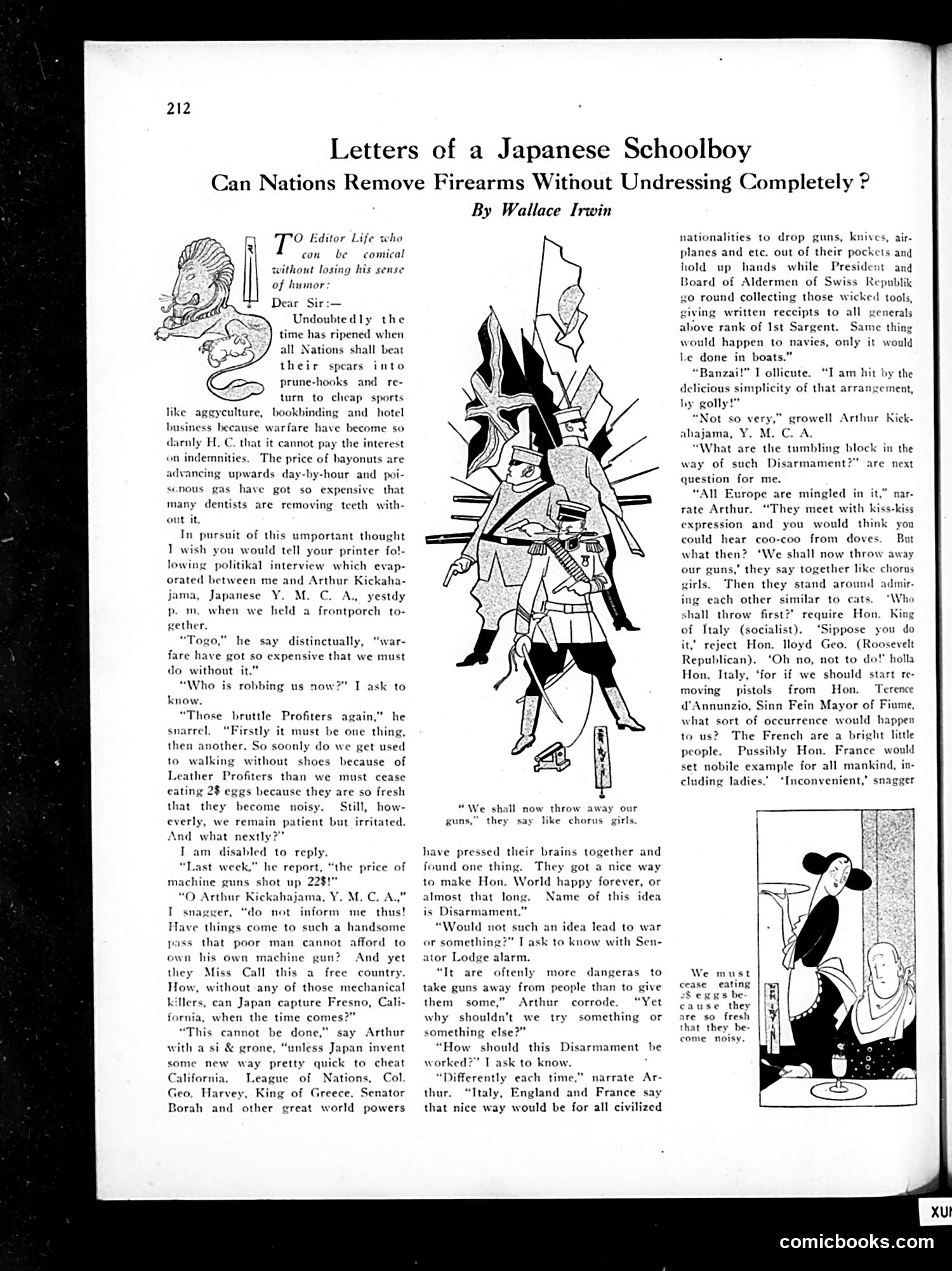
This is a satirical piece by Wallace Irwin presenting a humorous dialogue between an American narrator and "Arthur Kickahajama," a Japanese YMCA member, about international disarmament—a topical League of Nations debate of the 1920s era. The satire mocks the naïveté of disarmament proposals. Arthur's character comically illustrates European hypocrisy: nations claim to support throwing away guns while each hesitates to disarm first, fearing others won't comply ("Who shall throw first?"). The absurdist humor includes exaggerated economic consequences (eggs become noisy, dentists remove teeth) to suggest disarmament's impracticality. The cartoon depicts a pile of confiscated weapons, suggesting the literal chaos of actual arms collection. Irwin's target is Western politicians (Italy, England, France) who make pretty speeches about peace while maintaining military advantage—a common post-WWI criticism of League of Nations inadequacy. The Japanese character serves as an outsider observer exposing Western diplomatic theater.
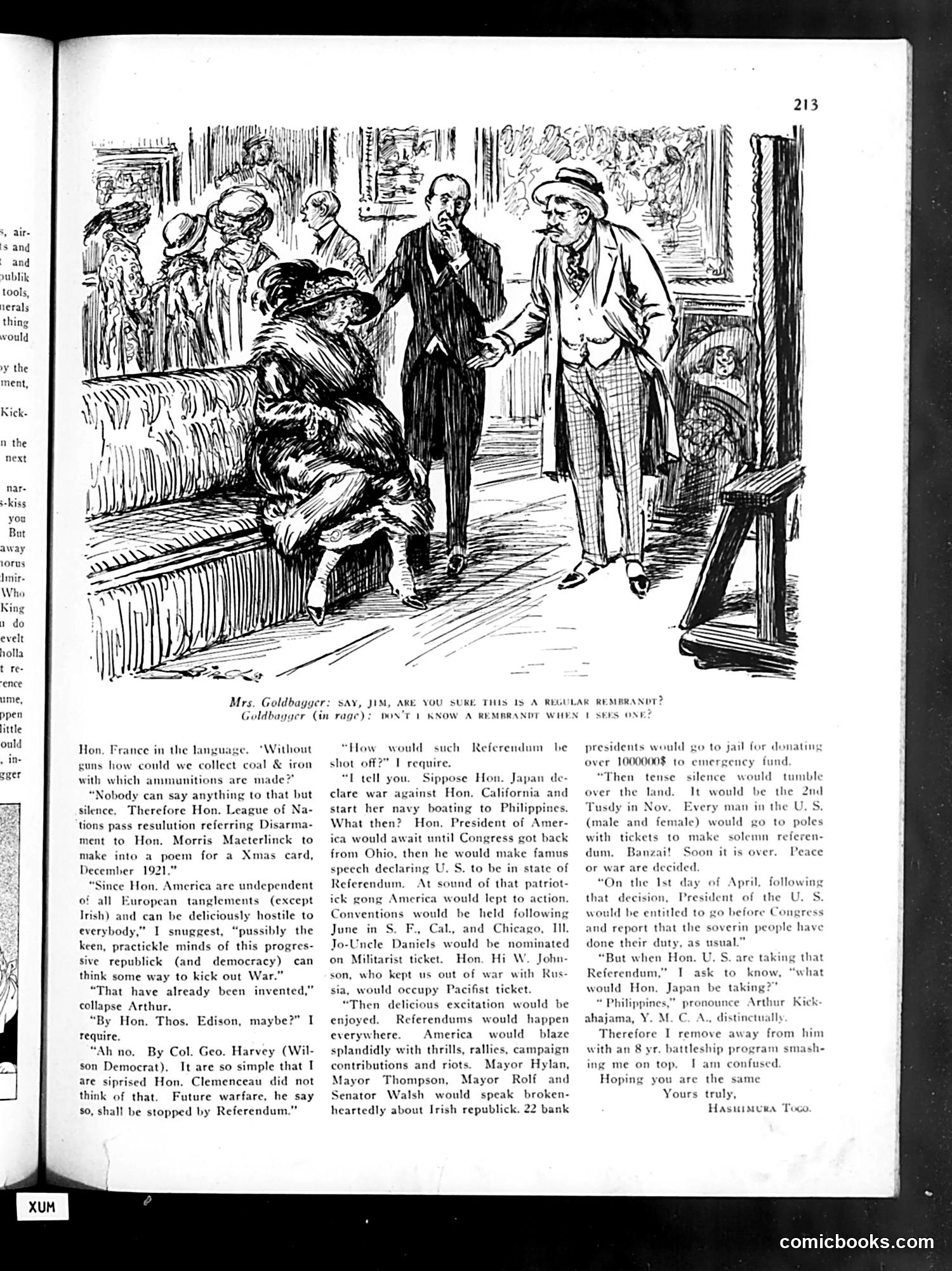
This page satirizes post-WWI disarmament debates and American isolationism. The cartoon depicts a heated argument between "Mrs. Goldbagger" and "Jim" about preventing future wars through a "Referendum" system—apparently Col. George Harvey's (a Wilson Democrat) proposed solution. The satire mocks the impracticality of deciding war through democratic voting. The scheme imagines Japan attacking California, America responding via national referendum with political conventions in San Francisco and Chicago, candidates nominated, campaigns and riots occurring, then citizens voting in November to decide peace or war. The text ridicules this as absurdly naive: Japan wouldn't wait months while America deliberates—it would simply seize the Philippines. The author concludes by literally "smashing" the proposal with "an 8 yr. battleship program," suggesting military preparedness, not idealistic referendums, prevents war. The joke targets American political naïveté about international conflict and the League of Nations' ineffectiveness.
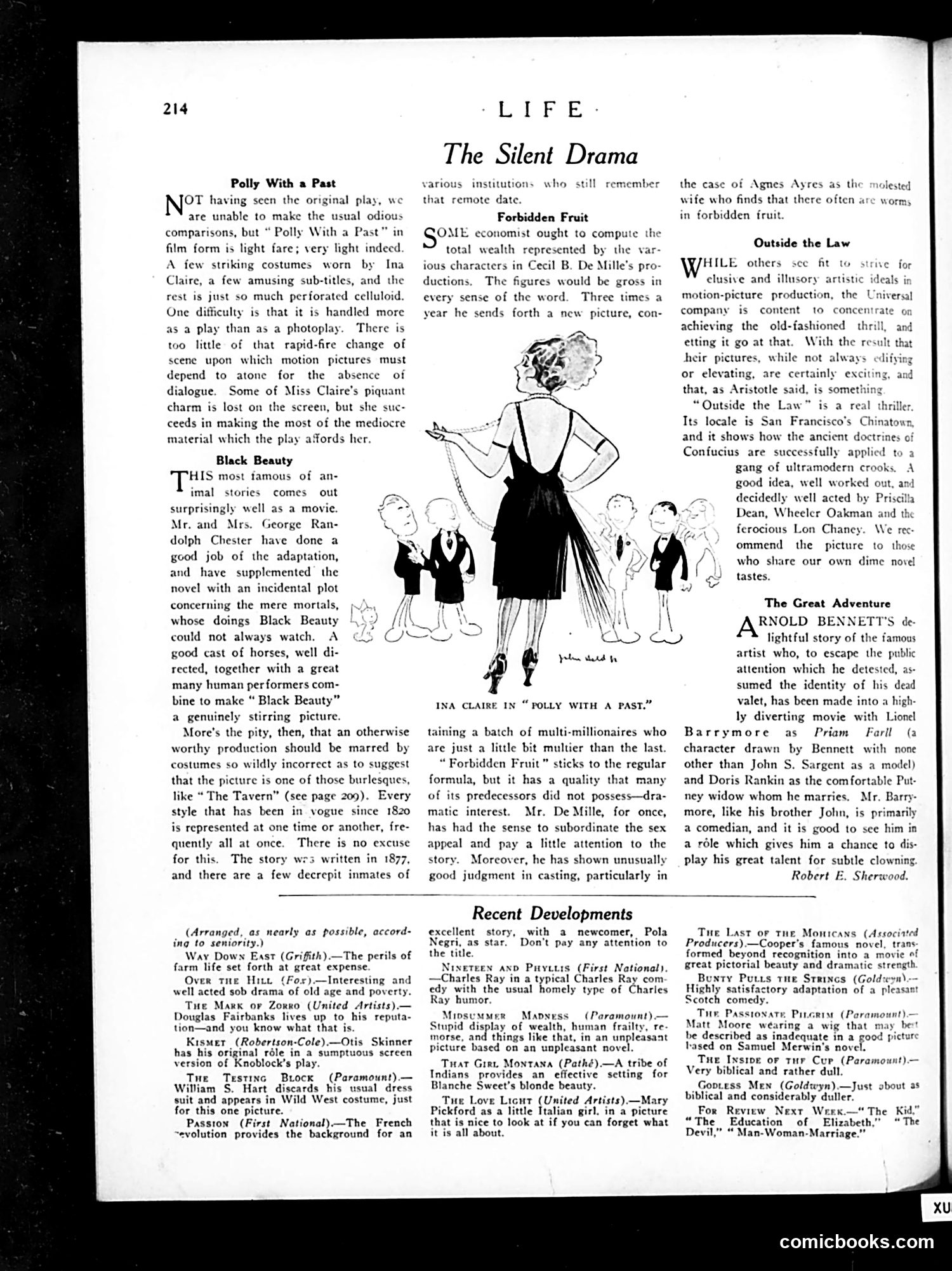
This page reviews silent films from circa 1920. The main illustration shows actress **Ina Claire** in "Polly With a Past"—depicted as a woman in fashionable dress surrounded by smaller figures (likely male admirers), satirizing the film's lightweight romantic plot. The reviews reveal period concerns: critics praise "Black Beauty" as a well-executed adaptation of the 1877 novel but mock its wildly anachronistic costumes spanning 1820-present, suggesting production carelessness. "Forbidden Fruit" by Cecil B. De Mille is criticized for his formulaic pattern of depicting wealthy characters, though this entry is praised for actually developing dramatic interest beyond mere "sex appeal." "Outside the Law" uses San Francisco's Chinatown setting to apply Confucian philosophy to crime narratives. The satire targets both filmmaking excess (De Mille's repetitive millionaire dramas) and technical incompetence (costume design), while praising intelligent adaptation and storytelling over shallow sensationalism.
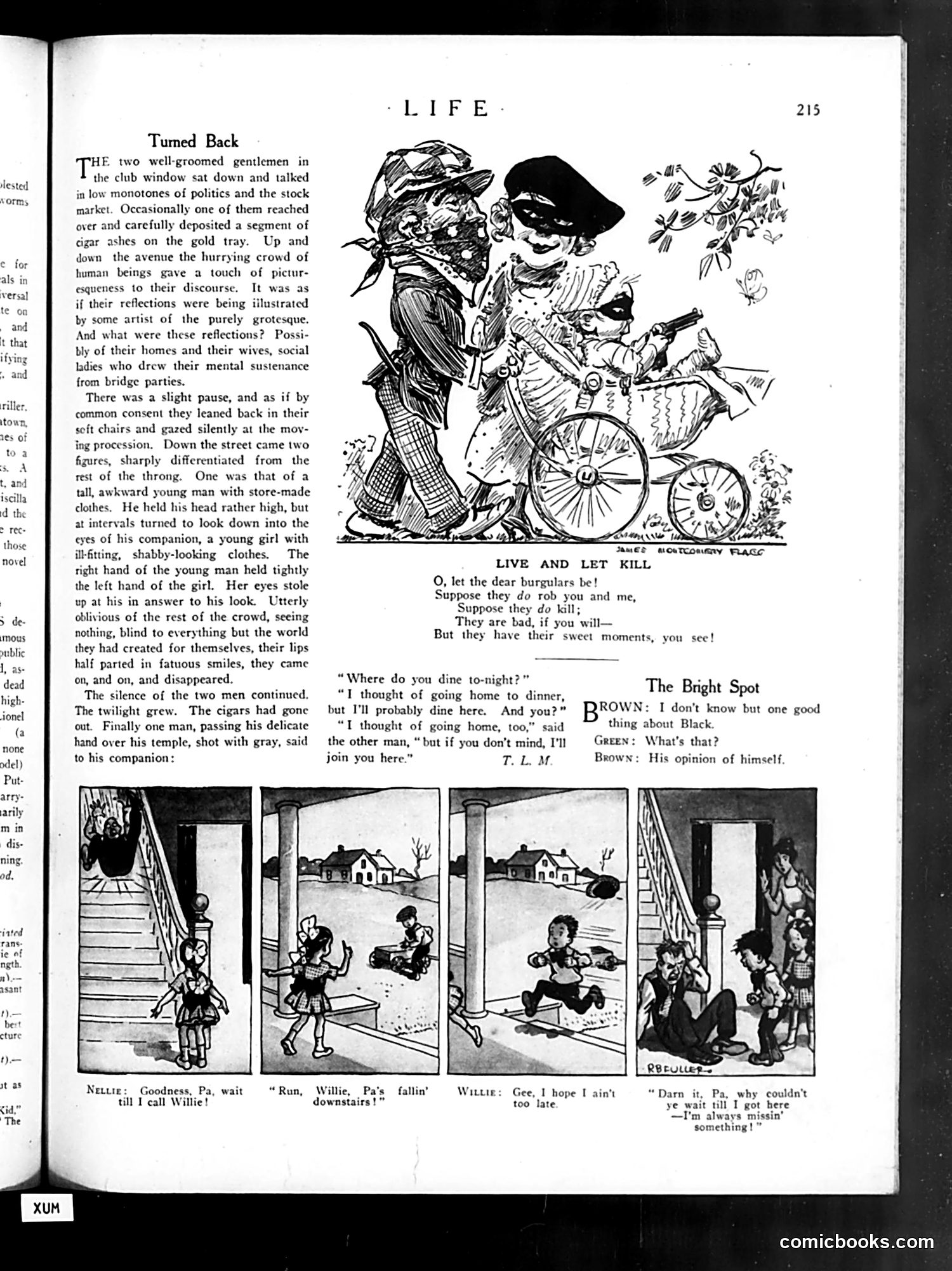
**"Turned Back"** (top illustration and story): This depicts two wealthy club members observing a young working-class couple pass by on the street—clearly in love, holding hands, oblivious to the world. The satire contrasts the gentlemen's empty lives (discussing stocks, cigars, their wives' bridge parties) with the couple's genuine happiness despite their poverty and shabby clothes. The point: material wealth and social status cannot purchase the authentic joy these poor young people possess. It's a critique of upper-class materialism and spiritual emptiness. **"Live and Let Kill"** (verse): A sardonic commentary on burglary and murder, suggesting criminals have "sweet moments" worth tolerating. This appears to mock sentimental attitudes toward crime or criminals. **"The Bright Spot"** (comic strip): Children attempting mischief—running downstairs, falling—while parents try unsuccessfully to supervise. The humor lies in children's chaos and parental frustration at constantly missing teachable moments.
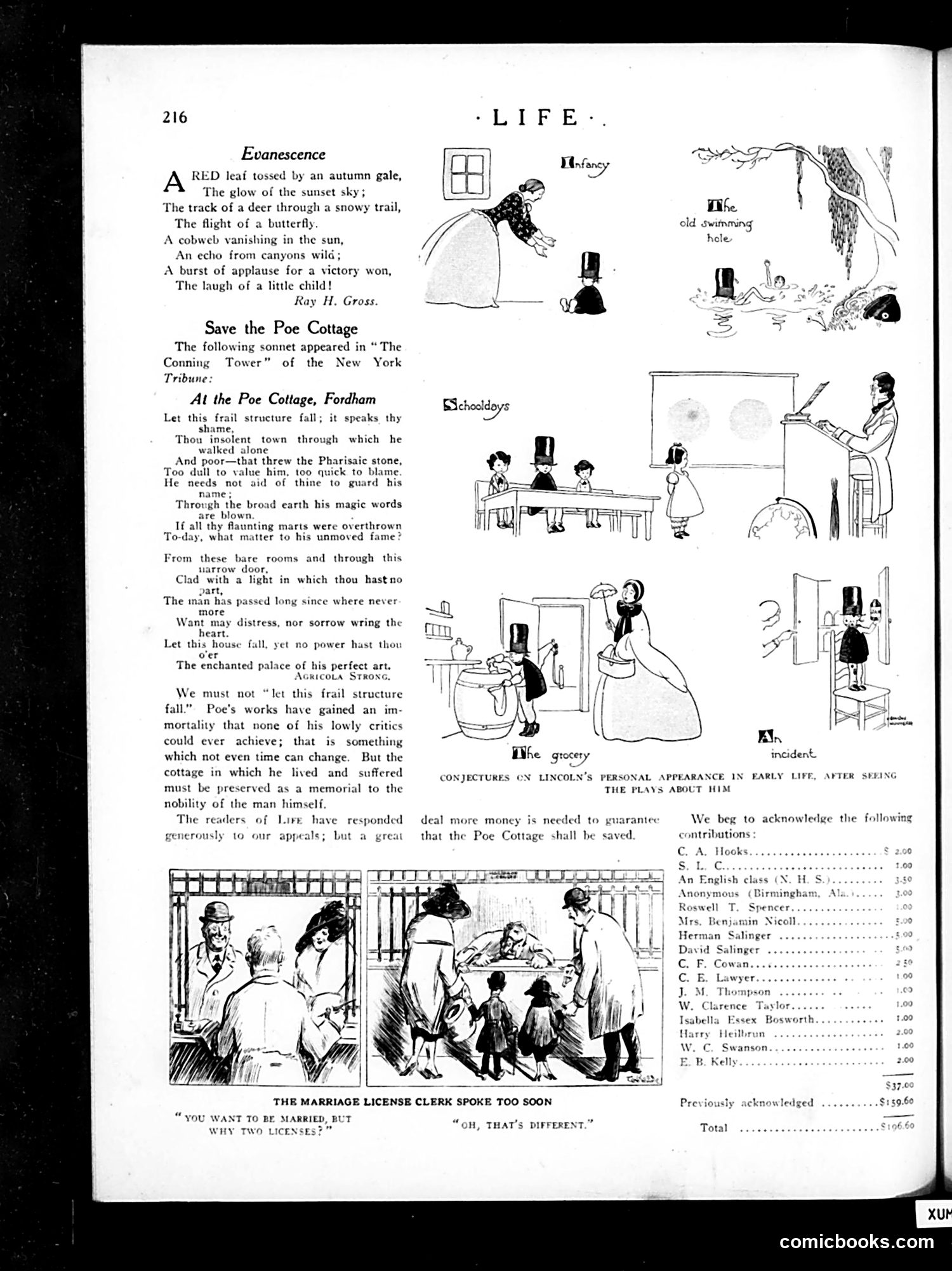
This page from *Life* magazine contains literary content and a fundraising appeal mixed with social humor. The main items are: **"Evanescence"** and **"Save the Poe Cottage"**: A poem and editorial campaign to preserve Edgar Allan Poe's cottage in Fordham, New York. The text argues the cottage—where the impoverished poet lived—deserves preservation as a memorial to his genius, despite his lowly status during life. This reflects early 20th-century literary preservation efforts. **Bottom cartoon**: "The Marriage License Clerk Spoke Too Soon" depicts a clerk misunderstanding a couple's request for two marriage licenses as bigamy, when they actually need duplicates for bureaucratic purposes. The humor relies on the clerk's hasty misinterpretation of their legitimate need. The page also includes small illustrations of childhood scenes (infancy, schooldays, grocery shopping) and a financial accounting of donations received for the Poe Cottage preservation fund.
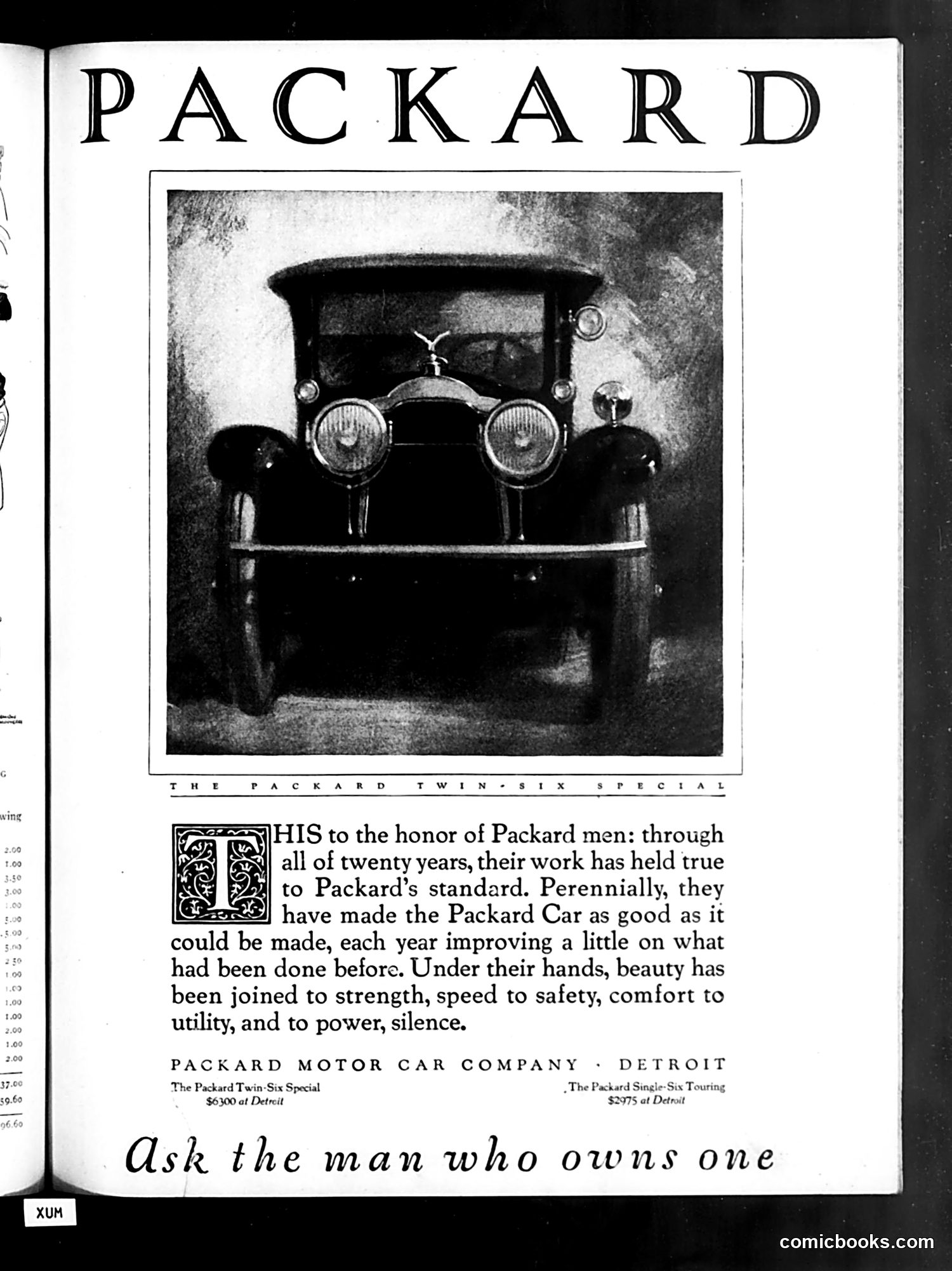
This is **not a cartoon or satire page**—it's a **Packard automobile advertisement** from Life magazine's early 20th century. The page features a front-view photograph of a Packard Twin-Six automobile and marketing copy praising the car's engineering over "twenty years." The ad emphasizes quality, incremental improvement, and the integration of luxury features (beauty, comfort, silence) with performance (strength, speed, power, safety). The famous closing line—"Ask the man who owns one"—became one of advertising's most iconic slogans, implying that satisfied owners would vouch for the product's quality. This represents **luxury car advertising during the early automotive era**, when Packard competed with other prestigious manufacturers. The prices listed ($6,300 and $2,975) reflected significant wealth required for ownership, positioning Packard as an elite brand for affluent Americans.
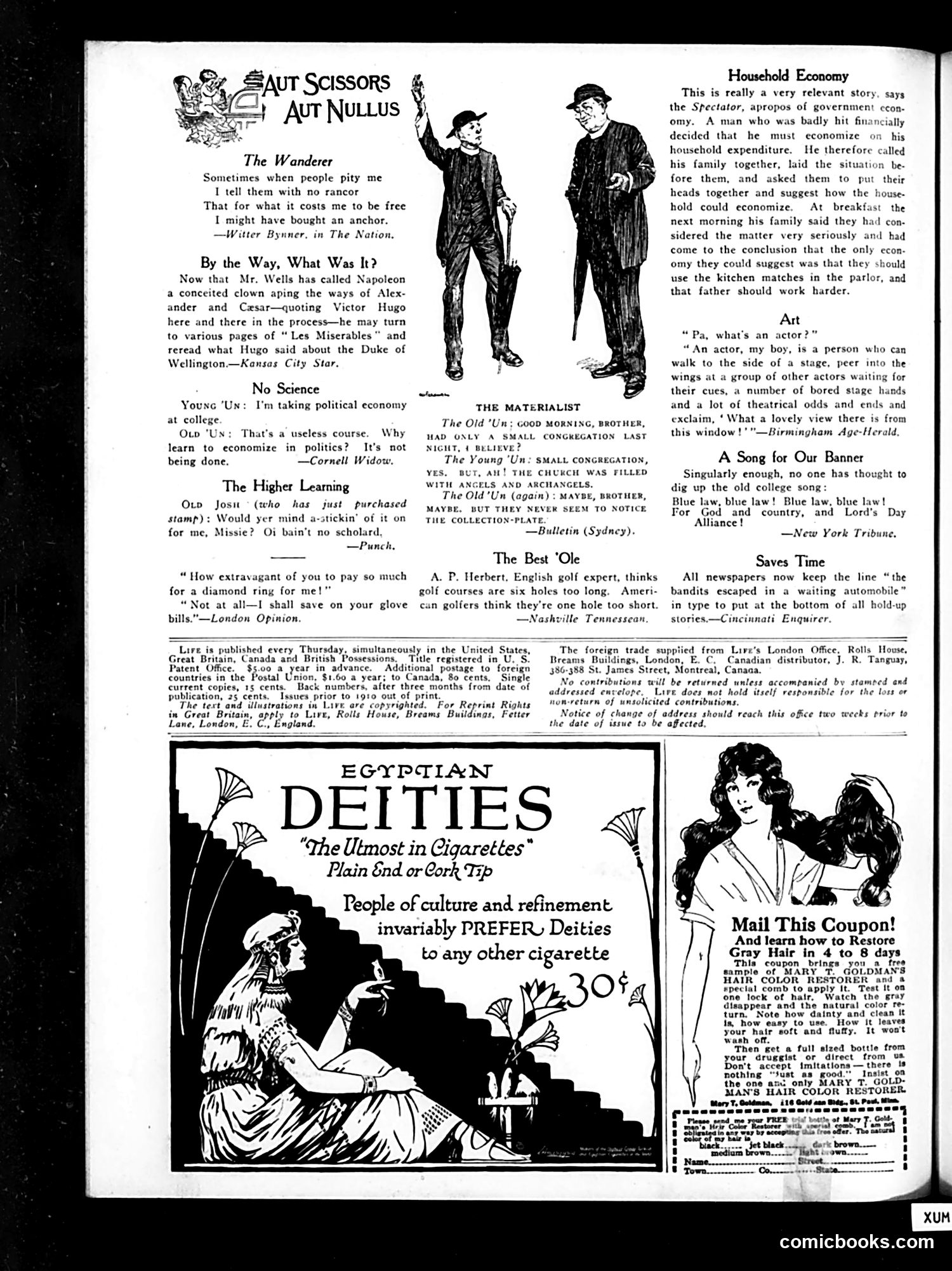
This page from *Life* magazine collects brief satirical pieces mocking contemporary society and pretension: **"The Materialist"** ridicules a clergyman boasting of his church being filled with "angels and archangels" (attending an evening service), only to be deflated when an older colleague notes the angels never contribute to the collection plate—satirizing empty religious posturing disconnected from actual charitable giving. **"Household Economy"** lampoons a financially struggling family's supposed "economizing": their solution is merely to use cheap kitchen matches instead of buying parlor matches, while demanding the father work harder—exposing how the burden of austerity falls on the working poor while "solutions" are trivial. **"Art"** mocks pretentious theatrical actors who strike artificial, sentimental poses ("What a lovely view!") while surrounded by stagehands and scattered props—ridiculing performative culture and fake aesthetics. The page's smaller quips target similar targets: academic uselessness, extravagant consumption disguised as economy, and journalistic clichés.
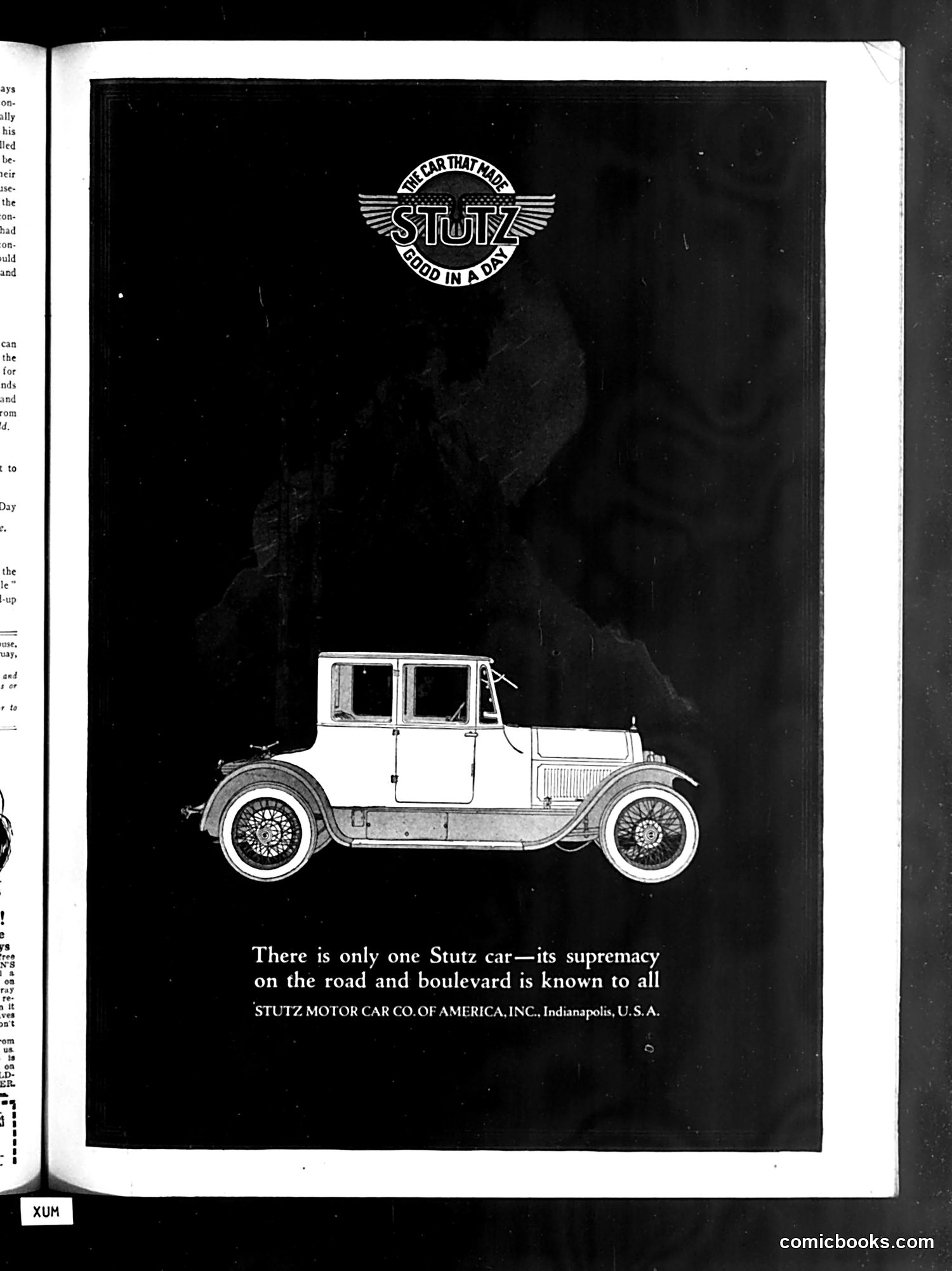
This is a **Stutz automobile advertisement**, not political satire or comics content. The page shows a side-view illustration of an early 1920s automobile with the Stutz company logo (winged emblem reading "The Car That Has Good in A Dose") at the top. The copy makes a straightforward marketing claim: Stutz cars are supremously reliable and well-known for highway performance. The Stutz Motor Car Company of Indianapolis, Indiana is identified at bottom. This appears in *Life* magazine as a paid advertisement rather than editorial cartooning or satirical content. It's a typical period automobile ad emphasizing quality and prestige to affluent readers.
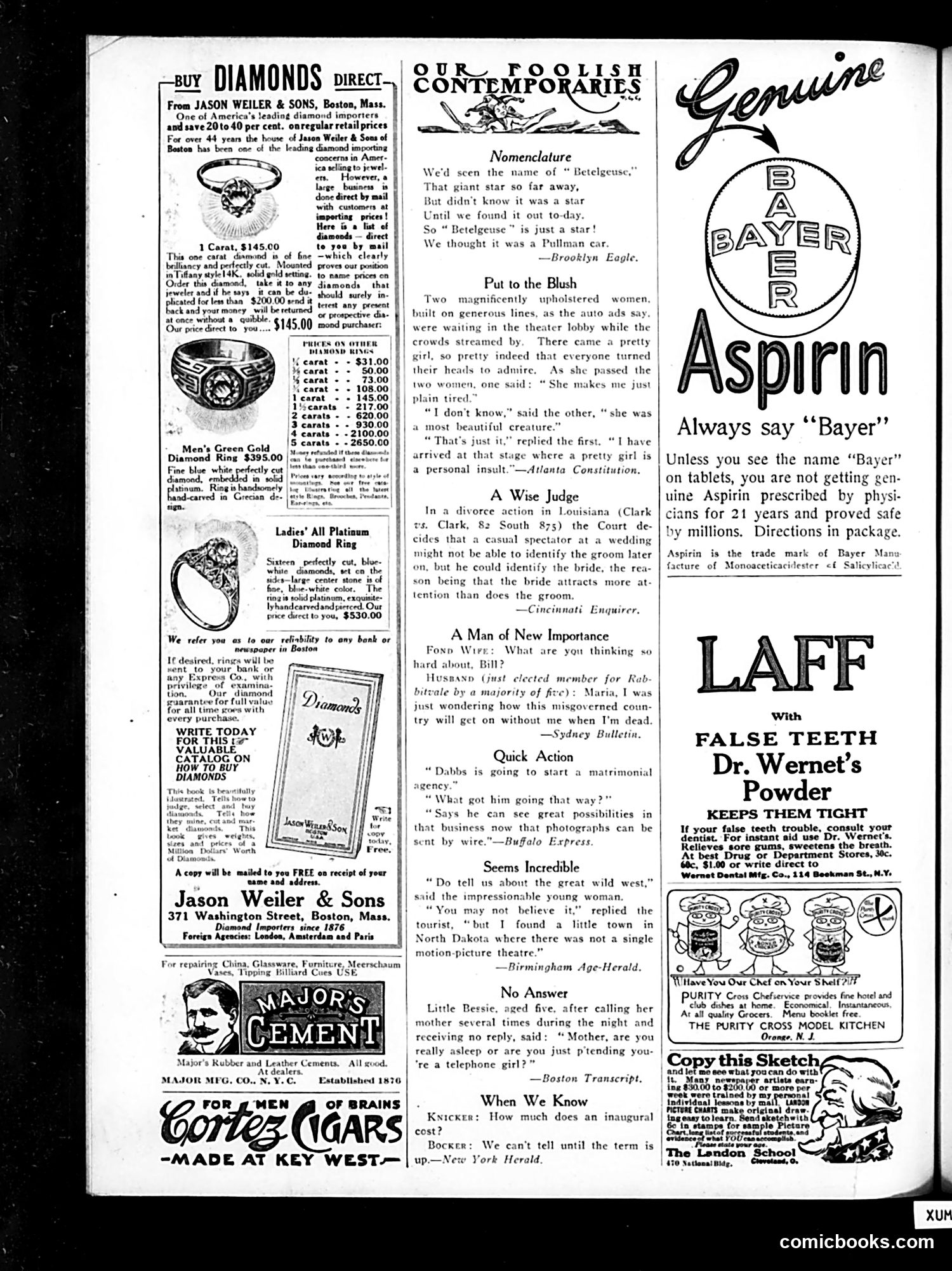
This page is primarily **advertisements and humor columns**, not political cartoons. The content includes: **Advertisements:** Diamond rings from Jason Weiler & Sons, Bayer Aspirin, Dr. Wernet's false teeth powder, Major's Cement, and Key West cigars dominate the layout. **Humor Sections:** Brief satirical anecdotes appear throughout: - "Nomenclature": A joke confusing the star "Betelgeuse" with a Pullman train car (mocking unfamiliar astronomical terms) - "Put to the Blush": Two women in a theater lobby discussing a beautiful girl, with the punchline that beauty becomes tiresome as a personal standard - "A Wise Judge": A Louisiana divorce case where a judge notes brides attract more attention than grooms - Various one-liners about matrimonial agencies, wild west exaggerations, and inaugurations These are gentle, society-page humor pieces typical of early 1900s Life magazine—wordplay and everyday observations rather than political satire. The page reflects the magazine's original format as a humor and advertising publication.
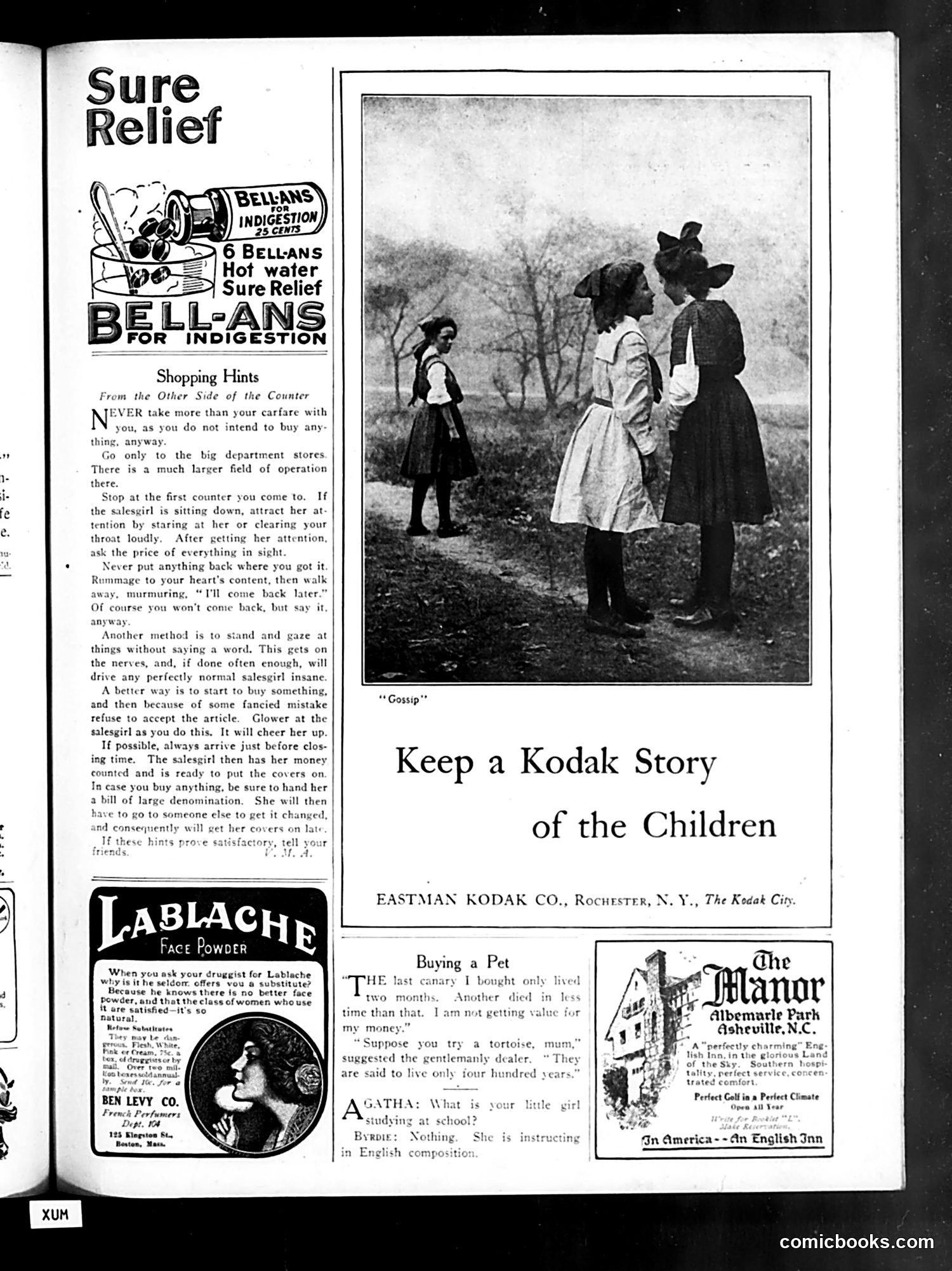
This is satirical advice **mocking rude customer behavior** toward retail salesgirls (female shop assistants). The piece is written from "the other side of the counter"—presenting customer tactics as deliberate annoyances. The satirized behaviors include: arriving without intent to buy, disrupting seated clerks through loud throat-clearing, ransacking merchandise and leaving without restocking, dawdling silently to unnerve staff, arriving at closing time, and handing large bills to inconvenience the salesgirl during change-making. The satire targets inconsiderate shopping practices common in early 20th-century department stores. The phrase "drive any perfectly normal salesgirl insane" emphasizes the psychological toll of such treatment. This reflects period awareness of working women's difficult conditions—long hours, low pay, demanding customers—while employing humor to shame bad behavior. The joke assumes readers will recognize these tactics and feel embarrassed by the portrait of rudeness.
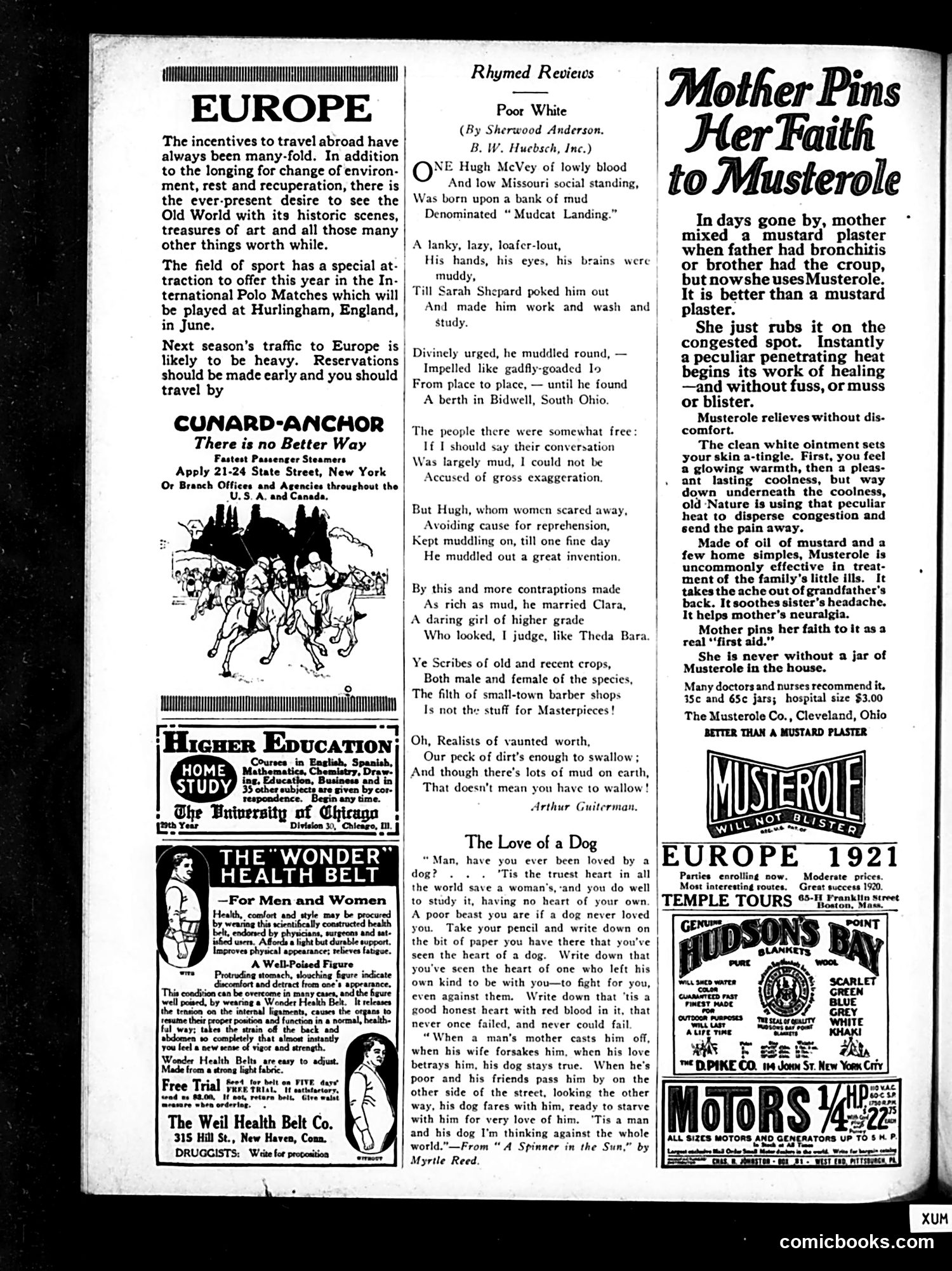
This page is primarily **advertising and literary content** rather than political cartoons. The main text features a **book review** of Sherwood Anderson's *Poor White* by Arthur Guiterman, satirizing realistic fiction that dwells excessively on small-town sordidness. Guiterman mocks writers who use "filth of small-town barber shops" as material, arguing that depicting mud and dirt isn't sufficient for great literature—a critique of Anderson's gritty naturalism. The page includes **period advertisements**: Cunard-Anchor steamship line promoting European travel (particularly polo matches in England), the "Wonder Health Belt" (a dubious medical device), and the University of Chicago correspondence courses. A **sentimental prose piece** titled "The Love of a Dog" celebrates canine loyalty, contrasting a dog's faithful devotion against human betrayal—typical early-20th-century sentimentalism. The **Musterole advertisement** promotes a mustard-plaster substitute for treating bronchitis and congestion—a common home remedy of the era. This reflects 1921 American culture: post-WWI optimism about European travel, pseudoscientific health products, and nostalgic rural Americana themes.
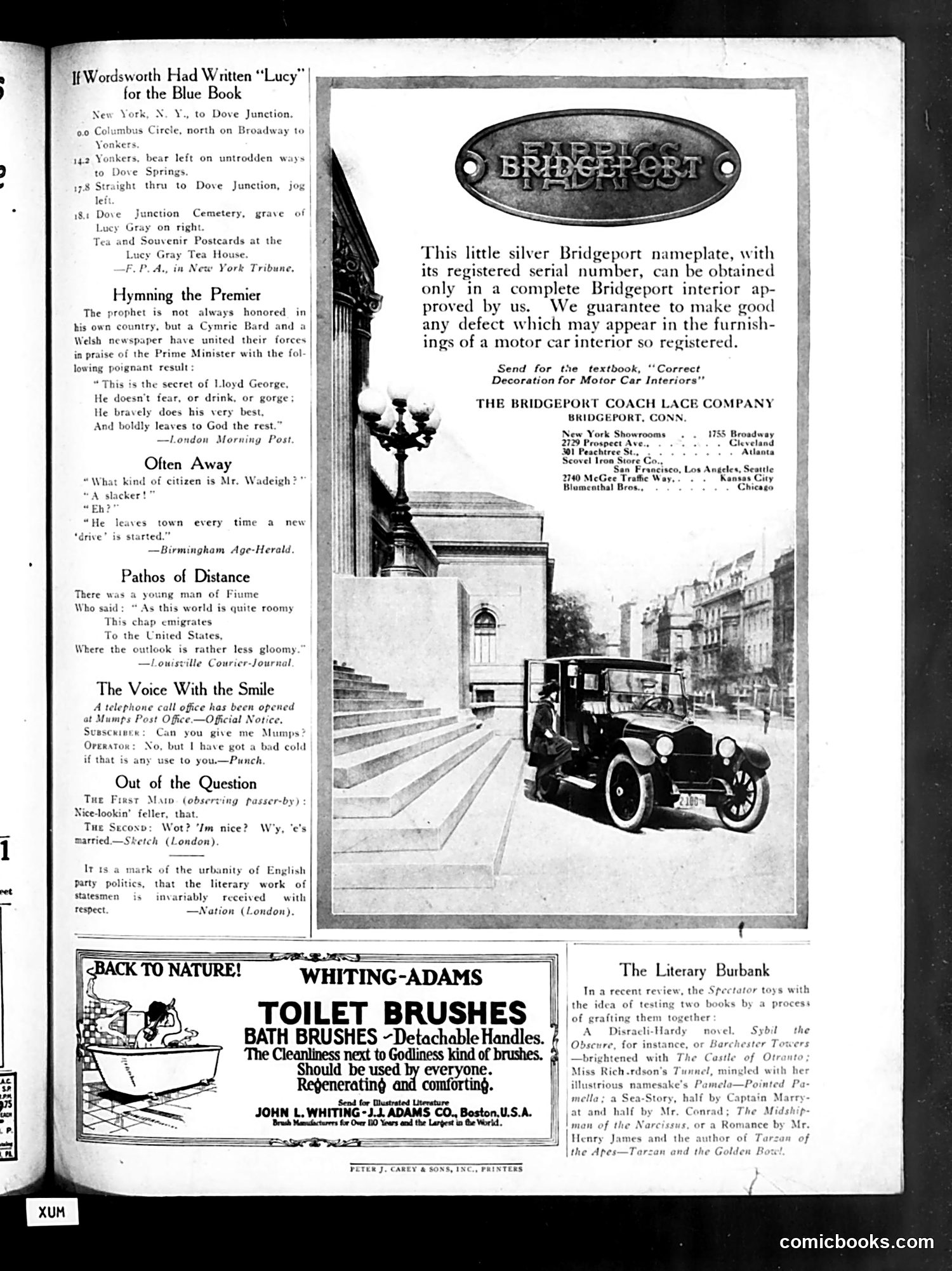
This page contains **satirical literary commentary and advertisements** rather than political cartoons. The left column features humorous literary parodies and short jokes from various publications (London Morning Post, Birmingham Age-Herald, Punch, etc.). Notable is a poem praising British Prime Minister Lloyd George, presenting him as virtuous and God-fearing—likely satirizing overwrought political praise. Other jokes mock everyday absurdities: a man called a "slacker" for leaving town during civic drives; a telephone operator's confusion about "Mumps"; observations about marriage and appearance. The **right side is primarily advertisement** for Bridgeport Coach Lace Company's luxury automobile interior nameplates and accessories, featuring a period car photograph. The bottom advertises **Whiting-Adams toilet brushes** with "Back to Nature" branding. "The Literary Burbank" column (bottom right) discusses a literary review combining famous classic novels with contemporary works—a playful commentary on literary mixing. The page is mostly **commercial and light entertainment**, not substantive satire requiring historical context beyond general early-20th-century product advertising.
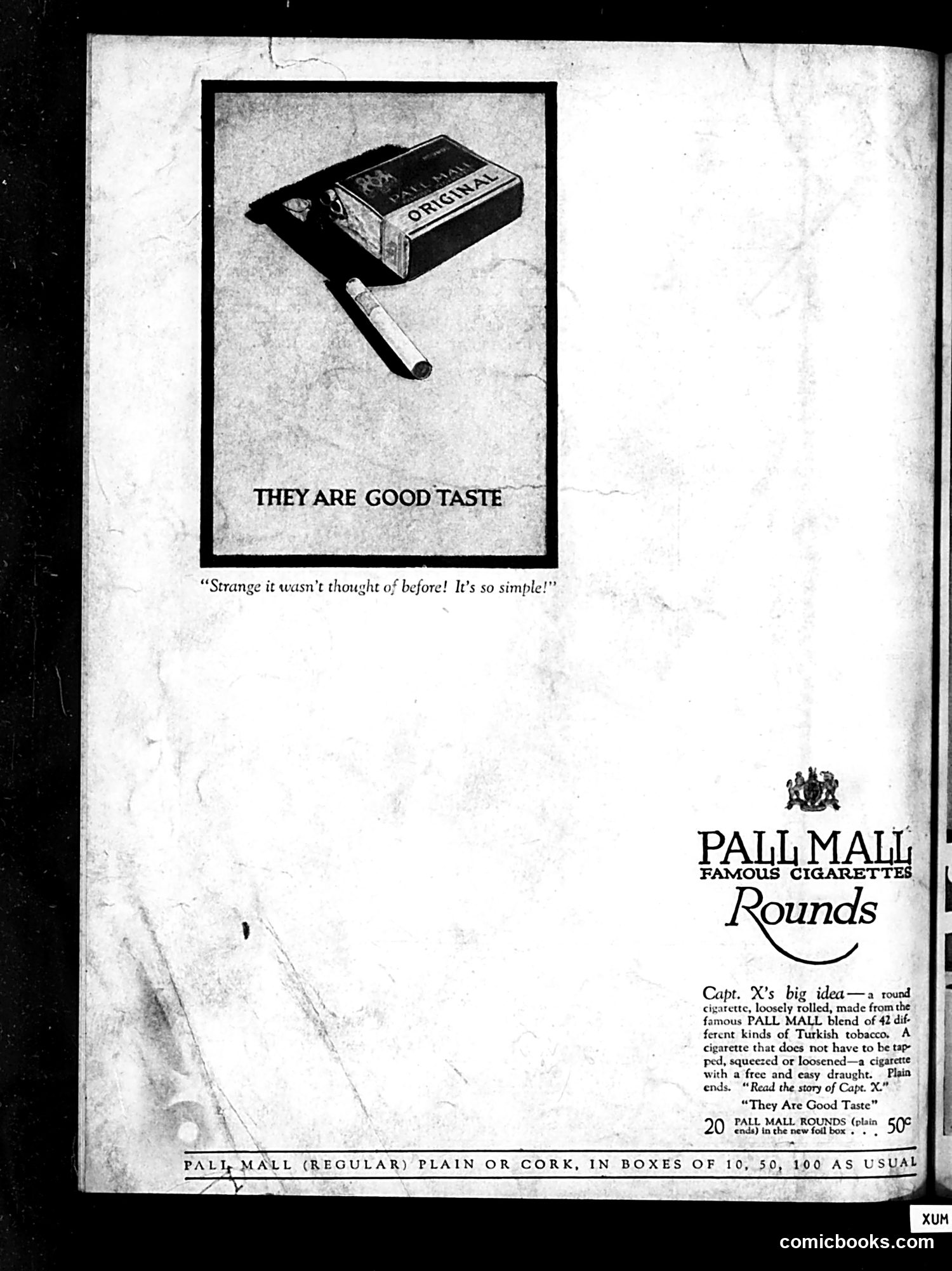
This is **vintage cigarette advertising**, not political satire. The page promotes Pall Mall's "Rounds" cigarettes through a fictional narrative device. The "cartoon" shows a cigarette box and single cigarette with the tagline "They Are Good Taste." The accompanying text presents "Capt. X's big idea"—a round, loosely-rolled cigarette that supposedly doesn't require tapping or squeezing. The quoted reaction ("Strange it wasn't thought of before! It's so simple!") mimics consumer testimonials praising the product's innovation. For modern readers: This illustrates early 20th-century marketing strategy, when cigarette companies actively advertised health and convenience benefits. The "Capt. X" framing creates a pseudo-factual narrative to sell a mundane product feature as revolutionary. The phrase "Good Taste" operates as both flavor claim and aspirational messaging—suggesting sophistication through cigarette choice.