
Life, 1921-02-10 · page 22 of 42
Life — February 10, 1921 — page 22: what you’re looking at
What you’re looking at
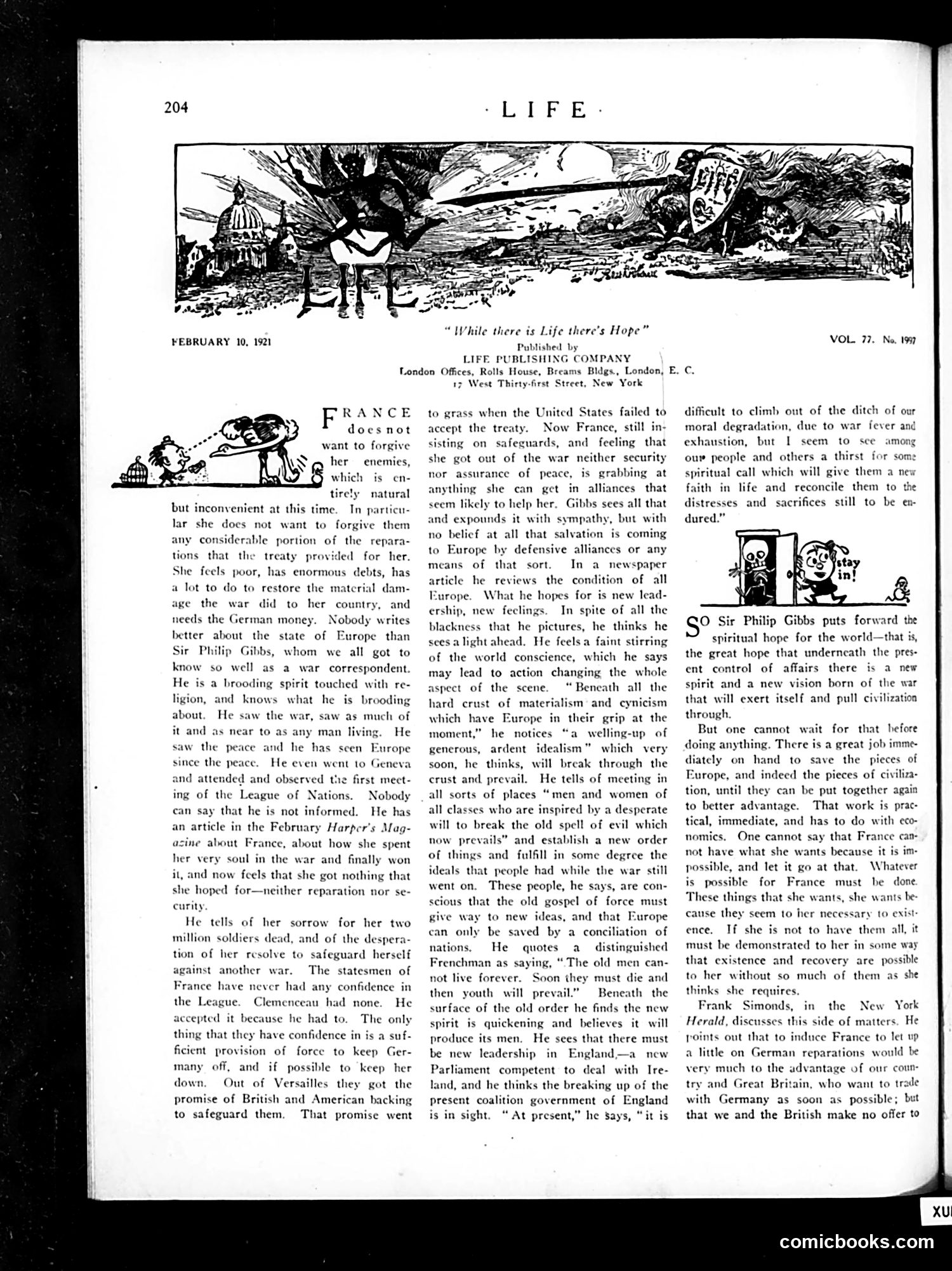
This page discusses post-WWI France's bitter disappointment and security anxieties. Sir Philip Gibbs, a respected war correspondent, argues that France—despite winning the war—feels cheated: she lost 2 million soldiers, suffered massive material destruction, and received neither adequate German reparations nor the promised Anglo-American military backing (the U.S. Senate rejected the Treaty of Versailles). France, distrusting the League of Nations, desperately seeks defensive alliances instead. However, Gibbs offers cautious optimism: beneath Europe's materialism and cynicism, he detects a "welling-up" of conscience and idealism among ordinary people across classes who reject the old gospel of force. He believes youth and new leadership will eventually prevail and reconcile nations. The cartoon's meaning remains unclear from the image alone.
📄 Transcribed text from this page (OCR, searchable)
Machine-transcribed from the original scan — historical spelling and the odd misread are preserved.
FEBRUARY 10, 1921 London Offices, Roll RANCE doesnot want to forgive her enemies, which is en- tirely natural but inconvenient at this time. In particu- lar she does not want to forgive them considera any le portion of the repara- tions that the treaty provided for her. She feels poor, has enormous debts, has a lot to do to restore the material m= age the war did to her country, and needs the German money. Nobody writes better about the state of Europe than Sir Philip Gibbs, whom we all got to know so well as a war correspondent. He is a brooding spirit touched with r what he He saw the war, saw as much of ligion, and knows is brooding about it and as near to as any man living. He saw the peace and he has seen Europe since the peace. He even went to Geneva and attended and observed the first meet- Nobody He has y Harper's Mag- azine about France, about how she spent ing of the League of Nations. can say that he is not informed. an article in the Februa her very soul in the war and finally won it, and now feels that she got nothing that she hoped for—neither reparation nor se- curity. He tells of for her two million soldiers dead, and of the despera- her sorrow tion of her resolve to safeguard herself against another war. The statesmen of France have never had any confidence in the League. accepted it because he had to. Clemenceau had none. He The only thing that they have confidence in is a suf- ficient provision of force to keep Ger- many off, and if possible to keep her down. Out of Versailles they got the promise of British and American backing to safeguard them. That promise went “While there is Life there’s Hope” Published by LIFE PUBLISHING COMPA 17 West Thirty-first Street, New York to grass when the United States failed to ot the treaty. Now France, still in- sisting on safeguards, and feeling that she got out of the war neither security nor peace, is grabbing at anything she can get in alliances that seem likely to help her, Gibbs sees all that and expounds it with sympathy, but with no belief at all that salvation is coming to Europe by defensive alliances or any that sort. In a newspaper article he reviews the condition of all Europe. What he hopes for is new lead- ership, new feclings. In spite of all the blackness that he pictures, he thinks he sees assurance of means of light ahead. He feels a faint stirring of the world conscience, which he says may lead to action changing the whole aspect of the “Beneath all the hard crust of materialism and cynicism which have Europe in their grip at the moment,” he welling-up of generous, ardent which ve! soon, he thinks, will break through the crust and prevail. He tells of meeting in all sorts of places “men and women of all classes who are inspired by a desperate will to break the old spell of evil which now prevails” and establish a new order of things and fulfill in some degree the ideals that people had while the war still went on. These people, he s: scene. notices idealism" s, are con- scious that the old gospel of force must give way to new ideas, and that Europe can only be saved by a conciliation of nations, He quotes a distinguished Frenchman as saying, “The old men can- not live forever. Soon they must die and then youth will prevail.” Beneath the surface of the old order he finds the new spirit is quickening and believes it will produce its men. He sees that there must be new leadership in) England—a new Parliament competent to deal with Ire- land, and he thinks the breaking up of the present coalition government of England is in sight. “At present,” he Says, “it is VOL. 77. No. 1997 s House, Breams Bldgs, London, E. C. difficult to climb out of the ditch of our moral degradation, due to war fever and exhaustion, but I our people and others a thirst for some seem tO sce among spiritual call which will give them a new life and reconcile them to and sacrifices still to be e faith in distresses O Sir Philip Gibbs puts forward spiritual hope for the world—that is, the great hope that underncath the pres- ent control of affairs there is spirit and a new vision born of the war that will exert itself and pull civilization through. But one cannot wait for that doing anything. There is a great job imme- diately on hand to save the pieces of Europe, and indeed the pieces of civiliza- tion, until they can be put together again to better advantage. That work is prac- tical, immediate, and has to do with eco- nomics. One cannot say that France can- not have what she wants because it is im- possible, and let it go at that. Whatever is possible for France must be done These things that she wants, she wants be- a new hefore cause they seem to her necessary to exist ence. If she is not to have them all, it must be demonstrated to her in some way that existence and recovery are possible to her without so much of them as she thinks she requires. Frank Simonds, in the New York Herald, discusses this side of matters. He points out that to induce France to let up a little on German reparations would be very much to the advantage of our coun try and Great Britain, who want to trade with Germany as soon as possible; but that we and the British make no offer to comicbooks.com