
Life, 1921-02-10 · page 33 of 42
Life — February 10, 1921 — page 33: what you’re looking at
What you’re looking at
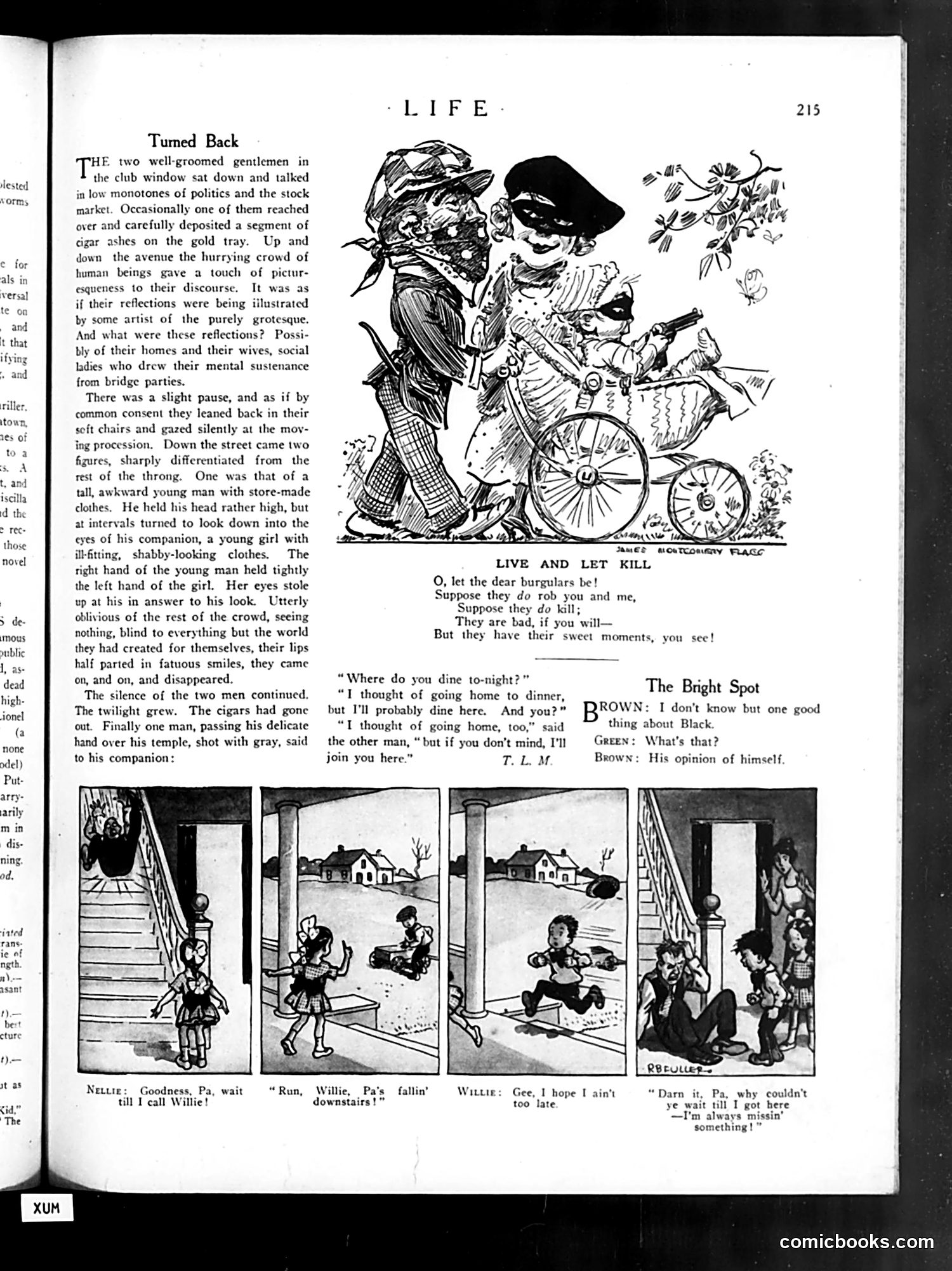
**"Turned Back"** (top illustration and story): This depicts two wealthy club members observing a young working-class couple pass by on the street—clearly in love, holding hands, oblivious to the world. The satire contrasts the gentlemen's empty lives (discussing stocks, cigars, their wives' bridge parties) with the couple's genuine happiness despite their poverty and shabby clothes. The point: material wealth and social status cannot purchase the authentic joy these poor young people possess. It's a critique of upper-class materialism and spiritual emptiness. **"Live and Let Kill"** (verse): A sardonic commentary on burglary and murder, suggesting criminals have "sweet moments" worth tolerating. This appears to mock sentimental attitudes toward crime or criminals. **"The Bright Spot"** (comic strip): Children attempting mischief—running downstairs, falling—while parents try unsuccessfully to supervise. The humor lies in children's chaos and parental frustration at constantly missing teachable moments.
📄 Transcribed text from this page (OCR, searchable)
Machine-transcribed from the original scan — historical spelling and the odd misread are preserved.
ested vorms ¢ for als in versal 2¢s of toa A t, and iscilla id the > ree: those novel > de- mous oublic dead high- ionel (a none odel) Put- arry- arily m in dis- ning. od, ‘ated rans ie af ngth. n\-— asant t= bert Tumed Back HE two well-groomed gentlemen in the club window sat down and talked in low monotones of politics and the stock market. Occasionally one of them reached over and carefully deposited a segment of cigar ashes on the gold tray. Up and down the avenue the hurrying crowd of human beings gave a touch of pictur- esqueness to their discourse. It was as if their reflections were being illustrated by some artist of the purely grotesque. And what were these reflections? Possi- bly of their homes and their wives, social ladies who drew their mental sustenance from bridge parties. There was a slight pause, and as if by common consent they leaned back in their soft chairs and gazed silently at the moy- ing procession. Down the street came two figures, sharply differentiated from the rest of the throng. One was that of a tall, awkward young man with store-made clothes. He held his head rather high, but at intervals turned to look down into the eyes of his companion, a young girl with ill-fitting, shabby-looking clothes. The right hand of the young man held tightly the left hand of the girl, Her eyes stole up at his in answer to his look. Utterly oblivious of the rest of the crowd, seeing nothing, blind to everything but the world they had created for themselves, their lips half parted in fatuous smiles, they came ‘on, and on, and disappeared. The silence of the two men continued, The twilight grew. The cigars had gone out. Finally one man, passing his delicate hand over his temple, shot with gray, said to his companion: Neue: Goodness, Pa, wait till I call Willie! “Run, Jamel MOuTCOMERY RAGS LIVE AND LET KILL O, let the dear burgulars be! Suppose they do rob you and me, Suppose they do kill; They are bad, if you ‘will— But they have their sweet moments, you see! “Where do you dine to-night?” “T thought of going home to dinner, but I'll probably dine here. And you?” “T thought of going home, too,” said the other man, “ but if you don’t mind, I'll join you here.” T. L. M. Willie, Pa's fallin’ Witte: downstairs!" too late Gee, I hope I ain't The Bright Spot ROWN: I don’t know but one good thing about Black. Green: What's that? His opinion of himself. “Darn it, Pa, why couldn't ye wait till I got here —I'm always missin’ something!” comicbooks.com