
Life, 1921-02-10 · page 32 of 42
Life — February 10, 1921 — page 32: what you’re looking at
What you’re looking at
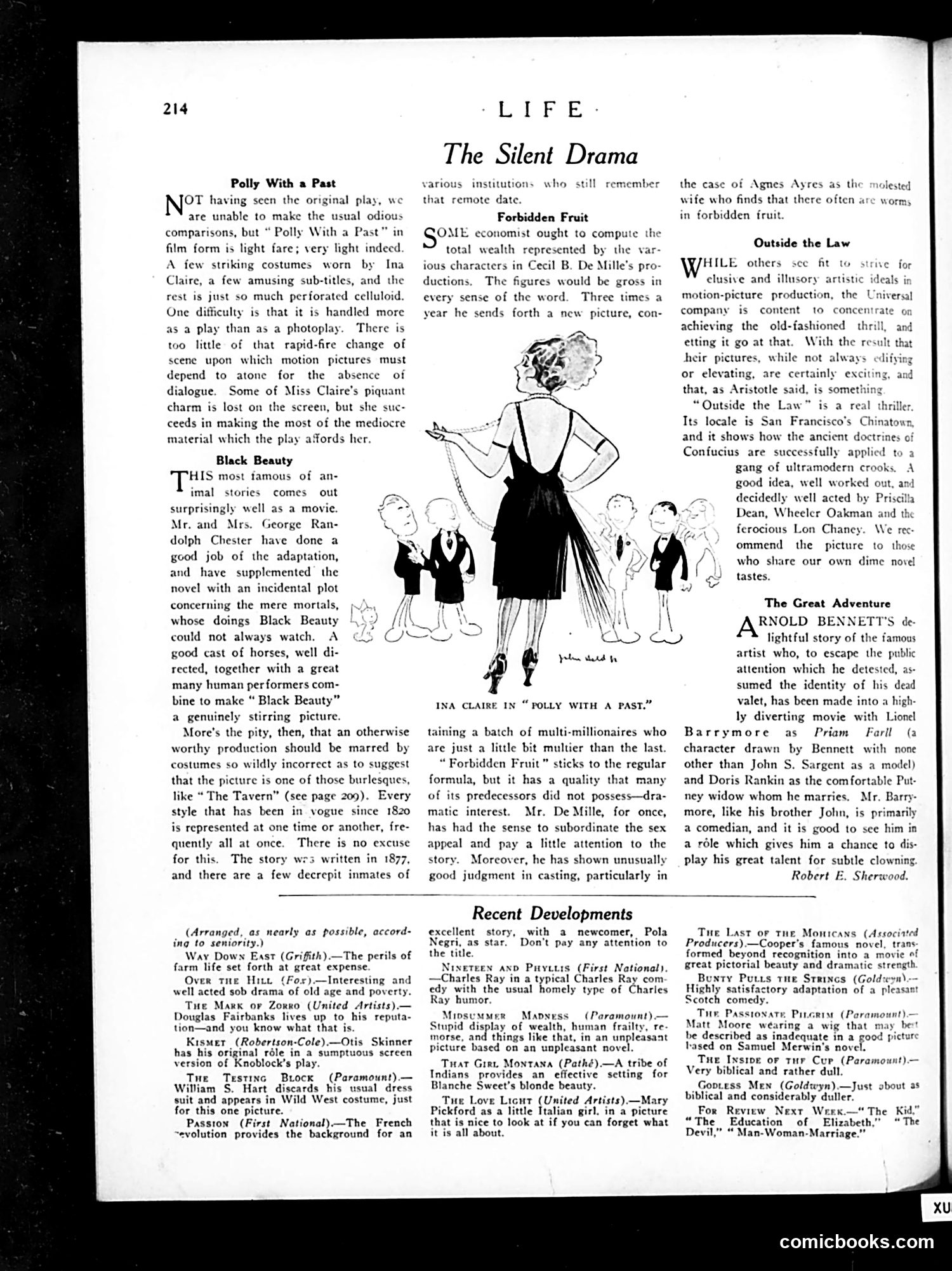
This page reviews silent films from circa 1920. The main illustration shows actress **Ina Claire** in "Polly With a Past"—depicted as a woman in fashionable dress surrounded by smaller figures (likely male admirers), satirizing the film's lightweight romantic plot. The reviews reveal period concerns: critics praise "Black Beauty" as a well-executed adaptation of the 1877 novel but mock its wildly anachronistic costumes spanning 1820-present, suggesting production carelessness. "Forbidden Fruit" by Cecil B. De Mille is criticized for his formulaic pattern of depicting wealthy characters, though this entry is praised for actually developing dramatic interest beyond mere "sex appeal." "Outside the Law" uses San Francisco's Chinatown setting to apply Confucian philosophy to crime narratives. The satire targets both filmmaking excess (De Mille's repetitive millionaire dramas) and technical incompetence (costume design), while praising intelligent adaptation and storytelling over shallow sensationalism.
📄 Transcribed text from this page (OCR, searchable)
Machine-transcribed from the original scan — historical spelling and the odd misread are preserved.
Polly With a Past ‘OT having seen the original play, we are unable to make the usual odious comparisons, but “ Polly With a Past” in film form is light fare; very light indeed. A few striking costumes Ina Claire, a few amusing sub-titles, and the rest is just so much perforated celluloid. One difficulty is that it is handled more as a play than as a photoplay. There is little of that rapid-fire change of scene upon which motion pictures must depend to atone for the absence of dialogue. Some of Miss Claire’s piquant charm is lost on the screen, but she suc- ceeds in making the most of the mediocre material which the play affords her. Black Beauty HIS most famous of an- comes out surprisingly well as a movie. Mr. and Mrs. George Ran- dolph Chester have done a good job of the adaptation, and have supplemented the novel with an incidental plot worn by too imal stories concerning the mere mortals, whose doings Black Beauty could not always watch, A good cast of horses, well di- rected, together with a great many human performers com- bine to make “ Black Beauty” a genuinely stirring picture. More's the pity, then, that an otherwise worthy production should be marred by costumes so wildly incorrect as to suggest that the picture is one of those burlesques, like “ The Tavern” (see page 209). Every style that has been in vogue since 1820 is represented at one time or another, fre- quently all at once. There is no excuse for this. The story wz3 written in 1877, and there are a few decrepit inmates of (Arranged, as nearly as possible, accord ing to seniority.) Way Dow East (Grifith).—The perils of farm life set forth at great expense Over the Hitt (For).—Interesting and well acted sob drama of old age and poverty. Tue Marx or Zoxro (United Artists) — Douglas Fairbanks lives up to his reputa- tion—and you know what that is. Kismet (Robertson-Cole).—Otis Skinner has his original réle ina sumptuous screen version of Knoblock’s play. Tue Testixc Broce (Paramount).— William S. Hart discards his usual dress suit and appears in Wild West costume, just for this one picture. Passion (First National) —The French ~evolution provides the background for an ~-LIFE- The Silent Drama various instituti who still remember that remote date. Forbidden Fruit Some economist ought to compute the total wealth represented by the var- ious characters in Cecil B. De Mille’s pro- ductions, The figures would be gross in every sense of the word. Three times a ar he sends forth a new picture, con- INA CLAIRE “POLLY WITH A PAST.” taining a batch of multi-millionaires who are just a little bit multier than the last. “Forbidden Fruit” sticks to the regular formula, but it has a quality that many of its predecessors did not possess—dra- matic interest. Mr. De Mille, for once, has had the sense to subordinate the sex appeal and pay a little attention to the story. Moreover, he has shown unusually good judgment in casting, particularly in the case of Agnes Ayres as the molested wife who finds that there often are w in forbidden fruit. Outside the Law others see fit to stri for HILE elusive and illusory artistic Is ir motion-picture production, the | company is content 10 niversal concentrat achieving the old-fashioned etting it go at that. With the re heir pictures, while not always edify or elevating, are certainly exciting, and that, as Aristotle said, is something “Outside the Law” is a real t Its locale is San Francisco's Ch and it shows how the ancient doc Confucius are successfully applied t gang of ultramodern crooks good idea, well worked out, and decidedly well acted by Priscilla Dean, Wheeler Oakman and th ferocious Lon Chaney. We rec- ommend the picture to who share our own dime novel tastes. those The Great Adventure RNOLD BENNETT'S de- lightful story of the famous artist who, to escape the public attention which he detested, as- sumed the identity of his dead valet, has been made into a high- ly diverting movie with Lionel Barrymore as Priam Farll (a character drawn by Bennett with none other than John S. Sargent as a model) and Doris Rankin as the comfortable Put- ney widow whom he marries. Mr. Barry- more, like his brother John, is primarily a comedian, and it is good to see him in a réle which gives him a chance to dis- play his great talent for subtle clowning. Robert E, Sherwood. Recent Developments excellent story, Negri, as star. the title. Nixeteex axp Puvitts (First National). —Charles Ray in a typical Charles Ray com edy with the usual homely type of Charles Ray humor, Minseaaer Mapyess (Paramount Stupid display of wealth, human frailty, re- morse, and things like that, in an unpleasant picture based on an unpleasant novel. Titat Girt Montana (Pathé).—A tribe of Indians provides an effective setting for Blanche Sweet’s blonde beauty. Tue Love Licut (United Artists).—Mary Pickford as a little Italian girl. in a picture at is nice to look at if you can forget what all about. with a newcomer, Pola Don't pay any attention to Tue Last of tue Montcans (Associnted Producers).—Cooper’s famous novel, trans: formed beyond recognition into a movie of great pictorial beauty and dramatic str Bunty Putts tne Sreixcs (Goldwyn). Highly satisfactory adaptation of a pleasant Scotch comedy, Tur, Passtonate. Pincrima (Peramon Matt Moore wearing a wig that may be described as inadequate in a good pictur lased on Samuel Merwin’s novel. Tue Ixstpe oF tr Cur (Paramount) — Very biblical and rather dull. Govtess Men (Goldwyn).—Just obout as biblical and considerably duller. For Review Next Weex.— The Kid.” “The ducation of Elizabeth. i Man-Woman-Marriage.” comicbooks.com