
Life, 1921-02-10 · page 26 of 42
Life — February 10, 1921 — page 26: what you’re looking at
What you’re looking at
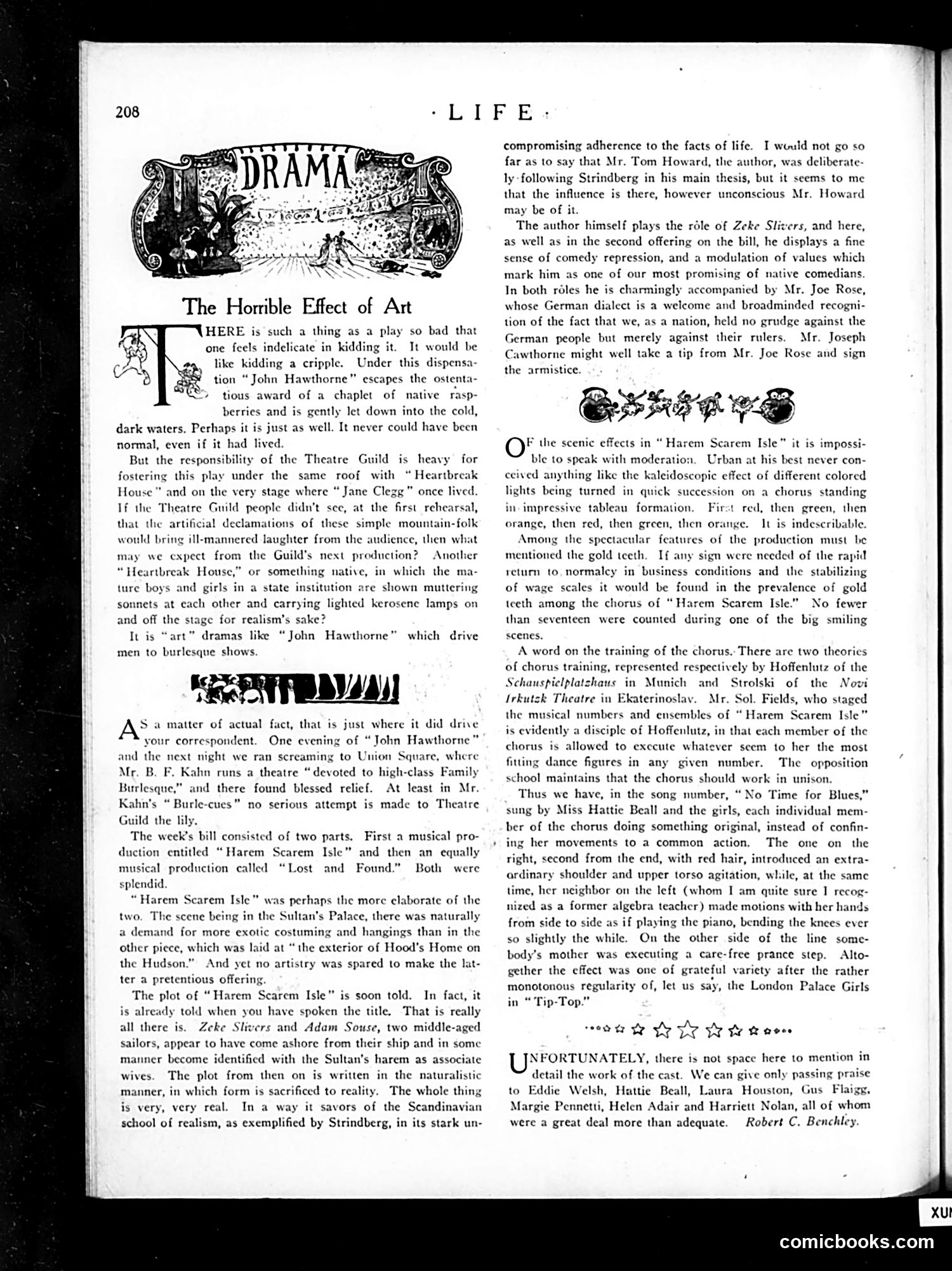
This satirical review contrasts serious theatrical productions with lowbrow entertainment. The critic reviews a Theatre Guild production of "John Hawthorne"—deemed so artistically poor that mocking it feels cruel. The author sarcastically notes the Guild's responsibility is "heavy" given their reputation for serious drama like "Heartbreak House." The piece then humorously pivots to praising a "high-class Family Burlesque" show at Union Square, where two musical comedies ("Harem Scarem Isle" and "Lost and Found") provided genuine entertainment and relief. The satire targets pretentious art theater: the critic suggests the Guild might next stage institutional patients reciting sonnets with kerosene lamps "for realism's sake"—mocking excessive adherence to naturalistic aesthetics (comparing it to Strindberg's style). The review praises the burlesque performers, particularly comedian Tom Howard and Joe Rose's German dialect, which the critic notes tactfully represents post-war American goodwill toward German people rather than their "rulers."
📄 Transcribed text from this page (OCR, searchable)
Machine-transcribed from the original scan — historical spelling and the odd misread are preserved.
*LIFE: s a play so bad that one feels indelicate in kidding it. It would be like kidding a cripple. Under this dispensa- tion “John Hawthorne” escapes the ostenta- > tious award of a chaplet of native rasp- berries and is gently let down into the cold, dark waters. Perhaps it is just as well. It never could have been normal, even if it had lived. But the responsibility of the Theatre Guild is heavy for fostering this play under the same roof with “ Heartbreak House” and on the very stage where “ Jane Clegg" once lived. If the Theatre Guild people didn’t ses the first rehearsal, that the artificial declamations of these simple mountain-folk would bring ill-mannered laughter from the audience, then what may we expect from the Guild's next production? Another “Heartbreak House,” or something native, in which the ma- ture boys and girls in a state institution are shown muttering sonnets at cach other and carrying lighted kerosene lamps on and off the stage for realism’s sake? dramas like “ men to burlesque shows. ese i i AT YI It is “art John Hawthorne” which drive AS a matter of actual fact, that is just where it did drive our correspondent. One evening of “John Hawthorne” and the next night we ran screaming to Union Square, where Mr. B. F, Kahn runs a theatre “devoted to high-class Family Burlesque,” and there found blessed relief. At least in Mr Kahn's “Burle-cues” no serious attempt is made to Theatre Guild the lily. The week's bill consisted of two parts duction entitled “Harem Scarem Isle musical production called “Lost and splendid. “Harem S First a musical pro- and then an equally Found.” Both were ‘arem Isle” was perhaps the more elaborate of the two. The scene being in the Sultan's Palace, there was naturally a demand for more exotic costuming and hangings than in the other piece, which was laid at “ the exterior of Hood's Home on the Hudson.” And yet no artistry was spared to make the lat- ter a pretentious offering. The plot of “Harem Scarem Isle" is soon told. In fact, it That is really ke Slivers and Adam Souse, two middle-aged sailors, appear to have come ashore from their ship and in some manner become identified with the Sultan’s harem as associate wives. is already told when you have spoken the title, all there is. The plot from then on is written in the naturalistic manner, in which form is sacrificed to reality. The whole thing is very, very real. In a way it savors of the Scandinavian school of realism, as exemplified by Strindberg, in its stark un- compromising adherence to the facts of life. I would not go so far as to say that Mr. Tom Howard, the author, was deliberate- ly following Strindberg in his main thesis, but it seems to me that the influence is there, however unconscious Mr. Howard may be of it. The author himself plays the role of Zeke Slivers, and here, as well as in the second offering on the bill, he displays a fine sense of comedy repression, and a modulation of values which mark him as one of our most promising of native comedians. In both rdles he is charmingly accompanied by Mr. Joe Rose, whose German dialect is a welcome and broadminded recogni- tion of the fact that we, as a nation, held no grudge against the German people but merely against their rulers. Mr. Joseph Cawthorne might well take a tip from Mr. Joe Rose and sign GERI e™ O the scenic effects in “ Harem Scarem Isle” it is impossi- ble to speak with moderation. Urban at his best never con- ceived anything like the kaleidoscopic effect of different colored lights being turned in quick succession on a chorus standing in-impressive tableau formation, First red, then green, then orange, then red, then green, then orange. It is indescribable. Among the spectacular features of the production must be mentioned the gold teeth. If any sign were needed of the rapid return to. normalcy in business conditions and the stabilizing e scales it would be found in the prevalence of gold teeth among the chorus of “Harem Scarem Isle.” No fewer than seventeen were counted during one of the big smiling scenes. A word on the training of the chorus. There are two theories of chorus training, represented respectively by Hoffenlutz of the Schauspielplatshaus in Munich and = Strolski of the Irkutsk Theatre in Ekaterinoslay. Mr. Sol. Fields, who staged the musical numbers and ensembles of “Harem Scarem Isle” is evidently a disciple of Hoffenlutz, in that each member of the chorus is allowed to execute whatever seem to her the most Novi fitting dance figures in any given number. The opposition school maintains that the chorus should work in unison. Thus we have, in the song number, “No Time for Blues,” sung by Miss Hattie Beall and the girls, each individual mem- ber of the chorus doing something original, instead of confin- ing her movements to a common action, The one on the right, second from the end, with red hair, introduced an extra- ardinary shoulder and upper torso agitation, while, at the same time, her neighbor on the left (whom I am quite sure I recog- nized as a former algebra teacher) made motions with her hands from side to side as if playing the piano, bending the knees ever so slightly the while. On the other side of the line some- body’s mother was executing a care-free prance step. Alto- gether the effect was one of grateful variety after the rather monotonous regularity of, let us say, the London Palace Girls in “ Tip-Top.” seo Ww LY Ww treo NFORTUNATELY, there is not space here to mention in detail the work of the cast. We can give only passing praise die Welsh, Hattie Beall, Laura Houston, Gus Flaigg, ie Pennetti, Helen Adair and Harriett Nolan, all of whom were a great deal more than adequate. Robert C. Benchley. comicbooks.com