
A complete issue · 36 pages · 1921
Life — January 20, 1921
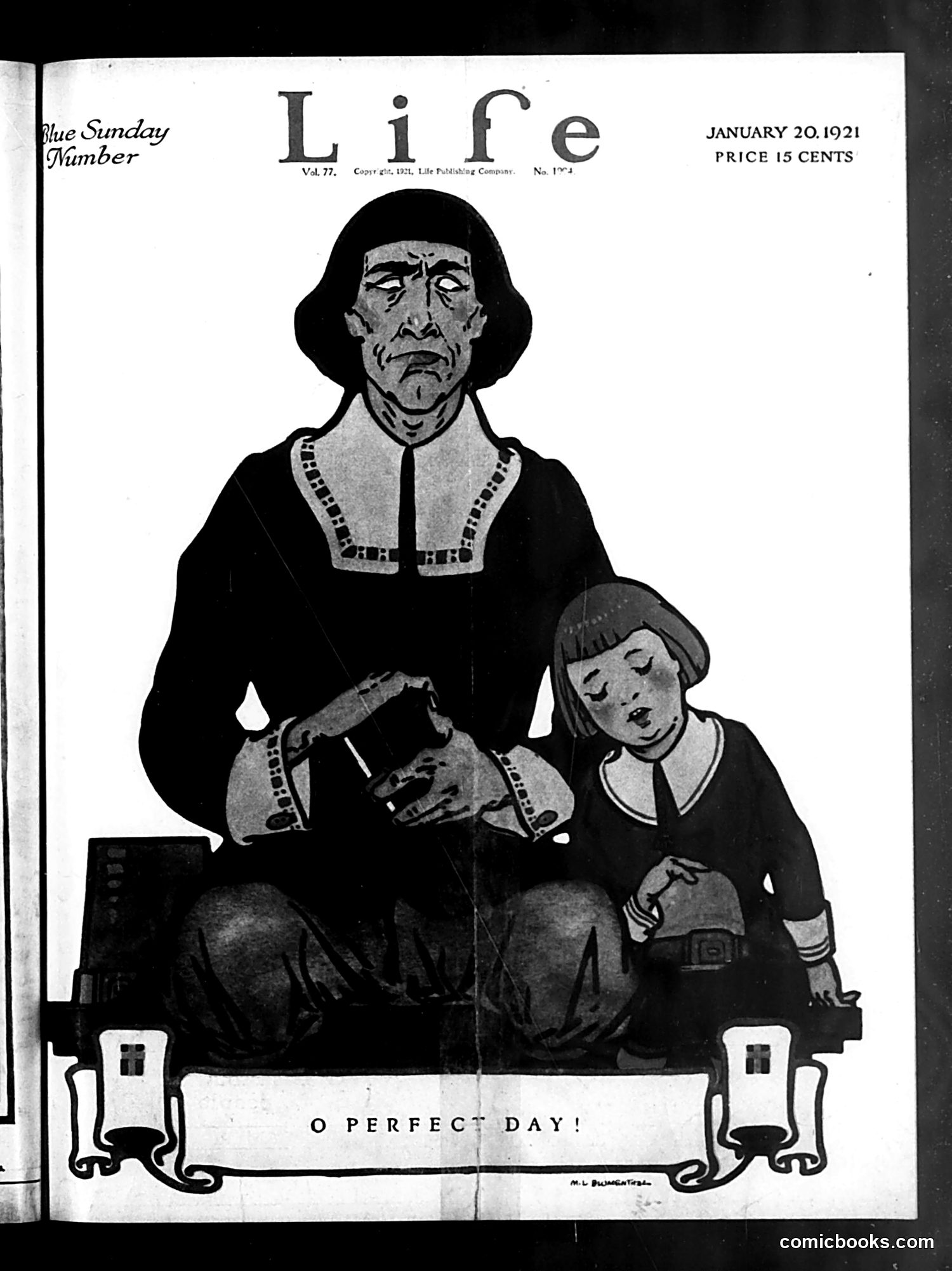
This cover cartoon, titled "Perfect Day!" depicts an adult woman and child in medieval or Tudor-era clothing. The woman holds what appears to be a drinking vessel, suggesting alcohol consumption. The historical context is Prohibition (1920-1933), when alcohol sales became illegal in the United States. The medieval/historical costume styling likely satirizes the idea that drinking had returned to "old-fashioned" or illicit, primitive conditions—people forced to hide their consumption as if living in a bygone era. The caption "Perfect Day!" is ironic, suggesting that despite Prohibition's intent to improve American life, the reality was less ideal. The artwork criticizes how the law pushed alcohol use underground rather than eliminating it.
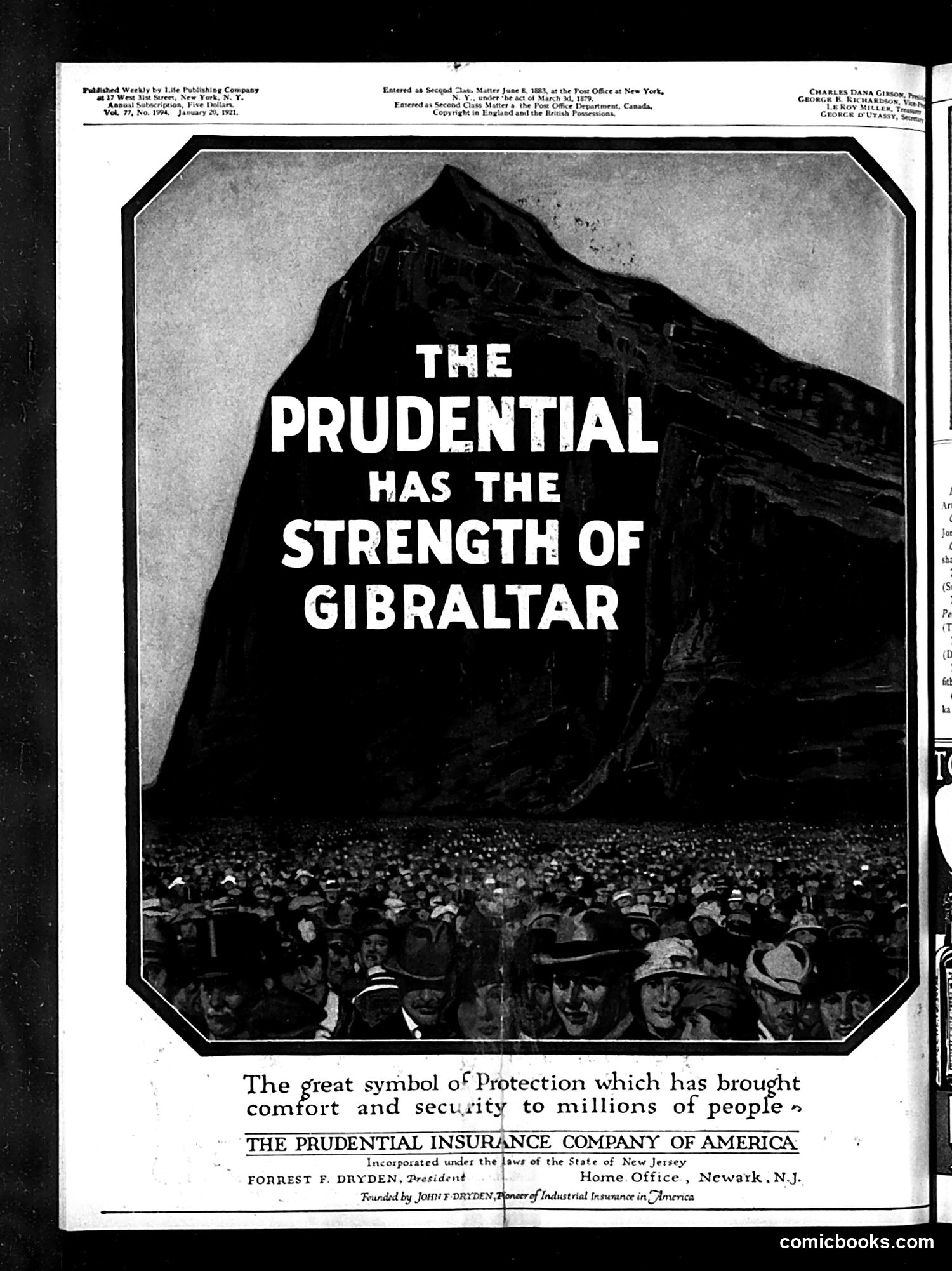
This is an **advertisement**, not satire or a political cartoon. The Prudential Insurance Company of America placed this full-page ad in *Life* magazine (dated January 28, 1921, per the masthead). The ad uses **Gibraltar**—the famous Rock of Gibraltar—as a metaphor for strength and stability. The image shows a massive crowd of people gathered before the imposing rock formation, with the tagline "THE PRUDENTIAL HAS THE STRENGTH OF GIBRALTAR." The advertisement's message is straightforward: Prudential offers reliable, enduring protection like the legendary fortress. The "great symbol of Protection which has brought comfort and security to millions of people" refers to insurance itself. This reflects early-20th-century advertising strategy: equating a commercial product with an iconic natural landmark to convey trustworthiness.
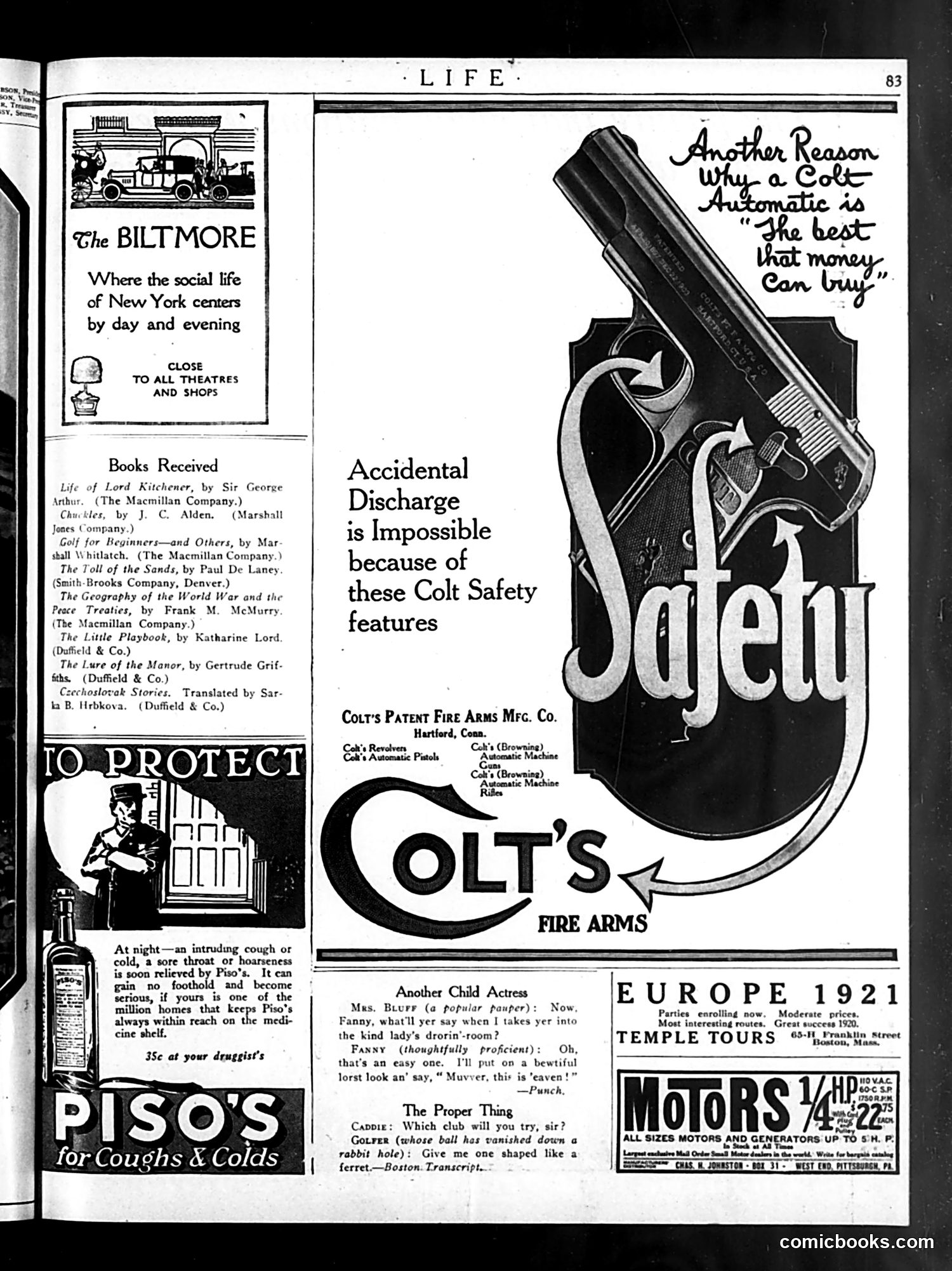
This page is predominantly **advertising** rather than editorial content or satire. The major advertisements are: 1. **Colt's Firearms** (center): Promotes their automatic pistol with the tagline "Another Reason Why a Colt Automatic is 'the best that money can buy.'" The ad emphasizes safety features preventing accidental discharge. 2. **Piso's for Coughs & Colds** (lower left): A patent medicine advertisement. 3. **Europe 1921 Temple Tours** and **MotoBs Motors** (lower right): Travel and automotive ads. The page also includes a "Books Received" section and "The Biltmore" hotel advertisement. There is no discernible political cartoon or satirical content—this appears to be a standard magazine advertising page from the early 1920s promoting consumer goods and services.
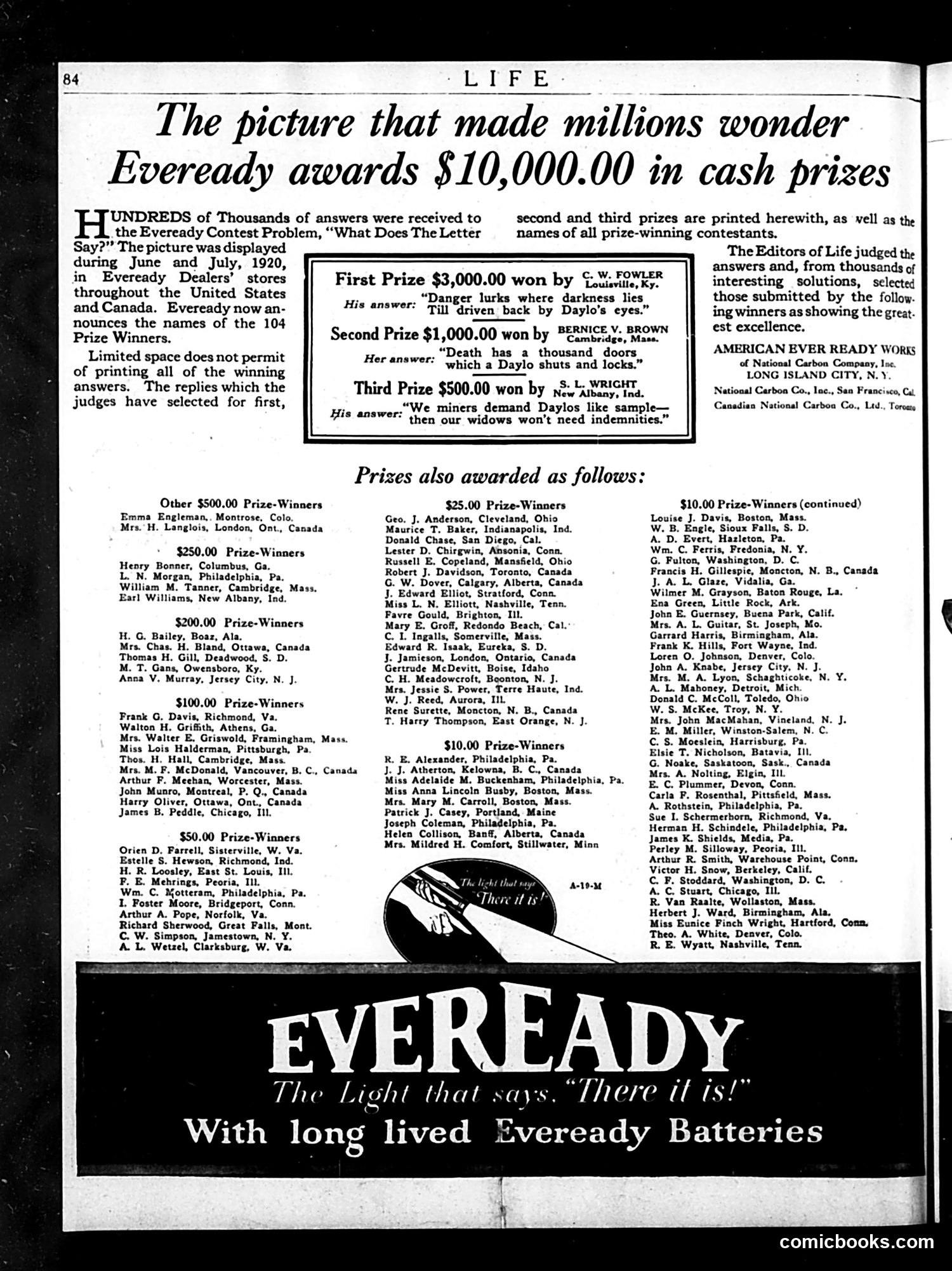
This page is primarily **advertising**, not satirical content. It announces an Eveready battery contest from June-July 1920 where "hundreds of thousands of answers" were submitted to solve "What Does The Letter Say?" The contest awarded $10,000 in total cash prizes: $3,000 (first), $1,000 (second), $500 (third), plus numerous smaller prizes distributed across the United States and Canada. The actual puzzle or cartoon that contestants solved is not visible on this page—only the results and prize winners' names are listed. The small illustration at bottom appears to be Eveready's standard advertising imagery (a light bulb), not a political cartoon. This is essentially a **results announcement and advertisement** for a consumer product contest, lacking satirical or political commentary.
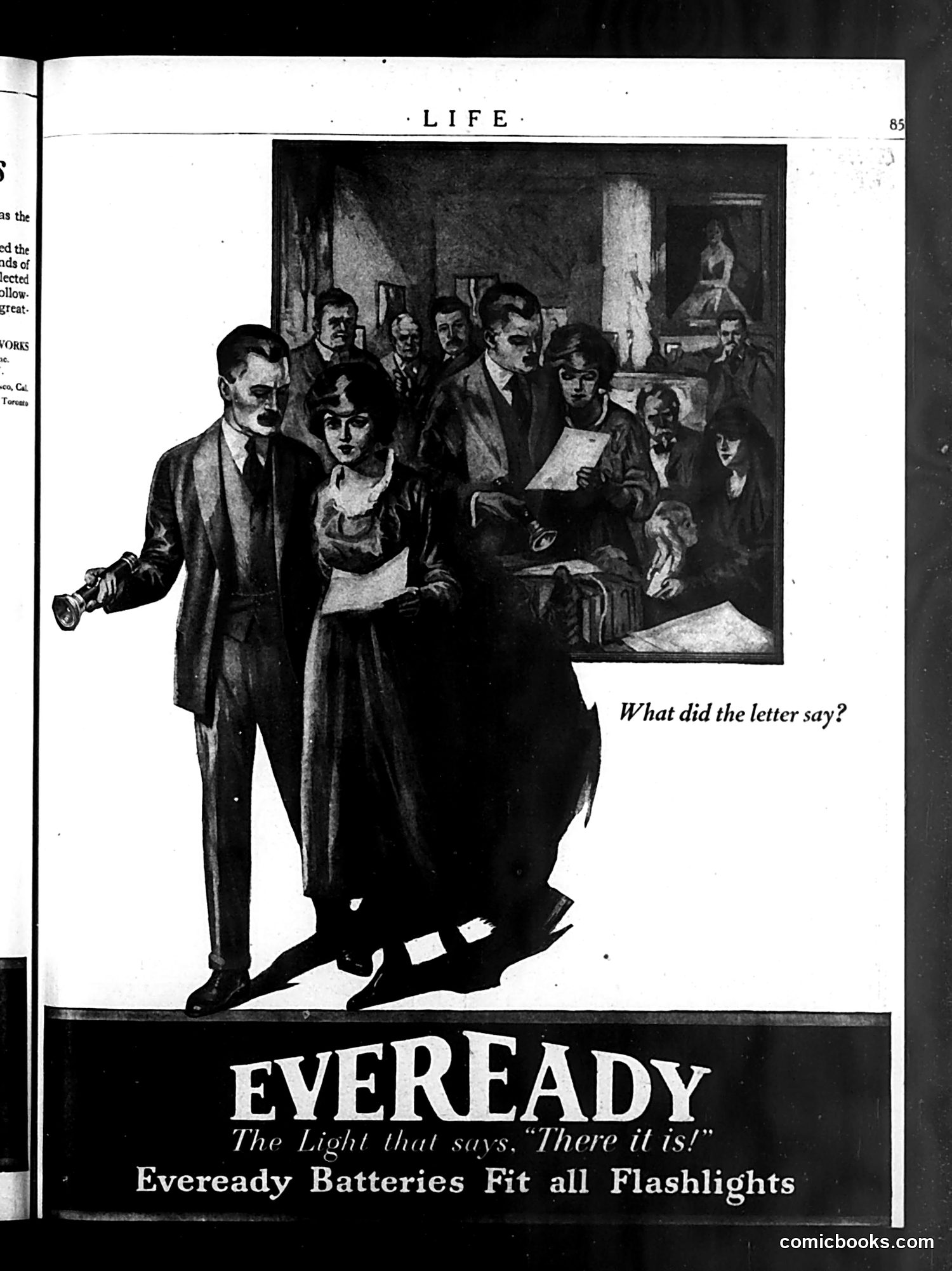
This page is primarily an **advertisement for Eveready Batteries**, not political satire. The illustration depicts a dramatic scene: a man with a flashlight stands beside a woman, both addressing a group of onlookers in what appears to be an interior setting. The caption asks "What did the letter say?"—suggesting a mystery or suspenseful scenario. The ad's tagline—"The Light that says 'There it is!'"—plays on the flashlight's practical utility in revealing hidden objects or solving problems. The dramatic staging and mystery narrative are typical of early 20th-century advertising, using intrigue to make the product seem indispensable. This is **consumer advertising**, not political commentary. The "Life" magazine context simply means it appeared in this popular publication as a paid advertisement.
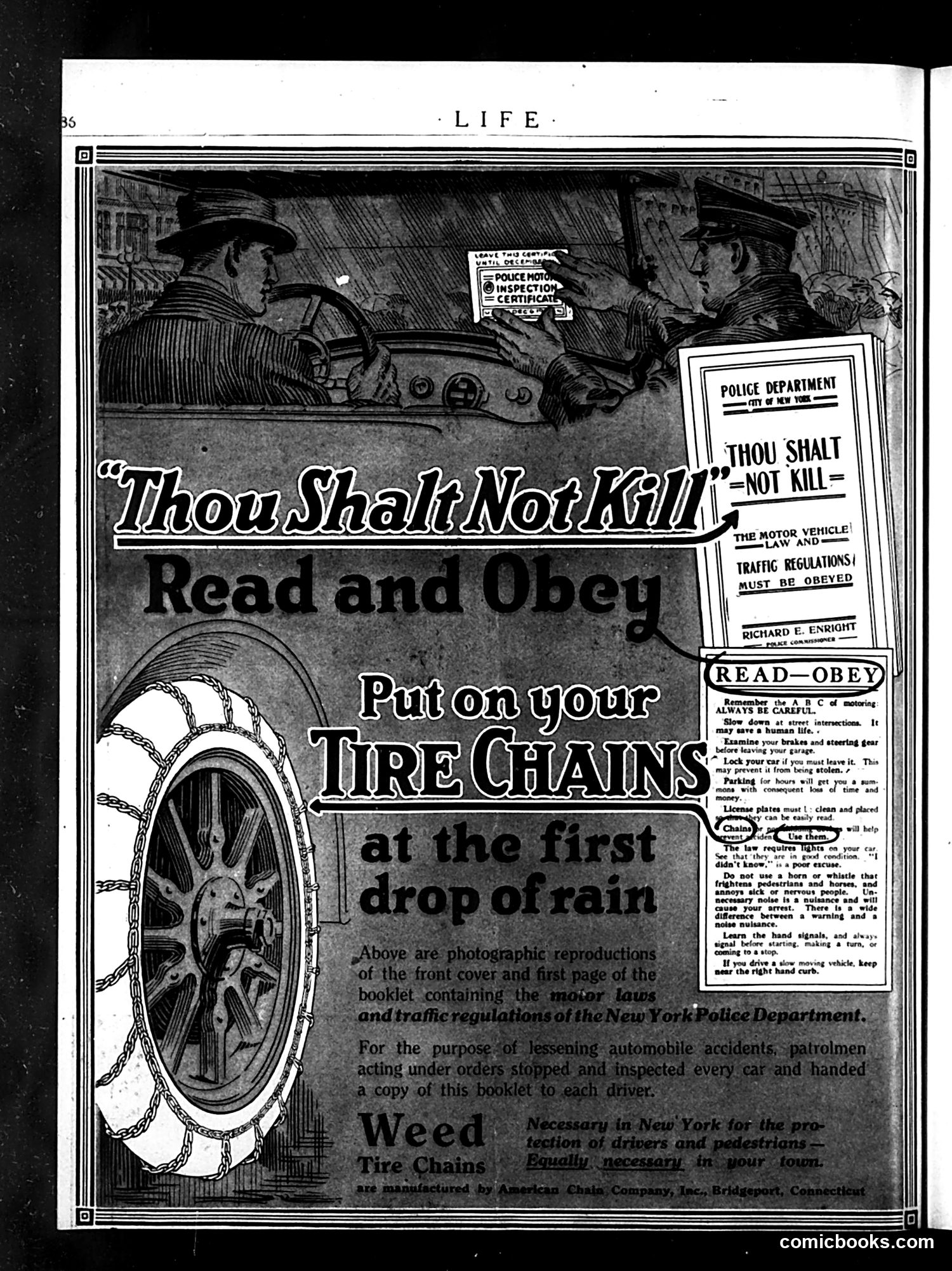
This page is primarily **advertising**, not satire or political commentary. It promotes "Weed Tire Chains" for automobiles, using a public safety angle rather than humor. The ad features: - A large illustration of a tire with chains - A mock police department "inspection certificate" and safety booklet titled "Thou Shalt Not Kill" - Text referencing the New York Police Department's traffic safety campaign The messaging appeals to winter driving safety, encouraging drivers to install tire chains "at the first drop of rain" to prevent accidents. The religious-sounding slogan "Thou Shalt Not Kill" frames safe driving as a moral imperative. The two uniformed figures at top appear to be police officers conducting vehicle inspections, lending authority to the safety message. This reflects early 20th-century automobile safety advocacy before modern regulations existed.
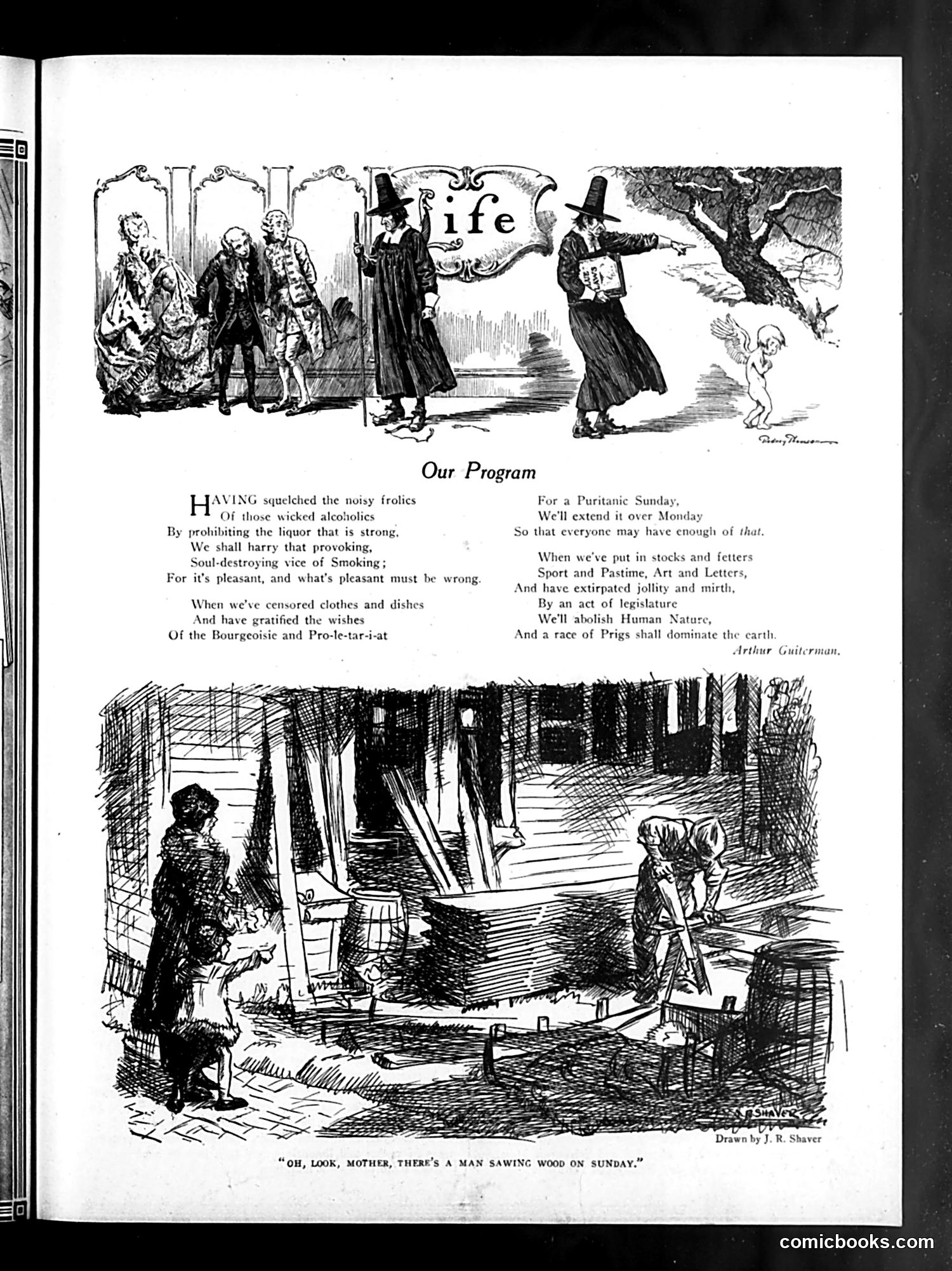
This page satirizes Prohibition-era moral reformism. The poem "Our Program" mocks self-righteous activists who sought to ban alcohol, tobacco, and "immoral" entertainment (referencing censorship of clothes, dishes, and "Bourgeoisie and Pro-la-ri-at"). The verse, attributed to Arthur Gutterman, sarcastically suggests these reformers aim to "abolish Human Nature" and institute authoritarian control through legislation. The lower illustration by J.R. Shaver depicts working-class domestic life—a woman discovering a man sawing wood on Sunday, violating Sabbath restrictions. The caption "'OH, LOOK, MOTHER, THERE'S A MAN SAWING WOOD ON SUNDAY'" mocks the petty moral policing that characterized the Prohibition era's broader campaign to regulate everyday behavior and enforce rigid social standards.
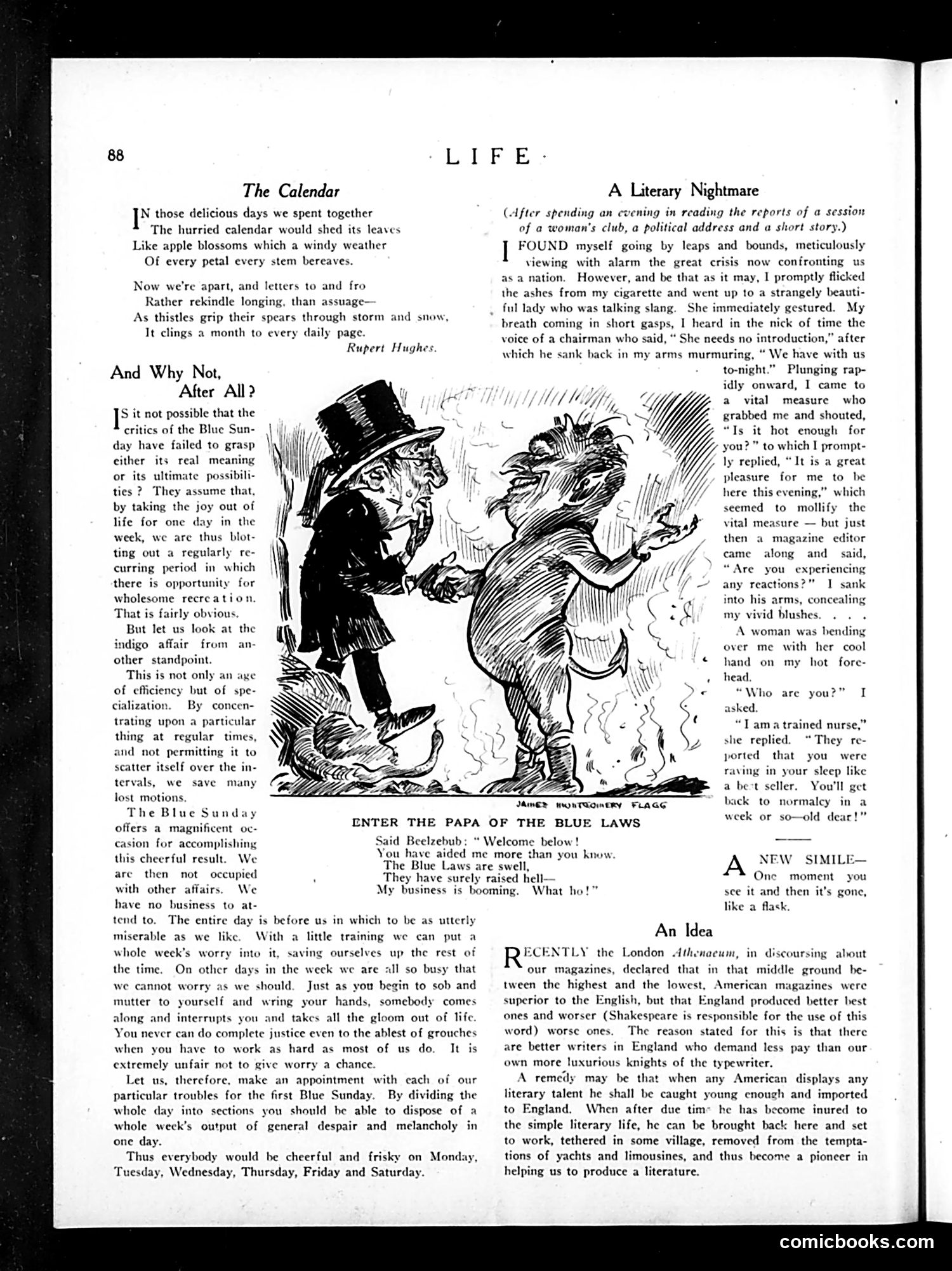
This cartoon satirizes religious or moral censorship—"Blue Laws" being restrictive legislation based on religious doctrine. The illustration shows two figures in a grotesque style: one wearing a top hat (representing authority/establishment) greeting another figure below, with the caption "Welcome below! You have aided me more than you know." The imagery suggests hypocrisy: those enforcing strict moral laws are depicted as demonic or infernal, implying they're not genuinely righteous but rather opportunistic. The satire critiques how censorship advocates and religious moralists profit from or enable moral restriction, presenting them as self-serving rather than principled. The "Blue Laws" reference indicates this targets actual restrictive legislation of the era regulating behavior based on religious grounds.
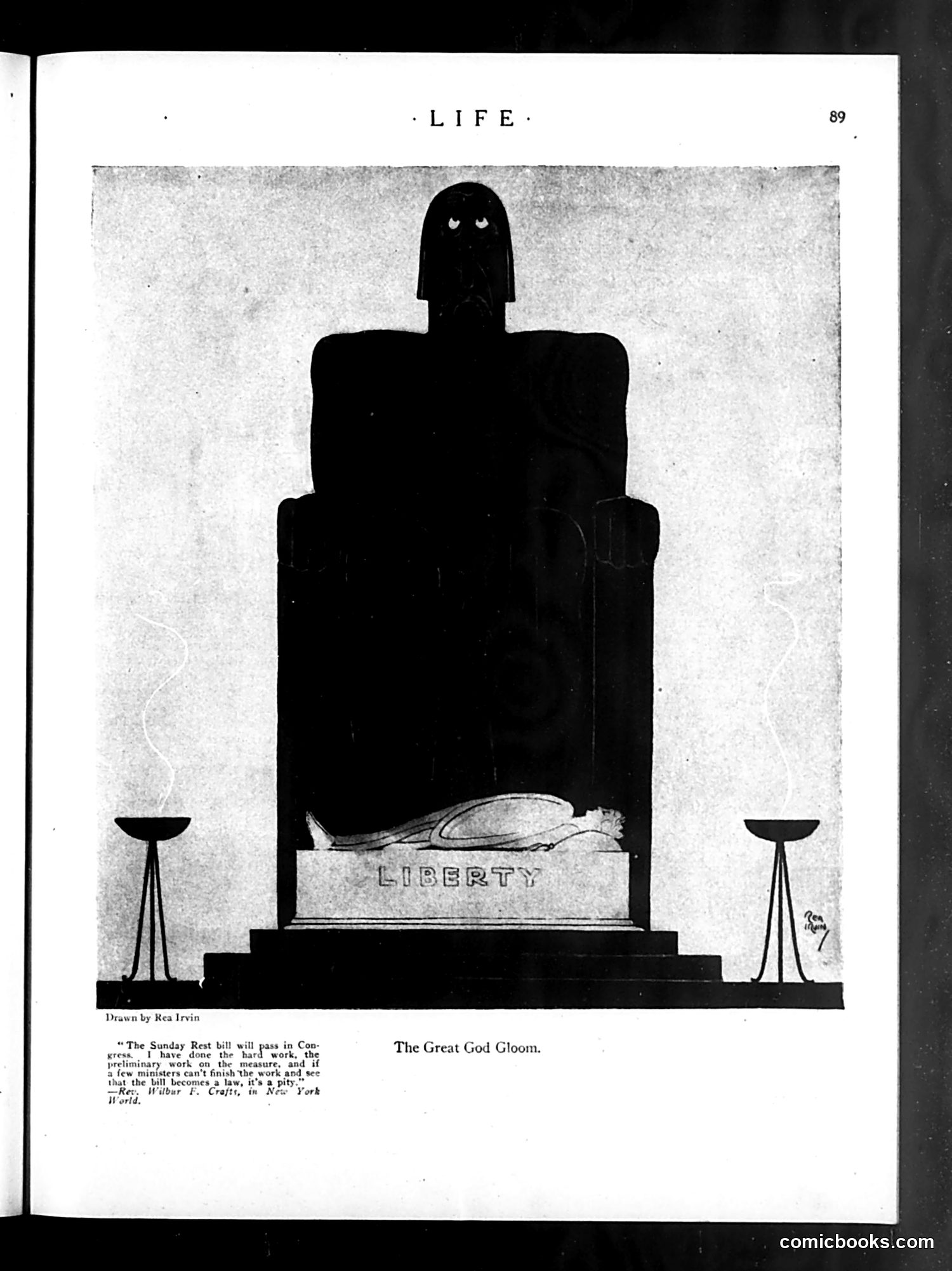
This political cartoon by Rea Irwin depicts a dark, towering figure—labeled "Liberty"—looming over a prone human figure lying on a bed or platform below. The piece appears to be satirizing how Liberty itself has become a threatening, oppressive force rather than liberating one. The accompanying quote from "Rev. William T. Crafts, in New York World" references congressional gridlock over the Sunday Rest bill, suggesting legislators cannot pass legislation because competing interests prevent consensus—portraying Liberty as ironically paralyzing rather than empowering. The cartoon thus critiques how abstract ideals of freedom, when unresolved or contested, can become sources of societal paralysis and despair rather than progress. The "gloom" suggests pessimism about democratic governance.
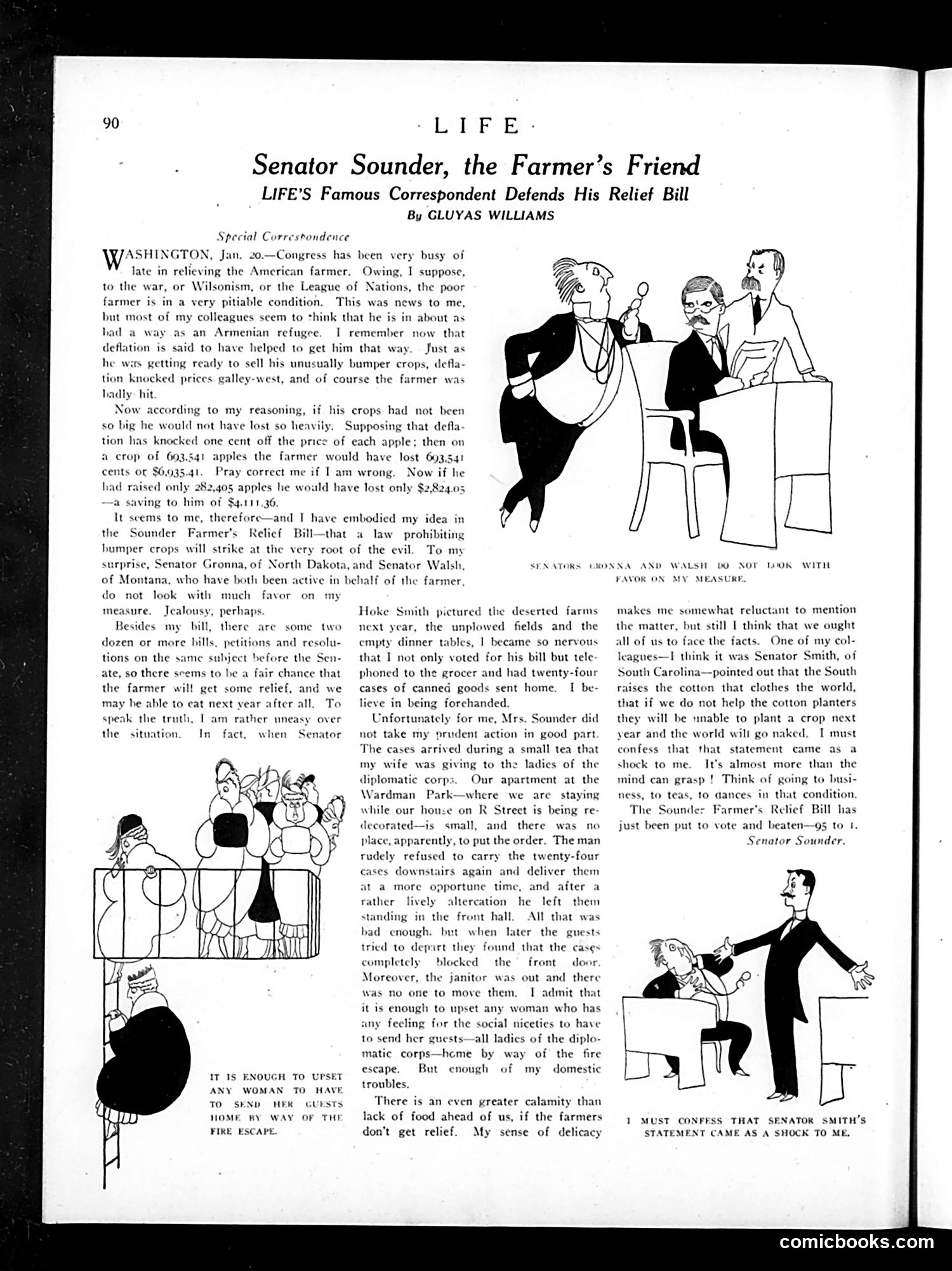
This 1920s Life magazine article by Cluyas Williams defends Senator Sounder's farm relief legislation against congressional skepticism. The cartoons mock fellow lawmakers' indifference to agricultural hardship. The top cartoon shows Senators Gronna (North Dakota) and Walsh (Montana) dismissively dismissing Sounder's proposal, despite their agricultural constituencies. The satire highlights the hypocrisy of representatives from farming states opposing relief measures. The lower cartoons humorously illustrate the author's personal domestic crisis—guests trapped in his apartment by a blocked front door during a small tea party—a comedic aside that trivializes social inconvenience compared to farmers' actual suffering. Williams argues that if deflation hasn't occurred, farmers wouldn't face ruin, and the relief bill addresses a genuine economic crisis requiring legislative action.
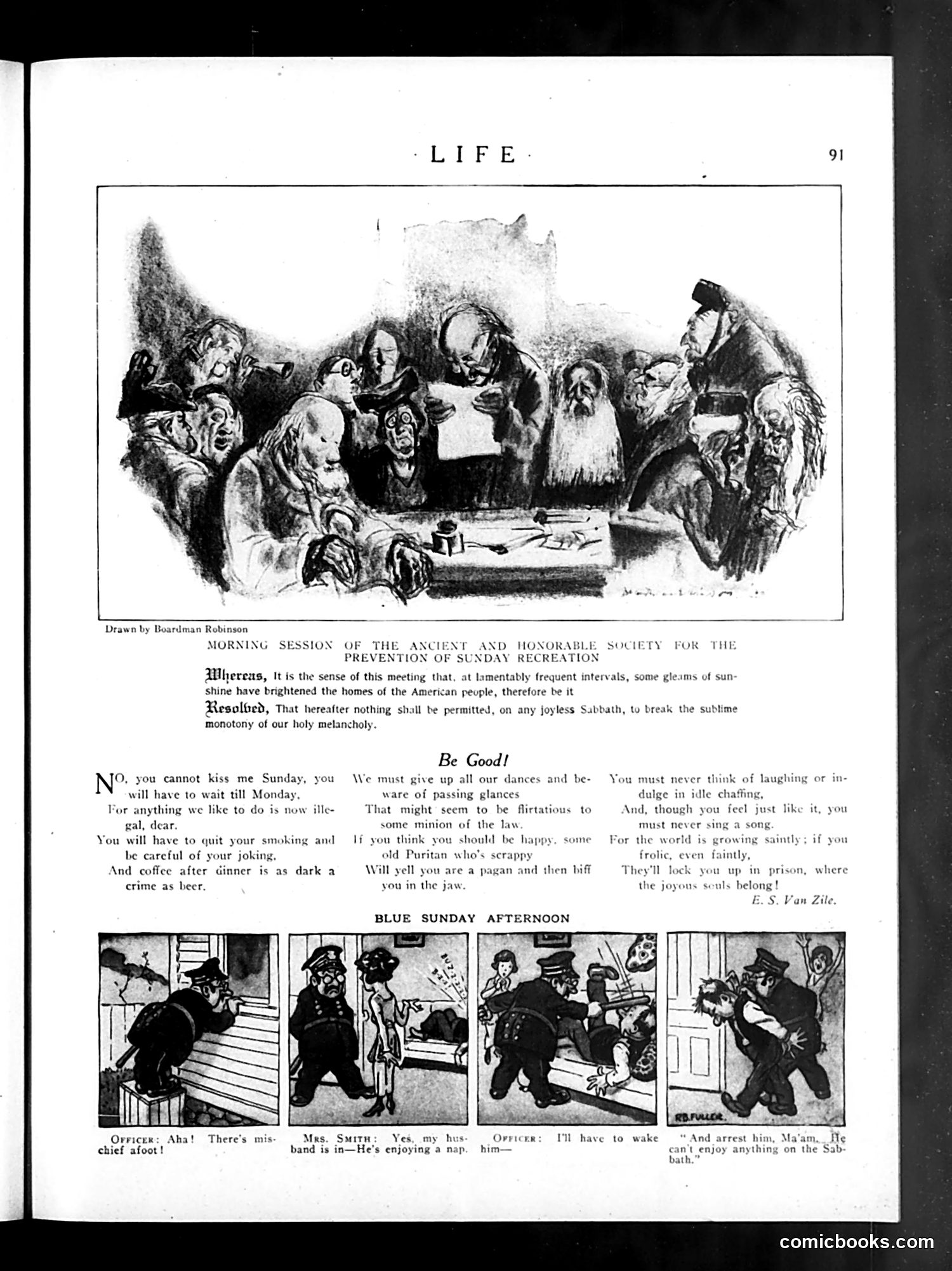
This page satirizes strict Sabbath observance campaigns of the early 20th century. The top illustration shows the "Ancient and Honorable Society for the Prevention of Sunday Recreation"—a caricatured group of stern religious figures—meeting to enforce joyless Sunday restrictions. The text mocks their resolutions banning dancing, smoking, coffee, and laughter on Sundays. The poem "Be Good!" parodies their austere messaging, warning against "idle chaffing" and threatening imprisonment for those who disobey. The comic strips below show an officer arresting people for Sunday violations: a man with a mischief foot, a woman visiting her napping husband, and another arrest for Sabbath-breaking. The satire criticizes religious fundamentalism and blue laws as oppressive, anti-freedom, and absurdly puritanical.
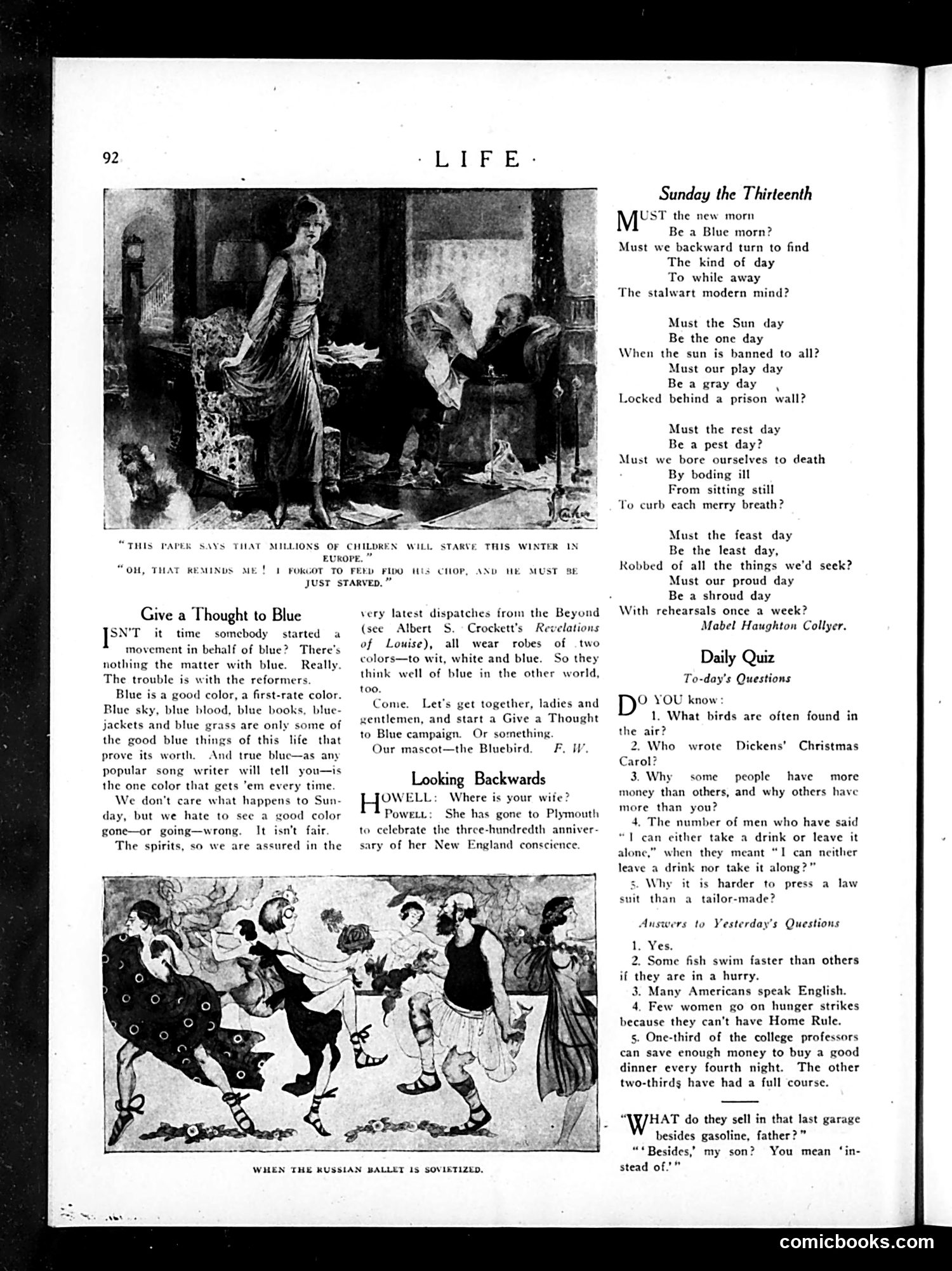
This page contains three distinct items: 1. **"Sunday the Thirteenth"** - A poem by Mabel Haughton Collyer questioning whether modern life must be uniformly gray and restricted, using days of the week as metaphor. 2. **"Give a Thought to Blue"** - An editorial advocating for the color blue in everyday life, noting reformers' dismissal of it as frivolous. The author argues blue deserves appreciation. 3. **"Looking Backwards"** - A brief comedic dialogue between Howell and Powell about Powell's wife attending a New England conscience celebration in Plymouth, satirizing puritanical values. 4. **"When the Russian Ballet is Sovietized"** - A cartoon depicting dancers in exaggerated poses, apparently satirizing how Soviet ideology might transform classical ballet into something crude or propagandistic. The page also includes a daily quiz with five questions on various topics.
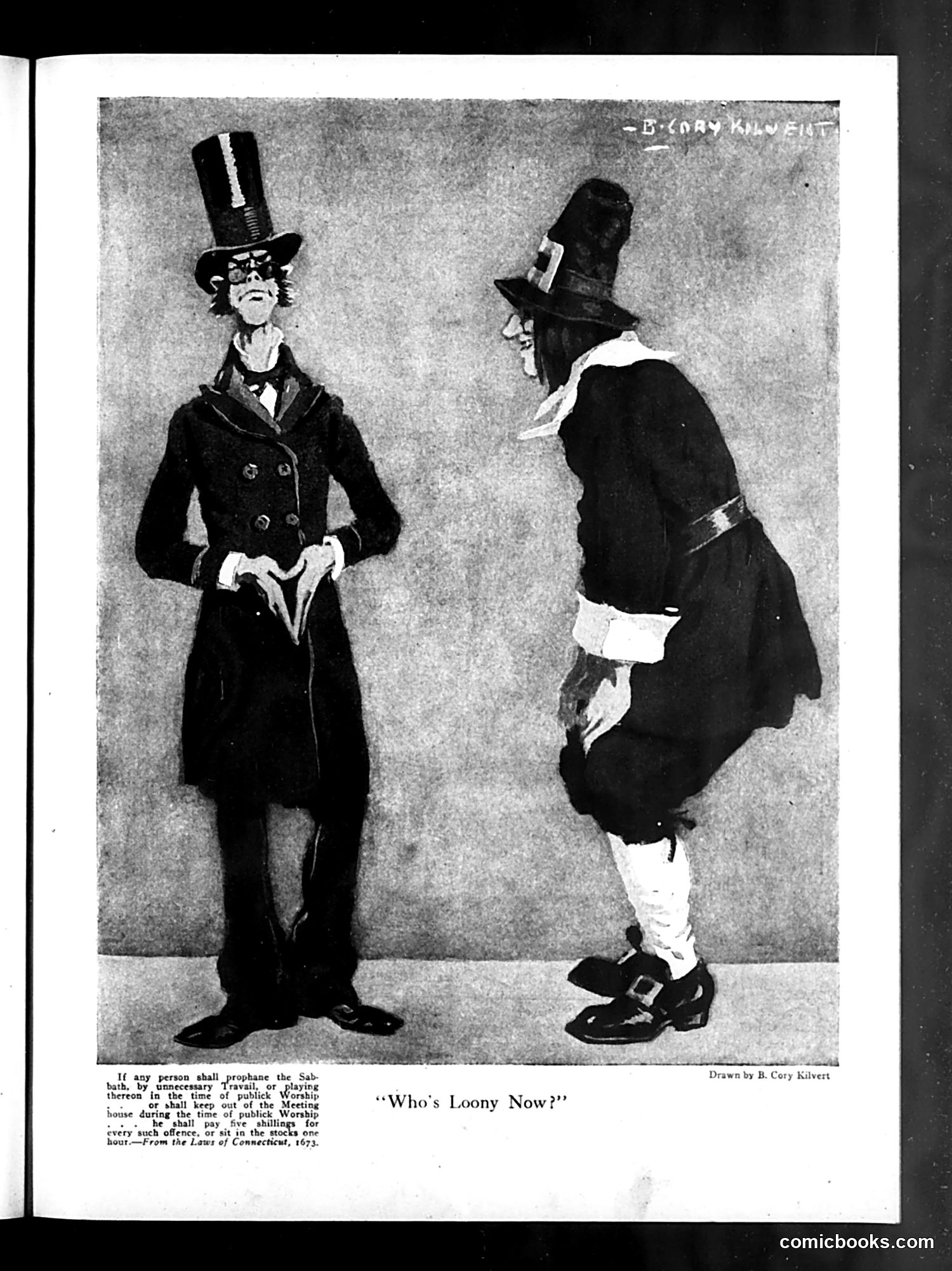
This cartoon by B. Cory Kilvert depicts two figures in formal 19th-century attire (top hats, double-breasted coats) in conversation. The left figure wears a monocle and appears stern; the right figure is shown in profile, gesturing animatedly. The caption asks "Who's Loony Now?" — suggesting a dispute over who is mentally unstable or foolish between two characters. The accompanying text references the Sabbath, unnecessary travel, and public worship disruptions, mentioning fines of five shillings. This appears to relate to 19th-century British religious or moral regulations. Without identifying the specific figures, the cartoon likely satirizes a social or political disagreement between two public figures regarding behavior or propriety, using exaggerated caricature to mock both parties as equally unreasonable.
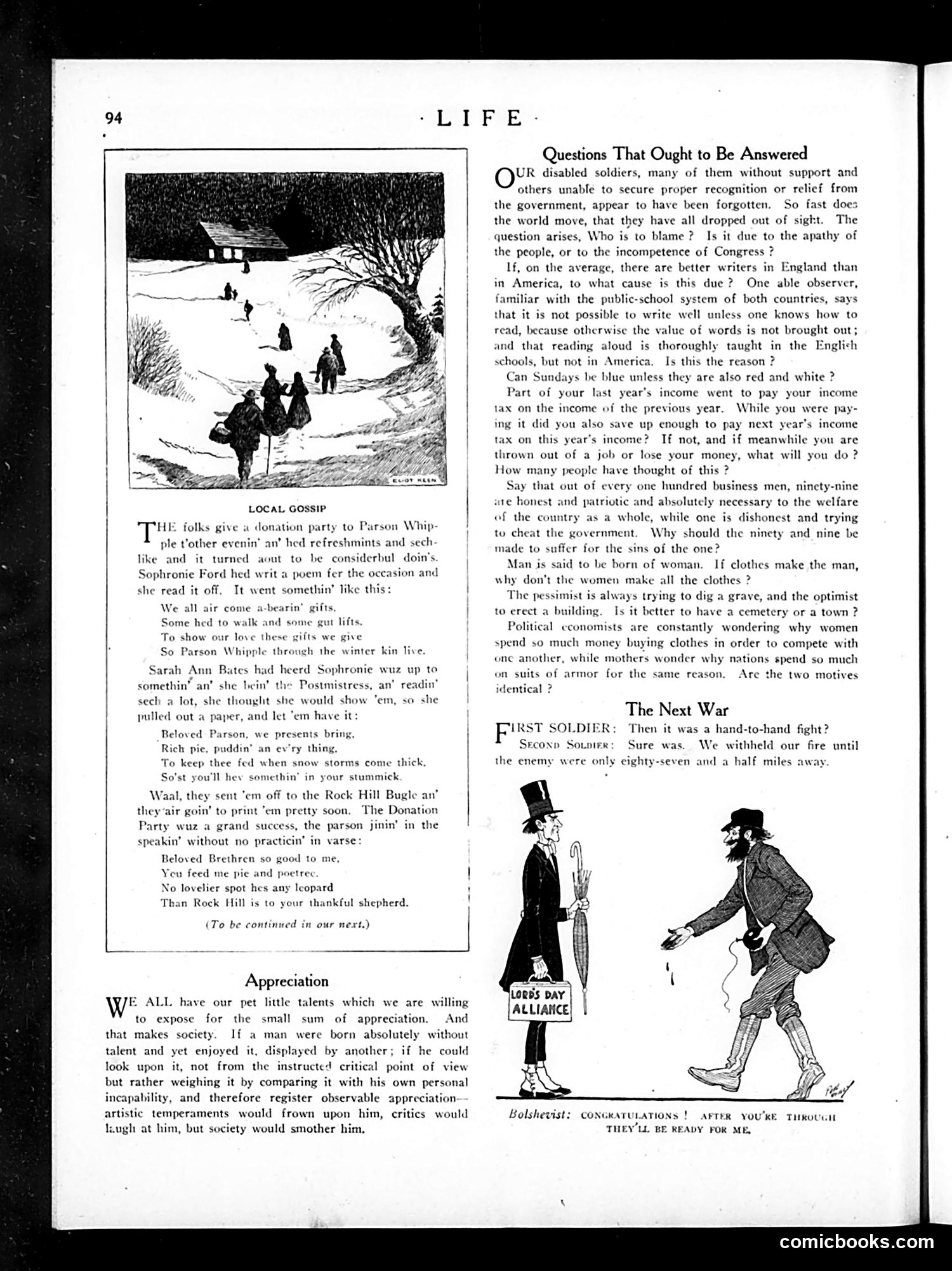
This page contains several distinct pieces: **"Local Gossip"** (left): A humorous poem about Parson Whipple hosting a party. The illustration shows people sledding in winter, with rural social commentary typical of Life's small-town humor. **"The Next War"** (bottom right): A political cartoon showing two caricatured figures labeled with a "Legs Day Alliance" banner. One congratulates the other on preparation for war, stating "the enemy were only eighty-seven and a half miles away." This appears to satirize contemporary military preparedness debates and alliance-building discussions, likely referencing post-WWI geopolitical tensions. The cartoon mocks either overconfidence in military readiness or absurd diplomatic posturing. **"Appreciation"** (bottom): A brief essay about recognizing talent in others without bias. The page exemplifies Life's mix of rural Americana humor and political satire.
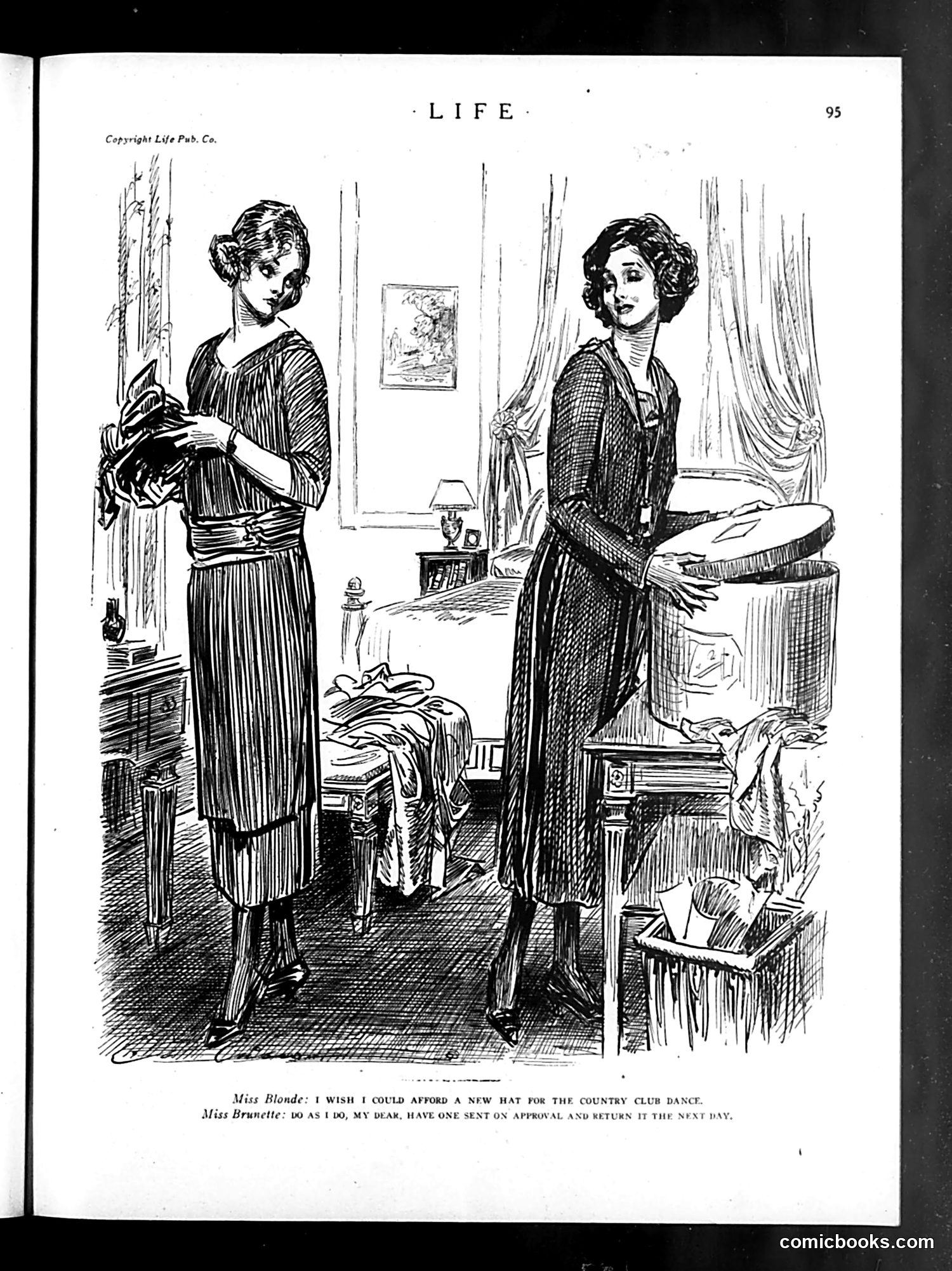
This is a single-panel cartoon from *Life* magazine (page 95) depicting two women in a bedroom having a conversation. The woman on the left holds flowers and speaks first: "I wish I could afford a new hat for the country club dance." The woman on the right, identified as "Miss Brunette," responds: "Do as I do, my dear, have one sent on approval and return it the next day." **The satire**: This jokes about a common shopping practice of the era—ordering items "on approval" (with the option to return them)—being exploited as a way to borrow clothing for free without purchasing. The cartoon gently mocks both consumer culture and the financial pretensions of women attempting to maintain appearances at exclusive clubs while living beyond their means. It's a commentary on conspicuous consumption and economic dishonesty among the middle class.
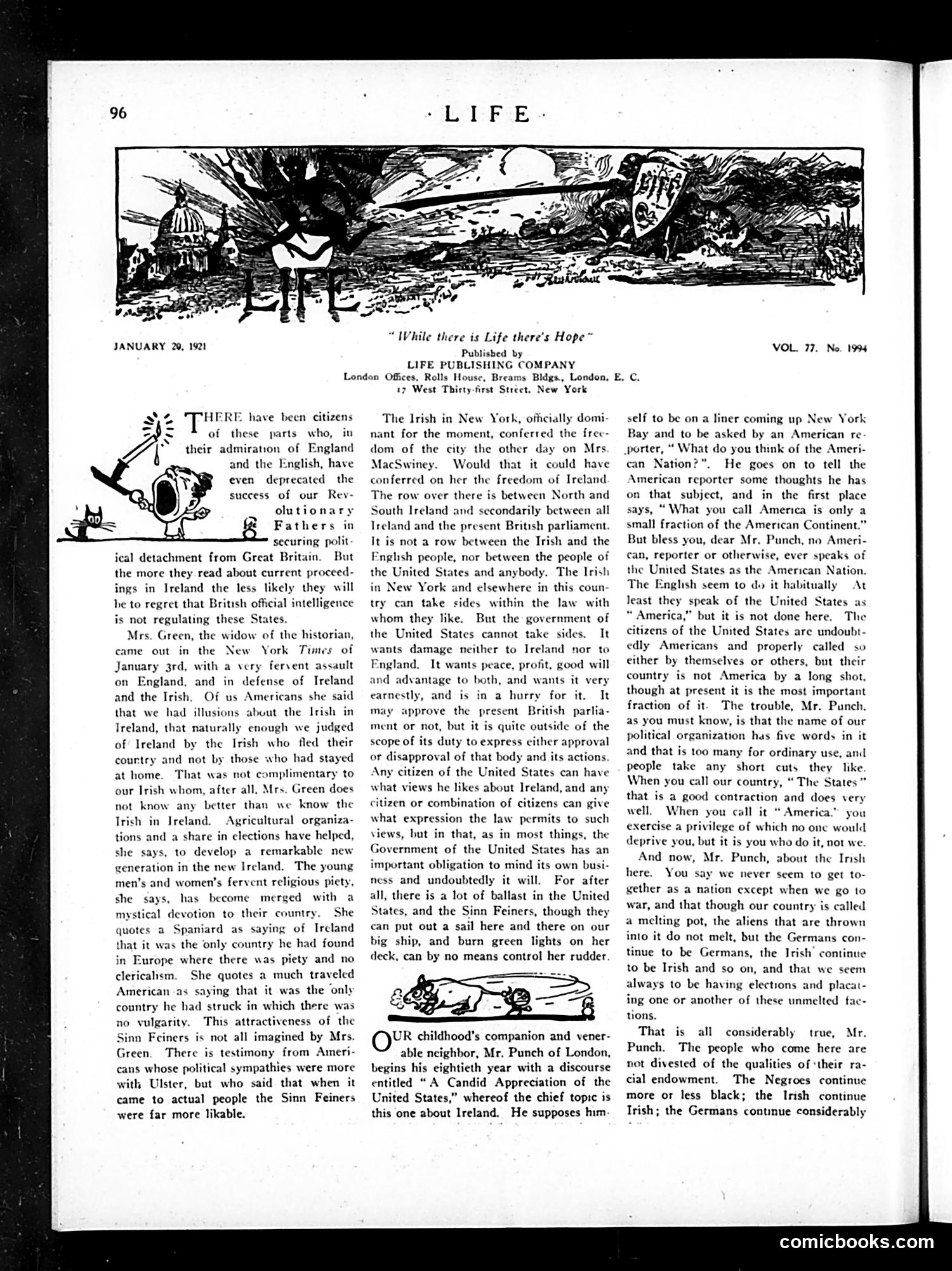
This Life magazine page critiques Irish-Americans' relationship with Ireland and the United States. The article, attributed to "Mr. Punch of London," discusses how Irish immigrants and their descendants navigate divided loyalties—specifically regarding Ireland's independence movement and their American citizenship. The text argues that Irish-Americans cannot simultaneously claim full American identity while maintaining strong political attachments to Ireland. It references the "Sinn Féiners" (Irish independence advocates) and suggests their political sympathies complicate their role as American citizens. The decorative header illustration shows a landscape with classical and political imagery, though specific caricatures aren't clearly identifiable in the reproduction. The piece addresses contemporary tensions around immigration, nationalism, and what constitutes American allegiance during the 1920s Irish independence era.
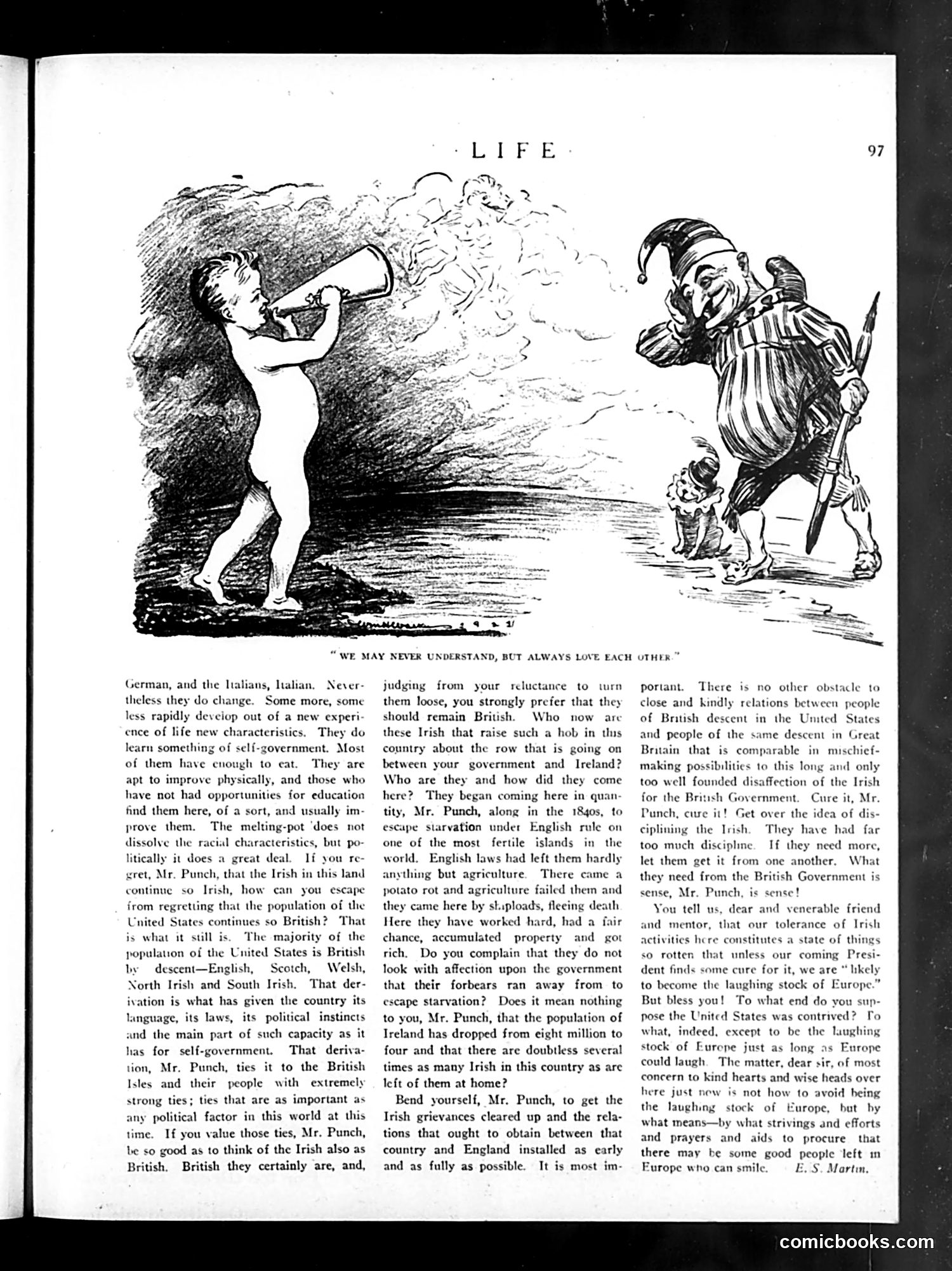
This page contains a satirical editorial cartoon and accompanying text addressing Anglo-Irish tensions and Irish-American identity circa the 1910s-1920s. **The Cartoon:** Shows a cherub blowing a trumpet at a jester-like figure (representing "Mr. Punch," Britain's satirical voice), with the caption "We May Never Understand, But Always Love Each Other." **The Argument:** The text argues that Irish immigrants to America—who fled English-caused famine and starvation in the 1840s—have legitimate grievances against the British government. The author urges "Mr. Punch" (British opinion) to stop criticizing Irish-Americans' political activism and instead resolve Irish independence issues fairly. **The Point:** Life magazine defends Irish-American loyalty while critiquing British dominance. The satire suggests Britain should accept Irish autonomy rather than expect Irish-Americans to abandon their ancestral grievances. The piece emphasizes that Irish and British descendants should unite as Americans, but only after Britain stops "disciplining" Ireland.
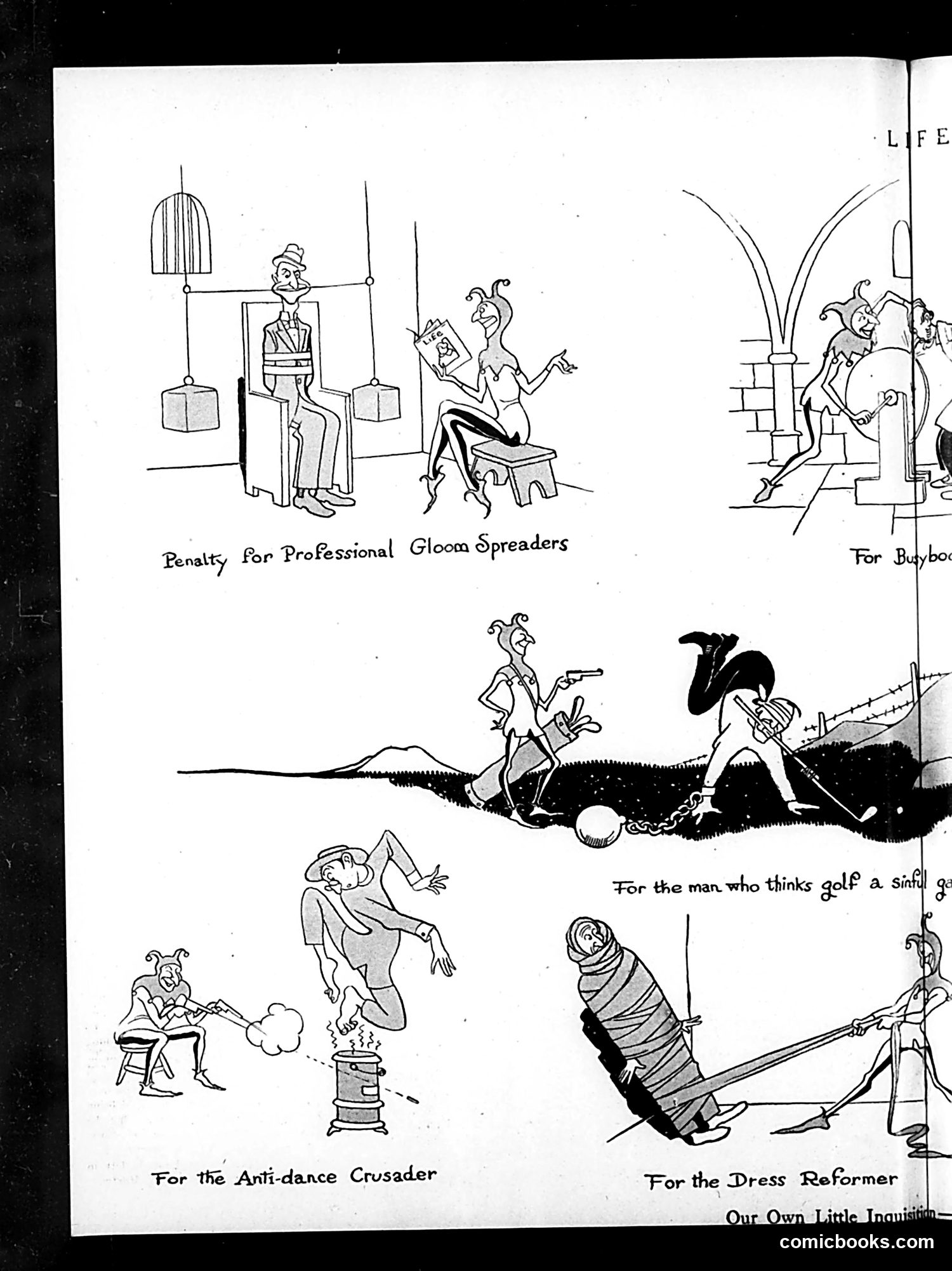
This page contains four punishment-themed cartoons mocking social reformers and moral crusaders of the early 20th century: 1. **"Penalty for Professional Gloom Spreaders"**: Shows a man in a scale-balance torture device, satirizing pessimists who spread negativity. 2. **"For Busybodies"**: Depicts intrusive gossips being accosted, mocking those who meddle in others' affairs. 3. **"For the man who thinks golf a sinful game"**: Shows someone shot by a golfer, ridiculing anti-leisure moralists. 4. **"For the Anti-dance Crusader"**: Depicts someone being burned, mocking those who opposed dancing as immoral. 5. **"For the Dress Reformer"**: Shows someone wrapped in restrictive bandages, satirizing those pushing dress codes. The cartoons mock Victorian-era moral crusaders and social reformers, suggesting their self-righteous positions deserve ironic "punishment." The satire defends personal freedoms against puritanical oversight.
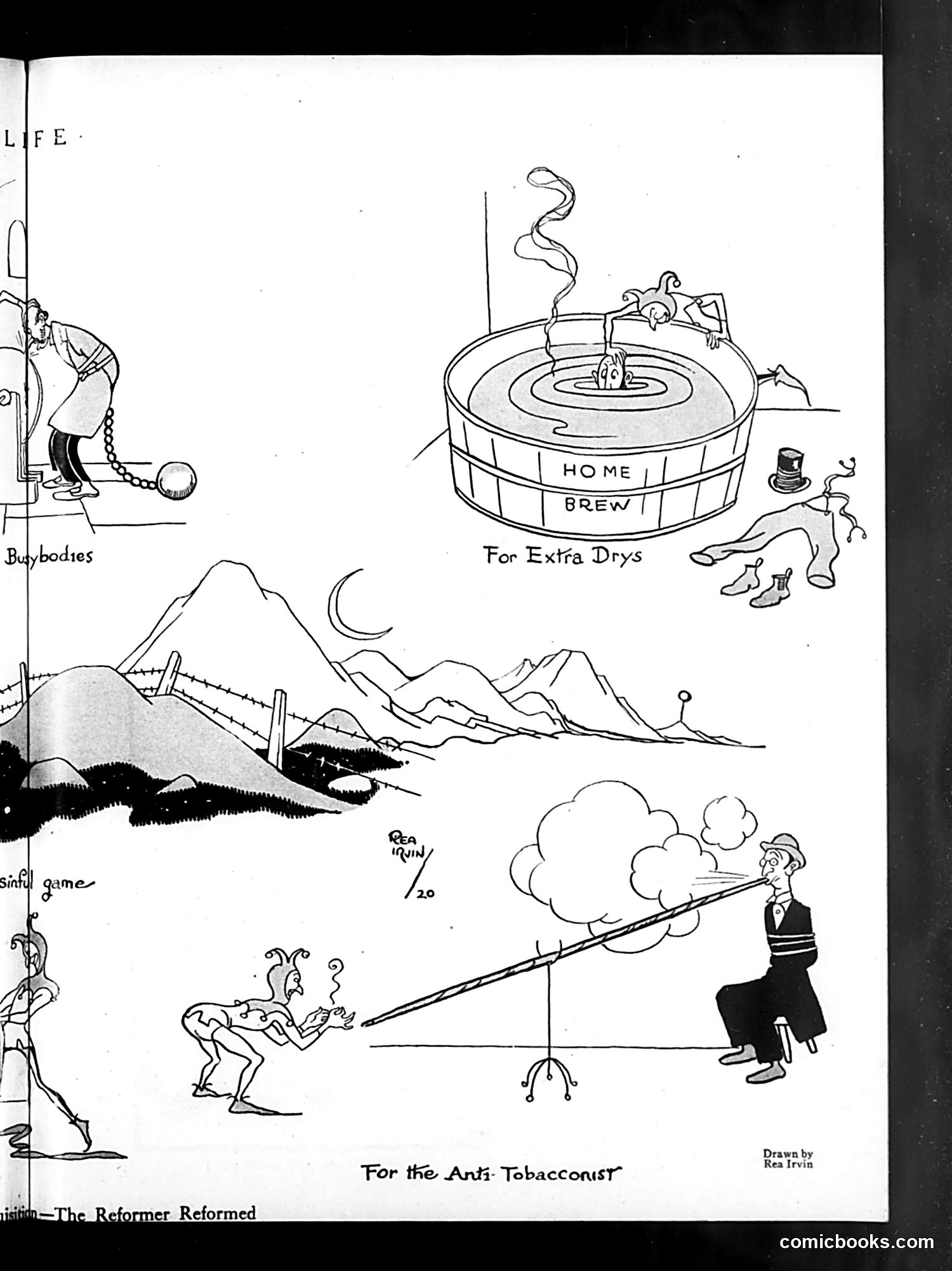
This page contains three separate satirical drawings by Rea Irvin titled "The Reformer Reformed," mocking various reform movements: 1. **"Busybodies"** (top left): Shows someone chained to reform work, suggesting reformers are obsessed with their causes. 2. **"For Extra Drys"** (top right): Depicts a large brewing vat labeled "HOME BREW," satirizing Prohibition-era alcohol reformers. The figure atop suggests ironic commentary on anti-alcohol crusaders, likely implying their efforts backfired into increased illegal home brewing. 3. **"For the Anti-Tobacconist"** (bottom): Shows a seesaw with clouds of smoke, mocking anti-smoking reformers as naive or ineffectual. The overall theme critiques overzealous social reformers as ineffective or self-defeating.
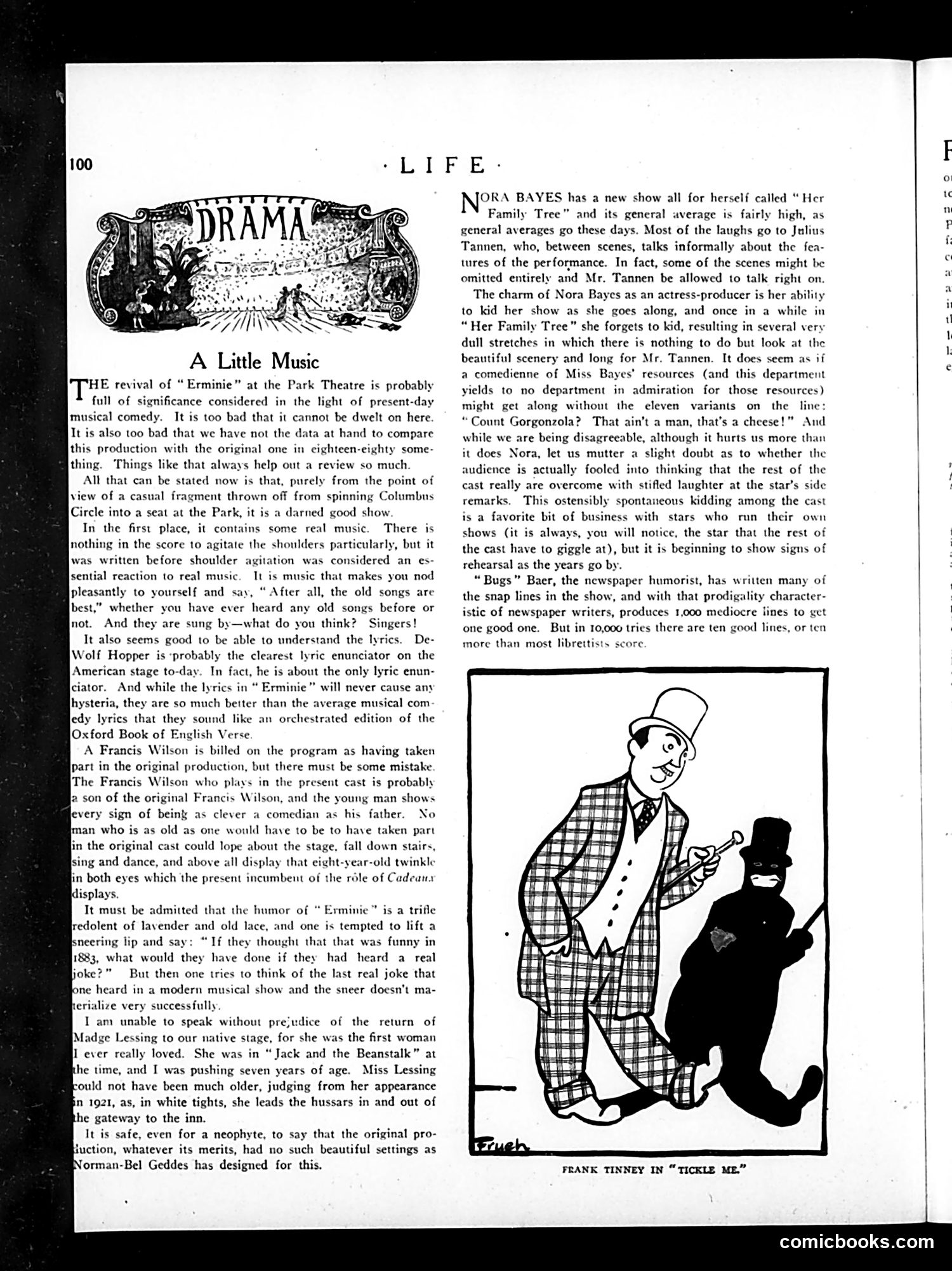
This page reviews theatrical productions, primarily focusing on the revival of the musical comedy "Erminie" at the Park Theatre. The cartoon below illustrates **Frank Tinney in "Tickle Me,"** showing a vaudeville-style comedian in a checkered suit with an exaggerated expression. The text critiques "Erminie" as a surprisingly competent revival of an 1880s musical, praising its actual melodies and intelligible lyrics—contrasting favorably with contemporary musical comedy standards. The reviewer commends DeWolf Hopper's clear enunciation and notes that Francis Wilson (likely the son of the original cast member) displays genuine comic timing. The review also mentions Nora Bayes's new show "Her Family Tree," where Julius Tannen provides most laughs through informal commentary between scenes. The satire targets modern musical theater's decline in music quality and intelligibility, nostalgically contrasting it with older productions that emphasized actual artistry over spectacle.
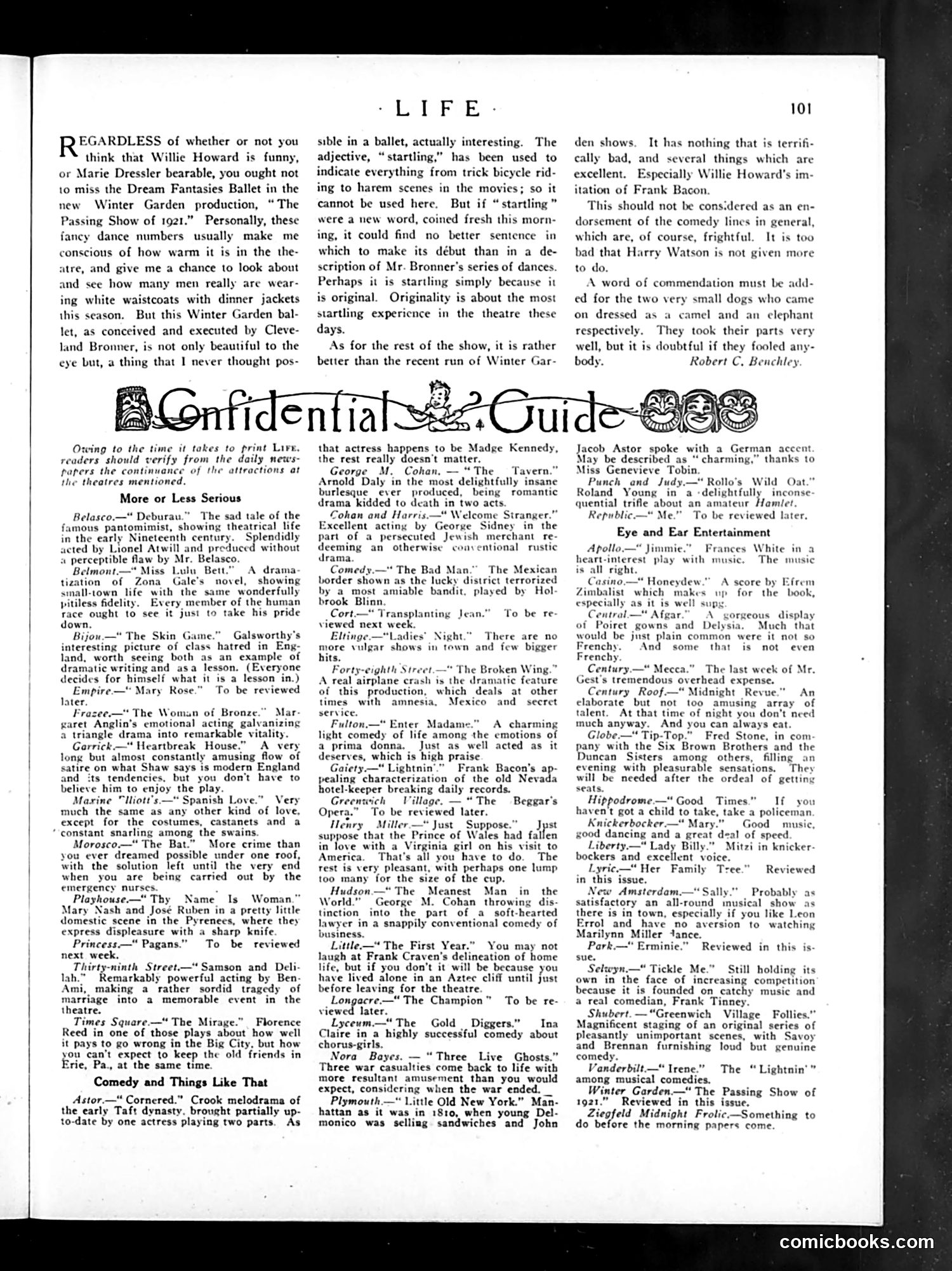
This is a theater review page from Life magazine (likely early 1920s based on "Passing Show of 1921" reference). The main content is critic Robert C. Benchley's review of the Winter Garden's "Passing Show of 1921." **Key figures mentioned:** - Willie Howard and Marie Dressler (performers) - Cleveland Bronner (choreographer/ballet designer) - Frank Bacon (actor whom Willie Howard imitates) **The satire:** Benchley praises the ballet sequences as genuinely original and "startling"—ironically noting that originality itself has become so rare in theater that it's shocking. He critiques the comedy dialogue as "frightful" but commends the performances and cleverly mocks two small dogs dressed as a camel and elephant, doubting they fooled anyone. The rest of the page lists Broadway shows with brief critical notes. This format allowed readers to quickly assess what was worth seeing in New York's theater district.
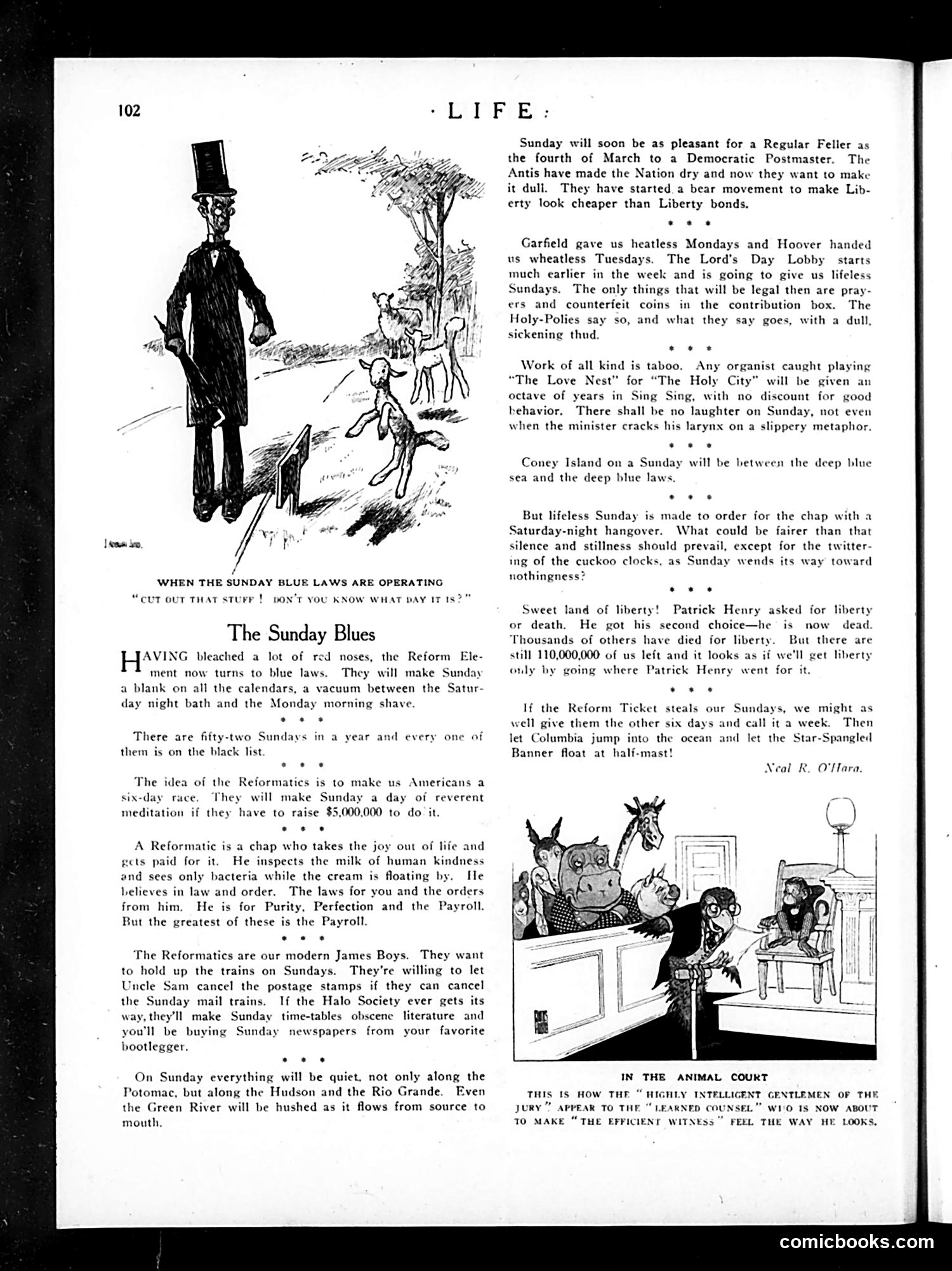
This article satirizes the "Reform Element"—Progressive Era activists pushing "blue laws" (strict Sunday regulations banning work and recreation). The cartoonist mocks these reformers as joyless busybodies who want to eliminate all pleasure from American life under the guise of moral purity. The top cartoon shows a stern figure (representing the reform movement) confronting children playing on Sunday, enforcing these restrictions. The text ridicules the "Reformatics" as hypocritical—they claim to protect morality while serving wealthy interests ("the Payroll"). The author references Prohibition ("made the Nation dry") and wartime rationing (Garfield's "heatless Mondays," Hoover's "wheatless Tuesdays"), suggesting reformers use crisis to expand control. Patrick Henry's famous "liberty or death" quote is inverted bitterly: he got death instead. The bottom cartoon about "the Animal Court" appears unrelated, depicting animals as a legal jury—likely another satire on institutional absurdity. Overall, this reflects 1920s backlash against Progressive social engineering and Prohibition.
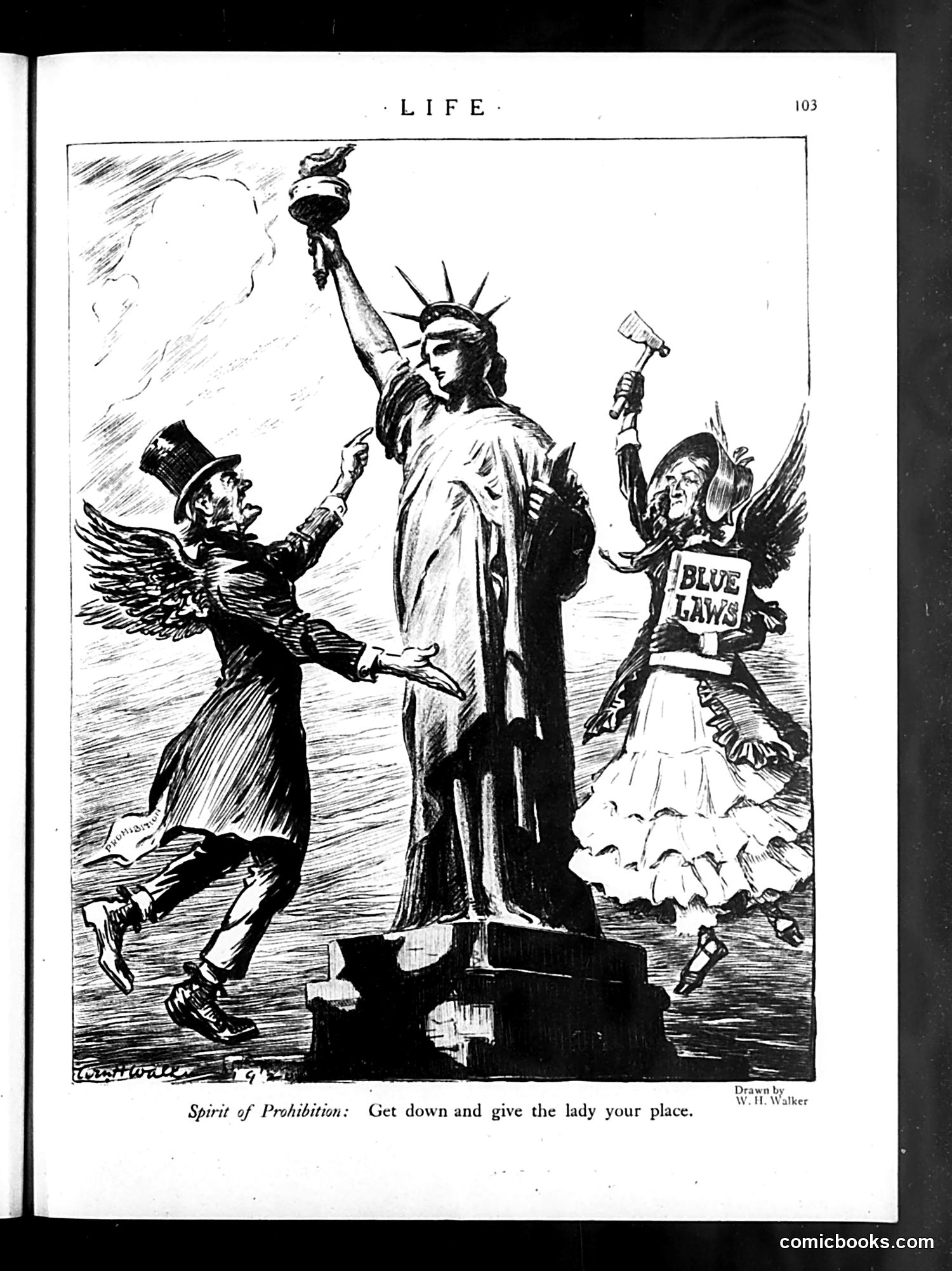
This satirical cartoon depicts the Statue of Liberty being attacked by two demonic or devil-like figures with wings. One carries an axe; the other wears a sash labeled "BLUE LAWS." The caption reads: "Spirit of Prohibition: Get down and give the lady your place." The cartoon critiques Prohibition and associated restrictive moral legislation ("blue laws"). The demons represent these policies as threats to American liberty itself—literally assaulting Lady Liberty. The caption sarcastically frames Prohibition as chivalrous ("give the lady your place"), when the cartoon argues these laws actually undermine American freedom. This reflects opposition to Prohibition era policies, suggesting they represent un-American, tyrannical forces rather than moral progress. The artwork advocates for personal liberty against government overreach.
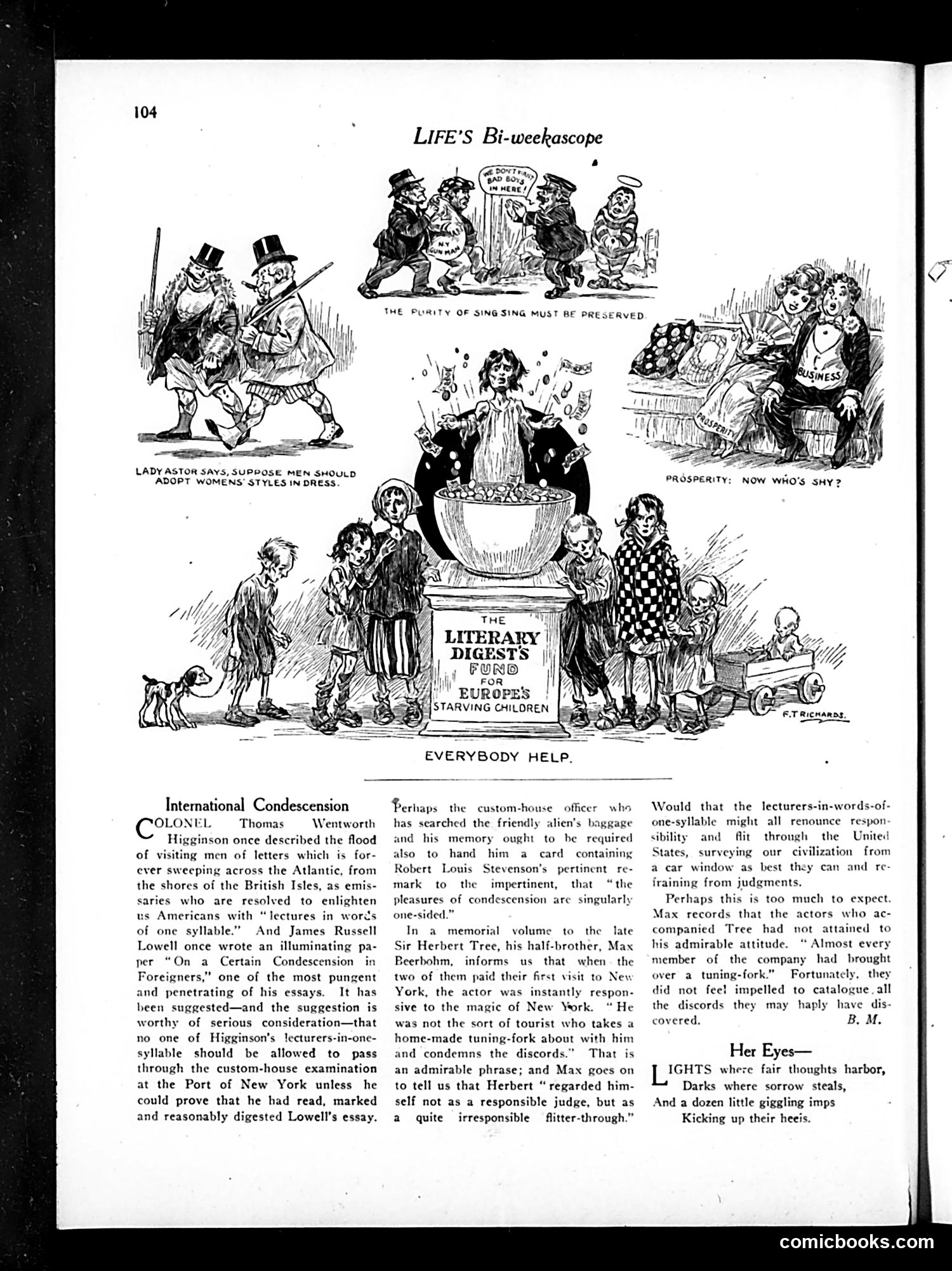
This satirical page mocks British intellectual condescension toward America. The top cartoon depicts Lady Astor's hypothetical suggestion that men adopt women's fashions—presented as absurd social commentary. The central image shows the "Literary Digests Fund for Europe's Starving Children," with children gathered around a large cauldron, satirizing how charitable giving becomes corrupted or self-serving. The text below attacks pretentious British visitors and lecturers who come to America speaking in overly simple language ("lectures in words of one syllable"), implying they view Americans as intellectually inferior. It references James Russell Lowell's essay criticizing such foreign condescension. The passage contrasts two attitudes: Herbert Tree, who visited New York without judgment ("irresponsible flitter-through"), versus his companions who brought "tuning-forks"—metaphor for standards to criticize American culture and "catalogue discords." The satire advocates for visiting foreigners to simply observe rather than judge American civilization.
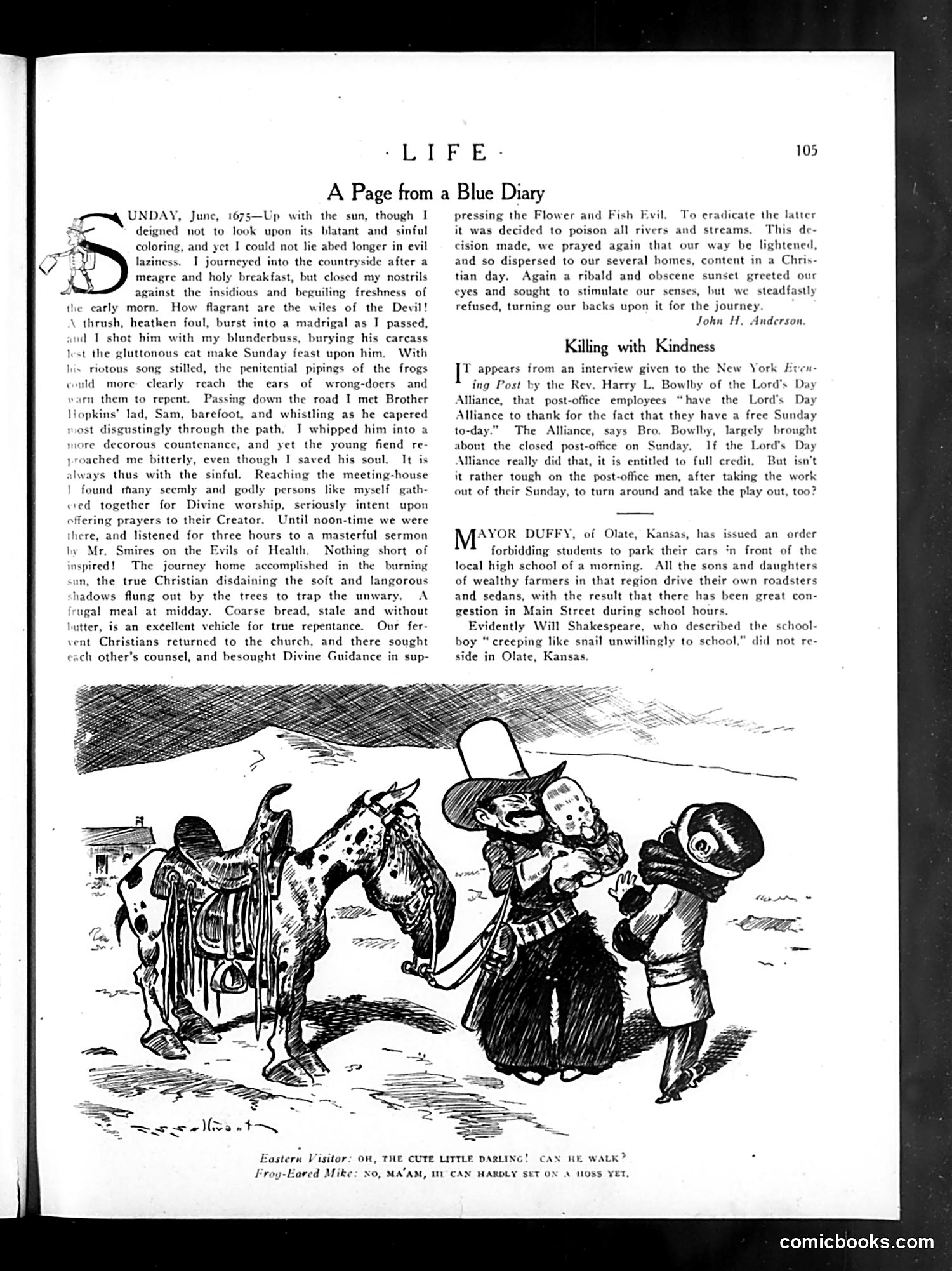
This page contains three separate satirical pieces mocking religious and civic overreach: **"A Page from a Blue Diary"** parodies Puritan excess through a fictional 1675 diary entry. The author depicts an absurdly austere Christian who shoots a singing bird as "sinful," whips a whistling boy for indecorum, and refuses to enjoy sunsets or shade trees—all while poisoning rivers. The satire targets rigid, joyless moralism that harms both nature and people in the name of piety. **"Killing with Kindness"** critiques the Lord's Day Alliance, which successfully closed post offices on Sundays. While framed as religious charity, the piece ironically notes it actually deprives postal workers of leisure time rather than granting it. **The Mayor Duffy piece** mocks a Kansas mayor's car-parking ban at a high school, which ironically creates congestion rather than solving it—another example of well-intentioned rules producing absurd results. The cartoon (depicting figures with a donkey) appears to illustrate one of these pieces, though the specific reference is unclear from the visible caption.
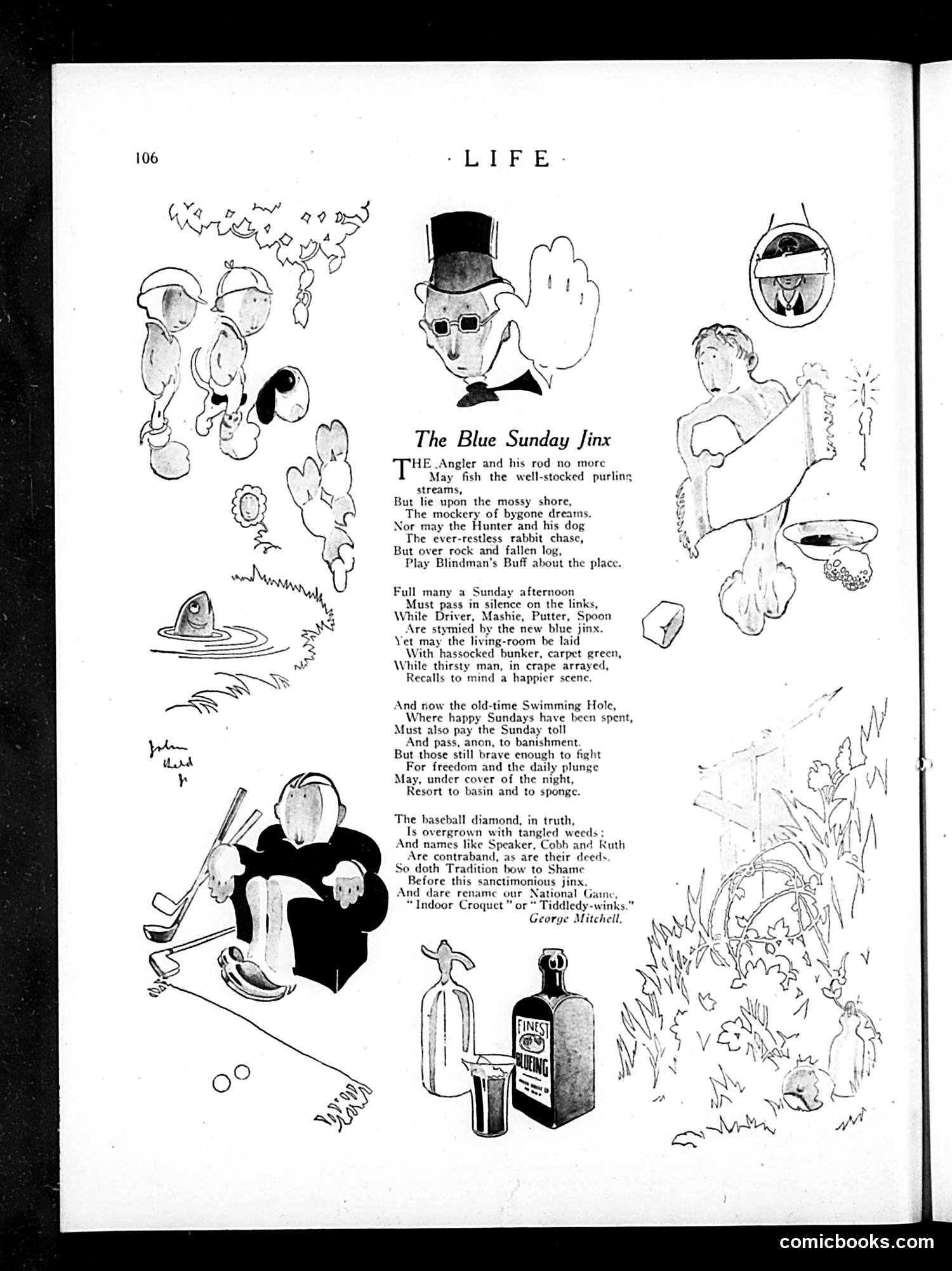
This satirical poem mocks Prohibition-era "Blue Laws"—religious legislation that banned recreational activities on Sundays. The "jinx" refers to these restrictive laws. The illustrations and text lament how Sunday restrictions eliminated traditional leisure: fishing, hunting, golf, baseball, and swimming are all prohibited or rendered pointless. The cartoon shows men forced indoors, unable to pursue their hobbies. The satire peaks in the final stanza: sports icons like Ty Cobb and Babe Ruth become "contraband," and baseball—America's national pastime—must be renamed "Indoor Croquet" or "Tiddledy-winks" (children's games), reducing a beloved sport to absurdity. The poem argues these laws represent "Tradition bow[ing] to Shame" before "sanctimonious" religious moralism. The overall message criticizes Blue Laws as oppressive, overly pious government intrusions into personal freedom and Sunday leisure activities.
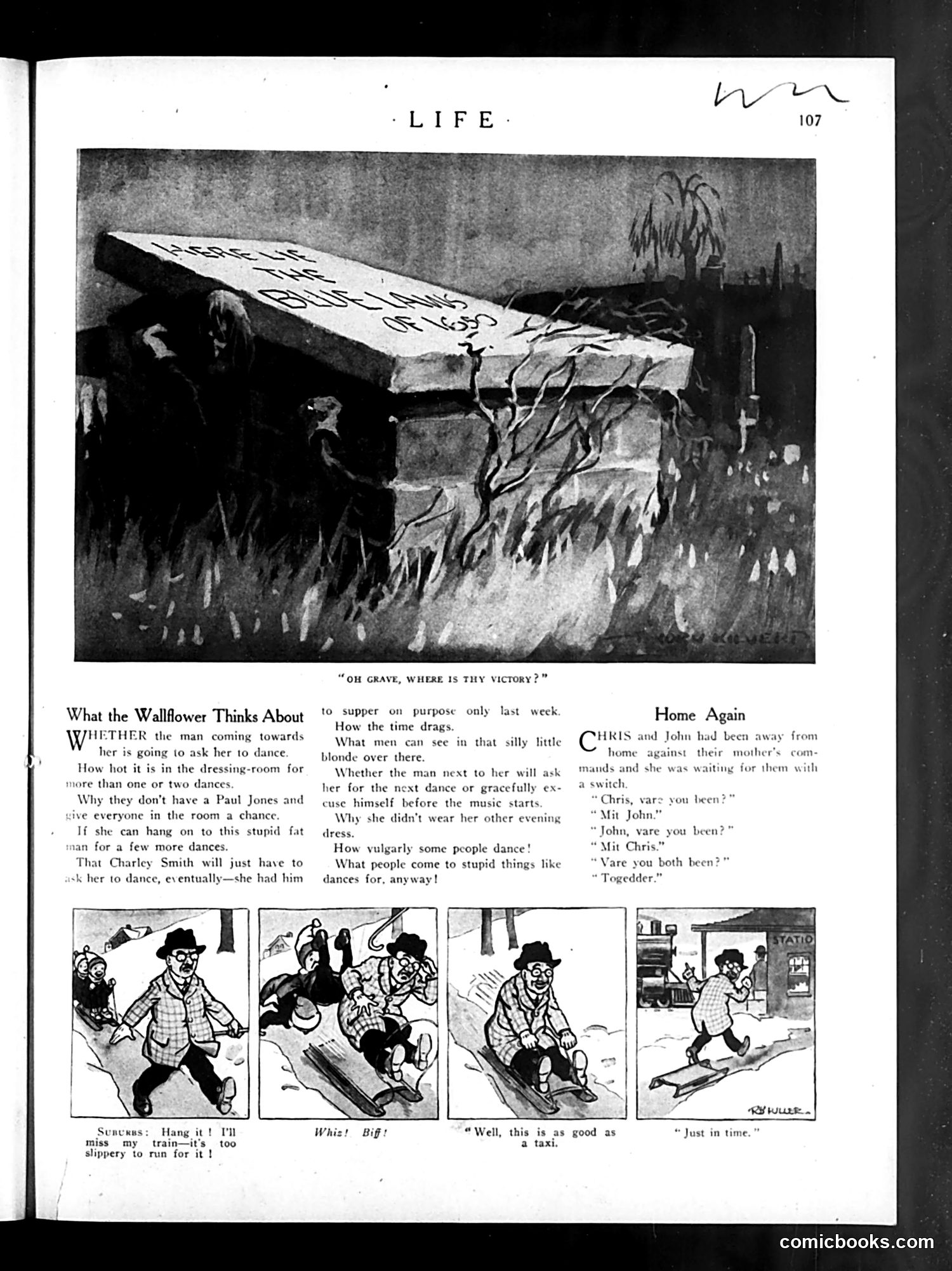
This page contains two separate humorous pieces satirizing social awkwardness and domestic life. **"What the Wallflower Thinks About"** mocks the anxieties of unmarried women at social dances—a major courtship venue of the era. The satire targets the woman's desperate focus on securing dance partners (mentioning specific men like "Charley Smith" and "Paul Jones") and her self-conscious preoccupations (her dress, other women's appearances, how people dance). The humor lies in exposing that she simultaneously wants attention yet resents the superficiality of dance culture. **"Home Again"** features four comic panels depicting children sledding in winter, with a humorous final scene showing them arriving home "just in time"—implying they narrowly avoided parental punishment. The dialogue uses exaggerated accent spelling ("vare" for "where"), suggesting immigrant or working-class parents. Both pieces use gentle social satire typical of Life magazine's era, poking fun at recognizable middle-class scenarios without harsh criticism.
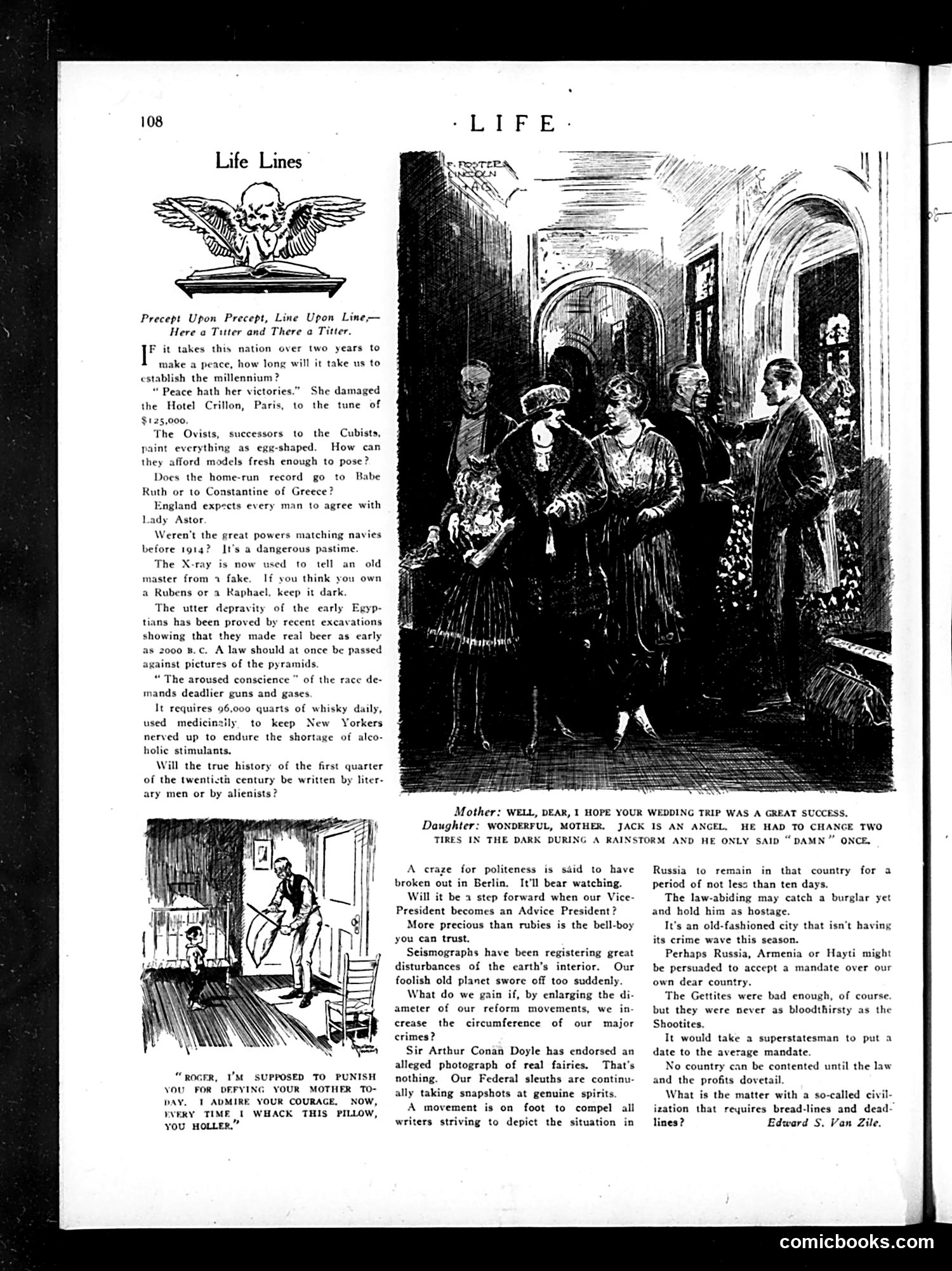
This page from *Life* magazine contains satirical commentary on post-WWI social and political issues, presented as brief quips and two cartoon panels. The "Life Lines" section mocks contemporary concerns: peace negotiations (referencing the Hotel Crillon in Paris, site of post-WWI talks), artistic movements (Cubism and "Ovism"), prohibition-era alcohol shortages, and post-war anxieties. References to "Constantine of Greece" and naval arms races reflect ongoing international instability. The two cartoons depict domestic life ironies: one shows a parent punishing a child while admitting admiration for the child's defiance—critiquing parental hypocrisy. The second shows newlyweds where the bride celebrates her husband's restraint in cursing only once during car trouble, suggesting lowered expectations for male behavior. The closing commentary by Edward S. Van Zile criticizes civilization's contradictions: breadlines coexisting with profit-driven systems, and nations accepting foreign mandates while neglecting domestic problems. The humor is cynical about post-war social progress.
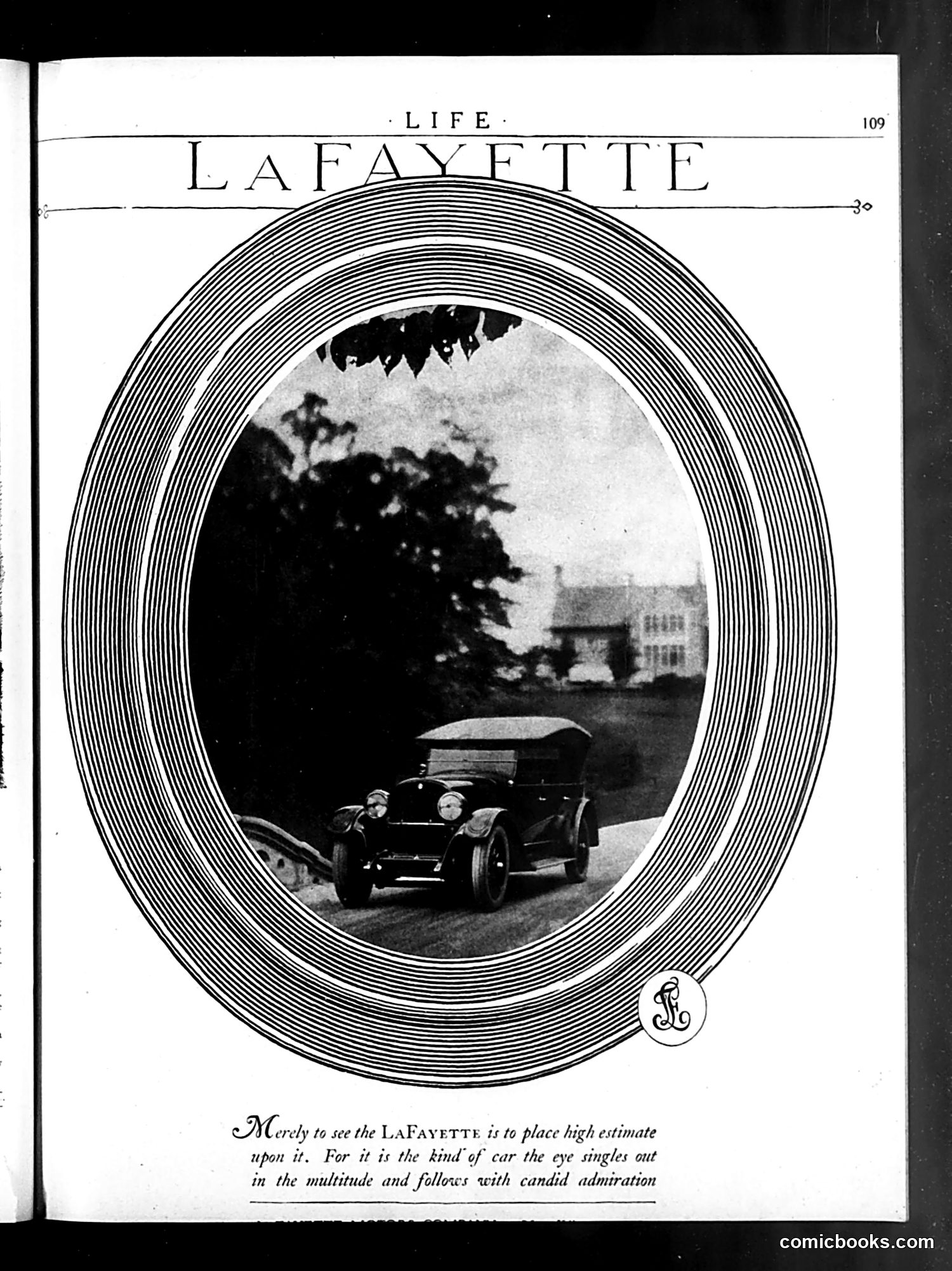
This is a *Life* magazine advertisement for the Lafayette automobile, not political satire. The page features an elegant oval-framed photograph of an early 1920s touring car positioned in a pastoral estate setting, with trees and a house visible in the background. The accompanying text uses aspirational language, claiming the Lafayette is distinctive enough to "single out in the multitude" and merit "candid admiration." This is straightforward automotive marketing emphasizing the car's visual appeal and perceived quality. The decorative oval frame and refined typography reflect the upscale advertising aesthetic of the era, targeting wealthy consumers. There is no political commentary or satirical intent—this is a standard product advertisement from the magazine's commercial pages.
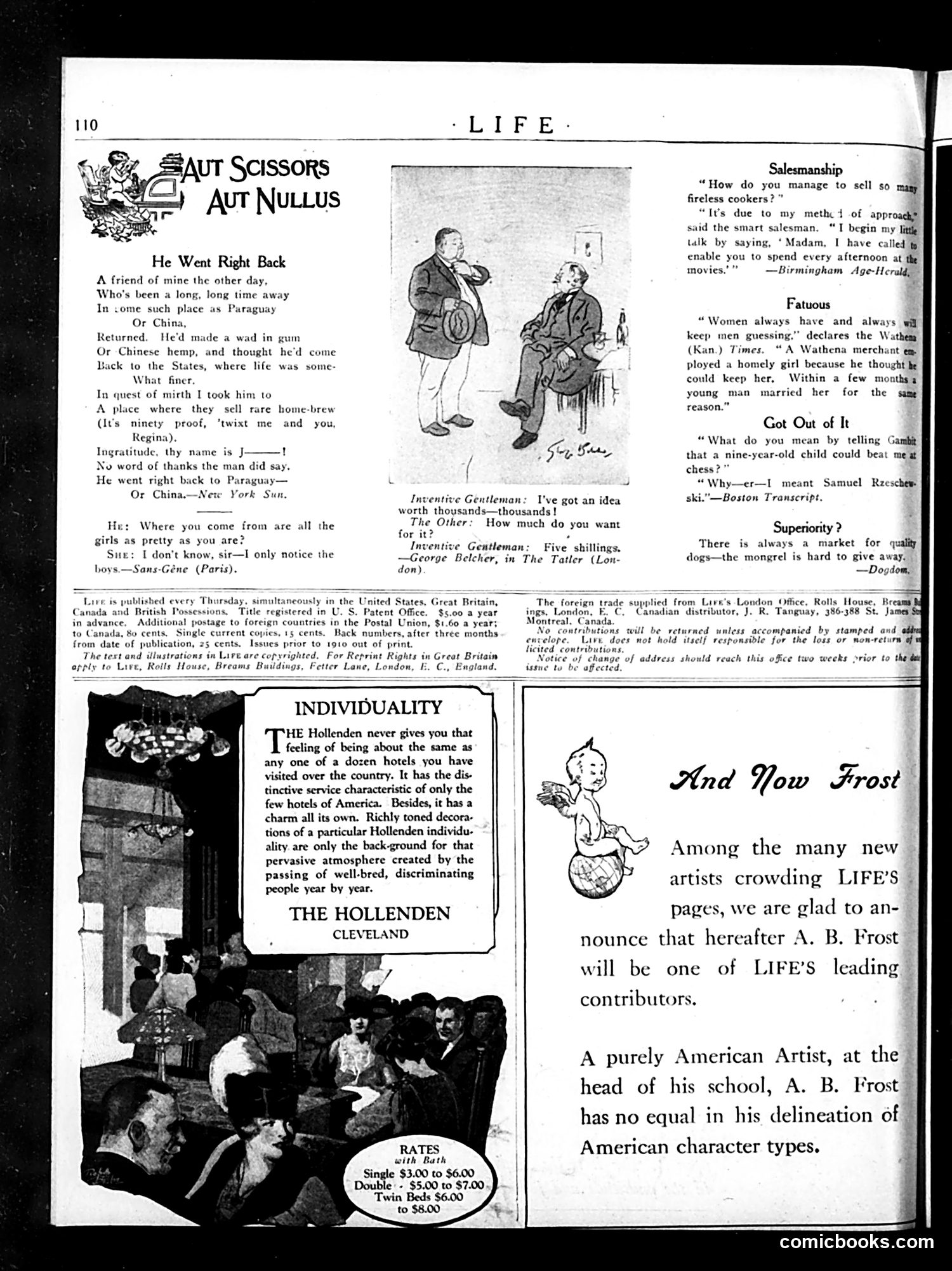
This page contains several short satirical pieces typical of Life's humor: **"He Went Right Back"** (poem): A man returns wealthy from Paraguay/China, but when taken to an expensive speakeasy during Prohibition, he shows no gratitude and leaves for South America again—satirizing ingratitude and perhaps the appeal of foreign locales over American entertainment. **The cartoon** (center): Shows two gentlemen discussing a business idea. One claims his invention is "worth thousands" but only wants five shillings for it—mocking absurd entrepreneurial overconfidence and unrealistic pricing. **Right-side quotes**: Brief humorous observations about salesmanship, female psychology, chess, and dog breeding—typical filler humor. **Bottom half**: An advertisement for The Hollenden hotel in Cleveland, emphasizing exclusive service and individuality. A separate announcement introduces artist A.B. Frost as a new Life contributor, praised for depicting "American character types." The page exemplifies Life's satirical style: poking fun at contemporary social pretensions, business folly, and human nature through light humor rather than sharp political critique.
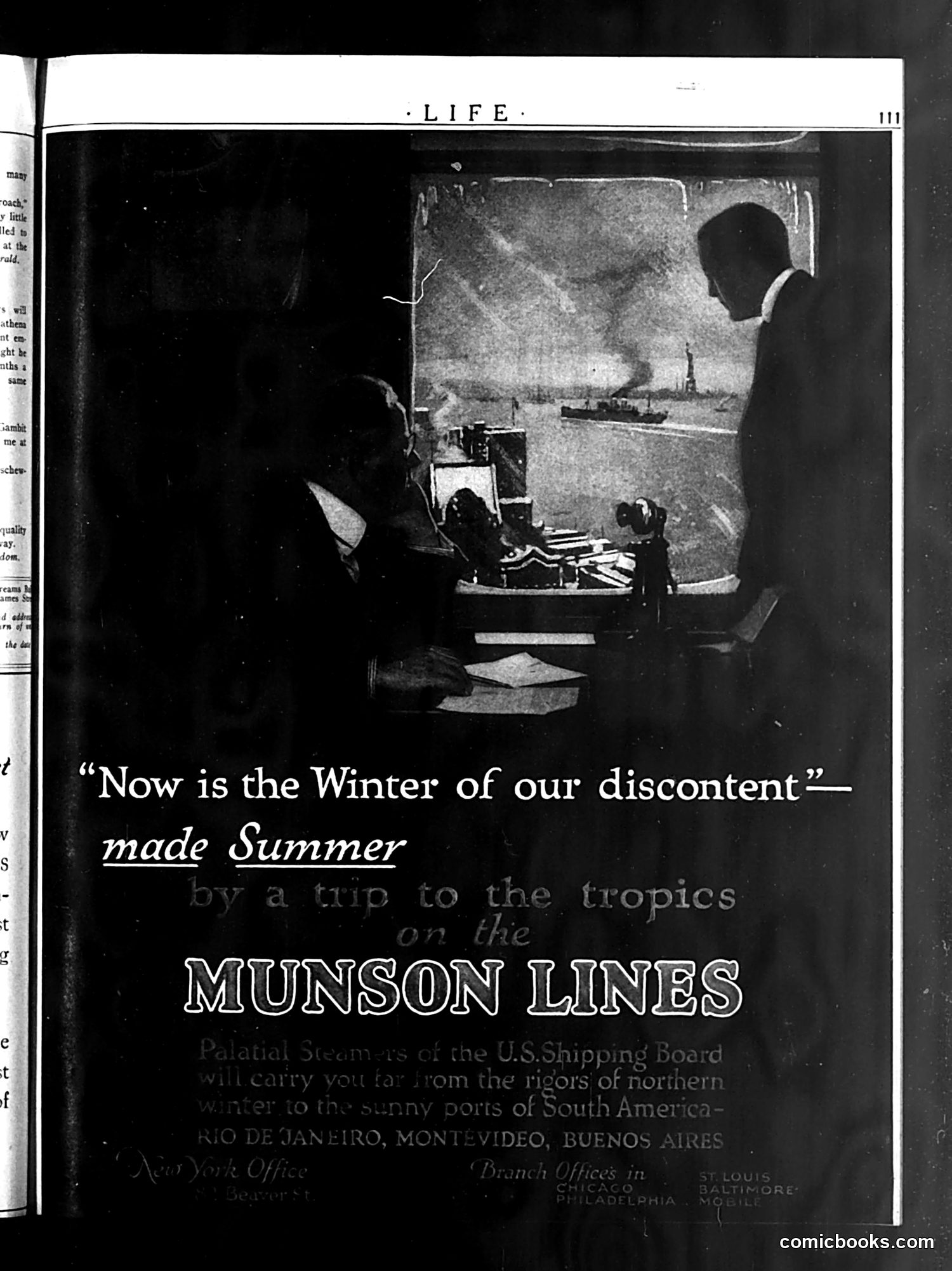
This is a **full-page advertisement**, not editorial content or satire. It advertises the Munson Lines shipping company, promoting tropical cruises to South American ports (Rio de Janeiro, Montevideo, Buenos Aires). The ad uses a famous Shakespeare quote from *Richard III* ("Now is the winter of our discontent") to suggest that a tropical voyage can cure winter blues. The image shows two silhouetted figures gazing at a ship through a window, implying escape from cold northern winters. The ad mentions "Palatial Steamers of the U.S. Shipping Board," indicating post-WWI American maritime commerce. This represents early 20th-century luxury travel marketing targeting wealthy readers of *Life* magazine—positioning exotic cruises as a remedy for seasonal depression and cold-weather malaise.
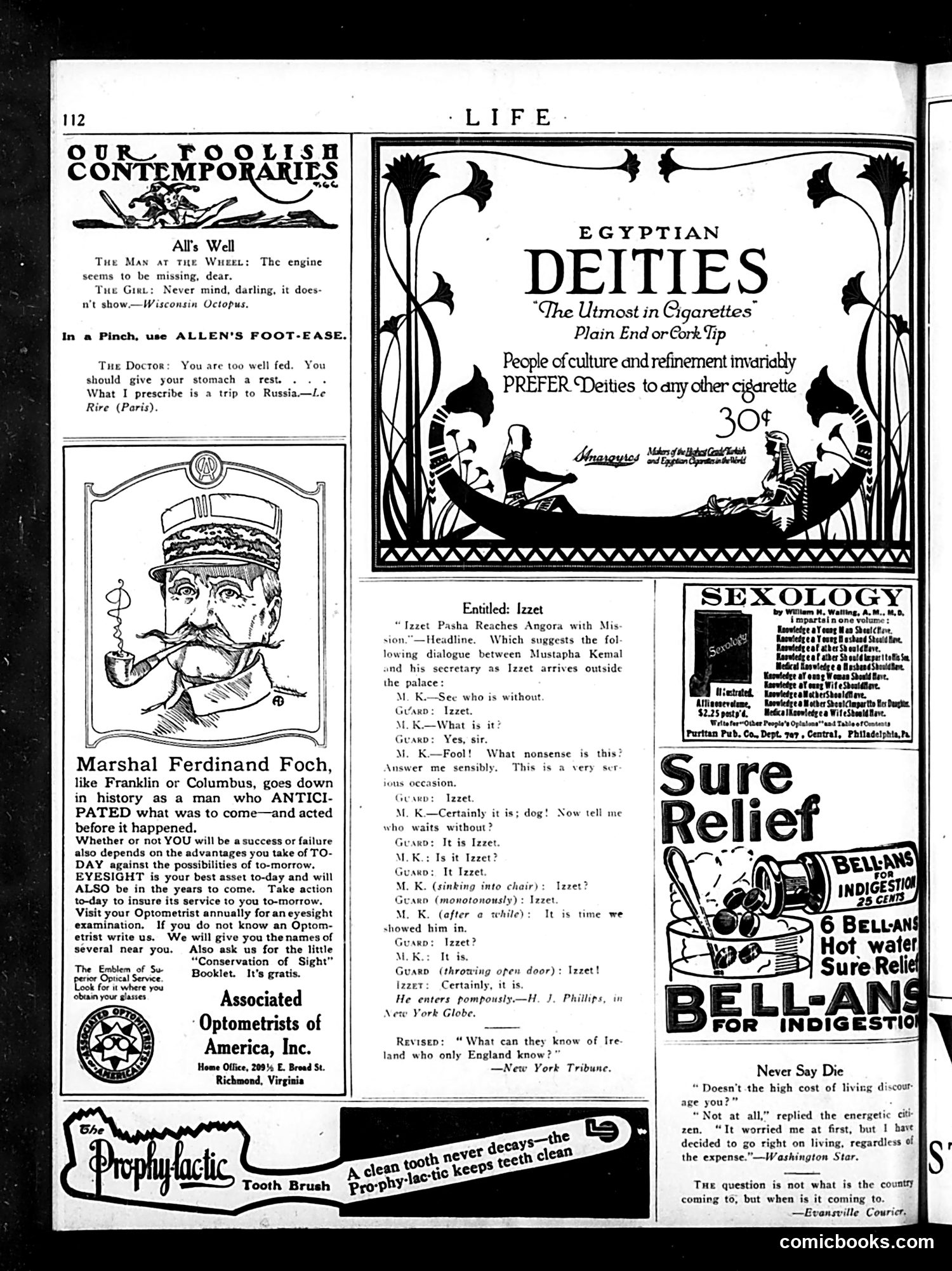
This page comprises mostly **advertisements and short humor items** typical of Life's satirical format. The main cartoon, titled "Izzet," satirizes **Turkish politics circa 1920s**. It features a dialogue between Mustapha Kemal (Turkish nationalist leader) and his guard about the arrival of Izzet Pasha. The joke relies on repetitive wordplay: "Izzet" sounds like "Is it," creating absurd circular dialogue where the guard's answers become nonsensical ("It Izzet"). This mocks Ottoman bureaucratic confusion during Turkey's nationalist reorganization period. The page also includes: - Brief joke exchanges about domestic life and medical advice - An advertisement featuring **Marshal Ferdinand Foch**, the WWI French general, used to promote optometry as "anticipating" future needs - Cigarette and digestive aid advertisements - Short quips about living costs The humor targets middle-class concerns (romance, health, expense) and contemporary international figures, reflecting Life's satirical focus on modern life's absurdities.
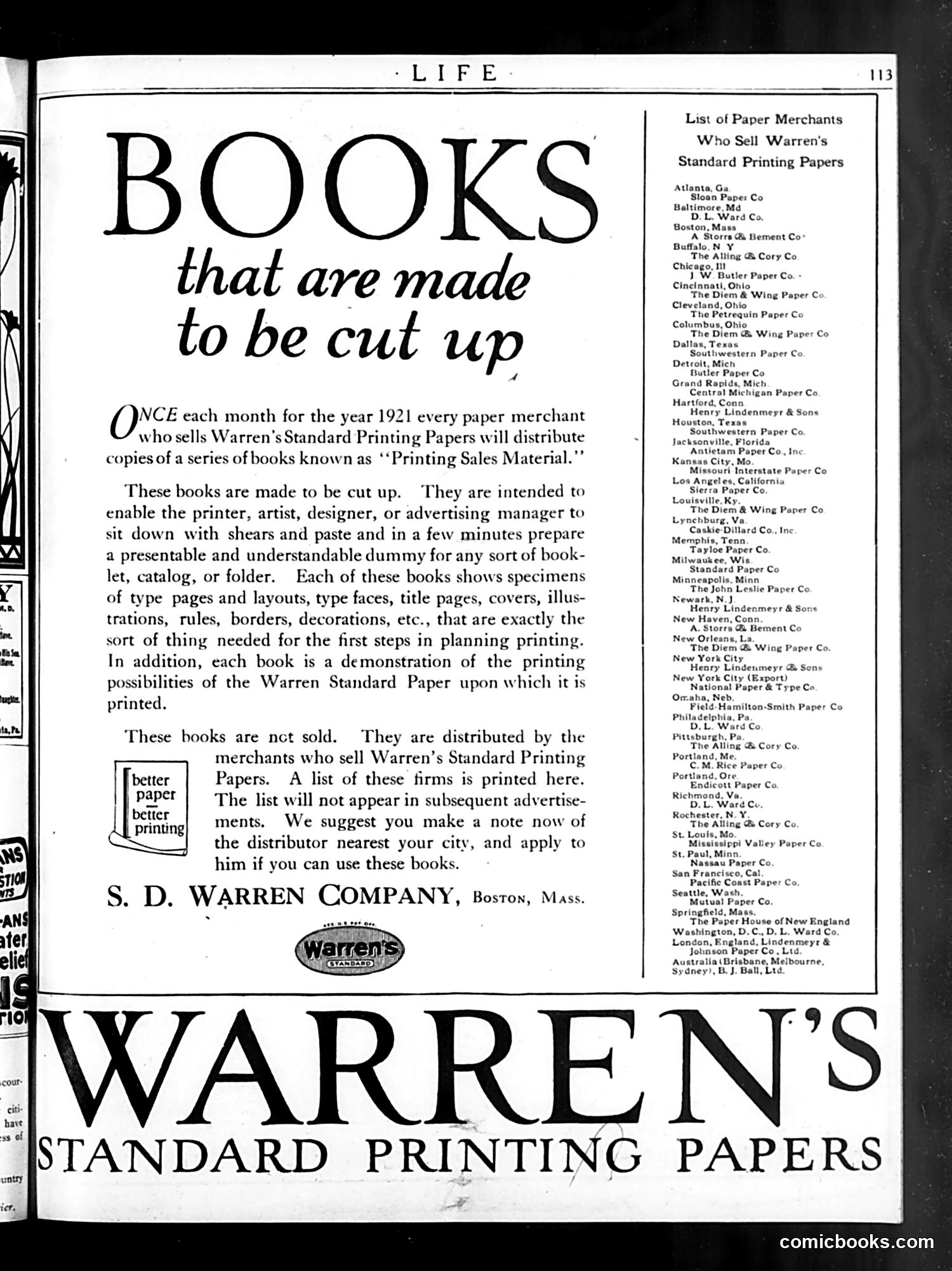
This is not a cartoon or satire—it's a straightforward **trade advertisement** for Warren's Standard Printing Papers from 1921. The page announces a monthly distribution program: paper merchants selling Warren's brand will distribute free instructional booklets designed to be "cut up" by printers, designers, and advertising managers. These dummy books contain specimen layouts, typefaces, borders, and decorative elements to help professionals quickly mock up designs for catalogs, brochures, and other printed materials. Each book also demonstrates Warren's paper quality. The ad emphasizes the books aren't for sale but are free promotional tools distributed through listed paper merchants nationwide (and internationally). A small sidebar logo notes "better paper / better printing." **For modern readers:** This reflects pre-digital design workflows where professionals literally used scissors and paste to assemble layouts before photocopying or printing—a standard practice until computers replaced this physical process.
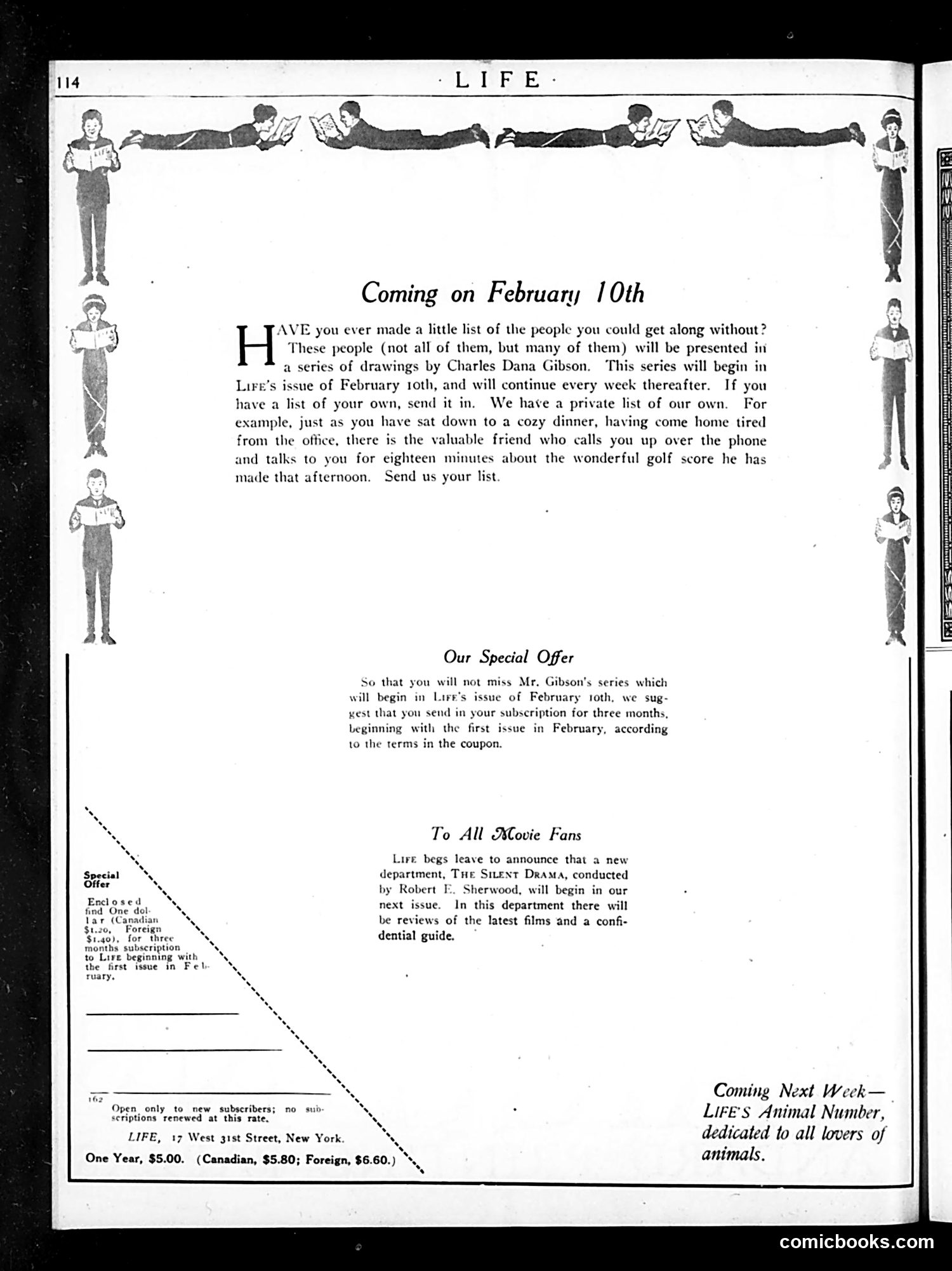
This is primarily an **advertising/promotional page** rather than a political cartoon. Life magazine announces three upcoming features: 1. **Charles Dana Gibson's series** (beginning February 10th): A weekly illustrated column about people readers "could get along without"—annoying social types. The example given is the friend who calls during dinner to brag about his golf score. Readers are invited to submit their own lists of irritating acquaintances. 2. **"The Silent Drama" department**: A new film review section by Robert E. Sherwood, with guidance on silent movies and "a confidential guide" (unclear what this means). 3. **Coming Animal Number**: Next week's special issue dedicated to animal lovers. The page uses decorative borders of illustrated figures and includes a subscription offer ($5 yearly, $5.80 Canadian) to ensure readers don't miss Gibson's series. The appeal is to Life's humor-focused, middle-class readership interested in satirizing everyday social irritations.
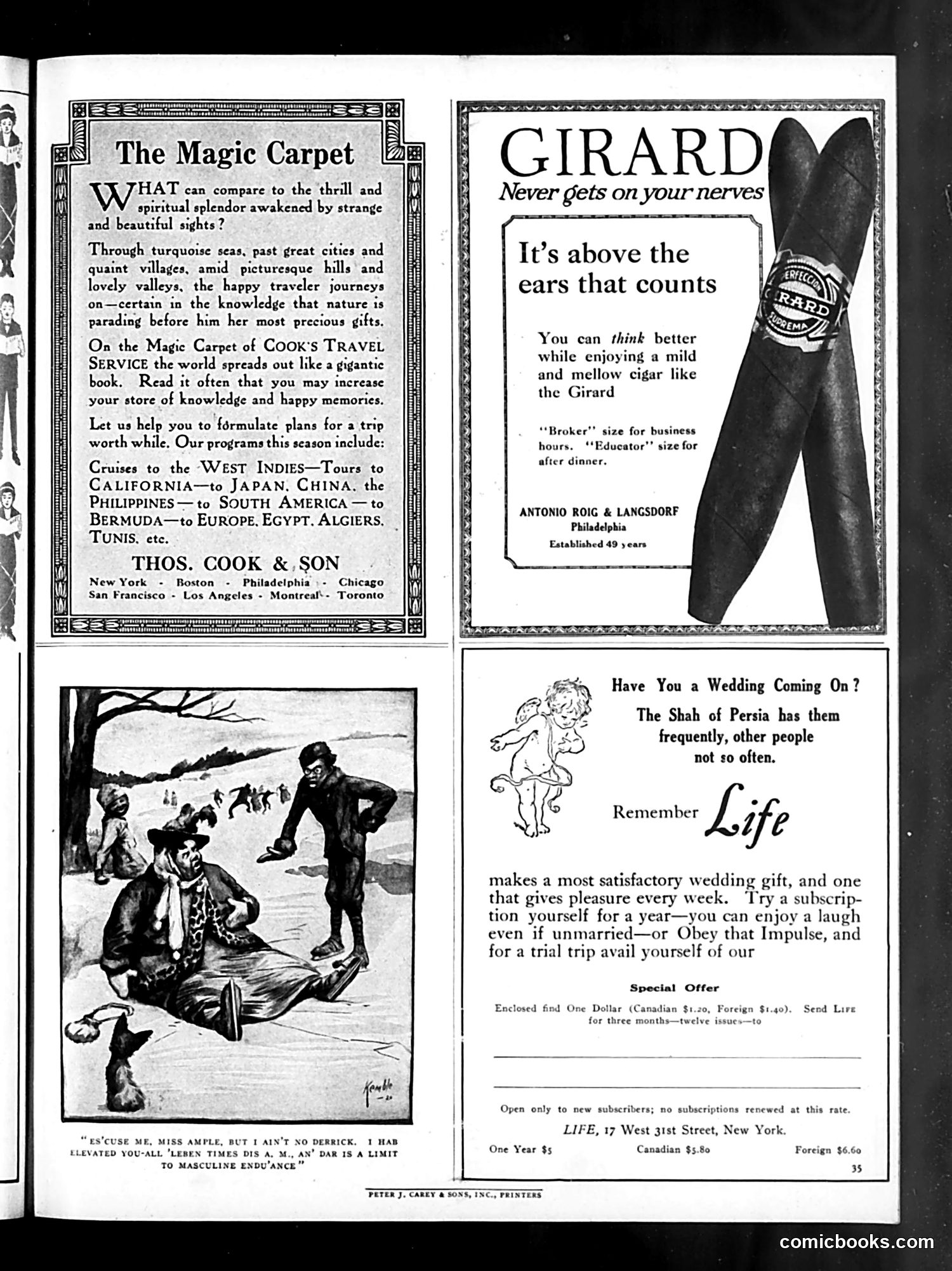
This page primarily contains **advertisements** rather than satirical content. The notable cartoon depicts a man in what appears to be **stereotypical African American dialect** ("'Scuse me, Miss Ample...") complaining to a woman that he's lifted her eleven times and has physical limits. The humor relies on crude racial caricature and exaggerated dialect common to early 20th-century American media. The advertisements include Cook's Travel Service promoting exotic destinations, Girard cigars, and Life magazine subscriptions. The cigar ad's tagline "It's above the ears that counts" suggests intellectual superiority while enjoying the product. The Life subscription pitch humorously references the Shah of Persia's frequent weddings as justification for the magazine as a gift. This page reflects the era's casual racism in entertainment and marketing conventions that would be considered offensive today.
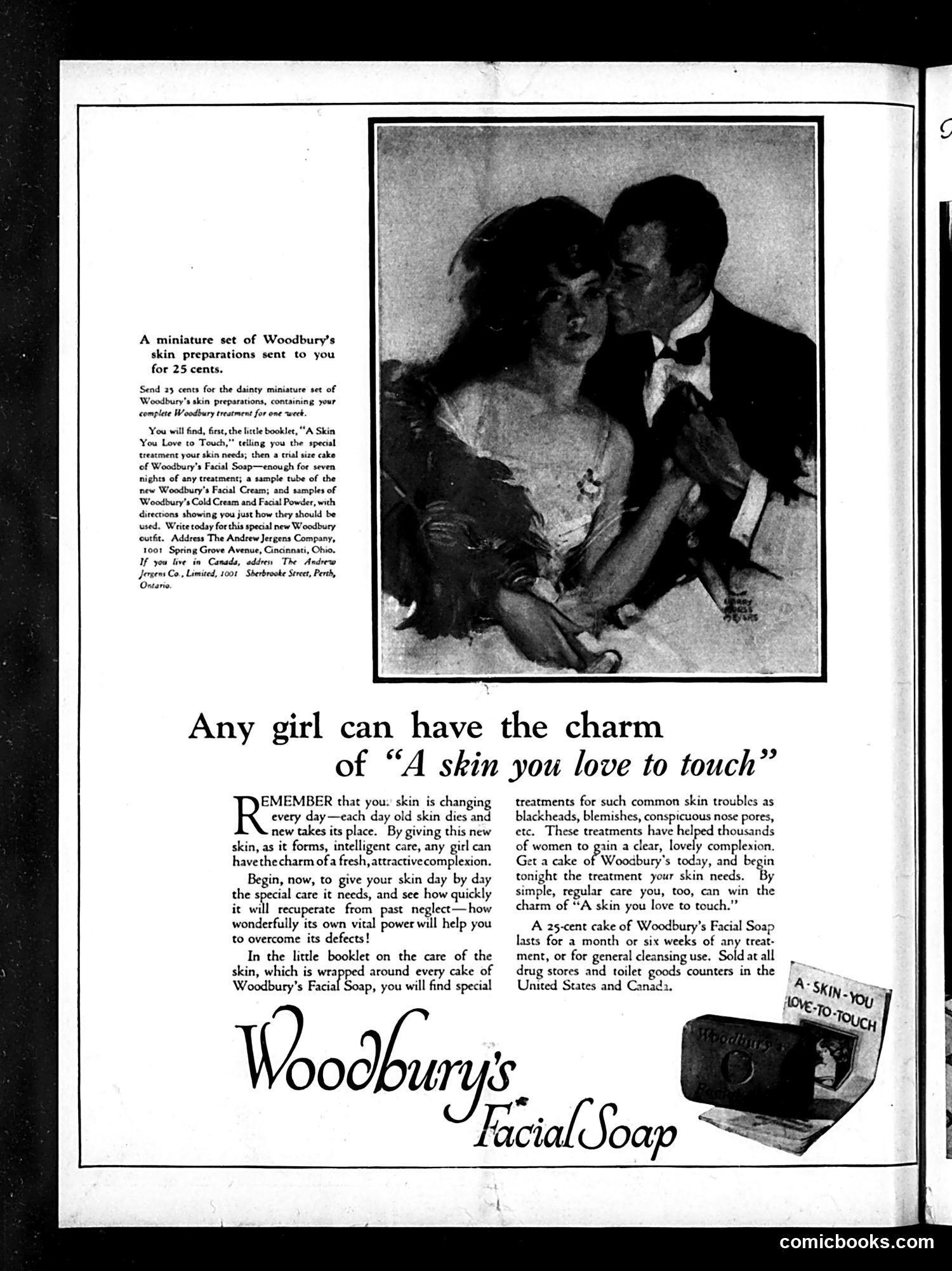
This is primarily a **product advertisement**, not political satire. It promotes Woodbury's Facial Soap and skincare products, offering a 25-cent miniature set. The page features a photograph of a couple (a woman and man in formal dress) to illustrate the advertisement's central appeal: "A skin you love to touch." The ad targets women, promising that proper skincare using Woodbury products will remedy common complexion problems like blackheads and blemishes, resulting in an "attractive complexion." The marketing strategy emphasizes that skin constantly renews itself, so daily care matters. The phrase "A skin you love to touch" appears repeatedly as the product's catchphrase. The ad provides ordering instructions and notes the soap's affordability (25 cents lasts a month). This reflects early 20th-century beauty industry messaging aimed at female consumers through magazines like *Life*.