
Life, 1921-01-20 · page 17 of 36
Life — January 20, 1921 — page 17: what you’re looking at
What you’re looking at
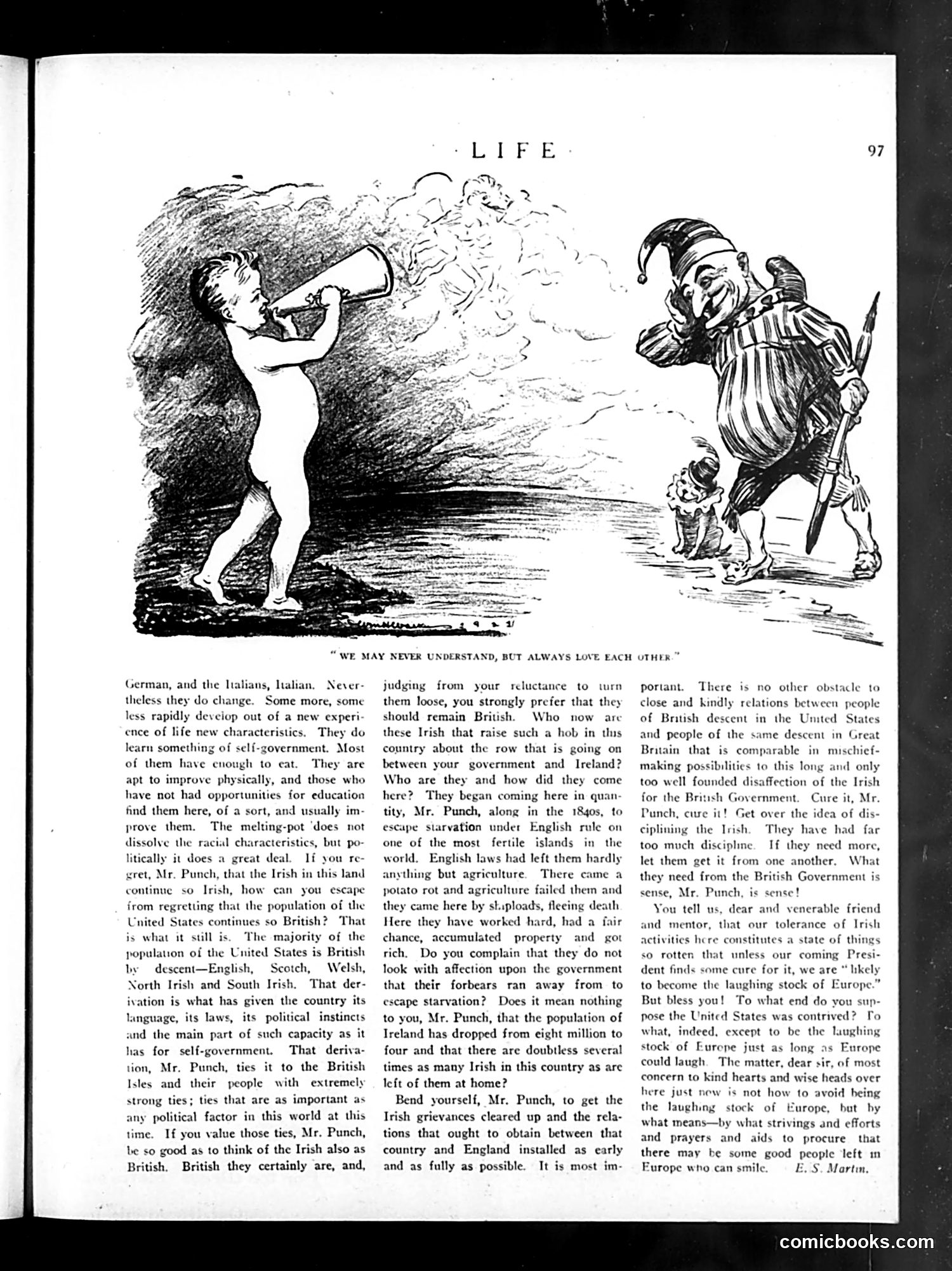
This page contains a satirical editorial cartoon and accompanying text addressing Anglo-Irish tensions and Irish-American identity circa the 1910s-1920s. **The Cartoon:** Shows a cherub blowing a trumpet at a jester-like figure (representing "Mr. Punch," Britain's satirical voice), with the caption "We May Never Understand, But Always Love Each Other." **The Argument:** The text argues that Irish immigrants to America—who fled English-caused famine and starvation in the 1840s—have legitimate grievances against the British government. The author urges "Mr. Punch" (British opinion) to stop criticizing Irish-Americans' political activism and instead resolve Irish independence issues fairly. **The Point:** Life magazine defends Irish-American loyalty while critiquing British dominance. The satire suggests Britain should accept Irish autonomy rather than expect Irish-Americans to abandon their ancestral grievances. The piece emphasizes that Irish and British descendants should unite as Americans, but only after Britain stops "disciplining" Ireland.
📄 Transcribed text from this page (OCR, searchable)
Machine-transcribed from the original scan — historical spelling and the odd misread are preserved.
“WE MAY NEVER UNDERSTAND, BUT ALWAYS LOVE EACH UTHER.” German, and the Italians, Italian, Never- theless they do change. Some more, some less rapidly deveiop out of a new experi- ence of life new characteristics, They do learn something of self-government. Most of them have cnough to eat. hey are apt to improve physically, and those who have not had opportunities for education find them here, of a sort, and usually im- prove them. The melting-pot ‘does not dissolve the racial characteristics, but po- litically it does a great deal. If you re- gret, Mr. Punch, that the Irish in this land you irom regretting that the population of the United States continues so British? That is what it sull is. The majority population of the United States is British by descent—English, Scotch, Welsh, North Irish and South Irish. That der- ivation is what has given the country its language, its laws, its political instincts and the main part of such capacity as it has for self-government. That deriva- tion, Mr. Punch, ties it to the British Isles and people with extremely strong ties; ties that are as important as any political factor in this world at this time. If you value those ties, Mr. Punch, be so good as to think of the Irish also as British. British they certainly are, and, continue so Irish, how can escape their judging from your reluctance to. turn them loose, you strongly prefer that they should remain British. Who now are these Irish that raise such a hob in this country about the row that is going on between your government and Ireland? Who are they and how did they come here? They began coming here in quan- tity, Mr. Punch, along in the 1840s, to escape Starvation under English rule on one of the most fertile islands in the world, English laws had left them hardly anything but agriculture potato rot and agriculture failed them and they came here by skiploads, fleeing death Here they have worked hard, had a fair chance, accumulated property and got rich, Do you complain that they do not look with affection upon the government that their forbears ran away from to escape starvation? Does it mean nothing to you, Mr. Punch, that the population of Ireland has dropped from eight million to four and that there are doubtless several times as many Irish in this country as are left of them at home? Bend yourself, Mr. Punch, to get the Irish grievances cleared up and the rela- tions that ought to obtain between that country and England installed as early and as fully as possible. There came a It is most im- portant. There is no other obstacle to close and kindly relations between people of British descent in the United States and people of the same descent in Great Britain that is comparable in mischief- making possibilities to this long and only too well founded disaffection of the Irish Cure it, Mr. Punch, cure it! Get over the idea of dis- for the British Government ciplining the Irish. They have had far too much discipline. If they need more, let them get it from one another, What they need from the British Government is sense, Mr. Punch, is sense! You tell us, dear and venerable friend and mentor, that our tolerance of Irish activities hcre constitutes a state of things so rotten that unless our coming Presi- dent finds some cure for it, we are “ like to become the laughing stock of Europe But bless you! To what end do you sup- pose the United States was contrived? To what, indeed, except to be the laughing stock of Europe just as long as could laugh. The matter, dear sir, of most concern to kind hearts and wise heads over here just new is not how to avoid being the laughing stock of Europe, but by what means—by what strivings and efforts and prayers and aids to procure that there may be some good people ‘left im Europe who can smile. E, S. Martin, rope comicbooks.com