
Life, 1921-01-20 · page 21 of 36
Life — January 20, 1921 — page 21: what you’re looking at
What you’re looking at
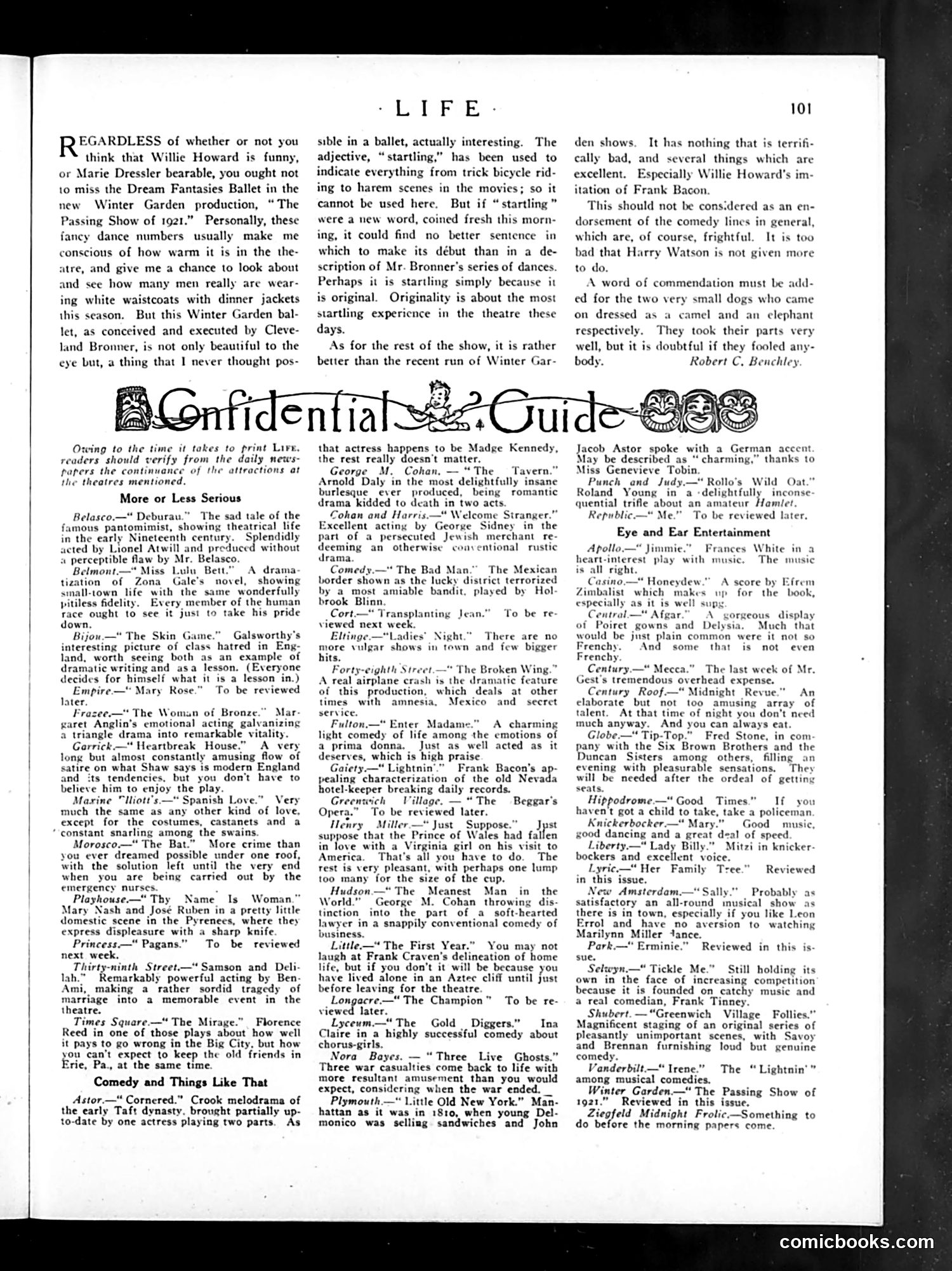
This is a theater review page from Life magazine (likely early 1920s based on "Passing Show of 1921" reference). The main content is critic Robert C. Benchley's review of the Winter Garden's "Passing Show of 1921." **Key figures mentioned:** - Willie Howard and Marie Dressler (performers) - Cleveland Bronner (choreographer/ballet designer) - Frank Bacon (actor whom Willie Howard imitates) **The satire:** Benchley praises the ballet sequences as genuinely original and "startling"—ironically noting that originality itself has become so rare in theater that it's shocking. He critiques the comedy dialogue as "frightful" but commends the performances and cleverly mocks two small dogs dressed as a camel and elephant, doubting they fooled anyone. The rest of the page lists Broadway shows with brief critical notes. This format allowed readers to quickly assess what was worth seeing in New York's theater district.
📄 Transcribed text from this page (OCR, searchable)
Machine-transcribed from the original scan — historical spelling and the odd misread are preserved.
EGARDLESS of whether or not you think that Willie Howard is funny, or Marie Dressler bearable, you ought not to miss the Dream Fantasies Ballet in the new Winter Garden production, “The Passing Show of 1921.” Personally, these fancy dance numbers usually make me conscious of how warm it is in the the- atre, and give me a chance to look about and see how many men really are wear- ing white waistcoats with dinner jackets this season. But this Winter Garden bal- let, as conceived and executed by Cleve- land Bronner, is not only beautiful to the eye but, a thing that I never thought pos- “LIFE. sible in a ballet, actually interesting. The adjective, “startling,” has been used to indicate everything from trick bicycle rid- ing to harem scenes in the movies; so it cannot be used here. But if “startling” were a new word, coined fresh this morn- ing, it could find no better sentence in which to make its début than in a de- scription of Mr. Bronner’s series of dances. Perhaps it is startling simply because it is original. Originality is about the most startling expericnce in the theatre these days. As for the rest of the show, it is rather better than the recent run of Winter Gar- 101 den shows, It has nothing that is terrifi- cally bad, and several things which are excellent. Especially Willie Howard's im- itation of Frank Bacon. This should not be considered as an en- dorsement of the comedy lines in general, which are, of course, frightful. bad that Harry Watson is not given more to do. A word of commendation must be add- ed for the two very small dogs who came on dressed as a camel and an elephant respectively. They took their parts very well, but it is doubtful if they fooled any- Robert C. Benchley It is too Owing to the time it tokes to print Live. aders should verify from the daily news- papers the continuance of the attractions at the theatres mentioned. More or Less Serious Belasco.—"* Deburau.” The sad tale of the famous pantomimist, showing theatrical life in the early Nineteenth century. Splendidly acted by Lionel Atwill and preduced without 4 perceptible flaw by Mr. Belasco. Belmont—* Miss Lulu, Bett.” A drama tization of Zona Gale's novel, showing U-town life with the same wonderfully pitiless fidelity. Every member of the human Face ought to see it jusi to take his pride down, Bijou.—" The Skin Game.” Galsworthy's interesting picture of class hatred in Eng- land, worth seeing both as an example of dramatic writing and asa lesson, (Everyone decides for himself what it is a lesson in.) Empire—" Mary Rose.” To be reviewed later. Frazee—" The Woman of Bronze.” Mar- garet Anglin's emotional acting galvanizing a triangle drama into remarkable vitality. Garrick —" Heartbreak House.” A_ very long but almost constantly amusing flow of satire on what Shaw says is modern England and its tendencies, but you don't have to believe him to enjoy the play. Maxine “Wiott’s—* Spanish Love.” Very much the same as any other kind of love, except for the costumes, castanets and a “constant snarling among the swains. Morosco.—" The Bat.” More crime than you ever dreamed possible under one roof, with the solution left until the very end when you are being carried out by the emergency nurses. Playhouse-—" Thy Name Is Woman.” Mary Nash and José Ruben in a pretty little domestic scene in the Pyrenees, where they express displeasure with a sharp knife. Princess.—" Pagans. To be reviewed next week, Thirty-ninth Street.— Samson and Deli- lah.” Remarkably powerful acting by Ben Ami, making a rather sordid tragedy of marriage into a memorable event in the theatre. Times Square—* The Mirage.” Florence Reed in one of those plays about how well it pays to go wrong in the Big City, but how you can't expect to keep the old friends in Erie, Pa, at the same time. Comedy and Things Like That Astor.—" Cornered.” Crook melodrama of the early Taft dyni brought partially up- to-date by one actress playing two parts. As that actress happens to be Madge Kennedy, the rest really doesn’t matter. George M. Cohan, — “The Tavern.” Arnold Daly in the most delightfully insane burlesque ever produced, being romantic drama kidded to death in two acts. Cohan and Harris.—* Welcome Stranger.” Excellent acting by George Sidney in the part of a persecuted Jewish merchant re- deeming an otherwise ventional rustic drama, Comedy.—" The Bad Man.” The Mexican border shown as the lucky district terrorized by a most amiable bandit, played by Hol brook Blinn. Cort. viewed next weel Eltinge—“Ladies’ Night.” There are no more vulgar shows in town and few bigger hits. Forty-eighth Street. The Broken Wing.” A real airplane crash is the dramatic feature of this production, which deals at other times with amnesia, Mexico and secret service. Fulton.—* Enter Madam A charming light comedy of life among the emotions of a prima donna. Just as well acted as it deserves, which is high praise i * Lightnin’. Frank Bacon's ap- pealing characterization of the old Nevada hotel-keeper breaking daily records. Jean.” To be re ich Village. —“ The Beggar's To be reviewed later. ‘y Miller —* Just Suppose.” — Just suppose that the Prince of Wales had fallen in love with a Virginia girl on his visit to America. That's all you have to do. The rest is very pleasant, with perhaps one lump too many for the size of the cup. Hudson. The Meanest Man in the World.” orge M. Cohan throwing dis- tinction into the part of a soft-hearted lawyer in a snappily conventional comedy of business. Little.—* The First Yea: You may not laugh at Frank Craven's delineation of home life, but if you don't it will be because you haye lived alone in an Aztec cliff until just before leaving for the theatre. Longacre—" The Champion” viewed later. Lyceum—“ The Gold | Diggers.” Ina Claire in a highly successful comedy about chorus-girls. Nora Bayes. — “Three Live Ghosts.” Three war casualties come back to life with more resultant amusement than you would expect, considering when the war ended. _ Plymouth —“ Little Old New York.” Man- hattan as it was in 1810, when young Del- monico was selling sandwiches and John To be re- Jacob Astor spoke with a German accent May be described as “charming,” thanks to Miss Genevieve Tobin. Punch and Judy.—" Rollo’s Wild Roland Young in a -delightfully inconse quential trifle about an amateur Hamlet Republic—* Me.” To be reviewed later. Eye and Ear Entertainment Oat.” Apollo —* Jim ances White in a heart-interest play with music. The is all right. Casino,—" Honeydew.” A score by Zimbalist which makes up for the especially as it is well sups Central—* Afgar. A gorgeous display of Poiret gowns and Delysia. Much that would be just plain common were it not so Frenchy. And some that is not even Frenchy Century.—" Mecca.” The last week of Mr. Gest's tremendous overhead expense. Century Roof—* Midnight Revue.” An elaborate but not too amusing arr: talent. At that time of night you don't need much anyway. And you can always eat. Globe-—" Tip-Top.” Fred Stone, in com pany with the Six Brown Brothers and the Duncan Sisters among others, filli evening with pleasurable sensations. will be need: seats. Hippodrome—" Good Times." If you haven't got a child to take, take a policeman Knickerbocker—" Mary.” Good music, good dancing and a great deal of speed. Liberty.—" Lady Billy.” Mitzi in knicker bockers and excellent voice. They after the ordeal of getting Lyric.—“ Her Family Tree.” Reviewed in this issue. New Amsterdam.—" Sally.” Probably as satisfactory an all-round musical show as there is in town, especially if you like Leon Errol and have no aversion to watching Marilynn Miller tance. Park.—" Ermi Reviewed in this is- —" Tickle Me.” Still holding its own in the face of increasing competition because it is founded on catchy music and a real comedian, Frank Tinney. Shubert.—“Greenwich Village Follies.” Magnificent staging of an original series of pleasantly unimportant scenes, with Savoy and Brennan furnishing loud but genuine comedy. Vanderbilt—" Irene.” The “ Lightnin'” among musical comedies. Winter Garden —" The Passing Show of 1921.” Reviewed in this issue. Ziegfeld Midnight Frotic.—Something to do before the morning papers come comicbooks.com