
Life, 1921-01-20 · page 8 of 36
Life — January 20, 1921 — page 8: what you’re looking at
What you’re looking at
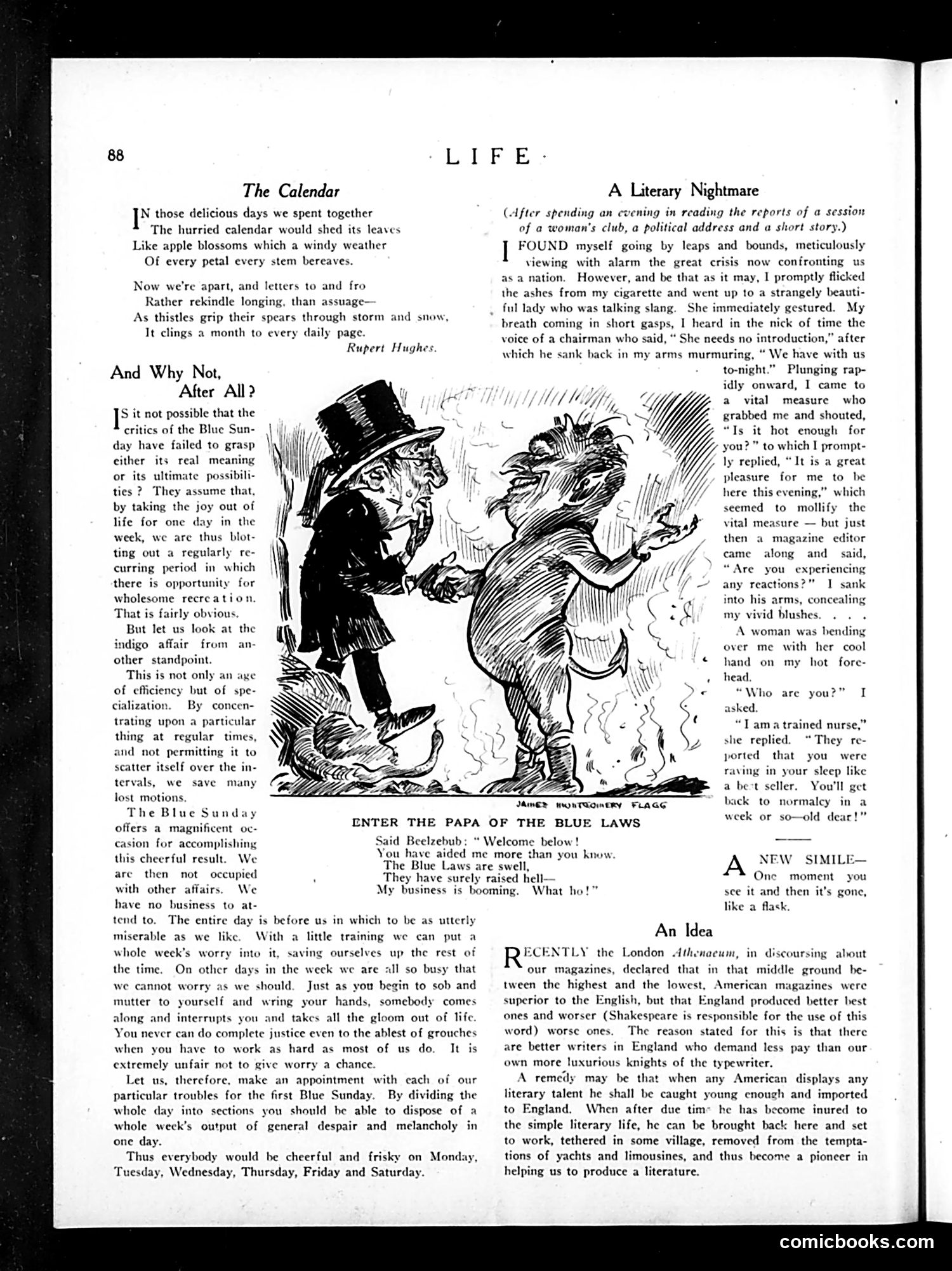
This cartoon satirizes religious or moral censorship—"Blue Laws" being restrictive legislation based on religious doctrine. The illustration shows two figures in a grotesque style: one wearing a top hat (representing authority/establishment) greeting another figure below, with the caption "Welcome below! You have aided me more than you know." The imagery suggests hypocrisy: those enforcing strict moral laws are depicted as demonic or infernal, implying they're not genuinely righteous but rather opportunistic. The satire critiques how censorship advocates and religious moralists profit from or enable moral restriction, presenting them as self-serving rather than principled. The "Blue Laws" reference indicates this targets actual restrictive legislation of the era regulating behavior based on religious grounds.
📄 Transcribed text from this page (OCR, searchable)
Machine-transcribed from the original scan — historical spelling and the odd misread are preserved.
LIFE: The Calendar I those delicious days we spent together The hurried calendar would shed its leaves Like apple blossoms which a windy weather Of every petal every stem bereaves. Now we're apart, and letters to and fro Rather rekindle longing, than assuage— As thistles grip their spears through storm and snow, It clings a month to every daily page. ert Hughes. And Why Not, After All? S it not possible that the critics of the Blue Sun- hal 7, day have failed to grasp \4\\hi/// either its real meaning il or its uw ait ties ? They assume that, by taking the joy out of life for one day in the week, we are thus blot- te possibili- ting out a regularly re- curring period in which there is opportunity for wholesome recreation. That is fairly obvious. But let us look at the indigo affair from an- other standpoint. This is not only an age of efficiency but of spe- cialization. By concen- trating upon a particular thing at regular times, and not permitting it to scatter itself over the in- tervals, we save many Jost motions. The Blue Sunday offers a magnificent oc- casion for accomplishing this cheerful result. We are then not occupied with other affairs. We have no business to at- tend to. The entire day is before us in which to be as utterly With a little training we can put a whole week's worry into it, saving ourselves up the rest of On other days in the week we are all so busy that Just as you begin to sob and mutter to yourself and wring your hands, somebody comes miserable as we like. the time. we cannot worry as we should along and interrupts you and takes all the gloom out of life. You never can do complete justice even to the ablest of grouches when you have to work as hard as most of us do. It is extremely unfair not to give worry a chance. Let us, therefore, make an appointment with each of our particular troubles for the first Blue Sunday. By dividing the whole day into sections you should he able to dispose of whole weck’s output of general despair and melancholy in one day. Thus everybody would be cheerful and frisky on Monday, Tuesday, Wednesday, Thursday, Friday and Saturday. ENTER THE PAPA OF THE BLUE LAWS Said Beelzebub: “ Welcome below ! You have aided me more than you know The Blue Laws are swell, They have surely raised hell- One My business is booming. A Literary Nightmare (After spending an evening in reading the reports of a session of a woman's club, a political address and a short story.) FOUND myself going by leaps and bounds, meticulously viewing with alarm the great crisis now confronting us asa nation. However, and be that as it may, | promptly flicked the ashes from my cigarette and went up to a strangely beauti- ful lady who was talking slang. She immediately gestured. My breath coming in short gasps, I heard in the nick of time the voice of a chairman who said, “ She needs no introduction,” after which he sank back in my arms murmuring, “ We have with us to-night.” Plunging rap- idly onward, I came to a vital measure who grabbed me and shouted, “Is it hot enough for you?” to which I prompt- ly replied, “It is a great pleasure for me to be here this evening,” which seemed to mollify the vital measure — but just then a magazine editor came along and said, “Are you experiencing any reactions?” I sank into his arms, concealing my vivid blushes. A woman was bending over me with her cool hand on my hot fore- head. “Who are you?” I asked. “Tama trained nurse,” she replied. “They re- ported that you were raving in your sleep like a beet seller. You'll get MineRi mUEreonery Fiaae back to normalcy in a week or so—old dear! NEW SIMILE— moment you What ho!” see it and then it’s gone, like a flask. An Idea ECENTLY the London Athenaeum, in discoursing about our magazines, declared that in that middle ground be- tween the highest and the lowest, American magazines were superior to the English, but that England produced better best ones and worser (Shakespeare is responsible for the use of this word) worse ones. The reason stated for this is that there England who demand less pay than our own more luxurious knights of the typewriter. A remedy may be that when any American displays any literary talent he shall be caught young enough and imported to England. When after due tim= he has become inured to the simple literary life, he can be brought back here and set to work, tethered in some village, removed from the tempta- tions of yachts and limousines, and thus become a pioneer in helping us to produce a literature. are better writers in comicbooks.com