
Life, 1921-01-20 · page 16 of 36
Life — January 20, 1921 — page 16: what you’re looking at
What you’re looking at
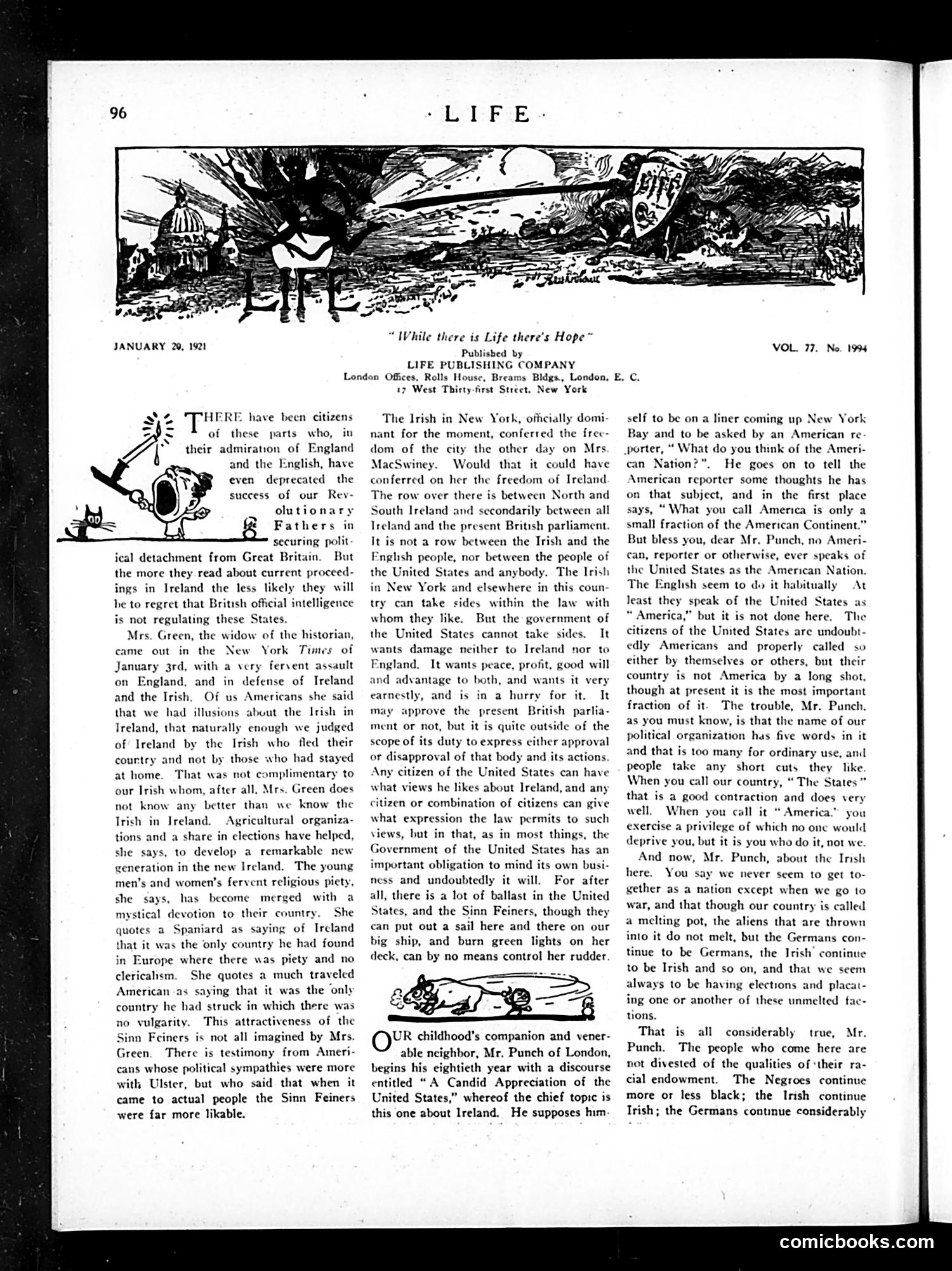
This Life magazine page critiques Irish-Americans' relationship with Ireland and the United States. The article, attributed to "Mr. Punch of London," discusses how Irish immigrants and their descendants navigate divided loyalties—specifically regarding Ireland's independence movement and their American citizenship. The text argues that Irish-Americans cannot simultaneously claim full American identity while maintaining strong political attachments to Ireland. It references the "Sinn Féiners" (Irish independence advocates) and suggests their political sympathies complicate their role as American citizens. The decorative header illustration shows a landscape with classical and political imagery, though specific caricatures aren't clearly identifiable in the reproduction. The piece addresses contemporary tensions around immigration, nationalism, and what constitutes American allegiance during the 1920s Irish independence era.
📄 Transcribed text from this page (OCR, searchable)
Machine-transcribed from the original scan — historical spelling and the odd misread are preserved.
JANUARY 20, 1921 “While there is Life there's Hope~ Published by LIFE PUBLISHING COMPANY VOL. 77. No. 1994 London Offices, Rolls House, Breams Bldgs, London, E. C, p-HERE have been citizens of these who, in their admiration of England and the English, have even deprecated the success of our Rev- olutionary Fathers in securing polit ical detachment from Great Britain. But the more they read about current proceed- ings in Ireland the less likely they will parts be to regret that British official intelligence is not regulating these States. Mrs. Green, the widow of the historian, came out in the New York Times of January 3rd, with a very fervent assault on England, and in defense of Ireland and the Irish, Of us Americans she said that we had illusions about the Irish in Ireland, that naturally enough we judged of Ireland by the Irish who fled their courtry and not by those who had stayed at home. That was not complimentary to our Irish whom, after all, Mrs. Green does not know any better than we know the Irish in Ireland. Agricultural organiza- tions and a share in clections have helped, she says, to develop a remarkable new generation in the new Ircland. The young men’s and women’s fervent religious piety, she says, become merged with a mystical devotion to their country. She quotes a Spaniard as saying of Ircland that it was the only country he had found in Europe where there was piety and no clericalism. She quotes a much traveled has American as saying that it was the ‘only country he had struck in which there was no vulgarity. This attractiveness of the Sinn Feiners is not all imagined by Mrs. Green. There is testimony from Ameri- cans whose political sympathies were more with Ulster, but who said that when it came to actual people the Sinn Feiners were far more likable. 17 West Thirty-first Street. New York The Irish in New York, officially domi nant for the moment, conferred the free- dom of the city the other day on Mrs MacSwiney. Would that it could have conferred on her the freedom of Ireland. The row over there is between North and South Ireland and secondarily between all Ireland and the present British parliament. It is not a row between the Irish and the Enghsh people, nor between the people of the United States and anybody. The Irish in New York and elsewhere in this coun try can take sides within the law with whom they like. But the government of the United States cannot take sides. It wants damage neither to England. Ireland nor to It wants peace, profit, good will and advantage to both, and wants it very earnestly, and is in a hurry for it. It may approve the present British parlia- ment or not, but it is quite outside of the scope of its duty to express either approval or disapproval of that body and its actions. Any citizen of the United States can have what views he likes about Ireland, and any citizen or combination of citizens can give what expression the law permits to such views, but in that, as in most things, the Government of the United States has an important obligation to mind its own busi- ness and undoubtedly it will. For after all, there is a lot of ballast in the United States, and the Sinn Feiners, though they can put out a sail here and there on our big ship, and burn green lights on her deck, can by no means control her rudder childhood’s companion and vener- able neighbor, Mr. Punch of London, begins his eightieth year with a discourse entitled “A Candid Appreciation of the United States,” whereof the chief topic is this one about Ireland. He supposes him self to be on a liner coming up New York Bay and to be asked by an American re- .porter, “ What do you think of the Ameri- can Nation?”. He goes on to tell the American reporter some thoughts he has on that subject, and in the first place says, “ What you call America is only a small fraction of the American Continent. But bless you, dear Mr. Punch, no Ameri- can, reporter or otherwise, ever speaks of the United States as the American Nation. The English seem to do it habitually At least they speak of the United States as * America,” but it is not done here. The citizens of the United States are undoubt- edly Americans and properly called so either by themselves or others, but their country is not America by a long shot, though at present it is the most important fraction of it. The trouble, Mr. Punch, as you must know, is that the name of our political organization has five words in it and that is too many for ordinary use, and people take any short cuts they like. When you call our country, “ The States” that is a good contraction and does very well. When you call it “ America.” you exercise a privilege of which no one would deprive you, but it is you who do it, not we. And now, Mr. Punch, about the Insh here. You say we never seem to get to- gether as a nation except when we go to war, and that though our country is called a melting pot, the aliens that are thrown into it do not melt, but the Germans con- tinue to be Germans, the Irish’ continue to be Irish and so on, and that we seem always to be having elections and placat- ing one or another of these unmelted fac- tions. That is all considerably true, Mr. Punch. The people who come here are not divested of the qualities of ‘their ra- cial endowment. The Negroes continue more or less black; the Insh continue Irish; the Germans continue considerably comicbooks.com