
Life, 1921-01-20 · page 20 of 36
Life — January 20, 1921 — page 20: what you’re looking at
What you’re looking at
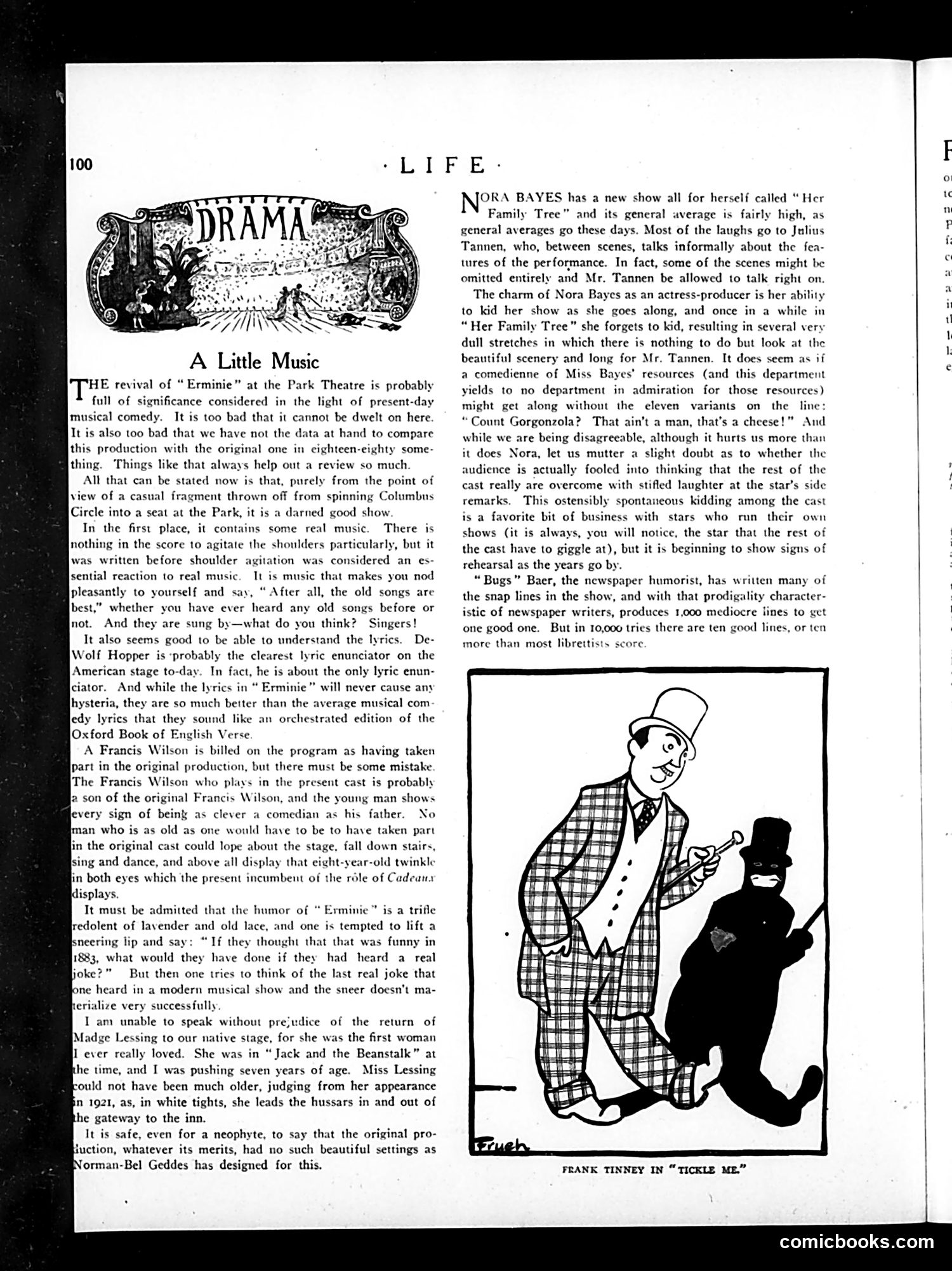
This page reviews theatrical productions, primarily focusing on the revival of the musical comedy "Erminie" at the Park Theatre. The cartoon below illustrates **Frank Tinney in "Tickle Me,"** showing a vaudeville-style comedian in a checkered suit with an exaggerated expression. The text critiques "Erminie" as a surprisingly competent revival of an 1880s musical, praising its actual melodies and intelligible lyrics—contrasting favorably with contemporary musical comedy standards. The reviewer commends DeWolf Hopper's clear enunciation and notes that Francis Wilson (likely the son of the original cast member) displays genuine comic timing. The review also mentions Nora Bayes's new show "Her Family Tree," where Julius Tannen provides most laughs through informal commentary between scenes. The satire targets modern musical theater's decline in music quality and intelligibility, nostalgically contrasting it with older productions that emphasized actual artistry over spectacle.
📄 Transcribed text from this page (OCR, searchable)
Machine-transcribed from the original scan — historical spelling and the odd misread are preserved.
A Little Music HE revival of “Erminie” at the Park Theatre is probably full of significance considered in the light of present-day musical comedy. It is too bad that it cannot be dwelt on here. It is also too bad that we have not the data at hand to compare this production with the original one in ghteen-eighty some- thing. Things like that always help out a review so much. All that can be stated now is that, purely from the point of view of a casual fragment thrown off from spinning Columbus Circle into a seat at the Park, it is a darned good show. In the first place, it cor nothing in the score to agitate the shoulders particularly, but it ains some real music. There is was written before shoulder agitation was considered an es- sential reaction to real music. It is music that makes you nod pleasantly to yourself and say, “After all, the old songs are best,” whether you have ever heard any old songs before or not. And they are sung by—what do you think? Singers! It also seems good to be able to understand the lyrics. De- Wolf Hopper is ‘probably the clearest lyric enunciator on the about the only lyric enun- And while the lyrics in “ Erminie” will never cause any , they are so much better than the average musical com ledy lyrics that they sound like an orchestrated edition of the Oxford Book of English Verse: A Francis Wilson is billed on the program as having taken American stage to-day. In fact, he part in the original production, but there must be some mistake The Francis Wilson who plays in the present cast is probably a son of the original Francis Wilson, and the young man shows every sign of being as clever a comedian as his father. No an who is as old as one would have to be to have taken part in the original cast could lope about the stage, fall down stairs, sing and dance, and above all display that eight-year-old twinkle in both eyes which the present incumbent of the jisplays. It must be admitted that the humor of is a trifle redolent of lavender and old 1: nd one is tempted to lift a neering lip and say: “If they thought that that was funny in ile of Cadeans Ermini what would they have done if they had heard a_ real "But then one tries to think of the last real joke that lize very successfully. I am unable to speak without prejudice of the return of Madge Lessing to our native stage, for she was the first woman ever really loved. She was in “Jack and the Beanstalk” at he time, and I was pushing seven years of age. Miss Lessing ould not have been much older, judging from her appearance in 1921, as, in white tights, she leads the hussars in and out of he gateway to the inn. It is safe, even for a neophyte, to say that the original pro- uction, whatever its merits, had no such beautiful settings as orman-Bel Geddes has designed for this. ‘LIFE: ORA BAYES has a new show all for herself called “ Her Family Tree” and its general average is rly high, as general averages go these days. Most of the laughs go to Julius Tannen, who, between scenes, talks informally about the fea- tures of the performance. In fact, some of the scenes might be omitted entirely and Mr. Tannen be allowed to talk right on. The charm of Nora Bayes as an actress-producer is her ability to kid her show as she goes along, and once in a while in “Her Family Tree” she forgets to kid, resulting in several very dull stretches in which there is nothing to do but look at the beautiful scenery and long for Mr. Tannen. It does seem as if a comedienne of Miss Bayes’ resources (and this department yields to no department in admiration for those resources) might get along without the eleven variants on the line: “Count Gorgonzola? That ain't a man, that’s a cheese!" And while we are being disagreeable, although it hurts us more than it does Nora, let us mutter a slight doubt as to whether the audience is actually fooled into thinking that the rest of the cast really are overcome with stifled laughter at the star’s side remarks. This ostensibly spontaneous kidding among the cast is a favorite bit of business with stars who run their own shows (it is always, you will notice, the star that the rest of the cast have to giggle at), but it is beginning to show signs of rehearsal as the years go by. “Bugs” Baer, the newspaper humorist, has written many of the snap lines in the show, and with that prodigality character- istic of newspaper writers, produces 1,000 mediocre lines to get one good one. But in 10,000 tries there are ten good lines, or ten more than most librettists score FRANK TINNEY IN “TICKLE ME.” comicbooks.com